
CAMERA
i) TYPES OF CAMERA
ii) CAMERA FUNCTION
Prepared by :
Muhammad Asri bin Azuddin
WHAT IS CAMERA?
• A device which captures ligth and which is used to record a
two dimensional image of a subject or scene.
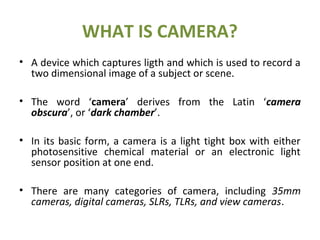
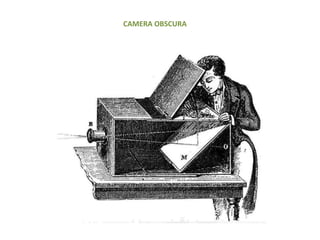
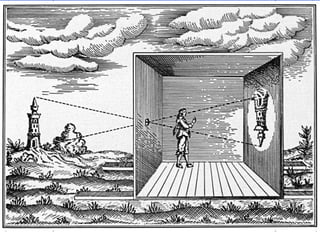
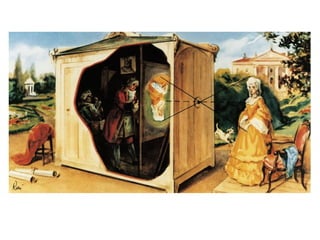
• The word ‘camera’ derives from the Latin ‘camera
obscura’, or ‘dark chamber’.
• In its basic form, a camera is a light tight box with either
photosensitive chemical material or an electronic light
sensor position at one end.
• There are many categories of camera, including 35mm
cameras, digital cameras, SLRs, TLRs, and view cameras.
CAMERA OBSCURA
TYPES OF CAMERA
1)PINHOLE CAMERA
2)VIEW CAMERA
3)TWIN LENS REFLEX CAMERA (TLR)
4)RANGE FINDER CAMERA
5)SINGLE LENS REFLEX CAMERA (SLR)
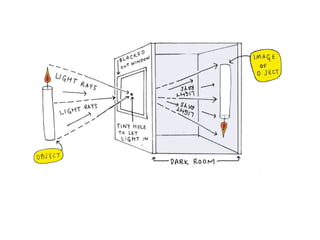
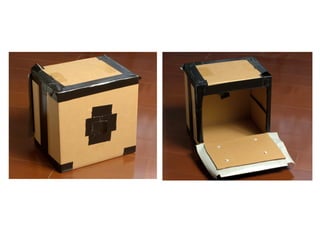
1) PINHOLE CAMERA
• A camera which has no glass lens and relies
instead on light passing through a tiny hole.
• The pinhole image is laterally reversed and
upside-down.
ADVANTAGES
1.Very in expensive
2.Easy to make
DISADVANTAGES
1.No control
2.Long exposures
3.Can not view what the camera sees
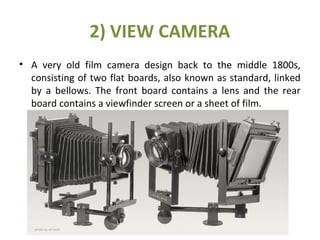
2) VIEW CAMERA
• A very old film camera design back to the middle 1800s,
consisting of two flat boards, also known as standard, linked
by a bellows. The front board contains a lens and the rear
board contains a viewfinder screen or a sheet of film.
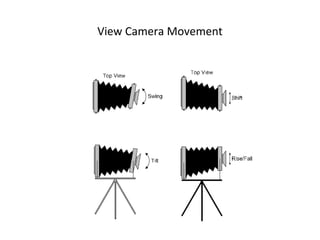
View Camera Movement
ADVANTAGES
1.Allow for perspective and distortion control of
landscape and architecture.
2.Large film size allows for very large prints.
3. Variety of special use attachments.
4.Directly viewing of the image.
5.Wide selection of lenses.
DISADVANTAGES
•Slow
•Very large and heavy camera
•Most models require the use of tripod
•Image difficult to see on viewing glass
•Takes time to set up and use
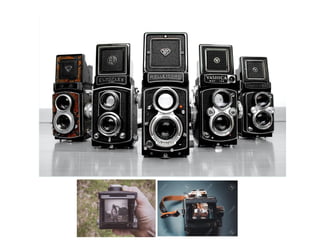
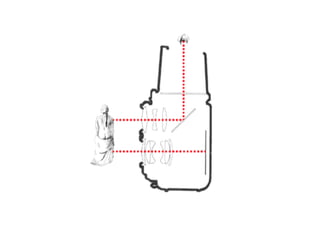
3) TWIN LENS REFLEX CAMERA (TLR)
• A camera with two lenses of the same focal
length mounted on the front; one for the
viewfinder and one which acts as the taking
lens.
• The TLR design was popular in the 1950s and
60s but is not common today.
ADVANTAGES
1.Larger film size for high quality enlargement
2.Image always visible in viewfinder
DISADVANTAGES
1.Lots of control
2.Many models do not have interchangeable
lenses
3.Parallax error
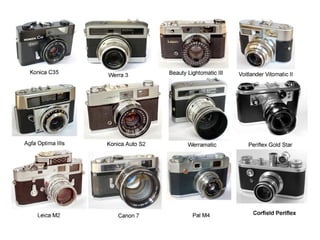
4) RANGE FINDER CAMERA
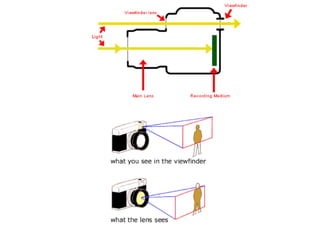
• A camera design in which there are separate
taking and viewfinder lens system, which
employs a range finding device for focus.
• Rangefinders have long been associated with
street photography owing to their compact
size and quiet operation.
ADVANTAGES
1.Easy to use
2.Focus free
3.Small compact camera
4.Quiet
DISADVANTAGES
1.Few control
2.Parallax error
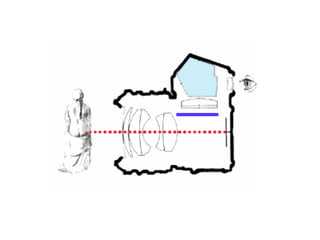
5) SINGLE LENS REFLEX CAMERA (SLR)
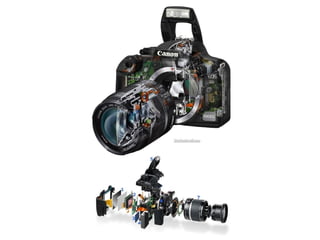
• A popular camera design in which the taking
lens sends light to both the film/image sensor
and the view finder.
• Through use of PENTAPRISM and moving
mirrors assembly, SLRs allowed
photographers to see exactly what the taking
lens sees, and correctly oriented.
ADVANTAGES
1.No parallax error
2.Variety of interchangeable lens
3.Variety of controlled adjustment
4.Wide range of shutter speed
DISADVANTAGES
1.Frequently have complicated controls
2.Larger size camera
3.Shutter and mirror system tend to be noisy
Others…
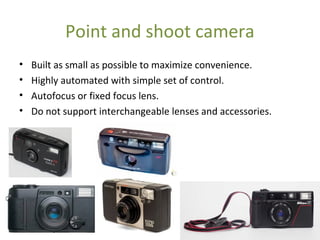
Point and shoot camera
• Built as small as possible to maximize convenience.
• Highly automated with simple set of control.
• Autofocus or fixed focus lens.
• Do not support interchangeable lenses and accessories.
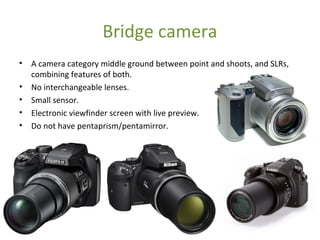
Bridge camera
• A camera category middle ground between point and shoots, and SLRs,
combining features of both.
• No interchangeable lenses.
• Small sensor.
• Electronic viewfinder screen with live preview.
• Do not have pentaprism/pentamirror.
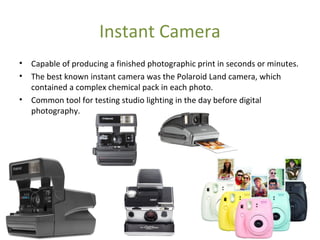
Instant Camera
• Capable of producing a finished photographic print in seconds or minutes.
• The best known instant camera was the Polaroid Land camera, which
contained a complex chemical pack in each photo.
• Common tool for testing studio lighting in the day before digital
photography.
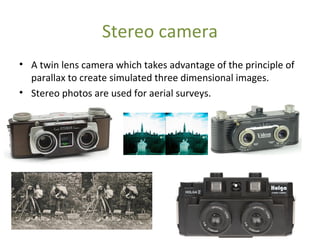
Stereo camera
• A twin lens camera which takes advantage of the principle of
parallax to create simulated three dimensional images.
• Stereo photos are used for aerial surveys.
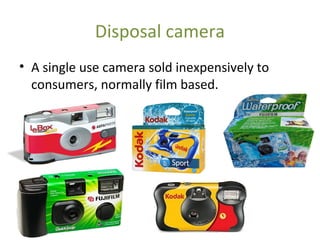
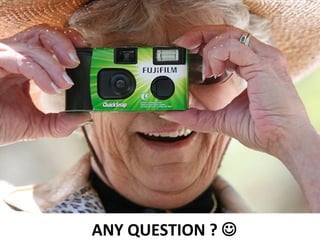
Disposal camera
• A single use camera sold inexpensively to
consumers, normally film based.
ANY QUESTION ? 

Camera

  • 1.
    CAMERA i) TYPES OFCAMERA ii) CAMERA FUNCTION Prepared by : Muhammad Asri bin Azuddin
  • 2.
    WHAT IS CAMERA? •A device which captures ligth and which is used to record a two dimensional image of a subject or scene. • The word ‘camera’ derives from the Latin ‘camera obscura’, or ‘dark chamber’. • In its basic form, a camera is a light tight box with either photosensitive chemical material or an electronic light sensor position at one end. • There are many categories of camera, including 35mm cameras, digital cameras, SLRs, TLRs, and view cameras.
  • 3.
  • 4.
    TYPES OF CAMERA 1)PINHOLECAMERA 2)VIEW CAMERA 3)TWIN LENS REFLEX CAMERA (TLR) 4)RANGE FINDER CAMERA 5)SINGLE LENS REFLEX CAMERA (SLR)
  • 5.
    1) PINHOLE CAMERA •A camera which has no glass lens and relies instead on light passing through a tiny hole. • The pinhole image is laterally reversed and upside-down.
  • 10.
    ADVANTAGES 1.Very in expensive 2.Easyto make DISADVANTAGES 1.No control 2.Long exposures 3.Can not view what the camera sees
  • 11.
    2) VIEW CAMERA •A very old film camera design back to the middle 1800s, consisting of two flat boards, also known as standard, linked by a bellows. The front board contains a lens and the rear board contains a viewfinder screen or a sheet of film.
  • 12.
  • 13.
    ADVANTAGES 1.Allow for perspectiveand distortion control of landscape and architecture. 2.Large film size allows for very large prints. 3. Variety of special use attachments. 4.Directly viewing of the image. 5.Wide selection of lenses.
  • 14.
    DISADVANTAGES •Slow •Very large andheavy camera •Most models require the use of tripod •Image difficult to see on viewing glass •Takes time to set up and use
  • 15.
    3) TWIN LENSREFLEX CAMERA (TLR) • A camera with two lenses of the same focal length mounted on the front; one for the viewfinder and one which acts as the taking lens. • The TLR design was popular in the 1950s and 60s but is not common today.
  • 18.
    ADVANTAGES 1.Larger film sizefor high quality enlargement 2.Image always visible in viewfinder DISADVANTAGES 1.Lots of control 2.Many models do not have interchangeable lenses 3.Parallax error
  • 19.
    4) RANGE FINDERCAMERA • A camera design in which there are separate taking and viewfinder lens system, which employs a range finding device for focus. • Rangefinders have long been associated with street photography owing to their compact size and quiet operation.
  • 22.
    ADVANTAGES 1.Easy to use 2.Focusfree 3.Small compact camera 4.Quiet DISADVANTAGES 1.Few control 2.Parallax error
  • 23.
    5) SINGLE LENSREFLEX CAMERA (SLR) • A popular camera design in which the taking lens sends light to both the film/image sensor and the view finder. • Through use of PENTAPRISM and moving mirrors assembly, SLRs allowed photographers to see exactly what the taking lens sees, and correctly oriented.
  • 26.
    ADVANTAGES 1.No parallax error 2.Varietyof interchangeable lens 3.Variety of controlled adjustment 4.Wide range of shutter speed DISADVANTAGES 1.Frequently have complicated controls 2.Larger size camera 3.Shutter and mirror system tend to be noisy
  • 27.
  • 28.
    Point and shootcamera • Built as small as possible to maximize convenience. • Highly automated with simple set of control. • Autofocus or fixed focus lens. • Do not support interchangeable lenses and accessories.
  • 29.
    Bridge camera • Acamera category middle ground between point and shoots, and SLRs, combining features of both. • No interchangeable lenses. • Small sensor. • Electronic viewfinder screen with live preview. • Do not have pentaprism/pentamirror.
  • 30.
    Instant Camera • Capableof producing a finished photographic print in seconds or minutes. • The best known instant camera was the Polaroid Land camera, which contained a complex chemical pack in each photo. • Common tool for testing studio lighting in the day before digital photography.
  • 31.
    Stereo camera • Atwin lens camera which takes advantage of the principle of parallax to create simulated three dimensional images. • Stereo photos are used for aerial surveys.
  • 32.
    Disposal camera • Asingle use camera sold inexpensively to consumers, normally film based.
  • 33.