www.bankdirector.com


                                Strong Board. Strong Bank.
Bank Director’s Educational Program for Members of the Board


         CAMELS RATINGS:
         What They Mean
         and Why They
         Matter

                                                      WHITE PAPER
2    CAMELS RATINGS: WHAT THEY MEAN AND WHY THEY MATTER


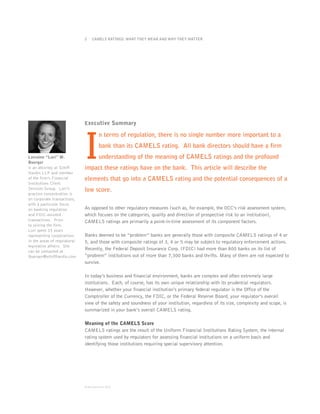
                              Executive Summary


                              I
                                        n terms of regulation, there is no single number more important to a
                                        bank than its CAMELS rating. All bank directors should have a firm
Lorraine “Lori” M.                      understanding of the meaning of CAMELS ratings and the profound
Buerger
is an attorney at Schiff      impact these ratings have on the bank. This article will describe the
Hardin LLP and member
of the firm’s Financial       elements that go into a CAMELS rating and the potential consequences of a
Institutions Client
Services Group. Lori’s        low score.
practice concentration is
on corporate transactions,
with a particular focus
on banking regulation         As opposed to other regulatory measures (such as, for example, the OCC’s risk assessment system,
and FDIC-assisted             which focuses on the categories, quality and direction of prospective risk to an institution),
transactions. Prior           CAMELS ratings are primarily a point-in-time assessment of its component factors.
to joining the firm,
Lori spent 15 years
representing corporations     Banks deemed to be “problem” banks are generally those with composite CAMELS ratings of 4 or
in the areas of regulatory/   5, and those with composite ratings of 3, 4 or 5 may be subject to regulatory enforcement actions.
legislative affairs. She
can be contacted at
                              Recently, the Federal Deposit Insurance Corp. (FDIC) had more than 800 banks on its list of
lbuerger@schiffhardin.com     “problem” institutions out of more than 7,300 banks and thrifts. Many of them are not expected to
                              survive.

                              In today’s business and financial environment, banks are complex and often extremely large
                              institutions. Each, of course, has its own unique relationship with its prudential regulators.
                              However, whether your financial institution’s primary federal regulator is the Office of the
                              Comptroller of the Currency, the FDIC, or the Federal Reserve Board, your regulator’s overall
                              view of the safety and soundness of your institution, regardless of its size, complexity and scope, is
                              summarized in your bank’s overall CAMELS rating.

                              Meaning of the CAMELS Score
                              CAMELS ratings are the result of the Uniform Financial Institutions Rating System, the internal
                              rating system used by regulators for assessing financial institutions on a uniform basis and
                              identifying those institutions requiring special supervisory attention.


                              © DirectorCorps 2011
3    CAMELS RATINGS: WHAT THEY MEAN AND WHY THEY MATTER


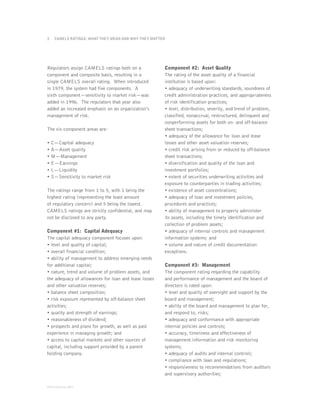
Regulators assign CAMELS ratings both on a             Component #2: Asset Quality
component and composite basis, resulting in a          The rating of the asset quality of a financial
single CAMELS overall rating. When introduced          institution is based upon:
in 1979, the system had five components. A             • adequacy of underwriting standards, soundness of
sixth component—sensitivity to market risk—was         credit administration practices, and appropriateness
added in 1996. The regulators that year also           of risk identification practices;
added an increased emphasis on an organization’s       • level, distribution, severity, and trend of problem,
management of risk.                                    classified, nonaccrual, restructured, delinquent and
                                                       nonperforming assets for both on- and off-balance
The six component areas are:                           sheet transactions;
                                                       • adequacy of the allowance for loan and lease
• C—Capital adequacy                                   losses and other asset valuation reserves;
• A—Asset quality                                      • credit risk arising from or reduced by off-balance
• M—Management                                         sheet transactions;
• E—Earnings                                           • diversification and quality of the loan and
• L—Liquidity                                          investment portfolios;
• S—Sensitivity to market risk                         • extent of securities underwriting activities and
                                                       exposure to counterparties in trading activities;
The ratings range from 1 to 5, with 1 being the        • existence of asset concentrations;
highest rating (representing the least amount          • adequacy of loan and investment policies,
of regulatory concern) and 5 being the lowest.         procedures and practices;
CAMELS ratings are strictly confidential, and may      • ability of management to properly administer
not be disclosed to any party.                         its assets, including the timely identification and
                                                       collection of problem assets;
Component #1: Capital Adequacy                         • adequacy of internal controls and management
The capital adequacy component focuses upon:           information systems; and
• level and quality of capital;                        • volume and nature of credit documentation
• overall financial condition;                         exceptions.
• ability of management to address emerging needs
for additional capital;                                Component #3: Management
• nature, trend and volume of problem assets, and      The component rating regarding the capability
the adequacy of allowances for loan and lease losses   and performance of management and the board of
and other valuation reserves;                          directors is rated upon:
• balance sheet composition;                           • level and quality of oversight and support by the
• risk exposure represented by off-balance sheet       board and management;
activities;                                            • ability of the board and management to plan for,
• quality and strength of earnings;                    and respond to, risks;
• reasonableness of dividend;                          • adequacy and conformance with appropriate
• prospects and plans for growth, as well as past      internal policies and controls;
experience in managing growth; and                     • accuracy, timeliness and effectiveness of
• access to capital markets and other sources of       management information and risk monitoring
capital, including support provided by a parent        systems;
holding company.                                       • adequacy of audits and internal controls;
                                                       • compliance with laws and regulations;
                                                       • responsiveness to recommendations from auditors
                                                       and supervisory authorities;

© DirectorCorps 2011
4    CAMELS RATINGS: WHAT THEY MEAN AND WHY THEY MATTER


• management depth and succession;                          funds management strategies, liquidity policies,
• extent of dominant influence or concentration of          management information systems and contingency
authority;                                                  funding plans.
• reasonableness of compensation policies and
avoidance of self-dealing;                                  Component #6: Sensitivity to Market Risk
• demonstrated willingness to serve the legitimate          The sensitivity to market risk component is based
banking needs of the community; and                         upon:
• overall performance of the institution and its risk       • sensitivity of the financial institution’s earnings to
profile.                                                    adverse changes in interest rates, foreign exchange
                                                            rates, commodity prices or equity prices;
Component #4: Earnings                                      • ability of management to identify, measure,
The rating of an institution’s earnings focuses upon:       monitor and control exposure to market risk;
• level of earnings, including trends and stability;        • nature and complexity of interest rate risk
• ability to provide for adequate capital through           exposure arising from non-trading positions; and
retained earnings;                                          • where appropriate, the nature and complexity
• quality and sources of earnings;                          of market risk exposure arising from trading and
• level of expenses in relation to operations;              foreign operations.
• adequacy of the budgeting systems, forecasting
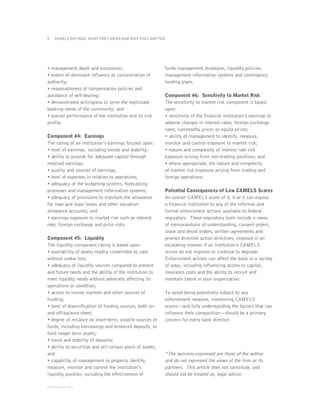
processes and management information systems;               Potential Consequences of Low CAMELS Scores
• adequacy of provisions to maintain the allowance          An overall CAMELS score of 3, 4 or 5 can expose
for loan and lease losses and other valuation               a financial institution to any of the informal and
allowance accounts; and                                     formal enforcement actions available to federal
• earnings exposure to market risk such as interest         regulators. These regulatory tools include a menu
rate, foreign exchange and price risks.                     of memorandums of understanding, consent orders,
                                                            cease and desist orders, written agreements and
Component #5: Liquidity                                     prompt directive action directives, imposed in an
The liquidity component rating is based upon:               escalating manner if an institution’s CAMELS
• availability of assets readily convertible to cash        scores do not improve or continue to degrade.
without undue loss;                                         Enforcement actions can affect the bank in a variety
• adequacy of liquidity sources compared to present         of ways, including influencing access to capital,
and future needs and the ability of the institution to      insurance costs and the ability to recruit and
meet liquidity needs without adversely affecting its        maintain talent in your organization.
operations or condition;
• access to money markets and other sources of              To avoid being potentially subject to any
funding;                                                    enforcement measure, monitoring CAMELS
• level of diversification of funding sources, both on-     scores—and fully understanding the factors that can
and off-balance-sheet;                                      influence their composition—should be a primary
• degree of reliance on short-term, volatile sources of     concern for every bank director.
funds, including borrowings and brokered deposits, to
fund longer term assets;
• trend and stability of deposits;
• ability to securitize and sell certain pools of assets;
and                                                         *The opinions expressed are those of the author
• capability of management to properly identify,            and do not represent the views of the firm or its
measure, monitor and control the institution’s              partners. This article does not constitute, and
liquidity position, including the effectiveness of          should not be treated as, legal advice.

© DirectorCorps 2011

Camels ratings---lori-buerger---march-2012

  • 1.
    www.bankdirector.com Strong Board. Strong Bank. Bank Director’s Educational Program for Members of the Board CAMELS RATINGS: What They Mean and Why They Matter WHITE PAPER
  • 2.
    2 CAMELS RATINGS: WHAT THEY MEAN AND WHY THEY MATTER Executive Summary I n terms of regulation, there is no single number more important to a bank than its CAMELS rating. All bank directors should have a firm Lorraine “Lori” M. understanding of the meaning of CAMELS ratings and the profound Buerger is an attorney at Schiff impact these ratings have on the bank. This article will describe the Hardin LLP and member of the firm’s Financial elements that go into a CAMELS rating and the potential consequences of a Institutions Client Services Group. Lori’s low score. practice concentration is on corporate transactions, with a particular focus on banking regulation As opposed to other regulatory measures (such as, for example, the OCC’s risk assessment system, and FDIC-assisted which focuses on the categories, quality and direction of prospective risk to an institution), transactions. Prior CAMELS ratings are primarily a point-in-time assessment of its component factors. to joining the firm, Lori spent 15 years representing corporations Banks deemed to be “problem” banks are generally those with composite CAMELS ratings of 4 or in the areas of regulatory/ 5, and those with composite ratings of 3, 4 or 5 may be subject to regulatory enforcement actions. legislative affairs. She can be contacted at Recently, the Federal Deposit Insurance Corp. (FDIC) had more than 800 banks on its list of lbuerger@schiffhardin.com “problem” institutions out of more than 7,300 banks and thrifts. Many of them are not expected to survive. In today’s business and financial environment, banks are complex and often extremely large institutions. Each, of course, has its own unique relationship with its prudential regulators. However, whether your financial institution’s primary federal regulator is the Office of the Comptroller of the Currency, the FDIC, or the Federal Reserve Board, your regulator’s overall view of the safety and soundness of your institution, regardless of its size, complexity and scope, is summarized in your bank’s overall CAMELS rating. Meaning of the CAMELS Score CAMELS ratings are the result of the Uniform Financial Institutions Rating System, the internal rating system used by regulators for assessing financial institutions on a uniform basis and identifying those institutions requiring special supervisory attention. © DirectorCorps 2011
  • 3.
    3 CAMELS RATINGS: WHAT THEY MEAN AND WHY THEY MATTER Regulators assign CAMELS ratings both on a Component #2: Asset Quality component and composite basis, resulting in a The rating of the asset quality of a financial single CAMELS overall rating. When introduced institution is based upon: in 1979, the system had five components. A • adequacy of underwriting standards, soundness of sixth component—sensitivity to market risk—was credit administration practices, and appropriateness added in 1996. The regulators that year also of risk identification practices; added an increased emphasis on an organization’s • level, distribution, severity, and trend of problem, management of risk. classified, nonaccrual, restructured, delinquent and nonperforming assets for both on- and off-balance The six component areas are: sheet transactions; • adequacy of the allowance for loan and lease • C—Capital adequacy losses and other asset valuation reserves; • A—Asset quality • credit risk arising from or reduced by off-balance • M—Management sheet transactions; • E—Earnings • diversification and quality of the loan and • L—Liquidity investment portfolios; • S—Sensitivity to market risk • extent of securities underwriting activities and exposure to counterparties in trading activities; The ratings range from 1 to 5, with 1 being the • existence of asset concentrations; highest rating (representing the least amount • adequacy of loan and investment policies, of regulatory concern) and 5 being the lowest. procedures and practices; CAMELS ratings are strictly confidential, and may • ability of management to properly administer not be disclosed to any party. its assets, including the timely identification and collection of problem assets; Component #1: Capital Adequacy • adequacy of internal controls and management The capital adequacy component focuses upon: information systems; and • level and quality of capital; • volume and nature of credit documentation • overall financial condition; exceptions. • ability of management to address emerging needs for additional capital; Component #3: Management • nature, trend and volume of problem assets, and The component rating regarding the capability the adequacy of allowances for loan and lease losses and performance of management and the board of and other valuation reserves; directors is rated upon: • balance sheet composition; • level and quality of oversight and support by the • risk exposure represented by off-balance sheet board and management; activities; • ability of the board and management to plan for, • quality and strength of earnings; and respond to, risks; • reasonableness of dividend; • adequacy and conformance with appropriate • prospects and plans for growth, as well as past internal policies and controls; experience in managing growth; and • accuracy, timeliness and effectiveness of • access to capital markets and other sources of management information and risk monitoring capital, including support provided by a parent systems; holding company. • adequacy of audits and internal controls; • compliance with laws and regulations; • responsiveness to recommendations from auditors and supervisory authorities; © DirectorCorps 2011
  • 4.
    4 CAMELS RATINGS: WHAT THEY MEAN AND WHY THEY MATTER • management depth and succession; funds management strategies, liquidity policies, • extent of dominant influence or concentration of management information systems and contingency authority; funding plans. • reasonableness of compensation policies and avoidance of self-dealing; Component #6: Sensitivity to Market Risk • demonstrated willingness to serve the legitimate The sensitivity to market risk component is based banking needs of the community; and upon: • overall performance of the institution and its risk • sensitivity of the financial institution’s earnings to profile. adverse changes in interest rates, foreign exchange rates, commodity prices or equity prices; Component #4: Earnings • ability of management to identify, measure, The rating of an institution’s earnings focuses upon: monitor and control exposure to market risk; • level of earnings, including trends and stability; • nature and complexity of interest rate risk • ability to provide for adequate capital through exposure arising from non-trading positions; and retained earnings; • where appropriate, the nature and complexity • quality and sources of earnings; of market risk exposure arising from trading and • level of expenses in relation to operations; foreign operations. • adequacy of the budgeting systems, forecasting processes and management information systems; Potential Consequences of Low CAMELS Scores • adequacy of provisions to maintain the allowance An overall CAMELS score of 3, 4 or 5 can expose for loan and lease losses and other valuation a financial institution to any of the informal and allowance accounts; and formal enforcement actions available to federal • earnings exposure to market risk such as interest regulators. These regulatory tools include a menu rate, foreign exchange and price risks. of memorandums of understanding, consent orders, cease and desist orders, written agreements and Component #5: Liquidity prompt directive action directives, imposed in an The liquidity component rating is based upon: escalating manner if an institution’s CAMELS • availability of assets readily convertible to cash scores do not improve or continue to degrade. without undue loss; Enforcement actions can affect the bank in a variety • adequacy of liquidity sources compared to present of ways, including influencing access to capital, and future needs and the ability of the institution to insurance costs and the ability to recruit and meet liquidity needs without adversely affecting its maintain talent in your organization. operations or condition; • access to money markets and other sources of To avoid being potentially subject to any funding; enforcement measure, monitoring CAMELS • level of diversification of funding sources, both on- scores—and fully understanding the factors that can and off-balance-sheet; influence their composition—should be a primary • degree of reliance on short-term, volatile sources of concern for every bank director. funds, including borrowings and brokered deposits, to fund longer term assets; • trend and stability of deposits; • ability to securitize and sell certain pools of assets; and *The opinions expressed are those of the author • capability of management to properly identify, and do not represent the views of the firm or its measure, monitor and control the institution’s partners. This article does not constitute, and liquidity position, including the effectiveness of should not be treated as, legal advice. © DirectorCorps 2011