Chapter 1. Measurement
1.What is Physics?
2. Measuring Things
3. The International System of Units
4. Length
5. Time
6. Mass
7. Changing Units
8.Calculations with Uncertain Quantities
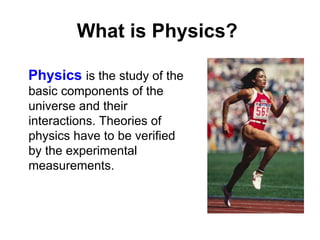
What is Physics?
Physics is the study of the
basic components of the
universe and their
interactions. Theories of
physics have to be verified
by the experimental
measurements.
Measurement
• A scientific measurement requires:
(1) the definition of the physical quantity
(2) the units.
• The value of a physical quantity is actually the
product of a number and a unit .
• The precision of the measurement result is
determined by procedures used to measure
them.
Basic Measurements in the Study of Motion
• Length: Our “How far?” question involves
being able to measure the distance between
two points.
• Time: To answer the question, “How long
did it take?”
• Mass: Mass is a measure of “amount of
stuff.”
The Système International (SI) of units
• The SI, or metric system of units is the
internationally accepted system of units for
measurement in all of the sciences, including
physics.
• The SI consists of base units and derived
units:
(1) The set of base units comprises an
irreducible set of units for measuring all
physical variables
(2) The derived units can be expressed in
terms of the base units
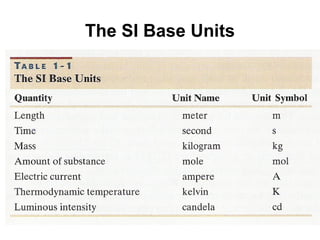
The SI Base Units
• Time: One second is the duration of
9.192631770 × 10⁹
periods of the
radiation corresponding to the
transition between the two hyperfine
levels of the ground state of the
cesium-133 atom.
• Length: One meter is the distance
traveled by light in a vacuum in a time
interval of 1/299 792 458 of a second
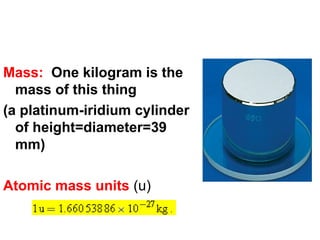
Mass: One kilogram is the
mass of this thing
(a platinum-iridium cylinder
of height=diameter=39
mm)
Atomic mass units (u)
Scientific Notation
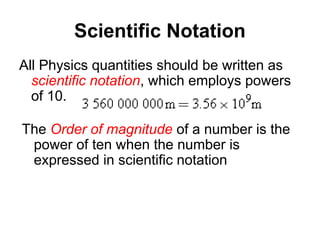
All Physics quantities should be written as
scientific notation, which employs powers
of 10.
The Order of magnitude of a number is the
power of ten when the number is
expressed in scientific notation
Example
• Determine the order of magnitude of the
following numbers:
(a) A=2.3×10⁴
, (b) B=7.8×10⁵
.
Changing Units
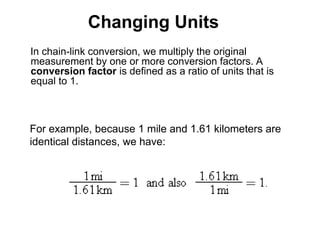
In chain-link conversion, we multiply the original
measurement by one or more conversion factors. A
conversion factor is defined as a ratio of units that is
equal to 1.
For example, because 1 mile and 1.61 kilometers are
identical distances, we have:
EXERCISE 1
• (a) Explain why it is correct to write
1 min/60 s = 1, but it is not correct to write
1/60 = 1.
• (b) Use the relevant conversion factors
and the method of chain-link conversions
to calculate how many seconds there are
in a day .
EXERCISE 2
• The cran is a British volume unit for freshly
caught herrings: 1 cran=170.474 liters (L) of
fish, about 750 herrings. Suppose that, to be
cleared through customs in Saudi Arabia, a
shipment of 1255 crans must be declared in
terms of cubic covidos, where the covido is an
Arabic unit of length: 1 covido=48.26 cm . What
is the required declaration?
Density
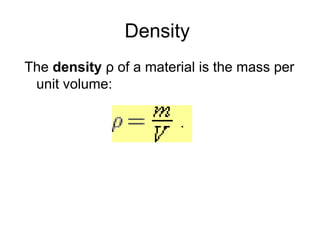
The density ρ of a material is the mass per
unit volume:
Calculations with Uncertain Quantities
Significant Figures: Read the number from left to right,
and count the first nonzero digit and all the digits
(zero or not) to the right of it as significant.
• Significant figures and decimal places are different
• The most right digit gives the absolute precision, which tells you explicitly the
smallest scale division of the measurement.
• Relative Precision is the ratio of absolute precision over the physics quantity.
EXERCISE 3
• Determine the number of significant
figures, absolute precision, relative
precision in each of the following numbers:
(a) 27 meters, (b) 27 cows, (c) 0.003 429
87 second, (d) –1.970 500 × 10–11
coulombs, (e) 5280 ft/mi.
EXERCISE 4
Suppose you measure a time to the
nearest 1/100 of a second and get a value
of 1.78 s.
(a) What is the absolute precision of your
measurement?
(b) What is the relative precision of your
measurement?
A Simple Rule for Reporting Significant Figures in a
Calculated Result
• Multiplying and Dividing: When multiplying or dividing
numbers, the relative precision of the result cannot exceed
that of the least precise number used
• Addition and Subtraction: When adding or subtracting, you
line up the decimal points before you add or subtract. This
means that it's the absolute precision of the least precise
number that limits the precision of the sum or the difference.
• Data that are known exactly should not be included when
deciding which of the original data has the fewest significant
figures.
• Only the final result at the end of your calculation should be
rounded using the simple rule. Intermediate results should
never be rounded.
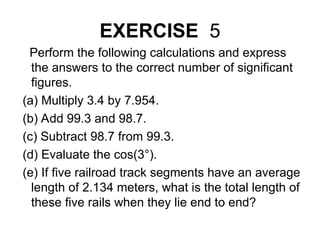
EXERCISE 5
Perform the following calculations and express
the answers to the correct number of significant
figures.
(a) Multiply 3.4 by 7.954.
(b) Add 99.3 and 98.7.
(c) Subtract 98.7 from 99.3.
(d) Evaluate the cos(3°).
(e) If five railroad track segments have an average
length of 2.134 meters, what is the total length of
these five rails when they lie end to end?

Cambridge chapter_1 - Measurement IGCSE.ppt

  • 1.
    Chapter 1. Measurement 1.Whatis Physics? 2. Measuring Things 3. The International System of Units 4. Length 5. Time 6. Mass 7. Changing Units 8.Calculations with Uncertain Quantities
  • 2.
    What is Physics? Physicsis the study of the basic components of the universe and their interactions. Theories of physics have to be verified by the experimental measurements.
  • 3.
    Measurement • A scientificmeasurement requires: (1) the definition of the physical quantity (2) the units. • The value of a physical quantity is actually the product of a number and a unit . • The precision of the measurement result is determined by procedures used to measure them.
  • 4.
    Basic Measurements inthe Study of Motion • Length: Our “How far?” question involves being able to measure the distance between two points. • Time: To answer the question, “How long did it take?” • Mass: Mass is a measure of “amount of stuff.”
  • 5.
    The Système International(SI) of units • The SI, or metric system of units is the internationally accepted system of units for measurement in all of the sciences, including physics. • The SI consists of base units and derived units: (1) The set of base units comprises an irreducible set of units for measuring all physical variables (2) The derived units can be expressed in terms of the base units
  • 6.
  • 7.
    • Time: Onesecond is the duration of 9.192631770 × 10⁹ periods of the radiation corresponding to the transition between the two hyperfine levels of the ground state of the cesium-133 atom.
  • 8.
    • Length: Onemeter is the distance traveled by light in a vacuum in a time interval of 1/299 792 458 of a second
  • 9.
    Mass: One kilogramis the mass of this thing (a platinum-iridium cylinder of height=diameter=39 mm) Atomic mass units (u)
  • 10.
    Scientific Notation All Physicsquantities should be written as scientific notation, which employs powers of 10. The Order of magnitude of a number is the power of ten when the number is expressed in scientific notation
  • 11.
    Example • Determine theorder of magnitude of the following numbers: (a) A=2.3×10⁴ , (b) B=7.8×10⁵ .
  • 12.
    Changing Units In chain-linkconversion, we multiply the original measurement by one or more conversion factors. A conversion factor is defined as a ratio of units that is equal to 1. For example, because 1 mile and 1.61 kilometers are identical distances, we have:
  • 13.
    EXERCISE 1 • (a)Explain why it is correct to write 1 min/60 s = 1, but it is not correct to write 1/60 = 1. • (b) Use the relevant conversion factors and the method of chain-link conversions to calculate how many seconds there are in a day .
  • 14.
    EXERCISE 2 • Thecran is a British volume unit for freshly caught herrings: 1 cran=170.474 liters (L) of fish, about 750 herrings. Suppose that, to be cleared through customs in Saudi Arabia, a shipment of 1255 crans must be declared in terms of cubic covidos, where the covido is an Arabic unit of length: 1 covido=48.26 cm . What is the required declaration?
  • 15.
    Density The density ρof a material is the mass per unit volume:
  • 16.
    Calculations with UncertainQuantities Significant Figures: Read the number from left to right, and count the first nonzero digit and all the digits (zero or not) to the right of it as significant. • Significant figures and decimal places are different • The most right digit gives the absolute precision, which tells you explicitly the smallest scale division of the measurement. • Relative Precision is the ratio of absolute precision over the physics quantity.
  • 17.
    EXERCISE 3 • Determinethe number of significant figures, absolute precision, relative precision in each of the following numbers: (a) 27 meters, (b) 27 cows, (c) 0.003 429 87 second, (d) –1.970 500 × 10–11 coulombs, (e) 5280 ft/mi.
  • 18.
    EXERCISE 4 Suppose youmeasure a time to the nearest 1/100 of a second and get a value of 1.78 s. (a) What is the absolute precision of your measurement? (b) What is the relative precision of your measurement?
  • 19.
    A Simple Rulefor Reporting Significant Figures in a Calculated Result • Multiplying and Dividing: When multiplying or dividing numbers, the relative precision of the result cannot exceed that of the least precise number used • Addition and Subtraction: When adding or subtracting, you line up the decimal points before you add or subtract. This means that it's the absolute precision of the least precise number that limits the precision of the sum or the difference. • Data that are known exactly should not be included when deciding which of the original data has the fewest significant figures. • Only the final result at the end of your calculation should be rounded using the simple rule. Intermediate results should never be rounded.
  • 20.
    EXERCISE 5 Perform thefollowing calculations and express the answers to the correct number of significant figures. (a) Multiply 3.4 by 7.954. (b) Add 99.3 and 98.7. (c) Subtract 98.7 from 99.3. (d) Evaluate the cos(3°). (e) If five railroad track segments have an average length of 2.134 meters, what is the total length of these five rails when they lie end to end?