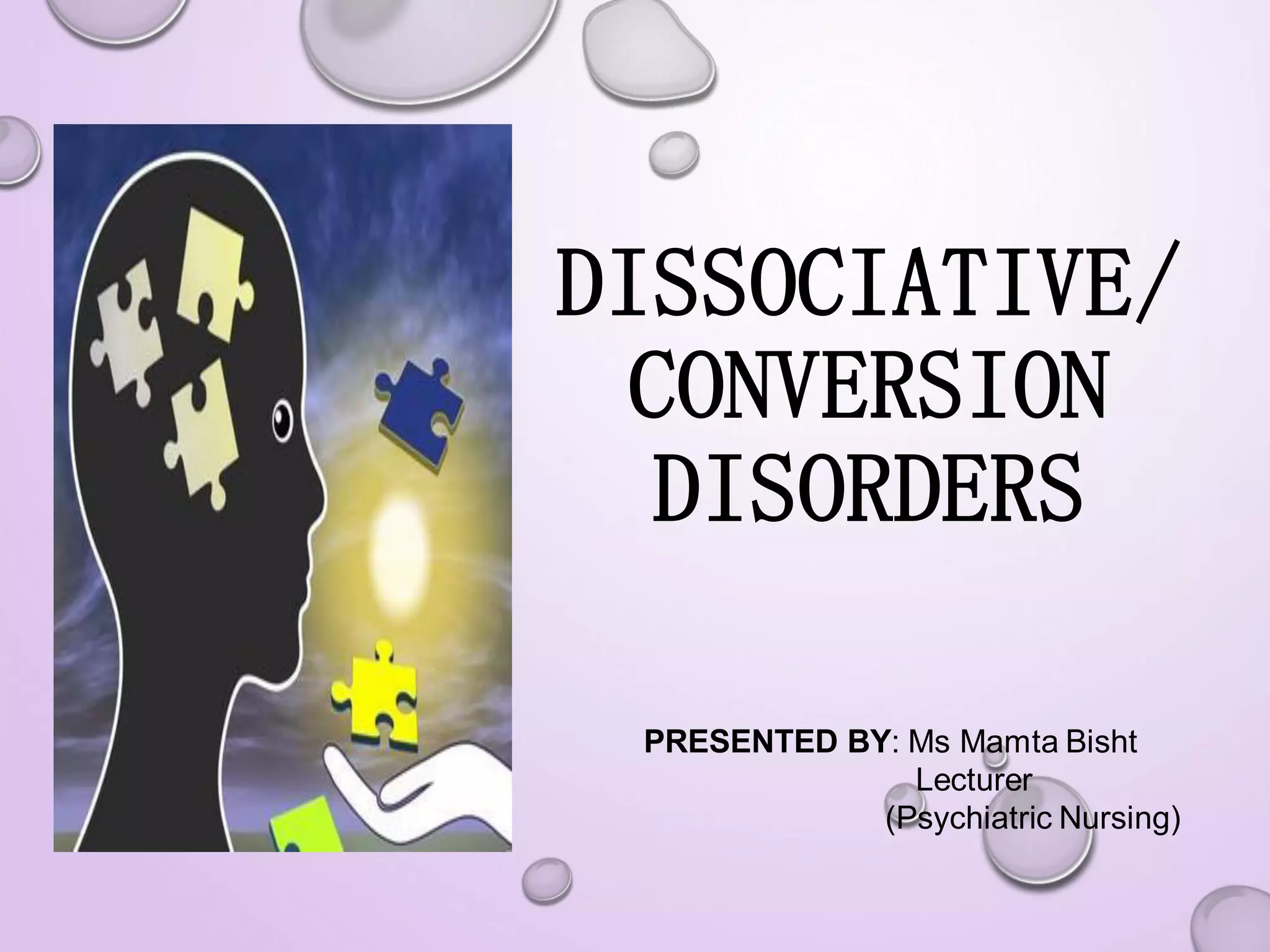

DISSOCIATIVE/
CONVERSION
DISORDERS
PRESENTED BY: Ms Mamta Bisht
Lecturer
(Psychiatric Nursing)
Dissociation and Conversion
The terms “dissociation” and “conversion” are
virtually synonymous;
However, conversion has been applied to physical
symptoms, i.e. motor and sensory deficits, while
dissociation has been applied to the mental
symptoms.
Presented By: Ms Mamta Bisht
DEFINITION OF CONVERSION DISORDER
Conversion Disorder is characterized by an
alteration or loss of some body functions (physical)
due to psychological conflict or need and cannot be
explained by any known medical condition.
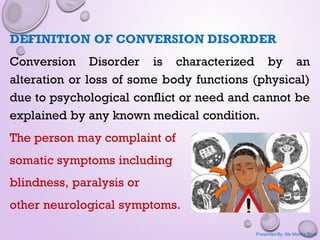
The person may complaint of
somatic symptoms including
blindness, paralysis or
other neurological symptoms.
Presented By: Ms Mamta Bisht
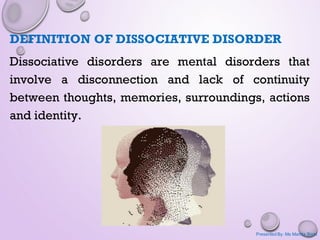
DEFINITION OF DISSOCIATIVE DISORDER
Dissociative disorders are mental disorders that
involve a disconnection and lack of continuity
between thoughts, memories, surroundings, actions
and identity.
Presented By: Ms Mamta Bisht
PREDISPOSING FACTORS TO
DISSOCIATIVE DISORDERS
•Exposure to trauma (War, Disasters, Personal trauma)
•Long term Inner Conflicts or stress
•Poor Individual coping -Failed Repression
•Ineffective ego defence mechanisms
•Certain personality traits are at higher risk of developing
dissociative disorders (Such as dependent or attention
seeking behaviour )
Presented By: Ms Mamta Bisht
CLASSIFICATION
• Dissociative identity disorder
• Dissociative amnesia- dissociative fugue
• Depersonalization/ derealization
• Other specified dissociative disorders
❑ Dissociative motor disorder
❑ Trance and possession disorders
❑ Dissociative stupor
❑ Dissociative convulsions
Presented By: Ms Mamta Bisht
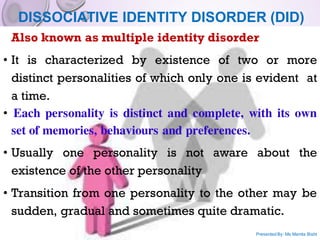
DISSOCIATIVE IDENTITY DISORDER (DID)
Also known as multiple identity disorder
• It is characterized by existence of two or more
distinct personalities of which only one is evident at
a time.
• Each personality is distinct and complete, with its own
set of memories, behaviours and preferences.
• Usually one personality is not aware about the
existence of the other personality
• Transition from one personality to the other may be
sudden, gradual and sometimes quite dramatic.
Presented By: Ms Mamta Bisht
DISSOCIATIVE AMNESIA
Dissociative amnesia is characterized by a sudden
amnesia (partial or complete) for recent events,
particularly related to the stressful or traumatic life
events.
Dissociative fugue.
It is characterized by the episodes of unexpected,
yet organized wandering away from home , office or
places .
During the episode the person usually adopts a new
identity (or confused with own identity) with
complete amnesia of the earlier life. Presented By: Ms Mamta Bisht
DEPERSONALIZATION/ DEREALIZATION
Depersonalization:
Feeling disconnected from one's own body, mind,
thoughts or emotions. They report feeling of loss of
control over their thought or actions (feeling like a
robot)
Derealization:
The person feels detached from one's surrounding
and perceives the world as living in a movie, dream
like, foggy, destroyed or distorted
Presented By: Ms Mamta Bisht
DISSOCIATIVE MOTOR DISORDER
Dissociative motor disorder involves either loss of
the ability to perform voluntary movements
(complete or partial) or presence of abnormal
movements. (tremors, gait disturbances)
The paralysis may be monoplegia, paraplegia, or
quadriplegia (including loss of speech)
Presented By: Ms Mamta Bisht
TRANCE AND POSSESSION DISORDERS
TRANCE DISORDER
• This condition is characterized by temporary loss
of identity and acute narrowing or complete loss of
awareness of surroundings.
• Presence of profound unresponsiveness or
insensitivity to environmental stimuli.
• Presence of minor stereotyped behaviors (e.g.,
finger movements) of which the individual is
unaware and/or that he or she cannot control
Presented By: Ms Mamta Bisht
TRANCE AND POSSESSION DISORDERS contd….
POSSESSION DISORDERS:
Possession trance is characterized by a transient
alteration in identity whereby one's normal identity
is temporarily replaced (possessed) by a spirit,
ghost, deity, or other person.
The voice and behavior may appear like that of the
possessed spirit.
Presented By: Ms Mamta Bisht
DISSOCIATIVE STUPOR
Dissociative stupor is characterized by an absence
of or marked diminution of voluntary movements
and speech (mutism) in the presence of normal or
relatively preserved conscious awareness.
The patient appears to be stuporous; however, muscle tone,
posture, and breathing are normal.
The onset is sudden and usually related to stressful
life events.
Presented By: Ms Mamta Bisht
DISSOCIATIVE CONVULSIONS
This disorder is characterized by sudden,
unexpected occurrence of convulsive movements
and/or partial loss of consciousness.
The episodes may superficially resemble epileptic
seizures but are not of epileptic origin.
Previously known as :hysterical fits” or :pseudo
seizures”
Presented By: Ms Mamta Bisht
THANK YOU

Conversion disorders

  • 1.
    DISSOCIATIVE/ CONVERSION DISORDERS PRESENTED BY: MsMamta Bisht Lecturer (Psychiatric Nursing)
  • 2.
    Dissociation and Conversion Theterms “dissociation” and “conversion” are virtually synonymous; However, conversion has been applied to physical symptoms, i.e. motor and sensory deficits, while dissociation has been applied to the mental symptoms. Presented By: Ms Mamta Bisht
  • 3.
    DEFINITION OF CONVERSIONDISORDER Conversion Disorder is characterized by an alteration or loss of some body functions (physical) due to psychological conflict or need and cannot be explained by any known medical condition. The person may complaint of somatic symptoms including blindness, paralysis or other neurological symptoms. Presented By: Ms Mamta Bisht
  • 4.
    DEFINITION OF DISSOCIATIVEDISORDER Dissociative disorders are mental disorders that involve a disconnection and lack of continuity between thoughts, memories, surroundings, actions and identity. Presented By: Ms Mamta Bisht
  • 5.
    PREDISPOSING FACTORS TO DISSOCIATIVEDISORDERS •Exposure to trauma (War, Disasters, Personal trauma) •Long term Inner Conflicts or stress •Poor Individual coping -Failed Repression •Ineffective ego defence mechanisms •Certain personality traits are at higher risk of developing dissociative disorders (Such as dependent or attention seeking behaviour ) Presented By: Ms Mamta Bisht
  • 6.
    CLASSIFICATION • Dissociative identitydisorder • Dissociative amnesia- dissociative fugue • Depersonalization/ derealization • Other specified dissociative disorders ❑ Dissociative motor disorder ❑ Trance and possession disorders ❑ Dissociative stupor ❑ Dissociative convulsions Presented By: Ms Mamta Bisht
  • 7.
    DISSOCIATIVE IDENTITY DISORDER(DID) Also known as multiple identity disorder • It is characterized by existence of two or more distinct personalities of which only one is evident at a time. • Each personality is distinct and complete, with its own set of memories, behaviours and preferences. • Usually one personality is not aware about the existence of the other personality • Transition from one personality to the other may be sudden, gradual and sometimes quite dramatic. Presented By: Ms Mamta Bisht
  • 8.
    DISSOCIATIVE AMNESIA Dissociative amnesiais characterized by a sudden amnesia (partial or complete) for recent events, particularly related to the stressful or traumatic life events. Dissociative fugue. It is characterized by the episodes of unexpected, yet organized wandering away from home , office or places . During the episode the person usually adopts a new identity (or confused with own identity) with complete amnesia of the earlier life. Presented By: Ms Mamta Bisht
  • 9.
    DEPERSONALIZATION/ DEREALIZATION Depersonalization: Feeling disconnectedfrom one's own body, mind, thoughts or emotions. They report feeling of loss of control over their thought or actions (feeling like a robot) Derealization: The person feels detached from one's surrounding and perceives the world as living in a movie, dream like, foggy, destroyed or distorted Presented By: Ms Mamta Bisht
  • 10.
    DISSOCIATIVE MOTOR DISORDER Dissociativemotor disorder involves either loss of the ability to perform voluntary movements (complete or partial) or presence of abnormal movements. (tremors, gait disturbances) The paralysis may be monoplegia, paraplegia, or quadriplegia (including loss of speech) Presented By: Ms Mamta Bisht
  • 11.
    TRANCE AND POSSESSIONDISORDERS TRANCE DISORDER • This condition is characterized by temporary loss of identity and acute narrowing or complete loss of awareness of surroundings. • Presence of profound unresponsiveness or insensitivity to environmental stimuli. • Presence of minor stereotyped behaviors (e.g., finger movements) of which the individual is unaware and/or that he or she cannot control Presented By: Ms Mamta Bisht
  • 12.
    TRANCE AND POSSESSIONDISORDERS contd…. POSSESSION DISORDERS: Possession trance is characterized by a transient alteration in identity whereby one's normal identity is temporarily replaced (possessed) by a spirit, ghost, deity, or other person. The voice and behavior may appear like that of the possessed spirit. Presented By: Ms Mamta Bisht
  • 13.
    DISSOCIATIVE STUPOR Dissociative stuporis characterized by an absence of or marked diminution of voluntary movements and speech (mutism) in the presence of normal or relatively preserved conscious awareness. The patient appears to be stuporous; however, muscle tone, posture, and breathing are normal. The onset is sudden and usually related to stressful life events. Presented By: Ms Mamta Bisht
  • 14.
    DISSOCIATIVE CONVULSIONS This disorderis characterized by sudden, unexpected occurrence of convulsive movements and/or partial loss of consciousness. The episodes may superficially resemble epileptic seizures but are not of epileptic origin. Previously known as :hysterical fits” or :pseudo seizures” Presented By: Ms Mamta Bisht
  • 15.