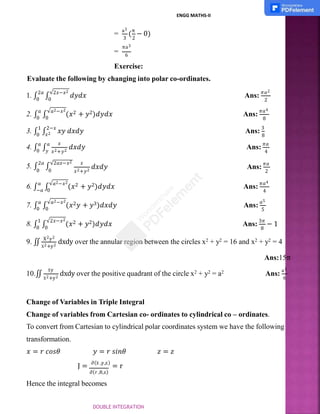
Change into polar co-ordinates and then evaluate ∫
∞
∫
∞
𝐞−(𝐱𝟐+𝐲𝟐)𝐝𝐲𝐝𝐱
𝟎 𝟎
Solution:
Given order 𝑑𝑦𝑑𝑥 is in correct form.
Given limits are 𝑦 ∶ 0 → ∞ , 𝑥 ∶ 0 → ∞
Equations are 𝑦 = 0 , 𝑦 = ∞ , 𝑥 = 0 , 𝑥 = ∞
Replacement:
ENGG MATHS-II
5.4 Change of variables in Double and Triple integrals:
Evaluation of double integrals by changing Cartesian to polar co- ordinates:
Working rule:
Step:1
Check the given order whether it is correct or not.
Step:2
Write the equations by using given limits.
Step:3
By using the equations sketch the region of integration.
Step:4
Replacement: put x = rcos𝜃 , y = rsin𝜃 , x2 + y2 = r2 and dxdy = rdrd𝜃
Step:5
Find r limits(draw radial strip inside the region) and θ limits and evaluate the
integral.
Example:
DOUBLE INTEGRATION
ENGG MATHS-II
Put x2 + y2 = r2 , dydx = rdrd𝜃
Limits:
r : 0→ ∞ , θ: 0 →
π
2
∞
e−r2
rdrdθ
π
∫
∞
∫
∞
e−(X2+y2)dydx = ∫2 ∫
0 0 0 0
Substitution: Put r2 = t , if r = 0 ⇒ t = 0, r = ∞ ⇒ t = ∞
2rdr = dt t: 0→ ∞
rdr =
𝑑𝑡
π
∫2 ∫
0 0 2
∞
e−t dt
dθ
π
2
∞
e−r2
rdrdθ = ∫2 ∫
0 0
1
2 −1 0
e−t ∞
π
0
= ∫2 [ ] dθ
= −∞ 0
+ e )dθ
π
∫2(−e
0
=
1
2
1
2
π
∫2(0 + 1)dθ
0
(∵ e−∞ = 0, e0 = 1)
1
2
π
= ∫2 dθ
0
2 0
π
=
1
(θ)2
=
1
(
π
− 0)
=
2 2
π
4
Example:
𝐱
𝐝𝐲𝐝𝐱
𝐲 𝐱𝟐+𝐲𝟐
Change into polar co-ordinates and then evaluate ∫
𝐚
∫
𝐚
𝟎
Solution:
Given order 𝑑𝑥𝑑𝑦 is in correct form.
DOUBLE INTEGRATION
ENGG MATHS-II
Given limits are x : y→ 𝑎 , y : 0→ 𝑎
Equations are x =y , x = 𝑎 , y = 0 , y = 𝑎
Replacement:
Put x = rcos𝜃 , 𝑥2 + 𝑦2 = 𝑟2 , 𝑑𝑥𝑑𝑦 = 𝑟𝑑𝑟𝑑𝜃
Limits: r : 0 →
𝑎
, 𝜃: 0 →
𝜋
𝑐𝑜𝑠𝜃 4
∫ ∫
𝑎 𝑎 𝑥
𝑥 +𝑦
2 2 𝑑𝑦𝑑𝑥 = ∫ ∫
0 𝑦 𝑟2 𝑟𝑑𝑟𝑑𝜃
𝑎
𝑟𝑐𝑜𝑠𝜃
𝜋
4 𝑐𝑜 𝑠
𝜃
0 0
0
𝑎
𝜋
= ∫4[𝑟𝑐𝑜𝑠𝜃]𝑐𝑜𝑠𝜃
𝑑𝜃
𝑎
𝑐𝑜𝑠
𝜃
0
𝜋
= ∫4 (
0
𝑐𝑜𝑠𝜃 − 0) 𝑑𝜃
𝜋
= 𝑎 ∫4 𝑑𝜃
0
0
𝜋
= 𝑎(𝜃)4
4
= 𝑎(
𝜋
− 0)
= 𝑎𝜋
4
Example:
𝐱𝟐
𝐲 √𝐱𝟐+𝐲𝟐
Evaluate ∫
𝐚
∫
𝐚
𝟎
𝐝𝐱𝐝𝐲 by changing into polar co-ordinates.
Solution:
Given order 𝑑𝑥𝑑𝑦 is in correct form.
Given limits are x : y→ 𝑎 , y : 0→ 𝑎
DOUBLE INTEGRATION
ENGG MATHS-II
Equations are x =y , x = 𝑎 , y = 0 , y = 𝑎
Replacement:
Put x2 = r2cos2𝜃 , 𝑥2 + 𝑦2 = 𝑟2 => 𝑟 = √𝑥2 + 𝑦2 , dxdy = rdrd𝜃
Limits: r : 0 →
𝑎
, 𝜃: 0 →
𝜋
𝑐𝑜𝑠𝜃 4
∫ ∫
𝑥2
√𝑥 +𝑦
2 2
𝑑𝑥𝑑𝑦 = ∫ ∫
𝑎 𝑎
0 𝑦 𝑟
𝑟𝑑𝑟𝑑𝜃
𝑎
𝑟2𝑐𝑜𝑠2𝜃
𝜋
4 𝑐 𝑜 𝑠
𝜃
0 0
3
3
𝜋
= ∫4 [𝑟
𝑎
𝑐𝑜𝑠2𝜃]
𝑐𝑜𝑠𝜃
𝑑𝜃
0
𝑎3
3
3𝑐𝑜𝑠 𝜃
2
0
𝜋
= ∫4 (
0
𝑐𝑜𝑠 𝜃 − 0) 𝑑𝜃
=
𝑎3 1
3
2
𝜋
∫4
3 0 𝑐𝑜𝑠 𝜃
𝑐𝑜𝑠 𝜃 𝑑𝜃
=
𝑎3 1
𝜋
3 0 𝑐𝑜𝑠𝜃
∫4 𝑑𝜃
=
𝜋
0
∫4 𝑠𝑒𝑐𝜃 𝑑𝜃
=
𝑎3
3
𝑎3
3 0
𝜋
(𝑙𝑜𝑔(𝑠𝑒𝑐𝜃 + 𝑡𝑎𝑛𝜃))4
= 𝑎3
[𝑙𝑜𝑔 (𝑠𝑒𝑐 𝜋
+ 𝑡𝑎𝑛 𝜋
) − 𝑙𝑜𝑔(𝑠𝑒𝑐0 + 𝑡𝑎𝑛0)]
3 4 4
3
=
𝑎3
[𝑙𝑜𝑔(√2 + 1) − 𝑙𝑜𝑔(1 − 0)]
3
=
𝑎3
𝑙𝑜𝑔(√2 + 1)
Note:
1. x2 + y2 = r2cos2θ + r2sin2θ = r2
2. ∫ cos
2
0
θdθ = ∫
2 2
π π
2
0
sin θdθ = ×
1 π
2 2
3. ∫ 4
cos θdθ = ∫
π
2
0
4
π
2
0
sin θdθ = × ×
3 1 π
4 2 2
4. ∫ 2 2
π
2
0
cos θsin θdθ = × ×
1 1 π
4 2 2
DOUBLE INTEGRATION
Example:
By changing into polar co-ordinates and evaluate ∫
𝟐𝐚
∫
√𝟐𝐚𝐱−𝐱𝟐
(𝐱𝟐 + 𝐲𝟐)𝐝𝐲𝐝𝐱
𝟎 𝟎
Solution:
Given order 𝑑𝑦𝑑𝑥 is in correct form.
Given limits are y : 0→ √2𝑎𝑥 − 𝑥2 , x : 0→ 2𝑎
Equations are y = 0 , y = √2𝑎𝑥 − 𝑥2 , x = 0 , x = 2𝑎
y2 = 2ax − x2
x2 + y2 − 2ax = 0 is a circle with centre (a,0) and radius ‘a’.
Replacement:
Put x2 + y2 = r2 , 𝑑𝑥𝑑𝑦 = 𝑟𝑑𝑟𝑑𝜃
Limits: r : 0 → 2𝑎𝑐𝑜𝑠𝜃 , 𝜃: 0 →
𝜋
2
2𝑎𝑐𝑜𝑠𝜃
𝑟2 × 𝑟𝑑𝑟𝑑𝜃
𝜋
∫
2𝑎
∫
√2𝑎𝑥−𝑥2
(𝑥2 + 𝑦2)𝑑𝑦𝑑𝑥 = ∫2 ∫
0 0 0 0
3
𝑟 𝑑𝑟𝑑𝜃
2𝑎𝑐𝑜𝑠
𝜃
𝜋
= ∫2 ∫
0 0
4
]
0
r4 2acosθ
π
= ∫2 [
0
dθ
4
π
24a4cos4θ
= ∫2(
0
− 0) dθ
π
0
= 4a4 ∫2 cos4θdθ
ENGG MATHS-II
DOUBLE INTEGRATION
= 4a4 × 3
× 1
× π
4 2 2
(∵ ∫ 4
π
2
0
cos θdθ = × ×
3 1 π
4 2 2
)
=
3πa4
4
Example:
𝐱
𝐱𝟐+𝐲𝟐
𝐝𝐱𝐝𝐲
By changing into polar co-ordinates and evaluate∫
𝟐
∫
√𝟐𝐱−𝐱𝟐
𝟎 𝟎
Solution:
Given order 𝑑𝑥𝑑𝑦 is in incorrect form.
X
X2+y2
dydx
The correct form is 𝑑𝑦𝑑𝑥 ⇒ ∫
2
∫
√2X−X2
0 0
Given limits are y : 0→ √2𝑥 − 𝑥2 , x : 0→ 2
Equations are y = 0 , y = √2𝑥 − 𝑥2 , x = 0 , x = 2
y2 = 2x − x2
x2 + y2 − 2x = 0 is a circle with centre (1,0) and radius ‘1’.
Replacement:
Put x = rcos𝜃, 𝑥2 + 𝑦2 = 𝑟2 , dxdy = rdrd𝜃
Limits: r : 0 → 2𝑐𝑜𝑠𝜃 , 𝜃: 0 →
𝜋
2
𝑥 +𝑦
2 2
𝑑𝑦𝑑𝑥 = ∫ ∫
2 √2𝑥−𝑥2 𝑥
∫0∫0 𝑟2
2𝑐𝑜𝑠𝜃 𝑟𝑐𝑜𝑠𝜃
× 𝑟𝑑𝑟𝑑𝜃
𝜋
2
0 0
0
𝜋
0
=∫2[𝑟𝑐𝑜𝑠𝜃]2𝑐𝑜𝑠𝜃 𝑑𝜃
𝜋
0
= ∫2(2𝑐𝑜𝑠2𝜃 − 0)𝑑𝜃
ENGG MATHS-II
DOUBLE INTEGRATION
𝜋
0
= 2 ∫2 𝑐𝑜𝑠2𝜃 𝑑𝜃
= 2 ×
1
×
𝜋
2 2
(∵ ∫ 2
𝜋
2
0
1 𝜋
2 2
𝑐𝑜𝑠 𝜃𝑑𝜃 = × )
=
𝜋
2
Example:
By changing into polar co-ordinates and evaluate∫
𝐚
∫
√𝐚𝟐−𝐱𝟐
√𝐱𝟐 + 𝐲𝟐𝐝𝐲𝐝𝐱
𝟎 𝟎
Solution:
Given order 𝑑𝑥𝑑𝑦 is in correct form.
Given limits are y : 0→ √𝑎2 − 𝑥2 , x : 0→ 𝑎
Equations are y = 0 , y = √𝑎2 − 𝑥2 , x = 0 , x = 𝑎
y2 = a2 − x2
x2 + y2 = a2 is a circle with centre (0,0) and radius ‘a’.
Replacement:
Put x2 + y2 = r2 ⇒ r = √x2 + y2 , 𝑑𝑦𝑑𝑥 = 𝑟𝑑𝑟𝑑𝜃
Limits: r : 0 → 𝑎 , 𝜃: 0 →
𝜋
a
r × rdrdθ
2
π
∫
a
∫
√a2−X2
√x2 + y2dydx = ∫2 ∫
0 0 0 0
a
r2drdθ
π
= ∫2 ∫
0 0
3
π
r3 a
= ∫2 [
0
] dθ
0
ENGG MATHS-II
DOUBLE INTEGRATION
a3
3
π
= ∫2 (
0
− 0)dθ
=
a3
3
π
∫2 dθ
0
a3
3 0
π
= (θ)2
3 2
=
a3
(
π
− 0)
=
πa3
6
Example:
𝐱𝟐+𝐲𝟐
Evaluate ∬
𝐱𝟐𝐲𝟐
𝐝𝐱𝐝𝐲 over the annular region between the circles x2 + y2 = a2
and
x2 + y2 = b2 (b>a) by transforming into polar co-ordinates.
Solution:
𝑥2+𝑦2 𝑟2
Replacement:
Put x2 = r2cos2θ,y2 = r2sin2θ
x2 + y2 = r2, 𝑑𝑥𝑑𝑦 = 𝑟𝑑𝑟𝑑𝜃
Given the region is between the circles x2 + y2 = a2 and x2 + y2 = b2
Limits: r : 𝑎 → 𝑏 , 𝜃: 0 → 2𝜋
∴ ∬
𝑥2𝑦2
𝑑𝑥𝑑𝑦 = ∫
2𝜋
∫
𝑏 𝑟2𝑐𝑜𝑠2𝜃×𝑟2𝑠𝑖𝑛2𝜃
× 𝑟𝑑𝑟𝑑𝜃
0 𝑎
ENGG MATHS-II
DOUBLE INTEGRATION
r2
0 a
ENGG MATHS-II
= ∫
2π
∫
b r5cos2θ×sin2θ
× drdθ
= ∫
2π
∫
b
r3cos2θ × sin2θ drdθ
0 a
4 a
r4 b
2π 2 2
= ∫0 [ ] cos θ × sin θ dθ
4 0
= 1
∫
2π
(b4 − a4) cos2θ × sin2θ dθ
4
= (b4−a4)
∫
2π
cos2θ × sin2θ dθ
0
=
4 4
(b −a )
4 × ∫
π
2
4 0
2π
0
cos2θ × sin2θ dθ (∵ ∫ = 4∫ )
π
2
0
π
= ( b4 − a4) × ∫2 cos2θ × sin2θ dθ
0
4 2 2
= ( b4 − a4) × 1
× 1
× π
(∵ ∫ 2 2
π
2
0
1 1 π
4 2 2
cos θsin θdθ = × × )
=
π(b4−a4)
16
Example:
𝟎 𝟎
Evaluate ∫
𝐚
∫
√𝐚𝟐−𝐱𝟐
√𝐚𝟐 − 𝐱𝟐 − 𝐲𝟐 𝐝𝐲𝐝𝐱 by transforming into polar co-ordinates.
Solution:
Given order 𝑑𝑦𝑑𝑥 is in correct form.
Given limits are y : 0→ √𝑎2 − 𝑥2 , x : 0→ 𝑎
Equations are y = 0 , y = √𝑎2 − 𝑥2 , x = 0 , x = 𝑎
𝑦2 = 𝑎2 − 𝑥2
x2 + y2 = a2 is a circle with centre (0,0) and radius ‘a’.
DOUBLE INTEGRATION
ENGG MATHS-II
Replacement:
Put a2 − x2 − y2 = a2 − (x2 + y2) = a2 − r2 , 𝑑𝑦𝑑𝑥 = 𝑟𝑑𝑟𝑑𝜃
∴ √a2 − x2 − y2 = √a2 − r2
Limits: r : 0 → 𝑎 , 𝜃: 0 →
𝜋
2
𝑎
√𝑎2 − 𝑟2 𝑟𝑑𝑟𝑑𝜃
𝜋
∫
𝑎
∫
√𝑎2−𝑥2
√𝑎2 − 𝑥2 − 𝑦2 𝑑𝑦𝑑𝑥 = ∫2 ∫
0 0 0 0
= 2 2
− 𝑟 𝑟𝑑𝑟)𝑑𝜃
𝑎
𝜋
∫2(∫ √𝑎
0 0
Substitution:
Put a2 − r2 = t
−2rdr = dt
if r = 0 ⇒ t = a2
if r = a ⇒ t = 0
rdr = −
dt
2
∴ t ∶ a2 → 0
2 2
a
π
∫2(∫ √a − r
0 0
−dt
2
0
π
rdr)dθ = ∫2[∫ 2 √t( )]dθ
0 a
2
−1 0
π
= ∫2[∫ 2 √tdt]dθ
0 a
=
−1
2
1
0
π
∫2[∫ 2 t2dt]dθ
0 a
=
−1
2
∫
t
3
2
3
2 a2
0
π
2
0
[ ] dθ
= − ×
1 2
2 3
π 3 0
0 a2
∫2 [t2] dθ
1
3
3
2
π
= − ∫2(0 − (a )2)dθ
= −
1
3
∫
0
π
3
− (a ) dθ
2
0
=
a3
3
π
∫2 dθ
0
a3
3 0
π
= (θ)2
DOUBLE INTEGRATION
3 2
=
a3
(
π
− 0)
=
πa3
6
Exercise:
Evaluate the following by changing into polar co-ordinates.
1. ∫
2𝑎
∫
√2𝑥−𝑥2
𝑑𝑦𝑑𝑥
0 0
Ans:
𝜋𝑎2
2
2. ∫
𝑎
∫
√𝑎2−𝑥2
(𝑥2 + 𝑦2)𝑑𝑦𝑑𝑥
0 0
Ans:
𝜋𝑎4
8
𝑥2
3. ∫
1
∫
2−𝑥
𝑥𝑦 𝑑𝑥𝑑𝑦
0
Ans:
3
8
𝑥
𝑑𝑥𝑑𝑦
𝑦 𝑥2+𝑦2
4. ∫
𝑎
∫
𝑎
0
Ans:
𝜋𝑎
4
𝑥2+𝑦2
𝑑𝑥𝑑𝑦
5. ∫
2𝑎
∫
√2𝑎𝑥−𝑥2 𝑥
0 0
Ans:
𝜋𝑎
2
6. ∫
𝑎
∫
√𝑎2−𝑥2
(𝑥2 + 𝑦2)𝑑𝑦𝑑𝑥
−𝑎 0
Ans:
𝜋𝑎4
4
7. ∫
𝑎
∫
√𝑎2−𝑥2
(𝑥2𝑦 + 𝑦3)𝑑𝑥𝑑𝑦
0 0
Ans:
𝑎5
5
8. ∫
1
∫
√2𝑥−𝑥2
(𝑥2 + 𝑦2)𝑑𝑦𝑑𝑥
0 0 8
Ans:
3𝜋
− 1
X2+y2
9. ∬
X2y2
dxdy over the annular region between the circles x2 + y2 = 16 and x2 + y2 = 4
Ans:15π
10.∬
Xy
X2+y2
dxdy over the positive quadrant of the circle x2 + y2 = a2 Ans:
a3
6
Change of Variables in Triple Integral
Change of variables from Cartesian co- ordinates to cylindrical co – ordinates.
To convert from Cartesian to cylindrical polar coordinates system we have the following
transformation.
𝑥 = 𝑟 𝑐𝑜𝑠𝜃 𝑦 = 𝑟 𝑠𝑖𝑛𝜃 𝑧 = 𝑧
J = ∂(X ,y,z)
= r
∂(r ,θ,z)
Hence the integral becomes
ENGG MATHS-II
DOUBLE INTEGRATION
ENGG MATHS-II
∭ f(x , y, z) dzdydx = ∭ f(r , θ, z) dzdrdθ
Example:
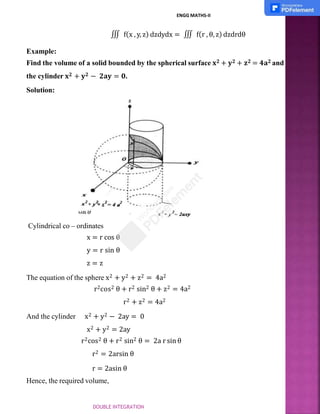
Find the volume of a solid bounded by the spherical surface 𝐱𝟐 + 𝐲𝟐 + 𝐳𝟐 = 𝟒𝐚𝟐 and
the cylinder 𝐱𝟐 + 𝐲𝟐 − 𝟐𝐚𝐲 = 𝟎.
Solution:
Cylindrical co – ordinates
x = r cos θ
y = r sin θ
z = z
The equation of the sphere x2 + y2 + z2 = 4a2
r2cos2 θ + r2 sin2 θ + z2 = 4a2
r2 + z2 = 4a2
And the cylinder x2 + y2 − 2ay = 0
x2 + y2 = 2ay
r2cos2 θ + r2 sin2 θ = 2a r sin θ
r2 = 2arsin θ
r = 2asin θ
Hence, the required volume,
DOUBLE INTEGRATION
∫
√4a2− r2
r dz dr dθ
0
r√4a2 − r2 dr dθ
Volume = ∫ ∫ ∫ dx dy dz
= ∫ ∫ ∫ r dθ dr dz
= 4 ∫
π⁄2
∫
2a sin θ
0 0
= 4 ∫
π⁄2
∫
2a sin θ
0 0
3 0
= 4 ∫
π⁄2
[− 1
(4a2 − r2)3⁄2]
2a sin θ
dθ
0
3 0
= 4
∫
π⁄2
[−(4a2 − 4a2 sin2 θ)3⁄2 + 8a3] dθ
= 4
3
∫
π⁄2
(−8a3 cos3 θ + 8a3) dθ
0
3
= 4
8a3 ∫
π⁄2
(1 − cos3 θ) dθ
0
3 2 3
=
32 a3
[
π
−
2
] cubic units
Example:
Find the volume of the portion of the cylinder 𝐱𝟐 + 𝐲𝟐 = 𝟏 intercepted between the
plane 𝐱 = 𝟎 and the paraboloid 𝐱𝟐 + 𝐲𝟐 = 𝟒 − 𝐳.
Solution:
Cylindrical co – ordinates
𝑥 = 𝑟 𝑐𝑜𝑠 𝜃
𝑦 = 𝑟 𝑠𝑖𝑛 𝜃
𝑧 = 𝑧
Given x2 + y2 = 1
r2cos2 θ + r2 sin2 θ = 1
r2 = 1
r = ±1
Given x2 + y2 = 4 − z
r2cos2 θ + r2 sin2 θ = 4 − z
r2 = 4 − z
z = 4 − r2
ENGG MATHS-II
DOUBLE INTEGRATION
ENGG MATHS-II
Hence the required volume
Volume = ∫ ∫ ∫ r dz dr dθ
∫
4− r2
r dz dr dθ
4− r
0
2
dr dθ
r (4 − r2) dr dθ
(4r − r3) dr dθ
= ∫
2π
∫
1
0 0 0
= ∫
2π
∫
1
r [z]
0 0
= ∫
2π
∫
1
0 0
= ∫
2π
∫
1
0 0
2
r4
− 4
] dθ
2π
[4r2
= ∫0
4
[(2 −
1
) − (0 − 0)] dθ
= ∫
2π
0
4
7
dθ
= ∫
2π
0
4 0
=
7
[θ] 2π
=
7
[2π − 0]
4 2
=
7
π cubic.units
Example:
Find the volume bounded by the paraboloid 𝐱𝟐 + 𝐲𝟐 = 𝐚𝐳, and the cylinder
𝐱𝟐 + 𝐲𝟐 = 𝟐𝐚𝐲 and the plane 𝐳 = 𝟎
Solution:
Cylindrical co – ordinates
x = r cos θ
y = r sin θ
z = z
The equation of the sphere x2 + y2+= az
r2cos2 θ + r2 sin2 θ = az
r2 = az
And the cylinder x2 + y2 = 2ay
r2cos2 θ + r2 sin2 θ = 2a r sin θ
r2 = 2arsin θ
DOUBLE INTEGRATION
r = 2asin θ
Hence, the required volume,
Volume = ∫ ∫ ∫ dx dy dz
= ∫ ∫ ∫ r dθ dr dz
r2
0
π 2a sin θ
=∫
0 ∫
0 ∫ a r dz dr dθ
0
r2
[z]a
rdrdθ
∫
2a sin θ
=∫
π
0 0
r3
[ a
] drdθ
π 2a sin θ
=∫0 ∫0
= 1
∫
a 4 0
r4 2a sin θ
π
0 [ ] dθ
a 4
0
= 1
∫
π 16a4sin4θ
dθ
π
2
= 4a3 × 2 ∫
⁄
sin4θdθ
0
= 4a3 × 2
3 1 π
= 3πa3
4 2 2 2
Change of variables from Cartesian Co – ordinates to spherical Polar Co – ordinates
To convert from Cartesian to spherical polar co-ordinates system we have the
following transformation
𝑥 = 𝑟𝑠𝑖𝑛𝜃𝑐𝑜𝑠𝜑 y = rsinθsinφ z = rcosθ
J =
∂(r ,θ,φ )
∂(X ,y,z)
= r2sinθ
Hence the integral becomes
∭ f(x , y, z) dzdydx = ∭ f(r , θ, z)r2sinθdrdθdφ
Example:
Evaluate ∫ ∫ ∫
𝟏
√𝟏− 𝐱𝟐− 𝐲𝟐− 𝐳𝟐
𝐝𝐱 𝐝𝐲 𝐝𝐳 over the region bounded by the sphere
𝐱𝟐 + 𝐲𝟐 + 𝐳𝟐 = 𝟏.
Solution:
Let us transform this integral in spherical polar co – ordinates by taking
ENGG MATHS-II
DOUBLE INTEGRATION
x = r sin θ cos ϕ
y = r sin θ sin ϕ
z = r cos θ
dx dy dz = (r2 sin θ) dr dθ dϕ
Hence ϕ varies from 0 to 2π
ϕ varies from 0 to π
ϕ varies from 0 to 1
r2 sin θ dr dθ d ϕ
0 √1− r2
= ∫
2π
∫
π
∫
1 1
0 0
0 0
r2
= [∫
2π
dϕ ] [∫
π
sin θ dθ] [∫
1
0 √1− r2
dr]
0 0
r2
dr
= [ϕ] 2π [– cosθ] π ∫
1
0 √1 − r2
r2
dr
= (2π − 0) ( 1 + 1) ∫
1
0 √1 − r2
r2
= 4π ∫
1
dr
0 √1 − r2
Put r = sint ; dr = cost dt
r = 0 ⇒ t = 0
r = 1 ⇒ t =
π
2
sin2 t
√1 − sin2t
cost dt
= 4π ∫
π⁄2
0
√ cos2t
= 4π ∫
π⁄2 sin2 t
cost dt
0
cost
= 4π ∫
π⁄2 sin2 t
cos t dt
0
= 4π ∫
π⁄2
sin2 t dt
0
2 2
= 4π
1 π
= π2
Example:
∫√𝐱𝟐+𝐲𝟐
𝐝𝐳 𝐝𝐲 𝐝𝐱
√𝐱𝟐+ 𝐲𝟐+ 𝐳𝟐
𝟏 √𝟏− 𝐱𝟐 𝟏
Evaluate ∫𝟎 ∫𝟎
Solution:
ENGG MATHS-II
DOUBLE INTEGRATION
Given 𝑥 varies from 0 to 1
y varies from 0 to √1 − x2
z varies from √x2 + y2 to 1
Let us transform this integral into spherical polar co – ordinates by using
x = r sin θ cos ϕ
y = r sin θ sin ϕ
z = r cos θ
dx dy dz = (r2 sin θ) dr dθ dϕ
Let z = √x2 + y2
⇒ z2 = x2 + y2
⇒ r2 cos2 θ = r2 sin2θ cos2ϕ + r2 sin2θ sin2ϕ
⇒ cos2 θ = sin2 θ [∵ cos2ϕ + sin2ϕ = 1 ]
⇒ θ =
π
4
Let 𝑧 = 1
⇒ 𝑟 𝑐𝑜𝑠 𝜃 = 1
⇒ 𝑟 =
1
𝑐𝑜𝑠
𝜃
⇒ 𝑟 = 𝑠𝑒𝑐 𝜃
The region of integration is common to the cone z2 = x2 + y2 and the cylinder
x2 + y2 = 1 bounded by the plane z = 1 in the positive octant.
r = 0 to r = sec θ
θ = 0 to θ =
π
4
Limits of r ∶
Limits of θ ∶
Limits of ϕ ∶ ϕ = 0 to ϕ =
π
2
r
= ∫
π⁄2
∫
π⁄4
∫
sec θ 1
r2 sin θ dr dθ dϕ
0 0 0
= ∫
π⁄2
∫
π⁄4
∫
sec θ
r sin θ dr dθ dϕ
0 0 0
r2 sec θ
π⁄2 π⁄4
= ∫0 ∫0 [sin θ 2
]
0
dθ dϕ
2
π⁄2 π⁄4 sec2θ sin θ−0
= ∫0 ∫0 [ ] dθ dϕ
2
0 0
= ∫
π⁄2
∫
π⁄4 1
sec θ tan θ dθ dϕ
2 0 0
= [1
∫
π⁄2
dϕ ] [∫
π⁄4
sec θ tan θ dθ ]
ENGG MATHS-II
DOUBLE INTEGRATION
2 0 0
=
1
[ θ ] π⁄2
[secθ] π⁄4
2 2
=
1
[
π
− 0] [√2 − 1]
4
=
π
(√2 − 1)
Example:
Evaluate ∫ ∫ ∫ (𝐱𝟐 + 𝐲𝟐 + 𝐳𝟐 )𝐝𝐱 𝐝𝐲 𝐝𝐳 taken over the region bounded by the
volume enclosed by the sphere 𝐱𝟐 + 𝐲𝟐 + 𝐳𝟐 = 𝟏.
Solution:
Let us convert the given integral into spherical polar co – ordinates.
x = r sin θ cos ϕ ⇒ x2 = r2 sin2 θ cos2 ϕ
y = r sin θ sin ϕ ⇒ y2 = r2 sin2 θ sin2 ϕ
z = r cos θ ⇒ z2 = r2 cos2 θ
dx dy dz = (r2 sin θ) dr dθ dϕ
∫ ∫ ∫ (x2 + y2 + z2 )dx dy dz = ∫
π
∫
2π
∫
1
r2 (r2 sin θ dθ dϕ dr)
0 0 0
Limits of r ∶
Limits of θ ∶
Limits of ϕ ∶
r = 0 to r = 1
θ = 0 to θ = π
ϕ = 0 to ϕ = 2π
∫ ∫ ∫ (x2 + y2 + z2 )dx dy dz = ∫
π
∫
2π
∫
1
r2 (r2 sin θ dθ dϕ dr)
0 0 0
= [∫
1
r4 dr] [∫
π
sin θ dθ] [∫
2π
dϕ]
0 0 0
r5 1
0
π
= [ 5
]
0
[– cos θ] [ϕ]2π
0
5
= (
1
− 0) (1 + 1) (2π − 0)
= (
1
) (2) (2π) =
4π
5 5
ENGG MATHS-II
DOUBLE INTEGRATION

Double Integration examples of double integration with substitution.pptx

  • 1.
    Change into polarco-ordinates and then evaluate ∫ ∞ ∫ ∞ 𝐞−(𝐱𝟐+𝐲𝟐)𝐝𝐲𝐝𝐱 𝟎 𝟎 Solution: Given order 𝑑𝑦𝑑𝑥 is in correct form. Given limits are 𝑦 ∶ 0 → ∞ , 𝑥 ∶ 0 → ∞ Equations are 𝑦 = 0 , 𝑦 = ∞ , 𝑥 = 0 , 𝑥 = ∞ Replacement: ENGG MATHS-II 5.4 Change of variables in Double and Triple integrals: Evaluation of double integrals by changing Cartesian to polar co- ordinates: Working rule: Step:1 Check the given order whether it is correct or not. Step:2 Write the equations by using given limits. Step:3 By using the equations sketch the region of integration. Step:4 Replacement: put x = rcos𝜃 , y = rsin𝜃 , x2 + y2 = r2 and dxdy = rdrd𝜃 Step:5 Find r limits(draw radial strip inside the region) and θ limits and evaluate the integral. Example: DOUBLE INTEGRATION
  • 2.
    ENGG MATHS-II Put x2+ y2 = r2 , dydx = rdrd𝜃 Limits: r : 0→ ∞ , θ: 0 → π 2 ∞ e−r2 rdrdθ π ∫ ∞ ∫ ∞ e−(X2+y2)dydx = ∫2 ∫ 0 0 0 0 Substitution: Put r2 = t , if r = 0 ⇒ t = 0, r = ∞ ⇒ t = ∞ 2rdr = dt t: 0→ ∞ rdr = 𝑑𝑡 π ∫2 ∫ 0 0 2 ∞ e−t dt dθ π 2 ∞ e−r2 rdrdθ = ∫2 ∫ 0 0 1 2 −1 0 e−t ∞ π 0 = ∫2 [ ] dθ = −∞ 0 + e )dθ π ∫2(−e 0 = 1 2 1 2 π ∫2(0 + 1)dθ 0 (∵ e−∞ = 0, e0 = 1) 1 2 π = ∫2 dθ 0 2 0 π = 1 (θ)2 = 1 ( π − 0) = 2 2 π 4 Example: 𝐱 𝐝𝐲𝐝𝐱 𝐲 𝐱𝟐+𝐲𝟐 Change into polar co-ordinates and then evaluate ∫ 𝐚 ∫ 𝐚 𝟎 Solution: Given order 𝑑𝑥𝑑𝑦 is in correct form. DOUBLE INTEGRATION
  • 3.
    ENGG MATHS-II Given limitsare x : y→ 𝑎 , y : 0→ 𝑎 Equations are x =y , x = 𝑎 , y = 0 , y = 𝑎 Replacement: Put x = rcos𝜃 , 𝑥2 + 𝑦2 = 𝑟2 , 𝑑𝑥𝑑𝑦 = 𝑟𝑑𝑟𝑑𝜃 Limits: r : 0 → 𝑎 , 𝜃: 0 → 𝜋 𝑐𝑜𝑠𝜃 4 ∫ ∫ 𝑎 𝑎 𝑥 𝑥 +𝑦 2 2 𝑑𝑦𝑑𝑥 = ∫ ∫ 0 𝑦 𝑟2 𝑟𝑑𝑟𝑑𝜃 𝑎 𝑟𝑐𝑜𝑠𝜃 𝜋 4 𝑐𝑜 𝑠 𝜃 0 0 0 𝑎 𝜋 = ∫4[𝑟𝑐𝑜𝑠𝜃]𝑐𝑜𝑠𝜃 𝑑𝜃 𝑎 𝑐𝑜𝑠 𝜃 0 𝜋 = ∫4 ( 0 𝑐𝑜𝑠𝜃 − 0) 𝑑𝜃 𝜋 = 𝑎 ∫4 𝑑𝜃 0 0 𝜋 = 𝑎(𝜃)4 4 = 𝑎( 𝜋 − 0) = 𝑎𝜋 4 Example: 𝐱𝟐 𝐲 √𝐱𝟐+𝐲𝟐 Evaluate ∫ 𝐚 ∫ 𝐚 𝟎 𝐝𝐱𝐝𝐲 by changing into polar co-ordinates. Solution: Given order 𝑑𝑥𝑑𝑦 is in correct form. Given limits are x : y→ 𝑎 , y : 0→ 𝑎 DOUBLE INTEGRATION
  • 4.
    ENGG MATHS-II Equations arex =y , x = 𝑎 , y = 0 , y = 𝑎 Replacement: Put x2 = r2cos2𝜃 , 𝑥2 + 𝑦2 = 𝑟2 => 𝑟 = √𝑥2 + 𝑦2 , dxdy = rdrd𝜃 Limits: r : 0 → 𝑎 , 𝜃: 0 → 𝜋 𝑐𝑜𝑠𝜃 4 ∫ ∫ 𝑥2 √𝑥 +𝑦 2 2 𝑑𝑥𝑑𝑦 = ∫ ∫ 𝑎 𝑎 0 𝑦 𝑟 𝑟𝑑𝑟𝑑𝜃 𝑎 𝑟2𝑐𝑜𝑠2𝜃 𝜋 4 𝑐 𝑜 𝑠 𝜃 0 0 3 3 𝜋 = ∫4 [𝑟 𝑎 𝑐𝑜𝑠2𝜃] 𝑐𝑜𝑠𝜃 𝑑𝜃 0 𝑎3 3 3𝑐𝑜𝑠 𝜃 2 0 𝜋 = ∫4 ( 0 𝑐𝑜𝑠 𝜃 − 0) 𝑑𝜃 = 𝑎3 1 3 2 𝜋 ∫4 3 0 𝑐𝑜𝑠 𝜃 𝑐𝑜𝑠 𝜃 𝑑𝜃 = 𝑎3 1 𝜋 3 0 𝑐𝑜𝑠𝜃 ∫4 𝑑𝜃 = 𝜋 0 ∫4 𝑠𝑒𝑐𝜃 𝑑𝜃 = 𝑎3 3 𝑎3 3 0 𝜋 (𝑙𝑜𝑔(𝑠𝑒𝑐𝜃 + 𝑡𝑎𝑛𝜃))4 = 𝑎3 [𝑙𝑜𝑔 (𝑠𝑒𝑐 𝜋 + 𝑡𝑎𝑛 𝜋 ) − 𝑙𝑜𝑔(𝑠𝑒𝑐0 + 𝑡𝑎𝑛0)] 3 4 4 3 = 𝑎3 [𝑙𝑜𝑔(√2 + 1) − 𝑙𝑜𝑔(1 − 0)] 3 = 𝑎3 𝑙𝑜𝑔(√2 + 1) Note: 1. x2 + y2 = r2cos2θ + r2sin2θ = r2 2. ∫ cos 2 0 θdθ = ∫ 2 2 π π 2 0 sin θdθ = × 1 π 2 2 3. ∫ 4 cos θdθ = ∫ π 2 0 4 π 2 0 sin θdθ = × × 3 1 π 4 2 2 4. ∫ 2 2 π 2 0 cos θsin θdθ = × × 1 1 π 4 2 2 DOUBLE INTEGRATION
  • 5.
    Example: By changing intopolar co-ordinates and evaluate ∫ 𝟐𝐚 ∫ √𝟐𝐚𝐱−𝐱𝟐 (𝐱𝟐 + 𝐲𝟐)𝐝𝐲𝐝𝐱 𝟎 𝟎 Solution: Given order 𝑑𝑦𝑑𝑥 is in correct form. Given limits are y : 0→ √2𝑎𝑥 − 𝑥2 , x : 0→ 2𝑎 Equations are y = 0 , y = √2𝑎𝑥 − 𝑥2 , x = 0 , x = 2𝑎 y2 = 2ax − x2 x2 + y2 − 2ax = 0 is a circle with centre (a,0) and radius ‘a’. Replacement: Put x2 + y2 = r2 , 𝑑𝑥𝑑𝑦 = 𝑟𝑑𝑟𝑑𝜃 Limits: r : 0 → 2𝑎𝑐𝑜𝑠𝜃 , 𝜃: 0 → 𝜋 2 2𝑎𝑐𝑜𝑠𝜃 𝑟2 × 𝑟𝑑𝑟𝑑𝜃 𝜋 ∫ 2𝑎 ∫ √2𝑎𝑥−𝑥2 (𝑥2 + 𝑦2)𝑑𝑦𝑑𝑥 = ∫2 ∫ 0 0 0 0 3 𝑟 𝑑𝑟𝑑𝜃 2𝑎𝑐𝑜𝑠 𝜃 𝜋 = ∫2 ∫ 0 0 4 ] 0 r4 2acosθ π = ∫2 [ 0 dθ 4 π 24a4cos4θ = ∫2( 0 − 0) dθ π 0 = 4a4 ∫2 cos4θdθ ENGG MATHS-II DOUBLE INTEGRATION
  • 6.
    = 4a4 ×3 × 1 × π 4 2 2 (∵ ∫ 4 π 2 0 cos θdθ = × × 3 1 π 4 2 2 ) = 3πa4 4 Example: 𝐱 𝐱𝟐+𝐲𝟐 𝐝𝐱𝐝𝐲 By changing into polar co-ordinates and evaluate∫ 𝟐 ∫ √𝟐𝐱−𝐱𝟐 𝟎 𝟎 Solution: Given order 𝑑𝑥𝑑𝑦 is in incorrect form. X X2+y2 dydx The correct form is 𝑑𝑦𝑑𝑥 ⇒ ∫ 2 ∫ √2X−X2 0 0 Given limits are y : 0→ √2𝑥 − 𝑥2 , x : 0→ 2 Equations are y = 0 , y = √2𝑥 − 𝑥2 , x = 0 , x = 2 y2 = 2x − x2 x2 + y2 − 2x = 0 is a circle with centre (1,0) and radius ‘1’. Replacement: Put x = rcos𝜃, 𝑥2 + 𝑦2 = 𝑟2 , dxdy = rdrd𝜃 Limits: r : 0 → 2𝑐𝑜𝑠𝜃 , 𝜃: 0 → 𝜋 2 𝑥 +𝑦 2 2 𝑑𝑦𝑑𝑥 = ∫ ∫ 2 √2𝑥−𝑥2 𝑥 ∫0∫0 𝑟2 2𝑐𝑜𝑠𝜃 𝑟𝑐𝑜𝑠𝜃 × 𝑟𝑑𝑟𝑑𝜃 𝜋 2 0 0 0 𝜋 0 =∫2[𝑟𝑐𝑜𝑠𝜃]2𝑐𝑜𝑠𝜃 𝑑𝜃 𝜋 0 = ∫2(2𝑐𝑜𝑠2𝜃 − 0)𝑑𝜃 ENGG MATHS-II DOUBLE INTEGRATION
  • 7.
    𝜋 0 = 2 ∫2𝑐𝑜𝑠2𝜃 𝑑𝜃 = 2 × 1 × 𝜋 2 2 (∵ ∫ 2 𝜋 2 0 1 𝜋 2 2 𝑐𝑜𝑠 𝜃𝑑𝜃 = × ) = 𝜋 2 Example: By changing into polar co-ordinates and evaluate∫ 𝐚 ∫ √𝐚𝟐−𝐱𝟐 √𝐱𝟐 + 𝐲𝟐𝐝𝐲𝐝𝐱 𝟎 𝟎 Solution: Given order 𝑑𝑥𝑑𝑦 is in correct form. Given limits are y : 0→ √𝑎2 − 𝑥2 , x : 0→ 𝑎 Equations are y = 0 , y = √𝑎2 − 𝑥2 , x = 0 , x = 𝑎 y2 = a2 − x2 x2 + y2 = a2 is a circle with centre (0,0) and radius ‘a’. Replacement: Put x2 + y2 = r2 ⇒ r = √x2 + y2 , 𝑑𝑦𝑑𝑥 = 𝑟𝑑𝑟𝑑𝜃 Limits: r : 0 → 𝑎 , 𝜃: 0 → 𝜋 a r × rdrdθ 2 π ∫ a ∫ √a2−X2 √x2 + y2dydx = ∫2 ∫ 0 0 0 0 a r2drdθ π = ∫2 ∫ 0 0 3 π r3 a = ∫2 [ 0 ] dθ 0 ENGG MATHS-II DOUBLE INTEGRATION
  • 8.
    a3 3 π = ∫2 ( 0 −0)dθ = a3 3 π ∫2 dθ 0 a3 3 0 π = (θ)2 3 2 = a3 ( π − 0) = πa3 6 Example: 𝐱𝟐+𝐲𝟐 Evaluate ∬ 𝐱𝟐𝐲𝟐 𝐝𝐱𝐝𝐲 over the annular region between the circles x2 + y2 = a2 and x2 + y2 = b2 (b>a) by transforming into polar co-ordinates. Solution: 𝑥2+𝑦2 𝑟2 Replacement: Put x2 = r2cos2θ,y2 = r2sin2θ x2 + y2 = r2, 𝑑𝑥𝑑𝑦 = 𝑟𝑑𝑟𝑑𝜃 Given the region is between the circles x2 + y2 = a2 and x2 + y2 = b2 Limits: r : 𝑎 → 𝑏 , 𝜃: 0 → 2𝜋 ∴ ∬ 𝑥2𝑦2 𝑑𝑥𝑑𝑦 = ∫ 2𝜋 ∫ 𝑏 𝑟2𝑐𝑜𝑠2𝜃×𝑟2𝑠𝑖𝑛2𝜃 × 𝑟𝑑𝑟𝑑𝜃 0 𝑎 ENGG MATHS-II DOUBLE INTEGRATION
  • 9.
    r2 0 a ENGG MATHS-II =∫ 2π ∫ b r5cos2θ×sin2θ × drdθ = ∫ 2π ∫ b r3cos2θ × sin2θ drdθ 0 a 4 a r4 b 2π 2 2 = ∫0 [ ] cos θ × sin θ dθ 4 0 = 1 ∫ 2π (b4 − a4) cos2θ × sin2θ dθ 4 = (b4−a4) ∫ 2π cos2θ × sin2θ dθ 0 = 4 4 (b −a ) 4 × ∫ π 2 4 0 2π 0 cos2θ × sin2θ dθ (∵ ∫ = 4∫ ) π 2 0 π = ( b4 − a4) × ∫2 cos2θ × sin2θ dθ 0 4 2 2 = ( b4 − a4) × 1 × 1 × π (∵ ∫ 2 2 π 2 0 1 1 π 4 2 2 cos θsin θdθ = × × ) = π(b4−a4) 16 Example: 𝟎 𝟎 Evaluate ∫ 𝐚 ∫ √𝐚𝟐−𝐱𝟐 √𝐚𝟐 − 𝐱𝟐 − 𝐲𝟐 𝐝𝐲𝐝𝐱 by transforming into polar co-ordinates. Solution: Given order 𝑑𝑦𝑑𝑥 is in correct form. Given limits are y : 0→ √𝑎2 − 𝑥2 , x : 0→ 𝑎 Equations are y = 0 , y = √𝑎2 − 𝑥2 , x = 0 , x = 𝑎 𝑦2 = 𝑎2 − 𝑥2 x2 + y2 = a2 is a circle with centre (0,0) and radius ‘a’. DOUBLE INTEGRATION
  • 10.
    ENGG MATHS-II Replacement: Put a2− x2 − y2 = a2 − (x2 + y2) = a2 − r2 , 𝑑𝑦𝑑𝑥 = 𝑟𝑑𝑟𝑑𝜃 ∴ √a2 − x2 − y2 = √a2 − r2 Limits: r : 0 → 𝑎 , 𝜃: 0 → 𝜋 2 𝑎 √𝑎2 − 𝑟2 𝑟𝑑𝑟𝑑𝜃 𝜋 ∫ 𝑎 ∫ √𝑎2−𝑥2 √𝑎2 − 𝑥2 − 𝑦2 𝑑𝑦𝑑𝑥 = ∫2 ∫ 0 0 0 0 = 2 2 − 𝑟 𝑟𝑑𝑟)𝑑𝜃 𝑎 𝜋 ∫2(∫ √𝑎 0 0 Substitution: Put a2 − r2 = t −2rdr = dt if r = 0 ⇒ t = a2 if r = a ⇒ t = 0 rdr = − dt 2 ∴ t ∶ a2 → 0 2 2 a π ∫2(∫ √a − r 0 0 −dt 2 0 π rdr)dθ = ∫2[∫ 2 √t( )]dθ 0 a 2 −1 0 π = ∫2[∫ 2 √tdt]dθ 0 a = −1 2 1 0 π ∫2[∫ 2 t2dt]dθ 0 a = −1 2 ∫ t 3 2 3 2 a2 0 π 2 0 [ ] dθ = − × 1 2 2 3 π 3 0 0 a2 ∫2 [t2] dθ 1 3 3 2 π = − ∫2(0 − (a )2)dθ = − 1 3 ∫ 0 π 3 − (a ) dθ 2 0 = a3 3 π ∫2 dθ 0 a3 3 0 π = (θ)2 DOUBLE INTEGRATION
  • 11.
    3 2 = a3 ( π − 0) = πa3 6 Exercise: Evaluatethe following by changing into polar co-ordinates. 1. ∫ 2𝑎 ∫ √2𝑥−𝑥2 𝑑𝑦𝑑𝑥 0 0 Ans: 𝜋𝑎2 2 2. ∫ 𝑎 ∫ √𝑎2−𝑥2 (𝑥2 + 𝑦2)𝑑𝑦𝑑𝑥 0 0 Ans: 𝜋𝑎4 8 𝑥2 3. ∫ 1 ∫ 2−𝑥 𝑥𝑦 𝑑𝑥𝑑𝑦 0 Ans: 3 8 𝑥 𝑑𝑥𝑑𝑦 𝑦 𝑥2+𝑦2 4. ∫ 𝑎 ∫ 𝑎 0 Ans: 𝜋𝑎 4 𝑥2+𝑦2 𝑑𝑥𝑑𝑦 5. ∫ 2𝑎 ∫ √2𝑎𝑥−𝑥2 𝑥 0 0 Ans: 𝜋𝑎 2 6. ∫ 𝑎 ∫ √𝑎2−𝑥2 (𝑥2 + 𝑦2)𝑑𝑦𝑑𝑥 −𝑎 0 Ans: 𝜋𝑎4 4 7. ∫ 𝑎 ∫ √𝑎2−𝑥2 (𝑥2𝑦 + 𝑦3)𝑑𝑥𝑑𝑦 0 0 Ans: 𝑎5 5 8. ∫ 1 ∫ √2𝑥−𝑥2 (𝑥2 + 𝑦2)𝑑𝑦𝑑𝑥 0 0 8 Ans: 3𝜋 − 1 X2+y2 9. ∬ X2y2 dxdy over the annular region between the circles x2 + y2 = 16 and x2 + y2 = 4 Ans:15π 10.∬ Xy X2+y2 dxdy over the positive quadrant of the circle x2 + y2 = a2 Ans: a3 6 Change of Variables in Triple Integral Change of variables from Cartesian co- ordinates to cylindrical co – ordinates. To convert from Cartesian to cylindrical polar coordinates system we have the following transformation. 𝑥 = 𝑟 𝑐𝑜𝑠𝜃 𝑦 = 𝑟 𝑠𝑖𝑛𝜃 𝑧 = 𝑧 J = ∂(X ,y,z) = r ∂(r ,θ,z) Hence the integral becomes ENGG MATHS-II DOUBLE INTEGRATION
  • 12.
    ENGG MATHS-II ∭ f(x, y, z) dzdydx = ∭ f(r , θ, z) dzdrdθ Example: Find the volume of a solid bounded by the spherical surface 𝐱𝟐 + 𝐲𝟐 + 𝐳𝟐 = 𝟒𝐚𝟐 and the cylinder 𝐱𝟐 + 𝐲𝟐 − 𝟐𝐚𝐲 = 𝟎. Solution: Cylindrical co – ordinates x = r cos θ y = r sin θ z = z The equation of the sphere x2 + y2 + z2 = 4a2 r2cos2 θ + r2 sin2 θ + z2 = 4a2 r2 + z2 = 4a2 And the cylinder x2 + y2 − 2ay = 0 x2 + y2 = 2ay r2cos2 θ + r2 sin2 θ = 2a r sin θ r2 = 2arsin θ r = 2asin θ Hence, the required volume, DOUBLE INTEGRATION
  • 13.
    ∫ √4a2− r2 r dzdr dθ 0 r√4a2 − r2 dr dθ Volume = ∫ ∫ ∫ dx dy dz = ∫ ∫ ∫ r dθ dr dz = 4 ∫ π⁄2 ∫ 2a sin θ 0 0 = 4 ∫ π⁄2 ∫ 2a sin θ 0 0 3 0 = 4 ∫ π⁄2 [− 1 (4a2 − r2)3⁄2] 2a sin θ dθ 0 3 0 = 4 ∫ π⁄2 [−(4a2 − 4a2 sin2 θ)3⁄2 + 8a3] dθ = 4 3 ∫ π⁄2 (−8a3 cos3 θ + 8a3) dθ 0 3 = 4 8a3 ∫ π⁄2 (1 − cos3 θ) dθ 0 3 2 3 = 32 a3 [ π − 2 ] cubic units Example: Find the volume of the portion of the cylinder 𝐱𝟐 + 𝐲𝟐 = 𝟏 intercepted between the plane 𝐱 = 𝟎 and the paraboloid 𝐱𝟐 + 𝐲𝟐 = 𝟒 − 𝐳. Solution: Cylindrical co – ordinates 𝑥 = 𝑟 𝑐𝑜𝑠 𝜃 𝑦 = 𝑟 𝑠𝑖𝑛 𝜃 𝑧 = 𝑧 Given x2 + y2 = 1 r2cos2 θ + r2 sin2 θ = 1 r2 = 1 r = ±1 Given x2 + y2 = 4 − z r2cos2 θ + r2 sin2 θ = 4 − z r2 = 4 − z z = 4 − r2 ENGG MATHS-II DOUBLE INTEGRATION
  • 14.
    ENGG MATHS-II Hence therequired volume Volume = ∫ ∫ ∫ r dz dr dθ ∫ 4− r2 r dz dr dθ 4− r 0 2 dr dθ r (4 − r2) dr dθ (4r − r3) dr dθ = ∫ 2π ∫ 1 0 0 0 = ∫ 2π ∫ 1 r [z] 0 0 = ∫ 2π ∫ 1 0 0 = ∫ 2π ∫ 1 0 0 2 r4 − 4 ] dθ 2π [4r2 = ∫0 4 [(2 − 1 ) − (0 − 0)] dθ = ∫ 2π 0 4 7 dθ = ∫ 2π 0 4 0 = 7 [θ] 2π = 7 [2π − 0] 4 2 = 7 π cubic.units Example: Find the volume bounded by the paraboloid 𝐱𝟐 + 𝐲𝟐 = 𝐚𝐳, and the cylinder 𝐱𝟐 + 𝐲𝟐 = 𝟐𝐚𝐲 and the plane 𝐳 = 𝟎 Solution: Cylindrical co – ordinates x = r cos θ y = r sin θ z = z The equation of the sphere x2 + y2+= az r2cos2 θ + r2 sin2 θ = az r2 = az And the cylinder x2 + y2 = 2ay r2cos2 θ + r2 sin2 θ = 2a r sin θ r2 = 2arsin θ DOUBLE INTEGRATION
  • 15.
    r = 2asinθ Hence, the required volume, Volume = ∫ ∫ ∫ dx dy dz = ∫ ∫ ∫ r dθ dr dz r2 0 π 2a sin θ =∫ 0 ∫ 0 ∫ a r dz dr dθ 0 r2 [z]a rdrdθ ∫ 2a sin θ =∫ π 0 0 r3 [ a ] drdθ π 2a sin θ =∫0 ∫0 = 1 ∫ a 4 0 r4 2a sin θ π 0 [ ] dθ a 4 0 = 1 ∫ π 16a4sin4θ dθ π 2 = 4a3 × 2 ∫ ⁄ sin4θdθ 0 = 4a3 × 2 3 1 π = 3πa3 4 2 2 2 Change of variables from Cartesian Co – ordinates to spherical Polar Co – ordinates To convert from Cartesian to spherical polar co-ordinates system we have the following transformation 𝑥 = 𝑟𝑠𝑖𝑛𝜃𝑐𝑜𝑠𝜑 y = rsinθsinφ z = rcosθ J = ∂(r ,θ,φ ) ∂(X ,y,z) = r2sinθ Hence the integral becomes ∭ f(x , y, z) dzdydx = ∭ f(r , θ, z)r2sinθdrdθdφ Example: Evaluate ∫ ∫ ∫ 𝟏 √𝟏− 𝐱𝟐− 𝐲𝟐− 𝐳𝟐 𝐝𝐱 𝐝𝐲 𝐝𝐳 over the region bounded by the sphere 𝐱𝟐 + 𝐲𝟐 + 𝐳𝟐 = 𝟏. Solution: Let us transform this integral in spherical polar co – ordinates by taking ENGG MATHS-II DOUBLE INTEGRATION
  • 16.
    x = rsin θ cos ϕ y = r sin θ sin ϕ z = r cos θ dx dy dz = (r2 sin θ) dr dθ dϕ Hence ϕ varies from 0 to 2π ϕ varies from 0 to π ϕ varies from 0 to 1 r2 sin θ dr dθ d ϕ 0 √1− r2 = ∫ 2π ∫ π ∫ 1 1 0 0 0 0 r2 = [∫ 2π dϕ ] [∫ π sin θ dθ] [∫ 1 0 √1− r2 dr] 0 0 r2 dr = [ϕ] 2π [– cosθ] π ∫ 1 0 √1 − r2 r2 dr = (2π − 0) ( 1 + 1) ∫ 1 0 √1 − r2 r2 = 4π ∫ 1 dr 0 √1 − r2 Put r = sint ; dr = cost dt r = 0 ⇒ t = 0 r = 1 ⇒ t = π 2 sin2 t √1 − sin2t cost dt = 4π ∫ π⁄2 0 √ cos2t = 4π ∫ π⁄2 sin2 t cost dt 0 cost = 4π ∫ π⁄2 sin2 t cos t dt 0 = 4π ∫ π⁄2 sin2 t dt 0 2 2 = 4π 1 π = π2 Example: ∫√𝐱𝟐+𝐲𝟐 𝐝𝐳 𝐝𝐲 𝐝𝐱 √𝐱𝟐+ 𝐲𝟐+ 𝐳𝟐 𝟏 √𝟏− 𝐱𝟐 𝟏 Evaluate ∫𝟎 ∫𝟎 Solution: ENGG MATHS-II DOUBLE INTEGRATION
  • 17.
    Given 𝑥 variesfrom 0 to 1 y varies from 0 to √1 − x2 z varies from √x2 + y2 to 1 Let us transform this integral into spherical polar co – ordinates by using x = r sin θ cos ϕ y = r sin θ sin ϕ z = r cos θ dx dy dz = (r2 sin θ) dr dθ dϕ Let z = √x2 + y2 ⇒ z2 = x2 + y2 ⇒ r2 cos2 θ = r2 sin2θ cos2ϕ + r2 sin2θ sin2ϕ ⇒ cos2 θ = sin2 θ [∵ cos2ϕ + sin2ϕ = 1 ] ⇒ θ = π 4 Let 𝑧 = 1 ⇒ 𝑟 𝑐𝑜𝑠 𝜃 = 1 ⇒ 𝑟 = 1 𝑐𝑜𝑠 𝜃 ⇒ 𝑟 = 𝑠𝑒𝑐 𝜃 The region of integration is common to the cone z2 = x2 + y2 and the cylinder x2 + y2 = 1 bounded by the plane z = 1 in the positive octant. r = 0 to r = sec θ θ = 0 to θ = π 4 Limits of r ∶ Limits of θ ∶ Limits of ϕ ∶ ϕ = 0 to ϕ = π 2 r = ∫ π⁄2 ∫ π⁄4 ∫ sec θ 1 r2 sin θ dr dθ dϕ 0 0 0 = ∫ π⁄2 ∫ π⁄4 ∫ sec θ r sin θ dr dθ dϕ 0 0 0 r2 sec θ π⁄2 π⁄4 = ∫0 ∫0 [sin θ 2 ] 0 dθ dϕ 2 π⁄2 π⁄4 sec2θ sin θ−0 = ∫0 ∫0 [ ] dθ dϕ 2 0 0 = ∫ π⁄2 ∫ π⁄4 1 sec θ tan θ dθ dϕ 2 0 0 = [1 ∫ π⁄2 dϕ ] [∫ π⁄4 sec θ tan θ dθ ] ENGG MATHS-II DOUBLE INTEGRATION
  • 18.
    2 0 0 = 1 [θ ] π⁄2 [secθ] π⁄4 2 2 = 1 [ π − 0] [√2 − 1] 4 = π (√2 − 1) Example: Evaluate ∫ ∫ ∫ (𝐱𝟐 + 𝐲𝟐 + 𝐳𝟐 )𝐝𝐱 𝐝𝐲 𝐝𝐳 taken over the region bounded by the volume enclosed by the sphere 𝐱𝟐 + 𝐲𝟐 + 𝐳𝟐 = 𝟏. Solution: Let us convert the given integral into spherical polar co – ordinates. x = r sin θ cos ϕ ⇒ x2 = r2 sin2 θ cos2 ϕ y = r sin θ sin ϕ ⇒ y2 = r2 sin2 θ sin2 ϕ z = r cos θ ⇒ z2 = r2 cos2 θ dx dy dz = (r2 sin θ) dr dθ dϕ ∫ ∫ ∫ (x2 + y2 + z2 )dx dy dz = ∫ π ∫ 2π ∫ 1 r2 (r2 sin θ dθ dϕ dr) 0 0 0 Limits of r ∶ Limits of θ ∶ Limits of ϕ ∶ r = 0 to r = 1 θ = 0 to θ = π ϕ = 0 to ϕ = 2π ∫ ∫ ∫ (x2 + y2 + z2 )dx dy dz = ∫ π ∫ 2π ∫ 1 r2 (r2 sin θ dθ dϕ dr) 0 0 0 = [∫ 1 r4 dr] [∫ π sin θ dθ] [∫ 2π dϕ] 0 0 0 r5 1 0 π = [ 5 ] 0 [– cos θ] [ϕ]2π 0 5 = ( 1 − 0) (1 + 1) (2π − 0) = ( 1 ) (2) (2π) = 4π 5 5 ENGG MATHS-II DOUBLE INTEGRATION