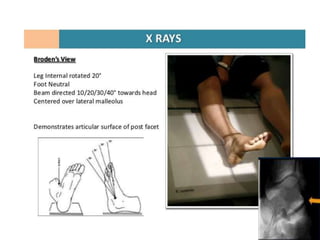
Calcaneum radiographic views
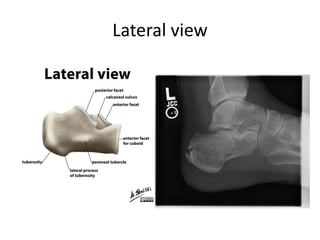
Lateral view
• This projection is use to assess
the calcaneum, talocrural,
talonavicular,and talocalcaneal
joint.
Lateral view
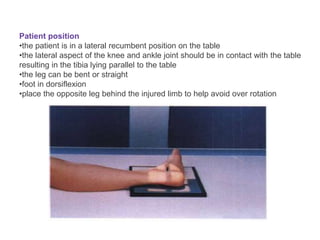
Patient position
•the patient is in a lateral recumbent position on the table
•the lateral aspect of the knee and ankle joint should be in contact with the table
resulting in the tibia lying parallel to the table
•the leg can be bent or straight
•foot in dorsiflexion
•place the opposite leg behind the injured limb to help avoid over rotation
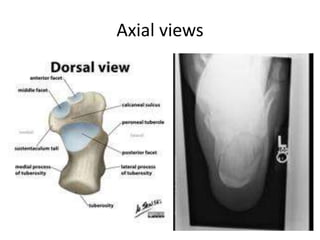
Axial view
• This projection is use to asses
the talocalcaneal joint and
plantar aspects of calcaneum.
Axial views
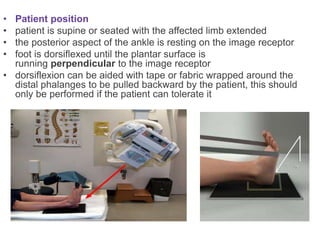
• Patient position
• patient is supine or seated with the affected limb extended
• the posterior aspect of the ankle is resting on the image receptor
• foot is dorsiflexed until the plantar surface is
running perpendicular to the image receptor
• dorsiflexion can be aided with tape or fabric wrapped around the
distal phalanges to be pulled backward by the patient, this should
only be performed if the patient can tolerate it
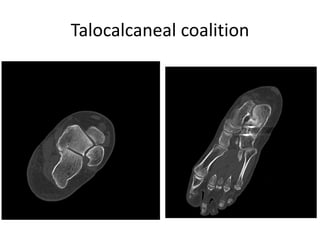
Harris view
• The Harris projection (also called
the penetrated axial projection) is a
special radiographic view that is used for
assessment of talocalcaneal coalition.
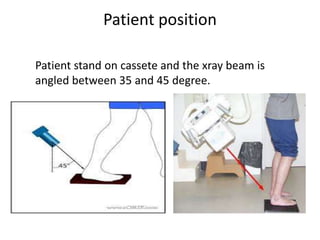
Patient position
Patient stand on cassete and the xray beam is
angled between 35 and 45 degree.
Talocalcaneal coalition
Calcaneum radiographic views

Calcaneum radiographic views

  • 1.
  • 2.
    Lateral view • Thisprojection is use to assess the calcaneum, talocrural, talonavicular,and talocalcaneal joint.
  • 3.
  • 4.
    Patient position •the patientis in a lateral recumbent position on the table •the lateral aspect of the knee and ankle joint should be in contact with the table resulting in the tibia lying parallel to the table •the leg can be bent or straight •foot in dorsiflexion •place the opposite leg behind the injured limb to help avoid over rotation
  • 5.
    Axial view • Thisprojection is use to asses the talocalcaneal joint and plantar aspects of calcaneum.
  • 6.
  • 7.
    • Patient position •patient is supine or seated with the affected limb extended • the posterior aspect of the ankle is resting on the image receptor • foot is dorsiflexed until the plantar surface is running perpendicular to the image receptor • dorsiflexion can be aided with tape or fabric wrapped around the distal phalanges to be pulled backward by the patient, this should only be performed if the patient can tolerate it
  • 8.
    Harris view • TheHarris projection (also called the penetrated axial projection) is a special radiographic view that is used for assessment of talocalcaneal coalition.
  • 9.
    Patient position Patient standon cassete and the xray beam is angled between 35 and 45 degree.
  • 10.