Created By Vivek
Sharma
Class-10
Roll No-17
Linear Equations
Definition of a Linear Equation
A linear equation in two variable x is an equation
that can be written in the form ax + by + c = 0,
where a ,b and c are real numbers and a and b is
not equal to 0.
An example of a linear equation in x is 2x – 3y + 4 = 0.
A pair of linear equations
in two variables can be
solved by the:
(i) Graphically method
(ii) Algebraic method
GRAPHICAL SOLUTIONS OF A
LINEAR EQUATION
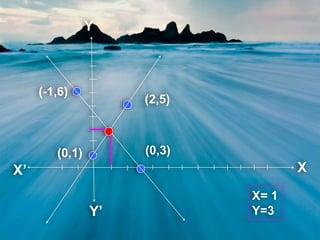
Let us consider the following system of
two simultaneous linear equations in
two variable.
2x – y = -1
3x + 2y = 9
Here we assign any value to one of the
two variables and then determine the
value of the other variable from the
given equation.
xxx 00
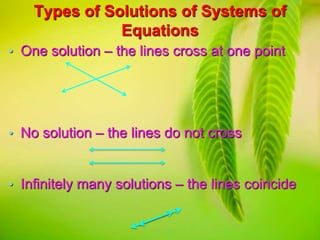
Types of Solutions of Systems of
Equations
• One solution – the lines cross at one point
• No solution – the lines do not cross
• Infinitely many solutions – the lines coincide
Algebraic method
TO SOLVE A PAIR
OF LINEAR
EQUATION IN TWO
VARIABLE
To solve a pair of linear equations in
two variables algebraically, we have
following methods:-
(i) Substitution method
(ii) Elimination method
(iii) Cross-multiplication
method
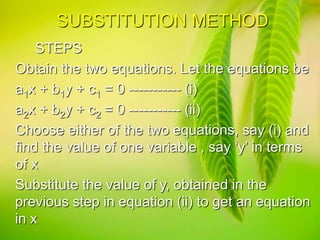
SUBSTITUTION METHOD
STEPS
Obtain the two equations. Let the equations be
a1x + b1y + c1 = 0 ----------- (i)
a2x + b2y + c2 = 0 ----------- (ii)
Choose either of the two equations, say (i) and
find the value of one variable , say ‘y’ in terms
of x
Substitute the value of y, obtained in the
previous step in equation (ii) to get an equation
in x
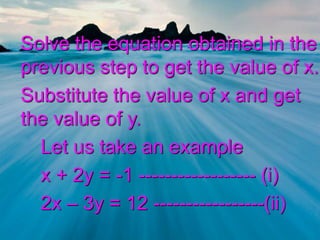
Solve the equation obtained in the
previous step to get the value of x.
Substitute the value of x and get
the value of y.
Let us take an example
x + 2y = -1 ------------------ (i)
2x – 3y = 12 -----------------(ii)
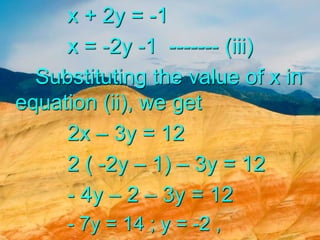
x + 2y = -1
x = -2y -1 ------- (iii)
Substituting the value of x in
equation (ii), we get
2x – 3y = 12
2 ( -2y – 1) – 3y = 12
- 4y – 2 – 3y = 12
- 7y = 14 ; y = -2 ,
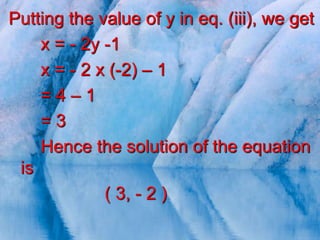
Putting the value of y in eq. (iii), we get
x = - 2y -1
x = - 2 x (-2) – 1
= 4 – 1
= 3
Hence the solution of the equation
is
( 3, - 2 )
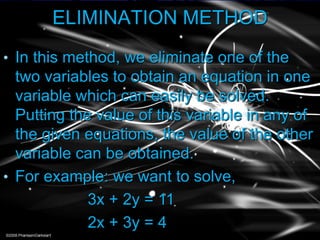
ELIMINATION METHOD
• In this method, we eliminate one of the
two variables to obtain an equation in one
variable which can easily be solved.
Putting the value of this variable in any of
the given equations, the value of the other
variable can be obtained.
• For example: we want to solve,
3x + 2y = 11
2x + 3y = 4
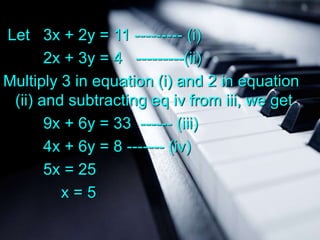
Let 3x + 2y = 11 --------- (i)
2x + 3y = 4 ---------(ii)
Multiply 3 in equation (i) and 2 in equation
(ii) and subtracting eq iv from iii, we get
9x + 6y = 33 ------ (iii)
4x + 6y = 8 ------- (iv)
5x = 25
x = 5
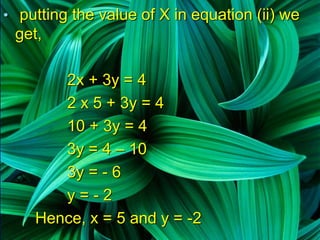
• putting the value of X in equation (ii) we
get,
2x + 3y = 4
2 x 5 + 3y = 4
10 + 3y = 4
3y = 4 – 10
3y = - 6
y = - 2
Hence, x = 5 and y = -2
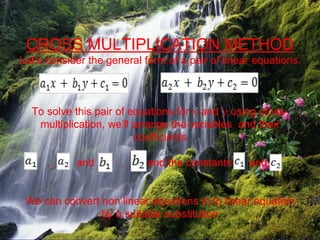
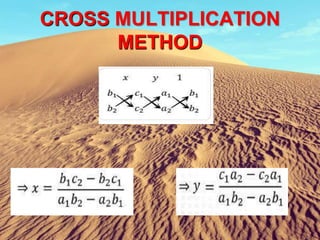
CROSS MULTIPLICATION METHOD
Let’s consider the general form of a pair of linear equations.
To solve this pair of equations for 𝑥 and 𝑦 using cross-
multiplication, we’ll arrange the variables and their
coefficients
, and , and the constants and
We can convert non linear equations in to linear equation
by a suitable substitution
CROSS MULTIPLICATION
METHOD
Maths

Maths

  • 1.
  • 2.
    Linear Equations Definition ofa Linear Equation A linear equation in two variable x is an equation that can be written in the form ax + by + c = 0, where a ,b and c are real numbers and a and b is not equal to 0. An example of a linear equation in x is 2x – 3y + 4 = 0.
  • 3.
    A pair oflinear equations in two variables can be solved by the: (i) Graphically method (ii) Algebraic method
  • 4.
    GRAPHICAL SOLUTIONS OFA LINEAR EQUATION Let us consider the following system of two simultaneous linear equations in two variable. 2x – y = -1 3x + 2y = 9 Here we assign any value to one of the two variables and then determine the value of the other variable from the given equation.
  • 5.
  • 7.
    Types of Solutionsof Systems of Equations • One solution – the lines cross at one point • No solution – the lines do not cross • Infinitely many solutions – the lines coincide
  • 8.
    Algebraic method TO SOLVEA PAIR OF LINEAR EQUATION IN TWO VARIABLE
  • 9.
    To solve apair of linear equations in two variables algebraically, we have following methods:- (i) Substitution method (ii) Elimination method (iii) Cross-multiplication method
  • 10.
    SUBSTITUTION METHOD STEPS Obtain thetwo equations. Let the equations be a1x + b1y + c1 = 0 ----------- (i) a2x + b2y + c2 = 0 ----------- (ii) Choose either of the two equations, say (i) and find the value of one variable , say ‘y’ in terms of x Substitute the value of y, obtained in the previous step in equation (ii) to get an equation in x
  • 11.
    Solve the equationobtained in the previous step to get the value of x. Substitute the value of x and get the value of y. Let us take an example x + 2y = -1 ------------------ (i) 2x – 3y = 12 -----------------(ii)
  • 12.
    x + 2y= -1 x = -2y -1 ------- (iii) Substituting the value of x in equation (ii), we get 2x – 3y = 12 2 ( -2y – 1) – 3y = 12 - 4y – 2 – 3y = 12 - 7y = 14 ; y = -2 ,
  • 13.
    Putting the valueof y in eq. (iii), we get x = - 2y -1 x = - 2 x (-2) – 1 = 4 – 1 = 3 Hence the solution of the equation is ( 3, - 2 )
  • 14.
    ELIMINATION METHOD • Inthis method, we eliminate one of the two variables to obtain an equation in one variable which can easily be solved. Putting the value of this variable in any of the given equations, the value of the other variable can be obtained. • For example: we want to solve, 3x + 2y = 11 2x + 3y = 4
  • 15.
    Let 3x +2y = 11 --------- (i) 2x + 3y = 4 ---------(ii) Multiply 3 in equation (i) and 2 in equation (ii) and subtracting eq iv from iii, we get 9x + 6y = 33 ------ (iii) 4x + 6y = 8 ------- (iv) 5x = 25 x = 5
  • 16.
    • putting thevalue of X in equation (ii) we get, 2x + 3y = 4 2 x 5 + 3y = 4 10 + 3y = 4 3y = 4 – 10 3y = - 6 y = - 2 Hence, x = 5 and y = -2
  • 17.
    CROSS MULTIPLICATION METHOD Let’sconsider the general form of a pair of linear equations. To solve this pair of equations for 𝑥 and 𝑦 using cross- multiplication, we’ll arrange the variables and their coefficients , and , and the constants and We can convert non linear equations in to linear equation by a suitable substitution
  • 18.