Newell McElwee, PharmD, MSPH
Merck Research Labs
Center for Outcomes and Real World Evidence
14 April 2015
Adaptive Design in Merck
Oncology Studies
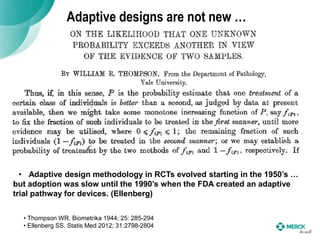
Adaptive designs are not new …
• Thompson WR. Biometrika 1944; 25: 285-294
• Ellenberg SS. Statis Med 2012; 31:2798-2804
• Adaptive design methodology in RCTs evolved starting in the 1950’s …
but adoption was slow until the 1990’s when the FDA created an adaptive
trial pathway for devices. (Ellenberg)
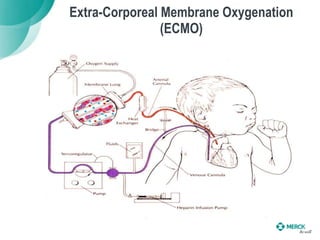
Extra-Corporeal Membrane Oxygenation
(ECMO)
Acknowledgements
Many people within Merck have contributed to the
planning, design, and execution of the adaptive trials used
in our pembrolizumab program. These include:
• Keaven Anderson, Ph.D. (Biostatistics)
• Cong Chen, Ph.D. (Biostatistics)
• Christine Gause, Ph.D. (Biostatistics)
• Eric Rubin, M.D. (Clinical Research)
Outline
• Types of designs
– Dose-finding
– Single-arm response rate studies
– Comparative studies
– Bayesian study design
• Driving theme: Biomarker-selected patient
populations
5
Dose-Finding Designs
• Modified TPI (toxicity profile interval) designs
– Very specific Bayesian design
– Dose escalation and de-escalation are table-driven
• No need for computer interaction like CRM
designs
– Preferred of traditional 3+3 designs
• Start similarly
• Allow confirmation of dose with further
adaptation beyond 6 patients
• Simple execution
6
Single-arm Response Rate Studies
• Very high response rates allow possible early access
for patients
– Single arm studies where no effective therapy exists
– Biomarker-selected population
• Evaluate in both biomarker-positive and
biomarker-negative patients
• Designs allow evaluation of effectiveness in
biomarker-positive and all-comer populations
• Early interim analysis to discontinue biomarker-
negative patients if no responses
7
Comparative Studies
• Dual primary endpoints:
– Overall survival (OS)
– Progression-free survival
• Multiple populations evaluated (depending on study)
– Overall
– Biomarker positive
– Biomarker strong-positive
• Possible early adaptation
– Discontinue biomarker negative
– Interim filing for PFS
– Early stop for both PFS and OS (e.g., Keynote-006)
8
Bayesian Adaptive Studies
• I-SPY 2 (ispy2.org)
– “..an innovative public-private collaboration that
combines Personalized Medicine & Novel Trial
Design to develop new cancer treatments much
faster and for much less cost.”
• Neoadjuvant phase 2 breast cancer study
– Accelerated development
– Adaptive biomarker and drug selection to generate
high probability of success in Phase 3
9

Cadth 2015 e4 mcelwee cadth 041415 fnl

  • 1.
    Newell McElwee, PharmD,MSPH Merck Research Labs Center for Outcomes and Real World Evidence 14 April 2015 Adaptive Design in Merck Oncology Studies
  • 2.
    Adaptive designs arenot new … • Thompson WR. Biometrika 1944; 25: 285-294 • Ellenberg SS. Statis Med 2012; 31:2798-2804 • Adaptive design methodology in RCTs evolved starting in the 1950’s … but adoption was slow until the 1990’s when the FDA created an adaptive trial pathway for devices. (Ellenberg)
  • 3.
  • 4.
    Acknowledgements Many people withinMerck have contributed to the planning, design, and execution of the adaptive trials used in our pembrolizumab program. These include: • Keaven Anderson, Ph.D. (Biostatistics) • Cong Chen, Ph.D. (Biostatistics) • Christine Gause, Ph.D. (Biostatistics) • Eric Rubin, M.D. (Clinical Research)
  • 5.
    Outline • Types ofdesigns – Dose-finding – Single-arm response rate studies – Comparative studies – Bayesian study design • Driving theme: Biomarker-selected patient populations 5
  • 6.
    Dose-Finding Designs • ModifiedTPI (toxicity profile interval) designs – Very specific Bayesian design – Dose escalation and de-escalation are table-driven • No need for computer interaction like CRM designs – Preferred of traditional 3+3 designs • Start similarly • Allow confirmation of dose with further adaptation beyond 6 patients • Simple execution 6
  • 7.
    Single-arm Response RateStudies • Very high response rates allow possible early access for patients – Single arm studies where no effective therapy exists – Biomarker-selected population • Evaluate in both biomarker-positive and biomarker-negative patients • Designs allow evaluation of effectiveness in biomarker-positive and all-comer populations • Early interim analysis to discontinue biomarker- negative patients if no responses 7
  • 8.
    Comparative Studies • Dualprimary endpoints: – Overall survival (OS) – Progression-free survival • Multiple populations evaluated (depending on study) – Overall – Biomarker positive – Biomarker strong-positive • Possible early adaptation – Discontinue biomarker negative – Interim filing for PFS – Early stop for both PFS and OS (e.g., Keynote-006) 8
  • 9.
    Bayesian Adaptive Studies •I-SPY 2 (ispy2.org) – “..an innovative public-private collaboration that combines Personalized Medicine & Novel Trial Design to develop new cancer treatments much faster and for much less cost.” • Neoadjuvant phase 2 breast cancer study – Accelerated development – Adaptive biomarker and drug selection to generate high probability of success in Phase 3 9