
Challenges associated in going beyond health-related
quality of life in cost-utility analysis
Lidia Engel, MSc
Saskatoon, April 14th, 2015
PhD Candidate
David GT Whitehurst, PhD
Stirling Bryan, PhD
Scott A Lear, PhD
Background Theoretical issues Normative issues Conceptual issues Methodological issues Practical issues
2
Background
Background
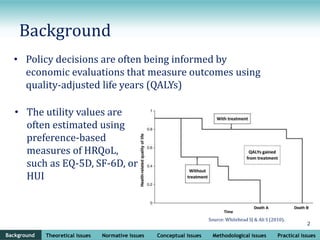
• Policy decisions are often being informed by
economic evaluations that measure outcomes using
quality-adjusted life years (QALYs)
• The utility values are
often estimated using
preference-based
measures of HRQoL,
such as EQ-5D, SF-6D, or
HUI
Source: Whitehead SJ & Ali S (2010).
Background Theoretical issues Normative issues Conceptual issues Methodological issues Practical issues
3
Health-related quality of life (HRQoL)
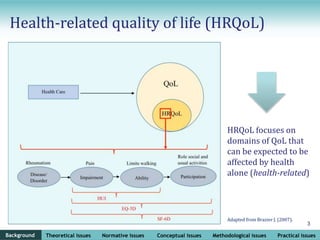
HRQoL focuses on
domains of QoL that
can be expected to be
affected by health
alone (health-related)
Background
Adapted from Brazier J. (2007).
Background Theoretical issues Normative issues Conceptual issues Methodological issues Practical issues
4
Health care services may result in outcomes other than health and may
impact broader aspects of QoL, for example:
- Independence
- Dignity
- Self-respect
- The ability to cope
- Etc.
These outcomes are not only affected by
health alone (non-health outcomes)
Individuals may derive value from the actual processes of providing
care (process utility)
Problem
Background
Ignoring these broader outcomes can lead to a
misallocation of scarce resources
Background Theoretical issues Normative issues Conceptual issues Methodological issues Practical issues
5
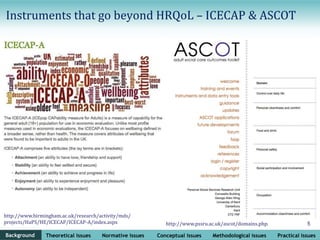
Instruments that go beyond HRQoL – ICECAP & ASCOT
Background
http://www.birmingham.ac.uk/research/activity/mds/
projects/HaPS/HE/ICECAP/ICECAP-A/index.aspx http://www.pssru.ac.uk/ascot/domains.php.
Background Theoretical issues Normative issues Conceptual issues Methodological issues Practical issues
6
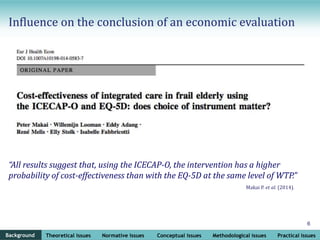
Influence on the conclusion of an economic evaluation
“All results suggest that, using the ICECAP-O, the intervention has a higher
probability of cost-effectiveness than with the EQ-5D at the same level of WTP.”
Background
Makai P. et al. (2014).
Background Theoretical issues Normative issues Conceptual issues Methodological issues Practical issues
7
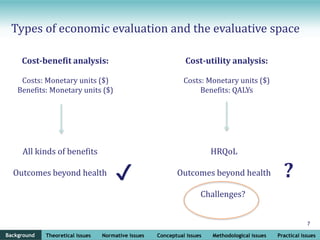
Types of economic evaluation and the evaluative space
Background
Cost-benefit analysis:
Costs: Monetary units ($)
Benefits: Monetary units ($)
Cost-utility analysis:
Costs: Monetary units ($)
Benefits: QALYs
All kinds of benefits
Outcomes beyond health ✔
HRQoL
Outcomes beyond health
Challenges?
?
Background Theoretical issues Normative issues Conceptual issues Methodological issues Practical issues
8
Theoretical issues
Theoretical issues
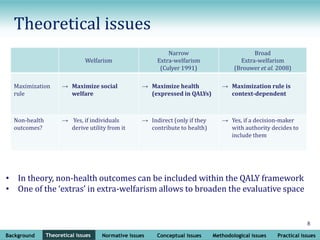
Welfarism
Narrow
Extra-welfarism
(Culyer 1991)
Broad
Extra-welfarism
(Brouwer et al. 2008)
Maximization
rule
→ Maximize social
welfare
→ Maximize health
(expressed in QALYs)
→ Maximization rule is
context-dependent
Non-health
outcomes?
→ Yes, if individuals
derive utility from it
→ Indirect (only if they
contribute to health)
→ Yes, if a decision-maker
with authority decides to
include them
• In theory, non-health outcomes can be included within the QALY framework
• One of the ‘extras’ in extra-welfarism allows to broaden the evaluative space
Background Theoretical issues Normative issues Conceptual issues Methodological issues Practical issues
9
Normative issues
Why should we go beyond health?
 Interventions provide benefits beyond health
 Can influence the conclusion of an economic evaluation
 To enable comparisons across a broader range of interventions
(e.g., drugs and public health services)
 To judge whether interventions offer ‘value for money’
Background Theoretical issues Normative issues Conceptual issues Methodological issues Practical issues
10
Normative issues
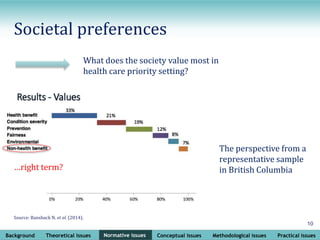
Societal preferences
What does the society value most in
health care priority setting?
The perspective from a
representative sample
in British Columbia
Source: Bansback N. et al. (2014).
…right term?
Background Theoretical issues Normative issues Conceptual issues Methodological issues Practical issues
11
Defining non-health outcomes
Conceptual issues
“Non-health outcomes were not strictly defined a priori, but included features
of the intervention (e.g. invasiveness), features of the healthcare process
(discomfort, duration, healthcare professional), or subjective/perceived impact
on patients (embarrassment, uncertainty, cosmetic).” Opmeer BC. et al. (2010).
Goebbels AFG. et al. (2012).
“Non-health outcomes were defined as all outcomes not captured by EQ5D-
based QALYs.”
Background Theoretical issues Normative issues Conceptual issues Methodological issues Practical issues
12
Conceptual issues
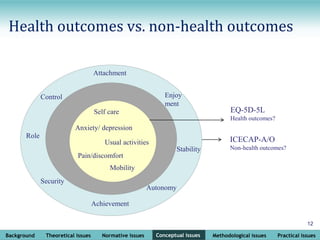
Health outcomes vs. non-health outcomes
Usual activities
Self care
Mobility
Anxiety/ depression
Pain/discomfort
Attachment
Enjoy
ment
Security
EQ-5D-5L
Health outcomes?
ICECAP-A/O
Non-health outcomes?
Role
Control
Stability
Achievement
Autonomy
Background Theoretical issues Normative issues Conceptual issues Methodological issues Practical issues
13
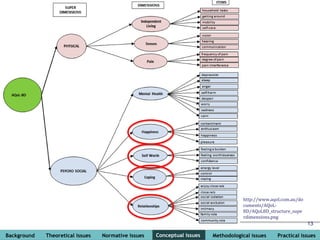
Conceptual issues
http://www.aqol.com.au/do
cuments/AQoL-
8D/AQoL8D_structure_supe
rdimensions.png
Background Theoretical issues Normative issues Conceptual issues Methodological issues Practical issues
14
Methodological issues
Measuring non-health outcomes
 Developing new measures
• ICECAP instruments
• ASCOT instruments
 Bolt-ons/add-ons/dimension extension
• NICEQoL Project
• EQ-5D-dignity (Dixon S. et al. (2013)
 Which additional dimensions?
• More generic? More specific?
• Are non-health outcomes relevant for all clinical areas?
Double counting might occur if instruments measuring non-health
outcomes are applied alongside preference-based HRQoL instruments
Background Theoretical issues Normative issues Conceptual issues Methodological issues Practical issues
15
Methodological issues
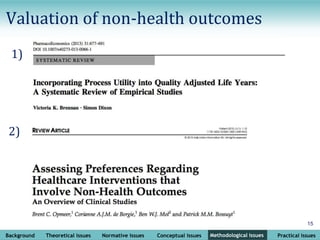
Valuation of non-health outcomes
1)
2)
Background Theoretical issues Normative issues Conceptual issues Methodological issues Practical issues
16
Methodological issues
1. Selection of the valuation technique
• Choices that involve trade-offs
• Risk of immediate death
• Should be practical, reliable and valid
• Discrete-choice experiment seems to be a promising technique
2. Full health-dead scale
3. Worse than dead health states
4. Duration: non-health outcomes are of temporary nature
5. Who should value?
Considerations for valuing non-health outcomes
Background Theoretical issues Normative issues Conceptual issues Methodological issues Practical issues
17
Practical issues
Practical issues
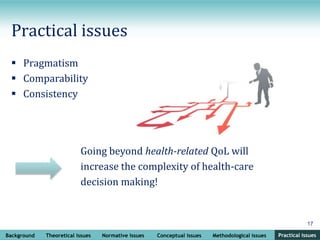
 Pragmatism
 Comparability
 Consistency
Going beyond health-related QoL will
increase the complexity of health-care
decision making!
Background Theoretical issues Normative issues Conceptual issues Methodological issues Practical issues
18
Perspectives in HTA
 Health care perspective
- Resources are insufficient to meet all demands 
Health is the appropriate maximand that should be used
in resources allocation decisions
- Example: NICE (UK), CADTH (CA)
 Societal perspective
- All costs and benefits are taken into account, regardless
of where these costs and benefits occur
- Example: CVZ (NL)
Practical issues
Background Theoretical issues Normative issues Conceptual issues Methodological issues Practical issues
19
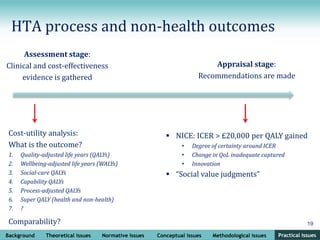
HTA process and non-health outcomes
Practical issues
Assessment stage:
Clinical and cost-effectiveness
evidence is gathered
Appraisal stage:
Recommendations are made
Cost-utility analysis:
What is the outcome?
1. Quality-adjusted life years (QALYs)
2. Wellbeing-adjusted life years (WALYs)
3. Social-care QALYs
4. Capability QALYs
5. Process-adjusted QALYs
6. Super QALY (health and non-health)
7. ?
Comparability?
 NICE: ICER > £20,000 per QALY gained
• Degree of certainty around ICER
• Change in QoL inadequate captured
• Innovation
 “Social value judgments”
 Solve conceptual issues first
• Conceptual framework is needed
• How do we define non-health outcomes?
• What can be considered as process-related what is an outcome?
 Examine existing preference-based HRQoL measures
• To what extent do they already capture outcomes that go beyond health?
• Avoid double-counting
 Communicate the results with decision makers early on
Conclusion and next steps
Thank you for your attention!
lengel@sfu.ca
Acknowledgements:
Supervisory Committee:
 David GT Whitehurst, PhD
 Stirling Bryan, PhD
 Scott Lear, PhD
References:
1. Bansback N, Pollard S, Bryan S. Eliciting Public Values To Support Health Care Priority Setting: A Novel
Approach. 2014 CADTH Symposium, Gatineau, Quebec.
2. Brazier J, Ratcliffe J, Tsuchiya A, Salomon J. Measuring and Valuing Health Benefits for Economic Evaluation.
New York: Oxford University Press 2007.
3. Brennan VK, Dixon S. Incorporating process utility into quality adjusted life years: a systematic review of
empirical studies. PharmacoEconomics. 2013; 31(8):677-91.
4. Brouwer WBF, Culyer AJ, van Exel NJA, Rutten FFH. Welfarism vs. extra-welfarism. J Health Econ. 2008;
27(2):325-38.
5. Culyer AJ. The normative economics of health care finance and provision. In: McGuire A, Fenn P, Mayhew K,
eds. Providing Healthcare: The Economics of Alternative Systems of Finance and Delivery: Oxford, Oxford
University Press 1991:34-58.
6. Dixon S, Shackley P, Brazier J: What is dignity? A literature review and conceptual mapping. HEDS
Discussion Paper 11/13.
7. Goebbels AFG, Lakerveld J, Ament AJHA, Bot SDM, Severens JL. Exploring non-health outcomes of health
promotion: The perspective of participants in a lifestyle behaviour change intervention. Health Policy. 2012;
106(2):177-86.
8. Makai P, Looman W, Adang E, Melis R, Stolk E, Fabbricotti I. Cost-effectiveness of integrated care in frail
elderly using the ICECAP-O and EQ-5D: does choice of instrument matter? The European journal of health
economics, 2014, DOI 10.1007/s10198-014-0583-7.
9. Opmeer BC, de Borgie CA, Mol BW, Bossuyt PM. Assessing Preferences Regarding Healthcare Interventions
that Involve Non-Health Outcomes: An Overview of Clinical Studies. Patient. 2010; 3(1):1-10.
10. Porter ME. What is value in health care? The New England journal of medicine. 2010; 363(26):2477-81.
11. Whitehead SJ, Ali S. Health outcomes in economic evaluation: the QALY and utilities. Br Med Bull. 2010;
96:5-21.

Cadth 2015 d4 lidia engel final

  • 1.
    Challenges associated ingoing beyond health-related quality of life in cost-utility analysis Lidia Engel, MSc Saskatoon, April 14th, 2015 PhD Candidate David GT Whitehurst, PhD Stirling Bryan, PhD Scott A Lear, PhD
  • 2.
    Background Theoretical issuesNormative issues Conceptual issues Methodological issues Practical issues 2 Background Background • Policy decisions are often being informed by economic evaluations that measure outcomes using quality-adjusted life years (QALYs) • The utility values are often estimated using preference-based measures of HRQoL, such as EQ-5D, SF-6D, or HUI Source: Whitehead SJ & Ali S (2010).
  • 3.
    Background Theoretical issuesNormative issues Conceptual issues Methodological issues Practical issues 3 Health-related quality of life (HRQoL) HRQoL focuses on domains of QoL that can be expected to be affected by health alone (health-related) Background Adapted from Brazier J. (2007).
  • 4.
    Background Theoretical issuesNormative issues Conceptual issues Methodological issues Practical issues 4 Health care services may result in outcomes other than health and may impact broader aspects of QoL, for example: - Independence - Dignity - Self-respect - The ability to cope - Etc. These outcomes are not only affected by health alone (non-health outcomes) Individuals may derive value from the actual processes of providing care (process utility) Problem Background Ignoring these broader outcomes can lead to a misallocation of scarce resources
  • 5.
    Background Theoretical issuesNormative issues Conceptual issues Methodological issues Practical issues 5 Instruments that go beyond HRQoL – ICECAP & ASCOT Background http://www.birmingham.ac.uk/research/activity/mds/ projects/HaPS/HE/ICECAP/ICECAP-A/index.aspx http://www.pssru.ac.uk/ascot/domains.php.
  • 6.
    Background Theoretical issuesNormative issues Conceptual issues Methodological issues Practical issues 6 Influence on the conclusion of an economic evaluation “All results suggest that, using the ICECAP-O, the intervention has a higher probability of cost-effectiveness than with the EQ-5D at the same level of WTP.” Background Makai P. et al. (2014).
  • 7.
    Background Theoretical issuesNormative issues Conceptual issues Methodological issues Practical issues 7 Types of economic evaluation and the evaluative space Background Cost-benefit analysis: Costs: Monetary units ($) Benefits: Monetary units ($) Cost-utility analysis: Costs: Monetary units ($) Benefits: QALYs All kinds of benefits Outcomes beyond health ✔ HRQoL Outcomes beyond health Challenges? ?
  • 8.
    Background Theoretical issuesNormative issues Conceptual issues Methodological issues Practical issues 8 Theoretical issues Theoretical issues Welfarism Narrow Extra-welfarism (Culyer 1991) Broad Extra-welfarism (Brouwer et al. 2008) Maximization rule → Maximize social welfare → Maximize health (expressed in QALYs) → Maximization rule is context-dependent Non-health outcomes? → Yes, if individuals derive utility from it → Indirect (only if they contribute to health) → Yes, if a decision-maker with authority decides to include them • In theory, non-health outcomes can be included within the QALY framework • One of the ‘extras’ in extra-welfarism allows to broaden the evaluative space
  • 9.
    Background Theoretical issuesNormative issues Conceptual issues Methodological issues Practical issues 9 Normative issues Why should we go beyond health?  Interventions provide benefits beyond health  Can influence the conclusion of an economic evaluation  To enable comparisons across a broader range of interventions (e.g., drugs and public health services)  To judge whether interventions offer ‘value for money’
  • 10.
    Background Theoretical issuesNormative issues Conceptual issues Methodological issues Practical issues 10 Normative issues Societal preferences What does the society value most in health care priority setting? The perspective from a representative sample in British Columbia Source: Bansback N. et al. (2014). …right term?
  • 11.
    Background Theoretical issuesNormative issues Conceptual issues Methodological issues Practical issues 11 Defining non-health outcomes Conceptual issues “Non-health outcomes were not strictly defined a priori, but included features of the intervention (e.g. invasiveness), features of the healthcare process (discomfort, duration, healthcare professional), or subjective/perceived impact on patients (embarrassment, uncertainty, cosmetic).” Opmeer BC. et al. (2010). Goebbels AFG. et al. (2012). “Non-health outcomes were defined as all outcomes not captured by EQ5D- based QALYs.”
  • 12.
    Background Theoretical issuesNormative issues Conceptual issues Methodological issues Practical issues 12 Conceptual issues Health outcomes vs. non-health outcomes Usual activities Self care Mobility Anxiety/ depression Pain/discomfort Attachment Enjoy ment Security EQ-5D-5L Health outcomes? ICECAP-A/O Non-health outcomes? Role Control Stability Achievement Autonomy
  • 13.
    Background Theoretical issuesNormative issues Conceptual issues Methodological issues Practical issues 13 Conceptual issues http://www.aqol.com.au/do cuments/AQoL- 8D/AQoL8D_structure_supe rdimensions.png
  • 14.
    Background Theoretical issuesNormative issues Conceptual issues Methodological issues Practical issues 14 Methodological issues Measuring non-health outcomes  Developing new measures • ICECAP instruments • ASCOT instruments  Bolt-ons/add-ons/dimension extension • NICEQoL Project • EQ-5D-dignity (Dixon S. et al. (2013)  Which additional dimensions? • More generic? More specific? • Are non-health outcomes relevant for all clinical areas? Double counting might occur if instruments measuring non-health outcomes are applied alongside preference-based HRQoL instruments
  • 15.
    Background Theoretical issuesNormative issues Conceptual issues Methodological issues Practical issues 15 Methodological issues Valuation of non-health outcomes 1) 2)
  • 16.
    Background Theoretical issuesNormative issues Conceptual issues Methodological issues Practical issues 16 Methodological issues 1. Selection of the valuation technique • Choices that involve trade-offs • Risk of immediate death • Should be practical, reliable and valid • Discrete-choice experiment seems to be a promising technique 2. Full health-dead scale 3. Worse than dead health states 4. Duration: non-health outcomes are of temporary nature 5. Who should value? Considerations for valuing non-health outcomes
  • 17.
    Background Theoretical issuesNormative issues Conceptual issues Methodological issues Practical issues 17 Practical issues Practical issues  Pragmatism  Comparability  Consistency Going beyond health-related QoL will increase the complexity of health-care decision making!
  • 18.
    Background Theoretical issuesNormative issues Conceptual issues Methodological issues Practical issues 18 Perspectives in HTA  Health care perspective - Resources are insufficient to meet all demands  Health is the appropriate maximand that should be used in resources allocation decisions - Example: NICE (UK), CADTH (CA)  Societal perspective - All costs and benefits are taken into account, regardless of where these costs and benefits occur - Example: CVZ (NL) Practical issues
  • 19.
    Background Theoretical issuesNormative issues Conceptual issues Methodological issues Practical issues 19 HTA process and non-health outcomes Practical issues Assessment stage: Clinical and cost-effectiveness evidence is gathered Appraisal stage: Recommendations are made Cost-utility analysis: What is the outcome? 1. Quality-adjusted life years (QALYs) 2. Wellbeing-adjusted life years (WALYs) 3. Social-care QALYs 4. Capability QALYs 5. Process-adjusted QALYs 6. Super QALY (health and non-health) 7. ? Comparability?  NICE: ICER > £20,000 per QALY gained • Degree of certainty around ICER • Change in QoL inadequate captured • Innovation  “Social value judgments”
  • 20.
     Solve conceptualissues first • Conceptual framework is needed • How do we define non-health outcomes? • What can be considered as process-related what is an outcome?  Examine existing preference-based HRQoL measures • To what extent do they already capture outcomes that go beyond health? • Avoid double-counting  Communicate the results with decision makers early on Conclusion and next steps
  • 21.
    Thank you foryour attention! lengel@sfu.ca Acknowledgements: Supervisory Committee:  David GT Whitehurst, PhD  Stirling Bryan, PhD  Scott Lear, PhD
  • 22.
    References: 1. Bansback N,Pollard S, Bryan S. Eliciting Public Values To Support Health Care Priority Setting: A Novel Approach. 2014 CADTH Symposium, Gatineau, Quebec. 2. Brazier J, Ratcliffe J, Tsuchiya A, Salomon J. Measuring and Valuing Health Benefits for Economic Evaluation. New York: Oxford University Press 2007. 3. Brennan VK, Dixon S. Incorporating process utility into quality adjusted life years: a systematic review of empirical studies. PharmacoEconomics. 2013; 31(8):677-91. 4. Brouwer WBF, Culyer AJ, van Exel NJA, Rutten FFH. Welfarism vs. extra-welfarism. J Health Econ. 2008; 27(2):325-38. 5. Culyer AJ. The normative economics of health care finance and provision. In: McGuire A, Fenn P, Mayhew K, eds. Providing Healthcare: The Economics of Alternative Systems of Finance and Delivery: Oxford, Oxford University Press 1991:34-58. 6. Dixon S, Shackley P, Brazier J: What is dignity? A literature review and conceptual mapping. HEDS Discussion Paper 11/13. 7. Goebbels AFG, Lakerveld J, Ament AJHA, Bot SDM, Severens JL. Exploring non-health outcomes of health promotion: The perspective of participants in a lifestyle behaviour change intervention. Health Policy. 2012; 106(2):177-86. 8. Makai P, Looman W, Adang E, Melis R, Stolk E, Fabbricotti I. Cost-effectiveness of integrated care in frail elderly using the ICECAP-O and EQ-5D: does choice of instrument matter? The European journal of health economics, 2014, DOI 10.1007/s10198-014-0583-7. 9. Opmeer BC, de Borgie CA, Mol BW, Bossuyt PM. Assessing Preferences Regarding Healthcare Interventions that Involve Non-Health Outcomes: An Overview of Clinical Studies. Patient. 2010; 3(1):1-10. 10. Porter ME. What is value in health care? The New England journal of medicine. 2010; 363(26):2477-81. 11. Whitehead SJ, Ali S. Health outcomes in economic evaluation: the QALY and utilities. Br Med Bull. 2010; 96:5-21.