Allan Grill, MD, CCFP, MPH
Family Physician Member, pERC
Mona Sabharwal, BScPhm, Pharm. D., R.Ph.,
Executive Director, pCODR
Nianda Penner, BSc(Pharm), R.Ph.,
Knowledge Management, pCODR
CADTH Symposium, Concurrent Session B1
Monday, April 13, 2015
Disclaimer
•  I have no financial conflicts of interest to declare
•  I receive a per diem remuneration for work
associated with CED and pERC membership
•  The opinions expressed in this presentation
reflect the presenters own personal experiences
with Health Technology Assessment and public
drug policy, and do not represent the opinions of
other pERC members, pCODR, CADTH, the
Ontario Public Drug Programs, Cancer Care
Ontario, or the Ontario Ministry of Health and
Long-Term Care
3
•  To review the discordance rates associated with pERC
recommendations and provincial cancer drug funding
decisions
•  To outline the potential reasons for discordance in the
context of Health Technology Assessment (HTA)
•  To present the results of a national survey among drug
funding decision makers outlining the challenges and
potential solutions towards enhancing alignment for
Canada’s national cancer drug review process
OBJECTIVES
4
•  pCODR/CADTH Overview:
§  Health Technology Assessment
§  National, evidence-based cancer drug review process
§  Consistency & clarity via Deliberative Framework à legitimacy
§  Process should guide provinces in drug-funding decision making
Background
5
Background
•  pERC recommendations are meant to:
§  Achieve best possible health outcomes
§  Contribute to health system sustainability
§  Promote equity across provinces
•  Is there discordance between recommendations and
decisions?
6
•  A state of disagreement and disharmony
What is Discordance?
7
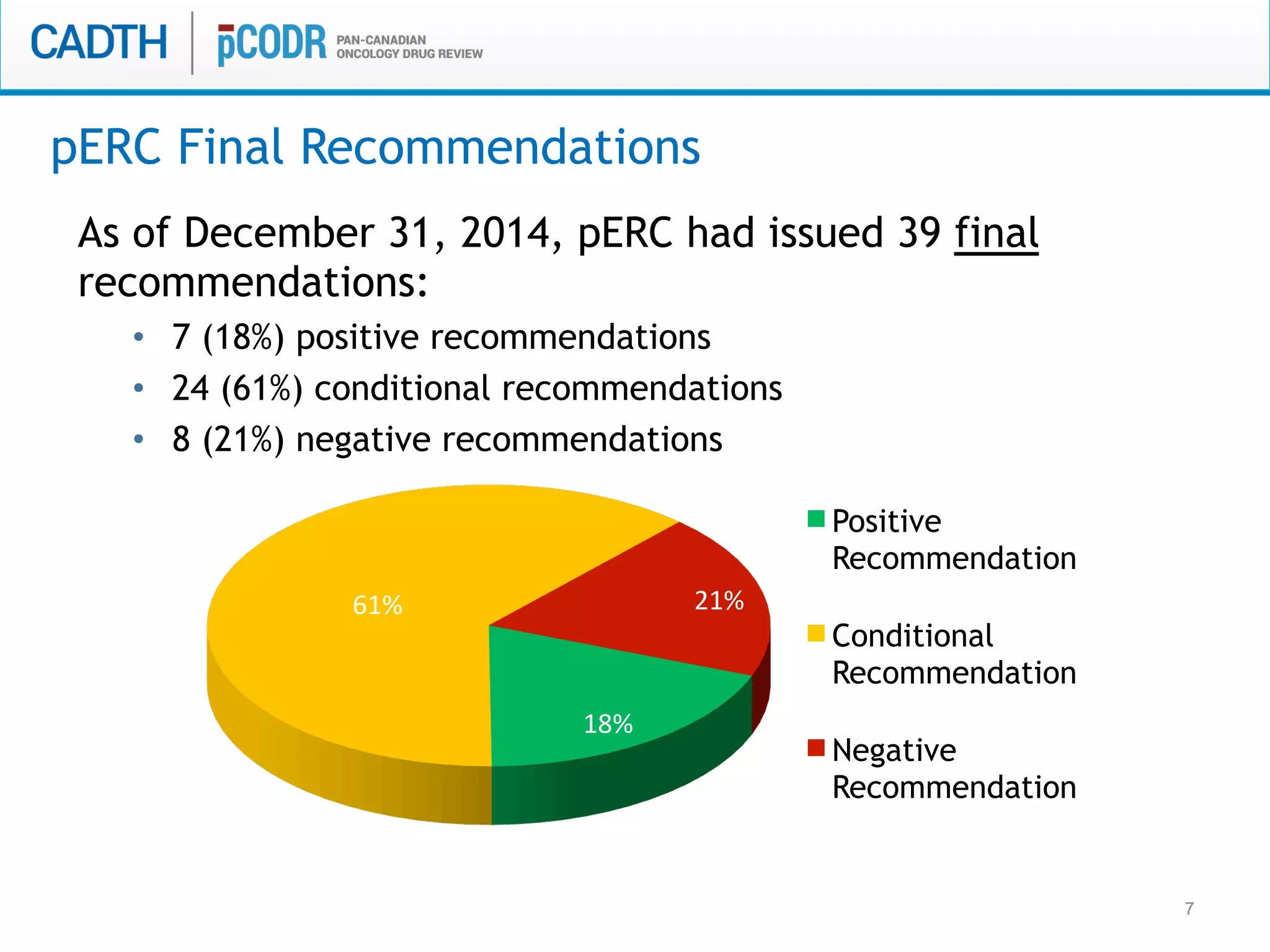
As of December 31, 2014, pERC had issued 39 final
recommendations:
•  7 (18%) positive recommendations
•  24 (61%) conditional recommendations
•  8 (21%) negative recommendations
pERC Final Recommendations
18%	
  
61%	
   21%	
  
Positive
Recommendation
Conditional
Recommendation
Negative
Recommendation
8
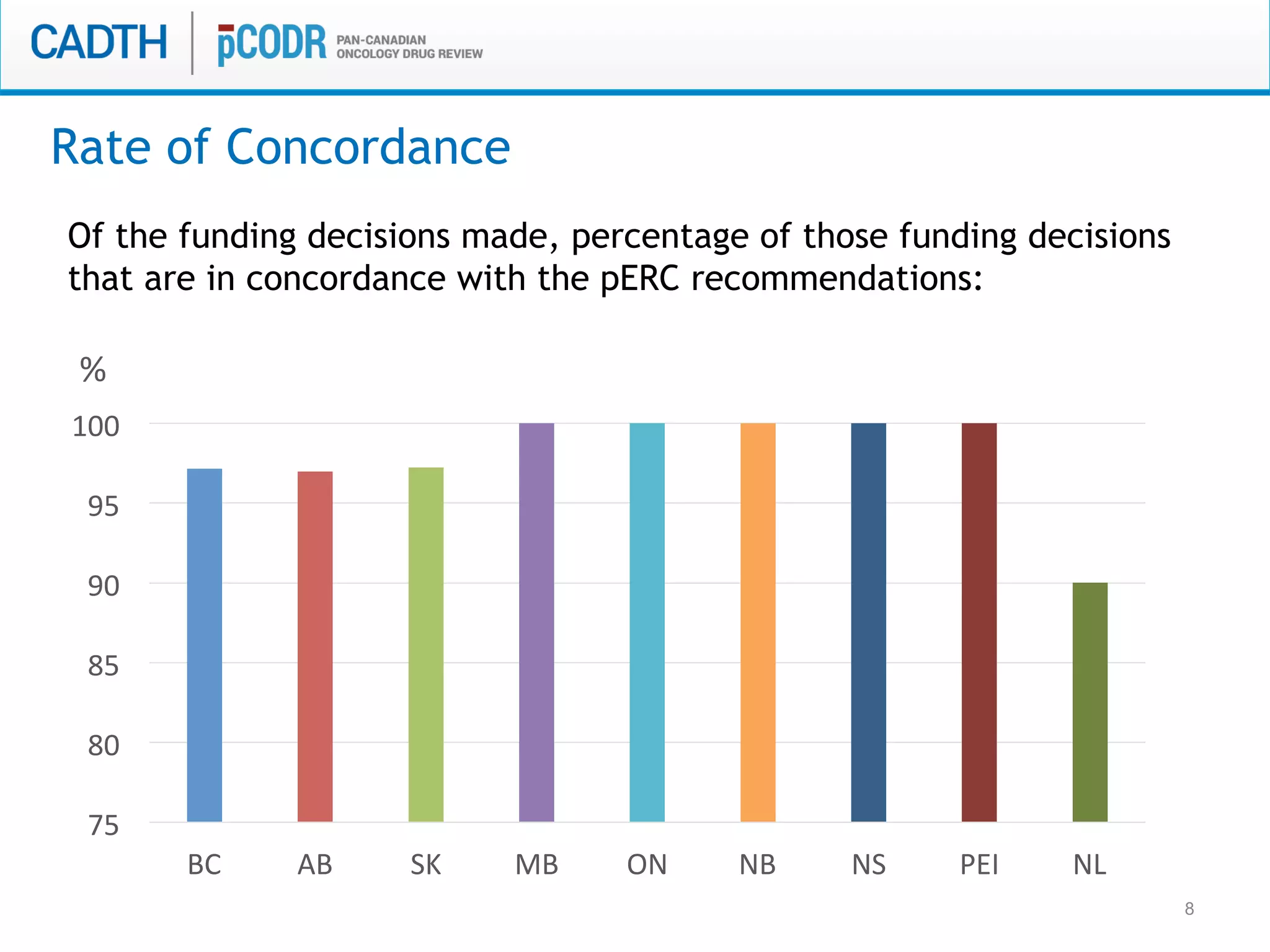
Of the funding decisions made, percentage of those funding decisions
that are in concordance with the pERC recommendations:
Rate of Concordance
75	
  
80	
  
85	
  
90	
  
95	
  
100	
  
BC	
   AB	
   SK	
   MB	
   ON	
   NB	
   NS	
   PEI	
   NL	
  
%	
  
9
pERC Recommendations to Fund
1.  Pazopanib (Votrient) for
metastatic renal cell
carcinoma [Jan 20, 2012]
2.  Bendamustine hydrochloride
(Treanda) for NHL [Dec 14,
2012]
3.  Axitinib (Inlyta) for
metastatic renal cell
carcinoma [Apr 11, 2013]
4.  Bortezomib (Velcade) for
multiple myeloma, pre-
ASCT [Apr 11, 2013]
5.  Pazopanib (Votrient)
resubmissions for
metastatic renal cell
carcinoma [Sep 16, 2013]
6.  Afatinib (Giotrif) for non-
small cell lung cancer [May
20, 2014]
7.  Arsenic trioxide (Trisenox)
for Acute Promyelocytic
Leukemia [Mar 5, 2014]
0%
10%
20%
30%
40%
50%
60%
70%
80%
90%
100%
1 2 3 4 5 6 7
Provincial Funding as of December 31, 2014
Funded Under Negotiation with Manufacturer
Under Provincial Consideration Not Funded
10
pERC Recommendations to Not Fund
1.  Pazopanib (Votrient) for soft
tissue sarcoma [Dec 14,
2012]
2.  Bendamustine hydrochloride
(Treanda) for CLL [Dec 14,
2012]
3.  Bortezomib (Velcade) for
multiple myeloma, post-
ASCT [Apr 11, 2013]
4.  Lapatinib (Tykerb) for
breast cancer [Jul 22, 2013
5.  Regorafenib (stivarga) for
metastatic colorectal
cancer [Dec 2, 2013]
6.  Cetuximab (Erbitux0 for
metastatic colorectal
cancer [Jan 27, 2014]
7.  Aflibercept (Zaltrap) for
metastatic colorectal
cancer [Sep 22, 2014]
0%
10%
20%
30%
40%
50%
60%
70%
80%
90%
100%
1 2 3 4 5 6 7
Provincial Funding as of December 31, 2014
Funded Under Negotiation with Manufacturer
Under Provincial Consideration Not Funded
11
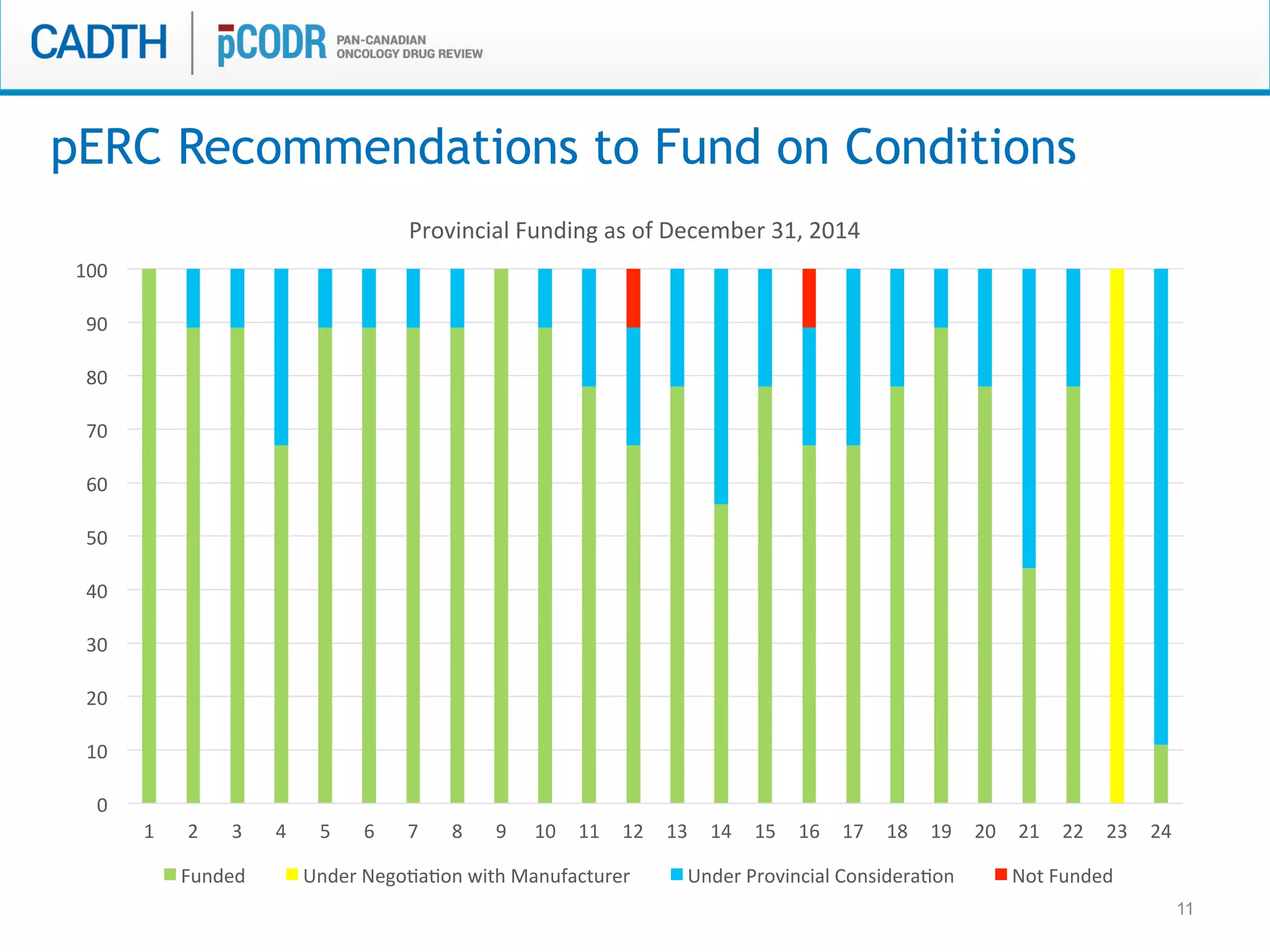
pERC Recommendations to Fund on Conditions
0	
  
10	
  
20	
  
30	
  
40	
  
50	
  
60	
  
70	
  
80	
  
90	
  
100	
  
1	
   2	
   3	
   4	
   5	
   6	
   7	
   8	
   9	
   10	
   11	
   12	
   13	
   14	
   15	
   16	
   17	
   18	
   19	
   20	
   21	
   22	
   23	
   24	
  
Provincial	
  Funding	
  as	
  of	
  December	
  31,	
  2014	
  
Funded	
   Under	
  NegoMaMon	
  with	
  Manufacturer	
   Under	
  Provincial	
  ConsideraMon	
   Not	
  Funded	
  
12
•  So we know there is some discordance.
•  What are the potential reasons for discordance between
pERC and the provinces ?
•  Do challenges exist that undermine pERC’s impact on
policy-makers leading to discordance?
•  Can these challenges be overcome?
More Questions
13
•  Hypothesized reasons for discordance
§  pERC member/HTA perspective
•  Designed an on-line survey
•  Survey issued to participating provincial ministries of health and
cancer agencies
•  Survey period March 4, 2015 to April 1, 2015
•  4 questions: Multiple choice + Free text
§  Choose answers based on our developed hypotheses
§  List challenges that limit the effectiveness of HTA processes
§  List solutions that enhance alignment between pERC
recommendations and provincial drug funding decisions
•  Anonymity respected
•  100% response rate
Methods
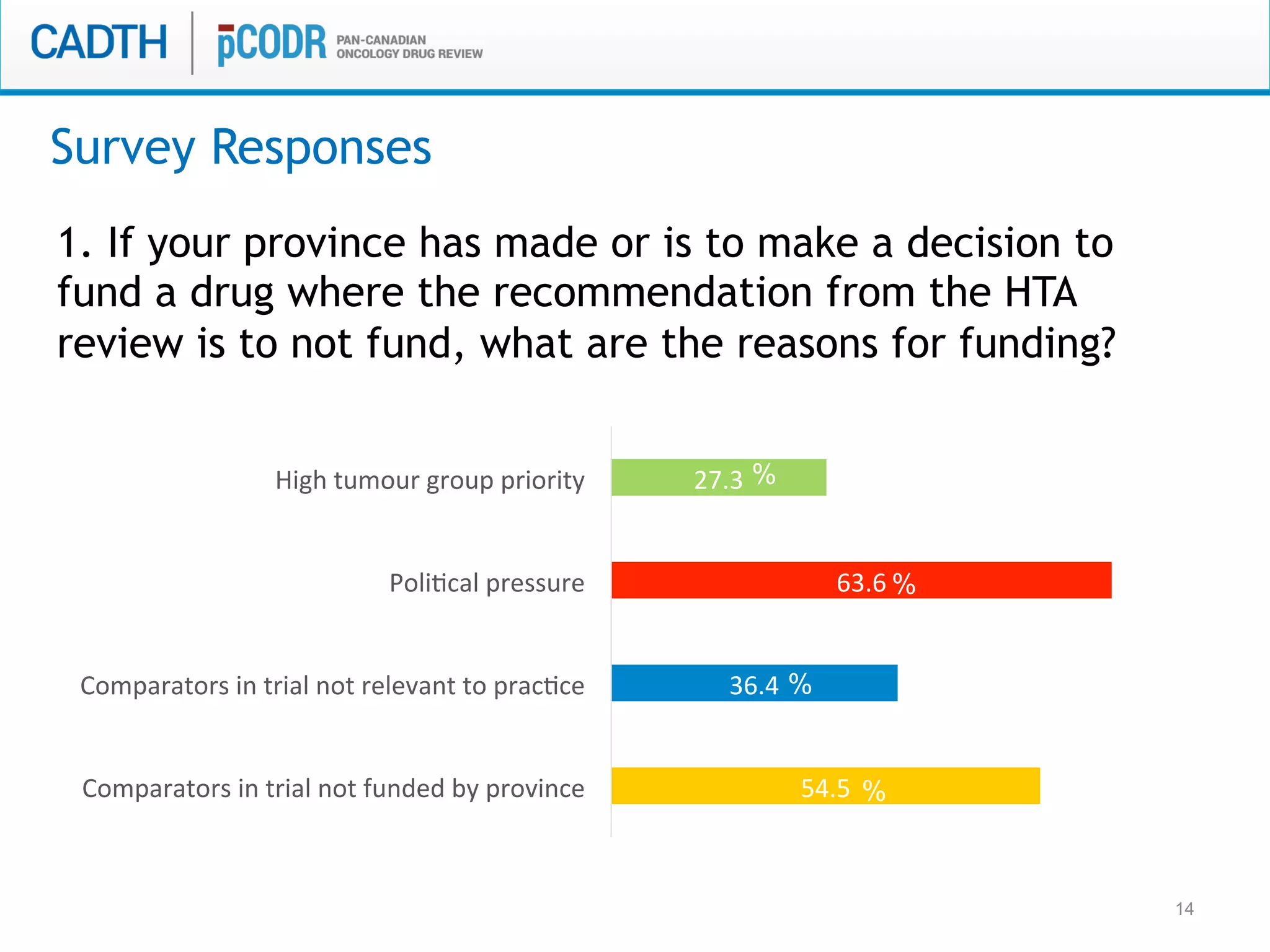
14
1. If your province has made or is to make a decision to
fund a drug where the recommendation from the HTA
review is to not fund, what are the reasons for funding?
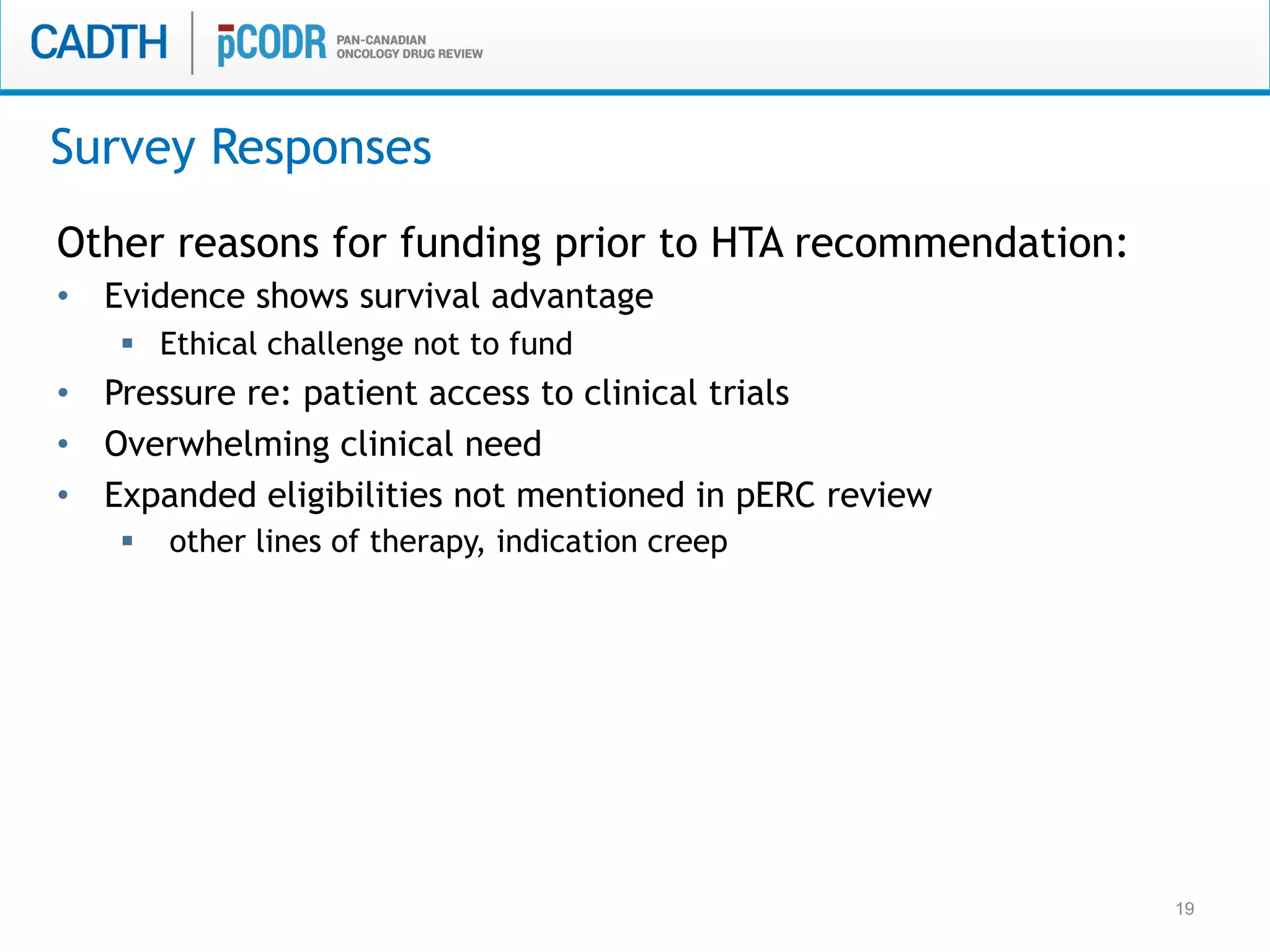
Survey Responses
54.5	
  
36.4	
  
63.6	
  
27.3	
  
Comparators	
  in	
  trial	
  not	
  funded	
  by	
  province	
  
Comparators	
  in	
  trial	
  not	
  relevant	
  to	
  pracMce	
  
PoliMcal	
  pressure	
  
High	
  tumour	
  group	
  priority	
   %
%
%
%
15
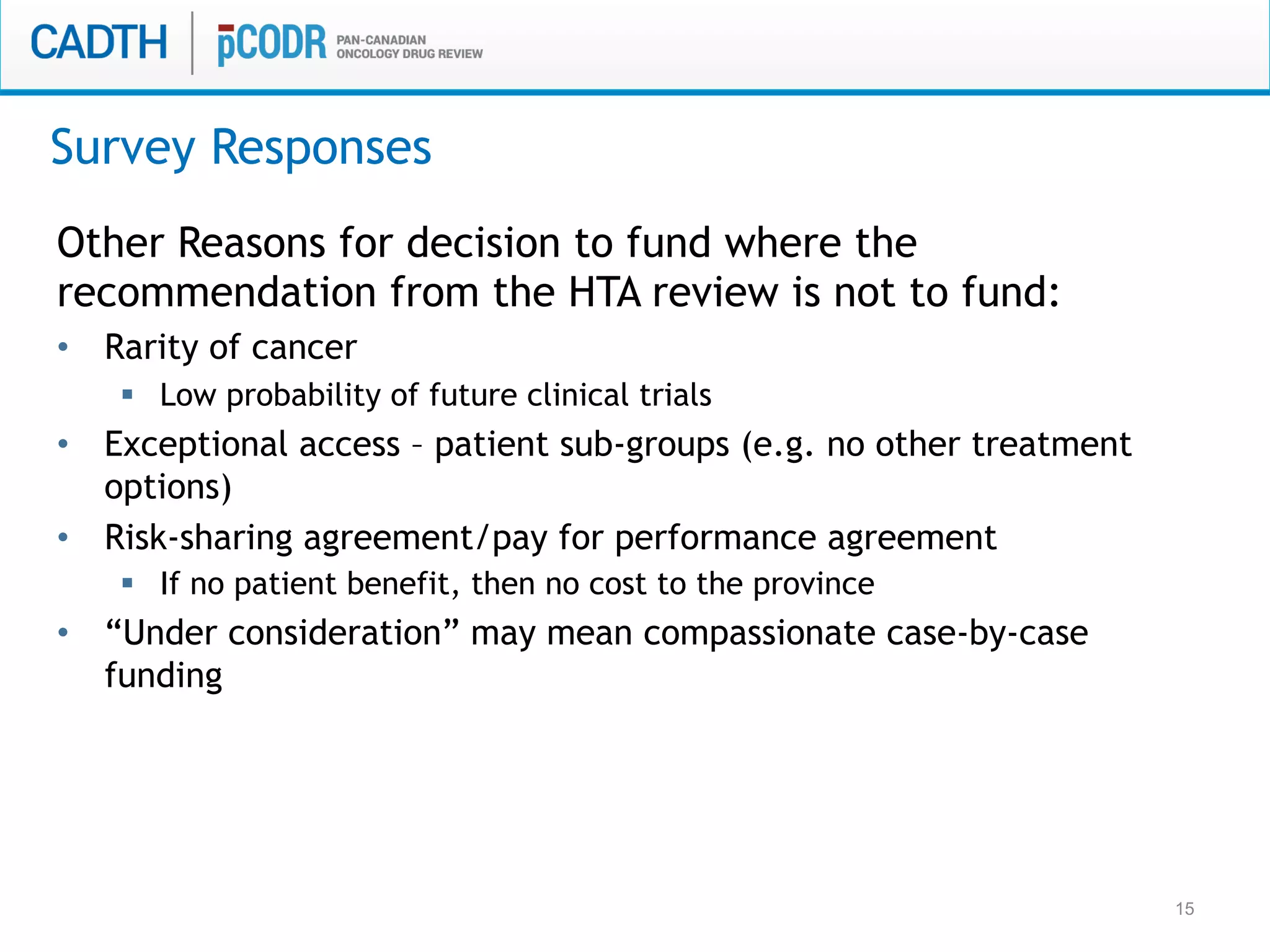
Other Reasons for decision to fund where the
recommendation from the HTA review is not to fund:
•  Rarity of cancer
§  Low probability of future clinical trials
•  Exceptional access – patient sub-groups (e.g. no other treatment
options)
•  Risk-sharing agreement/pay for performance agreement
§  If no patient benefit, then no cost to the province
•  “Under consideration” may mean compassionate case-by-case
funding
Survey Responses
16
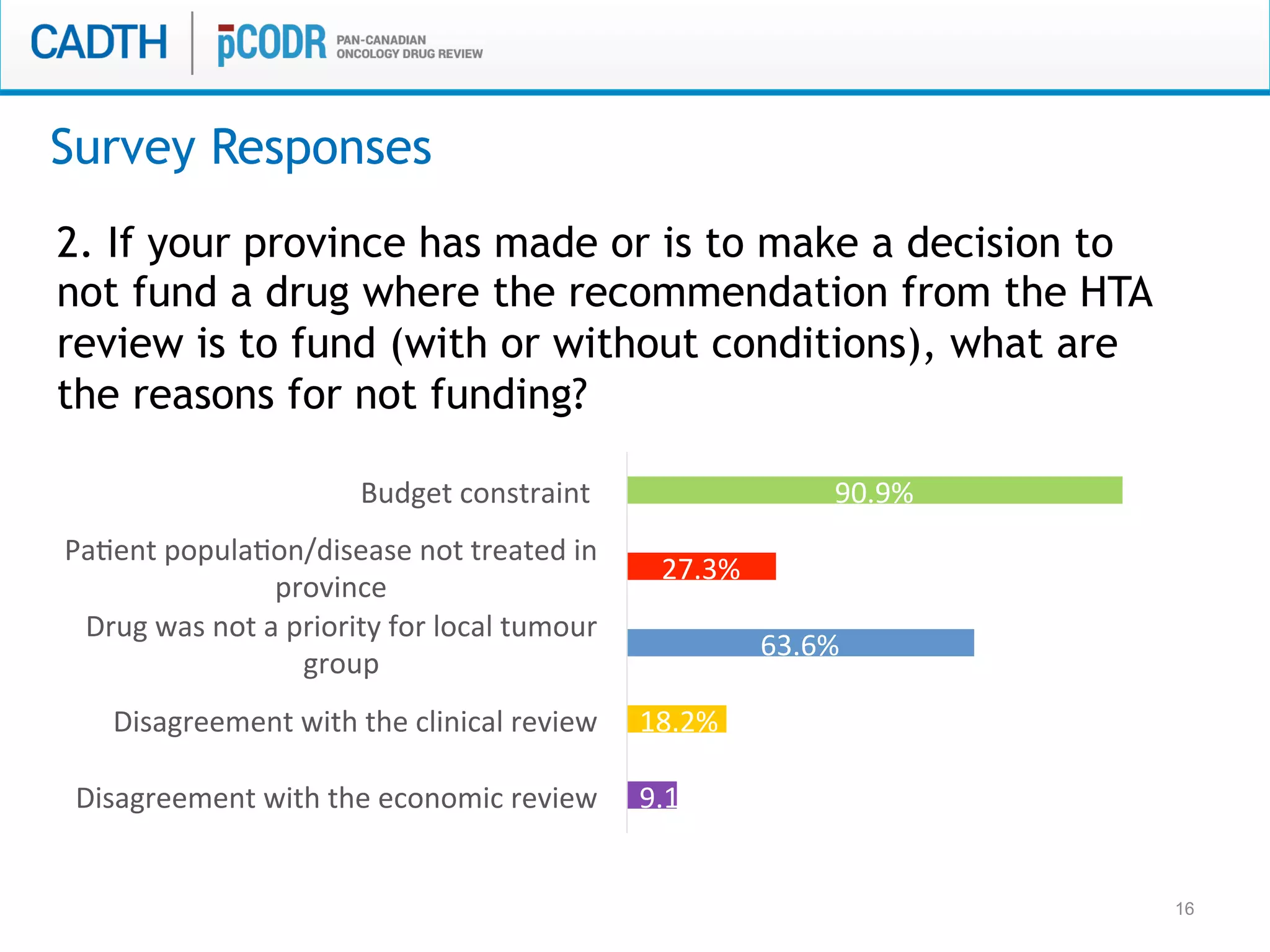
2. If your province has made or is to make a decision to
not fund a drug where the recommendation from the HTA
review is to fund (with or without conditions), what are
the reasons for not funding?
Survey Responses
9.1%	
  
18.2%	
  
63.6%	
  
27.3%	
  
90.9%	
  
Disagreement	
  with	
  the	
  economic	
  review	
  
Disagreement	
  with	
  the	
  clinical	
  review	
  
Drug	
  was	
  not	
  a	
  priority	
  for	
  local	
  tumour	
  
group	
  
PaMent	
  populaMon/disease	
  not	
  treated	
  in	
  
province	
  
Budget	
  constraint	
  	
  
%	
  
%
%
%
%
17
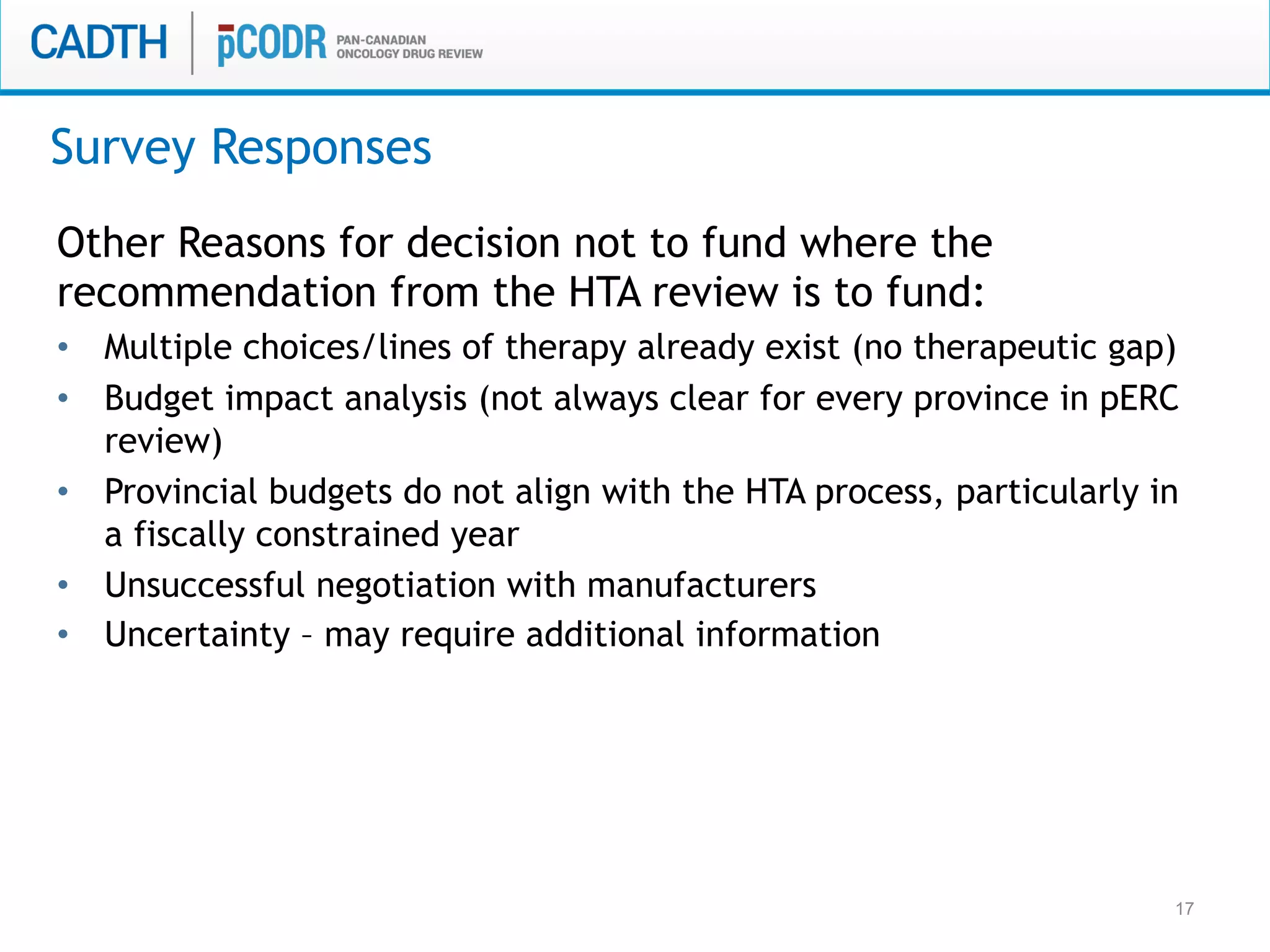
Other Reasons for decision not to fund where the
recommendation from the HTA review is to fund:
•  Multiple choices/lines of therapy already exist (no therapeutic gap)
•  Budget impact analysis (not always clear for every province in pERC
review)
•  Provincial budgets do not align with the HTA process, particularly in
a fiscally constrained year
•  Unsuccessful negotiation with manufacturers
•  Uncertainty – may require additional information
Survey Responses
18
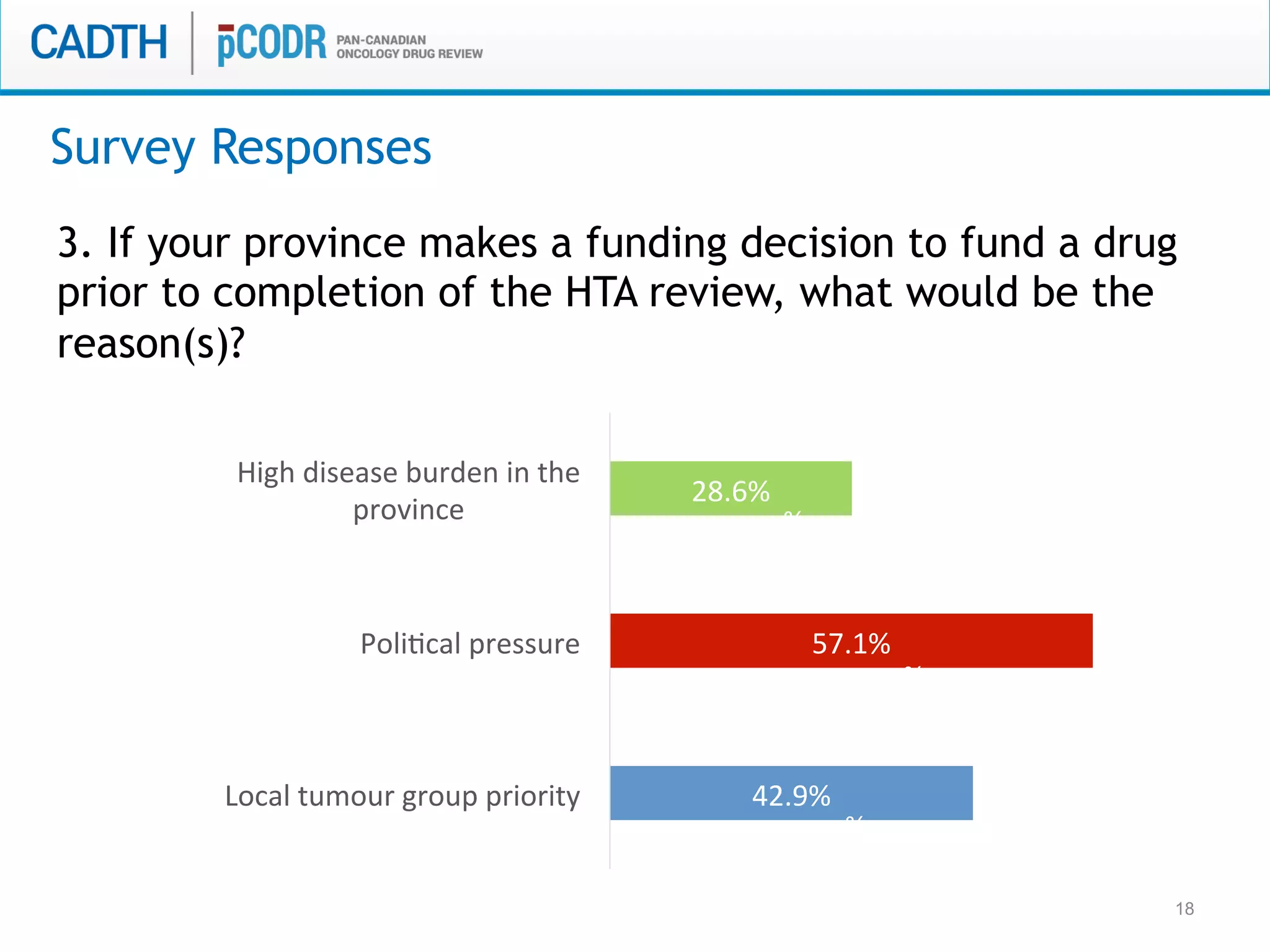
3. If your province makes a funding decision to fund a drug
prior to completion of the HTA review, what would be the
reason(s)?
Survey Responses
%
%
%
%
42.9%	
  
57.1%	
  
28.6%	
  
Local	
  tumour	
  group	
  priority	
  
PoliMcal	
  pressure	
  
High	
  disease	
  burden	
  in	
  the	
  
province	
   %	
  
%	
  
%	
  
%	
  
%	
  
%	
  
19
Other reasons for funding prior to HTA recommendation:
•  Evidence shows survival advantage
§  Ethical challenge not to fund
•  Pressure re: patient access to clinical trials
•  Overwhelming clinical need
•  Expanded eligibilities not mentioned in pERC review
§  other lines of therapy, indication creep
Survey Responses
20
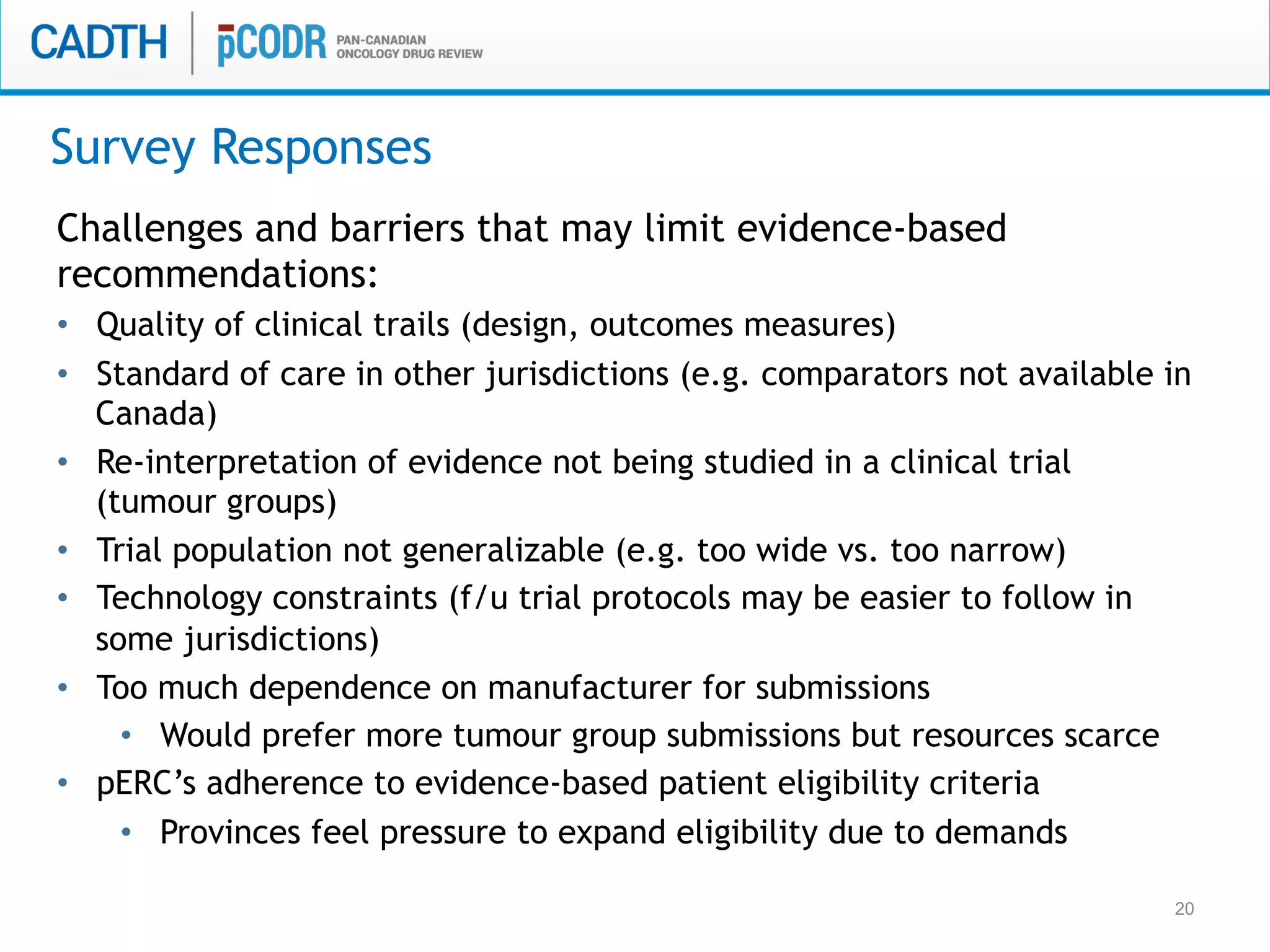
Challenges and barriers that may limit evidence-based
recommendations:
•  Quality of clinical trails (design, outcomes measures)
•  Standard of care in other jurisdictions (e.g. comparators not available in
Canada)
•  Re-interpretation of evidence not being studied in a clinical trial
(tumour groups)
•  Trial population not generalizable (e.g. too wide vs. too narrow)
•  Technology constraints (f/u trial protocols may be easier to follow in
some jurisdictions)
•  Too much dependence on manufacturer for submissions
•  Would prefer more tumour group submissions but resources scarce
•  pERC’s adherence to evidence-based patient eligibility criteria
•  Provinces feel pressure to expand eligibility due to demands
Survey Responses
21
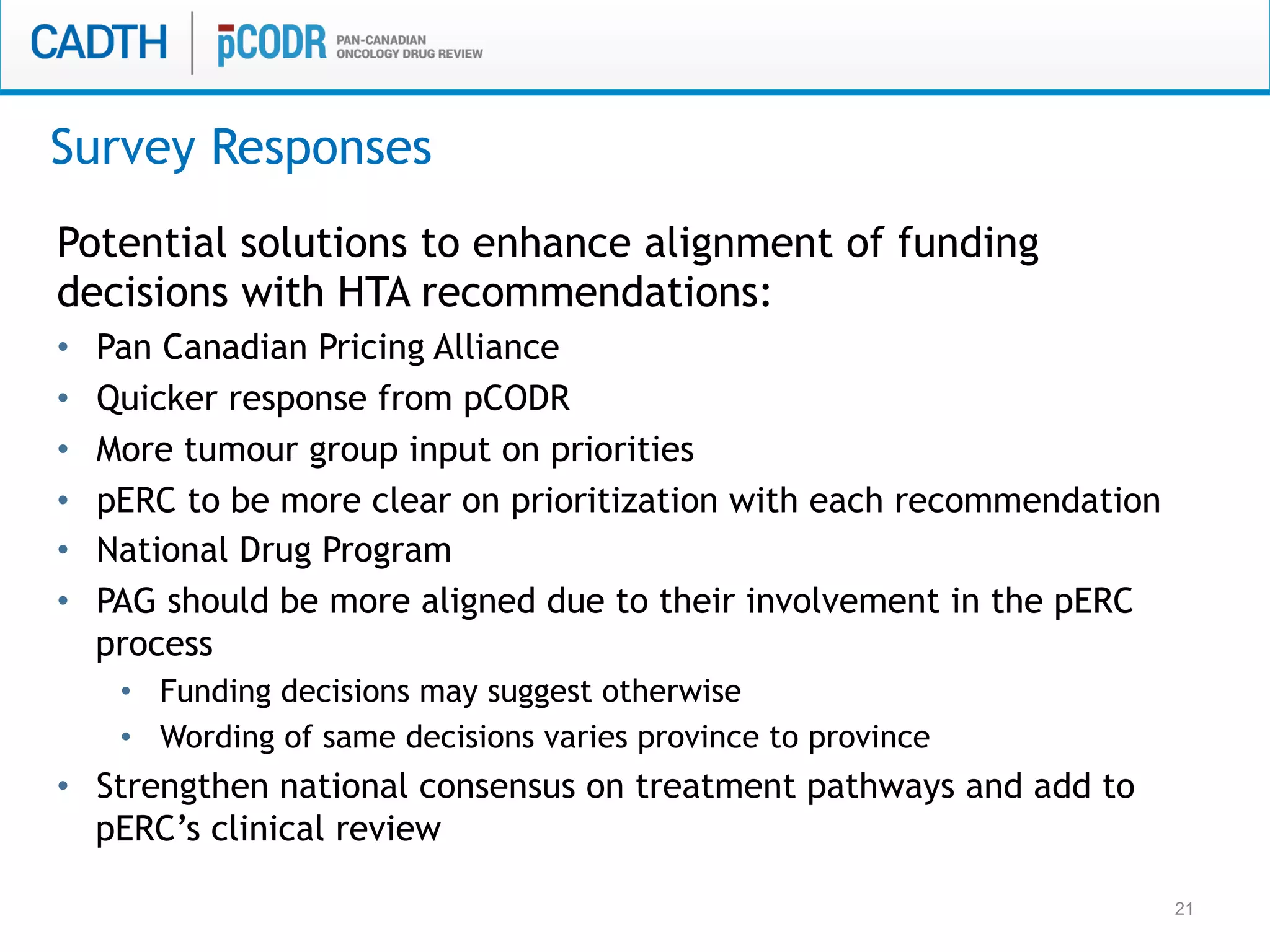
Potential solutions to enhance alignment of funding
decisions with HTA recommendations:
•  Pan Canadian Pricing Alliance
•  Quicker response from pCODR
•  More tumour group input on priorities
•  pERC to be more clear on prioritization with each recommendation
•  National Drug Program
•  PAG should be more aligned due to their involvement in the pERC
process
•  Funding decisions may suggest otherwise
•  Wording of same decisions varies province to province
•  Strengthen national consensus on treatment pathways and add to
pERC’s clinical review
Survey Responses
22
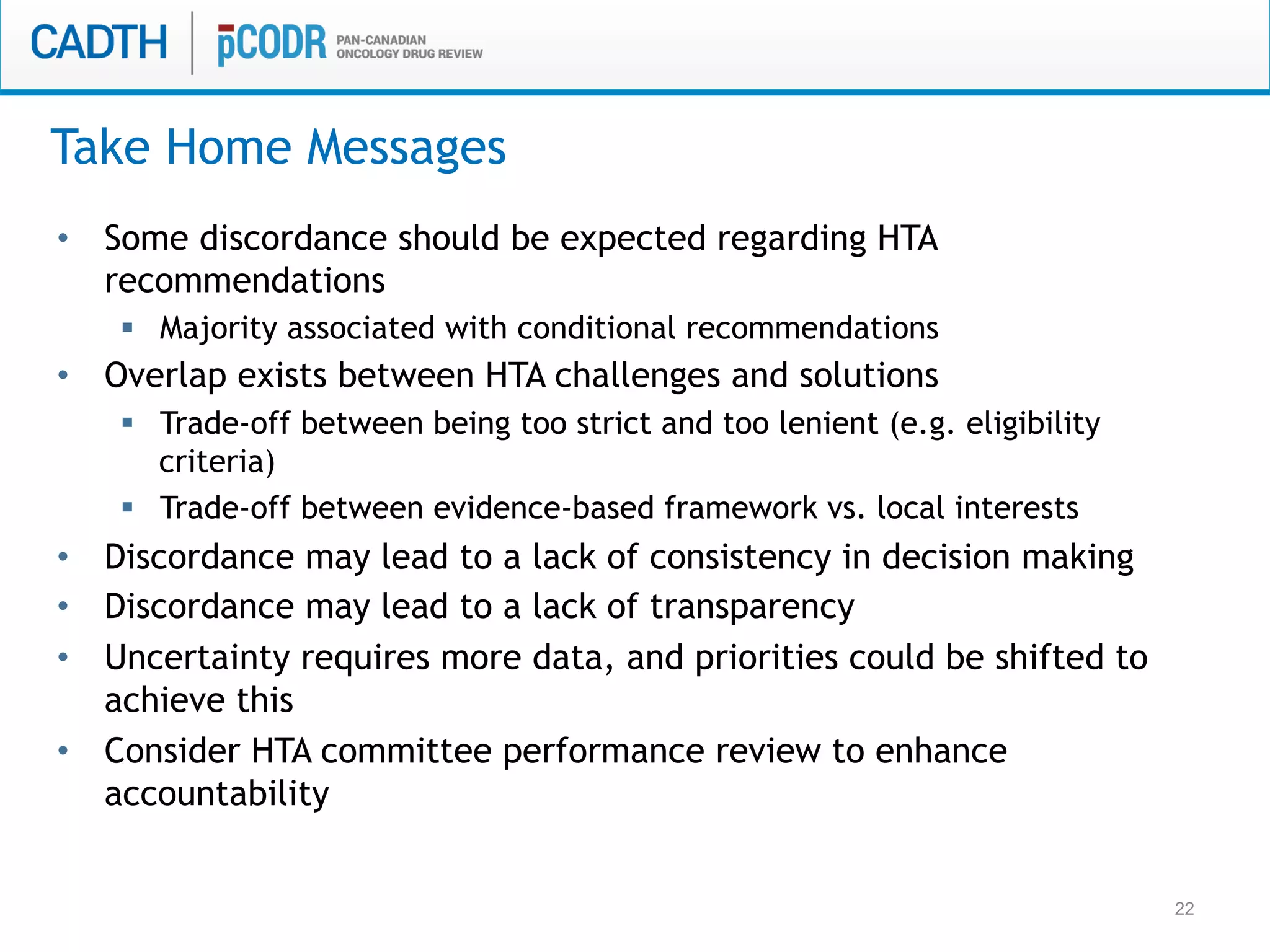
•  Some discordance should be expected regarding HTA
recommendations
§  Majority associated with conditional recommendations
•  Overlap exists between HTA challenges and solutions
§  Trade-off between being too strict and too lenient (e.g. eligibility
criteria)
§  Trade-off between evidence-based framework vs. local interests
•  Discordance may lead to a lack of consistency in decision making
•  Discordance may lead to a lack of transparency
•  Uncertainty requires more data, and priorities could be shifted to
achieve this
•  Consider HTA committee performance review to enhance
accountability
Take Home Messages
Thank you
23

Cadth 2015 b1 slides allan grill-pcodr-cadth_symposium2015presentationfinal

  • 1.
    Allan Grill, MD,CCFP, MPH Family Physician Member, pERC Mona Sabharwal, BScPhm, Pharm. D., R.Ph., Executive Director, pCODR Nianda Penner, BSc(Pharm), R.Ph., Knowledge Management, pCODR CADTH Symposium, Concurrent Session B1 Monday, April 13, 2015
  • 2.
    Disclaimer •  I haveno financial conflicts of interest to declare •  I receive a per diem remuneration for work associated with CED and pERC membership •  The opinions expressed in this presentation reflect the presenters own personal experiences with Health Technology Assessment and public drug policy, and do not represent the opinions of other pERC members, pCODR, CADTH, the Ontario Public Drug Programs, Cancer Care Ontario, or the Ontario Ministry of Health and Long-Term Care
  • 3.
    3 •  To reviewthe discordance rates associated with pERC recommendations and provincial cancer drug funding decisions •  To outline the potential reasons for discordance in the context of Health Technology Assessment (HTA) •  To present the results of a national survey among drug funding decision makers outlining the challenges and potential solutions towards enhancing alignment for Canada’s national cancer drug review process OBJECTIVES
  • 4.
    4 •  pCODR/CADTH Overview: § Health Technology Assessment §  National, evidence-based cancer drug review process §  Consistency & clarity via Deliberative Framework à legitimacy §  Process should guide provinces in drug-funding decision making Background
  • 5.
    5 Background •  pERC recommendationsare meant to: §  Achieve best possible health outcomes §  Contribute to health system sustainability §  Promote equity across provinces •  Is there discordance between recommendations and decisions?
  • 6.
    6 •  A stateof disagreement and disharmony What is Discordance?
  • 7.
    7 As of December31, 2014, pERC had issued 39 final recommendations: •  7 (18%) positive recommendations •  24 (61%) conditional recommendations •  8 (21%) negative recommendations pERC Final Recommendations 18%   61%   21%   Positive Recommendation Conditional Recommendation Negative Recommendation
  • 8.
    8 Of the fundingdecisions made, percentage of those funding decisions that are in concordance with the pERC recommendations: Rate of Concordance 75   80   85   90   95   100   BC   AB   SK   MB   ON   NB   NS   PEI   NL   %  
  • 9.
    9 pERC Recommendations toFund 1.  Pazopanib (Votrient) for metastatic renal cell carcinoma [Jan 20, 2012] 2.  Bendamustine hydrochloride (Treanda) for NHL [Dec 14, 2012] 3.  Axitinib (Inlyta) for metastatic renal cell carcinoma [Apr 11, 2013] 4.  Bortezomib (Velcade) for multiple myeloma, pre- ASCT [Apr 11, 2013] 5.  Pazopanib (Votrient) resubmissions for metastatic renal cell carcinoma [Sep 16, 2013] 6.  Afatinib (Giotrif) for non- small cell lung cancer [May 20, 2014] 7.  Arsenic trioxide (Trisenox) for Acute Promyelocytic Leukemia [Mar 5, 2014] 0% 10% 20% 30% 40% 50% 60% 70% 80% 90% 100% 1 2 3 4 5 6 7 Provincial Funding as of December 31, 2014 Funded Under Negotiation with Manufacturer Under Provincial Consideration Not Funded
  • 10.
    10 pERC Recommendations toNot Fund 1.  Pazopanib (Votrient) for soft tissue sarcoma [Dec 14, 2012] 2.  Bendamustine hydrochloride (Treanda) for CLL [Dec 14, 2012] 3.  Bortezomib (Velcade) for multiple myeloma, post- ASCT [Apr 11, 2013] 4.  Lapatinib (Tykerb) for breast cancer [Jul 22, 2013 5.  Regorafenib (stivarga) for metastatic colorectal cancer [Dec 2, 2013] 6.  Cetuximab (Erbitux0 for metastatic colorectal cancer [Jan 27, 2014] 7.  Aflibercept (Zaltrap) for metastatic colorectal cancer [Sep 22, 2014] 0% 10% 20% 30% 40% 50% 60% 70% 80% 90% 100% 1 2 3 4 5 6 7 Provincial Funding as of December 31, 2014 Funded Under Negotiation with Manufacturer Under Provincial Consideration Not Funded
  • 11.
    11 pERC Recommendations toFund on Conditions 0   10   20   30   40   50   60   70   80   90   100   1   2   3   4   5   6   7   8   9   10   11   12   13   14   15   16   17   18   19   20   21   22   23   24   Provincial  Funding  as  of  December  31,  2014   Funded   Under  NegoMaMon  with  Manufacturer   Under  Provincial  ConsideraMon   Not  Funded  
  • 12.
    12 •  So weknow there is some discordance. •  What are the potential reasons for discordance between pERC and the provinces ? •  Do challenges exist that undermine pERC’s impact on policy-makers leading to discordance? •  Can these challenges be overcome? More Questions
  • 13.
    13 •  Hypothesized reasonsfor discordance §  pERC member/HTA perspective •  Designed an on-line survey •  Survey issued to participating provincial ministries of health and cancer agencies •  Survey period March 4, 2015 to April 1, 2015 •  4 questions: Multiple choice + Free text §  Choose answers based on our developed hypotheses §  List challenges that limit the effectiveness of HTA processes §  List solutions that enhance alignment between pERC recommendations and provincial drug funding decisions •  Anonymity respected •  100% response rate Methods
  • 14.
    14 1. If yourprovince has made or is to make a decision to fund a drug where the recommendation from the HTA review is to not fund, what are the reasons for funding? Survey Responses 54.5   36.4   63.6   27.3   Comparators  in  trial  not  funded  by  province   Comparators  in  trial  not  relevant  to  pracMce   PoliMcal  pressure   High  tumour  group  priority   % % % %
  • 15.
    15 Other Reasons fordecision to fund where the recommendation from the HTA review is not to fund: •  Rarity of cancer §  Low probability of future clinical trials •  Exceptional access – patient sub-groups (e.g. no other treatment options) •  Risk-sharing agreement/pay for performance agreement §  If no patient benefit, then no cost to the province •  “Under consideration” may mean compassionate case-by-case funding Survey Responses
  • 16.
    16 2. If yourprovince has made or is to make a decision to not fund a drug where the recommendation from the HTA review is to fund (with or without conditions), what are the reasons for not funding? Survey Responses 9.1%   18.2%   63.6%   27.3%   90.9%   Disagreement  with  the  economic  review   Disagreement  with  the  clinical  review   Drug  was  not  a  priority  for  local  tumour   group   PaMent  populaMon/disease  not  treated  in   province   Budget  constraint     %   % % % %
  • 17.
    17 Other Reasons fordecision not to fund where the recommendation from the HTA review is to fund: •  Multiple choices/lines of therapy already exist (no therapeutic gap) •  Budget impact analysis (not always clear for every province in pERC review) •  Provincial budgets do not align with the HTA process, particularly in a fiscally constrained year •  Unsuccessful negotiation with manufacturers •  Uncertainty – may require additional information Survey Responses
  • 18.
    18 3. If yourprovince makes a funding decision to fund a drug prior to completion of the HTA review, what would be the reason(s)? Survey Responses % % % % 42.9%   57.1%   28.6%   Local  tumour  group  priority   PoliMcal  pressure   High  disease  burden  in  the   province   %   %   %   %   %   %  
  • 19.
    19 Other reasons forfunding prior to HTA recommendation: •  Evidence shows survival advantage §  Ethical challenge not to fund •  Pressure re: patient access to clinical trials •  Overwhelming clinical need •  Expanded eligibilities not mentioned in pERC review §  other lines of therapy, indication creep Survey Responses
  • 20.
    20 Challenges and barriersthat may limit evidence-based recommendations: •  Quality of clinical trails (design, outcomes measures) •  Standard of care in other jurisdictions (e.g. comparators not available in Canada) •  Re-interpretation of evidence not being studied in a clinical trial (tumour groups) •  Trial population not generalizable (e.g. too wide vs. too narrow) •  Technology constraints (f/u trial protocols may be easier to follow in some jurisdictions) •  Too much dependence on manufacturer for submissions •  Would prefer more tumour group submissions but resources scarce •  pERC’s adherence to evidence-based patient eligibility criteria •  Provinces feel pressure to expand eligibility due to demands Survey Responses
  • 21.
    21 Potential solutions toenhance alignment of funding decisions with HTA recommendations: •  Pan Canadian Pricing Alliance •  Quicker response from pCODR •  More tumour group input on priorities •  pERC to be more clear on prioritization with each recommendation •  National Drug Program •  PAG should be more aligned due to their involvement in the pERC process •  Funding decisions may suggest otherwise •  Wording of same decisions varies province to province •  Strengthen national consensus on treatment pathways and add to pERC’s clinical review Survey Responses
  • 22.
    22 •  Some discordanceshould be expected regarding HTA recommendations §  Majority associated with conditional recommendations •  Overlap exists between HTA challenges and solutions §  Trade-off between being too strict and too lenient (e.g. eligibility criteria) §  Trade-off between evidence-based framework vs. local interests •  Discordance may lead to a lack of consistency in decision making •  Discordance may lead to a lack of transparency •  Uncertainty requires more data, and priorities could be shifted to achieve this •  Consider HTA committee performance review to enhance accountability Take Home Messages
  • 23.