

© 2018 PAREXEL INTERNATIONAL CORP.
TRENDS IN EARLY
DEVELOPMENT
Dr. John Lambert
Corporate Vice President and Chief Medical
Officer, Early Phase Medical Sciences, PAREXEL
International
April 17, 2018
PAREXEL KOREA SYMPOSIUM 2018
© 2018 PAREXEL INTERNATIONAL CORP. / 2
AGENDA
• Introduction
• Innovative Trial Design
• Use of Genomic and other
Biomarkers in Clincal Trials –
Oncology
• Modelling and Simulation – Role
and importance
TRENDS IN EARLY
DEVELOPMENT
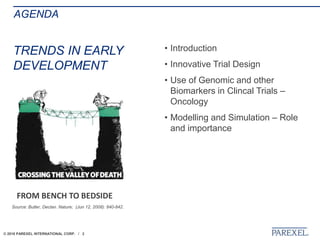
Source: Butler, Declan. Nature; (Jun 12, 2008): 840-842.
FROM BENCH TO BEDSIDE
© 2018 PAREXEL INTERNATIONAL CORP. / 3
BOSTON, MASSACHUSETTS
INNOVATIVE TRIAL DESIGNS IN
CLINICAL DRUG DEVELOPMENT
© 2018 PAREXEL INTERNATIONAL CORP. / 4
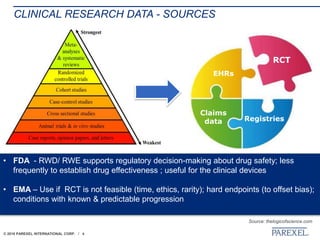
CLINICAL RESEARCH DATA - SOURCES
Registries
EHRs
Claims
data
RCT
• FDA - RWD/ RWE supports regulatory decision-making about drug safety; less
frequently to establish drug effectiveness ; useful for the clinical devices
• EMA – Use if RCT is not feasible (time, ethics, rarity); hard endpoints (to offset bias);
conditions with known & predictable progression
Source: thelogicofscience.com
© 2018 PAREXEL INTERNATIONAL CORP. / 5
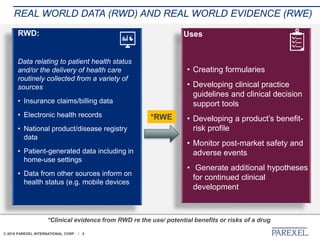
REAL WORLD DATA (RWD) AND REAL WORLD EVIDENCE (RWE)
RWD:
Data relating to patient health status
and/or the delivery of health care
routinely collected from a variety of
sources
• Insurance claims/billing data
• Electronic health records
• National product/disease registry
data
• Patient-generated data including in
home-use settings
• Data from other sources inform on
health status (e.g. mobile devices
Uses
• Creating formularies
• Developing clinical practice
guidelines and clinical decision
support tools
• Developing a product’s benefit-
risk profile
• Monitor post-market safety and
adverse events
• Generate additional hypotheses
for continued clinical
development
*RWE
*Clinical evidence from RWD re the use/ potential benefits or risks of a drug
© 2018 PAREXEL INTERNATIONAL CORP. / 6
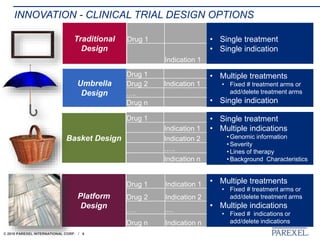
Drug 1
Indication 1
• Single treatment
• Single indication
Drug 1
Indication 1
Indication 2
…..
Indication n
• Single treatment
• Multiple indications
• Genomic information
• Severity
• Lines of therapy
• Background Characteristics
Drug 1
Drug 2 Indication 1
….
Drug n
• Multiple treatments
• Fixed # treatment arms or
add/delete treatment arms
• Single indication
Drug 1 Indication 1
Drug 2 Indication 2
…. …..
Drug n Indication n
• Multiple treatments
• Fixed # treatment arms or
add/delete treatment arms
• Multiple indications
• Fixed # indications or
add/delete indications
INNOVATION - CLINICAL TRIAL DESIGN OPTIONS
Traditional
Design
Umbrella
Design
Basket Design
Platform
Design
© 2018 PAREXEL INTERNATIONAL CORP. / 7
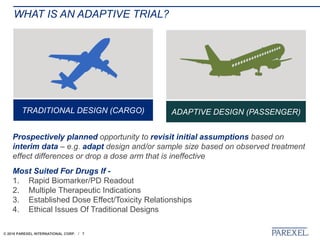
WHAT IS AN ADAPTIVE TRIAL?
Prospectively planned opportunity to revisit initial assumptions based on
interim data – e.g. adapt design and/or sample size based on observed treatment
effect differences or drop a dose arm that is ineffective
Most Suited For Drugs If -
1. Rapid Biomarker/PD Readout
2. Multiple Therapeutic Indications
3. Established Dose Effect/Toxicity Relationships
4. Ethical Issues Of Traditional Designs
TRADITIONAL DESIGN (CARGO) ADAPTIVE DESIGN (PASSENGER)
© 2018 PAREXEL INTERNATIONAL CORP. / 8
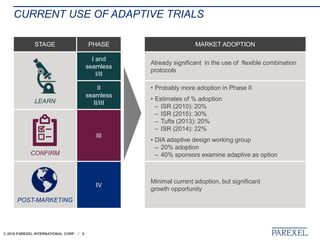
CURRENT USE OF ADAPTIVE TRIALS
STAGE PHASE MARKET ADOPTION
LEARN
I and
seamless
I/II
Already significant in the use of flexible combination
protocols
II
seamless
II/III
• Probably more adoption in Phase II
• Estimates of % adoption
– ISR (2010): 20%
– ISR (2015): 30%
– Tufts (2013): 20%
– ISR (2014): 22%
• DIA adaptive design working group
– 20% adoption
– 40% sponsors examine adaptive as optionCONFIRM
III
POST-MARKETING
IV
Minimal current adoption, but significant
growth opportunity
© 2018 PAREXEL INTERNATIONAL CORP. / 9
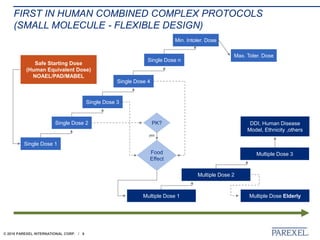
FIRST IN HUMAN COMBINED COMPLEX PROTOCOLS
(SMALL MOLECULE - FLEXIBLE DESIGN)
Single Dose 1
Single Dose 2
Single Dose 3
Single Dose 4
Multiple Dose 1
Multiple Dose 2
Single Dose n
Min. Intoler. Dose
Max. Toler. Dose
Food
Effect
PK?
yes
Multiple Dose Elderly
Safe Starting Dose
(Human Equivalent Dose)
NOAEL/PAD/MABEL
DDI, Human Disease
Model, Ethnicity ,others
Multiple Dose 3
© 2018 PAREXEL INTERNATIONAL CORP. / 10
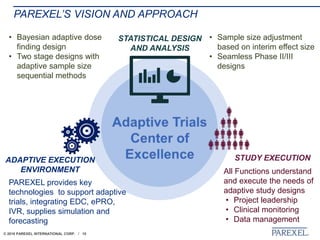
PAREXEL’S VISION AND APPROACH
STATISTICAL DESIGN
AND ANALYSIS
STUDY EXECUTIONADAPTIVE EXECUTION
ENVIRONMENT
• Sample size adjustment
based on interim effect size
• Seamless Phase II/III
designs
All Functions understand
and execute the needs of
adaptive study designs
• Project leadership
• Clinical monitoring
• Data management
PAREXEL provides key
technologies to support adaptive
trials, integrating EDC, ePRO,
IVR, supplies simulation and
forecasting
• Bayesian adaptive dose
finding design
• Two stage designs with
adaptive sample size
sequential methods
© 2018 PAREXEL INTERNATIONAL CORP. / 11
GENOMIC AND OTHER
BIOMARKERS IN
EARLY CLINICAL
TRIALS
© 2018 PAREXEL INTERNATIONAL CORP. / 12
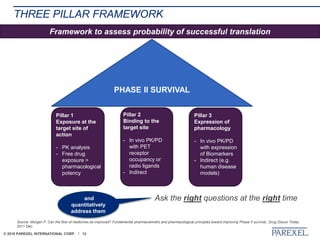
THREE PILLAR FRAMEWORK
Source: Morgan P. Can the flow of medicines be improved? Fundamental pharmacokinetic and pharmacological principles toward improving Phase II survival., Drug Discov Today.
2011 Dec.
- PK analysis
- Free drug
exposure >
pharmacological
potency
- In vivo PK/PD with
PET receptor
occupancy or radio
ligands
- Indirect
- In vivo PK/PD with
expression of
Biomarkers
- Indirect
Framework to assess probability of successful translation
PHASE II SURVIVAL
Pillar 1
Exposure at the
target site of
action
- PK analysis
- Free drug
exposure >
pharmacological
potency
Pillar 2
Binding to the
target site
- In vivo PK/PD
with PET
receptor
occupancy or
radio ligands
- Indirect
Pillar 3
Expression of
pharmacology
- In vivo PK/PD
with expression
of Biomarkers
- Indirect (e.g.
human disease
models)
Ask the right questions at the right timeand
quantitatively
address them
© 2018 PAREXEL INTERNATIONAL CORP. / 13
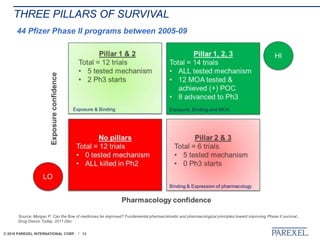
THREE PILLARS OF SURVIVAL
44 Pfizer Phase II programs between 2005-09
Source: Morgan P. Can the flow of medicines be improved? Fundamental pharmacokinetic and pharmacological principles toward improving Phase II survival.,
Drug Discov Today. 2011 Dec.
© 2018 PAREXEL INTERNATIONAL CORP. / 14
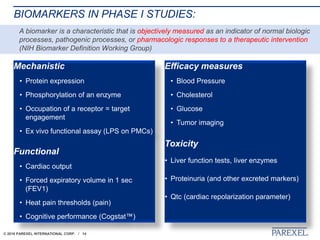
BIOMARKERS IN PHASE I STUDIES:
Mechanistic
• Protein expression
• Phosphorylation of an enzyme
• Occupation of a receptor = target
engagement
• Ex vivo functional assay (LPS on PMCs)
Functional
• Cardiac output
• Forced expiratory volume in 1 sec
(FEV1)
• Heat pain thresholds (pain)
• Cognitive performance (Cogstat™)
Efficacy measures
• Blood Pressure
• Cholesterol
• Glucose
• Tumor imaging
Toxicity
• Liver function tests, liver enzymes
• Proteinuria (and other excreted markers)
• Qtc (cardiac repolarization parameter)
A biomarker is a characteristic that is objectively measured as an indicator of normal biologic
processes, pathogenic processes, or pharmacologic responses to a therapeutic intervention
(NIH Biomarker Definition Working Group)
© 2018 PAREXEL INTERNATIONAL CORP. / 15
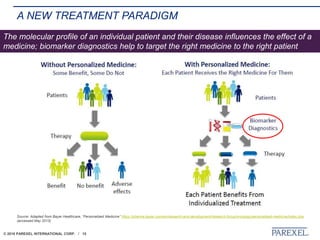
A NEW TREATMENT PARADIGM
The molecular profile of an individual patient and their disease influences the effect of a
medicine; biomarker diagnostics help to target the right medicine to the right patient
Source: Adapted from Bayer Healthcare, “Personalized Medicine” https://pharma.bayer.com/en/research-and-development/research-focus/oncology/personalized-medicine/index.php
(accessed May 2015)
© 2018 PAREXEL INTERNATIONAL CORP. / 16
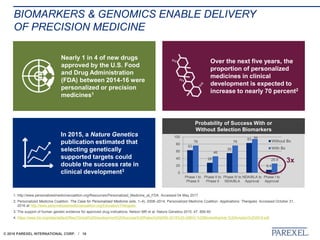
BIOMARKERS & GENOMICS ENABLE DELIVERY
OF PRECISION MEDICINE
1. http://www.personalizedmedicinecoalition.org/Resources/Personalized_Medicine_at_FDA. Accessed 04 May 2017
2. Personalized Medicine Coalition. The Case for Personalized Medicine (eds. 1–4). 2008–2014; Personalized Medicine Coalition. Applications: Therapies. Accessed October 31,
2016 at http://www.personalizedmedicinecoalition.org/Education/Therapies.
3. The support of human genetic evidence for approved drug indications. Nelson MR et al. Nature Genetics 2015; 47: 856-60
4. https://www.bio.org/sites/default/files/Clinical%20Development%20Success%20Rates%202006-2015%20-20BIO,%20Biomedtracker,%20Amplion%202016.pdf
Nearly 1 in 4 of new drugs
approved by the U.S. Food
and Drug Administration
(FDA) between 2014-16 were
personalized or precision
medicines1
Over the next five years, the
proportion of personalized
medicines in clinical
development is expected to
increase to nearly 70 percent2
In 2015, a Nature Genetics
publication estimated that
selecting genetically
supported targets could
double the success rate in
clinical development3
63
28
55
83
8.4
76
46
76
94
25.9
0
20
40
60
80
100
Phase I to
Phase II
Phase II to
Phase II
Phase III to
NDA/BLA
NDA/BLA to
Approval
Phase I to
Approval
Without Bx
With Bx
Probability of Success With or
Without Selection Biomarkers
3x
© 2018 PAREXEL INTERNATIONAL CORP. / 17
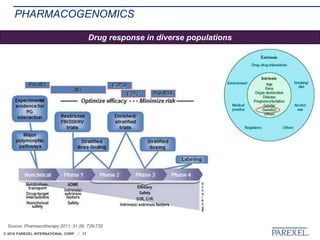
PHARMACOGENOMICS
Source: Pharmacotherapy 2011; 31 (8): 729-735
Drug response in diverse populations
© 2018 PAREXEL INTERNATIONAL CORP. / 18
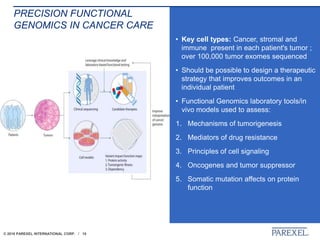
• Key cell types: Cancer, stromal and
immune present in each patient's tumor ;
over 100,000 tumor exomes sequenced
• Should be possible to design a therapeutic
strategy that improves outcomes in an
individual patient
• Functional Genomics laboratory tools/in
vivo models used to assess:
1. Mechanisms of tumorigenesis
2. Mediators of drug resistance
3. Principles of cell signaling
4. Oncogenes and tumor suppressor
5. Somatic mutation affects on protein
function
PRECISION FUNCTIONAL
GENOMICS IN CANCER CARE
© 2018 PAREXEL INTERNATIONAL CORP. / 19
PHARMACOKINETIC/
PHARMACODYNAMIC
MODELING/SIMULATION
© 2018 PAREXEL INTERNATIONAL CORP. / 20
PK/ PD MODELING AND SIMULATION
• The ultimate goal is to utilize internal and external data in a quantitative
manner to improve drug development strategy and decision-making
• Providing the right information at the right time in the right format. Early
buy-in from clinical and commercial to develop quantitative metrics by
which a meaningful ‘go/no go’ decision
• Reduce cost and time (e.g. use modeling instead of additional studies or
treatment arms)
• To facilitate dialogue with Regulatory agencies (Exposure Response or
PK/PD modeling is more of an expectation these days)
• Modelling of 1. Exposure (PK) to PD responses
2. Animal PK to human starting doses
3. Exposure to efficacy response
4. Exposure to toxicity/safety issues
© 2018 PAREXEL INTERNATIONAL CORP. / 21
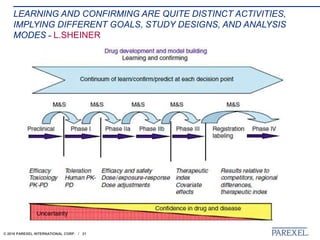
LEARNING AND CONFIRMING ARE QUITE DISTINCT ACTIVITIES,
IMPLYING DIFFERENT GOALS, STUDY DESIGNS, AND ANALYSIS
MODES - L.SHEINER
© 2018 PAREXEL INTERNATIONAL CORP. / 22
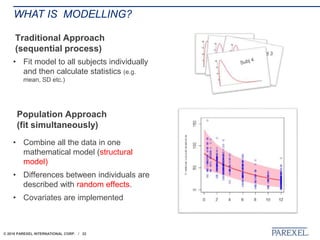
WHAT IS MODELLING?
• Fit model to all subjects individually
and then calculate statistics (e.g.
mean, SD etc.)
• Combine all the data in one
mathematical model (structural
model)
• Differences between individuals are
described with random effects.
• Covariates are implemented
Traditional Approach
(sequential process)
Population Approach
(fit simultaneously)
© 2018 PAREXEL INTERNATIONAL CORP. / 23
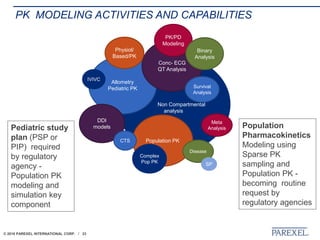
PK MODELING ACTIVITIES AND CAPABILITIES
Non Compartmental
analysis
Allometry
Pediatric PK
Population PK
Conc- ECG
QT Analysis
DDI
models
PK/PD
Modeling
Binary
Analysis
Complex
Pop PK
Survival
Analysis
Physiol/
Based/PK
Meta
Analysis
Disease
IVIVC
CTS
SP
Population
Pharmacokinetics
Modeling using
Sparse PK
sampling and
Population PK -
becoming routine
request by
regulatory agencies
Pediatric study
plan (PSP or
PIP) required
by regulatory
agency -
Population PK
modeling and
simulation key
component
© 2018 PAREXEL INTERNATIONAL CORP. / 24
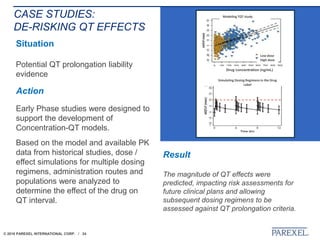
CASE STUDIES:
DE-RISKING QT EFFECTS
Situation
Potential QT prolongation liability
evidence
Action
Early Phase studies were designed to
support the development of
Concentration-QT models.
Based on the model and available PK
data from historical studies, dose /
effect simulations for multiple dosing
regimens, administration routes and
populations were analyzed to
determine the effect of the drug on
QT interval.
Drug concentration (ng/mL)
Modeling TQT study
Simulating Dosing Regimens in the Drug
Label
Low dose
High dose
Result
The magnitude of QT effects were
predicted, impacting risk assessments for
future clinical plans and allowing
subsequent dosing regimens to be
assessed against QT prolongation criteria.
© 2018 PAREXEL INTERNATIONAL CORP. / 25
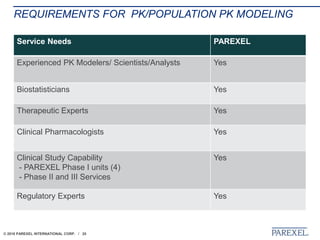
REQUIREMENTS FOR PK/POPULATION PK MODELING
Service Needs PAREXEL
Experienced PK Modelers/ Scientists/Analysts Yes
Biostatisticians Yes
Therapeutic Experts Yes
Clinical Pharmacologists Yes
Clinical Study Capability
- PAREXEL Phase I units (4)
- Phase II and III Services
Yes
Regulatory Experts Yes
© 2018 PAREXEL INTERNATIONAL CORP. / 26
THANK YOU
© 2018 PAREXEL INTERNATIONAL CORP. / 26

Trends in Early Development

  • 1.
    © 2018 PAREXELINTERNATIONAL CORP. TRENDS IN EARLY DEVELOPMENT Dr. John Lambert Corporate Vice President and Chief Medical Officer, Early Phase Medical Sciences, PAREXEL International April 17, 2018 PAREXEL KOREA SYMPOSIUM 2018
  • 2.
    © 2018 PAREXELINTERNATIONAL CORP. / 2 AGENDA • Introduction • Innovative Trial Design • Use of Genomic and other Biomarkers in Clincal Trials – Oncology • Modelling and Simulation – Role and importance TRENDS IN EARLY DEVELOPMENT Source: Butler, Declan. Nature; (Jun 12, 2008): 840-842. FROM BENCH TO BEDSIDE
  • 3.
    © 2018 PAREXELINTERNATIONAL CORP. / 3 BOSTON, MASSACHUSETTS INNOVATIVE TRIAL DESIGNS IN CLINICAL DRUG DEVELOPMENT
  • 4.
    © 2018 PAREXELINTERNATIONAL CORP. / 4 CLINICAL RESEARCH DATA - SOURCES Registries EHRs Claims data RCT • FDA - RWD/ RWE supports regulatory decision-making about drug safety; less frequently to establish drug effectiveness ; useful for the clinical devices • EMA – Use if RCT is not feasible (time, ethics, rarity); hard endpoints (to offset bias); conditions with known & predictable progression Source: thelogicofscience.com
  • 5.
    © 2018 PAREXELINTERNATIONAL CORP. / 5 REAL WORLD DATA (RWD) AND REAL WORLD EVIDENCE (RWE) RWD: Data relating to patient health status and/or the delivery of health care routinely collected from a variety of sources • Insurance claims/billing data • Electronic health records • National product/disease registry data • Patient-generated data including in home-use settings • Data from other sources inform on health status (e.g. mobile devices Uses • Creating formularies • Developing clinical practice guidelines and clinical decision support tools • Developing a product’s benefit- risk profile • Monitor post-market safety and adverse events • Generate additional hypotheses for continued clinical development *RWE *Clinical evidence from RWD re the use/ potential benefits or risks of a drug
  • 6.
    © 2018 PAREXELINTERNATIONAL CORP. / 6 Drug 1 Indication 1 • Single treatment • Single indication Drug 1 Indication 1 Indication 2 ….. Indication n • Single treatment • Multiple indications • Genomic information • Severity • Lines of therapy • Background Characteristics Drug 1 Drug 2 Indication 1 …. Drug n • Multiple treatments • Fixed # treatment arms or add/delete treatment arms • Single indication Drug 1 Indication 1 Drug 2 Indication 2 …. ….. Drug n Indication n • Multiple treatments • Fixed # treatment arms or add/delete treatment arms • Multiple indications • Fixed # indications or add/delete indications INNOVATION - CLINICAL TRIAL DESIGN OPTIONS Traditional Design Umbrella Design Basket Design Platform Design
  • 7.
    © 2018 PAREXELINTERNATIONAL CORP. / 7 WHAT IS AN ADAPTIVE TRIAL? Prospectively planned opportunity to revisit initial assumptions based on interim data – e.g. adapt design and/or sample size based on observed treatment effect differences or drop a dose arm that is ineffective Most Suited For Drugs If - 1. Rapid Biomarker/PD Readout 2. Multiple Therapeutic Indications 3. Established Dose Effect/Toxicity Relationships 4. Ethical Issues Of Traditional Designs TRADITIONAL DESIGN (CARGO) ADAPTIVE DESIGN (PASSENGER)
  • 8.
    © 2018 PAREXELINTERNATIONAL CORP. / 8 CURRENT USE OF ADAPTIVE TRIALS STAGE PHASE MARKET ADOPTION LEARN I and seamless I/II Already significant in the use of flexible combination protocols II seamless II/III • Probably more adoption in Phase II • Estimates of % adoption – ISR (2010): 20% – ISR (2015): 30% – Tufts (2013): 20% – ISR (2014): 22% • DIA adaptive design working group – 20% adoption – 40% sponsors examine adaptive as optionCONFIRM III POST-MARKETING IV Minimal current adoption, but significant growth opportunity
  • 9.
    © 2018 PAREXELINTERNATIONAL CORP. / 9 FIRST IN HUMAN COMBINED COMPLEX PROTOCOLS (SMALL MOLECULE - FLEXIBLE DESIGN) Single Dose 1 Single Dose 2 Single Dose 3 Single Dose 4 Multiple Dose 1 Multiple Dose 2 Single Dose n Min. Intoler. Dose Max. Toler. Dose Food Effect PK? yes Multiple Dose Elderly Safe Starting Dose (Human Equivalent Dose) NOAEL/PAD/MABEL DDI, Human Disease Model, Ethnicity ,others Multiple Dose 3
  • 10.
    © 2018 PAREXELINTERNATIONAL CORP. / 10 PAREXEL’S VISION AND APPROACH STATISTICAL DESIGN AND ANALYSIS STUDY EXECUTIONADAPTIVE EXECUTION ENVIRONMENT • Sample size adjustment based on interim effect size • Seamless Phase II/III designs All Functions understand and execute the needs of adaptive study designs • Project leadership • Clinical monitoring • Data management PAREXEL provides key technologies to support adaptive trials, integrating EDC, ePRO, IVR, supplies simulation and forecasting • Bayesian adaptive dose finding design • Two stage designs with adaptive sample size sequential methods
  • 11.
    © 2018 PAREXELINTERNATIONAL CORP. / 11 GENOMIC AND OTHER BIOMARKERS IN EARLY CLINICAL TRIALS
  • 12.
    © 2018 PAREXELINTERNATIONAL CORP. / 12 THREE PILLAR FRAMEWORK Source: Morgan P. Can the flow of medicines be improved? Fundamental pharmacokinetic and pharmacological principles toward improving Phase II survival., Drug Discov Today. 2011 Dec. - PK analysis - Free drug exposure > pharmacological potency - In vivo PK/PD with PET receptor occupancy or radio ligands - Indirect - In vivo PK/PD with expression of Biomarkers - Indirect Framework to assess probability of successful translation PHASE II SURVIVAL Pillar 1 Exposure at the target site of action - PK analysis - Free drug exposure > pharmacological potency Pillar 2 Binding to the target site - In vivo PK/PD with PET receptor occupancy or radio ligands - Indirect Pillar 3 Expression of pharmacology - In vivo PK/PD with expression of Biomarkers - Indirect (e.g. human disease models) Ask the right questions at the right timeand quantitatively address them
  • 13.
    © 2018 PAREXELINTERNATIONAL CORP. / 13 THREE PILLARS OF SURVIVAL 44 Pfizer Phase II programs between 2005-09 Source: Morgan P. Can the flow of medicines be improved? Fundamental pharmacokinetic and pharmacological principles toward improving Phase II survival., Drug Discov Today. 2011 Dec.
  • 14.
    © 2018 PAREXELINTERNATIONAL CORP. / 14 BIOMARKERS IN PHASE I STUDIES: Mechanistic • Protein expression • Phosphorylation of an enzyme • Occupation of a receptor = target engagement • Ex vivo functional assay (LPS on PMCs) Functional • Cardiac output • Forced expiratory volume in 1 sec (FEV1) • Heat pain thresholds (pain) • Cognitive performance (Cogstat™) Efficacy measures • Blood Pressure • Cholesterol • Glucose • Tumor imaging Toxicity • Liver function tests, liver enzymes • Proteinuria (and other excreted markers) • Qtc (cardiac repolarization parameter) A biomarker is a characteristic that is objectively measured as an indicator of normal biologic processes, pathogenic processes, or pharmacologic responses to a therapeutic intervention (NIH Biomarker Definition Working Group)
  • 15.
    © 2018 PAREXELINTERNATIONAL CORP. / 15 A NEW TREATMENT PARADIGM The molecular profile of an individual patient and their disease influences the effect of a medicine; biomarker diagnostics help to target the right medicine to the right patient Source: Adapted from Bayer Healthcare, “Personalized Medicine” https://pharma.bayer.com/en/research-and-development/research-focus/oncology/personalized-medicine/index.php (accessed May 2015)
  • 16.
    © 2018 PAREXELINTERNATIONAL CORP. / 16 BIOMARKERS & GENOMICS ENABLE DELIVERY OF PRECISION MEDICINE 1. http://www.personalizedmedicinecoalition.org/Resources/Personalized_Medicine_at_FDA. Accessed 04 May 2017 2. Personalized Medicine Coalition. The Case for Personalized Medicine (eds. 1–4). 2008–2014; Personalized Medicine Coalition. Applications: Therapies. Accessed October 31, 2016 at http://www.personalizedmedicinecoalition.org/Education/Therapies. 3. The support of human genetic evidence for approved drug indications. Nelson MR et al. Nature Genetics 2015; 47: 856-60 4. https://www.bio.org/sites/default/files/Clinical%20Development%20Success%20Rates%202006-2015%20-20BIO,%20Biomedtracker,%20Amplion%202016.pdf Nearly 1 in 4 of new drugs approved by the U.S. Food and Drug Administration (FDA) between 2014-16 were personalized or precision medicines1 Over the next five years, the proportion of personalized medicines in clinical development is expected to increase to nearly 70 percent2 In 2015, a Nature Genetics publication estimated that selecting genetically supported targets could double the success rate in clinical development3 63 28 55 83 8.4 76 46 76 94 25.9 0 20 40 60 80 100 Phase I to Phase II Phase II to Phase II Phase III to NDA/BLA NDA/BLA to Approval Phase I to Approval Without Bx With Bx Probability of Success With or Without Selection Biomarkers 3x
  • 17.
    © 2018 PAREXELINTERNATIONAL CORP. / 17 PHARMACOGENOMICS Source: Pharmacotherapy 2011; 31 (8): 729-735 Drug response in diverse populations
  • 18.
    © 2018 PAREXELINTERNATIONAL CORP. / 18 • Key cell types: Cancer, stromal and immune present in each patient's tumor ; over 100,000 tumor exomes sequenced • Should be possible to design a therapeutic strategy that improves outcomes in an individual patient • Functional Genomics laboratory tools/in vivo models used to assess: 1. Mechanisms of tumorigenesis 2. Mediators of drug resistance 3. Principles of cell signaling 4. Oncogenes and tumor suppressor 5. Somatic mutation affects on protein function PRECISION FUNCTIONAL GENOMICS IN CANCER CARE
  • 19.
    © 2018 PAREXELINTERNATIONAL CORP. / 19 PHARMACOKINETIC/ PHARMACODYNAMIC MODELING/SIMULATION
  • 20.
    © 2018 PAREXELINTERNATIONAL CORP. / 20 PK/ PD MODELING AND SIMULATION • The ultimate goal is to utilize internal and external data in a quantitative manner to improve drug development strategy and decision-making • Providing the right information at the right time in the right format. Early buy-in from clinical and commercial to develop quantitative metrics by which a meaningful ‘go/no go’ decision • Reduce cost and time (e.g. use modeling instead of additional studies or treatment arms) • To facilitate dialogue with Regulatory agencies (Exposure Response or PK/PD modeling is more of an expectation these days) • Modelling of 1. Exposure (PK) to PD responses 2. Animal PK to human starting doses 3. Exposure to efficacy response 4. Exposure to toxicity/safety issues
  • 21.
    © 2018 PAREXELINTERNATIONAL CORP. / 21 LEARNING AND CONFIRMING ARE QUITE DISTINCT ACTIVITIES, IMPLYING DIFFERENT GOALS, STUDY DESIGNS, AND ANALYSIS MODES - L.SHEINER
  • 22.
    © 2018 PAREXELINTERNATIONAL CORP. / 22 WHAT IS MODELLING? • Fit model to all subjects individually and then calculate statistics (e.g. mean, SD etc.) • Combine all the data in one mathematical model (structural model) • Differences between individuals are described with random effects. • Covariates are implemented Traditional Approach (sequential process) Population Approach (fit simultaneously)
  • 23.
    © 2018 PAREXELINTERNATIONAL CORP. / 23 PK MODELING ACTIVITIES AND CAPABILITIES Non Compartmental analysis Allometry Pediatric PK Population PK Conc- ECG QT Analysis DDI models PK/PD Modeling Binary Analysis Complex Pop PK Survival Analysis Physiol/ Based/PK Meta Analysis Disease IVIVC CTS SP Population Pharmacokinetics Modeling using Sparse PK sampling and Population PK - becoming routine request by regulatory agencies Pediatric study plan (PSP or PIP) required by regulatory agency - Population PK modeling and simulation key component
  • 24.
    © 2018 PAREXELINTERNATIONAL CORP. / 24 CASE STUDIES: DE-RISKING QT EFFECTS Situation Potential QT prolongation liability evidence Action Early Phase studies were designed to support the development of Concentration-QT models. Based on the model and available PK data from historical studies, dose / effect simulations for multiple dosing regimens, administration routes and populations were analyzed to determine the effect of the drug on QT interval. Drug concentration (ng/mL) Modeling TQT study Simulating Dosing Regimens in the Drug Label Low dose High dose Result The magnitude of QT effects were predicted, impacting risk assessments for future clinical plans and allowing subsequent dosing regimens to be assessed against QT prolongation criteria.
  • 25.
    © 2018 PAREXELINTERNATIONAL CORP. / 25 REQUIREMENTS FOR PK/POPULATION PK MODELING Service Needs PAREXEL Experienced PK Modelers/ Scientists/Analysts Yes Biostatisticians Yes Therapeutic Experts Yes Clinical Pharmacologists Yes Clinical Study Capability - PAREXEL Phase I units (4) - Phase II and III Services Yes Regulatory Experts Yes
  • 26.
    © 2018 PAREXELINTERNATIONAL CORP. / 26 THANK YOU © 2018 PAREXEL INTERNATIONAL CORP. / 26