Using a Discrete Choice
Experiment to Value the
EQ-5D-5L in Canada
Nick Bansback
Assistant Professor
School of Population and Public Health, University of
British Columbia
CIHR New Investigator
Conflict of interest
• Member of the EuroQol group
• No conflicts related to this presentation
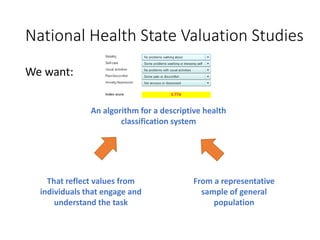
National Health State Valuation Studies
We want:
An algorithm for a descriptive health
classification system
That reflect values from
individuals that engage and
understand the task
From a representative
sample of general
population
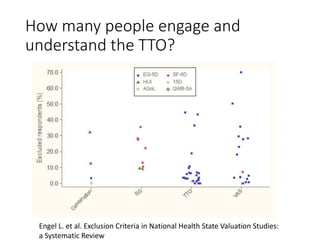
How many people engage and
understand the TTO?
• We excluded 136 (11%) from the TTO analysis:
• Illogical responses (e.g. value some pain better than no
pain)
• Implausible responses (e.g. value mild health states as
worse than dead)
• Untrustworthy responses (e.g. value a variety of health
states the same)
How many people engage and
understand the TTO?
Engel L. et al. Exclusion Criteria in National Health State Valuation Studies:
a Systematic Review
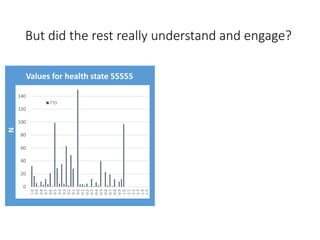
But did the rest really understand and engage?
0
20
40
60
80
100
120
140
1.0
0.9
0.8
0.7
0.6
0.5
0.4
0.3
0.2
0.1
0.0
-0.1
-0.2
-0.3
-0.4
-0.5
-0.6
-0.7
-0.8
-0.9
-1.0
-1.1
-1.2
-1.3
-1.4
-1.5
-1.6
-1.7
-1.8
-1.9
-2.0
-2.1
-2.2
-2.3
-2.4
-2.5
-2.6
-2.7
-2.8
-2.9
-3.0
N
TTO
Values for health state 55555
N
0
200
400
600
800
1000
1200
1400
1.0
0.9
0.8
0.7
0.6
0.5
0.4
0.3
0.2
0.1
0.0
-0.1
-0.2
-0.3
-0.4
-0.5
-0.6
-0.7
-0.8
-0.9
-1.0
-1.1
-1.2
-1.3
-1.4
-1.5
-1.6
-1.7
-1.8
N
N
Values for all health states
0
20
40
60
80
100
120
140 1.0
0.9
0.8
0.7
0.6
0.5
0.4
0.3
0.2
0.1
0.0
-0.1
-0.2
-0.3
-0.4
-0.5
-0.6
-0.7
-0.8
-0.9
-1.0
-1.1
-1.2
-1.3
-1.4
-1.5
-1.6
-1.7
-1.8
-1.9
-2.0
-2.1
-2.2
-2.3
-2.4
-2.5
-2.6
-2.7
-2.8
-2.9
-3.0
TTO
0
20
40
60
80
100
120
140
1.0
0.9
0.8
0.7
0.6
0.5
0.4
0.3
0.2
0.1
0.0
-0.1
-0.2
-0.3
-0.4
-0.5
-0.6
-0.7
N
TTO
Impact of exclusions on
representativeness
• In the wider literature, excluded persons tend to be
older, less educated and sicker1
• Similar findings in our TTO study
• Impact of exclusions on values varies between
studies1
• Small differences (larger at more severe health states)
found in our TTO study
→ the TTO task seems to lead to exclusions that
might influence the representativeness and
numbers in National Health State Valuation Studies
1. Engel L. et al. Exclusion Criteria in National Health State Valuation
Studies: a Systematic Review
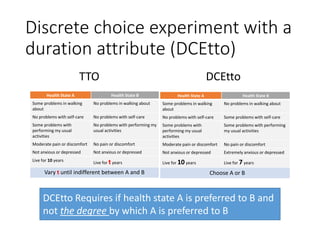
Discrete choice experiment with a
duration attribute (DCEtto)
Health State A Health State B
Some problems in walking
about
No problems in walking about
No problems with self-care Some problems with self-care
Some problems with
performing my usual
activities
Some problems with performing
my usual activities
Moderate pain or discomfort No pain or discomfort
Not anxious or depressed Extremely anxious or depressed
Live for 10 years Live for 7 years
Choose A or B
Health State A Health State B
Some problems in walking
about
No problems in walking about
No problems with self-care No problems with self-care
Some problems with
performing my usual
activities
No problems with performing my
usual activities
Moderate pain or discomfort No pain or discomfort
Not anxious or depressed Not anxious or depressed
Live for 10 years Live for tyears
Vary t until indifferent between A and B
DCEtto Requires if health state A is preferred to B and
not the degree by which A is preferred to B
TTO DCEtto
Previous research in DCEtto
• Simpler (fewer drop-outs)
• Enables incorporation of all respondents, increasing
power and representativeness
Cognition
• Included with no change in task or arbitrary
transformation
States worse
than dead
• DCEs rooted in economic theory (RUT)Theory
• Quick to complete
• Can be implemented on the web (cheaper)
Practical
Bansback, et al. "Using a discrete choice experiment to estimate health state utility values." Journal of health
economics 31.1 (2012): 306-318.
Bansback, et al. "Testing a discrete choice experiment including duration to value health states for large descriptive
systems: Addressing design and sampling issues." Social Science & Medicine 114 (2014): 38-48.
Canadian EQ-5D 5L study
• Alongside the TTO, participants also completed
between 7 and 9 DCEtto tasks (in 7 tasks duration
was equal between options)
• A total of 252 DCE unique pairs were valued –
created using D-efficient designs
• 1107 respondents – 19926 observations
• Modelled using conditional logit model, interacting
duration with each level of each EQ-5D dimension
Differences in distribution of values
0
20
40
60
80
100
120
140
1.0
0.9
0.8
0.7
0.6
0.5
0.4
0.3
0.2
0.1
0.0
-0.1
-0.2
-0.3
-0.4
-0.5
-0.6
-0.7
-0.8
-0.9
-1.0
-1.1
-1.2
-1.3
-1.4
-1.5
-1.6
-1.7
-1.8
-1.9
-2.0
-2.1
-2.2
-2.3
-2.4
-2.5
-2.6
-2.7
-2.8
-2.9
-3.0
N
TTO
1.0
0.9
0.8
0.7
0.6
0.5
0.4
0.3
0.2
0.1
0.0
-0.1
-0.2
-0.3
-0.4
-0.5
-0.6
-0.7
-0.8
-0.9
-1.0
-1.1
-1.2
-1.3
-1.4
-1.5
-1.6
-1.7
-1.8
-1.9
-2.0
-2.1
-2.2
-2.3
-2.4
-2.5
-2.6
-2.7
-2.8
-2.9
-3.0
TTO
Values for health state 55555
N
0
200
400
600
800
1000
1200
1400
1.0
0.9
0.8
0.7
0.6
0.5
0.4
0.3
0.2
0.1
0.0
-0.1
-0.2
-0.3
-0.4
-0.5
-0.6
-0.7
-0.8
-0.9
-1.0
-1.1
-1.2
-1.3
-1.4
-1.5
-1.6
-1.7
-1.8
-1.9
NN
Values for all health states
0
20
40
60
80
100
120
140
1.0
0.9
0.8
0.7
0.6
0.5
0.4
0.3
0.2
0.1
0.0
-0.1
-0.2
-0.3
-0.4
-0.5
-0.6
-0.7
-0.8
-0.9
-1.0
-1.1
-1.2
-1.3
-1.4
-1.5
-1.6
-1.7
-1.8
-1.9
-2.0
-2.1
-2.2
-2.3
-2.4
-2.5
-2.6
-2.7
-2.8
-2.9
-3.0
N
DCEtto TTO
0
200
400
600
800
1000
1200
1400
1.0
0.9
0.8
0.7
0.6
0.5
0.4
0.3
0.2
0.1
0.0
-0.1
-0.2
-0.3
-0.4
-0.5
-0.6
-0.7
-0.8
-0.9
-1.0
-1.1
-1.2
-1.3
-1.4
-1.5
-1.6
-1.7
-1.8
-1.9
N
0
20
40
60
80
100
120
140
1.0
0.9
0.8
0.7
0.6
0.5
0.4
0.3
0.2
0.1
0.0
-0.1
-0.2
-0.3
-0.4
-0.5
-0.6
-0.7
-0.8
-0.9
-1.0
-1.1
-1.2
-1.3
-1.4
-1.5
-1.6
-1.7
N
DCEtto TTO
0.3
0.2
0.1
0.0
-0.1
-0.2
-0.3
-0.4
-0.5
-0.6
-0.7
-0.8
-0.9
-1.0
-1.1
-1.2
-1.3
-1.4
-1.5
-1.6
-1.7
-1.8
-1.9
-2.0
-2.1
-2.2
-2.3
-2.4
-2.5
-2.6
-2.7
-2.8
-2.9
-3.0
DCEtto TTO
Differences in average values
-0.8
-0.6
-0.4
-0.2
0
0.2
0.4
0.6
0.8
1
11211
11121
12121
12112
11421
42321
53221
34232
32314
25222
12334
53412
31514
11425
15151
33253
45233
12244
31525
45413
21345
52335
21444
54342
53244
35245
55424
44345
52455
TTO DCEtto
←Better health states Worse health states→
Utilityvalues
Impact of excluded respondents from TTO
←Better health states Worse health states→
Utilityvalues
-1
-0.8
-0.6
-0.4
-0.2
0
0.2
0.4
0.6
0.8
1
11211
11121
12121
12112
11421
42321
53221
34232
32314
25222
12334
53412
31514
11425
15151
33253
45233
12244
31525
45413
21345
52335
21444
54342
53244
35245
55424
44345
52455
DCEtto exclusions DCEtto all
Limitations
• Unclear whether the DCEtto really is simpler
• Harder to test whether respondents have engaged
and understood the task
• Gives lower values than TTO – but these are not
directly valued - difficult to know if they are real
• …All questions currently being investigated in
studies by our team and others

Cadth 2015 e3 eq5 d

  • 1.
    Using a DiscreteChoice Experiment to Value the EQ-5D-5L in Canada Nick Bansback Assistant Professor School of Population and Public Health, University of British Columbia CIHR New Investigator
  • 2.
    Conflict of interest •Member of the EuroQol group • No conflicts related to this presentation
  • 3.
    National Health StateValuation Studies We want: An algorithm for a descriptive health classification system That reflect values from individuals that engage and understand the task From a representative sample of general population
  • 4.
    How many peopleengage and understand the TTO? • We excluded 136 (11%) from the TTO analysis: • Illogical responses (e.g. value some pain better than no pain) • Implausible responses (e.g. value mild health states as worse than dead) • Untrustworthy responses (e.g. value a variety of health states the same)
  • 5.
    How many peopleengage and understand the TTO? Engel L. et al. Exclusion Criteria in National Health State Valuation Studies: a Systematic Review
  • 6.
    But did therest really understand and engage? 0 20 40 60 80 100 120 140 1.0 0.9 0.8 0.7 0.6 0.5 0.4 0.3 0.2 0.1 0.0 -0.1 -0.2 -0.3 -0.4 -0.5 -0.6 -0.7 -0.8 -0.9 -1.0 -1.1 -1.2 -1.3 -1.4 -1.5 -1.6 -1.7 -1.8 -1.9 -2.0 -2.1 -2.2 -2.3 -2.4 -2.5 -2.6 -2.7 -2.8 -2.9 -3.0 N TTO Values for health state 55555 N 0 200 400 600 800 1000 1200 1400 1.0 0.9 0.8 0.7 0.6 0.5 0.4 0.3 0.2 0.1 0.0 -0.1 -0.2 -0.3 -0.4 -0.5 -0.6 -0.7 -0.8 -0.9 -1.0 -1.1 -1.2 -1.3 -1.4 -1.5 -1.6 -1.7 -1.8 N N Values for all health states 0 20 40 60 80 100 120 140 1.0 0.9 0.8 0.7 0.6 0.5 0.4 0.3 0.2 0.1 0.0 -0.1 -0.2 -0.3 -0.4 -0.5 -0.6 -0.7 -0.8 -0.9 -1.0 -1.1 -1.2 -1.3 -1.4 -1.5 -1.6 -1.7 -1.8 -1.9 -2.0 -2.1 -2.2 -2.3 -2.4 -2.5 -2.6 -2.7 -2.8 -2.9 -3.0 TTO 0 20 40 60 80 100 120 140 1.0 0.9 0.8 0.7 0.6 0.5 0.4 0.3 0.2 0.1 0.0 -0.1 -0.2 -0.3 -0.4 -0.5 -0.6 -0.7 N TTO
  • 7.
    Impact of exclusionson representativeness • In the wider literature, excluded persons tend to be older, less educated and sicker1 • Similar findings in our TTO study • Impact of exclusions on values varies between studies1 • Small differences (larger at more severe health states) found in our TTO study → the TTO task seems to lead to exclusions that might influence the representativeness and numbers in National Health State Valuation Studies 1. Engel L. et al. Exclusion Criteria in National Health State Valuation Studies: a Systematic Review
  • 8.
    Discrete choice experimentwith a duration attribute (DCEtto) Health State A Health State B Some problems in walking about No problems in walking about No problems with self-care Some problems with self-care Some problems with performing my usual activities Some problems with performing my usual activities Moderate pain or discomfort No pain or discomfort Not anxious or depressed Extremely anxious or depressed Live for 10 years Live for 7 years Choose A or B Health State A Health State B Some problems in walking about No problems in walking about No problems with self-care No problems with self-care Some problems with performing my usual activities No problems with performing my usual activities Moderate pain or discomfort No pain or discomfort Not anxious or depressed Not anxious or depressed Live for 10 years Live for tyears Vary t until indifferent between A and B DCEtto Requires if health state A is preferred to B and not the degree by which A is preferred to B TTO DCEtto
  • 9.
    Previous research inDCEtto • Simpler (fewer drop-outs) • Enables incorporation of all respondents, increasing power and representativeness Cognition • Included with no change in task or arbitrary transformation States worse than dead • DCEs rooted in economic theory (RUT)Theory • Quick to complete • Can be implemented on the web (cheaper) Practical Bansback, et al. "Using a discrete choice experiment to estimate health state utility values." Journal of health economics 31.1 (2012): 306-318. Bansback, et al. "Testing a discrete choice experiment including duration to value health states for large descriptive systems: Addressing design and sampling issues." Social Science & Medicine 114 (2014): 38-48.
  • 10.
    Canadian EQ-5D 5Lstudy • Alongside the TTO, participants also completed between 7 and 9 DCEtto tasks (in 7 tasks duration was equal between options) • A total of 252 DCE unique pairs were valued – created using D-efficient designs • 1107 respondents – 19926 observations • Modelled using conditional logit model, interacting duration with each level of each EQ-5D dimension
  • 11.
    Differences in distributionof values 0 20 40 60 80 100 120 140 1.0 0.9 0.8 0.7 0.6 0.5 0.4 0.3 0.2 0.1 0.0 -0.1 -0.2 -0.3 -0.4 -0.5 -0.6 -0.7 -0.8 -0.9 -1.0 -1.1 -1.2 -1.3 -1.4 -1.5 -1.6 -1.7 -1.8 -1.9 -2.0 -2.1 -2.2 -2.3 -2.4 -2.5 -2.6 -2.7 -2.8 -2.9 -3.0 N TTO 1.0 0.9 0.8 0.7 0.6 0.5 0.4 0.3 0.2 0.1 0.0 -0.1 -0.2 -0.3 -0.4 -0.5 -0.6 -0.7 -0.8 -0.9 -1.0 -1.1 -1.2 -1.3 -1.4 -1.5 -1.6 -1.7 -1.8 -1.9 -2.0 -2.1 -2.2 -2.3 -2.4 -2.5 -2.6 -2.7 -2.8 -2.9 -3.0 TTO Values for health state 55555 N 0 200 400 600 800 1000 1200 1400 1.0 0.9 0.8 0.7 0.6 0.5 0.4 0.3 0.2 0.1 0.0 -0.1 -0.2 -0.3 -0.4 -0.5 -0.6 -0.7 -0.8 -0.9 -1.0 -1.1 -1.2 -1.3 -1.4 -1.5 -1.6 -1.7 -1.8 -1.9 NN Values for all health states 0 20 40 60 80 100 120 140 1.0 0.9 0.8 0.7 0.6 0.5 0.4 0.3 0.2 0.1 0.0 -0.1 -0.2 -0.3 -0.4 -0.5 -0.6 -0.7 -0.8 -0.9 -1.0 -1.1 -1.2 -1.3 -1.4 -1.5 -1.6 -1.7 -1.8 -1.9 -2.0 -2.1 -2.2 -2.3 -2.4 -2.5 -2.6 -2.7 -2.8 -2.9 -3.0 N DCEtto TTO 0 200 400 600 800 1000 1200 1400 1.0 0.9 0.8 0.7 0.6 0.5 0.4 0.3 0.2 0.1 0.0 -0.1 -0.2 -0.3 -0.4 -0.5 -0.6 -0.7 -0.8 -0.9 -1.0 -1.1 -1.2 -1.3 -1.4 -1.5 -1.6 -1.7 -1.8 -1.9 N 0 20 40 60 80 100 120 140 1.0 0.9 0.8 0.7 0.6 0.5 0.4 0.3 0.2 0.1 0.0 -0.1 -0.2 -0.3 -0.4 -0.5 -0.6 -0.7 -0.8 -0.9 -1.0 -1.1 -1.2 -1.3 -1.4 -1.5 -1.6 -1.7 N DCEtto TTO 0.3 0.2 0.1 0.0 -0.1 -0.2 -0.3 -0.4 -0.5 -0.6 -0.7 -0.8 -0.9 -1.0 -1.1 -1.2 -1.3 -1.4 -1.5 -1.6 -1.7 -1.8 -1.9 -2.0 -2.1 -2.2 -2.3 -2.4 -2.5 -2.6 -2.7 -2.8 -2.9 -3.0 DCEtto TTO
  • 12.
    Differences in averagevalues -0.8 -0.6 -0.4 -0.2 0 0.2 0.4 0.6 0.8 1 11211 11121 12121 12112 11421 42321 53221 34232 32314 25222 12334 53412 31514 11425 15151 33253 45233 12244 31525 45413 21345 52335 21444 54342 53244 35245 55424 44345 52455 TTO DCEtto ←Better health states Worse health states→ Utilityvalues
  • 13.
    Impact of excludedrespondents from TTO ←Better health states Worse health states→ Utilityvalues -1 -0.8 -0.6 -0.4 -0.2 0 0.2 0.4 0.6 0.8 1 11211 11121 12121 12112 11421 42321 53221 34232 32314 25222 12334 53412 31514 11425 15151 33253 45233 12244 31525 45413 21345 52335 21444 54342 53244 35245 55424 44345 52455 DCEtto exclusions DCEtto all
  • 14.
    Limitations • Unclear whetherthe DCEtto really is simpler • Harder to test whether respondents have engaged and understood the task • Gives lower values than TTO – but these are not directly valued - difficult to know if they are real • …All questions currently being investigated in studies by our team and others

Editor's Notes

  • #10 Values are used to inform important decisions Conventional methods (e.g. TTO) have been used in many previous studies Results show: More people fail to complete the TTO than DCE The problematic responses for TTO impact results but not the same for the DCE People complete the DCE quicker than the TTO