pCODR Experience with Adaptive
Clinical Trial Designs
Tony Fields
Chair
pCODR Expert Review Committee
CADTH
2
• No significant conflicts of interest
• Opinions expressed are not necessarily
those of pCODR or CADTH
Disclosures
3
• Most common experiences:
– Early stopping rules
– Treatment switching
• Emerging and anticipated:
– More complex adaptive designs
pCODR and Adaptive Clinical Trial Designs
4
• The disease: chronic lymphocytic leukaemia
• The patient population: patients with a significant burden of
coexisting problems
• The standard treatment:
– Chlorambucil (an alkylating agent) in most of Canada
– Chlorambucil plus rituximab (a type 1 anti-CD20
monoclonal antibody) (actually not robustly evidence-
based for this population, therefore not available in most
provinces)
• The experimental treatment:
– Chlorambucil plus obinutuzumab (GA101, a type 2 anti-
CD20 monoclonal antibody)
Obinutuzumab plus chlorambucil for CLL
5
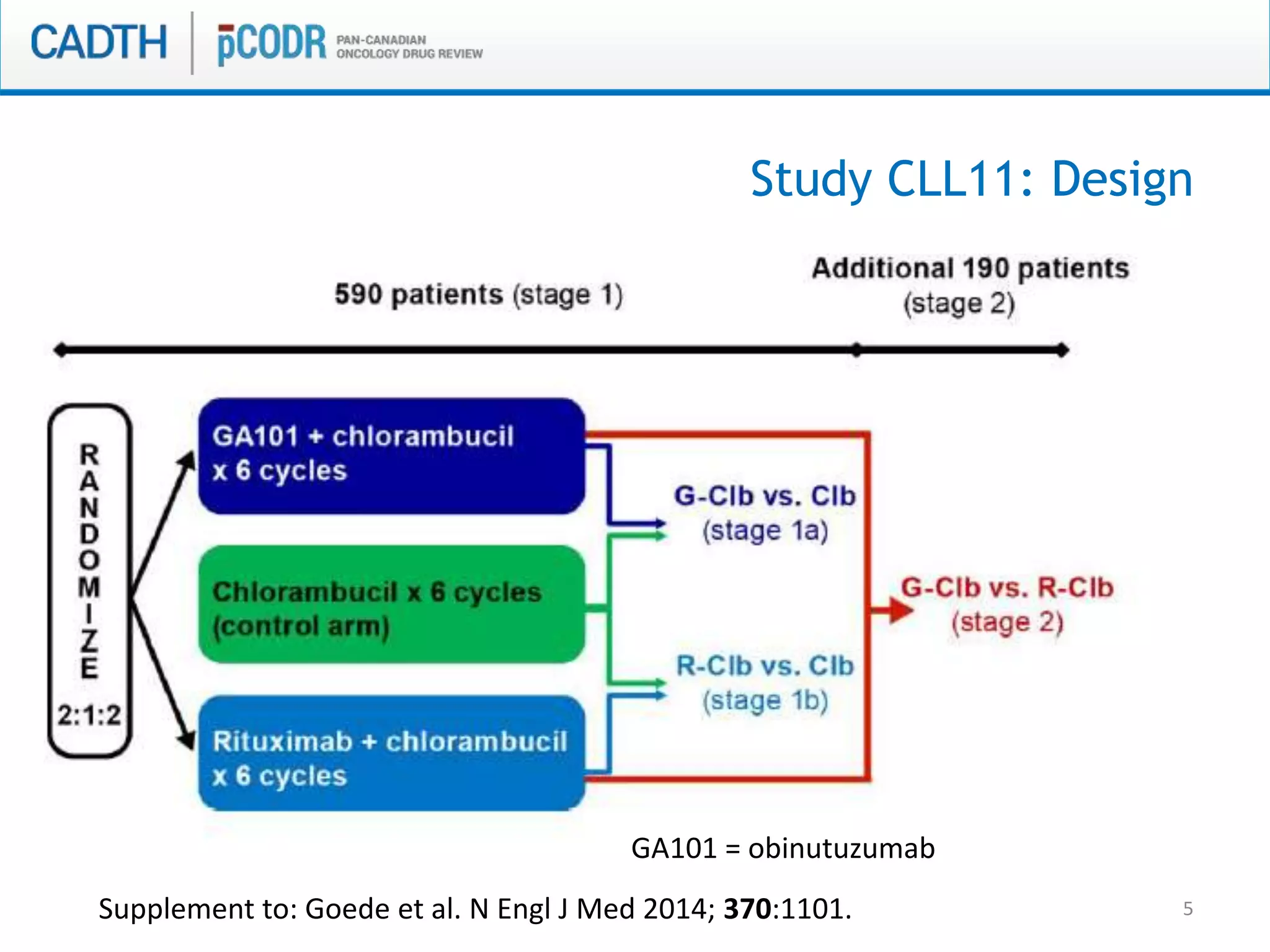
Study CLL11: Design
GA101 = obinutuzumab
Supplement to: Goede et al. N Engl J Med 2014; 370:1101.
6
7
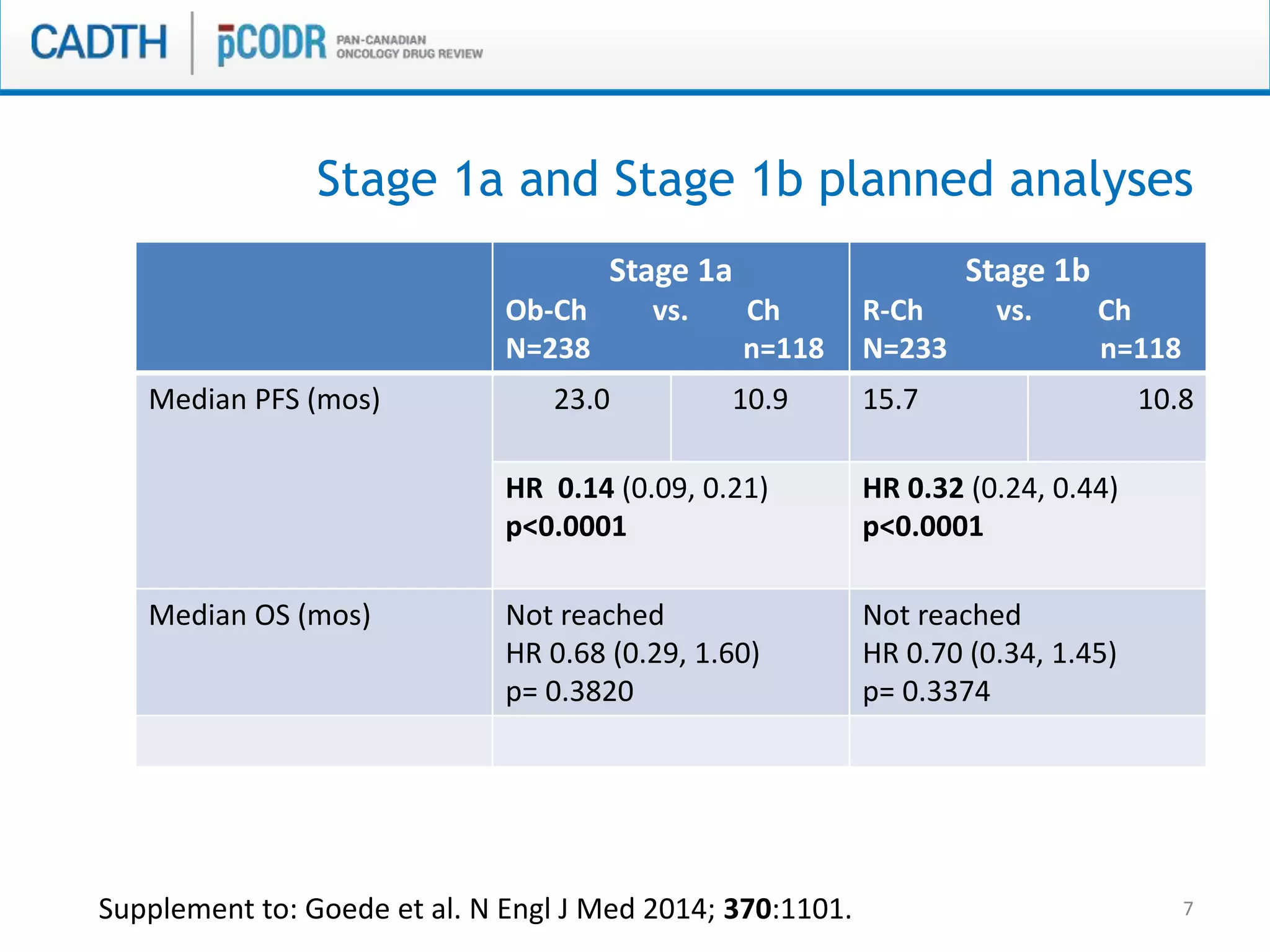
Stage 1a
Ob-Ch vs. Ch
N=238 n=118
Stage 1b
R-Ch vs. Ch
N=233 n=118
Median PFS (mos) 23.0 10.9 15.7 10.8
HR 0.14 (0.09, 0.21)
p<0.0001
HR 0.32 (0.24, 0.44)
p<0.0001
Median OS (mos) Not reached
HR 0.68 (0.29, 1.60)
p= 0.3820
Not reached
HR 0.70 (0.34, 1.45)
p= 0.3374
Stage 1a and Stage 1b planned analyses
Supplement to: Goede et al. N Engl J Med 2014; 370:1101.
8
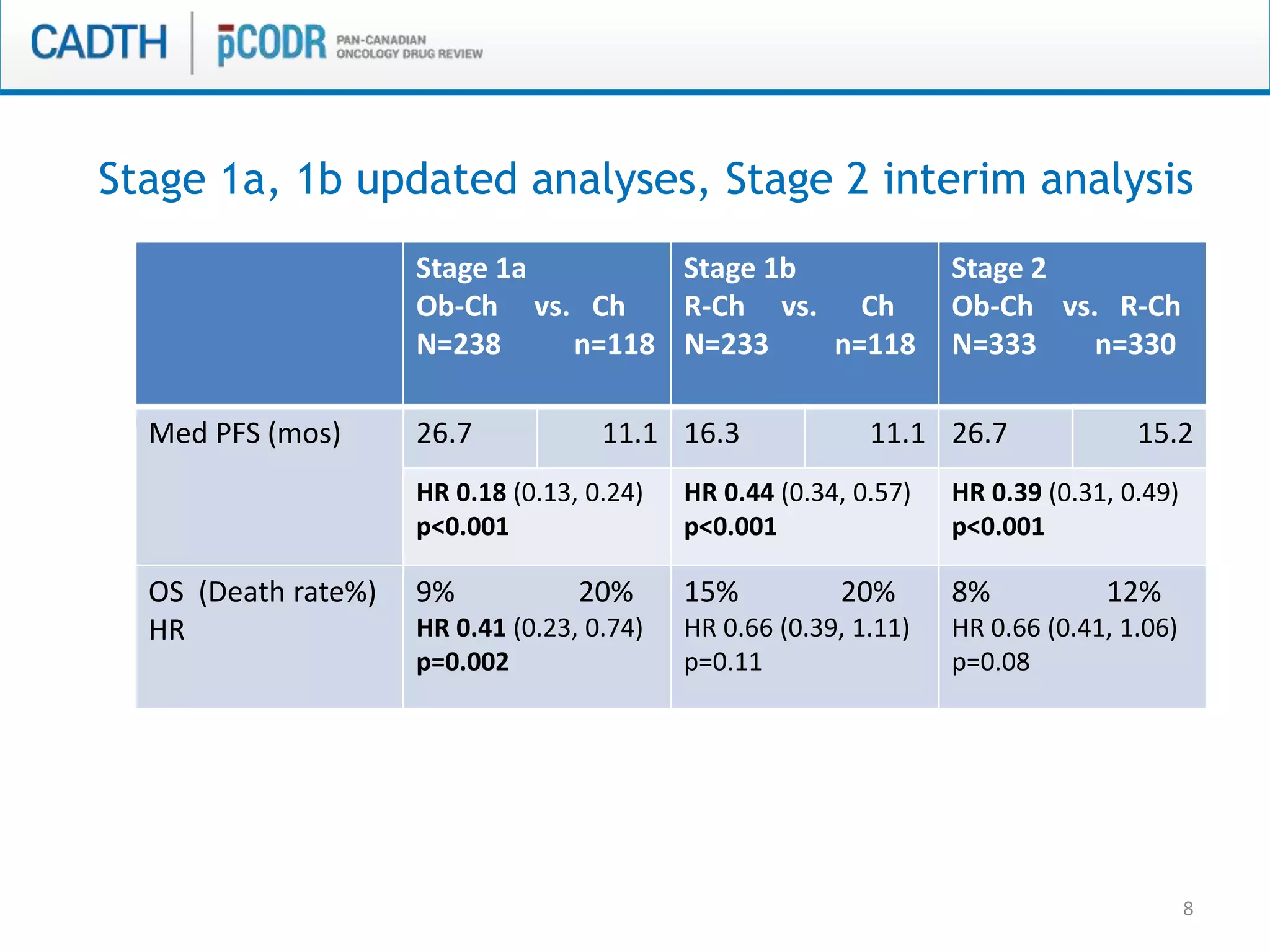
Stage 1a
Ob-Ch vs. Ch
N=238 n=118
Stage 1b
R-Ch vs. Ch
N=233 n=118
Stage 2
Ob-Ch vs. R-Ch
N=333 n=330
Med PFS (mos) 26.7 11.1 16.3 11.1 26.7 15.2
HR 0.18 (0.13, 0.24)
p<0.001
HR 0.44 (0.34, 0.57)
p<0.001
HR 0.39 (0.31, 0.49)
p<0.001
OS (Death rate%)
HR
9% 20%
HR 0.41 (0.23, 0.74)
p=0.002
15% 20%
HR 0.66 (0.39, 1.11)
p=0.11
8% 12%
HR 0.66 (0.41, 1.06)
p=0.08
Stage 1a, 1b updated analyses, Stage 2 interim analysis
9
• Recommended for funding for defined patient population
based on net clinical benefit and cost-effectiveness compared
to Canadian standard of chlorambucil monotherapy
pCODR recommendation: OB-Ch
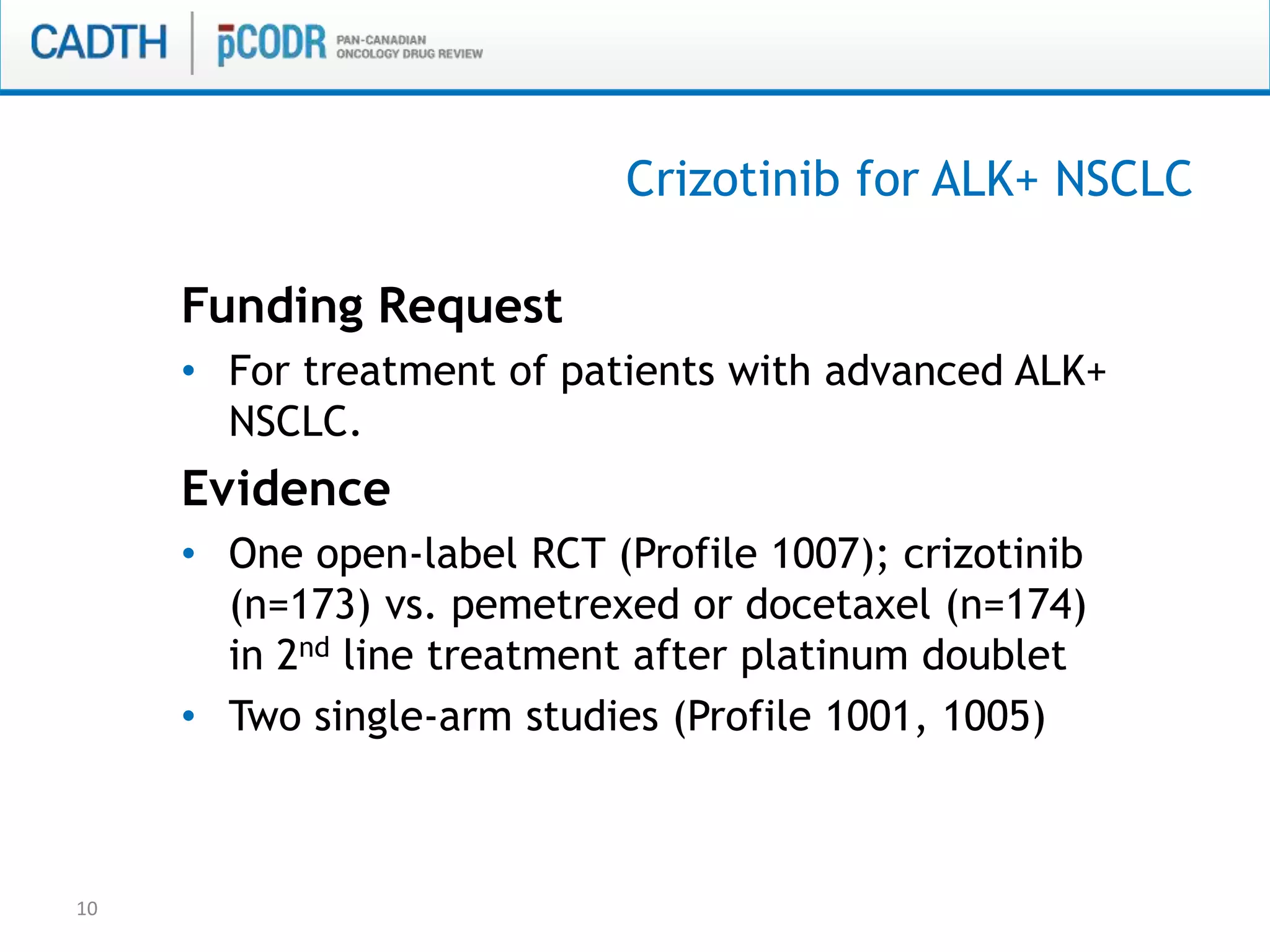
Crizotinib for ALK+ NSCLC
Funding Request
• For treatment of patients with advanced ALK+
NSCLC.
Evidence
• One open-label RCT (Profile 1007); crizotinib
(n=173) vs. pemetrexed or docetaxel (n=174)
in 2nd line treatment after platinum doublet
• Two single-arm studies (Profile 1001, 1005)
10
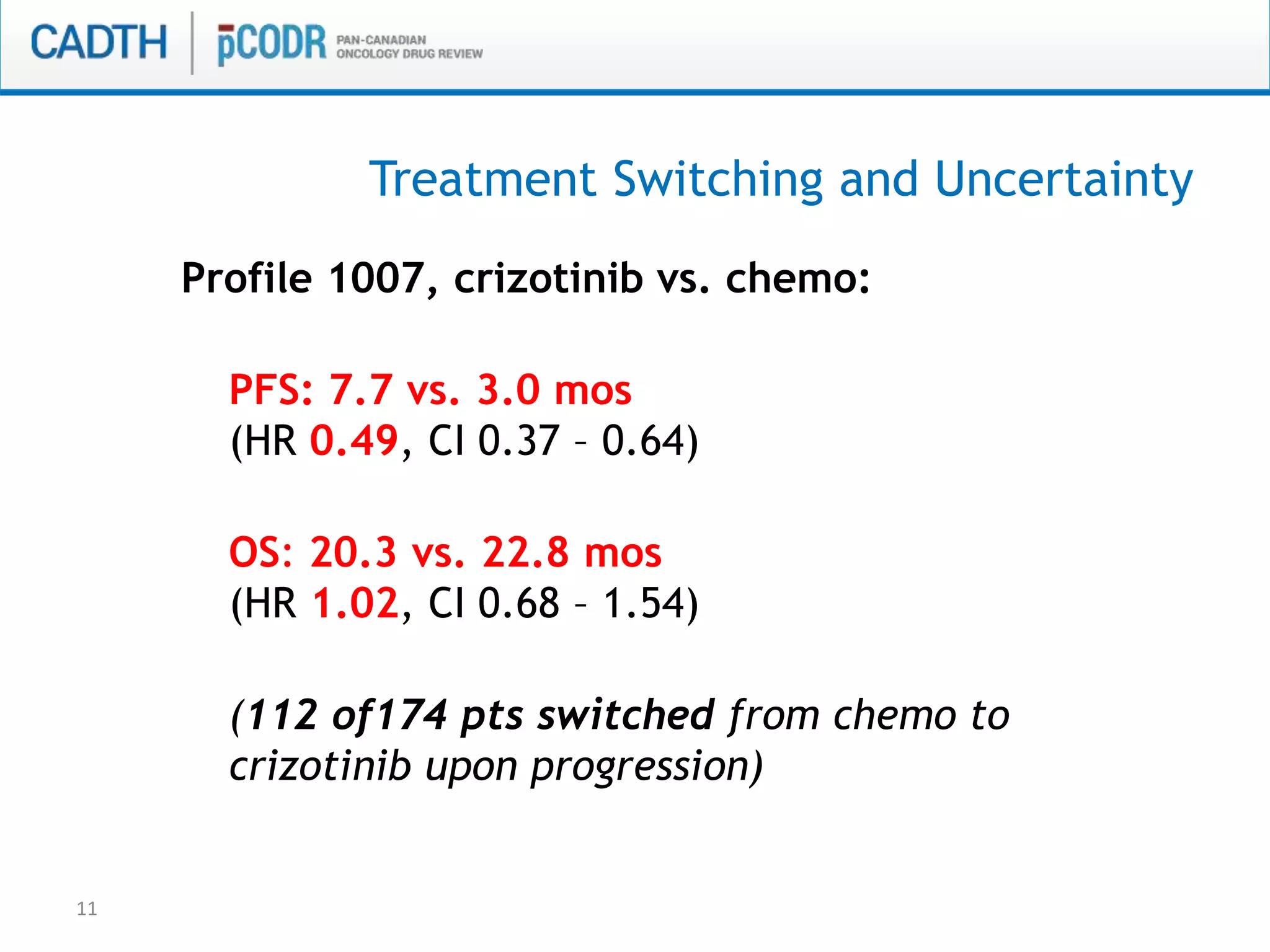
Treatment Switching and Uncertainty
Profile 1007, crizotinib vs. chemo:
PFS: 7.7 vs. 3.0 mos
(HR 0.49, CI 0.37 – 0.64)
OS: 20.3 vs. 22.8 mos
(HR 1.02, CI 0.68 – 1.54)
(112 of174 pts switched from chemo to
crizotinib upon progression)
11
12
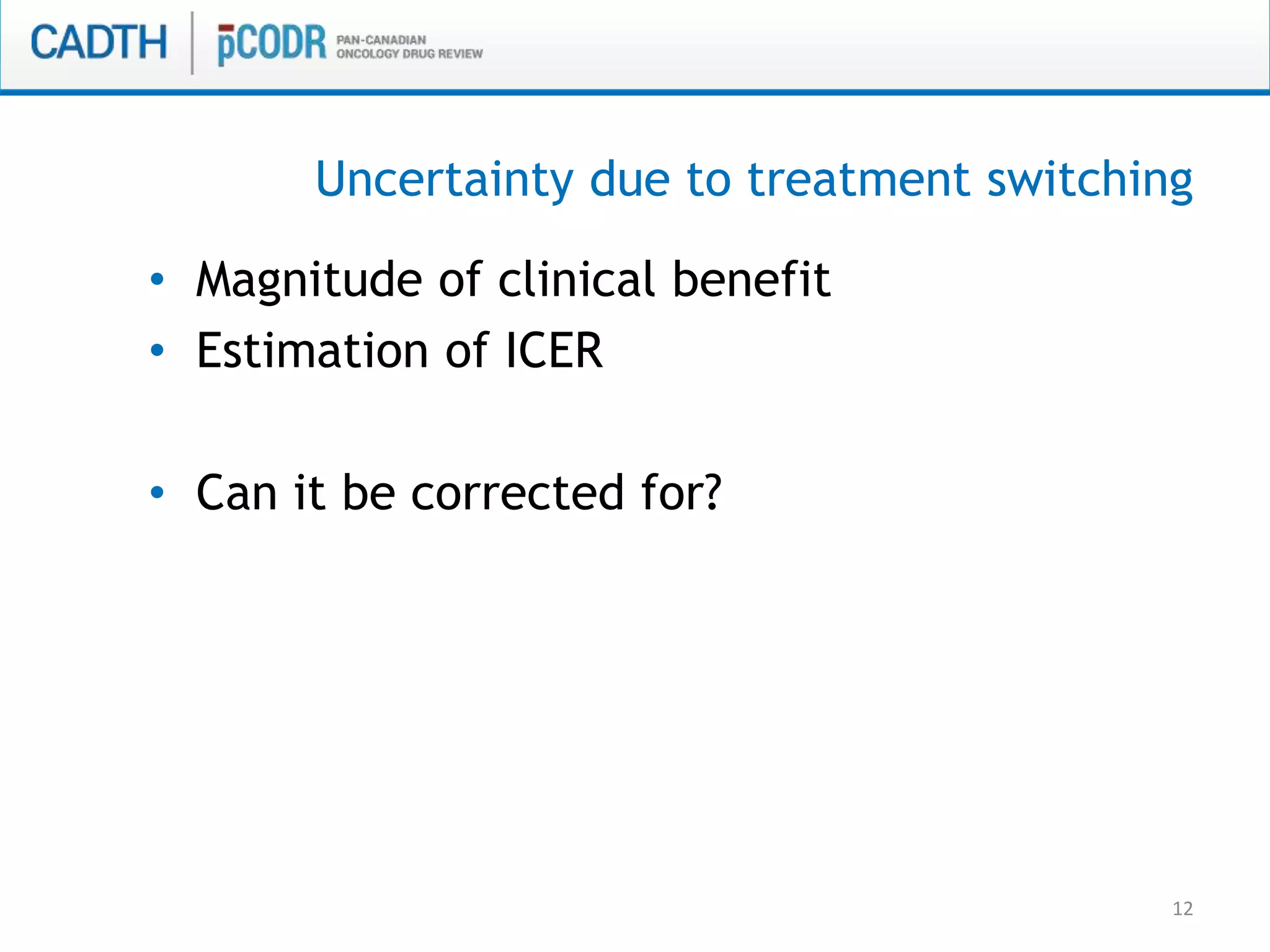
• Magnitude of clinical benefit
• Estimation of ICER
• Can it be corrected for?
Uncertainty due to treatment switching
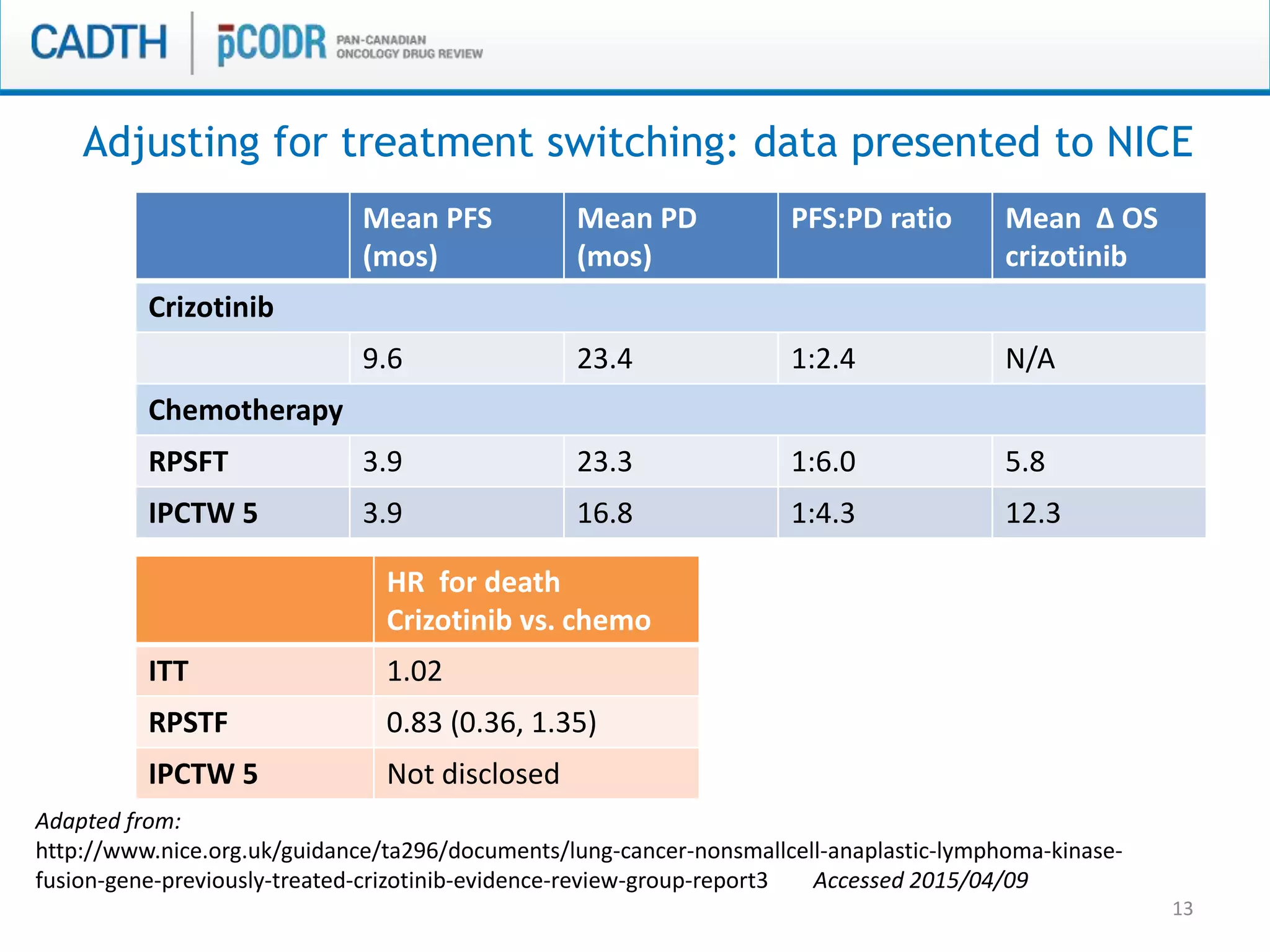
13
Mean PFS
(mos)
Mean PD
(mos)
PFS:PD ratio Mean Δ OS
crizotinib
Crizotinib
9.6 23.4 1:2.4 N/A
Chemotherapy
RPSFT 3.9 23.3 1:6.0 5.8
IPCTW 5 3.9 16.8 1:4.3 12.3
Adjusting for treatment switching: data presented to NICE
Adapted from:
http://www.nice.org.uk/guidance/ta296/documents/lung-cancer-nonsmallcell-anaplastic-lymphoma-kinase-
fusion-gene-previously-treated-crizotinib-evidence-review-group-report3 Accessed 2015/04/09
HR for death
Crizotinib vs. chemo
ITT 1.02
RPSTF 0.83 (0.36, 1.35)
IPCTW 5 Not disclosed
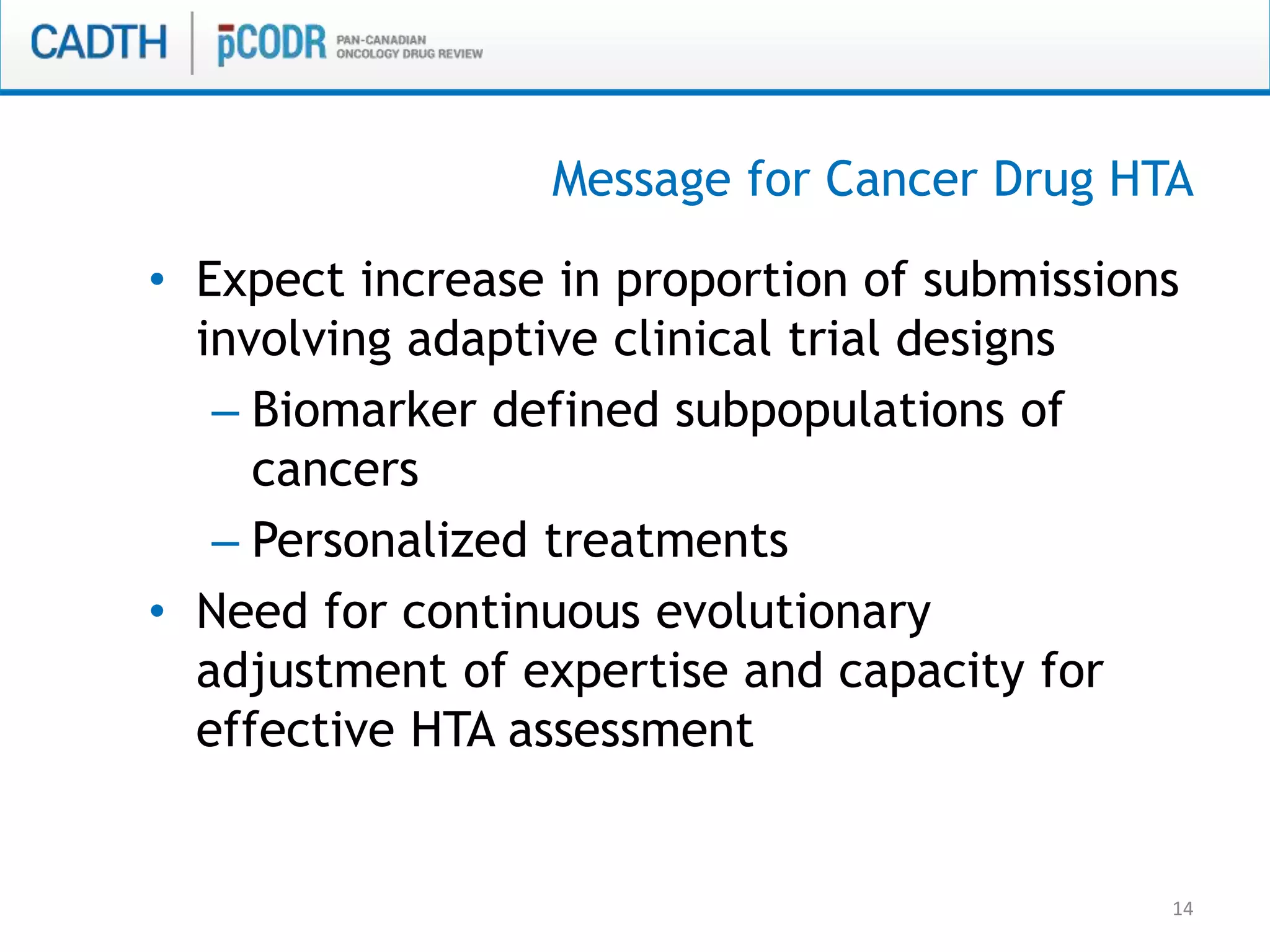
14
• Expect increase in proportion of submissions
involving adaptive clinical trial designs
– Biomarker defined subpopulations of
cancers
– Personalized treatments
• Need for continuous evolutionary
adjustment of expertise and capacity for
effective HTA assessment
Message for Cancer Drug HTA

Cadth 2015 e4 fields slides for adaptive panel final

  • 1.
    pCODR Experience withAdaptive Clinical Trial Designs Tony Fields Chair pCODR Expert Review Committee CADTH
  • 2.
    2 • No significantconflicts of interest • Opinions expressed are not necessarily those of pCODR or CADTH Disclosures
  • 3.
    3 • Most commonexperiences: – Early stopping rules – Treatment switching • Emerging and anticipated: – More complex adaptive designs pCODR and Adaptive Clinical Trial Designs
  • 4.
    4 • The disease:chronic lymphocytic leukaemia • The patient population: patients with a significant burden of coexisting problems • The standard treatment: – Chlorambucil (an alkylating agent) in most of Canada – Chlorambucil plus rituximab (a type 1 anti-CD20 monoclonal antibody) (actually not robustly evidence- based for this population, therefore not available in most provinces) • The experimental treatment: – Chlorambucil plus obinutuzumab (GA101, a type 2 anti- CD20 monoclonal antibody) Obinutuzumab plus chlorambucil for CLL
  • 5.
    5 Study CLL11: Design GA101= obinutuzumab Supplement to: Goede et al. N Engl J Med 2014; 370:1101.
  • 6.
  • 7.
    7 Stage 1a Ob-Ch vs.Ch N=238 n=118 Stage 1b R-Ch vs. Ch N=233 n=118 Median PFS (mos) 23.0 10.9 15.7 10.8 HR 0.14 (0.09, 0.21) p<0.0001 HR 0.32 (0.24, 0.44) p<0.0001 Median OS (mos) Not reached HR 0.68 (0.29, 1.60) p= 0.3820 Not reached HR 0.70 (0.34, 1.45) p= 0.3374 Stage 1a and Stage 1b planned analyses Supplement to: Goede et al. N Engl J Med 2014; 370:1101.
  • 8.
    8 Stage 1a Ob-Ch vs.Ch N=238 n=118 Stage 1b R-Ch vs. Ch N=233 n=118 Stage 2 Ob-Ch vs. R-Ch N=333 n=330 Med PFS (mos) 26.7 11.1 16.3 11.1 26.7 15.2 HR 0.18 (0.13, 0.24) p<0.001 HR 0.44 (0.34, 0.57) p<0.001 HR 0.39 (0.31, 0.49) p<0.001 OS (Death rate%) HR 9% 20% HR 0.41 (0.23, 0.74) p=0.002 15% 20% HR 0.66 (0.39, 1.11) p=0.11 8% 12% HR 0.66 (0.41, 1.06) p=0.08 Stage 1a, 1b updated analyses, Stage 2 interim analysis
  • 9.
    9 • Recommended forfunding for defined patient population based on net clinical benefit and cost-effectiveness compared to Canadian standard of chlorambucil monotherapy pCODR recommendation: OB-Ch
  • 10.
    Crizotinib for ALK+NSCLC Funding Request • For treatment of patients with advanced ALK+ NSCLC. Evidence • One open-label RCT (Profile 1007); crizotinib (n=173) vs. pemetrexed or docetaxel (n=174) in 2nd line treatment after platinum doublet • Two single-arm studies (Profile 1001, 1005) 10
  • 11.
    Treatment Switching andUncertainty Profile 1007, crizotinib vs. chemo: PFS: 7.7 vs. 3.0 mos (HR 0.49, CI 0.37 – 0.64) OS: 20.3 vs. 22.8 mos (HR 1.02, CI 0.68 – 1.54) (112 of174 pts switched from chemo to crizotinib upon progression) 11
  • 12.
    12 • Magnitude ofclinical benefit • Estimation of ICER • Can it be corrected for? Uncertainty due to treatment switching
  • 13.
    13 Mean PFS (mos) Mean PD (mos) PFS:PDratio Mean Δ OS crizotinib Crizotinib 9.6 23.4 1:2.4 N/A Chemotherapy RPSFT 3.9 23.3 1:6.0 5.8 IPCTW 5 3.9 16.8 1:4.3 12.3 Adjusting for treatment switching: data presented to NICE Adapted from: http://www.nice.org.uk/guidance/ta296/documents/lung-cancer-nonsmallcell-anaplastic-lymphoma-kinase- fusion-gene-previously-treated-crizotinib-evidence-review-group-report3 Accessed 2015/04/09 HR for death Crizotinib vs. chemo ITT 1.02 RPSTF 0.83 (0.36, 1.35) IPCTW 5 Not disclosed
  • 14.
    14 • Expect increasein proportion of submissions involving adaptive clinical trial designs – Biomarker defined subpopulations of cancers – Personalized treatments • Need for continuous evolutionary adjustment of expertise and capacity for effective HTA assessment Message for Cancer Drug HTA