International Journal of Engineering Research and Development 
e-ISSN: 2278-067X, p-ISSN: 2278-800X, www.ijerd.com 
Volume 10, Issue 7 (July 2014), PP.15-21 
Performance measurement of EDM parameters on high carbon-chromium 
15 
steel 
Dhruv kant Rahi¹, Manish Vishwakarma2 
1M.Tech,MED,MANIT Bhopal(INDIA) 
2Asst.Professor, MED,,M.A.N.I.T.Bhopal(INDIA) 
Abstract:- Electrical discharge machining (EDM) is an advance machining process primarily used for hard 
metals which are not possible to machine. In die Sinking EDM process, two metal parts are submerged in an 
insulating liquid and areconnected to a source of current which is switched on and off automatically. Parametric 
analysis has been done by conducting a set of experiments on high carbon-chromium steel with copper and 
graphite as electrodes and high carbon oil as the dielectric medium. This study focuses on the influence of 
process parameter such as pulse on time, duty cycle, current, voltage gap and pressure on EDM and effect of 
this process parameter on MRR, EWR and surface roughness has been studied.CCD was used for conducting 
the experiment and developing empirical models for MRR, surface roughness and EWR with the help of 
Minitab software. 
Key terms:- CCD, ANOVA analysis and Material removal rate, Surface Roughness 
I. INTRODUCTION 
Electrical discharge machining is an advance machining process primarily used for hard and difficult 
metals which are difficult to machine with traditional techniques. Only electrical conducting materials are 
machined by this process. Material is removed from the work piece by a series of rapidly recurring current 
discharge between two electrodes, separated by a dielectric fluid and subject to an electric voltage [1]. The EDM 
process is best suited for making intricate cavities and contours which would be difficult to produce with normal 
machine. At the present time EDM is a widespread technique used in industry for high – precision machining of 
all type of conductive materials such as: metallic alloys, graphite, or even some ceramic materials of whatsoever 
hardness. Regression analysis is a stabilized relationship between variables. Usually, the investigator seeks to 
ascertain the causal effect of one variable upon another variable [2]. 
Petropoulos et al. [3] used statistical multi – parameter analysis to model surface finish in EDM 
process. Multiple statistical regression models were developed and closed correlation was observed between 
surface roughness and EDM input variables. Modelling of die-sinking EDM process for MRR, EWR and SR 
was carried out by puertas et al. [4] using a factorial design of experiments and multiple regression analysis. 
Significant variable were identified for each of the responses. Palanikumar [5] in his research using surface 
responses methodologymodelled the surface roughness in machining of Glass Fibber reinforced plastic 
composite materials. He employed four factors five levels central composite, rotatable design matrix for 
experimental investigation and used ANOVA for validation of the model. Kanagarajan et al. [6] applied 
response surface methodology along with multiple linear regression analysis to obtain second order response 
equations for MRR and Ra in EDM machining WC/30%Co composite. The most influential parameters aiming 
at maximizing MRR and minimizing surface roughness were identified by carefully examining surface and 
contour plots of the response versus different combination of inputs parameters. S Gopalakannan et al. [7]they 
are applied central composite design and analysis of variance to investigate the influence of process parameters 
and their interaction on material removal rate, electrode wear rate and surface roughness and identified the 
significant process parameters that affect the output characteristics. 
In this work, the study is focused on the die-sinking EDM of high carbon high chromium steel with 
electrodes of copper. Consequently, an analysis of the influence of process parameters such as pulse on time, 
duty cycle, current, voltage gap and pressure over response variables such as material removal rate (MRR), 
surface roughness and electrode wear rate (EWR) was performed. This was done using the techniques of surface 
response methodology (CCD) for conducting series of experiment and analysis of variance (ANOVA) used for 
analysis the data. The combined use of these techniques has allowed us to create the second- order models 
which make it possible to explain the variability associated with each of the response variables studied.
Performance measurement of EDM parameters on high carbon-chromium steel 
II. EXPERIMENTAL DETAIL 
In this section, there will be brief description of equipment used to carry out the EDM experiment. Also 
16 
the design factors used in this work will be outlined. 
2.1 EQUIPMENT USED IN THE EXPERIMENTS 
The equipment used in order to carry out the EDM machine of high carbon high chromium steel was a 
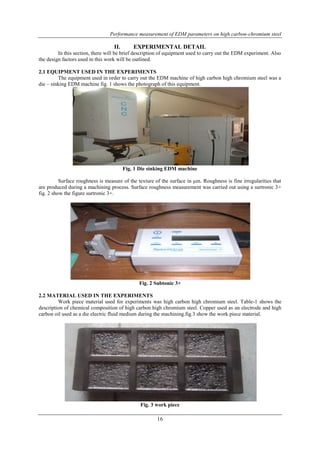
die – sinking EDM machine fig. 1 shows the photograph of this equipment. 
Fig. 1 Die sinking EDM machine 
Surface roughness is measure of the texture of the surface in μm. Roughness is fine irregularities that 
are produced during a machining process. Surface roughness measurement was carried out using a surtronic 3+ 
fig. 2 show the figure surtronic 3+. 
Fig. 2 Subtonic 3+ 
2.2 MATERIAL USED IN THE EXPERIMENTS 
Work piece material used for experiments was high carbon high chromium steel. Table-1 shows the 
description of chemical composition of high carbon high chromium steel. Copper used as an electrode and high 
carbon oil used as a die electric fluid medium during the machining.fig.3 show the work piece material. 
Fig. 3 work piece
Performance measurement of EDM parameters on high carbon-chromium steel 
Table – 1 chemical composition of high carbon high chromium steel (%)[8] 
C Mn Si Co Cr Mo V P Ni Cu S 
1.4-1.6 0.60 0.60 1.0 11.00-13.00 7.00-1.20 1.10 0.03 0.30 0.25 0.03 
17 
2.3 Process Parameters and Their Levels 
Table – 2process parameters and their levels 
Parameters (unit) 
Notation 
Levels /coded 
-2 -1 0 1 2 
Pulse on time (μs) Ton 100 825 1550 2275 300 
Duty cycle (%) Dc 1 8.75 16.5 24.25 32 
Current (amp.) Ip 5 16.25 27.5 38.75 50 
Voltage gap (volt) Vg 10 37.5 65 92.5 120 
Pressure (N) F 0.1 0.2 0.3 0.4 0.5 
There are various process parameters to be considered, but in this work we have considered five 
process parameters such as pulse on time, duty cycle, current, voltage gap and pressure. The material removal 
rate (MRR), surface roughness and electrode wear rate (EWR) selected as response variables. 
Material removal rate is the volume of material removed from the work piece in one minute. 
vo lume of material removed from work piece 
MRR = 
time of machining 
Mm³/min..................................... [9] 
EWR is the ratio of the difference of weight of the total before and after machining to the machining time. 
EWR = 
푊푡푎 − 푊푡푏 
푡 
푚푚3 
푚푖푛 
… … … … … … … … … … … … … … … … … … … … … … … … [10] 
Where, 
wta = weight of the tool before machining 
wtb = weight of the tool after machining 
t = machining time 
1.4 METHODOLOGY 
Design of experiment: experiments were designed by using Minitab software. Response surface 
methodology was used as a tool for development of a prediction model of MRR and surface roughness. 
RESPONSE SURFACE METHODOLOGY: 
RSM was developed to model experimental responses and then migrated into the modelling of 
numerical experiments [9]. The difference is in the type of error generated by the response. The application of 
RSM to design optimization is aimed at reducing the cost of expensive analysis methods and their associated 
numerical noise. Central composite design is generally used for fitting a second – order response surface model. 
CCD contains an imbedded factorial or fractional factorial design with central points that is augmented with a 
group of “star points” that a low estimation of curvature. Any central composite design can be built up from an 
initial 2k or 2k-p design by adding axial points and centre points to the two level designs (Ref 9).
Performance measurement of EDM parameters on high carbon-chromium steel 
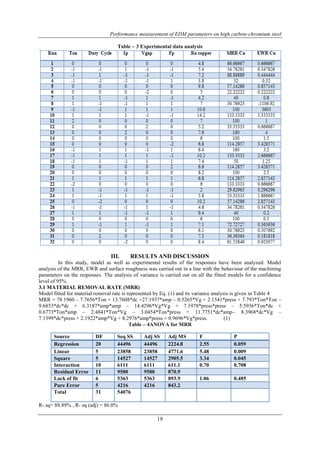
Table – 3 Experimental data analysis 
III. RESULTS AND DISCUSSION 
In this study, model as well as experimental results of the responses have been analyzed. Model 
analysis of the MRR, EWR and surface roughness was carried out in a line with the behaviour of the machining 
parameters on the responses. The analysis of variance is carried out on all the fitted models for a confidence 
level of 95%. 
3.1 MATERIAL REMOVAL RATE (MRR) 
Model fitted for material removal rate is represented by Eq. (1) and its variance analysis is given in Table 4 
MRR = 78.1960 – 7.7656*Ton + 13.7608*dc +27.1937*amp – 0.5265*Vg + 2.1541*press + 7.793*Ton*Ton – 
9.6853*dc*dc + 6.3187*amp*amp – 14.4296*Vg*Vg + 7.1978*press*press – 5.5936*Ton*dc + 
0.6773*Ton*amp – 2.4841*Ton*Vg – 3.0454*Ton*press + 11.7751*dc*amp– 8.3968*dc*Vg – 
7.1399*dc*press + 2.1922*amp*Vg + 8.2976*amp*press + 0.9696*Vg*press. (1) 
Table – 4ANOVA for MRR 
Source DF Seq SS Adj SS Adj MS F P 
Regression 20 44496 44496 2224.8 2.55 0.059 
Linear 5 23858 23858 4771.6 5.48 0.009 
Square 5 14527 14527 2905.5 3.34 0.045 
Interaction 10 6111 6111 611.1 0.70 0.708 
Residual Error 11 9580 9580 870.9 
Lack of fit 6 5363 5363 893.9 1.06 0.485 
Pure Error 5 4216 4216 843.2 
Total 31 54076 
18 
R- sq= 88.89% , R- sq (adj) = 86.0%
Performance measurement of EDM parameters on high carbon-chromium steel 
Table -4 Represent ANOVA for material removal rate which is come from Minitab. In table 4 linear square and 
two factor interaction were compared to see the best fitted model as indicated by F value (Ref 9) The F values 
can beconverted into the p value by using the F probability distribution curve. The model significance can be 
tested either by comparing the F value to a threshold F value or by comparing the corresponding p value to the 
threshold p value. On the basis of P value linear model is best fitted model for material removal rate.Adjusted R2 
is a measure of the amount of variation about the mean which is explained by the model. A value of 0.86 
indicates that 86% of the observed variation in the response can be explained by the model. 
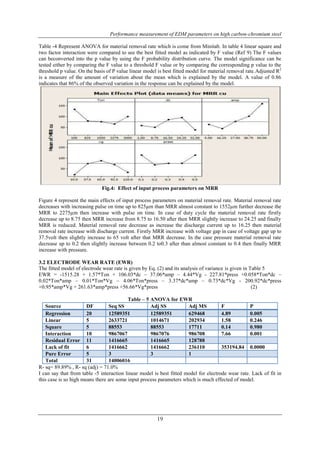
Fig.4: Effect of input process parameters on MRR 
Figure 4 represent the main effects of input process parameters on material removal rate. Material removal rate 
decreases with increasing pulse on time up to 825μm than MRR almost constant to 1552μm further decrease the 
MRR to 2275μm then increase with pulse on time. In case of duty cycle the material removal rate firstly 
decrease up to 8.75 then MRR increase from 8.75 to 16.50 after then MRR slightly increase to 24.25 and finally 
MRR is reduced. Material removal rate decrease as increase the discharge current up to 16.25 then material 
removal rate increase with discharge current. Firstly MRR increase with voltage gap in case of voltage gap up to 
37.5volt then slightly increase to 65 volt after that MRR decrease. In the case pressure material removal rate 
decrease up to 0.2 then slightly increase between 0.2 to0.3 after than almost constant to 0.4 then finally MRR 
increase with pressure. 
3.2 ELECTRODE WEAR RATE (EWR) 
The fitted model of electrode wear rate is given by Eq. (2) and its analysis of variance is given in Table 5 
EWR = -1515.28 + 1.57*Ton + 106.03*dc – 37.06*amp – 4.44*Vg - 227.81*press +0.058*Ton*dc – 
0.02*Ton*amp – 0.01*Ton*Vg – 4.06*Ton*press – 3.37*dc*amp – 0.73*dc*Vg - 200.92*dc*press 
+0.95*amp*Vg + 261.63*amp*press +56.66*Vg*press (2) 
Table – 5 ANOVA for EWR 
Source DF Seq SS Adj SS Adj MS F P 
Regression 20 12589351 12589351 629468 4.89 0.005 
Linear 5 2633721 1014671 202934 1.58 0.246 
Square 5 88553 88553 17711 0.14 0.980 
Interaction 10 9867067 9867076 986708 7.66 0.001 
Residual Error 11 1416665 1416665 128788 
Lack of fit 6 1416662 1416662 236110 353194.84 0.0000 
Pure Error 5 3 3 1 
Total 31 14006016 
R- sq= 89.89% , R- sq (adj) = 71.0% 
I can say that from table -5 interaction linear model is best fitted model for electrode wear rate. Lack of fit in 
this case is so high means there are some input process parameters which is much effected of model. 
19
Performance measurement of EDM parameters on high carbon-chromium steel 
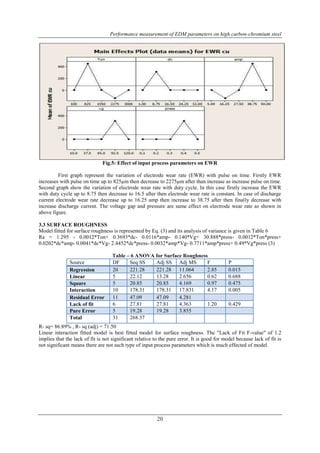
Fig.5: Effect of input process parameters on EWR 
First graph represent the variation of electrode wear rate (EWR) with pulse on time. Firstly EWR 
increases with pulse on time up to 825μm then decrease to 2275μm after than increase as increase pulse on time. 
Second graph show the variation of electrode wear rate with duty cycle. In this case firstly increase the EWR 
with duty cycle up to 8.75 then decrease to 16.5 after then electrode wear rate is constant. In case of discharge 
current electrode wear rate decrease up to 16.25 amp then increase to 38.75 after then finally decrease with 
increase discharge current. The voltage gap and pressure are same effect on electrode wear rate as shown in 
above figure. 
3.3 SURFACE ROUGHNESS 
Model fitted for surface roughness is represented by Eq. (3) and its analysis of variance is given in Table 6 
Ra = 1.295 - 0.0012*Ton+ 0.3693*dc- 0.0116*amp- 0.140*Vg+ 30.888*press- 0.0012*Ton*press+ 
0.0202*dc*amp- 0.0041*dc*Vg- 2.4452*dc*press- 0.0032*amp*Vg- 0.7711*amp*press+ 0.49*Vg*press (3) 
Table – 6 ANOVA for Surface Roughness 
Source DF Seq SS Adj SS Adj MS F P 
Regression 20 221.28 221.28 11.064 2.85 0.015 
Linear 5 22.12 13.28 2.656 0.62 0.688 
Square 5 20.85 20.85 4.169 0.97 0.475 
Interaction 10 178.31 178.31 17.831 4.17 0.005 
Residual Error 11 47.09 47.09 4.281 
Lack of fit 6 27.81 27.81 4.363 1.20 0.429 
Pure Error 5 19.28 19.28 3.855 
Total 31 268.37 
R- sq= 86.89% , R- sq (adj) = 71.50 
Linear interaction fitted model is best fitted model for surface roughness. The "Lack of Fit F-value" of 1.2 
implies that the lack of fit is not significant relative to the pure error. It is good for model because lack of fit is 
not significant means there are not such type of input process parameters which is much effected of model. 
20
Performance measurement of EDM parameters on high carbon-chromium steel 
Fig.6: Effect of input process parameters on surface roughness 
Fig. 6 Represent the effect of input process parameters on surface roughness.Surface roughness remains almost 
same with the change in pulse on time. In case of duty cycle surface roughness increase up to 8075μm then 
finally decrease. Surface roughness slightly increases with discharge current up to 16.25amp then decrease to 
38.75amp after then increase the surface roughness. voltage gap does not much effective from 10-92.5 volt on 
surface roughness bur after that surface roughness decrease with voltage gap. Last graph represent variation of 
surface roughness with respect to pressure in the above mention figure. 
IV. CONCLUSION 
In the present work parametric analysis of die- sinking EDM process has been done based on 
experimental results. Experiments based on the central composite design were conducted to develop empirical 
models of the process. 
Influence of input current and duty cycle is prominent over other machining parameters such as 
pressure, voltage gap on material removal rate with copper electrode. Pulse on time and duty cycle is most 
significant in the case of electrode wear rate with copper electrode. Duty cycle and pressure are mostsignificant 
factor in the case of surface roughness over others operating parameters like pulse on time, voltage gap and 
discharge current. 
REFERENCES 
[1]. Dr.Pradeepkumar, Dr. A.K. Sharma, IIT Roorkee: NPTEL, EDM process Alan O.sykes, Chicago 
Working Paper in Law & Economics, An introduction to regression analysis, the inaugural coase 
lecture, Petropoulos, N.M. Vaxevanidisand C. Pandazaras, modelling of surface finish in electro-discharge 
machining based upon statistical multi-parameter analysis, J. Mater,process, technol,2004, 
21 
155-156, P 1247-1251. 
[2]. I. Puertas, C.J. Luis and L. Alvarez, Analysis of the influence of EDM parameters on surface quality, 
MRR and EW of WC-Co, J. Mater process, technol,2004, 153-154, P 1026-1032 palanikumar, K., 
2007. Modelling and analysis for surface roughness in machining glass fibre reinforced plastics using 
response surface methodology. Mater des., 28: 2611-2618. 
[3]. kanagarajan, D. Karthikeyan, R. Ppalanikumar, K. Sivaraj, 2009, influence of process parameters on 
electric discharge machining of WC/30%Co composite, proc.IMechE, Part B: J.engineering 
manufacture,222,PP,807-815. 
[4]. S Gopalakannan,Tsenthilvelan,S Ranganathan,2012,modelling and optimization of EDM process 
parameters on machining of Al 7075-B4C MMc using RSM, procedia engineering 38 (2012) 685- 690 
Azom.com, 2014, D2 Tool Steel - High-Carbon, High-Chromium, Cold-Work Steel (UNS T30402), 
(accessed 2014-6-7) 
[5]. AkmAsifIqbal and Ahsan Ali Khan, Modelling and analysis of MRR, EWR, and surface Roughness in 
EDM milling through response surface methodology, journal of engineering and applied science 154- 
162 2010 
[6]. S. Gopalakannan, T. Senthilvelan, application of response surface method on machining of Al-SiC 
nano – composites, sciversesciencedirect measurement 46(2013) 2705-2715 
[7]. Myers, R. H. and D. C. Montgomery. Response surface methodology: process and product 
optimization using designed experiments, Second edition (2002) Wiley,New York

C1071521

  • 1.
    International Journal ofEngineering Research and Development e-ISSN: 2278-067X, p-ISSN: 2278-800X, www.ijerd.com Volume 10, Issue 7 (July 2014), PP.15-21 Performance measurement of EDM parameters on high carbon-chromium 15 steel Dhruv kant Rahi¹, Manish Vishwakarma2 1M.Tech,MED,MANIT Bhopal(INDIA) 2Asst.Professor, MED,,M.A.N.I.T.Bhopal(INDIA) Abstract:- Electrical discharge machining (EDM) is an advance machining process primarily used for hard metals which are not possible to machine. In die Sinking EDM process, two metal parts are submerged in an insulating liquid and areconnected to a source of current which is switched on and off automatically. Parametric analysis has been done by conducting a set of experiments on high carbon-chromium steel with copper and graphite as electrodes and high carbon oil as the dielectric medium. This study focuses on the influence of process parameter such as pulse on time, duty cycle, current, voltage gap and pressure on EDM and effect of this process parameter on MRR, EWR and surface roughness has been studied.CCD was used for conducting the experiment and developing empirical models for MRR, surface roughness and EWR with the help of Minitab software. Key terms:- CCD, ANOVA analysis and Material removal rate, Surface Roughness I. INTRODUCTION Electrical discharge machining is an advance machining process primarily used for hard and difficult metals which are difficult to machine with traditional techniques. Only electrical conducting materials are machined by this process. Material is removed from the work piece by a series of rapidly recurring current discharge between two electrodes, separated by a dielectric fluid and subject to an electric voltage [1]. The EDM process is best suited for making intricate cavities and contours which would be difficult to produce with normal machine. At the present time EDM is a widespread technique used in industry for high – precision machining of all type of conductive materials such as: metallic alloys, graphite, or even some ceramic materials of whatsoever hardness. Regression analysis is a stabilized relationship between variables. Usually, the investigator seeks to ascertain the causal effect of one variable upon another variable [2]. Petropoulos et al. [3] used statistical multi – parameter analysis to model surface finish in EDM process. Multiple statistical regression models were developed and closed correlation was observed between surface roughness and EDM input variables. Modelling of die-sinking EDM process for MRR, EWR and SR was carried out by puertas et al. [4] using a factorial design of experiments and multiple regression analysis. Significant variable were identified for each of the responses. Palanikumar [5] in his research using surface responses methodologymodelled the surface roughness in machining of Glass Fibber reinforced plastic composite materials. He employed four factors five levels central composite, rotatable design matrix for experimental investigation and used ANOVA for validation of the model. Kanagarajan et al. [6] applied response surface methodology along with multiple linear regression analysis to obtain second order response equations for MRR and Ra in EDM machining WC/30%Co composite. The most influential parameters aiming at maximizing MRR and minimizing surface roughness were identified by carefully examining surface and contour plots of the response versus different combination of inputs parameters. S Gopalakannan et al. [7]they are applied central composite design and analysis of variance to investigate the influence of process parameters and their interaction on material removal rate, electrode wear rate and surface roughness and identified the significant process parameters that affect the output characteristics. In this work, the study is focused on the die-sinking EDM of high carbon high chromium steel with electrodes of copper. Consequently, an analysis of the influence of process parameters such as pulse on time, duty cycle, current, voltage gap and pressure over response variables such as material removal rate (MRR), surface roughness and electrode wear rate (EWR) was performed. This was done using the techniques of surface response methodology (CCD) for conducting series of experiment and analysis of variance (ANOVA) used for analysis the data. The combined use of these techniques has allowed us to create the second- order models which make it possible to explain the variability associated with each of the response variables studied.
  • 2.
    Performance measurement ofEDM parameters on high carbon-chromium steel II. EXPERIMENTAL DETAIL In this section, there will be brief description of equipment used to carry out the EDM experiment. Also 16 the design factors used in this work will be outlined. 2.1 EQUIPMENT USED IN THE EXPERIMENTS The equipment used in order to carry out the EDM machine of high carbon high chromium steel was a die – sinking EDM machine fig. 1 shows the photograph of this equipment. Fig. 1 Die sinking EDM machine Surface roughness is measure of the texture of the surface in μm. Roughness is fine irregularities that are produced during a machining process. Surface roughness measurement was carried out using a surtronic 3+ fig. 2 show the figure surtronic 3+. Fig. 2 Subtonic 3+ 2.2 MATERIAL USED IN THE EXPERIMENTS Work piece material used for experiments was high carbon high chromium steel. Table-1 shows the description of chemical composition of high carbon high chromium steel. Copper used as an electrode and high carbon oil used as a die electric fluid medium during the machining.fig.3 show the work piece material. Fig. 3 work piece
  • 3.
    Performance measurement ofEDM parameters on high carbon-chromium steel Table – 1 chemical composition of high carbon high chromium steel (%)[8] C Mn Si Co Cr Mo V P Ni Cu S 1.4-1.6 0.60 0.60 1.0 11.00-13.00 7.00-1.20 1.10 0.03 0.30 0.25 0.03 17 2.3 Process Parameters and Their Levels Table – 2process parameters and their levels Parameters (unit) Notation Levels /coded -2 -1 0 1 2 Pulse on time (μs) Ton 100 825 1550 2275 300 Duty cycle (%) Dc 1 8.75 16.5 24.25 32 Current (amp.) Ip 5 16.25 27.5 38.75 50 Voltage gap (volt) Vg 10 37.5 65 92.5 120 Pressure (N) F 0.1 0.2 0.3 0.4 0.5 There are various process parameters to be considered, but in this work we have considered five process parameters such as pulse on time, duty cycle, current, voltage gap and pressure. The material removal rate (MRR), surface roughness and electrode wear rate (EWR) selected as response variables. Material removal rate is the volume of material removed from the work piece in one minute. vo lume of material removed from work piece MRR = time of machining Mm³/min..................................... [9] EWR is the ratio of the difference of weight of the total before and after machining to the machining time. EWR = 푊푡푎 − 푊푡푏 푡 푚푚3 푚푖푛 … … … … … … … … … … … … … … … … … … … … … … … … [10] Where, wta = weight of the tool before machining wtb = weight of the tool after machining t = machining time 1.4 METHODOLOGY Design of experiment: experiments were designed by using Minitab software. Response surface methodology was used as a tool for development of a prediction model of MRR and surface roughness. RESPONSE SURFACE METHODOLOGY: RSM was developed to model experimental responses and then migrated into the modelling of numerical experiments [9]. The difference is in the type of error generated by the response. The application of RSM to design optimization is aimed at reducing the cost of expensive analysis methods and their associated numerical noise. Central composite design is generally used for fitting a second – order response surface model. CCD contains an imbedded factorial or fractional factorial design with central points that is augmented with a group of “star points” that a low estimation of curvature. Any central composite design can be built up from an initial 2k or 2k-p design by adding axial points and centre points to the two level designs (Ref 9).
  • 4.
    Performance measurement ofEDM parameters on high carbon-chromium steel Table – 3 Experimental data analysis III. RESULTS AND DISCUSSION In this study, model as well as experimental results of the responses have been analyzed. Model analysis of the MRR, EWR and surface roughness was carried out in a line with the behaviour of the machining parameters on the responses. The analysis of variance is carried out on all the fitted models for a confidence level of 95%. 3.1 MATERIAL REMOVAL RATE (MRR) Model fitted for material removal rate is represented by Eq. (1) and its variance analysis is given in Table 4 MRR = 78.1960 – 7.7656*Ton + 13.7608*dc +27.1937*amp – 0.5265*Vg + 2.1541*press + 7.793*Ton*Ton – 9.6853*dc*dc + 6.3187*amp*amp – 14.4296*Vg*Vg + 7.1978*press*press – 5.5936*Ton*dc + 0.6773*Ton*amp – 2.4841*Ton*Vg – 3.0454*Ton*press + 11.7751*dc*amp– 8.3968*dc*Vg – 7.1399*dc*press + 2.1922*amp*Vg + 8.2976*amp*press + 0.9696*Vg*press. (1) Table – 4ANOVA for MRR Source DF Seq SS Adj SS Adj MS F P Regression 20 44496 44496 2224.8 2.55 0.059 Linear 5 23858 23858 4771.6 5.48 0.009 Square 5 14527 14527 2905.5 3.34 0.045 Interaction 10 6111 6111 611.1 0.70 0.708 Residual Error 11 9580 9580 870.9 Lack of fit 6 5363 5363 893.9 1.06 0.485 Pure Error 5 4216 4216 843.2 Total 31 54076 18 R- sq= 88.89% , R- sq (adj) = 86.0%
  • 5.
    Performance measurement ofEDM parameters on high carbon-chromium steel Table -4 Represent ANOVA for material removal rate which is come from Minitab. In table 4 linear square and two factor interaction were compared to see the best fitted model as indicated by F value (Ref 9) The F values can beconverted into the p value by using the F probability distribution curve. The model significance can be tested either by comparing the F value to a threshold F value or by comparing the corresponding p value to the threshold p value. On the basis of P value linear model is best fitted model for material removal rate.Adjusted R2 is a measure of the amount of variation about the mean which is explained by the model. A value of 0.86 indicates that 86% of the observed variation in the response can be explained by the model. Fig.4: Effect of input process parameters on MRR Figure 4 represent the main effects of input process parameters on material removal rate. Material removal rate decreases with increasing pulse on time up to 825μm than MRR almost constant to 1552μm further decrease the MRR to 2275μm then increase with pulse on time. In case of duty cycle the material removal rate firstly decrease up to 8.75 then MRR increase from 8.75 to 16.50 after then MRR slightly increase to 24.25 and finally MRR is reduced. Material removal rate decrease as increase the discharge current up to 16.25 then material removal rate increase with discharge current. Firstly MRR increase with voltage gap in case of voltage gap up to 37.5volt then slightly increase to 65 volt after that MRR decrease. In the case pressure material removal rate decrease up to 0.2 then slightly increase between 0.2 to0.3 after than almost constant to 0.4 then finally MRR increase with pressure. 3.2 ELECTRODE WEAR RATE (EWR) The fitted model of electrode wear rate is given by Eq. (2) and its analysis of variance is given in Table 5 EWR = -1515.28 + 1.57*Ton + 106.03*dc – 37.06*amp – 4.44*Vg - 227.81*press +0.058*Ton*dc – 0.02*Ton*amp – 0.01*Ton*Vg – 4.06*Ton*press – 3.37*dc*amp – 0.73*dc*Vg - 200.92*dc*press +0.95*amp*Vg + 261.63*amp*press +56.66*Vg*press (2) Table – 5 ANOVA for EWR Source DF Seq SS Adj SS Adj MS F P Regression 20 12589351 12589351 629468 4.89 0.005 Linear 5 2633721 1014671 202934 1.58 0.246 Square 5 88553 88553 17711 0.14 0.980 Interaction 10 9867067 9867076 986708 7.66 0.001 Residual Error 11 1416665 1416665 128788 Lack of fit 6 1416662 1416662 236110 353194.84 0.0000 Pure Error 5 3 3 1 Total 31 14006016 R- sq= 89.89% , R- sq (adj) = 71.0% I can say that from table -5 interaction linear model is best fitted model for electrode wear rate. Lack of fit in this case is so high means there are some input process parameters which is much effected of model. 19
  • 6.
    Performance measurement ofEDM parameters on high carbon-chromium steel Fig.5: Effect of input process parameters on EWR First graph represent the variation of electrode wear rate (EWR) with pulse on time. Firstly EWR increases with pulse on time up to 825μm then decrease to 2275μm after than increase as increase pulse on time. Second graph show the variation of electrode wear rate with duty cycle. In this case firstly increase the EWR with duty cycle up to 8.75 then decrease to 16.5 after then electrode wear rate is constant. In case of discharge current electrode wear rate decrease up to 16.25 amp then increase to 38.75 after then finally decrease with increase discharge current. The voltage gap and pressure are same effect on electrode wear rate as shown in above figure. 3.3 SURFACE ROUGHNESS Model fitted for surface roughness is represented by Eq. (3) and its analysis of variance is given in Table 6 Ra = 1.295 - 0.0012*Ton+ 0.3693*dc- 0.0116*amp- 0.140*Vg+ 30.888*press- 0.0012*Ton*press+ 0.0202*dc*amp- 0.0041*dc*Vg- 2.4452*dc*press- 0.0032*amp*Vg- 0.7711*amp*press+ 0.49*Vg*press (3) Table – 6 ANOVA for Surface Roughness Source DF Seq SS Adj SS Adj MS F P Regression 20 221.28 221.28 11.064 2.85 0.015 Linear 5 22.12 13.28 2.656 0.62 0.688 Square 5 20.85 20.85 4.169 0.97 0.475 Interaction 10 178.31 178.31 17.831 4.17 0.005 Residual Error 11 47.09 47.09 4.281 Lack of fit 6 27.81 27.81 4.363 1.20 0.429 Pure Error 5 19.28 19.28 3.855 Total 31 268.37 R- sq= 86.89% , R- sq (adj) = 71.50 Linear interaction fitted model is best fitted model for surface roughness. The "Lack of Fit F-value" of 1.2 implies that the lack of fit is not significant relative to the pure error. It is good for model because lack of fit is not significant means there are not such type of input process parameters which is much effected of model. 20
  • 7.
    Performance measurement ofEDM parameters on high carbon-chromium steel Fig.6: Effect of input process parameters on surface roughness Fig. 6 Represent the effect of input process parameters on surface roughness.Surface roughness remains almost same with the change in pulse on time. In case of duty cycle surface roughness increase up to 8075μm then finally decrease. Surface roughness slightly increases with discharge current up to 16.25amp then decrease to 38.75amp after then increase the surface roughness. voltage gap does not much effective from 10-92.5 volt on surface roughness bur after that surface roughness decrease with voltage gap. Last graph represent variation of surface roughness with respect to pressure in the above mention figure. IV. CONCLUSION In the present work parametric analysis of die- sinking EDM process has been done based on experimental results. Experiments based on the central composite design were conducted to develop empirical models of the process. Influence of input current and duty cycle is prominent over other machining parameters such as pressure, voltage gap on material removal rate with copper electrode. Pulse on time and duty cycle is most significant in the case of electrode wear rate with copper electrode. Duty cycle and pressure are mostsignificant factor in the case of surface roughness over others operating parameters like pulse on time, voltage gap and discharge current. REFERENCES [1]. Dr.Pradeepkumar, Dr. A.K. Sharma, IIT Roorkee: NPTEL, EDM process Alan O.sykes, Chicago Working Paper in Law & Economics, An introduction to regression analysis, the inaugural coase lecture, Petropoulos, N.M. Vaxevanidisand C. Pandazaras, modelling of surface finish in electro-discharge machining based upon statistical multi-parameter analysis, J. Mater,process, technol,2004, 21 155-156, P 1247-1251. [2]. I. Puertas, C.J. Luis and L. Alvarez, Analysis of the influence of EDM parameters on surface quality, MRR and EW of WC-Co, J. Mater process, technol,2004, 153-154, P 1026-1032 palanikumar, K., 2007. Modelling and analysis for surface roughness in machining glass fibre reinforced plastics using response surface methodology. Mater des., 28: 2611-2618. [3]. kanagarajan, D. Karthikeyan, R. Ppalanikumar, K. Sivaraj, 2009, influence of process parameters on electric discharge machining of WC/30%Co composite, proc.IMechE, Part B: J.engineering manufacture,222,PP,807-815. [4]. S Gopalakannan,Tsenthilvelan,S Ranganathan,2012,modelling and optimization of EDM process parameters on machining of Al 7075-B4C MMc using RSM, procedia engineering 38 (2012) 685- 690 Azom.com, 2014, D2 Tool Steel - High-Carbon, High-Chromium, Cold-Work Steel (UNS T30402), (accessed 2014-6-7) [5]. AkmAsifIqbal and Ahsan Ali Khan, Modelling and analysis of MRR, EWR, and surface Roughness in EDM milling through response surface methodology, journal of engineering and applied science 154- 162 2010 [6]. S. Gopalakannan, T. Senthilvelan, application of response surface method on machining of Al-SiC nano – composites, sciversesciencedirect measurement 46(2013) 2705-2715 [7]. Myers, R. H. and D. C. Montgomery. Response surface methodology: process and product optimization using designed experiments, Second edition (2002) Wiley,New York