Download to read offline
![International Journal of Mechanical Engineering and Technology (IJMET), ISSN 0976 –
6340(Print), ISSN 0976 – 6359(Online), Volume 5, Issue 2, February (2014), pp. 44-51, © IAEME
with the process have been a major drawback of EDM. Hydrocarbon oil based dielectric fluids used
in EDM are the primary source of pollution from the process. Replacing liquid dielectric by mixture
of gas and liquid is an emerging field in the environment-friendly EDM technology. Near dry EDM
is a modification of the conventional EDM process in which the liquid dielectric is replaced by a
mixture of gas and liquid medium. The flow of high velocity gas into the gap facilitates removal of
debris and prevents excessive heating of the tool and work-piece at the discharge spots. Several
experimental studies made in this field have brought out some of the essential features of the process.
In this study, near-dry EDM milling is investigated to understand the effect of discharge current,
pulse on time, pulse off time and discharge voltage on responses like MRR and Surface roughness.
2. LITERATURE REVIEW
Shih et al [2] investigated the dry and near-dry EDM milling to achieve the high MRR and
fine surface finish for roughing and finishing operations, respectively. Oxygen gas and copper
electrode was used in dry EDM, whereas nitrogen and de-ionized water mixture was used in near-dry
EDM operation. A 25-1fractional factorial design is applied to investigate the effect of discharge
current, pulse duration, pulse interval and gap voltage on the MRR and surface finish in both
process. The experiments were conducted on a CNC die-sinking EDM machine using AISI H13 tool
steel as the work material. A rotary spindle, Rotobore RBS-1000, with through-spindle flushing
capability is mounted on the EDM head. The input liquid flow is set at 5 ml/min. Negative polarity,
i.e. electrode as cathode, is used in the experiment, due lower wear on cathode at low discharge pulse
duration and smoother discharge crater on anode.
It was found that, high MRR were achieved in dry EDM where as fine surface finish were
obtained in near-dry EDM. Oxygen is to promote the MRR in dry and near-dry EDM due to
exothermal oxidation. Near-dry was proven beneficial for the finishing operation. Because liquid
phase is dispersed in gas medium is hypothesized to enhance the electrical field thus result is large
discharge gap and stable discharge at low energy input.
Pradhan et al [6] investigate three process parameters like discharge current, pulse duration
and pulse off time. Response surface methodology was used to investigate the relationship and
parametric interaction of variable and significant coefficient were obtained at 5% level by ANOVA.
Experiment were conducted on Electronica Electroplus PS 50ZNC Die Shrinking Machine. Copper
electrode of 30 mm diameter and 15x 15 mm2 AISI-D2 tool steel with 4 mm thickness work-piece
was used.
It was found that, model for MRR were developed for three parameters namely, pulse
current, discharge time and pulse off time for EDM process using RSM. It was also found that all
three machining parameters and their interactions have significant effect on MRR
Tomadi et al [7] was investigate the influence of themachining parameters such as peak
current, power supply voltage, pulse on time and pulse off time on out put responses Surface quality,
Electrode wear and material removal rate.
Result are analyzed by using STATISTICA software. Design of experiments (DOE) technique and
ANOVA analysis were used for experimental work. Tungsten Carbide has been selected as the workpiece and copper tungsten as a electrode material.
It was found that, for surface roughness, the most influential factors were voltage followed by
the pulse off time, while the peak current and pulse on time was not significant at the considered
confidence level. For material removal rate, pulse on time factor was most influential followed by
voltage, peak current, and pulse off time. For electrode wear, it was observed that the most
influential factor were pulse off time, followed by the peak current factor.
45](https://image.slidesharecdn.com/30120140502006-140225050547-phpapp01/85/30120140502006-2-320.jpg)
![International Journal of Mechanical Engineering and Technology (IJMET), ISSN 0976 –
6340(Print), ISSN 0976 – 6359(Online), Volume 5, Issue 2, February (2014), pp. 44-51, © IAEME
Iqbal et al [9] investigate machining parameter like voltage, rotational speed of electrode and
feed rate over a responses MRR, EWR and surface roughness on AISI 304 stainless steel as
workpiece material and copper was used as a electrode material. RSM was used for interactions
between the three controllable variables on MRR, EWR and Ra. Significant coefficients were
obtained by performing ANOVA at 95% significance level. It was found that voltage and rpm have
effect on MRR, EWR and surface roughness.
3. PLANNING OF EXPERIMENT
Oil hardened non shrinking steel material having size 5 x 50 x 50 mm with hollow copper
alloy electrode with10 mm diameter were used. Separate work piece used for each experiment. PS
50ZNC (die-sinking type) of EDM machine used for experimentations. Commercial grade EDM oil
(specific gravity= 0.763, freezing point= 94˚C) and air through a hallow tube used as dielectric fluid
with a pressure of 0.1 kgf/cm2 and 0.5 kgf/cm2 respectively. Circular shaped hollow copper tool with
internal flushing of air used to flush away the eroded materials from the sparking zone. In this
process, machining time and duty cycle is kept constant 7 min and 0.75. Four factors tackled with a
total number of 9 experiments were performed. The surface roughness measurement using contact
type C3A MahrPerthenPerthometer (stylus radius of 5 µm ) were done. The design scheme and
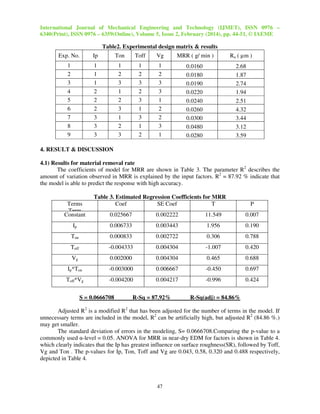
machining parameters and their levels are shown in Table1. Design matrix and results for MRR and
surface roughness as shown in table 2. Machine setup for near-dry EDM as shown in Figure1.
Figure1:-Near Dry EDM Setup
Table 1 Design Scheme of machining parameters and their levels
Levels
Parameters
Unit
Level-I
Level-II Level-III
2
3
4
Discharge current ( Ip )
amp
50
100
150
Pulse on time ( Ton )
µs
Pulse off time ( Toff )
Gap voltage ( Vg )
position
volt
46
10
40
11
45
12
50](https://image.slidesharecdn.com/30120140502006-140225050547-phpapp01/85/30120140502006-3-320.jpg)
![International Journal of Mechanical Engineering and Technology (IJMET), ISSN 0976 –
6340(Print), ISSN 0976 – 6359(Online), Volume 5, Issue 2, February (2014), pp. 44-51, © IAEME
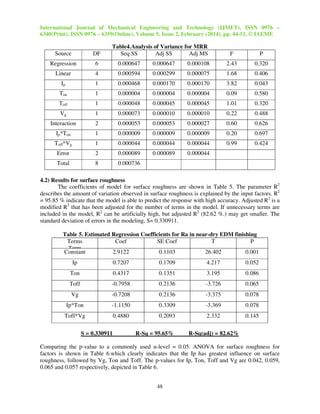
Optimal
High
D
Cur
0.75184 Low
Ip
4.0
[2.8687]
2.0
Ton
150.0
[50.0]
50.0
Toff
12.0
[10.0]
10.0
Vg
50.0
[50.0]
40.0
Composite
Desirability
0.75184
Ra ( m)
Minimum
y = 1.8265
d = 1.0000
MRR(g/mi
Maximum
y = 0.0341
d = 0.56527
Figure 2. Optimization graph
CONCLUSION
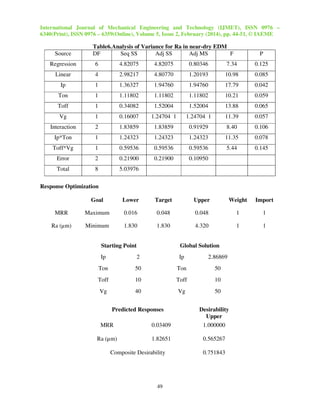
Analysis carried out by using response surface methodology’s (D-Optimal Method) to
optimize two responses simultaneously (to maximize MRR and minimize surface roughness). It is
also observed that, to obtain maximum MRR (0.0341) and minimum surface roughness (1.8265)
simultaneously when employ the discharge current (2.868) and low pulse on time(50), pulse off time
(10) and high discharge voltage (50).
Near-dry EDM proven beneficial for finishing operation because liquid phase is dispersed in
gas medium is hypothesized to enhance the electric field and thus results in a low frequency of spark
and stable discharge at low energy input. The gases in the air prevent the electrolysis and yield better
surface finish.
FUTURE SCOPE
1) Very less work has been reported on MRR improvement. Also on material like water hardened
die steel, molybdenum high speed steel have non tried as a work materials in near-dry EDM
and powder mixed EDM. The same may be tried in future works
2) Hollow tube and eccentric drilled hole type electrode are reported to have positive impact on
MRR due to improved flushing condition. Such designs need investigations for more work
materials to evaluate their case to case effects.
3) Use of near-dry EDM in micro machining.
50](https://image.slidesharecdn.com/30120140502006-140225050547-phpapp01/85/30120140502006-7-320.jpg)
![International Journal of Mechanical Engineering and Technology (IJMET), ISSN 0976 –
6340(Print), ISSN 0976 – 6359(Online), Volume 5, Issue 2, February (2014), pp. 44-51, © IAEME
REFERENCES
[1]
[2]
[3]
[4]
[5]
[6]
[7]
[8]
[9]
[10]
[11]
12]
[13]
[14]
[15]
[16]
Jia Tao, Albert J. Shih, and Jun Ni, “Near-dry EDM Mirror-Like Surface Finish” Jan.(2008)
International Journal of Electrical Machining , Department of Mechanical Engineering,
University of Michigan.
Jia Tao, Albert J. Shih, and Jun Ni, “Experimental Study of the Dry and Near-Dry Electrical
Discharge Milling Processes” Journal of Manufacturing Science and Engineering. (2008) 130,
011002, DOI:10.1115/1.2784276.
GrzegorzSkrabalak, Jerzy Kozak, “Study on Dry Electrical Discharge Machining” Proceedings
of the World Congress on Engineering , June 2010 Volume-III.
Yusuf Keskin, H. SelcukHalkaci, Mevlut Kizil, “An experimental study for determination of the
effects of machining parameters on surface roughness in EDM” International Journal of Advance
Manufacturing Technology.(2006)28:1118-1121, DOI 10.1007/s00170-004-2478-8.
Ko-Ta Chiang,“Modeling and analysis of the effects of machining parameters on the performance
characteristics in the EDM process of Al2O3+TiC mixed ceramic” International Journal Advance
Manufacturing Technology.(2008)37:523-533,DOI 10.1007/s00170-004-1002-3.
Mohan Kumar Pradhan, Chandan Kumar Biswas, “Modeling of machining parameters of MRR
in the EDM in EDM using response surface methodology” National conference on mechanical
science and technology. November 13-14 (2008).
S. H. Tomadi, M. A. Hassan, Z. Hamedon “Analysis of the Influence of EDM Parameters on
Surface Quality, Material removal rate & Electrode Wear of Tungsten Carbide” International
Multi Conference of Engineers & Computer Scientists, March 18-20 2009 Volume-II.
K. Ponappa , S. Aravindan, P. V. Rao, & M. Gupta “The effect of process parameters on
machining of magnesium nano alumina composites through EDM” 02 July 2009, International
Journal of Advance Manufacturing Technology. DOI 10.1007/s00170-009-2158-9.
AkmAsifIqbal & Ahsan Ali Khan, “Modeling & analysis of MRR, EWR and Surface roughness in
EDM Milling through response surface methodology” Journal of Engineering & Applied
science.Vol-5(2010). DOI: 10.3923, pp154-162.
AnandPandey, Shankar Singh “Current research trends in variants of Electrical Discharge
Machining: A review” Journal of Engineering Science and Technology, Vol-2(6), 2010, pp21722191.
S. S. Mahapatra& Amar Patnaik “Optimization of wire electric discharge machining process
parameters using Taguchi method” (2008), International Journal Advance Manufacturing
Technology.
KuldipOjha and R. K. Garg, 2010 “MRR Improvement in sinking electrical discharge
machining: A Review” Journal of Materials & Materials Characterization & Engineering.
Volume -9, No.8, pp709-739.
A. Manna & B. Bhattacharyya “Taguchi &Gauss elimination method: A dual response approach
for parametric optimization of CNC wire cut EDM” 2006, International Journal of Advance
Manufacturing and Technology.
Vishal Kesarwani “Thesis on investigation of electrical discharge machine for optimization of
surface roughness using response surface methodology approach” Department of Mechanical
Engineering, National Institute of Technology, Rourkela, Orisa.
Prof. P. R. Cheke, Prof. D. S. Khedekar, Prof. R. S. Pawar and Dr. M. S. Kadam, “Comparative
Performance of Wet and Near-Dry EDM Process for Machining of Oil Hardned Non Sinking
Steel Material”, International Journal of Mechanical Engineering & Technology (IJMET),
Volume 3, Issue 2, 2012, pp. 13 - 22, ISSN Print: 0976 – 6340, ISSN Online: 0976 – 6359.
Prakash R. Cheke, Prof. D. S. Khedekar, “Experimental Investigation of Machining Parameter
for Wet & Near-Dry EDM Finishing”, International Journal of Design and Manufacturing
Technology (IJDMT), Volume 2, Issue 1, 2011, pp. 28 - 33, ISSN Print: 0976 – 6995,
ISSN Online: 0976 – 7002.
51](https://image.slidesharecdn.com/30120140502006-140225050547-phpapp01/85/30120140502006-8-320.jpg)

This document summarizes a research study that investigated near-dry electrical discharge machining (EDM) to optimize material removal rate (MRR) and surface finish. The study used a Taguchi L9 orthogonal array design of experiments to examine the effects of discharge current, pulse on time, gap voltage, and pulse off time on MRR and surface roughness. Response surface methodology was employed to optimize both responses simultaneously. The experimental results found that near-dry EDM achieved a better surface finish compared to wet EDM due to more stable machining at lower discharge energies. MRR and surface roughness were modeled as functions of the process parameters. The models showed the parameters and their interactions significantly affected MRR.


![Getting Started with Apache Spark: Big Data Made Simple [Free Meetup]](https://cdn.slidesharecdn.com/ss_thumbnails/apachesparkgettingstarted-260203175547-8361bcc3-thumbnail.jpg?width=640&height=640&fit=bounds)

