IJSRD - International Journal for Scientific Research & Development| Vol. 2, Issue 07, 2014 | ISSN (online): 2321-0613
All rights reserved by www.ijsrd.com 209
Analysis of Material Removal Rate of AISI 304 SS in EDM Process
Ved Prakash Pandey1
Mr. R.N.Mall2
1
PG Scholar 2
Assistant Professor
1,2
Department of Mechanical Engineering
1,2
Madan Mohan Malaviya University of Technology Gorakhpur
Abstract— EDM has become an important and cost-
effective method of machining extremely tough and brittle
electrically conductive materials. It is widely used in the
process of making moulds and dies and sections of complex
geometry and intricate shapes. The work piece material
selected in this experiment is AISI 304 Stainless steel taking
into account its wide usage in industrial applications. In
today’s world 304 stainless steel contributes to almost half
of the world’s production and consumption for industrial
purposes. The input variable parameters are current, pulse
on time and duty cycle. Taguchi method is applied to create
an L27 orthogonal array of input variables using the Design
of Experiments (DOE). The effect of the variable parameters
mentioned above upon machining characteristics such as
Material Removal Rate (MRR), Surface Roughness (SR)
and Overcut (OC) is studied and investigated. The tool
material is copper. The results obtained showed that current
was the most significant parameter followed by pulse on
time and the least significant was the duty cycle for the
entire three responses namely Material removal rate, Surface
roughness and overcut. With the increase in current and duty
cycle MRR increased but for pulse on time it increased only
up to 100 µs and then started to decrease. SR increased
significantly with the increase in current; for pulse on time it
increased up to 100 µs and after that there was no significant
increase; and in case of duty cycle SR increased up to 70%
and then started to decrease. OC increased with the increase
in current and pulse on time but in different fashion and in
case of duty cycle, OC increased up to 70% and then started
decreasing.
Keywords: MRR-Material Removal Rate, EDM-Electric
Discharge, Taguchi design in MINITAB
I. INTRODUCTION
Electrical discharge machining is a non-traditional
machining method. It is a process for eroding and removing
material from electrically conductive materials by use of
consecutive electric sparks. The process is carried out in a
dielectric liquid with a small gap between the work piece
and electrode. Each electrical discharge generates heat
energy in a narrow area that locally melts, evaporates and
even ionizes work piece material. EDM does not make
direct contact between the electrode and the work piece
where it can eliminate mechanical stresses, chatter and
vibration problems during machining. Some of the melted
and all of the evaporated material is then quenched and
flushed away by dielectric liquid and the remaining melt
recast on the finished surface[1]. Important Parameters of
EDM process are Spark on-time (Ton): The duration of time
(µs) the current is allowed to flow per cycle.
Spark off-time (Toff): the duration of time in
between the sparks generated. During this time the molten
material gets removed from the gap between the electrode
and the workpiece.
Voltage (V): It is the potential difference applied
between the electrode and the workpiece.
Discharge Current (Ip): It is the current flowing
through the electrode and is measured in amp.
Duty cycle: It is the ratio of Ton divided by total
cycle time (Ton+Toff)[2].
The quality of an EDM product is usually
evaluated in terms of its surface integrity, which is
characterized by the surface roughness, existence of surface
cracks and residual stresses. There are many process
variables that affect the surface integrity such as pulse
duration, peak current, open gap voltage, electrode polarity,
material properties of the tool electrode, work piece and
dielectric liquid, debris concentration and even size of the
electrode [1].
II. LITERATURE REVIEW
In this paper, some selected research papers have been
discussed related to Electrical Discharge Machining. The
studies carried out in these papers are mainly concerned
with the EDM parameters such as current, voltage, pulse on
time, duty cycle, etc. and how these affect the machining
characteristics like MRR, SR, OC, etc.B.S. Reddy et al.
carried out a study on the effect EDM parameters over
MRR, TWR, SR and hardness. Mixed factorial design of
experiments and multiple regression analysis techniques had
been employed to achieve the desired results. The
parameters in the decreasing order of importance for; MRR:
servo, duty cycle, current and voltage; TWR: current, servo
and duty cycle; SR: current; HRB: servo only. M.M.
Rahman et al. investigated the effect of the peak current and
pulse duration on the performance characteristics of the
EDM. The conclusions drawn were: the current and pulse on
time greatly affected the MRR, TWR and SR, the MRR
increases almost linearly with the increasing current, the SR
increases linearly with current for different pulse on time,
TWR increased with increasing peak current while
decreased when the pulse on time was increased. Puertas et
al. carried out results which showed that the intensity and
pulse time factor were the most important in case of SR
while the duty cycle factor was not significant at all. The
intensity factor was again influential in case of TWR. The
important factors in case of MRR were the intensity
followed by duty cycle and the pulse time. S.H. Tomadi et
al. investigated the machining of tungsten carbide with
copper tungsten as electrode. The full factorial design of
experiments was used for analyzing the parameters. In case
of SR, the important factors were voltage and pulse off time
while current and pulse on time were not significant. For
MRR the most influential was pulse on time followed by
voltage, current and pulse off time. Finally in case of TWR
the important factor was pulse off time followed by peak
current. Iqbal and Khan concluded that the voltage and
rotational speed of the electrode are the two significant
Analysis of Material Removal Rate of AISI 304 SS in EDM Process
(IJSRD/Vol. 2/Issue 07/2014/048)
All rights reserved by www.ijsrd.com 210
parameters for EDM milling. Optimization is concerned
with maximizing the MRR and minimizing EWR along with
an optimum Ra. Norliana Mohd Abbas et al. studied the
research trends in dry wire EDM, EDM in water, EDM with
powder additives, EDM on ultrasonic vibration and
modeling techniques in predicting EDM performances. For
every method that was introduced and employed in EDM
process, the objectives were the same: to improve the
capability of machining performances, to get improved
output product and to create better technologies to machine
new materials.Singh and Maheshwari found that the input
parameters such as current, pulse on time, voltage applied
and the workpiece material greatly influences overcut. It
increases with the increase of current but only up to a certain
limit. It also depends on the gap voltage. Kiyak and Cakir
ound that SR of workpiece and electrode were influenced by
current and pulse on time, higher values of these parameters
increased the surface roughness. Lower current and pulse
time and higher pulse off time produced a better surface
finish. Bhattacharyya et al. observed that peak current and
pulse on time significantly influenced different criteria of
surface integrity such as surface crack density, surface
roughness and white layer thickness. S Dhar et al. came to
the following conclusions: with increase in peak current
MRR, TWR and ROC increased significantly in a nonlinear
fashion; MRR and ROC increased with the increase in pulse
on time and gap voltage was found to have some effect on
the three responses.
III. EXPERIMENTAL DETAILS
In this paper we will discuss about the experimental work
formulated prior to execution of work. It consists of an L-27
orthogonal array using Taguchi design, selection of
workpiece, experimental set-up, tool design and calculation
of Material Removal Rate, Surface Roughness and Overcut.
The experiments were conducted using the Electric
Discharge Machine, model ELECTRONICA -
ELECTRAPLUS PS 50ZNC (die sinking type) the polarity
of the electrode was set as positive while that of workpiece
was negative. The dielectric fluid used was EDM oil
(specific gravity-0.763). The EDM consists of the following
parts:
IV. WORKIPECE MATERIAL
AISI 304 Stainless Steel is one of the most widely used
materials in all industrial applications and accounts for
approximately half of the world’s stainless steel production
and consumption. Because of its aesthetic view in
architecture, superior physical and mechanical properties,
resistance against corrosion and chemicals, weldability, it
has become the most preferred material over others. Many
conventional and non-conventional methods for machining
AISI 304 stainless steel are available.
A. composition of AISI 304 stainless steel
Elements Weight Limit % Actual Weight %
C 0.04-0.08 0.08 max
Mn 0.06-1.00 1.00 max
Si 0.20-1.00 1 max
Cr 18-20 20
Ni 8 -10.5 10
Fe 66.345 – 74 74
P 0.045 0.045 max
S 0.03 0.03 max
Table 1
B. Properties of AISI 304 SS
Mechanical Properties Typical Minimum
Tensile Strength 600MPa 485MPa
Proof Strength, (off set 0.2%)310MPa 170MPa
Elongation (Percent in 50mm) 60 40
Hardness(Brinell) 217
Hardness (Rockwell) 95
Endurance (fatigue Limit) 240MPa
Table 2
V. TOOL MATERIAL
The tools selected for this experiment is a Electrolytic
Copper, which is a ductile metal with high thermal and
electric conductivity. Pure copper is soft and mallable,
freshly exposed copper surface has reddish-orange colour. It
is used as conductor of heat and electricity and constituent
of various metal alloys.
A. The properties of copper materials
Density 8.89g/cc
Tensile
strength
220MPa
Tensile
strength
69 MPa
Poisons ratio 0.333
Melting point 1065-1083
o
c
Table 3
VI. RESULT AND DISCUSSION
Initially workpiece and copper tool materials are weighted
each time before the machining process are carried out. The
electrodes and workpiece after machining process are
cleaned to remove the carbon deposition, and are weighted
measuring using electronic weighing machine, which has a
resolution of 0.0001 grams. Each experiment was repeated
for three times and the averaged of MRR in term of
(grams/min) and TWR in terms of (grams/min). The
Materials Removal Rate and Tools Wear Rate are defined
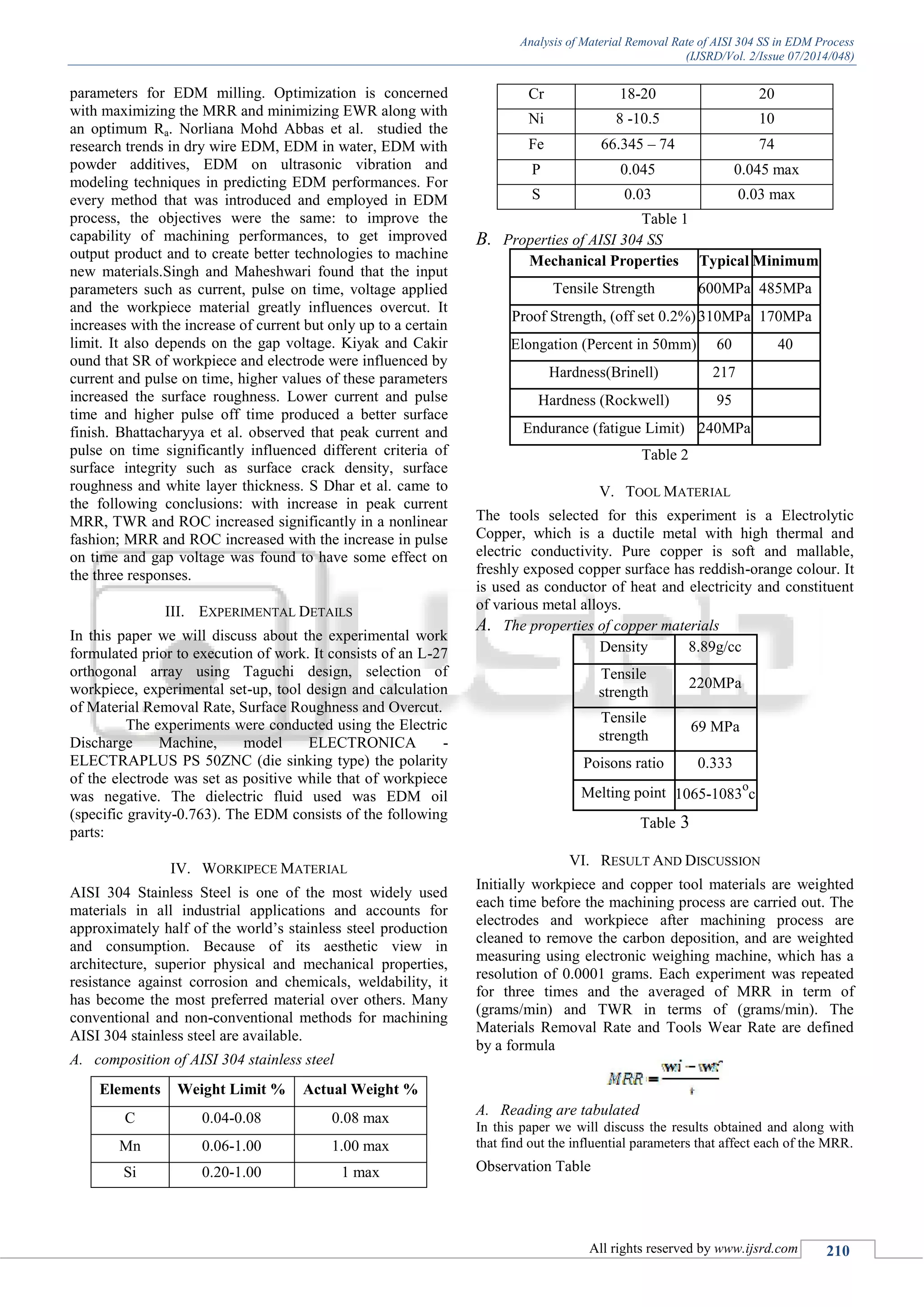
by a formula
A. Reading are tabulated
In this paper we will discuss the results obtained and along with
that find out the influential parameters that affect each of the MRR.
Observation Table
Analysis of Material Removal Rate of AISI 304 SS in EDM Process
(IJSRD/Vol. 2/Issue 07/2014/048)
All rights reserved by www.ijsrd.com 211
Run No. Ip (A) Ton (µs) τ (%) MRR
(mm3
/min)
1 3 60 80 1.5439
2 3 60 90 2.3064
3 3 60 100 1.3126
4 3 110 80 1.7939
5 3 110 90 2.0626
6 3 110 100 2.1501
7 3 160 80 1.9001
8 3 160 90 2.1189
9 3 160 100 2.1251
10 6 60 80 7.3501
11 6 60 90 8.3166
12 6 60 100 8.7967
13 6 110 80 8.1916
14 6 110 90 9.2249
15 6 110 100 9.4249
16 6 160 80 7.6581
17 6 160 90 9.1751
18 6 160 100 9.5079
19 9 60 80 14.2415
20 9 60 90 17.1001
21 9 60 100 17.5166
22 9 110 80 15.8416
23 9 110 90 18.8669
24 9 110 100 20.4671
25 9 160 80 14.5876
26 9 160 90 16.9876
27 9 160 100 19.3501
Table 4. 1
B. Analysis and Discussion of MRR
The MRR increases as the current increases throughout the entire
range. In case of pulse on time, the MRR first slightly increases up
to 100 µs and then decreases in a similar fashion till 150 µs. The
MRR increases linearly along with the increase in duty cycle
within the range but the magnitude of increase is not very large.
Analysis of Variance for Means of MRR
Source D
F
Seq SS Adj
MS
F P %
cont.
Ip 2 1057.9
3
528.96
3
4893.2
1
0.00
0
96.23
1
Ton 2 5.06 2.529 23.39 0.00
0
0.460
2
τ 2 18.45 9.227 85.36 0.00
0
1.678
2
Ip*Ton 4 3.10 0.774 7.16 0.00
9
0.282
Ip*τ 4 13.16 3.291 30.44 0.00
0
1.197
1
Ton*τ 4 0.80 0.200 1.85 0.21
3
0.072
Residua
l Error
8 0.86 0.108 0.078
Total 26 1099.3
6
S =
0.3288
R-Sq = 99.9% R-Sq(adj) =
99.7%
Table 4.2
Response Table for Mean of MRR
Level Ip Ton τ
1 1.924 8.720 8.123
2 8.627 9.780 9.573
3 17.218 9.268 10.072
Delta 15.294 1.060 1.949
Rank 1 2 3
Table 4.3
In table 4.1 1 column 1 represents variable sources such as
current, pulse on time, duty cycle and the interactions
between these three factors. Subsequently in the following
columns degree of freedom (DF), Sum of squares (Seq SS),
adjusted mean of square (Adj MS), F distribution and
Probability are calculated respectively.
The standard deviation of errors in the modeling,
S=0.3288. R2
=99.9% which indicates that the model is
capable of predicting the response with a high accuracy.
From this table it can be concluded that all the factors except
for the interaction between Ton*
τ are significant as the value of p<0.05. The value
of p for Ton* τ is 0.213 and hence the interaction is not
significant. From the response table it can be seen that the
most significant factor is Ip followed by Ton and the least
significant being Tau.
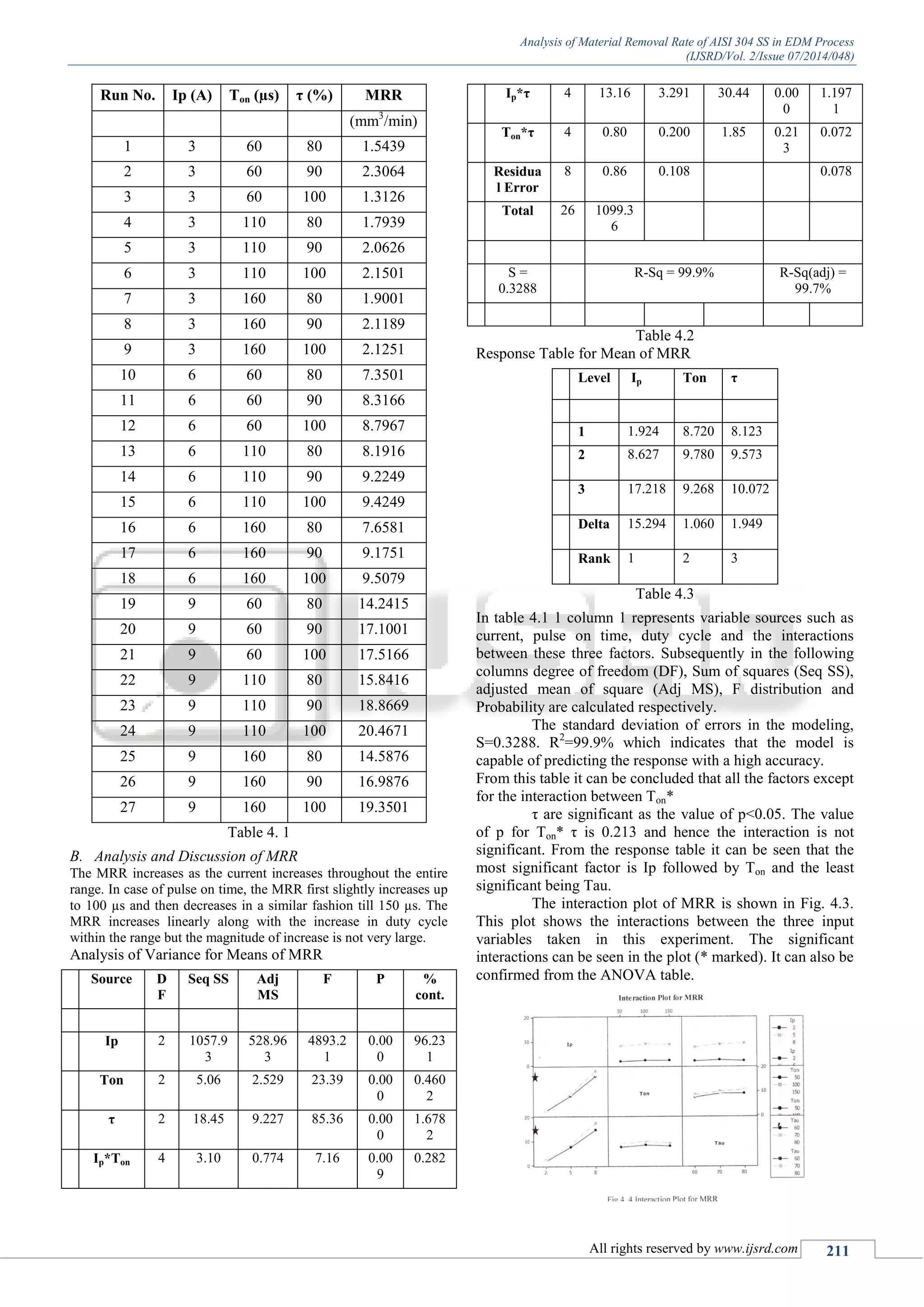
The interaction plot of MRR is shown in Fig. 4.3.
This plot shows the interactions between the three input
variables taken in this experiment. The significant
interactions can be seen in the plot (* marked). It can also be
confirmed from the ANOVA table.
Analysis of Material Removal Rate of AISI 304 SS in EDM Process
(IJSRD/Vol. 2/Issue 07/2014/048)
All rights reserved by www.ijsrd.com 212
VII. CONCLUSION
In this study the experiment was conducted by considering
three variable parameters namely current, pulse on time and
duty cycle. The objective was to find the Material Removal
Rate, Surface Roughness and Overcut and to study the
effects of the variable parameters on these characteristics.
The tool material was taken as copper and the workpiece
was chosen as AISI 304 stainless steel. Using the Taguchi
method an L27 orthogonal array was created and the
experiments were performed accordingly. The following
conclusions were drawn for MRR the most significant factor
was found to be peak current followed by pulse on time and
the least significant was duty cycle. The MRR increased
nonlinearly with the increase in current. For Ton the MRR
first increased till 100 µs and then decreased. With increase
in duty cycle, MRR increased insignificantly.
REFERENCES
[1] Rao P.S., Kumar J.S, Reddy K., Reddy B., Parametric
Study of Electric Discharge Machining of AISI 304
Stainless Steel, International Journal of Engineering
Science and Technology, Vol. 2(8), 2010, 3535-3550.
[2] Rahman M.M., Khan M.A.R., Kadirgama K., Noor
M.M. and Bakar R.A., Experimental Investigation
into Electrical Discharge Machining of Stainless Steel
304,Journal of Applied Sciences, 11: 549-554.
[3] Puertas I., Luis C.J., Alvarez L., Analysis of the
influence of EDM parameters on surface quality,
MRR and EW of WC-Co, Journal of Materials
Processing Technology, 153-154 (2004), 1026-1032.
[4] Tomadi S.H., Hassan M.A., Hamedon Z., Analysis of
the influence of EDM parameters on surface quality,
material removal rate and electrode wear of tungsten
carbide, Proceedings of the International
MultiConference of Engineers and Computer
Scientists, Vol II (2009).
[5] Iqbal AKM A., Khan A.A., Optimization of process
parameters on EDM milling of stainless steel AISI
304, Advance Materials Research, Vols. 264-265
(2011), pp 979-984.
[6] Abbas Md. N., Solomon D.G., Bahari Md.F., A
review on current research trends in electrical
discharge machining (EDM), International Journal of
Machine Tool and Manufacture, 47 (2007), 1214-
1228
[7] Singh S., Maheshwari S. and Pandey P., Some
investigations into the electric discharge machining of
hardened tool steel using different electrode
materials, Journal of Materials Processing
Technology, 149 (2004), 272-277
[8] Kiyak M. and Cakir O., Examination of machining
parameters on surface roughness in EDM of tool
steel, Journal of Materials Processing Technology,
191 (2007), 141-144
[9] Bhattacharyya B., Gangopadhyay S., Sarkar B.R.,
Modelling and Analysis of EDMed job surface
integrity, Journal of Materials Processing
Technology, 189 (2007), 169-177.
[10]Dhar S., Purohit R., Saini N., Sharma A., Kumar
G.H., Mathematical modelling of electric discharge
machining of cast Al-4Cu-6Si alloy-10 wt.% SiCp
composites, Journal of Materials Processing
Technology, 194 (2007), 24-29
[11]Rao P.S., Kumar J.S, Reddy K., Reddy B., Fuzzy
Modelling for Electrical Discharge Machining of
AISI 304 Stainless Steel, Journal of Applied Sciences
Research, 6 (2011), 1687-1700
[12]Reza M.S., Hamdi M., Tomadi S.H., Ismail A.R.,
Optimization of control parameters for EWR in
injection flushing type of EDM on stainless steel 403
workpiece, World Academy of Science, Engineering
and Technology, 72 (2010
[13]Puertas I. and Luis C.J., A study of optimization of
machining parameters for electrical discharge
machining of boron carbide, Materials and
Manufacturing Process, 19(6), 2004, 1041-1070.
[14]Simao J., Lee H.G., Aspinwall D.K., Dewes R.C.,
and Apinwall E.M., Workpiece surface modification
using electrical discharge machining, 43 (2003), 121-
128.
[15]Saha S.K., and Choudhury S.K., Experimental
Investigation and empirical modelling of the dry
electric discharge machining process, International
Journal of Machine Tools and Manufacture, 49(3-4),
2009, 297-308.
[16]Dewangan S.K., Experimental Investigation of
Machining parameters for EDM using U-shaped
Electrode of AISI P20 tool steel, M-Tech Thesis
2010,

Anaysis of Material Removal Rate of AISI 304 SS In EDM Process

  • 1.
    IJSRD - InternationalJournal for Scientific Research & Development| Vol. 2, Issue 07, 2014 | ISSN (online): 2321-0613 All rights reserved by www.ijsrd.com 209 Analysis of Material Removal Rate of AISI 304 SS in EDM Process Ved Prakash Pandey1 Mr. R.N.Mall2 1 PG Scholar 2 Assistant Professor 1,2 Department of Mechanical Engineering 1,2 Madan Mohan Malaviya University of Technology Gorakhpur Abstract— EDM has become an important and cost- effective method of machining extremely tough and brittle electrically conductive materials. It is widely used in the process of making moulds and dies and sections of complex geometry and intricate shapes. The work piece material selected in this experiment is AISI 304 Stainless steel taking into account its wide usage in industrial applications. In today’s world 304 stainless steel contributes to almost half of the world’s production and consumption for industrial purposes. The input variable parameters are current, pulse on time and duty cycle. Taguchi method is applied to create an L27 orthogonal array of input variables using the Design of Experiments (DOE). The effect of the variable parameters mentioned above upon machining characteristics such as Material Removal Rate (MRR), Surface Roughness (SR) and Overcut (OC) is studied and investigated. The tool material is copper. The results obtained showed that current was the most significant parameter followed by pulse on time and the least significant was the duty cycle for the entire three responses namely Material removal rate, Surface roughness and overcut. With the increase in current and duty cycle MRR increased but for pulse on time it increased only up to 100 µs and then started to decrease. SR increased significantly with the increase in current; for pulse on time it increased up to 100 µs and after that there was no significant increase; and in case of duty cycle SR increased up to 70% and then started to decrease. OC increased with the increase in current and pulse on time but in different fashion and in case of duty cycle, OC increased up to 70% and then started decreasing. Keywords: MRR-Material Removal Rate, EDM-Electric Discharge, Taguchi design in MINITAB I. INTRODUCTION Electrical discharge machining is a non-traditional machining method. It is a process for eroding and removing material from electrically conductive materials by use of consecutive electric sparks. The process is carried out in a dielectric liquid with a small gap between the work piece and electrode. Each electrical discharge generates heat energy in a narrow area that locally melts, evaporates and even ionizes work piece material. EDM does not make direct contact between the electrode and the work piece where it can eliminate mechanical stresses, chatter and vibration problems during machining. Some of the melted and all of the evaporated material is then quenched and flushed away by dielectric liquid and the remaining melt recast on the finished surface[1]. Important Parameters of EDM process are Spark on-time (Ton): The duration of time (µs) the current is allowed to flow per cycle. Spark off-time (Toff): the duration of time in between the sparks generated. During this time the molten material gets removed from the gap between the electrode and the workpiece. Voltage (V): It is the potential difference applied between the electrode and the workpiece. Discharge Current (Ip): It is the current flowing through the electrode and is measured in amp. Duty cycle: It is the ratio of Ton divided by total cycle time (Ton+Toff)[2]. The quality of an EDM product is usually evaluated in terms of its surface integrity, which is characterized by the surface roughness, existence of surface cracks and residual stresses. There are many process variables that affect the surface integrity such as pulse duration, peak current, open gap voltage, electrode polarity, material properties of the tool electrode, work piece and dielectric liquid, debris concentration and even size of the electrode [1]. II. LITERATURE REVIEW In this paper, some selected research papers have been discussed related to Electrical Discharge Machining. The studies carried out in these papers are mainly concerned with the EDM parameters such as current, voltage, pulse on time, duty cycle, etc. and how these affect the machining characteristics like MRR, SR, OC, etc.B.S. Reddy et al. carried out a study on the effect EDM parameters over MRR, TWR, SR and hardness. Mixed factorial design of experiments and multiple regression analysis techniques had been employed to achieve the desired results. The parameters in the decreasing order of importance for; MRR: servo, duty cycle, current and voltage; TWR: current, servo and duty cycle; SR: current; HRB: servo only. M.M. Rahman et al. investigated the effect of the peak current and pulse duration on the performance characteristics of the EDM. The conclusions drawn were: the current and pulse on time greatly affected the MRR, TWR and SR, the MRR increases almost linearly with the increasing current, the SR increases linearly with current for different pulse on time, TWR increased with increasing peak current while decreased when the pulse on time was increased. Puertas et al. carried out results which showed that the intensity and pulse time factor were the most important in case of SR while the duty cycle factor was not significant at all. The intensity factor was again influential in case of TWR. The important factors in case of MRR were the intensity followed by duty cycle and the pulse time. S.H. Tomadi et al. investigated the machining of tungsten carbide with copper tungsten as electrode. The full factorial design of experiments was used for analyzing the parameters. In case of SR, the important factors were voltage and pulse off time while current and pulse on time were not significant. For MRR the most influential was pulse on time followed by voltage, current and pulse off time. Finally in case of TWR the important factor was pulse off time followed by peak current. Iqbal and Khan concluded that the voltage and rotational speed of the electrode are the two significant
  • 2.
    Analysis of MaterialRemoval Rate of AISI 304 SS in EDM Process (IJSRD/Vol. 2/Issue 07/2014/048) All rights reserved by www.ijsrd.com 210 parameters for EDM milling. Optimization is concerned with maximizing the MRR and minimizing EWR along with an optimum Ra. Norliana Mohd Abbas et al. studied the research trends in dry wire EDM, EDM in water, EDM with powder additives, EDM on ultrasonic vibration and modeling techniques in predicting EDM performances. For every method that was introduced and employed in EDM process, the objectives were the same: to improve the capability of machining performances, to get improved output product and to create better technologies to machine new materials.Singh and Maheshwari found that the input parameters such as current, pulse on time, voltage applied and the workpiece material greatly influences overcut. It increases with the increase of current but only up to a certain limit. It also depends on the gap voltage. Kiyak and Cakir ound that SR of workpiece and electrode were influenced by current and pulse on time, higher values of these parameters increased the surface roughness. Lower current and pulse time and higher pulse off time produced a better surface finish. Bhattacharyya et al. observed that peak current and pulse on time significantly influenced different criteria of surface integrity such as surface crack density, surface roughness and white layer thickness. S Dhar et al. came to the following conclusions: with increase in peak current MRR, TWR and ROC increased significantly in a nonlinear fashion; MRR and ROC increased with the increase in pulse on time and gap voltage was found to have some effect on the three responses. III. EXPERIMENTAL DETAILS In this paper we will discuss about the experimental work formulated prior to execution of work. It consists of an L-27 orthogonal array using Taguchi design, selection of workpiece, experimental set-up, tool design and calculation of Material Removal Rate, Surface Roughness and Overcut. The experiments were conducted using the Electric Discharge Machine, model ELECTRONICA - ELECTRAPLUS PS 50ZNC (die sinking type) the polarity of the electrode was set as positive while that of workpiece was negative. The dielectric fluid used was EDM oil (specific gravity-0.763). The EDM consists of the following parts: IV. WORKIPECE MATERIAL AISI 304 Stainless Steel is one of the most widely used materials in all industrial applications and accounts for approximately half of the world’s stainless steel production and consumption. Because of its aesthetic view in architecture, superior physical and mechanical properties, resistance against corrosion and chemicals, weldability, it has become the most preferred material over others. Many conventional and non-conventional methods for machining AISI 304 stainless steel are available. A. composition of AISI 304 stainless steel Elements Weight Limit % Actual Weight % C 0.04-0.08 0.08 max Mn 0.06-1.00 1.00 max Si 0.20-1.00 1 max Cr 18-20 20 Ni 8 -10.5 10 Fe 66.345 – 74 74 P 0.045 0.045 max S 0.03 0.03 max Table 1 B. Properties of AISI 304 SS Mechanical Properties Typical Minimum Tensile Strength 600MPa 485MPa Proof Strength, (off set 0.2%)310MPa 170MPa Elongation (Percent in 50mm) 60 40 Hardness(Brinell) 217 Hardness (Rockwell) 95 Endurance (fatigue Limit) 240MPa Table 2 V. TOOL MATERIAL The tools selected for this experiment is a Electrolytic Copper, which is a ductile metal with high thermal and electric conductivity. Pure copper is soft and mallable, freshly exposed copper surface has reddish-orange colour. It is used as conductor of heat and electricity and constituent of various metal alloys. A. The properties of copper materials Density 8.89g/cc Tensile strength 220MPa Tensile strength 69 MPa Poisons ratio 0.333 Melting point 1065-1083 o c Table 3 VI. RESULT AND DISCUSSION Initially workpiece and copper tool materials are weighted each time before the machining process are carried out. The electrodes and workpiece after machining process are cleaned to remove the carbon deposition, and are weighted measuring using electronic weighing machine, which has a resolution of 0.0001 grams. Each experiment was repeated for three times and the averaged of MRR in term of (grams/min) and TWR in terms of (grams/min). The Materials Removal Rate and Tools Wear Rate are defined by a formula A. Reading are tabulated In this paper we will discuss the results obtained and along with that find out the influential parameters that affect each of the MRR. Observation Table
  • 3.
    Analysis of MaterialRemoval Rate of AISI 304 SS in EDM Process (IJSRD/Vol. 2/Issue 07/2014/048) All rights reserved by www.ijsrd.com 211 Run No. Ip (A) Ton (µs) τ (%) MRR (mm3 /min) 1 3 60 80 1.5439 2 3 60 90 2.3064 3 3 60 100 1.3126 4 3 110 80 1.7939 5 3 110 90 2.0626 6 3 110 100 2.1501 7 3 160 80 1.9001 8 3 160 90 2.1189 9 3 160 100 2.1251 10 6 60 80 7.3501 11 6 60 90 8.3166 12 6 60 100 8.7967 13 6 110 80 8.1916 14 6 110 90 9.2249 15 6 110 100 9.4249 16 6 160 80 7.6581 17 6 160 90 9.1751 18 6 160 100 9.5079 19 9 60 80 14.2415 20 9 60 90 17.1001 21 9 60 100 17.5166 22 9 110 80 15.8416 23 9 110 90 18.8669 24 9 110 100 20.4671 25 9 160 80 14.5876 26 9 160 90 16.9876 27 9 160 100 19.3501 Table 4. 1 B. Analysis and Discussion of MRR The MRR increases as the current increases throughout the entire range. In case of pulse on time, the MRR first slightly increases up to 100 µs and then decreases in a similar fashion till 150 µs. The MRR increases linearly along with the increase in duty cycle within the range but the magnitude of increase is not very large. Analysis of Variance for Means of MRR Source D F Seq SS Adj MS F P % cont. Ip 2 1057.9 3 528.96 3 4893.2 1 0.00 0 96.23 1 Ton 2 5.06 2.529 23.39 0.00 0 0.460 2 τ 2 18.45 9.227 85.36 0.00 0 1.678 2 Ip*Ton 4 3.10 0.774 7.16 0.00 9 0.282 Ip*τ 4 13.16 3.291 30.44 0.00 0 1.197 1 Ton*τ 4 0.80 0.200 1.85 0.21 3 0.072 Residua l Error 8 0.86 0.108 0.078 Total 26 1099.3 6 S = 0.3288 R-Sq = 99.9% R-Sq(adj) = 99.7% Table 4.2 Response Table for Mean of MRR Level Ip Ton τ 1 1.924 8.720 8.123 2 8.627 9.780 9.573 3 17.218 9.268 10.072 Delta 15.294 1.060 1.949 Rank 1 2 3 Table 4.3 In table 4.1 1 column 1 represents variable sources such as current, pulse on time, duty cycle and the interactions between these three factors. Subsequently in the following columns degree of freedom (DF), Sum of squares (Seq SS), adjusted mean of square (Adj MS), F distribution and Probability are calculated respectively. The standard deviation of errors in the modeling, S=0.3288. R2 =99.9% which indicates that the model is capable of predicting the response with a high accuracy. From this table it can be concluded that all the factors except for the interaction between Ton* τ are significant as the value of p<0.05. The value of p for Ton* τ is 0.213 and hence the interaction is not significant. From the response table it can be seen that the most significant factor is Ip followed by Ton and the least significant being Tau. The interaction plot of MRR is shown in Fig. 4.3. This plot shows the interactions between the three input variables taken in this experiment. The significant interactions can be seen in the plot (* marked). It can also be confirmed from the ANOVA table.
  • 4.
    Analysis of MaterialRemoval Rate of AISI 304 SS in EDM Process (IJSRD/Vol. 2/Issue 07/2014/048) All rights reserved by www.ijsrd.com 212 VII. CONCLUSION In this study the experiment was conducted by considering three variable parameters namely current, pulse on time and duty cycle. The objective was to find the Material Removal Rate, Surface Roughness and Overcut and to study the effects of the variable parameters on these characteristics. The tool material was taken as copper and the workpiece was chosen as AISI 304 stainless steel. Using the Taguchi method an L27 orthogonal array was created and the experiments were performed accordingly. The following conclusions were drawn for MRR the most significant factor was found to be peak current followed by pulse on time and the least significant was duty cycle. The MRR increased nonlinearly with the increase in current. For Ton the MRR first increased till 100 µs and then decreased. With increase in duty cycle, MRR increased insignificantly. REFERENCES [1] Rao P.S., Kumar J.S, Reddy K., Reddy B., Parametric Study of Electric Discharge Machining of AISI 304 Stainless Steel, International Journal of Engineering Science and Technology, Vol. 2(8), 2010, 3535-3550. [2] Rahman M.M., Khan M.A.R., Kadirgama K., Noor M.M. and Bakar R.A., Experimental Investigation into Electrical Discharge Machining of Stainless Steel 304,Journal of Applied Sciences, 11: 549-554. [3] Puertas I., Luis C.J., Alvarez L., Analysis of the influence of EDM parameters on surface quality, MRR and EW of WC-Co, Journal of Materials Processing Technology, 153-154 (2004), 1026-1032. [4] Tomadi S.H., Hassan M.A., Hamedon Z., Analysis of the influence of EDM parameters on surface quality, material removal rate and electrode wear of tungsten carbide, Proceedings of the International MultiConference of Engineers and Computer Scientists, Vol II (2009). [5] Iqbal AKM A., Khan A.A., Optimization of process parameters on EDM milling of stainless steel AISI 304, Advance Materials Research, Vols. 264-265 (2011), pp 979-984. [6] Abbas Md. N., Solomon D.G., Bahari Md.F., A review on current research trends in electrical discharge machining (EDM), International Journal of Machine Tool and Manufacture, 47 (2007), 1214- 1228 [7] Singh S., Maheshwari S. and Pandey P., Some investigations into the electric discharge machining of hardened tool steel using different electrode materials, Journal of Materials Processing Technology, 149 (2004), 272-277 [8] Kiyak M. and Cakir O., Examination of machining parameters on surface roughness in EDM of tool steel, Journal of Materials Processing Technology, 191 (2007), 141-144 [9] Bhattacharyya B., Gangopadhyay S., Sarkar B.R., Modelling and Analysis of EDMed job surface integrity, Journal of Materials Processing Technology, 189 (2007), 169-177. [10]Dhar S., Purohit R., Saini N., Sharma A., Kumar G.H., Mathematical modelling of electric discharge machining of cast Al-4Cu-6Si alloy-10 wt.% SiCp composites, Journal of Materials Processing Technology, 194 (2007), 24-29 [11]Rao P.S., Kumar J.S, Reddy K., Reddy B., Fuzzy Modelling for Electrical Discharge Machining of AISI 304 Stainless Steel, Journal of Applied Sciences Research, 6 (2011), 1687-1700 [12]Reza M.S., Hamdi M., Tomadi S.H., Ismail A.R., Optimization of control parameters for EWR in injection flushing type of EDM on stainless steel 403 workpiece, World Academy of Science, Engineering and Technology, 72 (2010 [13]Puertas I. and Luis C.J., A study of optimization of machining parameters for electrical discharge machining of boron carbide, Materials and Manufacturing Process, 19(6), 2004, 1041-1070. [14]Simao J., Lee H.G., Aspinwall D.K., Dewes R.C., and Apinwall E.M., Workpiece surface modification using electrical discharge machining, 43 (2003), 121- 128. [15]Saha S.K., and Choudhury S.K., Experimental Investigation and empirical modelling of the dry electric discharge machining process, International Journal of Machine Tools and Manufacture, 49(3-4), 2009, 297-308. [16]Dewangan S.K., Experimental Investigation of Machining parameters for EDM using U-shaped Electrode of AISI P20 tool steel, M-Tech Thesis 2010,