International Journal of Engineering Research and Development
e-ISSN: 2278-067X, p-ISSN: 2278-800X, www.ijerd.com
Volume 5, Issue 11 (February 2013), PP. 16-20

     Imparting Liquid Barrier Characteristics on Bamboo
                     Medical Garments
                       1
                        Mr. G. Mohamed zakriya, 2Dr. G. Ramakrishnan
       Department of Fashion Technology, Angel College of Engineering and Technology, Tirupur-641665.


      Abstract:- Hospital infection is by large bacterial or viral infection which develops during the
      patient stay at hospital or soon after leaving. The total statistical figure of patient in today‘s world
      acquiring infections during their hospital stay is frightening and one of the important reasons for that
      is lack of guaranteed barrier materials. Plasma treatments can answer the demand of textile industry.
      Besides the base function of dressing people, textiles contribute to human health and safety,
      protecting from exposure to dangerous environments. Important requirements for protective apparel
      are barrier effectiveness and comfort for the wearer. Bamboo species the advantage of bamboo as a
      raw material include its fast renewability, its biodegradability and its organic status. The advantages
      of bamboo fabric are its antimicrobial properties, better moisture management and anti-static
      properties. These advantages make bamboo an ideal choice for application in medical textiles
      compared to other fibres. Bamboo woven fabric treated with fluorocarbon finish by padding mangle
      method and then it undergone to a Low pressure plasma treatment process by with SF 6 gas, from that
      super hydrophobic features are readily achieved on the fabric. Barrier effectiveness with comfort,
      antimicrobial, sterilizing effect is moving towards high value added product segments in medical
      garments. E.g. Patient wear, surgical wear, hospital workers wear etc.

                                           I.   INTRODUCTION
         One of the latest developments in new fibre researches is the use of bamboo fibre in various textile
products that has been used in construction materials, decorating items, furniture and high performance
composite materials for years. Regenerated bamboo fibre is obtained from the bamboo plant, which is an
abundant and cheap natural resource. Bamboo grows in tropical climates and is harvested after 3 - 4 years
Textile materials subjected to plasma treatments undergo major chemical and physical transformations including
(i) chemical changes in surface layers, (ii) changes in surface layer structure, and (iii) changes in physical
properties of surface layers. Plasmas create a high density of free radicals by disassociating molecules through
electron collisions and photochemical processes. This causes disruption of the chemical bonds in the fibre
polymer surface which results in formation of new chemical species. Both the surface chemistry and surface
topography are affected and the specific surface area of fibres is significantly increased. Plasma treatment on
fibre and polymer surfaces results in the formation of new functional groups such as —OH, —C=O, —COOH
which affect fabric wettability as well as facilitate graft polymerisation which, in turn, improve or decrease the
liquid repellence of treated textiles and nonwovens.

                                   II.    MATERIAL PREPARATION
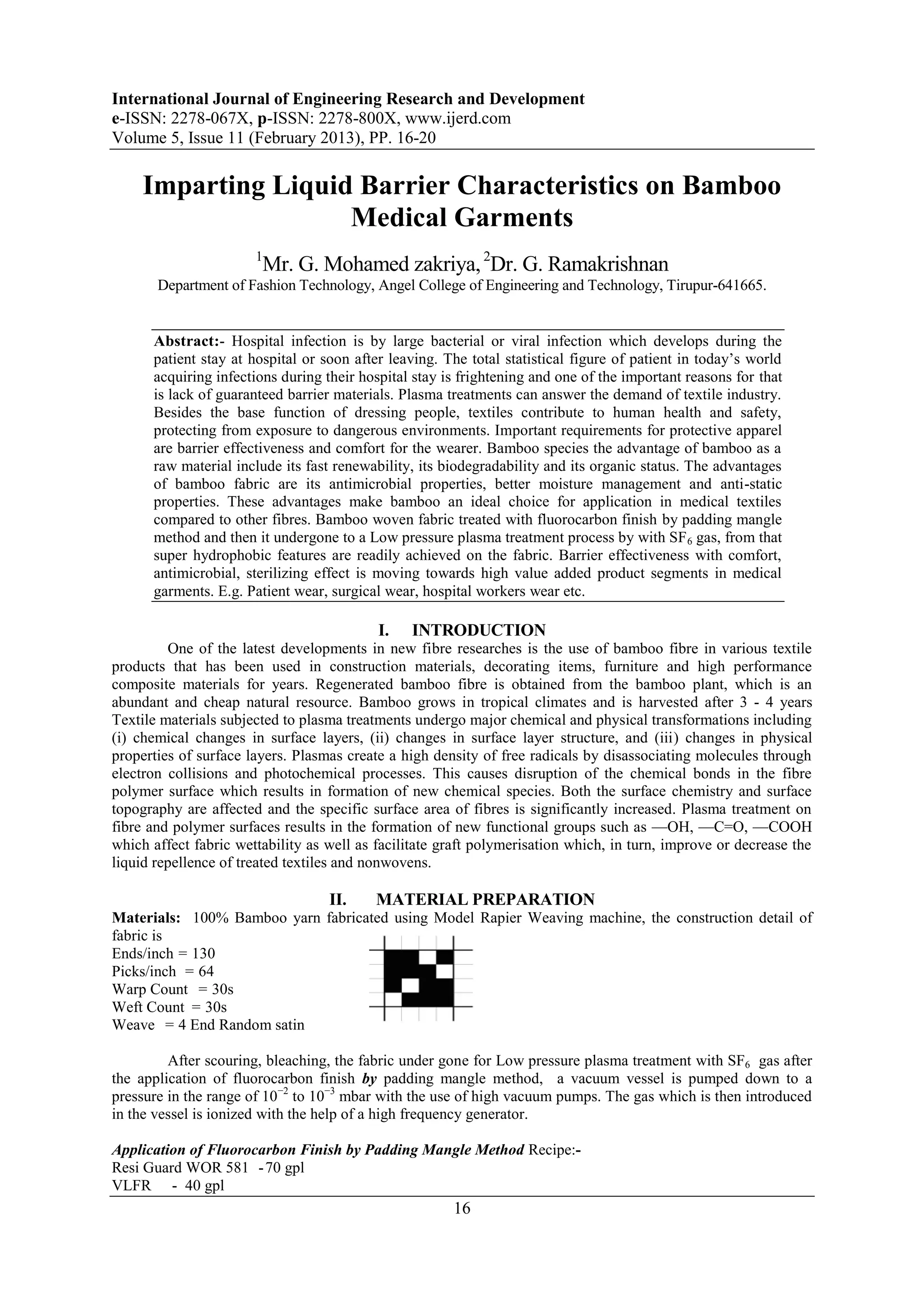
Materials: 100% Bamboo yarn fabricated using Model Rapier Weaving machine, the construction detail of
fabric is
Ends/inch = 130
Picks/inch = 64
Warp Count = 30s
Weft Count = 30s
Weave = 4 End Random satin

         After scouring, bleaching, the fabric under gone for Low pressure plasma treatment with SF6 gas after
the application of fluorocarbon finish by padding mangle method, a vacuum vessel is pumped down to a
pressure in the range of 10−2 to 10−3 mbar with the use of high vacuum pumps. The gas which is then introduced
in the vessel is ionized with the help of a high frequency generator.

Application of Fluorocarbon Finish by Padding Mangle Method Recipe:-
Resi Guard WOR 581 - 70 gpl
VLFR - 40 gpl
                                                       16
Imparting Liquid Barrier Characteristics on Bamboo Medical Garments

Mgcl2     - 8 gpl
R75 cone - 20 gpl
PH       - 4.5 - 5.0
Dry      - 120o C to 130 o C (90 minutes)
Curing    - 160 o C (3 to 5 minutes)

          III.     HYDROPHOBIC AND OLEOPHOBIC TREATMENT BY PLASMA
         The generation of water and oil repellent functional layers on textiles by plasma polymerisation of
fluorocarbons at atmospheric pressure under continuous in line conditions has been a major issue in
collaborative research projects at ITV Denkendorf.
         The structures of plasma polymerised fluorocarbon coatings are characterized by a relatively high
degrees of cross-linking, which can be deduced from CF-group detection by XPS-analysis. The molecular
structures and specific chemical functionalities of the used gaseous precursors are only rudimentarily found in
the cross-linked deposited layer.
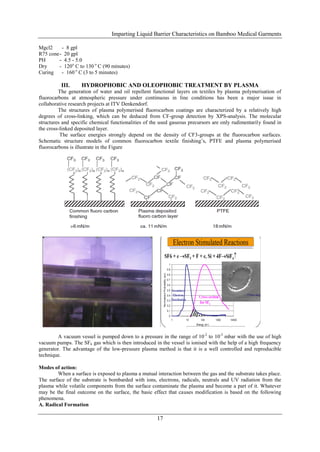
          The surface energies strongly depend on the density of CF3-groups at the fluorocarbon surfaces.
Schematic structure models of common fluorocarbon textile finishing‘s, PTFE and plasma polymerised
fluorocarbons is illustrate in the Figure


         A vacuum vessel is pumped down to a pressure in the range of 10 -2 to 10-3 mbar with the use of high
vacuum pumps. The SF6 gas which is then introduced in the vessel is ionised with the help of a high frequency
generator. The advantage of the low-pressure plasma method is that it is a well controlled and reproducible
technique.

Modes of action:
        When a surface is exposed to plasma a mutual interaction between the gas and the substrate takes place.
The surface of the substrate is bombarded with ions, electrons, radicals, neutrals and UV radiation from the
plasma while volatile components from the surface contaminate the plasma and become a part of it. Whatever
may be the final outcome on the surface, the basic effect that causes modification is based on the following
phenomena.
A. Radical Formation

                                                      17
Imparting Liquid Barrier Characteristics on Bamboo Medical Garments

i. Attachment of functional group
ii. Deposition/polymerization

B. Etching
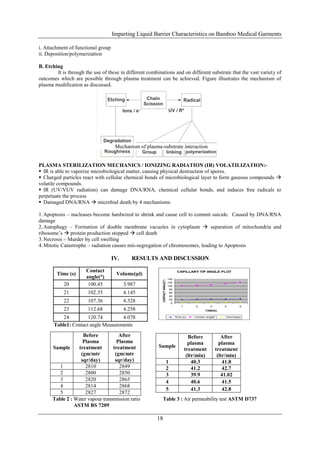
        It is through the use of these in different combinations and on different substrate that the vast variety of
outcomes which are possible through plasma treatment can be achieved. Figure illustrates the mechanism of
plasma modification as discussed.


                                     Mechanism of plasma-substrate interaction


PLASMA STERILIZATION MECHANICS / IONIZING RADIATION (IR) VOLATILIZATION:-
 IR is able to vaporize microbiological matter, causing physical destruction of spores.
 Charged particles react with cellular chemical bonds of microbiological layer to form gaseous compounds 
volatile compounds.
 IR (UV/VUV radiation) can damage DNA/RNA, chemical cellular bonds, and induces free radicals to
perpetuate the process
 Damaged DNA/RNA  microbial death by 4 mechanisms:

1. Apoptosis – nucleases become hardwired to shrink and cause cell to commit suicide. Caused by DNA/RNA
damage
2. Autophagy – Formation of double membrane vacuoles in cytoplasm  separation of mitochondria and
ribosome‘s  protein production stopped  cell death
3. Necrosis – Murder by cell swelling
4. Mitotic Catastrophe – radiation causes mis-segregation of chromosomes, leading to Apoptosis

                                    IV.      RESULTS AND DISCUSSION

                      Contact                                                        CAPILLARY TIP ANGLE PLOT
        Time (s)                     Volume(µl)
                      angle(°)                                                140
                                                           CONTACT ANGLE(°)


                                                                              120
           20          100.45             3.987                               100
                                                                               80
           21          102.35             4.145                                60
                                                                               40

           22          107.36             4.328                                20
                                                                                0
                                                                                        1        2         3       4        5
           23          112.68             4.258                                                        TIME(S)


          24          120.74         4.078                                          Time (s)    Contact angle(°)   Volume(µl)


       Table1: Contact angle Measurements
                    Before           After                                                    Before              After
                    Plasma          Plasma                                                    plasma             plasma
      Sample      treatment       treatment              Sample
                                                                                            treatment          treatment
                   (gm/mtr         (gm/mtr                                                   (ltr/min)          (ltr/min)
                   sqr/day)        sqr/day)                                   1                 40.3               41.8
         1           2810            2849                                     2                 41.2               42.7
         2           2800            2850                                     3                 39.9              41.02
         3           2820            2865                                     4                 40.6               41.5
         4           2814            2868
                                                                              5                 41.3               42.8
         5           2827            2872
      Table 2 : Water vapour transmission ratio            Table 3 : Air permeability test ASTM D737
                ASTM BS 7209

                                                        18
Imparting Liquid Barrier Characteristics on Bamboo Medical Garments

                                                         Bacterial reduction ( in % )

        Sample       Sample                                    Klebsiella
                                      Staphylococcus
          No.       particulars                               pneumoniae                Remarks
                                       ( ATCC 6538)
                                                             (ATCC 4352)
                    4 End Satin -                                               Excellent antibacterial
           1       100% Bamboo              86                   75                    activity
                      (Plasma
                    4 End Satin -
                       treated)                                                 Excellent antibacterial
           2       100% Bamboo              85                   75                    activity
                      (Plasma
                    4 End Satin -
                        treated                                                 Excellent antibacterial
           3       100% Bamboo              87                   76                    activity
                      (Plasma
                        treated        Table 4: Anti Bacterial reduction test


 The water contact angle of fabrics increased from 0 o up to 122o. The slippery angle is increased with respect
to time in seconds which shows the super hydrophobic nature due to SF6 plasma treatment.
 Water Vapour Transmission Ratio (ASTM BS 7209) and Air permeability test (ASTM D737) results shows
slightly higher range of values before then the plasma treatment which indicates the itching action of plasma
causes the porosity of the fabric improved.
 Assessment of Antibacterial Activity by Bacterial Reduction Test Staphylococcus (ATCC 6538) is 86% and
Klebsiella pneumoniae (ATCC 4352) is 75% remarked as excellent antibacterial activity.

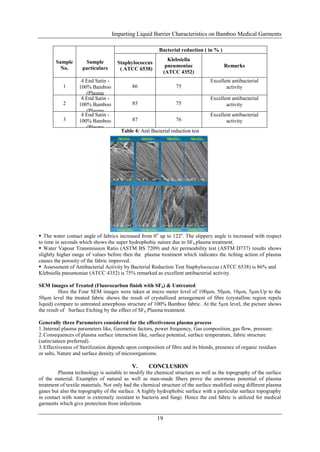
SEM Images of Treated (Fluorocarbon finish with SF6) & Untreated
          Here the Four SEM images were taken at micro meter level of 100µm, 50µm, 10µm, 5µm.Up to the
50µm level the treated fabric shows the result of crystallized arrangement of fibre (crystalline region repels
liquid) compare to untreated amorphous structure of 100% Bamboo fabric. At the 5µm level, the picture shows
the result of Surface Etching by the effect of SF6 Plasma treatment.

Generally three Parameters considered for the effectiveness plasma process
1. Internal plasma parameters like, Geometric factors, power frequency, Gas composition, gas flow, pressure.
2. Consequences of plasma surface interaction like, surface potential, surface temperature, fabric structure
(satin/sateen preferred).
3. Effectiveness of Sterilization depends upon composition of fibre and its blends, presence of organic residues
or salts, Nature and surface density of microorganisms.

                                            V.      CONCLUSION
         Plasma technology is suitable to modify the chemical structure as well as the topography of the surface
of the material. Examples of natural as well as man-made fibers prove the enormous potential of plasma
treatment of textile materials. Not only had the chemical structure of the surface modified using different plasma
gases but also the topography of the surface. A highly hydrophobic surface with a particular surface topography
in contact with water is extremely resistant to bacteria and fungi. Hence the end fabric is utilized for medical
garments which give protection from infections.

                                                        19
Imparting Liquid Barrier Characteristics on Bamboo Medical Garments

                                             REFERENCES
[1]. Anand S C, Medical Textiles 96 (Woodhead Publishing Ltd Cambridge), 1997, pp.3-6.
[2]. American Convertors - ISO•BAC™ Literature, August 1980.
[3]. AORN Journal, Vol. 21, No. 4, March, 1975, p. 594.
[4]. Bhat, N.V., and Benjamin, Y.N. 1989, Indian J Text. Res. pp1-14.
[5]. Collier, B.J., Collier, J.R., Agarwal, P., and Lo,Y.W. 1992, Textile Research Journal, 62, pp.741.
[6]. Coulson S R, Brewer S A, Willis C R, Badyal J P S (1997), GB Pat.Patent: WO 98/58117.
[7]. Coulson S. R., Woodward I S, Badyal J P S, Brewer S A, Willis C R (2000), ‗Plasma chemical
     functionalization of solid surfaces with low surface energy perfluorocarbon chains‘, Langmuir, 16,
     pp6287–6293.
[8]. Coulson S R, Woodward I S, Badyal J P S, Brewer
[9]. S A, Willis C R (2000) Super-repellent composite fl uoropolymer surfaces‘, J. Phys. Chem. B,104,
     pp8836–8840.
[10]. Coulson S R, Woodward I S, Badyal J P S, Brewer S A, Willis C R (2000) ‗Ultra low surface energy
     plasma polymer fi lms‘, Chem. Mater., 104, pp2200-2241
[11]. Dai, X.J. and Kviz, L. 2001, ―Study of atmospheric and low pressure plasma            modification on the
     surface properties of synthetic and natural fibres‖, CSIRO.
[12]. Davidson et.al., Brit. J. of Surgery, Vol., 58, No. 5, May, 1971, pp 333-337.
[13]. Dow Corning Corporation, Corporate Test Method 0923, Dynamic Shake Flask Test.
[14]. Fibres & Textiles in Eastern Europe Jan/March 2008. Vol.16, No 1 (66), pp 99-102.
[15]. Kan C.W. Chan K., Yuen C.W.M., Fibres & Polymers 2004, 5(1), pp 52-58.
[16]. Kim M.S. Kang T.J., Textile Research Journal 2002, 72(2), pp 113-120.
[17]. Malek, James R. and J.L. Speier, J. Coated Fabrics, 12, 1982, p. 38.
[18]. Michel Moisan, Jean Barbeau, Marie-Charlotte Crevier, Jacques Pelletier, Nicolas Philip, and Bachir
       Saoudi 2002, Plasma sterilization. Methods and mechanisms Pure Appl. Chem., Vol. 74, No. 3, pp.
       349–358.
[19]. Practical-perspectives, processing of bamboo fibre in textile industries. Colourage 2007, 54(4) pp.72
[20]. Rajendran S & Anand S C, Contribution of textiles to medical and healthcare products and
     developing innovative medical devices, Indian J Fibre Text Res , 31(1) (2006) pp215.
[21]. Thongphud. A, Paosawatyanyong. B, Visal-athaphand.P and. Supaphol .P 2008, Improvement of
     Hydrophobic Properties of the Electro spun PVA fabrics by SF6 Plasma Treatment, Advanced Materials
     Research Vols. 55-57 pp 625-628.


                                                     20

Welcome to International Journal of Engineering Research and Development (IJERD)

  • 1.
    International Journal ofEngineering Research and Development e-ISSN: 2278-067X, p-ISSN: 2278-800X, www.ijerd.com Volume 5, Issue 11 (February 2013), PP. 16-20 Imparting Liquid Barrier Characteristics on Bamboo Medical Garments 1 Mr. G. Mohamed zakriya, 2Dr. G. Ramakrishnan Department of Fashion Technology, Angel College of Engineering and Technology, Tirupur-641665. Abstract:- Hospital infection is by large bacterial or viral infection which develops during the patient stay at hospital or soon after leaving. The total statistical figure of patient in today‘s world acquiring infections during their hospital stay is frightening and one of the important reasons for that is lack of guaranteed barrier materials. Plasma treatments can answer the demand of textile industry. Besides the base function of dressing people, textiles contribute to human health and safety, protecting from exposure to dangerous environments. Important requirements for protective apparel are barrier effectiveness and comfort for the wearer. Bamboo species the advantage of bamboo as a raw material include its fast renewability, its biodegradability and its organic status. The advantages of bamboo fabric are its antimicrobial properties, better moisture management and anti-static properties. These advantages make bamboo an ideal choice for application in medical textiles compared to other fibres. Bamboo woven fabric treated with fluorocarbon finish by padding mangle method and then it undergone to a Low pressure plasma treatment process by with SF 6 gas, from that super hydrophobic features are readily achieved on the fabric. Barrier effectiveness with comfort, antimicrobial, sterilizing effect is moving towards high value added product segments in medical garments. E.g. Patient wear, surgical wear, hospital workers wear etc. I. INTRODUCTION One of the latest developments in new fibre researches is the use of bamboo fibre in various textile products that has been used in construction materials, decorating items, furniture and high performance composite materials for years. Regenerated bamboo fibre is obtained from the bamboo plant, which is an abundant and cheap natural resource. Bamboo grows in tropical climates and is harvested after 3 - 4 years Textile materials subjected to plasma treatments undergo major chemical and physical transformations including (i) chemical changes in surface layers, (ii) changes in surface layer structure, and (iii) changes in physical properties of surface layers. Plasmas create a high density of free radicals by disassociating molecules through electron collisions and photochemical processes. This causes disruption of the chemical bonds in the fibre polymer surface which results in formation of new chemical species. Both the surface chemistry and surface topography are affected and the specific surface area of fibres is significantly increased. Plasma treatment on fibre and polymer surfaces results in the formation of new functional groups such as —OH, —C=O, —COOH which affect fabric wettability as well as facilitate graft polymerisation which, in turn, improve or decrease the liquid repellence of treated textiles and nonwovens. II. MATERIAL PREPARATION Materials: 100% Bamboo yarn fabricated using Model Rapier Weaving machine, the construction detail of fabric is Ends/inch = 130 Picks/inch = 64 Warp Count = 30s Weft Count = 30s Weave = 4 End Random satin After scouring, bleaching, the fabric under gone for Low pressure plasma treatment with SF6 gas after the application of fluorocarbon finish by padding mangle method, a vacuum vessel is pumped down to a pressure in the range of 10−2 to 10−3 mbar with the use of high vacuum pumps. The gas which is then introduced in the vessel is ionized with the help of a high frequency generator. Application of Fluorocarbon Finish by Padding Mangle Method Recipe:- Resi Guard WOR 581 - 70 gpl VLFR - 40 gpl 16
  • 2.
    Imparting Liquid BarrierCharacteristics on Bamboo Medical Garments Mgcl2 - 8 gpl R75 cone - 20 gpl PH - 4.5 - 5.0 Dry - 120o C to 130 o C (90 minutes) Curing - 160 o C (3 to 5 minutes) III. HYDROPHOBIC AND OLEOPHOBIC TREATMENT BY PLASMA The generation of water and oil repellent functional layers on textiles by plasma polymerisation of fluorocarbons at atmospheric pressure under continuous in line conditions has been a major issue in collaborative research projects at ITV Denkendorf. The structures of plasma polymerised fluorocarbon coatings are characterized by a relatively high degrees of cross-linking, which can be deduced from CF-group detection by XPS-analysis. The molecular structures and specific chemical functionalities of the used gaseous precursors are only rudimentarily found in the cross-linked deposited layer. The surface energies strongly depend on the density of CF3-groups at the fluorocarbon surfaces. Schematic structure models of common fluorocarbon textile finishing‘s, PTFE and plasma polymerised fluorocarbons is illustrate in the Figure A vacuum vessel is pumped down to a pressure in the range of 10 -2 to 10-3 mbar with the use of high vacuum pumps. The SF6 gas which is then introduced in the vessel is ionised with the help of a high frequency generator. The advantage of the low-pressure plasma method is that it is a well controlled and reproducible technique. Modes of action: When a surface is exposed to plasma a mutual interaction between the gas and the substrate takes place. The surface of the substrate is bombarded with ions, electrons, radicals, neutrals and UV radiation from the plasma while volatile components from the surface contaminate the plasma and become a part of it. Whatever may be the final outcome on the surface, the basic effect that causes modification is based on the following phenomena. A. Radical Formation 17
  • 3.
    Imparting Liquid BarrierCharacteristics on Bamboo Medical Garments i. Attachment of functional group ii. Deposition/polymerization B. Etching It is through the use of these in different combinations and on different substrate that the vast variety of outcomes which are possible through plasma treatment can be achieved. Figure illustrates the mechanism of plasma modification as discussed. Mechanism of plasma-substrate interaction PLASMA STERILIZATION MECHANICS / IONIZING RADIATION (IR) VOLATILIZATION:-  IR is able to vaporize microbiological matter, causing physical destruction of spores.  Charged particles react with cellular chemical bonds of microbiological layer to form gaseous compounds  volatile compounds.  IR (UV/VUV radiation) can damage DNA/RNA, chemical cellular bonds, and induces free radicals to perpetuate the process  Damaged DNA/RNA  microbial death by 4 mechanisms: 1. Apoptosis – nucleases become hardwired to shrink and cause cell to commit suicide. Caused by DNA/RNA damage 2. Autophagy – Formation of double membrane vacuoles in cytoplasm  separation of mitochondria and ribosome‘s  protein production stopped  cell death 3. Necrosis – Murder by cell swelling 4. Mitotic Catastrophe – radiation causes mis-segregation of chromosomes, leading to Apoptosis IV. RESULTS AND DISCUSSION Contact CAPILLARY TIP ANGLE PLOT Time (s) Volume(µl) angle(°) 140 CONTACT ANGLE(°) 120 20 100.45 3.987 100 80 21 102.35 4.145 60 40 22 107.36 4.328 20 0 1 2 3 4 5 23 112.68 4.258 TIME(S) 24 120.74 4.078 Time (s) Contact angle(°) Volume(µl) Table1: Contact angle Measurements Before After Before After Plasma Plasma plasma plasma Sample treatment treatment Sample treatment treatment (gm/mtr (gm/mtr (ltr/min) (ltr/min) sqr/day) sqr/day) 1 40.3 41.8 1 2810 2849 2 41.2 42.7 2 2800 2850 3 39.9 41.02 3 2820 2865 4 40.6 41.5 4 2814 2868 5 41.3 42.8 5 2827 2872 Table 2 : Water vapour transmission ratio Table 3 : Air permeability test ASTM D737 ASTM BS 7209 18
  • 4.
    Imparting Liquid BarrierCharacteristics on Bamboo Medical Garments Bacterial reduction ( in % ) Sample Sample Klebsiella Staphylococcus No. particulars pneumoniae Remarks ( ATCC 6538) (ATCC 4352) 4 End Satin - Excellent antibacterial 1 100% Bamboo 86 75 activity (Plasma 4 End Satin - treated) Excellent antibacterial 2 100% Bamboo 85 75 activity (Plasma 4 End Satin - treated Excellent antibacterial 3 100% Bamboo 87 76 activity (Plasma treated Table 4: Anti Bacterial reduction test  The water contact angle of fabrics increased from 0 o up to 122o. The slippery angle is increased with respect to time in seconds which shows the super hydrophobic nature due to SF6 plasma treatment.  Water Vapour Transmission Ratio (ASTM BS 7209) and Air permeability test (ASTM D737) results shows slightly higher range of values before then the plasma treatment which indicates the itching action of plasma causes the porosity of the fabric improved.  Assessment of Antibacterial Activity by Bacterial Reduction Test Staphylococcus (ATCC 6538) is 86% and Klebsiella pneumoniae (ATCC 4352) is 75% remarked as excellent antibacterial activity. SEM Images of Treated (Fluorocarbon finish with SF6) & Untreated Here the Four SEM images were taken at micro meter level of 100µm, 50µm, 10µm, 5µm.Up to the 50µm level the treated fabric shows the result of crystallized arrangement of fibre (crystalline region repels liquid) compare to untreated amorphous structure of 100% Bamboo fabric. At the 5µm level, the picture shows the result of Surface Etching by the effect of SF6 Plasma treatment. Generally three Parameters considered for the effectiveness plasma process 1. Internal plasma parameters like, Geometric factors, power frequency, Gas composition, gas flow, pressure. 2. Consequences of plasma surface interaction like, surface potential, surface temperature, fabric structure (satin/sateen preferred). 3. Effectiveness of Sterilization depends upon composition of fibre and its blends, presence of organic residues or salts, Nature and surface density of microorganisms. V. CONCLUSION Plasma technology is suitable to modify the chemical structure as well as the topography of the surface of the material. Examples of natural as well as man-made fibers prove the enormous potential of plasma treatment of textile materials. Not only had the chemical structure of the surface modified using different plasma gases but also the topography of the surface. A highly hydrophobic surface with a particular surface topography in contact with water is extremely resistant to bacteria and fungi. Hence the end fabric is utilized for medical garments which give protection from infections. 19
  • 5.
    Imparting Liquid BarrierCharacteristics on Bamboo Medical Garments REFERENCES [1]. Anand S C, Medical Textiles 96 (Woodhead Publishing Ltd Cambridge), 1997, pp.3-6. [2]. American Convertors - ISO•BAC™ Literature, August 1980. [3]. AORN Journal, Vol. 21, No. 4, March, 1975, p. 594. [4]. Bhat, N.V., and Benjamin, Y.N. 1989, Indian J Text. Res. pp1-14. [5]. Collier, B.J., Collier, J.R., Agarwal, P., and Lo,Y.W. 1992, Textile Research Journal, 62, pp.741. [6]. Coulson S R, Brewer S A, Willis C R, Badyal J P S (1997), GB Pat.Patent: WO 98/58117. [7]. Coulson S. R., Woodward I S, Badyal J P S, Brewer S A, Willis C R (2000), ‗Plasma chemical functionalization of solid surfaces with low surface energy perfluorocarbon chains‘, Langmuir, 16, pp6287–6293. [8]. Coulson S R, Woodward I S, Badyal J P S, Brewer [9]. S A, Willis C R (2000) Super-repellent composite fl uoropolymer surfaces‘, J. Phys. Chem. B,104, pp8836–8840. [10]. Coulson S R, Woodward I S, Badyal J P S, Brewer S A, Willis C R (2000) ‗Ultra low surface energy plasma polymer fi lms‘, Chem. Mater., 104, pp2200-2241 [11]. Dai, X.J. and Kviz, L. 2001, ―Study of atmospheric and low pressure plasma modification on the surface properties of synthetic and natural fibres‖, CSIRO. [12]. Davidson et.al., Brit. J. of Surgery, Vol., 58, No. 5, May, 1971, pp 333-337. [13]. Dow Corning Corporation, Corporate Test Method 0923, Dynamic Shake Flask Test. [14]. Fibres & Textiles in Eastern Europe Jan/March 2008. Vol.16, No 1 (66), pp 99-102. [15]. Kan C.W. Chan K., Yuen C.W.M., Fibres & Polymers 2004, 5(1), pp 52-58. [16]. Kim M.S. Kang T.J., Textile Research Journal 2002, 72(2), pp 113-120. [17]. Malek, James R. and J.L. Speier, J. Coated Fabrics, 12, 1982, p. 38. [18]. Michel Moisan, Jean Barbeau, Marie-Charlotte Crevier, Jacques Pelletier, Nicolas Philip, and Bachir Saoudi 2002, Plasma sterilization. Methods and mechanisms Pure Appl. Chem., Vol. 74, No. 3, pp. 349–358. [19]. Practical-perspectives, processing of bamboo fibre in textile industries. Colourage 2007, 54(4) pp.72 [20]. Rajendran S & Anand S C, Contribution of textiles to medical and healthcare products and developing innovative medical devices, Indian J Fibre Text Res , 31(1) (2006) pp215. [21]. Thongphud. A, Paosawatyanyong. B, Visal-athaphand.P and. Supaphol .P 2008, Improvement of Hydrophobic Properties of the Electro spun PVA fabrics by SF6 Plasma Treatment, Advanced Materials Research Vols. 55-57 pp 625-628. 20