Surface modifications by applying
organic nanoparticles from a water
dispersion


Dr. Dirk Stanssens
Topchim introduction
                                                              2
 - Established in 1996

 - Offices + laboratories in Belgium and Brazil

 - R&D mainly focused on paper and card board coatings

 - 3 actual core-domains:

       - Rheology and water retention

       - Barrier coatings (ecological alternatives)

       - Organic nano-pigments
 - New development group started for non-paper applications
Market drivers

  • Better performing products at competitive prices

  • Growing awareness for more sustainable solutions
    • Use of renewable materials
    • Recycling of used materials
    • Reduction of VOC
    • Water as an environmentally friendly and save
      solvent
    • Cradle to cradle solutions
Topchim’s Nano-particles

  • Development of organic nanoparticles
     – Good interaction with other materials
     – High surface area
     – Tunable properties
     – Water borne
     – High solid content
     – Without use of external surfactants
     – High bio-renewability content
  • Applicable on most substrates
  • Approved for food contact
Technologies to produce organic nano-particles


   1. Straight synthesis by chemical transformation of
      SMA polymers

   2. Precipitation on inorganic carriers

   3. Core-shell nanoparticles; encapsulation of active
      ingredients
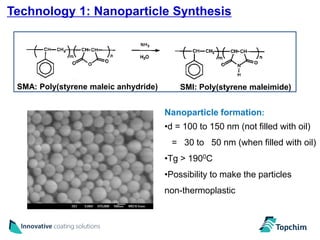
Technology 1: Nanoparticle Synthesis
                                                                              6


 SMA: Poly(styrene maleic anhydride)       SMI: Poly(styrene maleimide)


                                       Nanoparticle formation:
                                       •d = 100 to 150 nm (not filled with oil)
                                        = 30 to 50 nm (when filled with oil)
                                       •Tg > 1900C
                                       •Possibility to make the particles
                                       non-thermoplastic
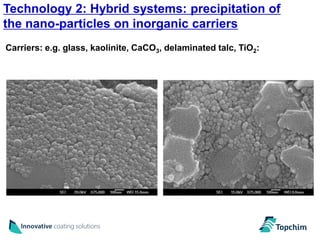
Technology 2: Hybrid systems: precipitation of
the nano-particles on inorganic carriers                          7


Carriers: e.g. glass, kaolinite, CaCO3, delaminated talc, TiO2:
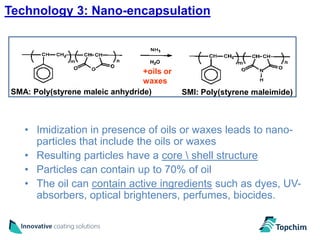
Technology 3: Nano-encapsulation


                                 +oils or
                                 waxes
SMA: Poly(styrene maleic anhydride)         SMI: Poly(styrene maleimide)


   • Imidization in presence of oils or waxes leads to nano-
     particles that include the oils or waxes
   • Resulting particles have a core  shell structure
   • Particles can contain up to 70% of oil
   • The oil can contain active ingredients such as dyes, UV-
     absorbers, optical brighteners, perfumes, biocides.
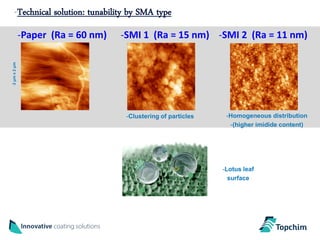
-Technical solution: tunability by SMA type
               -Paper (Ra = 60 nm)
                               174.78 nm
                                           -SMI 1 (Ra = 15 nm) -SMI 2 (Ra = 11 nm)
                                                                       122.74 nm                             55.73 nm
-2 µm x 2 µm


                                 0.00 nm                                 0.00 nm                              0.00 nm
                                            -Clustering of particles                -Homogeneous distribution
                                                                                     -(higher imidide content)


                                                                                   -Lotus leaf
                                                                                     surface
SMI coating: Chemical interactions
                                                                              10

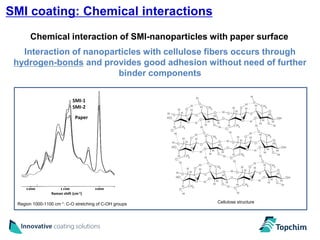
       Chemical interaction of SMI-nanoparticles with paper surface
   Interaction of nanoparticles with cellulose fibers occurs through
 hydrogen-bonds and provides good adhesion without need of further
                         binder components

                             SMI-1
                             SMI-2
                               Paper


                 Raman shift (cm-1)

 Region 1000-1100 cm-1: C-O stretching of C-OH groups   Cellulose structure
Mechanical Stability

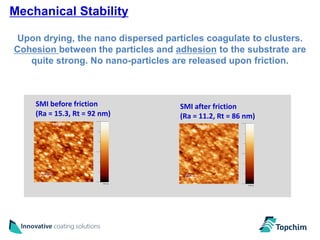
Upon drying, the nano dispersed particles coagulate to clusters.
Cohesion between the particles and adhesion to the substrate are
   quite strong. No nano-particles are released upon friction.


    SMI before friction             SMI after friction
    (Ra = 15.3, Rt = 92 nm)
                        56.08 nm    (Ra = 11.2, Rt = 86 nm)
                                                        80.10 nm

             height
                                             height


     400nm                           400nm
                         0.00 nm
                                                         0.00 nm
Hydrophobicity                                                  4,5
                                                                  4
                                                                                          y = 0,1438x + 1
                                                                               Roughness Component
                                                                                            R² = 0,9938

                                                                3,5
                                                                  3
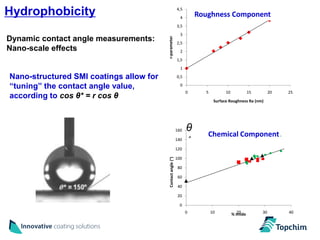
Dynamic contact angle measurements:


                                         r-parameter
                                                                2,5
Nano-scale effects                                                2
                                                                1,5
                                                                  1

Nano-structured SMI coatings allow for                          0,5

“tuning” the contact angle value,                                 0
                                                                       0           5                                  10              15              20             25
according to cos θ* = r cos θ
                                                                                        Surface Roughness Ra (nm)


                                                                160    θ
                                                                 160
                                                                           *       Chemical Component
                                                                140
                                                                 140

                                                                120
                                                                 120

                                                                100


                                            Contact angle (°)
                                          Contact angle(°)
                                                                 100

                                                                80
                                                                 80

                                                                60                                              120        Calibration curve on
                                                                 60
                                                                                                                               y‘flat’ surface
                                                                                                                                 = 1.8826x + 52.113
                                                                40                                              100
                                                                                                                                  R² = 0.9993
                                                                 40


                                                                                            Contact angle (°)
                                                                                                                 80
                                                                20
                                                                 20
                                                                                                                 60
                                                                  0
                                                                   0
                                                                       0
                                                                       0               10
                                                                                       10                        40           20
                                                                                                                              20
                                                                                                                           % imide               30
                                                                                                                                                 30                  40
                                                                                                                                                                     40
                                                                                                                            % imide
                                                                                                                 20


                                                                                                                  0
                                                                                                                      0       5        10       15         20   25        30   35
Hydrophobicity


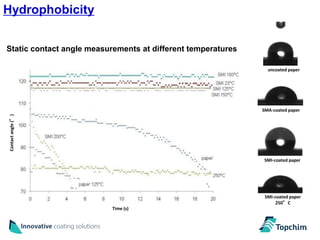
Static contact angle measurements at different temperatures

                                                                uncoated paper


                                                              SMA-coated paper
Contact angle (°)


                                                              SMI-coated paper


                                                               SMI-coated paper
                                                                    250°C
                           Time (s)
SMI-coatings: Hydrophobicity
                                                                                              14


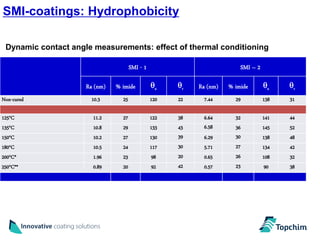
 Dynamic contact angle measurements: effect of thermal conditioning

                                      SMI - 1                            SMI – 2

                     Ra (nm)   % imide          qa    qr   Ra (nm)   % imide       qa    qr
Non-cured              10.3      25             120   22     7.44      29          138   31

125°C                  11.2      27             122   38     6.64      32          141   44
135°C                  10.8      29             133   43     6.58      36          145   52
150°C                  10.2      27             130   39     6.29      30          138   48
180°C                  10.5      24             117   30     5.71      27          134   42
200°C*                 1.96      23              98   20     0.65      26          108   32
250°C**                0.89      20              92   42     0.57      23          90    38
Obtained results for paper coating applications
                                                       15


   • Good print quality and paper strength with less
     coating weight
   • Replacing environmental unfriendly substances
     used in paper and card board production:
         - Fluorine based additives
         - Wax emulsions
         - Polyethylene
   • Improved repulpability
Environmental solution
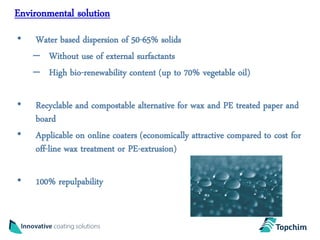
•   Water based dispersion of 50-65% solids
    – Without use of external surfactants
    – High bio-renewability content (up to 70% vegetable oil)

•   Recyclable and compostable alternative for wax and PE treated paper and
    board
•   Applicable on online coaters (economically attractive compared to cost for
    off-line wax treatment or PE-extrusion)

•   100% repulpability
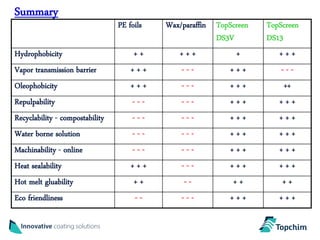
Summary
                                 PE foils   Wax/paraffin TopScreen   TopScreen
                                                         DS3V        DS13
Hydrophobicity                        ++       +++            +         +++
Vapor transmission barrier           +++        ---          +++        ---
Oleophobicity                        +++        ---          +++         ++
Repulpability                        ---        ---          +++        +++
Recyclability - compostability       ---        ---          +++        +++
Water borne solution                 ---        ---          +++        +++
Machinability - online               ---        ---          +++        +++
Heat sealability                     +++        ---          +++        +++
Hot melt gluability                   ++        --            ++        ++
Eco friendliness                      --        ---          +++        +++
Applications
  • Corrugated board and boxes for fruit and vegetables

  • Frozen food packaging

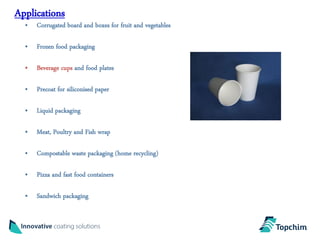
  • Beverage cups and food plates

  • Precoat for siliconised paper

  • Liquid packaging

  • Meat, Poultry and Fish wrap

  • Compostable waste packaging (home recycling)

  • Pizza and fast food containers

  • Sandwich packaging
-PE-free beverage paper cups
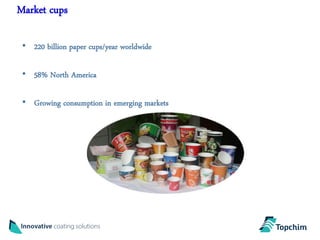
Market cups

 • 220 billion paper cups/year worldwide

 • 58% North America

 • Growing consumption in emerging markets
TopChim’s technology
 • Coated cup stock

 • No thermoplastic film (like PE or PLA)

 • Standard sealing process

 • Coating chemistry based on particles containing vegetable oil

 • Competitive alternative for PE treatment

 • Suitable for cold and hot drinks
Performances

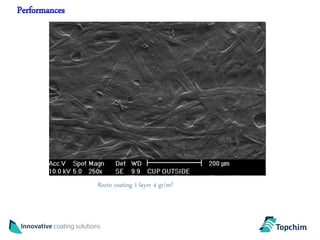
 • No leaking, even after 24 hours

 • Tunable for cost efficiency
    – Layer thickness can be chosen

 • Condensation barrier; 2 gsm of coating layer sufficient

 • Additional oleophobicity (e.g. pop-corn cups or salad bowls)
Performances


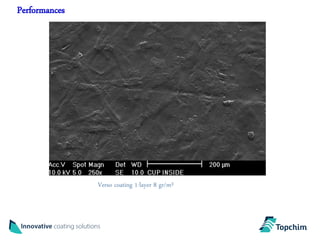
               Verso coating 1-layer 8 gr/m²
Performances


               Recto coating 1-layer 4 gr/m²
Process cup stock production

 • Surface treatment immediately at cup stock production

 • No off-line extrusion treatment
    – Less transport
    – Less energy
    – Less waste

 • Treated cup stock is repulpable (broke and waste)

 • Higher flexibility on barrier layer weight
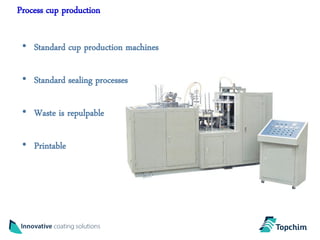
Process cup production

 • Standard cup production machines

 • Standard sealing processes

 • Waste is repulpable

 • Printable
Ecological advantages

 • Reduced manufacturing process
    – Less energy and waste
    – Less transport

 • Higher degree of recyclability and compostability

 • Highly reduced dependency on mineral oil based materials
Potential non-paper applications

 • Use of nano-pigments and nano-dispersions for a.o.:
    – Cosmetics
    – Fibers
    – Inks
    – Paints
 • Focus on:
    – Applying coatings that make substrates hydrophobic
    – Nano-encapsulating of active ingredients (dyes, optical
      brighteners, perfumes, sun screen,…)
 • Market approach by co-operation with development partners
Textile industry: semi-permeable coatings

   • Fully water-borne coatings
   • Good adhesion to several textile substrates
   • Transparent coatings with good water repellency
   • Nano-particles have a high Tg and are not film
     forming
   • The coating layer keeps its porosity and its
     breathability
Ink applications

   •   Water borne formulations, no external surfactants
   •   Encapsulated dyes behave as nano-pigments
   •   Upon drying ink shows water repellency
   •   Very stable dispersion of pigments in water
        – Carbon black, carbon nanotubes
        – Can be used for ink-jet ink applications
Conclusions
                                                                31
 The imidisation of poly(styrene-maleic anhydride) results in
 SMI nanoparticles:
   - of 100 to 150 nm diameter
    -   Tg = 190 – 220°C
    -   with good mechanical resistance
    -   high dispersion stability in water
    -   leading to favorable processing characteristics
    -   having high interaction with other materials
Conclusions
                                                                 32

 The SMI nano-particles can be produced in the presence of
 a carrier material andor in the presence of oils and waxes.

 Furthermore, these oils or waxes can contain active
 ingredients. Properties such as e.g. water repellency, color,
 UV absorption, gloss can be tuned by choosing the
 appropriate combination of raw materials.

 Topchim is open for collaborations on specific projects with
 clear market needs.
Address


           info@topchim.com

               TOPCHIM NV
           Nijverheidsstraat 98
           2160 Wommelgem
                  Belgium
          Tel: +32 3 350.08.40
          Fax: +32 3 350.08.49

11.20 dhr stanssens

  • 1.
    Surface modifications byapplying organic nanoparticles from a water dispersion Dr. Dirk Stanssens
  • 2.
    Topchim introduction 2 - Established in 1996 - Offices + laboratories in Belgium and Brazil - R&D mainly focused on paper and card board coatings - 3 actual core-domains: - Rheology and water retention - Barrier coatings (ecological alternatives) - Organic nano-pigments - New development group started for non-paper applications
  • 3.
    Market drivers • Better performing products at competitive prices • Growing awareness for more sustainable solutions • Use of renewable materials • Recycling of used materials • Reduction of VOC • Water as an environmentally friendly and save solvent • Cradle to cradle solutions
  • 4.
    Topchim’s Nano-particles • Development of organic nanoparticles – Good interaction with other materials – High surface area – Tunable properties – Water borne – High solid content – Without use of external surfactants – High bio-renewability content • Applicable on most substrates • Approved for food contact
  • 5.
    Technologies to produceorganic nano-particles 1. Straight synthesis by chemical transformation of SMA polymers 2. Precipitation on inorganic carriers 3. Core-shell nanoparticles; encapsulation of active ingredients
  • 6.
    Technology 1: NanoparticleSynthesis 6 SMA: Poly(styrene maleic anhydride) SMI: Poly(styrene maleimide) Nanoparticle formation: •d = 100 to 150 nm (not filled with oil) = 30 to 50 nm (when filled with oil) •Tg > 1900C •Possibility to make the particles non-thermoplastic
  • 7.
    Technology 2: Hybridsystems: precipitation of the nano-particles on inorganic carriers 7 Carriers: e.g. glass, kaolinite, CaCO3, delaminated talc, TiO2:
  • 8.
    Technology 3: Nano-encapsulation +oils or waxes SMA: Poly(styrene maleic anhydride) SMI: Poly(styrene maleimide) • Imidization in presence of oils or waxes leads to nano- particles that include the oils or waxes • Resulting particles have a core shell structure • Particles can contain up to 70% of oil • The oil can contain active ingredients such as dyes, UV- absorbers, optical brighteners, perfumes, biocides.
  • 9.
    -Technical solution: tunabilityby SMA type -Paper (Ra = 60 nm) 174.78 nm -SMI 1 (Ra = 15 nm) -SMI 2 (Ra = 11 nm) 122.74 nm 55.73 nm -2 µm x 2 µm 0.00 nm 0.00 nm 0.00 nm -Clustering of particles -Homogeneous distribution -(higher imidide content) -Lotus leaf surface
  • 10.
    SMI coating: Chemicalinteractions 10 Chemical interaction of SMI-nanoparticles with paper surface Interaction of nanoparticles with cellulose fibers occurs through hydrogen-bonds and provides good adhesion without need of further binder components SMI-1 SMI-2 Paper Raman shift (cm-1) Region 1000-1100 cm-1: C-O stretching of C-OH groups Cellulose structure
  • 11.
    Mechanical Stability Upon drying,the nano dispersed particles coagulate to clusters. Cohesion between the particles and adhesion to the substrate are quite strong. No nano-particles are released upon friction. SMI before friction SMI after friction (Ra = 15.3, Rt = 92 nm) 56.08 nm (Ra = 11.2, Rt = 86 nm) 80.10 nm height height 400nm 400nm 0.00 nm 0.00 nm
  • 12.
    Hydrophobicity 4,5 4 y = 0,1438x + 1 Roughness Component R² = 0,9938 3,5 3 Dynamic contact angle measurements: r-parameter 2,5 Nano-scale effects 2 1,5 1 Nano-structured SMI coatings allow for 0,5 “tuning” the contact angle value, 0 0 5 10 15 20 25 according to cos θ* = r cos θ Surface Roughness Ra (nm) 160 θ 160 * Chemical Component 140 140 120 120 100 Contact angle (°) Contact angle(°) 100 80 80 60 120 Calibration curve on 60 y‘flat’ surface = 1.8826x + 52.113 40 100 R² = 0.9993 40 Contact angle (°) 80 20 20 60 0 0 0 0 10 10 40 20 20 % imide 30 30 40 40 % imide 20 0 0 5 10 15 20 25 30 35
  • 13.
    Hydrophobicity Static contact anglemeasurements at different temperatures uncoated paper SMA-coated paper Contact angle (°) SMI-coated paper SMI-coated paper 250°C Time (s)
  • 14.
    SMI-coatings: Hydrophobicity 14 Dynamic contact angle measurements: effect of thermal conditioning SMI - 1 SMI – 2 Ra (nm) % imide qa qr Ra (nm) % imide qa qr Non-cured 10.3 25 120 22 7.44 29 138 31 125°C 11.2 27 122 38 6.64 32 141 44 135°C 10.8 29 133 43 6.58 36 145 52 150°C 10.2 27 130 39 6.29 30 138 48 180°C 10.5 24 117 30 5.71 27 134 42 200°C* 1.96 23 98 20 0.65 26 108 32 250°C** 0.89 20 92 42 0.57 23 90 38
  • 15.
    Obtained results forpaper coating applications 15 • Good print quality and paper strength with less coating weight • Replacing environmental unfriendly substances used in paper and card board production: - Fluorine based additives - Wax emulsions - Polyethylene • Improved repulpability
  • 16.
    Environmental solution • Water based dispersion of 50-65% solids – Without use of external surfactants – High bio-renewability content (up to 70% vegetable oil) • Recyclable and compostable alternative for wax and PE treated paper and board • Applicable on online coaters (economically attractive compared to cost for off-line wax treatment or PE-extrusion) • 100% repulpability
  • 17.
    Summary PE foils Wax/paraffin TopScreen TopScreen DS3V DS13 Hydrophobicity ++ +++ + +++ Vapor transmission barrier +++ --- +++ --- Oleophobicity +++ --- +++ ++ Repulpability --- --- +++ +++ Recyclability - compostability --- --- +++ +++ Water borne solution --- --- +++ +++ Machinability - online --- --- +++ +++ Heat sealability +++ --- +++ +++ Hot melt gluability ++ -- ++ ++ Eco friendliness -- --- +++ +++
  • 18.
    Applications •Corrugated board and boxes for fruit and vegetables • Frozen food packaging • Beverage cups and food plates • Precoat for siliconised paper • Liquid packaging • Meat, Poultry and Fish wrap • Compostable waste packaging (home recycling) • Pizza and fast food containers • Sandwich packaging
  • 19.
  • 20.
    Market cups •220 billion paper cups/year worldwide • 58% North America • Growing consumption in emerging markets
  • 21.
    TopChim’s technology •Coated cup stock • No thermoplastic film (like PE or PLA) • Standard sealing process • Coating chemistry based on particles containing vegetable oil • Competitive alternative for PE treatment • Suitable for cold and hot drinks
  • 22.
    Performances • Noleaking, even after 24 hours • Tunable for cost efficiency – Layer thickness can be chosen • Condensation barrier; 2 gsm of coating layer sufficient • Additional oleophobicity (e.g. pop-corn cups or salad bowls)
  • 23.
    Performances Verso coating 1-layer 8 gr/m²
  • 24.
    Performances Recto coating 1-layer 4 gr/m²
  • 25.
    Process cup stockproduction • Surface treatment immediately at cup stock production • No off-line extrusion treatment – Less transport – Less energy – Less waste • Treated cup stock is repulpable (broke and waste) • Higher flexibility on barrier layer weight
  • 26.
    Process cup production • Standard cup production machines • Standard sealing processes • Waste is repulpable • Printable
  • 27.
    Ecological advantages •Reduced manufacturing process – Less energy and waste – Less transport • Higher degree of recyclability and compostability • Highly reduced dependency on mineral oil based materials
  • 28.
    Potential non-paper applications • Use of nano-pigments and nano-dispersions for a.o.: – Cosmetics – Fibers – Inks – Paints • Focus on: – Applying coatings that make substrates hydrophobic – Nano-encapsulating of active ingredients (dyes, optical brighteners, perfumes, sun screen,…) • Market approach by co-operation with development partners
  • 29.
    Textile industry: semi-permeablecoatings • Fully water-borne coatings • Good adhesion to several textile substrates • Transparent coatings with good water repellency • Nano-particles have a high Tg and are not film forming • The coating layer keeps its porosity and its breathability
  • 30.
    Ink applications • Water borne formulations, no external surfactants • Encapsulated dyes behave as nano-pigments • Upon drying ink shows water repellency • Very stable dispersion of pigments in water – Carbon black, carbon nanotubes – Can be used for ink-jet ink applications
  • 31.
    Conclusions 31 The imidisation of poly(styrene-maleic anhydride) results in SMI nanoparticles: - of 100 to 150 nm diameter - Tg = 190 – 220°C - with good mechanical resistance - high dispersion stability in water - leading to favorable processing characteristics - having high interaction with other materials
  • 32.
    Conclusions 32 The SMI nano-particles can be produced in the presence of a carrier material andor in the presence of oils and waxes. Furthermore, these oils or waxes can contain active ingredients. Properties such as e.g. water repellency, color, UV absorption, gloss can be tuned by choosing the appropriate combination of raw materials. Topchim is open for collaborations on specific projects with clear market needs.
  • 33.
    Address info@topchim.com TOPCHIM NV Nijverheidsstraat 98 2160 Wommelgem Belgium Tel: +32 3 350.08.40 Fax: +32 3 350.08.49