ECONOMICS
BUSINESS ORGANIZATIONS
Short revison series
TYPES
 Private enterprises
 Sole proprietorship
 Partnerships
 Limited liability Companies
 Cooperative societies
 Public enterprises
I. Forming a Proprietorship
 Easiest form of business to start-needs only the
occasional licenses and fees
 Ease of start up
 Relative ease of management
 Decisions can be made quickly
Proprietorship Advantages
 Owner enjoys the PROFITS of successful
management without having to share
 No separate business income taxes
 Not recognized as a separate legal entity
 Owner must pay individual income taxes on
profits
 Business is exempt from any tax on the
income
 Psychological satisfaction
 Easy to get out of business
Proprietary Disadvantages
 Unlimited liability
 Owner is personally and fully responsible for all loses
and debts of the business
 If business fails, the owner’s personal possessions
may be taken away to satisfy business debts
 Difficult to raise capital
 Personal financial resources are limited
 Size and efficiency: Inventory is any unused stock
of finished goods/parts in reserve
Proprietary Disadvantages
 Limited Managerial Skills
 Difficulty of attracting qualified employees
 Fringe benefits- Employee benefits such as vacation,
sick leave, retirement, medical, and health insurance
may not be available
 Limited lifespan: The firm legally ceases to exist
when the owner dies, quits, or sells the business
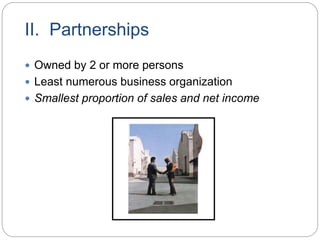
II. Partnerships
 Owned by 2 or more persons
 Least numerous business organization
 Smallest proportion of sales and net income
Types of Partnerships
 General Partnership: All partners are responsible
for the management and financial obligations of the
business.
 Limited Partnership: At least one partner is not
active in the daily running of the business, although
he or she may have contributed funds to finance the
operation
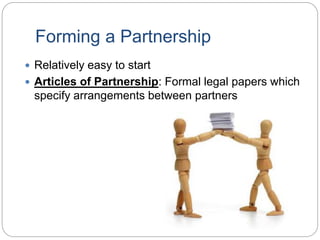
Forming a Partnership
 Relatively easy to start
 Articles of Partnership: Formal legal papers which
specify arrangements between partners
Advantages of Partnerships
 Ease of start up.
 Articles of Partnership involves attorney fees and
filing fee for the state.
 Ease of management: Each partner usually brings
different areas of expertise to the business.
 Lack of special taxes: Partners draw profits from
the firm and then pay individual income taxes at the
end of the year
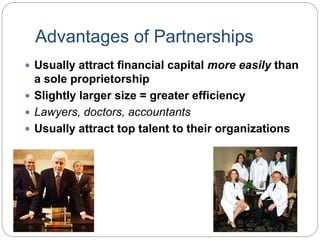
Advantages of Partnerships
 Usually attract financial capital more easily than
a sole proprietorship
 Slightly larger size = greater efficiency
 Lawyers, doctors, accountants
 Usually attract top talent to their organizations
Disadvantages of Partnerships
 Unlimited Liability: Each partner is fully
responsible for the acts of all partners
 Limited Partnership: The limited partner has
limited liability
 Investor’s responsibility for the debts of the business is
limited by the size of their investment in the firm
 If business fails with a large debt, the limited partner
(investor) only loses their original investment, leaving
the general partners to make up the rest
Disadvantages of Partnerships
 Limited Life: When a partner leaves or dies, the
partnership must be dissolved and reorganized.
 The new partner may try to keep an
agreement to keep its name
 Potential for Conflict: “Why can’t we all just get
along?”
Forming a Public Corporation
 Very formal and legal arrangement
 Incorporation (or forming a corporation) must file
for permission from the state where business will
have be headquartered
 Charter: A government document that gives
permission to create a corporation if approved
 States the company name, address, purpose of
business, and the number of shares of stock, or
ownership certificates, within the firm
Forming a Public Corporation,
continued
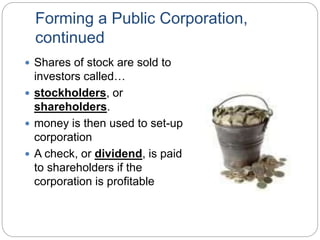
 Shares of stock are sold to
investors called…
 stockholders, or
shareholders.
 money is then used to set-up
corporation
 A check, or dividend, is paid
to shareholders if the
corporation is profitable
Corporate Structure: Common Stock
 Investors become owners with certain ownership rights,
depending on type of stock purchased:
 Common Stock: Basic ownership of corporation
 Owner usually receives 1 vote for each share of stock
 Used to elect board of directors who direct the corporation’s
business by setting policies/goals
 The Board hires a professional management team to run
the business on a daily basis
Common Stock
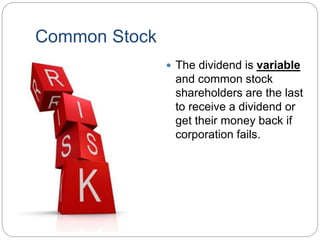
 The dividend is variable
and common stock
shareholders are the last
to receive a dividend or
get their money back if
corporation fails.
Preferred Stock
 Nonvoting ownership shares of a corporation
 These shareholders receive dividends first and they
are fixed
 If there are funds or property left after a business fails,
preferred stockholders get their investment back
first!
 Preferred stockholders cannot elect the board of
directors-THEY CANNOT VOTE!!
Advantages of the Public Corporation
 Ease of raising financial capital
 Need more capital?
 Sell additional stock
 Borrow money by issuing bonds: Written promise to
repay the amount borrowed at a later date
 Principal: Amount borrowed to be repaid later
 Interest: The price paid by the corporation for the
use of another’s money
Advantages of the Corporation
 Ease of finding
professional
managers
 Limited liability for
its owners
 Corporation is fully
responsible for its
debts and obligations
 **Because limited
liability is so attractive,
many firms
incorporate just to
take advantage of it
Advantages of the Corporation
 Unlimited life: Corporation continues to exist even
when ownership changes
 Because the corporation is a legal entity, the name of
the company remains the same, and the corporation
continues to do business
 Ease of transferring ownership: If a shareholder
no longer wants to be an owner, they can sell the
stock
Disadvantages of the Corporation
 Difficult to get a charter
 Depending on the state, attorneys’ fees and filing
expense can cost several thousand $$
 Owners/shareholders have little say in
business affairs after voting for board of
directors
 Double Taxation: Corporate profits
 Stockholders’ dividends are taxed twice: once as
corporate profit and again as personal income
Disadvantages of the Corporation
 Lots of Government regulation:
 Register with state where the Corp. is chartered
 To sell stock to the public, the Corp. must register
with the Securities and Exchange Commission
 Provide detailed financial statements on regular
basis to the general public
 When taking over another business, the Corp may
require federal approval
END

Businessorganizations

  • 1.
  • 2.
    TYPES  Private enterprises Sole proprietorship  Partnerships  Limited liability Companies  Cooperative societies  Public enterprises
  • 3.
    I. Forming aProprietorship  Easiest form of business to start-needs only the occasional licenses and fees  Ease of start up  Relative ease of management  Decisions can be made quickly
  • 4.
    Proprietorship Advantages  Ownerenjoys the PROFITS of successful management without having to share  No separate business income taxes  Not recognized as a separate legal entity  Owner must pay individual income taxes on profits  Business is exempt from any tax on the income  Psychological satisfaction  Easy to get out of business
  • 5.
    Proprietary Disadvantages  Unlimitedliability  Owner is personally and fully responsible for all loses and debts of the business  If business fails, the owner’s personal possessions may be taken away to satisfy business debts  Difficult to raise capital  Personal financial resources are limited  Size and efficiency: Inventory is any unused stock of finished goods/parts in reserve
  • 6.
    Proprietary Disadvantages  LimitedManagerial Skills  Difficulty of attracting qualified employees  Fringe benefits- Employee benefits such as vacation, sick leave, retirement, medical, and health insurance may not be available  Limited lifespan: The firm legally ceases to exist when the owner dies, quits, or sells the business
  • 7.
    II. Partnerships  Ownedby 2 or more persons  Least numerous business organization  Smallest proportion of sales and net income
  • 8.
    Types of Partnerships General Partnership: All partners are responsible for the management and financial obligations of the business.  Limited Partnership: At least one partner is not active in the daily running of the business, although he or she may have contributed funds to finance the operation
  • 9.
    Forming a Partnership Relatively easy to start  Articles of Partnership: Formal legal papers which specify arrangements between partners
  • 10.
    Advantages of Partnerships Ease of start up.  Articles of Partnership involves attorney fees and filing fee for the state.  Ease of management: Each partner usually brings different areas of expertise to the business.  Lack of special taxes: Partners draw profits from the firm and then pay individual income taxes at the end of the year
  • 11.
    Advantages of Partnerships Usually attract financial capital more easily than a sole proprietorship  Slightly larger size = greater efficiency  Lawyers, doctors, accountants  Usually attract top talent to their organizations
  • 12.
    Disadvantages of Partnerships Unlimited Liability: Each partner is fully responsible for the acts of all partners  Limited Partnership: The limited partner has limited liability  Investor’s responsibility for the debts of the business is limited by the size of their investment in the firm  If business fails with a large debt, the limited partner (investor) only loses their original investment, leaving the general partners to make up the rest
  • 13.
    Disadvantages of Partnerships Limited Life: When a partner leaves or dies, the partnership must be dissolved and reorganized.  The new partner may try to keep an agreement to keep its name  Potential for Conflict: “Why can’t we all just get along?”
  • 14.
    Forming a PublicCorporation  Very formal and legal arrangement  Incorporation (or forming a corporation) must file for permission from the state where business will have be headquartered  Charter: A government document that gives permission to create a corporation if approved  States the company name, address, purpose of business, and the number of shares of stock, or ownership certificates, within the firm
  • 15.
    Forming a PublicCorporation, continued  Shares of stock are sold to investors called…  stockholders, or shareholders.  money is then used to set-up corporation  A check, or dividend, is paid to shareholders if the corporation is profitable
  • 16.
    Corporate Structure: CommonStock  Investors become owners with certain ownership rights, depending on type of stock purchased:  Common Stock: Basic ownership of corporation  Owner usually receives 1 vote for each share of stock  Used to elect board of directors who direct the corporation’s business by setting policies/goals  The Board hires a professional management team to run the business on a daily basis
  • 17.
    Common Stock  Thedividend is variable and common stock shareholders are the last to receive a dividend or get their money back if corporation fails.
  • 18.
    Preferred Stock  Nonvotingownership shares of a corporation  These shareholders receive dividends first and they are fixed  If there are funds or property left after a business fails, preferred stockholders get their investment back first!  Preferred stockholders cannot elect the board of directors-THEY CANNOT VOTE!!
  • 19.
    Advantages of thePublic Corporation  Ease of raising financial capital  Need more capital?  Sell additional stock  Borrow money by issuing bonds: Written promise to repay the amount borrowed at a later date  Principal: Amount borrowed to be repaid later  Interest: The price paid by the corporation for the use of another’s money
  • 20.
    Advantages of theCorporation  Ease of finding professional managers  Limited liability for its owners  Corporation is fully responsible for its debts and obligations  **Because limited liability is so attractive, many firms incorporate just to take advantage of it
  • 21.
    Advantages of theCorporation  Unlimited life: Corporation continues to exist even when ownership changes  Because the corporation is a legal entity, the name of the company remains the same, and the corporation continues to do business  Ease of transferring ownership: If a shareholder no longer wants to be an owner, they can sell the stock
  • 22.
    Disadvantages of theCorporation  Difficult to get a charter  Depending on the state, attorneys’ fees and filing expense can cost several thousand $$  Owners/shareholders have little say in business affairs after voting for board of directors  Double Taxation: Corporate profits  Stockholders’ dividends are taxed twice: once as corporate profit and again as personal income
  • 23.
    Disadvantages of theCorporation  Lots of Government regulation:  Register with state where the Corp. is chartered  To sell stock to the public, the Corp. must register with the Securities and Exchange Commission  Provide detailed financial statements on regular basis to the general public  When taking over another business, the Corp may require federal approval
  • 24.