Business Organization
Submitted from- Sneha Kumari
B.Com 1 Semsester
Dhirendre Mahila PG College
Business Organization
 Def. an establishment formed to carry on commercial enterprise.
 3 main types:
Sole Proprietorships
Partnerships
Corporations
 Other, less common:
Business Franchises
Cooperatives
Nonprofits
Sole Proprietorship
 Def. a business org. owned and managed by a single
individual.
 Sole Prop. Are the most common form of business, but
are small, generating only 6% of all U.S. sales
Advantages of Sole
Proprietorships
 Ease of Start-Up
 Relatively Few Regulations
 Sole Receiver of Profit
 Full Control
 Easy to Discontinue (to end)
Disadvantages of Sole
Proprietorships
 Unlimited Personal Liability: Owner is legally bound to
pay all business debts.
 Limited Access to Resources: Lack of money, capital,
etc. prevent Sole Proprietorships from becoming large.
 Lack Permanence: when an owner closes shop, retires
etc. the business ceases to exist.
Partnerships
 Def. Business owned by two or more people who share
responsibility and liability (responsibility for debt) for
the business.
Advantages of Partnerships
 Ease of Start-up
 Shared decision making and Specialization: partners
divide workload and skills to the business.
 Larger Pool of Capital: partners both invest funds into
the business.
 Taxation: Partners pay their own taxes, but the business
does not.
Disadvantages of Partnerships
 At least one partner has unlimited liability (has to pay
business debts/obligations)
 Partners are bound by each other’s actions (i.e. if your
partner makes a stupid mistake, you are stuck with it!)
 Potential for Conflict: Arguments, disputes etc.
between partners can cause major problems in the
business.
Corporations
 Def. A business that is a legal entity (it exists on its own
with rights like a person) owned by individual
stockholders.
 Stock: sometimes called shares, represent a
stockholder’s portion of ownership of a corporation. (we
will discuss the stock market in more detail next unit)
Advantages of a Corporation
 Advantages for the stockholders
 Do not carry responsibility for corporation’s actions (if a
corporation does something illegal or owes debt,
stockholders are not responsible)
 Shares of stock are transferable, they can be sold to others
for a profit. (I buy a share of Kodak stock for $1, and sell it
to you for $2, I make a profit of $1!)
Advantages of Corporations cont.
 Have potential for more growth than other business forms
 Can borrow money by selling bonds.
 Can hire the best labor (human resources) and best equipment (capital
resources)
 Have long lives (ex. George Eastman died over 70 years ago, yet Kodak is going
strong)
Disadvantages of Corporations
 Difficult and expensive to start up
 Double Taxation (the Corporation must pay taxes on income, and stockholders must
also pay taxes on dividends, or their share of any corporate profit)
 Loss of Control (managers and boards of directors control corporations, not owners)
 More Regulation (Government regulates corporations more than other business
organizations)
Growth of Corporations
 Mergers: are combinations of two or more corporations
into a larger corporation. They are closely watched by
the government to prevent the creation of monopolies.
3 types of Mergers
 Horizontal Merger: combination of 2 or more corporations who
provide the same good or service (ex. Cingular and AT&T)
 Vertical Merger: combine 2 or more firms involved in different
stages of producing a good or service (ex. Carnegie Steel
owned the Iron mines and Steel Refineries)
 Conglomerate: a combination of 3 or more businesses making
unrelated products. [ex. AOL (internet) Time (news magazines)
Warner (TV and Movies]
Multinational Corporations
 Def. Large corporations headquartered in one country with subsidiaries
(smaller branches) throughout the world.
 Advantages: Offer products worldwide, spread technology and jobs around
globe.
 Disadvantages: Influence cultures of other countries and take advantage
of countries with little worker protections (ex. Paying factory workers in
China $.25/hour, polluting countries like Mexico)
Business Franchises
 Def. a semi-independent business that pays fees to a
larger parent company in return for the right to sell a
product or service.
 Ex. McDonalds, 7-11, Pizza Hut
 Pay $ to use the name, symbols, and for help in running
the store/restaurant etc.
Advantages of Business
Franchises
 Management training and support
 Standardized quality
 National advertising programs
 Financial assistance
 Centralized buying power
Disadvantages of Business
Franchises
 High franchise fees and royalties (have to pay to use the
McDonalds name)
 Strict Operating standards
 Purchasing restrictions
 Limited Product line (can’t sell hot dogs at KFC)
Cooperatives
 Def. a business organization owned and operated by a
group of individuals for their shared benefit.
 Ex. Sam’s Club: must pay to be a member and shop
there, but get benefit of reduced prices.
Nonprofit Organizations
 Def. Institutions that function like businesses but do not operate for
profit. Any earned profits are put back into the organization, not paid out
to share holders. They are exempt from federal income taxes.
 Ex. The Red Cross, Goodwill, YMCA, Churches, Labor Unions, Business and
trade associations, the Bar Association, etc.
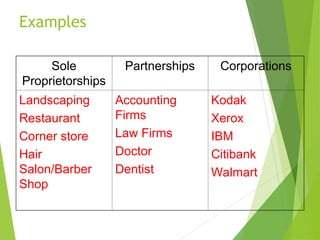
Examples
Sole
Proprietorships
Partnerships Corporations
Landscaping
Restaurant
Corner store
Hair
Salon/Barber
Shop
Accounting
Firms
Law Firms
Doctor
Dentist
Kodak
Xerox
IBM
Citibank
Walmart
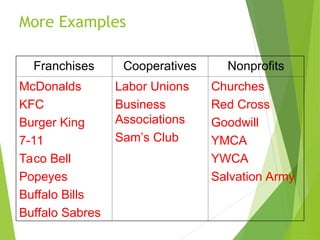
More Examples
Franchises Cooperatives Nonprofits
McDonalds
KFC
Burger King
7-11
Taco Bell
Popeyes
Buffalo Bills
Buffalo Sabres
Labor Unions
Business
Associations
Sam’s Club
Churches
Red Cross
Goodwill
YMCA
YWCA
Salvation Army

Business_Organization Classic Presentation

  • 1.
    Business Organization Submitted from-Sneha Kumari B.Com 1 Semsester Dhirendre Mahila PG College
  • 2.
    Business Organization  Def.an establishment formed to carry on commercial enterprise.  3 main types: Sole Proprietorships Partnerships Corporations  Other, less common: Business Franchises Cooperatives Nonprofits
  • 3.
    Sole Proprietorship  Def.a business org. owned and managed by a single individual.  Sole Prop. Are the most common form of business, but are small, generating only 6% of all U.S. sales
  • 4.
    Advantages of Sole Proprietorships Ease of Start-Up  Relatively Few Regulations  Sole Receiver of Profit  Full Control  Easy to Discontinue (to end)
  • 5.
    Disadvantages of Sole Proprietorships Unlimited Personal Liability: Owner is legally bound to pay all business debts.  Limited Access to Resources: Lack of money, capital, etc. prevent Sole Proprietorships from becoming large.  Lack Permanence: when an owner closes shop, retires etc. the business ceases to exist.
  • 6.
    Partnerships  Def. Businessowned by two or more people who share responsibility and liability (responsibility for debt) for the business.
  • 7.
    Advantages of Partnerships Ease of Start-up  Shared decision making and Specialization: partners divide workload and skills to the business.  Larger Pool of Capital: partners both invest funds into the business.  Taxation: Partners pay their own taxes, but the business does not.
  • 8.
    Disadvantages of Partnerships At least one partner has unlimited liability (has to pay business debts/obligations)  Partners are bound by each other’s actions (i.e. if your partner makes a stupid mistake, you are stuck with it!)  Potential for Conflict: Arguments, disputes etc. between partners can cause major problems in the business.
  • 9.
    Corporations  Def. Abusiness that is a legal entity (it exists on its own with rights like a person) owned by individual stockholders.  Stock: sometimes called shares, represent a stockholder’s portion of ownership of a corporation. (we will discuss the stock market in more detail next unit)
  • 10.
    Advantages of aCorporation  Advantages for the stockholders  Do not carry responsibility for corporation’s actions (if a corporation does something illegal or owes debt, stockholders are not responsible)  Shares of stock are transferable, they can be sold to others for a profit. (I buy a share of Kodak stock for $1, and sell it to you for $2, I make a profit of $1!)
  • 11.
    Advantages of Corporationscont.  Have potential for more growth than other business forms  Can borrow money by selling bonds.  Can hire the best labor (human resources) and best equipment (capital resources)  Have long lives (ex. George Eastman died over 70 years ago, yet Kodak is going strong)
  • 12.
    Disadvantages of Corporations Difficult and expensive to start up  Double Taxation (the Corporation must pay taxes on income, and stockholders must also pay taxes on dividends, or their share of any corporate profit)  Loss of Control (managers and boards of directors control corporations, not owners)  More Regulation (Government regulates corporations more than other business organizations)
  • 13.
    Growth of Corporations Mergers: are combinations of two or more corporations into a larger corporation. They are closely watched by the government to prevent the creation of monopolies.
  • 14.
    3 types ofMergers  Horizontal Merger: combination of 2 or more corporations who provide the same good or service (ex. Cingular and AT&T)  Vertical Merger: combine 2 or more firms involved in different stages of producing a good or service (ex. Carnegie Steel owned the Iron mines and Steel Refineries)  Conglomerate: a combination of 3 or more businesses making unrelated products. [ex. AOL (internet) Time (news magazines) Warner (TV and Movies]
  • 15.
    Multinational Corporations  Def.Large corporations headquartered in one country with subsidiaries (smaller branches) throughout the world.  Advantages: Offer products worldwide, spread technology and jobs around globe.  Disadvantages: Influence cultures of other countries and take advantage of countries with little worker protections (ex. Paying factory workers in China $.25/hour, polluting countries like Mexico)
  • 16.
    Business Franchises  Def.a semi-independent business that pays fees to a larger parent company in return for the right to sell a product or service.  Ex. McDonalds, 7-11, Pizza Hut  Pay $ to use the name, symbols, and for help in running the store/restaurant etc.
  • 17.
    Advantages of Business Franchises Management training and support  Standardized quality  National advertising programs  Financial assistance  Centralized buying power
  • 18.
    Disadvantages of Business Franchises High franchise fees and royalties (have to pay to use the McDonalds name)  Strict Operating standards  Purchasing restrictions  Limited Product line (can’t sell hot dogs at KFC)
  • 19.
    Cooperatives  Def. abusiness organization owned and operated by a group of individuals for their shared benefit.  Ex. Sam’s Club: must pay to be a member and shop there, but get benefit of reduced prices.
  • 20.
    Nonprofit Organizations  Def.Institutions that function like businesses but do not operate for profit. Any earned profits are put back into the organization, not paid out to share holders. They are exempt from federal income taxes.  Ex. The Red Cross, Goodwill, YMCA, Churches, Labor Unions, Business and trade associations, the Bar Association, etc.
  • 21.
  • 22.
    More Examples Franchises CooperativesNonprofits McDonalds KFC Burger King 7-11 Taco Bell Popeyes Buffalo Bills Buffalo Sabres Labor Unions Business Associations Sam’s Club Churches Red Cross Goodwill YMCA YWCA Salvation Army