EQ: What are the
different types of
business
structures and
the different
ways of
classifying
business activity.
BUSINESS STRUCTURE
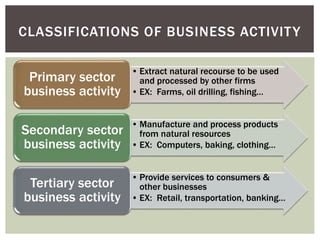
• Extract natural recourse to be used
and processed by other firms
• EX: Farms, oil drilling, fishing…
Primary sector
business activity
• Manufacture and process products
from natural resources
• EX: Computers, baking, clothing…
Secondary sector
business activity
• Provide services to consumers &
other businesses
• EX: Retail, transportation, banking…
Tertiary sector
business activity
CLASSIFICATIONS OF BUSINESS ACTIVITY
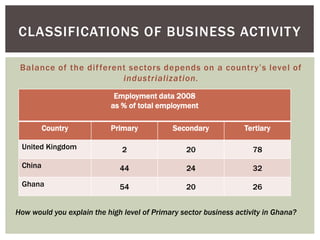
Balance of the different sectors depends on a country’s level of
industrialization.
CLASSIFICATIONS OF BUSINESS ACTIVITY
Employment data 2008
as % of total employment
Country Primary Secondary Tertiary
United Kingdom 2 20 78
China 44 24 32
Ghana 54 20 26
How would you explain the high level of Primary sector business activity in Ghana?
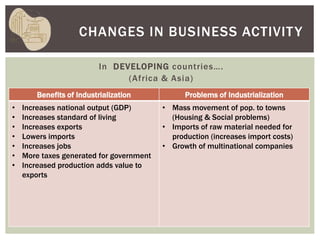
In DEVELOPING countries….
(Africa & Asia)
CHANGES IN BUSINESS ACTIVITY
Benefits of Industrialization Problems of Industrialization
• Increases national output (GDP)
• Increases standard of living
• Increases exports
• Lowers imports
• Increases jobs
• More taxes generated for government
• Increased production adds value to
exports
• Mass movement of pop. to towns
(Housing & Social problems)
• Imports of raw material needed for
production (increases import costs)
• Growth of multinational companies
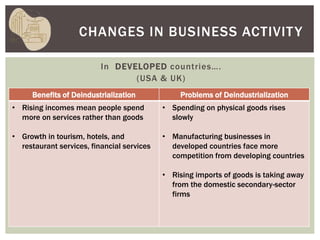
In DEVELOPED countries….
(USA & UK)
CHANGES IN BUSINESS ACTIVITY
Benefits of Deindustrialization Problems of Deindustrialization
• Rising incomes mean people spend
more on services rather than goods
• Growth in tourism, hotels, and
restaurant services, financial services
• Spending on physical goods rises
slowly
• Manufacturing businesses in
developed countries face more
competition from developing countries
• Rising imports of goods is taking away
from the domestic secondary-sector
firms
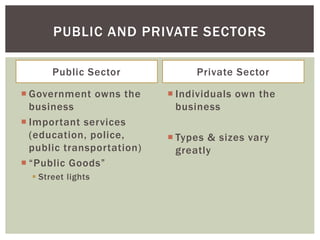
Public Sector
 Government owns the
business
 Important services
(education, police,
public transportation)
 “Public Goods”
 Street lights
Private Sector
 Individuals own the
business
 Types & sizes vary
greatly
PUBLIC AND PRIVATE SECTORS
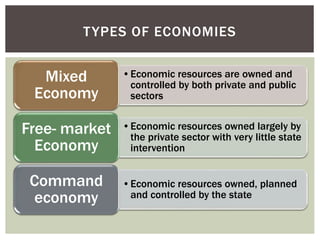
•Economic resources are owned and
controlled by both private and public
sectors
Mixed
Economy
•Economic resources owned largely by
the private sector with very little state
intervention
Free- market
Economy
•Economic resources owned, planned
and controlled by the state
Command
economy
TYPES OF ECONOMIES
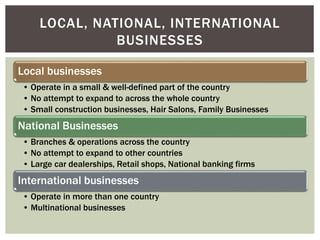
Local businesses
• Operate in a small & well-defined part of the country
• No attempt to expand to across the whole country
• Small construction businesses, Hair Salons, Family Businesses
National Businesses
• Branches & operations across the country
• No attempt to expand to other countries
• Large car dealerships, Retail shops, National banking firms
International businesses
• Operate in more than one country
• Multinational businesses
LOCAL, NATIONAL, INTERNATIONAL
BUSINESSES
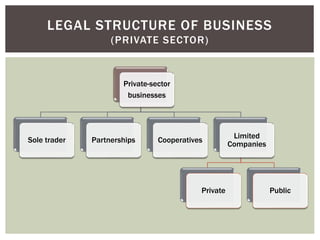
Private-sector
businesses
Sole trader Partnerships Cooperatives
Limited
Companies
Private Public
LEGAL STRUCTURE OF BUSINESS
(PRIVATE SECTOR)
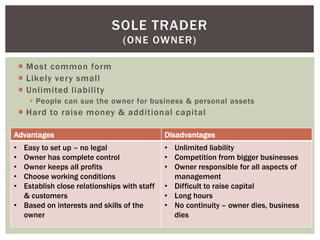
 Most common form
 Likely very small
 Unlimited liability
 People can sue the owner for business & personal assets
 Hard to raise money & additional capital
SOLE TRADER
(ONE OWNER)
Advantages Disadvantages
• Easy to set up – no legal
• Owner has complete control
• Owner keeps all profits
• Choose working conditions
• Establish close relationships with staff
& customers
• Based on interests and skills of the
owner
• Unlimited liability
• Competition from bigger businesses
• Owner responsible for all aspects of
management
• Difficult to raise capital
• Long hours
• No continuity – owner dies, business
dies
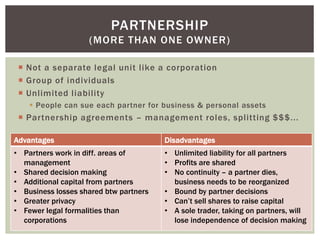
 Not a separate legal unit like a corporation
 Group of individuals
 Unlimited liability
 People can sue each partner for business & personal assets
 Partnership agreements – management roles, splitting $$$...
PARTNERSHIP
(MORE THAN ONE OWNER)
Advantages Disadvantages
• Partners work in diff. areas of
management
• Shared decision making
• Additional capital from partners
• Business losses shared btw partners
• Greater privacy
• Fewer legal formalities than
corporations
• Unlimited liability for all partners
• Profits are shared
• No continuity – a partner dies,
business needs to be reorganized
• Bound by partner decisions
• Can’t sell shares to raise capital
• A sole trader, taking on partners, will
lose independence of decision making
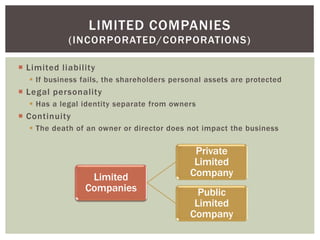
 Limited liability
 If business fails, the shareholders personal assets are protected
 Legal personality
 Has a legal identity separate from owners
 Continuity
 The death of an owner or director does not impact the business
LIMITED COMPANIES
(INCORPORATED/CORPORATIONS)
Limited
Companies
Private
Limited
Company
Public
Limited
Company
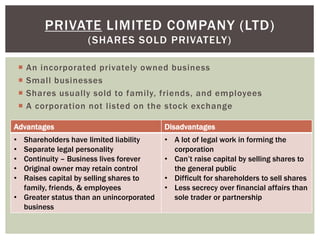
 An incorporated privately owned business
 Small businesses
 Shares usually sold to family, friends, and employees
 A corporation not listed on the stock exchange
PRIVATE LIMITED COMPANY (LTD)
(SHARES SOLD PRIVATELY)
Advantages Disadvantages
• Shareholders have limited liability
• Separate legal personality
• Continuity – Business lives forever
• Original owner may retain control
• Raises capital by selling shares to
family, friends, & employees
• Greater status than an unincorporated
business
• A lot of legal work in forming the
corporation
• Can’t raise capital by selling shares to
the general public
• Difficult for shareholders to sell shares
• Less secrecy over financial affairs than
sole trader or partnership
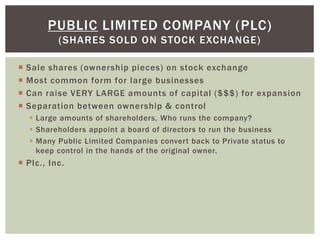
 Sale shares (ownership pieces) on stock exchange
 Most common form for large businesses
 Can raise VERY LARGE amounts of capital ($$$) for expansion
 Separation between ownership & control
 Large amounts of shareholders, Who runs the company?
 Shareholders appoint a board of directors to run the business
 Many Public Limited Companies convert back to Private status to
keep control in the hands of the original owner.
 Plc., Inc.
PUBLIC LIMITED COMPANY (PLC)
(SHARES SOLD ON STOCK EXCHANGE)
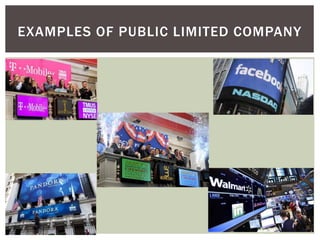
EXAMPLES OF PUBLIC LIMITED COMPANY
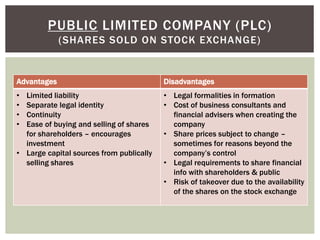
Advantages Disadvantages
• Limited liability
• Separate legal identity
• Continuity
• Ease of buying and selling of shares
for shareholders – encourages
investment
• Large capital sources from publically
selling shares
• Legal formalities in formation
• Cost of business consultants and
financial advisers when creating the
company
• Share prices subject to change –
sometimes for reasons beyond the
company’s control
• Legal requirements to share financial
info with shareholders & public
• Risk of takeover due to the availability
of the shares on the stock exchange
PUBLIC LIMITED COMPANY (PLC)
(SHARES SOLD ON STOCK EXCHANGE)
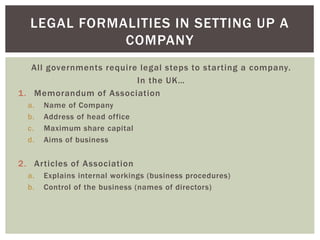
All governments require legal steps to starting a company.
In the UK…
1. Memorandum of Association
a. Name of Company
b. Address of head office
c. Maximum share capital
d. Aims of business
2. Articles of Association
a. Explains internal workings (business procedures)
b. Control of the business (names of directors)
LEGAL FORMALITIES IN SETTING UP A
COMPANY
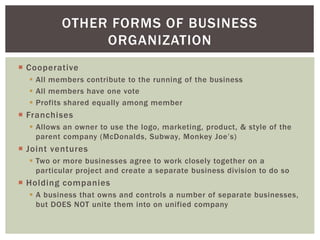
 Cooperative
 All members contribute to the running of the business
 All members have one vote
 Profits shared equally among member
 Franchises
 Allows an owner to use the logo, marketing, product, & style of the
parent company (McDonalds, Subway, Monkey Joe’s)
 Joint ventures
 Two or more businesses agree to work closely together on a
particular project and create a separate business division to do so
 Holding companies
 A business that owns and controls a number of separate businesses,
but DOES NOT unite them into on unified company
OTHER FORMS OF BUSINESS
ORGANIZATION
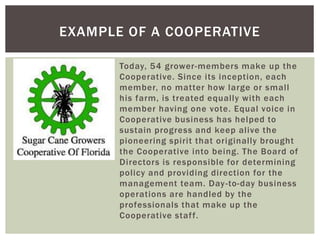
Today, 54 grower-members make up the
Cooperative. Since its inception, each
member, no matter how large or small
his farm, is treated equally with each
member having one vote. Equal voice in
Cooperative business has helped to
sustain progress and keep alive the
pioneering spirit that originally brought
the Cooperative into being. The Board of
Directors is responsible for determining
policy and providing direction for the
management team. Day-to-day business
operations are handled by the
professionals that make up the
Cooperative staff.
EXAMPLE OF A COOPERATIVE
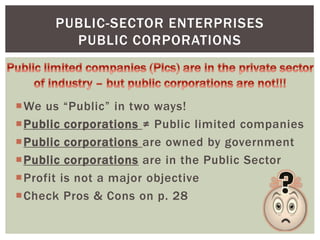
We us “Public” in two ways!
Public corporations ≠ Public limited companies
Public corporations are owned by government
Public corporations are in the Public Sector
Profit is not a major objective
Check Pros & Cons on p. 28
PUBLIC-SECTOR ENTERPRISES
PUBLIC CORPORATIONS
Citizens is a not-for-profit, tax-
exempt government corporation
whose public purpose is to
provide insurance protection to
Florida property owners
throughout the state. The
corporation insures hundreds of
thousands of homes, businesses
and condominiums whose
owners otherwise might not be
able to find coverage.
EXAMPLE OF PUBLIC CORPORATION

5937968

  • 1.
    EQ: What arethe different types of business structures and the different ways of classifying business activity. BUSINESS STRUCTURE
  • 2.
    • Extract naturalrecourse to be used and processed by other firms • EX: Farms, oil drilling, fishing… Primary sector business activity • Manufacture and process products from natural resources • EX: Computers, baking, clothing… Secondary sector business activity • Provide services to consumers & other businesses • EX: Retail, transportation, banking… Tertiary sector business activity CLASSIFICATIONS OF BUSINESS ACTIVITY
  • 3.
    Balance of thedifferent sectors depends on a country’s level of industrialization. CLASSIFICATIONS OF BUSINESS ACTIVITY Employment data 2008 as % of total employment Country Primary Secondary Tertiary United Kingdom 2 20 78 China 44 24 32 Ghana 54 20 26 How would you explain the high level of Primary sector business activity in Ghana?
  • 4.
    In DEVELOPING countries…. (Africa& Asia) CHANGES IN BUSINESS ACTIVITY Benefits of Industrialization Problems of Industrialization • Increases national output (GDP) • Increases standard of living • Increases exports • Lowers imports • Increases jobs • More taxes generated for government • Increased production adds value to exports • Mass movement of pop. to towns (Housing & Social problems) • Imports of raw material needed for production (increases import costs) • Growth of multinational companies
  • 5.
    In DEVELOPED countries…. (USA& UK) CHANGES IN BUSINESS ACTIVITY Benefits of Deindustrialization Problems of Deindustrialization • Rising incomes mean people spend more on services rather than goods • Growth in tourism, hotels, and restaurant services, financial services • Spending on physical goods rises slowly • Manufacturing businesses in developed countries face more competition from developing countries • Rising imports of goods is taking away from the domestic secondary-sector firms
  • 6.
    Public Sector  Governmentowns the business  Important services (education, police, public transportation)  “Public Goods”  Street lights Private Sector  Individuals own the business  Types & sizes vary greatly PUBLIC AND PRIVATE SECTORS
  • 7.
    •Economic resources areowned and controlled by both private and public sectors Mixed Economy •Economic resources owned largely by the private sector with very little state intervention Free- market Economy •Economic resources owned, planned and controlled by the state Command economy TYPES OF ECONOMIES
  • 8.
    Local businesses • Operatein a small & well-defined part of the country • No attempt to expand to across the whole country • Small construction businesses, Hair Salons, Family Businesses National Businesses • Branches & operations across the country • No attempt to expand to other countries • Large car dealerships, Retail shops, National banking firms International businesses • Operate in more than one country • Multinational businesses LOCAL, NATIONAL, INTERNATIONAL BUSINESSES
  • 9.
    Private-sector businesses Sole trader PartnershipsCooperatives Limited Companies Private Public LEGAL STRUCTURE OF BUSINESS (PRIVATE SECTOR)
  • 10.
     Most commonform  Likely very small  Unlimited liability  People can sue the owner for business & personal assets  Hard to raise money & additional capital SOLE TRADER (ONE OWNER) Advantages Disadvantages • Easy to set up – no legal • Owner has complete control • Owner keeps all profits • Choose working conditions • Establish close relationships with staff & customers • Based on interests and skills of the owner • Unlimited liability • Competition from bigger businesses • Owner responsible for all aspects of management • Difficult to raise capital • Long hours • No continuity – owner dies, business dies
  • 11.
     Not aseparate legal unit like a corporation  Group of individuals  Unlimited liability  People can sue each partner for business & personal assets  Partnership agreements – management roles, splitting $$$... PARTNERSHIP (MORE THAN ONE OWNER) Advantages Disadvantages • Partners work in diff. areas of management • Shared decision making • Additional capital from partners • Business losses shared btw partners • Greater privacy • Fewer legal formalities than corporations • Unlimited liability for all partners • Profits are shared • No continuity – a partner dies, business needs to be reorganized • Bound by partner decisions • Can’t sell shares to raise capital • A sole trader, taking on partners, will lose independence of decision making
  • 12.
     Limited liability If business fails, the shareholders personal assets are protected  Legal personality  Has a legal identity separate from owners  Continuity  The death of an owner or director does not impact the business LIMITED COMPANIES (INCORPORATED/CORPORATIONS) Limited Companies Private Limited Company Public Limited Company
  • 13.
     An incorporatedprivately owned business  Small businesses  Shares usually sold to family, friends, and employees  A corporation not listed on the stock exchange PRIVATE LIMITED COMPANY (LTD) (SHARES SOLD PRIVATELY) Advantages Disadvantages • Shareholders have limited liability • Separate legal personality • Continuity – Business lives forever • Original owner may retain control • Raises capital by selling shares to family, friends, & employees • Greater status than an unincorporated business • A lot of legal work in forming the corporation • Can’t raise capital by selling shares to the general public • Difficult for shareholders to sell shares • Less secrecy over financial affairs than sole trader or partnership
  • 14.
     Sale shares(ownership pieces) on stock exchange  Most common form for large businesses  Can raise VERY LARGE amounts of capital ($$$) for expansion  Separation between ownership & control  Large amounts of shareholders, Who runs the company?  Shareholders appoint a board of directors to run the business  Many Public Limited Companies convert back to Private status to keep control in the hands of the original owner.  Plc., Inc. PUBLIC LIMITED COMPANY (PLC) (SHARES SOLD ON STOCK EXCHANGE)
  • 15.
    EXAMPLES OF PUBLICLIMITED COMPANY
  • 16.
    Advantages Disadvantages • Limitedliability • Separate legal identity • Continuity • Ease of buying and selling of shares for shareholders – encourages investment • Large capital sources from publically selling shares • Legal formalities in formation • Cost of business consultants and financial advisers when creating the company • Share prices subject to change – sometimes for reasons beyond the company’s control • Legal requirements to share financial info with shareholders & public • Risk of takeover due to the availability of the shares on the stock exchange PUBLIC LIMITED COMPANY (PLC) (SHARES SOLD ON STOCK EXCHANGE)
  • 17.
    All governments requirelegal steps to starting a company. In the UK… 1. Memorandum of Association a. Name of Company b. Address of head office c. Maximum share capital d. Aims of business 2. Articles of Association a. Explains internal workings (business procedures) b. Control of the business (names of directors) LEGAL FORMALITIES IN SETTING UP A COMPANY
  • 18.
     Cooperative  Allmembers contribute to the running of the business  All members have one vote  Profits shared equally among member  Franchises  Allows an owner to use the logo, marketing, product, & style of the parent company (McDonalds, Subway, Monkey Joe’s)  Joint ventures  Two or more businesses agree to work closely together on a particular project and create a separate business division to do so  Holding companies  A business that owns and controls a number of separate businesses, but DOES NOT unite them into on unified company OTHER FORMS OF BUSINESS ORGANIZATION
  • 19.
    Today, 54 grower-membersmake up the Cooperative. Since its inception, each member, no matter how large or small his farm, is treated equally with each member having one vote. Equal voice in Cooperative business has helped to sustain progress and keep alive the pioneering spirit that originally brought the Cooperative into being. The Board of Directors is responsible for determining policy and providing direction for the management team. Day-to-day business operations are handled by the professionals that make up the Cooperative staff. EXAMPLE OF A COOPERATIVE
  • 20.
    We us “Public”in two ways! Public corporations ≠ Public limited companies Public corporations are owned by government Public corporations are in the Public Sector Profit is not a major objective Check Pros & Cons on p. 28 PUBLIC-SECTOR ENTERPRISES PUBLIC CORPORATIONS
  • 21.
    Citizens is anot-for-profit, tax- exempt government corporation whose public purpose is to provide insurance protection to Florida property owners throughout the state. The corporation insures hundreds of thousands of homes, businesses and condominiums whose owners otherwise might not be able to find coverage. EXAMPLE OF PUBLIC CORPORATION