PREPARED & PRESENTED BY:
ALI RASHID CHEEMA
1
FORMS OF BUSINESS ORGANIZATIONS
 Sole Proprietorship
 Partnership
 Corporation
PREPARED & PRESENTED BY:
ALI RASHID CHEEMA
2
SOLE PROPRIETORSHIP & PARTNERSHIP
A business owned by one person is called a ‘Sole
Proprietorship’.
A business owned by two or more persons is called a
‘Partnership’.
Owners of a partnership are called co-owners or
partners.
PREPARED & PRESENTED BY:
ALI RASHID CHEEMA
3
SOLE PROPRIETORSHIP & PARTNERSHIP
Proprietorships and Partnerships are business
organizations that do not have legal identities
distinct from their owners.
For most proprietorships and partnerships, owners
also manage the business.
The amount of a proprietor’s personal wealth and his
or her ability to borrow limit the size of a
proprietorship.
PREPARED & PRESENTED BY:
ALI RASHID CHEEMA
4
SOLE PROPRIETORSHIP & PARTNERSHIP
The profit of most proprietorships and partnerships
is not taxed.
The profit is income for the owners who pay income
taxes on the profit as part of their personal income
taxes.
PREPARED & PRESENTED BY:
ALI RASHID CHEEMA
5
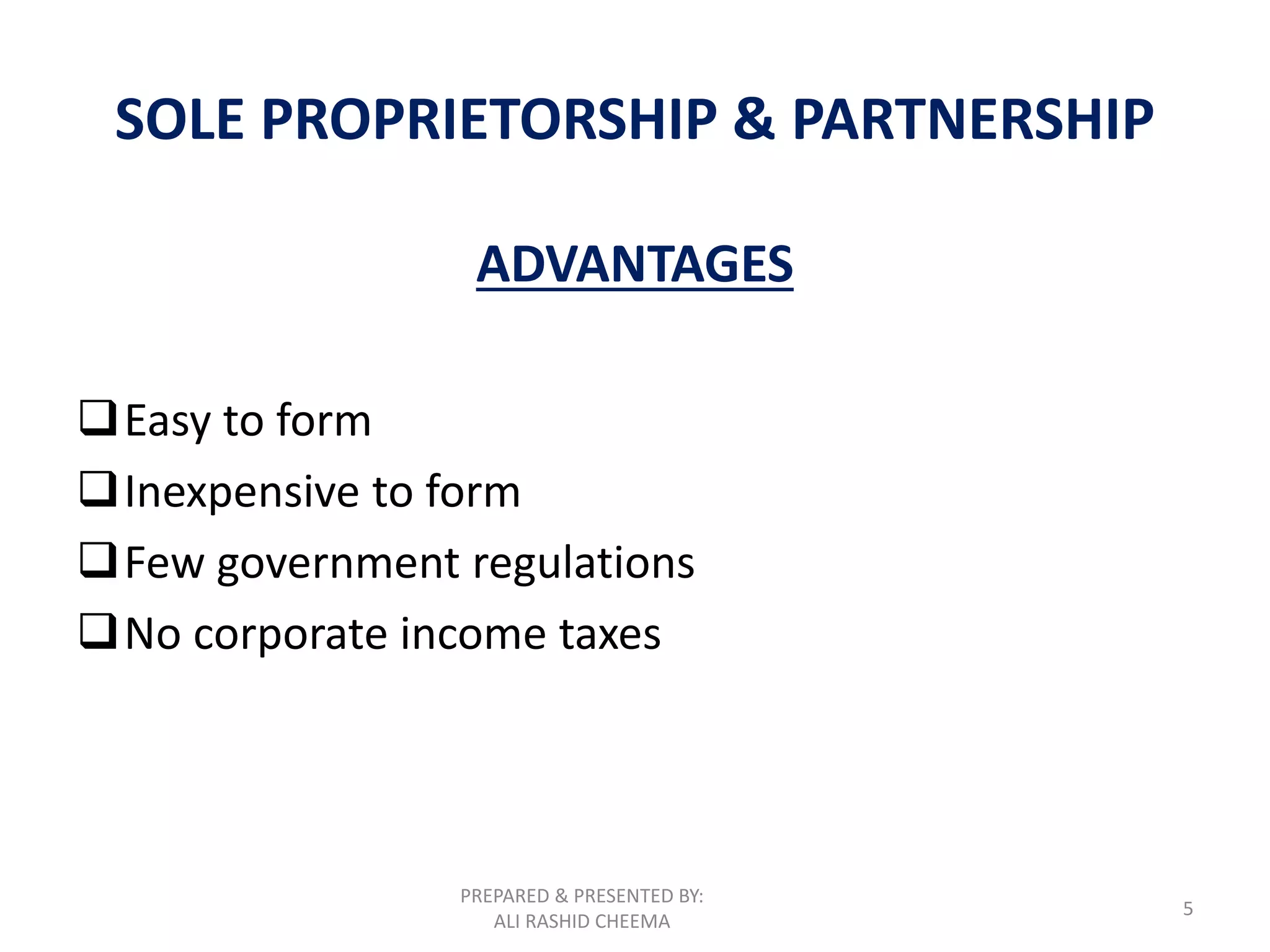
SOLE PROPRIETORSHIP & PARTNERSHIP
ADVANTAGES
Easy to form
Inexpensive to form
Few government regulations
No corporate income taxes
PREPARED & PRESENTED BY:
ALI RASHID CHEEMA
6
SOLE PROPRIETORSHIP & PARTNERSHIP
DISADVANTAGES
Limited life of business
Difficult to obtain large sum of capital
Unlimited personal liability
PREPARED & PRESENTED BY:
ALI RASHID CHEEMA
7
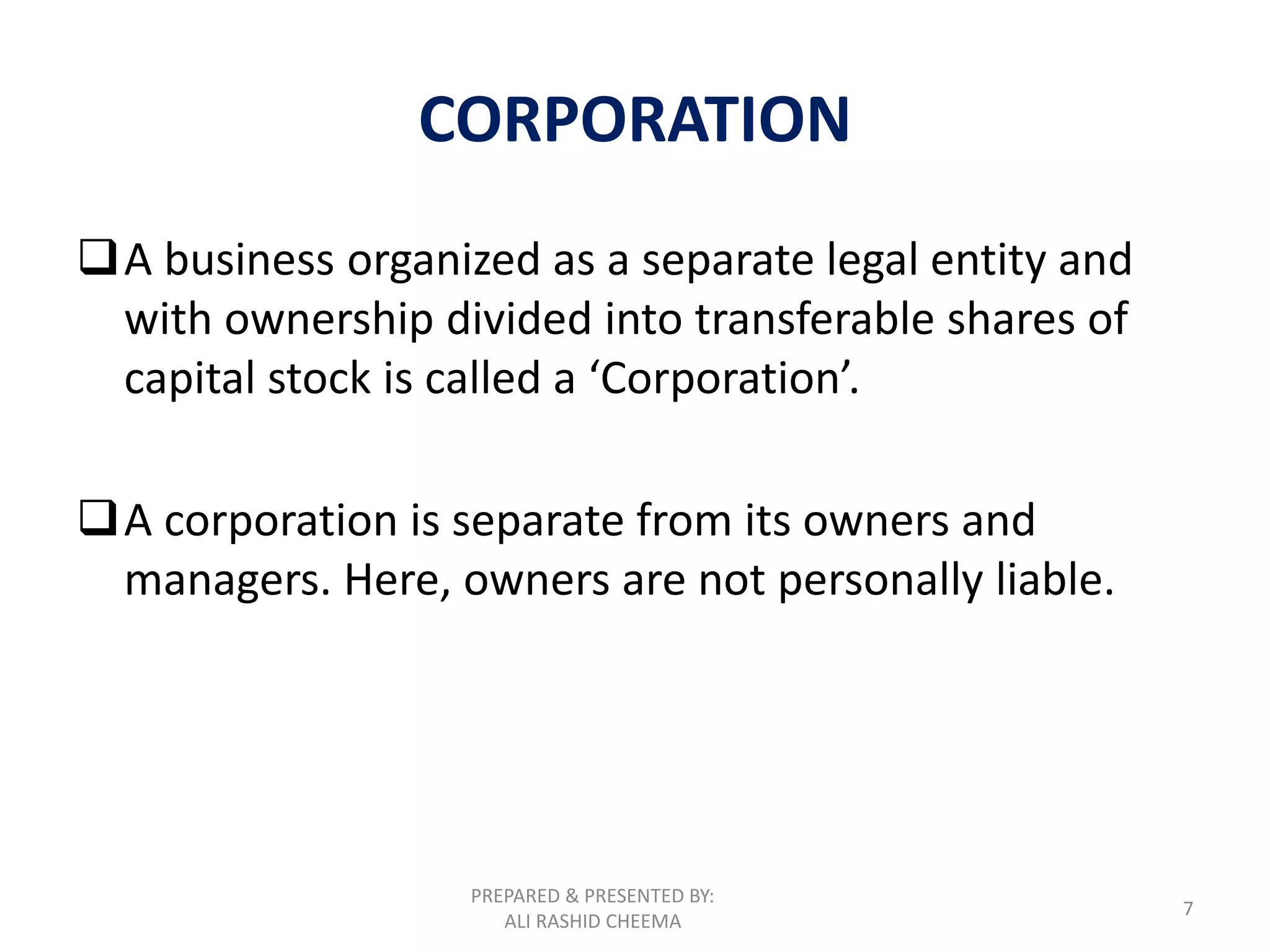
CORPORATION
A business organized as a separate legal entity and
with ownership divided into transferable shares of
capital stock is called a ‘Corporation’.
A corporation is separate from its owners and
managers. Here, owners are not personally liable.
PREPARED & PRESENTED BY:
ALI RASHID CHEEMA
8
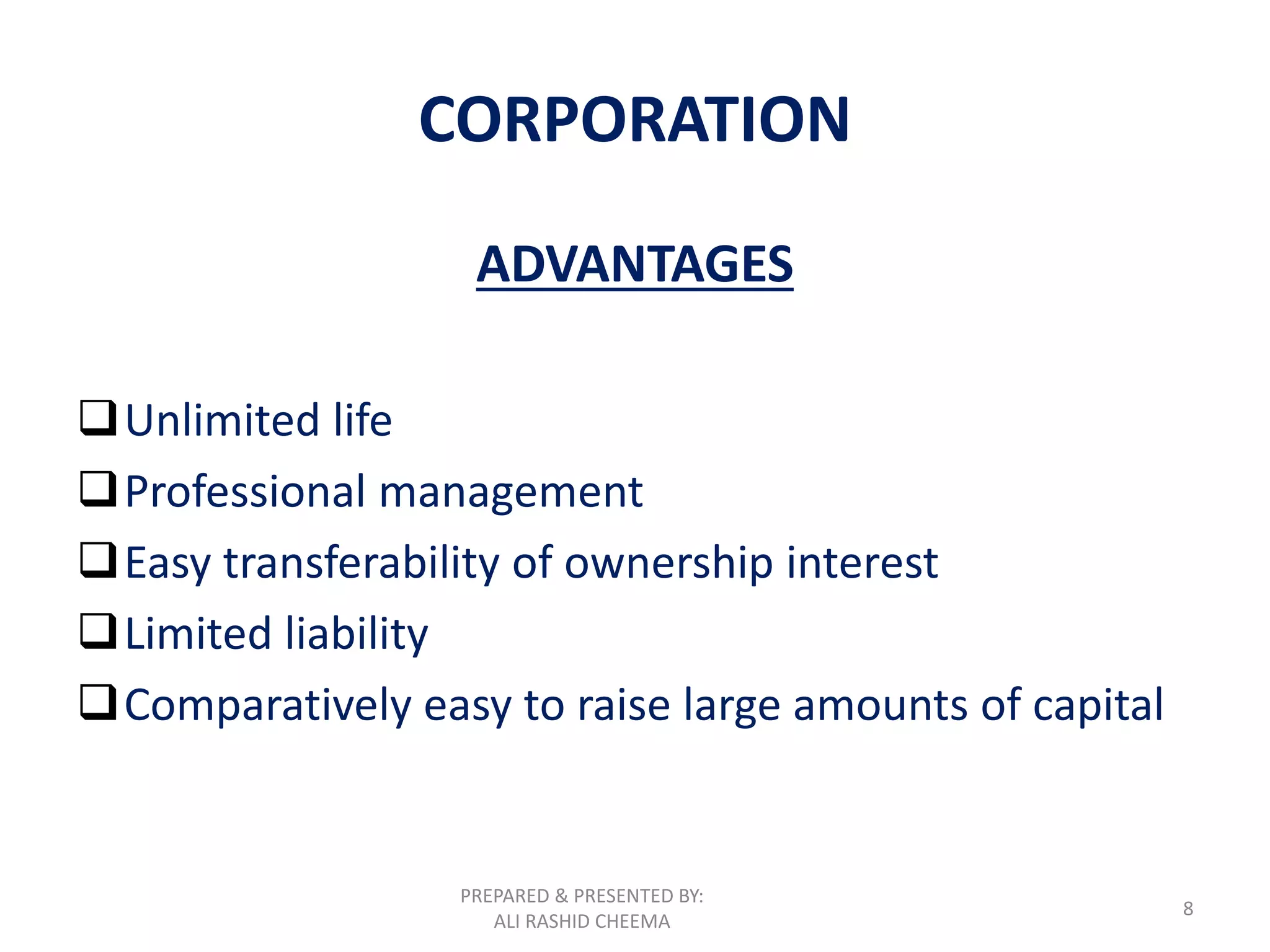
CORPORATION
ADVANTAGES
Unlimited life
Professional management
Easy transferability of ownership interest
Limited liability
Comparatively easy to raise large amounts of capital
PREPARED & PRESENTED BY:
ALI RASHID CHEEMA
9
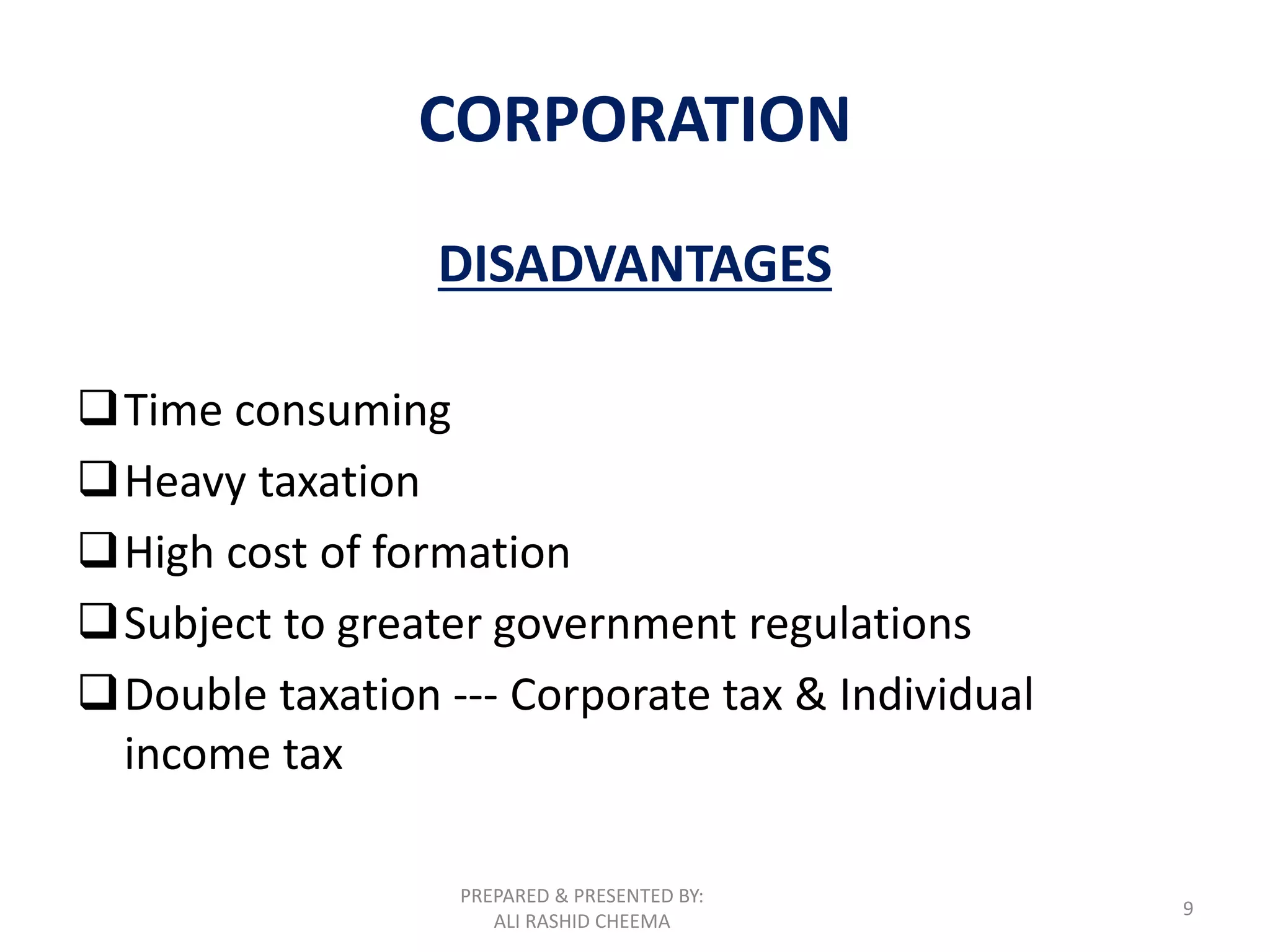
CORPORATION
DISADVANTAGES
Time consuming
Heavy taxation
High cost of formation
Subject to greater government regulations
Double taxation --- Corporate tax & Individual
income tax
PREPARED & PRESENTED BY:
ALI RASHID CHEEMA
10
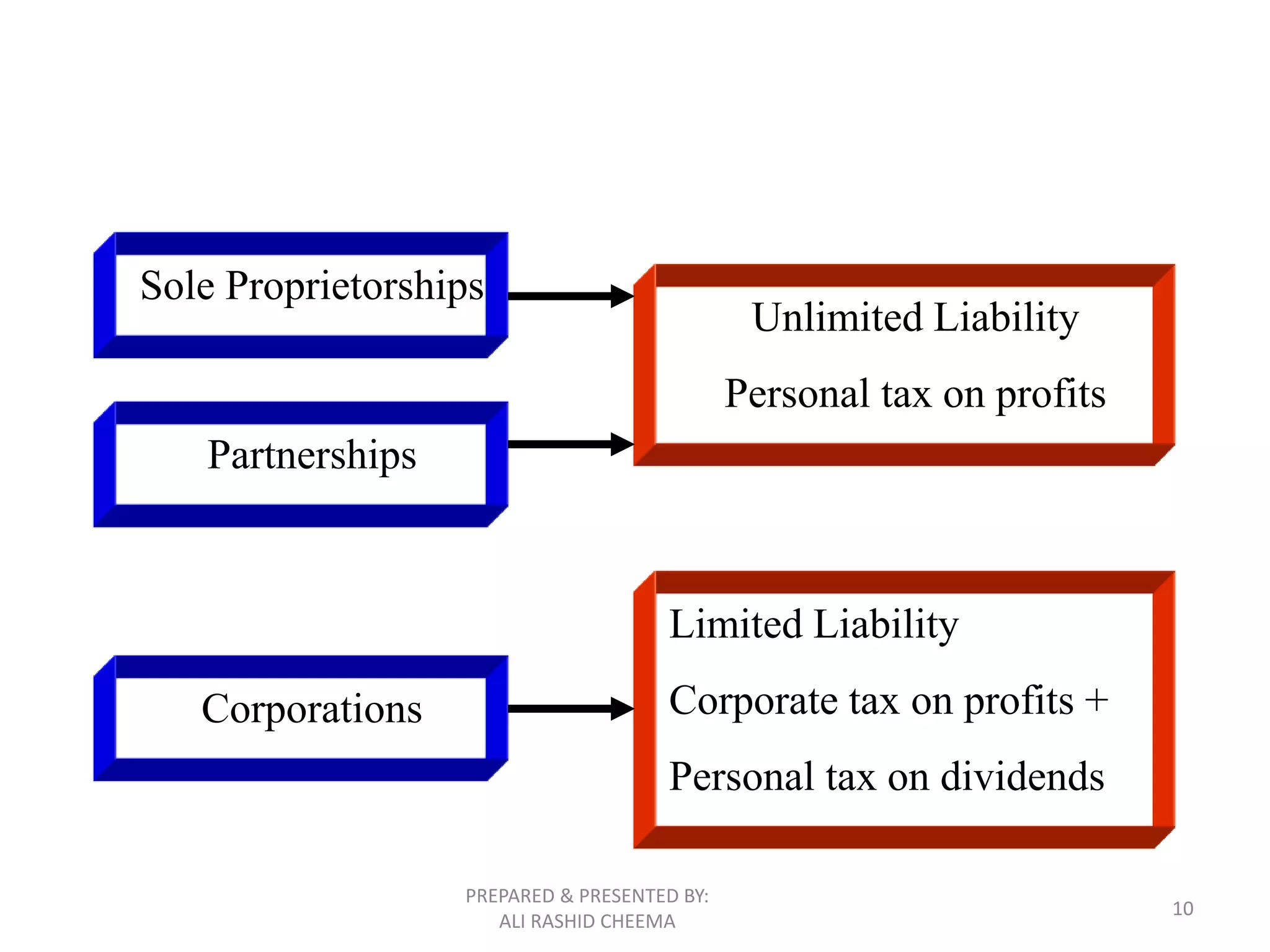
Sole Proprietorships
Corporations
Partnerships
Limited Liability
Corporate tax on profits +
Personal tax on dividends
Unlimited Liability
Personal tax on profits
PREPARED & PRESENTED BY:
ALI RASHID CHEEMA
11
DOUBLE TAXATION -- Example
Earnings Before Income and Tax (EBIT) 10m
Less: Interest Expense (1m)
Earnings Before Tax (EBT) 9m
Less: Tax @ 40% (3.6m)
Earnings After Tax (EAT) or Net Income available to common
stockholders 5.4m
PREPARED & PRESENTED BY:
ALI RASHID CHEEMA
12
DOUBLE TAXATION -- Example
It is assumed that company’s:
Dividend Payout Ratio = 50%
Retained Earnings Ratio = 50%
Outstanding Common Stock = 1m
PREPARED & PRESENTED BY:
ALI RASHID CHEEMA
13
DOUBLE TAXATION -- Example
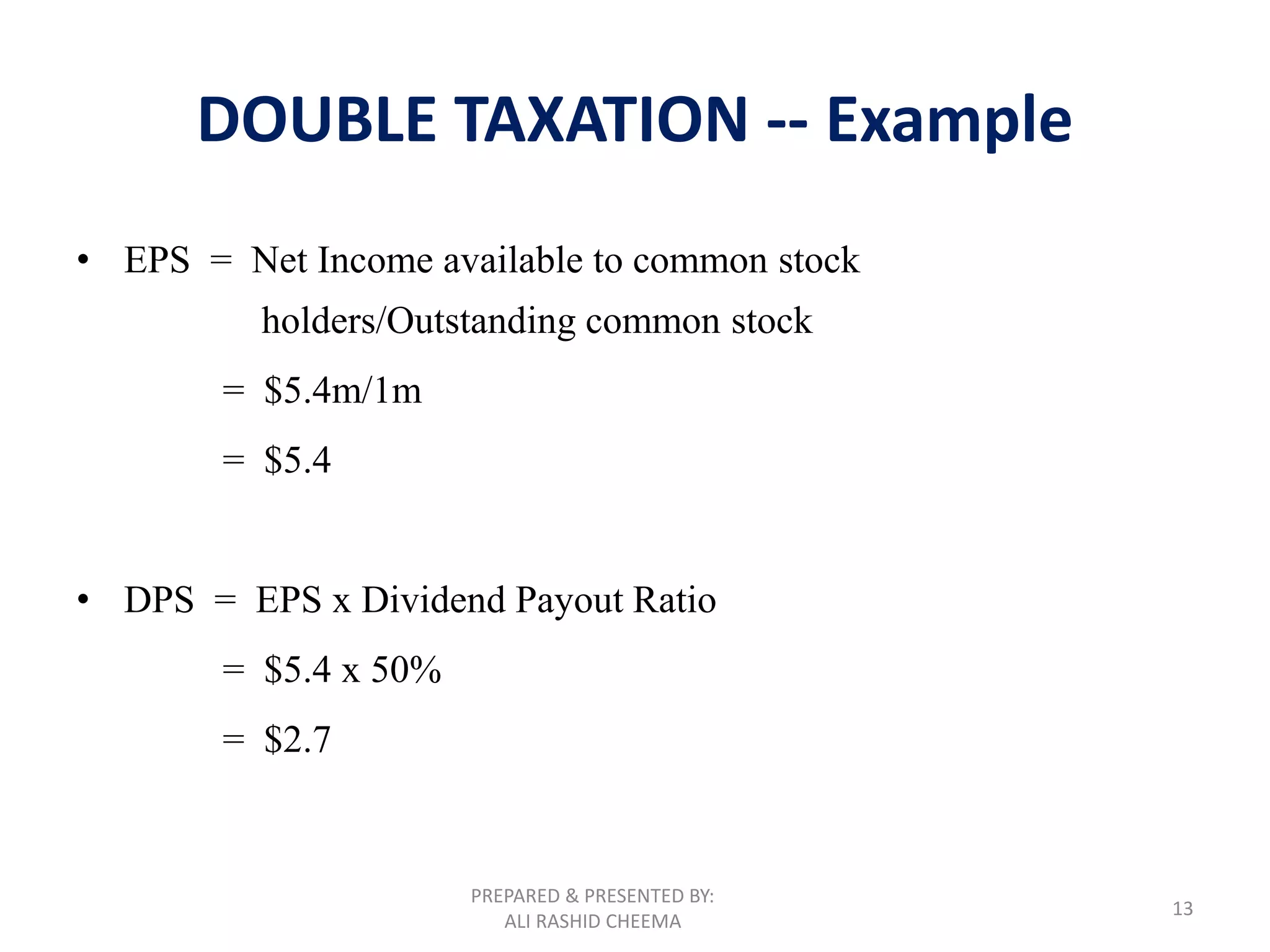
• EPS = Net Income available to common stock
holders/Outstanding common stock
= $5.4m/1m
= $5.4
• DPS = EPS x Dividend Payout Ratio
= $5.4 x 50%
= $2.7
PREPARED & PRESENTED BY:
ALI RASHID CHEEMA
14
DOUBLE TAXATION-- Example
It is assumed that Mr. X owns 100,000 shares of this company;
• Dividend Income = $2.7 x 100,000 shares = $270,000
• If Personal Income Tax = 10%, then
Mr. X’s personal income = 270,000 – 10% of 270,000
= 270,000 – 27,000
= $243,000
PREPARED & PRESENTED BY:
ALI RASHID CHEEMA
15
FORMS OF BUSINESS ORGANIZATIONS
In terms of numbers, 73% of businesses are operated
as sole proprietorships, 6% as partnerships and 21%
as corporations.
In terms of dollar value of sales, 91% of all business is
conducted by corporations, 5% by sole
proprietorships and 4% by partnerships.

Forms of business organizations

  • 1.
    PREPARED & PRESENTEDBY: ALI RASHID CHEEMA 1 FORMS OF BUSINESS ORGANIZATIONS  Sole Proprietorship  Partnership  Corporation
  • 2.
    PREPARED & PRESENTEDBY: ALI RASHID CHEEMA 2 SOLE PROPRIETORSHIP & PARTNERSHIP A business owned by one person is called a ‘Sole Proprietorship’. A business owned by two or more persons is called a ‘Partnership’. Owners of a partnership are called co-owners or partners.
  • 3.
    PREPARED & PRESENTEDBY: ALI RASHID CHEEMA 3 SOLE PROPRIETORSHIP & PARTNERSHIP Proprietorships and Partnerships are business organizations that do not have legal identities distinct from their owners. For most proprietorships and partnerships, owners also manage the business. The amount of a proprietor’s personal wealth and his or her ability to borrow limit the size of a proprietorship.
  • 4.
    PREPARED & PRESENTEDBY: ALI RASHID CHEEMA 4 SOLE PROPRIETORSHIP & PARTNERSHIP The profit of most proprietorships and partnerships is not taxed. The profit is income for the owners who pay income taxes on the profit as part of their personal income taxes.
  • 5.
    PREPARED & PRESENTEDBY: ALI RASHID CHEEMA 5 SOLE PROPRIETORSHIP & PARTNERSHIP ADVANTAGES Easy to form Inexpensive to form Few government regulations No corporate income taxes
  • 6.
    PREPARED & PRESENTEDBY: ALI RASHID CHEEMA 6 SOLE PROPRIETORSHIP & PARTNERSHIP DISADVANTAGES Limited life of business Difficult to obtain large sum of capital Unlimited personal liability
  • 7.
    PREPARED & PRESENTEDBY: ALI RASHID CHEEMA 7 CORPORATION A business organized as a separate legal entity and with ownership divided into transferable shares of capital stock is called a ‘Corporation’. A corporation is separate from its owners and managers. Here, owners are not personally liable.
  • 8.
    PREPARED & PRESENTEDBY: ALI RASHID CHEEMA 8 CORPORATION ADVANTAGES Unlimited life Professional management Easy transferability of ownership interest Limited liability Comparatively easy to raise large amounts of capital
  • 9.
    PREPARED & PRESENTEDBY: ALI RASHID CHEEMA 9 CORPORATION DISADVANTAGES Time consuming Heavy taxation High cost of formation Subject to greater government regulations Double taxation --- Corporate tax & Individual income tax
  • 10.
    PREPARED & PRESENTEDBY: ALI RASHID CHEEMA 10 Sole Proprietorships Corporations Partnerships Limited Liability Corporate tax on profits + Personal tax on dividends Unlimited Liability Personal tax on profits
  • 11.
    PREPARED & PRESENTEDBY: ALI RASHID CHEEMA 11 DOUBLE TAXATION -- Example Earnings Before Income and Tax (EBIT) 10m Less: Interest Expense (1m) Earnings Before Tax (EBT) 9m Less: Tax @ 40% (3.6m) Earnings After Tax (EAT) or Net Income available to common stockholders 5.4m
  • 12.
    PREPARED & PRESENTEDBY: ALI RASHID CHEEMA 12 DOUBLE TAXATION -- Example It is assumed that company’s: Dividend Payout Ratio = 50% Retained Earnings Ratio = 50% Outstanding Common Stock = 1m
  • 13.
    PREPARED & PRESENTEDBY: ALI RASHID CHEEMA 13 DOUBLE TAXATION -- Example • EPS = Net Income available to common stock holders/Outstanding common stock = $5.4m/1m = $5.4 • DPS = EPS x Dividend Payout Ratio = $5.4 x 50% = $2.7
  • 14.
    PREPARED & PRESENTEDBY: ALI RASHID CHEEMA 14 DOUBLE TAXATION-- Example It is assumed that Mr. X owns 100,000 shares of this company; • Dividend Income = $2.7 x 100,000 shares = $270,000 • If Personal Income Tax = 10%, then Mr. X’s personal income = 270,000 – 10% of 270,000 = 270,000 – 27,000 = $243,000
  • 15.
    PREPARED & PRESENTEDBY: ALI RASHID CHEEMA 15 FORMS OF BUSINESS ORGANIZATIONS In terms of numbers, 73% of businesses are operated as sole proprietorships, 6% as partnerships and 21% as corporations. In terms of dollar value of sales, 91% of all business is conducted by corporations, 5% by sole proprietorships and 4% by partnerships.