Business
Structure
Business Structure and
Size of Business
YSL
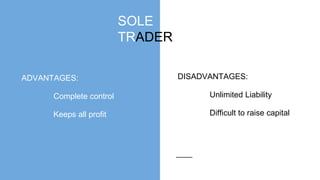
SOLE
TRADER
ADVANTAGES:
Complete control
Keeps all profit
DISADVANTAGES:
Unlimited Liability
Difficult to raise capital
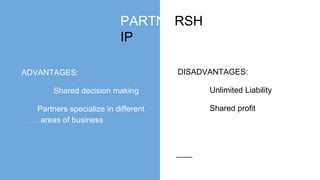
PARTNERSH
IP
ADVANTAGES:
Shared decision making
Partners specialize in different
….....areas of business
DISADVANTAGES:
Unlimited Liability
Shared profit
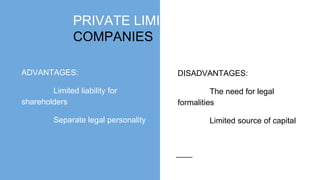
PRIVATE LIMITED
COMPANIES
ADVANTAGES:
Limited liability for
shareholders
Separate legal personality
DISADVANTAGES:
The need for legal
formalities
Limited source of capital
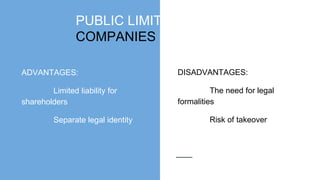
PUBLIC LIMITED
COMPANIES
ADVANTAGES:
Limited liability for
shareholders
Separate legal identity
DISADVANTAGES:
The need for legal
formalities
Risk of takeover
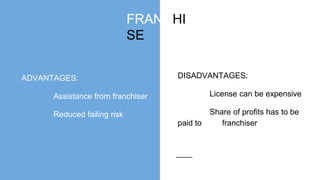
FRANCHI
SE
ADVANTAGES:
Assistance from franchiser
Reduced failing risk
DISADVANTAGES:
License can be expensive
Share of profits has to be
paid to …….franchiser
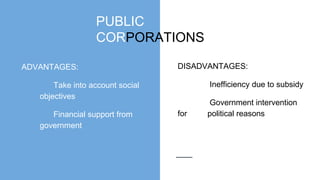
PUBLIC
CORPORATIONS
ADVANTAGES:
Take into account social
…….objectives
Financial support from
…….government
DISADVANTAGES:
Inefficiency due to subsidy
Government intervention
for …….political reasons
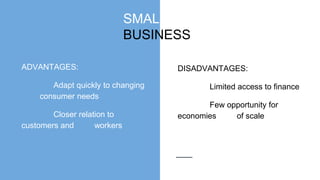
SMALL
BUSINESS
ADVANTAGES:
Adapt quickly to changing
…….consumer needs
Closer relation to
customers and …….workers
DISADVANTAGES:
Limited access to finance
Few opportunity for
economies …….of scale
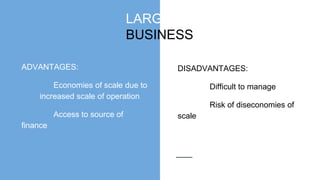
LARGE
BUSINESS
ADVANTAGES:
Economies of scale due to
…….increased scale of operation
Access to source of
finance
DISADVANTAGES:
Difficult to manage
Risk of diseconomies of
scale
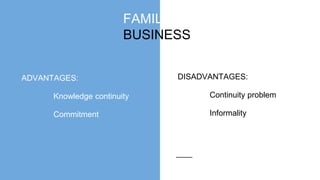
FAMILY
BUSINESS
ADVANTAGES:
Knowledge continuity
Commitment
DISADVANTAGES:
Continuity problem
Informality
SUMMARY
- Primary Sector : Engaged in
extraction of natural resources
- Secondary Sector : Engaged in
manufacturing and production from
natural resources
- Tertiary Sector : Engaged in
providing services to consumers
- Public Sector : Organisations
accountable to and controlled by
central government
- Mixed Economy : Resources are
owned and controlled by public and
private sector
- Free-Market Economy : Resources
are owned largely by private sector
- Command Economy : Resources
are owned and controlled by the
state
- Sole Trader : One person provides
the permanent finance and has full
control of the business
SUMMARY
- Limited Liability: the only liability a
shareholder has if the company fails
is the amount invested in the
company
- Private Limited Company: Business
that is owned by shareholders often
members of the family and sell
shares to the general public
- Share: Certificate confirming part
ownership of a company
- Shareholder: Individuals owning
- Public Limited Company: a limited
company with the legal right to sell
shares to the general public
- Memorandum of Association:
states the name of the company and
the address of the head office.
- Articles of Association: this
document covers the internal
workings and control of the
business
- Franchise: a business that uses the
SUMMARY
- Joint Venture: two or more
businesses agree to work closely
together on a particular project.
- Holding Company: a business
organisation that owns and controls
a number of separate businesses.
- Public Corporation: a business
enterprise owned and controlled by
the state – also known as
nationalised industry.
SUMMARY
- Revenue: total value of sales made
by a business in a given time
period.
- Capital Employed: the total value of
all long-term finance invested in the
business
- Market Capitalisation: the total
value of a company’s issued shares.
- Market Share: sales of the business
as a proportion of total market
sales.
- Internal Growth: expansion of a
business by means of opening new
branches, shops or factories (also
known as organic growth).
Business Structure
& Size of Business
Ashley Andyanto
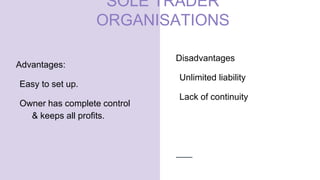
SOLE TRADER
ORGANISATIONS
Advantages:
Easy to set up.
Owner has complete control
& keeps all profits.
Disadvantages
Unlimited liability
Lack of continuity
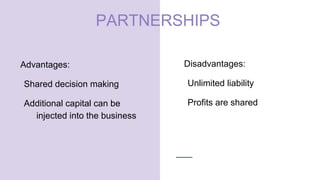
PARTNERSHIPS
Advantages:
Shared decision making
Additional capital can be
injected into the business
Disadvantages:
Unlimited liability
Profits are shared
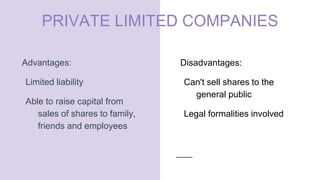
PRIVATE LIMITED COMPANIES
Advantages:
Limited liability
Able to raise capital from
sales of shares to family,
friends and employees
Disadvantages:
Can't sell shares to the
general public
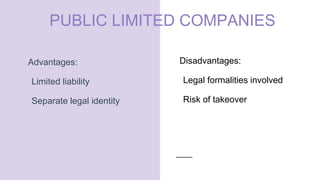
Legal formalities involved
PUBLIC LIMITED COMPANIES
Advantages:
Limited liability
Separate legal identity
Disadvantages:
Legal formalities involved
Risk of takeover
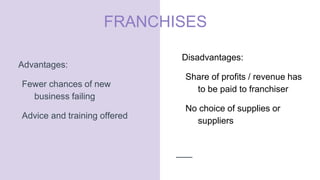
FRANCHISES
Advantages:
Fewer chances of new
business failing
Advice and training offered
Disadvantages:
Share of profits / revenue has
to be paid to franchiser
No choice of supplies or
suppliers
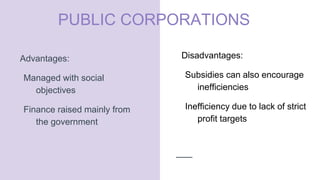
PUBLIC CORPORATIONS
Advantages:
Managed with social
objectives
Finance raised mainly from
the government
Disadvantages:
Subsidies can also encourage
inefficiencies
Inefficiency due to lack of strict
profit targets
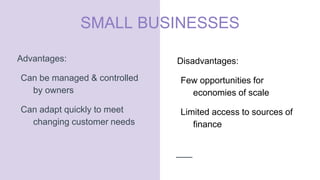
SMALL BUSINESSES
Advantages:
Can be managed & controlled
by owners
Can adapt quickly to meet
changing customer needs
Disadvantages:
Few opportunities for
economies of scale
Limited access to sources of
finance
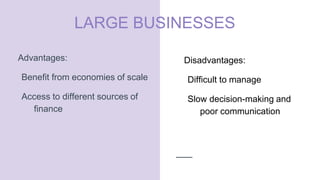
LARGE BUSINESSES
Advantages:
Benefit from economies of scale
Access to different sources of
finance
Disadvantages:
Difficult to manage
Slow decision-making and
poor communication
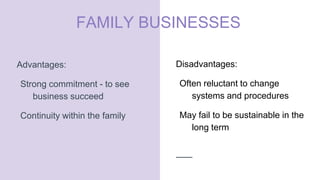
FAMILY BUSINESSES
Advantages:
Strong commitment - to see
business succeed
Continuity within the family
Disadvantages:
Often reluctant to change
systems and procedures
May fail to be sustainable in the
long term
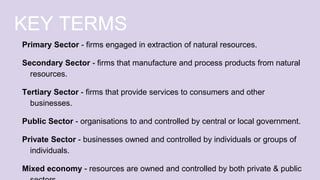
KEY TERMS
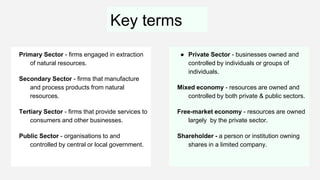
Primary Sector - firms engaged in extraction of natural resources.
Secondary Sector - firms that manufacture and process products from natural
resources.
Tertiary Sector - firms that provide services to consumers and other
businesses.
Public Sector - organisations to and controlled by central or local government.
Private Sector - businesses owned and controlled by individuals or groups of
individuals.
Mixed economy - resources are owned and controlled by both private & public
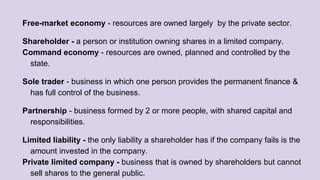
Free-market economy - resources are owned largely by the private sector.
Shareholder - a person or institution owning shares in a limited company.
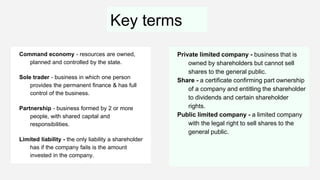
Command economy - resources are owned, planned and controlled by the
state.
Sole trader - business in which one person provides the permanent finance &
has full control of the business.
Partnership - business formed by 2 or more people, with shared capital and
responsibilities.
Limited liability - the only liability a shareholder has if the company fails is the
amount invested in the company.
Private limited company - business that is owned by shareholders but cannot
sell shares to the general public.
Share - a certificate confirming part ownership of a company and entitling the
shareholder to dividends and certain shareholder rights.
Public limited company - a limited company with the legal right to sell shares
to the general public.
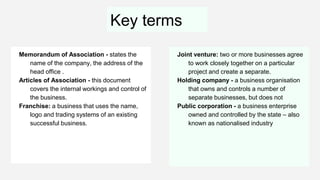
Memorandum of Association - states the name of the company, the address
of the head office .
Articles of Association - this document covers the internal workings and
control of the business.
Franchise: a business that uses the name, logo and trading systems of an
existing successful business.
Joint venture: two or more businesses agree to work closely together on a
particular project and create a separate.
Holding company - a business organisation that owns and controls a number of
separate businesses, but does not
Public corporation - a business enterprise owned and controlled by the state –
also known as nationalised industry
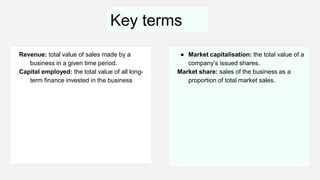
Revenue: total value of sales made by a business in a given time period.
Capital employed: the total value of all long-term finance invested in the
business
Market capitalisation: the total value of a company’s issued shares.
Market share: sales of the business as a proportion of total market sales.
Business Structure & Size of Business
Sherlin
Wongso
Sole Trader
Advantages:
1. Makes all the decision
2. No profit sharing
Disadvantages:
1. Unlimited liability
2. No continuity once owner dies
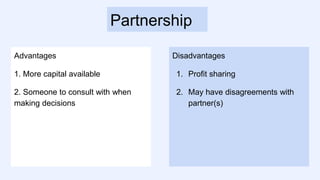
Partnership
Advantages
1. More capital available
2. Someone to consult with when
making decisions
Disadvantages
1. Profit sharing
2. May have disagreements with
partner(s)
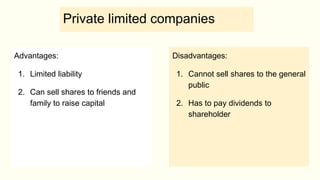
Private limited companies
Advantages:
1. Limited liability
2. Can sell shares to friends and
family to raise capital
Disadvantages:
1. Cannot sell shares to the general
public
2. Has to pay dividends to
shareholder
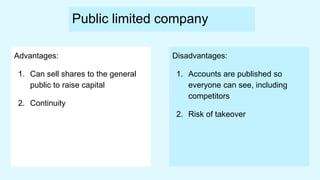
Public limited company
Advantages:
1. Can sell shares to the general
public to raise capital
2. Continuity
Disadvantages:
1. Accounts are published so
everyone can see, including
competitors
2. Risk of takeover
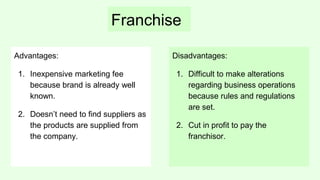
Franchise
Advantages:
1. Inexpensive marketing fee
because brand is already well
known.
2. Doesn’t need to find suppliers as
the products are supplied from
the company.
Disadvantages:
1. Difficult to make alterations
regarding business operations
because rules and regulations
are set.
2. Cut in profit to pay the
franchisor.
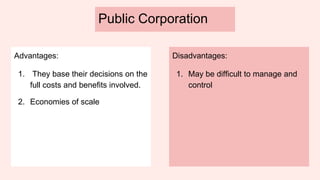
Public Corporation
Advantages:
1. They base their decisions on the
full costs and benefits involved.
2. Economies of scale
Disadvantages:
1. May be difficult to manage and
control
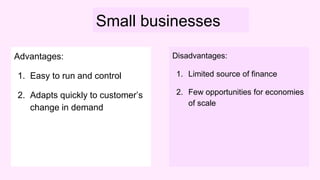
Small businesses
Advantages:
1. Easy to run and control
2. Adapts quickly to customer’s
change in demand
Disadvantages:
1. Limited source of finance
2. Few opportunities for economies
of scale
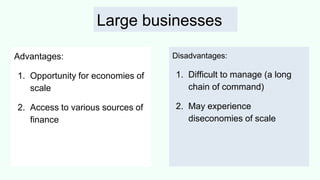
Large businesses
Advantages:
1. Opportunity for economies of
scale
2. Access to various sources of
finance
Disadvantages:
1. Difficult to manage (a long
chain of command)
2. May experience
diseconomies of scale
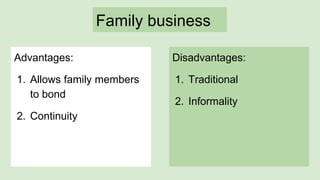
Family business
Advantages:
1. Allows family members
to bond
2. Continuity
Disadvantages:
1. Traditional
2. Informality
Key terms
Primary Sector - firms engaged in extraction
of natural resources.
Secondary Sector - firms that manufacture
and process products from natural
resources.
Tertiary Sector - firms that provide services to
consumers and other businesses.
Public Sector - organisations to and
controlled by central or local government.
● Private Sector - businesses owned and
controlled by individuals or groups of
individuals.
Mixed economy - resources are owned and
controlled by both private & public sectors.
Free-market economy - resources are owned
largely by the private sector.
Shareholder - a person or institution owning
shares in a limited company.
Key terms
Command economy - resources are owned,
planned and controlled by the state.
Sole trader - business in which one person
provides the permanent finance & has full
control of the business.
Partnership - business formed by 2 or more
people, with shared capital and
responsibilities.
Limited liability - the only liability a shareholder
has if the company fails is the amount
invested in the company.
Private limited company - business that is
owned by shareholders but cannot sell
shares to the general public.
Share - a certificate confirming part ownership
of a company and entitling the shareholder
to dividends and certain shareholder
rights.
Public limited company - a limited company
with the legal right to sell shares to the
general public.
Key terms
Memorandum of Association - states the
name of the company, the address of the
head office .
Articles of Association - this document
covers the internal workings and control of
the business.
Franchise: a business that uses the name,
logo and trading systems of an existing
successful business.
Joint venture: two or more businesses agree
to work closely together on a particular
project and create a separate.
Holding company - a business organisation
that owns and controls a number of
separate businesses, but does not
Public corporation - a business enterprise
owned and controlled by the state – also
known as nationalised industry
Key terms
Revenue: total value of sales made by a
business in a given time period.
Capital employed: the total value of all long-
term finance invested in the business
● Market capitalisation: the total value of a
company’s issued shares.
Market share: sales of the business as a
proportion of total market sales.
Business
Structure

Business structure study notes G11

  • 1.
  • 2.
  • 3.
    SOLE TRADER ADVANTAGES: Complete control Keeps allprofit DISADVANTAGES: Unlimited Liability Difficult to raise capital
  • 4.
    PARTNERSH IP ADVANTAGES: Shared decision making Partnersspecialize in different ….....areas of business DISADVANTAGES: Unlimited Liability Shared profit
  • 5.
    PRIVATE LIMITED COMPANIES ADVANTAGES: Limited liabilityfor shareholders Separate legal personality DISADVANTAGES: The need for legal formalities Limited source of capital
  • 6.
    PUBLIC LIMITED COMPANIES ADVANTAGES: Limited liabilityfor shareholders Separate legal identity DISADVANTAGES: The need for legal formalities Risk of takeover
  • 7.
    FRANCHI SE ADVANTAGES: Assistance from franchiser Reducedfailing risk DISADVANTAGES: License can be expensive Share of profits has to be paid to …….franchiser
  • 8.
    PUBLIC CORPORATIONS ADVANTAGES: Take into accountsocial …….objectives Financial support from …….government DISADVANTAGES: Inefficiency due to subsidy Government intervention for …….political reasons
  • 9.
    SMALL BUSINESS ADVANTAGES: Adapt quickly tochanging …….consumer needs Closer relation to customers and …….workers DISADVANTAGES: Limited access to finance Few opportunity for economies …….of scale
  • 10.
    LARGE BUSINESS ADVANTAGES: Economies of scaledue to …….increased scale of operation Access to source of finance DISADVANTAGES: Difficult to manage Risk of diseconomies of scale
  • 11.
  • 12.
    SUMMARY - Primary Sector: Engaged in extraction of natural resources - Secondary Sector : Engaged in manufacturing and production from natural resources - Tertiary Sector : Engaged in providing services to consumers - Public Sector : Organisations accountable to and controlled by central government - Mixed Economy : Resources are owned and controlled by public and private sector - Free-Market Economy : Resources are owned largely by private sector - Command Economy : Resources are owned and controlled by the state - Sole Trader : One person provides the permanent finance and has full control of the business
  • 13.
    SUMMARY - Limited Liability:the only liability a shareholder has if the company fails is the amount invested in the company - Private Limited Company: Business that is owned by shareholders often members of the family and sell shares to the general public - Share: Certificate confirming part ownership of a company - Shareholder: Individuals owning - Public Limited Company: a limited company with the legal right to sell shares to the general public - Memorandum of Association: states the name of the company and the address of the head office. - Articles of Association: this document covers the internal workings and control of the business - Franchise: a business that uses the
  • 14.
    SUMMARY - Joint Venture:two or more businesses agree to work closely together on a particular project. - Holding Company: a business organisation that owns and controls a number of separate businesses. - Public Corporation: a business enterprise owned and controlled by the state – also known as nationalised industry.
  • 15.
    SUMMARY - Revenue: totalvalue of sales made by a business in a given time period. - Capital Employed: the total value of all long-term finance invested in the business - Market Capitalisation: the total value of a company’s issued shares. - Market Share: sales of the business as a proportion of total market sales. - Internal Growth: expansion of a business by means of opening new branches, shops or factories (also known as organic growth).
  • 16.
    Business Structure & Sizeof Business Ashley Andyanto
  • 17.
    SOLE TRADER ORGANISATIONS Advantages: Easy toset up. Owner has complete control & keeps all profits. Disadvantages Unlimited liability Lack of continuity
  • 18.
    PARTNERSHIPS Advantages: Shared decision making Additionalcapital can be injected into the business Disadvantages: Unlimited liability Profits are shared
  • 19.
    PRIVATE LIMITED COMPANIES Advantages: Limitedliability Able to raise capital from sales of shares to family, friends and employees Disadvantages: Can't sell shares to the general public Legal formalities involved
  • 20.
    PUBLIC LIMITED COMPANIES Advantages: Limitedliability Separate legal identity Disadvantages: Legal formalities involved Risk of takeover
  • 21.
    FRANCHISES Advantages: Fewer chances ofnew business failing Advice and training offered Disadvantages: Share of profits / revenue has to be paid to franchiser No choice of supplies or suppliers
  • 22.
    PUBLIC CORPORATIONS Advantages: Managed withsocial objectives Finance raised mainly from the government Disadvantages: Subsidies can also encourage inefficiencies Inefficiency due to lack of strict profit targets
  • 23.
    SMALL BUSINESSES Advantages: Can bemanaged & controlled by owners Can adapt quickly to meet changing customer needs Disadvantages: Few opportunities for economies of scale Limited access to sources of finance
  • 24.
    LARGE BUSINESSES Advantages: Benefit fromeconomies of scale Access to different sources of finance Disadvantages: Difficult to manage Slow decision-making and poor communication
  • 25.
    FAMILY BUSINESSES Advantages: Strong commitment- to see business succeed Continuity within the family Disadvantages: Often reluctant to change systems and procedures May fail to be sustainable in the long term
  • 26.
    KEY TERMS Primary Sector- firms engaged in extraction of natural resources. Secondary Sector - firms that manufacture and process products from natural resources. Tertiary Sector - firms that provide services to consumers and other businesses. Public Sector - organisations to and controlled by central or local government. Private Sector - businesses owned and controlled by individuals or groups of individuals. Mixed economy - resources are owned and controlled by both private & public
  • 27.
    Free-market economy -resources are owned largely by the private sector. Shareholder - a person or institution owning shares in a limited company. Command economy - resources are owned, planned and controlled by the state. Sole trader - business in which one person provides the permanent finance & has full control of the business. Partnership - business formed by 2 or more people, with shared capital and responsibilities. Limited liability - the only liability a shareholder has if the company fails is the amount invested in the company. Private limited company - business that is owned by shareholders but cannot sell shares to the general public.
  • 28.
    Share - acertificate confirming part ownership of a company and entitling the shareholder to dividends and certain shareholder rights. Public limited company - a limited company with the legal right to sell shares to the general public. Memorandum of Association - states the name of the company, the address of the head office . Articles of Association - this document covers the internal workings and control of the business. Franchise: a business that uses the name, logo and trading systems of an existing successful business. Joint venture: two or more businesses agree to work closely together on a particular project and create a separate.
  • 29.
    Holding company -a business organisation that owns and controls a number of separate businesses, but does not Public corporation - a business enterprise owned and controlled by the state – also known as nationalised industry Revenue: total value of sales made by a business in a given time period. Capital employed: the total value of all long-term finance invested in the business Market capitalisation: the total value of a company’s issued shares. Market share: sales of the business as a proportion of total market sales.
  • 30.
    Business Structure &Size of Business Sherlin Wongso
  • 31.
    Sole Trader Advantages: 1. Makesall the decision 2. No profit sharing Disadvantages: 1. Unlimited liability 2. No continuity once owner dies
  • 32.
    Partnership Advantages 1. More capitalavailable 2. Someone to consult with when making decisions Disadvantages 1. Profit sharing 2. May have disagreements with partner(s)
  • 33.
    Private limited companies Advantages: 1.Limited liability 2. Can sell shares to friends and family to raise capital Disadvantages: 1. Cannot sell shares to the general public 2. Has to pay dividends to shareholder
  • 34.
    Public limited company Advantages: 1.Can sell shares to the general public to raise capital 2. Continuity Disadvantages: 1. Accounts are published so everyone can see, including competitors 2. Risk of takeover
  • 35.
    Franchise Advantages: 1. Inexpensive marketingfee because brand is already well known. 2. Doesn’t need to find suppliers as the products are supplied from the company. Disadvantages: 1. Difficult to make alterations regarding business operations because rules and regulations are set. 2. Cut in profit to pay the franchisor.
  • 36.
    Public Corporation Advantages: 1. Theybase their decisions on the full costs and benefits involved. 2. Economies of scale Disadvantages: 1. May be difficult to manage and control
  • 37.
    Small businesses Advantages: 1. Easyto run and control 2. Adapts quickly to customer’s change in demand Disadvantages: 1. Limited source of finance 2. Few opportunities for economies of scale
  • 38.
    Large businesses Advantages: 1. Opportunityfor economies of scale 2. Access to various sources of finance Disadvantages: 1. Difficult to manage (a long chain of command) 2. May experience diseconomies of scale
  • 39.
    Family business Advantages: 1. Allowsfamily members to bond 2. Continuity Disadvantages: 1. Traditional 2. Informality
  • 40.
    Key terms Primary Sector- firms engaged in extraction of natural resources. Secondary Sector - firms that manufacture and process products from natural resources. Tertiary Sector - firms that provide services to consumers and other businesses. Public Sector - organisations to and controlled by central or local government. ● Private Sector - businesses owned and controlled by individuals or groups of individuals. Mixed economy - resources are owned and controlled by both private & public sectors. Free-market economy - resources are owned largely by the private sector. Shareholder - a person or institution owning shares in a limited company.
  • 41.
    Key terms Command economy- resources are owned, planned and controlled by the state. Sole trader - business in which one person provides the permanent finance & has full control of the business. Partnership - business formed by 2 or more people, with shared capital and responsibilities. Limited liability - the only liability a shareholder has if the company fails is the amount invested in the company. Private limited company - business that is owned by shareholders but cannot sell shares to the general public. Share - a certificate confirming part ownership of a company and entitling the shareholder to dividends and certain shareholder rights. Public limited company - a limited company with the legal right to sell shares to the general public.
  • 42.
    Key terms Memorandum ofAssociation - states the name of the company, the address of the head office . Articles of Association - this document covers the internal workings and control of the business. Franchise: a business that uses the name, logo and trading systems of an existing successful business. Joint venture: two or more businesses agree to work closely together on a particular project and create a separate. Holding company - a business organisation that owns and controls a number of separate businesses, but does not Public corporation - a business enterprise owned and controlled by the state – also known as nationalised industry
  • 43.
    Key terms Revenue: totalvalue of sales made by a business in a given time period. Capital employed: the total value of all long- term finance invested in the business ● Market capitalisation: the total value of a company’s issued shares. Market share: sales of the business as a proportion of total market sales.
  • 44.