Unit 1.1 What do businesses do?
Needs and Wants A  Need  is a basic thing humans have to have in order to survive. I.e. Food, water, shelter and clothes are all needs. A  Want  is something extra we would like to have. They can be luxuries or time saving devices. Cars, mobile phones, computers and CDs are all wants
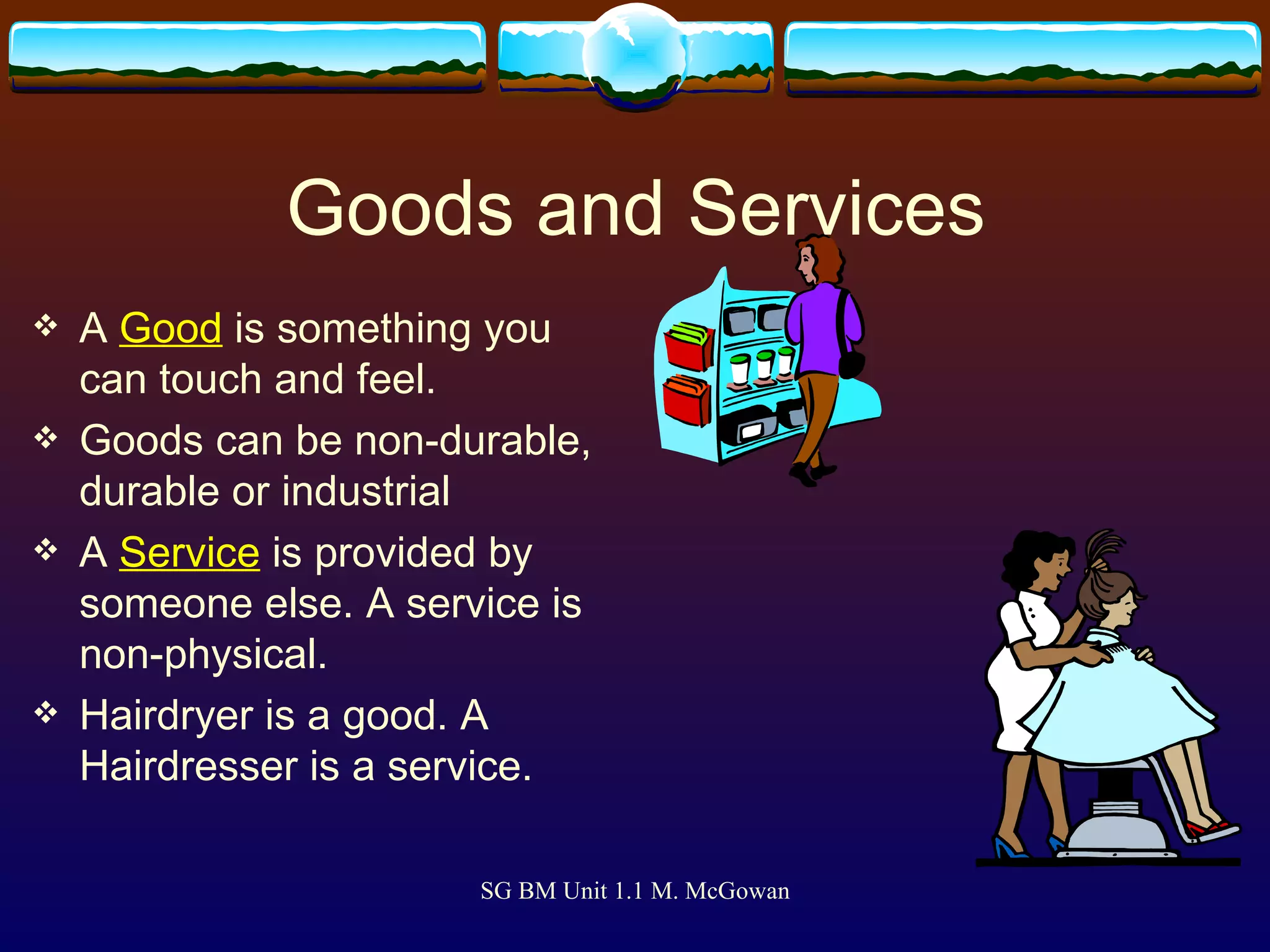
Goods and Services A  Good  is something you can touch and feel. Goods can be non-durable, durable or industrial A  Service   is provided by someone else. A service is non-physical. Hairdryer is a good. A Hairdresser is a service.
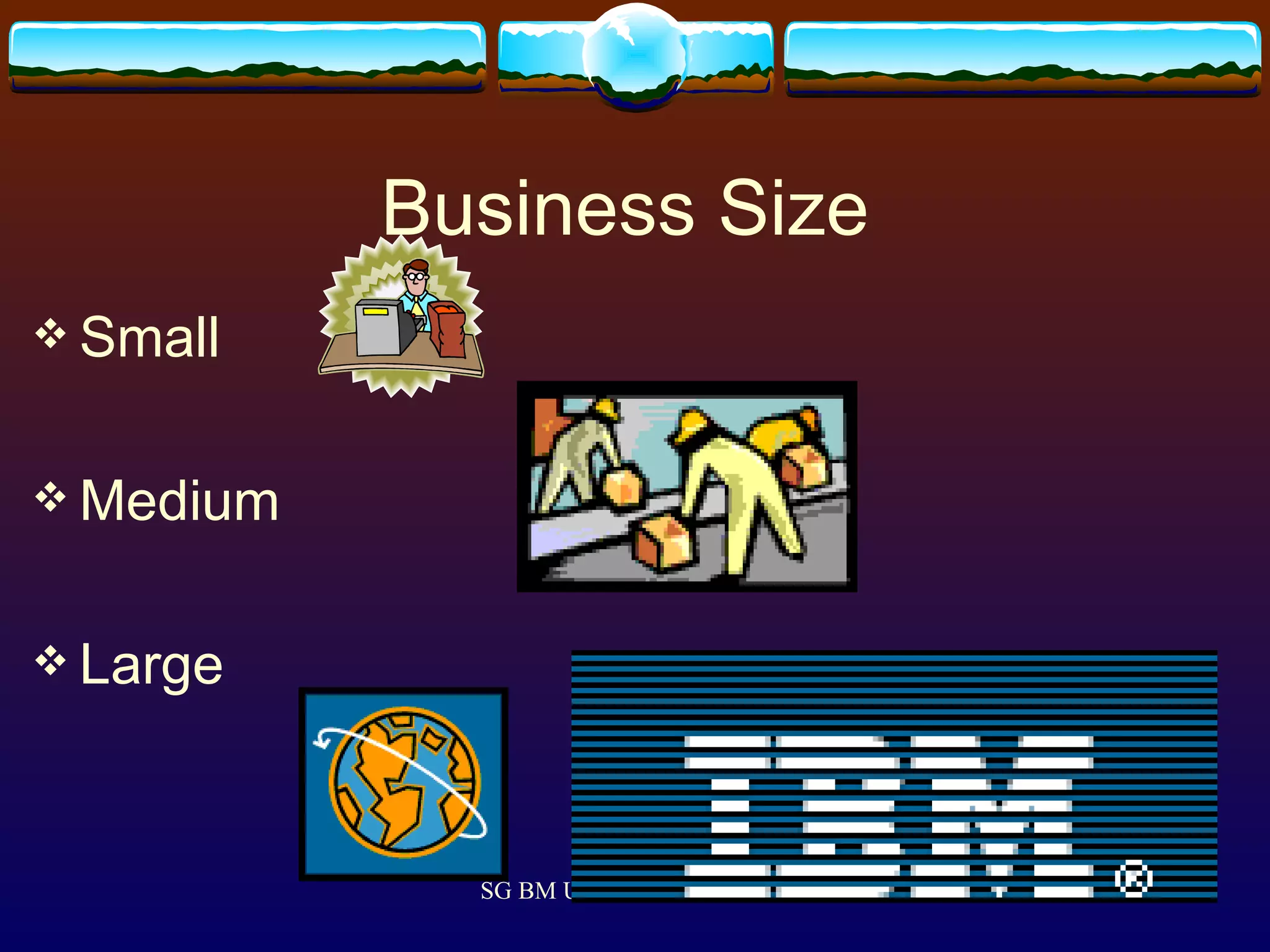
Business Size  Small Medium Large
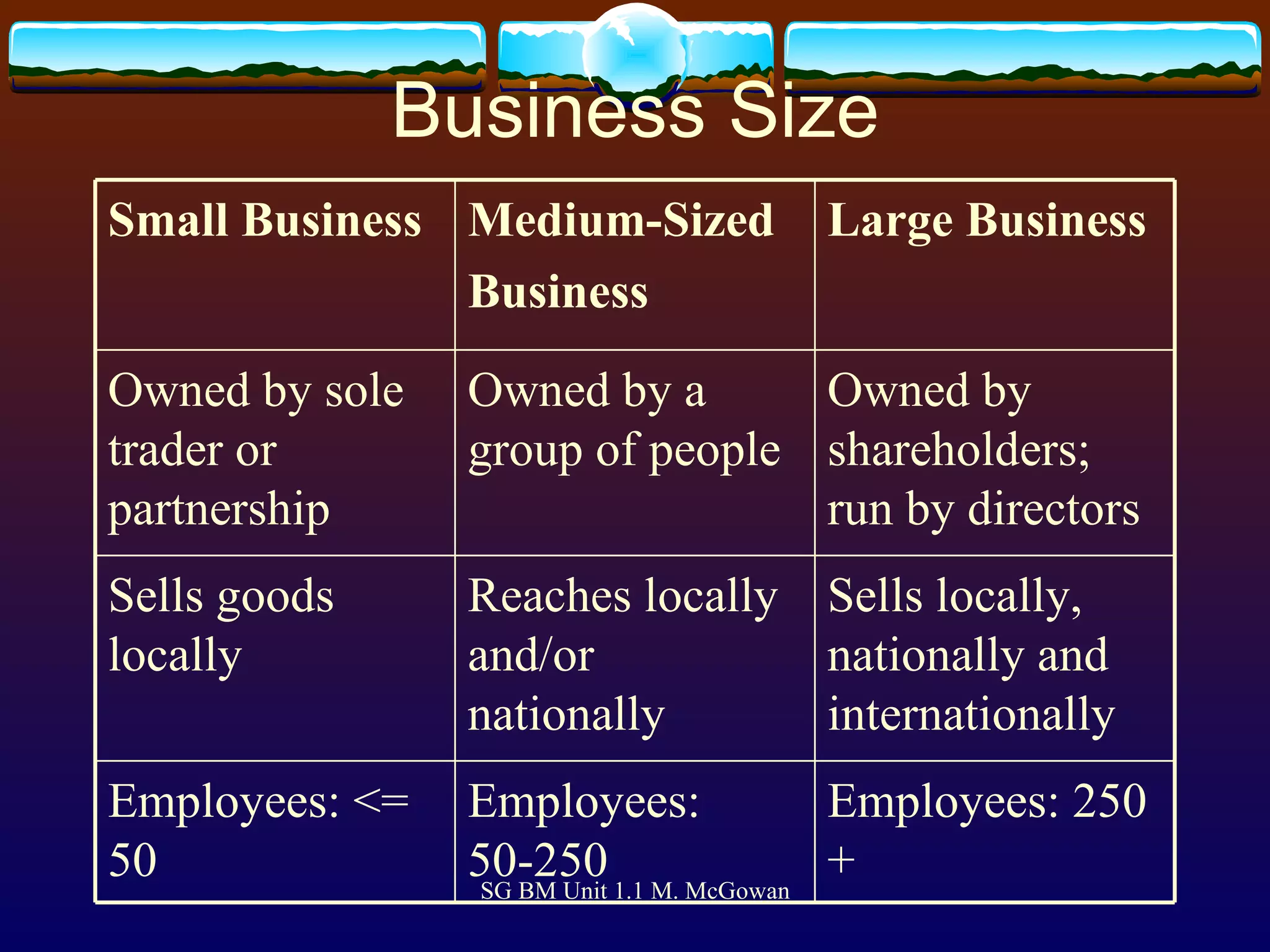
Business Size Employees: 250 + Employees: 50-250 Employees: <= 50 Sells locally, nationally and internationally Reaches locally and/or nationally Sells goods locally Owned by shareholders; run by directors Owned by a group of people Owned by sole trader or partnership Large Business Medium-Sized Business Small Business
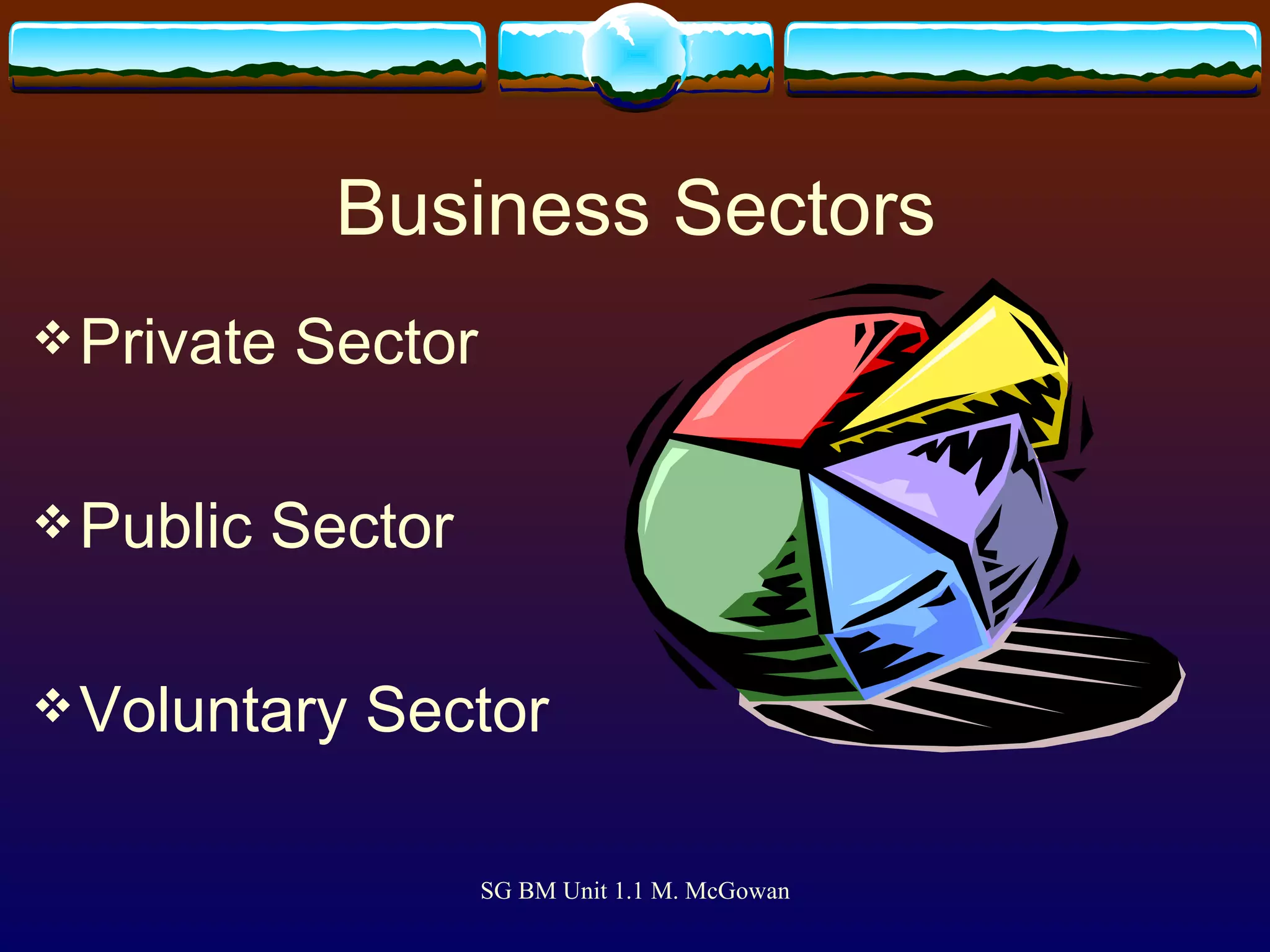
Business Sectors Private Sector Public Sector Voluntary Sector
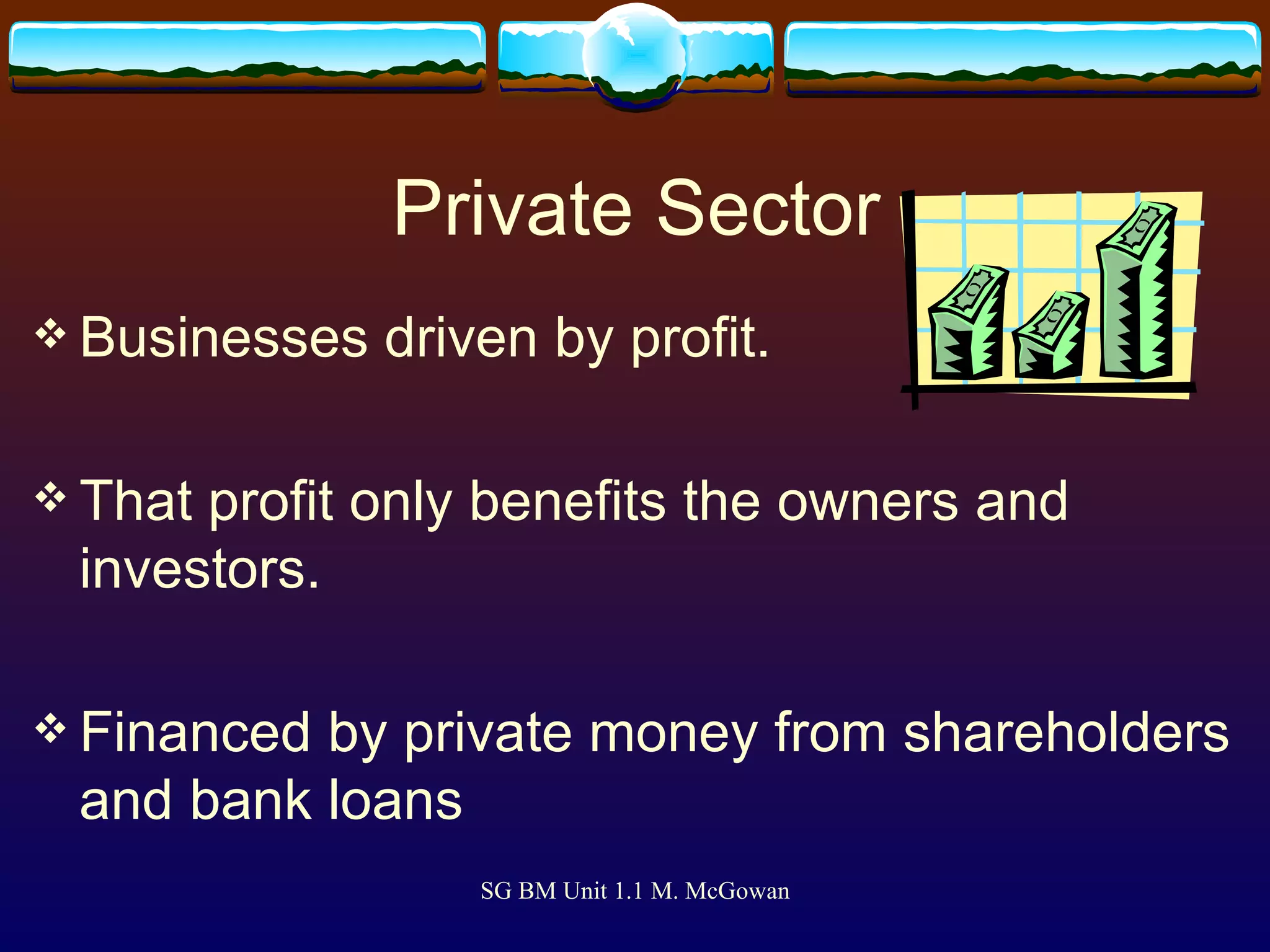
Private Sector Businesses driven by profit.  That profit only benefits the owners and investors. Financed by private money from shareholders and bank loans
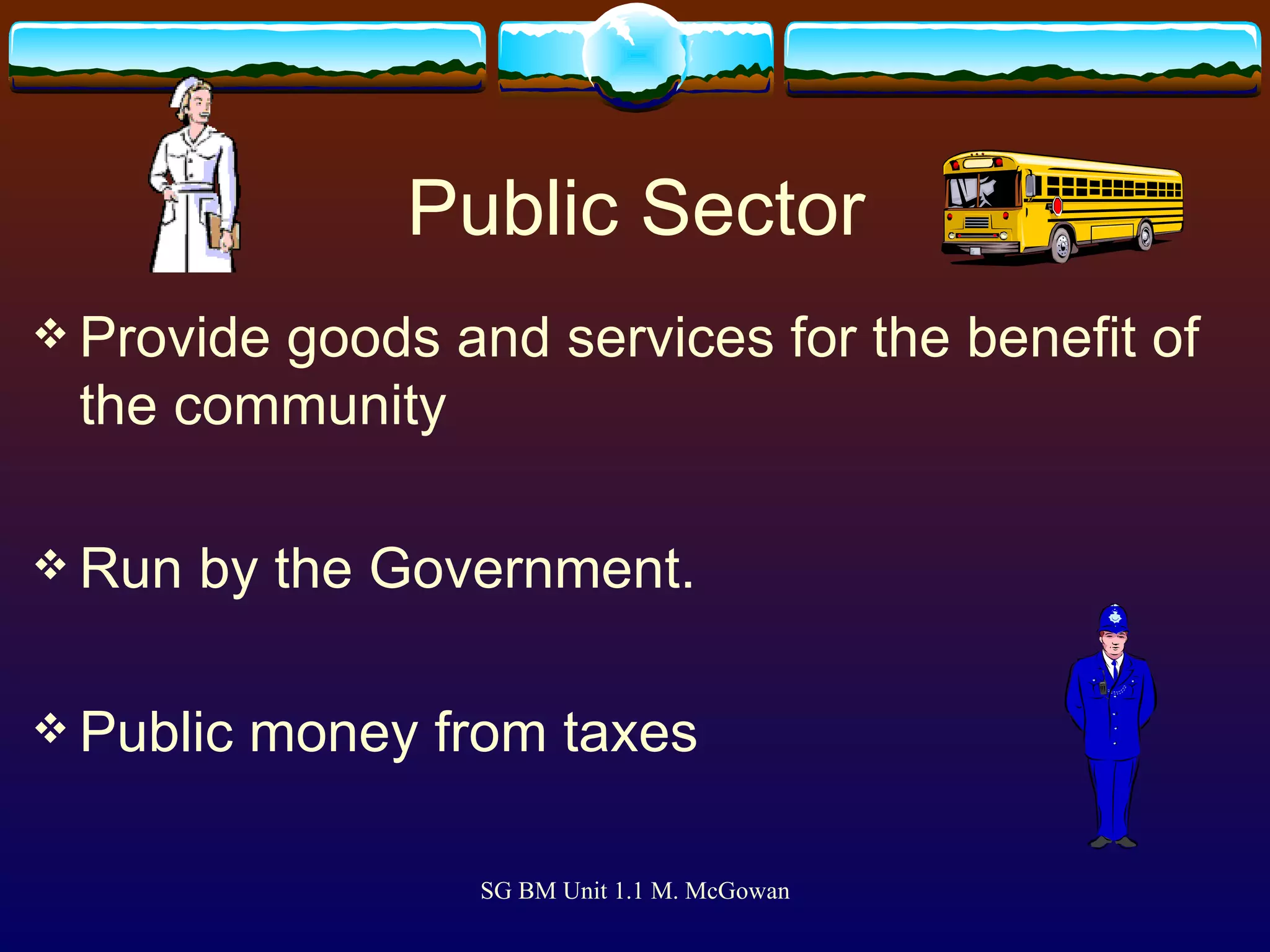
Public Sector Provide goods and services for the benefit of the community Run by the Government. Public money from taxes
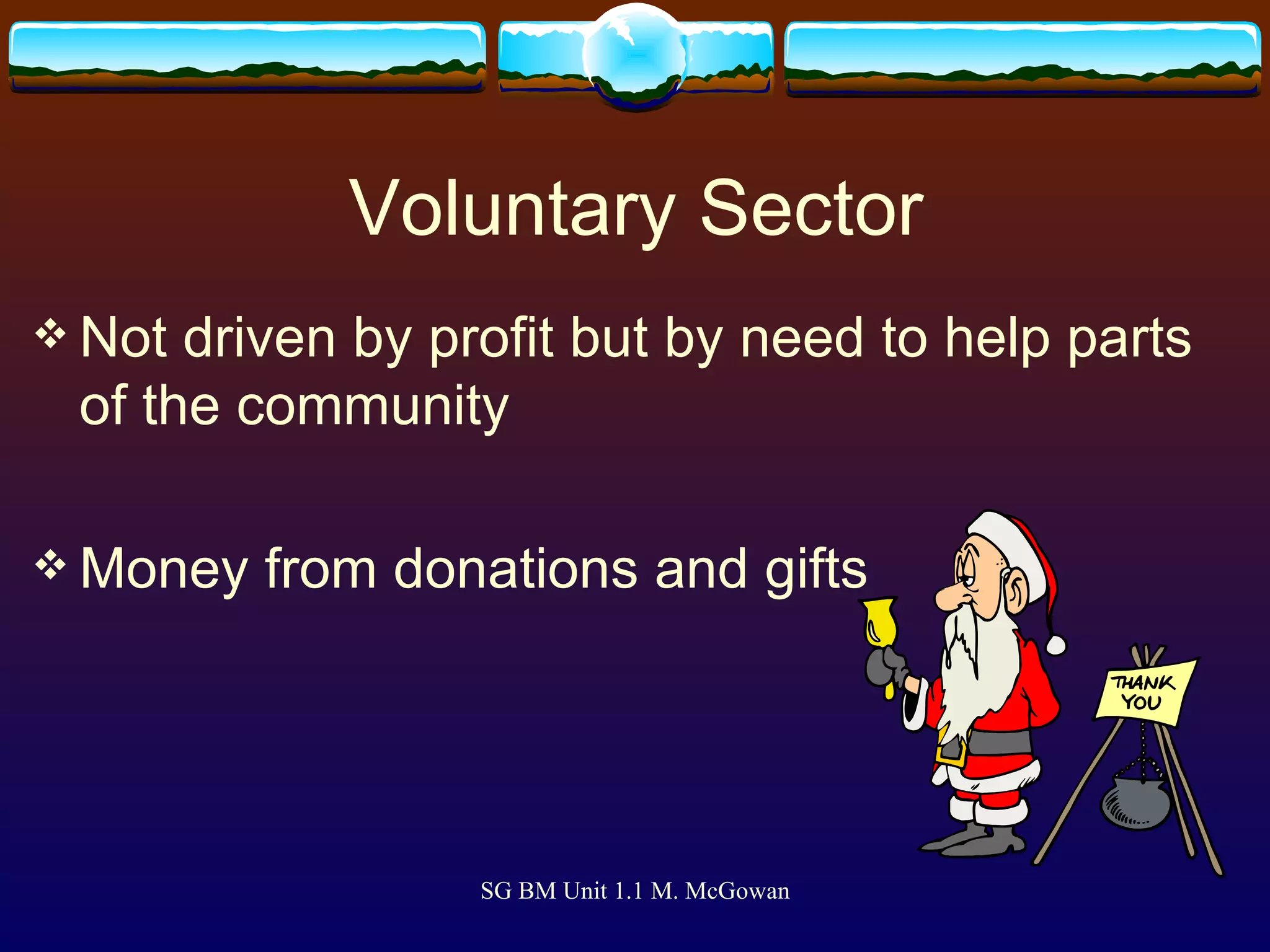
Voluntary Sector Not driven by profit but by need to help parts of the community Money from donations and gifts
Types of Ownership Sole Trader Partnership Private Limited Company Public Limited Company Franchise Co-operative Government-Owned
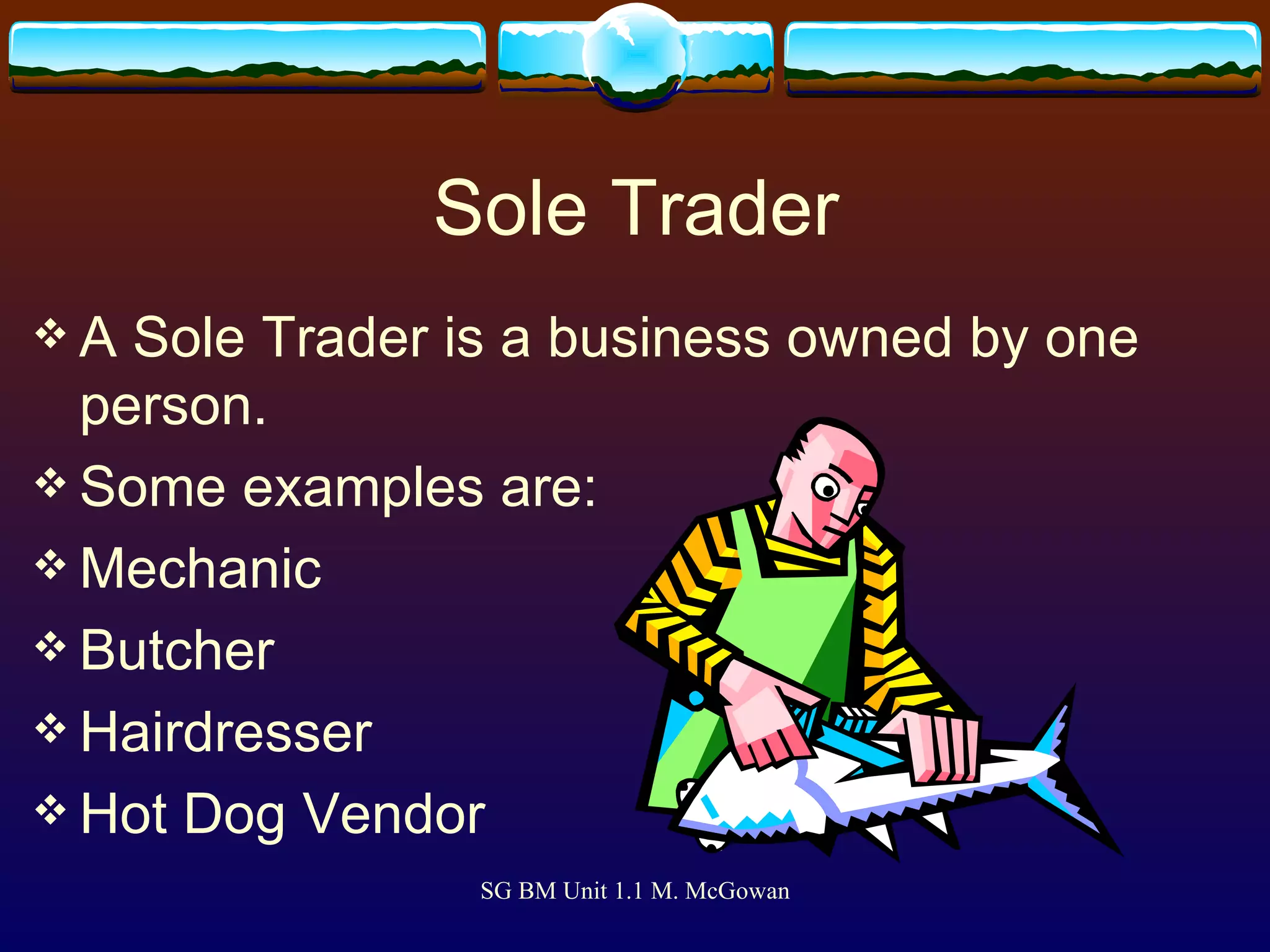
Sole Trader A Sole Trader is a business owned by one person. Some examples are: Mechanic Butcher Hairdresser Hot Dog Vendor
Features of Sole Trader One man/woman business Sole Trader owns business. Owner and business are the same Owner provides own capital (savings & borrowings) Profits go to the owner but responsible for losses (Unlimited liability) Owner controls business, all decisions are theirs
Sole Trader Advantages Owner has total control Owner keeps all profits Owner has better job satisfaction Disadvantages Unlimited liability Hard to raise capital Owner is responsible High failure rate
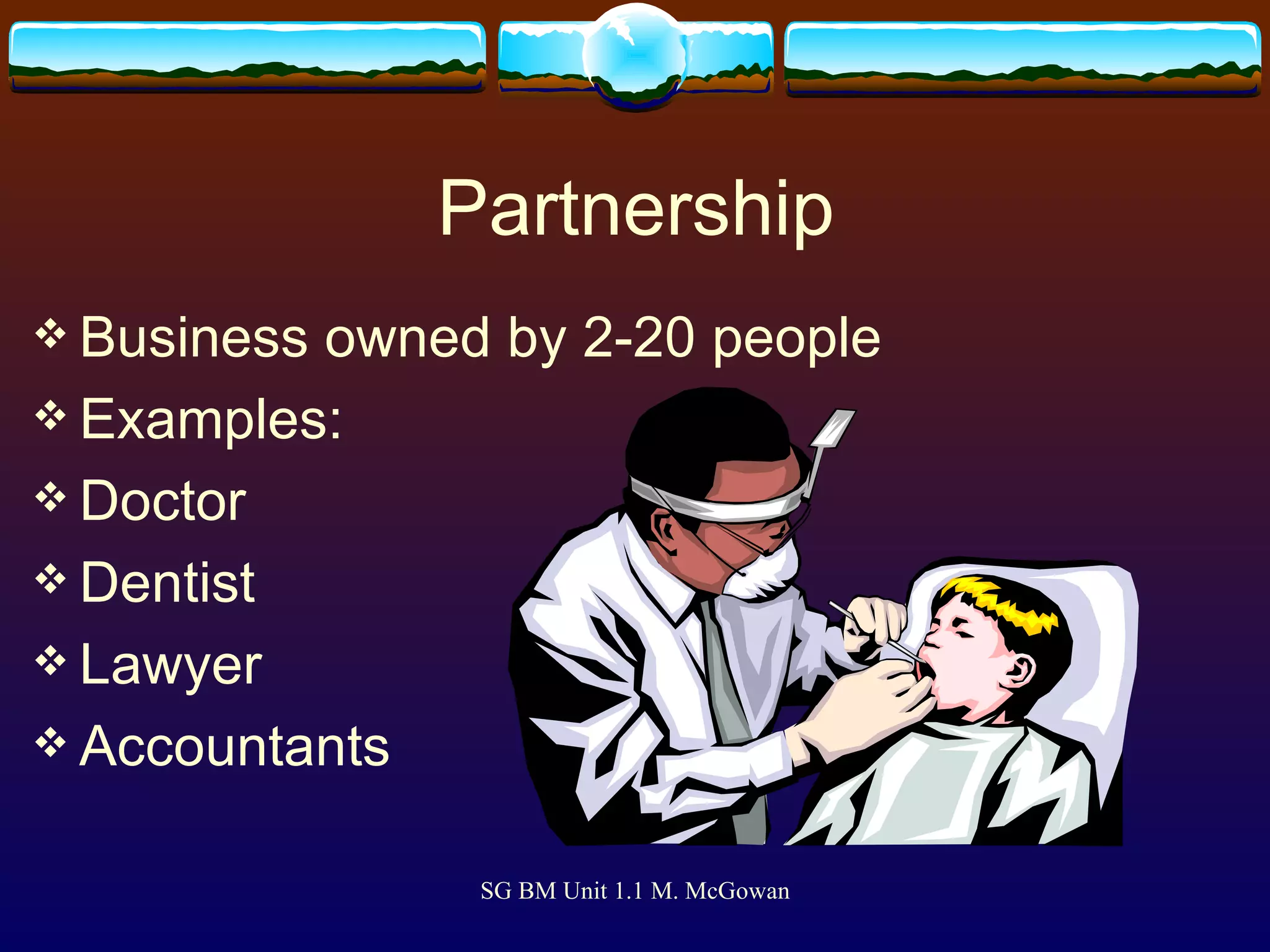
Partnership Business owned by 2-20 people Examples: Doctor Dentist Lawyer Accountants
Features of Partnership A business owned by several people 2-20 Deed of Partnership  – contract dealing with share of profits, roles and duties, capital contributed, dispute procedures Owned jointly but not always equally Partnership is an extension of sole trader Capital provided by partners Profit goes to partners, not always equally All partners entitled to participate in management (unless  silent partners )
Partnership Advantages Able to specialise Do not have total responsibility More ideas More money Can borrow more money easier Disadvantages Unlimited liability Risk of conflict
Private Limited Company Shareholders  – a part-owner of a business. Limited liability  – shareholders are only liable for debts equal to value of their shares. Dividends  – the share of profits received by shareholders
Features of Private Limited Companies Organisation owned by a group of individuals Memorandum/Articles of Association Owned by Shareholders (usually family) whose main function is to elect Board of Directors Money raised by share issue or borrowing Ordinary Shares & Preference Shares Profit shared between shareholders or retained by company
Private Limited Company Advantages Company is a legal entity Easy to raise capital Limited liability Company keeps going regardless of changes in personnel Disadvantages Complicated rules to set-up business Audited accounts need to be made public
Public Limited Company Has  plc  after the name Limited liability Minimum £50,000 share capital Shares sold by banks and stockbrokers Shares can be offered to general public Private limited companies become PLCs to raise money for expansion
Features of plcs Org. owned by a group of individuals, has plc after name Certificate of Incorporation approved by Registrar of Companies Shareholders 2+. Shares sold on stock exchange.  Prospectus  prepared to attract shareholders Capital raised by share issue or borrowing Profits shared between shareholders or retained by company Board of Directors = Divorce of ownership and control
Advantages & Disadvantages of PLCs Advantages Shareholders limited liability Sale of shares raises money Shareholders recoup money by selling shares Directors may be experts in their field Disadvantages Number of legal requirements Company accounts made public Directors report to shareholders at AGMs
Charities A charity is an organisation set up to raise funds to help other people or causes. Charities have to register and publish their accounts. Unlike voluntary organisations, charities employ managers and workers. Cancer Research, Save the Children and Oxfam are well known charities.
Charities Advantages If charity has status of charitable trust it doesn’t pay tax   Looks after less privileged and the environment   Disadvantages Less money may be donated due to introduction of lottery Relies on voluntary workers who may not be paid for work
Franchise A franchise is a  business marriage  between an existing business and a newcomer The franchisee buys permission to copy the business idea of the established company McDonald’s is a franchise
Franchise Advantages Franchisor provides a lot of support; training to start business, equipment, materials, advice, brand name Take over a successful, winning formula   Disadvantages Franchisee doesn’t have complete freedom May not agree with decision placed upon you
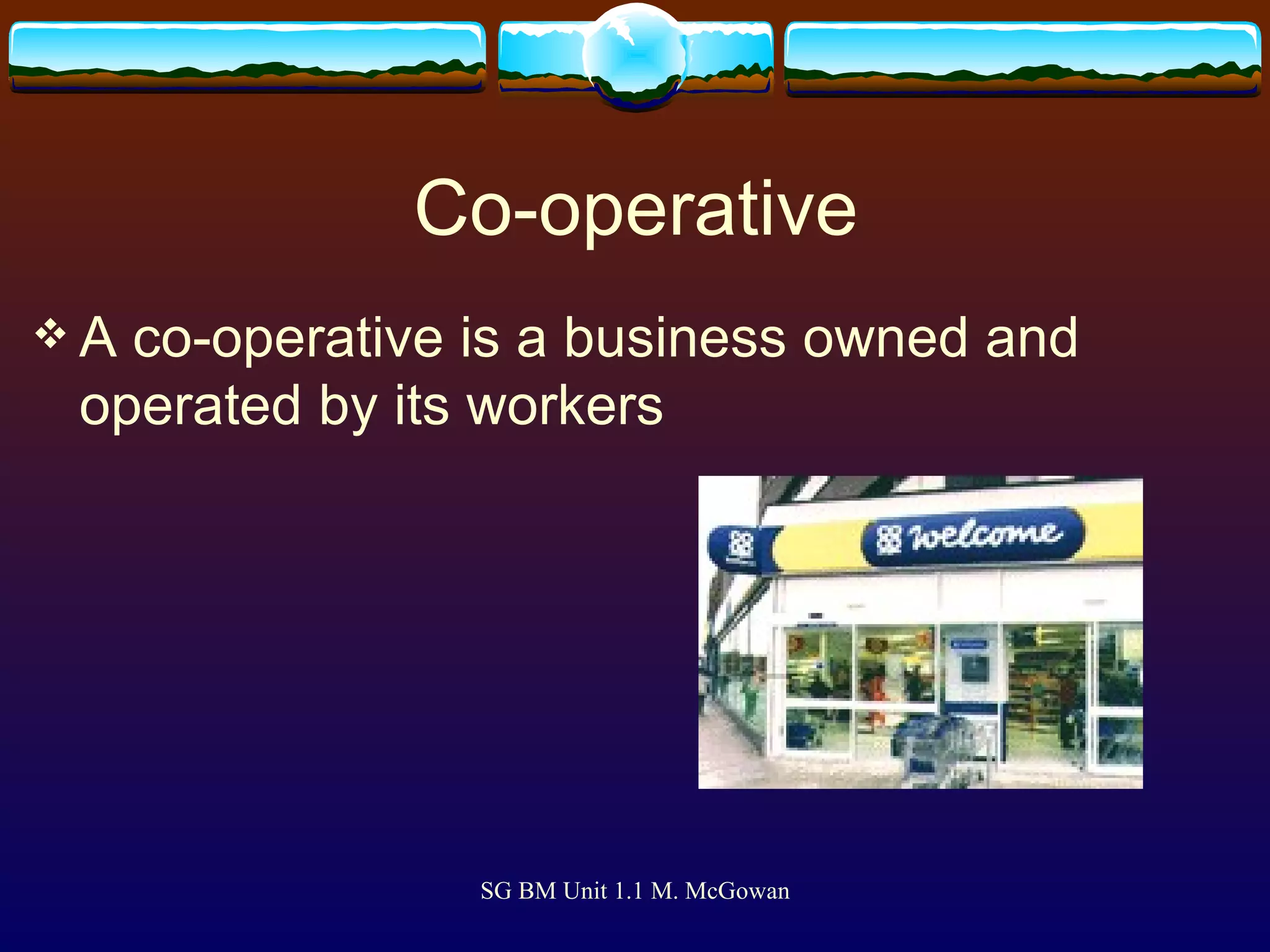
Co-operative A co-operative is a business owned and operated by its workers
Co-operative Advantages Members in control Members have interest in business doing well Members share profits Disadvantages New workers need to buy shares Often pressured to sell if successful Need new workers to expand
Government Owned Central Local Public Corporations
Central Government Advantages Shareholders limited liability Easy to raise finance Disadvantages Expensive to set up Accounts need to be made public Provides services to public for nothing or a fee. NHS is paid for by tax ( income tax ,  VAT, National Insurance )
Local Government Advantages In touch with local needs Disadvantages Can be politically driven Run by local councils providing a variety of vital services to the area ( police, fire, roads, libraries ). Can be done by local council or  contracted out .
Public Corporations Set up by an Act of Parliament and directors appointed by the Government. Very rare. ( BBC, Post Office, Bank of England)
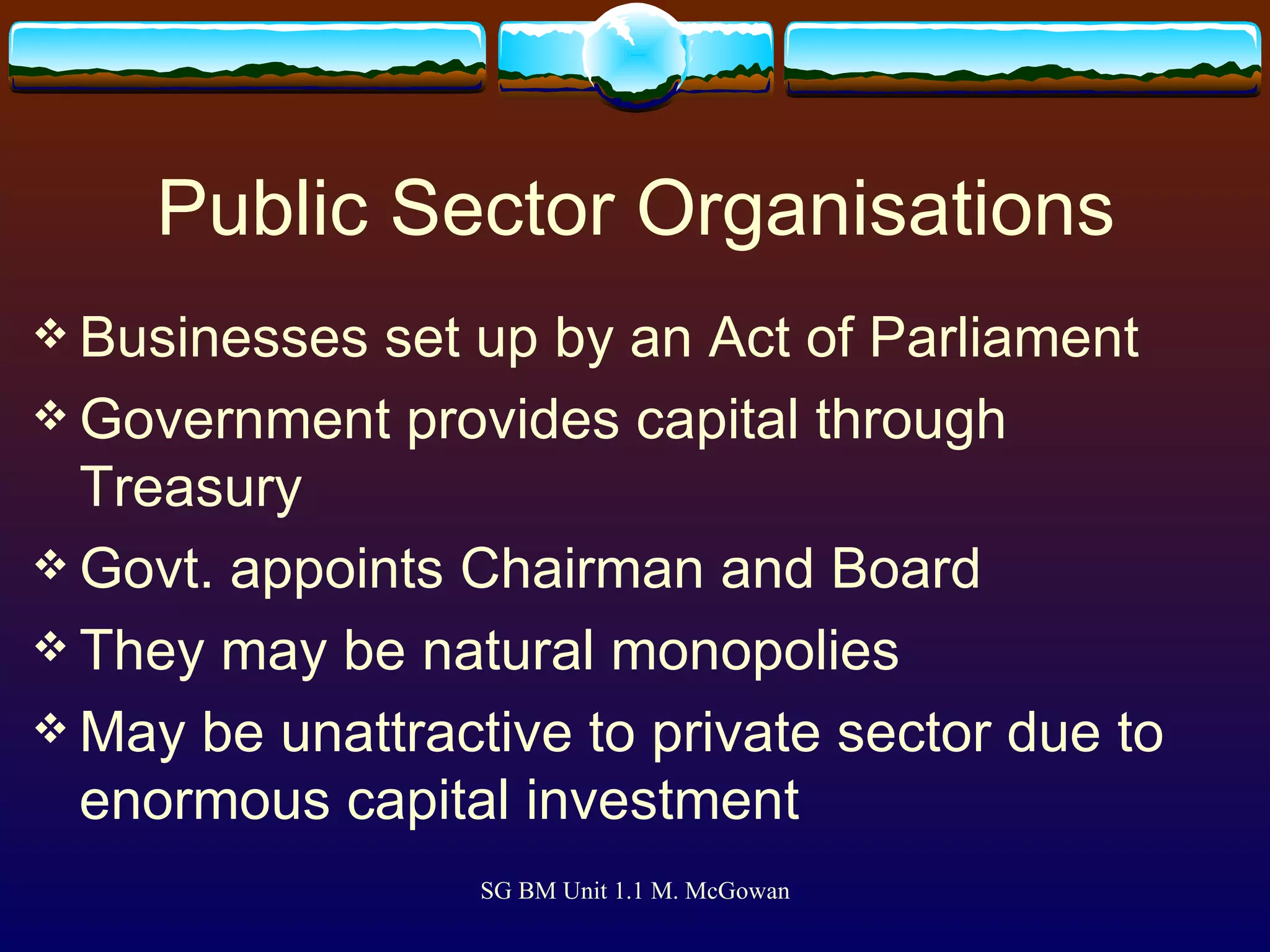
Public Sector Organisations Businesses set up by an Act of Parliament Government provides capital through Treasury Govt. appoints Chairman and Board They may be natural monopolies May be unattractive to private sector due to enormous capital investment
Public Corporations Reasons for being set-up: To avoid wasteful duplication and confusion To set up and run important non-profitable services To prevent exploitation of consumers To protect jobs and key industries
Privatisation The selling off of Public Corporations to the private sector Why Privatise? To improve efficiency by introducing competition Shareholders in Modern Society Privatisation raises huge monies for government
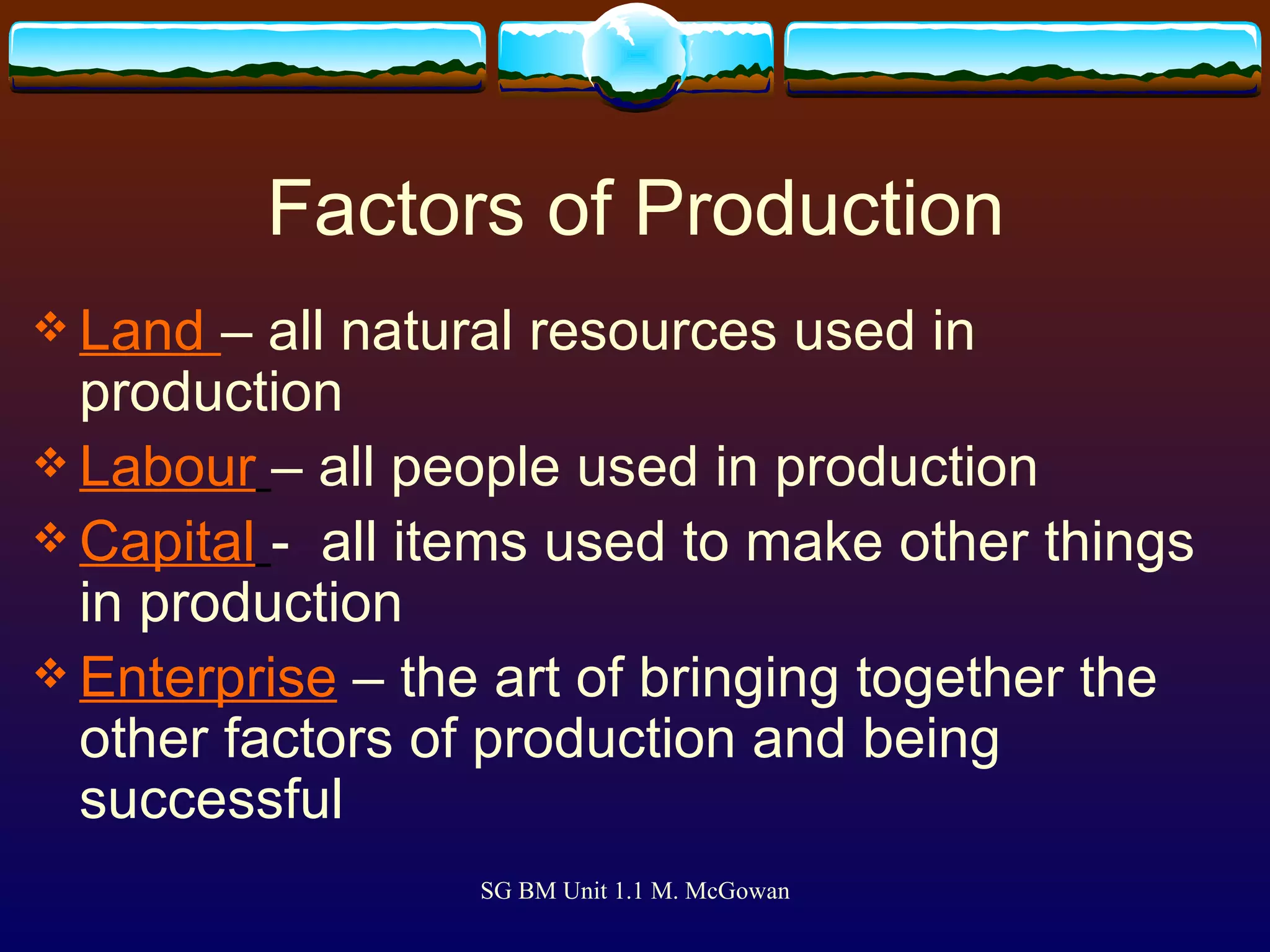
Factors of Production Land  – all natural resources used in production Labour   – all people used in production Capital   -  all items used to make other things in production Enterprise   – the art of bringing together the other factors of production and being successful
Types of Production Primary Secondary Tertiary
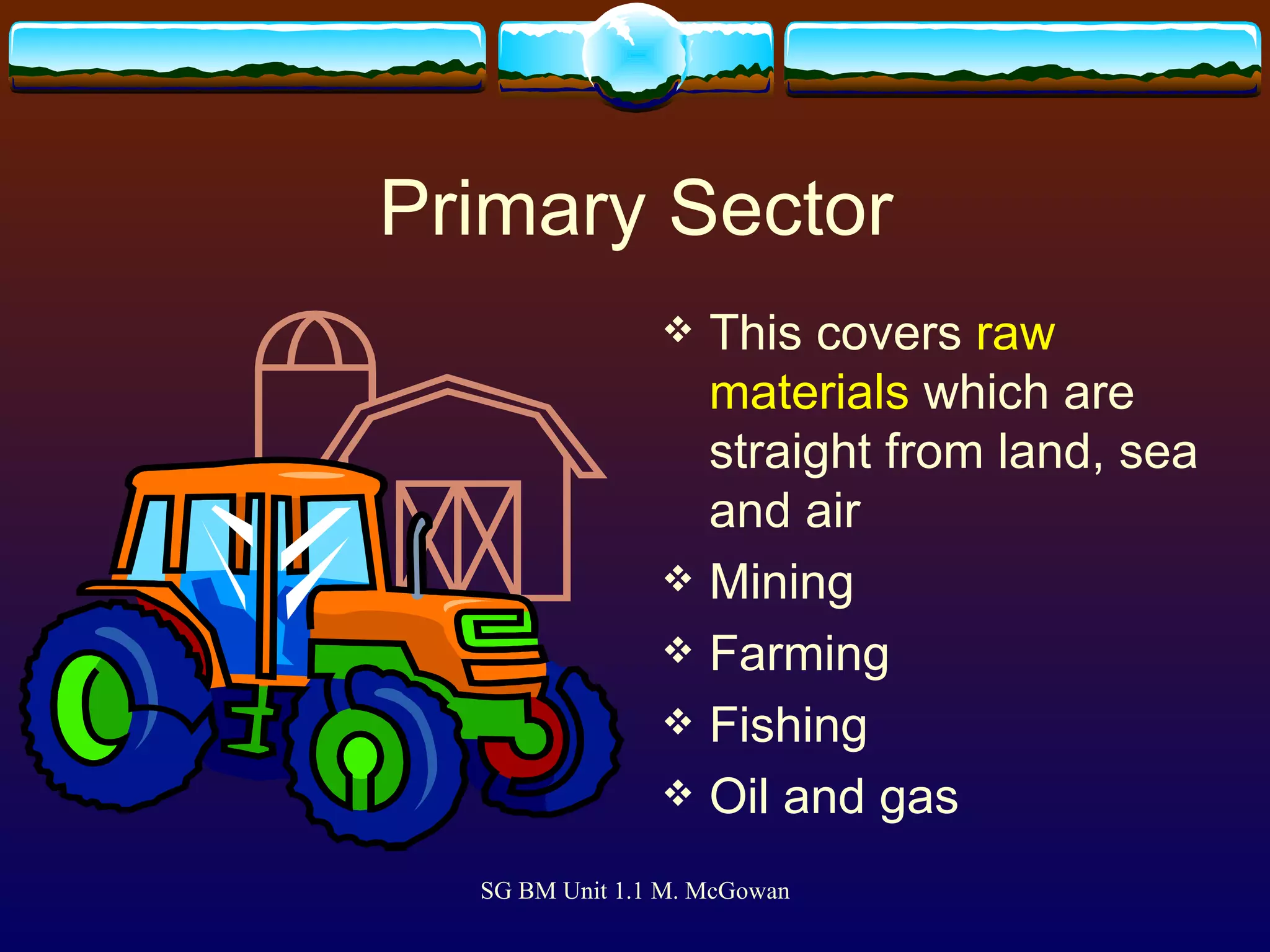
Primary Sector This covers  raw materials  which are straight from land, sea and air Mining Farming  Fishing Oil and gas
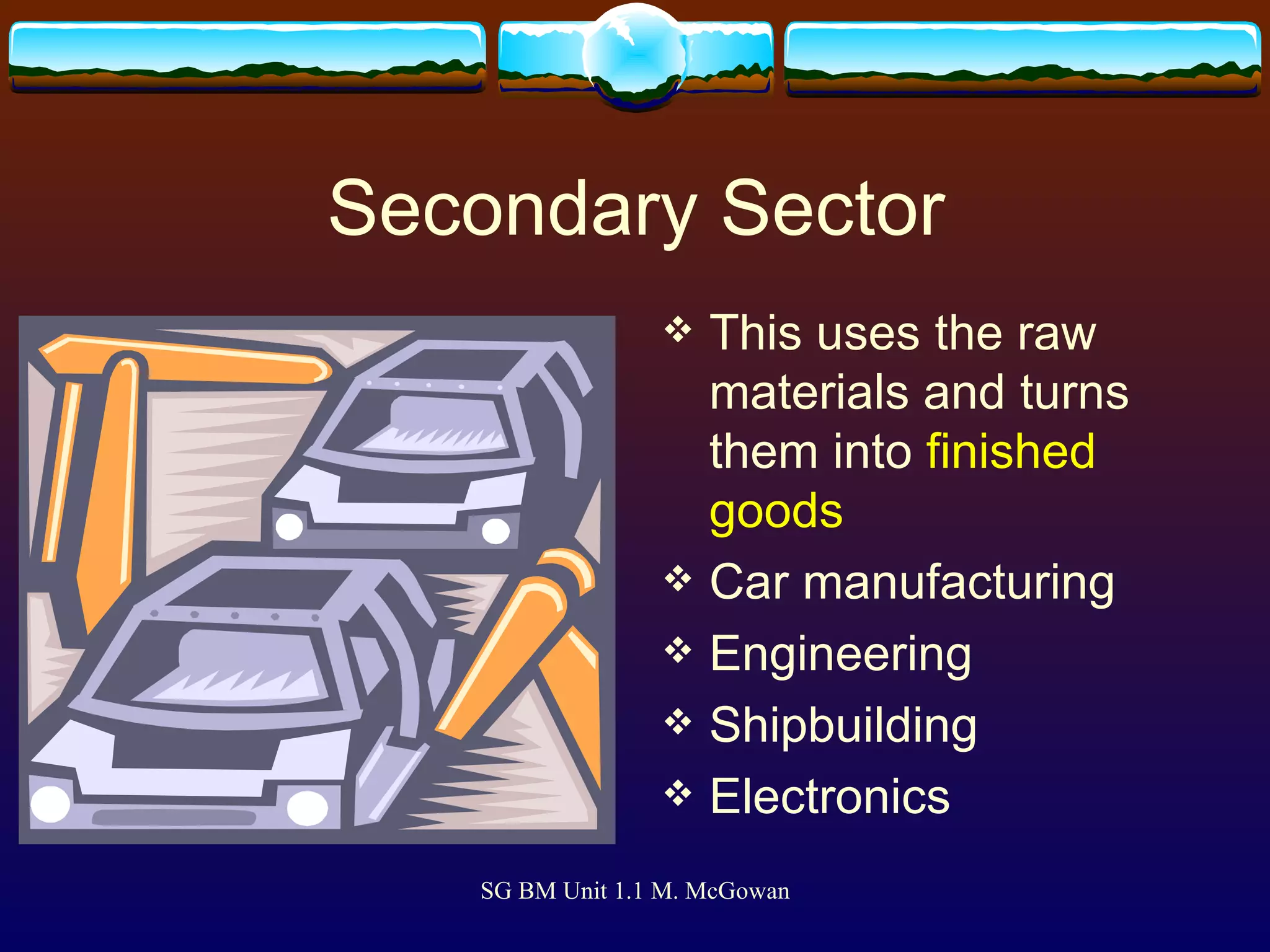
Secondary Sector This uses the raw materials and turns them into  finished goods Car manufacturing Engineering Shipbuilding Electronics
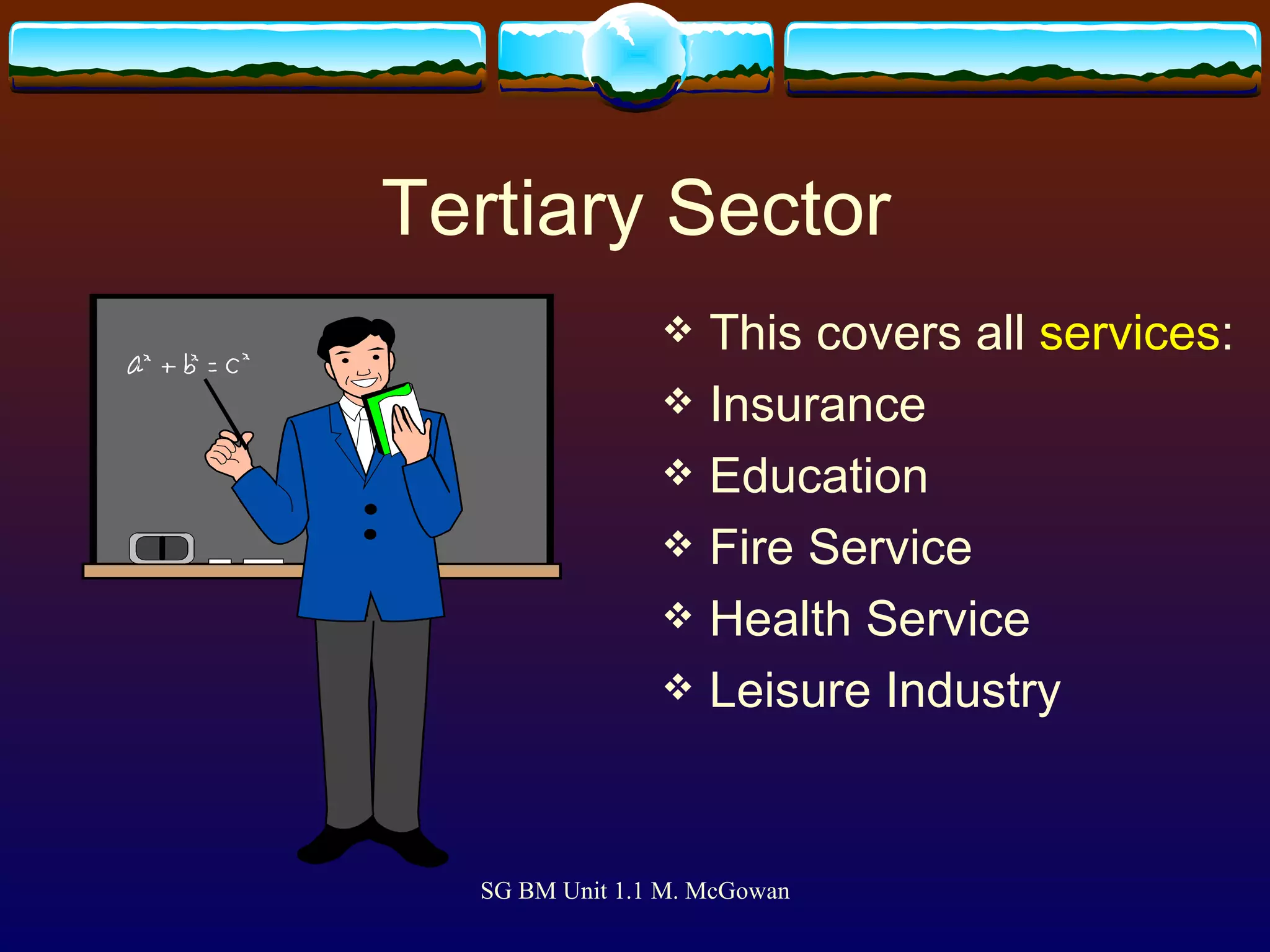
Tertiary Sector This covers all  services : Insurance Education Fire Service Health Service Leisure Industry
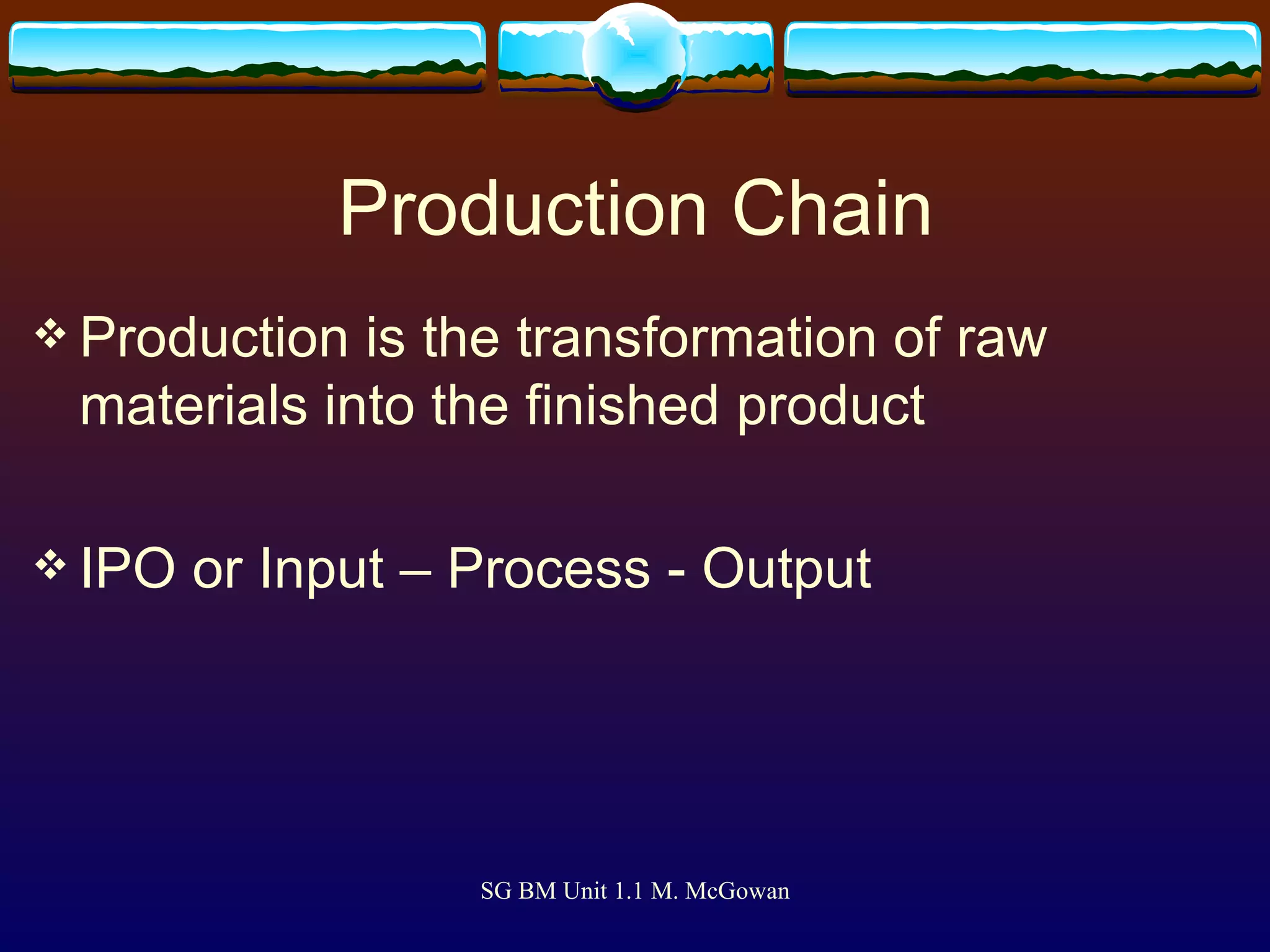
Production Chain Production is the transformation of raw materials into the finished product IPO or Input – Process - Output
Creating Wealth Wealth is created by  adding value   to each stage of the production process Selling Price = Cost of materials + Value

Unit 1.1 Slides

  • 1.
    Unit 1.1 Whatdo businesses do?
  • 2.
    Needs and WantsA Need is a basic thing humans have to have in order to survive. I.e. Food, water, shelter and clothes are all needs. A Want is something extra we would like to have. They can be luxuries or time saving devices. Cars, mobile phones, computers and CDs are all wants
  • 3.
    Goods and ServicesA Good is something you can touch and feel. Goods can be non-durable, durable or industrial A Service is provided by someone else. A service is non-physical. Hairdryer is a good. A Hairdresser is a service.
  • 4.
    Business Size Small Medium Large
  • 5.
    Business Size Employees:250 + Employees: 50-250 Employees: <= 50 Sells locally, nationally and internationally Reaches locally and/or nationally Sells goods locally Owned by shareholders; run by directors Owned by a group of people Owned by sole trader or partnership Large Business Medium-Sized Business Small Business
  • 6.
    Business Sectors PrivateSector Public Sector Voluntary Sector
  • 7.
    Private Sector Businessesdriven by profit. That profit only benefits the owners and investors. Financed by private money from shareholders and bank loans
  • 8.
    Public Sector Providegoods and services for the benefit of the community Run by the Government. Public money from taxes
  • 9.
    Voluntary Sector Notdriven by profit but by need to help parts of the community Money from donations and gifts
  • 10.
    Types of OwnershipSole Trader Partnership Private Limited Company Public Limited Company Franchise Co-operative Government-Owned
  • 11.
    Sole Trader ASole Trader is a business owned by one person. Some examples are: Mechanic Butcher Hairdresser Hot Dog Vendor
  • 12.
    Features of SoleTrader One man/woman business Sole Trader owns business. Owner and business are the same Owner provides own capital (savings & borrowings) Profits go to the owner but responsible for losses (Unlimited liability) Owner controls business, all decisions are theirs
  • 13.
    Sole Trader AdvantagesOwner has total control Owner keeps all profits Owner has better job satisfaction Disadvantages Unlimited liability Hard to raise capital Owner is responsible High failure rate
  • 14.
    Partnership Business ownedby 2-20 people Examples: Doctor Dentist Lawyer Accountants
  • 15.
    Features of PartnershipA business owned by several people 2-20 Deed of Partnership – contract dealing with share of profits, roles and duties, capital contributed, dispute procedures Owned jointly but not always equally Partnership is an extension of sole trader Capital provided by partners Profit goes to partners, not always equally All partners entitled to participate in management (unless silent partners )
  • 16.
    Partnership Advantages Ableto specialise Do not have total responsibility More ideas More money Can borrow more money easier Disadvantages Unlimited liability Risk of conflict
  • 17.
    Private Limited CompanyShareholders – a part-owner of a business. Limited liability – shareholders are only liable for debts equal to value of their shares. Dividends – the share of profits received by shareholders
  • 18.
    Features of PrivateLimited Companies Organisation owned by a group of individuals Memorandum/Articles of Association Owned by Shareholders (usually family) whose main function is to elect Board of Directors Money raised by share issue or borrowing Ordinary Shares & Preference Shares Profit shared between shareholders or retained by company
  • 19.
    Private Limited CompanyAdvantages Company is a legal entity Easy to raise capital Limited liability Company keeps going regardless of changes in personnel Disadvantages Complicated rules to set-up business Audited accounts need to be made public
  • 20.
    Public Limited CompanyHas plc after the name Limited liability Minimum £50,000 share capital Shares sold by banks and stockbrokers Shares can be offered to general public Private limited companies become PLCs to raise money for expansion
  • 21.
    Features of plcsOrg. owned by a group of individuals, has plc after name Certificate of Incorporation approved by Registrar of Companies Shareholders 2+. Shares sold on stock exchange. Prospectus prepared to attract shareholders Capital raised by share issue or borrowing Profits shared between shareholders or retained by company Board of Directors = Divorce of ownership and control
  • 22.
    Advantages & Disadvantagesof PLCs Advantages Shareholders limited liability Sale of shares raises money Shareholders recoup money by selling shares Directors may be experts in their field Disadvantages Number of legal requirements Company accounts made public Directors report to shareholders at AGMs
  • 23.
    Charities A charityis an organisation set up to raise funds to help other people or causes. Charities have to register and publish their accounts. Unlike voluntary organisations, charities employ managers and workers. Cancer Research, Save the Children and Oxfam are well known charities.
  • 24.
    Charities Advantages Ifcharity has status of charitable trust it doesn’t pay tax   Looks after less privileged and the environment Disadvantages Less money may be donated due to introduction of lottery Relies on voluntary workers who may not be paid for work
  • 25.
    Franchise A franchiseis a business marriage between an existing business and a newcomer The franchisee buys permission to copy the business idea of the established company McDonald’s is a franchise
  • 26.
    Franchise Advantages Franchisorprovides a lot of support; training to start business, equipment, materials, advice, brand name Take over a successful, winning formula Disadvantages Franchisee doesn’t have complete freedom May not agree with decision placed upon you
  • 27.
    Co-operative A co-operativeis a business owned and operated by its workers
  • 28.
    Co-operative Advantages Membersin control Members have interest in business doing well Members share profits Disadvantages New workers need to buy shares Often pressured to sell if successful Need new workers to expand
  • 29.
    Government Owned CentralLocal Public Corporations
  • 30.
    Central Government AdvantagesShareholders limited liability Easy to raise finance Disadvantages Expensive to set up Accounts need to be made public Provides services to public for nothing or a fee. NHS is paid for by tax ( income tax , VAT, National Insurance )
  • 31.
    Local Government AdvantagesIn touch with local needs Disadvantages Can be politically driven Run by local councils providing a variety of vital services to the area ( police, fire, roads, libraries ). Can be done by local council or contracted out .
  • 32.
    Public Corporations Setup by an Act of Parliament and directors appointed by the Government. Very rare. ( BBC, Post Office, Bank of England)
  • 33.
    Public Sector OrganisationsBusinesses set up by an Act of Parliament Government provides capital through Treasury Govt. appoints Chairman and Board They may be natural monopolies May be unattractive to private sector due to enormous capital investment
  • 34.
    Public Corporations Reasonsfor being set-up: To avoid wasteful duplication and confusion To set up and run important non-profitable services To prevent exploitation of consumers To protect jobs and key industries
  • 35.
    Privatisation The sellingoff of Public Corporations to the private sector Why Privatise? To improve efficiency by introducing competition Shareholders in Modern Society Privatisation raises huge monies for government
  • 36.
    Factors of ProductionLand – all natural resources used in production Labour – all people used in production Capital - all items used to make other things in production Enterprise – the art of bringing together the other factors of production and being successful
  • 37.
    Types of ProductionPrimary Secondary Tertiary
  • 38.
    Primary Sector Thiscovers raw materials which are straight from land, sea and air Mining Farming Fishing Oil and gas
  • 39.
    Secondary Sector Thisuses the raw materials and turns them into finished goods Car manufacturing Engineering Shipbuilding Electronics
  • 40.
    Tertiary Sector Thiscovers all services : Insurance Education Fire Service Health Service Leisure Industry
  • 41.
    Production Chain Productionis the transformation of raw materials into the finished product IPO or Input – Process - Output
  • 42.
    Creating Wealth Wealthis created by adding value to each stage of the production process Selling Price = Cost of materials + Value