Forms of Business Ownership Chapter 5 Chapter 5: Forms of Ownership
Choosing a Form of Ownership There is no one “best” form of ownership. The best form of ownership depends on an entrepreneur’s particular situation. Key: Understanding the characteristics of each form of ownership and how well they match an entrepreneur’s business and personal circumstances.
Factors Affecting the Choice Tax considerations Liability exposure Start-up and future capital requirements Control Managerial ability Business goals Management succession plans Cost of formation
Major Forms of Ownership Sole Proprietorship Partnership Corporation S Corporation Limited Liability Company Joint Venture
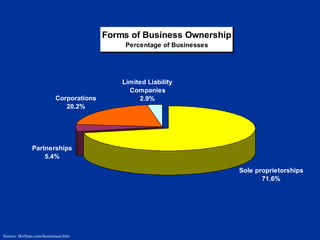
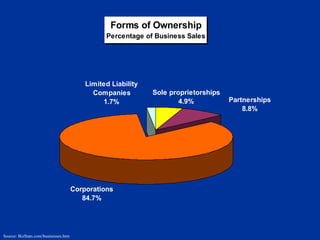
Source: BizStats.com/businesses.htm
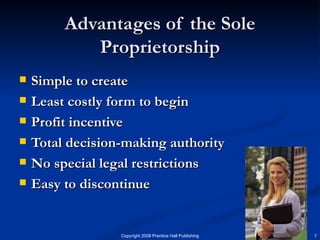
Advantages of the Sole Proprietorship Simple to create Least costly form to begin Profit incentive Total decision-making authority No special legal restrictions Easy to discontinue
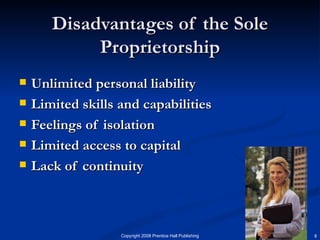
Disadvantages of the Sole Proprietorship Unlimited personal liability Limited skills and capabilities Feelings of isolation Limited access to capital Lack of continuity
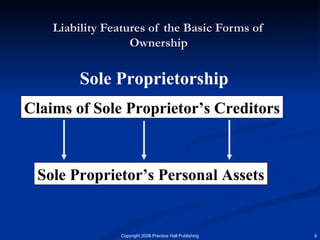
Liability Features of the Basic Forms of Ownership Sole Proprietorship Claims of Sole Proprietor’s Creditors Sole Proprietor’s Personal Assets
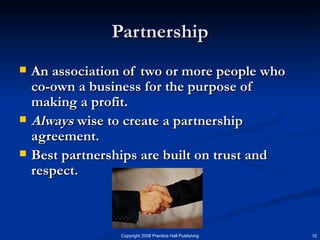
Partnership An association of two or more people who co-own a business for the purpose of making a profit. Always  wise to create a partnership agreement. Best partnerships are built on trust and respect.
Advantages of the Partnership Easy to establish Complementary skills of partners Division of profits Larger pool of capital Ability to attract limited partners
Types of Partners General partners Take an active role in managing a business. Have unlimited liability for the partnership’s debts. Every partnership must have at least one general partner. Limited partners Cannot participate in the day-to-day management of a company.  Have limited liability for the partnership’s debts.
Advantages of the Partnership Easy to establish Complementary skills of partners Division of profits Larger pool of capital Ability to attract limited partners Little government regulation Flexibility Taxation
Disadvantages of the Partnership Unlimited liability of at least one partner Capital accumulation Difficulty in disposing of partnership interest Lack of continuity Potential for personality and authority conflicts Partners bound by law of agency
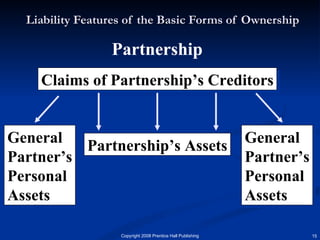
Liability Features of the Basic Forms of Ownership Partnership Claims of Partnership’s Creditors Partnership’s Assets General Partner’s Personal Assets General Partner’s Personal Assets
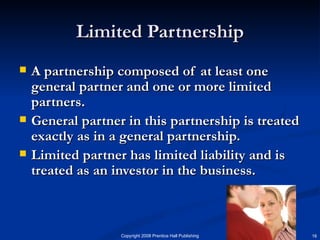
Limited Partnership A partnership composed of at least one general partner and one or more limited partners. General partner in this partnership is treated exactly as in a general partnership. Limited partner has limited liability and is treated as an investor in the business.
Corporation A separate legal entity from its owners. Types of corporations: Domestic  – a corporation doing business in the state in which it is incorporated. Foreign  – a corporation doing business in a state other than the state in which it is incorporated.  Alien  – a corporation formed in another country but doing business in the United States.
Corporation Types of corporations: Publicly held  – a corporation that has a large number of shareholders and whose stock usually is traded on one of the large stock exchanges. Closely held  – a corporation in which shares are controlled by a relatively small number of people, often family members, relatives, or friends.
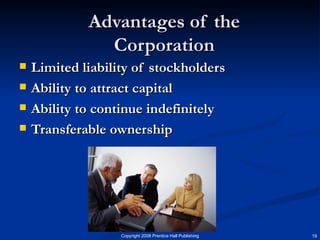
Advantages of the Corporation Limited liability of stockholders Ability to attract capital Ability to continue indefinitely Transferable ownership
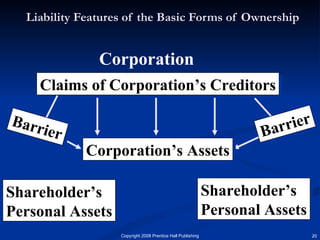
Liability Features of the Basic Forms of Ownership Corporation Claims of Corporation’s Creditors Corporation’s Assets Shareholder’s Personal Assets Shareholder’s Personal Assets Barrier Barrier
Disadvantages of the Corporation Cost and time of incorporating Double taxation Potential for diminished managerial incentives Legal requirements and regulatory “red tape” Potential loss of control by founder(s)
S Corporation No different from any other corporation from a legal perspective. For tax purposes, however, an S corporation is taxed like a partnership, passing all of its profits (or losses) through to individual shareholders. To elect “S” status, all shareholders must consent, and the corporation must file with the IRS within the first 75 days of its tax year.
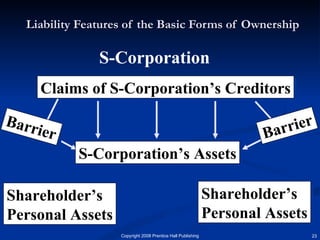
Liability Features of the Basic Forms of Ownership S-Corporation Claims of S-Corporation’s Creditors S-Corporation’s Assets Shareholder’s Personal Assets Shareholder’s Personal Assets Barrier Barrier
Limited Liability Company (LLC) Resembles an S corporation but is  not  subject to the same restrictions. Two documents required:  Articles of organization Operating agreement
Limited Liability Company (LLC) An LLC cannot have more than  two  of these four corporate characteristics: Limited liability Continuity of life Free transferability of interest Centralized management
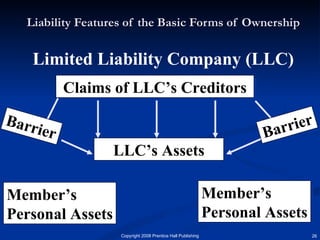
Liability Features of the Basic Forms of Ownership Limited Liability Company (LLC) Claims of LLC’s Creditors  LLC’s Assets  Member’s Personal Assets Member’s Personal Assets Barrier Barrier

Chapter 5

  • 1.
    Forms of BusinessOwnership Chapter 5 Chapter 5: Forms of Ownership
  • 2.
    Choosing a Formof Ownership There is no one “best” form of ownership. The best form of ownership depends on an entrepreneur’s particular situation. Key: Understanding the characteristics of each form of ownership and how well they match an entrepreneur’s business and personal circumstances.
  • 3.
    Factors Affecting theChoice Tax considerations Liability exposure Start-up and future capital requirements Control Managerial ability Business goals Management succession plans Cost of formation
  • 4.
    Major Forms ofOwnership Sole Proprietorship Partnership Corporation S Corporation Limited Liability Company Joint Venture
  • 5.
  • 6.
  • 7.
    Advantages of theSole Proprietorship Simple to create Least costly form to begin Profit incentive Total decision-making authority No special legal restrictions Easy to discontinue
  • 8.
    Disadvantages of theSole Proprietorship Unlimited personal liability Limited skills and capabilities Feelings of isolation Limited access to capital Lack of continuity
  • 9.
    Liability Features ofthe Basic Forms of Ownership Sole Proprietorship Claims of Sole Proprietor’s Creditors Sole Proprietor’s Personal Assets
  • 10.
    Partnership An associationof two or more people who co-own a business for the purpose of making a profit. Always wise to create a partnership agreement. Best partnerships are built on trust and respect.
  • 11.
    Advantages of thePartnership Easy to establish Complementary skills of partners Division of profits Larger pool of capital Ability to attract limited partners
  • 12.
    Types of PartnersGeneral partners Take an active role in managing a business. Have unlimited liability for the partnership’s debts. Every partnership must have at least one general partner. Limited partners Cannot participate in the day-to-day management of a company. Have limited liability for the partnership’s debts.
  • 13.
    Advantages of thePartnership Easy to establish Complementary skills of partners Division of profits Larger pool of capital Ability to attract limited partners Little government regulation Flexibility Taxation
  • 14.
    Disadvantages of thePartnership Unlimited liability of at least one partner Capital accumulation Difficulty in disposing of partnership interest Lack of continuity Potential for personality and authority conflicts Partners bound by law of agency
  • 15.
    Liability Features ofthe Basic Forms of Ownership Partnership Claims of Partnership’s Creditors Partnership’s Assets General Partner’s Personal Assets General Partner’s Personal Assets
  • 16.
    Limited Partnership Apartnership composed of at least one general partner and one or more limited partners. General partner in this partnership is treated exactly as in a general partnership. Limited partner has limited liability and is treated as an investor in the business.
  • 17.
    Corporation A separatelegal entity from its owners. Types of corporations: Domestic – a corporation doing business in the state in which it is incorporated. Foreign – a corporation doing business in a state other than the state in which it is incorporated. Alien – a corporation formed in another country but doing business in the United States.
  • 18.
    Corporation Types ofcorporations: Publicly held – a corporation that has a large number of shareholders and whose stock usually is traded on one of the large stock exchanges. Closely held – a corporation in which shares are controlled by a relatively small number of people, often family members, relatives, or friends.
  • 19.
    Advantages of theCorporation Limited liability of stockholders Ability to attract capital Ability to continue indefinitely Transferable ownership
  • 20.
    Liability Features ofthe Basic Forms of Ownership Corporation Claims of Corporation’s Creditors Corporation’s Assets Shareholder’s Personal Assets Shareholder’s Personal Assets Barrier Barrier
  • 21.
    Disadvantages of theCorporation Cost and time of incorporating Double taxation Potential for diminished managerial incentives Legal requirements and regulatory “red tape” Potential loss of control by founder(s)
  • 22.
    S Corporation Nodifferent from any other corporation from a legal perspective. For tax purposes, however, an S corporation is taxed like a partnership, passing all of its profits (or losses) through to individual shareholders. To elect “S” status, all shareholders must consent, and the corporation must file with the IRS within the first 75 days of its tax year.
  • 23.
    Liability Features ofthe Basic Forms of Ownership S-Corporation Claims of S-Corporation’s Creditors S-Corporation’s Assets Shareholder’s Personal Assets Shareholder’s Personal Assets Barrier Barrier
  • 24.
    Limited Liability Company(LLC) Resembles an S corporation but is not subject to the same restrictions. Two documents required: Articles of organization Operating agreement
  • 25.
    Limited Liability Company(LLC) An LLC cannot have more than two of these four corporate characteristics: Limited liability Continuity of life Free transferability of interest Centralized management
  • 26.
    Liability Features ofthe Basic Forms of Ownership Limited Liability Company (LLC) Claims of LLC’s Creditors LLC’s Assets Member’s Personal Assets Member’s Personal Assets Barrier Barrier

Editor's Notes

  • #2 This "Deco" border was drawn on the Slide master using PowerPoint's Rectangle and Line tools. A smaller version was placed on the Notes Master by selecting all of the elements (using Select All from the Edit menu), deselecting the unwanted elements such as the Title (holding down the Shift key and clicking on the unwanted elements), and then using Paste as Picture from the Edit menu to place the border on the Notes Master. After pasting as a picture, we used the resize handles (with Shift to maintain the proportions) to reduce it to the size you see. Be sure to delete this word processing box before using this template for your own presentation.