Business Organization
Survey Monkey
https://www.surveymonkey.com/
s/3SRZ9L6
Have you ever thought about starting
your own business? If you were your
own boss, what type of business could
you see yourself running 5, 10 ,15
years from now?
Sole Proprietorship
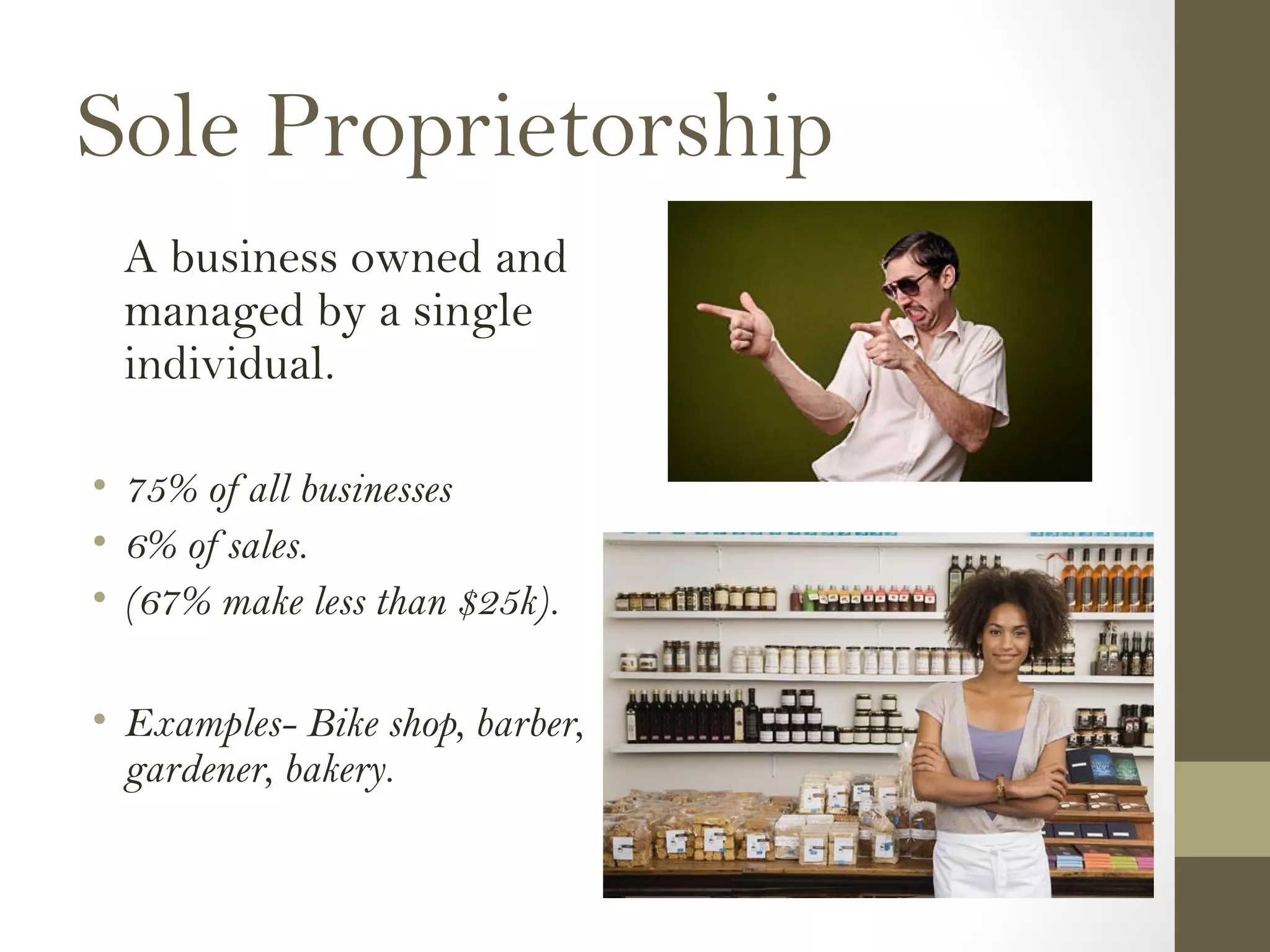
A business owned and
managed by a single
individual.
• 75% of all businesses
• 6% of sales.
• (67% make less than $25k).
• Examples- Bike shop, barber,
gardener, bakery.
Sole Proprietorship
Positive
•Full control.
•Start-up costs low (business license).
•Relatively few regulations.
•Full receiver of profits.
•Taxation.
•Easy to discontinue.
Sole Proprietorship
Negative
• Unlimited liability.
• Limited capital ($) for expansion.
• Lack of permanence.
Partnerships
A business organization owned by
two or more persons.
• 7% of all businesses.
• 5% of all sales.
*General v. Limited Partnerships or
(LLP).
• Examples- Doctor, Lawyer, Accountant.
Partnerships
Positive
• Low start-up costs
• Shared decision making.
• Specialization/complimentary qualities.
• Larger pool of assets = expansion.
• Taxation.
Partnerships
Negative
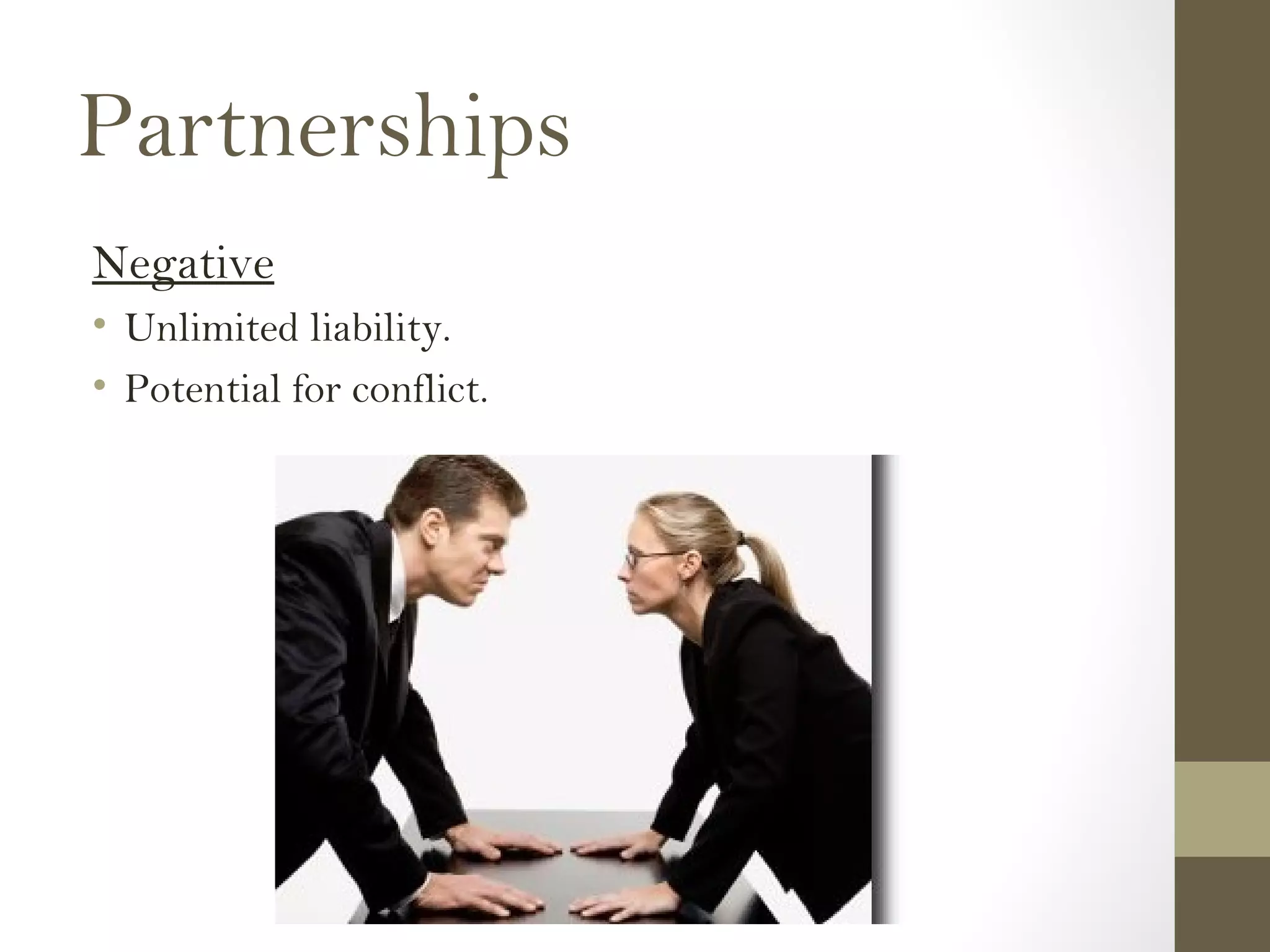
• Unlimited liability.
• Potential for conflict.
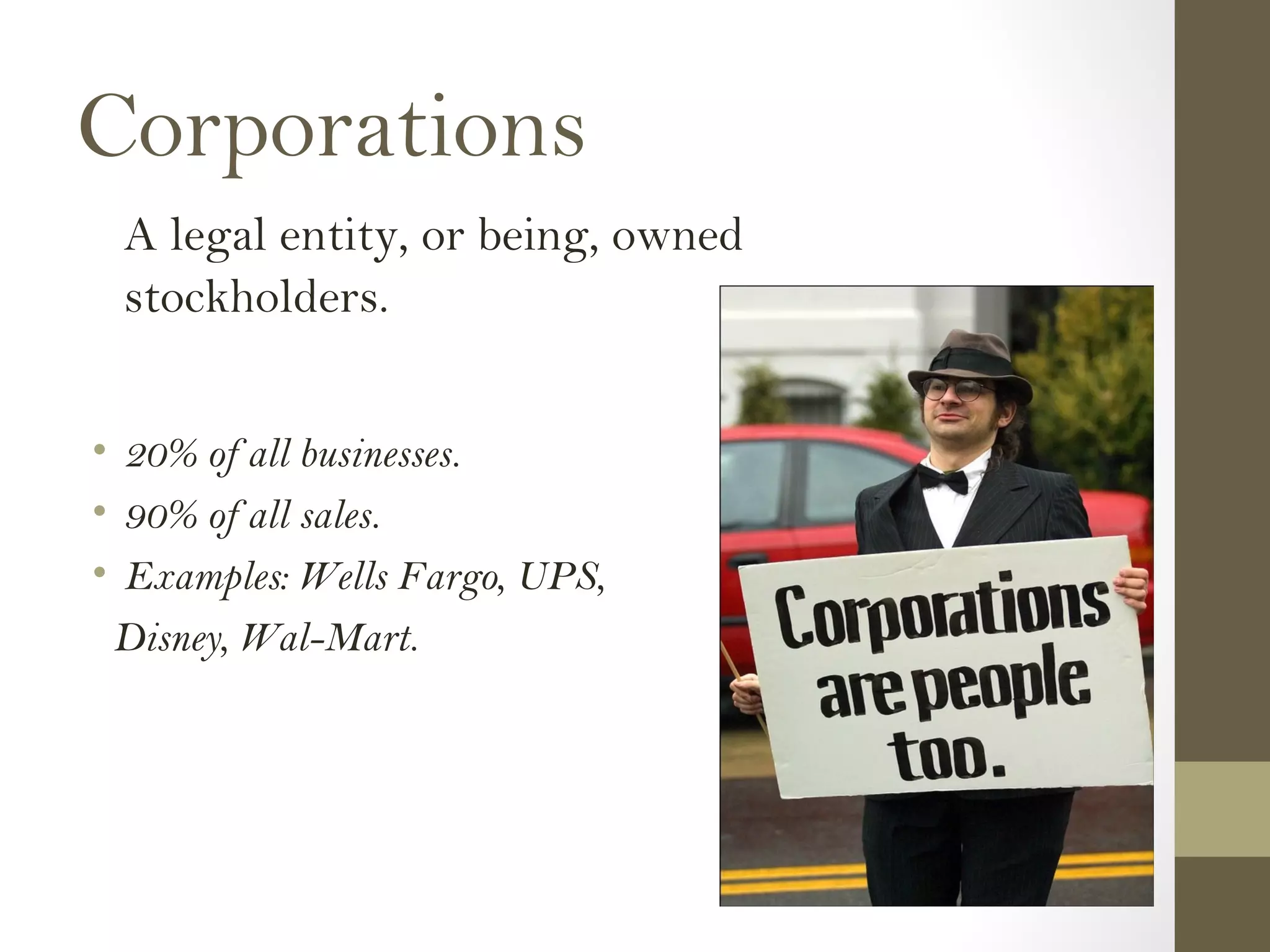
Corporations
A legal entity, or being, owned
stockholders.
• 20% of all businesses.
• 90% of all sales.
• Examples: Wells Fargo, UPS,
Disney, Wal-Mart.
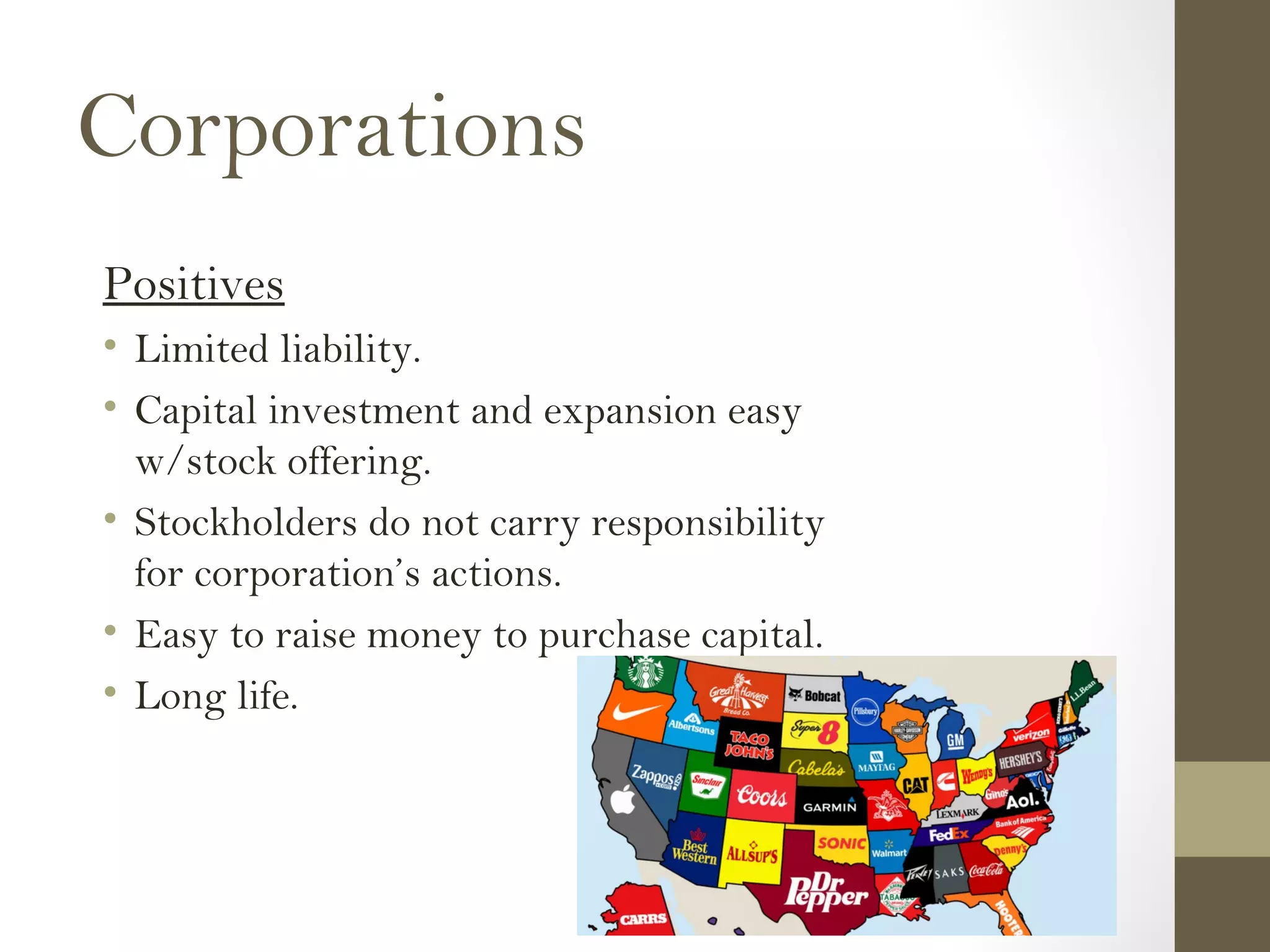
Corporations
Positives
• Limited liability.
• Capital investment and expansion easy
w/stock offering.
• Stockholders do not carry responsibility
for corporation’s actions.
• Easy to raise money to purchase capital.
• Long life.
Corporations
Negative
• Difficult and expense of start-up.
• Double taxation.
(Corporate and Individual)
• Loss of Control = Stockholders.
• More regulations.
Corporation Combinations
1. Horizontal Merger – The joining of two or more firms
competing in the same market with the same good or
service.
2. Vertical Merger – The joining of two or more firms
involved in different stages of producing the good or
service.
3. Conglomerate – The joining of companies that produce
entirely different products. (Remember Sara Lee?)
Franchise
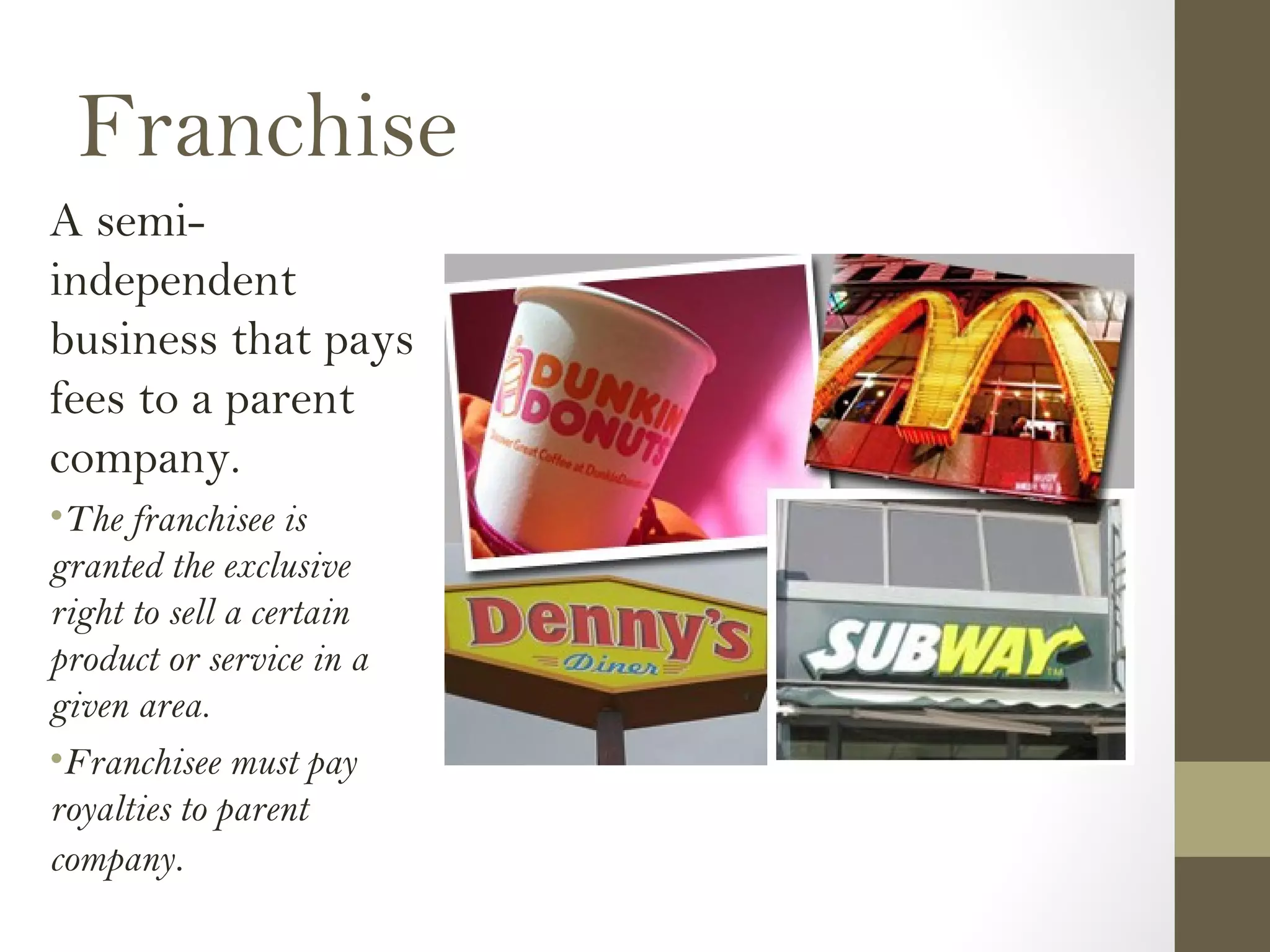
A semi-
independent
business that pays
fees to a parent
company.
•The franchisee is
granted the exclusive
right to sell a certain
product or service in a
given area.
•Franchisee must pay
royalties to parent
company.
Franchise
Positives
• Built-in reputation/brand recognition.
• Management and training support.
• Standardized quality.
• National advertising.
• Buying power.
Franchise
Negatives
• High franchise/royalty fees
• Strict operating standards.
• Purchasing restrictions.
• Limited product line.
Match the Characteristics
• Unlimited Liability
• Limited Liability for
Investors
• Articles of Partnership
• Few Government
Regulations
• Must Issue Stock
• Articles of Incorporation
• Recognizable Brand
• Long Work Hours
• Stricter Regulations
• Needs Accurate Tax &
Employee Records
• Use of Personal Savings
and Investments
• Board of Directors
• Can Be a Hybrid
• Lasts for a Fixed Period of
Time (5-30 years)
• Life of Partnership
Limited
• Documents of Disclosure
• Secure Financing More
Easily
• Quick Start Up
• Complimentary Skills
• Royalty Fees
• Easy to Form
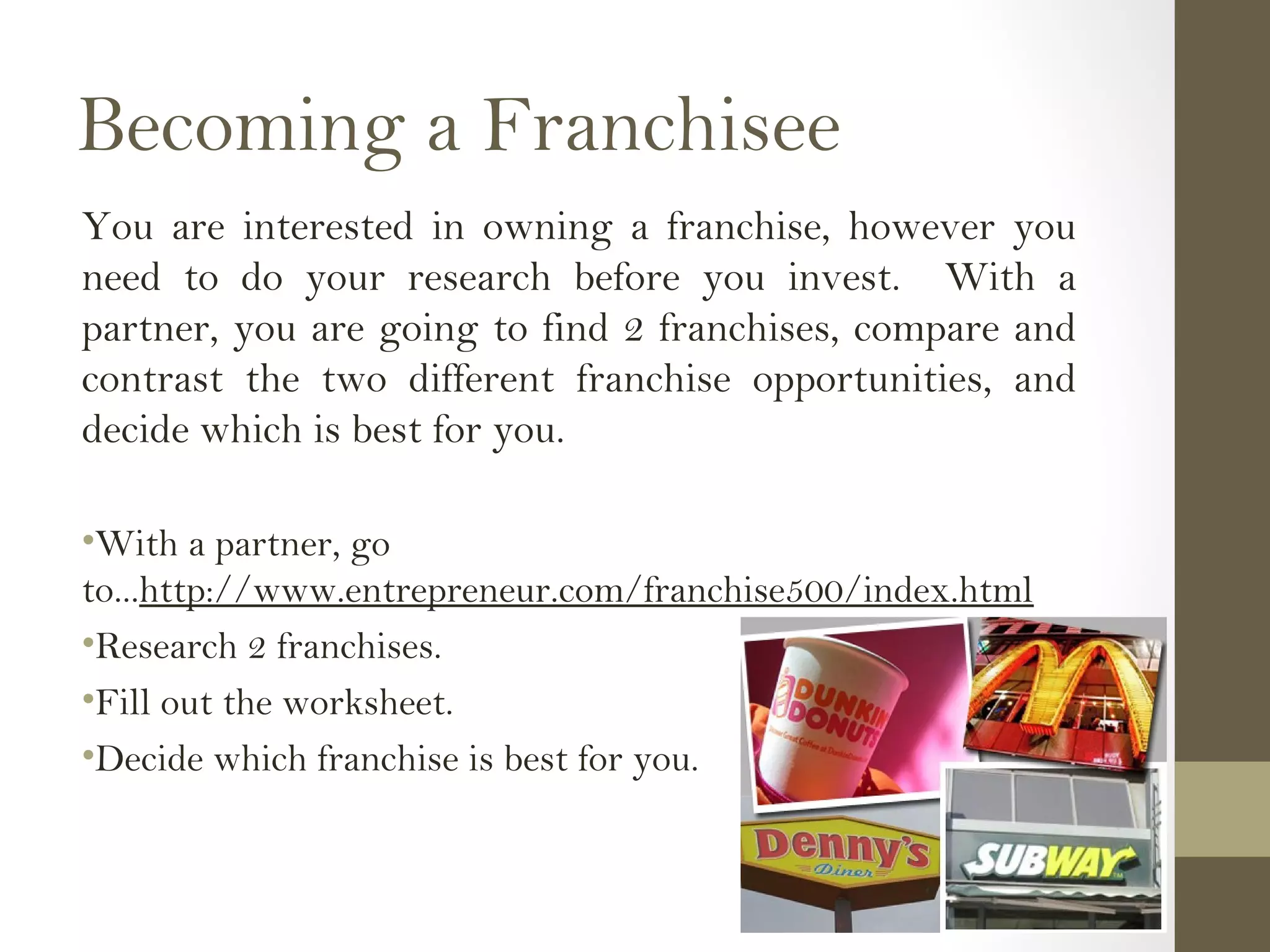
Becoming a Franchisee
You are interested in owning a franchise, however you
need to do your research before you invest. With a
partner, you are going to find 2 franchises, compare and
contrast the two different franchise opportunities, and
decide which is best for you.
•With a partner, go
to...http://www.entrepreneur.com/franchise500/index.html
•Research 2 franchises.
•Fill out the worksheet.
•Decide which franchise is best for you.

Lesson 1 business organization - power point - duke

  • 1.
  • 2.
  • 3.
    Have you everthought about starting your own business? If you were your own boss, what type of business could you see yourself running 5, 10 ,15 years from now?
  • 4.
    Sole Proprietorship A businessowned and managed by a single individual. • 75% of all businesses • 6% of sales. • (67% make less than $25k). • Examples- Bike shop, barber, gardener, bakery.
  • 5.
    Sole Proprietorship Positive •Full control. •Start-upcosts low (business license). •Relatively few regulations. •Full receiver of profits. •Taxation. •Easy to discontinue.
  • 6.
    Sole Proprietorship Negative • Unlimitedliability. • Limited capital ($) for expansion. • Lack of permanence.
  • 7.
    Partnerships A business organizationowned by two or more persons. • 7% of all businesses. • 5% of all sales. *General v. Limited Partnerships or (LLP). • Examples- Doctor, Lawyer, Accountant.
  • 8.
    Partnerships Positive • Low start-upcosts • Shared decision making. • Specialization/complimentary qualities. • Larger pool of assets = expansion. • Taxation.
  • 9.
  • 10.
    Corporations A legal entity,or being, owned stockholders. • 20% of all businesses. • 90% of all sales. • Examples: Wells Fargo, UPS, Disney, Wal-Mart.
  • 11.
    Corporations Positives • Limited liability. •Capital investment and expansion easy w/stock offering. • Stockholders do not carry responsibility for corporation’s actions. • Easy to raise money to purchase capital. • Long life.
  • 12.
    Corporations Negative • Difficult andexpense of start-up. • Double taxation. (Corporate and Individual) • Loss of Control = Stockholders. • More regulations.
  • 13.
    Corporation Combinations 1. HorizontalMerger – The joining of two or more firms competing in the same market with the same good or service. 2. Vertical Merger – The joining of two or more firms involved in different stages of producing the good or service. 3. Conglomerate – The joining of companies that produce entirely different products. (Remember Sara Lee?)
  • 14.
    Franchise A semi- independent business thatpays fees to a parent company. •The franchisee is granted the exclusive right to sell a certain product or service in a given area. •Franchisee must pay royalties to parent company.
  • 15.
    Franchise Positives • Built-in reputation/brandrecognition. • Management and training support. • Standardized quality. • National advertising. • Buying power.
  • 16.
    Franchise Negatives • High franchise/royaltyfees • Strict operating standards. • Purchasing restrictions. • Limited product line.
  • 17.
    Match the Characteristics •Unlimited Liability • Limited Liability for Investors • Articles of Partnership • Few Government Regulations • Must Issue Stock • Articles of Incorporation • Recognizable Brand • Long Work Hours • Stricter Regulations • Needs Accurate Tax & Employee Records • Use of Personal Savings and Investments • Board of Directors • Can Be a Hybrid • Lasts for a Fixed Period of Time (5-30 years) • Life of Partnership Limited • Documents of Disclosure • Secure Financing More Easily • Quick Start Up • Complimentary Skills • Royalty Fees • Easy to Form
  • 18.
    Becoming a Franchisee Youare interested in owning a franchise, however you need to do your research before you invest. With a partner, you are going to find 2 franchises, compare and contrast the two different franchise opportunities, and decide which is best for you. •With a partner, go to...http://www.entrepreneur.com/franchise500/index.html •Research 2 franchises. •Fill out the worksheet. •Decide which franchise is best for you.