Clinician-Centric Data
and AI Integration in
Healthcare
Abstract
Gain insights into the orchestration of data, knowledge and AI in support of decision-making in
healthcare.
We explore the thought processes of clinicians when accessing data for decision-making. We then
discuss concepts and semantic lifting using concept maps, highlighting the importance of context in
interpreting data. The session also covers structured data for FHIR interoperability through SDMN,
demonstrating the significance of data reuse and integration in healthcare.
By focusing on cleanliness and relevance, we examine the role of data in various AI approaches,
including machine learning and generative AI. This webinar aims to showcase how clean, well-
structured data can empower clinicians and improve patient outcomes.
Data in Healthcare
• Generally, when people talk about data in healthcare
they do so generically.
• There are many facets to data in Healthcare for
examples:
• The clinician's thought processes when using data
• Concepts and semantic lifting from data
• Structured data for Interoperability
• Data and AI
• We will explore these four particular facets in this
presentation.
There are many types of healthcare data:
• Structured
• Unstructured
• Time series
• Interdependent or relative data
• Raw or normalized
The clinician's
thought
processes when
using data
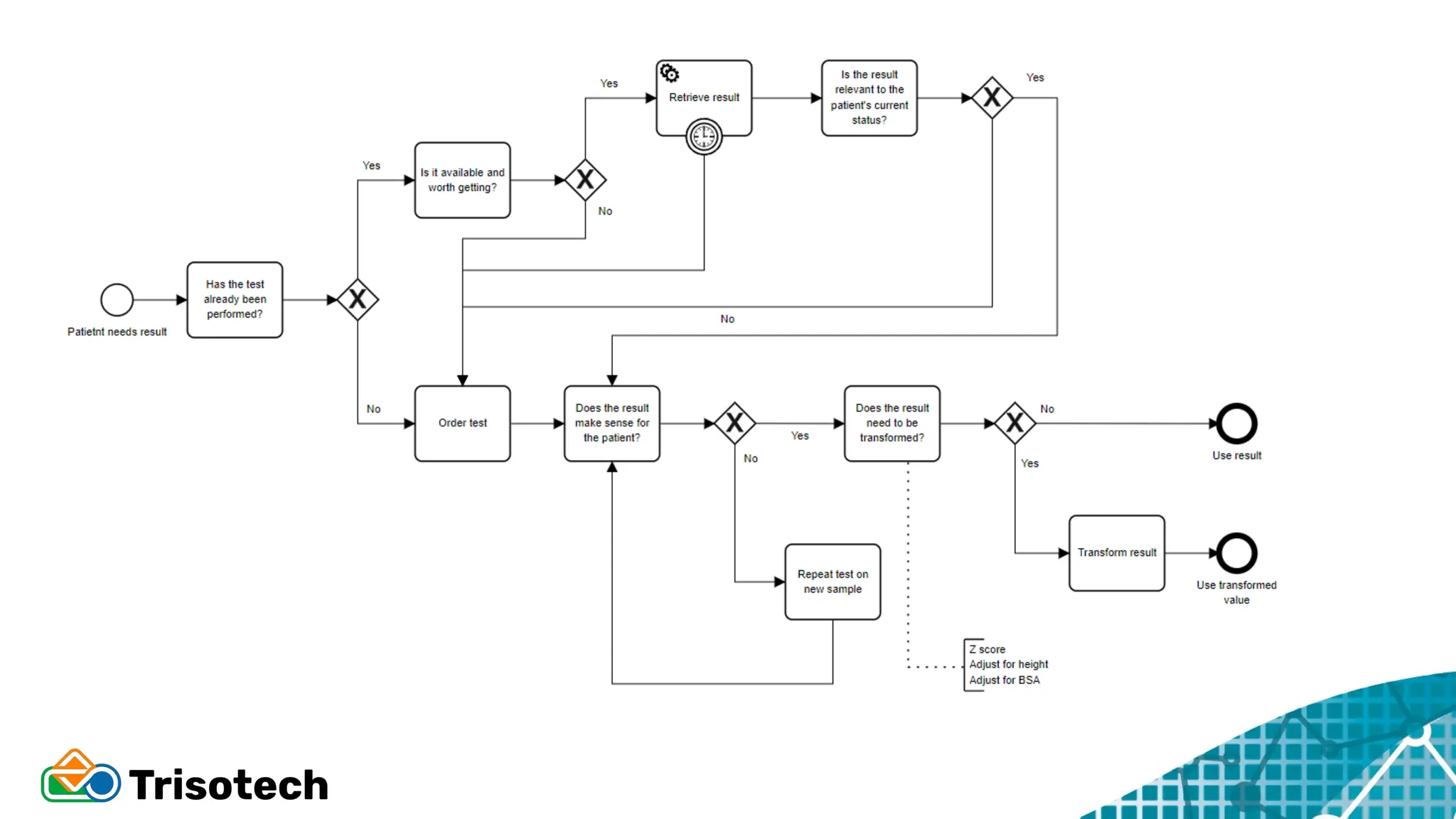
BPMN Notional model
Why is data relevant?
Everything in healthcare depends on data.
Clinicians look at data from a range of contexts:
• Diagnosis
• Determination of disease severity
• Prediction and prognosis
• Drug selection and dosing
• Tracking status over time
• Response to therapy
Questions that a provider may ask about data:
• What data do I need to meet my goal?
• Is the data available, and at what cost?
• Is the data relevant?
• Is the data valid, accurate and precise?
• Is the data consistent with the clinical status of the patient?
• Do I need to transform the data to make it more useful?
Concepts and
semantic lifting
from data
KEM and Concept Maps
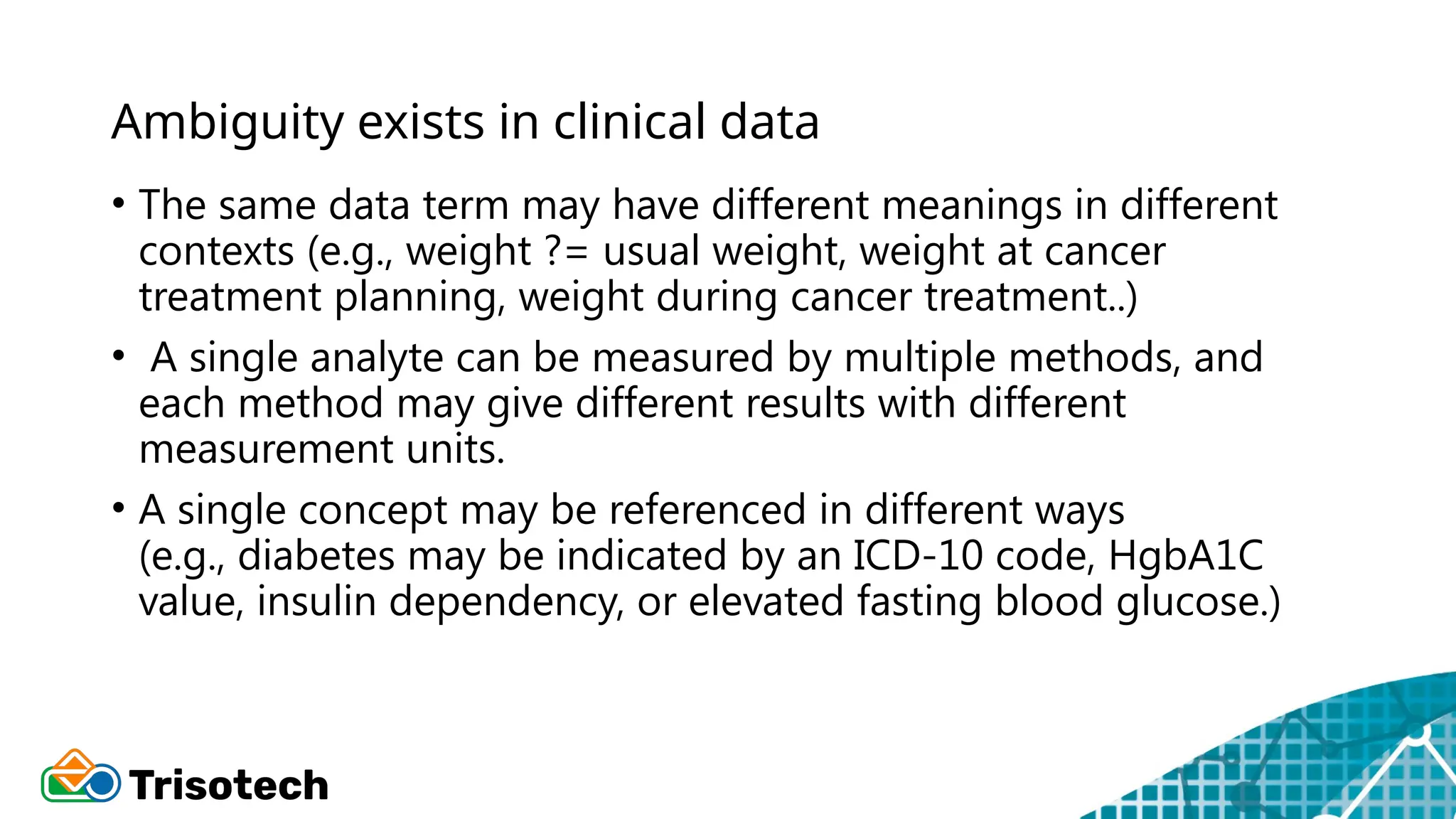
Ambiguity exists in clinical data
• The same data term may have different meanings in different
contexts (e.g., weight ?= usual weight, weight at cancer
treatment planning, weight during cancer treatment..)
• A single analyte can be measured by multiple methods, and
each method may give different results with different
measurement units.
• A single concept may be referenced in different ways
(e.g., diabetes may be indicated by an ICD-10 code, HgbA1C
value, insulin dependency, or elevated fasting blood glucose.)
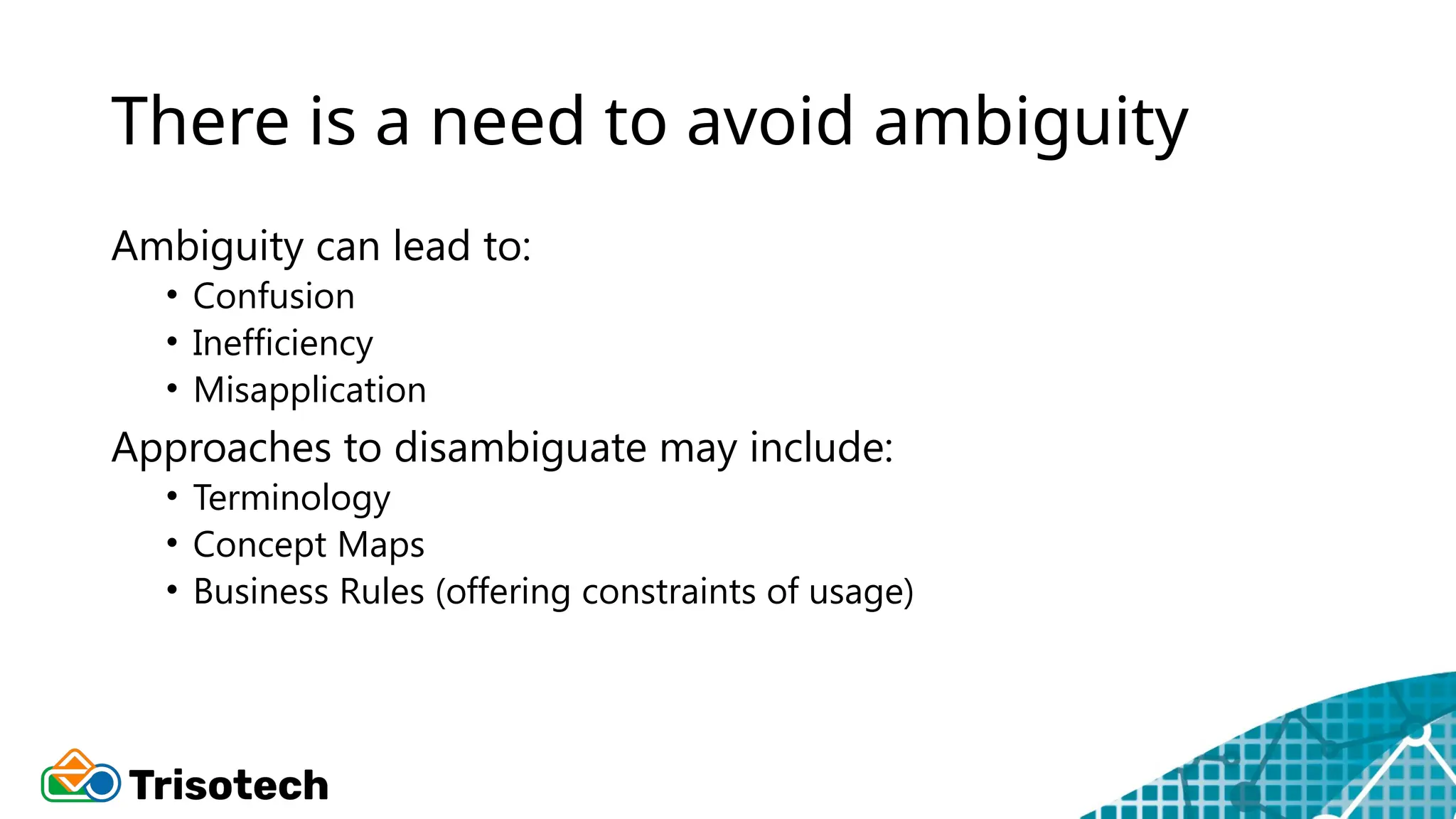
There is a need to avoid ambiguity
Ambiguity can lead to:
• Confusion
• Inefficiency
• Misapplication
Approaches to disambiguate may include:
• Terminology
• Concept Maps
• Business Rules (offering constraints of usage)
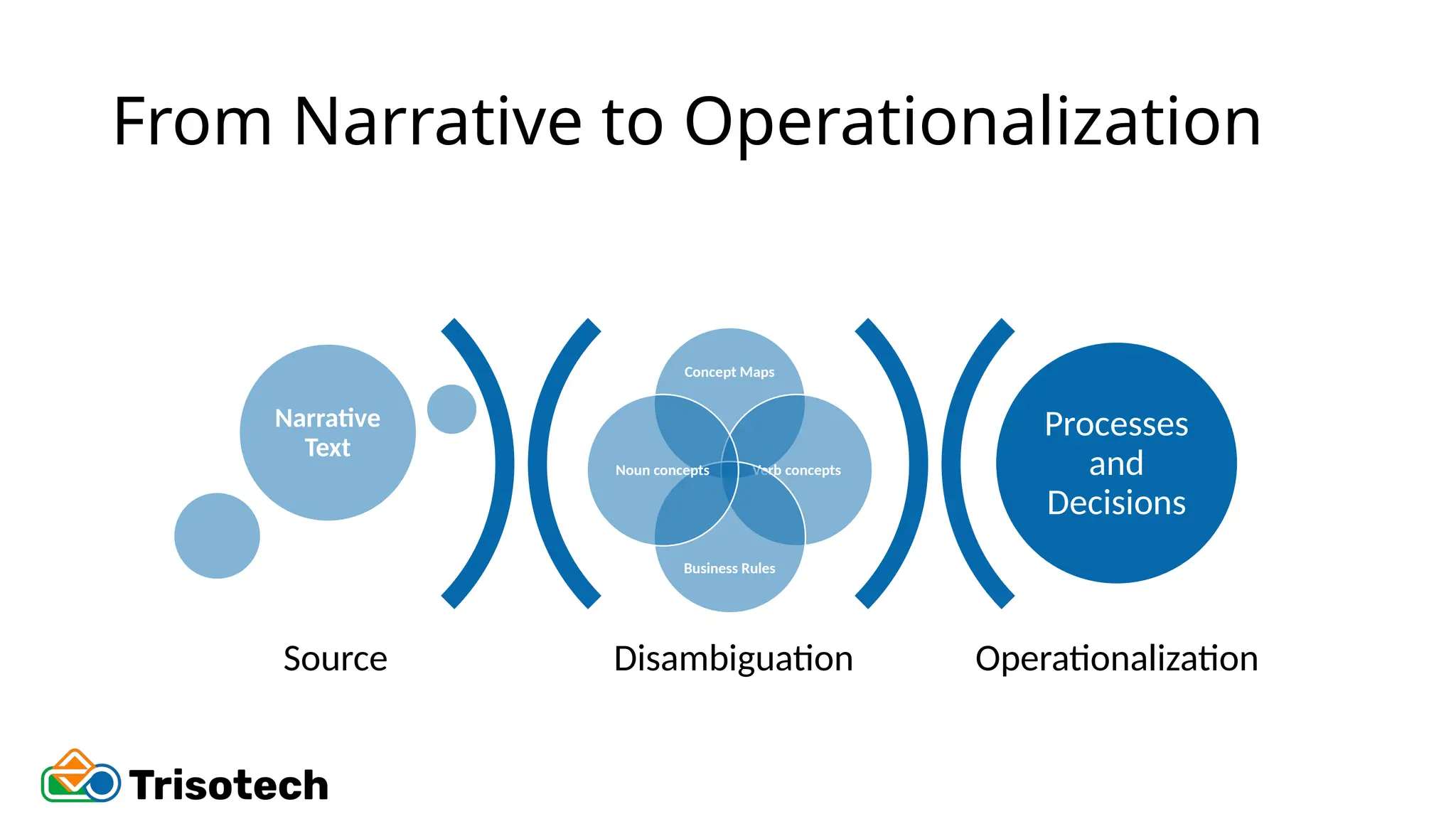
From Narrative to Operationalization
Disambiguation Operationalization
Concept Maps
Verb concepts
Business Rules
Noun concepts
Narrative
Text
Processes
and
Decisions
Source
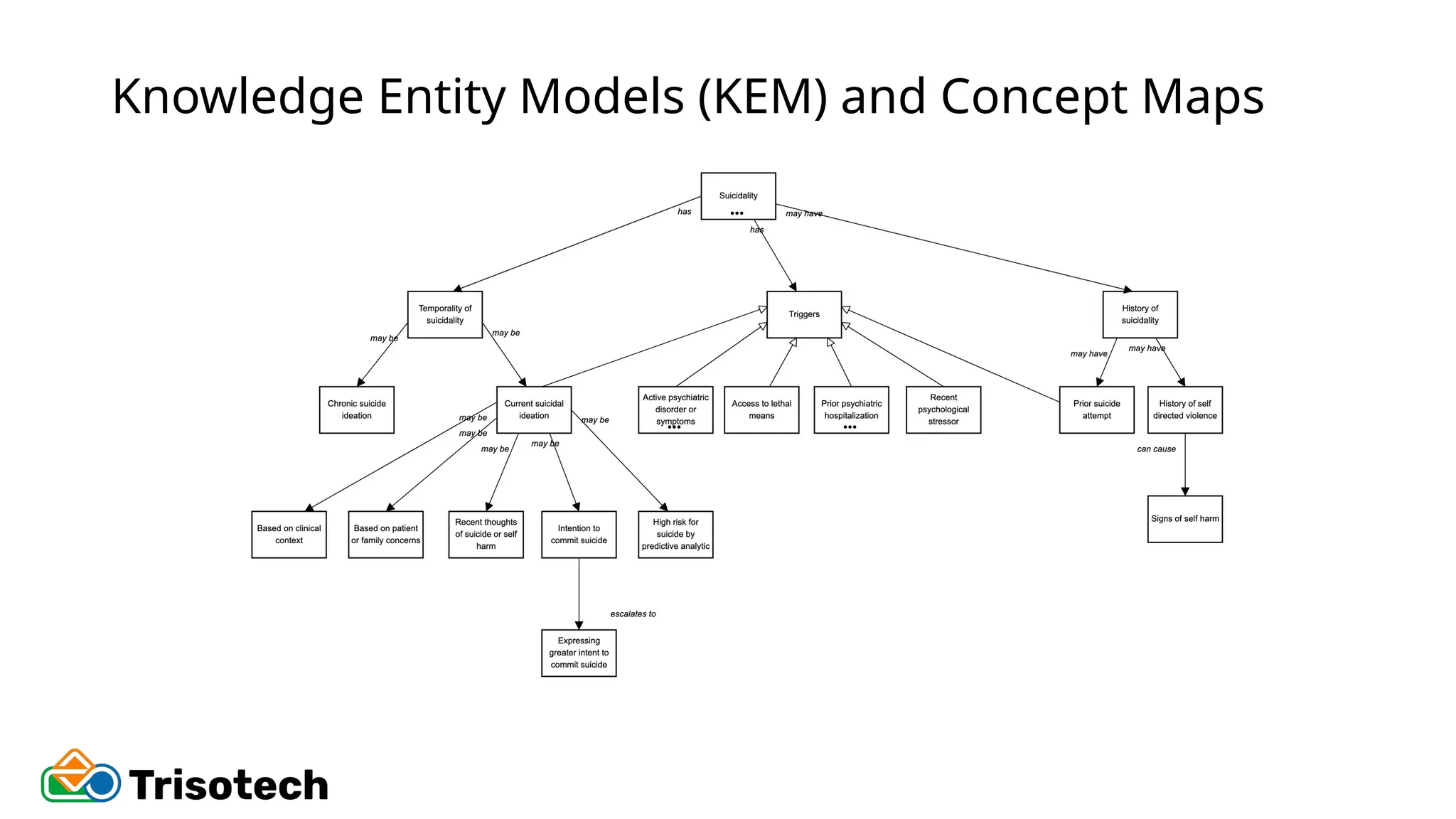
Knowledge Entity Models (KEM) and Concept Maps
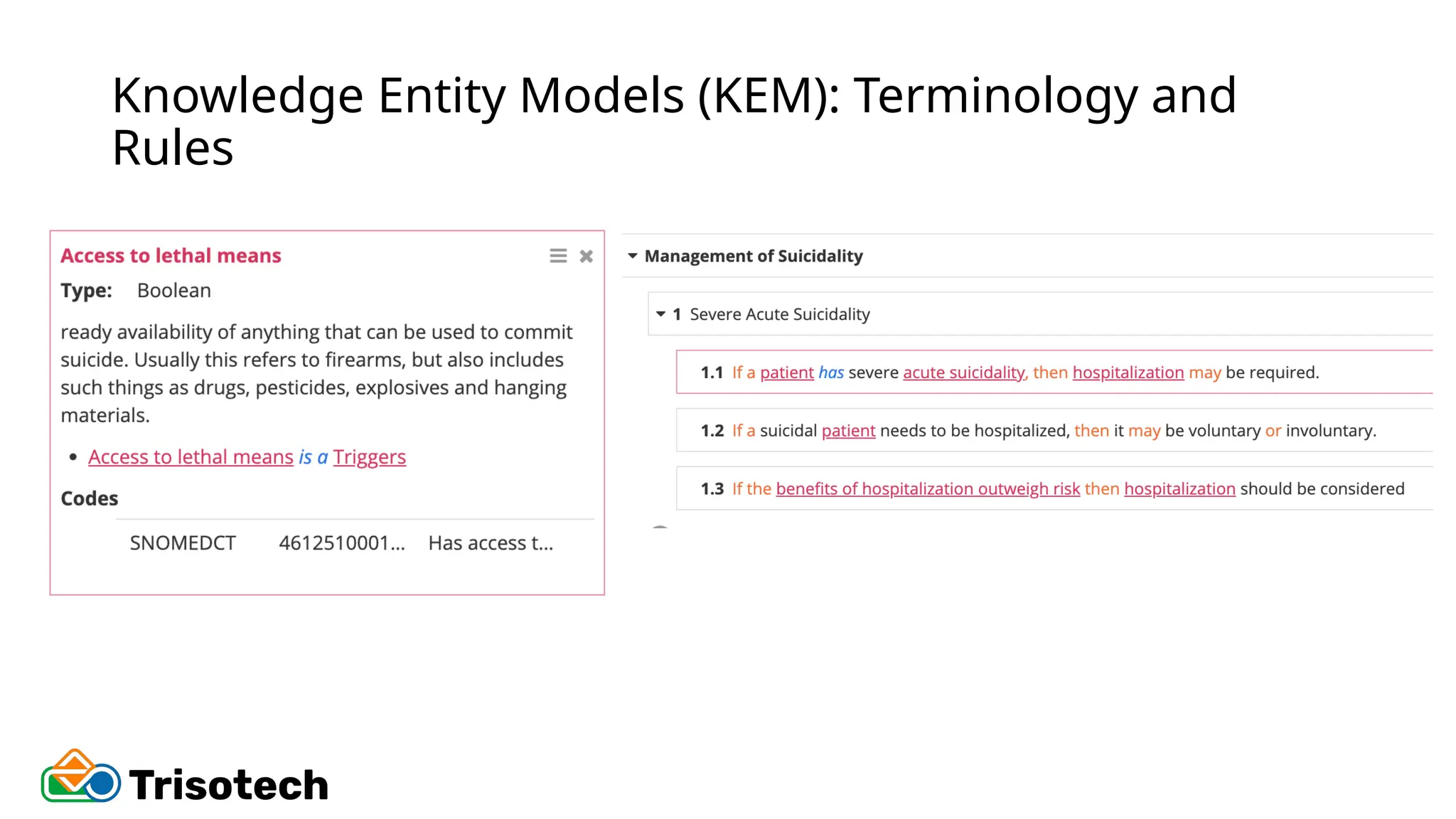
Knowledge Entity Models (KEM): Terminology and
Rules
Structured data
for
Interoperability
FHIR using SDMN
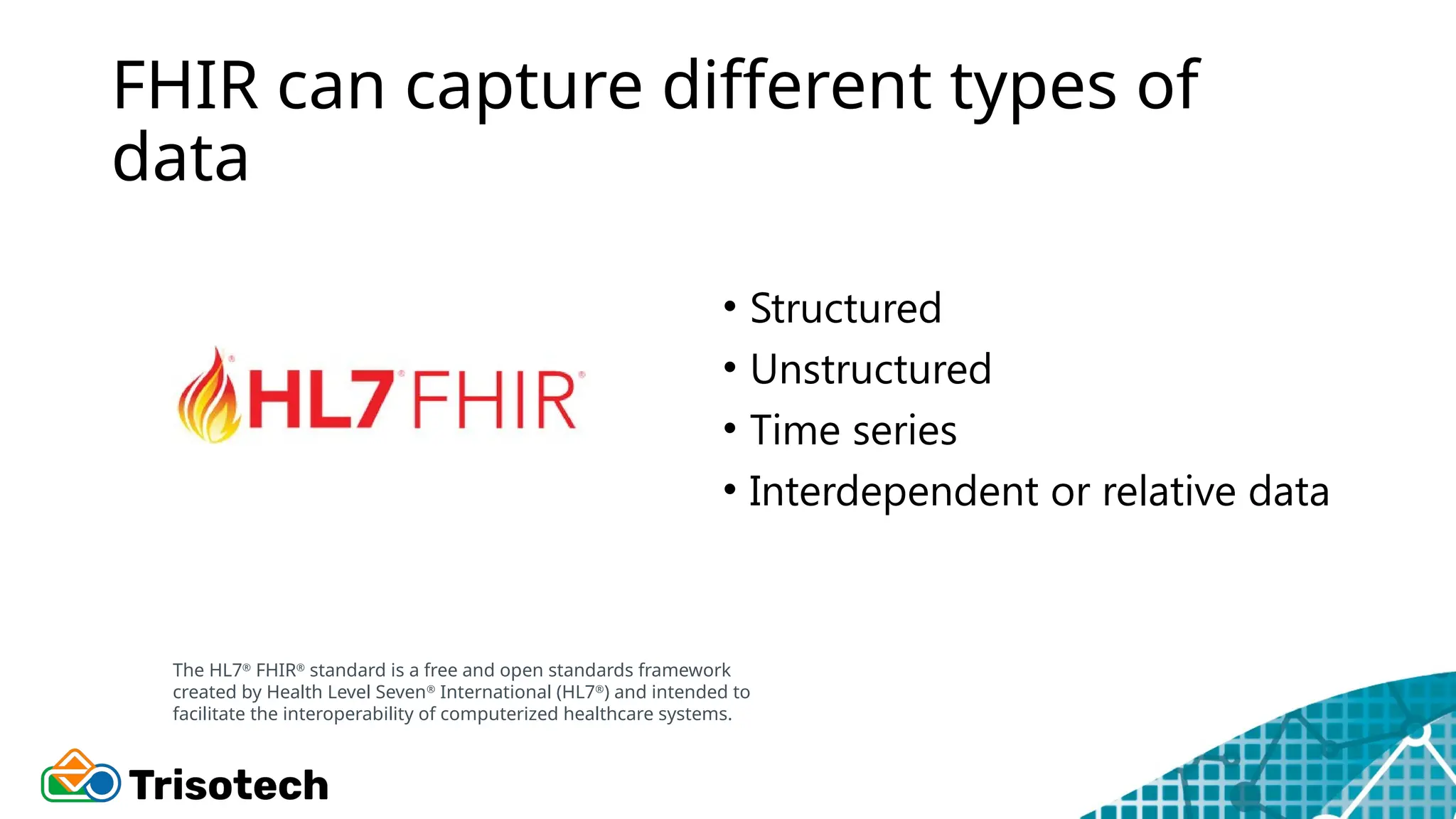
FHIR can capture different types of
data
• Structured
• Unstructured
• Time series
• Interdependent or relative data
The HL7®
FHIR®
standard is a free and open standards framework
created by Health Level Seven®
International (HL7®
) and intended to
facilitate the interoperability of computerized healthcare systems.
Unstructured Data Example: Patient
Notes
• Patient Notes are essential in Healthcare as a documentation
and communication tool.
• Creation of notes can be a source of problems (for example,
"plagiarism" when copying and pasting).
• Technology provides new opportunities to improve the patient
note and reduce clinical burden.
• By having better and more complete notes you reduce risk of
omissions and improve compliance.
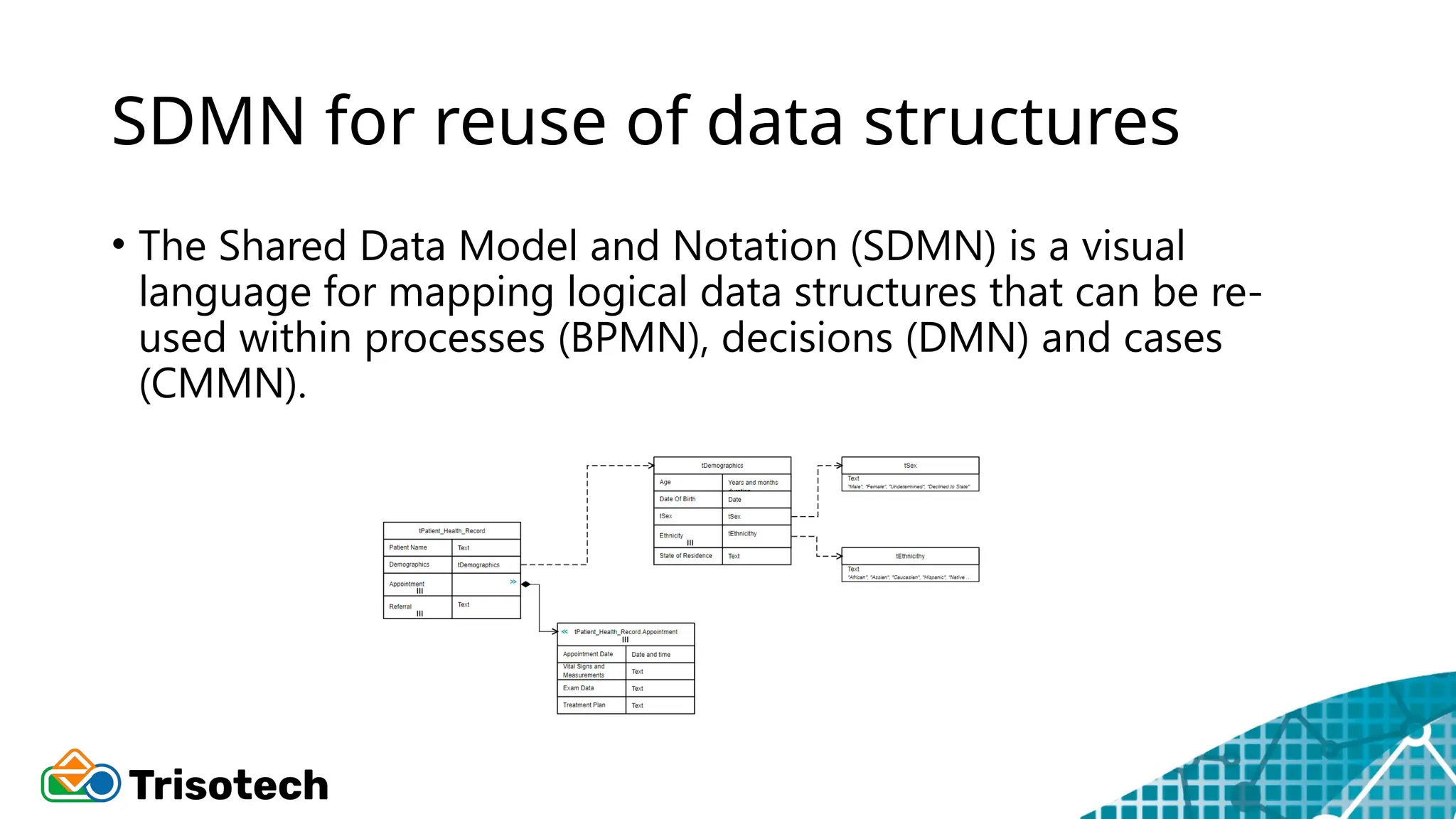
SDMN for reuse of data structures
• The Shared Data Model and Notation (SDMN) is a visual
language for mapping logical data structures that can be re-
used within processes (BPMN), decisions (DMN) and cases
(CMMN).
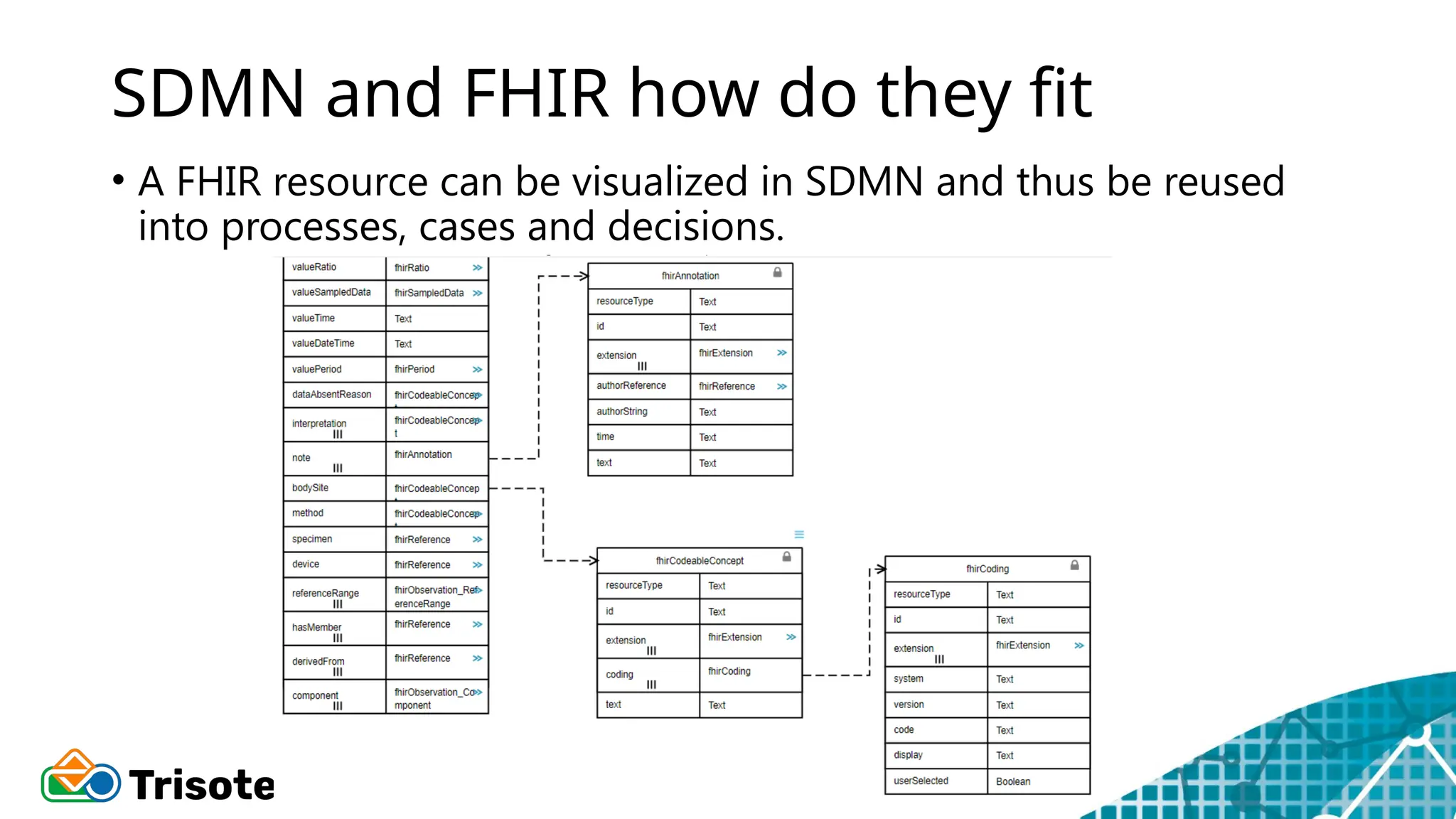
SDMN and FHIR how do they fit
• A FHIR resource can be visualized in SDMN and thus be reused
into processes, cases and decisions.
Data and AI
ML or GenAI
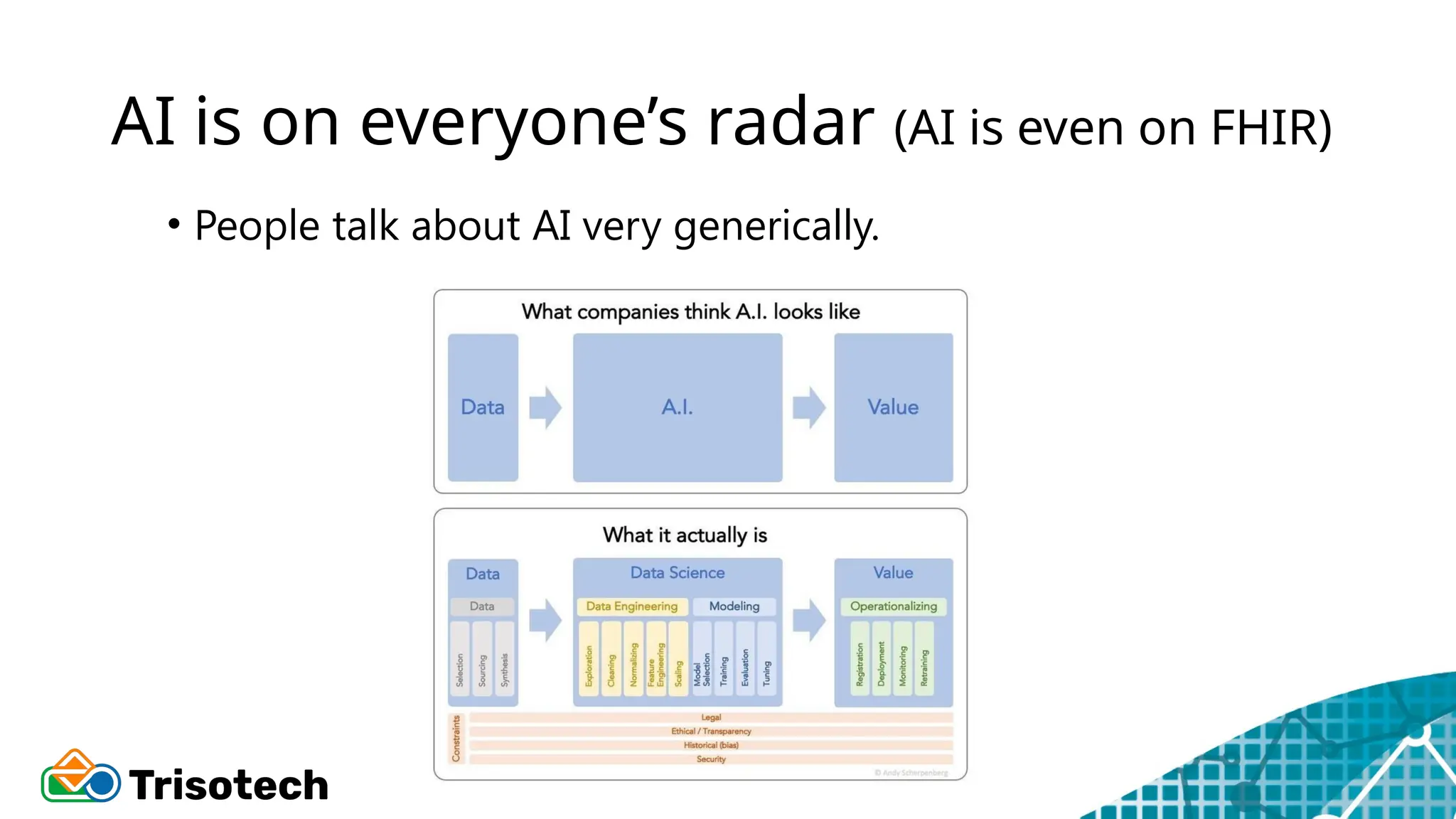
AI is on everyone’s radar (AI is even on FHIR)
• People talk about AI very generically.
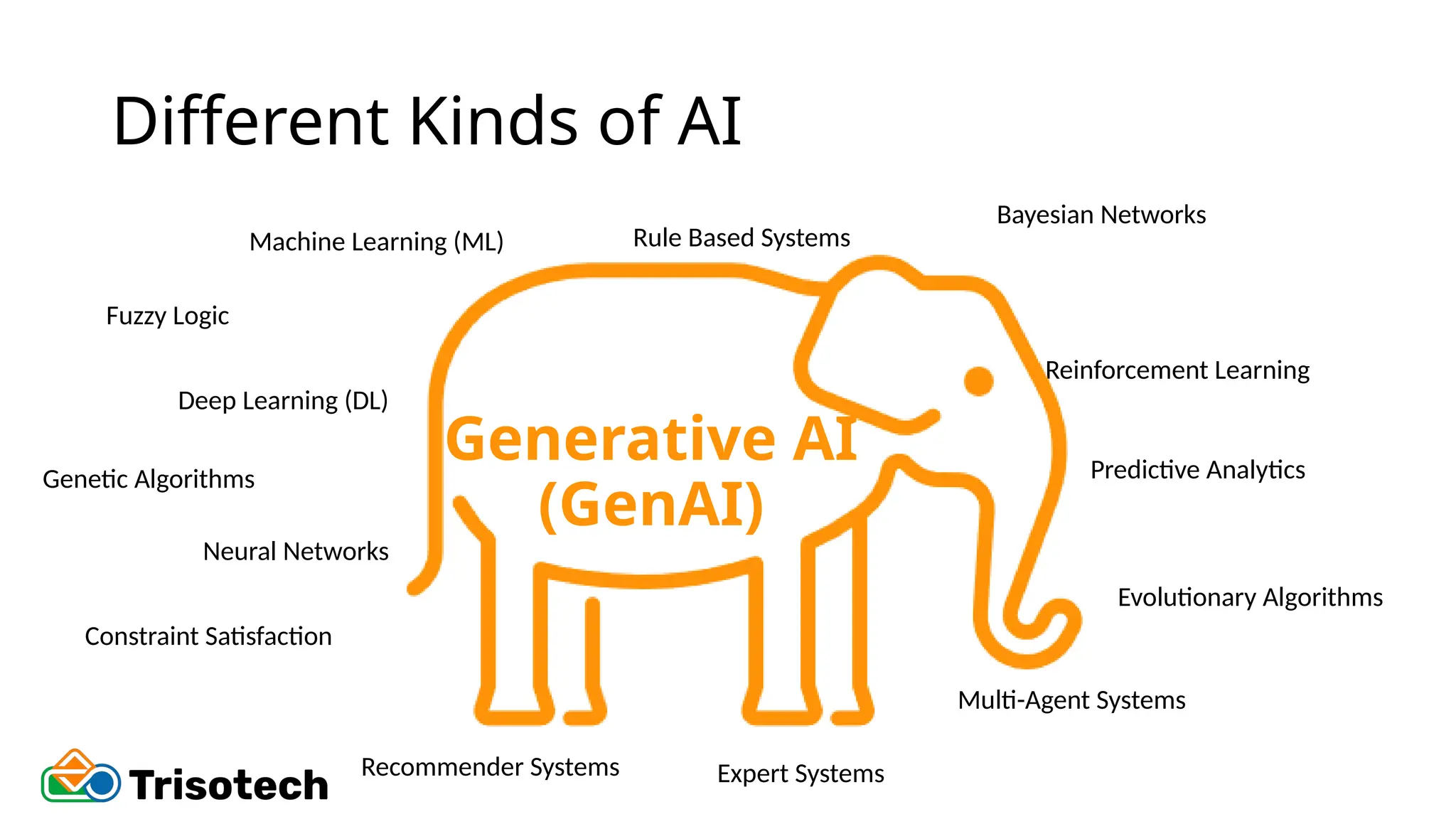
Generative AI
(GenAI)
Different Kinds of AI
Machine Learning (ML)
Deep Learning (DL)
Expert Systems
Fuzzy Logic
Neural Networks
Reinforcement Learning
Evolutionary Algorithms
Bayesian Networks
Recommender Systems
Predictive Analytics
Genetic Algorithms
Constraint Satisfaction
Multi-Agent Systems
Rule Based Systems
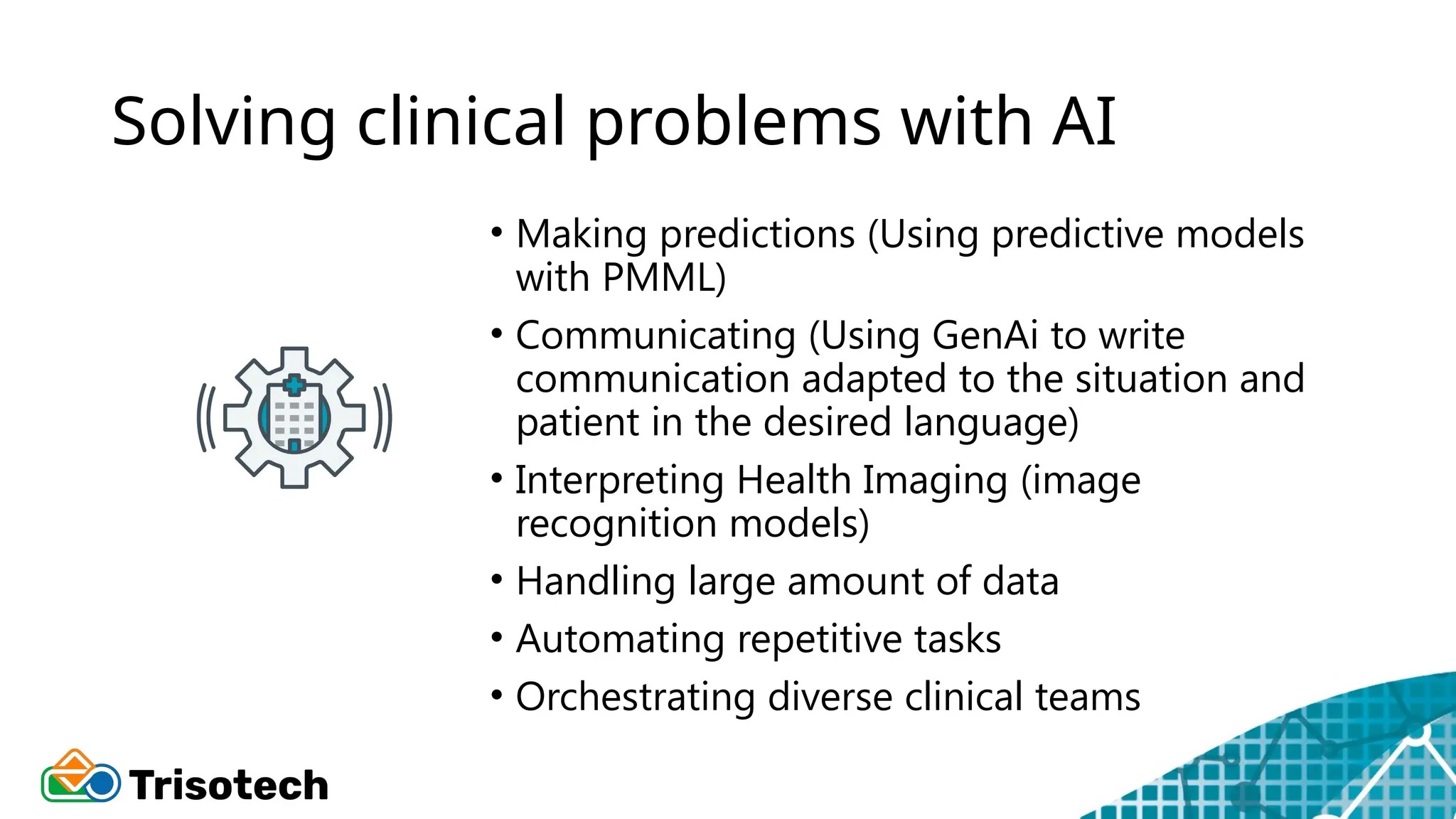
Solving clinical problems with AI
• Making predictions (Using predictive models
with PMML)
• Communicating (Using GenAi to write
communication adapted to the situation and
patient in the desired language)
• Interpreting Health Imaging (image
recognition models)
• Handling large amount of data
• Automating repetitive tasks
• Orchestrating diverse clinical teams
Motivators for large data sets
Discovering
• Search for new
insights.
Improving care
• Greater sensitivity
and specificity.
Automating
• Cover shortages
of personnel and
do more with less.
Challenges
• AI = garbage in garbage out
• Clean data is a must
• Ethical issues
• Copyrights and ownership of data
• Dataset bias
Data cleansing
• Health organizations generate vast
amounts of data.
• Not all of it is accurate, organized or
well-formed.
• Data cleansing is the process of
detecting and fixing or removing
incorrect, corrupted, incorrectly
formatted, duplicate, or incomplete
data within a dataset.
Data efficiency
• Not having the right data when it is needed
is problematic.
• Interrupting a process to obtain data can be
disruptive.
• Some tests that are ordered are unnecessary
or the results unused.
• There is a need to create protocols to ensure
collection of the data that is needed.
• It is important not waste the available
information.
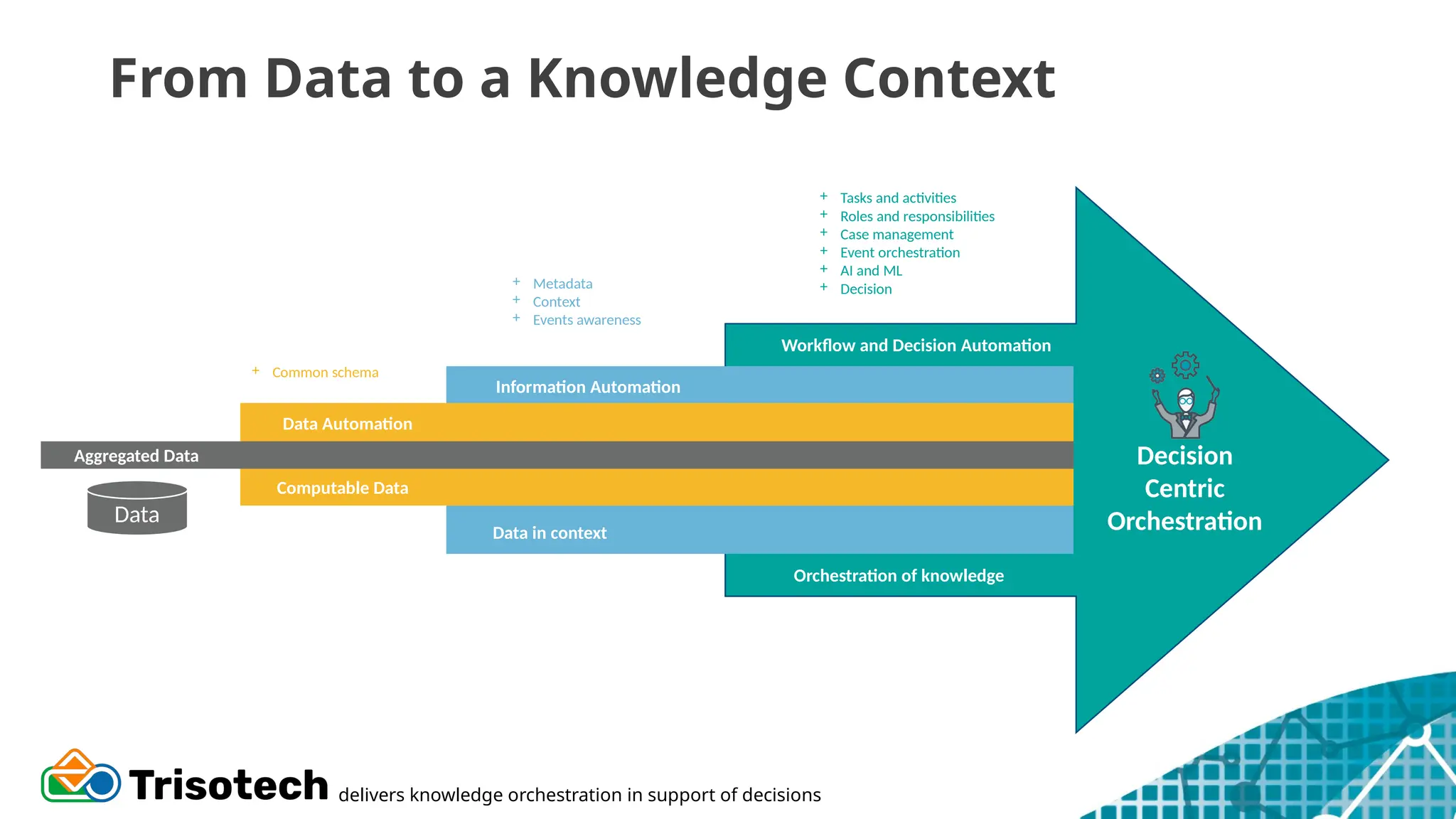
From Data to a Knowledge Context
Data
Decision
Centric
Orchestration
Computable Data
Aggregated Data
Data Automation
Information Automation
Orchestration of knowledge
Workflow and Decision Automation
Data in context
+ Common schema
+ Metadata
+ Context
+ Events awareness
+ Tasks and activities
+ Roles and responsibilities
+ Case management
+ Event orchestration
+ AI and ML
+ Decision
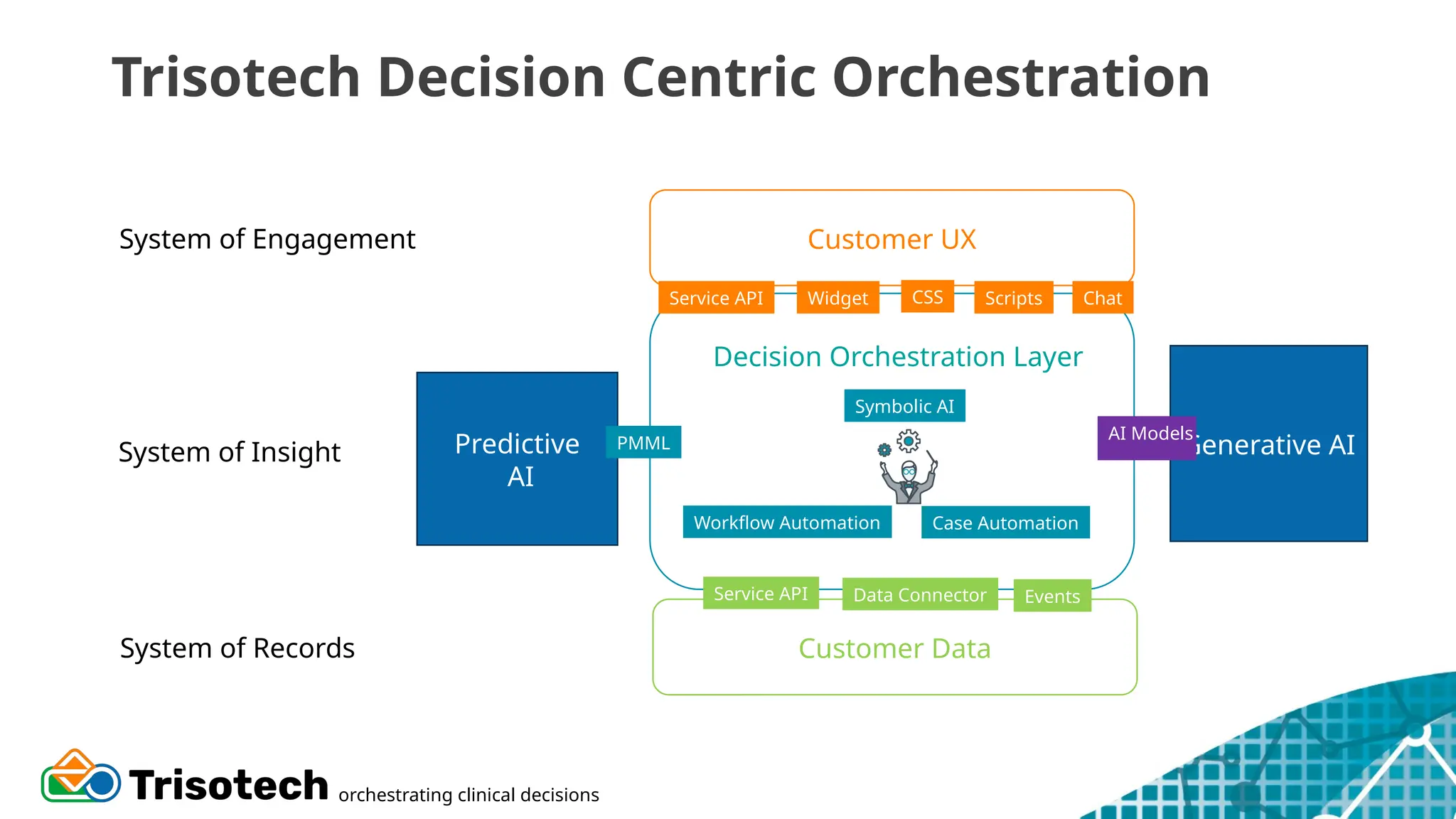
delivers knowledge orchestration in support of decisions
Predictive
AI
Customer Data
Generative AI
Trisotech Decision Centric Orchestration
System of Engagement
System of Insight
System of Records
Service API
Widget CSS Scripts
Data Connector Events
Symbolic AI
PMML
Workflow Automation Case Automation
Service API Chat
Customer UX
AI Models
Decision Orchestration Layer
orchestrating clinical decisions
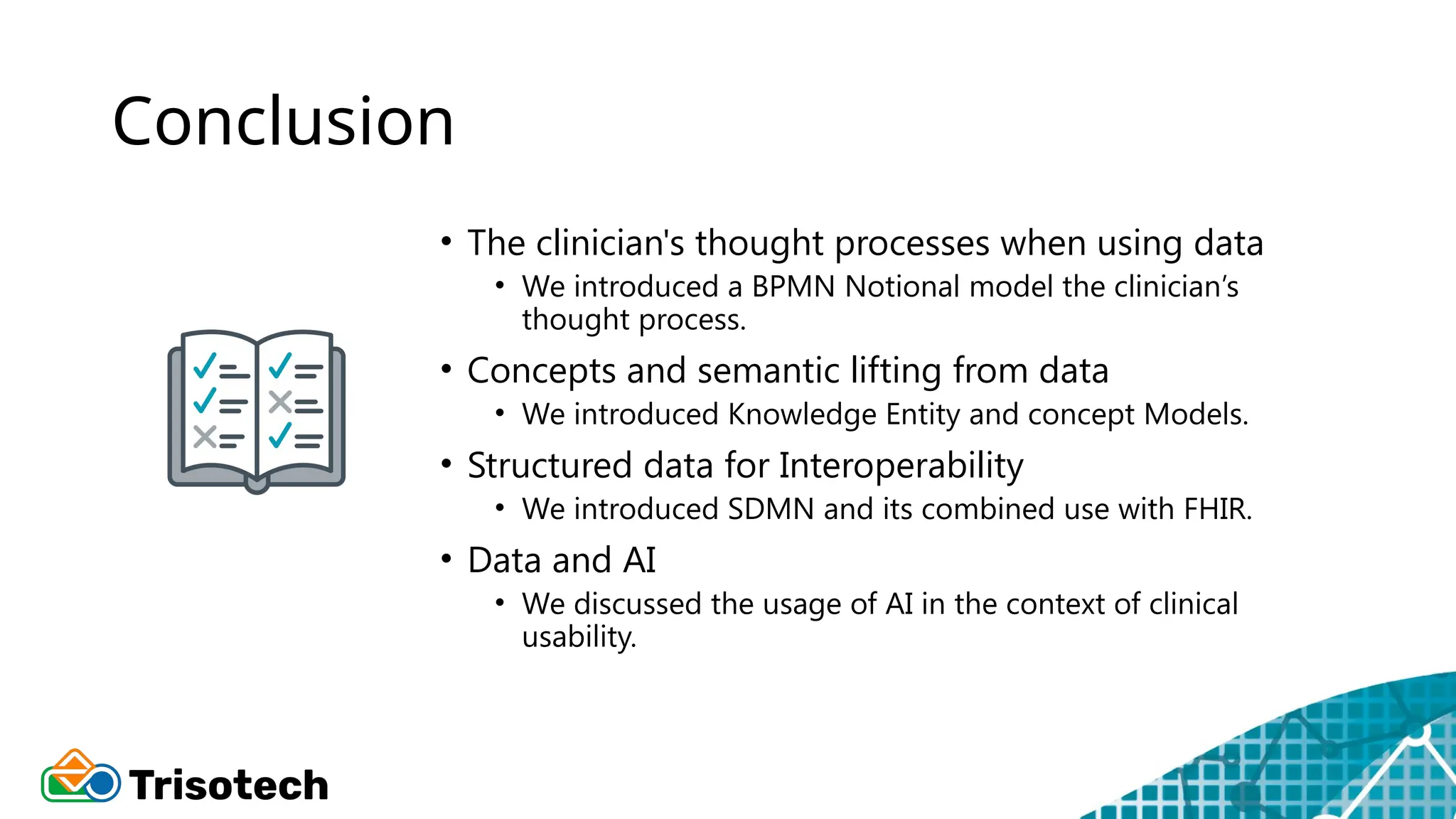
Conclusion
• The clinician's thought processes when using data
• We introduced a BPMN Notional model the clinician’s
thought process.
• Concepts and semantic lifting from data
• We introduced Knowledge Entity and concept Models.
• Structured data for Interoperability
• We introduced SDMN and its combined use with FHIR.
• Data and AI
• We discussed the usage of AI in the context of clinical
usability.
Any questions?
THANKS!
31

Clinician-Centric Data and AI Integration in Healthcare

  • 1.
    Clinician-Centric Data and AIIntegration in Healthcare
  • 2.
    Abstract Gain insights intothe orchestration of data, knowledge and AI in support of decision-making in healthcare. We explore the thought processes of clinicians when accessing data for decision-making. We then discuss concepts and semantic lifting using concept maps, highlighting the importance of context in interpreting data. The session also covers structured data for FHIR interoperability through SDMN, demonstrating the significance of data reuse and integration in healthcare. By focusing on cleanliness and relevance, we examine the role of data in various AI approaches, including machine learning and generative AI. This webinar aims to showcase how clean, well- structured data can empower clinicians and improve patient outcomes.
  • 3.
    Data in Healthcare •Generally, when people talk about data in healthcare they do so generically. • There are many facets to data in Healthcare for examples: • The clinician's thought processes when using data • Concepts and semantic lifting from data • Structured data for Interoperability • Data and AI • We will explore these four particular facets in this presentation.
  • 4.
    There are manytypes of healthcare data: • Structured • Unstructured • Time series • Interdependent or relative data • Raw or normalized
  • 5.
  • 6.
    Why is datarelevant? Everything in healthcare depends on data. Clinicians look at data from a range of contexts: • Diagnosis • Determination of disease severity • Prediction and prognosis • Drug selection and dosing • Tracking status over time • Response to therapy
  • 7.
    Questions that aprovider may ask about data: • What data do I need to meet my goal? • Is the data available, and at what cost? • Is the data relevant? • Is the data valid, accurate and precise? • Is the data consistent with the clinical status of the patient? • Do I need to transform the data to make it more useful?
  • 9.
    Concepts and semantic lifting fromdata KEM and Concept Maps
  • 10.
    Ambiguity exists inclinical data • The same data term may have different meanings in different contexts (e.g., weight ?= usual weight, weight at cancer treatment planning, weight during cancer treatment..) • A single analyte can be measured by multiple methods, and each method may give different results with different measurement units. • A single concept may be referenced in different ways (e.g., diabetes may be indicated by an ICD-10 code, HgbA1C value, insulin dependency, or elevated fasting blood glucose.)
  • 11.
    There is aneed to avoid ambiguity Ambiguity can lead to: • Confusion • Inefficiency • Misapplication Approaches to disambiguate may include: • Terminology • Concept Maps • Business Rules (offering constraints of usage)
  • 12.
    From Narrative toOperationalization Disambiguation Operationalization Concept Maps Verb concepts Business Rules Noun concepts Narrative Text Processes and Decisions Source
  • 13.
    Knowledge Entity Models(KEM) and Concept Maps
  • 14.
    Knowledge Entity Models(KEM): Terminology and Rules
  • 15.
  • 16.
    FHIR can capturedifferent types of data • Structured • Unstructured • Time series • Interdependent or relative data The HL7® FHIR® standard is a free and open standards framework created by Health Level Seven® International (HL7® ) and intended to facilitate the interoperability of computerized healthcare systems.
  • 17.
    Unstructured Data Example:Patient Notes • Patient Notes are essential in Healthcare as a documentation and communication tool. • Creation of notes can be a source of problems (for example, "plagiarism" when copying and pasting). • Technology provides new opportunities to improve the patient note and reduce clinical burden. • By having better and more complete notes you reduce risk of omissions and improve compliance.
  • 18.
    SDMN for reuseof data structures • The Shared Data Model and Notation (SDMN) is a visual language for mapping logical data structures that can be re- used within processes (BPMN), decisions (DMN) and cases (CMMN).
  • 19.
    SDMN and FHIRhow do they fit • A FHIR resource can be visualized in SDMN and thus be reused into processes, cases and decisions.
  • 20.
  • 21.
    AI is oneveryone’s radar (AI is even on FHIR) • People talk about AI very generically.
  • 22.
    Generative AI (GenAI) Different Kindsof AI Machine Learning (ML) Deep Learning (DL) Expert Systems Fuzzy Logic Neural Networks Reinforcement Learning Evolutionary Algorithms Bayesian Networks Recommender Systems Predictive Analytics Genetic Algorithms Constraint Satisfaction Multi-Agent Systems Rule Based Systems
  • 23.
    Solving clinical problemswith AI • Making predictions (Using predictive models with PMML) • Communicating (Using GenAi to write communication adapted to the situation and patient in the desired language) • Interpreting Health Imaging (image recognition models) • Handling large amount of data • Automating repetitive tasks • Orchestrating diverse clinical teams
  • 24.
    Motivators for largedata sets Discovering • Search for new insights. Improving care • Greater sensitivity and specificity. Automating • Cover shortages of personnel and do more with less.
  • 25.
    Challenges • AI =garbage in garbage out • Clean data is a must • Ethical issues • Copyrights and ownership of data • Dataset bias
  • 26.
    Data cleansing • Healthorganizations generate vast amounts of data. • Not all of it is accurate, organized or well-formed. • Data cleansing is the process of detecting and fixing or removing incorrect, corrupted, incorrectly formatted, duplicate, or incomplete data within a dataset.
  • 27.
    Data efficiency • Nothaving the right data when it is needed is problematic. • Interrupting a process to obtain data can be disruptive. • Some tests that are ordered are unnecessary or the results unused. • There is a need to create protocols to ensure collection of the data that is needed. • It is important not waste the available information.
  • 28.
    From Data toa Knowledge Context Data Decision Centric Orchestration Computable Data Aggregated Data Data Automation Information Automation Orchestration of knowledge Workflow and Decision Automation Data in context + Common schema + Metadata + Context + Events awareness + Tasks and activities + Roles and responsibilities + Case management + Event orchestration + AI and ML + Decision delivers knowledge orchestration in support of decisions
  • 29.
    Predictive AI Customer Data Generative AI TrisotechDecision Centric Orchestration System of Engagement System of Insight System of Records Service API Widget CSS Scripts Data Connector Events Symbolic AI PMML Workflow Automation Case Automation Service API Chat Customer UX AI Models Decision Orchestration Layer orchestrating clinical decisions
  • 30.
    Conclusion • The clinician'sthought processes when using data • We introduced a BPMN Notional model the clinician’s thought process. • Concepts and semantic lifting from data • We introduced Knowledge Entity and concept Models. • Structured data for Interoperability • We introduced SDMN and its combined use with FHIR. • Data and AI • We discussed the usage of AI in the context of clinical usability.
  • 31.