Required Resources
Text
Blanchard, P. N., & Thacker, J. W. (2013). Effective training:
Systems, strategies, and practices (5th ed). Upper Saddle River,
NJ: Pearson Education, Inc.
· Chapter 5: Training Design
· Chapter 6: Traditional Training Methods
· Chapter 7: Computer-Based Training Methods
Articles
Cherry, K. (2014). What is emotional intelligence? Definitions,
history, and measures (Links to an external site.). About.com
Psychology. Retrieved from
http://psychology.about.com/od/personalitydevelopment/a/emoti
onalintell.htm
Clark, D. (2014). Why instructional system design and
ADDIE? (Links to an external site.) Retrieved from
http://www.nwlink.com/~donclark/hrd/sat1.html
Learning styles (Links to an external site.). (n.d.). Retrieved
from http://www.mindtools.com/mnemlsty.html
DISCUSSION 1 WEEK 3 Replies Needed
Training Design
For this discussion, imagine that you are designing a 4-hour
leadership development training session. Identify specific
learning objectives for your training session. Conduct an
Internet search to identify the types of games and business
simulations that are available. Select one game or business
simulation appropriate for your audience and learning
objectives. Provide a brief description, detailed rationale, and
thorough analysis of the game or business simulation as it
pertains to your specific audience and learning objectives. Do
not simply cut and paste from the Internet source.
Your initial post should be 250 to 300 words. Use this week’s
lecture as a foundation for your initial post. In addition to the
Blanchard and Thacker (2013) text, use at least one additional
scholarly source to support your discussion.
Respond to two other posts regarding items you found to be
compelling and enlightening. To help you with your reply,
please consider the following questions:
· What did you learn from the posting?
· What additional questions do you have after reading the
posting?
· What clarification do you need regarding the posting?
· What differences or similarities do you see between your
initial discussion thread and your classmates' postings?
· Ask each other questions about why the specific game or
simulation was selected.
· How does the chosen game or simulation apply to other
situations?
· What are the differences or similarities in the specific game or
simulation you selected compared to those identified by others?
· Analyze your classmates' chosen game or simulation. Do you
agree or disagree with the choice? Why or why not? Provide
examples where possible.
· What are the differences or similarities in the learning content
objectives for your training session compared to those identified
by others?
Your reply posts should be a minimum of 150-250 words each.
Reply to Paul Strange post
When design a leadership program there needs to be a
competitive strategy, as this relates to the training of that
organization you need to know what the organization needs first
then you may be able to develop. The training process plan the
most important role this helps align the internal organizational
strategy. Learning needs to be for everyone in that organization
and this relies on the motivation, and self-efficacy of the
individuals. It could be in groups, individuals, and
organizations. The important thing to remember is why people
learn, what is important when, and where they learn (Weekly
lecture).
Types of games and business simulations:
This type of simulation caught my eye this is for the leadership
that develops leadership knowledge it uses real-life business
scenarios. It can be done in 3 hours it also has comprehensive
training and this can be integrated into everyday leadership
programs. It is called (lead-out) both informal and formal team
building, planning, decision making interpersonal relationships,
risk making. To succeed, the groups must plan effectively,
implement their strategy, work together as a team, depending on
the performance of each individual and yet cooperate in a
competitive, high-performance setting
(www.leadout.com (Links to an external site.). 2014).
Objectives:
The objectives of training there are four different types of such
as reaction, learning transfer, transfer of training, and the
organizational outcome (Blanchard & Thacker, 2013). Reaction
refers to how the trainees feel about the training and in their
learning environment. The learning objectives refer to the KSAs
and what is expected to acquire while being trained and how it
will be demonstrated to them. The transfer of learning is about
how it affects job behavior and what can be expected as a result
of learning about the KSAs in referring to the job position. The
organizational outcomes describe how this will also affect the
organization as a whole and what will be the outcome (if any)
changes to the trainee’s behavior in what they have learned
(Blanchard & Thacker, 2013).
Provide a brief description, detailed rationale,
The desired outcome in the trainee’s behavior is to do what they
are doing and in the same breathable to do, what is being told to
them, and do the job accordingly and specifically to detail.
They need to be able to differentiate between two piles of chips
which is bad, and which is good (Blanchard & Thacker, 2013).
Blanchard, P. N., & Thacker, J. W. (2013). Effective training:
Systems, strategies, and practices (5th ed.). Boston, MA:
Pearson.
(n.a. 2014). How Leadout Works: The Leadout Leadership
Training Simulation Retrieved from the web site:
https://www.leadout.com/how-leadout-works.html
Reply to Bud Benson post
Hello class,
Objectives
The purpose of the leadership developmental training is to train
50% of the fabrication employee’s supervisors on the new
fabrication software within the first quarter of operations. When
creating a leadership development training program, the
designer must utilize the Training Needs Analysis (TNA)
(Blanchard & Thacker, 4.2) results to ensure proper alignment
with the company’s strategies and goals. The training
objectives must be conveyed in a specific, measurable,
achievable, realistic, and timely (SMART) (Forrest) manner.
The training program will be approximately 60% simulation,
15% lecture, 15% breaktime, and 10% game.
Game
The designer must account for the audience make up to keep
them actively learning. The beginning of the training starts
with the game called the “Whisper Game.” The instructor
whispers a random statement into the person’s ear that is sitting
in the first row of computer terminals and the person tries to
whisper exactly what the instructor whispered into the next
person’s ear. This goes on from person to person until the last
training attendee has to repeat what the instructor whispered,
out loud, what the 2nd to the last person whispered to her/him.
The object of the game is to demonstrate that details get lost
when passing information so it is vital for the information to
make sense. The “Whisper” game also gets the fabrication
employees supervisors actively engaged in the upcoming
training session.
Simulation
The simulation portion of the training is installed in each of the
computer terminals and will simulate the fabrication machine’s
daily operation with the new “Windows” based fabrication
software without having the fabrication machine physically
present. This simulation will allow the supervisors to become
familiar with troubleshooting techniques, alterations in the
fabrication design, and perform throughput calculations that are
included in the supervisor’s daily reports at a fraction of the
time and cost when compared to training each supervisor at
different plants where they work. As the supervisor’s become
more proficient in the use of the software, the simulation
provides each supervisor with continuous reinforcement
(Mazur) thus facilitating the active learning process. Upon
receiving this training, each supervisor will be able to perform
on-the-job training to 10 fabrication employees.
Blanchard, P.N. & Thacker, J.W. (2013). Effective training:
Systems, strategies, and practices (5th ed.). Upper Saddle
River, NJ: Prentice Hal
Forrest, C. (2003). Writing training objectives using
SMART (Links to an external site.). Retrieved from
www.structuredlearning.com/uploads/docs/smart_objectives_art
icle.pdf
Mazur, Jame E. (2001) Learning and Behavior. (5th ed.) Upper
Saddle
River, NJ: Prentice Hall
V/R
Bud Benson
DISCUSSION 2 WEEK 3
Training Delivery
Consider your best workplace learning experience. Describe the
training delivery method(s) used and identify the factors that
contributed to making it an effective workplace learning
experience. Then, consider your worst workplace learning
experience. Describe the training delivery method(s) used and
identify the factors that contributed to making it an ineffective
workplace learning experience. Discuss what you would suggest
to make each workplace learning experience more effective.
Your initial post should be 250 to 300 words. Use this week’s
lecture as a foundation for your initial post. In addition to the
Blanchard and Thacker (2013) text, use at least one additional
scholarly source to support your discussion.
Respond to two other posts regarding items you found to be
compelling and enlightening. To help you with your reply,
please consider the following questions:
· What did you learn from the posting?
· What additional questions do you have after reading the
posting?
· What clarification do you need regarding the posting?
· What differences or similarities do you see between your
initial discussion thread and your classmates' postings?
· What are the differences or similarities in the delivery
methods for your workplace learning experiences compared to
those identified by others?
· How do the factors that contributed to your best or worst
workplace learning experience compare to those identified by
others?
Your reply posts should be a minimum of 150-250 words each.
Reply to Falana Kimbrough post
My best workplace learning experience was in a startup in the
media and communications industry. It was the best training
since I retained the learnt information that is useful until
presently. In this training, the tutor used several training
designs to deliver the information. Firstly, the training occurred
outdoors in a tranquil setting that provided a break from the
regular work environment (Coultas, Grossman & Salas, 2012).
This approach helped us to develop newer perspectives of our
workplace since we later had to develop work place simulations.
The tutor presented the information as a coach since he
instructed and showed examples as well. Finally, he let us work
out real life problems as a team as each member took on a
certain responsibility. The highlights of the training was that it
was highly interactive, fun, and lively.
The worst workplace learning experience was for the same
company but for a different learning outcome. Here, the trainer
presented us with lecture videos to watch and aid in the learning
process. The videos had lectures that were too plain. The
instructor used cryptic terminologies to explain the concepts
and there were little examples to support the work. Likewise the
instructor rushed all through the training in a complex manner
negating the learners’ understanding. The video presentation
also lacked appropriate illustrations making it the most boring
training I have ever experienced.
Each workplace learning experience would be more interesting
if there were props to match the training. Props include video
illustrations, simulations, or other artistic features intended to
facilitate the learning process (Blanchard & Thacker, 2013).
Similarly, for such trainings, the instructor should personalize
the trainings to suit a mentorship design. Finally, work trainings
should have attached incentives that promote participation and
grasping of the information.
References
Blanchard, P. N., & Thacker, J. W. (2013). Effective
training:Systems, strategies, and practices (5th ed). Upper
Saddle River, NJ: Pearson Education, Inc.
Coultas, C. W., Grossman, R., & Salas, E. (2012). Design,
delivery, evaluation, and transfer of training systems. In G.
Salvendry (Ed.), Handbook of human factors and
ergonomics (4th ed., pp. 490-533). John Wiley & Sons, Inc.
Reply to Sade Malone post
When I started working at my current job Amazon, I started out
a level 1 associate. When we first started they broke us up into
groups of 10, so there was 10 new hires per trainer. the trainer
took us through safety school being that we was working in a
warehouse with heavy machinery, and gave us a tour so we
would know where all the facilities where. Once we where all
started the actual training process they read off of a manual
while showing us what to actually do. Than they made each of
us demonstrate the process from beginning to the end and
explain why every step was important. We where with our
trainers for 3 days before being left alone on the 4th day. This
was one of my best workplace learning experience. There was
also this system in place that would allow you managers to tell
how many errors you made and you productivity, you would get
instant feedback on an error you made either yesterday or a
couple hours ago which was great to help you prevent from
making future mistake.
Now this is my current job which I am now a level 3 supervisor
thanks to the mentors I had in the past. My supervisor took me
under his wing and helped improve and develop my skills to
replace him for when he became a manager. My associates are
trained to replace me for when I get promoted or when I don't
come to work. We try to build each other and learn off of each
other. I have a couple of associates that went on to be managers,
supervisors and some even went into HR. This organization is
always developing and coming up with new ways to train
associates especially during these times.
One of my worse workplace experience was when I was an after
school teacher. I loved working with kids but the owner didn't
make it easy, there was little to no training. He just put us with
a group of kids and access how well we got along with them, no
safety or first aid training, or child development training. We
where only after school teachers but kids are gonna be kids and
some type of training should've been done in order to deal with
rude parents and their children. He basically put matters into
our hands which could've been a recipe for disaster luckily
most of us had experience with kids to be able to teach others.
What made matter worse was when we tried to talk to him about
it he would get defensive, and threaten our jobs. What made this
workplace experience ineffective was the fact that there was no
training on how to properly handle these kids at all or any
safety training. I would've at least conducted a class on how to
deal and interact with parents as well as the children. He
should've also made sure the bigger groups had more than one
teacher to make the load easier. I was with grades 3-6 and there
was 30 kids and my partner got a new job. I was stressful on me
but somehow I managed, I had the biggest group but the least
help.
Seven Electronic Training Methods
LearningObjectives
Afterreadingthischapter,youshouldbeableto:
Describe the relationship between electronic training (ET),
learning management systems, electronic
delivery systems and e-learning.
Identify and describe the components of an ET learning and
delivery system.
Describe each of the following ET components:
Programmedinstruction
Intelligenttutoringsystems
Interactivemultimedia
Virtualreality
Describe the design and development factors that are key to an
effective ET program.
Identify the factors that will determine if an ET program is
appropriate and indicate what you would be
looking for in each of the factors.
Identify when ET is appropriate as a stand-alone training
program.
7.1Case:EvolutionofTrainingatMr.Lube
In 1979, Clifford Giese had become so frustrated with the
amount of time it took to get his �leet of vehicles serviced
that he created a drive-through oil change system. His �irst
store opened that year, and by 1984, there were 45
stores. Shortly thereafter, Mr. Giese sold the rights to the Mr.
Lube trademark to Imperial Oil Limited (Esso), and by
2003, the number of corporate stores and franchised outlets had
grown to 87. However, this growth created new
challenges for maintaining the consistent high quality and
customer-focused service across the widely distributed
network.
The success of the Mr. Lube operation depended on a high level
of competence from a relatively young and
geographically dispersed workforce. The technical aspects of
the industry were becoming increasingly
sophisticated, making training a key component in Mr. Lube’s
strategic thinking. In 2002, Senior Vice-President Bill
Tickner did not feel that the paper-based training system that
had developed over the history of the company could
meet the demands of the current workforce and company
con�iguration. The training manuals contained all the
correct information about how to service a vehicle properly, but
he didn’t feel that employees were actually reading
the voluminous training manuals and technical bulletins
distributed to each of the stores and franchises.
Additionally, there was no reliable and easy way to ensure that
the employee actually understood and retained the
information. How could he ensure that every employee across
the country had the competencies needed to meet
Mr. Lube’s standards, while keeping the cost within reasonable
limits?
7.2OverviewoftheChapter
The material in this chapter will provide you with an
understanding of various components of electronictraining
(ET)(http://content.thuzelearning.com/books/AUBUS680.16.1/s
ections/i177#glossch07_001)as well as
how to use ET effectively. Following that, we will examine the
various delivery systems available for use with these
methods. We then provide guidelines for how to design and
develop ET programs. Finally, the strengths and
limitations of ET are discussed, covering cost, suitable learning
objectives, and other factors related to its
effectiveness. As you go through this chapter, you should keep
in mind that just as with traditional training methods,
the effectiveness of ET will depend on a good needs analysis,
and a match between the design of the program and
the outcomes desired. Thus, the issues that were discussed in
Chapter 6 under the heading “Matching methods with
outcomes” also apply to ET.
https://content.ashford.edu/books/AUBUS680.16.1/sections/i17
7#glossch07_001
7.3ElectronicTraining(ET)andItsComponents
Today’s competitive business environment requires more
knowledge and skill from employees than ever before,
while also requiring companies to keep costs as low as possible.
Many look to ET as a way to provide employees
with needed training while minimizing costs. This may or may
not be the case as we will discuss at the end of this
chapter. However, compared with the traditional training
methods discussed in Chapter6
(http://content.thuzelearning.com/books/AUBUS680.16.1/sectio
ns/i84#ch06), ET may provide some or all of
the following advantages:
(http://content.thuzelearning.com/books/AUBUS680.16.1/sectio
ns/i176#ch07biblio_001)
Reduced trainee learning time
Reduced cost of delivering training
More instructional consistency
Privacy of learning (errors can be made without embarrassment)
Easy tracking of trainees’ learning progress
More time to allow the trainee to master learning
A safe method for learning hazardous tasks
Increased employee access to training
ComponentsofanETProgram
ET uses many of the methods described in Chapter6
(http://content.thuzelearning.com/books/AUBUS680.16.1/sectio
ns/i84#ch06)but converts those methods
into electronic form and delivers the training through an
electronic delivery system. ET is so varied in its forms and
applications that it is dif�icult to describe in concise terms. We
use the term ET to refer to any training that is
delivered electronically. It is different from traditional training
because face-to-face interaction with a human trainer
is not required (though it can be accommodated). Under this
de�inition, ET may include many different techniques
and processes to provide the training experience. Table 7-1 lists
and brie�ly describes some of the components
related to ET in order of technological sophistication. One or
more of these components are used in the
development of any ET program.
Table7-
1NamesandDescriptionsofElectronicTrainingComponents
1
https://content.ashford.edu/books/AUBUS680.16.1/sections/i84
#ch06
https://content.ashford.edu/books/AUBUS680.16.1/sections/i17
6#ch07biblio_001
https://content.ashford.edu/books/AUBUS680.16.1/sections/i84
#ch06
CBT Computer-basedtraining is the term most often used in
private industry or government for training
employees using computer-assisted instruction. It is a general
term referring to training provided in
part or whole through the use of a computer.
PI Programmedinstruction is used in ET programs and consists
of text, graphics, and multimedia
enhancements that are stored in memory and connected to one
another electronically. Material to be
learned is grouped into chunks of closely related information.
Typically, the trainees are presented
with a chunk of information and then tested on their retention of
that information. If the trainees
have not retained the material, they are referred back to the
original information. If they retained the
information, they are referred to the next chunk of information
to be learned. PI is also found in
printed material and interactive videos.
IM Interactivemultimedia (IM) integrates the use of text, video,
graphics, photos, animation, and sound
to produce a complex training environment with which the
trainee interacts. IM can be delivered
through most electronic media that have visual and audio
capabilities.
ITS Intelligenttutoringsystems are able to provide some of the
primary characteristics of a human tutor.
Expert systems are used to run the tutoring aspect of the
training, monitor trainee knowledge within
a PI module, and provide adaptive tutoring on the basis of
trainee responses. For example, many
software programs (such as Microsoft Word) provide tutorials to
teach users how to utilize different
aspects of the program. More advanced forms of ITS “learn” the
best methods of facilitating the
trainee’s learning on the basis of the trainee’s responses.
Virtual
Reality
Virtualreality is an advanced form of computer simulation,
placing the trainee in a simulated
environment that is “virtually” the same as the physical
environment. PI and ITS are typically
components of a virtual reality training program. Programs vary
in the level to which they are able
simulate actual reality. Some are simply cartoonish characters
whose actions are manipulated by the
trainees. Others provide psychological and physical sensations
of reality by having the trainee
wearing special equipment, such as head gear, gloves, and so
on, that control what the trainee is able
to see, feel, and otherwise sense. The trainee learns by
interacting with objects in the electronic
environment to achieve some goal.
The growth of electronic technology and connectivity has made
the use of ET feasible for most companies. By
2001, about 75 percent of organizations surveyed indicated that
they provided some training to employees through
the Internet or an intranet (accessible only to those in the
particularorganization).
(http://content.thuzelearning.com/books/AUBUS680.16.1/sectio
ns/i176#ch07biblio_002)By 2010, about 30
percent of all employee training was provided electronically.
(http://content.thuzelearning.com/books/AUBUS680.16.1/sectio
ns/i176#ch07biblio_003)An additional 10
percent received training through some type of virtual
classroom.
(http://content.thuzelearning.com/books/AUBUS680.16.1/sectio
ns/i176#ch07biblio_004)
ProgrammedInstruction
Programmedinstruction(PI) is a method of self-paced learning
managed by both the trainee and the learning
system. Self-pacedlearning
(http://content.thuzelearning.com/books/AUBUS680.16.1/sectio
ns/i177#glossch07_002)means that the
trainees move through the training as fast as they are able to
learn the material. The program determines the
trainees’ learning through trainee responses to questions.
Higher forms of ET, such as intelligent tutoring, are much
more than PI, but the principles of PI are the basis on which
these other techniques operate. PI is the process of
leading a trainee systematically through new information in a
way that facilitates the most ef�icient learning. At its
2
3
4
https://content.ashford.edu/books/AUBUS680.16.1/sections/i17
6#ch07biblio_002
https://content.ashford.edu/books/AUBUS680.16.1/sections/i17
6#ch07biblio_003
https://content.ashford.edu/books/AUBUS680.16.1/sections/i17
6#ch07biblio_004
https://content.ashford.edu/books/AUBUS680.16.1/sections/i17
7#glossch07_002
most basic level, PI provides the trainee with information, asks
a question related to the information and, on the
basis of the response, goes to the next bit of information or
recycles back to the previous information. Table 7-2
describes the PI principles while at the same time providing an
example of the PI approach. Working sequentially
through the questions shows how this method works and what
principles of learning it uses.
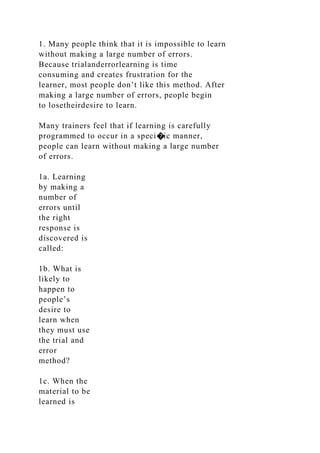
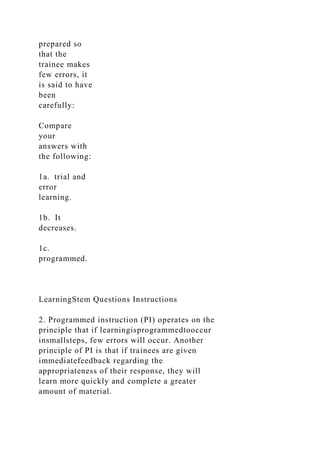
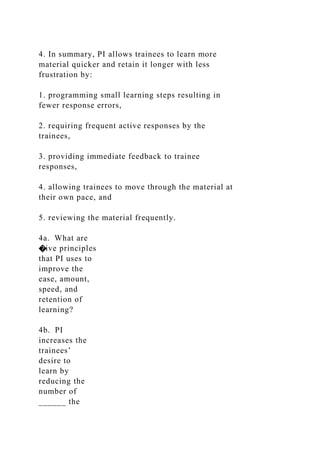
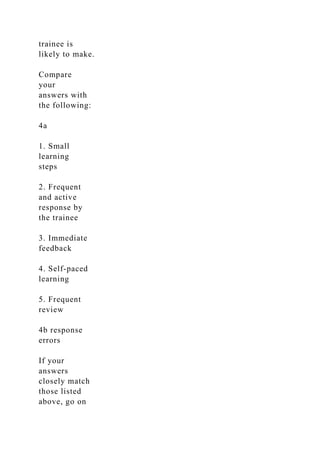
Table7-2ProgrammedInstructionforProgrammedInstruction
LearningStem Questions Instructions
1. Many people think that it is impossible to learn
without making a large number of errors.
Because trialanderrorlearning is time
consuming and creates frustration for the
learner, most people don’t like this method. After
making a large number of errors, people begin
to losetheirdesire to learn.
Many trainers feel that if learning is carefully
programmed to occur in a speci�ic manner,
people can learn without making a large number
of errors.
1a. Learning
by making a
number of
errors until
the right
response is
discovered is
called:
1b. What is
likely to
happen to
people’s
desire to
learn when
they must use
the trial and
error
method?
1c. When the
material to be
learned is
prepared so
that the
trainee makes
few errors, it
is said to have
been
carefully:
Compare
your
answers with
the following:
1a. trial and
error
learning.
1b. It
decreases.
1c.
programmed.
LearningStem Questions Instructions
2. Programmed instruction (PI) operates on the
principle that if learningisprogrammedtooccur
insmallsteps, few errors will occur. Another
principle of PI is that if trainees are given
immediatefeedback regarding the
appropriateness of their response, they will
learn more quickly and complete a greater
amount of material.
2a. If the goal
is to reduce
the number
of trainee
errors before
the material is
learned, how
should
learning be
programmed?
2b. To
increase the
amount
learned and
the speed of
learning,
when should
feedback be
given?
Compare
your
answers with
the following:
3a. active
3b. their
own pace
3c. longer
retention of
the material.
LearningStem Questions Instructions
3. Trainee learning is enhanced if the trainee is
active in the learning process. PI asks trainees to
respondtoquestionsputtingthetraineeinan
activelearningmode. Because trainees learn at
different rates, theywilllearnbestiftheycan
movethroughthematerialattheirownpace. PI
allows people to learn at their own pace. Finally,
frequentreviewofmaterialhelpstraineesretain
the material for longer periods of time.
3a.
Programming
questions into
the material
enhances
learning
because it
places
trainees into
a(n)______
mode of
learning.
3b. At what
pace should
trainees move
through the
material to be
learned?
3c. Frequent
review of
material
results in:
Compare
your
answers with
the following:
3a. active
3b. their own
pace
3c. longer
retention of
the material.
If your
answers
closely match
those listed
above, go on
to section 4.
If not, re-
read section
3, paying
close
attention to
the italicized
concepts.
Then answer
the questions
again.
LearningStem Questions Instructions
4. In summary, PI allows trainees to learn more
material quicker and retain it longer with less
frustration by:
1. programming small learning steps resulting in
fewer response errors,
2. requiring frequent active responses by the
trainees,
3. providing immediate feedback to trainee
responses,
4. allowing trainees to move through the material at
their own pace, and
5. reviewing the material frequently.
4a. What are
�ive principles
that PI uses to
improve the
ease, amount,
speed, and
retention of
learning?
4b. PI
increases the
trainees’
desire to
learn by
reducing the
number of
______ the
trainee is
likely to make.
Compare
your
answers with
the following:
4a
1. Small
learning
steps
2. Frequent
and active
response by
the trainee
3. Immediate
feedback
4. Self-paced
learning
5. Frequent
review
4b response
errors
If your
answers
closely match
those listed
above, go on
to section 3.
If not, re-
read section
2, paying
close
attention to
the italicized
concepts.
Then answer
the questions
again.
In its most sophisticated form, PI consists of a set of branches
that might be activated depending on the answer
provided to a question. If the trainee provides a correct answer,
one branch moves the trainee forward to new
information. If the answer is incorrect, a different branch is
activated, taking the trainee back to review relevant
information in more detail or to another branch that provides
additional information on the subject. This format
allows trainees to move through the material at their own pace.
Trainees who show a better grasp of the material
(on the basis of their responses) move through the material
more rapidly than those who do not. The branches
taken by those for whom the material is more dif�icult are
different and will depend on the types of errors they
make. These trainees will obviously take longer to complete the
material.
ET applies PI techniques within a computerized format to create
the learning experience. However, PI can also
come in book, interactive video, or other formats. We will focus
on the computerized application, but keep in mind
that the principles are the same regardless of format.
HowtoUsePIEffectively
Development of PI can be a dif�icult and expensive process and
might not justify the cost and effort needed.
However, when a large number of people require training,
especially if they are geographically dispersed, it can be a
viable option. Once developed, PI can be transferred to
whatever medium is appropriate for the training (tablet,
DVD, or Web site). Trainees are then able to complete the
training at their own pace, on their own time (if
desirable), and from different locations around the world. PI can
automate the less interactive components of
training.
(http://content.thuzelearning.com/books/AUBUS680.16.1/sectio
ns/i176#ch07biblio_005)In a
blended approach, you can use PI to provide the required
knowledge base and then use classroom and on-the-job
training for the hands-on practice. PI can be used to teach some
skills (e.g., computer) in addition to knowledge. PI
can be a stand-alone type of training, or it can be integrated into
a multimethod training program.
InteractiveMultimedia
Training using interactivemultimedia(IM)
(http://content.thuzelearning.com/books/AUBUS680.16.1/sectio
ns/i177#glossch07_003)integrates the use
of text, video, graphics, photos, animation, and sound to
produce a complex training environment with which the
trainee interacts. Typically, PI methodology is applied to
learning chunks that are converted into a multimedia
format to facilitate learning. For example, the trainee is put into
a real-life job situation and asked to solve a speci�ic
problem. Once the trainee interacts with the program to solve
the problem, he can receive immediate feedback as to
the effectiveness of his decision.
(http://content.thuzelearning.com/books/AUBUS680.16.1/sectio
ns/i176#ch07biblio_006)Typically, trainees
become very engaged in this type of learning because they are
immersed psychologically into the situation.
The development of portable devices and networking technology
has allowed IM to grow rapidly over the last
few years. In the early 1990s, few �irms used this technology
for training. About 45 percent of those responding to a
2008 training survey indicated that they used IM as a training
tool.
(http://content.thuzelearning.com/books/AUBUS680.16.1/sectio
ns/i176#ch07biblio_007)
ExamplesofIMUsage
IM training systems can provide training related to almost any
training objective. The training can be as simple as
providing some basic knowledge or as complex as teaching how
to diagnose heart disorders or improve
communication skills. Companies across many industries are
using this technology for training in widely differing
content areas. Following are some examples of the types of
training for which IM is used.
Nugget Brand Distributors developed a certi�icate in food
safety training, which it markets to restaurants.
(http://content.thuzelearning.com/books/AUBUS680.16.1/sectio
ns/i176#ch07biblio_008)Jackson Hewitt Tax
Service, with its huge number of part-time workers (in the tax
season), needed a way to bring employees up to
speed regarding tax changes. Downloads and “apps” allow them
to distribute the information more easily and
cheaply than using printed material. It provides training just
when the new employee needs it, and a trainer does
not have to be there.
(http://content.thuzelearning.com/books/AUBUS680.16.1/sectio
ns/i176#ch07biblio_009)Training in Action
5
6
7
8
9
https://content.ashford.edu/books/AUBUS680.16.1/sections/i17
6#ch07biblio_005
https://content.ashford.edu/books/AUBUS680.16.1/sections/i17
7#glossch07_003
https://content.ashford.edu/books/AUBUS680.16.1/sections/i17
6#ch07biblio_006
https://content.ashford.edu/books/AUBUS680.16.1/sections/i17
6#ch07biblio_007
https://content.ashford.edu/books/AUBUS680.16.1/sections/i17
6#ch07biblio_008
https://content.ashford.edu/books/AUBUS680.16.1/sections/i17
6#ch07biblio_009
7-1 describes the success of Aeronett, a company that
specializes in the development of IM training for the airline
industry.
7-1TraininginAction AeronettCornersAirlineTraining
(http://content.thuzelearning.com/books/AUBUS680.16.1/sectio
ns/i176#ch07biblio_011)
Aeronett Technologies Limited is in the business of developing
courseware for a new generation of aviation
training. Development of courseware comes from their team of
subject matter experts, instructional
designers, graphic designers, 3D animators, multimedia
programmers, and sound engineers. Air Canada, Pan
Am International Flight Academy, Jetway Aeronautics, and Star
Airlines have selected Aeronett’s ET for their
employees.
Training packages can be delivered over the Internet. They
include initial pilot training and transitional
and recurrent ground school training. Other ET training
packages for pilots include �lying dangerous goods,
cold weather/winter operations, and Paci�ic operations. But
Web-based training has been developed for
more than just pilots. Aeronett has developed training for
maintenance personnel and �light and cabin crews.
Pan Am International Flight Academy’s (PAIFA) Gary
LaGuardia indicates that Aeronett’s course will enable
PAIFA to offer state-of-the-art training “that is speci�ically
designed to meet the needs of our commercial
airline clients who come to our training from around the world.”
Air Canada selected Aeronett because its
integration of 3D simulation, 2D digital images, and
interactivity which provides a realistic portrayal of the
�light deck. The courses motivate the learner, improve
retention of new information, and allow for effective
transfer of knowledge, skills, and attitudes to aircraft operation.
As a result of their advances in ET, Aeronett was named the
2001 Leading Edge Training Innovator by the
Aerospace Industry Association of British Columbia. Training
times dropped 50 percent to 70 percent from
previous methods. Their technology-based training programs
lowered costs associated with travel and time
spent in training centers. Trainees appreciate the �lexibility
this training provides; they are able to go to
training anytime and anywhere.
IM technology is also used to provide medical training.
(http://content.thuzelearning.com/books/AUBUS680.16.1/sectio
ns/i176#ch07biblio_010)This training,
delivered via the Internet, allows a medical student to take the
medical history of a hypothetical patient, conduct an
examination, and run laboratory tests. For example, as part of
the examination, the medical student may choose to
examine the patient’s chest. The student clicks the “examine
chest” button and is then asked to choose a type of
examination to conduct (visual inspection, palpation, or
auscultation). The trainee might click on “auscultate” (listen
to sounds made by the lungs) and hear the chest sounds that
would be made by a particular patient. On the basis of
the interpretation of the sounds, the trainee would make a
diagnosis and click the button that represented a
diagnosis. The trainee would then be informed of the accuracy
of the diagnosis. If the diagnosis were incorrect, the
trainee would be given an explanation and moved to
supplementary materials designed to provide the knowledge
needed to make a correct diagnosis. The previous examples
show how useful IM can be in developing knowledge,
psychomotor, and decision-making skills. What about improving
interpersonal skills? Training in Action 7-2
describes a training program developed by Marriott
International to develop their employees’ interpersonal skills.
Another application, Virtual Leader, was developed by
SimuLearn, Inc. It utilizes arti�icial intelligence (fuzzy logic)
to
render graphics and dialogue dynamically to give the user a
simulated real-life environment for learning and
practicing persuasive leadership skills. In this example of high-
end IM, the system can simulate realistic situations,
interpret trainee responses within the logic of the leadership
model, and show how trainee interactions will
in�luence employees to behave. The simulation’s intent is to
teach people to monitor and appropriately balance
11
10
https://content.ashford.edu/books/AUBUS680.16.1/sections/i17
6#ch07biblio_011
https://content.ashford.edu/books/AUBUS680.16.1/sections/i17
6#ch07biblio_010
power, tension, and ideas to align the work of employees with
business goals (�inancial performance, customer
satisfaction, and employee morale). The authors received
training in the use of the simulation and found it to be
challenging and engaging. As with any off-the-shelf training
product, the trainer will need to carefully evaluate the
product’s �it with the �irm’s training objectives.
7-2TraininginAction
MarriottInternationalUsesMultimediaTraining
forSoftSkills
(http://content.thuzelearning.com/books/AUBUS680.16.1/sectio
ns/i176#ch07biblio_012)
Marriott International, a widely recognized name in the lodging
industry, is noted for their people-oriented
high-touch culture, so their strategic plan indicating a
commitment to growing from 900 properties to 2,000
in only a few years raised a concern regarding their ability to
train such large numbers of new employees.
Analysis indicated that in the next �ive years, Marriott would
be hiring about a million employees, who would
all need training.
A training transformation team was struck to study the problem
and �ind a solution. The solution that
made the most sense was a set of multimedia training packages
that use CD-ROM technology and operate
from a traditional personal computer. One of these, Front Desk
Quest, provides soft-skills training. To begin
the training, the trainee logs on with an ID and a password. An
on-screen person greets the trainee, walks
her through the training, and is always available for help (by
pressing the Help button). The trainee is
presented with a series of different training modules, the
culmination of which is a simulation in which the
trainee plays an active role in combining the skills and
knowledge learned earlier. In the simulation, trainees
are presented with a situation in which they are required to
determine, from a set of choices, what is the
correct thing to say or do. They then click on what they believe
to be the correct response. The computer
program responds by playing out the scenario to show the
student what happens if they make a correct or
incorrect decision. If the trainee was correct, she sees the
customer on the screen saying something positive.
If the choice was not correct, the video might show an angry
customer responding. The trainee can then
make alternative responses and see the customer reaction.
Trainees can sign on to the training at any time and start up
where they left off in the previous session.
They can go over previous exercises as often as they want and
can track their progress. Management can
also sign on and note the progress of employees.
Do employees like the new training format? Reactions are
consistently positive, so the answer must be yes.
Even those with minimal skill in the use of a computer �ind it
easy to use and are going full speed in only a
few minutes. As Starr Shafer, a manager at Marriott, says,
“They immediately give better service with greater
self-assurance. And they say, ‘Wow, I felt so comfortable doing
it.’”
HowtoUseIMEffectively
As always, the effectiveness of the program will depend on how
closely it meets the learning objectives. With IM,
trainees are likely to enjoy their experience and give the
training high marks because it is so much fun, even if many
of the training objectives are not met. Thus, it is especially
important to verify the match between the IM program’s
outcomes and the training objectives. Although this sounds
logical and straightforward, our discussion a few years
ago with Nina Adams, president of Adams I
Solution
s (a �irm that designs IM training), suggests that it is often not
the case. She told us,
12
https://content.ashford.edu/books/AUBUS680.16.1/sections/i17
6#ch07biblio_012
IfIhadonemessagetogivepeopleconsideringtheuseofIMtraining,iti
sthis:Understandthegoalsof
theprogramyou’regoingtodevelopbeforeyoudoanythingelse.Irece
ntlyworkedonaprojectwhere
theclientwasconvertingalivepresentationtomultimedia.Themajor
problemwaspullingoutofthe
clientwhattheywantedtoaccomplish…whattheywantedpeoplewho
wentthroughthetraining
programtothink,do,orfeel.It’samazinghowmanypeopledevelopapr
ogramwithoutknowingwhat
they’retryingtoaccomplish.Howdoyouknowtheprogramis“success
ful”ifyoudon’tknowwhat
you’retryingtodo?
To be most effective, your IM should accommodate multiple
learning styles and make it easy for trainees to
organize the new KSAs into their existing knowledge base
(cognitive organization). Any target group of trainees is
likely to have a variety of learning styles and cognitive
organization systems. Thus, it is necessary to ensure that the
IM uses a variety of audio and visual cues to communicate the
information and the many ways of connecting new
KSAs to old. Attention to self-pacing, interactivity, and the
sophistication of the multimedia will address these issues
and improve IM’s effectiveness.
(http://content.thuzelearning.com/books/AUBUS680.16.1/sectio
ns/i176#ch07biblio_013)
Self-pacing allows trainees to learn on the basis of what they
already know. It is important that the self-pacing be
designed to accommodate multiple ways of organizing and using
information (cognitive organization). The better
your design is in this area, the better the learning that will be
realized by your trainees. Interactivity is the
program’s ability to allow trainees to respond to situations and
to receive feedback. The more interactive the ET, the
more the trainees will retain the training. It is important to
make sure that the ET has a suf�icient level of
interactivity for trainees to retain the learning. The
sophistication of the multimedia, in this context, refers to
audio/visual integration and realism of the program. The more
ways the same information is communicated, the
easier it will be for trainees to learn it. At the same time, the
various ways of presenting the information must be
connected realistically and reinforce each other. A good IM
program should rate high on all three factors. Table 7-3
provides points to consider when evaluating IM training.
Table7-
3PointstoConsiderinDevelopmentofInteractiveMultimedia
13
https://content.ashford.edu/books/AUBUS680.16.1/sections/i17
6#ch07biblio_013
Factor MorePositive LessPositive
Self-pacing
The pace of the program is
entirely controlled by the
learner.
Trainees can select menu
options to determine the order
of modules.
Trainees can skip lessons or
segments at will and can exit
the program from any screen.
Automated tutor provides
additional practice and
material as needed or
requested.
Pace is not under control of trainee.
Trainee must follow order of the program.
Trainees can exit the program only at
certain points.
No or little additional practice or in-depth
material available.
Interactivity
Trainees’ respond/interact
following short instructional
segments.
The program tests skills and
judgments, not just facts.
The orderly sequence of topics
is apparent to the learner.
Feedback explains why
answers are correct or
incorrect.
The program has long, uninterrupted
lessons that offer no chance for the trainee
to interact or respond.
The program tests recall instead of skills.
Segments do not build on one another.
Feedback provides little explanation, only
right and wrong answers.
Multimedia
Sophistication The sounds and visuals are
realistic and clear.
A voice provides information
and instructions that go along
with the written material.
Sound and visuals reinforce
one another.
Visuals are attention grabbing
and illustrate the idea
presented.
The sound or visuals are of poor quality.
The sound is restricted to a voice saying,
“You are correct” or “Try again.”
There is no connection between the audio
and visual material (the sound is limited to
irrelevant music, for example).
The visuals don’t reinforce instructional
points.
The degree to which the IM training will result in the transfer of
new KSAs back to the job will depend on the
physical and psychological �idelity that the programming
creates. This �idelity can be accomplished by having the
program developers visit the operational areas that will be
involved in the training and by having a representative
from these areas consult with the development team. The more
closely the IM program re�lects the kinds of
situations faced on the job, the more the KSAs will transfer
back to the job.
It is a good idea to consider blending IM with other methods.
This blending allows each method to provide
unique learning opportunities while reinforcing learning from
other methods. Blending has been shown to improve
the transfer of the training to the job.
(http://content.thuzelearning.com/books/AUBUS680.16.1/sectio
ns/i176#ch07biblio_014)Instructor-guided
discussion will generally be helpful as a supplement to IM. One
thing that was evident after going through the
SimuLearn leadership training was the energy it creates for
discussing the experience. Some of our conversation
focused on the balance of realism and arti�iciality, some on the
relation of the leadership model to other models in
the literature, and some on our rationale for our personal scores.
All of these topics, guided appropriately by a
trainer, can provide valuable insight to the trainees. Other
advantages to blending guided discussion with IM include
the following:
The trainer’s enthusiasm for the training content encourages
learning.
The trainer provides assessment and accountability that is
missing in IM alone.
Trainees’ questions and comments raise issues not addressed in
the IM programming.
Trainees acquire a deeper understanding through social
interaction.
Although signi�icant learning can occur without it, guided
discussion can lead to additional learning and greater
understanding. Another approach is to supplement the IM with
manuals and other material. This was Duracell’s
approach, as described in Training in Action 7-3. This method
also seems to increase learning beyond what was
gained in the IM training.
7-3TraininginAction Duracell’sIntegratedApproachtoTrainingin
China
(http://content.thuzelearning.com/books/AUBUS680.16.1/sectio
ns/i176#ch07biblio_015)
Duracell needed to develop a training program to support its
battery manufacturing plant in China. The
program had to provide a training process that was highly
visual. The program that was developed relied
heavily on graphics, animation, digitized photos, video, and
Chinese text. These components were integrated
into a multimedia presentation that was supplemented with
“hard copy” materials. These included manuals
that trainees could take with them to use as a reference and
printed job aids to assist in the recall of the
more complex manufacturing processes. Most importantly, the
multimedia program was followed by “hands-
on” practice sessions. It was felt that these backup methods
were necessary to aid the trainee in retention
and transfer.
The training was comprehensive. It included health and safety,
operations, quality, and causal analysis. The
goal was to create a standardized training process that would
promote a safe work environment and help
the workforce become as productive as possible, as quickly as
possible. Employees were excited about the
program, and a crowd immediately formed around the
workstations of the �irst employees to use the
program. Employees were anxious to be next in line to get their
personalized training session. As motivation
is a critical component of successful training, this program was
off to a positive start.
IntelligentTutoringSystems
14
15
https://content.ashford.edu/books/AUBUS680.16.1/sections/i17
6#ch07biblio_014
https://content.ashford.edu/books/AUBUS680.16.1/sections/i17
6#ch07biblio_015
An intelligenttutoringsystem(ITS)
(http://content.thuzelearning.com/books/AUBUS680.16.1/sectio
ns/i177#glossch07_004)is a more
sophisticated form of PI. It uses arti�icial intelligence to assist
in tutoring or coaching the trainee. An ITS provides
guidance and selects the appropriate level of instruction for the
trainee. In addition, an ITS can learn from trainee
responses what worked and what did not in the training process.
On the basis of this information, the ITS improves
its methods of teaching the trainee. Intelligent tutoring can
simply be a text-based system or a combination of text
with graphics and other types of audiovisual (AV) aids.
ITS has �ive components: an expert knowledge base, a trainee
model, a training session manager, a scenario
generator, and a user interface.
(http://content.thuzelearning.com/books/AUBUS680.16.1/sectio
ns/i176#ch07biblio_016)The expert
knowledgebase(http://content.thuzelearning.com/books/AUBUS
680.16.1/sections/i177#glossch07_005)is
the set of knowledge about what is correct (e.g., the best way to
perform a task, or the knowledge needed to be
effective). The traineemodel
(http://content.thuzelearning.com/books/AUBUS680.16.1/sectio
ns/i177#glossch07_006)component stores
information about the trainees’ performance during training,
keeping track of what they seem to know. As the
trainees respond to items, the information is used to tutor or
coach them. The trainingsessionmanager
(http://content.thuzelearning.com/books/AUBUS680.16.1/sectio
ns/i177#glossch07_007)is the component
that interprets the trainees’ responses and responds either with
more information, coaching (helping the trainee
explore the topic), or tutoring (guiding the trainee toward the
correct answer). This component also determines
how and when to send the trainee back to more basic material
and what strategy to use in the remedial work. For
example, the session manager may act simply as a reference
source (providing sources for the trainee to look up
needed information), it might decide to provide a
demonstration, or it might tutor or coach (suggesting an
appropriate response) the trainee.
(http://content.thuzelearning.com/books/AUBUS680.16.1/sectio
ns/i176#ch07biblio_017)The training
scenariogenerator
(http://content.thuzelearning.com/books/AUBUS680.16.1/sectio
ns/i177#glossch07_008)is the component
that determines the order and level of dif�iculty of the
problems that are presented to the trainee. The user
interface(http://content.thuzelearning.com/books/AUBUS680.16
.1/sections/i177#glossch07_009)is the
equipment that allows the trainee to interact with the ITS. It
commonly includes a computer keyboard, mouse, or
joystick.
ITS sets itself apart from simple PI because it can do the
following:
(http://content.thuzelearning.com/books/AUBUS680.16.1/sectio
ns/i176#ch07biblio_018)
Generate instruction that matches the individual trainee’s needs.
Communicate and respond to trainee questions.
Model the trainee’s learning processes (assess current level of
knowledge and identify misconceptions,
learning problems, and needs).
Determine what information should follow based on previous
trainee responses.
Determine the trainee’s level of understanding of the topic.
Improve its strategies for teaching the trainee on the basis of
the trainee’s responses.
An examination of Figure 7-1 illustrates how trainee responses
allow the system to interpret the response and
provide the trainee with speci�ic training to address the
problem.
(http://content.thuzelearning.com/books/AUBUS680.16.1/sectio
ns/i176#ch07biblio_019)Note that the
three trainees depicted in Figure 7-1 all provided the wrong
answer to the addition questions, but each made
different errors. The intelligent tutor determines that trainee A
never carries over, trainee B carries over but
sometimes inappropriately, and trainee C has trouble with
simple single-digit addition. The tutor will then provide a
different type of instruction to each of the trainees on the basis
of the diagnosis of the errors. This process
16
17
18
19
https://content.ashford.edu/books/AUBUS680.16.1/sections/i17
7#glossch07_004
https://content.ashford.edu/books/AUBUS680.16.1/sections/i17
6#ch07biblio_016
https://content.ashford.edu/books/AUBUS680.16.1/sections/i17
7#glossch07_005
https://content.ashford.edu/books/AUBUS680.16.1/sections/i17
7#glossch07_006
https://content.ashford.edu/books/AUBUS680.16.1/sections/i17
7#glossch07_007
https://content.ashford.edu/books/AUBUS680.16.1/sections/i17
6#ch07biblio_017
https://content.ashford.edu/books/AUBUS680.16.1/sections/i17
7#glossch07_008
https://content.ashford.edu/books/AUBUS680.16.1/sections/i17
7#glossch07_009
https://content.ashford.edu/books/AUBUS680.16.1/sections/i17
6#ch07biblio_018
https://content.ashford.edu/books/AUBUS680.16.1/sections/i17
6#ch07biblio_019
continues, with the tutor constantly reevaluating and providing
new instruction until the learning objectives are
achieved.
Figure7-1StudentModelingExample
Advances in ITS continue. Presently, work is being done to
have the intelligent tutor identify when the trainee is
bored, confused, or frustrated and to have the system respond
accordingly.
(http://content.thuzelearning.com/books/AUBUS680.16.1/sectio
ns/i176#ch07biblio_020)At North Carolina
State University, scientists are working to have ITS determine a
trainee’s self-ef�icacy.* Enabling ITS to determine a
trainee’s self-ef�icacy could lead to improved pedagogy that
factors the trainee’s self–ef�icacy into the training
approach.
(http://content.thuzelearning.com/books/AUBUS680.16.1/sectio
ns/i176#ch07biblio_021)
* Recall, trainees with high self-ef�icacy learn differently from
those with low self-ef�icacy.
HowtoUseITSEffectively
ITS is even more expensive to develop than is PI. It requires
speci�ic expertise not likely found in the organization.
With electronic training technology changing so fast, however,
it is dif�icult to make recommendations that will hold
even a short time into the future. ITS is de�initely worth
considering, given the enormous advantages over simple PI.
Numerous vendors offer relevant PI and ITS training that is
available for purchase. Whether to buy off the shelf or
to develop one will depend on a cost/bene�it analysis.
VirtualReality
Virtualreality(VR)training
(http://content.thuzelearning.com/books/AUBUS680.16.1/sectio
ns/i177#glossch07_010)can be the next
best thing to being there. It allows training for dangerous
situations (police car chases, hostage situations) and
situations for which using the real thing is very expensive
(�lying, operating heavy equipment). VR puts the trainee
in an arti�icial three-dimensional environment that simulates
events and situations that might be experienced on the
job. The trainee interacts with these images to accomplish
speci�ic goals. In these respects, VR is not much different
from the more advanced forms of IM. The difference is in how
the trainee experiences the simulation. In VR, the
trainee experiences a physical involvement with and a presence
in the simulated environment.
(http://content.thuzelearning.com/books/AUBUS680.16.1/sectio
ns/i176#ch07biblio_022)That is, the trainee
psychologically experiences the environment as real. To
experience a computerized VR, the trainee must wear
devices that provide sensory input. Such devices include a
headset that provides visual and audio information,
gloves that give tactile information, and treadmills or other
types of motion platforms for creating the sense of
movement. Some can even supply olfactory information.
20
21
22
https://content.ashford.edu/books/AUBUS680.16.1/sections/i17
6#ch07biblio_020
https://content.ashford.edu/books/AUBUS680.16.1/sections/i17
6#ch07biblio_021
https://content.ashford.edu/books/AUBUS680.16.1/sections/i17
7#glossch07_010
https://content.ashford.edu/books/AUBUS680.16.1/sections/i17
6#ch07biblio_022
Many advanced forms of IM use arti�icial intelligence to
portray situations more realistically and manage
interactions with the trainee. They do not, however, reach the
level of creating a sense of physical presence. The
creators of these advanced IM programs wish to distinguish
themselves from the less advanced IM training, and
sometimes incorrectly refer to their products as VR. So when
reading about VR in trade journals, be aware that
some of what is called VR is in reality just advanced IM. For
some good reasons that are discussed later, few actual
VR training systems exist.
VR provides trainees with an understanding of the consequences
of their actions in the work environment by
interpreting and responding to the trainees’ actions in the
simulation. Sensory devices transmit to the computer
how the trainee is responding in the virtual workplace, allowing
the VR program to respond by changing the
environment accordingly. For example, a police academy
trainee sitting in a simulated driver’s seat of a police car
can see the speedometer and all the gauges on the dashboard;
looking to the right, the trainee sees an empty seat;
when the trainee turns the steering wheel, the view through the
windshield provides a visual representation of the
car turning along a corner. VR has been used to train police
of�icers how to stop a speeding car safely, without the
danger of using real people and automobiles. To date, VR has
been used for training complex and dangerous skills,
such as �lying outside the earth’s atmosphere,
(http://content.thuzelearning.com/books/AUBUS680.16.1/sectio
ns/i176#ch07biblio_024)and more
traditional skills, such as teaching someone to speak in front of
large audiences.
(http://content.thuzelearning.com/books/AUBUS680.16.1/sectio
ns/i176#ch07biblio_025)More recently, it
has been expanded to organizational training such as the one in
Training in Action 7-4.
7-4TraininginAction FordUsesVRforTrainingatVulcanForge
(http://content.thuzelearning.com/books/AUBUS680.16.1/sectio
ns/i176#ch07biblio_023)
Taking a molten bar of steel and placing it in a stamping die
correctly, quickly, and most important safely is
critical to running an effective forging plant. Vulcan Forge,
realizing this, was on the lookout for less harsh
methods of training employees in the use of their stamping
machines. The on-the-job training was dangerous
and inef�icient, in terms of use of the machinery and waste.
That is where virtual reality (VR) came in. The trainee dons the
glasses and other peripherals, and he
appears to be in the plant with the stamping machine and all the
other environmental factors present. He
picks up the molten steel bar and places it under the hammer.
The hammer comes down hard stamping the
steel, he picks it up and rolls it to the next mold, and again the
hammer comes down hard. He drops the
newly stamped part into the bin and gets another molten steel
bar to complete the task again. When he takes
off the glasses, he is back in the training room. This VR
training is safe and results in no waste. But is it
realistic? According to trainees, the weight of the molten bar is
very similar, as is the hammer weight coming
down on the bar. Trainees suggest that it is very close to the
real thing. Furthermore, the trainees like the
idea of learning in a safe environment, where mistakes are much
more forgiving.
But what about the effectiveness of VR training? A one-day
evaluation of employees trained using VR and
those who were trained on the job determined that those trained
using VR were 10 to 20 percent more
productive than those who were trained on the job.
UsingVREffectively
The points raised for effective use of IM apply even more
strongly to VR. A concern unique to VR training,
“simulator sickness,” has limited the growth of VR. Prolonged
immersion in the VR environment has caused some
people to experience vertigo and general motion sickness.
Because people show different tolerances in terms of
24
25
23
https://content.ashford.edu/books/AUBUS680.16.1/sections/i17
6#ch07biblio_024
https://content.ashford.edu/books/AUBUS680.16.1/sections/i17
6#ch07biblio_025
https://content.ashford.edu/books/AUBUS680.16.1/sections/i17
6#ch07biblio_023
how long they can last in such an environment, and because of
the cost and long lead time, VR training is a risk not
many companies are willing to take. For the most part, VR
remains in the entertainment industry.
(http://content.thuzelearning.com/books/AUBUS680.16.1/sectio
ns/i176#ch07biblio_026)If it is being used,
a number of organizations are available to provide assistance,
but you should expect a long development period
and possible problems when trainees are using it. It is necessary
to do extensive pilot testing, as the complexity of
this type of programming leads to bugs in the program that are
not readily apparent.
(http://content.thuzelearning.com/books/AUBUS680.16.1/sectio
ns/i176#ch07biblio_027)
As with all these technologies, change is the one constant. For
example, VirtuSphere, Inc., has developed a system
that consists of a large hollow sphere that sits on top of a base,
which allows the sphere to rotate 360 degrees. The
trainee wears wireless goggles. When inside the sphere, the
trainee can move in any direction, walk, jump, roll,
crawl, and run over virtually unlimited distances without hitting
a wall.
(http://content.thuzelearning.com/books/AUBUS680.16.1/sectio
ns/i176#ch07biblio_028)Another
breakthrough at the University of Pennsylvania has a VR system
that does not require those bulky, sometimes
vertigo-producing, glasses.
(http://content.thuzelearning.com/books/AUBUS680.16.1/sectio
ns/i176#ch07biblio_029)
E-TrainingandDeliverySystems
Innovation in ET and associated learning management and
delivery systems occurs so rapidly that confusion often
exists regarding terms and their usage. They are two distinct
systems that require different types of expertise to
create, manage, and maintain. In this section, we provide a
description of the process used in creating an ET
program and delivering it to trainees. This will clarify our use
of terms throughout the rest of the chapter. Figure 7-
2 shows the basic components for creating and delivering an ET
program.
Figure7-2ComponentsforCreatingandDeliveringET
Another terminology issue is that e-learning is often used as a
synonym for ET. In practice, however, e-learning
(http://content.thuzelearning.com/books/AUBUS680.16.1/sectio
ns/i177#glossch07_011)is what results
when the recipient of the ET engages in the training once it has
been delivered. The training itself is distinct from the
deliverysystem(http://content.thuzelearning.com/books/AUBUS
680.16.1/sections/i177#glossch07_012)
and the learning that occurs is the result of both. The Internet
and intranets are common means of delivering
26
27
28
29
https://content.ashford.edu/books/AUBUS680.16.1/sections/i17
6#ch07biblio_026
https://content.ashford.edu/books/AUBUS680.16.1/sections/i17
6#ch07biblio_027
https://content.ashford.edu/books/AUBUS680.16.1/sections/i17
6#ch07biblio_028
https://content.ashford.edu/books/AUBUS680.16.1/sections/i17
6#ch07biblio_029
https://content.ashford.edu/books/AUBUS680.16.1/sections/i17
7#glossch07_011
https://content.ashford.edu/books/AUBUS680.16.1/sections/i17
7#glossch07_012
training, but they are not learning systems or training programs.
As Figure 7-2 shows, the training content is
developed from a knowledgebase
(http://content.thuzelearning.com/books/AUBUS680.16.1/sectio
ns/i177#glossch07_013)created by subject
matter experts. Once the content is developed, it is translated
into some type of electronic format through the use of
authoring and learning development tools. The design of the
training is discussed in more detail in the sections on
ET methods. In the late 1990s, some predicted that e-training
would be the primary method of training within �ive
years. That has not yet happened, but e-training is gathering
momentum. Large �irms, in 2010, indicated that they
provided only 37 percent of their training via the traditional
instructor led classroom approach. Small and medium-
sized companies, however utilize this approach more than half
the time. All companies are moving more toward a
blended training approach in which some of the training is
delivered online and some in the classroom.
(http://content.thuzelearning.com/books/AUBUS680.16.1/sectio
ns/i176#ch07biblio_030)
Once developed, ET may or may not be integrated into a
learningmanagementsystem(LMS)
(http://content.thuzelearning.com/books/AUBUS680.16.1/sectio
ns/i177#glossch07_014), depending on the
sophistication of the company’s IT systems. As shown in Figure
7-2, the ET content is developed �irst and then, if
desired can be put into an LMS. An LMS is software that
manages the content of the training, records the progress
of trainees and can perform many other administrative
functions. An LMS can be more or less sophisticated and
may or may not include features such as
authoring,
class management,
competency management,
knowledge management,
certi�ication or compliance management,
mentoring,
chat,
threaded discussion, and
video conferencing.
A set of standards called the Sharable Content Object
Referenced Model (SCORM) has been created to encourage
the standardization of LMSs.
As Figure 7-2 indicates, the �inal step is delivering the ET to
the trainees. The most common delivery methods are
CD-ROM and DVDs,
local computers and local area networks (LANs),
Internet and intranet,
mobile devices such as cell phones, iPods, and mp3 players, and
more recently, social networking sites are being utilized to
deliver training.
Many learners like to listen to podcasts not only on the road, or
while jogging, but also while at their desks or at
home. By giving employees iPods, companies can now provide
them with training as they drive, ride the subway, or
simply walk to work. Alexis Conelias, a learning consultant
with IBM Learning in Piscataway, New Jersey, began
creating podcasts for sales and solutions education and training
for the global sales team. The podcasts use
interviews and discussions with internal experts to teach and
inform the team about competitors, products,
customers, information management, new initiatives, and sales
solutions. “This was the perfect solution for trying to
get information to our sales team,” Conelias says. Because the
global sales force is so mobile, it’s dif�icult to �ind a
good time for face-to-face education or even conference calls.
This way, the sales team can download the latest
30
https://content.ashford.edu/books/AUBUS680.16.1/sections/i17
7#glossch07_013
https://content.ashford.edu/books/AUBUS680.16.1/sections/i17
6#ch07biblio_030
https://content.ashford.edu/books/AUBUS680.16.1/sections/i17
7#glossch07_014
segment on a train, in a car, or even waiting for a meeting at the
client site.
(http://content.thuzelearning.com/books/AUBUS680.16.1/sectio
ns/i176#ch07biblio_031)Training in Action
7-5 provides another example of the value of iPods in training.
Mobile devices today (tablets and most cell phones)
can utilize video and graphics, making them a more powerful
training delivery method.
7-5TraininginAction iPodsatCapitalOne
(http://content.thuzelearning.com/books/AUBUS680.16.1/sectio
ns/i176#ch07biblio_032)
The senior vice president of learning and development at
Capital One thought Duke University’s decision to
provide all its students with iPods was a great idea. He decided
to try it out at his company. They provided
iPods to a random sampling of 50 Associates and loaded the
iPods with material generated by corporation’s
training organization. The associates gave very positive
feedback and the company purchased 3,000 iPods.
Each Associate who had signed up for the 20 most popular
instructor-led courses was given an iPod. Did it
work?
In an employee survey, over 90 percent of the respondents said
such as:
I recommend the company’s audio learning to others.
It’s a worthwhile investment.
It’s a worthwhile use of my time.
Employees indicated their appreciation for this type of training
with comments such as:
“I love audio learning because I can listen to lectures or
speeches while driving, jogging or working
in the yard that I simply wouldn’t access another way.”
“One of the biggest advantages of the iPod is that you can learn
at your convenient open times and
not lose an entire day (or more) from deliverables.”
E-learning vendors are becoming a part of a larger approach to
knowledge management. Companies are now
linking their portals to a vendor’s LMS. This creates a single
location for corporate information, learning, and
collaboration. Web-based training programs are being used
extensively for mandatory or compliance training. This
is because this type of training is easier to deploy, measure, and
report.
The next step for human resource departments is the integration
of their LMS with other human resource
functions. PerformanceManagementSystems(PMS)
(http://content.thuzelearning.com/books/AUBUS680.16.1/sectio
ns/i177#glossch07_015)is software that
does just that. It links an employee’s competencies from the
LMS to annual performance reviews, compensation-
based performance, succession planning, and so forth. Although
this sounds like a great idea, it does require a great
deal of money and commitment to make it work properly.
31
32
https://content.ashford.edu/books/AUBUS680.16.1/sections/i17
6#ch07biblio_031
https://content.ashford.edu/books/AUBUS680.16.1/sections/i17
6#ch07biblio_032
https://content.ashford.edu/books/AUBUS680.16.1/sections/i17
7#glossch07_015
7.4ETDesignandDevelopment
Training utilizing the latest technology can seem to provide
exciting training at a lower cost than traditional
methods. However, the training is only able to meet the
organization’s objectives if it is good training. That means
the training must be practical, designed to meet the needs of the
learner and achieve the learning objectives for the
training. The following are some considerations in the design
and development of good ET programs.
UseLearningDesignPrinciples
Good learning design is important for the success of the training
regardless of how the training is delivered.
Effective ET program designers use the same design principles
that work for traditional training. Remember the 10
steps for instructional effectiveness discussed in Chapter5
(http://content.thuzelearning.com/books/AUBUS680.16.1/sectio
ns/i68#ch05). They were (1) gain attention,
(2) indicate the goal, (3) stimulate recall of prior knowledge,
(4) stimulate trainee motivation, (5) present material,
(6) guide learning, (7) elicit performance, (8) provide feedback,
(9) assess performance, and (10) enhance retention
and transfer. Those design components are just as important
when designing ET programs. The ET program
designer needs to take advantage of the opportunities provided
by the electronic nature of the training. For
example, an advantage of the electronic medium is that the goal
of the training can be visible throughout the
training as a banner or a sidebar. Another big advantage is the
amount of interaction between the trainee and the
content of the training. In a face-to-face classroom, there is
only a limited amount of time for trainees to interact
with the content. In ET, the trainee has as much time as he
wants to take. But, more importantly, the program can
require continued interaction with the content until it has been
mastered (ITS). This can be accomplished through
content questions and exercises that require the use of the
content. As mentioned earlier, ITS can provide learning
guidance and the more sophisticated the system, the more
guidance that can be provided. These have been some
examples of how ET can apply the principles of good training
design. The point is that it needs to be done.
Designers sometimes get carried away by the “�lash and sizzle”
of graphics and animation and lose track of what the
training is all about.
ProvideIndividualizedAttention
ET is based on content that has been programmed into a
package. Thus, it is not initially designed to meet the needs
of each trainee. As discussed in Chapter3
(http://content.thuzelearning.com/books/AUBUS680.16.1/sectio
ns/i32#ch03), a number of individual
differences can in�luence the amount learned. Thus, something
is needed to address these differences. This is where
ITS comes into play. Advances in technology have made
possible for ITS to mimic individual needs assessment.
Careful attention to the ITS needs to occur during the
development of the ET in order to allow the appropriate
branching, looping back and skipping ahead that will meet the
individual trainees’ needs. However, ITS can only go
so far. If the TNA indicates that individual attention is a critical
aspect of the training, more traditional methods
should be used, rather than ET.
MatchDeliveryMethodtoPurposeofTraining
Like any training the overall purpose of the training must be
determined before training can be designed and
developed. Certain ways of delivering training are more or less
appropriate depending on what training is to
achieve. Sometimes the goal of training is to simply have the
trainees acquire new information (declarative and
procedural knowledge). The acquisition of new knowledge can
be easily facilitated by ET as discussed in the
previous section on programmed instruction. In this case the ET
is simply delivering the information to the trainee.
More complex intelligent tutoring systems can provide tutoring
for how to apply the information and incorporate it
into the trainee’s existing mental framework. At other times, the
goal is to have the trainee create new knowledge
(strategic knowledge). This type of knowledge is more dif�icult
to develop through ET as the trainee must expand
her existing knowledge base through creation of a new mental
model of where, when, and how the knowledge can
https://content.ashford.edu/books/AUBUS680.16.1/sections/i68
#ch05
https://content.ashford.edu/books/AUBUS680.16.1/sections/i32
#ch03
be of use. This type of knowledge cannot be directly transmitted
to the trainee. Rather, it is through the interaction
with the training content and material, application of previous
experiences and feedback from knowledgeable
experts that the trainee creates this knowledge; thus, at most,
ET serves as a guidance system or aid. For training
that has a goal of strategic knowledge creation, a content expert
instructor is necessary. When skills are the goal of
training, ET can be very effective if; (1) it is designed well, and
(2) the skill can be evaluated electronically. So,
training in spreadsheet analysis might be well suited for ET
where training in persuasive communication would not.
KeepFocusontheLeaning,NottheProcess
Often trainees going through an ET program will become
overwhelmed or confused by the navigational
requirements of the training. It is important to provide clear
procedures for navigating through the training and
some level of “help” support for those who run into problems.
Additionally, too much information provided too fast
can discourage trainees. Make sure the content information is
displayed in accordance with the trainee’s ability to
incorporate it. Make every effort to minimize unnecessary
information and distractions. For example, page layouts
and functionality should be consistent across the program. To
assist learning, the program should provide graphics,
pictures, or animations to accompany text, but make sure it
enhances the content and is not just entertainment. Only
present as much information on a page as will be easily seen by
the trainee. Make sure to group relevant material
together.
ConvertingTraditionalProgramstoET
Not all traditional training programs should be converted to an
e-learning format. Neither should conversion be
done on a piecemeal basis. The entire company curriculum
should be analyzed to determine which content areas
can be converted to an electronic format effectively. These
content areas then should be analyzed to identify
similarities and overlap in content. Converting these areas of
similarity and overlap into a standardized electronic
format reduces the workload that would be required if each
course was done separately. “Yes,” you might say, “but
each program might have a somewhat different purpose and
context for that content.” You would be right. So, when
integrating the content back into the original course, it will
need to be customized. However, using a standardized
format, it becomes easier and more ef�icient to make the
customization than to create the electronic content
separately for each course. At the same time, you have captured
a set of knowledge that can be stored and later
used by programs that are developed in the future. Another
bene�it of doing the curriculum analysis is that you can
identify content that can be considered to be prerequisite
knowledge for other courses. Once these are identi�ied,
they can then serve as “pretraining work” for trainees who
might not be quite ready for the main program. A
sophisticated system would assess the trainee’s readiness for the
training program by administering a pretest. The
results of the pretest would then be linked to pretraining
modules that the trainee needs to be ready for the main
program.
Of�lineDeliverySystems
Local computers are individual computers that are available to
the trainees. The ET is loaded onto each computer’s
hard drive and can be accessed by the trainee. This is not a very
ef�icient delivery method if more than a few
trainees are to be trained. A more ef�icient process is to use the
organization’s localareanetwork(LAN)
(http://content.thuzelearning.com/books/AUBUS680.16.1/sectio
ns/i177#glossch07_016). A LAN is simply
the electronic connection among the various computers and a
central server. With a LAN, the ET is loaded onto the
server, where it becomes accessible from any authorized
computer on the network. This saves memory in the
individual computers and the time and inconvenience of trainees
loading the program onto their own computers.
The ET can be reproduced on �lash drives or DVDs and
delivered to individual trainees. This method of delivery
allows trainees to access the training outside the LAN and
without downloading the program onto the computer.
The development of small, portable DVD players allows
trainees to access the training even in remote locations
where Internet connections do not exist. DVDs are easy to
package and inexpensive to reproduce and distribute.
https://content.ashford.edu/books/AUBUS680.16.1/sections/i17
7#glossch07_016
InternetandIntranet
The Internet and intranets are also rapidly becoming methods
for transmitting standardized training to trainees
who are in many different locations. Companies use an intranet
(http://content.thuzelearning.com/books/AUBUS680.16.1/sectio
ns/i177#glossch07_017)to provide access
to training through a company portal. The portal allows only
authorized employees’ access to training. Training
over the Internet or intranet will require the use of an LMS to
monitor who is accessing the training, record trainee
progress, and perform other training management functions. An
advantage to this delivery approach is that the time
that trainees spend on the training, and any evaluation of trainee
learning, can be recorded in a central location.
With the development of Web 2.0, dynamic person-to-person
and group-to-group interaction was made possible.
This will allow Web-based training to become a more
instantaneous collaborative experience.
(http://content.thuzelearning.com/books/AUBUS680.16.1/sectio
ns/i176#ch07biblio_033)
StrengthsandLimitationsofET
ET is just one potential method of training. The soundness of
the design and development of the content are more
important to the effectiveness of the training than the method of
delivery. As with any training method you need to
look at its costs, control of material and training process, ability
to meet learning objectives, ability to facilitate the
trainees’ learning process, and the characteristics of the group
that will be trained.
Costs
Arguments are made both supporting and criticizing the cost
effectiveness of ET. The costs of developing and
implementing an ET program include the following factors:
Number of trainees taking the course per year
Cost of wages per hour for trainees while they are taking the
course
Cost of wages per hour for course developer
Amortized cost of hardware to support the ET
Amortized cost of software used in the ET
Hours needed to complete the ET program
Hours needed to develop ET course content
Stability of the course content
Cost of not addressing the training need sooner with some other
method
It is usually believed that ET programs are more cost effective
than traditional methods because of little overhead
(training rooms and equipment for example) and no trainee
travel costs (transportation, lodging and such). There
are other costs however that are associated with ET that are not
associated with traditional training. There is the
infrastructure cost of dedicated servers and the cost of periodic
technology upgrades. There is also the cost of
developing the program that increases as the complexity and
quality of the program increases.
The development cost of ET is not usually justi�ied for a small
number of trainees. The cost of developing an ET
program varies with the quality and complexity of the medium
used. Interactive and engaging ET that adapts some
traditional training content to be delivered electronically could
have a development cost of between $50,000 and
$100,000 per hour of training.
(http://content.thuzelearning.com/books/AUBUS680.16.1/sectio
ns/i176#ch07biblio_034)On average, an
hour of ET instruction is reported to require about 220 hours of
development time. This can be much higher for
more complex material and has been estimated as high as 1,300
hours per 1 hour of instruction.
(http://content.thuzelearning.com/books/AUBUS680.16.1/sectio
ns/i176#ch07biblio_035)But as with all
33
34
35
https://content.ashford.edu/books/AUBUS680.16.1/sections/i17
7#glossch07_017
https://content.ashford.edu/books/AUBUS680.16.1/sections/i17
6#ch07biblio_033
https://content.ashford.edu/books/AUBUS680.16.1/sections/i17
6#ch07biblio_034
https://content.ashford.edu/books/AUBUS680.16.1/sections/i17
6#ch07biblio_035
technology, there have been advances, and some rapid
development tools have made it easier and faster to create
ET programs. Compared with the 220 hours required for 1 hour
of less complex ET, some rapid-development tools
can do a similar job in 33 hours—a substantial savings.
(http://content.thuzelearning.com/books/AUBUS680.16.1/sectio
ns/i176#ch07biblio_036)Of course, this
requires the upfront cost of purchasing the rapid development
tools. So, if the company will be engaging in a large
number of ET programs, the return on the investment will be
better.
A learning management system can also reduce the costs of ET.
The LMS is the engine that delivers the
knowledge to the trainee. The knowledge base is the
information that needs to be learned. Development of the LMS
is fairly expensive, but the development of the knowledge base
is less so.
(http://content.thuzelearning.com/books/AUBUS680.16.1/sectio
ns/i176#ch07biblio_037)A knowledge base
(e.g., persuasive communication) that is used for one
application (training a salesperson to sell an automobile) can
be quickly and easily changed to �it another application
(training the HR manager to explain why a grievance cannot
be allowed).
(http://content.thuzelearning.com/books/AUBUS680.16.1/sectio
ns/i176#ch07biblio_038)
Thus, the knowledge base, once developed, can be used across
many training programs. Many e-learning companies
have developed very sophisticated LMS that they lease or
license. Many companies acquire access to a LMS and
develop the knowledge base in-house to keep the cost of ET
down.
Multimedia training is somewhat less costly to develop and can
be easier to deliver and more convenient to use.
CDs, DVDs, and �lash drives are inexpensive media and can be
easily distributed to trainees across geographically
dispersed locations. If the topic to be trained is generic, various
programs are available at a reasonable cost.
Consider the health and safety training programs offered by
Comprehensive Loss Management of Minneapolis,
presented in Table 7-4. They offer a number of reasonably
priced training programs in safety, available in DVD or
other media. Likewise, companies can share in the development
costs for common types of training, as was the case
with LearnShare (see Training in Action 7-6). Its charter
members can access more than 500,000 online
development courses.
(http://content.thuzelearning.com/books/AUBUS680.16.1/sectio
ns/i176#ch07biblio_040)This concept is a
great idea for small companies to consider in the pursuit of all
types of training, but particularly the more expensive
types of ET.
Table7-4SomeHealthandSafetyTrainingUsingDVDTechnology
36
37
38
40
https://content.ashford.edu/books/AUBUS680.16.1/sections/i17
6#ch07biblio_036
https://content.ashford.edu/books/AUBUS680.16.1/sections/i17
6#ch07biblio_037
https://content.ashford.edu/books/AUBUS680.16.1/sections/i17
6#ch07biblio_038
https://content.ashford.edu/books/AUBUS680.16.1/sections/i17
6#ch07biblio_040
AccidentInvestigation
Prevents costly accidents from recurring by investigating to
�ind causes and implementing steps to prevent
them.
Length of video 12 minutes. Price $449
Of�iceErgonomics
Helps workers understand injuries caused by repetitive motion
and how to prevent them.
Length of video 17 minutes. Price $319
WSI:Blood-BornePathogens
This video is patterned after the popular TV show CSI. It
describes a workplace injury where an employee
contracts a bloodborne disease and describes potentially
overlooked vectors of bloodborne pathogen
transition.
Length of video 13 minutes. Price $499
Con�inedSpaceEntry
This training teaches workers concepts essential for a safe work
environment when in a con�ined space.
Twenty-nine interactive activities assess the level of
understanding of the key learning objectives and let trainees
apply what they learned in a safe environment.
Length of video 17 minutes. Price $449
Note:Allvideoscomewithadministrativematerials,traineehandboo
ks,etc.
Source:Informationacquiredathttp://www.clmi-training.com.
7-6TraininginAction TheHighCostofMultimediaTraining
(http://content.thuzelearning.com/books/AUBUS680.16.1/sectio
ns/i176#ch07biblio_039)
A software developer was extolling the virtues of multimedia
training. “It will alter the learning landscape for
the next millennium,” he said to 200 training executives at a
Boston conference. A newly appointed training
executive listened with some irritation. He recently had been
told by one of these people that they would
develop a DVD training program for his company for $250,000.
Unfortunately, his division would not be able
to share the program with other business units in the company.
In fact, the corporation would not even own
the copyright on the program for two years, during which time
the developer could sell it to anyone else who
was interested.
At the end of the talk, when the speaker asked if there were any
questions, the training executive stood up,
looking at the rest of the attendees and said, “Why don’t we all
get together and share what we have and
fund what we need? Most of us have similar training needs in a
number of areas: basic sales skills, time
management, leadership skills, and interpersonal skills.”
Nobody said anything and the speaker concluded
the session. The training executive was then surrounded by the
other training executives, who wanted to
explore the idea. From that encounter came a consortium of nine
large noncompeting manufacturing
companies—LearnShare. One of its goals is to develop
partnerships with vendors of multimedia training in a
39
https://content.ashford.edu/books/AUBUS680.16.1/sections/i17
6#ch07biblio_039
way that is win–win for everyone. With the consortium’s
combined revenues of more than $100 billion and
2.2 million employees, they are likely to carry some real clout
with vendors.
One of LearnShare’s �irst objectives was to determine
similarities in the training needs across the different
companies. So, they conducted a survey in all nine companies
that identi�ied the training material that was
not related to a company’s processes or products. The result: 74
percent of the training was addressing the
same needs. In other words, diversity training is diversity
training, no matter where it is taught.
Interestingly, LearnShare has evolved into its own company and
now sells its products and services to
others. However, it is still true to its roots and members of the
“LearnShare Community” still share their
ideas and materials with each other.
Unless there is access in the organization to a technology unit
with speci�ic skills related to the development of
IM, it will probably be more cost-effective to use outside
vendors. The more sophisticated and complex the material,
the more likely it is that it will be necessary to contract with an
outside provider. Although many generic “off-the-
shelf ” programs can be useful, many vendors will customize
the content to �it the objectives of the company. In
addition to the organizations discussed previously, Michelin,
IBM, Motorola, Volvo Heavy Truck, and Duracell use IM
training. Applications range from the start-up and shutdown of a
production line to verbal interaction skills.
(http://content.thuzelearning.com/books/AUBUS680.16.1/sectio
ns/i176#ch07biblio_041)Some of these
programs are developed in-house, and others are purchased.
A VR unit can cost as little as $20,000, and even with the cost
of designing, the training could make the total cost
reasonable compared with something like an equipment
simulator.
(http://content.thuzelearning.com/books/AUBUS680.16.1/sectio
ns/i176#ch07biblio_042)Keep in mind that
the time to build a VR program can be eight months or longer.
The potential health risks will also need to be
weighed when using VR.
Although all ET technologies generally involve more expensive
start-up costs than does classroom training, they
offer a major advantage: ET delivery systems make it possible
to eliminate many of the costs incurred with other
methods, such as trainers, facilities, and trainee travel and
lodging.
Research shows that ET reduces training time and, in most
cases, travel and lodging costs related to training.
Several studies examining various types of ET (programmed
instruction and multimedia) indicate that ET learning
takes less time.
(http://content.thuzelearning.com/books/AUBUS680.16.1/sectio
ns/i176#ch07biblio_043)
In a more recent study, Air Force trainees were taught
troubleshooting of the hydraulic subsystems of F-15 aircraft
using ITS and ET-programmed instruction. Evaluation of the
two teaching methods indicated that the ITS trained
group not only learned the material in less time, they also
learned more.
(http://content.thuzelearning.com/books/AUBUS680.16.1/sectio
ns/i176#ch07biblio_044)
As mentioned earlier, there is typically a signi�icant lag time
between the point at which a training need is
identi�ied and completion of a relevant ET program. The cost
of not immediately addressing the training need
through some other method must be factored into the cost of
developing the ET.
ControlofMaterialandProcess
ET software determines the content and process of the training.
Perhaps the most important advantage of ET is its
control over the content of the material, method of presentation,
and movement of the trainee through sequentially
structured learning episodes based on previous trainee
responses.
(http://content.thuzelearning.com/books/AUBUS680.16.1/sectio
ns/i176#ch07biblio_045)The pace of
learning is controlled by the interaction between the software
and the trainee.
41
42
43
44
45
https://content.ashford.edu/books/AUBUS680.16.1/sections/i17
6#ch07biblio_041
https://content.ashford.edu/books/AUBUS680.16.1/sections/i17
6#ch07biblio_042
https://content.ashford.edu/books/AUBUS680.16.1/sections/i17
6#ch07biblio_043
https://content.ashford.edu/books/AUBUS680.16.1/sections/i17
6#ch07biblio_044
https://content.ashford.edu/books/AUBUS680.16.1/sections/i17
6#ch07biblio_045
The aforementioned features are both strengths and weaknesses
of various ET compared with instructor-based
training. The advantages are that ET ensures consistency of
topic coverage and topic mastery across all trainees.
Sometimes, however, learning opportunities are lost if trainees
cannot diverge from prescribed topic areas to clarify
understanding. A live trainer can identify when such divergence
is necessary. ET programs have tried to address
this issue by providing instant messaging and other
communication tools that allow trainees to communicate with
one another and a live trainer. Of course, this adds to the cost of
training. Pilot testing of the ET can attempt to
identify these issues ahead of time and incorporate appropriate
segments to deal with them.
ET has the advantage of being portable, allowing the trainee to
learn at times and places that are most
convenient and to control the pace of learning. Trainees can
start and stop training whenever they wish.
Unfortunately, we could not �ind any studies that looked at the
effects of such interrupted learning. Frequent
interruptions in the learning process might lead to increased
time to learn the material, as trainees must go back
and review previously covered material to catch up to where
they left off when the training was stopped. In
Chapter5(http://content.thuzelearning.com/books/AUBUS680.16
.1/sections/i68#ch05), we cited research
showing that whole rather than part learning is more effective
when the task to be learned is highly organized but
not complex. Spaced practice of the learning is more effective
than when done all at once. It is important then for ET
to provide guidance to the trainees about when and when not to
interrupt their learning.
Most ET programs lack control over who is actually taking the
training. A few years ago, a professor of an
introductory MBA accounting course decided to use an online
learning program to teach basic accounting
principles. Each student got a personal password to sign on to
the system. Students could complete lessons at their
convenience, as long as they completed the 10 modules within a
three-week period. The modules were linked so
that the students were required to complete module 1 before
they could begin module 2, and so on. According to
the records generated by the program, everyone completed all
the modules by the end of the third week. At this
point, the professor began his lectures and discussions about
contemporary accounting practices. It soon became
clear that many of the students did not understand the basic
principles covered in the ET. Further investigation
revealed that several students had recruited others to use their
password and complete their ET modules. The
professor abandoned the ET approach the following year.
This could also happen when training is mandated (e.g., safety,
sexual harassment) and the trainees are not
particularly motivated to complete it or when there are no
rewards for actually using the KSAs on the job. For
example, employees in “pay for knowledge” systems have been
known to divide the training among the members of
the group so that one or two people complete the training for all
the other members. When it is important to
ensure that the target population is completing the training, it is
necessary to develop appropriate control
mechanisms for the ET.
LearningObjectives(KSAs)
ET is a useful method for enhancing trainees’ knowledge base.
It can do so through repeated presentation of facts
in several different formats and presentation styles. It can do an
excellent job of describing when and how to apply
the knowledge to situations relevant to the training objectives.
ET can document the appropriateness of the
trainee’s application and provide additional practice modules to
improve areas of weakness.
Skill development is also possible with ET when task
simulations are highly consistent with the actual job. For
example, ET software training employees in the use of word
processing, spreadsheet, and other computer-based
programs can easily replicate situations they will face when
back on the job. Evidence exists that even more complex
skills that require the use of natural language (e.g.,
interpersonal or con�lict resolution skills) or psychomotor
development (driving a forklift) can be developed through IM
and VR, though not to the level of mastery. Recall the
Marriott hotel chain in Training in Action 7-2. Although Eric
Jensen, director at Marriott headquarters, was initially
hesitant about the ability of multimedia to train soft skills, he
changed his mind. The Marriott soft skills focus on
improving the interaction between two or more people.
Developing these skills requires trainees to engage in the
interaction and receive immediate feedback about their
performance. It is extremely dif�icult for computers to
simulate these situations in a fully realistic manner. That is why
we recommend a blended approach combining ET
https://content.ashford.edu/books/AUBUS680.16.1/sections/i68
#ch05
with instructor-led training that allows the trainee to practice
with the feedback and guidance of an expert. As Eric
Jensen noted regarding the training at Marriott, “There is no
‘intelligent tutoring’ in terms of the system ‘knowing’
what kind of tutoring an individual needs. The program simply
branches in certain areas, but the branching is also
limited, because of the enormous cost in trying to take many
different options into account.”
(http://content.thuzelearning.com/books/AUBUS680.16.1/sectio
ns/i176#ch07biblio_046)Although the
interaction is far from perfect, it does provide one-on-one
feedback, and learning does occur.
What about training of psychomotor skills? Well, we have the
Vulcan Forge Training (Training in Action 7-4)
example. Another example is the National Guard. They train
members on how to troubleshoot and repair Bradley
tanks. In many situations, the tanks are not available; having
members train in an IM-simulated environment is less
expensive and still effective. Of course, the Aeronett example
(see Training in Action 7-1) also demonstrated that ET
can improve psychomotor and decision-making skills for pilots,
�light crew, and aircraft maintenance personnel.
What do all these examples mean? ET can be a useful tool in
developing skills, including more complex skills such
as those that can be simulated electronically. However, other
methods are required to develop those skills to higher
levels. For instance, unless a VR program is highly
sophisticated, it will not be able to observe the person and
provide feedback on such things as standing too close when
talking to someone or not maintaining good eye
contact.
Attitudes and motivation can be positively or negatively
in�luenced through ET by showing connections among
objects, events, and outcomes. The opportunity to experience or
interact personally with the objects and events,
however, is limited by the ET’s ability to simulate reality. As a
result, the emotional or affective side of attitudes might
not be strongly activated. This might partially explain why most
adult learners prefer ET when it is blended with
some form of instructor-based training.
(http://content.thuzelearning.com/books/AUBUS680.16.1/sectio
ns/i176#ch07biblio_047)
LearningProcess
Attention
ET is generally seen as more interesting and motivating than
instructor-based training, such as the lecture. Trainees
cite reasons for this, such as feeling less threatened by the
machine and having more control over the pace of
instruction. In addition, ET can integrate audio and visual
effects that draw the learner’s attention to the material.
Perhaps most importantly, ET can occur when the trainee is
ready to learn and not at some pre-set time and
location. For these reasons, ET is good at capturing and
retaining trainee attention.
Retention—SymbolicCoding
ET can provide multiple cues that can be used in the symbolic
coding process. Textual, auditory, and oral cues can
be integrated to allow trainees to use those that �it best with
their learning style to code the content of the training.
Audiovisuals (AVs) are also effective in facilitating trainees’
cognitive organization. The programming of the ET
creates a speci�ic organization of the material, with each
learning segment broken down into small steps. This makes
it easier to integrate with the trainee’s existing cognitive
organization. Through the accumulation of these small
steps and their repetition, ET is able to shape the cognitive
organization of the trainee in the desired manner. The
ease with which the trainee can do this will depend on how
closely the organization of the ET matches the cognitive
organization of the trainee. The more self-paced the ET, the
more it facilitates cognitive organization.
Retention—SymbolicRehearsal
Symbolic rehearsal is a strong feature of the ET approach,
especially IM and VR. The trainees are �irst moved
through mastery of the facts; then they are provided application
segments in which to apply the facts to speci�ic
situations. For example, suppose trainees were learning to take
photographs. The ET would provide a simulated
situation such as the inside of a room with arti�icial lighting,
objects that are closer or farther away, and a
description of what should be photographed. The trainees would
then indicate the camera settings for taking the
46
47
https://content.ashford.edu/books/AUBUS680.16.1/sections/i17
6#ch07biblio_046
https://content.ashford.edu/books/AUBUS680.16.1/sections/i17
6#ch07biblio_047
picture. The ET could even provide feedback that shows what
would happen in a real situation. Using the
photography example, the ET program could show what kind of
photograph would be produced. It allows each
trainee to continue to practice while providing immediate
feedback, until the trainee masters the simulation. This
type of symbolic rehearsal borders on behavioral reproduction
and is valuable for retaining the material.
BehavioralReproduction
ET is effective at modeling appropriate behavior and providing
simulations in which the trainee can apply
knowledge. These components facilitate the development of
skills but do not provide the opportunities to actually
reproduce the desired behavior and receive feedback. For
example, ET can be used to learn a foreign language. The
trainee can learn the meaning of words, correct usage, and
proper pronunciation, but she will not master the
language conversationally until actually interacting with an
expert and receiving feedback. Likewise, the
photography example is not true behavioral reproduction
because the trainee is not using a real camera or a real
scene. Pilots do not complete their training until they �ly under
the guidance of experts. Physicians are not certi�ied
to practice medicine until they have trained under the guidance
of experts. Blending ET with some form of on-the-
job training will allow trainees to master the more complex
skills.
TrainingGroupCharacteristics
Typically, only one trainee can use a computer at a time, so the
number of computers available limits the number of
trainees who can be trained at the same time. However, because
training is available virtually all the time, this is
usually not much of a problem. If the ET is online or on a CD,
then trainees can take it anywhere they have access to
a computer and, in the case of online situations, the Internet.
Because ET can take into account many differences in trainee
readiness, there are few trainee limitations. As with
most methods, trainees must be able to read and understand the
text and AV components presented. Trainees must
also have basic computer skills. If you are considering ET as a
training method, it will be necessary to assess the
trainees’ reading levels, computer literacy, and attitude toward
ET. Some type of pretraining orientation or
preparation program can address these issues. It might also be
possible to build the considerations into the design
of the ET program.
BlendingETandOtherMethods
Blending instructional methods allows the bene�its of
instructor-led training to be incorporated with those of ET.
Advantages of blending are that it can foster learning
communities, extend training time, provide follow-up
resources, provide access to guest experts, and offer timely
mentoring or coaching via either face-to-face or online
laboratory and simulation activities.
(http://content.thuzelearning.com/books/AUBUS680.16.1/sectio
ns/i176#ch07biblio_048)There is
substantial evidence that blended learning is more effective than
either method alone, for training focused on
declarative and procedural knowledge. To attain this advantage,
however, the design of the ET should include a high
level of control by the learner. By learner control, we are
referring to control of the content, sequencing of training
events, and pace of the learning. The trainee should also have
an opportunity to practice the material and receive
feedback.
(http://content.thuzelearning.com/books/AUBUS680.16.1/sectio
ns/i176#ch07biblio_049)So,
although each type of ET can stand alone and in some cases be
suf�icient, you should consider integrating ET with
other methods when possible. For example, training supervisors
in active listening skills through an interactive
video would provide the trainee with some level of skill.
Coupling the video with some instructor-led, active listening
role-plays with real people, followed by trainee–instructor
discussions of the experience, will lead to a richer
learning experience. Remember, all the previously discussed
advantages related to guided discussion apply to any
training conducted by an instructor. Combining ET with these
other methods, therefore, can only enhance the
learning experience.
48
49
https://content.ashford.edu/books/AUBUS680.16.1/sections/i17
6#ch07biblio_048
https://content.ashford.edu/books/AUBUS680.16.1/sections/i17
6#ch07biblio_049
Summary
Electronic training (ET) is delivered to trainees through e-
learning systems such as LANs, �lash drives, DVDs,
intranets, and the Internet, as well as other electronic devices
such as iPods and cell phones. ET methods integrate
the content to be learned (knowledge base) into a training
design such as programmedinstruction(PI)
(http://content.thuzelearning.com/books/AUBUS680.16.1/sectio
ns/i177#glossch07_018), intelligent tutoring
system (ITS), interactive multimedia (IM), or virtual reality
(VR). The content and design are transformed into
electronic media through the use of authoring and design tools.
Sometimes a learning management system (LMS) is
used to integrate training management functions and learning
tools with the training program.
PI is a method of self-paced learning managed by both the
trainee and the program software. Although typically
delivered electronically, this training can also be delivered via
print, multimedia, or other formats. ITS utilizes PI and
arti�icial intelligence to diagnose and deliver the kind of
training the trainee needs. IM training integrates the use of
text, video, graphics, photos, animation, and sound to produce a
complex training environment with which the
trainee interacts. Typically, PI or ITS methodology is applied to
learning chunks that are converted into a multimedia
format to facilitate learning. VR puts the trainee in an arti�icial
three-dimensional environment that simulates events
and situations that might be experienced on the job. The trainee
experiences a physical involvement with and a
presence in the simulated environment. To experience a
computerized VR, you must wear devices that provide
sensory input. This method is relatively new and has not caught
on as rapidly as some had predicted. This method
also raises some health concerns.
ET can provide training to more employees, in more locations,
and at a lower cost than other training methods.
However, development costs for ET are typically higher than for
other methods, so a careful cost/bene�it analysis is
necessary to determine whether an ET method is appropriate.
The more sophisticated the ET, the higher the
development costs and the longer the time it will take to
develop the training. ET maintains very good control of the
learning process. In most cases, this is an advantage, but it can
become a disadvantage when the software does not
allow needed clari�ication or discussion that addresses trainee
concerns. Because ET can take into account many
differences in trainee readiness, there are few trainee
characteristics that would limit its use. ET can do an excellent
job of activating the learning processes of attention, symbolic
coding, cognitive organization, and symbolic
rehearsal, making it a good method for addressing knowledge
and attitude training objectives. It does a fairly good
job of developing skills up to, but not including, the mastery
level. It is recommended that, where possible, ET be
blended with other training methods to maximize learning.
https://content.ashford.edu/books/AUBUS680.16.1/sections/i17
7#glossch07_018
Case:EvolutionofTrainingatMr.Lube(Conclusion)
Senior VP Bill Tickner had decided that his paper-based
training system was not an effective tool for ensuring that
the geographically dispersed workforce had the competencies
required by Mr. Lube. After investigating many
alternatives, Mr. Tickner found his solution in partnering with
the e-learning company, Acerra Learning, Inc., and Q9,
a provider of outsourced Internet infrastructure and managed
hosting services. Mr. Lube began conducting its
training over the Internet, using a learning management system
(LMS) developed by Acerra. Mr. Tickner felt sure
that the system was working because employees were
completing oil changes and safety checks more quickly now
that they were being coached with an LMS. For Mr. Lube, e-
learning presented a compelling business proposition. It
provides training on a just-in-time basis to employees anywhere
in the world. It allows on-the-job training and self-
paced learning. For Mr. Lube, an important component was that
the LMS can monitor the progress of each
employee and administer and score online tests to ensure that
each employee has the required competencies. Mr.
Lube blends electronic training with worksite mentors assigned
to the trainees. The LMS data are complemented by
online progress reports from these worksite mentors.
Mr. Lube planed to eventually integrate its LMS with other
corporate information systems such as payroll and
human resources. Mr. Tickner saw an advantage to having all
employee information stored in one place. This would
allow the mining of these data to improve systems and make
better decisions. As with many other companies, Mr.
Lube found that advancing their technical capabilities in
training has pointed the way to technical advances in other
aspects of HR.
Sources: This case is based on information contained in the
following Web sites:
www.globeandmail.com/servlet/story/RTGAM.20030710welear
n.0710BNStory/Technology/; www.mrlube.ca
www.newswire.ca/en/releases/archive/july2002/
KeyTerms
Electronictraining(ET)
(http://content.thuzelearning.com/books/AUBUS680.16.1/sectio
ns/i103#ch07term01)
Deliverysystem
(http://content.thuzelearning.com/books/AUBUS680.16.1/sectio
ns/i104#ch07term02)
E-
learning(http://content.thuzelearning.com/books/AUBUS680.16.
1/sections/i104#ch07term03)
Expertknowledgebase
(http://content.thuzelearning.com/books/AUBUS680.16.1/sectio
ns/i104#ch07term04)
Intelligenttutoringsystem(ITS)
(http://content.thuzelearning.com/books/AUBUS680.16.1/sectio
ns/i104#ch07term05)
Interactivemultimedia(IM)
(http://content.thuzelearning.com/books/AUBUS680.16.1/sectio
ns/i104#ch07term06)
Intranet(http://content.thuzelearning.com/books/AUBUS680.16.
1/sections/i105#ch07term07)
Knowledgebase
(http://content.thuzelearning.com/books/AUBUS680.16.1/sectio
ns/i104#ch07term08)
Learningmanagementsystem(LMS)
(http://content.thuzelearning.com/books/AUBUS680.16.1/sectio
ns/i104#ch07term09)
Localareanetwork(LAN)
(http://content.thuzelearning.com/books/AUBUS680.16.1/sectio
ns/i105#ch07term10)
PerformanceManagementSystems(PMS)
(http://content.thuzelearning.com/books/AUBUS680.16.1/sectio
ns/i104#ch07term11)
Programmedinstruction(PI)
(http://content.thuzelearning.com/books/AUBUS680.16.1/sectio
ns/i106#ch07term12)
Self-pacedlearning
(http://content.thuzelearning.com/books/AUBUS680.16.1/sectio
ns/i104#ch07term13)
Traineemodel
(http://content.thuzelearning.com/books/AUBUS680.16.1/sectio
ns/i104#ch07term14)
Trainingscenariogenerator
(http://content.thuzelearning.com/books/AUBUS680.16.1/sectio
ns/i104#ch07term15)
Trainingsessionmanager
(http://content.thuzelearning.com/books/AUBUS680.16.1/sectio
ns/i104#ch07term16)
Userinterface
(http://content.thuzelearning.com/books/AUBUS680.16.1/sectio
ns/i104#ch07term17)
Virtualreality(VR)training
(http://content.thuzelearning.com/books/AUBUS680.16.1/sectio
ns/i104#ch07term18)
https://content.ashford.edu/books/AUBUS680.16.1/sections/i10
3#ch07term01
https://content.ashford.edu/books/AUBUS680.16.1/sections/i10
4#ch07term02
https://content.ashford.edu/books/AUBUS680.16.1/sections/i10
4#ch07term03
https://content.ashford.edu/books/AUBUS680.16.1/sections/i10
4#ch07term04
https://content.ashford.edu/books/AUBUS680.16.1/sections/i10
4#ch07term05
https://content.ashford.edu/books/AUBUS680.16.1/sections/i10
4#ch07term06
https://content.ashford.edu/books/AUBUS680.16.1/sections/i10
5#ch07term07
https://content.ashford.edu/books/AUBUS680.16.1/sections/i10
4#ch07term08
https://content.ashford.edu/books/AUBUS680.16.1/sections/i10
4#ch07term09
https://content.ashford.edu/books/AUBUS680.16.1/sections/i10
5#ch07term10
https://content.ashford.edu/books/AUBUS680.16.1/sections/i10
4#ch07term11
https://content.ashford.edu/books/AUBUS680.16.1/sections/i10
6#ch07term12
https://content.ashford.edu/books/AUBUS680.16.1/sections/i10
4#ch07term13
https://content.ashford.edu/books/AUBUS680.16.1/sections/i10
4#ch07term14
https://content.ashford.edu/books/AUBUS680.16.1/sections/i10
4#ch07term15
https://content.ashford.edu/books/AUBUS680.16.1/sections/i10
4#ch07term16
https://content.ashford.edu/books/AUBUS680.16.1/sections/i10
4#ch07term17
https://content.ashford.edu/books/AUBUS680.16.1/sections/i10
4#ch07term18
QuestionsforReview
1. How is ET different from e-learning?
2. What are the basic components of ET and its delivery?
3. How does programmed instruction allow the trainee to work
at his or her own pace?
4. How does ITS differ from programmed instruction?
5. What learning processes are most in�luenced by interactive
multimedia? Which are in�luenced the least?
6. What is the most expensive part of developing an ET?
7. What are the factors associated with calculating the cost of
ET?
8. How effective is ET in maintaining control over learning
processes and training content? Provide your
rationale.
9. What is the purpose of an LMS?
10. How are ITS and LMS related to each other?
Exercises
1. Your instructor will assign you (or your group) to one of the
ET methods from the chapter. Conduct an
Internet search to �ind a company in your area that uses the
method. Contact the HRD department, and
indicate that you are learning about training and would like to
know how they use the method in their
training programs. Schedule an interview with your contact
person, meet with that person, and �ind out the
following information:
A. How long has he or she been using this method?
B. Approximately how many people get training with this
method each year? What are the advantages
of using this over other methods?
C. What are the disadvantages of using this over other methods?
D. Does he or she blend this type of training with other
methods? If so, why?
E. Does he or she have any evidence of whether trainees are
responding positively or negatively to the
method?
F. How is the method delivered to the trainees (e.g., LAN,
Internet)?
WebResearch
Conduct an Internet search to identify two companies that
provide some type of ET service (e.g., develop training,
learning management, training delivery, etc.). For each service
that is provided, identify where it �its in Figure7-2.
(http://content.thuzelearning.com/books/AUBUS680.16.1/sectio
ns/i104#ch07�ig02)
https://content.ashford.edu/books/AUBUS680.16.1/sections/i10
4#ch07fig02
CaseAnalysis
Science and Technology, Inc. (STI) is a high-tech consulting
�irm. The core business is helping �irms and individual
scientists transfer basic scienti�ic discoveries into practical
applications. Their 40 consultants provide consulting and
training services for developing strategies and implementation
processes for the commercialization of new
technologies. These employees are grouped into teams that
operate from of�ices in different cities, from coast to
coast. These teams are frequently on the road, and individual
employees often work from home.
In addition to its work with private companies and individual
scientists, STI recently was awarded a grant by the
government to provide training to 150 small-business owners
awarded governmental grants to pursue the
development of businesses based on new technology. Each of
these business owners has a different set of
circumstances that must be addressed in making the business a
success. Also, there are widely differing types of
technology that need to be commercialized. The basic training
has already been developed by STI, but the consulting
will require the expertise of different STI consultants on the
basis of the small-business owners’ needs and
situations.
STI has several challenges to overcome to ful�ill the
government grant and successfully move its core business
forward. Your tasks include the following:
Provide basic technology commercialization training to the 150
small-business owners and ensure that they
have learned the material.
Provide customized consulting to each of the 150 small-business
owners.
Develop a method for small-business owners to be able to get
the appropriate consultation and be able to
document that the consultation was provided.
Develop a system that would capture the learning provided by
each of the STI consultants and make that
available to all STI consultants. This would allow STI to
develop their consultants’ knowledge base.
Ensure whatever is developed is as cost-effective as possible,
because government grants leave little room
for pro�it.
CaseQuestion
Develop a business solution for STI that addresses all of the
challenges they face. Indicate any assumptions you are
making that are not directly addressed by the case.
Five Training Design
LearningObjectives
Afterreadingthischapter,youshouldbeableto:
Identify three constraints a human resources department (HRD)
might face in the design of training, and what might be done to
deal with each.
Describe the purpose of learning objectives, the criteria for
evaluating such objectives, and the advantages of developing
these objectives.
List the reasons that learning objectives are a bene�it to the
trainee, training designer, trainer, and training evaluator.
Use expectancy theory to explain how to motivate a trainee to
attend training.
Describe social learning theory and how it helps in the design of
training.
Identify what to include in training to facilitate transfer of
training to the workplace.
Identify the help that supervisors, peers, and trainers can
provide back on the job to assist in the transfer of training.
Explain the relationship between the Gagné–Briggs theory of
instruction and social learning theory.
Use elaboration theory and the Gagné–Briggs theory of
instructional design to design a training session.
Describe the advantages a small business has to facilitate the
transfer of training.
5.1Case:TheRealWorldofTraining...WhatIsWrongHere?
Case1
Mechanics from dealerships across the country attended a three
day training session put on by the manufacturer. The cost of the
training, including travel and lodging was split
between the manufacturer and the dealerships. The focus of the
training was on the electrical systems in three lines of
automobiles. Given the number of trainees, it would
have been too expensive to provide three automobiles for each
mechanic to work on and it would be nearly impossible to �ind
a facility large enough to do so. So the training
was designed for the instructor to give instruction on the
various systems and then to pose various problems that might
occur. The trainees would then try to identify the
symptoms that would result. For example, the problem might be
given as “The car has a burned-out capacitor.” The trainees
would then try to identify the symptoms that would
appear (e.g., High current surge demands on the vehicle’s
electrical systems can damage the electrical system, including
the battery, alternator and voltage regulator.). The
training covered a wide range of electrical problems and the
mechanics rated the program highly as they left. When doing a
follow-up evaluation, the training director was
disappointed to learn that the dealerships reported that their
mechanics showed no improvement in trouble shooting
electrical problems.
Case2
You are the training director for a training program designed to
prepare people to become certi�ied as program managers. The
training is divided into �ive sections. Each
section consists of two days of training for each of four weeks.
Each section has a different trainer who is an expert in the
content of that section. At the end of each week, the
trainees take a test to measure what they have learned. You’ve
just reviewed the results of the last four cohorts to have
completed the training. You are surprised to notice that
the trainees did poorly on the �irst exam but then did
considerably better on the second and third exams. Then the
trainees did poorly on the fourth, but improved on the �ifth
and sixth. This trend continued throughout the 20 weeks, even
for the brightest trainees. You wonder “What is going on here?
5.2IntroductiontotheDesignofTraining
The design phase of training is a process of identifying the set
of speci�ications that will be used in the development phase for
creating the training modules. It creates the
guidelines that need to be followed when creating the content,
delivery process and materials to be used for the training. In the
simplest terms, the design phase answers the
following questions:
Why is training needed?
Who will be trained?
What are the training objectives, and what methods will be
used?
When and where will training take place?
What are the overarching guidelines that need to be followed to
facilitate the learning of the material and its transfer to the job?
The model of the design phase at the start of the chapter
provides an overview of the process and guides our discussion
in this chapter. The training needs analysis (TNA)
results, along with organizational constraints and learning
theories, are the inputs into the design phase. These inputs are
used to determine the learningobjectives
(http://content.thuzelearning.com/books/AUBUS680.16.1/sectio
ns/i177#glossch05_001)—the process part of the model. The
�irst of the three outputs for this phase is
to determine the factors that facilitate learning and transfer of
training, which is discussed in this chapter. Learning theory is
used for identifying how to best facilitate learning
and transfer. The other two outputs that come from the design
phase are discussed in separate chapters. Identifying the most
appropriate method of instruction is discussed in
Chapters6(http://content.thuzelearning.com/books/AUBUS680.1
6.1/sections/i84#ch06)and 7
(http://content.thuzelearning.com/books/AUBUS680.16.1/sectio
ns/i100#ch07). Determining the methods for evaluating the
training is discussed brie�ly here, and in
much more detail in
Chapter9(http://content.thuzelearning.com/books/AUBUS680.16
.1/sections/i125#ch09).
In summary, training needs, and an understanding of the
constraints placed on the training process are the inputs into the
�irst step of the design phase—developing
objectives. The objectives you develop are then used to drive
the rest of this phase and subsequent phases (development,
implementation, and evaluation). Decisions we make
about how best to facilitate learning and transfer integrate what
we know about how people learn (learning theory) with what
they need to learn (training objectives). From
there, we move on to the next phase and develop the appropriate
training, taking into consideration the constraints (money, time,
facilities, etc.) we face. Suppose that an HRD
department completed a TNA that identi�ied that supervisors
need training in effective communication skills. Objectives for
the training would be developed on the basis of
speci�ic KSAs that were required for effective performance.
These objectives would identify what the training is to achieve.
But, before developing the objectives, the
organizational constraints need to be addressed (you need to
know the constraints in order to develop realistic objectives).
So, we must address the following types of issues:
Time allotted for the training
Number of trainees to be trained at the same time
Timing of the training—regular hours or overtime
Voluntary or mandatory training
Location of the training
Identi�ication of training program personnel
Financial resources needed
Organizational constraints will in�luence many of these
decisions. For example, if the HRD department does not have
the resources to develop the program, or if supervisors
cannot be off the job for more than a half-day, then these
factors will help shape what the training will look like and how
it will be offered.
OrganizationalConstraints
In a perfect world, it would be possible to develop the perfect
training program for every training need identi�ied. For
supervisors who need effective communication training,
you could develop a two-week intensive training package using
the most effective methods with plenty of practice built in.
Reality prevails, however, and you must consider the
constraints on training design. Many of these constraints
in�luence the type of training that can be offered. Table 5-1
provides a list of some of these constraints and various
ways to approach training design on the basis of these
constraints. This list is not exhaustive and serves only as an
example of the ways in which organizational constraints
affect the methods and approaches used to meet the
Table5-
1SomeOrganizationalConstraintsandWaysofDealingwithThem
https://content.ashford.edu/books/AUBUS680.16.1/sections/i17
7#glossch05_001
https://content.ashford.edu/books/AUBUS680.16.1/sections/i84
#ch06
https://content.ashford.edu/books/AUBUS680.16.1/sections/i10
0#ch07
https://content.ashford.edu/books/AUBUS680.16.1/sections/i12
5#ch09
Constraint SuggestionforHowtoHandle
Needhighlevelofsimulationa
(http://content.thuzelearning.com/books/AUBUS680.16.1/sectio
ns/i71#ch05fnt01)
because:
Law (�ire drills)
Task is critical to the job (police �iring a gun) Incorporate
longer lead times to prepare simulations/ role-plays.
Mistakes are costly (airline pilot) Purchase simulators.
Differencesamongtrainees
Trainees vary in amount of experience Consider
modularization.
Trainees have large differences in ability levels Use
programmed instruction—Have high level of trainer–trainee
interaction.
Mix of employees and new hires trained on a new procedure
Consider different training programs because of possible
negative transfer for
employees but not for new hires.
Longlagbetweenendoftraininganduseofskillonthejob Distribute
practice through the lag. Provide refresher material or models
for the
employees to follow.
Shortleadtime Use external consultant or packaged training.
Biasagainstatypeoftraining(e.g.,role-play) Develop proof of
effectiveness into the training package. Use another method.
Fewtraineesavailableatanyonetime Use electronic-based
training.b
(http://content.thuzelearning.com/books/AUBUS680.16.1/sectio
ns/i71#ch05fnt
Smallorganizationwithlimitedfunds Hire consultant or purchase
training—Join consortium.
a(http://content.thuzelearning.com/books/AUBUS680.16.1/secti
ons/i71#r__ch05fnt01)This constraint results when you are
forced to provide a more costly training
program involving simulators or costly practice sessions, and so
forth.
b(�ilech05.xhtml#r__cch05fnt02)There are a variety of e-
learning approaches discussed in Chapter7
(http://content.thuzelearning.com/books/AUBUS680.16.1/sectio
ns/i100#ch07)that provide self-paced learning.
training needs. We discuss two major categories of constraints:
organizational/environmental and trainee population. Each
affects the issue of whether to train and the type of
training that can be offered.
OrganizationalPriorities
Budgets generally are limited, so choices must be made about
who gets trained and what type of training they receive. One
way of making these decisions is to use the strategic
direction of the organization to set priorities. The strategic plan
provides a rationale for determining who gets how much of what
kind of training. Recall the Domtar case
presented in
Chapter1(http://content.thuzelearning.com/books/AUBUS680.16
.1/sections/i6#ch01). The “Domtar difference” was “tapping the
intelligence of the
experts, our employees.” The tactic for doing this was the
introduction of Kaizen. Clearly, then, training dollars will be
marked for such training given that it is a primary
operating principle. The next decision is to determine whether
Domtar plans to use internal resources for the training or hire
outside consultants. Here, they decided to hire
someone with the expertise and bring them in-house to oversee
a major undertaking—the training of all employees in the
Kaizen method. This is again based on an
organizational constraint since the required expertise was not
present in Domtar.
Even if the organization does not have a clear strategic plan in
place, the top managers in human resources (HR) can establish
priorities by meeting with senior executives.
Such meetings help de�ine HR and HRD priorities and
determine how to put resources in line with the direction of the
company. A side bene�it is that the process might
stimulate top management to engage in strategic planning.
The technological sophistication of the organization affects the
type of training that can be offered. If, as in the Domtar case,
there are many locations, and each location has
access to computer networks or videoconferencing, the type of
training you can offer will be different from that offered by an
organization without these capabilities.
Decisions about training priorities also must follow the law. As
discussed in
Chapter1(http://content.thuzelearning.com/books/AUBUS680.16
.1/sections/i6#ch01),
some training is mandated by law. For example, a 2010 study
noted that 90 percent of organizations surveyed provided
mandatory or compliance type training and 13 percent
expected the amount they provide to go up.
(http://content.thuzelearning.com/books/AUBUS680.16.1/sectio
ns/i176#ch05biblio_001)A little over 60 percent of this
training is provided on line.
BudgetingforTraining
The budgeting process presented here is from the perspective of
the HRD department that charges its customers (departments in
the organization) for the services that HRD
provides. Charging for services is occurring more frequently in
organizations because HRD departments are being asked to
justify their existence just like other departments.
In fact, in some cases, they are expected to market their training
outside and inside the organization.
(http://content.thuzelearning.com/books/AUBUS680.16.1/sectio
ns/i176#ch05biblio_002)This budgeting process is, for the most
part, similar to that used by an outside
consultant bidding on a project. So, when providing estimates,
understand that departments are competing for resources and
that the estimate must be as accurate as possible.
Otherwise, the department could lose the training to an outside
consultant or have the training cancelled due to cost.
1
2
https://content.ashford.edu/books/AUBUS680.16.1/sections/i71
#ch05fnt01
https://content.ashford.edu/books/AUBUS680.16.1/sections/i71
#ch05fnt02
https://content.ashford.edu/books/AUBUS680.16.1/sections/i71
#r__ch05fnt01
https://content.ashford.edu/print/filech05.xhtml#r__cch05fnt02
https://content.ashford.edu/books/AUBUS680.16.1/sections/i10
0#ch07
https://content.ashford.edu/books/AUBUS680.16.1/sections/i6#c
h01
https://content.ashford.edu/books/AUBUS680.16.1/sections/i6#c
h01
https://content.ashford.edu/books/AUBUS680.16.1/sections/i17
6#ch05biblio_001
https://content.ashford.edu/books/AUBUS680.16.1/sections/i17
6#ch05biblio_002
In creating a budget for a particular training program, estimates
of training cost can be dif�icult to determine accurately.
Because the budget estimate is often expected
before a needs assessment is completed (or even begun),
providing budgets for several scenarios is helpful to decision
makers. Before a TNA, there is not really a clear idea of
what, or how much, training is required. So how to start? Begin
with the triggering event, as explained in Chapter4
(http://content.thuzelearning.com/books/AUBUS680.16.1/sectio
ns/i48#ch04). Provide budget estimates for different training
scenarios or deal with this issue the way
it was done in the Fabrics, Inc., example presented at the end of
Chapter4(http://content.thuzelearning.com/books/AUBUS680.16
.1/sections/i48#ch04). In the Fabrics
case the consultant offered to do a TNA at a given cost,
providing the company with a clearer idea of what would be
required. To avoid any ethical issues the consultant offered
to bid on any training that might result from the TNA in
competition with any other consultants Fabrics might consider.
The resulting bids would be more accurate because the
issues were identi�ied and the type of training required would
be clearer.
Once the objectives of training are determined, it is necessary to
estimate the amount of time it will take to design and develop
the training for delivery. The more accurate
this estimate is, the more accurate the costing will be, and the
more credibility the department will have with clients. The
length of the training program (how long it takes to
actually deliver the training) is often used for estimating the
length of time to prepare. However, the ratio of preparation
time to training time varies a great deal. It can range
from 10:1, if much of the material is in some form of readiness,
to 300:1, if it is computer-based, multimedia training with little
already prepared. In many cases, when training
is requested, the client wants a proposed training solution and
its associated costs quickly.
We have provided a relatively easy and quick way to estimate
the time required in developing a training program. This guide
is shown in Table 5-2. To make a rough
calculation of the length of time it will take to develop the
training, begin by estimating the number of days of training that
will be required. Typically this will be based on the
amount of material that needs to be covered. However,
sometimes a company will place a limit on the number of days
or hours of training. Multiply that number by 2 as a
starting point for the time it will take for designing and
developing (D/D) the training. Then you need to factor in how
skilled the person is who will be doing the D/D and how
well they understand the subject matter. Circle the number in
the right-hand column of rows 2 and 3 that is your best estimate
of these characteristics. Then multiply the
numbers in rows 1–3 together to get the minimum D/D estimate
and enter that number in row M. Then go through items 4–10
and write down the number; this is your best
estimate for that factor. Now, add up the numbers you have
written down for rows 4–10, and put that number in the space
next to Additional (A) Design/development Days
Required. Add this number to the number you calculated for M.
That is the approximate number of days it will take. Obviously,
this is just an estimate, and the actual time
required will depend on the accuracy of your estimates as well
as other issues not addressed here. But it should give you a
good general idea of the amount of design and
development time you’ll need in order to deliver the program.
Table5-
2EstimatingtheTimeRequiredtoDesignandDevelopTraining
https://content.ashford.edu/books/AUBUS680.16.1/sections/i48
#ch04
https://content.ashford.edu/books/AUBUS680.16.1/sections/i48
#ch04
Forlines2-
11,circlethenumberintherighthandboxthatre�lectsthelevelofthef
actorforthetrainingyouaredeveloping.
Factorstobeconsidered
LevelofTimeRequired(smallernumbers5lesstime)
1. Number of Days of Training
Determine the amount of material that must be covered and
convert that into the estimated days
of training needed.
Typically you should �igure on 2 days of
design/development (D/D) work for every day of
delivered training.
Enter D/D days here _______
2. Designer/Developer’s Skill in Training Design/Development
1 = high 1.5 = medium 2 = low
3. Designer/Developer’s Understanding of Subject Matter 1 =
high 1.5 = medium 2 = low
M Multiply the numbers for items 1, 2 and 3 and enter the result
in the box to the right. This will
give you an estimate of the number of days required.
Minimum(M)days
M5______
4. Size of Largest Group to be Trained
(Little to no additional design/development time is needed when
delivering the same training to
multiple groups)
0 = small (less than 10)
1.5 = medium (10-25)
2 = large (26 or more)
5. Group’s Diversity of KSA in Topic Area 0 = very
homogenous
1 = moderately diverse
2 = very diverse
6. Diversity of Learning Styles in Group 0 = very homogenous
1 = moderately diverse
2 = very diverse
7. Amount of Participation Needing to be Designed &
Developed 0 = none 1 = some
2 = a moderate amount
3 = a great deal
8. Complexity of Training Material 0 = not at all complex
1 = moderately complex
2 = complex
3 = highly complex
9. Requirements for handouts and other AV material. Determine
the number appropriate for your
training, with “0” being the lowest and “3” the highest.
0 = simple Xerox sheets and basic AV material
3 = many professionally developed high grade
manuals handouts and AV presentations
Forlines2-
11,circlethenumberintherighthandboxthatre�lectsthelevelofthef
actorforthetrainingyouaredeveloping.
10. Degree of Client Collaboration and Input 0 = none
1 = minimal
2 = approval of each module
4 = multiple levels of approval needed.
11. Now Add items 4 through 10 and place total in the box to
the right next to A This will give you
the additional days necessary to complete the design and
development of training.
Additional (A) Design/development Days Required
= _______
Total required time to design and develop the training
is: M + A = _________
Note:TotalD/DdaysrequiredarearrivedatbyaddingM(items1,2,and
3multipliedtogether)toA(totalsumoflines4–11).
Imagine calculating the bid on a one-day workshop on effective
communication and the training designer is relatively
inexperienced. Using Table 5-2, you check “low” for
rows two and three. Your DD score will be 2 3 1 5 2, and your
M score will then be 8 (2 3 2 3 2). Now let’s move down to box
4, the largest group you will train is 16 people (5
1.5). For box 5, you know the trainees are moderately diverse in
their communication KSAs (5 1.5), and for box 6, you believe
there are a very diverse range of learning styles
(5 2). To improve skills you are going to have to have
design/develop numerous ways of generating active practice as
well as trainee participation in discussions. So, for box 7,
your number will be three. For box 8, the training will be
moderately complex (1). Your A/V materials (box 9) are going
to be basic (slides, training manual, and handouts) so
you would circle a 1 in this box. You will need to get approval
(box 10) from the client on each module of the training (5 2).
So, adding these together you have 12 additional
days. Add this to the minimum you estimated at 8 days and you
have 20 days of design and development work to produce a
single day of training. As you can see it can take
quite a bit of time to design and develop an effective day of
training from scratch. However, your estimates will depend on
the experience and resources available to your D/D
person. A seasoned training design specialist has the advantage
of her past efforts and a considerable amount of D/D time can
be reduced by drawing on and using past
efforts, or the efforts of other training designers within the
organization. For example, the training might require a lot of
participation and activities, but the seasoned designer
wouldn’t have to design and develop these because she has
already done this for previous training programs. All she will
need to do is make some minor modi�ications to
adapt them for this speci�ic training. The point here is that
judgment will need to be exercised in assigning the numbers to
the boxes.
A simple calculation on overall cost could be done on the basis
of this information, but it might seem high to those not knowing
what is involved in the development of
training. So it is useful to have some sort of breakdown, as
depicted in Table 5-3. With such estimates, it is a good idea to
build in a contingency fund of about 10 percent, to
help cover unforeseen costs. This portion is indicated under
“miscellaneous.” The “rate” should include both the trainer’s
fee and overhead costs. In the example depicted in
Table 5-3, if the training were presented only once, the cost of
designing and developing the training package would be $3,400.
Remember that this is only part of the cost for
the training. However, this is a one-time cost. If it is to be
offered 10 times, then the total cost of the development can be
amortized over the 10 sessions, making its cost per
session or per employee much less. The cost in the table is
based on using an internal design/development specialist
making about $50,000/year. If an external consultant is
used the cost would likely be �ive to ten times higher.
Table5-3ProposalforDevelopingaOne-
DayWorkshoponEffectiveCommunication
Action Time
(Days)
Rate
($)
Total
Amount($)
Interview relevant employees to determine issues and context to
develop training (or review needs analysis and follow up where
necessary).
1 200 200
Develop objectives and guidelines for developing training,
including identifying appropriate strategies to facilitate learning
and
transfer; also develop evaluation objectives.
3 200 600
Create content, organize module sequencing, organize content
within modules, and so on. 3 200 600
Develop training materials on the basis of objectives. Develop
exercises and activities to engage trainees and reinforce
learning. 7 200 1,400
Develop basic training manual, handouts and so on. 1 200 200
Collaboration and miscellaneous expenses 2 200 400
Total cost for design and development 17 3,400
So far, we have dealt only with the developmental costs
associated with training. Direct costs associated with delivering
the training (trainer compensation, travel, facilities,
food and beverages, and so forth), indirect costs, overhead
costs, participant compensation, and evaluation costs must also
be included to determine the total cost. For an
example of a more inclusive estimate of the total costs
associated with delivering a training program, see Table 5-4.
Table5-4TrainingCostsforGrievance-ReductionTraining
DevelopmentalCosts
1. 20 days of director’s time at $50,000 per year $ 4,000
2. 5 days of trainer’s time at $30,000 per year $ 600
3. Materials $ 1,000
DirectCosts
1. 5 days of trainer’s time at $30,000 per year $ 600
2. Training facility rental for 5 days at $150 per day $ 750
3. Materials and equipment $ 2,000
4. Coffee, juice, and muf�ins $ 600
IndirectCosts
1. 1 day of trainer preparation at $30,000 per year $ 120
2. 3 days of administrative preparation at $20,000 per year $
240
ParticipantCompensation
1. 30 supervisors attending 5-day workshop (average
$35,000/year) $ 21,000
EvaluationCosts
1. 6 days of evaluator’s time at $30,000 per year $ 720
2. Materials $ 800
TotalTrainingCosts $32,430
Note:Calculationsforthepersonnelcostsarebasedona250-
dayworkyear.
TraineePopulation
What if the TNA identi�ies two or more subgroups with the
same learning objectives but different levels of knowledge,
skills, and attitudes (KSAs)? It is dif�icult to develop a
single training program to meet all their needs. Going back to
our supervisors who need the communication training, what if
the TNA indicated that half of them previously
received training in active listening and were reasonably
pro�icient in it? The effective communication model we plan to
use in the training of supervisors involves �ive steps,
the �irst of which is active listening. The training could be
designed in a modular manner to provide only the relevant
modules to each subgroup. In our supervisor example,
the �irst module would be skill building in the active listening
process, and only those not already pro�icient would need to
attend. Then all of the supervisors would receive the
effective communication training, with the understanding that
all were pro�icient in the active listening portion of the model.
Sometimes the needs analysis identi�ies a wide variability in
the KSAs of the target population. In this case, the training
design could provide individualized instruction,
accomplished through computer-based or video instruction,
although both take a long time to develop. Another alternative
would be to allow for small classes and a high level
of interaction between the instructor and each trainee.
Often your trainee population will have a wide variety of
learning styles. This is an organizational constraint that we will
discuss in more depth later in this chapter. You will
have to take this into account as you design your training.
Likewise, in some instances you may �ind that trainees hold
negative feelings about a particular training technique.
One way of dealing with this constraint is to use a different
technique that trainees feel more positively about.
Alternatively, if the technique is the best approach to achieving
the desired learning, the design could build in attitude-change
modules at the beginning. We found, for example, that many
managers do not want to role-play in training. We
often hear arguments such as “This is silly,” or “These never
work.” One way to handle this resistance is simply to call it
something different. The term play, for some, suggests
that it is not serious learning. Sometimes when we present the
technique, we suggest it is time for some “behavioral practice.”
This simple change in terms causes the exercise
to be received more positively. The point here is that if, through
the needs analysis, it is discovered that a particular method of
training is disliked because of past experience or
word of mouth, the training design should include a way of
changing the perception or another method should be used.
While organizational constraints in�luence most aspects of the
training process, they can have a real impact on the
development of the training objectives. As stated earlier, it
would be wonderful if we could always deliver the perfect
training to satisfy the training needs. Unfortunately, we face
constraints on what we are able to do, thus the
objectives we set for training must realistically re�lect what is
achievable. The organizational priorities, the budget available,
the nature of the employees needing training, and
so on, will place limits on what can be achieved. Once you have
general idea of how the organizational constraints will be
accommodated and have a general understanding of
what can be achieved, you will need to re�ine that into clear
objective statements and a set of speci�ic guidelines for how
the training program is to be developed. The next
section focuses on the development of objectives.
DevelopingObjectives
The term trainingobjectives refers to all the objectives that are
developed for the training program. There are generally four
types of training objectives: reaction, learning,
transfer of training, and organizational outcome (see Table 5-5).
Reaction objectives refer to the objectives set for how trainees
should feel about the training and their
learning environment. Learning objectives describe the KSAs
that trainees are expected to acquire throughout the training
program and the ways that learning will be
demonstrated. Transfer of training objectives describes the
changes in job behavior that are expected to occur as a result of
transferring the KSAs gained in training to the
trainee’s job. Organizational outcome objectives describe the
outcomes that the organization can expect from the changes in
the trainees’ job behavior as a result of the
learning. Ideally, a training program would develop objectives
in all four areas.
Table5-5TypesofTrainingObjectives
TraineeReaction
Objectives
Describes the desired attitudinal and subjective evaluations of
training by the trainee
LearningObjectives Describes the type of behavior that will
demonstrate the learning, the conditions under which the
behavior must occur, and the criteria that will
signify that a suf�icient level of learning has occurred
TransferofTraining
Objectives
Describes the job behaviors that will be affected by training, the
conditions under which those behaviors must occur, and the
criteria that will
signify that a suf�icient transfer of learning from training to
the job has occurred
Organizational
OutcomeObjectives
Describes the organizational outcomes that will be affected by
the transfer of learning to the job and the criteria that will
signify that
organizational outcome objectives were achieved
CreatingObjectives
The TNA is a critical part of determining what the objectives of
training should be. As part of the TNA you have integrated the
results of the organization, operation, and person
analyses to identify the relevant performance gaps that should
be addressed by training and the KSAs causing those gaps.
From this information, we set the learning objectives, transfer
of training objectives, and organizational outcome objectives.
Trainee reaction objectives can be linked to the
person analysis but also to the key aspects of your training
design and development such as satisfaction with the value and
relevance of the training. We will discuss what
should be included in the reaction objectives following our
discussion of the learning objectives.
Although the content of the various types of objectives differs,
the structure and process of developing good objective
statements is the same. Objectives are statements
about what is expected to be accomplished. A good objective
has three components:
(http://content.thuzelearning.com/books/AUBUS680.16.1/sectio
ns/i176#ch05biblio_003)
1. Desiredoutcome: What should be expected to occur?
2. Conditions: Under what conditions is the outcome expected
to occur?
3. Standards: What criteria signify that the outcome is
acceptable?
It is dif�icult to write good objectives. You must take care to
ensure that the three components are speci�ied in unambiguous
terms and that the full range of expectations is
addressed.
WritingaGoodLearningObjective
We focus attention on learning objectives for two reasons:
1. Learning objectives are often the most dif�icult to write.
2. Learning is training’s �irst priority. Unless trainees learn
what they are supposed to learn, the performance gaps will not
be reduced or eliminated.
Clearly articulated learning objectives are a critical �irst step
in developing an effective training program. Learning can be
observed only through its in�luence on behavior.
Thus, when writing a learning objective, think not only about
what will be learned but also about how the learning will be
demonstrated.
DesiredOutcome:Behavior
The desired behavior must be worded clearly and
unambiguously. Anyone reading the objective should be able to
understand what the learner will be required to do to
demonstrate that she learned the KSA. A learning objective that
states, “After completing the training, the trainees will
understand how to splice electrical wire” is ambiguous. It
fails to specify what trainee behavior will indicate that the
trainee “understands.” Recall that just a few sentences ago we
said—think not only about what will be learned but
also about how the learning will be demonstrated. A clearer
learning objective would be: “will be able to splice electrical
wires of any gauge.” This statement indicates what the
learner should be able to do at the end of training. Consider
another example: “The trainee will be able to differentiate (by
sorting into two piles) between computer chips that
are within speci�ication and those that are outside of
speci�ication.” Here the behavior is clear, but not how the
trainee is expected to differentiate between the computer chips.
Will the trainees have gauges to work with? Will they have to
be able to tell the difference by simply looking at the chips?
The conditions under which the person will sort the
chips are not stated.
Conditions
Explaining the
conditions(http://content.thuzelearning.com/books/AUBUS680.1
6.1/sections/i177#glossch05_002)under which the behavior
must occur further
clari�ies exactly what is required. In the preceding example, it
is not clear what, if any, aids will be available to the trainee to
determine whether the computer chips are within
3
https://content.ashford.edu/books/AUBUS680.16.1/sections/i17
6#ch05biblio_003
https://content.ashford.edu/books/AUBUS680.16.1/sections/i17
7#glossch05_002
speci�ications. Providing the conditions makes the objective
even clearer: “Using an ohmmeter and a chart, the trainee will
be able to differentiate (by sorting into two piles)
between computer chips that are within speci�ication and those
that are outside of speci�ication.”
A description of the conditions (assistance or barriers) under
which the desired behavior will be performed should be
provided when creating objectives. For example, the
statement “Using an ohmmeter and a chart” indicates the help
that is provided. If the objective began with the phrase “Without
the use of reference material,” it is clear that the
trainee must discriminate between the chips without using any
aids.
Writing in conditions is necessary in some cases but not in
others. In the following example, it is critical to know that the
pie charts must be developed using a speci�ic
software package: “Present the results of an accounting problem
in pie chart form, using the Harvard Graphics software.”
Objectives often begin with the phrase, “After
completing the training, the trainee will. . . .” This is a
condition, as it states when the behavior will occur. However,
for transfer of training and organizational objectives, the
point at which the objectives are achieved and measured
typically doesn’t occur until sometime after training has ended,
so this should be included in these objectives. For
example, a transfer of training objective might read as follows:
“Six weeks after the completion of training, the rate of
incorrectly sorted computer chips will drop from the
pretraining rate of 3 percent to less than 0.01 percent.”
Conditions should be included only if they help clarify what is
required.
Standards
Standards(http://content.thuzelearning.com/books/AUBUS680.1
6.1/sections/i177#glossch05_003)are the criteria for success.
Three potential standards are accuracy,
quality, and speed. For example, a learning objective might
de�ine accuracy as “being able to take a reading off an
altimeter with an error of no more than three meters.” A
quality standard might be indicated by the statement “is within
engineering speci�ications 99.9 percent of the time.” Or, if
speed is a critical concern, “will be completed in 15
minutes or less.”
Here are a few examples of learning objectives for a telephone
repairperson. The desired behavior is bolded, the conditions are
italicized, and the standards are
underlined.
Usingadropwire,bushing,andconnector,butwithouttheuseofamanu
al, thetraineewillspliceadropwire meeting the standards set out
in the manual.
Usingastandardclimbingharnessandspikes,
thetraineewillclimbastandardtelephonepole within �ive minutes,
following all safety procedures.
Thetraineewillsplice, according to code, sixsetsofwires in ten
minutes
whileatthetopofatelephonepolewearingallstandardsafetygear.
TheFormulaforWritingtheObjective
The outcome speci�ies the type of behavior; the conditions
state where, when, and what tools will be used; and standards
describe the criteria for judging the adequacy of the
behavior. Remember that a learning objective should state
clearly what the result of the training will be. Here are the steps
to follow:
1. Write out the “desired behavior.” Here, the verb needs to
describe clearly what will be done: A “doing” verb is used to
indicate some action. Do not use the word
understand. Always make sure that the verb describes an action.
Examples of “doing” verbs are provided in Table 5-6.
2. Now add the conditions under which the behavior must be
performed. This description encompasses the use or nonuse of
aids. So “using an ohmmeter,” “using
reference material provided,” “using a standard climbing
harness and spikes,” “while at the top of a telephone pole,”
“without the use of a manual,” “without the use of a
calculator” are all examples of conditions that would be
expected in certain situations.
3. Finally, it needs to be clear what standards for success will
be used. How will the trainee know that he successfully
completed the training? What level of accuracy is
required? Is quality or speed an important part of success?
“According to code,” “following all safety procedures,” “within
�ive minutes,” “according to the manual”
“within 15 minutes,” “with no more than three errors,” and
“obtaining a score of 80 percent” are all possible standards.
Table5-6TypesofDoingVerbs
Knowledge Analyze, cite, compare, de�ine, describe,
distinguish, explain, identify, list, provide, name, quote,
reproduce
Skills Assemble, compute, construct, count, design,
demonstrate, eliminate, install, list, measure, operate, place,
recite, replace, solve, sort
Attitudes Align, belong, choose, commit, criticize, decide,
praise
Now, to test whether the learning objective is effective, ask
someone to read it and explain exactly what she believes a
trainee needs to do, under what conditions, and how
the trainee will know if she is successful. If the person can
articulate these factors, the learning objective is a good one.
Table 5-7 provides some examples of poorly written learning
objectives followed by an improved version. For some practice
in writing a good learning objective, cover the
right column of Table 5-7 and read the poorly written learning
objective on the left side of the table. Improve this objective
using the formula. Now check the right side for an
example of how the objective can be improved. How did you
do? Now do the remaining objectives, as this will provide good
practice for writing effective learning objectives.
Table5-7LearningObjectivesImproved
https://content.ashford.edu/books/AUBUS680.16.1/sections/i17
7#glossch05_003
Before After
Uponcompletionoftraining,the
trainee
Uponcompletionoftraining,thetrainee
Will be able to apply theories of
motivation to different situations.
Will be able, after reading a scenario of an unmotivated trainee,
to identify orally what she would do to motivate the trainee, and
explain which theory she used and why. The explanation must
identify at least three motivators and tie them to correct theory.
The
trainee must do the above on four of �ive scenarios, without the
use of any outside material.
Will be able to recognize and
identify different personalities, and
know how to motivate them.
Will be able to watch a fellow trainee role-play a situation and
correctly explain in writing what type of personality is being
exhibited and what to do to motivate the trainee. Trainee must
be 100% correct on the personality and identify at least two
motivators.
Will understand what is necessary
to have an effective team.
Will be able to correctly list �ive things that are required for an
effective team and explain why they are necessary.
Will have knowledge of three types
of active listening, and will be able to
use the appropriate one in a
particular situation.
Will be able to correctly identify in writing, three of the active
listening techniques that were identi�ied in training and match
them
with the appropriate situation.
In a role-play, will be able to respond verbally to an angry
comment using one of the appropriate active listening types,
and orally
explain which was used and why.
Will be able to say no to boss and
peers when asked to do extra work.
After reading a scenario in which the trainee is asked to do
extra work which is not possible to complete, will be able to
correctly
use an appropriate way of saying “no” and explain which
technique was used and why, with 100% accuracy.
Will be able to give an 5-minute oral
presentation on a topic provided by
the instructor using all the skills
taught
After being given a topic by the trainer and 15 minutes to
prepare a presentation, will give an oral presentation on the
topic. The
trainee will cover all the major points, use no more than three 3
3 5 cue cards; have fewer than �ive dys�luencies, maintain eye
contact with the audience for a minimum of 4 minutes 30
seconds, and follow the guidelines for an effective presentation
with an
opening, body, and closing.
The other three types of objectives listed in Table 5-5 require
similar components. For example, a transfer of training
objective might read as follows:
After completing training, participants, attheirregularjobstation
and usinganohmmeterandachart,
willbeabletoseparateacceptable(within
speci�ications)fromunacceptable(outsidespeci�ications)comput
erchips with an accuracy of 99.99 percent
whilesortingaminimumof10chipsper
minute.
Attitudes
Sometimes attitudes, in addition to knowledge and skills, are
the focus of training. How do you write a learning objective for
an attitude? When the goal of training is attitude
change, the focus of training activities is to provide the trainees
with information that contradicts inappropriate attitudes and
supports more appropriate attitudes. Thus,
training does not focus on changing attitudes speci�ically, but
rather on providing new knowledge. This new knowledge might
consist of alternative views and information
related to attitudes. Therefore, learning objectives for attitude
change should focus on acquisition of the relevant information
rather than on the resulting attitude change.
Consider training that is attempting to improve attitudes toward
teamwork in a group of trainees who all scored below the
midpoint on a TNA teamwork awareness survey.
In this case, the learning objective might read as follows: At the
end of training, trainees will demonstrate an increased
awareness of the positive aspects of teamwork (new
knowledge) as demonstrated by a 50 percent improvement on
the team awareness survey.
Recall that the reason we want to affect an attitude is to
in�luence behavior. In this example, we want trainees to have
positive attitudes so that once they are back in the
workplace, they will participate fully in team meetings and
provide input. The transfer of training objective in this case
might be “Eight weeks after completing training, the
participants will have attended all team meetings and, using the
skills taught, provide ideas and suggestions in those meetings.”
Another might be “Eight weeks after completing
training, the participants’ performance rating in team meetings
(as rated by other team members) will average one point higher
than before training.”
PurposeStatements
At times you will need to communicate only a short statement
of what the training is intended to accomplish. This is called a
purpose statement. The purpose statement is used
to synthesize the individual training objectives into one clear
statement regarding what the training will be all about. This can
be useful when �irst communicating with trainees
or others about an upcoming training program (invitations,
announcements, and the like). In these initial communications,
you want to convey the overall purpose of the
training without getting into the detail of the individual
objectives. So, the purpose statement should describe what the
trainee will be able to do as a result of the training but
should not contain all of the detail in the formal objectives. For
example, if the previous section of this chapter were to be
converted into a training workshop, some of the
formal training objectives might be those described next.
Given a set of training needs, organizational priorities, and
constraints, the trainees, at the end of training, using notes and
materials from the training, will be able to
1. Identify all the training needs that should be met by the
training
2. Write effective learning objectives for each of the needs that
meet the guidelines speci�ied in the training (i.e., behavior,
standards, and conditions)
3. Write effective transfer of training objectives for the needs
that meet the guidelines speci�ied in the training (i.e.,
behavior, standards, and conditions)
4. Write effective organizational objectives for the training that
meet the guidelines speci�ied in the training (i.e., observable
changes in outcomes, standards, and
conditions)
The purpose statement might read as follows: “The purpose of
the Writing Training Objectives workshop is to provide
participants with the ability to construct training
objectives that effectively facilitate the design, development,
and evaluation of training.” This conveys the essential purpose
of the training in a simple and straightforward
manner. However, as we indicate in the following section, there
are signi�icant advantages to communicating the speci�ic
objectives to various audiences.
5.3WhyUseTrainingObjectives?
Developing good learning objectives takes time, effort, and
careful thought. Why not spend that time constructively
developing the actual training? In fact, some HRD specialists
seriously question the value of speci�ic learning objectives.
(http://content.thuzelearning.com/books/AUBUS680.16.1/sectio
ns/i176#ch05biblio_004)Some concerns
about the use of objectives include the following:
Waste of valuable time
Inhibited �lexibility
Focus moved from other areas
Unrealistic for management training and other soft areas of
training
Not practical in today’s workplace
We respectfully disagree with those HRD specialists regarding
the �irst concern; the argument is that resources are often
scarce and the time taken to develop the objectives
takes away from more important endeavors. On the face of it,
this generalization might be true, but the objectives guide the
development of training. They might even result in
less time to develop the training because of the clear guidelines
objectives provide. Go back and look at the objectives in Table
5-7. Note in the “After” column how much clearer
the focus is regarding “what will be trained” as compared with
the “Before” column.
Some suggest that objectives inhibit the trainer’s �lexibility to
respond to trainee needs. The counterargument here is that a
comprehensive TNA is designed to determine
trainees’ needs and that the objectives focus speci�ically on
those needs. They do, perhaps, inhibit the trainer’s �lexibility
to go off on tangents that she might like to pursue, but
adhering to a focused direction is a positive thing. Moving the
focus from other areas is again the point of having objectives.
The idea is to keep the focus on the topics
identi�ied in the TNA.
Some argue that concrete objectives are not possible in
management training or areas such as time management or
interpersonal skills.
(http://content.thuzelearning.com/books/AUBUS680.16.1/sectio
ns/i176#ch05biblio_005)We note that whatever the training, the
goal is to achieve certain outcomes,
and those outcomes need to be translated into objectives. With
time management, for example, you want trainees to gain some
cognitive knowledge about strategies for time
management. The purpose is for them to develop skills to use in
the workplace. Trainees must know the skills before they can
transfer them into the workplace. So articulating
an objective that states, “At the end of training, trainees will
demonstrate time management skills by completing an in-basket
exercise within 45 minutes and be able to provide
an appropriate time management rationale for each decision”
makes perfect sense.
Finally, some say that objectives have outlived their usefulness,
and they are too speci�ic for today’s complex jobs.
(http://content.thuzelearning.com/books/AUBUS680.16.1/sectio
ns/i176#ch05biblio_006)They say that we need to �ind methods
that are better at determining what is
required for effective performance. Although this reasoning
might be true at a more macro level, the purpose of objectives
as a guide for training development is still valid. The
complexities of the job will surface during a TNA, but it is still
necessary in any job to have competence in speci�ic KSAs to
be an effective performer.
The majority of HRD specialists agree with us that training
objectives are important from the following stakeholders’
perspectives:
Trainee
Designer of training
Trainer
Evaluator of training
TheTrainee
Training objectives bene�it trainees because they
reduce anxiety related to the unknown,
focus attention, and
increase the likelihood that the trainees will be successful in
training.
High levels of anxiety can negatively affect learning.
(http://content.thuzelearning.com/books/AUBUS680.16.1/sectio
ns/i176#ch05biblio_007)Not knowing what to
expect in a situation creates anxiety. Training objectives
provide a clear understanding of what will be taking place over
the training period. This reduces the anxiety felt from
not knowing what to expect. The objectives also focus attention
on relevant topics to be trained, which, recalling social learning
theory in Chapter3
(http://content.thuzelearning.com/books/AUBUS680.16.1/sectio
ns/i32#ch03), is the important �irst step to learning. Thus, from
a learning theory perspective, it is
important to let the trainee know what the performance
expectations are and be able to refer to them throughout the
training. Also, as was indicated in Chapter3
(http://content.thuzelearning.com/books/AUBUS680.16.1/sectio
ns/i32#ch03), this information will assist the learner in both
focusing attention and cognitively
organizing the new information. A key here is to make sure that
your objectives are easily understood. Recall the formula for
writing good objectives: You should check to
make sure the objectives are clear and understandable. Finally,
learning objectives increase relevant learning
(http://content.thuzelearning.com/books/AUBUS680.16.1/sectio
ns/i176#ch05biblio_008)and the likelihood that trainees will be
successful in training. This makes
sense according to goal-setting research,
(http://content.thuzelearning.com/books/AUBUS680.16.1/sectio
ns/i176#ch05biblio_009)which indicates that when speci�ic
and challenging goals are set, the probability is higher that
these will be achieved than when no goal is set or an instruction
to “do the best you can” is given.
(http://content.thuzelearning.com/books/AUBUS680.16.1/sectio
ns/i176#ch05biblio_010)A goal is what a learning objective is.
TheTrainingDesigner
The learning objectives guide the designer of the training or the
purchaser of a training package. The objectives directly
translate the training needs into training outcomes.
With clear objectives, training methods and content can be
checked against the objectives to ensure that they are
consistent. Furthermore, evidence shows that following
learning objectives results in the development of better lesson
plans.
(http://content.thuzelearning.com/books/AUBUS680.16.1/sectio
ns/i176#ch05biblio_011)
Suppose the designer is told to “design training to provide
salespeople with skills in customer service.” Does the designer
design a course in interpersonal skills so that
salespeople learn how to be friendly and upbeat? Does the
designer design a course in product knowledge so that the
salesperson can provide information about the various
products and their features to customers? Does the designer
design a course in technical expertise so that salespeople can
assist customers in getting the product to work
effectively? Consider the learning objective that reads, “After
completing training, participants will, using paraphrasing or
decoding and feedback (desired outcome), respond to
an angry customer (conditions), suggesting two alternative
remedies judged by the customer to be appropriate for resolving
the problem (standard).” This learning objective
4
5
6
7
8
9
10
11
https://content.ashford.edu/books/AUBUS680.16.1/sections/i17
6#ch05biblio_004
https://content.ashford.edu/books/AUBUS680.16.1/sections/i17
6#ch05biblio_005
https://content.ashford.edu/books/AUBUS680.16.1/sections/i17
6#ch05biblio_006
https://content.ashford.edu/books/AUBUS680.16.1/sections/i17
6#ch05biblio_007
https://content.ashford.edu/books/AUBUS680.16.1/sections/i32
#ch03
https://content.ashford.edu/books/AUBUS680.16.1/sections/i32
#ch03
https://content.ashford.edu/books/AUBUS680.16.1/sections/i17
6#ch05biblio_008
https://content.ashford.edu/books/AUBUS680.16.1/sections/i17
6#ch05biblio_009
https://content.ashford.edu/books/AUBUS680.16.1/sections/i17
6#ch05biblio_010
https://content.ashford.edu/books/AUBUS680.16.1/sections/i17
6#ch05biblio_011
provides a clear, unambiguous goal for the designer. The
designer can then design a course in active listening
(paraphrasing, decoding, and feedback), with the focus on
dealing
with angry customers. Without that guidance, the training might
not be designed appropriately.
TheTrainer
With clear learning objectives, the trainer can facilitate the
learning process more effectively. Clear, speci�ic objectives
allow the trainer to more readily determine how well the
trainees are progressing and thus make the appropriate
adjustments. In addition, the trainer can highlight the
relationship of particular segments of the training to the
objectives. Some trainers might see objectives as infringing on
their freedom to train the way they want to. It is probably for
those trainers that objectives do the most good,
keeping the trainer on the right track.
TheEvaluator
Evaluating training is much easier when objectives are used,
because these objectives de�ine the behaviors expected at the
end of training. With no clear indication of what
training is supposed to accomplish, an evaluator has no way to
assess whether the training was effective. It is analogous to the
army sergeant who tells the private, “Dig a hole
here.” The private starts to dig and the sergeant walks away.
After digging for a few minutes, the private begins to worry
because he knows he’s in trouble. He doesn’t know
how deep the hole should be, how long, wide, or anything else.
When the private sees the platoon leader walk by, he asks him,
“How am I doing on this hole, sir?” The platoon
leader, of course, says, “How should I know?” When good
objectives are developed, the evaluator simply needs to assess
whether the stated outcomes and standards are met.
5.4FacilitationofLearning:FocusontheTrainee
Recall from Figure3-
1(http://content.thuzelearning.com/books/AUBUS680.16.1/secti
ons/i36#ch03�ig01)the formula for factors in�luencing
performance (P 5 M 3 KSA
3 E). Many issues exist within each of these factors that will
make it easier or more dif�icult for the trainee to achieve the
learning objectives.
IndividualDifferencesinKSAs
The TNA supplies information not only on the need for training
but also on the trainees’ readiness for such training. Let’s take
the example of employees recently hired or
promoted. They were selected for their new job because of their
KSAs, but they need some initial training to get them ready to
perform in their new job (processes,
procedures, and the like). Perfect selection techniques would
ensure that these people have the requisite KSAs to be
successful in training, but few selection techniques are
perfect. Even the best selection practices result in a certain
number of individuals who are selected but subsequently are not
successful. If these false positives—those who are
predicted to be successful but are not—can somehow be
identi�ied in the TNA, the design of training might be able to
address the issues that would prevent them from being
successful.
For example, some who are identi�ied as in need of training
might not have the requisite KSAs to make use of the training
methods and materials that would be effective for
90 percent of the other potential trainees. Providing a
preliminary training module for this group prior to the regular
training might increase the likelihood of them
successfully completing training.
The selection process sets minimum criteria (based on a job
analysis) that individuals must meet to be selected. Even here,
however, if all met those criteria, some individual
differences in abilities would be evident. Some will show higher
levels of the KSA in question, and others might not possess the
minimum skills (e.g., false positive). Needs
assessment data that show large differences among the potential
trainees indicate that the training design must be adjusted to
address the differences, which relates back to
organizational constraints (Table 5-1). If the variance in KSAs
is large, you need to consider a design that allows those with
lower levels of the KSAs to “catch up.” Otherwise,
the training reduces motivation for many by being too boring
for some and too complex for others.
By not accounting for trainee differences, companies can be the
losers. For example, there was an insurance company that hired
a number of older workers for its call
center.
(http://content.thuzelearning.com/books/AUBUS680.16.1/sectio
ns/i176#ch05biblio_012)The company believed that an older
voice could relate to older
customers better. The older workers were sent through the
company computer-training program. Many of them quit before
completing training, and those who did stay were
substandard performers. The company decided that it was
simply a bad idea to hire older workers, as they were not
capable of learning the new technology. After discussions
with a consultant, the company decided to try again. This time,
the training was extended. Trainers were able to work more
closely with the older trainees. As a result,
performance on the job after training was on par with that of the
younger employees.
Just how important is the individual difference issue? Consider
the following:
Increased ethnic diversity—Hispanics will become the largest
minority group in the U.S. workforce by 2016.
(http://content.thuzelearning.com/books/AUBUS680.16.1/sectio
ns/i176#ch05biblio_013)
A very large portion of the workforce is made up of older
workers.
(http://content.thuzelearning.com/books/AUBUS680.16.1/sectio
ns/i176#ch05biblio_014)
Women will continue to increase as a percentage of the
workforce.
(http://content.thuzelearning.com/books/AUBUS680.16.1/sectio
ns/i176#ch05biblio_015)
New technology and government legislation in North America is
making it easier for people with disabilities to enter the
workforce.
These facts suggest an increasingly diverse workforce in North
America. With this increase in diversity comes individual
differences in ways of viewing the workplace and its
norms and values. Care in the needs assessment to understand
these differences will help tremendously in designing a
successful training program.
DifferencesinLearningStyles
Individual differences also exist in how people learn.
(http://content.thuzelearning.com/books/AUBUS680.16.1/sectio
ns/i176#ch05biblio_016)There are a number
of different learning style models to choose from. A recent
Google search turned up over 80 different inventories. Although
each has a slightly different perspective based on
the particular research premises of the authors, they do have
much in common. We chose the Felder–Silverman model to use
as an example of how different trainee learning
styles can in�luence the effectiveness of the training. We chose
this model because it is consistent with many other models and
the scale has reasonable reliability and
validity.
(http://content.thuzelearning.com/books/AUBUS680.16.1/sectio
ns/i176#ch05biblio_017)In this model, there are four different
dimensions of learner
preference. Within each dimension, the learners will differ in
their preference for how they like to learn. The different
learning styles are described next.
SensingversusIntuitiveLearners
Your preference for one style or the other may be strong,
moderate, or mild. Everybody is sensing sometimes and
intuitive sometimes. To be effective as a learner and problem
solver, you need to be able to function both ways. If you
overemphasize intuition, you may miss important details or
make careless mistakes in calculations or hands-on work; if
you overemphasize sensing, you may rely too much on
memorization and familiar methods and not concentrate enough
on understanding and innovative thinking.
Sensing learners don’t like training that doesn’t connect closely
to practical application, tend to like learning facts, and prefer
solving problems by well-established
methods. They dislike complications and surprises. They are
good at memorizing and are patient with details. They like
hands-on learning opportunities. Sensors are
more likely than intuitors to resent being tested on material that
has not been explicitly covered in training.
Intuitive learners often prefer discovering possibilities and
relationships, like innovation, and dislike repetition. They seem
to be better at grasping new concepts and
are often more comfortable than sensors with abstractions and
mathematical formulations. Intuitors don’t like “plug-and-chug”
courses that involve a lot of
memorization and routine calculations.
HowCanTrainersHelpSensors?
Sensors remember and understand information best if they can
see how it connects to the real world. If you are training in an
area where most of the material is abstract and
theoretical, you may have dif�iculty. You can be helpful by
providing speci�ic examples of concepts and procedures and
how they apply in practice.
HowCanTrainersHelpIntuitors?
If your training requires primarily memorization and plugging
in formulas, you may have trouble with these trainees. Provide
interpretations or theories that link the facts, or
ask these trainees to �ind the connections. You should also
create incentives for memorizing details and correct solutions
(reinforcing the trainee for checking her completed
solutions). Some type of competition (either among a group or
individual improvement) might work well when the content of
the training doesn’t match the intuitor’s
preferred approach.
VisualversusVerbalLearners
12
13
14
15
16
17
https://content.ashford.edu/books/AUBUS680.16.1/sections/i36
#ch03fig01
https://content.ashford.edu/books/AUBUS680.16.1/sections/i17
6#ch05biblio_012
https://content.ashford.edu/books/AUBUS680.16.1/sections/i17
6#ch05biblio_013
https://content.ashford.edu/books/AUBUS680.16.1/sections/i17
6#ch05biblio_014
https://content.ashford.edu/books/AUBUS680.16.1/sections/i17
6#ch05biblio_015
https://content.ashford.edu/books/AUBUS680.16.1/sections/i17
6#ch05biblio_016
https://content.ashford.edu/books/AUBUS680.16.1/sections/i17
6#ch05biblio_017
Visual learners remember best what they see—pictures,
diagrams, �lowcharts, time lines, �ilms, and demonstrations.
Verbal learners get more out of words—written and
spoken explanations. Everyone learns more when information is
presented both visually and verbally.
HowCanTrainersHelpVisualLearners?
The simple answer is to �ind diagrams, sketches, schematics,
photographs, �low charts, or any other visual representation of
course material that is predominantly visual. Even
showing a short video of someone else presenting the material
will help the visual learner. Prepare a concept map showing key
points, enclosing them in boxes or circles, and
drawing lines with arrows between concepts to show
connections.
HowCanTrainersHelpVerbalLearners?
Have trainees write summaries or outlines of course material in
their own words. Put trainees into groups where they can gain
understanding of material by hearing others
explain the concepts. The most learning will occur when the
trainee does the explaining.
SequentialversusGlobalLearners
Sequential learners tend to gain understanding in linear steps,
with each step following logically from the previous one. They
are able to absorb and use material even
though they do not understand the big picture, but the material
has to be presented in a logical order.
Global learners are not able to absorb the details until they
understand the big picture. Even then, they may not be great
with the details. They tend to learn in large
jumps, absorbing material almost randomly without seeing
connections, and then suddenly “getting it.” They tend to be
able to solve complex problems quickly or put
things together in novel ways once they have grasped the big
picture, but they may have dif�iculty explaining how they did
it.
HowCanTrainersHelpSequentialLearners?
One useful technique here is to provide trainees with a copy of
the lecture material with blank spaces in place of key terms and
de�initions. Ask trainees to �ill in the blanks as
the training progresses. At the end of the module, as a review,
go through the blank spaces and ask the trainees to tell you
what should be in the space. You can help strengthen
the trainees’ global thinking skills by asking them to relate each
new topic to things they already know.
HowCanTrainersHelpGlobalLearners?
Before beginning each module, indicate how that module �its
into the overall purpose of the training. Follow this up with how
the module �its into the world of the trainees. As
indicated earlier, one way to do this is to get the trainees to
make the connection between the new topic and things they
already know. This helps the global learner to put the
new topic into a familiar context and see the connections.
Fortunately, there are steps you can take that may help you get
the big picture more rapidly.
ActiveversusRe�lectiveLearners
Active learners tend to retain and understand information best
by doing something active with it—discussing or applying it or
explaining it to others. These trainees
want to try it out and see how it works because that’s how they
most effectively process the new information (e.g., symbolic
coding, cognitive organization, and
symbolic rehearsal). Because they process information
externally, these trainees like working in groups.
Re�lective learners prefer to think about the new information
before applying it. They are more comfortable processing the
new information internally, before using it
externally. These trainees prefer working alone so that they can
complete their internal processing of the information.
Sitting through lectures without any activity except taking notes
is hard for both learning types, but particularly hard for active
learners.
HowCanTrainersHelpActiveLearners?
Create time for group discussion or problem-solving activities
as part of the training. If training requires work outside the
classroom, have the trainees work in teams.
HowCanTrainersHelpRe�lectiveLearners?
Before moving to group activities, have the trainees engage in
individual thinking. At the end of each module, ask trainees
questions about the content. Also, ask them to think
of possible applications. It will also help this type of learner if
you allow some time at the end of the module for them to write
down a summary of the material in their own
words.
What’saTrainertoDo?
Typically, a training class is �illed with trainees that have a
mix of preferred learning styles. If the training is of short
duration, this will not matter too much. As noted earlier,
everyone has the ability to learn material presented in their non-
preferred style. However, if the training is more extensive, this
becomes a problem as learners will “turn off ”
and stop learning because the cognitive load becomes too great
(too much stress on the trainee’s cognitive processes). The most
effective approach in this instance is to design
the training to tap into the whole brain. That is, design in
components to each module that cater to each of the learning
styles. For example, your lecture covering the content of
each module should be accompanied by lots of diagrams,
graphs, charts, and such. Organize the lecture so that you start
out with the big picture and then begin covering the
details in a sequential manner. Create sets of exercises that ask
the trainees to use memorized facts and details and other sets of
exercises that ask them to identify
relationships and possibilities. Some of these exercises should
have the trainees actually using the material, and other
exercises should have them thinking and re�lecting on
the material. As you can see, our advice here is to design the
training to accommodate all styles of learning unless you have
the luxury of limiting the trainees to a certain
learning preference.
The individual difference issue is complex, and interactions are
not easy to generalize to different situations.
(http://content.thuzelearning.com/books/AUBUS680.16.1/sectio
ns/i176#ch05biblio_018)Note in Figure 5-1 that training design
A produces better results for those at
all levels of the particular trait, suggesting that training design
A is the method of choice. In Figure 5-2, however, design A
provides positive results for those high in the trait but
not for those low in the trait. In contrast, training design B
provides positive results for those low in the trait but not for
those high in the trait. Ideally, those low in the trait
should receive training design B, whereas those high in the trait
should receive training design A. When you are not able to
create separate programs for differences in traits,
we are suggesting that you will want to design the training to
accommodate the different traits as much as possible. This
method offers the advantage of covering the same
learning point in different ways, thus facilitating the learning
process for everyone. Disadvantages include increased time to
complete training and higher costs to design and
develop the training than would be the case when simply
providing one mode of instruction. However, this expense must
be weighed against the cost of putting people through
training who cannot learn the required KSAs.
Figure5-
1NoInteractionBetweenTrainingDesignandIndividualTrait.
18
https://content.ashford.edu/books/AUBUS680.16.1/sections/i17
6#ch05biblio_018
Figure5-2IndividualTraitandTrainingDesignInteraction.
An alternative is to create separate training programs designed
around the traits of each group. Here, the training is tailored to
the individual trait(s), but multiple training
programs need to be designed, developed, and implemented.
Time for each individual group to complete training is
minimized, but the time for everyone to complete the
training is higher and cost of development is high because the
training is different for each group.
MotivationofTrainee
As the performance formula (P 5 M 3 KSA 3 E) indicates, if
motivation is lacking, no learning is likely to occur. Thus,
training should be designed not only to provide KSAs but
also to motivate trainees to learn those KSAs and apply them to
their jobs.
Self-Ef�icacy
Recall from
Chapter3(http://content.thuzelearning.com/books/AUBUS680.16
.1/sections/i32#ch03), self-ef�icacy
(http://content.thuzelearning.com/books/AUBUS680.16.1/sectio
ns/i177#glossch03_023)(as it relates to training) is the feeling
we have about our ability to successfully
complete training. Those with high self-ef�icacy are not only
more motivated to learn, but also more likely transfer the
learning to the job.
(http://content.thuzelearning.com/books/AUBUS680.16.1/sectio
ns/i176#ch05biblio_019)An individual’s self-ef�icacy is based
on several factors. Recall from Chapter3
(http://content.thuzelearning.com/books/AUBUS680.16.1/sectio
ns/i32#ch03)that these factors are a person’s prior experiences,
feedback from others, behavior
models, and emotional arousal. Three of these can be
in�luenced prior to training; the fourth (prior experience) can
be in�luenced during training, and will be discussed under
“Elaboration Theory.”
So, how do we in�luence an employee’s self-ef�icacy prior to
training? Let’s �irst look at feedback from others. Both
supervisors and peers can play an important role here.
They need to provide positive feedback regarding the employees
skills, and indicate con�idence in the employee’s ability to
complete the training successfully. This will enhance
an employee’s self-ef�icacy.
(http://content.thuzelearning.com/books/AUBUS680.16.1/sectio
ns/i176#ch05biblio_020)How about behavioral models? We
know self-
ef�icacy can be improved through vicarious learning.
(http://content.thuzelearning.com/books/AUBUS680.16.1/sectio
ns/i176#ch05biblio_021)So what we need to
do is have the employee observe peers that are similar and who
have successfully completed the training and transferred the
learning to the job. Finally, we need to reduce
anxiety (emotional arousal). Recall that one of the reasons for
developing clear behavioral objectives is to reduce the anxiety
of trainees. Getting these objectives to trainees
early on (before actual training) would help to reduce anxiety,
and improve an employee’s self-ef�icacy. Additionally, pre-
training communications should be designed to put the
trainees at ease about their ability to learn the material. So, an
important part of any TNA should be to determine the trainees’
self-ef�icacy. For those who have low self–
ef�icacy, consider using the methods above help raise it before
training.
Suppose one of your older supervisors has poor relations with
her subordinates. Sending her to training to provide her with
better interpersonal skills is fruitless unless
she believes she can master the skills being taught. The person
analysis of the TNA indicates she has low self-ef�icacy. Being
older, and set in her ways, she actually is quite sure
that learning new interpersonal skills is hopeless. How can we
help? First, have supervisors and peers tell her they are quite
con�ident she can master the skills taught. They
can point out other new approaches they have seen her learn.
Second, provide her with the opportunity to observe and talk
with some older supervisors who have completed
the training and are successfully using the skills. Third, provide
her with clear objectives for training ahead of time so she will
not be anxious about the unknown. These three
interventions can help to improve her self-ef�icacy (and
resulting motivation) to succeed in the training.
ExpectancyTheoryImplications
Let’s return to the intervention mentioned earlier. We have a
trainee who believes she cannot master the skills. The
intervention before training provides her with information
that shows that she can succeed in the training (increasing her
self-ef�icacy regarding the training). In expectancy theory
terms, we are in�luencing Expectancy 1 (E1, the belief
that effort will lead to desired performance). Also, by clarifying
the positive outcomes of training, we make trainees aware of
what can be achieved by being successful in
training. Finally, by showing that training increases the positive
outcomes, we in�luence Expectancy 2 (E2, the belief that
desired performance will lead to desired outcomes).
Increasing the expectancies (1 and 2) and also the number of
positive outcomes will have the net effect increasing motivation
to be successful in training.
19
20
21
https://content.ashford.edu/books/AUBUS680.16.1/sections/i32
#ch03
https://content.ashford.edu/books/AUBUS680.16.1/sections/i17
7#glossch03_023
https://content.ashford.edu/books/AUBUS680.16.1/sections/i17
6#ch05biblio_019
https://content.ashford.edu/books/AUBUS680.16.1/sections/i32
#ch03
https://content.ashford.edu/books/AUBUS680.16.1/sections/i17
6#ch05biblio_020
https://content.ashford.edu/books/AUBUS680.16.1/sections/i17
6#ch05biblio_021
No one consciously goes systematically through all the steps
suggested in expectancy theory to make a decision, but
unconsciously, such a process does occur.
Understanding the process helps focus on an important process
that in�luences motivation. An example will illustrate the
point. A TNA in the area that Bill supervises found
productivity to be lower than expected. It was also found that
Bill’s subordinates were afraid to talk to him about problems
they experienced doing their work. An interview
with Bill revealed that he believed that the best way to
supervise was to be tough. “If they are afraid of what I might do
to them if they screw up, they will work harder,” he said.
Bill seemed to like the idea that subordinates were afraid of
him. On the basis of this information, Bill was encouraged to
attend a training workshop. The workshop covers
active listening, effective feedback, and other skills designed to
teach supervisors how to interact better with subordinates,
peers, and superiors. Will he be motivated to learn
these skills? Let’s look inside Bill’s head, as represented in
Training in Action 5-1.
5-1TraininginAction AnalysisofBill’sMotivation
What are the outcomes Bill sees and their attractiveness
(valence) to him (on a scale of 1 to 10) if he is successful in
training versus if he is unsuccessful?
OutcomesIfSuccessful Valence OutcomesIfNotSuccessful
Valence
Promotion 7 Does not have to change behavior 10
Better at job 8 Employees still afraid of him 8
Less tension between Bill and subordinates 6 Not ridiculed by
coworkers for being a nice guy 9
Less feeling of stress 4
Better relationship with union 7
Fewer grievances 9
How likely is it that if Bill is successful or unsuccessful, these
outcomes will actually occur (Expectancy 2)? These
expectancies are based on Bill’s belief that they will
occur and range from 0.0 (not at all likely to occur) to 1.0
(guaranteed to occur).
OutcomesIfSuccessful Expectancy2 Valence
OutcomesIfNotSuccessful Expectancy2 Valence
Promotion 0.2 7 Does not have to change behavior 1.0 10
Better at job 0.6 8 Employees still afraid of him 1.0 8
Less tension between Bill and subordinates 0.7 6 Not ridiculed
by coworkers for being a nice guy 1.0 9
Less feeling of stress 0.8 4
Better relationship with union 0.4 7
Fewer grievances 0.6 9
Finally, how likely does Bill think it is that he could learn the
new skills if he really tried (Expectancy 1)? This likelihood is
also expressed as a probability (0 to 1.0).
In this case, Bill believes that the skills will be dif�icult for
him to learn, and he also believes that “leopards cannot change
their spots.” Therefore, Bill believes that if
he really tries, there is only a 0.5 chance that he will be
successful. On the other hand, if he does not try, he de�initely
(1.0) will not learn or change his behavior.
To answer the question of whether Bill will be motivated to
learn, we need to examine the factors in expectancy theory.
What does Bill consider to be possible outcomes of
successful training, and what is the attractiveness (valence) of
each of the outcomes? An examination of Training in Action 5-1
indicates that he sees promotion as one
outcome, and it is a fairly attractive outcome (7 on a 10-point
scale). Less stress is another outcome, but one not especially
attractive (4 on a 10-point scale). Altogether Bill
identi�ied six outcomes that might occur if he is successful at
training. If he is unsuccessful, he identi�ies three outcomes,
and all three are attractive; the lowest is an 8 on a 10-
point scale. Notice that Bill does not perceive that his training
can have any effect on the productivity of his workgroup.
Now examine the likelihood that Bill believes that the outcomes
he identi�ied will actually occur (E2) if he is successful or
unsuccessful in training. If successful in training
(improves his interpersonal skills), the likelihood of his being
promoted is low (0.2, or a 20 percent probability). The
likelihood he will feel less stress is quite high at 0.8. All
others are somewhere in between. If he is unsuccessful (does
not learn the new skills), the probability that he will not have to
change his behavior (he will behave in the same
manner as before) is 1.0, or absolutely guaranteed. If he is not
successful in training, no one would expect him to change his
behavior. Similarly, because he has not changed his
behavior, employees will still be afraid of him (probability of
1.0); he will be the same old Bill, and his peers will not ridicule
him. As for Bill’s belief about his ability to complete
training successfully, he believes that if he really tries, it (E1)
is 0.5. If he does not try, he believes that the likelihood of being
unsuccessful is 1.0, or guaranteed to happen. Let’s
determine whether he is likely to try in training through the
following calculations:
Formula
where V is the valence or attractiveness of the outcome.
Willtryintraining
Willnottryintraining
On the basis of these calculations, it is clear that Bill will not
be motivated to learn in the training. The motivation to not try
is substantially higher than the motivation to try.
What can be done to in�luence Bill to learn? A number of
approaches can be taken. First, recall from Chapter3
(http://content.thuzelearning.com/books/AUBUS680.16.1/sectio
ns/i32#ch03)that expectancies are beliefs about the way things
are. They can be in�luenced in many
ways (e.g., past experience, communication from others). If Bill
heard from other supervisors that the training was not dif�icult,
he might change his belief about how dif�icult it
would be to complete the training successfully (Expectancy 1).
If Bill learned that supervisors who were successful in training
were promoted more often than others, this
information would in�luence Bill’s belief that if he completed
training, he would get promoted (Expectancy 2). If those who
go to training generally receive higher pay raises
and Bill is not aware of this fact, make him aware of the
relationship between training and the raise (Expectancy 2). This
relationship will add an additional positive outcome to
Bill’s calculations, with a high probability of occurring.
It is also possible that Bill did not consider some potentially
positive outcomes such as “Improved productivity in his area,”
“Respect from upper management,” “Better
relationship with family and friends” (because he also will be
able to use the skills in his personal life), and “Better able to
persuade others of his point of view.” Once made
aware of these outcomes, depending on their attractiveness, the
motivation may be altered to try rather than not. For example,
“Respect of upper management” might be a
given (E2 5 1.0) for all those who successfully complete the
training. If this outcome were highly attractive to Bill, it would
go a long way toward changing the decision to “try.”
Other ways to in�luence Bill’s motivation to learn can focus on
enhancing Expectancies 1 and 2 and clarifying the types of
outcomes that will result from successful training.
As Bill’s supervisor, you could do the following:
(http://content.thuzelearning.com/books/AUBUS680.16.1/sectio
ns/i176#ch05biblio_022)
Discuss Bill’s job performance and job-related goals and reach
agreement that he needs to improve some set of KSAs to
achieve those goals. Providing focus on goals
presents speci�ic outcomes that the trainee might not have
considered.
Agree that this particular training program is the best
alternative available for achieving the desired improvement
(Expectancy 1).
Agree that demonstrated improvement in the identi�ied KSA
area will result in desirable outcomes for him (Expectancy 2).
These steps should result in Bill’s realizing the advantages of
successful training and should make his attitude more positive.
In the design of training, therefore, it is
important to include such pretraining interventions. An integral
part of a training design might be working with the supervisors
to ensure that the suggested discussions take
place. In large organizations with well-organized HR functions,
the trainee–supervisor discussions might take place in the
formal performance review. A portion of any
thorough review is the developmental aspect, which is useful
for the supervisor to use with subordinates in determining
training needs and increasing the motivation to learn.
As noted earlier, it is not likely that anyone consciously goes
through the expectancy model process because many of the
factors are not known. But the model is still useful.
It provides evidence of the complexity of the motivational
process and what factors to consider when meeting with a
subordinate to discuss their development and motivate
them to improve. Discussion regarding his desired outcomes, his
belief in achieving them, and his beliefs about successfully
completing training can assist in helping change the
person’s perceptions and improve motivation, without resorting
to the complex analysis mentioned earlier.
ImplicationsfromConditioningandReinforcement(TheEnvironme
nt)
ClassicalConditioning
Recall from
Chapter3(http://content.thuzelearning.com/books/AUBUS680.16
.1/sections/i32#ch03)that classical conditioning takes place
without awareness. We
salivate when we smell something we like cooking because of
prior learning. Emotional responses can be conditioned in a
similar manner. A trainee who had bad experiences
in school might feel anxious and even sick on entering a
training room set up like a school classroom. Trainees who
experience high stress in their jobs become conditioned to
feel stressed when they arrive at work. Eventually, just seeing
the building begins to create the stress because the two events
are so often paired. Having someone in such an
emotional state does not facilitate effective training, which
might be a good reason to hold the training off-site for
employees of this type. The point here is that some situations
are associated with unpleasant emotional conditioned responses.
Pleasant emotional responses are conditioned to other
situations. When designing training, in most
circumstances, you want to create situations that are pleasant.
When the trainees are comfortable both physically and
emotionally, they are better able to focus their attention
on training. For these reasons, it is useful to know in advance as
much about the trainee as possible.
OperantConditioning
Recall from
Chapter3(http://content.thuzelearning.com/books/AUBUS680.16
.1/sections/i32#ch03)that if a particular behavior is immediately
followed by a reward,
the behavior is likely to be repeated. Also, punishment that
immediately follows a particular behavior will decrease the
likelihood of that behavior continuing. The following are
important points to consider in the design of effective training:
Know the things your trainees will see as rewarding and those
that will be seen as punishing.
Plan to reward at lower levels for effort and at higher levels for
success using successive approximations.
Use both tangible and intangible rewards. Do not underestimate
the power of trainees learning how to self-reward. Sometimes
trainers will give coupons to trainees as
a recognition and reward for participating in training exercises.
These coupons are then redeemed at the end of the day for
prizes such as books and/or other
mementos related to the training.
Do not forget that feedback is a reinforcer and key element in
learning. Design feedback to show what the trainee did well and
what needs improvement.
The following example illustrates these points.
Some trainees are reluctant to role-play. However, the role-play
is an effective method for achieving behavior change. If role-
plays are incorporated into the training design,
it is important to ensure that positive reinforcement, rather than
punishment, follows. For example, the two trainers might �irst
act out a simple role-play to demonstrate how it
is done. After it is over, the trainers thank each other and point
out some positive things that each did during the role-play.
They might then indicate that they would like
someone to volunteer to do another simple role-play; when the
trainee is �inished, the trainer and the other trainees applaud
the efforts. Of course, this approach is successful
only if the applause is seen as both real and reinforcing. You
might then give the trainee feedback, highlighting the positive
things done, and present the trainee with a
“participation ticket” that can be exchanged later for a training
memento.
GoalSetting
Goal-setting research consistently demonstrates that speci�ic,
challenging goals result in higher motivation levels than do no
goals or the goal of “do the best you can.” Speci�ic
goals direct the individual’s energy and attention toward
meeting the goal. Several conditions related to goal setting
affect performance:
(http://content.thuzelearning.com/books/AUBUS680.16.1/sectio
ns/i176#ch05biblio_023)
22
23
https://content.ashford.edu/books/AUBUS680.16.1/sections/i32
#ch03
https://content.ashford.edu/books/AUBUS680.16.1/sections/i17
6#ch05biblio_022
https://content.ashford.edu/books/AUBUS680.16.1/sections/i32
#ch03
https://content.ashford.edu/books/AUBUS680.16.1/sections/i32
#ch03
https://content.ashford.edu/books/AUBUS680.16.1/sections/i17
6#ch05biblio_023
Individuals who are given a speci�ic, hard, or challenging goal
perform better than those given speci�ic easy goals, “do the
best you can” goals, or no goals.
Goals appear to result in more predictable effects when they are
given in speci�ic terms rather than as vague intentions.
Goals must be matched to the ability of the individual so the
person is likely to achieve it. Being able to achieve the goal is
important for an individual’s self-ef�icacy, for
that is how individuals judge their ability to perform well on the
tasks. For this reason, the analyst will need to design
intermediate goals that re�lect progress.
Feedback concerning the degree to which the goal is being
achieved is necessary for goal setting to have the desired effect.
For goal setting to be effective, the individual needs to accept
the goal that is set.
What is the application of this goal-setting research to training?
Well, what better way to capture the interest and attention of
trainees than to provide them with individual
goals? Learning objectives, discussed earlier, are a form of goal
setting and could provide challenging, speci�ic goals. These
goals provide the measuring stick against which
trainees can evaluate their progress and from which they derive
self-satisfaction as they progress.
GoalOrientation
Goalorientation, although studied in children for years, has only
recently been researched in an organizational context. It is the
degree to which an individual is predisposed
toward a learning goal orientation versus a performance goal
orientation.
(http://content.thuzelearning.com/books/AUBUS680.16.1/sectio
ns/i176#ch05biblio_024)
Those with a learning goal orientation focus on the learning
process. They seek challenging tasks to increase their
competence, see negative feedback as important information
to help them master the task, and see failure as a learning
experience. One result from this learning goal orientation is
persistence when having problems doing a complex task.
Research shows that a learning goal orientation is associated
with increases learning.
(http://content.thuzelearning.com/books/AUBUS680.16.1/sectio
ns/i176#ch05biblio_025)
Those with a performance goal orientation differ because they
focus on the end result. They wish to be seen as competent and,
therefore, desire favorable feedback. They
prefer easier tasks where they are able to demonstrate their
competence rather than learning something new. A result of
having this performance goal orientation is
avoidance of complex tasks for fear of failure, limited
persistence, and a tendency to be easily distracted.
(http://content.thuzelearning.com/books/AUBUS680.16.1/sectio
ns/i176#ch05biblio_026)
In an organizational setting, those with a performance goal
orientation have a strong desire to impress others and focus on
the outcome of their performance. Those with a
learning goal orientation focus on mastery of the task to
develop their competence, acquire new skills, and learn from
their experience.
(http://content.thuzelearning.com/books/AUBUS680.16.1/sectio
ns/i176#ch05biblio_027)The research using goal orientation in
an organizational/training setting has
only been going on for a few years, but much of it concludes
that it is better to have a learning goal orientation than a
performance goal orientation in a training setting.
(http://content.thuzelearning.com/books/AUBUS680.16.1/sectio
ns/i176#ch05biblio_028)In other words, the focus should be on
the process of learning new things
rather than on some end-product performance goal.
Although there is evidence that goal orientation is a trait, the
trait can be in�luenced by the situation. In fact, it seems that as
long as there are situational cues suggesting a
focus on learning rather than performance, the situational cues
will override the goal orientation trait.
(http://content.thuzelearning.com/books/AUBUS680.16.1/sectio
ns/i176#ch05biblio_029)Furthermore, these �indings tend to be
supported when the task is complex
and requires new knowledge and strategies.
(http://content.thuzelearning.com/books/AUBUS680.16.1/sectio
ns/i176#ch05biblio_030)
What has this to do with design of training? First, it provides
support for designing the training of complex tasks with the
simple examples before moving to the more
complex. You will see how to do this later in the chapter, when
we discuss elaboration theory (ET), a macro theory of training
design. The use of simple tasks at the beginning
will help negate the in�luence of goal orientation. Also, getting
trainees to experience success early in training will lessen the
effect of goal orientation. The use of practice and
feedback will be useful in this regard. In active listening, for
example, using the easiest situation possible for beginning to
practice a new skill, providing positive feedback, and
suggesting alternative methods of response keep the focus on
learning. In summary, goal orientation seems to be a personal
trait that is in�luenced by cues in the training
environment. A training design that starts with the simplest
examples and provides positive feedback should negate the
negative effect of a performance goal orientation.
So far, we have discussed getting and keeping trainees
interested in the training. Now let us examine how to facilitate
the learning process. In this regard, a number of
important factors need to be addressed when you are designing a
training program. These factors will be presented under two
headings: facilitation of learning and facilitation
of transfer. Facilitation of transfer, of course, also helps
facilitation of learning.
24
25
26
27
28
29
30
https://content.ashford.edu/books/AUBUS680.16.1/sections/i17
6#ch05biblio_024
https://content.ashford.edu/books/AUBUS680.16.1/sections/i17
6#ch05biblio_025
https://content.ashford.edu/books/AUBUS680.16.1/sections/i17
6#ch05biblio_026
https://content.ashford.edu/books/AUBUS680.16.1/sections/i17
6#ch05biblio_027
https://content.ashford.edu/books/AUBUS680.16.1/sections/i17
6#ch05biblio_028
https://content.ashford.edu/books/AUBUS680.16.1/sections/i17
6#ch05biblio_029
https://content.ashford.edu/books/AUBUS680.16.1/sections/i17
6#ch05biblio_030
5.5FacilitationofLearning:FocusonTrainingDesign
Developing effective training programs requires an
understanding of how individuals learn.
(http://content.thuzelearning.com/books/AUBUS680.16.1/sectio
ns/i176#ch05biblio_031)Learning is at the heart of training. In
order to facilitate learning, we must
make sure our training design accommodates the trainees’
learning processes. We do this by �irst looking at how effective
training practices correspond to social learning
theory (SLT). We then look at instructional
designtheory(http://content.thuzelearning.com/books/AUBUS68
0.16.1/sections/i177#glossch05_005)and see how the
concepts from SLT are incorporated into an effective training
design.
SocialLearningTheory
As noted in
Chapter3(http://content.thuzelearning.com/books/AUBUS680.16
.1/sections/i32#ch03), SLT provides a broad description of the
process of learning yet is
relatively easy to understand. Let’s examine the parts of SLT as
they relate to training. Speci�ic training events that correspond
to the speci�ic learning processes are illustrated
in Table 5-8.
Table5-8LearningProcessesandCorrespondingTrainingEvents
LearningProcess TrainingEvents
Attention/Expectancy Creating the learning environment,
pretraining communications, statement of objectives and
purpose, highlighting of key
learning points
Retention
Activation of memory Stimulation of prior related learning
Symbolic coding and cognitive
organization
Presentation of various encoding schemes and cognitive images,
associations with previously learned material, order of
presentation during training
Symbolic rehearsal and cues for
retrieval
Case studies, hypothetical scenarios, aids for transfer of
learning (identical elements or general principles)
BehavioralReproduction Active and guided practice (role-plays
and simulations)
Reinforcement Assessment and feedback (positive and/or
negative)
Attention/Expectancy
Social learning theory (see Figure3-
5(http://content.thuzelearning.com/books/AUBUS680.16.1/secti
ons/i38#ch03�ig05)in Section3.5
(http://content.thuzelearning.com/books/AUBUS680.16.1/sectio
ns/i38#ch03lev1sec4)) indicates that the trainee’s motivation
in�luences where attention is directed.
Trainees attend to things in the environment that are most
important to them. Thus, the learning environment and process
should be structured so that the most important
things are the learning events and materials. Attention
distracters need to be removed and creature comforts attended
to.
EliminatingDistractions
The room should be at a comfortable temperature, not too hot or
too cold. People are generally comfortable at a temperature
between 71 and 73 degrees Fahrenheit, with a
humidity level at about 50 percent. The walls should be a
neutral but pleasant color, free from distracting objects (e.g.,
posters, notices, and pictures unrelated to training). The
room should be soundproof. The room should have no view to
the outside, but if the room has windows, close the shades or
curtains. Ideally, the learning facility will be away
from the workplace, so trainees can concentrate on learning
rather than be sidetracked by what might be going on at work. If
the training must be conducted at the work site,
establish a rule that no interruptions are allowed (from bosses,
subordinates, or others who “just need a few minutes with . .
.”). This rule also means no phones, beepers, or
other communication devices while training is being conducted.
Communicating with the work area can be important, so the
training facility should have a system for incoming
messages that can be delivered to trainees during breaks and
after completion of training.
The seating should be such that trainees will not become
uncomfortable over a two-hour period, but not become so
comfortable that they must �ight off sleep. Choose
comfortable, �lexible, cloth-covered chairs with armrests.
Trainees will also need a surface on which to place their
training materials, for engaging in exercises and for writing.
Sometimes it is not possible to address some of the elements we
identi�ied earlier. In those instances, it is important to let the
trainees know that the situation prevents you
from dealing with the issue. For example, if you are unable to
control the room temperature, you might say something like
“The temperature in the room is not adjustable and
it might get a little warm. I’ve left the doors open so air can
circulate, but if people walking by or talking in the hallway
become a distraction I’ll need to close them. Please let
me know if you are getting too warm and we’ll take a short
break.”
Schedule training activities with the following rule in mind:
“The brain can absorb only as much as the seat can endure.”
Breaks should be scheduled so that trainees do not
have to sit for too long at one time. Provide refreshments if
trainees are likely to be hungry at the start of or during training.
A growling stomach is a signi�icant force in taking
the trainee’s mind off the learning. Remember, food is a
reinforcing, so it is important to create positive associations for
training while keeping trainees attentive. If lunch is
provided, it should be light and not contain large amounts of
carbohydrates, which tend to make people drowsy. Also avoid
turkey, because it is sleep inducing. Remember how
you feel after a turkey dinner? Obviously, alcohol should not be
available while training is going on.
AttractingAttention
The �irst steps in motivating your employees and setting their
expectations are to notify them that they will be participating in
the training, inform them of the nature of the
training, and explain its job-related bene�its. This pretraining
communication should, at a minimum, state the purpose and
agenda, the type of attire that is appropriate, and
provide contact numbers in case there are questions. You should
also inform them if refreshments are going to be available. At
the outset of training you should state the
learning objectives, and review them at strategic points
throughout. Reiterating the objectives helps keep the focus of
training on the desired outcomes and attention on the
important training activities. However, it is not enough for the
trainer simply to state the objectives from time to time. The
trainees must accept those objectives. To this end, at
the beginning of training, ask trainees to describe how
accomplishing the objectives will lead to resolving job-related
problems. This exercise not only focuses trainees’
attention on the learning objectives but also builds commitment
that will facilitate the transfer of new KSAs back to the job.
31
https://content.ashford.edu/books/AUBUS680.16.1/sections/i17
6#ch05biblio_031
https://content.ashford.edu/books/AUBUS680.16.1/sections/i17
7#glossch05_005
https://content.ashford.edu/books/AUBUS680.16.1/sections/i32
#ch03
https://content.ashford.edu/books/AUBUS680.16.1/sections/i38
#ch03fig05
https://content.ashford.edu/books/AUBUS680.16.1/sections/i38
#ch03lev1sec4
In addition to accepting the learning objectives, trainees must
also feel that the objectives are achievable. This principle
comes directly from both expectancy theory and goal
setting. The following is a way you can design achievable goals
into the training. At the start of training, the overall objective
might seem dif�icult, if not impossible, to achieve.
Point out that the overall objective is just the �inal step in a
series of obtainable sub-objectives. Research on goal setting
suggests that following this procedure will result in
higher levels of trainee learning.
(http://content.thuzelearning.com/books/AUBUS680.16.1/sectio
ns/i176#ch05biblio_032)Suppose the purpose of a one-day
seminar was to “use the con�lict resolution model to calm an
irate customer, without giving in to his request.” The thought of
calming an irate customer using a method (con�lict
resolution model) that the trainees know nothing about might
raise trainees’ anxiety level. An intermediate objective that
stated, “Respond to a single angry comment using
active listening,” does not seem as imposing and would provide
a view of one of the steps toward reaching the overall objective.
Finally, the trainees’ attention should be focused on the critical
aspects of each step in the learning process. Techniques for
highlighting the important points should be built
into the learning activities so that the appropriate material is
processed into permanently stored information.
(http://content.thuzelearning.com/books/AUBUS680.16.1/sectio
ns/i176#ch05biblio_033)The method of highlighting will vary
according to the instructional method
(e.g., case study, lecture). In the example of con�lict resolution
training discussed previously, suppose the training included a
videotape of the correct steps. As the video
progressed through the various stages of the con�lict resolution
model, these steps would �lash on the bottom of the screen.
This model begins with active listening, so as the
video shows the person using active listening, “Active
Listening” will be �lashed on the bottom of the screen. This
device would give the trainee an idea of how to perform each
step and how the steps integrate into the total model.
Retention
An individual goes through four stages in the process of
retaining something she is taught:
1. Activation of memory
2. Symbolic coding
3. Cognitive organization
4. Symbolic rehearsal and cues for retrieval
ActivationofMemory
The Social Learning model does not identify the activation of
memory as a separate process but includes this as a part of the
symbolic coding process. We have separated
these two processes to show how each is an important
consideration in the design of training. Information that is
attended to is transformed into symbolically coded (typically
as language) long-term memory. From there, it is called up
when the appropriate cues are present.
(http://content.thuzelearning.com/books/AUBUS680.16.1/sectio
ns/i176#ch05biblio_034)Before the symbolic encoding process
can begin, relevant prior learning must
be stimulated, so connections between the new information and
the old can be established. The trainer, through stimulating the
recall of the relevant prerequisite learning or
prior supportive learning, can facilitate this process.
Assume that the trainer has already discussed the various
management styles and now wants the management trainees to
learn the “relevant employee characteristics” for
matching managerial style to the needs of the subordinate. The
trainer can stimulate the recall of the prerequisite learning by
asking the trainees, “Which employee
characteristics are important for determining what management
style to use?” Perhaps the trainees provide a few characteristics
that are related to a few of the styles, but
seem to have run out of ideas. Recalling supportive prior
learning can be stimulated by asking the trainees to draw on
related experience. In this case, the trainer might say,
“Think back to employees you’ve dealt with in the past that
seemed to have given you problems. What were their dominant
characteristics? What would be an appropriate
management style for you to adopt with them?” This activity
would recall information supporting the new learning, providing
a context for the new learning to occur.
SymbolicCodingandCognitiveOrganization
Once the appropriate prior learning is recalled, the trainee is
ready to encode the new information. The trainer can facilitate
the encoding process through the technique of
guideddiscovery(http://content.thuzelearning.com/books/AUBU
S680.16.1/sections/i177#glossch06_015). Typically, the trainer
makes statements and then asks a
question. Assume that the trainees just watched a video of a
supervisor and a subordinate discussing the subordinate’s work
performance. After watching the video the trainer
might say, “Remember, certain employee characteristics are
more closely related to how the employee approaches the work
situation. In the video, how did the employee
approach the work situation and what characteristics are most
likely to in�luence this approach?” The statement is intended to
stimulate relevant prior learning, and the
question is designed to allow the trainee to discover the
appropriate rule from the cues provided. The question should
not contain all the information needed for the answer
but should suggest a strategy for discovering the answer. The
trainee develops a coding scheme that relates the new learning
to prior learning by engaging in guided discovery
with the trainer.
Encoding can be enhanced through the use of images, in
addition to being coded as verbal propositions. When
symboliccoding
(http://content.thuzelearning.com/books/AUBUS680.16.1/sectio
ns/i177#glossch03_032)incorporates both verbal propositions
and images, retention of the
information is improved, probably because image retention and
language retention occur through different cognitive channels.
(http://content.thuzelearning.com/books/AUBUS680.16.1/sectio
ns/i176#ch05biblio_035)The addition of visual material in
support of the oral and written language
increases the trainees’ ability to remember the information. So,
in communication training, when you are explaining what active
listening is, the showing of a video of active
listening being used will help the trainee to accurately code the
concept.
Cognitiveorganization(http://content.thuzelearning.com/books/A
UBUS680.16.1/sections/i177#glossch03_033)is intimately tied
to symbolic coding. When you
develop the materials and the �low of a training program, you
should make sure the new learning builds on relevant older
learning. This will help assure that the new learning
is organized into the cognitive structure correctly. Similarly, the
use of visual models that show how the information �its
together will be very helpful in facilitating the cognitive
organization of the new material.
As you design the �low of training, you want to help the
learner organize the new material by providing various
organizational strategies. Imagine a training program on
con�lict resolution. The model of con�lict resolution has four
steps; active listening, indicating respect, being assertive and
providing information. The TNA indicated all trainees
have had previous training in active listening. The training,
therefore, will build on this prior knowledge. You might ask
trainees to recall their active listening skills, and how
using it might help in a con�lict situation. This will provide a
background for the other three steps and how they integrate into
the prior learning, which helps in assuring
cognitive organization.
SymbolicRehearsal
Symbolicrehearsal(http://content.thuzelearning.com/books/AUB
US680.16.1/sections/i177#glossch03_034)is a type of practice.
It is practicing in your mind, as when
the trainer asks the trainees to imagine a hypothetical situation
and discuss how they would behave. At this point, the trainees
are not actually doing what they have learned to
do—they are thinking, talking, or writing about it. Case studies
provide one form of symbolic rehearsal. Trainees read about a
situation and describe how they would handle
the situation. See Training in Action 5-2 for a different way of
providing an opportunity for symbolic rehearsal.
32
33
34
35
https://content.ashford.edu/books/AUBUS680.16.1/sections/i17
6#ch05biblio_032
https://content.ashford.edu/books/AUBUS680.16.1/sections/i17
6#ch05biblio_033
https://content.ashford.edu/books/AUBUS680.16.1/sections/i17
6#ch05biblio_034
https://content.ashford.edu/books/AUBUS680.16.1/sections/i17
7#glossch06_015
https://content.ashford.edu/books/AUBUS680.16.1/sections/i17
7#glossch03_032
https://content.ashford.edu/books/AUBUS680.16.1/sections/i17
6#ch05biblio_035
https://content.ashford.edu/books/AUBUS680.16.1/sections/i17
7#glossch03_033
https://content.ashford.edu/books/AUBUS680.16.1/sections/i17
7#glossch03_034
5-2TraininginAction
UsingSymbolicRehearsaltoFacilitateRetention
The following is a transcript from a training class regarding a
Training Needs Analysis
Professor: That’s all I have to say about a TNA, does anyone
have any questions?
Silence
Professor: OK I want you to imagine you are going to do a TNA
for a small organization of about 50 employees. There is 1
manager (owner) 4 supervisors, and 3
clerical and 42 employees made up of welders, metal workers
and laborers. The owner has asked you to come in and train her
supervisors as they have had no
supervisory training whatsoever. What I want you to do is �irst
create a list of questions you would want to ask and who you
would ask. Once you’ve done that, then in
your groups discuss the questions and come up with a list to
share with the rest of the class.
20minuteselapse
Professor: So, how about Group 3, what have you come up
with?
Burt: Well, we have lots of questions for the operational and
person analysis, but as a group, we have disagreement as to the
need to do an organizational analysis, so
we have no questions in that category.
Professor: What about the other groups, is an organizational
analysis necessary? Yes Jan.
Jan: We had the same argument, some of us think you always
need to do an organizational analysis but a few of us disagreed.
Those of us that believe it is necessary
have generated some questions for the organizational analysis
but there is still the disagreement as to its necessity.
Professor: What about your group Helen?
Helen: We have a number of organizational analysis questions
as we all believed it is necessary to do all three levels of
analysis whenever you are doing a TNA.
Professor: Alright let’s hear the reasons an organizational
analysis is not necessary under these circumstances. OK Pat
let’s hear from you.
Pat: Well it is a small organization and clearly the owner just
wants us to provide some basic supervisory skills.
Professor: Helen, you obviously disagree, why?
Helen: Well even in a small organization there may be obstacles
or poor feedback mechanisms in place that could be preventing
supervisors from using effective
supervisor skills they may already know. Or, even if they don’t
have the skills these obstacles could be in place. When we train
the supervisors in the appropriate skills,
they would not be able to transfer the training because the
obstacles or feedback issues haven’t been identi�ied and dealt
with. In that case, we would have wasted the
company’s time and money.
Professor: Well does that make any sense to those why thought
one might not be necessary?
I see a lot of you nodding your heads yes. So, do you see what
happened here. By getting you to symbolically rehearse what
you might do, and discussing this with your
group, we identi�ied an important issue that needed to be
resolved. In SLT jargon we have made sure that all of you have
symbolically coded and cognitively organized
the material in an appropriate manner. I would think that now
after this little exercise, we all understand the importance of the
organizational analysis in all situations.
Do you agree? Does anyone have anything to add?
Jan: Well I am glad we did this in class as it is an argument we
would have de�initely had in our groups eventually, given our
project.
Professor: Good, yes Jan I agree, and this is but one more
method to assure that symbolic coding and cognitive
organization have taken place accurately. Now that we
have accomplished that, let’s go through the questions you came
up with for each of the categories and discuss them.
BehavioralReproduction
Behavioralreproduction(http://content.thuzelearning.com/books/
AUBUS680.16.1/sections/i177#glossch05_050)is the
transformation of the learning into actual
behavior. Pilot training provides a clear example of the
difference between behavioral reproduction and symbolic
rehearsal. Pilots go through an extensive training process in
learning how to �ly a new aircraft. They read manuals, attend
lectures, watch videos, and engage in computer-assisted, self-
paced learning modules. Once a suf�icient amount of
learning occurs, the pilot trainees demonstrate their knowledge
of procedures through discussions with the trainer and one
another about what they would do in speci�ic
situations. Trainees are given written or visual scenarios and
asked how they would respond. All of these activities are
symbolic rehearsal. When trainees demonstrate
suf�icient cognitive command of the aircraft’s systems,
procedures, and capabilities, they are put into �light
simulators, which allow them to practice �lying the aircraft.
After
they demonstrate competence �lying the aircraft in simulation,
they �ly the actual aircraft under the supervision of an
experienced pilot. The simulation and supervised �lights
are behavioral reproduction activities.
DesignTheory
There are several theories related to the effective design of
training. Some, such as component display theory,
(http://content.thuzelearning.com/books/AUBUS680.16.1/sectio
ns/i176#ch05biblio_036)are speci�ic only to cognitive learning,
and others focus only on attitude
change.
(http://content.thuzelearning.com/books/AUBUS680.16.1/sectio
ns/i176#ch05biblio_037)For more information on these and
many others, you should
consult Instructional-
DesignTheoriesandModels,VolumeIII:BuildingaCommonKnowle
dgeBase by Charles Reigeluth.
(http://content.thuzelearning.com/books/AUBUS680.16.1/sectio
ns/i176#ch05biblio_038)For our purposes, we will examine two
design theories with a broader
application: elaboration theory (ET),
(http://content.thuzelearning.com/books/AUBUS680.16.1/sectio
ns/i176#ch05biblio_039)a macro theory of design, and the
micro theory of Gagné and Briggs.
(http://content.thuzelearning.com/books/AUBUS680.16.1/sectio
ns/i176#ch05biblio_040)
Theories of training design are not theories in the traditional
sense, because they do not predict cause-and-effect
relationships. They prescribe methods of presenting what
is to be learned in a way that enhances the likelihood that the
learning will occur. So instructional design theories offer
guidelines for designing effective training in terms of
what techniques to use in what situations.
(http://content.thuzelearning.com/books/AUBUS680.16.1/sectio
ns/i176#ch05biblio_041)
36
37
38
39
40
41
https://content.ashford.edu/books/AUBUS680.16.1/sections/i17
7#glossch05_050
https://content.ashford.edu/books/AUBUS680.16.1/sections/i17
6#ch05biblio_036
https://content.ashford.edu/books/AUBUS680.16.1/sections/i17
6#ch05biblio_037
https://content.ashford.edu/books/AUBUS680.16.1/sections/i17
6#ch05biblio_038
https://content.ashford.edu/books/AUBUS680.16.1/sections/i17
6#ch05biblio_039
https://content.ashford.edu/books/AUBUS680.16.1/sections/i17
6#ch05biblio_040
https://content.ashford.edu/books/AUBUS680.16.1/sections/i17
6#ch05biblio_041
Elaborationtheory
Elaborationtheory is a macro theory of design. It is based on a
holistic alternative to the part/whole sequencing that is usually
followed in training. This holistic approach is
more meaningful and motivational for learners, because from
the start they see and get to practice the complete task.
(http://content.thuzelearning.com/books/AUBUS680.16.1/sectio
ns/i176#ch05biblio_042)It is relevant only for complex tasks
(and is not applicable for the design of
attitudinal training). To understand when to use ET, it is
necessary to understand the issue of sequencing. Sequencing is
the process of how to group and order the content of
training. It is directed at facilitating the “cognitive
organization” aspect of SLT.
If you are training employees in the use of several software
packages (word processing, spreadsheet, e-mail use),
sequencing is not important, and it does not matter which
you teach �irst. If the operating system is Windows and it is a
part of the training, it would be necessary to present it �irst
(because all other programs require its use). In this
case, sequencing is important. Sequencing is important only
when a strong relationship exists among the topics of the
course. So, if your training included producing charts
from the spreadsheet program and integrating them into a
necessary word processing document, some sequencing would
be necessary.
For the purposes of training different topics, two sequencing
strategies are possible: topical and spiral (see Figure 5-3).
Topical sequencing requires the complete learning
of one topic before moving to the next task. Spiral sequencing
requires learning the basics of the �irst task, then the basics
from the second task, and so on. After completing
the basic understanding of all tasks, the learner moves to the
second level of the �irst task to do the same thing. The
advantages and disadvantages to each of these strategies
are depicted in Table 5-9.
Figure5-3ComparisonofTopicalandSpiralSequencing
Table5-9ComparisonofTopicalandSpiralSequencing
Advantages Disadvantages
Topical Concentrate on topic, no interference from other topic
Once learned, move to the next topic, and the �irst is forgotten
Spiral Built-in synthesis and review, interrelationships are more
obvious and understood Disruption of learner’s thought
processes when moving to the next topic
A training program is seldom all one or the other, but a
combination of the two, depending on the relationships among
the tasks being taught. Consider a weeklong
workshop for supervisor training on topics such as effective
feedback, effective communication, providing performance
reviews, running an effective meeting, problem solving,
and so forth. In sequencing these topics, it makes sense to have
feedback and effective communication before performance
reviews, because they will provide help in doing an
effective performance review. They can also be taught
separately, using topical sequencing strategy. Consider another
topic—problem solving. If you were teaching a six-step
problem-solving process, you might combine the methods of
sequencing. Learning to de�ine a problem correctly and
brainstorming might be taught topically before the
problem-solving model is presented because they are stand-
alone topics. Then the six-step model could be taught using the
spiral method. The learning process is facilitated,
because some tasks are learned independently. The complexity
of the overall problem-solving process and interrelationship
among the steps suggest the use of the spiral
approach.
Here is where ET comes in. Recall that it is only applicable to
complex tasks and is based on what Charles Reigeluth calls the
SimplifyingConditionsMethod(SCM). As he
states:
Regarding complex tasks, the SCM sequencing strategy enables
learners to understand tasks holistically. . . . Holistic
understanding of the task results in the
formation of a stable cognitive schema to which more complex
capabilities and understanding can be assimilated.
(http://content.thuzelearning.com/books/AUBUS680.16.1/sectio
ns/i176#ch05biblio_043)
42
43
https://content.ashford.edu/books/AUBUS680.16.1/sections/i17
6#ch05biblio_042
https://content.ashford.edu/books/AUBUS680.16.1/sections/i17
6#ch05biblio_043
SCM is based on the notion that for all complex tasks, simple
and more complex versions exist. Consider driving a car, which
is considered a complex task. Driving in an
empty lot is much less complex than driving on a freeway
during rush hour.
The SCM is based on two parts, epitomizing and elaborating.
Epitomizing is the process of identifying the simplest version of
the task, which is still representative of the
task as a whole. Elaborating is the process of identifying
progressively more complex versions of the task. In the design
of training, the epitomizing version of the task is
taught �irst, followed by increasingly more complex
(elaborating) versions of the task until the desired level of
complexity is reached. Consider the job of air traf�ic
controller.
The task is complex; they must assist several aircraft landings
under various weather conditions. Training would take place in
a simulator when the computer would simulate
aircraft landing at the airport. First, determine the epitome: the
simplest version of the task possible while still representative
of the complex task. It would be where only one
aircraft is on the screen, no wind or other adverse weather
conditions are present, and the pilot is responding perfectly to
the trainee’s instructions (when told to turn to
heading 040 and descend at 100 feet per minute, the pilot
response is exactly that). Once this epitome is mastered, a
number of elaborations of the task must be mastered,
each more complex, until the complexity required on the job is
reached. In the air traf�ic trainee’s situation, the �irst
elaboration is to add a light crosswind, then perhaps
errors in responses from the pilot (�irst regarding the heading,
then both heading and descent). The �inal elaboration would be
matched to the expectation of air traf�ic
controller in the �ield.
The major advantage of this approach to training is that the
more complete tasks are presented immediately, which should
foster better understanding and motivate
trainees as they immediately see the relationship between what
they are learning and the job-related tasks. Evidence indicates
that ET is not only effective but also appealing to
trainees.
(http://content.thuzelearning.com/books/AUBUS680.16.1/sectio
ns/i176#ch05biblio_044)Students wanting to know more about
the theory and see actual
examples of its use are referred to work by Carson and Curtis
and others.
(http://content.thuzelearning.com/books/AUBUS680.16.1/sectio
ns/i176#ch05biblio_045)
This process of presenting the simplest form of the task
(Epitomizing) and gradually presenting more complex forms
(Elaborating) until the level of complexity needed is
reached also helps the trainee develop a higher self-ef�icacy.
Recall that earlier in the chapter, we discussed three of the four
methods of improving a trainee’s self-ef�icacy.
These could be done prior to training. The �inal method was
personal experience. Personal successes (experience) through
gradual presentation of the task to be learned; �irst
in simpli�ied form (epitome), and continued successes through
the gradual increase in complexity (elaboration), leads to an
increase in a trainee’s self-ef�icacy. So, using the
elaboration theory to design your training accomplishes two
things. First, such a design makes it easier to learn the concepts.
Second, in allowing for consecutive successes,
such a design actually helps improve a trainee’s self-ef�icacy.
Let’s go back to the older female supervisor who did not have a
good relationship with her subordinates and was sure she could
not learn the new interpersonal skills.
Recall we suggested some ways to improve her self-ef�icacy
prior to training. This would give her more con�idence in
believing she could in fact master the skills. Now, in
training if we use epitome and elaboration of the skills (starting
simple and moving slowly to more complex) she should have
some early successes in using the skills, which
will improve her self-ef�icacy even more. As a result, she
would be more likely to not only learn the skills, but also
transfer the skills to the job.
Gagné–BriggsModelandSocialLearningTheory
The Gagné–Briggs model of instructional design,
(http://content.thuzelearning.com/books/AUBUS680.16.1/sectio
ns/i176#ch05biblio_046)discussed in Chapter3
(http://content.thuzelearning.com/books/AUBUS680.16.1/sectio
ns/i32#ch03), is applicable to cognitive, behavioral, and
attitudinal learning. It provides a set of
procedures to follow for each instructional event to enhance
learning. The model identi�ies nine events of instruction,
which are tied to social learning theory (see Table 5-10).
Note that the �irst event in the theory of instructional design is
“attention,” which parallels that of social learning theory. The
next event, “informing of the objectives,” further
activates a process of getting the trainees’ “attention” focused
on training goals. Stimulating recall of prerequisite learning is
one aspect of activating relevant memory. The one
aspect of social learning theory (SLT) that is not addressed in
the nine-step model is activation of motivation. As you may
recall from SLT (see Figure3-5
(http://content.thuzelearning.com/books/AUBUS680.16.1/sectio
ns/i38#ch03�ig05)), motivation needs to be activated before
learning can occur. So, in our discussion of
the Gagné–Briggs model we have included an additional step
that activates motivation to learn. This is why Table 5-10 is
titled the “Revised Gagné–Briggs Nine Events of
Instruction.” Let’s examine our ten events of instruction in
more detail. Typically a training program consists of multiple
modules that are integrated to meet the training
objectives. It is important to remember as you go through the
ten events that they can apply to each module of a training
program.
Table5-10RelationshipBetweenRevisedGagné–
BriggsNineEventsofInstructionandSocialLearningTheory
44
45
46
https://content.ashford.edu/books/AUBUS680.16.1/sections/i17
6#ch05biblio_044
https://content.ashford.edu/books/AUBUS680.16.1/sections/i17
6#ch05biblio_045
https://content.ashford.edu/books/AUBUS680.16.1/sections/i17
6#ch05biblio_046
https://content.ashford.edu/books/AUBUS680.16.1/sections/i32
#ch03
https://content.ashford.edu/books/AUBUS680.16.1/sections/i38
#ch03fig05
SocialLearningTheory Gagné–Briggs
NineEventsof
Instruction
FactorstoConsider
Training
Module
(name of
module)
Attention/Expectancy Gain
attention
Beginning Create/reinforce positive
attitude toward training
Provide introductory comments to develop a relaxed
atmosphere.
Inform
traineeof
goals
Describe the objectives for this module.
ActivateMotivationtoLearn Notincluded
Discuss the value/ relevance of
achieving the goal.
As you are discussing the objectives for the module have
trainees explain how they are related to
the job. Draw out examples of how achieving the objective(s)
will be of value. Use guided discovery
technique if no or few examples are forthcoming.
During
Module
Retention Focus material on training
Symbolic coding Stimulate
recallofprior
knowledge
Develop links between previous learning and the new learning
(activation of memory).
Make relevant
Cognitive organization Present
material
Use multiple media and make interesting.
Make
interesting
Ask questions to obtain trainee involvement.
Symbolic rehearsal Provide
guidancefor
learning
Get trainees involved (symbolic rehearsal).
Use relevant examples, and offer many of them.
Behavioral
Reproduction/Reinforcement
Elicit
performance
Encourage
learning
Provide relevant activities that allow practice with the material
(including maximum similarity
and/or different situations).
Provide
feedback
Provide time to evaluate performance level accomplished and
provide feedback. Tell trainees how
they are doing or design activity to provide feedback
Endingof
Module
Reinforcement
Ensure that trainees see results
of training
Assess
performance
Use an assessment tool (written or oral to determine if trainees
have the KSAs). Allow trainees to
indicate their comfort with the material. Ask for any questions.
Sensitize trainees to dif�iculty in
transfer training
Enhance
retentionand
transfer
Review objectives to show what was accomplished. Ask trainees
to describe how this could apply
to the workplace.
GainAttention
Attention can be gained in several ways (raise voice, clap
hands, or a comment such as “Now watch me carefully”), but is
best when tied to the training at hand. If the training
was in problem solving, for example, ask the question, “How do
you go about solving a problem?” or “We have high
absenteeism; what should we do about it?” These types of
questions focus discussion on the types of problems trainees
face and their typical problem-solving approaches. This initial
focus leads nicely into the introduction of the
problem-solving objectives. Another way to gain attention is to
have the CEO/president welcome the trainees and indicate how
important the training is to the future of the
company. High-level support for training is always important,
and when a key decision maker takes time to convey this
support, it is especially effective in getting trainees’
attention.
InformtheLearneroftheGoalorObjective
We covered learning objectives and their importance in depth.
Clearly, this step is important in getting the trainee focused and
aware of not only what needs to be learned, but
also what will be required when training is complete. Also, it is
useful to tie the training back to the job and how it will help
trainees be better performers. Having done a TNA,
you will �ind this an easy task.
ActivateMotivationtoLearn
This step is not included in the Gagné–Briggs model. However,
it is a key process in SLT. Trainers need to activate the
trainees’ motivation to learn the new material or learning
will not occur. Remember that motivation is one of the three
factors that determine whether someone will perform. In this
case, performance is learning and without
motivation, learning will not occur. One way to get trainees
motivated to learn the new material is to tell them how relevant
the training is to their job performance and how
valuable the training will be to them. A better way would be to
get the trainees to describe the training’s relevance and value.
This can be accomplished in conjunction with the
preceding step (informing of the goal) and the following step
(recall of prior knowledge). For example, the trainer could ask
trainees to think about problems they have
experienced in their job (in the areas the training is targeting).
She could then identify the training objectives and as she does,
ask the trainees how achieving that objective
would be of value. Using this approach the trainer should be
able to provide the link between learning the new material and
the on-the-job rewards that will follow (i.e.,
elimination of problems, easier to do, better performance and so
on).
StimulateRecallofPriorRelevantKnowledge
This step is important to ensure that the trainee has accessed the
information/knowledge necessary for the learning that is about
to take place. At the moment of learning, all
relevant prerequisite capabilities must be highly accessible to
be part of the learning event.
(http://content.thuzelearning.com/books/AUBUS680.16.1/sectio
ns/i176#ch05biblio_047)Suppose “team problem solving”
training is to be conducted. Previously, some
brainstorming training and problem-de�inition training had
been completed. Now trainees should be thinking about these
topics so that the previous learning will be accessible
to the problem-solving training. Ask for an explanation of
brainstorming from a trainee, or focus a discussion on these two
topics and show how they are related to the present
learning task. Or simply review the two topics with a high level
of participation from trainees.
PresentMaterialtoBeLearned
Material is presented in a logical and understandable format.
This point seems obvious, but recall that what the trainer might
think is obvious might not �it in the trainees’
schema. To ensure understanding, the method of instruction
should include several questions designed to elicit responses
from trainees regarding their level of understanding.
Highlight important points with verbal emphasis (raise voice,
slow down presentation for effect). Use easel sheets with bold
print to highlight important learning points. Also,
eliciting examples from trainees serves to ensure that trainees
understand the material. The trainer in team problem solving
should list the steps on an easel board for all to
see, with the sub-steps provided under each of the main
headings. Some simple examples of problems and the
procedures to solve them could be on a video for effect. The
video could be stopped at each step to highlight the step and the
preparation for the next step. These examples re�lect ways in
which the organization and presentation of
material assist the trainee in their symbolic coding and
cognitive organization.
ProvideGuidanceforLearning
The key here is to guide the trainees to the appropriate
answer/conclusion, not just to tell them the answer. Get trainees
to examine the possibilities related to the topic, both
right and wrong. When the solution is reached, the overall
discussion will have helped trainees obtain an in-depth
understanding of the topic. Provide them with a problem and
ask for possible alternatives. For example, in problem-solving
training, give trainees a problem such as “absenteeism is high”
and ask them to “de�ine the problem” (the �irst
step in problem solving). This task gets trainees thinking and
providing different perspectives. These different perspectives
are shared, and all can assess (depending on
whether the response was correct) their own level of
understanding. Providing numerous examples allows the
trainees to see the generality of the material to many situations.
Asking for their examples con�irms that the material is being
put into the correct context.
ElicitthePerformance
Here, trainees actually do it. For example, in the case of
learning a problem-solving model, they now would work in
teams to solve a real problem. The problem should be
similar to or even the same problem they have been discussing
all along. It should also be the simplest type of problem they
are likely to come across. Until now, working
through the solution was piecemeal; now, as a team, they do it
as a whole integrated process without interaction with other
teams or the trainer. Once they are successful,
provide a more complex problem to solve—even suggest that
they use one they previously encountered in their workplace.
ProvideFeedback
Once the team completes a process, a feedback session as to
how they did is essential. Feedback can be provided in
numerous ways. Videotaping the session and going over it
with the team (time-consuming), sitting in on parts of each
meeting and providing feedback, or having another team watch
and provide feedback are all methods used to
provide feedback. The type you use will, to some extent, be a
function of the time available and the number of trainees. Of
course, designing a program in which training is
spread over a number of weeks would allow for more individual
feedback between training sessions, but the bene�its must be
weighed against the cost of trainer time. The
important thing is that trainees know what they are doing right
and wrong, and that they can make corrections before training is
complete.
AssessPerformance
The Gagné–Briggs theory indicates that learning should be
assessed after each topic is taught. So, after training on
effective feedback skills and before moving to performance
appraisal training, you need to assess the learning that took
place regarding feedback skills. The assessment need not be
formal, especially when a formal evaluation may be
planned for the end of the training program. But some method
of determining whether the trainees learned the material is
necessary. Questioning (for cognitive knowledge) is
one way to assess this. Asking trainees for a behavioral
response (a skill) is also a form of assessment. This approach
has two purposes: It con�irms that learning took place
and provides for additional practice at recalling the knowledge
or performing the skill.
EnhanceRetentionandTransfer
An important part of any training program is the transfer of the
training to the job. Designing the program to facilitate retention
and transfer is one of the more critical
components of the training design. If the purpose of the training
is cognitive knowledge, the opportunity for review (retrieval of
the information) needs to be provided at
spaced intervals after the training is complete. The same applies
to skills. All of the support processes discussed earlier are
relevant here. For an example of using the Gagné–
Briggs design theory to develop training, see Table 5-11. This is
an example of an introductory module of a multi-module
training program designed to teach supervisors how
to give feedback.
Table5-
11Modulefor“GivingEffectiveFeedback”UsingtheRevisedGagné
–BriggsTenStepModel
47
https://content.ashford.edu/books/AUBUS680.16.1/sections/i17
6#ch05biblio_047
Event FeedbackTraining
Gain
attention
Ask questions of trainees to initiate interest in topic of
feedback: “Who has received constructive feedback that they
actually appreciated?” If some have,
ask them what it was about the feedback that made it better than
other feedback they received. If no one has, ask what it was
about previous feedback that
made them not appreciate it. Have a brief discussion about what
is wrong with the typical feedback received and what would
make it better.
Inform of
goal
Show objectives and discuss; tie to previous discussion.
Activate
motivation
to learn:
Discuss the value/relevance of the objectives. Have the trainees
identify how achieving the objectives will improve their ability
to work with their
subordinates, peers and supervisors.
Stimulate
recall of
prior
knowledge
Ask “How do you behave when you are trying to help someone
versus when you are disciplining them?” “How do you behave
toward someone you are
trying to help (helping is what feedback is all about)?” Get
trainees to verbalize things they do such as “provide it in
private,” “do it as soon as possible,”
and so forth, to put them in a helping frame of mind with their
rules for helping in their “working memory.”
Present
material
Share a list of what makes for effective feedback—be speci�ic,
not general; be descriptive, not evaluative; and so forth. Present
it on an easel sheet in bold.
Provide examples for each item.
Provide
guidance
Provide trainees with multiple examples (some good, some
poor) and ask for input as to effectiveness. Give a handout sheet
with a number of feedback
statements, and ask trainees to rate their effectiveness. Get
trainees in small groups to discuss their results and come up
with a group consensus as to
which are good and which are not so good. Have them provide a
rationale. Now go through each and ask trainees to discuss this
in terms of their
responses.
Elicit
performance
Performance here is cognitive knowledge about what is
effective, and not effective feedback. Ask trainees to form
groups of three. Have one of the three
teach the others the rules of effective feedback with examples.
Then switch, so each trainee has the opportunity to show that
they know the information
well enough to teach it to others and provide their own unique
examples.
Provide
feedback
The other two trainees receiving training complete an
evaluation form giving feedback to the one doing the training
(in the groups of three). The trainer
also goes around to each group and provides feedback.
Assess
performance
Conduct a quiz that asks trainees to recall the rules for effective
feedback. Go through a list of feedback examples (similar to the
ones earlier), and indicate
which are effective, which are not effective, and why they were
not effective.
Enhance
retention
and transfer
Trainees will be back to learn the behavioral component of
training in a week. At that time, review will take place to
facilitate retention.
StrategicKnowledge
In the past, training was designed to provide trainees with only
the KSAs needed for their particular job. Many organizations
found that more broadly based training leads to
greater organizational effectiveness. In many cases, physical
work is being replaced by knowledge work. An examination of
some of North America’s best-managed companies
found that the use of management teams was a common
approach. This use of teams is on the increase all over Northern
America. The Center for Study of Work Teams at the
University of North Texas indicates that about 80 percent of the
Fortune 500 companies use teams with half or more of their
employees. To be effective in the team approach,
employees need a broad understanding of how their jobs interact
with other jobs. In these companies, job-speci�ic training is
supported with information about the job’s
relationship to other parts of the organization. This type of
training incorporates aspects of strategic knowledge
development because it allows trainees to understand when
and why to use their new KSAs.
Strategicknowledgedevelopment increases the breadth of what is
learned by extending the training content to include learning
when and why KSAs are appropriate and
developing strategies for their use. The strategies that are
developed revolve around the planning, monitoring, and
modifying of behavior. The trainee learns not only how to
perform the task but also how to behave strategically and
adaptively. Table 5-12 compares a traditional skills training
format with a strategic knowledge training format. You
can see that the main difference is that the strategic knowledge
training provides information as to when the skill is used and
why it is important. Trainees are also provided
with practice sessions in determining when to use the skill.
Table5-
12ComparisonofTraditionalandStrategicKnowledgeTraining
(http://content.thuzelearning.com/books/AUBUS680.16.1/sectio
ns/i176#ch05biblio_054)
54
https://content.ashford.edu/books/AUBUS680.16.1/sections/i17
6#ch05biblio_054
Training Topic: Reading and Interpreting Quality Control
Charts
TraditionalTraining StrategicKnowledgeTraining
Step 1
Declarative Knowledge (what) is presented. Trainees are told
the
purpose of the training and given speci�ic objectives.
The different types of charts that are used in the work area and
their purpose are explained.
The different components of the charts are presented with a
brief
explanation
Step 1
Declarative Knowledge (what) is presented in the same way as
in traditional training.
Step 2
The context is presented. How the information from each of the
charts is used to make
decisions about production processes is explained. It is
explained that if the trainees could read
and interpret quality control data, mistakes would be caught
earlier and the product saved
instead of scrapped.
Step 2
Procedural Knowledge (how) is presented.
Trainees are guided in recalling required mathematics skills.
Then the information and materials required to master the task
are
presented. Trainees are shown how to create the charts during
production and interpret them. Examples of charts with
explanations
are provided.
Step 3
Procedural Knowledge (how) is presented in the same was as
traditional training, but with the
following addition.
The context for the procedures is added by explaining why the
procedures used to create the
charts are important and the appropriate times for applying the
procedures.
Step 3
Trainees practice using the charts and interpreting the results.
Step 4
Trainees practice using the charts and also are given exercises
to allow practice in determining
when and why to use them.
Workers are provided opportunities for rehearsal and
reinforcement of both declarative and
procedural knowledge.
Step 4
Trainees are given feedback.
Step 5
Trainees would be given feedback (same as in traditional
training).
5.6FacilitationofTransfer:FocusonTraining
Transferoftraining(http://content.thuzelearning.com/books/AUB
US680.16.1/sections/i177#glossch05_011)refers to how much of
what is learned in training
transfers to the job. Training can result in the following transfer
outcomes:
(http://content.thuzelearning.com/books/AUBUS680.16.1/sectio
ns/i176#ch05biblio_048)
Positivetransfer(http://content.thuzelearning.com/books/AUBUS
680.16.1/sections/i177#glossch05_012): a higher level of job
performance,
Zerotransfer(http://content.thuzelearning.com/books/AUBUS68
0.16.1/sections/i177#glossch05_013): no change in job
performance, or
Negativetransfer(http://content.thuzelearning.com/books/AUBU
S680.16.1/sections/i177#glossch05_014): a lower level of job
performance.
The goal is to have training result in positive transfer to the job.
Research into factors that in�luence transfer of training focuses
on three areas: conditions of practice, identical elements, and
stimulus variability. The research also provides
evidence that the nature of feedback, the strategies used for
retention, and goal setting can in�luence how well the training
is transferred back to the job.
ConditionsofPractice
Opportunities for trainees to practice can be designed in several
ways. Each will facilitate the transfer of training more or less
effectively depending on the nature of the KSAs
to be learned.
MassedversusSpacedPractice
Which is more effective—having trainees practice continuously
for four hours, for one hour on four different days, or for a half
hour on eight different days? Research
demonstrated that material learned under the latter approach,
spacedpractice
(http://content.thuzelearning.com/books/AUBUS680.16.1/sectio
ns/i177#glossch05_015), is generally retained longer than is
material learned under the �irst approach,
massedpractice(http://content.thuzelearning.com/books/AUBUS
680.16.1/sections/i177#glossch05_016).
(http://content.thuzelearning.com/books/AUBUS680.16.1/sectio
ns/i176#ch05biblio_049)This �inding is one of the most
replicated in psychological research,
(http://content.thuzelearning.com/books/AUBUS680.16.1/sectio
ns/i176#ch05biblio_050)and additional support was found for
simple motor tasks in a recent meta-
analytic review of the research.
(http://content.thuzelearning.com/books/AUBUS680.16.1/sectio
ns/i176#ch05biblio_051)However, spaced practice requires a
longer
training cycle, and management generally resists it. Training
departments need to become more creative in developing their
training to allow for spaced practice. Instead of the
traditional one-day workshop, eight one-hour sessions at the
beginning of the workday might be possible. Instead of a �ive-
day workshop, consider once a week for �ive weeks.
This approach also gives trainees time to think about and even
practice the knowledge or skill on their own.
Regarding more complex tasks, the research is less clear. A
recent meta-analytic review suggests that using spaced practice
for complex tasks is not as critical.
(http://content.thuzelearning.com/books/AUBUS680.16.1/sectio
ns/i176#ch05biblio_052)Tasks that are dif�icult and complex
seem to be performed better when
massed practice is provided �irst, followed by briefer sessions
with more frequent rest intervals.
(http://content.thuzelearning.com/books/AUBUS680.16.1/sectio
ns/i176#ch05biblio_053)More recent work suggests that
although there is no difference between the
two with regard to acquisition of the complex task, spaced
practice seems to inoculate trainees against skill loss over
extended periods of nonuse.
(http://content.thuzelearning.com/books/AUBUS680.16.1/sectio
ns/i176#ch05biblio_055)
WholeversusPartLearning
First we need to be clear that in most instances it is important to
provide an explanation of the whole before getting into the
details of the individual parts of the training
material. The learner needs to understand the “big picture” to
see how the facts, principles, and concepts that will be
presented in each of the “parts” of the training relate to
each other and to the job. A wall chart that visually depicts the
overall structure and individual parts of the training will be
useful to trainees as a reference as the training
moves through its individual modules.
Once the big picture is understood, the question still remains,
should the training be designed to teach everything together or
should it be separated into its component
parts? From the learner’s perspective this is termed
partlearning(http://content.thuzelearning.com/books/AUBUS680
.16.1/sections/i177#glossch05_017)and whole
learning(http://content.thuzelearning.com/books/AUBUS680.16.
1/sections/i177#glossch05_018). Whether trainees should learn
parts of a task separately or learn
the whole task all at once depends on whether the task can be
logically divided into parts. In many cases, it is just too
dif�icult to design part training.
(http://content.thuzelearning.com/books/AUBUS680.16.1/sectio
ns/i176#ch05biblio_056)Whole training devices are much easier
because the design can be modeled
after the real device (e.g., pilot-training simulators). James
Naylor suggests that even when the task can be divided into
parts, the whole method is still preferred when
The intelligence of the trainee is high,
The training material is high in task organization but low in
complexity, and
Practice is spaced rather than massed.
(http://content.thuzelearning.com/books/AUBUS680.16.1/sectio
ns/i176#ch05biblio_057)
Taskorganization(http://content.thuzelearning.com/books/AUBU
S680.16.1/sections/i177#glossch05_019)relates to the degree to
which the tasks are interrelated
(highly dependent on each other). For example, in driving a car,
the steering, braking, and acceleration are highly interdependent
when you are turning a corner (high
organization). Starting a standard-shift car, however, requires a
number of tasks that are not as highly organized (pushing in the
clutch, putting the gear shift in neutral, placing
the foot on the accelerator, and turning the key to start).
Taskcomplexity(http://content.thuzelearning.com/books/AUBUS
680.16.1/sections/i177#glossch05_020)
relates to the level of dif�iculty of performing each task.
(http://content.thuzelearning.com/books/AUBUS680.16.1/sectio
ns/i176#ch05biblio_058)
In the design of training, it is often not practical to attempt to
subdivide the task into meaningful parts. If it is possible to
subdivide them, use the whole method if the task
organization is high and use the part method if task organization
is low.
As an example of high-task organization, imagine training a
backhoe operator to dig a hole by �irst having her practice
raising and lowering the boom, then moving the outer
arm in and out, and �inally moving the bucket. This sequence
simply does not make sense. Ultimately the trainee has to learn
how to open each of the valves concurrently and
sequentially in the digging of a hole. An example of low-task
organization is the maintenance of the backhoe. Here a number
of tasks (check the teeth on the bucket, check the
hydraulic oil, and inspect the boom for cracks) are not highly
organized, so each could be taught separately.
A third option,
progressiveparttraining(http://content.thuzelearning.com/books/
AUBUS680.16.1/sections/i177#glossch05_021), can be used
when tasks are not
as clear in their organization. Consider the training of con�lict
resolution skills. Imagine that the model to be taught involves
four steps (actively listen, indicate respect, be
assertive, and provide information). These tasks are
interdependent but might also be taught separately. In this case,
a combination of the two types may make sense. The
process is as follows:
1. The trainees learn and practice active listening.
48
49
50
51
52
53
55
56
57
58
https://content.ashford.edu/books/AUBUS680.16.1/sections/i17
7#glossch05_011
https://content.ashford.edu/books/AUBUS680.16.1/sections/i17
6#ch05biblio_048
https://content.ashford.edu/books/AUBUS680.16.1/sections/i17
7#glossch05_012
https://content.ashford.edu/books/AUBUS680.16.1/sections/i17
7#glossch05_013
https://content.ashford.edu/books/AUBUS680.16.1/sections/i17
7#glossch05_014
https://content.ashford.edu/books/AUBUS680.16.1/sections/i17
7#glossch05_015
https://content.ashford.edu/books/AUBUS680.16.1/sections/i17
7#glossch05_016
https://content.ashford.edu/books/AUBUS680.16.1/sections/i17
6#ch05biblio_049
https://content.ashford.edu/books/AUBUS680.16.1/sections/i17
6#ch05biblio_050
https://content.ashford.edu/books/AUBUS680.16.1/sections/i17
6#ch05biblio_051
https://content.ashford.edu/books/AUBUS680.16.1/sections/i17
6#ch05biblio_052
https://content.ashford.edu/books/AUBUS680.16.1/sections/i17
6#ch05biblio_053
https://content.ashford.edu/books/AUBUS680.16.1/sections/i17
6#ch05biblio_055
https://content.ashford.edu/books/AUBUS680.16.1/sections/i17
7#glossch05_017
https://content.ashford.edu/books/AUBUS680.16.1/sections/i17
7#glossch05_018
https://content.ashford.edu/books/AUBUS680.16.1/sections/i17
6#ch05biblio_056
https://content.ashford.edu/books/AUBUS680.16.1/sections/i17
6#ch05biblio_057
https://content.ashford.edu/books/AUBUS680.16.1/sections/i17
7#glossch05_019
https://content.ashford.edu/books/AUBUS680.16.1/sections/i17
7#glossch05_020
https://content.ashford.edu/books/AUBUS680.16.1/sections/i17
6#ch05biblio_058
https://content.ashford.edu/books/AUBUS680.16.1/sections/i17
7#glossch05_021
2. Then the trainees learn and practice active listening and
indicating respect.
3. Then the trainees learn and practice active listening,
indicating respect, and being assertive.
4. Finally, the trainees learn and practice the whole model.
Whole, part, and a combination of the two (progressive part)
learnings are represented in the following diagram:
Phases
TrainingType Phase1 Phase2 Phase3 Phase4 Phase5
Whole A + B + C + D A + B + C + D A + B + C + D A + B + C
+ D A + B + C + D
Part A B C D A + B + C + D
Progressive Part A A + B A + B + C A + B + C + D A + B + C
+ D
As mentioned previously, “whole learning” is generally
preferred. However, you will need to take into consideration the
cognitiveload
(http://content.thuzelearning.com/books/AUBUS680.16.1/sectio
ns/i177#glossch05_022)that is being placed on your trainees.
Cognitive load refers to the amount of
mental processing that is needed for the trainee to learn the
material. The less familiar the trainee is with the material, the
more complex the material, and the more material
there is to learn, the higher the cognitive load. Other factors
such as stress, fatigue, low self-ef�icacy, and so forth, can also
increase the cognitive load. Perhaps you’ve
experienced the situation in which the instructor just presented
a constant stream of facts, principles and concepts until you felt
that you just couldn’t take anymore. At that
point you probably shut down your processing of the
information, feeling that your brain was overloaded. As a
trainer you can avoid this type of situation by designing the
material to be presented in organized and “right-sized” chunks.
Allowing trainees to master smaller tasks (overlearning) leads
to better learning of the whole.
Overlearning
Overlearning(http://content.thuzelearning.com/books/AUBUS68
0.16.1/sections/i177#glossch05_023)is the process of providing
trainees with continued practice far
beyond the point at which they perform the task successfully.
The more a task is overlearned, the greater the retention.
(http://content.thuzelearning.com/books/AUBUS680.16.1/sectio
ns/i176#ch05biblio_059)
Overlearning is particularly valuable for tasks that are not used
frequently or if the opportunity to practice them is limited. In a
study of soldiers assembling and
disassembling their weapons, the overlearning group received
extra trials equal to the number of trials it took them to learn
the task. The other group, called the refresher
group, received the same extra number of trials as the
overlearning group, but at a later date. The third group received
no extra trials. The overlearning and refresher groups
both outperformed the third group, but the overlearning group
also retained more than the refresher group.
(http://content.thuzelearning.com/books/AUBUS680.16.1/sectio
ns/i176#ch05biblio_060)Even when information or skills are
overlearned, however, it is important to
put mechanisms in place to reinforce the use and practice of the
learned behaviors on a continual basis, especially when it is a
newly learned knowledge or skill.
(http://content.thuzelearning.com/books/AUBUS680.16.1/sectio
ns/i176#ch05biblio_061)
When trainees practice a skill beyond the ability to simply do
the task, the responses become more automatic and eventually
do not require thinking. For this reason,
overlearning is most valuable for tasks performed in high-
intensity or high-stress situations such as emergencies. For
example, one trainee recalls that numerous times during
initial pilot training in the air force, the instructor would pull
back the throttle of the aircraft and yell, “Emergency!” He did it
frequently, and soon the trainee discovered that
thinking was not even required—the emergency procedures
became automatic. This re�lexive nature is important in a
situation where correct responses are critical.
In
Chapter1(http://content.thuzelearning.com/books/AUBUS680.16
.1/sections/i6#ch01)we de�ined the concept of automaticity, a
concept closely related to
overlearning. It could be thought of as an outcome of
overlearning, although it could also occur after a great deal of
on-the-job practice. It is a shift to a point where
performance of a task is �luid, requires little conscious effort,
and, as the name implies, is “automatic.” Automaticity, through
overlearning, should be designed into training
when the task will be performed in high-stress situations, or
those that are encountered infrequently but must be performed
correctly.
MaximizeSimilarity
Maximizing similarity is also known as
identicalelements(http://content.thuzelearning.com/books/AUB
US680.16.1/sections/i177#glossch05_024). The more the
elements in the training design are identical to the actual work
setting, the more likely it is that transfer will occur.
(http://content.thuzelearning.com/books/AUBUS680.16.1/sectio
ns/i176#ch05biblio_062)Two areas of similarity are possible:
the tasks to be performed and the
environment in which they are to be performed. How to increase
similarity? A newscaster reading the news on television must
use a teleprompter (the task) while someone is
talking to him via an earphone (environment). After the basic
skill is learned, the trainees practice the skill in an environment
similar to their actual workplace environment to
ensure transfer. A machinist is exposed to the background noise
of the factory �loor and the interruptions common to the job.
The secretary is exposed to the of�ice noise and
to the interruptions that occur in the of�ice.
VarytheSituation
It is much easier to use the concept of identical elements for
motor or technical skills, where most of the elements required
for learning are in the job situation. When
conceptual or administrative skills are required, as in
management training, a great deal of variability often
characterizes typical situations, and the use of identical
elements
simply is not effective. In such cases, the general principles
approach is more useful.
GeneralPrinciples
For much of management training, it is impossible to provide
speci�ic training for what to do in every situation that might
arise. It is necessary, therefore, to provide a
framework or context for what is being taught, which is what
strategic knowledge training attempts to do. Training through
general principles will better equip trainees to
handle novel situations.
Suppose that in teaching managers how to motivate employees,
you tell them that praise is a good motivator. A manager goes
back to the job and begins praising workers.
Some workers are not motivated and, in some cases, they even
become less motivated. The manager is at a loss. If, however,
the managers were taught some general principles
about motivation, they would understand the responses they get
and alter their own behavior. The principles related to
expectancy theory suggest that certain rewards are
attractive to some and not to others. Furthermore, it indicates
that praise must be a function of performance to be motivating.
The manager could think through these
principles and identify what change was required to motivate
those not responding to the praise. For some of these
employees, the attractive outcome might be for the
manager to say nothing and stay away when they perform at an
appropriate level.
OtherConsiderationstoFacilitateTransfer
59
60
61
62
https://content.ashford.edu/books/AUBUS680.16.1/sections/i17
7#glossch05_022
https://content.ashford.edu/books/AUBUS680.16.1/sections/i17
7#glossch05_023
https://content.ashford.edu/books/AUBUS680.16.1/sections/i17
6#ch05biblio_059
https://content.ashford.edu/books/AUBUS680.16.1/sections/i17
6#ch05biblio_060
https://content.ashford.edu/books/AUBUS680.16.1/sections/i17
6#ch05biblio_061
https://content.ashford.edu/books/AUBUS680.16.1/sections/i6#c
h01
https://content.ashford.edu/books/AUBUS680.16.1/sections/i17
7#glossch05_024
https://content.ashford.edu/books/AUBUS680.16.1/sections/i17
6#ch05biblio_062
KnowledgeofResults
Providing feedback
(knowledgeofresults(http://content.thuzelearning.com/books/AU
BUS680.16.1/sections/i177#glossch05_025)) to a trainee is
important to
learning and the transfer of training back to the job. Feedback
performs three functions:
(http://content.thuzelearning.com/books/AUBUS680.16.1/sectio
ns/i176#ch05biblio_063)
1. It tells trainees whether their responses are correct, allowing
for necessary adjustments in their behavior.
2. It makes the learning more interesting, encouraging trainees
to continue.
3. It leads to speci�ic goals for maintaining or improving
performance.
When providing such feedback, it is better to indicate that the
trainee can control the level of performance. Sometimes
inexperienced trainers will try to be supportive by
suggesting that the task is dif�icult, so any problems in
mastering it are understandable.
(http://content.thuzelearning.com/books/AUBUS680.16.1/sectio
ns/i176#ch05biblio_064)This approach reinforces low self-
ef�icacy. Feedback indicating that a trainee
can master the task improves a person’s self-ef�icacy, and
trainees with high self-ef�icacy tend to be more motivated and
achieve more.
(http://content.thuzelearning.com/books/AUBUS680.16.1/sectio
ns/i176#ch05biblio_065)
Frequent opportunities to provide feedback should be part of the
training design. Providing feedback takes a rather long time if
the group is large because the trainer needs
to get to all trainees and monitor improvements. To help
overcome this problem, other trainees can be used to provide
feedback. For example, three-person groups can be
used in interpersonal skills training. One of the three acts as an
observer of the behavior and provides feedback to the person
who is practicing.
CombinationofRelapsePreventionandGoalSetting
A major reason that training does not transfer to the job is that,
once back on the job, the trainee faces many of the same
pressures that caused reduced effectiveness in the
�irst place. Marx
(http://content.thuzelearning.com/books/AUBUS680.16.1/sectio
ns/i176#ch05biblio_066)instituted a system of
relapseprevention
(http://content.thuzelearning.com/books/AUBUS680.16.1/sectio
ns/i177#glossch05_026)into his training, modeled after a
successful approach to assisting addicts to
resist returning to their addictive behavior.
(http://content.thuzelearning.com/books/AUBUS680.16.1/sectio
ns/i176#ch05biblio_067)The strategy sensitizes trainees
to the fact that relapse is likely, prepares them for it by having
them identify high-risk situations that will result in relapse, and
helps them develop coping strategies to prevent
such a relapse.
Goal setting has also been shown to increase the likelihood of
transfer.
(http://content.thuzelearning.com/books/AUBUS680.16.1/sectio
ns/i176#ch05biblio_068)
With goal setting, the trainees are required to meet with fellow
trainees to discuss the goals and how they will accomplish
them. Furthermore, trainees are required to keep a
record of their goal accomplishments, return these records to
the trainer, and promise to meet at a later date to discuss these
accomplishments publicly. This public
commitment, through documentation of behavior, discussions
with fellow trainees, and monitoring by trainers, further
increases the likelihood of transfer.
Some evidence shows that relapse prevention without goal
setting is not always successful,
(http://content.thuzelearning.com/books/AUBUS680.16.1/sectio
ns/i176#ch05biblio_069)so Marx incorporated both the goal
setting and public commitment into his
relapse prevention training.
(http://content.thuzelearning.com/books/AUBUS680.16.1/sectio
ns/i176#ch05biblio_070)This revised relapse prevention
training is
presented in Table 5-13. Table 5-14 presents some of the
relapse prevention strategies (step 4 in Table 5-13) used in
training. In preparation for relapse prevention training,
trainees complete a relapse prevention worksheet (Figure 5-4)
(http://content.thuzelearning.com/books/AUBUS680.16.1/sectio
ns/i176#ch05biblio_071)to get them
thinking of the issues involved.
Table5-13Seven-StepRelapse-PreventionTraining
(http://content.thuzelearning.com/books/AUBUS680.16.1/sectio
ns/i176#ch05biblio_072)
63
64
65
66
67
68
69
70
71
72
https://content.ashford.edu/books/AUBUS680.16.1/sections/i17
7#glossch05_025
https://content.ashford.edu/books/AUBUS680.16.1/sections/i17
6#ch05biblio_063
https://content.ashford.edu/books/AUBUS680.16.1/sections/i17
6#ch05biblio_064
https://content.ashford.edu/books/AUBUS680.16.1/sections/i17
6#ch05biblio_065
https://content.ashford.edu/books/AUBUS680.16.1/sections/i17
6#ch05biblio_066
https://content.ashford.edu/books/AUBUS680.16.1/sections/i17
7#glossch05_026
https://content.ashford.edu/books/AUBUS680.16.1/sections/i17
6#ch05biblio_067
https://content.ashford.edu/books/AUBUS680.16.1/sections/i17
6#ch05biblio_068
https://content.ashford.edu/books/AUBUS680.16.1/sections/i17
6#ch05biblio_069
https://content.ashford.edu/books/AUBUS680.16.1/sections/i17
6#ch05biblio_070
https://content.ashford.edu/books/AUBUS680.16.1/sections/i17
6#ch05biblio_071
https://content.ashford.edu/books/AUBUS680.16.1/sections/i17
6#ch05biblio_072
Step Purpose
1. Choose a
skill to retain
Helps manager to identify and quantify the skill chosen. Goal
setting and monitoring of the skill require clear de�initions of
the skills, so this is an
important step and often requires help from the trainer. “Be nice
to my employees” is not clear enough and needs to be revised to
something more
concrete such as “Provide praise to employees when they meet
their quota.”
2. Set goals Once a skill has been de�ined and quanti�ied,
then appropriate de�initions of what a slip (warning that goal is
in jeopardy) and relapse (more serious
disengagement from goal) are. From this, goals are set as to
what is desired. For example, the goal might be to praise at
least �ive employees a minimum
of once a day when they meet their quotas. Then de�ine what a
slip is: “Two consecutive days where �ive employees are not
praised”; and what a relapse
is: “A week where targeted behavior is not met.”
3. Commit to
retain the skill
Need to think about the reasons for maintaining the skill.
Trainees write out advantages of maintaining the skills.
4. Learn
coping
(relapse
prevention)
strategies
These strategies help increase awareness of potential trouble
spots, how to respond emotionally and behaviorally, where to
get help, and so forth.
5. Identify
likely
circumstances
for �irst
relapse
The trainees are asked to think of a situation that would most
likely cause them to slip back to old behavior. Prepares them
for when it really happens and
provides a nice transition to the next step, which is practice.
6. Practice
coping
(relapse
prevention)
strategies
With an understanding of what will cause a slip, trainees work
in small groups practicing (using role-plays, and so forth) how
to maintain the skill in such
situations.
7. Learn to
monitor
target skill
Develop feedback mechanisms to help you monitor the
frequency of using the speci�ied skill. Use of whiteboard in
of�ice or notepad where you can check
off each time you use the skill.
Table5-14CopingStrategiesforRelapsePrevention
Step Purpose
Understand the
relapse process
By understanding that relapses are common and can be
expected, it better prepares the trainee for such events. When a
slip or relapse occurs, it is
expected.
Recognize
difference
between
training and the
work setting
In training, there is often a lot of positive feedback from peers
and the trainer. This creates some overcon�idence about how
easy it will be to continue
with the new skill when back on the job. However, you need to
think about the likelihood that this attention and feedback will
not happen back on the
job, so realize that the transfer will be more dif�icult.
Create an
effective
support
network on the
job
Identify and enlist others who can support you back on the job.
Peers who have also attended the same training and superiors
who are supportive can
be asked to provide you with needed feedback on how you are
doing.
Identify high-
risk situations
Determine times and situations where you are likely to slip back
to old behavior. These cognitive “�ire drills” help you
determine cues that signal a
potential slip.
Reduce
emotional
reactions that
interfere with
learning
Understanding that there will be slips and not reacting with
feelings of failure, or tendency to blame the poor training.
These responses are self-
defeating, and being aware that they are likely to occur prepares
you to take them in stride. Realize that it is a part of the
learning process and does not
re�lect poorly on you or the training
Diagnose
speci�ic support
skills necessary
to retain new
skill
Determine what support skills are necessary to assist in the
transfer of the trained skill. Consider the skill of allowing the
team, rather than the
supervisor, to make the decisions. This is dif�icult to change,
and the skill of time management is an important collateral
skill. If you are always running
behind, the tendency to make the decisions yourself or push the
team to hurry will interfere with the taught skill. You need to be
aware of this and, if
necessary, also get training in the collateral skills.
Identify
organizational
support for skill
retention
Determine who in the organization will support the skill, and
actively seek them out for assistance in providing feedback. Ask
supervisor to give
feedback even if initially, the supervisor is not that interested in
doing so.
This combination of relapse prevention and goal setting is a
powerful tool for encouraging transfer. The relapse part uses
both cognitive and behavioral components to
facilitate long-term maintenance of the newly learned
behaviors.
(http://content.thuzelearning.com/books/AUBUS680.16.1/sectio
ns/i176#ch05biblio_073)Trainees
leave the training expecting that relapse is a strong possibility,
but possessing a repertoire of coping responses to deal with it.
The addition of the goal setting and public
commitment further provides an incentive for transfer. Recent
research indicates this method is particularly effective where
the climate for the transfer is not supportive.
(http://content.thuzelearning.com/books/AUBUS680.16.1/sectio
ns/i176#ch05biblio_074)
Figure5-4RelapsePreventionWorksheet
73
74
https://content.ashford.edu/books/AUBUS680.16.1/sections/i17
6#ch05biblio_073
https://content.ashford.edu/books/AUBUS680.16.1/sections/i17
6#ch05biblio_074
5.7FacilitationofTransfer:FocusonOrganizationalIntervention
In
Chapter4(http://content.thuzelearning.com/books/AUBUS680.16
.1/sections/i48#ch04), we noted that once a performance gap is
identi�ied, the next step is to
determine how much of the gap is a function of inadequate
KSAs and how much arises from other factors. Remember what
Nancy Gordon from Ameritech said, that many of
these gaps are a function of organizational forces and not a lack
of KSAs. Just as these forces can interfere with effective
performance, they can also interfere with new learning
and inhibit transfer. To increase the likelihood of transfer,
therefore, it is useful to harness as much help as possible back
on the job.
SupervisorSupport
Supervisor support is one of the key determining factors for the
transfer of training.
(http://content.thuzelearning.com/books/AUBUS680.16.1/sectio
ns/i176#ch05biblio_075)Supervisors need to understand the
behaviors being trained and provide
support for trainees who use these new behaviors back on the
job. In addition, research indicates that transfer is more likely
when supervisors provide trainees with desired
outcomes upon successful completion of training.
(http://content.thuzelearning.com/books/AUBUS680.16.1/sectio
ns/i176#ch05biblio_076)These actions on the
part of supervisors will go a long way toward facilitating
transfer.
Supervisors also can affect their employees’ learning and
transfer of training in other ways. If employees who are
motivated to improve (involved in their own development)
receive support from their supervisors for such developmental
activity, this support enhances their motivation.
(http://content.thuzelearning.com/books/AUBUS680.16.1/sectio
ns/i176#ch05biblio_077)Also, motivation to learn can be
enhanced when employees understand
realistic information regarding the bene�its of their
development activities.
(http://content.thuzelearning.com/books/AUBUS680.16.1/sectio
ns/i176#ch05biblio_078)
Two other factors that affect motivation to learn are the
employee’s perception of training relevance and reduction of
negative side effects (like work that piles up) of attending
training.
(http://content.thuzelearning.com/books/AUBUS680.16.1/sectio
ns/i176#ch05biblio_079)These two factors can also be
controlled, to a great extent, by the
supervisor.
PeerSupport
Research indicates that peer support can also have a positive
effect on transfer of training.
(http://content.thuzelearning.com/books/AUBUS680.16.1/sectio
ns/i176#ch05biblio_080)If the trainee is the only one from a
department who receives training, peers
back on the job might not understand how to provide social
support. In some climates, this situation could result in pressure
from more experienced peers to “forget all that
stuff.” With the right climate, however, peers can provide the
proper support to use the training. What is the right climate?
Learning must be considered an integral aspect of
the organization’s ongoing operation, becoming part of the
employees’ and managers’ responsibilities. If everyone is
involved in the learning process, it continues beyond the
classroom. Most important, all employees must understand and
support overall organizational objectives. By involving the
entire workgroup in training, the resulting peer
pressure will support company goals and objectives. With this
type of climate, it is possible to use peer support in a more
formalized manner. Peers could be considered
potential coaches. Although it is the supervisor who is generally
thought of as a coach to help recently trained employees
transfer their skills to the workplace, experienced
peers can also take on this role.
(http://content.thuzelearning.com/books/AUBUS680.16.1/sectio
ns/i176#ch05biblio_081)The peers would receive training as
coaches and be provided with speci�ic checklists to evaluate
trainees periodically on their performance. In addition, more
experienced peers can serve as mentors, willing to
answer questions and provide advice, guidance, and support to
remedy the dif�iculties trainees may encounter in applying the
new skills to the work situation.
We discuss strategies for dealing with different climates in a
later section. For now, it is suf�icient to note that it is the
training department’s responsibility to inform upper
management of the advantages of creating such a climate if the
goal is to encourage transfer of training.
TrainerSupport
Conventional wisdom is that the trainer’s job is done when
training is over. More recent research, however, demonstrates
the value of continued trainer involvement in the
transfer of training. Trainees who commit to meet the trainer
and other trainees at some later date to discuss transfer of
training use the training more effectively.
(http://content.thuzelearning.com/books/AUBUS680.16.1/sectio
ns/i176#ch05biblio_082)Thus, value derives from the continued
involvement of the trainer, who can be
a useful resource in helping trainees work through any problems
encountered in the workplace.
In this regard, one idea is to have trainers monitor trainees at
some point after training to assess how they are doing and
provide feedback.
(http://content.thuzelearning.com/books/AUBUS680.16.1/sectio
ns/i176#ch05biblio_083)The trainer sits in and observes the
trainee in a situation where she is
required to use the trained behavior. To be effective, the sit-
in(http://content.thuzelearning.com/books/AUBUS680.16.1/sect
ions/i177#glossch05_027)must be
voluntary on the part of the trainee,
con�idential between the trainer and trainee, and
only for developmental purposes, not administrative
During the sit-in, the trainer must not interrupt the interaction
between the trainee and others and provide feedback only after
the session is over. After all, “Who is better
to be coaching the trainee on behaviors that were learned in
training than the trainer?”
(http://content.thuzelearning.com/books/AUBUS680.16.1/sectio
ns/i176#ch05biblio_084)
Using the trainer in a follow-up to facilitate transfer of training
might spread the trainers rather thin. However, it is important to
consider the investment already made in
training. If transfer does not occur, the investment is lost.
RewardSystems
As noted earlier, valued outcomes contingent upon successful
training enhance training transfer.
(http://content.thuzelearning.com/books/AUBUS680.16.1/sectio
ns/i176#ch05biblio_085)Operant conditioning is a powerful
regulator of behavior. Employees are quite
adept at determining which behaviors can get them in trouble,
bring them rewards, or result in their being left alone. If trained
behaviors are not reinforced, then the
likelihood is small that such behaviors will be exhibited. Part of
the trainer’s responsibility is to work with the supervisor and
other parts of the organization to align reward
systems to support the behaviors learned in training.
ClimateandCulture
Using a systems approach to training, you facilitate transfer of
learning by focusing as many forces as possible on reinforcing
the learned behaviors. Although supervisors,
peers, and reward systems all in�luence an organization’s
climate and culture, these factors need to be discussed in their
own right.
Climate
75
76
77
78
79
80
81
82
83
84
85
https://content.ashford.edu/books/AUBUS680.16.1/sections/i48
#ch04
https://content.ashford.edu/books/AUBUS680.16.1/sections/i17
6#ch05biblio_075
https://content.ashford.edu/books/AUBUS680.16.1/sections/i17
6#ch05biblio_076
https://content.ashford.edu/books/AUBUS680.16.1/sections/i17
6#ch05biblio_077
https://content.ashford.edu/books/AUBUS680.16.1/sections/i17
6#ch05biblio_078
https://content.ashford.edu/books/AUBUS680.16.1/sections/i17
6#ch05biblio_079
https://content.ashford.edu/books/AUBUS680.16.1/sections/i17
6#ch05biblio_080
https://content.ashford.edu/books/AUBUS680.16.1/sections/i17
6#ch05biblio_081
https://content.ashford.edu/books/AUBUS680.16.1/sections/i17
6#ch05biblio_082
https://content.ashford.edu/books/AUBUS680.16.1/sections/i17
6#ch05biblio_083
https://content.ashford.edu/books/AUBUS680.16.1/sections/i17
7#glossch05_027
https://content.ashford.edu/books/AUBUS680.16.1/sections/i17
6#ch05biblio_084
https://content.ashford.edu/books/AUBUS680.16.1/sections/i17
6#ch05biblio_085
Climate(http://content.thuzelearning.com/books/AUBUS680.16.
1/sections/i177#glossch05_028)can in�luence the transfer of
training.
(http://content.thuzelearning.com/books/AUBUS680.16.1/sectio
ns/i176#ch05biblio_086)Climate is generally conceptualized as
the perception of salient characteristics
of the organization.
(http://content.thuzelearning.com/books/AUBUS680.16.1/sectio
ns/i176#ch05biblio_087)Such salient characteristics as company
policies,
reward systems, and management behaviors are important in
determining the organizational climate. Supervisor support and
peer support are part of the total climate that
will reinforce the use of the trained skills, but they alone do not
make up an organization’s climate. Other climate factors such
as company policies and the attitudes re�lected by
upper management regarding training, if positive, will also
support the transfer of training. Consider how trainees perceive
training. If they believe adequate resources (time
and money) went into the development of training, trainees are
more motivated to attend and learn. The message here is that the
company cares enough about this training to
devote valued resources. If these characteristics do not describe
the climate, it might be better not to offer training at all.
(http://content.thuzelearning.com/books/AUBUS680.16.1/sectio
ns/i176#ch05biblio_088)Cultivating such a supportive climate
toward training is important and does
facilitate transfer.
(http://content.thuzelearning.com/books/AUBUS680.16.1/sectio
ns/i176#ch05biblio_089)
Climate is related to, and in many ways re�lects, the culture of
an organization. When asked, “What is useful in promoting
transfer of training?” HR specialists and
supervisors responded that it is critical to have a culture that
supports training.
(http://content.thuzelearning.com/books/AUBUS680.16.1/sectio
ns/i176#ch05biblio_090)
Culture
Culture(http://content.thuzelearning.com/books/AUBUS680.16.
1/sections/i177#glossch05_029)is de�ined as a pattern of basic
assumptions invented, discovered, or
developed by a group within the organization. It can be
considered a set of shared understandings about the
organization.
(http://content.thuzelearning.com/books/AUBUS680.16.1/sectio
ns/i176#ch05biblio_091)One type of culture—a continuous
learning culture—evidenced by the shared
understanding that learning is an important part of the job,
shows a positive effect on the transfer of training.
(http://content.thuzelearning.com/books/AUBUS680.16.1/sectio
ns/i176#ch05biblio_092)A continuous learning culture is
in�luenced by a variety of factors such as
challenging jobs, social support (peer and supervisor), and
developmental systems that allow employees the opportunity to
learn continually and receive appropriate training.
In�luencingClimateandCulture
Given the importance of climate, what can be done if the
climate is nonsupportive or neutral regarding training?
Changing climate and culture in an organization is a long and
dif�icult process and must be done from the top. Issues related
to the mismatch of the training goals and organizational climate
and culture should surface in the organizational
analysis part of the needs analysis. This information would then
be provided to the top HR manager.
Evidence in North America indicates that the HR departments of
organizations now carry more in�luence in organizational
decision making than in the past
(http://content.thuzelearning.com/books/AUBUS680.16.1/sectio
ns/i176#ch05biblio_093)and that employees in these
departments are better trained in HR issues.
(http://content.thuzelearning.com/books/AUBUS680.16.1/sectio
ns/i176#ch05biblio_094)With this increased in�luence and
training, HR professionals are responsible
for helping the company leadership to understand and resolve
con�licts between organizational strategies and objectives and
the existing climate and culture. Training in
Action 5-3 provides an example of things that, when
incorporated into the training process to facilitate transfer, help
change the learning climate and culture.
5-3TraininginAction HelpingEnsureTransfer
Dr. Richaurd Camp is a consultant to many organizations in the
United States and abroad. A few years back, an executive search
�irm hired him to train its employees on
effective interviewing techniques. This was a key part of their
work. Dr. Camp, in a meeting with the �irm’s management,
discussed the importance of approaching the
training as an organizational intervention and the need to
consider several organizational factors to ensure that the
training transferred to the job. The client would be
spending a great deal of money on the training and was willing
to do what was necessary to ensure transfer, which would be
especially dif�icult because the
international company is highly decentralized.
After a number of meetings with management, Dr. Camp
designed a three-day workshop to provide the interviewing
skills requested. The �irst group to go through
the training consisted of all the top managers, including the
president. This not only provided them with the necessary skills
but also garnered their support for the
process throughout the organization. He then began training of
all the other employees, from the top down. At the beginning of
each training session, to indicate the
importance of the training to the trainees, a video of the
president of the company was shown. In the video, the president
indicates the importance of the training and
how it would make them a more effective organization.
Furthermore, a senior manager who also verbalized support for
the training was in attendance at each training
session. The manager was also able to provide real-life
examples of when employees had used old versus new training
skills, and he answered questions that arose
about using the training back on the job. This put the training in
a real organizational context for the trainees.
In each local area, “stars” were identi�ied (those using the
process very effectively) and used as a resource people to
facilitate transfer. After training, employees were
also assigned coaches (recall that everyone has received the
training, so experienced coaches were available). To reinforce
the importance of using the skills on the job,
Dr. Camp developed a “one-day refresher” training and went to
the various of�ices to provide this. Part of the “refresher”
training was to share concerns about the
dif�iculties in implementing the process and to generate ideas
on how to make transfer easier. At the end of this training, Dr.
Camp encouraged trainees to send him
copies of the “outcome of an interview process” so he could
provide them with feedback to again facilitate effective transfer
to the job.
Dr. Camp then suggested that the company develop a task force
to examine how effective the transfer of training was and
consider other steps that could be taken to
ensure that what trainees were learning was being transferred to
the job. A representative of the task force began meeting with
employees (while they were at different
training sessions) to explore ways of facilitating the transfer.
One of the ideas to come from these meetings was that each
trainee team up with another trainee who was
at the training session. When they got back to their respective
of�ices throughout the world, they would stay in contact,
providing support, feedback, and ideas for
dealing with obstacles to using the trained skills.
How successful has the training been? Management has looked
at some bottom-line results and has determined that the training
has helped them become more
pro�itable. Does everyone use the skills as effectively as they
could? No, but the organization continues to work on ideas to
encourage the transfer. Recently, the task
force has begun discussing the possibility of videos and online
information to introduce the skills and to reinforce their correct
use.
86
87
88
89
90
91
92
93
94
https://content.ashford.edu/books/AUBUS680.16.1/sections/i17
7#glossch05_028
https://content.ashford.edu/books/AUBUS680.16.1/sections/i17
6#ch05biblio_086
https://content.ashford.edu/books/AUBUS680.16.1/sections/i17
6#ch05biblio_087
https://content.ashford.edu/books/AUBUS680.16.1/sections/i17
6#ch05biblio_088
https://content.ashford.edu/books/AUBUS680.16.1/sections/i17
6#ch05biblio_089
https://content.ashford.edu/books/AUBUS680.16.1/sections/i17
6#ch05biblio_090
https://content.ashford.edu/books/AUBUS680.16.1/sections/i17
7#glossch05_029
https://content.ashford.edu/books/AUBUS680.16.1/sections/i17
6#ch05biblio_091
https://content.ashford.edu/books/AUBUS680.16.1/sections/i17
6#ch05biblio_092
https://content.ashford.edu/books/AUBUS680.16.1/sections/i17
6#ch05biblio_093
https://content.ashford.edu/books/AUBUS680.16.1/sections/i17
6#ch05biblio_094
FocusonSmallBusiness
Small businesses follow more sophisticated HR policies today
than in the past.
(http://content.thuzelearning.com/books/AUBUS680.16.1/sectio
ns/i176#ch05biblio_095)In fact, a recent study suggests that
many of their policies and practices are
not much different from those of large businesses.
(http://content.thuzelearning.com/books/AUBUS680.16.1/sectio
ns/i176#ch05biblio_096)Furthermore, like larger
businesses, effective HR practices have been shown to have a
positive effect on quality
(http://content.thuzelearning.com/books/AUBUS680.16.1/sectio
ns/i176#ch05biblio_097)and productivity.
(http://content.thuzelearning.com/books/AUBUS680.16.1/sectio
ns/i176#ch05biblio_098)These �indings suggest that small
businesses are beginning to realize the
importance of sound HR practices.
Much of what was discussed earlier is relevant for any size
organization. Ensuring that employees are highly motivated to
learn, and presenting interesting and relevant
training, is the goal no matter what the size of the company.
Again, the major problem in many training programs is not the
learning of the skills but the transfer of these skills
to the job. We believe that given the requirements necessary for
transfer of training, the small business enjoys a de�inite
advantage. We see that climate and a continuous
learning culture go a long way toward ensuring the transfer of
training. Although any organizational change is dif�icult, a
small organization should be able to accomplish
climate and culture change faster and more easily than a large
one. Furthermore, in the small business, it should be easier to
obtain and demonstrate top management’s
commitment. In many of the large company interventions
conducted by the authors, top management provides written or
verbal support for the intervention, but little else.
Most of our dealings are with the HR manager, rather than with
the CEO or president. Although we stress the continued
involvement of upper management, we often have little
interaction with top management once the intervention has
begun. Top management typically feels they must spend their
time on more important things.
In the small �irm, it is often the CEO or owner who makes
decisions about the type of training and development that will
be provided.
(http://content.thuzelearning.com/books/AUBUS680.16.1/sectio
ns/i176#ch05biblio_099)Access to these individuals is much
easier and provides a greater opportunity
for you to in�luence them. Because of their greater
involvement, they often develop a clearer understanding of their
role in making training successful. An example of this
involvement is shown in our Training in Action 5-4.
5-4TraininginAction RealSupport
The Sandwich Community Health Centre is a service-oriented
organization with about 35 employees located in Sandwich,
Ontario, Canada. The executive director and
assistant executive director of the organization wanted to
integrate the two areas of the organization (clinical and health
promotion) and develop a team approach to
much of the community care they offer. After a discussion on
the issue, a consultant conducted a TNA and provided training
on communication skills and con�lict
resolution.
Everyone attended training, even the executive director. This
involvement by top management conveyed an important
message about the importance of the training.
Top management also insisted that the training be evaluated.
Knowing that an assessment would be made at some future date
kept everyone focused on the need to
change. Finally, although no formal culture assessment was
made, the interviews conducted in the TNA clearly indicated a
climate of continuous learning.
Will the training in Training in Action 5-4 transfer? According
to the research, it stands a good chance. The fact that the
organization is small enough that all could attend the
same training at the same time and experience the same things
will help the transfer process. This situation simply could not
occur in a larger company.
95
96
97
98
99
https://content.ashford.edu/books/AUBUS680.16.1/sections/i17
6#ch05biblio_095
https://content.ashford.edu/books/AUBUS680.16.1/sections/i17
6#ch05biblio_096
https://content.ashford.edu/books/AUBUS680.16.1/sections/i17
6#ch05biblio_097
https://content.ashford.edu/books/AUBUS680.16.1/sections/i17
6#ch05biblio_098
https://content.ashford.edu/books/AUBUS680.16.1/sections/i17
6#ch05biblio_099
OutcomesofDesign
As noted at the start of this chapter, to develop effective
training programs you need to understand the various factors
that facilitate learning and transfer. This is one of the
three outputs of the design phase. The other two outputs are the
development of evaluation methods and the identi�ication of
alternative methods of instruction.
Evaluation
The design of the evaluation for your training has already begun
if you have been following our training process model. The
methods you used to determine the organizational
and person performance gaps are the same methods you should
use to evaluate whether the training has reduced those gaps. The
objectives you set (reaction, learning, etc.)
de�ine the behaviors, standards and conditions for evaluating
the effectiveness of the training. These become one set of inputs
to the evaluation process discussed in Chapter
9(http://content.thuzelearning.com/books/AUBUS680.16.1/secti
ons/i125#ch09). Recall the learning objective from earlier in the
chapter:
Usingadropwire,bushing,andconnector,butwithouttheuseofamanu
al, thetraineewillspliceadropwire
accordingtothestandardssetoutinthemanual.
This objective assists us in development of the evaluation. From
the objective it is clear that we need to develop a behavioral test
that will assess how well the trainee will splice
a drop wire compared with the standards set out in the manual.
Ideally, you would have developed such a test when you were
assessing employees to determine their needs.
Chapter9(http://content.thuzelearning.com/books/AUBUS680.16
.1/sections/i125#ch09)discusses evaluations strategies when this
is not the case. In any case, you
should begin the design of your evaluation strategy once you
have addressed the other design issues. Once you have
completed the development phase you should �inalize the
evaluation strategy (develop the evaluation instruments,
determine the time frame and location and so on). Note in
Fabrics,Inc.
(http://content.thuzelearning.com/books/AUBUS680.16.1/sectio
ns/i79#ch05sidebar05)how we use the learning objectives in the
development of the evaluation. You
should �ind it useful to re-read this portion of Fabrics, Inc.,
just prior to reading Chapter9
(http://content.thuzelearning.com/books/AUBUS680.16.1/sectio
ns/i125#ch09)on evaluation, so that the contiguity between
design and evaluation remains clear.
Identi�icationofAlternativeMethodsofInstruction
In addition to developing the evaluation for the training, you
also begin developing the training. To do this, you �irst need to
understand the various methods available and
what their effectiveness is in terms of training KSAs. So the
next two chapters
(Chapters6(http://content.thuzelearning.com/books/AUBUS680.
16.1/sections/i84#ch06)
and
7(http://content.thuzelearning.com/books/AUBUS680.16.1/secti
ons/i100#ch07)) provide that information. Then in Chapter8
(http://content.thuzelearning.com/books/AUBUS680.16.1/sectio
ns/i113#ch08)we return to the development of training, which,
as noted earlier, is done in tandem with
developing the evaluation.
Case:TheRealWorldofTraining...WhatIsWrongHere?(Conclusion
)
Were you able to �igure out what went wrong in the two cases
at the beginning of the chapter? Both deal with the need to
develop good training objectives.
Case1
Recall the incidents discussed in Case 1 at the beginning of the
chapter. Training in troubleshooting did not transfer well. What
went wrong? Would more training
have helped the mechanics become better troubleshooters?
Reexamine the training that took place. The instructor provided
a problem, and the trainees indicated the
symptoms that would result from the problem. This
problem/symptom sequence was the exact opposite of what they
would have been required to do on the job,
which involved seeing a symptom and then determining the
problem. A given set of symptoms might have several different
causes, but the mechanics weren’t trained
to use symptoms to diagnose the cause. Had proper learning
objectives been developed before the design of the training, the
instructor would have realized this
mistake. For example, consider the learning objective, “Upon
identifying the symptoms of the electrical problem, the trainee
will be able to list and describe the
possible causes of these symptoms.” Had this objective been
developed before training, the type of training required would
have been more obvious.
Case2
In case incident 2, all the trainees followed a cycle of doing
poorly on tests 1, 5, 9, 13, and 17, and much better on the other
exams. Remember, a different instructor
taught each section. On the very �irst test, the trainees did not
know what to expect and so did poorly. Once they understood
what to expect on the tests, they
improved on the remaining three tests. When a new instructor
arrived, they prepared as usual, only to �ind the type of test
had changed; once again they did poorly.
When they understood what the new instructor wanted, they did
better. It was “getting used to what the instructor wanted” that
caused the cycle. The training
director then looked at the objectives for each section and found
them to be loosely worded and unclear about what would
constitute trainees having learned what
they were supposed to have learned. If done correctly, the
objectives for each of the sessions would clearly describe the
performance expectations and the way in
which they are to be measured. Knowing this, the training
director revised the learning objectives for all sections,
providing guidance to both instructors and trainees
as to what would constitute successful learning. The problem
soon disappeared.
https://content.ashford.edu/books/AUBUS680.16.1/sections/i12
5#ch09
https://content.ashford.edu/books/AUBUS680.16.1/sections/i12
5#ch09
https://content.ashford.edu/books/AUBUS680.16.1/sections/i79
#ch05sidebar05
https://content.ashford.edu/books/AUBUS680.16.1/sections/i12
5#ch09
https://content.ashford.edu/books/AUBUS680.16.1/sections/i84
#ch06
https://content.ashford.edu/books/AUBUS680.16.1/sections/i10
0#ch07
https://content.ashford.edu/books/AUBUS680.16.1/sections/i11
3#ch08
Summary
Table 5-15 provides a tool to use in reviewing design phase
activities and whether the design is ready to be moved into the
development phase. In the design of training,
several constraints need to be considered, such as how much
time will be given to prepare and present training, how much of
a priority it is, and how much money can be
spent. These will all place constraints on the type of training
offered. Once these questions are answered, it is necessary to
determine the type of trainees, their current level of
KSAs, their motivation to learn, and the degree of homogeneity
for the group. Answers to these questions will provide you with
a framework that will be used to develop the
objectives for training.
Table5-15DesignMatrix
Design
Component
ActivitiesandIssues ReadytoMovetoDevelopment?
Organizational
Constraints
Review analysis data, and then identify any additional
constraints that might relate to the “who,
what, when, where and how” of the training program.
All constraints are identi�ied, and
accommodation strategies developed.
Training
Objectives
Trainee reaction, learning, transfer, and organizational results
objectives need to be developed.
These must have a clear description of the desired outcome, the
conditions under which that
outcome will occur, and the standards that will signal that the
outcome has been achieved.
All objectives have been reviewed and approved
by the appropriate parties.
The evaluation instruments are developed, and
decisions about when and where to evaluate
have been made.
Learning
Theory
Focusonthe
trainee Individual differences (KSAs, learning style, etc.) must
be addressed.
Trainee motivation issues must be addressed.
The issues to the left have been completed and
documented. This document will drive the
development and implementation of the
training.
Focuson
training
design
Review Social Learning theory, the Nine Events of Learning
model, Elaboration theory, and other
learning theories to arrive at the rules, policies, and procedures
that will guide the development of
the training and facilitate learning.
Focuson
Transfer Appropriate use of whole/part practice, maximized
similarity, varied situations, and general
principles to maximize transferability from the classroom.
Using data from the analysis phase, develop strategies for
addressing organizational
impediments to transfer.
Alternative
training
methods
With the learning objectives in mind, identify the methods most
suited to achieving those objectives
and which �it within the constraints that have been identi�ied
are selected to be used for the
training
Learning objectives provide clear, unambiguous goals for the
training. An effective objective contains three parts: (1) desired
behaviors, or what the trainee is expected to
be able to do; (2) conditions, or what help/environment trainees
will have when performing the expected behavior; and (3)
standards, or what will be required to be
successful. Learning objectives should be developed for
reaction to training, learning, transfer to the job, and
organizational outcomes. These objectives provide guidance for
designing and developing the training. They also provide the
trainer with clear instructions on what to train and how to do it.
Finally, they inform the trainees about what to
expect.
In the design of training, consider two aspects: learning and
transfer. To facilitate learning, the design must address the
motivation of the trainees and the environment in
which training will take place. Social learning theory and the
Gagné–Briggs micro theory of design provide a framework for
setting up each instructional event in a manner that
is most effective. To facilitate transfer, consider issues such as
type of practice, whole or part learning, overlearning, and
similarity to the job. Also, using a combination of goal
setting and relapse prevention helps trainees transfer the KSAs
to the job.
The support of the supervisor and peers in the work group is
just as important to transfer, and sit-ins by the trainer will help
too. Finally, congruent reward systems and a
supportive climate/culture need to be present to ensure transfer.
ET, a macro theory of design, is useful for determining the
sequencing of events and just how to present them in a training
context. This theory argues that one should focus
on whole rather than part learning, but to make the whole as
simple as possible at the beginning and then make it more
dif�icult in stages until it reaches the level of complexity
found in the workplace.
This chapter sets the stage for showing the link between the
learning objectives and the methods used to provide training.
Understanding what makes a good learning
objective and the groundwork in terms of what facilitates
learning and transfer on the basis of theory allow for an
examination of the methods of training and the link between
these methods and the learning objectives.
(http://content.thuzelearning.com/books/AUBUS680.16.1/sectio
ns/i79#ch05sidebar05)
TheTrainingProgram(Fabrics,Inc.)
This continues the description of the Fabrics, Inc., training
program that we began in Chapter4
(http://content.thuzelearning.com/books/AUBUS680.16.1/sectio
ns/i48#ch04). Recall that Fabrics, Inc., grew quickly and
experienced problems with its
supervisors. In
Chapter4(http://content.thuzelearning.com/books/AUBUS680.16
.1/sections/i48#ch04), we described how the consultant
completed a needs
https://content.ashford.edu/books/AUBUS680.16.1/sections/i79
#ch05sidebar05
https://content.ashford.edu/books/AUBUS680.16.1/sections/i48
#ch04
https://content.ashford.edu/books/AUBUS680.16.1/sections/i48
#ch04
analysis. From this TNA, the consultant determined a number of
areas in which supervisors could use training. A partial list
included a lack of KSAs in the following
areas:
Effective listening
Communication
Con�lict resolution
Effective feedback
Measuring employee performance
Motivating employees
For the purpose of this exercise, we deal with only one,
con�lict resolution. The �irst step will be to develop the
learning objectives.
TheLearningObjectives
Some of the learning objectives are as follows:
The trainee will, with no errors,
presentinwritingthefourtypesofactivelistening,alongwithexample
sofeachofthetypes, withnohelpfromreference
material.
When,inarole-play,thetraineeispresentedwithanangrycomment,
thetraineewillrespond immediately
usingoneoftheactivelisteningtypes. The trainee
will thenexplainorallythetechniqueusedandwhy,
withnohelpfromreferencematerial. The trainee will be presented
with �ive of these comments and be
expected to correctly respond and explain a minimum of four.
The trainee will, with 100 percent accuracy,
provideinwritingeachstepofthecon�lictresolutionmodel,alongwit
harelevantexample, withnohelpfrom
anyreferencematerial.
Inarole-playofanangrycustomer, the trainee/employee
willshowconcernforthecustomerbylisteningandprovidingalternati
vesolutions,usingthe
stepsinthecon�lictresolutionmodel,
withhelpfromaneaselsheetthathasthestepslistedonit. The trainee
must use all the steps and two types of active
listening in the role-play.
Afterwatchingarole-
playofanangrypersonandanemployeeusingthecon�lictresolution
model, thetraineewill, withoutreferencetomaterial,immediately
providefeedbackastotheeffectivenessofthepersonusingthecon�li
ctresolutionmodel. The trainee must identify four of the six
errors.
ReactionObjective
Thetraineewill,uponcompletionoftraining, respondtoa15-
itemreactionquestionnairewith minimum scores of 4 on a 5-
point scale.
TransferofTrainingObjective
Whenanangrycustomerapproachestheemployeeandbeginsspeakin
ginanangrytoneofvoice, theemployeewill, immediately,
usethecon�lictresolutionmodelto
calm the customer down.
OrganizationalObjective
Threemonthsaftertraining, there will be a 75 percent drop
inlettersofcomplaintfromcustomers.
DesignIssues
We turn now to design issues. The con�lict resolution model
has four steps and requires attending to cues at verbal, vocal,
and visual levels. From an ET perspective
then, it is a complex task. The four steps in the model are as
follows:
1. Use active listening.
2. Indicate respect.
3. Be assertive.
4. Provide information.
Further examination of the model reveals that the �irst part,
active listening is a complex task by itself,
(http://content.thuzelearning.com/books/AUBUS680.16.1/sectio
ns/i176#ch05biblio_100)as is the total model. So the �irst
decision is what mix of spiral/topical
sequencing to use in the training of this model. Active listening,
being a skill that can also be used on its own, suggests the use
of topical sequencing to train employees
in active listening �irst. Then we will use spiral sequencing to
train the total con�lict resolution model.
Teaching of the cognitive component of each of these skills will
be completed before the skills training, but for brevity we will
discuss only the behavioral component.
Using SCM, as proposed by ET, we �irst determine the epitome
(simplest version of the task that still embodies the whole task).
For active listening, it will be to use the
skill in an everyday situation, such as discussing which movie
to see. In this situation, the initiator (person in the role of
disagreeing with the trainee) will simply disagree
regarding a movie the trainee wants to see. This situation has
minimal emotional content and should require minimal
monitoring of the initiator by the trainee, as it will
not result in an argument. The same epitome used for active
listening can also be used for the con�lict resolution model
because the latter simply takes the discussion to
a different level.
The most complex task will require dealing with a great deal of
anger on the part of the initiator of the discussion. Once these
two extremes are conceptualized, those
in between can be determined.
Let’s now examine this training at a micro level using Gagné–
Briggs theory. For the module related to teaching active
listening, we want to begin by getting trainees’
attention, as suggested by Gagné–Briggs design theory. This can
be accomplished by showing a video of two people in a heated
argument and then asking, “Has that
situation ever happened to you? Would you like to have a better
way of responding in such a situation so tempers do not �lare?”
This would allow you to introduce
active listening. The next step in the theory is to inform the
trainees of the goal. Presenting the learning objective related to
active listening accomplishes this. The
training would continue to be designed paying close attention to
the steps in the design theory.
Now let’s turn to the evaluation component as an output from
the training design. To consider these, we turn back to the
learning objectives, which are as follows:
100
https://content.ashford.edu/books/AUBUS680.16.1/sections/i17
6#ch05biblio_100
The trainee will, with no errors,
presentinwritingthefourtypesofactivelistening,alongwithexample
sofeachofthetypes, withnoreferencematerial.
The trainee will, with 100 percent accuracy,
provideinwritingeachstepofthecon�lictresolutionmodel,alongwit
harelevantexample, withnohelpfrom
anyreferencematerial.
These, along with a number of similar objectives not shown,
will require a paper-and-pencil test of declarative knowledge.
Regarding the behavioral component of the evaluation, consider
these objectives:
When,inarole-play,thetraineeispresentedwithanangrycomment,
thetraineewillrespond immediately
usingoneoftheactivelisteningtypes. The trainee
willthenexplainorallythetechniqueusedandwhy,
withnohelpfromreferencematerial. The trainee will be presented
with �ive of these and be expected to
correctly respond and explain a minimum of four.
Inarole-playofanangrycustomer the trainee/employee
willshowconcernforthecustomerbylisteningandprovidingalternati
vesolutions,usingthe
stepsinthecon�lictresolutionmodel,
withhelpfromaneaselsheetwhichhasthestepslistedonit. The
trainee must use all the steps and two types of active
listening in the role-play.
Afterwatchingrole-
playofanangrypersonandanemployeeusingthecon�lictresolution
model, thetraineewill, withoutreferencetomaterial,immediately
providefeedbackastotheeffectivenessofthepersonusingthecon�li
ctresolutionmodel. The trainee must identify a minimum of four
of the six errors.
These objectives will require carefully developed standardized
role-plays. The role of the initiator will be scripted and
standardized to provide each trainee with similar
situations to respond to. In addition, a standardized scoring key,
which will guide the scoring of a trainee in the behavioral tests,
will be developed. These scoring keys
will provide examples of acceptable and unacceptable behavior
of the trainee, and a rating scale for different responses. There
will also be a scoring key provided for
the explanations (oral test) that follow the behavioral part of the
test.
We will return to Fabrics, Inc., in
Chapter8,(http://content.thuzelearning.com/books/AUBUS680.1
6.1/sections/i113#ch08)to provide a look at the
development process.
https://content.ashford.edu/books/AUBUS680.16.1/sections/i11
3#ch08
KeyTerms
Behavioralreproduction(http://content.thuzelearning.com/books/
AUBUS680.16.1/sections/i74#ch05term01)
Climate(http://content.thuzelearning.com/books/AUBUS680.16.
1/sections/i76#ch05term02)
Cognitiveload(http://content.thuzelearning.com/books/AUBUS6
80.16.1/sections/i75#ch05term03)
Cognitiveorganization(http://content.thuzelearning.com/books/A
UBUS680.16.1/sections/i74#ch05term04)
Conditions(http://content.thuzelearning.com/books/AUBUS680.
16.1/sections/i71#ch05term05)
Culture(http://content.thuzelearning.com/books/AUBUS680.16.
1/sections/i76#ch05term06)
Designtheory(http://content.thuzelearning.com/books/AUBUS68
0.16.1/sections/i74#ch05term07)
Guideddiscovery(http://content.thuzelearning.com/books/AUBU
S680.16.1/sections/i74#ch05term08)
Identicalelements(http://content.thuzelearning.com/books/AUB
US680.16.1/sections/i75#ch05term09)
Knowledgeofresults(http://content.thuzelearning.com/books/AU
BUS680.16.1/sections/i75#ch05term10)
Learningobjectives(http://content.thuzelearning.com/books/AU
BUS680.16.1/sections/i71#ch05term11)
Massedpractice(http://content.thuzelearning.com/books/AUBUS
680.16.1/sections/i75#ch05term12)
Negativetransfer(http://content.thuzelearning.com/books/AUBU
S680.16.1/sections/i75#ch05term13)
Overlearning(http://content.thuzelearning.com/books/AUBUS68
0.16.1/sections/i75#ch05term14)
Partlearning(http://content.thuzelearning.com/books/AUBUS680
.16.1/sections/i75#ch05term15)
Positivetransfer(http://content.thuzelearning.com/books/AUBUS
680.16.1/sections/i75#ch05term16)
Progressiveparttraining(http://content.thuzelearning.com/books/
AUBUS680.16.1/sections/i75#ch05term17)
Relapseprevention(http://content.thuzelearning.com/books/AUB
US680.16.1/sections/i75#ch05term18)
Self-
ef�icacy(http://content.thuzelearning.com/books/AUBUS680.16
.1/sections/i73#ch05term19)
Sit-
in(http://content.thuzelearning.com/books/AUBUS680.16.1/sect
ions/i76#ch05term20)
Spacedpractice(http://content.thuzelearning.com/books/AUBUS
680.16.1/sections/i75#ch05term21)
Standards(http://content.thuzelearning.com/books/AUBUS680.1
6.1/sections/i71#ch05term22)
Symboliccoding(http://content.thuzelearning.com/books/AUBU
S680.16.1/sections/i74#ch05term23)
Symbolicrehearsal(http://content.thuzelearning.com/books/AUB
US680.16.1/sections/i74#ch05term24)
Taskcomplexity(http://content.thuzelearning.com/books/AUBUS
680.16.1/sections/i75#ch05term25)
Taskorganization(http://content.thuzelearning.com/books/AUBU
S680.16.1/sections/i75#ch05term26)
Transferoftraining(http://content.thuzelearning.com/books/AUB
US680.16.1/sections/i75#ch05term27)
Wholelearning(http://content.thuzelearning.com/books/AUBUS6
80.16.1/sections/i75#ch05term28)
Zerotransfer(http://content.thuzelearning.com/books/AUBUS68
0.16.1/sections/i75#ch05term29)
https://content.ashford.edu/books/AUBUS680.16.1/sections/i74
#ch05term01
https://content.ashford.edu/books/AUBUS680.16.1/sections/i76
#ch05term02
https://content.ashford.edu/books/AUBUS680.16.1/sections/i75
#ch05term03
https://content.ashford.edu/books/AUBUS680.16.1/sections/i74
#ch05term04
https://content.ashford.edu/books/AUBUS680.16.1/sections/i71
#ch05term05
https://content.ashford.edu/books/AUBUS680.16.1/sections/i76
#ch05term06
https://content.ashford.edu/books/AUBUS680.16.1/sections/i74
#ch05term07
https://content.ashford.edu/books/AUBUS680.16.1/sections/i74
#ch05term08
https://content.ashford.edu/books/AUBUS680.16.1/sections/i75
#ch05term09
https://content.ashford.edu/books/AUBUS680.16.1/sections/i75
#ch05term10
https://content.ashford.edu/books/AUBUS680.16.1/sections/i71
#ch05term11
https://content.ashford.edu/books/AUBUS680.16.1/sections/i75
#ch05term12
https://content.ashford.edu/books/AUBUS680.16.1/sections/i75
#ch05term13
https://content.ashford.edu/books/AUBUS680.16.1/sections/i75
#ch05term14
https://content.ashford.edu/books/AUBUS680.16.1/sections/i75
#ch05term15
https://content.ashford.edu/books/AUBUS680.16.1/sections/i75
#ch05term16
https://content.ashford.edu/books/AUBUS680.16.1/sections/i75
#ch05term17
https://content.ashford.edu/books/AUBUS680.16.1/sections/i75
#ch05term18
https://content.ashford.edu/books/AUBUS680.16.1/sections/i73
#ch05term19
https://content.ashford.edu/books/AUBUS680.16.1/sections/i76
#ch05term20
https://content.ashford.edu/books/AUBUS680.16.1/sections/i75
#ch05term21
https://content.ashford.edu/books/AUBUS680.16.1/sections/i71
#ch05term22
https://content.ashford.edu/books/AUBUS680.16.1/sections/i74
#ch05term23
https://content.ashford.edu/books/AUBUS680.16.1/sections/i74
#ch05term24
https://content.ashford.edu/books/AUBUS680.16.1/sections/i75
#ch05term25
https://content.ashford.edu/books/AUBUS680.16.1/sections/i75
#ch05term26
https://content.ashford.edu/books/AUBUS680.16.1/sections/i75
#ch05term27
https://content.ashford.edu/books/AUBUS680.16.1/sections/i75
#ch05term28
https://content.ashford.edu/books/AUBUS680.16.1/sections/i75
#ch05term29
QuestionsforReview
1. What is a learning objective? List and explain its three
components.
2. What can be done long before the trainee attends training to
ensure that the trainee will be motivated to learn?
3. How does knowledge of classical and operant conditioning
assist you in designing effective training?
4. How would you present training material in a manner that
facilitates retention?
5. If a particular task were critical to saving a life (police
of�icer shooting a gun, pilot responding to an emergency),
what factors would you build into the design of
training to ensure that the behavior was both learned and
transferred to the workplace?
6. To help ensure transfer of training, what would you do
outside the training itself ? Who would you involve and how?
What would you do about the organizational
structure/environment?
7. Suppose you are designing a training program for a group of
40 employees. These employees come from a wide range of
ethnic and cultural backgrounds and have
different educational and experience backgrounds relative to the
content area of the training. What training design features
would you use to address these
constraints?
8. Discuss the Gagné–Briggs theory of design and its
relationship to social learning theory.
9. Explain ET and how it would help you design a training
program.
Exercises
1. You perhaps already noted that the learning objectives at the
beginning of each chapter do not completely follow the three
criteria we identi�ied. They all describe the
outcome in behavioral terms but do not identify the conditions
or standards, which vary with the instructor. Assume you will
be the instructor for this chapter and will
rewrite each of the learning objectives at the beginning of the
chapter in complete form. Your trainees are corporate HRD
employees, and you are training them on the
contents of this chapter. Additionally, write an objective for
each of the other types of training objectives (trainee reaction,
transfer of training, and organizational
outcome).
2. Examine each of the �ive objectives below, and rewrite them
using the criteria presented in the chapter
Uponcompletionoftraining,thetrainee:
A. will be able to identify the different types of employee
motivation, and methods that could be used to motivate the
employee
B. will be able to give a 20-minute oral presentation on a topic
of their choice using all the skills taught
C. Without the use of any training material, the trainee will be
able to list and provide a description of four methods of
providing incentives, two monetary based
and two nonmonetary based.
D. Will feel more positive toward union stewards
E. After watching a video of a supervisor–subordinate
interaction will be able to identify what the supervisor did
wrong and how she should have responded.
3. What is your grade point average since you started your
education at this institution? How hard do you work to maintain
that average: 3 (very hard/hard), 2 (about
average), and 1 (enough to get by)? Now ask yourself why. Tie
your answer into Expectancies 1 and 2 and the valence of
outcomes. Break into groups that contain a
mix of 1s, 2s, and 3s. Discuss what makes the person in your
group a 3. Is it attractive outcomes (valence), con�idence in
ability (Expectancy 1), or belief that it will
result in the positive outcomes desired? From that information,
is there any way you believe you could in�luence the 2s or 1s
to be more motivated? What would you
try to in�luence? Explain your approach in terms of
Expectancies 1 and 2. How does this process relate to trainee
populations in the workplace?
4. In the chart below, identify from the column on the right
which prescription �its with which of Gagne’s 9 events in the
left column. Write the appropriate letter in the
middle column.
Event Letter Prescription
1. Gaining
attention
A) Restate the problem in general terms, and then add speci�ic
details: (a) rectangular lot 50 by 100 ft; (2) radius of the
sprinklers, 5 ft; (3) water
source in the center of the lot.
2. Inform the
learner of
the objective
B) Present a different problem using the same type of sprinkler,
with different lot shape and size. Check the ef�iciency of the
student’s solution in
terms of coverage and amount of materials used.
3. Stimulate
recall of
requisites
C) Have the learners recall applicable rules. Since the sprinkler
heads they will use spray in circles and partial circles, rules to
be recalled are (1)
area of a circle, (2) area of quarter and half circles, (3) area of
rectangular areas, and (4) area of irregular shapes made by the
intersection of
circular arcs with straight sides.
4. Presenting
the stimulus
material
D) Have the student design tentative sprinkler layouts, draw
them out, and calculate the relative ef�iciency of each. Guide
the learner through
various options if it appears that rules are not being applied
correctly. For example, “Could you get more ef�icient coverage
in the corner by
using a quarter- circle sprinkler head?” or “It looks like you
have a lot of overlap; are you allowing for 10 percent non-
coverage?” Ask the
learner what rule he is following for placing the sprinkler.
5. Providing
learning
guidance,
and
E) The problem to be solved is to design the most ef�icient
sprinkler system for a plot of ground—one that covers at least
90% and uses the least
amount of materials.
6. Eliciting
performance
7. Providing
feedback
F) Present several different problems varying in shape of lot,
position of the water source, and area of sprinkler coverage.
Assess the student’s
ability to generalize problem solving to these new situations.
8. Assessing
performance
G) Show pictures of sprinkler coverage of a rectangular plot of
ground. One highly successful (90 percent coverage), one
unsuccessful (70
percent coverage), and one using too many sprinkler heads.
Show these rapidly, asking for them to identify differences.
9. Enhancing
retention
and transfer
H) Con�irm good moves, when in a suitable direction. If the
learner doesn’t see a possible solution, suggestions may be
made. For example, “Why
don’t you draw four circles that barely touch, calculate the area,
then draw a rectangle around the circles and calculate the area
of coverage to
see how much you have?”
WebResearch
Conduct an Internet search to identify two companies that
provide training design consulting services. Identify the design
process for each. Compare and contrast each in
terms of their approach.
SomeInterestingSites
Conditions of Learning (R. Gagné)
http://tip.psychology.org/gagne.html
Zenon Environmental, Inc. (small business with ef�icient HR
management)
www.zenonenv.com
CaseAnalysis
1. Review the Domtar case from
Chapter1(http://content.thuzelearning.com/books/AUBUS680.16
.1/sections/i6#ch01), and answer the following questions:
A. In the implementation of Kaizen, what groups of employees
are likely to need training? How should the trainees be
organized? Think of this issue from a
training design perspective and from a training content
perspective.
B. For the type of training envisioned, what are the learning
objectives? Write these objectives in complete form.
C. For each group of employees that will need training, what are
the organizational constraints that need to be addressed in the
design of the training? What
design features should be used to address these constraints? Be
sure to address both the learning and transfer of training issues.
2. Review the Multistate Health Corporation case from
Chapter2(http://content.thuzelearning.com/books/AUBUS680.16
.1/sections/i19#ch02), and answer the
following questions:
A. In the implementation of the HRPS, what groups of
employees are likely to need training? Think of this from a
training design perspective and from a training
content perspective.
B. For the type of training you envision for each group, what
are the learning objectives? Write these in complete form.
C. For each group of employees that will need training, what are
the organizational constraints you will need to address in the
design of your training? What
design features will you use to address these constraints? Be
sure to address both the learning and transfer of training issues.
https://content.ashford.edu/books/AUBUS680.16.1/sections/i6#c
h01
https://content.ashford.edu/books/AUBUS680.16.1/sections/i19
#ch02
Six Traditional Training Methods
LearningObjectives
Afterreadingthischapter,youshouldbeableto:
Describe the purposes, procedures, strengths, and limitations of
the following training methods:
Lectures, lecture/discussions, and demonstrations;
Games and simulations; and
On-the-job training (OJT).
Describe the types of learning objectives for which each method
is most suited.
Identify the various audiovisual (AV) options and their
strengths and weaknesses.
6.1Case:InsuringTrainingSuccessatFarmers
(http://content.thuzelearning.com/books/AUBUS680.16.1/sectio
ns/i176#ch06biblio_001)
Farmers Insurance has developed a strategic plan to support
company growth, productivity and leadership. A cornerstone to
this plan is intensive training. While the depth
and scope of all the training programs is far too much to list
here we can provide a summary of their approach to providing
more immersive and extensive learning
opportunities for their employees. The key seems to be blending
a variety of methods and delivery systems that are aligned with
the goals of the program (which are tied to
the strategic plan), and the needs of the potential trainees.
Most of the programs blend instructor-led and online training
modules, with coaching sessions. They can also include reading
and self-study components. Instructor-led
classroom activities contain the typical lectures and discussions,
but are interspersed with hands on activities such as role-plays,
role modeling, case analysis, and business
games.
The use of technical innovation doesn’t stop with online
systems. Farmers has a new 58,000-square-foot campus in
Grand Rapids, MI, where they incorporate technology
into the classroom experience. Multiple projection surfaces
allowing a 360-degree view of the materials being presented
combine with interactive whiteboards that allow
trainers to move the “front of the room” to the center middle of
the training space. Tablets (such as iPads) are used not only in
remote locations, but also in the classroom.
They are used to disseminate handouts, exercise instructions,
and the like. Videos are also downloaded to the trainee for
things like immediate feedback of skill practice
sessions, as well as storage and replay of training videos.
1
https://content.ashford.edu/books/AUBUS680.16.1/sections/i17
6#ch06biblio_001
6.2OverviewoftheChapter
This chapter provides a basic understanding of traditional
training methods in terms of their strengths and limitations
related to cost, suitable learning objectives, and other
factors related to their effectiveness. In
Chapter7(http://content.thuzelearning.com/books/AUBUS680.16
.1/sections/i100#ch07), we will discuss the same issues as
they relate to electronic training. Most of the methods discussed
in this chapter would be delivered via the classroom. A recent
survey of more than 400 companies across all
major industries shows that instructor led, classroom training is
the most frequent mode of delivery. When the instructor is
either on-line or live, this accounts for about 70
percent of the training being delivered. About 60 percent of this
(or 42 percent of the total) occurs with a live instructor.
(http://content.thuzelearning.com/books/AUBUS680.16.1/sectio
ns/i176#ch06biblio_002)
2
https://content.ashford.edu/books/AUBUS680.16.1/sections/i10
0#ch07
https://content.ashford.edu/books/AUBUS680.16.1/sections/i17
6#ch06biblio_002
6.3MatchingMethodswithOutcomes
The material in this chapter and the next will provide the
principle methods and delivery systems used in training. The
designer of a training program needs to understand
each of these to determine the best method for meeting the
speci�ic training objectives (given the organizational
constraints). Instructional methods differ in their ability to
in�luence knowledge, skills, and attitudes (KSAs), so the
training designer must be able to evaluate a method’s strengths
and weaknesses to make good decisions about its use.
Before we move into that discussion, a brief review of the KSA
de�initions might be helpful. Refer to the de�initions in
Chapter1
(http://content.thuzelearning.com/books/AUBUS680.16.1/sectio
ns/i6#ch01)for more detail. Knowledge
(http://content.thuzelearning.com/books/AUBUS680.16.1/sectio
ns/i177#glossch06_001)is an organized body of facts,
principles, procedures, and information. Skills
(http://content.thuzelearning.com/books/AUBUS680.16.1/sectio
ns/i177#glossch06_002)are the capacities needed to perform a
set of tasks. Attitudes
(http://content.thuzelearning.com/books/AUBUS680.16.1/sectio
ns/i177#glossch06_003)are employee beliefs and opinions that
support or inhibit behavior.
Think about the variety of methods that were used in the
opening case. Like many training programs, there were learning
objectives in more than one area. Most training
requires a combination of methods because no single method
can do everything well. For example, among the methods used
in the opening case are lecture (oral and printed
forms), role-modeling, and business games. Each method is
used to accomplish different objectives, but it is the
combination of methods that allows the full set of training
objectives to be achieved.
Training methods can be divided into cognitive and behavioral
approaches. The primary focus of these approaches differs,
although cognitive methods contain behavioral
elements, and behavioral methods have cognitive elements.
Cognitivemethods
(http://content.thuzelearning.com/books/AUBUS680.16.1/sectio
ns/i177#glossch06_004)focus on knowledge and attitude
development by providing information that
demonstrates relationships among concepts or provides rules on
how to do something. These methods stimulate learning through
their effect on the trainee’s cognitive
processes. Though these types of methods can in�luence skill
development, it is not their focus. Conversely,
behavioralmethods
(http://content.thuzelearning.com/books/AUBUS680.16.1/sectio
ns/i177#glossch06_005)focus on the trainee’s behavior in a real
or simulated situation. They are best
used for skill development and attitude change. Thus, both
behavioral and cognitive learning methods can be used
effectively to change attitudes, though they do so through
different means. Prior to discussing each of the methods, Table
6-1 provides an overview of each of the methods and how
effective they are at meeting KSA objectives.
Table6-1TrainingMethodEffectivenessatMeetingKSAObjectives
(http://content.thuzelearning.com/books/AUBUS680.16.1/sectio
ns/i176#ch06biblio_004)
4
https://content.ashford.edu/books/AUBUS680.16.1/sections/i6#c
h01
https://content.ashford.edu/books/AUBUS680.16.1/sections/i17
7#glossch06_001
https://content.ashford.edu/books/AUBUS680.16.1/sections/i17
7#glossch06_002
https://content.ashford.edu/books/AUBUS680.16.1/sections/i17
7#glossch06_003
https://content.ashford.edu/books/AUBUS680.16.1/sections/i17
7#glossch06_004
https://content.ashford.edu/books/AUBUS680.16.1/sections/i17
7#glossch06_005
https://content.ashford.edu/books/AUBUS680.16.1/sections/i17
6#ch06biblio_004
ObjectivesofTraining
Knowledge Skills
TrainingMethods Declarative Procedural Strategic Technical
Interpersonal
Lecture
Straighta
(http://content.thuzelearning.com/books/AUBUS680.16.1/sectio
ns/i88#ch06fnt01)
3 2 1 1 1
Discussion 4 3 2 1 1
Demonstration 1 4 2 4 4
Simulations/
Games
Equipment 1 3 2 5 1
Case Studies 2 2 4 2 2
Business Games 2 3 5 2 2b
(http://content.thuzelearnin
In-Basket 1 3 4 1 2c
(http://content.thuzelearnin
Role-Play 1 2 2 2 4
Behavior Modeling 1 3 3 4 5
OJT
JIT 3 5 4 4 2
Apprentice 5 5 4 5 2
Coaching 3 5 4 4 4
Mentoring 2 4 5 1 4
Scale: 1 5 not effective, 2 5 mildly effective, 3 5 moderately
effective, 4 5 effective, 5 5 very effective.
a(http://content.thuzelearning.com/books/AUBUS680.16.1/secti
ons/i88#r__ch06fnt01)This rating is for lectures delivered
orally; printed lectures would be one point
higher in each knowledge category.
b(http://content.thuzelearning.com/books/AUBUS680.16.1/secti
ons/i88#r__ch06fnt02)If the business game is designed for
interpersonal skills, this rating would be a
4.
c(http://content.thuzelearning.com/books/AUBUS680.16.1/secti
ons/i88#r__ch06fnt03)If multiple in-baskets were used, this
rating would be 3.
d(http://content.thuzelearning.com/books/AUBUS680.16.1/secti
ons/i88#r__ch06fnt04)This rating applies speci�ically to role
reversal.
Now let’s examine in more detail, the methods in each of these
approaches, their strengths and limitations, and when they are
most appropriate.
https://content.ashford.edu/books/AUBUS680.16.1/sections/i88
#ch06fnt01
https://content.ashford.edu/books/AUBUS680.16.1/sections/i88
#ch06fnt02
https://content.ashford.edu/books/AUBUS680.16.1/sections/i88
#ch06fnt03
https://content.ashford.edu/books/AUBUS680.16.1/sections/i88
#r__ch06fnt01
https://content.ashford.edu/books/AUBUS680.16.1/sections/i88
#r__ch06fnt02
https://content.ashford.edu/books/AUBUS680.16.1/sections/i88
#r__ch06fnt03
https://content.ashford.edu/books/AUBUS680.16.1/sections/i88
#r__ch06fnt04
6.4LecturesandDemonstrations
The lecture is one of the most frequently used and oldest forms
of training. Nearly all training programs contain some lecture
component, and a great many provide some type
of demonstration. Although lectures and demonstrations have
similar characteristics, they are appropriate for different
objectives. We will discuss the lecture �irst.
The lecture can be in print or oral form. The oral lecture can be
live or presented on video. In any form, the lecture is best used
to present information. It is used to create
understanding of a topic and to in�luence attitudes related to
the topic. In its simplest form, the lecture is merely telling
someone about something.
(http://content.thuzelearning.com/books/AUBUS680.16.1/sectio
ns/i176#ch06biblio_003)It is dif�icult to imagine training that
does not use the lecture format to some
extent. When the trainer begins a training session by telling the
trainees the objectives, the agenda, and the process that will be
used in training, the trainer is using the lecture
method.
Several variations in the lecture format allow it to be more or
less formal or interactive.
(http://content.thuzelearning.com/books/AUBUS680.16.1/sectio
ns/i176#ch06biblio_005)The clearest difference is the role that
trainees are expected to play. The
straight lecture does not include trainees interacting with the
trainer. Adding discussion and a question-and-answer period
invites the trainees to be more interactive in the
learning process.
StraightLecture/Lecturette
The
straightlecture(http://content.thuzelearning.com/books/AUBUS6
80.16.1/sections/i177#glossch06_006)is a presentation of
information by the trainer. The
trainee’s role is to try to absorb the information.
(http://content.thuzelearning.com/books/AUBUS680.16.1/sectio
ns/i176#ch06biblio_006)The lecture is typically
thought of in terms of a lecturer speaking to a group (the
trainees) about a topic. However, the lecture also might take the
form of printed text, such as this book . The only
differences between a straight lecture and the same material in
print are the lecturer’s control of the speed at which material is
presented, voice in�lections, body language
used to emphasize points, and, of course, the visual image of
the lecturer.
A good lecture is well organized and begins with an
introduction that lays out the purpose of the lecture and the
order in which topics will be covered. If it is an oral lecture,
the introduction should cover any rules about interrupting the
lecture for questions and any opportunity for clari�ication. The
main body of the lecture—the topic content—
follows the introduction. These parts of the topic area should be
logically sequenced so that trainees are prepared for each topic
by the content of the preceding topics. The
lecture should conclude with a summary of the main learning
points or conclusions.
Lectures require trainees to be fairly inactive, a state which,
after 20 minutes or so, begins to reduce the amount being
learned. A shorter version of a lecture, the lecturette
(http://content.thuzelearning.com/books/AUBUS680.16.1/sectio
ns/i177#glossch06_007), is often used to counter this problem.
It has the same characteristics as the
lecture but usually lasts less than 20 minutes if done orally. In
print, the lecturette would be a shorter amount of printed text to
read (e.g., this section on lecture/discussion
compared with the whole chapter).
During an oral lecture or lecturette, the trainee listens,
observes, and takes notes. Even when done well, it is not an
especially effective technique for learning. However, it is
useful when a large number of people must be given a
speci�ied amount of information. The oral lecture should not
contain too many learning points unless printed text
accompanies the lecture, as trainees tend to forget information
provided orally. A major concern about the straight lecture
method is the inability to identify and correct
misunderstandings.
When the training objective is to acquire speci�ic factual
information, increased learning can often be achieved at less
cost by putting the information into text. This way,
employees can read or view the material at their leisure, which
minimizes lost productivity because of training. The added
value provided by the oral lecture is the credibility
the lecturer can give to the material by his or her personal
presence and the attention commanded through presentation
skills. Obviously, the oral presentation also presents
the opportunity for discussion and questions, which are not
possible in written form.
HowtoUsetheStraightLectureEffectively
If an oral lecture is used, the trainer must be clear and
articulate. He must be familiar with the use of a microphone if a
large number of trainees will be present. Table 6-2
provides a number of common errors made by lecturers and
ways to avoid them. Of course, these will also apply to the
lecture/discussion method.
Table6-
2TypicalLecturePresentationErrorsandWaystoAvoidThem
3
5
6
https://content.ashford.edu/books/AUBUS680.16.1/sections/i17
6#ch06biblio_003
https://content.ashford.edu/books/AUBUS680.16.1/sections/i17
6#ch06biblio_005
https://content.ashford.edu/books/AUBUS680.16.1/sections/i17
7#glossch06_006
https://content.ashford.edu/books/AUBUS680.16.1/sections/i17
6#ch06biblio_006
https://content.ashford.edu/books/AUBUS680.16.1/sections/i17
7#glossch06_007
Errors WaystoAvoid
Talking with back to trainees while writing on board or �lip
chart Don’t talk and write at the same time.
Prepare �lip charts ahead of time.
If considerable board work is required, use a document camera
to project what you are writing
while facing the trainees.
Using highly technical words, unfamiliar jargon, or
complex sentences If technical words or jargon must be used,
provide de�initions.
Simplify the language and sentences.
Pilot test at least part of the lecture with an audience similar to
the trainees.
Providing examples or asides without much relevance to
the trainees Do not provide all the examples. Ask trainees for
some.
Get examples from trainee’s supervisors.
Reading rather than lecturing
Use projected slides as your outline of points to be covered and
don’t read them.
Be very familiar with each point on the slides so you can talk
about it without referencing notes.
Speaking in a monotone
Listen to TV and radio commentators, for how they change the
tone and pitch of their voice.
Practice �luctuating the tone and pitch of your voice on tape
and in conversations.
Use pauses in your lecture so you can think about how you want
to say something.
Making distracting gestures
Observe your lectures on videotape. If you �ind them
distracting or irritating, trainees likely feel the
same.
Don’t stand stiff as a board. Some gestures are useful and can
be practiced.
Leaving projector on with no image or an irrelevant image
Glance at the projected image as you are talking about it.
When not using projections for a while turn the projector off or
blacken the screen.
Losing your place in the lecture
Likely haven’t become familiar enough with your content.
Refer back to your slide.
Lecture/DiscussionMethod
The
lecture/discussionmethod(http://content.thuzelearning.com/book
s/AUBUS680.16.1/sections/i177#glossch06_008)uses a
lecturette to provide trainees with
information that is supported, reinforced, and expanded on
through interactions among the trainees and between the
trainees and the trainer. This added communication has
much greater power than the lecture. Trainers can achieve more
complex learning objectives—such as problem solving—through
the use of logically sequenced lecturettes
followed by immediate discussion and questioning.
The lecture/discussion method provides a two-way �low of
communication. Knowledge is communicated from trainer to
trainees, and communication from trainees back to
the trainer conveys understanding. Verbal and nonverbal
feedback from trainees enables the trainer to determine whether
the material is understood. If not, the trainer might
need to spend more time on this area or present the information
again in a different manner.
Both the trainees and the trainer can ask questions. When the
trainees volunteer questions, they demonstrate their thinking
about the content of the lecture. A trainer who
asks questions stimulates thinking about the key areas that are
important to know. Questioning (by trainees or the trainer) and
discussions are bene�icial because they
enhance understanding and keep trainees focused on the
material. Furthermore, discussions allow the trainee to be
actively engaged in the content of the lecture, an activity
that improves recall and future use.
HowtoUsetheLecture/DiscussionEffectively
Training that requires trainees to understand and integrate
material before moving forward also requires two-way
communication. Two-way communication, including
questioning, is accomplished through the lecture/discussion
method.
Questioning
Questioning is a powerful tool for starting discussions. It can
help trainees discover for themselves the answers to questions
asked. Questions also help the trainer determine
whether trainees understand the information correctly, and help
create a common understanding. Trainers should be familiar
with a number of question types. First, let us
https://content.ashford.edu/books/AUBUS680.16.1/sections/i17
7#glossch06_008
examine closed-versus open-ended questions.
The closed-
endedquestion(http://content.thuzelearning.com/books/AUBUS6
80.16.1/sections/i177#glossch06_009)asks for a speci�ic
answer. “What are the �ive
strategies for dealing with con�lict?” “What is the next step in
the procedure?” This type of question is useful to assess
learning or review previous material.
The open-
endedquestion(http://content.thuzelearning.com/books/AUBUS6
80.16.1/sections/i177#glossch06_010)requires no speci�ic
response. In this case, no
answer is incorrect—you are seeking an opinion. “What do you
think about this method of problem solving?” “How would you
approach this issue?” “What did you learn from
that exercise?” These types of questions are useful for obtaining
trainee involvement, generating discussion, and demonstrating
the trainer’s willingness to listen to the
trainees’ point of view.
Both types are useful. Closed-ended questions are useful to
regain control of the discussion or to assess understanding of
speci�ic points. Open-ended questions are useful
to relax the trainees or explore their beliefs and opinions about
issues.
Two additional types are overhead questions and direct
questions. Overheadquestions
(http://content.thuzelearning.com/books/AUBUS680.16.1/sectio
ns/i177#glossch06_011)are either open- or closed-ended and are
directed at the whole group rather
than at one person in particular. They are nonthreatening
because they do not require any particular person to respond.
This type of question is useful when trainees are
highly involved and respond readily. If no one responds, tension
can mount. Increased tension, however, is not always negative.
Some trainers become anxious if their
overhead question is not answered within 10 to 15 seconds. To
relieve their tension, trainers answer the question themselves.
Effective trainers understand that unanswered
questions create tension in the trainees, which is a good thing
because it helps focus trainee attention on the material being
presented. This topic is discussed further in the
“Encouraging Trainees to Respond” section. When only a few
trainees are answering the questions, and it is the same trainees
over and over, it is wise to revert to the direct
question.
The
directquestion(http://content.thuzelearning.com/books/AUBUS6
80.16.1/sections/i177#glossch06_012)is asked of a particular
trainee. It is used to draw out
nonparticipators and to obtain differing points of view. As any
trainer knows, a few trainees will often willingly answer any
and all questions. If the same few trainees prevail
over and over, many other trainees will tire of hearing from
them and will withdraw. Keeping everyone involved in a
discussion is an important skill required of an effective
trainer. Most trainees begin responding to questions once they
see that answering a question is a safe and rewarding
experience.
Sometimes when asked a question by one of the participants, the
trainer will want to hear how the rest of the participants would
answer it. As the trainer in such a situation,
you would need to repeat the question so everyone can hear it
and then ask the trainee group to answer it. This is the
relayquestion
(http://content.thuzelearning.com/books/AUBUS680.16.1/sectio
ns/i177#glossch06_013)technique. For example, a trainee might
ask, “How would this concept work in
a unionized shop?” As the trainer, you might respond by
repeating the question and following up with a statement such
as, “An interesting issue. Does anyone have any ideas?”
Redirecting questions to the trainee group allows you to hear
the trainees’ views and then reinforce appropriate responses. It
can lead to interesting discussions about the
issue that otherwise might not arise.
The
reversequestion(http://content.thuzelearning.com/books/AUBUS
680.16.1/sections/i177#glossch06_014)is similar, except that
the person asking the question
is asked to answer it. Again, as the trainer responding to the
same question, you might say, “Interesting question, Bill. Your
area is unionized; how do you think it would work
there?” Use this approach when you believe that the questioner
really wants to provide an answer but is hesitant. This technique
is also helpful to get a feeling for how deeply
the trainee wants to delve into the question. Be careful in
redirecting a question back to the questioner, however. If
overused, it could inhibit trainees from asking a question
for fear of having to answer it themselves.
EncouragingTraineestoRespond
Asking questions is only half of the equation in an effective
discussion. Trainees must also respond. Here are some tips on
how to encourage responses:
(http://content.thuzelearning.com/books/AUBUS680.16.1/sectio
ns/i176#ch06biblio_007)
Do not rush to �ill the silence. Trainers tend to show less
tolerance for silence than do trainees. Sometimes waiting them
out will work. Remember, the trainees are just
learning the material, and it may take them a bit of time to
process through the material mentally to arrive at an answer
with which they feel comfortable.
Ask them to write out an answer. Say, “Pick up your pens and
write down a few reasons why workers are not motivated.” Then
allow them time for this task. Trainees
are much more willing to read what they write than answer off
the top of their heads.
(http://content.thuzelearning.com/books/AUBUS680.16.1/sectio
ns/i176#ch06biblio_008)This method also allows the trainer to
ask speci�ic trainees to
respond, as the pressure of the “unknown” question is
alleviated. A variation is to ask trainees to share their responses
with one or two other trainees and come up
with a common answer. This technique further diffuses the
accountability problem.
Use the
guideddiscovery(http://content.thuzelearning.com/books/AUBU
S680.16.1/sections/i177#glossch06_015)method when faced
with no response to a
question. As the trainer, you would not answer the question but
would ask a new question that addresses much more basic
material that the trainees should already
understand. When the correct answer is given, move to a
slightly more complex question. Each question is designed to
bring the trainees closer to “discovering” the
answer to the question themselves. It encourages trainees to
respond because the questions are easy at the beginning and
also the answer to the last helps answer the
next.
Demonstrations
A
demonstration(http://content.thuzelearning.com/books/AUBUS6
80.16.1/sections/i177#glossch06_016)is a visual display of how
to do something or how
something works. To be most effective, a demonstration should
be integrated with the lecture/discussion method. Whether
demonstrating how to do something or
demonstrating how something works, the principles of an
effective demonstration are the same. The demonstration is most
useful when your training objectives are to
increase knowledge and skills (technical or interpersonal).
The most effective demonstrations provide each trainee with the
resources (equipment, materials, etc.) needed to actually do
what is being demonstrated. Each trainee is
then able to copy the demonstration process immediately after
watching. As trainees are performing the demonstration, the
trainer can move around the room giving
feedback. Even having teams of four to �ive trainees sharing
the demonstration resources provides opportunities for them to
watch others and to do it at least once
themselves. While one trainee is performing the demonstration,
fellow trainees can recall the steps in the sequence and provide
feedback. This approach also presents
opportunities for questions, instructor clari�ication, and group
discussion, all of which contribute to a common understanding
of what should be done, the order in which it is
done, and why it is done that way.
HowtoUsetheDemonstrationEffectively
To conduct an effective demonstration, �irst prepare the lesson
plan by breaking down the task to be performed into smaller,
easily learned parts. Then sequentially organize
the parts of the task and prepare an explanation for why each
action is required. There are two main components to the
demonstration—present and try out. The following
steps are part of the “present” component. Complete each of the
following steps for each part of the task:
Tell the trainees what you will be doing so they understand
what you will be showing them. This focuses their attention on
the critical aspects of the task.
Demonstrate the task, describing what you are doing while you
are doing it.
7
8
https://content.ashford.edu/books/AUBUS680.16.1/sections/i17
7#glossch06_009
https://content.ashford.edu/books/AUBUS680.16.1/sections/i17
7#glossch06_010
https://content.ashford.edu/books/AUBUS680.16.1/sections/i17
7#glossch06_011
https://content.ashford.edu/books/AUBUS680.16.1/sections/i17
7#glossch06_012
https://content.ashford.edu/books/AUBUS680.16.1/sections/i17
7#glossch06_013
https://content.ashford.edu/books/AUBUS680.16.1/sections/i17
7#glossch06_014
https://content.ashford.edu/books/AUBUS680.16.1/sections/i17
6#ch06biblio_007
https://content.ashford.edu/books/AUBUS680.16.1/sections/i17
6#ch06biblio_008
https://content.ashford.edu/books/AUBUS680.16.1/sections/i17
7#glossch06_015
https://content.ashford.edu/books/AUBUS680.16.1/sections/i17
7#glossch06_016
Explain why each part of the task should be performed in that
way immediately after you demonstrate a part of the task.
Just as in the lecture, the level of involvement of the trainee can
vary in a demonstration. As with the lecture, more trainee
involvement leads to more learning. The following
steps increase the value of the demonstration.
After the trainer completes the demonstration, it is time for the
trainee to “try out” the demonstration by doing the following:
Ask the trainee to “talk through” the task before actually doing
it.
Give the trainee an opportunity to do the task and to describe
what he is doing and why.
Provide feedback, both positive and negative.
Let the learner practice.
The temptation is not to spend much time on this process, as it
seems so easy and obvious. But remember that what is being
demonstrated might be easy for someone who is
familiar with it, but not so for a novice. The demonstration
process is used in the job instruction technique (JIT) discussed
later as part of on-the-job training.
StrengthsandLimitationsofLecturesandDemonstration
In examining the strengths and limitations of the various
methods, we focus on four major issues:
1. The cost of both �inancial and other resources required to
achieve the training objective(s)
2. The amount of control the trainer has over the material that
will be covered
3. The type(s) of learning objectives addressed
4. The ways in which the method activates different social
learning theory processes
Costs
The �inancial costs typically associated with developing and
implementing lectures, lecture/discussions, and demonstrations
include the following:
Development costs related to creating the content and
organization of the training
Cost of ancillary materials to facilitate learning
Compensation of trainer and trainee time spent in training
Cost of the training facility for the program
Travel, lodging, and food for the trainer and trainees
In terms of development and delivery, printed lectures are the
most time-ef�icient. Oral lectures followed by discussions and
demonstrations require more time. Of course, the
more questions, discussion, and participation allowed, the
greater the amount of time required. If the training objective
focuses on factual information, and interaction is not
important, printed text, video lecture, or demonstration will be
more ef�icient and equally effective. The advantage of the live
lecture is that it guarantees that everyone is
exposed to the information. Printed or video lectures rely on
trainees following instructions.
ControlofMaterialandProcess
Lectures, discussions, and demonstrations provide a high degree
of trainer control over the training process and content. The
material covered is predetermined by the
trainer, as are the processes used to present the material. The
trainees have little, if any, in�luence other than whatever
involvement was allowed in the TNA and program
design process. However, as the training becomes more
interactive, trainees are able to exert more control. Trainee
questions or answers to questions shape the content of
what is covered. The group dynamics help shape the processes
used by the trainer in presenting the information.
For example, in lecture/discussions, the order in which issues
arise is determined partly by the lecture content, the types of
questions raised, and the results of the
discussion sessions. Discussions can move into tangential areas
not speci�ically addressed in the lecture material but which are
of interest to the trainees. These types of
discussions can take the trainees’ attention away from the
training at hand. Being able to address any trainee concerns
early on in training and provide the appropriate
information will help keep attention on the training material.
LearningObjectives(KSAs)
The lecture is most useful to �ill gaps in trainee knowledge or
address attitudes that con�lict with the training objectives. The
printed or video lecture is effective because it can
be studied in more depth and retained to refresh learning over
time. The lecture/discussion method is more effective than the
straight lecture for learning higher-level
knowledge such as concepts and principles. The
lecture/discussion method is also more effective than the
straight lecture at producing attitude changes. Because attitudes
consist of a person’s beliefs and feelings about an object or
event, new learning can modify them. The lecture, especially
combined with discussion, can change employee
attitudes by providing new insights, facts, and understanding.
Lectures and discussions do not provide opportunities for
behavioral reproduction, so these should not be used
for skill development objectives, except to provide the
knowledge base for the skill.
If the training objective is skill improvement, the demonstration
might be appropriate. When training objectives include both
knowledge and skill development, more than
just a demonstration is needed. For example, the training
objective might be to improve managers’ ability to conduct
effective meetings. First, the managers would need to
know the components of effective meetings (facts) and when
and how to use them (procedures). The lecture/discussion
method might be appropriate to meet these objectives,
but the skill development objectives should be addressed
through methods that show trainees how to conduct meetings
and allow them to practice these skills. The
demonstration may also in�luence attitudes. For example, a
new product demonstration is intended not only to show how the
product works but also to generate enthusiasm
in the sales force about the product.
LearningProcess
In describing the effects of the various methods on learning
processes, we return to social learning theory. It will be helpful
for you to review these learning processes
(attention, retention, and behavioral reproduction) by returning
to
Chapter3(http://content.thuzelearning.com/books/AUBUS680.16
.1/sections/i32#ch03)and
speci�ically Figure3-
5(http://content.thuzelearning.com/books/AUBUS680.16.1/secti
ons/i38#ch03�ig05)in Section3.5
(http://content.thuzelearning.com/books/AUBUS680.16.1/sectio
ns/i38#ch03lev1sec4).
Lectures, lecture/discussions, and demonstrations can be good
at capturing trainee attention, at least in the short term. These
are also relatively good methods for retention,
especially discussions and demonstrations. Even though only
demonstrations are good at facilitating behavioral reproduction,
lectures and discussions can develop attitudes
https://content.ashford.edu/books/AUBUS680.16.1/sections/i32
#ch03
https://content.ashford.edu/books/AUBUS680.16.1/sections/i38
#ch03fig05
https://content.ashford.edu/books/AUBUS680.16.1/sections/i38
#ch03lev1sec4
that are supportive of the desired behavior.
Table 6-3 lists the basic components of the lecture/discussion,
and, using social learning theory, indicates the learning process
affected. Table 6-4 provides the same
information for the demonstration.
Table6-
3BasicLecture/DiscussionComponentsandEffectsonLearning
Lecture/DiscussionComponents LearningProcessAffected*
(http://content.thuzelearning.com/books/AUBUS680.16.1/sectio
ns/i89#ch06fnt05)
1. Orientation
Presenting information so that trainees understand the direction
the lecture
is headed and how it is organized.
Attention
2. Enthusiasm
Presenting information in a manner that conveys the topic’s
importance and
inherent value.
Attention
3. Variety
Using voice, gestures, various components listed in this table,
and audiovisual
aids. For printed lectures, this component is minimized.
Attention
Retention
Symbolic coding
4. Logical organization
Presenting information in a logical order and providing logical
transitions
between topic areas
Retention
Cognitive organization
5. Explanations
Describing facts, concepts, and principles in a clear and easily
understood
manner.
Retention
Symbolic coding
Cognitive organization
6. Directions
Providing instructions in a manner that allows trainees to
understand what
they are to do and how to do it.
Retention
Cognitive organization
Symbolic rehearsal
7. Illustrations
Providing clear, interesting, and relevant examples of how
information can or
has been applied (both correctly and incorrectly).
Attention
Retention
All areas
8. Compare and contrast
Articulating the similarities and differences, advantages and
disadvantages,
and so on, of relevant topic areas.
Attention
Retention
All areas
9. Questions and discussion
Seeking information from the trainees regarding their
comprehension, their
content-related ideas, and stimulating the trainees’ thought
processes (e.g.,
Socratic questioning). This component is not possible in printed
lectures.
Attention
Retention
All areas
10. Summarize
Highlighting important concepts covered in a manner that links
the
topics/ideas together.
Retention
Cognitive organization
https://content.ashford.edu/books/AUBUS680.16.1/sections/i89
#ch06fnt05
*
(http://content.thuzelearning.com/books/AUBUS680.16.1/sectio
ns/i89#r__ch06fnt05) The items under “Learning Process
Affected” are from social learning theory, as
illustrated in Figure3-
5(http://content.thuzelearning.com/books/AUBUS680.16.1/secti
ons/i38#ch03�ig05).
Table6-
4BasicDemonstrationComponentsandTheirEffectsonLearning
DemonstrationComponents AreasofLearningAffected*
(http://content.thuzelearning.com/books/AUBUS680.16.1/sectio
ns/i89#ch06fnt06)
Present
• Tell: Explain the process you will use and then give and
overview and
identify the key learning points.
Attention & Motivation
Retention: Symbolic Coding
• Demonstrate: Show the different parts, pieces equipment or
other tangible
objects that will be used, explaining their purpose. Then
demonstrate how to
do the task/activity. If there are many components do them one
at a time and
in the appropriate order.
Attention and motivation
Retention: Symbolic coding
Retention: Cognitive organization
• Explain: During each demonstration identify what you are
doing as you are
doing it and explain why you are doing it that way.
Retention: Symbolic coding
Retention: Cognitive organization
TryOut
• Trainees describe how to do the task step by step Retention:
Symbolic rehearsal
• Trainees do task while describing what they are doing and why
Behavioral reproduction
• Trainer provides appropriate feedback (positive and negative)
Consequences of behavior
• Allow the trainee to practice. Behavioral reproduction
*
(http://content.thuzelearning.com/books/AUBUS680.16.1/sectio
ns/i89#r__ch06fnt06) The items under “Learning Process
Affected” are from social learning theory, as
illustrated in Figure3-
5(http://content.thuzelearning.com/books/AUBUS680.16.1/secti
ons/i38#ch03�ig05).
Attention
Done properly, lectures and demonstrations attract and maintain
the attention of trainees. In fact, of the three learning processes
(attention, retention, and behavioral
reproduction), attracting attention is what the lecture does best.
Demonstrations, when combined with lecturettes, are better at
covering all the learning processes than either
is alone. It is easy to gain the attention of the trainees at the
start, but trainees’ attention wanders, especially in longer
lectures and demonstrations. Thus, these methods have a
limitation in this regard. Printed and video lectures offer the
advantage that the trainee can put down the lecture when
attention begins to wander and come back to it when in
a more receptive mental state.
For live lectures, a good lecturer will speak at about a rate of
125 words per minute, but the average person processes
information at a rate equivalent of 400 to 500 words
a minute. Thus, a trainee’s attention can �luctuate dramatically
during a one-hour lecture. Attention begins to decline after 15
to 20 minutes and begins to pick up again only
near the end.
(http://content.thuzelearning.com/books/AUBUS680.16.1/sectio
ns/i176#ch06biblio_009)This phenomenon is a primary reason
for the use of
lecturettes. Likewise, demonstrations should be short enough to
maintain trainee attention while providing the necessary
information about how to complete the task.
Discussion, if properly managed by the trainer, acts to heighten
attention and refocus thought processes.
Retention
Retention involves the processes of symbolic coding, cognitive
organization, and symbolic rehearsal. The lecture’s strongest
link in the retention process is the �irst step of
symbolic coding. A symbolic coding system is provided during
the lecture while the trainer is describing, explaining, and
illustrating the learning points. The trainer
symbolically codes the material by using the appropriate words
and images. Likewise, in the demonstration, the actions of the
trainer are a form of symbolic coding. The
learners translate the trainer’s words and actions into their
individual symbolic coding schemes. The challenge for the
trainer is to present the material in a way that ensures
that the symbolic codes used by the trainer hold the same
meaning for the learner. Discussions and questions help align
the trainee’s symbolic coding with the training
objectives. Putting the lecture into print or creating a video for
a demonstration facilitates the trainee’s symbolic coding
process by allowing the trainee more time to adjust her
coding to that used by the text or video. This adjustment
increases recall of the information at a later date (e.g., back on
the job). Using visual aids, such as graphics in a text or
projections in a live lecture, will facilitate the trainee’s coding
process by providing additional cues. The more varied the
stimuli used to present the same material, the more
accurately the information is coded.
Organizing the coded information into already existing or new
cognitive structures is what social learning theorists call
cognitiveorganization. The organization of
information determines the ease of recall and its appropriate use
when recalled. When trainees become actively engaged in
integrating concepts and principles into their
cognitive structures, the cognitive organization process is
facilitated. Thus, demonstrations allow more opportunity for
cognitive organization than does the straight lecture.
Discussion and questioning allow trainees to clarify their
understanding of the lecture and organize it appropriately.
Better cognitive organization occurs when the trainees are
free to discuss various aspects of the new knowledge and its
relationship to already existing knowledge, and to question the
trainer about actual or hypothetical situations in
which they might use the knowledge.
Demonstrations, by their very nature, stimulate symbolic
rehearsal. By simply watching the trainer demonstrate the task,
the learner is encouraged to think about doing it,
especially if the learner knows that he will be asked to do the
task when the trainer is �inished. Lectures present greater
dif�iculty in this area. The lecturer can, and should,
stimulate symbolic rehearsal by making suggestions about how
the knowledge could be applied. However, these suggestions are
not as powerful as the trainee herself seeing
how the knowledge is applicable to her speci�ic situation.
Properly managed, a lecture/discussion session can facilitate
this symbolic rehearsal. For example, as a trainer you might ask
the trainees to think about ways in which the
knowledge could be used in their work area and write their
ideas on a �lip chart. Trainees could then be organized into
small groups, and each individual encouraged to report
9
https://content.ashford.edu/books/AUBUS680.16.1/sections/i89
#r__ch06fnt05
https://content.ashford.edu/books/AUBUS680.16.1/sections/i38
#ch03fig05
https://content.ashford.edu/books/AUBUS680.16.1/sections/i89
#ch06fnt06
https://content.ashford.edu/books/AUBUS680.16.1/sections/i89
#r__ch06fnt06
https://content.ashford.edu/books/AUBUS680.16.1/sections/i38
#ch03fig05
https://content.ashford.edu/books/AUBUS680.16.1/sections/i17
6#ch06biblio_009
her thoughts to the group. You might say to the group members,
“As you listen to others describe how they could apply this
knowledge, imagine you were applying it that way
in your work area. When the person is �inished, discuss the
application idea and how it would apply in your area.” This
process would not only bring misunderstandings to the
surface and possibly clarify them but also would assist in the
cognitive organization of the information. The primary value,
however, would be that each trainee was getting a
chance to practice mentally (i.e., symbolic rehearsal) using the
new knowledge in a variety of ways and situations.
BehavioralReproduction
The lecture/discussion approach does not provide for practicing
actual behaviors, so it is not appropriate for skill development
objectives. Conversely, the demonstration
incorporates behavioral reproduction into the training through
practice. Remember, however, that it is important for the trainer
to monitor the learner’s performance,
providing appropriate feedback to ensure that the correct
behavior is learned.
TrainingGroupCharacteristic
TheTrainees
For any type of lecture to be effective, trainees should be at
about the same general level of intellectual ability and possess
about the same level of related content knowledge.
If the trainee group is widely divergent in either of these areas,
it is dif�icult to aim the lecture at the appropriate level of
understanding. If the lecture is in other respects a
satisfactory method, the best approach then is to train such
groups separately.
Discussions allow more diversity in a training group because
the discussion period provides an opportunity for more active
learning. Trainees who learn better in a more
active mode have the opportunity to do so. Trainees also have
the opportunity to learn from their peers as they participate in
the discussion and ask questions.
The training group can be fairly diverse for demonstrations.
However, the trainer must be able to observe each trainee
performing the task. As with lecture/discussion, the
trainees in a demonstration learn not only by observing the
trainer but also by observing other trainees performing the task
and the type of feedback the instructor gives.
SizeofTrainingGroup
Lectures or lecturettes can be given to groups ranging from just
a few to hundreds of trainees. This is not true of the
lecture/discussion method. In general, class size should
be small enough to allow all trainees ample opportunity to
participate in discussions and questioning. The appropriate size
depends on the complexity of the material and the
amount of time allocated. More complicated material requires
more time for more questions, so fewer trainees can be
accommodated in a given amount of time. The dynamics
of large groups make it dif�icult or impossible for all to
participate in a meaningful way. When trainees cannot
participate meaningfully, they will inevitably become less
involved
and withdraw their attention. So when using lecture/discussions
in training, make sure that groups are small enough to allow all
to participate within the time constraints of
the training.
As with lecture/discussion, many of the advantages of the
demonstration are lost when the group is too large. To capture
all the advantages of a demonstration, it should be
limited to small groups. A way to allow for larger groups is to
provide additional trainers to monitor trainee practice on the
task and provide feedback. A good rule of thumb is
to have no more than �ive trainees per trainer when the
demonstration involves hands-on practice by the trainees.
6.5GamesandSimulations
Training games and simulations are designed to reproduce or
simulate processes, events, and circumstances that occur in the
trainee’s job. Thus, trainees can experience these
events in a controlled setting where they can develop their skills
or discover concepts that will improve their performance.
Equipment simulators, business games, in-basket
exercises, case studies, role-plays, and behavior modeling are
the primary examples of this method. We discuss each of these
separately and then describe the strengths and
limitations of simulations in general.
EquipmentSimulators
If technical skills in the operation or maintenance of equipment
are the focus of training, then one of the best instructional
methods is the equipment simulator. Equipment
simulators(http://content.thuzelearning.com/books/AUBUS680.1
6.1/sections/i177#glossch06_017)are mechanical devices that
require trainees to use the same
procedures, movements, and decision processes they would use
with equipment back on the job. Simulators train airline pilots,
(http://content.thuzelearning.com/books/AUBUS680.16.1/sectio
ns/i176#ch06biblio_010)air traf�ic controllers,
(http://content.thuzelearning.com/books/AUBUS680.16.1/sectio
ns/i176#ch06biblio_011)military of�icers,
(http://content.thuzelearning.com/books/AUBUS680.16.1/sectio
ns/i176#ch06biblio_012)taxi drivers,
(http://content.thuzelearning.com/books/AUBUS680.16.1/sectio
ns/i176#ch06biblio_013)maintenance workers,
(http://content.thuzelearning.com/books/AUBUS680.16.1/sectio
ns/i176#ch06biblio_014)telephone operators,
(http://content.thuzelearning.com/books/AUBUS680.16.1/sectio
ns/i176#ch06biblio_015)ship navigators,
(http://content.thuzelearning.com/books/AUBUS680.16.1/sectio
ns/i176#ch06biblio_016)and product development engineers.
(http://content.thuzelearning.com/books/AUBUS680.16.1/sectio
ns/i176#ch06biblio_017)
It is important that the simulators be designed to replicate, as
closely as possible, the physical aspects of the equipment and
operating environment that trainees will �ind at
their job site. This resemblance is referred to as the
physical�idelity(http://content.thuzelearning.com/books/AUBU
S680.16.1/sections/i177#glossch06_018)of the
simulation. In addition, psychological conditions under which
the equipment is operated (such as time pressures and
con�licting demands) must also be closely matched to
what the trainees experience on the job. This similarity is called
psychological�idelity
(http://content.thuzelearning.com/books/AUBUS680.16.1/sectio
ns/i177#glossch06_019). Training in Action 6-1 describes what
can happen when the match between
simulation and work setting is less than adequate. The events
described in this example were reported by one of the new sales
clerk trainees.
6-1TraininginAction SalesSimulation
Twenty-�ive retail sales clerk trainees were learning how to
operate the company’s electronic sales register system. The
trainees each stood in front of a sales register
that was an older-model sales register re�itted to serve as a
training device. On a screen facing each trainee, a video
depicted a customer waiting to make a purchase.
The items this customer wanted to purchase were automatically
brought on a conveyor belt to the trainee. The trainee entered
speci�ic keystrokes to activate the
register for a new sale, picked up each item, and scanned it into
the register. When all the items were entered, the trainee
entered more keystrokes to total the sale.
When the sale was totaled, the conveyor brought forward cash, a
check, or a credit card, simulating the customer’s payment
choice. The trainee entered different
keystrokes denoting a check, credit, or cash sale. If cash was
used, the cash drawer opened. The clerk was to deposit the
customer’s payment and remove the correct
amount of change, if any. Credit cards were scanned and
automatically debited for the total of the purchase. Payment by
credit card or check also required the
customer’s identi�ication to be documented. Once payment was
received, any change and the receipt were to be given to the
customer. This was simulated by placing the
change in a bin on the counter. The purchased items were then
bagged and given to the customer (again simulated by placing in
the bin).
This simulation might be fairly good. Unfortunately, when the
trainees were placed at the real registers the next day, things
were quite different from their training
experiences. First, the registers they used were a newer model
than those used in the training, so some of the keys were in
different places. Second, people were
standing in line impatiently. Some wanted to purchase items,
and others needed help with merchandise or wanted to know the
location of items in the store. The clerks
couldn’t concentrate only on working the register; they also had
to interact with the customers. The scanner wouldn’t read some
customers’ credit cards. Some
customers argued about the price of items, insisting that those
items were on sale for a lower price whereas the scanner
indicated a higher price. Some customers had
their items totaled and then decided that they did not want one
of the items or that they wanted additional items. Needless to
say, the simulation training proved less
than helpful, and many considered it to have lowered their
capabilities. They felt that they made many keystroke errors
because of the training. If they just were allowed
to learn on the job, they would not now be unlearning portions
of the previous day’s training.
The organizational development literature provides guidelines
for the design or redesign of equipment.
(http://content.thuzelearning.com/books/AUBUS680.16.1/sectio
ns/i176#ch06biblio_018)Human resource development (HRD)
professionals engaged in the design of
simulators and their pretesting should involve those who will be
using the equipment, as well as their supervisors. Users’ input
helps reduce potential resistance to the
equipment and, more importantly, increases the degree of
�idelity between the simulation and the work setting. In
Training in Action 6-1, if trainers had brought in experienced
sales clerks or their supervisors to pilot the simulation, they
might have identi�ied the �idelity problems, which then could
have been corrected.
HowtoUseanEquipmentSimulationEffectively
When a simulator is used, it often occupies the bulk of the
training time. Tasks are attempted on the simulator, feedback is
provided, and then more simulator time is taken.
Learning by doing is the major focus. At the same time, the
instructor is available to provide feedback.
In the development of a simulation, there might be a temptation
to use out-of-date equipment to reduce costs. After all, why take
a piece of equipment of�line to use for
training when it could be in use and contributing to
organizational productivity? This issue was part of the problem
in Training in Action 6-1. When we reduce the �idelity of the
simulation, we also reduce the likelihood that training will
result in appropriate changes in job behavior (transfer of
training). Productivity will be lost and training time and
costs will be wasted if the required skills do not transfer back to
the job.
Psychological �idelity is just as important as physical �idelity.
Imagine a pilot learning how to �ly a simulator that did not
have a wind factor built in. Suppose in landing a real
plane, the pilot lines up with the runway and heads straight in,
as taught, when suddenly a 35-mile-per-hour crosswind appears.
This type of thing happened in Training in
Action 6-1, when customers suddenly appeared with different
requests, and events occurred that had not been part of the
simulation.
The simulation should �irst be designed to allow the learning
of the job skills without complications from other factors, such
as wind in the case of the pilot and customers in
the case of the clerks. Once the trainee acquires these basic
skills, outside factors can be introduced into the training.
Increasing levels of complication are added to the
simulation until the trainee reaches the required levels of
physical and psychological �idelity.
10
11
12
13
14
15
16
17
18
https://content.ashford.edu/books/AUBUS680.16.1/sections/i17
7#glossch06_017
https://content.ashford.edu/books/AUBUS680.16.1/sections/i17
6#ch06biblio_010
https://content.ashford.edu/books/AUBUS680.16.1/sections/i17
6#ch06biblio_011
https://content.ashford.edu/books/AUBUS680.16.1/sections/i17
6#ch06biblio_012
https://content.ashford.edu/books/AUBUS680.16.1/sections/i17
6#ch06biblio_013
https://content.ashford.edu/books/AUBUS680.16.1/sections/i17
6#ch06biblio_014
https://content.ashford.edu/books/AUBUS680.16.1/sections/i17
6#ch06biblio_015
https://content.ashford.edu/books/AUBUS680.16.1/sections/i17
6#ch06biblio_016
https://content.ashford.edu/books/AUBUS680.16.1/sections/i17
6#ch06biblio_017
https://content.ashford.edu/books/AUBUS680.16.1/sections/i17
7#glossch06_018
https://content.ashford.edu/books/AUBUS680.16.1/sections/i17
7#glossch06_019
https://content.ashford.edu/books/AUBUS680.16.1/sections/i17
6#ch06biblio_018
BusinessGames
Many decades ago, the University of Washington debuted a
board game, TopManagementDecisionGame, as a way for
business students to see the theories in their textbooks
put into action.
(http://content.thuzelearning.com/books/AUBUS680.16.1/sectio
ns/i176#ch06biblio_019)Today trainers have moved to
computer-based simulations
that use interactive multimedia and animation for the same
purpose. Businessgames
(http://content.thuzelearning.com/books/AUBUS680.16.1/sectio
ns/i177#glossch06_020)are simulations that attempt to represent
the way an industry, company, or unit
of a company functions. Typically, they are based on a set of
relationships, rules, and principles derived from theory or
research. However, they can also re�lect the actual
operations of a particular department in a speci�ic company.
Trainees are provided with information describing a situation
and are asked to make decisions about what to do.
The system then provides feedback about the effect of their
decisions, after which trainees are asked to make another
decision. This process continues until some prede�ined
state of the organization is reached, or a speci�ied number of
trials are completed.
Games can also be used to review information presented in
other forms. Often this uses a quiz show format such as the
popular television (TV) show, Jeopardy. For example,
recent titles of off-the-shelf games that can be customized with
the information from your training session include
QuizShow,GameShowPresenter,GameshowPro, and MyQuiz
Show. Some of these types of games can handle up to 180
players at one time, making it useful for training with large
groups.
Depending on the objectives, you will choose either an
intercompany or an intracompany game. The intercompany
games require trainees to compete in a marketplace. The
more complex games require decisions about where to build
factories, what product to advertise, what level of quality to be
built into the product, how many salespeople to
hire, how to pay them, and so on. Trainees are assigned to teams
that compete against one another in the simulation game. As a
result, the decisions made by each team affect
the environment they all share.
These business games involve an element of competition, either
against other players or against the game itself. Following is a
list of some of the purposes for which
business games have been developed and used:
(http://content.thuzelearning.com/books/AUBUS680.16.1/sectio
ns/i176#ch06biblio_020)
Strengthen executive and upper-management skills
Improve decision-making skills at all levels
Demonstrate principles and concepts
Combine separate components of training into an integrated
whole
Explore and solve complex problems in a safe, simulated setting
Develop leadership skills
Improve application of total quality principles
Develop skill in using quality tools
Games that simulate entire companies or industries provide a far
better systems perspective than do other training methods. They
allow trainees to see how their decisions
and actions in�luence not only their immediate target but also
related areas. Training in Action 6-2 describes how one
company combined simulations, games, and lectures to
improve performance.
6-2TraininginAction Kimberly-
Clark’sTrainingforaProductLaunch
(http://content.thuzelearning.com/books/AUBUS680.16.1/sectio
ns/i176#ch06biblio_021)
Kimberly-Clark (KC) is one of the world’s largest consumer-
products companies. Launching new products is key to KC’s
business success. KC felt it was important that
employees understand the product launch process, but in the
past many attempts at teaching employees about the process had
failed. The senior executive group �inally
mandated that an effective training program was needed
immediately, that they didn’t want to spend a lot of additional
money, and that it had to bring the approximately
15,000 employees up to speed on how the process worked.
The training program that was developed to meet this need
combined a business game with various simulations and video
presentations. The program began with a
lengthy simulation that allowed trainees to understand KC’s
supply chain. This was followed by small group discussions
focused on key customers and other supply
chain issues. Key points from these discussions were posted on
a “discovery map.” Each member of a team then received a role
in a �ictional company that was bringing
a new product to market. The team then engaged in activities
designed to launch the product. This simulation ended with their
company being beaten to the market by a
competitor. This allowed trainees to experience and get an
understanding of the problems and issues with supply chain
management as well as the disappointment of
getting beaten to the market by a competitor. This experience
was followed by more discussions that led to a second discovery
map that showed how the KC supply
chain of the future would work. The �inal phase of the program
had presentations from the CEO down to the local leadership.
The CEO provided the 10,000 foot picture
while others provided progressively more speci�ic information
about how to launch a product and how employees could make
positive contributions.
The success of this training program is indicated in the $275
million in cost savings that was realized from employee
suggestions on how to improve the process.
Another measure of success (and perhaps one the director of
Organizational Effectiveness, who was responsible for the
program, held dearest to his heart) was that
when the senior executive team had completed the training they
were standing up cheering and giving high-�ives.
Intra company business games require teams or individuals to
represent different functional areas in a single company. The
process is similar to that of the intercompany
game but without the competition. In fact, cooperation is
usually required for success in the game.
If it is decided to use a business game, �irst �ind one that
meets the training objectives. A wide variety of business games
and simulations are available. They cover a wide
range of topics such as marketing, accounting, �inance, and
general management. A good source for exploring new games
and learning how to develop your own games is the
Association for Business Simulations and Experiential
Learning. Its publication
DevelopmentsinBusinessSimulationandExperientialLearning
describes new business games
and simulations. The association also sponsors an annual
conference where new exercises, games, and simulations are
demonstrated and discussed.
HowtoUsetheBusinessGameEffectively
Business games should not be used as a stand-alone training
method. A typical training program would alternate methods
(such as readings, lecture, discussion) with trials on
the simulation, continuing in this way to the end of the game, at
which point a general discussion would take place. Initial
interest needs to be created in the game. However, as
the game progresses, trainees often become quite involved,
spending a great deal of time determining their strategies and
plotting moves.
19
20
21
https://content.ashford.edu/books/AUBUS680.16.1/sections/i17
6#ch06biblio_019
https://content.ashford.edu/books/AUBUS680.16.1/sections/i17
7#glossch06_020
https://content.ashford.edu/books/AUBUS680.16.1/sections/i17
6#ch06biblio_020
https://content.ashford.edu/books/AUBUS680.16.1/sections/i17
6#ch06biblio_021
Business games can take between a few hours and several weeks
to complete. Unless the training objectives are fairly simple,
expect to need at least a few days for trainees
to complete the game. Before beginning the game and at its
conclusion, point out to the trainees what the learning
objectives are and how the game relates to the objectives.
These brie�ings will help keep trainees focused on the key
learning points. Before beginning the game, trainees will need
to read the instruction manual. Once trainees are
familiar with the objectives of the game and its rules and
procedures, they meet in teams to make decisions about
strategy, roles, and such. Once the game begins, the team’s
decisions are transferred to the trainer (game administrator) or
computer. Results are tabulated and fed back to the teams.
Teams examine the feedback and any new
information in light of the previous decisions and then make
another decision. This process continues over a number of
decisions. Dr. Tony Faria, an expert in the �ield,
suggests that a minimum of 12 decisions need to be made for
trainees to bene�it from the exercise. The �irst four decisions
provide trainees with a general understanding of
the game and how the various factors interact; the second four
provide a framework for competing; and the �inal four allow
strategic decisions to be made with enough
knowledge to be meaningful.
(http://content.thuzelearning.com/books/AUBUS680.16.1/sectio
ns/i176#ch06biblio_022)After the �inal decisions are in and
results
tabulated, trainees meet to discuss the results and the logic and
criteria they used to make their decisions. These discussions
regarding how and why decisions were made, and
their consequences, are a very important part of the training, as
this is where a great deal of learning takes place.
In-BasketTechnique
The in-
baskettechnique(http://content.thuzelearning.com/books/AUBU
S680.16.1/sections/i177#glossch06_021)provides trainees with
a packet of written
information and requests, such as memos, messages, and
reports, that typically would be handled in a given position such
as sales manager, staff administrator, or engineer.
This popular quasi simulation focuses primarily on decision
making and allows an opportunity for both assessing and
developing decision-making KSAs. This technique is most
often used when preparing employees for promotion or transfer
to a new work environment.
Typically, the trainee’s decisions are simply written down
rather than carried out. Thus, the technique is good at teaching
trainees what decision to make but not at
developing the skills needed to carry out the decision. A few in-
basket exercises require the trainee to “call” someone and
communicate the decision or request additional
information. In these cases, interpersonal skills can also be
developed.
In-baskets are not as readily available commercially as
simulations. One reason is that they are relatively easy to
develop. Simply examine current jobholders’ in-baskets for
the material. Take papers from the in-basket, including �iller
material that requires no action (�lyers, memos copied to the
person) and follow the scenario from Training in
Action 6-3. Use the trainee’s current position as the position in
the scenario. To provide the stress of real-life management, the
amount of information that needs attention
should be more than can be expected to be completed in the
allotted time. To determine the appropriate actions that should
be taken, choose high performers from the job in
question and ask them what they would do. The attraction of the
in-basket is that it is developed from real information from the
trainees’ organization.
6-3TraininginAction TypicalInstructionsforanIn-BasketExercise
SalespersonIn-BasketInstructions
Your name is Lee. You have been with Bennett Corporation for
one and a half years as a salesperson in the business machines
marketing force on the east
coast. A position opened up in the Midwest region a few weeks
ago when the salesman, John Quitt, left the company and his
customers without notice. The
other salespeople in your new of�ice were unable to cover the
calls coming in from the accounts you are taking over, so you
must do some catching up. Your
transfer is still a week away, but the company �lies you out to
the Midwest of�ice to go through your predecessor’s
over�lowing in-basket. It is Sunday evening,
April 13, and no one else is in the of�ice. In 75 minutes, you
must leave to catch a plane to the training center, and you will
not be available for the coming week.
Read through the items in the in-basket, and decide on a course
of action for each. It is imperative that you respond
immediately, because you will not be back
for a week. All responses must be in writing so you can leave
them for the other of�ice personnel. Responses may include
writing letters, writing memos to
others or yourself, scheduling meetings, making phone calls
(outline what is to be discussed), and so on. You may write your
responses on the same memo you
received or on the memo pad provided. Writing paper is also
provided if you wish to write a letter. Be sure to attach any
memos or letters to the appropriate
item. It is your �irst trip to the Midwest, and you have not yet
met any of your new co-workers.
An organizational chart and a calendar are provided for your
reference.
Remember, every action you take or plan to take must be in
writing. If you don’t write it down, the assessor will have no
way of assessing your performance.
It is advisable to read through the entire in-basket before taking
any action.
Timetable
***Please do not proceed until told to do so.***
5 minutes Read instructions.
75 minutes Read and respond to in-basket items.
HowtoUsetheIn-BasketEffectively
Typically, trainees are given a type of job to role-play. They
receive a description of their role and general information about
the context in which the role is being carried out.
See Training in Action 6-3 for an example. Trainees are then
given the packet of materials that make up the in-basket and
asked to respond to the materials within a certain
time period. After all the trainees complete the in-basket, a
group discussion with the trainer follows in which the trainees
describe the rationale for their decisions. For
example, a trainer might ask about strategies the trainees used
to prioritize the information, asking questions such as, “What
criteria did you use to determine which person to
contact �irst when you arrived on the job?” “How did you
determine the order in which you addressed the issues?” The
discussion will gradually become more speci�ic and
address how trainees responded to speci�ic items, such as
“What did you do about the complaint that was three weeks
old?”
The group discussion highlights the advantages and
disadvantages of different approaches to the exercise. This
allows trainees to see different strategies and approaches to
the same set of issues. During or immediately following the
discussion, the trainer provides a summary of the alternative
approaches to making the various types of decisions.
The training concludes with a discussion of the lessons learned
and how these can be applied on the job.
22
https://content.ashford.edu/books/AUBUS680.16.1/sections/i17
6#ch06biblio_022
https://content.ashford.edu/books/AUBUS680.16.1/sections/i17
7#glossch06_021
The majority of the learning with the in-basket technique occurs
during the discussion session. It can take a half-day or more to
complete the in-basket and the discussion
that follows. If the training objectives allow trainees to
complete the in-basket materials before the start of the training
session (perhaps the evening before), the actual time
spent in training can be reduced. In such cases, the time
constraint on the trainee to complete the in-basket is removed.
If you can create the in-basket electronically, the time
limit can be retained. The extra time you gain could be used to
provide individual feedback on each trainee’s decisions before
the discussion session. This will help focus the
trainees’ attention on the areas most important to their
individual development. It will also allow you to develop more
targeted and effective questions to ask during the group
discussion.
A variation on the technique is to run multiple, simultaneous in-
baskets in which each trainee receives a different but
interrelated set of information. The trainees must
interact with one another to gather all the information necessary
to make an appropriate decision. This activity allows
development of communication and decision-making
skills. It also includes elements of role-play and business games
training.
CaseStudies
The
casestudy(http://content.thuzelearning.com/books/AUBUS680.1
6.1/sections/i177#glossch06_022)attempts to simulate decision-
making situations that trainees
might �ind on the job. The trainee is usually presented with a
written (or videotaped) history, key elements, and the issues
faced by a real or imaginary organization or
organizational unit. The trainer should convey that no single
solution is right or wrong and that many solutions are possible.
(http://content.thuzelearning.com/books/AUBUS680.16.1/sectio
ns/i176#ch06biblio_023)The learning objective is to get
trainees to apply known concepts and
principles and discover new ones. The solutions are not as
important as is trainees’ understanding of the advantages and
disadvantages that go along with the solutions.
A written case study can range in length from a few pages to
over 100. A series of questions usually appears at the end of the
case. Longer ones provide a great deal of
information to be examined and assessed for its relevance to the
decisions being made. Others require the trainee to conduct the
research themselves to acquire the
appropriate information. The trainee must then analyze the
situation, identify the key issues, and then identify ways to
address the issues. Typically, the issues revolve around
threats and opportunities to the organization in relation to its
strengths and weaknesses. Smaller cases are often called
scenarios and can only be a paragraph or two in length.
The purpose of these smaller cases is to provide trainees with a
very limited situation in which they are able to test out their
new knowledge. These are typically used as
exercises following a lecture/discussion segment of training.
Another variation of the case study is the
incidentprocess(http://content.thuzelearning.com/books/AUBUS
680.16.1/sections/i177#glossch06_023), in which
trainees are given only a brief description of the problem
(http://content.thuzelearning.com/books/AUBUS680.16.1/sectio
ns/i176#ch06biblio_024)and must gather
additional information from the trainer (and perhaps others) by
asking speci�ic questions. Because managers gather most of
their information from questioning and
interacting with others, this activity is meant to simulate a
manager’s work more closely. In all case study methods, the
information sorting and gathering process can be as
much a learning focus as the nature of the problem being
worked on. In such instances, the focus is on understanding the
criteria that separate relevant from irrelevant
information, and learning where and how to gather relevant
information.
If the decision is to use a case, it is necessary to �ind or
develop one that will achieve the objectives. Harvard University
and the University of Western Ontario are good
sources. Their cases are based on real organizations’
experiences. The advantage of “real” cases is that they can be
enriched with up-to-date information from the organization
and can describe “what the outcome of the case really was” and
how it affected the company.
Writing a case requires a special skill, and if you can �ind a
case that ful�ills your objectives, it is probably preferable to
use it. However, there are inherent advantages to
trainers who can write a case about their own company. The
case can be written with the learning objectives in mind and
therefore be truly focused on the company’s needs.
Additionally, trainee interest and transfer of training will be
high because it is about the trainees’ own organization.
(http://content.thuzelearning.com/books/AUBUS680.16.1/sectio
ns/i176#ch06biblio_025)If you do decide to write a case, refer
to guides such as the Handbookof
CreativeLearning.
(http://content.thuzelearning.com/books/AUBUS680.16.1/sectio
ns/i176#ch06biblio_026)
HowtoUsetheCaseStudyEffectively
Cases re�lect the typical situation faced by most managers—
incomplete information about many of the factors that
in�luence how an organization should move forward. For
most cases, the trainees are given time to digest the information
provided individually. If time permits, they may be allowed to
collect additional information and integrate it
into their strategy and action plan. Once individuals complete
their case write-up, they may meet in small groups to discuss
the different analyses, issues, strategies, and action
plans. Then the trainees meet with the trainer, who facilitates
and directs further discussion.
The trainer guides the trainees in examining the possible
alternatives and consequences without actually stating what
they are. The guided discovery method is especially
important in this situation. The trainer’s analysis of the case
and action plan to address the issues are irrelevant to that
process; in fact, they hinder it. The trainer must also
direct the discussion of the case toward achieving the training
objectives. Suppose problem analysis is the objective of the
training. Here you allow the case to go in the
direction the trainees wish it to go, as long as they are pursuing
a problem and analyzing it.
The role of trainer also requires facilitation of group discussion,
keeping the communication climate open while ensuring that the
focus remains on important learning
points. The trainer becomes the catalyst for discussion by
calling on trainees for opinions and encouraging others to
confront aspects of a position they do not support. In this
role, the trainer must remember to de�lect requests from
trainees to give her own “solution” to the case. Instead, use
relay or reverse questioning techniques.
One major concern for trainers when using the case method is
ensuring that participants read the case and prepare for the
discussion. Using training time for case reading
and preparation ensures that work will be done, but it cuts into
discussion time. If several training days are to be used,
especially if the training is offsite and trainees are
staying at a hotel, structured assignments can be built into the
evenings. This option reduces the downtime of the training day.
Of course, with a one-day training period, you
can always provide the case and ask that trainees read it and
answer questions ahead of time. However, this technique is
advisable only when you can be sure that everyone
will in fact read it ahead of time. Trainees are more likely to
read the case if they realize they will be required to meet in
small groups to discuss it.
Role-play
Role-
play(http://content.thuzelearning.com/books/AUBUS680.16.1/se
ctions/i177#glossch06_024)is an enactment (or simulation) of a
scenario in which each
participant is given a part to act out. Trainees are provided with
a description of the context—usually a topic area, a general
description of a situation, a description of their
roles (e.g., their objectives, emotions, concerns), and the
problem they each face. For example, the topic area could be
managing con�lict, with the two parties in con�lict being
the supervisor and subordinate, and the situation might revolve
around scheduling vacation days. The problem could be that the
subordinate wants to take a vacation during
the �irst week of August, and the supervisor knows that a big
project comes due that week. Once the participants read their
role descriptions, they act out their roles by
interacting with one another.
The degree to which a scenario is structured will depend on
what the learning objectives are. Structuredrole-plays
(http://content.thuzelearning.com/books/AUBUS680.16.1/sectio
ns/i177#glossch06_025)provide trainees with more detail about
the situation and more detailed
descriptions of each character’s attitudes, needs, opinions, and
so on. Sometimes, structured role-plays even include a scripted
dialogue. This type of role-play is used primarily
to develop interpersonal skills such as communication, con�lict
resolution, and group decision making.
Spontaneousrole-
plays(http://content.thuzelearning.com/books/AUBUS680.16.1/s
ections/i177#glossch06_026)are loosely constructed interactions
in which one
of the participants plays himself while the other(s) play people
with whom the �irst trainee interacted in the past or will in the
future. This type of role-play focuses on
23
24
25
26
https://content.ashford.edu/books/AUBUS680.16.1/sections/i17
7#glossch06_022
https://content.ashford.edu/books/AUBUS680.16.1/sections/i17
6#ch06biblio_023
https://content.ashford.edu/books/AUBUS680.16.1/sections/i17
7#glossch06_023
https://content.ashford.edu/books/AUBUS680.16.1/sections/i17
6#ch06biblio_024
https://content.ashford.edu/books/AUBUS680.16.1/sections/i17
6#ch06biblio_025
https://content.ashford.edu/books/AUBUS680.16.1/sections/i17
6#ch06biblio_026
https://content.ashford.edu/books/AUBUS680.16.1/sections/i17
7#glossch06_024
https://content.ashford.edu/books/AUBUS680.16.1/sections/i17
7#glossch06_025
https://content.ashford.edu/books/AUBUS680.16.1/sections/i17
7#glossch06_026
attitudes. It is typically used to develop insight into our own
behavior and its effect on others rather than to develop speci�ic
skills.
In a singlerole-
play(http://content.thuzelearning.com/books/AUBUS680.16.1/se
ctions/i177#glossch06_027), one group of trainees role-plays
for the rest,
providing a visual demonstration of some learning points. Other
trainees observe the role-play, analyzing the interactions and
identifying learning points. Although this format
provides a single focus for trainees and feedback from a skilled
observer (the trainer), it does have some disadvantages. Those
chosen to act as the characters might
experience acute embarrassment at being the center of attention.
They also do not have the advantage of watching others perform
the roles. In addition, they might not clearly
portray the behaviors that are the focus of training. Having
people other than trainees act out the role-play eliminates these
problems but adds some cost to the training.
A multiplerole-
play(http://content.thuzelearning.com/books/AUBUS680.16.1/se
ctions/i177#glossch06_028)is the same as a single role-play
except that all
trainees are in groups, with each group acting out the role-play
simultaneously. Following the role-play, each group analyzes
the interactions and identi�ies learning points
among themselves. Each group may report a summary of its
analysis and learning to the others. This format allows a rich
discussion of the issues because each group will play
the roles somewhat differently. It also reduces the amount of
time required to complete the process but also might reduce the
quality of feedback. Trainees are generally
reluctant to provide negative feedback to peers. Even if they are
willing, they might not have the experience or expertise to
provide constructive feedback. Videotaping the role-
play is another option. The trainee uses the tape for self-
evaluation, and the trainer can examine the tapes between
sessions and provide individual feedback.
The
rolerotation(http://content.thuzelearning.com/books/AUBUS680
.16.1/sections/i177#glossch06_029)method begins as a single
role-play. After the characters
interact for a period of time, the trainer will stop the role-play
and discuss what happened so far and what can be learned from
it. Then different trainees are asked to
exchange places with some or all of the characters. These
trainees then pick up where the others left off. This format
allows a common focus for all trainees (except those in
the role-play) and demonstrates several different ways to
approach the roles. It keeps trainees more active than the single
role-play and allows for feedback from a skilled
observer. However, it requires the progress of the role-play to
be interrupted frequently, creating additional arti�iciality.
Again, trainees might be inhibited from critiquing the
behavior of their fellow trainees publicly, and they might be
embarrassed to play a role in front of everyone else.
HowtoUsetheRole-playEffectively
Role-plays are available in many textbooks and other sources,
but they are also reasonably easy to write. The advantage of
writing a role-play is that it can be tailored to the
needs of the company and the trainee population. Role-plays can
be strategically placed throughout the training to provide not
only the skills practice but also a change of
pace.
Feedback is an important component in the role-play. The
manner in which feedback is given will depend on the amount
of time available. Training is more effective when
the trainer can provide individual feedback. However, time and
�inancial constraints might limit the degree to which this is
possible. When time is limited, trainees may be asked
to provide feedback to other trainees. For example, if the role-
play involves two people, you could put the trainees into groups
of three: the two people acting out the role-play
(initiator and responder), and the other providing feedback
(observer). Ideally you would provide three sets of role-plays
that are different but contain the same learning
points. Also, provide sheets of “learning points to look for”
regarding the three role-plays. Each of the trainees is given the
opportunity to act out each position, but with a
different role-play scenario. The advantage to this feedback
approach is that it reduces the amount of time required to
complete the process because the entire training group
can be completed after just three role-plays. The disadvantage is
in the quality of feedback provided by the trainees. Trainees are
generally reluctant to provide negative
feedback to peers. Even if they are willing, trainees are not
experts, so feedback might not be accurate. Nevertheless, if the
role-play is set up with clear instructions and an
understanding of the requirements, it can be an excellent
learning tool. Each trainee is able to practice the skills, see how
the skills work on them (when in the role of the
initiator), and watch and provide feedback (as the observer). It
might be useful to have the instructor and two volunteers run
through exactly what is required (using a
different role-play) before starting. Another option is to
videotape the role-play. The trainee can use the tape for self-
evaluation, peers in small groups can use it to evaluate
each other, or the trainer can use it between sessions to provide
individual feedback.
It is important to avoid the following problems when selecting
or writing a role-play:
(http://content.thuzelearning.com/books/AUBUS680.16.1/sectio
ns/i176#ch06biblio_027)
1. Reduced level of generalizability to the job, which results
from problems addressed in the role-play that are not generally
handled at the trainees’ level in the
organization
2. Confusion that results from incomplete, excess, or misleading
information
3. Confusion about how to behave in the role-play because the
interrelationships are too complex
4. Con�licts left unresolved because the script creates more
than can be resolved in the allotted time
5. Unrealistic or trivial scripts
Some concerns might arise about the trainees’ involvement in
the role-play. For some trainees, the role-play can be considered
“fun” but not real, which lessens the
generalizability to the job. Others �ind it stressful to act out a
role with others watching. Table 6-5 provides tips on how to
develop and present a role-play.
Table6-5TipsforDevelopingandPresentingRole-Plays
27
https://content.ashford.edu/books/AUBUS680.16.1/sections/i17
7#glossch06_027
https://content.ashford.edu/books/AUBUS680.16.1/sections/i17
7#glossch06_028
https://content.ashford.edu/books/AUBUS680.16.1/sections/i17
7#glossch06_029
https://content.ashford.edu/books/AUBUS680.16.1/sections/i17
6#ch06biblio_027
Developing
Make a summary of the different skills that the role-play is
intended to develop. Use these to guide the role play you create.
Make it real. Use situations, issues and concerns from the
company whenever possible.
Set up your situation carefully so it creates the type of
interaction that will illustrate your points and engender the type
of behavior on which you are focusing.
Create a situation in which one player’s behavior causes another
player to either use the skills taught or to illustrate what
happens when those skills are not used.
Create whole characters. Give your characters enough
background and context to illustrate your key learning points.
Give your characters room to act. Unless you are teaching rote
responses a full script is not needed. Providing the detailed
background on habits, attitudes, goals,
personalities, mood and so on, of your characters as well as the
business concerns and restrictions that motivate or restrain the
players should be enough.
A role-play should only focus on one key problem. Do not try
for more than one issue; otherwise, you will diffuse the impact
and distract the learners with too
much information.
Presenting
Begin by letting the participants know the objective of the role-
play. Then provide them with the background and context
within which the role-play will be
conducted. Sometimes you may want to demonstrate the role-
play with volunteers or other trainers.
Don’t let the role-plays or the debrie�ings get off topic. To
prevent your role-play from going in the wrong direction, make
sure that participants understand what
they are supposed to do. A simple way to do this is to give them
written instructions. If the role-play gets off topic, stop the
performance and ask, “What are the
problems here? Why isn’t the conversation moving in the right
direction?” Be assertive to ensure that the participants stay in
character and on topic.
If possible you should plan to use observers to provide
feedback. Provide them with an observation sheet that lists the
key behaviors to look for and allows space
to record key aspects of the performance.
Always debrief after the role-play. This is how learning takes
place. Ask questions of each player, and observer. Allow the
group to comment about what they
learned from observing the players.
Encourage discussion. Challenge them with alternatives: “What
would have happened if . . .?”
Depending on the method used in providing feedback, the time
frame for completing a set of role-plays could be from one hour
to one day. Considering that just the
preparation of trainees for the role-play (along with a
demonstration) could take 20 to 30 minutes, the complete
session could take a whole day if everyone were to role-play
in front of everyone else.
BehaviorModeling
Behaviormodeling(http://content.thuzelearning.com/books/AUB
US680.16.1/sections/i177#glossch06_030)uses the natural
tendency of people to observe others to
learn how to do something new. This technique is most
frequently used in combination with some other technique. For
example, the modeled behavior is typically videotaped
and then watched by the trainees. We include it in the “Games
and Simulation” section because once the trainees observe the
model, they typically practice the behavior in
some form of simulation or role-play. However, the behavioral
modeling process itself is distinctly different from these
methods. Only minor differences exist among the
various descriptions of behavior modeling in the literature.
(http://content.thuzelearning.com/books/AUBUS680.16.1/sectio
ns/i176#ch06biblio_028)The behavior
modeling process can be summarized as follows:
1. De�ine the key skill de�iciencies.
2. Provide a brief overview of relevant theory.
3. Specify key learning points and critical behaviors to observe.
4. Use an expert to model the appropriate behaviors.
5. Encourage trainees to practice the appropriate behaviors in a
structured role-play.
6. Provide opportunities for the trainer and other trainees to
give reinforcement for appropriate imitation of the model’s
behavior.
7. Ensure that the trainee’s supervisor reinforces appropriate
demonstration of behavior on the job.
Develop a training module comprising all seven steps for each
skill to be learned. An overview module should also be
provided, as well as a separate workshop for those who
supervise the trainees back on the job.
Behavior modeling differs from both role-play and simulation
by �irst providing the trainee with an understanding of what the
desired skill level looks like. This method is
based on Bandura’s social learning theory and is focused on
developing behavioral skills. However, steps 2 and 3 re�lect
the cognitively oriented learning features of the
technique, and steps 5 to 7 re�lect behaviorist/reinforcement
theory features.
Behavior modeling is useful for almost any type of skill
training. It can be used to provide interpersonal skills, sales
skills, interviewee and interviewer skills, safety skills, and
many other skills.
(http://content.thuzelearning.com/books/AUBUS680.16.1/sectio
ns/i176#ch06biblio_029)One method of behavior modeling
makes extensive use
of video modeling and feedback. The trainee �irst observes the
behavior being performed by a model and then attempts to
reproduce the behavior (step 5) while being
videotaped. Through split-screen devices, the model and the
trainee can be shown side by side, and the trainee can see
exactly where his performance does or does not match
the model’s.
HowtoUseBehaviorModelingEffectively
Although a live model can be used, a video is better for two
reasons. First, it will be an accurate, standardized depiction of
the required behavior. The action can be redone
until it is exact. Using a live model leaves room for variations
or inappropriate behaviors. Second, scripted learning points and
steps being followed can be inserted into the
video. These descriptions allow the trainee to see the behavior
and the speci�ic point being highlighted at the same time. The
best results are obtained when both positive and
negative models are used. This allows trainees to see both what
should be done and what should not.
(http://content.thuzelearning.com/books/AUBUS680.16.1/sectio
ns/i176#ch06biblio_030)
One dif�iculty is �inding or developing a video for the desired
behavior. Many videos are available covering various types of
skills, but the quality varies considerably.
(http://content.thuzelearning.com/books/AUBUS680.16.1/sectio
ns/i176#ch06biblio_031)It is important to preview them before
purchase because the video must
28
29
30
31
https://content.ashford.edu/books/AUBUS680.16.1/sections/i17
7#glossch06_030
https://content.ashford.edu/books/AUBUS680.16.1/sections/i17
6#ch06biblio_028
https://content.ashford.edu/books/AUBUS680.16.1/sections/i17
6#ch06biblio_029
https://content.ashford.edu/books/AUBUS680.16.1/sections/i17
6#ch06biblio_030
https://content.ashford.edu/books/AUBUS680.16.1/sections/i17
6#ch06biblio_031
match the learning objectives. Videos developed for general
sale typically do not model the behavior exactly the way the
company would like. Developing a video is also a
possibility, but cost, ability to make a professional product, and
the time needed might rule out that option. Table 6-6 provides
several suggestions if the decision is made to use
behavior modeling.
Table6-6ThingstoConsiderWhenImplementingBehaviorModeling
(http://content.thuzelearning.com/books/AUBUS680.16.1/sectio
ns/i176#ch06biblio_032)
Use care in selecting the trainer/program administrator who will
set up and conduct the sessions. This person must be skilled and
experienced with this technique.
Consider carefully whether this technique will meet your needs
within your constraints of time and money. You should probably
not use this technique unless you
can:
identify real skill de�iciencies in advance of training, and
involve the potential trainees and their bosses in this process,
which will gain the key people’s
attention and their ownership of the objectives of the training
sessions;
provide a model that is seen as credible and is able to correctly
and consistently model the appropriate behavior (use of video
clips is preferred for
consistency);
provide time for each trainee to practice the behavior under the
watchful eye of the trainer; and
arrange for the manager of each trainee to reinforce correct
behavior back on the job.
Break the skills into small behaviors. Build a module around
each small behavior, and progress one step at a time, starting
with a simple behavioral element, to gain
con�idence.
Do not emphasize more than seven learning points during any
one training module.
Ask trainees to verbalize the behavioral cues demonstrated by
the model and then to visualize their pending performance
before they actually practice the desired
behavior. Verbalization may help improve generalization and
use of the behaviors in new situations.
Establish a supportive climate that encourages experimentation
for the practice sessions. Emphasis on positive reinforcement
rather than criticism increases self-
con�idence and learning.
Provide a wallet-sized card that outlines the key learning points
and critical steps, after each session, as some experts suggest.
This reminder acts as a security
blanket for the trainees to reassure them that they will know the
crucial features as they attempt to apply the training back to
their jobs.
Conduct a review session after the completion of several
modules to reinforce the learning points and to demonstrate the
progress attained by the trainees.
Manage the consequences of attempting the newly trained
behaviors in the actual job situation. Work with the trainees’
manager to ensure that attainable goals are
set for their subordinates, barriers that may prevent trainees
from attempting the new behaviors are removed, and incentives
for attempting the new behaviors
are provided.
A behavior modeling training session starts with trainees
watching the modeled behavior. Trainees would then perform
the behavior and receive feedback on it. If the
trainee is videotaped while performing, the trainee would watch
the video and receive feedback while watching the video. If
video recording of the trainee is used, the number
of video cameras and VCRs available limits the number of
concurrent sessions that can take place. This method is highly
dependent on effective feedback; thus, a suf�icient
number of trainers must be available to provide feedback.
StrengthsandLimitationsofGamesandSimulations
Even though games and simulations come in many different
formats, they share a number of common strengths and
limitations. When a speci�ic format differs from others in
this regard, we discuss it separately; otherwise, our discussion
of strengths and limitations applies to all formats.
Costs
The development costs of games and simulations vary from
format to format. In general, equipment simulators are the most
expensive to develop, but cost will depend on the
nature of the equipment that is simulated. For example, millions
of dollars are spent on aircraft simulators used to train
commercial and military �light of�icers. Conversely,
retail clerks and bank tellers can be trained on the actual
equipment they will use on the job. The equipment can be
moved back and forth from training to the job site. Even if
the development costs of equipment simulators are high, they
are often the best alternative. For example, pilot trainees taking
test �lights in an airplane will not be exposed to
all the possible situations they might encounter in �lying
thousands of hours a year, so the trainees would not learn as
much from this method as they could from a simulator.
Also, pilots will need to know how to respond in dangerous
situations, which is best practiced in the safety of the simulator.
In addition, the cost of “�lying” a simulator is a small
fraction of the cost of �lying an actual aircraft. The total costs
of using the simulation can be lower than alternative methods,
even when the development cost is quite high.
At the low end of development costs are role-plays. A wide
range of role-plays are already developed and published,
including instructions and suggestions for their use.
Many of these publications are free. However, a role-play
tailored to the company’s needs can be created at little cost.
Business games are somewhat more complicated and thus
usually more expensive than role-plays. Multimedia or
computer-based games or simulations will be more
expensive but have the advantage of being reusable, so the cost
can be amortized across the number of trainees. Behavior
modeling costs can range from moderately low to
high, depending on the format used. Using an expert to model
the desired behavior live (e.g., welding two plates together)
simply involves the cost of the model. Since the
model is typically an employee of the company, the cost is just
the lost production while the expert is modeling. Using
professional actors as models for interpersonal skills
training, for example, will add to the cost, but could be worth it
in terms of improved quality. The use of live models is more
expensive than using videotaped models because
the cost is incurred each time the model is used. Videotaping
the model allows the videotape to be used again but adds the
cost of creating it. Professionally developed videos
can be fairly expensive. This will be discussed more fully in the
audiovisual section of this chapter.
Two things to consider when examining the cost of a game or
simulation are
the degree of �lexibility built into the simulation or game, and
the cost of making mistakes while in training.
Regarding �lexibility, a cockpit simulator that is programmable
to re�lect the characteristics of many different aircrafts will be
more cost-effective than one that can simulate
only one type of aircraft. The same is true of business games
and other types of simulations. A business game that is
programmed to create different economic situations and
business conditions will have a wider audience base and a
longer useful life than one that is not.
32
https://content.ashford.edu/books/AUBUS680.16.1/sections/i17
6#ch06biblio_032
One of the primary strengths of games and simulations is that
they allow trainees to develop and practice skills in a safe
setting. Mistakes in business decisions can be
�inancially disastrous. Mistakes in equipment operation can
cause damage to the equipment and physical harm to the
operator and others. Mistakes in interpersonal behavior
can also result in �inancial losses to the company through lost
customers, resentful employees, and misinterpreted instructions.
Mistakes can result in psychological harm to
the trainee, such as lowered self-esteem and con�idence or
increased defensiveness. Simulations and games allow trainees
the opportunity to develop their skills in a situation
where the costs of making a mistake are low or nonexistent.
ControlofContentandProcess
When games and simulations are used, both the trainer and the
trainee in�luence the content of what is learned and the
processes used in learning. The game or simulation
provides a set of information that focuses on a particular
content area. The Kimberly-Clark simulation and game
(Training in Action 6-2), for example, focuses on integrating
business decisions across functional areas to improve company
pro�itability and growth. Games and simulations also provide
instructions and guidelines that strongly
in�luence the learning process. By selecting an existing game
or simulation or developing a new one, the trainer exerts control
over the learning content and process. Many
games and simulations are structured so that situations occur in
a predetermined order, providing the trainer with greater control
over both content and process. This control
is desirable if all trainees will be exposed to the same situations
back on the job. Arrest procedures for police, or machine
maintenance and troubleshooting for equipment
operators, are examples of such jobs. Other games and
simulations allow the situation to change according to how
trainees respond, enabling the trainee to exercise greater
in�luence on what is learned and how. These types of games
and simulations are useful when trainees must learn how to deal
with a wide range of situations and how to apply
general principles in areas such as business and �inancial
planning, decision making, and military battle tactics.
The format providing the least built-in structure is the
unstructured role-play in which only a general set of guidelines
is given to the participants beforehand. How the
trainees interact while playing out their roles is under their own
control. Although the trainer controls the choice of situation
and roles, the trainees control how they are
carried out. By asking the role-players to focus on certain steps
in the learning process, such as saying “First try to identify the
cause of the con�lict, and then try to generate
win-win alternatives,” the trainer exerts more in�luence. In the
case of role-plays, reduced structure allows the trainees to
imagine the situation as it might occur on the job. The
potential danger is that it might be so unstructured that they do
not take their roles seriously, or they are unable to imagine how
it could possibly apply to their job.
Cases provide more structure, particularly in setting the
situation (i.e., characteristics of the organization). However, the
trainees’ process of analyzing the case is largely
internal or in�luenced by the interaction within the training
group. Through the manner in which trainers facilitate
discussion of the case, they can exert more or less control
over what trainees learn and how.
Equipment simulators generally provide the most structure.
They must replicate the physical and psychological
characteristics of the equipment and the environment in
which it is operated. The simulator itself controls the content
and process of learning. To the extent that the simulation is
programmable, the trainer can manipulate the
content.
LearningObjectives(KSAs)
Games and simulations provide opportunities to learn through
concrete experiences that require both theory and application.
Theory provides the general principles that
guide action. Application provides the opportunity to test those
principles and understand them at a behavioral level, not just as
abstract intellectual knowledge. As the
philosopher Confucius said, “I hear and I forget. I see and I
remember. I do and I understand.”
Some types of knowledge enhancement and attitude change are
achievable through games and simulations, but usually
supplemental methods are required. Games and
simulations generally require some background knowledge and
provide a context in which this knowledge is applied. For
example, a business game in which several teams of
trainees compete for product market share makes some
assumptions about the knowledge that trainees have about basic
marketing strategies (e.g., product, pricing,
promotions, and location). It allows them to apply their
knowledge and see the consequences of that strategy.
For these and numerous other reasons, games and simulations
do a good job of developing skills. First, they simulate the
important conditions and situations that occur on
the job. Second, they allow the trainees to practice the skill.
Finally, they provide feedback about the appropriateness of the
trainees’ actions. Each of the formats is most suited
to particular types of skills, as follows:
Equipment simulators are best at teaching people how to work
with equipment.
Business games are best for developing business decision-
making skills (both day-to-day and more strategic) and for
exploring and solving complex problems.
The in-basket technique is best suited to development of
strategic knowledge used in making day-to-day decisions.
Case studies are best for developing analytic skills, higher-level
principles, and complex problem-solving strategies. As trainees
do not actually implement their
decision/solution, their focus is more on the “what to do”
(strategic knowledge) than on the “how to get it done” (skills).
Role-plays provide a good vehicle for developing interpersonal
skills and personal insight, allowing trainees to practice
interacting with others and receiving feedback.
Behavior modeling is a good technique for developing skills,
especially when learning points are used as rules and when
there is suf�icient time for practicing the
behavior.
(http://content.thuzelearning.com/books/AUBUS680.16.1/sectio
ns/i176#ch06biblio_033)
Role-playing is an especially effective technique for creating
attitude change.
(http://content.thuzelearning.com/books/AUBUS680.16.1/sectio
ns/i176#ch06biblio_034)It allows trainees to act out behavior
that re�lects their attitudes and to
experience others’ reactions and their own feelings about the
behavior. The experience and feedback allow the trainee to
make proper attitudinal adjustments. The role
reversal is even more powerful, as it requires the trainee to take
a position opposite to their attitude. It allows the trainee to
better understand why others may hold differing
attitudes. One such situation would be the supervisor with a
negative attitude about union of�icials being asked to play the
role of union steward defending an employee who
had been treated unfairly. As an old role-playing saying goes:
“Seeing is believing, but feeling is the truth.” Although trainees
might see the logic of a principle through a lecture
and see its application in a video, they can feel its personal
value only when they use it themselves.
LearningProcess
Attention
One of the strengths of games and simulations is their ability to
gain the attention of the learner. The active learning process
used by these training methods is generally more
compelling to trainees than is sitting through a lecture or
reading a text. In most games and many simulations, the aspect
of competition against ourselves or others increases
attention and enthusiasm. Many also use clever gimmicks that
capture trainees’ interest, but these aspects can also distract
trainees from the real learning objectives of the
training. Sometimes trainees get so engrossed in the competition
or “�iguring out” the gimmick that they fail to learn the
principles or develop the skills the game/simulation
was intended to produce. It is important for trainers to build
modules into the training that prepare trainees to use the game
or simulation by identifying the desired learning
outcomes. Modules might also be planned for breaks during the
simulation to capture learning that occurred and to refocus
trainees on the learning objectives. In general, a
debrie�ing module should always be included so that trainees
can re�lect and elaborate on what they have learned.
Another important factor affecting trainee attention is the
credibility of the game or simulation. When the game or
simulation does not realistically represent the key
characteristics of the trainees’ job, trainees will not take it
seriously and will give it less attention. Consider a role-play or
simulation designed to improve union-management
33
34
https://content.ashford.edu/books/AUBUS680.16.1/sections/i17
6#ch06biblio_033
https://content.ashford.edu/books/AUBUS680.16.1/sections/i17
6#ch06biblio_034
problem solving. It asks trainees who are members of union-
management committees to work on resolving certain issues. If
these issues are, in reality, already contractually
mandated in the company, both sides must pretend that part of
the labor contract does not exist. When this happens, trainees
are likely to consider the training irrelevant and
not take it seriously.
Retention
Games and simulations are best at developing trainees’ skills in
applying or using knowledge. This approach assumes that the
knowledge needed to play the game or use the
simulation was already learned. This information exists as
symbolic codes in the trainees’ cognitive structure. Games or
simulations do not do a good job of teaching facts or
procedures, but they are especially good at enhancing this
knowledge through the repeated recall and use of the
information during the training. Thus they serve to re�ine and
reinforce symbolic coding. Games and simulations focus
primarily on the cognitive organization and symbolic rehearsal
processes. Because the trainee must use many
different areas of knowledge to complete the game or
simulation, the trainee can see the connections and relationships
between the different areas. Learning these new
connections and relationships allows trainees to solve problems
and develop strategies for achieving goals. Most games and
simulations require trainees to engage in symbolic
rehearsal by having them plan their action steps and anticipate
their consequences.
BehavioralReproduction
Of course, the real strength of games and simulations is their
focus on learning by doing. Creating realistic situations in
which trainees can apply their knowledge to goal-
directed actions and receive fairly immediate feedback is
critical for skill development. Behavioral reproduction is a
signi�icant part of the learning process when games and
simulations are used. For the desired learning to occur, the
training design must include feedback to the trainees about their
actions. This requirement follows from the
principles of reinforcement and shaping discussed in
Chapter3(http://content.thuzelearning.com/books/AUBUS680.16
.1/sections/i32#ch03).
TrainingGroupCharacteristics
Only one person at a time can use an equipment simulator, so to
some extent, differences in trainee readiness are addressed. As
with all games and simulations, however,
trainees must possess the prerequisite knowledge and skill to
use the method effectively. Equipment simulators limit the
number of trainees who can be trained, so this
becomes a problem when a large number of trainees must be
trained in a short period of time.
Business games and simulations, including behavior modeling,
typically use small groups ranging in size from three to eight
trainees. Differences in trainee characteristics
can be both an advantage and a disadvantage, depending on the
goals of the training. Differences in content knowledge or
experience can be an advantage if one of the goals
of training is to increase the awareness of how different people
approach the situation. In a business game or simulation, for
example, constructing a group of trainees from
different functional areas of the business allows each trainee to
learn how decisions in their area affect other areas. Thus, all
trainees learn a more integrative framework for
decision making. However, such groups generate more con�lict
and require more time for discussion and decision making.
Other differences in content knowledge can be more
troublesome. When some trainees in the group are more
knowledgeable in basic business concepts than are others, they
can become irritated at having to educate the rest of
the group. In general, it is best to make sure that groups are
formed so that everyone shares relatively the same level of
basic knowledge—unless, of course, the goal is to have
more knowledgeable trainees educate those less knowledgeable.
The trainer must take care to identify how trainee group
composition matches the training objectives.
ExercisesandActivities
Most well-crafted training programs include exercises and
activities that allow the participants to work with and explore
the implications of the training content. These include
paper-and-pencil self-assessment instruments, written
assignments, and small-group activities. While some of these
may �it into the methods we have discussed earlier, usually
it is not a very good �it. For example, an activity commonly
used in communication training is the Three Person Interview.
In this activity, one person is the interviewer, one is
the interviewee, and the other is an observer. The interviewer is
given two minutes to learn as much as possible about some
aspect of the person (her accomplishments, for
example). After each two-minute interview, the roles rotate
until everyone is done. When all the interviews are completed,
each person then describes what they have learned
to the rest of the training group. While there may be multiple
objectives for this activity, one is to demonstrate the dif�iculty
of effective listening. How would you categorize this
activity in terms of the methods we have described? You might
say it was an unstructured role-play, but that wouldn’t exactly
�it. Another activity used in creativity training is to
organize the trainees into small groups and have them list as
many possible uses for a brick as they can think of. This doesn’t
�it into any of the methods we have previously
discussed. These types of activities often do not �it our
de�initions of the training methods. We think of these as
supplements to the training that allow the participants to
engage with the material that was delivered through the method
(lecturette, case study, simulation, etc.). There are literally
thousands of these activities and exercises available.
For example, 101GreatGamesandActivities is over a decade old
and contains many useful ideas.
(http://content.thuzelearning.com/books/AUBUS680.16.1/sectio
ns/i176#ch06biblio_035)A recent Web search showed over
250,000 sites related to this topic.
35
https://content.ashford.edu/books/AUBUS680.16.1/sections/i32
#ch03
https://content.ashford.edu/books/AUBUS680.16.1/sections/i17
6#ch06biblio_035
6.6On-the-JobTraining
The most frequently used training method, especially in smaller
businesses and among manufacturers, is on-the-jobtraining(OJT)
(http://content.thuzelearning.com/books/AUBUS680.16.1/sectio
ns/i177#glossch06_031). A recent study of the National
Manufacturers Association found that 77
percent of the members used OJT as the primary form of
training. OJT is the preferred method for training employees for
new technology and increasing skills in the use of
existing technology.
(http://content.thuzelearning.com/books/AUBUS680.16.1/sectio
ns/i176#ch06biblio_036)
OJT uses more experienced and skilled employees, whether co-
workers or supervisors, to train less-skilled or less-experienced
employees. OJT takes many forms and can be
supplemented with classroom training. However, many
organizations do not follow a structured approach.
(http://content.thuzelearning.com/books/AUBUS680.16.1/sectio
ns/i176#ch06biblio_037)Instruction by co-workers or
supervisors at the job site often occurs on an
informal basis and is characterized by the following:
It has not been carefully thought out or prepared.
It is done on an ad hoc basis with no predetermined content or
process.
No objectives or goals have been developed or referred to
during training.
Trainers are chosen on the basis of technical expertise, not
training ability.
Trainers have no formal training in how to train.
Formal OJT programs are quite different. Those chosen to be
the trainers for OJT are not necessarily the ones with the best
technical knowledge and skills. These trainers need
to have a solid understanding of the job and be able to use one-
on-one instructional techniques effectively. One-on-one training
is not a skill most people develop on their own,
so organizations with formal OJT programs provide “train the
trainer” training for these employees.
Formal OJT programs should follow a carefully developed
sequence of learning events. Learning is usually achieved by
using the following steps:
1. The trainee observes a more experienced and skilled
employee (the trainer) performing job-related tasks.
2. The procedures and techniques used are discussed before,
during, and after the trainer has demonstrated how the job tasks
are performed.
3. The trainee begins performing the job tasks when the trainer
determines that the trainee is ready.
4. The trainer provides continuing guidance and feedback.
5. The trainee is gradually given more and more of the job to
perform until he can adequately perform the entire job on his
own.
The generalized instructional process just described is
formalized in more detail as the job instruction technique.
JobInstructionTechnique(JIT)
The
jobinstructiontechnique(JIT)(http://content.thuzelearning.com/b
ooks/AUBUS680.16.1/sections/i177#glossch06_032)uses a
behavioral strategy with a focus
on skill development. However, as with most jobs, some
knowledge objectives are usually involved. JIT was developed
during World War II and continues to be a standard in
evaluating OJT programs.
(http://content.thuzelearning.com/books/AUBUS680.16.1/sectio
ns/i176#ch06biblio_038)JIT consists of four steps—prepare,
present, try
out, and follow-up—as shown in Table 6-7.
Table6-7JITInstruction/LearningSequence
36
37
38
https://content.ashford.edu/books/AUBUS680.16.1/sections/i17
7#glossch06_031
https://content.ashford.edu/books/AUBUS680.16.1/sections/i17
6#ch06biblio_036
https://content.ashford.edu/books/AUBUS680.16.1/sections/i17
6#ch06biblio_037
https://content.ashford.edu/books/AUBUS680.16.1/sections/i17
7#glossch06_032
https://content.ashford.edu/books/AUBUS680.16.1/sections/i17
6#ch06biblio_038
BasicsofInstruction AreasofLearningAffected*
(http://content.thuzelearning.com/books/AUBUS680.16.1/sectio
ns/i91#ch06fnt07)
Prepare
1. Break down the job into its components.
2. Prepare a training plan that presents the job components in
the correct
order and covers each of the presentation points in item three.
3. Put the learner at ease. Explain the purpose of the training
and why it is
needed. Provide reassurance that by the end the trainee will be
able to
perform the job.
Attention and motivation
Present Retention
1. Tell. Explain the process you will use and then give and
overview and
identify the key learning points.
Attention and motivation
Symbolic coding
2. Show. This only applies when there are things to show. Show
the different
parts, pieces equipment or other tangible objects that will be
used, explaining
their purpose.
Attention and motivation
Symbolic coding
Cognitive organization
3. Demonstrate. Demonstrate how to do the job. If there are
many
components do them one at a time and in the appropriate order.
Attention and motivation
Symbolic coding
Cognitive organization
4. Explain. During each demonstration identify what you are
doing as you are
doing it and explain why you are doing it that way.
Attention and motivation
Symbolic coding
Cognitive organization
TryOut Retention
1. Have the trainee identify the different components of the job
and what
needs to be done to get the job done.
Symbolic rehearsal
2. Have the trainee give you instructions on how to do the job,
as you do it. Symbolic rehearsal
3. Have the trainee do the job. Behavioral reproduction
4. Provide appropriate feedback, both positive and negative as
the trainee
moves through the job. If performance is too poor repeat steps 3
and 4.
Consequences of behavior
5. Allow the trainee to practice. Tell the trainee where and
whom to go to for
help.
Behavioral reproduction
FollowUp
1. Check progress frequently at �irst and provide constructive
feedback. Behavioral reproduction
Consequences of behavior
2. Gradually taper off progress checks.
*
(http://content.thuzelearning.com/books/AUBUS680.16.1/sectio
ns/i91#r__ch06fnt07) The items under “Areas of Learning
Affected” are the social learning theory
components as shown in Figure3-
5(http://content.thuzelearning.com/books/AUBUS680.16.1/secti
ons/i38#ch03�ig05).
Prepare
Preparation and follow-up are the two areas most often ignored
in OJT programs. Preparation should include a written
breakdown of the job. The person responsible for the
OJT might believe that, because of a familiarity with the job,
written documentation is unnecessary. To ignore this step,
however, is to miss seeing the job through the eyes of
the trainee. A trainer who knows the job well is likely to be able
to do several things without thinking, and these tasks might be
overlooked in training. A systematic analysis and
documentation of the job tasks will ensure that all the points are
covered in the training. The next step is to prepare an
instructional plan. As a trainer, �irst determine what the
trainee already knows. The person analysis portion of a needs
assessment provides this information (see Chapter4
(http://content.thuzelearning.com/books/AUBUS680.16.1/sectio
ns/i48#ch04)). Next, review any data available from a
completed TNA. If no TNA is available, checking
personnel records and interviewing the trainee are ways for you
to �ind out what the trainee knows and what training should
focus on.
https://content.ashford.edu/books/AUBUS680.16.1/sections/i91
#ch06fnt07
https://content.ashford.edu/books/AUBUS680.16.1/sections/i91
#r__ch06fnt07
https://content.ashford.edu/books/AUBUS680.16.1/sections/i38
#ch03fig05
https://content.ashford.edu/books/AUBUS680.16.1/sections/i48
#ch04
Finally, putting the trainee at ease is just as important in OJT as
it is in the classroom. Care must be taken to create a
comfortable learning atmosphere. One way to create
such an environment is to provide the trainee with an
orientation to the OJT/JIT learning process. This orientation
may or may not be provided by the JIT trainer. In this
orientation, help trainees understand their role and the role of
the trainer in the process. The importance of trainee listening
and questioning should be emphasized.
Familiarizing trainees with the steps in the JIT process will
reduce their anxiety because they will know what to expect.
Present
The four activities of this stage are tell, show, demonstrate, and
explain.
(http://content.thuzelearning.com/books/AUBUS680.16.1/sectio
ns/i176#ch06biblio_039)
First, tell and show. As the trainer, provide an overview of the
job while showing the trainee the different aspects of the job.
You are not actually doing the job but pointing out
where buttons are pushed, where materials are located, where to
stand, and so on. When �inished, demonstrate how to do the
job, and explain why it is done in that manner. If
the job involves many components or is complex, cover only
one segment at a time, in the same order in which segments
occur when the job is performed. During the
demonstration, indicate why the procedure is performed in that
particular way, emphasizing key learning points and important
safety instructions.
TryOut
Before actually trying the behaviors, the trainee describes to the
trainer how to do the job (symbolic rehearsal). This step
provides a safe transition from watching and
listening to doing. The trainee then attempts to perform the job,
and the trainer is able to provide instant feedback. Any errors
that take place are probably a function of the
training and not the fault of the trainee. With this in mind, the
focus will be on improving the method of instruction rather than
on the inability of the trainee to comprehend. In
any case, it is useful to allow the trainee to learn from mistakes,
provided they are not too costly. Allowing the trainee to see the
consequences of using an incorrect procedure
(such as having to scrap the product) reinforces the use of the
correct procedures. Such an occurrence becomes a form of
negative reinforcement because using the correct
procedures avoids the scrap. Questioning the trainee about her
actions while she is performing the job and guiding her in
identifying the correct procedures will help her
organize and retain the processes.
Follow-Up
There is a tendency for informal OJT programs to consider
training completed after the previous step. That is not correct.
The trainer must check the trainee’s work often
enough to prevent incorrect or bad work habits from developing.
It is also important that trainees feel comfortable asking for
help during these initial solo efforts. Every
opportunity should be taken to reinforce trainees in areas where
they are performing well. As trainees demonstrate pro�iciency
on the job, progress checks can taper off until
they are eventually eliminated.
HowtoUseJITEffectively
Trainers are chosen from those already knowledgeable about the
job, so they often see the �irst step, preparation, as
unnecessary. Ignoring the preparation step can result in
missing something important, because for the trainer, it is
automatic. Refer to Table 6-8 for an example of the preparation
step for the job of press feeder. If it looks similar to
the operational analysis in the chapter on needs assessment, it
is. If an operational analysis was previously completed, the
majority of the work outlined in Table 6-8 is already
done.
Table6-8JobBreakdownSheetforOJT
Dept.:ConstructionandMaintenance Preparedby:J.Smith
Job:Pipe�itter Date:June8
MainSteps KeyPoints Tools/Equipment
&Material
SafetyFactors
PartI(Sizingupthejobforhouseswithabasement)
1. Examine position of furnace
and gas meter to determine
where piping should go.
Ask pipe�itter what issues to consider in
deciding on the optimal path for the piping to
take.
If piping must cross the ceiling the pipe�itter will
need to look up while walking the possible paths
for the pipe. Check for and if possible remove any
barriers from possible paths and use caution when
walking and looking up.
2. Measure the lengths of pipe
you will require to connect the
meter to the furnace. Measure
drop required, count the
number of elbows, tees, caps
and shutoffs you will need.
In measuring be sure to consider the
corrections for elbows, tees, shutoffs, and the
threading of pipe. Make sure to follow the gas
code.
Tape measure,
goggles.
Measuring up in un�inished basements results in
the potential for dust and debris to fall into the
eyes and face.
PartII(Preparingthepipe)
1. Cut the pipes to required
length.
Be sure cutter is perpendicular to the pipe
before beginning. Only tighten cutter 1 to 1½
turns for each pass.
Gas piping, tape
measure, marking
chalk and pipe
cutter, protective
gloves and
goggles.
Wear gloves as pipe ends can be sharp.
2. Thread the pipes according to
code.
Check to assure length of threading is
appropriate for pipe size. While threading pipe
be sure to use suf�icient cutting oil. After
threading, make sure to clean threads with wire
brush and ream the inside of pipe
Cut pipe, threading
machine, cutting
oil, wire brush,
reamer, protective
gloves and
goggles.
Always wear gloves when handling threading
machine and pipe.
39
https://content.ashford.edu/books/AUBUS680.16.1/sections/i17
6#ch06biblio_039
The follow-up step may also be ignored because it is not
considered important. This step, however, is critical to ensure
that the trained skills continue as they were taught.
During the try-out step, the trainee may demonstrate her
capabilities in doing the job, but as with anything freshly
learned, shortcuts, poor work habits, and incorrect
procedures can creep into performance. Periodically dropping
by to follow up can catch such performance gaps and correct
them before they become habitual. Following up
becomes less important as the trainee’s performance becomes
consistently acceptable.
Structured OJT is effective when done properly and supported
by the organization. HRD can ensure this support by following
the six steps in Table 6-9.
Table6-9HowHRDCanSupportEffectiveOJT
(http://content.thuzelearning.com/books/AUBUS680.16.1/sectio
ns/i176#ch06biblio_041)
1. Create effective OJT process document that does the
following:
1. States the rationale for using OJT.
2. Links OJT to the overall strategy of HRD (how it �its with
HRD’s general approach in the organization.
3. Identi�ies supervisory responsibilities with respect to OJT,
such as what support will be provided to OJ Trainers, and how
the OJ Trainer’s regular job is affected in
terms of reducing responsibilities and/or workload. It should
also provide for a process of including the OJ Trainer’s
responsibilities in her performance appraisal.
2. Develop a job description and speci�ication for the job of OJ
trainer to aid supervisors in the selection of appropriate
candidates for the job.
3. Develop a training program for OJ trainers.
1. To the extent possible, this should be e-training to ensure the
consistency of the information and provide convenience to those
learning how to be an OJ trainer.
This training will need to have a good evaluation component
built in. Preferably, the assessment would consist of an OJT
expert watching the trainee role-play the
OJT process.
2. Make sure that a system is in place to keep track of how well
those selected and trained in the OJT process are doing.
A. This should be part of the performance appraisal process, but
special attention needs to be paid to this particular dimension so
those not effective in
providing OJT are helped to improve or are removed from that
responsibility.
B. As jobs change over time, those responsible for providing
OJT will need to update their OJT competencies with respect to
those jobs.
3. Provide support for OJ trainers.
A. Create materials such as lesson plans, checklists, manuals,
and so on, for those who are providing the OJT training.
Periodically, hold focus groups of your
OJ trainers to see what tools and materials would be of value.
This keeps the HRD unit connected to the OJT process and
enhances the perception of HRD
as a partner.
4. Think large, but begin small.
A. Start implementing your OJT process in areas where
supervisors are supportive. Build on your successes there to
expand to other areas. Your goal is to
have the entire organization using your structured OJT process,
but this will be much easier after you are able to show how
effective it is.
FocusonSmallBusiness
Although any of the training methods described in this chapter
are appropriate, OJT is the training method of choice for the
small business. Many small businesses use peer
training because they lack a budget for any formal training. The
value of following the procedures outlined in the JIT, whether
the supervisor or a peer is to be the trainer,
cannot be overemphasized. An up-front investment of time to
train the OJT instructor and prepare the proper plan will ensure
an optimal return on investment. Research
suggests that structured OJT such as that described in JIT can
get workers up to speed on their jobs in half the time regular
training takes.
(http://content.thuzelearning.com/books/AUBUS680.16.1/sectio
ns/i176#ch06biblio_040)
ApprenticeshipTraining
Apprenticeshiptraining(http://content.thuzelearning.com/books/
AUBUS680.16.1/sections/i177#glossch06_033), another form of
OJT, is one of the oldest forms of
training. Its roots date back to the Middle Ages, when skilled
crafts- and trades people passed their knowledge on to others as
a way of preserving the guilds (similar to
unions). Many similarities characterize today’s North American
apprenticeship programs. Apprenticeship programs are
partnerships among labor unions, employers, schools,
and government. Most apprenticeships are in skilled trade and
professional unions such as boiler engineers, electrical workers,
pipe �itters, and carpenters. In general, an
apprenticeship program requires about two years of on-the-job
experience and 180 hours of classroom instruction, though
requirements vary from program to program.
(http://content.thuzelearning.com/books/AUBUS680.16.1/sectio
ns/i176#ch06biblio_042)An apprentice cook, for example,
might require a year of OJT and a week of
classroom training, whereas a mold maker might require four
years of OJT with three 8-week classroom sessions.
(http://content.thuzelearning.com/books/AUBUS680.16.1/sectio
ns/i176#ch06biblio_043)
Journeymen provide the training on the job, and adult education
centers and community colleges typically provide the classroom
training. An apprentice must be able to
demonstrate mastery of all required skills and knowledge before
being allowed to graduate to journeyman status. These programs
are regulated by governmental agencies,
which also set standards and provide services.
HowtoUseApprenticeshipTrainingEffectively
Although formal apprenticeship programs are strictly controlled
by the Department of Labor, nothing would stop an organization
from setting up its own informal
apprenticeship programs. The journeyman rank provided to
employees upon successful completion will not be transferable
to other organizations, but it is possible to take
advantage of the process nonetheless.
One way to do this is to �ind and examine a comparable job
with an apprenticeship program and use it as a model. The
classroom training could take place at a local
community college, school of technology, or similar institution.
Apprentices are usually off the job for their classroom training,
but in designing a program it might be possible
to arrange night-school classes, weekend classes, or some
combination of the two. Correspondence-school training is
sometimes substituted for classroom training.
41
40
42
43
https://content.ashford.edu/books/AUBUS680.16.1/sections/i17
6#ch06biblio_041
https://content.ashford.edu/books/AUBUS680.16.1/sections/i17
6#ch06biblio_040
https://content.ashford.edu/books/AUBUS680.16.1/sections/i17
7#glossch06_033
https://content.ashford.edu/books/AUBUS680.16.1/sections/i17
6#ch06biblio_042
https://content.ashford.edu/books/AUBUS680.16.1/sections/i17
6#ch06biblio_043
Before venturing out to develop an apprenticeship program,
check with local government agencies regarding the programs
available. Given that government is usually
willing to help pay for the classroom training part of the
apprenticeship program, it might be advantageous to make the
program of�icial.
Coaching
Coaching(http://content.thuzelearning.com/books/AUBUS680.1
6.1/sections/i177#glossch06_034)as used here is the process of
providing one-on-one guidance and
instruction to improve knowledge, skills, attitudes, and
ultimately work performance. The term coaching is also
commonly used to refer to the use of an outside consultant to
assist upper-level managers with speci�ic challenges such as
public speaking, a particular type of business problem, and so
on. This will be discussed in Chapter11
(http://content.thuzelearning.com/books/AUBUS680.16.1/sectio
ns/i157#ch11). Although some of the general concepts are the
same, there are substantial differences
in the coaching process for lower levels of management, which
is the focus here.
Coaching can be used in a number of different situations, such
as
providing feedback to the employee in order for them to hone
their skills in order to be more productive,
assisting an employee master changing responsibilities in
response to organizational change,
(http://content.thuzelearning.com/books/AUBUS680.16.1/sectio
ns/i176#ch06biblio_044)
reducing role ambiguity, improving employee attitudes and
increase motivation,
(http://content.thuzelearning.com/books/AUBUS680.16.1/sectio
ns/i176#ch06biblio_045)and
providing support after training to facilitate transfer of new
skills.
Although co-workers can be coaches, especially in team-based
organizations, more typically the supervisor acts as coach. We
would argue that coaching by supervisors
should be ongoing with all employees, to assure that each
employee is operating at her peak performance.
One analysis suggests that in the past, supervisors spent, on the
average, only about 10 percent of their time coaching
subordinates. In today’s organizations, supervisors
typically spend more than 50 percent of their time in such
activities.
(http://content.thuzelearning.com/books/AUBUS680.16.1/sectio
ns/i176#ch06biblio_046)The
following outline looks at the process from the coach’s
perspective:
Understand the trainee’s job, the KSAs, the resources required
to meet performance expectations, and the trainee’s current
level of performance.
Through observation and discussions with the subordinate
identify
any barriers the subordinate perceives inhibits her ability to
perform,
any resources the subordinate feels she needs to perform at her
best, and
any KSAs you or the subordinate identify as lacking
Deal with these barriers and resources to the extent possible.
Meet with the trainee, and mutually agree on the performance
objectives to be achieved.
Arrive at a mutual plan and schedule for achieving the
performance objectives.
Show the trainee how to achieve the objectives, observe the
trainee perform, and provide feedback. This process is similar
to JIT and is conducted at the work site.
Repeat step 4 until performance improves.
An important part of being a coach is to develop a positive
relationship with the subordinate. As the supervisor, it is your
job to see that the subordinate is comfortable
coming to you for help and she knows that you will always do
your best to meet her needs. Demonstrating your ability to
provide the resources needed, and removing any
barriers that inhibit effective performance will go a long way to
accomplishing that relationship. In some cases you will not be
able to deal with all these concerns but
discussing this with the subordinate acknowledges you did your
best, and any support you were unable to meet because of
organizational constraints should be taken into
consideration in the setting of objectives. Developing mutually
agreed upon objectives that are clear and behaviorally based
means listening to the employee and taking their
suggestions seriously. It does not mean simply providing a list
of objectives you feel are appropriate. The positive relationship
you are building will be assisted by your
willingness to listen and take into consideration the employees
ideas on the objective setting process. The same goes for
developing the action plan for meeting the objectives
you have developed.
Although some of the earlier steps in the coaching process are
formal meetings, the last two, observing the trainee and
providing feedback, are ongoing. This is where the
process often breaks down. Supervisors are often not good at
providing feedback, especially when it is not positive, so they
tend to put it off. When we are training supervisors
in “Effective Supervision” we often use the phrase “Every day
is performance appraisal day.” This means the supervisor should
always be providing feedback to subordinates,
often positive and when necessary identifying areas where they
need to improve. This way the subordinate does not see the
supervisor as someone always criticizing, but as
someone who praises as well as helps the subordinate when
appropriate. This once again helps to solidify a positive
relationship between subordinate and supervisor.
Coaching involves more than simply helping the subordinate
with the KSAs that are required to be effective. In fact an
important part of coaching is providing the tools
necessary to be able to do the job effectively as well as
removing any barriers that would impede performance.
Recall we suggested that coaching can be for a number of
different reasons. But in actuality, the coaching process should
never be considered over. There are always ways
of improving and the supervisor should be coaching
subordinates in order to stretch their capabilities. Coaching can
help subordinates come up with better ways of doing
things, be creative in their problem solving, and to always be
focused on objectives that improve the bottom line.
The advantages of a successful coaching relationship are
numerous. The organization, supervisor and subordinate all
bene�it from an effective coaching process. There is
evidence that effective coaching is positively related to
organizational commitment and intrinsic motivation.
(http://content.thuzelearning.com/books/AUBUS680.16.1/sectio
ns/i176#ch06biblio_047)It also assists in aligning the goals of
the subordinate to the strategic goals of
the organization, as well as improving performance.
(http://content.thuzelearning.com/books/AUBUS680.16.1/sectio
ns/i176#ch06biblio_048)Improved
performance of subordinates is an advantage for the supervisor.
As well, effective coaching results in no surprises when the
annual performance review comes along making
that process much less stressful for the supervisor. When the
subordinate’s relationship with his supervisor is positive it
makes it easier for him to approach the supervisor
with questions or for assistance. Effective coaching also leads
to higher job satisfaction and clearer understanding of job
expectations.
(http://content.thuzelearning.com/books/AUBUS680.16.1/sectio
ns/i176#ch06biblio_049)
The main difference between coaching and traditional OJT is
that in coaching, the supervisor continues to analyze the
subordinate’s performance, plans mutually acceptable
action, creates a supportive climate, and motivates the
subordinate to improve.
(http://content.thuzelearning.com/books/AUBUS680.16.1/sectio
ns/i176#ch06biblio_050)Effective coaching requires a
relationship between the coach (supervisor,
peer) and player (employee) that motivates the employee to seek
help from the coach to become a better performer.
44
45
46
47
48
*
49
50
51
https://content.ashford.edu/books/AUBUS680.16.1/sections/i17
7#glossch06_034
https://content.ashford.edu/books/AUBUS680.16.1/sections/i15
7#ch11
https://content.ashford.edu/books/AUBUS680.16.1/sections/i17
6#ch06biblio_044
https://content.ashford.edu/books/AUBUS680.16.1/sections/i17
6#ch06biblio_045
https://content.ashford.edu/books/AUBUS680.16.1/sections/i17
6#ch06biblio_046
https://content.ashford.edu/books/AUBUS680.16.1/sections/i17
6#ch06biblio_047
https://content.ashford.edu/books/AUBUS680.16.1/sections/i17
6#ch06biblio_048
https://content.ashford.edu/books/AUBUS680.16.1/sections/i17
6#ch06biblio_049
https://content.ashford.edu/books/AUBUS680.16.1/sections/i17
6#ch06biblio_050
https://content.ashford.edu/books/AUBUS680.16.1/sections/i17
6#ch06biblio_051
(http://content.thuzelearning.com/books/AUBUS680.16.1/sectio
ns/i176#ch06biblio_051)Therefore, the role of the supervisor
must change from controlling to
collaborating with the trainee.
Even though coaching is clearly a skill-focused method, it can
also be used for knowledge development, although other
methods are better for transmitting knowledge. Like
the OJT trainer, the coach must be skilled both in how to do the
tasks and in how to train others to do them. HRD professionals
typically do not perform the role of coach
(unless they are coaching other HRD professionals). Rather,
they train supervisors in the coaching process and develop the
supervisors’ interpersonal skills to make them
more effective.
TrainingforCoaches
To be most effective coaching needs to become a major part of a
supervisors job description. For this reason, we will go into
detail regarding what that training should entail.
In training supervisors to be effective coaches, the
organizational analysis is particularly important. One of the
main reasons supervisors give for not interacting with their
subordinates is they have too much work. Therefore, the
organizational analysis can identify performance barriers in the
system and recommend their removal if management
wants the training to transfer to the workplace (see Training in
Action 6-4).
6-4TraininginAction
A large manufacturing �irm conducted a survey of their
employees and one of the pieces of data they gathered was what
subordinates felt about their supervisors.
Management was surprised to learn that many of the supervisors
were not perceived by their subordinates as being very
supportive. Management wanted to provide
these supervisors with this information as part of a feedback on
their performance but were concerned about how the supervisors
would handle this information and
whether they would use it in a positive manner.
They asked outside consultants to develop a workshop that
would help the supervisors understand the feedback information
and deal with it in a positive way. They
also wanted to provide any training they felt the supervisors
would need to become more supportive.
In developing the one-day workshop, the consultants included
an opportunity for supervisors to indicate barriers that
prevented them from spending more time
with subordinates (partial organizational analysis). They used
easel sheets to document all the barriers. When this part of the
workshop was completed, two of the four
walls were covered with easel sheets identifying a multitude of
things that were required of the supervisors, most of which
prevented them from interacting with their
subordinates on a regular basis. At the end of the session, top
management was brought in to address these barriers with the
idea of reducing a number of them so
supervisors could have more meaningful time with their
subordinates. Top management during this session agreed that
there were likely a number of activities that
could be curtailed or even stopped altogether, and they would
set up a task force to deal with the issue.
Over a year later, the head of HR indicated that nothing had
ever been done to reduce the workload. Furthermore, meetings
supervisors were to have with their
managers after the training session, to help them develop
objectives and action plans on how to improve their relationship
with subordinates never occurred.
A major complaint of supervisors is that they are swamped with
busy work and too often do not have time to interact in a
meaningful way with their subordinates. Unless
this is addressed, any coaching efforts implemented are likely to
fail. With all the good intentions top management showed in
Training in Action 6-4, once the training sessions
were over, commitments made were forgotten. This is why it is
so important to identify concerns and change systems in the
organization to facilitate new expected behaviors.
What would you do in Training in Action 6-4 to assure follow
through? First and foremost would be to be sure the task force
met and came up with suggestions and those
suggestions were implemented. That would reduce the
workload. But what else? How about the performance appraisal
process? There was nothing in the supervisor
appraisals that mentioned coaching. Would it be wise to include
something? What about promotions? At the time of the training
promotions were based on maintaining
productivity and there was no focus on how well a supervisor
developed his subordinates. As Tim Brown, of Grant Thornton
says:
The culture, starting at the top, must attach importance to
developing people. Setting expectations through performance
management processes and
reinforcing them through rewards and recognition are critical
for embedding these priorities in the culture, and managers need
to be held accountable for
supporting the development of their staff.
(http://content.thuzelearning.com/books/AUBUS680.16.1/sectio
ns/i176#ch06biblio_052)
A partial list of the KSAs (from the operational analysis)
required for a coach are as follows:
Have active listening skills
Skill at providing feedback in a positive way
Skill at developing behaviorally based objectives
Have a Theory Y orientation toward subordinates
AttitudesandCoaching
In the person analysis you may �ind that some supervisors have
some of the skills in the list as these are necessary to manage
subordinates. However, something that is often
not considered is attitude change. Clearly, to be an effective
coach it would be good to have a Theory Y orientation.
Supervisors with a Theory Y orientation believe that
subordinates will exercise appropriate self-direction, feel
positive about work, and respond positively to responsibility.
On the other hand, the Theory X supervisor believes
that subordinates dislike work and want to avoid it whenever
possible. As you can see, supervisors with a Theory X
orientation will supervise in a much more authoritarian
manner and would be unlikely to be able to form a positive
relationship with their subordinates. Theory Y supervisors, on
the other hand, would supervise in a manner that
helps subordinates achieve their goals.
Although we use
theoriesXandY(http://content.thuzelearning.com/books/AUBUS
680.16.1/sections/i177#glossch03_001)to explain an important
attitude
supervisors need to have, it is not necessary to use it. Simply
put, a supervisor in the role of coach needs to feel that
subordinates will work hard if given the support and tools
necessary to do the job.
HowtoUseCoachingEffectively
For coaching to be effective, a needs assessment related to the
subordinates job should be conducted. Figure 6-1 outlines the
basic questions that the supervisor should ask in
terms of the subordinate’s job. Just as there were likely barriers
in the supervisors job that got in the way of his interacting with
subordinates, subordinates as well may have
barriers that prevent them from performing at the appropriate
level. Note the similarity of the items in Figure 6-1 to Figure4-1
(http://content.thuzelearning.com/books/AUBUS680.16.1/sectio
ns/i53#ch04�ig01)(Section4.4
(http://content.thuzelearning.com/books/AUBUS680.16.1/sectio
ns/i53#ch04lev1sec3)) in the discussion of needs analysis.
52
*
https://content.ashford.edu/books/AUBUS680.16.1/sections/i17
6#ch06biblio_051
https://content.ashford.edu/books/AUBUS680.16.1/sections/i17
6#ch06biblio_052
https://content.ashford.edu/books/AUBUS680.16.1/sections/i17
7#glossch03_001
https://content.ashford.edu/books/AUBUS680.16.1/sections/i53
#ch04fig01
https://content.ashford.edu/books/AUBUS680.16.1/sections/i53
#ch04lev1sec3
Figure6-1AssessmentofCoachingNeeds
Once the supervisor is satis�ied that performance barriers have
been removed, and resources necessary for effective
performance are available, then the supervisor simply
follows the steps laid out as bullet points on in the section on
coaching above.
Mentoring
Mentoring(http://content.thuzelearning.com/books/AUBUS680.1
6.1/sections/i177#glossch06_036)is considered to be a form of
coaching in which an ongoing
relationship is developed between a senior and a junior
employee. Mentoring provides the more junior employee with
guidance and a clear understanding of how the
organization goes about its business and how the person being
mentored can be effective. Whereas coaching focuses on the
technical aspects of the job, mentoring focuses
more on improving the employee’s �it within the organization.
Thus, coaching emphasizes skill development, and mentoring
focuses more on attitude development. Generally,
mentoring is conducted only for management-level employees,
though in some cases, it is applied at lower levels. In the past,
mentoring was mostly informal, but more recently,
some organizations have formalized the process.
(http://content.thuzelearning.com/books/AUBUS680.16.1/sectio
ns/i176#ch06biblio_053)The concerns about
untrained OJT trainers discussed earlier also apply to
mentoring. The value of mentoring programs was made evident
in a recent article in which a management “headhunter”
observed that banking �irms without institutionalized
mentoring programs were much more likely to experience
dramatic defections of mid-level managers.
(http://content.thuzelearning.com/books/AUBUS680.16.1/sectio
ns/i176#ch06biblio_054)
At the core of the mentoring process is individual responsibility
for learning. The mentor provides insights and guidance, but the
person being mentored must accept
personal responsibility for setting objectives, developing
strategies for learning, and evaluating outcomes. These are
shared with the mentor and discussed. Ultimately,
agreement in these areas forms the basis for the mentoring
relationship.
HowtoUseMentoringEffectively
Several features characterize successful mentoring programs, all
of which should be considered if mentoring is to be effective.
These features include the following:
(http://content.thuzelearning.com/books/AUBUS680.16.1/sectio
ns/i176#ch06biblio_055)
Top management support
Integration into the career development process
Voluntary involvement
Assignment of mentees to mentors
Relatively short phases to the program
An established orientation
Monitoring of the process
As in any organizational intervention, top management support
is essential. Allowing mentoring activities to take place on
company time is one way of sending the signal that
these activities are important. Providing rewards to successful
mentors is also a way of indicating that mentoring is a valued
behavior.
Also, mentoring needs to be integrated into the overall career
development process. It must be seen as an extension of the
mentee’s development process. Internal access to
training is needed, along with development programs and
materials to supplement mentor–mentee activities. The mentor
program must be voluntary. Forcing managers to
take part in mentoring activities will do more harm than good.
A reluctant mentor cannot provide the interest and motivation
needed to assist someone in the organization.
It is helpful to assign mentors to mentees. Most formal mentor
programs require a nominating procedure. Mentees are
nominated by their supervisors and matched by the
director of training to a mentor. It is a good idea to allow for
switching, particularly if a match does not seem to be working.
Keeping each phase of the program short will help prevent
potential mentors from being reluctant to take on mentoring
responsibilities. Six-month cycles are enough time
for a mentor to help a mentee in a signi�icant manner while not
being tied to him inde�initely. Mentors who �ind the process
successful will sign up for another stint.
Provide an orientation for mentors and mentees. This is a formal
process by which they can meet and hear about what worked in
the past and the role expectations for
both parties in the mentoring relationship. The mentors should
be allowed to work within their style and not be forced to
follow a strict format. The orientation can feature
successful past mentors who can describe how they took on and
carried out the role. Presenting a few different approaches will
reinforce the idea that it is not necessary to
follow a speci�ic process.
Finally, it is important to monitor the mentoring process, as this
is critical to its success. At speci�ic checkpoints, both parties
can be surveyed about the progress of the
mentee. This survey could take the form of a meeting to discuss
what has happened, a request for mini reports on progress, or
simply phone calls to ask how the process is
working. Use this information to highlight successful mentoring
relationships in company newsletters and other communications.
This publicity will keep individuals motivated
and the program visible. Plotting the career paths of mentees is
another method of showing the success of the program.
StrengthsandLimitationsofOJT
53
54
55
https://content.ashford.edu/books/AUBUS680.16.1/sections/i17
7#glossch06_036
https://content.ashford.edu/books/AUBUS680.16.1/sections/i17
6#ch06biblio_053
https://content.ashford.edu/books/AUBUS680.16.1/sections/i17
6#ch06biblio_054
https://content.ashford.edu/books/AUBUS680.16.1/sections/i17
6#ch06biblio_055
OJT is clearly a useful method for skill enhancement. Trainees
learn their KSAs in the actual job situation; thus, transfer of
training occurs naturally. An additional bene�it is that
the OJT process will provide new employees with a rapid
orientation to how the company operates. It also has the
potential to develop a more positive relationship among
older and newer employees and between supervisors and their
subordinates.
A major concern in OJT is the competency of the trainer. The
trainer must possess the technical competence, training
competence, and motivation to train. Without all these
characteristics, training is not likely to be successful. In
addition, the organization must provide the trainer with enough
time away from her regular job to do the training. This
accommodation not only leads to better training but also
demonstrates the organization’s commitment to its OJT
program.
Cost
OJT offers some clear cost advantages if it is done effectively.
Both trainees and trainers are at the job site performing job
activities. Although neither the trainee nor the trainer
will be producing at full capacity, they are at least producing
something. With other techniques, neither the trainer nor the
trainee is engaged in producing the organization’s
products or services while training is going on. Also, OJT does
not require the purchase of expensive training materials such as
simulators, games, or computer-based training
modules. All the materials are part of the normal work
equipment.
OJT also speeds up the learning process. No delay separates
training from its application to the work situation. In addition,
some evidence indicates that one-on-one training
produces faster learning that is more resistant to forgetting.
(http://content.thuzelearning.com/books/AUBUS680.16.1/sectio
ns/i176#ch06biblio_056)The more
ef�icient the training, the less costly it is.
One cost concern in implementing OJT is the cost of training
the trainers. Unlike other methods, for a start-up OJT system,
most, if not all, of the trainers will need training. In
addition, whereas other methods have one trainer for many
trainees, this method uses one-on-one training. The drop in
productivity from having the more skilled employees
conducting training must be added into the cost. In addition,
companies should expect some increased waste, breakage, and
downtime because of inexperienced trainees
operating the equipment. There is more about training trainers
in
Chapter8(http://content.thuzelearning.com/books/AUBUS680.16
.1/sections/i113#ch08).
ControlofContentandProcess
The trainer primarily controls the content and process of
learning in OJT during the “prepare” and “present” stages of
training. As training progresses to the “try out” and
“follow-up” stages, the trainee and trainer jointly control the
content and process, because the trainee’s actions determine
what the next learning module will be. The training
moves as quickly or as slowly as necessary for the trainee to
master the learning. Thus, if the trainee is in the “talk through”
portion of trying it out and misses some steps, the
trainer might again demonstrate how the job is done. If the
trainee is able to “talk through” the steps correctly, the trainer
might be ready to move to the “instruct the trainee”
portion. However, if the trainee were to say, “You know, I was
just guessing on some of those steps,” the trainer might repeat
the “talk through” portion until the trainee feels
con�ident of knowing all the steps.
LearningObjectives(KSAs)
The primary focus of OJT is skill development, but OJT can
also enhance the knowledge base of trainees and in�luence
their attitudes. Through discussions with the trainer and
through questioning and restating of techniques, the trainee can
learn facts and procedures that are required on the job.
However, classroom techniques and individual
reading assignments are more ef�icient at this type of learning.
The attitudes that new employees hold about their jobs and their
company come from observing and interacting with others. OJT
provides a great opportunity to get
employees off on the right foot by clarifying the norms,
expectations, and culture of the work unit. Of course,
accomplishing this task will depend on the ability of the OJT
trainer to convey these properly to the trainee.
On a �inal note, if knowledge acquisition is required to perform
the job, OJT techniques should be supplemented with other
techniques—such as apprenticeship training—
that are more suited to knowledge acquisition. For skilled
trades, it is important to develop the skills of the trade;
however, certain knowledge is a prerequisite for that skill
development. For that reason, a signi�icant amount of
classroom training is also required as a part of the training.
Computer-based training, role-playing, reading of texts and
manuals, and other techniques can all be combined successfully
with OJT.
LearningProcess
Trainees are likely to be relatively more attentive and more
motivated during OJT, because it is easier to see a direct
relationship between the training and job performance.
Verbal and visual stimuli direct attention to key learning points.
Periods of active practice require the trainees to attend to what
they are doing and what is being said, thus
increasing the learning potential.
The visual, auditory, and tactile cues in OJT assist in the
symbolic coding process, providing many relationships among
objects and actions in the work environment. Through
observation, practice, and discussion, the trainee cognitively
organizes these relationships into easily recalled patterns of
behavior.
By asking the trainee to describe the steps in the operation
(before letting the trainee perform the operation), the trainer is
facilitating the symbolic rehearsal process. The
trainee must imagine himself going through the operations as he
describes the procedures.
Behavioral reproduction, of course, is a strong point of this
method. The trainee practices small portions of the operation
until they are mastered. The trainee then moves
on to larger portions until command over all the tasks that make
up the job reaches the level needed to perform the job alone.
56
https://content.ashford.edu/books/AUBUS680.16.1/sections/i17
6#ch06biblio_056
https://content.ashford.edu/books/AUBUS680.16.1/sections/i11
3#ch08
6.7SummaryofMethodsandWhentoUseThem
While we have covered the different traditional methods in
detail in the preceding sections, we thought it would be useful
to provide a summary of the purpose of each of the
methods and when it is appropriate to use them. Table 6-10
provides this summary.
Table6-10ListofMethods,Purpose,andWhentoUse
Method Purpose WhentoUse
Lecturettes
To convey knowledge To provide declarative or procedural
knowledge
To provide instructions or other types of process information
Following a module or “chunk” of training to highlight the key
learning
points
OpenDiscussion
To generate participation
To �ind out what participants think or have
learned
To stimulate recall of relevant knowledge
After or during a lecturette
Following any experiential activity or small-group discussion
To facilitate participant symbolic coding and cognitive
organization
Demonstrations
To show how to do something or how
something works
When a visual display and/or hands-on manipulation of objects
is required
When both knowledge and skill are learning objectives
Small-Group
Discussions To generate and/or provide a safer place to
test out ideas
To make use of collaborative learning related
to the topic
To work through problems, issues, and
concerns
To develop group cohesion
When participants need an opportunity to explore or test ideas
After a lecturette to assist participants with integrating and
organizing the
new material into their existing cognitive structure
After an experiential exercise to allow participants to explore
lessons
learned as they relate to the topic
To build relationships among the participants
GamesandSimulations The methods below should be used in
conjunction with the methods listed above
and not as stand-alone methods.
Equipment Simulators
To provide the skills needed for the operation
and/or maintenance of equipment
When using the actual equipment is not
feasible (too expensive, dangerous, etc.)
Business Games
To enhance management skills
To improve decision-making skills
To explore and solve complex problems in a
safe setting
To provide strategic knowledge
After required declarative and procedural knowledge has been
acquired
When the complexity of the issues is relatively high
To motivate participants to learn
Memory Games
To provide participants with a review and/or
refresher of key learning points
As an alternative fun way to review information
As a way to assess if the participants seem to be acquiring the
knowledge
In-Basket and Case
Studies To develop decision-making skills that the
participant will need on the job
When preparing employees for a new assignment (promotion or
transfer)
When written information is suf�icient to convey the key
aspects of the
situation in which the decision must be made
Role-Play
To develop and provide practice with
interpersonal skills appropriate to speci�ic
situations
To experience what it feels like to be in a
particular situation
After required declarative and procedural knowledge has been
acquired
Only if quality feedback can be assured
If an opportunity to debrief the experience can be provided
Method Purpose WhentoUse
Behavior Modeling
To show participants what the appropriate
and/or inappropriate behavior looks like
To allow participants to compare their
behavior to that of the model.
To increase participants’ observational and
critiquing skills
When skills are the object of the training
When a good model of the behavior is available or can be
developed.
When there is ample opportunity for feedback
When feedback is of high quality
When there is ample opportunity to practice
Task-Related Exercises
or Activities To allow participants to work with the
material individually or in small groups
To enhance the likelihood of transfer to the
job
At every opportunity. The key is to ensure the quality of the
task/exercise
and to provide an opportunity for debrie�ing when it is
completed
On-the-JobTraining Job
Instruction Technique To provide a systematic process for
teaching a
new employee how to perform the job
Primarily used for skilled trades and clerical and technical jobs
Coaching
To enhance managerial or executive
competencies in speci�ic areas
When a manager needs individual assistance of a speci�ic
nature
Mentoring
To provide general advice to newly placed
managers
When a manager needs periodic advice and someone to discuss
issues
with. Care needs to be taken in selection of the mentors.
6.8AudiovisualEnhancementstoTraining
Audiovisuals (AVs) can be useful enhancements for meeting all
three types of training objectives (knowledge, skills, and
attitudes) and are easily applied to any of the other
methods discussed.
Audiovisualaids(http://content.thuzelearning.com/books/AUBU
S680.16.1/sections/i177#glossch06_037)consist of any physical,
mechanical, or
electronic media used to provide or assist instruction. Typically,
they are used as a supplement to other methods of training
rather than as a stand-alone means of instruction,
though some are effective training devices by themselves.
The range of AV alternatives is quite large, from simple
chalkboard or whiteboard text and images to interactive
multimedia presentations. They can be grouped under the
headings of static or dynamic media.
Staticmedia(http://content.thuzelearning.com/books/AUBUS680
.16.1/sections/i177#glossch06_038)are presentations of �ixed
(stationary) text or images such as printed matter,
pictures/slides, and computer-generated projections. An AV is
considered static if the material presented is stationary.
Dynamicmedia(http://content.thuzelearning.com/books/AUBUS
680.16.1/sections/i177#glossch06_039)create sequentially
moving stimuli, where the information is
presented in a continuously moving progression from beginning
to end, as with audiotapes and videotapes, computer-generated
presentations, and moving �ilm.
StaticMedia
Static media are generally not suitable for training as a stand-
alone method. Rather, they are used to augment and enhance
other methods—in particular the lecture method—
but they also are adaptable to other training techniques.
Newsprint,Charts,andPosters
Newsprint, charts, and posters display information through
words or images. They range from handmade, with felt markers
and newsprint, to professionally prepared glossy
prints. An advantage of these presentations is that they can be
posted on walls or other vertical surfaces so the information is
visible to trainees while other training methods
are in use (e.g., lecture, role-plays, video). For example, these
media are frequently used to post an outline of the day’s
training and to display procedural steps related to the
training material. They allow trainees to place the material that
is presented at any time into the context of the total program.
Figure 6-2 shows a poster that could be used
during con�lict resolution training. It might be left up during
the entire training so that trainees are constantly reminded of
the six steps the training focuses on. Posters and
charts that the trainer knows will be used during training should
be prepared before training and checked for accuracy. The
credibility of the training and the trainer will
suffer if errors exist.
Figure6-2PosterExample
ProjectedTextandImages
Creating slides for projection requires text and images to be
presented in a way that is visually pleasing while conveying the
desired information. Computer-generated text and
images, and those copied from published materials, can be
pasted together to create attention-getting and informative
projections.
Many popular of�ice software packages, such as those produced
by Microsoft and Corel, contain presentation software
components that create projections, discussion notes,
and other training aids that can be integrated into the
presentation. Once the projections are created and placed in
proper order, they can be downloaded onto a portable
storage device such as a USB drive or stored on a hard drive.
During the training, the trainer will require a computer
(typically a laptop or notebook) and a high-intensity
digital projector. Most projectors will also project video images
from a VCR, CD, or DVD player. The presenter can control the
display of the projections with a mouse, clicking
to move from one projection to the next, or time the
presentation so that the image automatically advances to the
next projection after a speci�ied period of time.
The purpose of static projections is to focus trainees’ attention
on speci�ic content. In addition to displaying information,
projections can aid the trainer in moving
systematically through the components of the training. This
feature is especially useful in training methods where the
interaction between trainer and trainees might cause the
trainer to stray from the training outline; the trainer can simply
look to the displayed projection to get back on track.
EffectiveUseofStaticVisuals
Trainers tend to put too much information on slides. Guidelines
for creating effective slides are as follows:
Present one idea or concept.
Print in large letters.
Limit to six or seven lines with six to eight words per line.
Use color for effect.
If using a pointing device, make sure to keep your focus on the
trainees.
Make sure that the right image is being projected at the right
time.
Make sure that everyone has a good line of sight to the screen.
https://content.ashford.edu/books/AUBUS680.16.1/sections/i17
7#glossch06_037
https://content.ashford.edu/books/AUBUS680.16.1/sections/i17
7#glossch06_038
https://content.ashford.edu/books/AUBUS680.16.1/sections/i17
7#glossch06_039
Face the trainees, not the screen, when speaking. If necessary,
turn to the visual aid to identify a point, and then turn back to
the trainees to speak.
When using �lip charts or posters, you should keep the
following in mind:
Remove or cover a visual aid when it is no longer being
discussed.
When writing on newsprint, look at the trainees from time to
time as you are writing; do not stand in front of the easel or
face it.
For effective static visuals, the room setup must allow easy
viewing by all trainees. Seating should be arranged to allow a
clear sightlines, and the projector should not block the
trainees’ view of the screen. Line of sight should also be clear
for newsprint information. Here are some additional
considerations:
1. Rehearse the presentation using the static visuals on the
equipment in the room where training will occur. Doing so will
reveal all the things forgotten about and the
things not known (e.g., the circuit breaker for the outlet won’t
handle the computer projection unit and the video equipment at
the same time).
2. Bring extra equipment accessories such as extra projector
bulbs, cables, extension cords, and easels to the training facility
before training begins. Remember, Murphy’s
Law applies to trainers, too. In fact, trainers face the following
addendum: The more important the event, the more likely it is
that things will go wrong. Extra
precautions are always wise.
3. Arrive at the training site early, and check that all equipment
is in working order. Make sure that visuals are ready to operate
when training starts (overheads are in the
correct order, right side up, computer-generated projections are
ready, etc.).
4. Bring along an extra copy of your slide show for emergencies
if using computer-generated projections.
DynamicAVMethods
Dynamic AVs include audiotapes, moving picture �ilm, videos,
and computer-generated presentations. Dynamic visuals can also
serve as aids to enhance other methods of
training. However, unlike static visuals, these methods can be,
and frequently are, used as the sole method of training.
Audiotapes
Audiotape has the same characteristics as the straight lecture.
The only differences are that the audiotape is exactly the same
each time it is used and provides no
accompanying visual stimulus. Even though advances in video
and computer-generated presentations reduce the popularity of
audiotapes as training tools, they have an
advantage in some situations. They are effective when the
content of the training is primarily auditory recognition or
auditory response. Almost 50 percent of companies with
more than 50 employees use audiocassettes in their training.
(http://content.thuzelearning.com/books/AUBUS680.16.1/sectio
ns/i176#ch06biblio_057)One obvious
instance is if the material to be learned requires speci�ic
responses to auditory cues. Telephone and radio operators of all
types (e.g., 911 emergency operators, taxi
dispatchers, and customer-service line operators) can receive
bene�icial training through audiotape playback that closely
simulates the work environment. Learning a foreign
language is also a fairly common use of audiotapes.
Audiotapes are also useful when other forms of training are not
available. For example, audiotape training can be a productive
use of the long hours that sales
representatives spend in their cars.
Advantages of the audiotape over the lecture are its portability
and its ability to be reused both for training additional people
and for easy review and clari�ication by
trainees. Also, if it is important that all trainees receive exactly
the same information, an audiotape will be better than a lecture.
Videos
Videos are good ways of both showing and telling trainees how
to do something. They can present conceptual or factual
information by integrating narration with visual
illustrations, graphics, and animated depictions. In more
sophisticated applications, they can be used in an interactive
fashion. This medium is relatively portable and generally
can be made available to trainees at their convenience through
wireless devices. The many advantages offered by videos make
it clear why 96 percent of companies with 50 or
more employees used video for training in some fashion, second
only to classroom instruction.
(http://content.thuzelearning.com/books/AUBUS680.16.1/sectio
ns/i176#ch06biblio_058)
Videos can be used as a stand-alone training technique or in
combination with other more interactive techniques. Many
�irms use videos to enhance training in ways similar
to those described in Training in Action 6-5, featuring Home
Depot and APC. In the APC case, the video is used to show
engineers how to perform speci�ic tasks. In the Home
Depot example, video is blended with other training methods,
some of which allow the trainee to interact with video.
6-5TraininginAction UsingVideoforTraining
Following are two examples of how videos are used to train
employees working in two vastly different work environments.
TheHomeDepot,Inc.
(http://content.thuzelearning.com/books/AUBUS680.16.1/sectio
ns/i176#ch06biblio_059)
Most retailers have to keep employees up-to-date on rapid
product change, but The Home Depot has an added challenge:
Frontline workers also are expected
to provide customers with information on how products can be
used to complete home improvement projects. Basic product and
project information is
provided through e-learning modules. With store employees
ranging in age from 18 to 70, the e-learning modules come with
both audio and text onscreen.
The ability to listen to key lessons, rather than read them, is
helpful to all the generations as well as the multiethnic groups
the company employs. To provide
the skills needed to interact effectively with customers, the
coursework has to have components where trainees are able to
apply what they’re learning. This
hands-on approach allows workers to actually touch, feel, and
do things with the products. The delivery of training is speeded
up through what it calls “Rapid
Web-Based Training.” It is video-based e-learning in which the
screen is divided into three sections. One part of the screen
features a video, the second a
PowerPoint presentation, and the third a program options menu.
Customer interaction is simulated with all the products. Each
module takes about 15 minutes
to complete, so it’s very convenient in the fast-paced retail
world where learners can be scheduled to take that training
before or after their shift.
AmericanPowerConversionCorp.(APC)
(http://content.thuzelearning.com/books/AUBUS680.16.1/sectio
ns/i176#ch06biblio_060)
APC is a global provider of network-critical physical
infrastructure solutions and is based in West Kingston, Rhode
Island. Field-service engineers provide
maintenance and implement procedural changes. In the past, a
training team at APC would compose lengthy text-based
technical information bulletins for the
maintenance and procedural changes and communicate these to
�ield-service engineers. Though these text-only bulletins met
stringent criteria, the �ield-
service engineers had a dif�icult time comprehending and
visualizing the recommended solution. They would frequently
call in to request additional
57
58
59
60
https://content.ashford.edu/books/AUBUS680.16.1/sections/i17
6#ch06biblio_057
https://content.ashford.edu/books/AUBUS680.16.1/sections/i17
6#ch06biblio_058
https://content.ashford.edu/books/AUBUS680.16.1/sections/i17
6#ch06biblio_059
https://content.ashford.edu/books/AUBUS680.16.1/sections/i17
6#ch06biblio_060
information and clari�ication. To address this problem, APC
implemented the Video Information Bulletin program in June
2006. In each bulletin, trainers would
demonstrate the skills and tasks required to perform each
procedure. The videos were then incorporated into Flash-based
e-learning modules that are
supplemented by more detailed, text-based bulletins—both of
which can be accessed from the �ield via wireless-enabled
laptops. In tying this program back to
corporate goals, APC has seen return on value in three areas:
customer satisfaction, employee satisfaction, and pro�itability.
The number of calls to the training
team from those in the �ield asking for help and further
explanation regarding how to perform new and/or complex
procedures also decreased signi�icantly.
Computer-GeneratedDynamicPresentations
With the ability to project computer screen images onto a large
screen and the increasing ability to digitize sound and images
electronically, the computer is rapidly becoming a
critical training tool. Multimedia software allows computers to
store, modify, and recon�igure sound, images, and text, to
create nearly any combination of audio and visual
presentation. Developing a computer-generated dynamic
presentation (CGDP) does require considerably more hardware
and software knowledge than do the presentation
software packages discussed earlier. The development process is
similar to that of producing a video but also includes converting
all the components into digital media. As with
video productions, it is advisable to use professionals to ensure
the quality of the presentation. This method is discussed in
more depth in Chapter7
(http://content.thuzelearning.com/books/AUBUS680.16.1/sectio
ns/i100#ch07)under “Interactive Multimedia Training.”
EffectiveUseofDynamicMedia
How close to the AV equipment should trainees sit to view the
material adequately? A rule of thumb (whether static or
dynamic visuals are used) is one foot of trainee distance
from the screen for every inch of screen size. Thus for a 32-inch
TV screen, the maximum distance that trainees should be from
the screen is about 32 feet. Sound can be a
problem if the room is not wired and the TV is not adaptable to
external speakers. Adequate volume for those who are seven
feet from the TV will be too low for those who
are 32 feet away, and making the sound adequate for those who
are furthest away can make it too loud for those in the front.
One solution is to create a semicircle around the
TV, although this arrangement limits the number of people who
can be seated comfortably. Learning to operate the equipment is
also more dif�icult than with the other
methods. Little skill is required to operate an overhead or slide
projector. Signi�icantly more skill is required to operate
computer- or image-projection equipment.
As with anything mechanical, it is important to try the system
before training begins. Arrive early to check out all the
equipment. Be sure that remote controls for lights,
video, and so on, are operating and that you understand how
they work. Put the equipment through a trial run. Have a backup
for any video or disk that will be used. Video
machines do eat tapes, and disks do crash. Most training
facilities have more than one VCR and computer, which can be
critical if an important part of training requires their
use. Find out where the extra VCR is kept, carry a portable
computer as a spare, or arrange for backup overheads.
Breakdowns do happen. When you are using dynamic visual
aids, keep these points in mind:
Turn off or blank the screen of the TV, computer, or other
visual aid when it is not in use.
Keep the line of sight to visual aids unblocked. If the group is
large, use two TVs placed in strategic locations, connected to
the single VCR.
Turn the lighting up when talking about or discussing an issue
(even for a short time) between the visual presentations. Do not
attempt to discuss issues in a darkened
room.
StrengthsandLimitationsofAVs
Static AVs are one-way communication techniques and should
rarely, if ever, be used as stand-alone training tools. The only
exception is printed material, such as books or
pamphlets, which can be used alone if the material is simple and
straightforward. This use typically occurs as self-study material
and not as part of a formalized training
program. Static media cannot demonstrate how to use the
material, answer questions, or allow for interaction between the
trainee and trainer, so their value is greatest as a
supplement to other methods. As they are generally not useful
as a stand-alone training method, we will compare static visuals
with each other and with dynamic AV methods.
Cost
StaticAVs
An advantage of static AVs is their lower development costs.
Costs range from low (�lip charts, and computer-generated
projections) to moderate (photographic slides and
professionally prepared posters). Implementation costs range
from low (�lip charts) to high (computer-generated
projections). The high implementation cost is entirely a result
of the cost of equipment. Overhead projectors are relatively
inexpensive (several hundred dollars), slide projectors are
slightly more, and computer image projectors
(requiring a relatively sophisticated system) can range from
$1,500 to $10,000. Of course, all this equipment is amortized
across the training sessions in which it is used, so
even the most expensive projection devices might be only a
minor factor in the total cost of training.
Static visuals are reusable, so a trainee who did not understand
something the �irst time can look at it again and again. It is not
necessary, however, for the trainee to use the
original materials. For a minimal cost, computer-generated
projections can be copied to paper and given as handouts; slides
are more expensive to convert. Providing these
handouts will help address any moderate-to-small differences in
learning readiness among trainees.
Computer-generated projections provide a unique advantage
because they are stored electronically. Any given display can be
modi�ied easily by adding or removing text
and images. This reduces the cost of program modi�ications or
adaptations. Slides, on the other hand, would need to be
completely redone. For example, assume that 30
photographic slides are produced for training human resource
clerks in the proper procedure for processing a worker’s
compensation claim. It is not likely that these slides
would be much use in training supervisors about how to handle
a workplace accident, even though worker’s compensation
claims are closely related. If computer-generated
projections had been used, the original projections could be
easily modi�ied to delete irrelevant material and include the
new material. Likewise, if six months later, the
government rewrites the worker’s compensation laws, it will
probably be necessary to replace most of the slides for the HR
clerks rather than modifying the existing slides.
Technological advances in computer imaging and projection
make slides less and less viable as static visual aids.
DynamicAVs
Using a professional video production company is expensive. A
completed video can cost from $700 to $1,200 per minute
(http://content.thuzelearning.com/books/AUBUS680.16.1/sectio
ns/i176#ch06biblio_061)or more, but it is often worth the cost
because of the professional appearance
of the video. Even developing in-house videos is fairly
expensive, given the cost of labor, equipment, and so on.
Developing an original CGDP can require even greater up-front
costs than producing a video, because each component of the
multimedia package must be developed, digitized, and then
integrated into a coherent, logically �lowing package.
The cost of development is reduced if the training components
can be developed digitally in the �irst place.
Although the up-front cost is high, the per-person cost of
producing a video can be low if the trainee population is large
enough. Videos, �ilm, and CGDP are portable and
reusable. Videos and CGDPs are easily and cheaply duplicated,
enabling many trainees in different places to see them at any
time, or one trainee to see them many times. This
capability is valuable for refresher courses or for trainees who
learn at a slower pace. Because of their reusability, the
development cost can be spread over a large number of
trainees, thus reducing the per-trainee costs.
61
https://content.ashford.edu/books/AUBUS680.16.1/sections/i10
0#ch07
https://content.ashford.edu/books/AUBUS680.16.1/sections/i17
6#ch06biblio_061
When they are used for stand-alone training, the biggest
advantage of videos and CGDPs is that trainees can view or
study at their convenience. This capability can have
signi�icant cost and time savings because the trainees and
trainers do not have to travel to the presentations. For example,
ADC Communications estimated that it would cost
about $150,000 to bring the company’s 60 salespeople to the
Minneapolis headquarters for a week of sales training.
(http://content.thuzelearning.com/books/AUBUS680.16.1/sectio
ns/i176#ch06biblio_062)By using stand-alone video training,
this cost was eliminated. Since most
employees can use VCRs and TVs in their homes, the company
is not required to buy much equipment. The company should,
however, provide on-site equipment to those
employees who do not own the equipment or whose home
environment is not conducive to learning. CGDP does not offer
this equipment cost advantage because the
employees do not likely own the necessary hardware and
software.
Finally, if employees view the tape at home or during free time
at work, the productivity savings are substantial. If trainees
must travel more than 200 miles to reach a
centralized training location, they lose not only their
productivity for the time at training but also one or two days of
travel time.
One way to cut the cost of video training is to rent or buy a
video from commercial producers. A large number of
commercially available training videos cover a wide variety
of topics. Also, some videos and �ilms produced primarily for
entertainment can be used effectively in training. We used
segments of the classic �ilm TwelveAngryMen (a �ilm
about a jury’s deliberations during a criminal trial) to illustrate
the problems and bene�its of consensus decision making. Small
portions of the movie FallingDown can illustrate
various risk factors and warning signs for workplace violence.
TV broadcasts can be used in a similar fashion. For example,
textbook publishers now provide, as
accompaniments to their textbooks, videocassettes containing
segments of news programs and TV specials that relate to the
content of the text.
Equipment costs vary across the media used. A �ilm requires a
projector and a screen for presentation, and a video requires a
VCR and a TV. Videos can also be projected
onto large screens with a video projector. The technology is
rapidly improving, and state-of-the-art projectors (costing about
$4,000) can display large-screen images. This
capability overcomes one of the disadvantages of the TV video,
which is that only a small group of trainees can easily see it at
the same time.
ControlofMaterialandProcess
StaticAVs
Generally, computer-generated projections are more easily
controlled by the trainer than are other static visuals. The
sequence of projections can be structured so that
material is displayed only when the presenter begins to discuss
it. Text can be programmed to fade into and out of the
projection with a click of the mouse. The mouse can also
be used to point to or highlight particular parts of the
projection. Finally, worry about slides or overheads getting out
of order, being upside down, and the like is eliminated.
The whole visual presentation is contained on a single �loppy
disk, so it is more easily transportable than slides or overheads.
Although computer-generated projection offers many
advantages, it also comes with a major disadvantage—it suffers
all the potential problems of computer technology.
Hard drives crash at inopportune times, �loppy disks are not
readable by the operating system, viruses abound, and software
and disk-formatting compatibility issues must be
solved. To avoid most of these problems, take a portable
computer to the training site, but make sure that a compatible
backup is available. Of course, carrying a laptop reduces
the convenience of having to carry only a single �loppy disk.
DynamicAVs
The disadvantage of acquiring a commercially made video is
that the information might not be speci�ic to the company or
the training content, but rather must appeal to the
largest audience. Such videos will likely need to be augmented
with additional training relevant to the trainees. You can control
the content and process of learning by selecting
the appropriate video and creating the supplemental materials
yourself.
The portability of dynamic AVs means that trainees can take
them off the shelf and use them when convenient. To this
extent, the trainee controls the learning process.
However, many distractions may disrupt watching a training
video or multimedia presentation at home. Here the training
process is completely in the hands of the trainee, who
can stop the presentation at any point and do something else.
The desired level of learning might not be attained.
When video and CGDP are used as stand-alone techniques, the
content and presentation format are controlled, but not the
manner in which the trainee goes through the
material. Especially with video, trainees may fast-forward over
parts they do not understand or �ind boring, making evaluating
learning particularly important when this
training technique is used.
LearningObjectives(KSAs)
Appropriately prepared and displayed AVs will enhance almost
any training and are especially effective for techniques in which
the trainee is less active, such as
lecture/discussion and some types of computer-based training.
However, the nature of the learning objective will determine
which type of AV is best.
Knowledge
Both static and dynamic AVs facilitate the trainee’s knowledge
development through their ability to activate or enhance
learning processes. AVs focus trainee attention and
provide visual stimuli that aid symbolic coding and cognitive
organization. They are also useful for highlighting cues that
will stimulate appropriate recall. AVs are most effective
at enhancing declarative knowledge but can also be useful in
developing procedural knowledge. Dynamic AVs are more
suited than are static AVs for developing procedural
knowledge because they can model the steps required to
perform the task and display several different situations in
which the task is appropriate.
Skills
Static presentation of information is not especially useful for
skill building because it does not lend itself to facilitating
development or practice of skills. Dynamic presentations,
however, can be useful in skill development and practice, and
foreign language audiotapes use this approach. Dynamic AVs
can also make it easier to simulate the work
environment. Police departments might use a �ilm or video to
place the trainee in the position of searching a building for an
armed and dangerous suspect. The trainee must
make decisions about what to do in several different situations,
such as the sudden appearance of objects and people or entering
a room that has a closed door.
Another AV technique increasingly being used is videotaping
the trainee’s performance during practice and using the video as
feedback for skill improvement. Even though
dynamic AVs can provide good models and instructions for skill
development, they usually are not capable of providing
feedback, so they should not be used as stand-alone
methods. Interactive videos and CGDP provide the exceptions
to this rule.
Attitudes
Static and dynamic AVs, used in conjunction with other
techniques, can facilitate attitude change by visually clarifying
the relationships among objects and events that are the
basis of trainee opinions and evaluations. For example, the
Domtar plant in southern California used static visuals to
display the consequences of not following correct safety
procedures. This manufacturer of construction products used
graphic displays of eye injuries in a safety training program to
develop positive attitudes about wearing safety
goggles. It also used pictures of employees working on various
equipment. Some pictures showed employees wearing goggles,
and some showed employees not wearing safety
goggles. Trainees were asked to identify the potential hazards to
the individual in each picture. The process allowed the trainees
to make the proper links between wearing the
goggles and protecting themselves from injury. It is interesting
to note that this plant won many safety awards from both the
company and the state. The ability to provide
visual documentation of the relationship between objects and
events is a powerful source of learning and attitude change.
Beliefs such as “Wearing goggles is uncomfortable
and unnecessary” are often reinforced by cognitive distortions
and rationalization. Statements such as “If you’re careful, you
don’t need goggles” and “I’m too experienced to
62
https://content.ashford.edu/books/AUBUS680.16.1/sections/i17
6#ch06biblio_062
get an eye injury” are examples of the kind of rationalizations
heard at the Domtar plant before training. The trainer’s words
alone might not be suf�icient to change attitudes.
Visual displays allow the trainees to see that their distortions
and rationalizations are inaccurate, making a change in attitudes
easier to accomplish. Dynamic AVs can produce
even more powerful images because the connection among
objects, actions, and consequences can be made even more
explicit.
LearningProcess
Attention
The saying, “A picture is worth a thousand words,” re�lects the
importance of visual representation in the learning process.
Static visuals provide the trainee with a visually
based message, even if the image is simply enlarged text. Visual
stimuli focus the trainee’s attention when they represent a
change in the environment. No matter how
professional a trainer’s voice and image are, they can become
familiar to the trainees after a period of time. When familiarity
occurs, it becomes easier for the trainee’s
attention to wander. The periodic presentation of new visual
stimuli activates the attention process. If the visuals are
consistently similar in format (e.g., all text, black print,
same font size), they too will lose their ability to attract
attention. Combining graphic images, charts, and text, and
varying color to highlight key learning points, will add zest to
the training and maintain trainee attention. With dynamic AVs,
the dynamic nature of the presentation itself attracts attention
because it is constantly changing.
The trainer should be careful that all AVs are integrated with
the content of the training. When they show little relationship to
the content, they become distracting and can
actually reduce learning. This distraction can also occur if the
trainer fails to manage the presentation of the visuals properly,
such as incorrectly moving to the next slide,
standing in front of the screen, or otherwise interfering with the
normal viewing of the visual. Trainees often begin to pay
attention to the trainer’s management of the
presentation rather than to the content of the presentation, thus
reducing learning.
Retention
Because different trainees learn more or less effectively through
different media, the use of AVs provides additional modalities
for learning. When several media are used to
convey the same message, the message is more easily coded for
storage and contributes more reference points. In general, visual
communications are absorbed more quickly
and retained for a longer time than are auditory messages.
Visual images are also more readily coded symbolically and
recalled in their original form.
(http://content.thuzelearning.com/books/AUBUS680.16.1/sectio
ns/i176#ch06biblio_063)
The symbolic coding process is enhanced when pictures or
graphic images provide visual cues that supplement or
complement auditory or written cues. Combining cues
from different senses results in more accurate symbolic coding
and thus better retention.
(http://content.thuzelearning.com/books/AUBUS680.16.1/sectio
ns/i176#ch06biblio_064)Showing several different images, all
pertaining to the same issue, presents
trainees with a wider base of common cues to use in storing the
information. AVs are also extremely good for demonstrating
events and effects not usually observable or
noticed. For example, enlarged images of tiny or microscopic
objects are useful in many training settings. In the safety
training example discussed earlier, trainees could see the
effects of not wearing goggles. Eye injuries are often not easily
observable, but the visual projections used in the training
allowed the trainees to see what actually happened to
the eye and what damage tiny bits of material can do. By
making objects and effects visible, symbolic encoding becomes
much easier.
Cognitive organization can be facilitated by graphic images that
demonstrate how the training relates to familiar concepts.
Pictorially representing these relationships makes
integrating the new with the old easier than using verbal
descriptions alone does. Integration is likely to be easier and
faster if the trainer is able to represent visually both the
old cognitive organization and the new, showing the changes
required. To the degree that the trainees’ cognitive structures
are different from one another, creating visual
representations of them all is dif�icult. However, it can be
accomplished by asking trainees to develop pictorial
representations of their cognitive organization on �lip charts.
They can then compare these representations with the new
organization being presented. For example, suppose that jobs in
a work group were redesigned because of a
change in how the product is produced. During training, trainees
could map out how the old job was performed. Then, after
presenting the new work procedures, the trainer
could compare the old with the new and identify the areas for
which the new KSAs provided by the training will be needed.
Using AVs in training provides a common reference for all
trainees. When you ask the trainees to “picture this” or
“imagine you are. . . ,” each trainee might hold a different
image, but when you provide the image, they all receive the
same sensory cues. When the trainees later recall the image, the
frame of reference will be similar for all. Though a
differential loss of information and detail is likely to occur
across trainees, the basis of the recalled information is the
initial image that is provided.
AVs can be somewhat useful in aiding symbolic rehearsal. They
provide visual cues that trainees can use to practice hypothetical
applications of the training material. This
process works in much the same manner as behavioral
reproduction (described next). The difference is that in
symbolic rehearsal, the trainees are only imagining themselves
applying the new learning. The AVs can help create the context
in which the symbolic rehearsal takes place, and it provides
cues to assist in the symbolic rehearsal (as in
guided discovery).
BehavioralReproduction
AVs can be used to enhance the learning of a new behavior. By
illustrating what to do, AVs can provide a model of how to
perform. This modeling is usually accomplished best
with dynamic AVs. Static or dynamic AVs can also be used to
provide the appropriate cues for when to perform. For example,
sometimes cue cards are given to trainees when
they are practicing new behaviors. These aids need to be present
and visible when the new behavior is �irst being practiced. In
the training facility, supplying these cues
shouldn’t pose a problem. However, to allow opportunities for
reproduction outside the training environment, the visual
images must be easily portable. Many training
programs provide pocket- or wallet-sized cards (static visual
aid) to help trainees practice the new material back on the job.
As we mentioned earlier, videos and CGDPs are
portable but require equipment that might not be compatible
with the trainee’s workstation (particularly line employees).
AVs cannot observe the trainee’s performance and
provide appropriate feedback. Thus, although AVs can enhance
behavioral reproduction, they are limited as stand-alone tools
for this type of learning.
The big advantage of CGDPs is that each component of the
training can provide the AV format best suited for meeting the
objectives of that component. Some of these
multimedia packages are now interactive, allowing the trainee
to respond to and even pose questions, thereby partially
eliminating the one-way communication limitation of
standard videos and static AVs. With interactivity comes two-
way communication, though the limitations discussed earlier
about the quality and type of interaction should be
kept in mind.
LimitationsforLearning
The principal limitation of static visuals is that they are
typically not stand-alone learning tools. They are best used as
enhancements to other methods. Because they are static,
they cannot capture the full range of material that is dynamic.
Even though it is possible to capture the essence of some types
of dynamic material, such as the “steps in con�lict
resolution” or “tips for providing constructive feedback,”
dynamic AV media generally will perform this task more easily
and with higher quality. Except for the most
sophisticated dynamic AVs (i.e., interactive CGDP), they
cannot adapt to differing characteristics of the trainees or the
situation. It is a “one-size-�its-all” technique. If trainees do
not have the KSAs to learn from the AVs, they will not learn no
matter how many times they reuse it.
TraineeCharacteristics
Obviously, the trainees must be able to understand the AVs.
This point may sound fairly trivial, but it is often overlooked.
For example, the poster in Figure6-2
(http://content.thuzelearning.com/books/AUBUS680.16.1/sectio
ns/i93#ch06�ig02)assumes that the trainees can read. If the
trainees are managers, it is a pretty safe
assumption. However, if they are line employees in an assembly
plant, problems may arise. Not only must trainees be able to
read, but they must also be able to understand the
terms. Even all managers might not know what the trainer
means by “actively listen,” “be assertive,” or “reconsider the
problem.” Displaying this poster without de�ining all the
terms might create confusion for the trainees. The issue of
understandability applies to all AVs, both static and dynamic.
63
64
https://content.ashford.edu/books/AUBUS680.16.1/sections/i17
6#ch06biblio_063
https://content.ashford.edu/books/AUBUS680.16.1/sections/i17
6#ch06biblio_064
https://content.ashford.edu/books/AUBUS680.16.1/sections/i93
#ch06fig02
When wide differences in trainee readiness levels are present,
AVs aimed at the highest level of KSAs might not be
understandable to those at the lower level. If they are
aimed at the lowest level, they will seem unnecessary and
boring to those at higher levels. If a dynamic AV is being used
as a stand-alone program, it is probably best to provide
separate training AVs customized to the readiness level of each
group.
Summary
This chapter focused on nonelectronic training methods. We
described the process of using the method effectively and the
method’s ability to meet KSAs learning objectives.
These methods are included in a summary (Table6-
1(http://content.thuzelearning.com/books/AUBUS680.16.1/secti
ons/i88#ch06table01)) at the beginning of this
chapter. Please note that this table represents a general guide.
More speci�ic information is provided in the relevant sections
of this chapter.
Learning objectives are a critical factor in designing a training
program, but other factors such as cost, control of training
content, and learning processes also need to be
taken into account. This chapter discussed the non-computer-
based training methods in terms of their advantages and
disadvantages as they relate to the above factors. In
most cases, organizations need to make trade-offs between
effectiveness at meeting the learning objectives and the cost of
the method or the time required to develop it into a
usable training program.
https://content.ashford.edu/books/AUBUS680.16.1/sections/i88
#ch06table01
KeyTerms
Apprenticeshiptraining(http://content.thuzelearning.com/books/
AUBUS680.16.1/sections/i91#ch06term01)
Attitudes(http://content.thuzelearning.com/books/AUBUS680.16
.1/sections/i88#ch06term02)
Audiovisualaids(http://content.thuzelearning.com/books/AUBU
S680.16.1/sections/i93#ch06term03)
Behaviormodeling(http://content.thuzelearning.com/books/AUB
US680.16.1/sections/i90#ch06term04)
Behavioralmethods(http://content.thuzelearning.com/books/AU
BUS680.16.1/sections/i88#ch06term05)
Businessgames(http://content.thuzelearning.com/books/AUBUS
680.16.1/sections/i90#ch06term06)
Casestudy(http://content.thuzelearning.com/books/AUBUS680.1
6.1/sections/i90#ch06term07)
Closed-
endedquestion(http://content.thuzelearning.com/books/AUBUS6
80.16.1/sections/i89#ch06term08)
Coaching(http://content.thuzelearning.com/books/AUBUS680.1
6.1/sections/i91#ch06term09)
Cognitivemethods(http://content.thuzelearning.com/books/AUB
US680.16.1/sections/i88#ch06term10)
Demonstration(http://content.thuzelearning.com/books/AUBUS6
80.16.1/sections/i89#ch06term11)
Directquestion(http://content.thuzelearning.com/books/AUBUS6
80.16.1/sections/i89#ch06term12)
Dynamicmedia(http://content.thuzelearning.com/books/AUBUS
680.16.1/sections/i93#ch06term13)
Equipmentsimulators(http://content.thuzelearning.com/books/A
UBUS680.16.1/sections/i90#ch06term14)
Guideddiscovery(http://content.thuzelearning.com/books/AUBU
S680.16.1/sections/i89#ch06term15)
In-
baskettechnique(http://content.thuzelearning.com/books/AUBU
S680.16.1/sections/i90#ch06term16)
Incidentprocess(http://content.thuzelearning.com/books/AUBUS
680.16.1/sections/i90#ch06term17)
Jobinstructiontechnique(JIT)(http://content.thuzelearning.com/b
ooks/AUBUS680.16.1/sections/i91#ch06term18)
Knowledge(http://content.thuzelearning.com/books/AUBUS680.
16.1/sections/i88#ch06term19)
Lecture/discussionmethod(http://content.thuzelearning.com/boo
ks/AUBUS680.16.1/sections/i89#ch06term20)
Lecturette(http://content.thuzelearning.com/books/AUBUS680.1
6.1/sections/i89#ch06term21)
Mentoring(http://content.thuzelearning.com/books/AUBUS680.1
6.1/sections/i91#ch06term22)
Multiplerole-
play(http://content.thuzelearning.com/books/AUBUS680.16.1/se
ctions/i90#ch06term23)
On-the-
jobtraining(OJT)(http://content.thuzelearning.com/books/AUBU
S680.16.1/sections/i91#ch06term24)
Open-
endedquestion(http://content.thuzelearning.com/books/AUBUS6
80.16.1/sections/i89#ch06term25)
Overheadquestion(http://content.thuzelearning.com/books/AUB
US680.16.1/sections/i89#ch06term26)
Physical�idelity(http://content.thuzelearning.com/books/AUBU
S680.16.1/sections/i90#ch06term27)
Psychological�idelity(http://content.thuzelearning.com/books/A
UBUS680.16.1/sections/i90#ch06term28)
Relayquestion(http://content.thuzelearning.com/books/AUBUS6
80.16.1/sections/i89#ch06term29)
Reversequestion(http://content.thuzelearning.com/books/AUBU
S680.16.1/sections/i89#ch06term30)
Role-
play(http://content.thuzelearning.com/books/AUBUS680.16.1/se
ctions/i90#ch06term31)
Rolerotation(http://content.thuzelearning.com/books/AUBUS68
0.16.1/sections/i90#ch06term32)
Singlerole-
play(http://content.thuzelearning.com/books/AUBUS680.16.1/se
ctions/i90#ch06term33)
Skills(http://content.thuzelearning.com/books/AUBUS680.16.1/
sections/i88#ch06term34)
Spontaneousrole-
play(http://content.thuzelearning.com/books/AUBUS680.16.1/se
ctions/i90#ch06term35)
Staticmedia(http://content.thuzelearning.com/books/AUBUS680
.16.1/sections/i93#ch06term36)
Straightlecture(http://content.thuzelearning.com/books/AUBUS
680.16.1/sections/i89#ch06term37)
Structuredrole-
play(http://content.thuzelearning.com/books/AUBUS680.16.1/se
ctions/i90#ch06term38)
TheoriesXandY(http://content.thuzelearning.com/books/AUBUS
680.16.1/sections/i91#ch06term39)
https://content.ashford.edu/books/AUBUS680.16.1/sections/i91
#ch06term01
https://content.ashford.edu/books/AUBUS680.16.1/sections/i88
#ch06term02
https://content.ashford.edu/books/AUBUS680.16.1/sections/i93
#ch06term03
https://content.ashford.edu/books/AUBUS680.16.1/sections/i90
#ch06term04
https://content.ashford.edu/books/AUBUS680.16.1/sections/i88
#ch06term05
https://content.ashford.edu/books/AUBUS680.16.1/sections/i90
#ch06term06
https://content.ashford.edu/books/AUBUS680.16.1/sections/i90
#ch06term07
https://content.ashford.edu/books/AUBUS680.16.1/sections/i89
#ch06term08
https://content.ashford.edu/books/AUBUS680.16.1/sections/i91
#ch06term09
https://content.ashford.edu/books/AUBUS680.16.1/sections/i88
#ch06term10
https://content.ashford.edu/books/AUBUS680.16.1/sections/i89
#ch06term11
https://content.ashford.edu/books/AUBUS680.16.1/sections/i89
#ch06term12
https://content.ashford.edu/books/AUBUS680.16.1/sections/i93
#ch06term13
https://content.ashford.edu/books/AUBUS680.16.1/sections/i90
#ch06term14
https://content.ashford.edu/books/AUBUS680.16.1/sections/i89
#ch06term15
https://content.ashford.edu/books/AUBUS680.16.1/sections/i90
#ch06term16
https://content.ashford.edu/books/AUBUS680.16.1/sections/i90
#ch06term17
https://content.ashford.edu/books/AUBUS680.16.1/sections/i91
#ch06term18
https://content.ashford.edu/books/AUBUS680.16.1/sections/i88
#ch06term19
https://content.ashford.edu/books/AUBUS680.16.1/sections/i89
#ch06term20
https://content.ashford.edu/books/AUBUS680.16.1/sections/i89
#ch06term21
https://content.ashford.edu/books/AUBUS680.16.1/sections/i91
#ch06term22
https://content.ashford.edu/books/AUBUS680.16.1/sections/i90
#ch06term23
https://content.ashford.edu/books/AUBUS680.16.1/sections/i91
#ch06term24
https://content.ashford.edu/books/AUBUS680.16.1/sections/i89
#ch06term25
https://content.ashford.edu/books/AUBUS680.16.1/sections/i89
#ch06term26
https://content.ashford.edu/books/AUBUS680.16.1/sections/i90
#ch06term27
https://content.ashford.edu/books/AUBUS680.16.1/sections/i90
#ch06term28
https://content.ashford.edu/books/AUBUS680.16.1/sections/i89
#ch06term29
https://content.ashford.edu/books/AUBUS680.16.1/sections/i89
#ch06term30
https://content.ashford.edu/books/AUBUS680.16.1/sections/i90
#ch06term31
https://content.ashford.edu/books/AUBUS680.16.1/sections/i90
#ch06term32
https://content.ashford.edu/books/AUBUS680.16.1/sections/i90
#ch06term33
https://content.ashford.edu/books/AUBUS680.16.1/sections/i88
#ch06term34
https://content.ashford.edu/books/AUBUS680.16.1/sections/i90
#ch06term35
https://content.ashford.edu/books/AUBUS680.16.1/sections/i93
#ch06term36
https://content.ashford.edu/books/AUBUS680.16.1/sections/i89
#ch06term37
https://content.ashford.edu/books/AUBUS680.16.1/sections/i90
#ch06term38
https://content.ashford.edu/books/AUBUS680.16.1/sections/i91
#ch06term39
QuestionsforReview
1. Supervisors often resist taking on the role of coach. What can
organizations do to encourage supervisors to be effective
coaches?
2. Go through the different instructional methods and sort them
into those that you think would be most useful in training
someone on the technical aspects of the job
and those that would be most useful in the more social aspects
of the job. Provide the rationale for your decisions.
3. Why are classroom-based training programs
(lecture/discussion, role-play, games, etc.) used so much more
than individualized approaches to training? Do you think
this choice is appropriate?
Exercises
1. Your instructor will assign you (or your group) to one of the
methods from the chapter. Contact the HRD department of a
local business. Indicate that you are learning
about training and would like to know whether the department
uses the method in its training programs. If so, ask if you can
schedule a time to observe the method
being used. If the method isn’t used or if you are unable to
observe it, try other companies until you are successful. While
observing the method, take careful notes on
how it is used. On a date speci�ied by your instructor, the class
members will report their observations.
2. In small groups, develop a role-play. First, determine the
objective of the role-play (a limited one that can be achieved in
15 to 20 minutes). Then develop all aspects of
a role-play that will achieve your objective.
3. Take 10 minutes to think about your best classroom-based
learning experience, and list the things that made it such a good
experience. When the 10 minutes are up,
use 10 additional minutes to think of your worst classroom-
based learning experience, and list the factors that made it such
a bad experience. At the end of this time,
the instructor will ask you to share your experiences.
WebResearch
Do an Internet search to identify the types of games and
business simulations that are available. From your research,
select four that list different learning content objectives.
Prepare a one- to two-paragraph description for each.
CaseAnalysis:TrainingforCustomerServiceSpecialists
As a part of the president’s initiative to remove “barriers to
learning” at a regional midwestern university, an analysis of
student services operations was conducted. The
analysis revealed that the barriers deemed most important by
students were those that would delay or prevent them from
registering for classes. These barriers fell into three
areas:
1. Resolving issues relating to �ines accrued over the previous
terms (e.g., library, parking, late fees)
2. Completing forms accurately and meeting processing
deadlines for �inancial aid in time to enroll in classes
3. Acquiring appropriate advice so that they enrolled in the
right classes (avoiding the problems associated with drops and
adds)
As a result of this analysis, the university decided to create a
new position called customer service specialist (CSS). The job
description is presented here.
Classi�icationSpeci�icationSupersedes:NewClassi�icationTitl
e:CustomerServiceSpecialistGrade:PT08
GeneralSummary
Supervise, support, monitor, and assist with the continuous
improvement of the work unit’s customer service functions and
related operational activities. Ensure quality
customer service, both in person and over the telephone. These
activities require a working knowledge of the work unit’s
program policies, procedures, and regulations
and an understanding of other departments and systems that
interface with the work unit’s activities.
EssentialDuties
Personally provide and ensure that customer support staff
provide positive customer service practices throughout the work
unit, including greeting departmental
customers in person or over the telephone, identifying their
needs, obtaining necessary and appropriate information, and
processing customer requests in a manner
that will best meet the needs of the customer.
Monitor staff and ensure that customers perceive customer
service support staff as treating them with courtesy, respect,
tact, and a sincere desire to meet their
needs.
Provide mediation and resolution to customer complaints and
requests within delegated authority limits and consistent with
departmental policies.
Communicate to customers the departmental policies and
procedures related to their needs, and provide customers with
the appropriate forms and instructions.
Design and implement systems to ensure that forms turned in by
customers are the correct forms for their service request and
that they are complete and as
accurate as possible.
Work with the appropriate departmental administrator to
identify the training needs of designated support staff in the
work unit who provide direct customer
service. Where called for, provide on-the-job training and
coaching. Work with the designated department administrator to
identify suitable training experiences for
customer service support staff.
Recruit, interview, and make recommendations in the hiring of
customer support staff.
Identify processes and procedures in the department that are
causing problems for groups of customers (not individuals), and
work with department management
toward their improvement. Where authorized, implement
improvements in systems, processes, and procedures that will
increase the customer satisfaction capability of
the department.
Develop and maintain a network of contacts with other
university departments that commonly interface with the work
unit.
Interact with other university departments to resolve a
customer’s problem, or meet the customer’s needs.
Interpret and reconcile account records related to area of
assignment.
Receive, read, and interpret correspondence, and determine
proper handling.
Perform other related duties as assigned.
SupervisionReceived
Supervision is received from the designated departmental
administrator.
SupervisionExercised
Supervision may be exercised, as determined by the appropriate
departmental administrator, over customer service
representatives, clerical support staff, and student
support staff in the work unit who provide direct customer
service.
Quali�ications
Ability to read, write, interpret instructions, perform basic
arithmetic, and communicate orally and in writing at a level
typically acquired through the completion of a
college degree is necessary.
Personal computing skills suf�icient to use word processing
and spreadsheet applications and to perform �ile management
and data input/retrieval functions are
necessary. Knowledge of speci�ic software applications and
university information systems utilized in the work unit
assigned is desirable.
Supervisory skills needed to provide direction to subordinates,
monitor and manage subordinate performance, and to plan,
organize, and coordinate the customer
service activities are required, and supervisory experience is
desirable.
Preference is given to those who master basic customer service
and problem-solving skills as listed:
The ability to communicate accurately and pleasantly with
customers (across a wide diversity of cultural backgrounds) is
necessary to identify customer needs
and solve customer problems.
The ability to communicate moderately to highly complex
policies, procedures, and regulations and to ensure
understanding of these while working under
pressure (e.g., handling several requests at the same time) is
required.
Effective problem-solving abilities are required to (1) identify
and prioritize customer service problems, (2) conduct a root
cause analysis to determine the
cause(s) of a problem, (3) develop a range of alternatives that
will remove the cause(s) of a problem, (4) identify the
alternatives that are most effective, and (5)
develop an implementation plan for carrying out the alternative
selected.
Effective con�lict management skills are required (e.g., defuse
emotionally charged situations, clearly identify issues, and
clearly communicate procedures for
resolving the issue, and working with the customer to develop a
resolution acceptable to the customer and the work unit).
Knowledge and understanding of university, state, and federal
policies, systems, procedures, and regulations as they pertain to
the work unit’s ability to meet
customer needs and to areas of the university that interface with
the work unit in meeting those needs.
Those hired without the preceding competencies will undergo
training before assuming job responsibilities. During the
training period, these individuals will be
considered temporary employees. Upon successful completion
of the training, the classi�ication will be changed to permanent.
Failure to complete training successfully
will result in termination of employment or reassignment to
another position, at the discretion of the university.
WorkingConditions
Work is performed in a typical of�ice environment.
After the position was posted and advertised, 25 applicants were
selected. Unfortunately, only seven applicants were assessed as
demonstrating the desired level of
problem-solving and customer service knowledge and skills.
CaseQuestions
You are assigned the challenge of designing the training
program for the temporary CSS employees, who must complete
training before they become permanent CSS
employees.
1. What are the training objectives for the CSS training
program? Indicate how these objectives are tied to the KSA
requirements. Assume that all trainees have college
degrees but need KSAs in all other areas listed in the
Quali�ications section.
2. On the basis of the training objectives, provide a training
agenda and indicate the time allocated and order of modules in
your program.
3. For each module, describe the goals of the module and the
training methods you will use to accomplish it. Provide your
rationale.
4. How will you evaluate whether each person in your training
program has mastered the knowledge and skill levels needed to
perform as a CSS? Describe the types of
questions you would ask of those supervising the CSS
employees graduating from your program.

Required ResourcesTextBlanchard, P. N., & Thacker, J. W. (2013.docx

  • 1.
    Required Resources Text Blanchard, P.N., & Thacker, J. W. (2013). Effective training: Systems, strategies, and practices (5th ed). Upper Saddle River, NJ: Pearson Education, Inc. · Chapter 5: Training Design · Chapter 6: Traditional Training Methods · Chapter 7: Computer-Based Training Methods Articles Cherry, K. (2014). What is emotional intelligence? Definitions, history, and measures (Links to an external site.). About.com Psychology. Retrieved from http://psychology.about.com/od/personalitydevelopment/a/emoti onalintell.htm Clark, D. (2014). Why instructional system design and ADDIE? (Links to an external site.) Retrieved from http://www.nwlink.com/~donclark/hrd/sat1.html Learning styles (Links to an external site.). (n.d.). Retrieved from http://www.mindtools.com/mnemlsty.html DISCUSSION 1 WEEK 3 Replies Needed Training Design For this discussion, imagine that you are designing a 4-hour leadership development training session. Identify specific learning objectives for your training session. Conduct an Internet search to identify the types of games and business simulations that are available. Select one game or business simulation appropriate for your audience and learning objectives. Provide a brief description, detailed rationale, and thorough analysis of the game or business simulation as it pertains to your specific audience and learning objectives. Do not simply cut and paste from the Internet source. Your initial post should be 250 to 300 words. Use this week’s lecture as a foundation for your initial post. In addition to the
  • 2.
    Blanchard and Thacker(2013) text, use at least one additional scholarly source to support your discussion. Respond to two other posts regarding items you found to be compelling and enlightening. To help you with your reply, please consider the following questions: · What did you learn from the posting? · What additional questions do you have after reading the posting? · What clarification do you need regarding the posting? · What differences or similarities do you see between your initial discussion thread and your classmates' postings? · Ask each other questions about why the specific game or simulation was selected. · How does the chosen game or simulation apply to other situations? · What are the differences or similarities in the specific game or simulation you selected compared to those identified by others? · Analyze your classmates' chosen game or simulation. Do you agree or disagree with the choice? Why or why not? Provide examples where possible. · What are the differences or similarities in the learning content objectives for your training session compared to those identified by others? Your reply posts should be a minimum of 150-250 words each. Reply to Paul Strange post When design a leadership program there needs to be a competitive strategy, as this relates to the training of that organization you need to know what the organization needs first then you may be able to develop. The training process plan the most important role this helps align the internal organizational strategy. Learning needs to be for everyone in that organization and this relies on the motivation, and self-efficacy of the individuals. It could be in groups, individuals, and organizations. The important thing to remember is why people learn, what is important when, and where they learn (Weekly
  • 3.
    lecture). Types of gamesand business simulations: This type of simulation caught my eye this is for the leadership that develops leadership knowledge it uses real-life business scenarios. It can be done in 3 hours it also has comprehensive training and this can be integrated into everyday leadership programs. It is called (lead-out) both informal and formal team building, planning, decision making interpersonal relationships, risk making. To succeed, the groups must plan effectively, implement their strategy, work together as a team, depending on the performance of each individual and yet cooperate in a competitive, high-performance setting (www.leadout.com (Links to an external site.). 2014). Objectives: The objectives of training there are four different types of such as reaction, learning transfer, transfer of training, and the organizational outcome (Blanchard & Thacker, 2013). Reaction refers to how the trainees feel about the training and in their learning environment. The learning objectives refer to the KSAs and what is expected to acquire while being trained and how it will be demonstrated to them. The transfer of learning is about how it affects job behavior and what can be expected as a result of learning about the KSAs in referring to the job position. The organizational outcomes describe how this will also affect the organization as a whole and what will be the outcome (if any) changes to the trainee’s behavior in what they have learned (Blanchard & Thacker, 2013). Provide a brief description, detailed rationale, The desired outcome in the trainee’s behavior is to do what they are doing and in the same breathable to do, what is being told to them, and do the job accordingly and specifically to detail. They need to be able to differentiate between two piles of chips which is bad, and which is good (Blanchard & Thacker, 2013). Blanchard, P. N., & Thacker, J. W. (2013). Effective training: Systems, strategies, and practices (5th ed.). Boston, MA: Pearson.
  • 4.
    (n.a. 2014). HowLeadout Works: The Leadout Leadership Training Simulation Retrieved from the web site: https://www.leadout.com/how-leadout-works.html Reply to Bud Benson post Hello class, Objectives The purpose of the leadership developmental training is to train 50% of the fabrication employee’s supervisors on the new fabrication software within the first quarter of operations. When creating a leadership development training program, the designer must utilize the Training Needs Analysis (TNA) (Blanchard & Thacker, 4.2) results to ensure proper alignment with the company’s strategies and goals. The training objectives must be conveyed in a specific, measurable, achievable, realistic, and timely (SMART) (Forrest) manner. The training program will be approximately 60% simulation, 15% lecture, 15% breaktime, and 10% game. Game The designer must account for the audience make up to keep them actively learning. The beginning of the training starts with the game called the “Whisper Game.” The instructor whispers a random statement into the person’s ear that is sitting in the first row of computer terminals and the person tries to whisper exactly what the instructor whispered into the next person’s ear. This goes on from person to person until the last training attendee has to repeat what the instructor whispered, out loud, what the 2nd to the last person whispered to her/him. The object of the game is to demonstrate that details get lost when passing information so it is vital for the information to make sense. The “Whisper” game also gets the fabrication employees supervisors actively engaged in the upcoming training session. Simulation The simulation portion of the training is installed in each of the computer terminals and will simulate the fabrication machine’s
  • 5.
    daily operation withthe new “Windows” based fabrication software without having the fabrication machine physically present. This simulation will allow the supervisors to become familiar with troubleshooting techniques, alterations in the fabrication design, and perform throughput calculations that are included in the supervisor’s daily reports at a fraction of the time and cost when compared to training each supervisor at different plants where they work. As the supervisor’s become more proficient in the use of the software, the simulation provides each supervisor with continuous reinforcement (Mazur) thus facilitating the active learning process. Upon receiving this training, each supervisor will be able to perform on-the-job training to 10 fabrication employees. Blanchard, P.N. & Thacker, J.W. (2013). Effective training: Systems, strategies, and practices (5th ed.). Upper Saddle River, NJ: Prentice Hal Forrest, C. (2003). Writing training objectives using SMART (Links to an external site.). Retrieved from www.structuredlearning.com/uploads/docs/smart_objectives_art icle.pdf Mazur, Jame E. (2001) Learning and Behavior. (5th ed.) Upper Saddle River, NJ: Prentice Hall V/R Bud Benson DISCUSSION 2 WEEK 3 Training Delivery Consider your best workplace learning experience. Describe the training delivery method(s) used and identify the factors that contributed to making it an effective workplace learning experience. Then, consider your worst workplace learning experience. Describe the training delivery method(s) used and
  • 6.
    identify the factorsthat contributed to making it an ineffective workplace learning experience. Discuss what you would suggest to make each workplace learning experience more effective. Your initial post should be 250 to 300 words. Use this week’s lecture as a foundation for your initial post. In addition to the Blanchard and Thacker (2013) text, use at least one additional scholarly source to support your discussion. Respond to two other posts regarding items you found to be compelling and enlightening. To help you with your reply, please consider the following questions: · What did you learn from the posting? · What additional questions do you have after reading the posting? · What clarification do you need regarding the posting? · What differences or similarities do you see between your initial discussion thread and your classmates' postings? · What are the differences or similarities in the delivery methods for your workplace learning experiences compared to those identified by others? · How do the factors that contributed to your best or worst workplace learning experience compare to those identified by others? Your reply posts should be a minimum of 150-250 words each. Reply to Falana Kimbrough post My best workplace learning experience was in a startup in the media and communications industry. It was the best training since I retained the learnt information that is useful until presently. In this training, the tutor used several training designs to deliver the information. Firstly, the training occurred outdoors in a tranquil setting that provided a break from the regular work environment (Coultas, Grossman & Salas, 2012). This approach helped us to develop newer perspectives of our workplace since we later had to develop work place simulations. The tutor presented the information as a coach since he instructed and showed examples as well. Finally, he let us work out real life problems as a team as each member took on a
  • 7.
    certain responsibility. Thehighlights of the training was that it was highly interactive, fun, and lively. The worst workplace learning experience was for the same company but for a different learning outcome. Here, the trainer presented us with lecture videos to watch and aid in the learning process. The videos had lectures that were too plain. The instructor used cryptic terminologies to explain the concepts and there were little examples to support the work. Likewise the instructor rushed all through the training in a complex manner negating the learners’ understanding. The video presentation also lacked appropriate illustrations making it the most boring training I have ever experienced. Each workplace learning experience would be more interesting if there were props to match the training. Props include video illustrations, simulations, or other artistic features intended to facilitate the learning process (Blanchard & Thacker, 2013). Similarly, for such trainings, the instructor should personalize the trainings to suit a mentorship design. Finally, work trainings should have attached incentives that promote participation and grasping of the information. References Blanchard, P. N., & Thacker, J. W. (2013). Effective training:Systems, strategies, and practices (5th ed). Upper Saddle River, NJ: Pearson Education, Inc. Coultas, C. W., Grossman, R., & Salas, E. (2012). Design, delivery, evaluation, and transfer of training systems. In G. Salvendry (Ed.), Handbook of human factors and ergonomics (4th ed., pp. 490-533). John Wiley & Sons, Inc. Reply to Sade Malone post When I started working at my current job Amazon, I started out a level 1 associate. When we first started they broke us up into groups of 10, so there was 10 new hires per trainer. the trainer took us through safety school being that we was working in a warehouse with heavy machinery, and gave us a tour so we would know where all the facilities where. Once we where all
  • 8.
    started the actualtraining process they read off of a manual while showing us what to actually do. Than they made each of us demonstrate the process from beginning to the end and explain why every step was important. We where with our trainers for 3 days before being left alone on the 4th day. This was one of my best workplace learning experience. There was also this system in place that would allow you managers to tell how many errors you made and you productivity, you would get instant feedback on an error you made either yesterday or a couple hours ago which was great to help you prevent from making future mistake. Now this is my current job which I am now a level 3 supervisor thanks to the mentors I had in the past. My supervisor took me under his wing and helped improve and develop my skills to replace him for when he became a manager. My associates are trained to replace me for when I get promoted or when I don't come to work. We try to build each other and learn off of each other. I have a couple of associates that went on to be managers, supervisors and some even went into HR. This organization is always developing and coming up with new ways to train associates especially during these times. One of my worse workplace experience was when I was an after school teacher. I loved working with kids but the owner didn't make it easy, there was little to no training. He just put us with a group of kids and access how well we got along with them, no safety or first aid training, or child development training. We where only after school teachers but kids are gonna be kids and some type of training should've been done in order to deal with rude parents and their children. He basically put matters into our hands which could've been a recipe for disaster luckily most of us had experience with kids to be able to teach others. What made matter worse was when we tried to talk to him about it he would get defensive, and threaten our jobs. What made this workplace experience ineffective was the fact that there was no training on how to properly handle these kids at all or any safety training. I would've at least conducted a class on how to
  • 9.
    deal and interactwith parents as well as the children. He should've also made sure the bigger groups had more than one teacher to make the load easier. I was with grades 3-6 and there was 30 kids and my partner got a new job. I was stressful on me but somehow I managed, I had the biggest group but the least help. Seven Electronic Training Methods LearningObjectives Afterreadingthischapter,youshouldbeableto: Describe the relationship between electronic training (ET), learning management systems, electronic delivery systems and e-learning. Identify and describe the components of an ET learning and delivery system. Describe each of the following ET components: Programmedinstruction Intelligenttutoringsystems Interactivemultimedia Virtualreality Describe the design and development factors that are key to an
  • 10.
    effective ET program. Identifythe factors that will determine if an ET program is appropriate and indicate what you would be looking for in each of the factors. Identify when ET is appropriate as a stand-alone training program. 7.1Case:EvolutionofTrainingatMr.Lube In 1979, Clifford Giese had become so frustrated with the amount of time it took to get his �leet of vehicles serviced that he created a drive-through oil change system. His �irst store opened that year, and by 1984, there were 45 stores. Shortly thereafter, Mr. Giese sold the rights to the Mr. Lube trademark to Imperial Oil Limited (Esso), and by 2003, the number of corporate stores and franchised outlets had grown to 87. However, this growth created new challenges for maintaining the consistent high quality and customer-focused service across the widely distributed network. The success of the Mr. Lube operation depended on a high level of competence from a relatively young and geographically dispersed workforce. The technical aspects of the industry were becoming increasingly sophisticated, making training a key component in Mr. Lube’s strategic thinking. In 2002, Senior Vice-President Bill Tickner did not feel that the paper-based training system that had developed over the history of the company could meet the demands of the current workforce and company con�iguration. The training manuals contained all the correct information about how to service a vehicle properly, but he didn’t feel that employees were actually reading
  • 11.
    the voluminous trainingmanuals and technical bulletins distributed to each of the stores and franchises. Additionally, there was no reliable and easy way to ensure that the employee actually understood and retained the information. How could he ensure that every employee across the country had the competencies needed to meet Mr. Lube’s standards, while keeping the cost within reasonable limits? 7.2OverviewoftheChapter The material in this chapter will provide you with an understanding of various components of electronictraining (ET)(http://content.thuzelearning.com/books/AUBUS680.16.1/s ections/i177#glossch07_001)as well as how to use ET effectively. Following that, we will examine the various delivery systems available for use with these methods. We then provide guidelines for how to design and develop ET programs. Finally, the strengths and limitations of ET are discussed, covering cost, suitable learning objectives, and other factors related to its effectiveness. As you go through this chapter, you should keep in mind that just as with traditional training methods, the effectiveness of ET will depend on a good needs analysis, and a match between the design of the program and the outcomes desired. Thus, the issues that were discussed in Chapter 6 under the heading “Matching methods with outcomes” also apply to ET. https://content.ashford.edu/books/AUBUS680.16.1/sections/i17 7#glossch07_001 7.3ElectronicTraining(ET)andItsComponents Today’s competitive business environment requires more
  • 12.
    knowledge and skillfrom employees than ever before, while also requiring companies to keep costs as low as possible. Many look to ET as a way to provide employees with needed training while minimizing costs. This may or may not be the case as we will discuss at the end of this chapter. However, compared with the traditional training methods discussed in Chapter6 (http://content.thuzelearning.com/books/AUBUS680.16.1/sectio ns/i84#ch06), ET may provide some or all of the following advantages: (http://content.thuzelearning.com/books/AUBUS680.16.1/sectio ns/i176#ch07biblio_001) Reduced trainee learning time Reduced cost of delivering training More instructional consistency Privacy of learning (errors can be made without embarrassment) Easy tracking of trainees’ learning progress More time to allow the trainee to master learning A safe method for learning hazardous tasks Increased employee access to training ComponentsofanETProgram ET uses many of the methods described in Chapter6 (http://content.thuzelearning.com/books/AUBUS680.16.1/sectio ns/i84#ch06)but converts those methods into electronic form and delivers the training through an electronic delivery system. ET is so varied in its forms and applications that it is dif�icult to describe in concise terms. We
  • 13.
    use the termET to refer to any training that is delivered electronically. It is different from traditional training because face-to-face interaction with a human trainer is not required (though it can be accommodated). Under this de�inition, ET may include many different techniques and processes to provide the training experience. Table 7-1 lists and brie�ly describes some of the components related to ET in order of technological sophistication. One or more of these components are used in the development of any ET program. Table7- 1NamesandDescriptionsofElectronicTrainingComponents 1 https://content.ashford.edu/books/AUBUS680.16.1/sections/i84 #ch06 https://content.ashford.edu/books/AUBUS680.16.1/sections/i17 6#ch07biblio_001 https://content.ashford.edu/books/AUBUS680.16.1/sections/i84 #ch06 CBT Computer-basedtraining is the term most often used in private industry or government for training employees using computer-assisted instruction. It is a general term referring to training provided in part or whole through the use of a computer. PI Programmedinstruction is used in ET programs and consists of text, graphics, and multimedia enhancements that are stored in memory and connected to one another electronically. Material to be learned is grouped into chunks of closely related information. Typically, the trainees are presented
  • 14.
    with a chunkof information and then tested on their retention of that information. If the trainees have not retained the material, they are referred back to the original information. If they retained the information, they are referred to the next chunk of information to be learned. PI is also found in printed material and interactive videos. IM Interactivemultimedia (IM) integrates the use of text, video, graphics, photos, animation, and sound to produce a complex training environment with which the trainee interacts. IM can be delivered through most electronic media that have visual and audio capabilities. ITS Intelligenttutoringsystems are able to provide some of the primary characteristics of a human tutor. Expert systems are used to run the tutoring aspect of the training, monitor trainee knowledge within a PI module, and provide adaptive tutoring on the basis of trainee responses. For example, many software programs (such as Microsoft Word) provide tutorials to teach users how to utilize different aspects of the program. More advanced forms of ITS “learn” the best methods of facilitating the trainee’s learning on the basis of the trainee’s responses. Virtual Reality Virtualreality is an advanced form of computer simulation, placing the trainee in a simulated environment that is “virtually” the same as the physical environment. PI and ITS are typically components of a virtual reality training program. Programs vary in the level to which they are able
  • 15.
    simulate actual reality.Some are simply cartoonish characters whose actions are manipulated by the trainees. Others provide psychological and physical sensations of reality by having the trainee wearing special equipment, such as head gear, gloves, and so on, that control what the trainee is able to see, feel, and otherwise sense. The trainee learns by interacting with objects in the electronic environment to achieve some goal. The growth of electronic technology and connectivity has made the use of ET feasible for most companies. By 2001, about 75 percent of organizations surveyed indicated that they provided some training to employees through the Internet or an intranet (accessible only to those in the particularorganization). (http://content.thuzelearning.com/books/AUBUS680.16.1/sectio ns/i176#ch07biblio_002)By 2010, about 30 percent of all employee training was provided electronically. (http://content.thuzelearning.com/books/AUBUS680.16.1/sectio ns/i176#ch07biblio_003)An additional 10 percent received training through some type of virtual classroom. (http://content.thuzelearning.com/books/AUBUS680.16.1/sectio ns/i176#ch07biblio_004) ProgrammedInstruction Programmedinstruction(PI) is a method of self-paced learning managed by both the trainee and the learning system. Self-pacedlearning (http://content.thuzelearning.com/books/AUBUS680.16.1/sectio ns/i177#glossch07_002)means that the trainees move through the training as fast as they are able to learn the material. The program determines the trainees’ learning through trainee responses to questions. Higher forms of ET, such as intelligent tutoring, are much
  • 16.
    more than PI,but the principles of PI are the basis on which these other techniques operate. PI is the process of leading a trainee systematically through new information in a way that facilitates the most ef�icient learning. At its 2 3 4 https://content.ashford.edu/books/AUBUS680.16.1/sections/i17 6#ch07biblio_002 https://content.ashford.edu/books/AUBUS680.16.1/sections/i17 6#ch07biblio_003 https://content.ashford.edu/books/AUBUS680.16.1/sections/i17 6#ch07biblio_004 https://content.ashford.edu/books/AUBUS680.16.1/sections/i17 7#glossch07_002 most basic level, PI provides the trainee with information, asks a question related to the information and, on the basis of the response, goes to the next bit of information or recycles back to the previous information. Table 7-2 describes the PI principles while at the same time providing an example of the PI approach. Working sequentially through the questions shows how this method works and what principles of learning it uses. Table7-2ProgrammedInstructionforProgrammedInstruction LearningStem Questions Instructions
  • 17.
    1. Many peoplethink that it is impossible to learn without making a large number of errors. Because trialanderrorlearning is time consuming and creates frustration for the learner, most people don’t like this method. After making a large number of errors, people begin to losetheirdesire to learn. Many trainers feel that if learning is carefully programmed to occur in a speci�ic manner, people can learn without making a large number of errors. 1a. Learning by making a number of errors until the right response is discovered is called: 1b. What is likely to happen to people’s desire to learn when they must use the trial and error method? 1c. When the material to be learned is
  • 18.
    prepared so that the traineemakes few errors, it is said to have been carefully: Compare your answers with the following: 1a. trial and error learning. 1b. It decreases. 1c. programmed. LearningStem Questions Instructions 2. Programmed instruction (PI) operates on the principle that if learningisprogrammedtooccur insmallsteps, few errors will occur. Another principle of PI is that if trainees are given immediatefeedback regarding the appropriateness of their response, they will learn more quickly and complete a greater amount of material.
  • 19.
    2a. If thegoal is to reduce the number of trainee errors before the material is learned, how should learning be programmed? 2b. To increase the amount learned and the speed of learning, when should feedback be given? Compare your answers with the following: 3a. active 3b. their own pace 3c. longer retention of the material.
  • 20.
    LearningStem Questions Instructions 3.Trainee learning is enhanced if the trainee is active in the learning process. PI asks trainees to respondtoquestionsputtingthetraineeinan activelearningmode. Because trainees learn at different rates, theywilllearnbestiftheycan movethroughthematerialattheirownpace. PI allows people to learn at their own pace. Finally, frequentreviewofmaterialhelpstraineesretain the material for longer periods of time. 3a. Programming questions into the material enhances learning because it places trainees into a(n)______ mode of learning. 3b. At what pace should trainees move through the material to be learned? 3c. Frequent review of material
  • 21.
    results in: Compare your answers with thefollowing: 3a. active 3b. their own pace 3c. longer retention of the material. If your answers closely match those listed above, go on to section 4. If not, re- read section 3, paying close attention to the italicized concepts. Then answer the questions again. LearningStem Questions Instructions
  • 22.
    4. In summary,PI allows trainees to learn more material quicker and retain it longer with less frustration by: 1. programming small learning steps resulting in fewer response errors, 2. requiring frequent active responses by the trainees, 3. providing immediate feedback to trainee responses, 4. allowing trainees to move through the material at their own pace, and 5. reviewing the material frequently. 4a. What are �ive principles that PI uses to improve the ease, amount, speed, and retention of learning? 4b. PI increases the trainees’ desire to learn by reducing the number of ______ the
  • 23.
    trainee is likely tomake. Compare your answers with the following: 4a 1. Small learning steps 2. Frequent and active response by the trainee 3. Immediate feedback 4. Self-paced learning 5. Frequent review 4b response errors If your answers closely match those listed above, go on
  • 24.
    to section 3. Ifnot, re- read section 2, paying close attention to the italicized concepts. Then answer the questions again. In its most sophisticated form, PI consists of a set of branches that might be activated depending on the answer provided to a question. If the trainee provides a correct answer, one branch moves the trainee forward to new information. If the answer is incorrect, a different branch is activated, taking the trainee back to review relevant information in more detail or to another branch that provides additional information on the subject. This format allows trainees to move through the material at their own pace. Trainees who show a better grasp of the material (on the basis of their responses) move through the material more rapidly than those who do not. The branches taken by those for whom the material is more dif�icult are different and will depend on the types of errors they make. These trainees will obviously take longer to complete the material. ET applies PI techniques within a computerized format to create the learning experience. However, PI can also come in book, interactive video, or other formats. We will focus on the computerized application, but keep in mind
  • 25.
    that the principlesare the same regardless of format. HowtoUsePIEffectively Development of PI can be a dif�icult and expensive process and might not justify the cost and effort needed. However, when a large number of people require training, especially if they are geographically dispersed, it can be a viable option. Once developed, PI can be transferred to whatever medium is appropriate for the training (tablet, DVD, or Web site). Trainees are then able to complete the training at their own pace, on their own time (if desirable), and from different locations around the world. PI can automate the less interactive components of training. (http://content.thuzelearning.com/books/AUBUS680.16.1/sectio ns/i176#ch07biblio_005)In a blended approach, you can use PI to provide the required knowledge base and then use classroom and on-the-job training for the hands-on practice. PI can be used to teach some skills (e.g., computer) in addition to knowledge. PI can be a stand-alone type of training, or it can be integrated into a multimethod training program. InteractiveMultimedia Training using interactivemultimedia(IM) (http://content.thuzelearning.com/books/AUBUS680.16.1/sectio ns/i177#glossch07_003)integrates the use of text, video, graphics, photos, animation, and sound to produce a complex training environment with which the trainee interacts. Typically, PI methodology is applied to learning chunks that are converted into a multimedia format to facilitate learning. For example, the trainee is put into a real-life job situation and asked to solve a speci�ic problem. Once the trainee interacts with the program to solve the problem, he can receive immediate feedback as to the effectiveness of his decision.
  • 26.
    (http://content.thuzelearning.com/books/AUBUS680.16.1/sectio ns/i176#ch07biblio_006)Typically, trainees become veryengaged in this type of learning because they are immersed psychologically into the situation. The development of portable devices and networking technology has allowed IM to grow rapidly over the last few years. In the early 1990s, few �irms used this technology for training. About 45 percent of those responding to a 2008 training survey indicated that they used IM as a training tool. (http://content.thuzelearning.com/books/AUBUS680.16.1/sectio ns/i176#ch07biblio_007) ExamplesofIMUsage IM training systems can provide training related to almost any training objective. The training can be as simple as providing some basic knowledge or as complex as teaching how to diagnose heart disorders or improve communication skills. Companies across many industries are using this technology for training in widely differing content areas. Following are some examples of the types of training for which IM is used. Nugget Brand Distributors developed a certi�icate in food safety training, which it markets to restaurants. (http://content.thuzelearning.com/books/AUBUS680.16.1/sectio ns/i176#ch07biblio_008)Jackson Hewitt Tax Service, with its huge number of part-time workers (in the tax season), needed a way to bring employees up to speed regarding tax changes. Downloads and “apps” allow them to distribute the information more easily and cheaply than using printed material. It provides training just when the new employee needs it, and a trainer does not have to be there. (http://content.thuzelearning.com/books/AUBUS680.16.1/sectio
  • 27.
    ns/i176#ch07biblio_009)Training in Action 5 6 7 8 9 https://content.ashford.edu/books/AUBUS680.16.1/sections/i17 6#ch07biblio_005 https://content.ashford.edu/books/AUBUS680.16.1/sections/i17 7#glossch07_003 https://content.ashford.edu/books/AUBUS680.16.1/sections/i17 6#ch07biblio_006 https://content.ashford.edu/books/AUBUS680.16.1/sections/i17 6#ch07biblio_007 https://content.ashford.edu/books/AUBUS680.16.1/sections/i17 6#ch07biblio_008 https://content.ashford.edu/books/AUBUS680.16.1/sections/i17 6#ch07biblio_009 7-1describes the success of Aeronett, a company that specializes in the development of IM training for the airline industry. 7-1TraininginAction AeronettCornersAirlineTraining (http://content.thuzelearning.com/books/AUBUS680.16.1/sectio ns/i176#ch07biblio_011) Aeronett Technologies Limited is in the business of developing courseware for a new generation of aviation
  • 28.
    training. Development ofcourseware comes from their team of subject matter experts, instructional designers, graphic designers, 3D animators, multimedia programmers, and sound engineers. Air Canada, Pan Am International Flight Academy, Jetway Aeronautics, and Star Airlines have selected Aeronett’s ET for their employees. Training packages can be delivered over the Internet. They include initial pilot training and transitional and recurrent ground school training. Other ET training packages for pilots include �lying dangerous goods, cold weather/winter operations, and Paci�ic operations. But Web-based training has been developed for more than just pilots. Aeronett has developed training for maintenance personnel and �light and cabin crews. Pan Am International Flight Academy’s (PAIFA) Gary LaGuardia indicates that Aeronett’s course will enable PAIFA to offer state-of-the-art training “that is speci�ically designed to meet the needs of our commercial airline clients who come to our training from around the world.” Air Canada selected Aeronett because its integration of 3D simulation, 2D digital images, and interactivity which provides a realistic portrayal of the �light deck. The courses motivate the learner, improve retention of new information, and allow for effective transfer of knowledge, skills, and attitudes to aircraft operation. As a result of their advances in ET, Aeronett was named the 2001 Leading Edge Training Innovator by the Aerospace Industry Association of British Columbia. Training times dropped 50 percent to 70 percent from previous methods. Their technology-based training programs lowered costs associated with travel and time spent in training centers. Trainees appreciate the �lexibility this training provides; they are able to go to
  • 29.
    training anytime andanywhere. IM technology is also used to provide medical training. (http://content.thuzelearning.com/books/AUBUS680.16.1/sectio ns/i176#ch07biblio_010)This training, delivered via the Internet, allows a medical student to take the medical history of a hypothetical patient, conduct an examination, and run laboratory tests. For example, as part of the examination, the medical student may choose to examine the patient’s chest. The student clicks the “examine chest” button and is then asked to choose a type of examination to conduct (visual inspection, palpation, or auscultation). The trainee might click on “auscultate” (listen to sounds made by the lungs) and hear the chest sounds that would be made by a particular patient. On the basis of the interpretation of the sounds, the trainee would make a diagnosis and click the button that represented a diagnosis. The trainee would then be informed of the accuracy of the diagnosis. If the diagnosis were incorrect, the trainee would be given an explanation and moved to supplementary materials designed to provide the knowledge needed to make a correct diagnosis. The previous examples show how useful IM can be in developing knowledge, psychomotor, and decision-making skills. What about improving interpersonal skills? Training in Action 7-2 describes a training program developed by Marriott International to develop their employees’ interpersonal skills. Another application, Virtual Leader, was developed by SimuLearn, Inc. It utilizes arti�icial intelligence (fuzzy logic) to render graphics and dialogue dynamically to give the user a simulated real-life environment for learning and practicing persuasive leadership skills. In this example of high- end IM, the system can simulate realistic situations, interpret trainee responses within the logic of the leadership model, and show how trainee interactions will
  • 30.
    in�luence employees tobehave. The simulation’s intent is to teach people to monitor and appropriately balance 11 10 https://content.ashford.edu/books/AUBUS680.16.1/sections/i17 6#ch07biblio_011 https://content.ashford.edu/books/AUBUS680.16.1/sections/i17 6#ch07biblio_010 power, tension, and ideas to align the work of employees with business goals (�inancial performance, customer satisfaction, and employee morale). The authors received training in the use of the simulation and found it to be challenging and engaging. As with any off-the-shelf training product, the trainer will need to carefully evaluate the product’s �it with the �irm’s training objectives. 7-2TraininginAction MarriottInternationalUsesMultimediaTraining forSoftSkills (http://content.thuzelearning.com/books/AUBUS680.16.1/sectio ns/i176#ch07biblio_012) Marriott International, a widely recognized name in the lodging industry, is noted for their people-oriented high-touch culture, so their strategic plan indicating a commitment to growing from 900 properties to 2,000 in only a few years raised a concern regarding their ability to train such large numbers of new employees. Analysis indicated that in the next �ive years, Marriott would be hiring about a million employees, who would all need training.
  • 31.
    A training transformationteam was struck to study the problem and �ind a solution. The solution that made the most sense was a set of multimedia training packages that use CD-ROM technology and operate from a traditional personal computer. One of these, Front Desk Quest, provides soft-skills training. To begin the training, the trainee logs on with an ID and a password. An on-screen person greets the trainee, walks her through the training, and is always available for help (by pressing the Help button). The trainee is presented with a series of different training modules, the culmination of which is a simulation in which the trainee plays an active role in combining the skills and knowledge learned earlier. In the simulation, trainees are presented with a situation in which they are required to determine, from a set of choices, what is the correct thing to say or do. They then click on what they believe to be the correct response. The computer program responds by playing out the scenario to show the student what happens if they make a correct or incorrect decision. If the trainee was correct, she sees the customer on the screen saying something positive. If the choice was not correct, the video might show an angry customer responding. The trainee can then make alternative responses and see the customer reaction. Trainees can sign on to the training at any time and start up where they left off in the previous session. They can go over previous exercises as often as they want and can track their progress. Management can also sign on and note the progress of employees. Do employees like the new training format? Reactions are consistently positive, so the answer must be yes. Even those with minimal skill in the use of a computer �ind it
  • 32.
    easy to useand are going full speed in only a few minutes. As Starr Shafer, a manager at Marriott, says, “They immediately give better service with greater self-assurance. And they say, ‘Wow, I felt so comfortable doing it.’” HowtoUseIMEffectively As always, the effectiveness of the program will depend on how closely it meets the learning objectives. With IM, trainees are likely to enjoy their experience and give the training high marks because it is so much fun, even if many of the training objectives are not met. Thus, it is especially important to verify the match between the IM program’s outcomes and the training objectives. Although this sounds logical and straightforward, our discussion a few years ago with Nina Adams, president of Adams I Solution s (a �irm that designs IM training), suggests that it is often not the case. She told us, 12 https://content.ashford.edu/books/AUBUS680.16.1/sections/i17 6#ch07biblio_012 IfIhadonemessagetogivepeopleconsideringtheuseofIMtraining,iti
  • 33.
    sthis:Understandthegoalsof theprogramyou’regoingtodevelopbeforeyoudoanythingelse.Irece ntlyworkedonaprojectwhere theclientwasconvertingalivepresentationtomultimedia.Themajor problemwaspullingoutofthe clientwhattheywantedtoaccomplish…whattheywantedpeoplewho wentthroughthetraining programtothink,do,orfeel.It’samazinghowmanypeopledevelopapr ogramwithoutknowingwhat they’retryingtoaccomplish.Howdoyouknowtheprogramis“success ful”ifyoudon’tknowwhat you’retryingtodo? To be mosteffective, your IM should accommodate multiple learning styles and make it easy for trainees to organize the new KSAs into their existing knowledge base (cognitive organization). Any target group of trainees is likely to have a variety of learning styles and cognitive organization systems. Thus, it is necessary to ensure that the IM uses a variety of audio and visual cues to communicate the information and the many ways of connecting new KSAs to old. Attention to self-pacing, interactivity, and the sophistication of the multimedia will address these issues and improve IM’s effectiveness. (http://content.thuzelearning.com/books/AUBUS680.16.1/sectio
  • 34.
    ns/i176#ch07biblio_013) Self-pacing allows traineesto learn on the basis of what they already know. It is important that the self-pacing be designed to accommodate multiple ways of organizing and using information (cognitive organization). The better your design is in this area, the better the learning that will be realized by your trainees. Interactivity is the program’s ability to allow trainees to respond to situations and to receive feedback. The more interactive the ET, the more the trainees will retain the training. It is important to make sure that the ET has a suf�icient level of interactivity for trainees to retain the learning. The sophistication of the multimedia, in this context, refers to audio/visual integration and realism of the program. The more ways the same information is communicated, the easier it will be for trainees to learn it. At the same time, the various ways of presenting the information must be connected realistically and reinforce each other. A good IM program should rate high on all three factors. Table 7-3 provides points to consider when evaluating IM training. Table7- 3PointstoConsiderinDevelopmentofInteractiveMultimedia
  • 35.
    13 https://content.ashford.edu/books/AUBUS680.16.1/sections/i17 6#ch07biblio_013 Factor MorePositive LessPositive Self-pacing Thepace of the program is entirely controlled by the learner. Trainees can select menu options to determine the order of modules. Trainees can skip lessons or segments at will and can exit the program from any screen. Automated tutor provides additional practice and material as needed or requested.
  • 36.
    Pace is notunder control of trainee. Trainee must follow order of the program. Trainees can exit the program only at certain points. No or little additional practice or in-depth material available. Interactivity Trainees’ respond/interact following short instructional segments. The program tests skills and judgments, not just facts. The orderly sequence of topics is apparent to the learner. Feedback explains why answers are correct or incorrect.
  • 37.
    The program haslong, uninterrupted lessons that offer no chance for the trainee to interact or respond. The program tests recall instead of skills. Segments do not build on one another. Feedback provides little explanation, only right and wrong answers. Multimedia Sophistication The sounds and visuals are realistic and clear. A voice provides information and instructions that go along with the written material. Sound and visuals reinforce one another. Visuals are attention grabbing
  • 38.
    and illustrate theidea presented. The sound or visuals are of poor quality. The sound is restricted to a voice saying, “You are correct” or “Try again.” There is no connection between the audio and visual material (the sound is limited to irrelevant music, for example). The visuals don’t reinforce instructional points. The degree to which the IM training will result in the transfer of new KSAs back to the job will depend on the physical and psychological �idelity that the programming creates. This �idelity can be accomplished by having the program developers visit the operational areas that will be involved in the training and by having a representative from these areas consult with the development team. The more
  • 39.
    closely the IMprogram re�lects the kinds of situations faced on the job, the more the KSAs will transfer back to the job. It is a good idea to consider blending IM with other methods. This blending allows each method to provide unique learning opportunities while reinforcing learning from other methods. Blending has been shown to improve the transfer of the training to the job. (http://content.thuzelearning.com/books/AUBUS680.16.1/sectio ns/i176#ch07biblio_014)Instructor-guided discussion will generally be helpful as a supplement to IM. One thing that was evident after going through the SimuLearn leadership training was the energy it creates for discussing the experience. Some of our conversation focused on the balance of realism and arti�iciality, some on the relation of the leadership model to other models in the literature, and some on our rationale for our personal scores. All of these topics, guided appropriately by a trainer, can provide valuable insight to the trainees. Other advantages to blending guided discussion with IM include the following: The trainer’s enthusiasm for the training content encourages learning.
  • 40.
    The trainer providesassessment and accountability that is missing in IM alone. Trainees’ questions and comments raise issues not addressed in the IM programming. Trainees acquire a deeper understanding through social interaction. Although signi�icant learning can occur without it, guided discussion can lead to additional learning and greater understanding. Another approach is to supplement the IM with manuals and other material. This was Duracell’s approach, as described in Training in Action 7-3. This method also seems to increase learning beyond what was gained in the IM training. 7-3TraininginAction Duracell’sIntegratedApproachtoTrainingin China (http://content.thuzelearning.com/books/AUBUS680.16.1/sectio ns/i176#ch07biblio_015) Duracell needed to develop a training program to support its battery manufacturing plant in China. The program had to provide a training process that was highly
  • 41.
    visual. The programthat was developed relied heavily on graphics, animation, digitized photos, video, and Chinese text. These components were integrated into a multimedia presentation that was supplemented with “hard copy” materials. These included manuals that trainees could take with them to use as a reference and printed job aids to assist in the recall of the more complex manufacturing processes. Most importantly, the multimedia program was followed by “hands- on” practice sessions. It was felt that these backup methods were necessary to aid the trainee in retention and transfer. The training was comprehensive. It included health and safety, operations, quality, and causal analysis. The goal was to create a standardized training process that would promote a safe work environment and help the workforce become as productive as possible, as quickly as possible. Employees were excited about the program, and a crowd immediately formed around the workstations of the �irst employees to use the program. Employees were anxious to be next in line to get their personalized training session. As motivation is a critical component of successful training, this program was off to a positive start.
  • 42.
    IntelligentTutoringSystems 14 15 https://content.ashford.edu/books/AUBUS680.16.1/sections/i17 6#ch07biblio_014 https://content.ashford.edu/books/AUBUS680.16.1/sections/i17 6#ch07biblio_015 An intelligenttutoringsystem(ITS) (http://content.thuzelearning.com/books/AUBUS680.16.1/sectio ns/i177#glossch07_004)is amore sophisticated form of PI. It uses arti�icial intelligence to assist in tutoring or coaching the trainee. An ITS provides guidance and selects the appropriate level of instruction for the trainee. In addition, an ITS can learn from trainee responses what worked and what did not in the training process. On the basis of this information, the ITS improves its methods of teaching the trainee. Intelligent tutoring can simply be a text-based system or a combination of text with graphics and other types of audiovisual (AV) aids.
  • 43.
    ITS has �ivecomponents: an expert knowledge base, a trainee model, a training session manager, a scenario generator, and a user interface. (http://content.thuzelearning.com/books/AUBUS680.16.1/sectio ns/i176#ch07biblio_016)The expert knowledgebase(http://content.thuzelearning.com/books/AUBUS 680.16.1/sections/i177#glossch07_005)is the set of knowledge about what is correct (e.g., the best way to perform a task, or the knowledge needed to be effective). The traineemodel (http://content.thuzelearning.com/books/AUBUS680.16.1/sectio ns/i177#glossch07_006)component stores information about the trainees’ performance during training, keeping track of what they seem to know. As the trainees respond to items, the information is used to tutor or coach them. The trainingsessionmanager (http://content.thuzelearning.com/books/AUBUS680.16.1/sectio ns/i177#glossch07_007)is the component that interprets the trainees’ responses and responds either with more information, coaching (helping the trainee explore the topic), or tutoring (guiding the trainee toward the correct answer). This component also determines how and when to send the trainee back to more basic material and what strategy to use in the remedial work. For
  • 44.
    example, the sessionmanager may act simply as a reference source (providing sources for the trainee to look up needed information), it might decide to provide a demonstration, or it might tutor or coach (suggesting an appropriate response) the trainee. (http://content.thuzelearning.com/books/AUBUS680.16.1/sectio ns/i176#ch07biblio_017)The training scenariogenerator (http://content.thuzelearning.com/books/AUBUS680.16.1/sectio ns/i177#glossch07_008)is the component that determines the order and level of dif�iculty of the problems that are presented to the trainee. The user interface(http://content.thuzelearning.com/books/AUBUS680.16 .1/sections/i177#glossch07_009)is the equipment that allows the trainee to interact with the ITS. It commonly includes a computer keyboard, mouse, or joystick. ITS sets itself apart from simple PI because it can do the following: (http://content.thuzelearning.com/books/AUBUS680.16.1/sectio ns/i176#ch07biblio_018) Generate instruction that matches the individual trainee’s needs.
  • 45.
    Communicate and respondto trainee questions. Model the trainee’s learning processes (assess current level of knowledge and identify misconceptions, learning problems, and needs). Determine what information should follow based on previous trainee responses. Determine the trainee’s level of understanding of the topic. Improve its strategies for teaching the trainee on the basis of the trainee’s responses. An examination of Figure 7-1 illustrates how trainee responses allow the system to interpret the response and provide the trainee with speci�ic training to address the problem. (http://content.thuzelearning.com/books/AUBUS680.16.1/sectio ns/i176#ch07biblio_019)Note that the three trainees depicted in Figure 7-1 all provided the wrong answer to the addition questions, but each made different errors. The intelligent tutor determines that trainee A never carries over, trainee B carries over but sometimes inappropriately, and trainee C has trouble with
  • 46.
    simple single-digit addition.The tutor will then provide a different type of instruction to each of the trainees on the basis of the diagnosis of the errors. This process 16 17 18 19 https://content.ashford.edu/books/AUBUS680.16.1/sections/i17 7#glossch07_004 https://content.ashford.edu/books/AUBUS680.16.1/sections/i17 6#ch07biblio_016 https://content.ashford.edu/books/AUBUS680.16.1/sections/i17 7#glossch07_005 https://content.ashford.edu/books/AUBUS680.16.1/sections/i17 7#glossch07_006 https://content.ashford.edu/books/AUBUS680.16.1/sections/i17 7#glossch07_007 https://content.ashford.edu/books/AUBUS680.16.1/sections/i17 6#ch07biblio_017 https://content.ashford.edu/books/AUBUS680.16.1/sections/i17
  • 47.
    7#glossch07_008 https://content.ashford.edu/books/AUBUS680.16.1/sections/i17 7#glossch07_009 https://content.ashford.edu/books/AUBUS680.16.1/sections/i17 6#ch07biblio_018 https://content.ashford.edu/books/AUBUS680.16.1/sections/i17 6#ch07biblio_019 continues, with thetutor constantly reevaluating and providing new instruction until the learning objectives are achieved. Figure7-1StudentModelingExample Advances in ITS continue. Presently, work is being done to have the intelligent tutor identify when the trainee is bored, confused, or frustrated and to have the system respond accordingly. (http://content.thuzelearning.com/books/AUBUS680.16.1/sectio ns/i176#ch07biblio_020)At North Carolina State University, scientists are working to have ITS determine a trainee’s self-ef�icacy.* Enabling ITS to determine a trainee’s self-ef�icacy could lead to improved pedagogy that factors the trainee’s self–ef�icacy into the training
  • 48.
    approach. (http://content.thuzelearning.com/books/AUBUS680.16.1/sectio ns/i176#ch07biblio_021) * Recall, traineeswith high self-ef�icacy learn differently from those with low self-ef�icacy. HowtoUseITSEffectively ITS is even more expensive to develop than is PI. It requires speci�ic expertise not likely found in the organization. With electronic training technology changing so fast, however, it is dif�icult to make recommendations that will hold even a short time into the future. ITS is de�initely worth considering, given the enormous advantages over simple PI. Numerous vendors offer relevant PI and ITS training that is available for purchase. Whether to buy off the shelf or to develop one will depend on a cost/bene�it analysis. VirtualReality Virtualreality(VR)training (http://content.thuzelearning.com/books/AUBUS680.16.1/sectio ns/i177#glossch07_010)can be the next best thing to being there. It allows training for dangerous situations (police car chases, hostage situations) and situations for which using the real thing is very expensive
  • 49.
    (�lying, operating heavyequipment). VR puts the trainee in an arti�icial three-dimensional environment that simulates events and situations that might be experienced on the job. The trainee interacts with these images to accomplish speci�ic goals. In these respects, VR is not much different from the more advanced forms of IM. The difference is in how the trainee experiences the simulation. In VR, the trainee experiences a physical involvement with and a presence in the simulated environment. (http://content.thuzelearning.com/books/AUBUS680.16.1/sectio ns/i176#ch07biblio_022)That is, the trainee psychologically experiences the environment as real. To experience a computerized VR, the trainee must wear devices that provide sensory input. Such devices include a headset that provides visual and audio information, gloves that give tactile information, and treadmills or other types of motion platforms for creating the sense of movement. Some can even supply olfactory information. 20 21 22
  • 50.
    https://content.ashford.edu/books/AUBUS680.16.1/sections/i17 6#ch07biblio_020 https://content.ashford.edu/books/AUBUS680.16.1/sections/i17 6#ch07biblio_021 https://content.ashford.edu/books/AUBUS680.16.1/sections/i17 7#glossch07_010 https://content.ashford.edu/books/AUBUS680.16.1/sections/i17 6#ch07biblio_022 Many advanced formsof IM use arti�icial intelligence to portray situations more realistically and manage interactions with the trainee. They do not, however, reach the level of creating a sense of physical presence. The creators of these advanced IM programs wish to distinguish themselves from the less advanced IM training, and sometimes incorrectly refer to their products as VR. So when reading about VR in trade journals, be aware that some of what is called VR is in reality just advanced IM. For some good reasons that are discussed later, few actual VR training systems exist. VR provides trainees with an understanding of the consequences of their actions in the work environment by interpreting and responding to the trainees’ actions in the
  • 51.
    simulation. Sensory devicestransmit to the computer how the trainee is responding in the virtual workplace, allowing the VR program to respond by changing the environment accordingly. For example, a police academy trainee sitting in a simulated driver’s seat of a police car can see the speedometer and all the gauges on the dashboard; looking to the right, the trainee sees an empty seat; when the trainee turns the steering wheel, the view through the windshield provides a visual representation of the car turning along a corner. VR has been used to train police of�icers how to stop a speeding car safely, without the danger of using real people and automobiles. To date, VR has been used for training complex and dangerous skills, such as �lying outside the earth’s atmosphere, (http://content.thuzelearning.com/books/AUBUS680.16.1/sectio ns/i176#ch07biblio_024)and more traditional skills, such as teaching someone to speak in front of large audiences. (http://content.thuzelearning.com/books/AUBUS680.16.1/sectio ns/i176#ch07biblio_025)More recently, it has been expanded to organizational training such as the one in Training in Action 7-4. 7-4TraininginAction FordUsesVRforTrainingatVulcanForge (http://content.thuzelearning.com/books/AUBUS680.16.1/sectio
  • 52.
    ns/i176#ch07biblio_023) Taking a moltenbar of steel and placing it in a stamping die correctly, quickly, and most important safely is critical to running an effective forging plant. Vulcan Forge, realizing this, was on the lookout for less harsh methods of training employees in the use of their stamping machines. The on-the-job training was dangerous and inef�icient, in terms of use of the machinery and waste. That is where virtual reality (VR) came in. The trainee dons the glasses and other peripherals, and he appears to be in the plant with the stamping machine and all the other environmental factors present. He picks up the molten steel bar and places it under the hammer. The hammer comes down hard stamping the steel, he picks it up and rolls it to the next mold, and again the hammer comes down hard. He drops the newly stamped part into the bin and gets another molten steel bar to complete the task again. When he takes off the glasses, he is back in the training room. This VR training is safe and results in no waste. But is it realistic? According to trainees, the weight of the molten bar is very similar, as is the hammer weight coming down on the bar. Trainees suggest that it is very close to the
  • 53.
    real thing. Furthermore,the trainees like the idea of learning in a safe environment, where mistakes are much more forgiving. But what about the effectiveness of VR training? A one-day evaluation of employees trained using VR and those who were trained on the job determined that those trained using VR were 10 to 20 percent more productive than those who were trained on the job. UsingVREffectively The points raised for effective use of IM apply even more strongly to VR. A concern unique to VR training, “simulator sickness,” has limited the growth of VR. Prolonged immersion in the VR environment has caused some people to experience vertigo and general motion sickness. Because people show different tolerances in terms of 24 25 23 https://content.ashford.edu/books/AUBUS680.16.1/sections/i17
  • 54.
    6#ch07biblio_024 https://content.ashford.edu/books/AUBUS680.16.1/sections/i17 6#ch07biblio_025 https://content.ashford.edu/books/AUBUS680.16.1/sections/i17 6#ch07biblio_023 how long theycan last in such an environment, and because of the cost and long lead time, VR training is a risk not many companies are willing to take. For the most part, VR remains in the entertainment industry. (http://content.thuzelearning.com/books/AUBUS680.16.1/sectio ns/i176#ch07biblio_026)If it is being used, a number of organizations are available to provide assistance, but you should expect a long development period and possible problems when trainees are using it. It is necessary to do extensive pilot testing, as the complexity of this type of programming leads to bugs in the program that are not readily apparent. (http://content.thuzelearning.com/books/AUBUS680.16.1/sectio ns/i176#ch07biblio_027) As with all these technologies, change is the one constant. For example, VirtuSphere, Inc., has developed a system that consists of a large hollow sphere that sits on top of a base,
  • 55.
    which allows thesphere to rotate 360 degrees. The trainee wears wireless goggles. When inside the sphere, the trainee can move in any direction, walk, jump, roll, crawl, and run over virtually unlimited distances without hitting a wall. (http://content.thuzelearning.com/books/AUBUS680.16.1/sectio ns/i176#ch07biblio_028)Another breakthrough at the University of Pennsylvania has a VR system that does not require those bulky, sometimes vertigo-producing, glasses. (http://content.thuzelearning.com/books/AUBUS680.16.1/sectio ns/i176#ch07biblio_029) E-TrainingandDeliverySystems Innovation in ET and associated learning management and delivery systems occurs so rapidly that confusion often exists regarding terms and their usage. They are two distinct systems that require different types of expertise to create, manage, and maintain. In this section, we provide a description of the process used in creating an ET program and delivering it to trainees. This will clarify our use of terms throughout the rest of the chapter. Figure 7- 2 shows the basic components for creating and delivering an ET program.
  • 56.
    Figure7-2ComponentsforCreatingandDeliveringET Another terminology issueis that e-learning is often used as a synonym for ET. In practice, however, e-learning (http://content.thuzelearning.com/books/AUBUS680.16.1/sectio ns/i177#glossch07_011)is what results when the recipient of the ET engages in the training once it has been delivered. The training itself is distinct from the deliverysystem(http://content.thuzelearning.com/books/AUBUS 680.16.1/sections/i177#glossch07_012) and the learning that occurs is the result of both. The Internet and intranets are common means of delivering 26 27 28 29 https://content.ashford.edu/books/AUBUS680.16.1/sections/i17 6#ch07biblio_026 https://content.ashford.edu/books/AUBUS680.16.1/sections/i17 6#ch07biblio_027
  • 57.
    https://content.ashford.edu/books/AUBUS680.16.1/sections/i17 6#ch07biblio_028 https://content.ashford.edu/books/AUBUS680.16.1/sections/i17 6#ch07biblio_029 https://content.ashford.edu/books/AUBUS680.16.1/sections/i17 7#glossch07_011 https://content.ashford.edu/books/AUBUS680.16.1/sections/i17 7#glossch07_012 training, but theyare not learning systems or training programs. As Figure 7-2 shows, the training content is developed from a knowledgebase (http://content.thuzelearning.com/books/AUBUS680.16.1/sectio ns/i177#glossch07_013)created by subject matter experts. Once the content is developed, it is translated into some type of electronic format through the use of authoring and learning development tools. The design of the training is discussed in more detail in the sections on ET methods. In the late 1990s, some predicted that e-training would be the primary method of training within �ive years. That has not yet happened, but e-training is gathering momentum. Large �irms, in 2010, indicated that they provided only 37 percent of their training via the traditional instructor led classroom approach. Small and medium-
  • 58.
    sized companies, howeverutilize this approach more than half the time. All companies are moving more toward a blended training approach in which some of the training is delivered online and some in the classroom. (http://content.thuzelearning.com/books/AUBUS680.16.1/sectio ns/i176#ch07biblio_030) Once developed, ET may or may not be integrated into a learningmanagementsystem(LMS) (http://content.thuzelearning.com/books/AUBUS680.16.1/sectio ns/i177#glossch07_014), depending on the sophistication of the company’s IT systems. As shown in Figure 7-2, the ET content is developed �irst and then, if desired can be put into an LMS. An LMS is software that manages the content of the training, records the progress of trainees and can perform many other administrative functions. An LMS can be more or less sophisticated and may or may not include features such as authoring, class management, competency management,
  • 59.
    knowledge management, certi�ication orcompliance management, mentoring, chat, threaded discussion, and video conferencing. A set of standards called the Sharable Content Object Referenced Model (SCORM) has been created to encourage the standardization of LMSs. As Figure 7-2 indicates, the �inal step is delivering the ET to the trainees. The most common delivery methods are CD-ROM and DVDs, local computers and local area networks (LANs), Internet and intranet,
  • 60.
    mobile devices suchas cell phones, iPods, and mp3 players, and more recently, social networking sites are being utilized to deliver training. Many learners like to listen to podcasts not only on the road, or while jogging, but also while at their desks or at home. By giving employees iPods, companies can now provide them with training as they drive, ride the subway, or simply walk to work. Alexis Conelias, a learning consultant with IBM Learning in Piscataway, New Jersey, began creating podcasts for sales and solutions education and training for the global sales team. The podcasts use interviews and discussions with internal experts to teach and inform the team about competitors, products, customers, information management, new initiatives, and sales solutions. “This was the perfect solution for trying to get information to our sales team,” Conelias says. Because the global sales force is so mobile, it’s dif�icult to �ind a good time for face-to-face education or even conference calls. This way, the sales team can download the latest 30 https://content.ashford.edu/books/AUBUS680.16.1/sections/i17
  • 61.
    7#glossch07_013 https://content.ashford.edu/books/AUBUS680.16.1/sections/i17 6#ch07biblio_030 https://content.ashford.edu/books/AUBUS680.16.1/sections/i17 7#glossch07_014 segment on atrain, in a car, or even waiting for a meeting at the client site. (http://content.thuzelearning.com/books/AUBUS680.16.1/sectio ns/i176#ch07biblio_031)Training in Action 7-5 provides another example of the value of iPods in training. Mobile devices today (tablets and most cell phones) can utilize video and graphics, making them a more powerful training delivery method. 7-5TraininginAction iPodsatCapitalOne (http://content.thuzelearning.com/books/AUBUS680.16.1/sectio ns/i176#ch07biblio_032) The senior vice president of learning and development at Capital One thought Duke University’s decision to provide all its students with iPods was a great idea. He decided to try it out at his company. They provided iPods to a random sampling of 50 Associates and loaded the
  • 62.
    iPods with materialgenerated by corporation’s training organization. The associates gave very positive feedback and the company purchased 3,000 iPods. Each Associate who had signed up for the 20 most popular instructor-led courses was given an iPod. Did it work? In an employee survey, over 90 percent of the respondents said such as: I recommend the company’s audio learning to others. It’s a worthwhile investment. It’s a worthwhile use of my time. Employees indicated their appreciation for this type of training with comments such as: “I love audio learning because I can listen to lectures or speeches while driving, jogging or working in the yard that I simply wouldn’t access another way.” “One of the biggest advantages of the iPod is that you can learn at your convenient open times and
  • 63.
    not lose anentire day (or more) from deliverables.” E-learning vendors are becoming a part of a larger approach to knowledge management. Companies are now linking their portals to a vendor’s LMS. This creates a single location for corporate information, learning, and collaboration. Web-based training programs are being used extensively for mandatory or compliance training. This is because this type of training is easier to deploy, measure, and report. The next step for human resource departments is the integration of their LMS with other human resource functions. PerformanceManagementSystems(PMS) (http://content.thuzelearning.com/books/AUBUS680.16.1/sectio ns/i177#glossch07_015)is software that does just that. It links an employee’s competencies from the LMS to annual performance reviews, compensation- based performance, succession planning, and so forth. Although this sounds like a great idea, it does require a great deal of money and commitment to make it work properly. 31 32
  • 64.
    https://content.ashford.edu/books/AUBUS680.16.1/sections/i17 6#ch07biblio_031 https://content.ashford.edu/books/AUBUS680.16.1/sections/i17 6#ch07biblio_032 https://content.ashford.edu/books/AUBUS680.16.1/sections/i17 7#glossch07_015 7.4ETDesignandDevelopment Training utilizing thelatest technology can seem to provide exciting training at a lower cost than traditional methods. However, the training is only able to meet the organization’s objectives if it is good training. That means the training must be practical, designed to meet the needs of the learner and achieve the learning objectives for the training. The following are some considerations in the design and development of good ET programs. UseLearningDesignPrinciples Good learning design is important for the success of the training regardless of how the training is delivered. Effective ET program designers use the same design principles that work for traditional training. Remember the 10 steps for instructional effectiveness discussed in Chapter5
  • 65.
    (http://content.thuzelearning.com/books/AUBUS680.16.1/sectio ns/i68#ch05). They were(1) gain attention, (2) indicate the goal, (3) stimulate recall of prior knowledge, (4) stimulate trainee motivation, (5) present material, (6) guide learning, (7) elicit performance, (8) provide feedback, (9) assess performance, and (10) enhance retention and transfer. Those design components are just as important when designing ET programs. The ET program designer needs to take advantage of the opportunities provided by the electronic nature of the training. For example, an advantage of the electronic medium is that the goal of the training can be visible throughout the training as a banner or a sidebar. Another big advantage is the amount of interaction between the trainee and the content of the training. In a face-to-face classroom, there is only a limited amount of time for trainees to interact with the content. In ET, the trainee has as much time as he wants to take. But, more importantly, the program can require continued interaction with the content until it has been mastered (ITS). This can be accomplished through content questions and exercises that require the use of the content. As mentioned earlier, ITS can provide learning guidance and the more sophisticated the system, the more guidance that can be provided. These have been some examples of how ET can apply the principles of good training
  • 66.
    design. The pointis that it needs to be done. Designers sometimes get carried away by the “�lash and sizzle” of graphics and animation and lose track of what the training is all about. ProvideIndividualizedAttention ET is based on content that has been programmed into a package. Thus, it is not initially designed to meet the needs of each trainee. As discussed in Chapter3 (http://content.thuzelearning.com/books/AUBUS680.16.1/sectio ns/i32#ch03), a number of individual differences can in�luence the amount learned. Thus, something is needed to address these differences. This is where ITS comes into play. Advances in technology have made possible for ITS to mimic individual needs assessment. Careful attention to the ITS needs to occur during the development of the ET in order to allow the appropriate branching, looping back and skipping ahead that will meet the individual trainees’ needs. However, ITS can only go so far. If the TNA indicates that individual attention is a critical aspect of the training, more traditional methods should be used, rather than ET. MatchDeliveryMethodtoPurposeofTraining Like any training the overall purpose of the training must be
  • 67.
    determined before trainingcan be designed and developed. Certain ways of delivering training are more or less appropriate depending on what training is to achieve. Sometimes the goal of training is to simply have the trainees acquire new information (declarative and procedural knowledge). The acquisition of new knowledge can be easily facilitated by ET as discussed in the previous section on programmed instruction. In this case the ET is simply delivering the information to the trainee. More complex intelligent tutoring systems can provide tutoring for how to apply the information and incorporate it into the trainee’s existing mental framework. At other times, the goal is to have the trainee create new knowledge (strategic knowledge). This type of knowledge is more dif�icult to develop through ET as the trainee must expand her existing knowledge base through creation of a new mental model of where, when, and how the knowledge can https://content.ashford.edu/books/AUBUS680.16.1/sections/i68 #ch05 https://content.ashford.edu/books/AUBUS680.16.1/sections/i32 #ch03 be of use. This type of knowledge cannot be directly transmitted
  • 68.
    to the trainee.Rather, it is through the interaction with the training content and material, application of previous experiences and feedback from knowledgeable experts that the trainee creates this knowledge; thus, at most, ET serves as a guidance system or aid. For training that has a goal of strategic knowledge creation, a content expert instructor is necessary. When skills are the goal of training, ET can be very effective if; (1) it is designed well, and (2) the skill can be evaluated electronically. So, training in spreadsheet analysis might be well suited for ET where training in persuasive communication would not. KeepFocusontheLeaning,NottheProcess Often trainees going through an ET program will become overwhelmed or confused by the navigational requirements of the training. It is important to provide clear procedures for navigating through the training and some level of “help” support for those who run into problems. Additionally, too much information provided too fast can discourage trainees. Make sure the content information is displayed in accordance with the trainee’s ability to incorporate it. Make every effort to minimize unnecessary information and distractions. For example, page layouts and functionality should be consistent across the program. To assist learning, the program should provide graphics,
  • 69.
    pictures, or animationsto accompany text, but make sure it enhances the content and is not just entertainment. Only present as much information on a page as will be easily seen by the trainee. Make sure to group relevant material together. ConvertingTraditionalProgramstoET Not all traditional training programs should be converted to an e-learning format. Neither should conversion be done on a piecemeal basis. The entire company curriculum should be analyzed to determine which content areas can be converted to an electronic format effectively. These content areas then should be analyzed to identify similarities and overlap in content. Converting these areas of similarity and overlap into a standardized electronic format reduces the workload that would be required if each course was done separately. “Yes,” you might say, “but each program might have a somewhat different purpose and context for that content.” You would be right. So, when integrating the content back into the original course, it will need to be customized. However, using a standardized format, it becomes easier and more ef�icient to make the customization than to create the electronic content separately for each course. At the same time, you have captured a set of knowledge that can be stored and later
  • 70.
    used by programsthat are developed in the future. Another bene�it of doing the curriculum analysis is that you can identify content that can be considered to be prerequisite knowledge for other courses. Once these are identi�ied, they can then serve as “pretraining work” for trainees who might not be quite ready for the main program. A sophisticated system would assess the trainee’s readiness for the training program by administering a pretest. The results of the pretest would then be linked to pretraining modules that the trainee needs to be ready for the main program. Of�lineDeliverySystems Local computers are individual computers that are available to the trainees. The ET is loaded onto each computer’s hard drive and can be accessed by the trainee. This is not a very ef�icient delivery method if more than a few trainees are to be trained. A more ef�icient process is to use the organization’s localareanetwork(LAN) (http://content.thuzelearning.com/books/AUBUS680.16.1/sectio ns/i177#glossch07_016). A LAN is simply the electronic connection among the various computers and a central server. With a LAN, the ET is loaded onto the server, where it becomes accessible from any authorized computer on the network. This saves memory in the
  • 71.
    individual computers andthe time and inconvenience of trainees loading the program onto their own computers. The ET can be reproduced on �lash drives or DVDs and delivered to individual trainees. This method of delivery allows trainees to access the training outside the LAN and without downloading the program onto the computer. The development of small, portable DVD players allows trainees to access the training even in remote locations where Internet connections do not exist. DVDs are easy to package and inexpensive to reproduce and distribute. https://content.ashford.edu/books/AUBUS680.16.1/sections/i17 7#glossch07_016 InternetandIntranet The Internet and intranets are also rapidly becoming methods for transmitting standardized training to trainees who are in many different locations. Companies use an intranet (http://content.thuzelearning.com/books/AUBUS680.16.1/sectio ns/i177#glossch07_017)to provide access to training through a company portal. The portal allows only authorized employees’ access to training. Training over the Internet or intranet will require the use of an LMS to
  • 72.
    monitor who isaccessing the training, record trainee progress, and perform other training management functions. An advantage to this delivery approach is that the time that trainees spend on the training, and any evaluation of trainee learning, can be recorded in a central location. With the development of Web 2.0, dynamic person-to-person and group-to-group interaction was made possible. This will allow Web-based training to become a more instantaneous collaborative experience. (http://content.thuzelearning.com/books/AUBUS680.16.1/sectio ns/i176#ch07biblio_033) StrengthsandLimitationsofET ET is just one potential method of training. The soundness of the design and development of the content are more important to the effectiveness of the training than the method of delivery. As with any training method you need to look at its costs, control of material and training process, ability to meet learning objectives, ability to facilitate the trainees’ learning process, and the characteristics of the group that will be trained. Costs Arguments are made both supporting and criticizing the cost effectiveness of ET. The costs of developing and
  • 73.
    implementing an ETprogram include the following factors: Number of trainees taking the course per year Cost of wages per hour for trainees while they are taking the course Cost of wages per hour for course developer Amortized cost of hardware to support the ET Amortized cost of software used in the ET Hours needed to complete the ET program Hours needed to develop ET course content Stability of the course content Cost of not addressing the training need sooner with some other method It is usually believed that ET programs are more cost effective than traditional methods because of little overhead (training rooms and equipment for example) and no trainee
  • 74.
    travel costs (transportation,lodging and such). There are other costs however that are associated with ET that are not associated with traditional training. There is the infrastructure cost of dedicated servers and the cost of periodic technology upgrades. There is also the cost of developing the program that increases as the complexity and quality of the program increases. The development cost of ET is not usually justi�ied for a small number of trainees. The cost of developing an ET program varies with the quality and complexity of the medium used. Interactive and engaging ET that adapts some traditional training content to be delivered electronically could have a development cost of between $50,000 and $100,000 per hour of training. (http://content.thuzelearning.com/books/AUBUS680.16.1/sectio ns/i176#ch07biblio_034)On average, an hour of ET instruction is reported to require about 220 hours of development time. This can be much higher for more complex material and has been estimated as high as 1,300 hours per 1 hour of instruction. (http://content.thuzelearning.com/books/AUBUS680.16.1/sectio ns/i176#ch07biblio_035)But as with all 33
  • 75.
    34 35 https://content.ashford.edu/books/AUBUS680.16.1/sections/i17 7#glossch07_017 https://content.ashford.edu/books/AUBUS680.16.1/sections/i17 6#ch07biblio_033 https://content.ashford.edu/books/AUBUS680.16.1/sections/i17 6#ch07biblio_034 https://content.ashford.edu/books/AUBUS680.16.1/sections/i17 6#ch07biblio_035 technology, there havebeen advances, and some rapid development tools have made it easier and faster to create ET programs. Compared with the 220 hours required for 1 hour of less complex ET, some rapid-development tools can do a similar job in 33 hours—a substantial savings. (http://content.thuzelearning.com/books/AUBUS680.16.1/sectio ns/i176#ch07biblio_036)Of course, this requires the upfront cost of purchasing the rapid development tools. So, if the company will be engaging in a large number of ET programs, the return on the investment will be
  • 76.
    better. A learning managementsystem can also reduce the costs of ET. The LMS is the engine that delivers the knowledge to the trainee. The knowledge base is the information that needs to be learned. Development of the LMS is fairly expensive, but the development of the knowledge base is less so. (http://content.thuzelearning.com/books/AUBUS680.16.1/sectio ns/i176#ch07biblio_037)A knowledge base (e.g., persuasive communication) that is used for one application (training a salesperson to sell an automobile) can be quickly and easily changed to �it another application (training the HR manager to explain why a grievance cannot be allowed). (http://content.thuzelearning.com/books/AUBUS680.16.1/sectio ns/i176#ch07biblio_038) Thus, the knowledge base, once developed, can be used across many training programs. Many e-learning companies have developed very sophisticated LMS that they lease or license. Many companies acquire access to a LMS and develop the knowledge base in-house to keep the cost of ET down. Multimedia training is somewhat less costly to develop and can
  • 77.
    be easier todeliver and more convenient to use. CDs, DVDs, and �lash drives are inexpensive media and can be easily distributed to trainees across geographically dispersed locations. If the topic to be trained is generic, various programs are available at a reasonable cost. Consider the health and safety training programs offered by Comprehensive Loss Management of Minneapolis, presented in Table 7-4. They offer a number of reasonably priced training programs in safety, available in DVD or other media. Likewise, companies can share in the development costs for common types of training, as was the case with LearnShare (see Training in Action 7-6). Its charter members can access more than 500,000 online development courses. (http://content.thuzelearning.com/books/AUBUS680.16.1/sectio ns/i176#ch07biblio_040)This concept is a great idea for small companies to consider in the pursuit of all types of training, but particularly the more expensive types of ET. Table7-4SomeHealthandSafetyTrainingUsingDVDTechnology 36 37
  • 78.
  • 79.
    Helps workers understandinjuries caused by repetitive motion and how to prevent them. Length of video 17 minutes. Price $319 WSI:Blood-BornePathogens This video is patterned after the popular TV show CSI. It describes a workplace injury where an employee contracts a bloodborne disease and describes potentially overlooked vectors of bloodborne pathogen transition. Length of video 13 minutes. Price $499 Con�inedSpaceEntry This training teaches workers concepts essential for a safe work environment when in a con�ined space. Twenty-nine interactive activities assess the level of understanding of the key learning objectives and let trainees apply what they learned in a safe environment. Length of video 17 minutes. Price $449
  • 80.
    Note:Allvideoscomewithadministrativematerials,traineehandboo ks,etc. Source:Informationacquiredathttp://www.clmi-training.com. 7-6TraininginAction TheHighCostofMultimediaTraining (http://content.thuzelearning.com/books/AUBUS680.16.1/sectio ns/i176#ch07biblio_039) A softwaredeveloper was extolling the virtues of multimedia training. “It will alter the learning landscape for the next millennium,” he said to 200 training executives at a Boston conference. A newly appointed training executive listened with some irritation. He recently had been told by one of these people that they would develop a DVD training program for his company for $250,000. Unfortunately, his division would not be able to share the program with other business units in the company. In fact, the corporation would not even own the copyright on the program for two years, during which time the developer could sell it to anyone else who was interested. At the end of the talk, when the speaker asked if there were any questions, the training executive stood up,
  • 81.
    looking at therest of the attendees and said, “Why don’t we all get together and share what we have and fund what we need? Most of us have similar training needs in a number of areas: basic sales skills, time management, leadership skills, and interpersonal skills.” Nobody said anything and the speaker concluded the session. The training executive was then surrounded by the other training executives, who wanted to explore the idea. From that encounter came a consortium of nine large noncompeting manufacturing companies—LearnShare. One of its goals is to develop partnerships with vendors of multimedia training in a 39 https://content.ashford.edu/books/AUBUS680.16.1/sections/i17 6#ch07biblio_039 way that is win–win for everyone. With the consortium’s combined revenues of more than $100 billion and 2.2 million employees, they are likely to carry some real clout with vendors. One of LearnShare’s �irst objectives was to determine
  • 82.
    similarities in thetraining needs across the different companies. So, they conducted a survey in all nine companies that identi�ied the training material that was not related to a company’s processes or products. The result: 74 percent of the training was addressing the same needs. In other words, diversity training is diversity training, no matter where it is taught. Interestingly, LearnShare has evolved into its own company and now sells its products and services to others. However, it is still true to its roots and members of the “LearnShare Community” still share their ideas and materials with each other. Unless there is access in the organization to a technology unit with speci�ic skills related to the development of IM, it will probably be more cost-effective to use outside vendors. The more sophisticated and complex the material, the more likely it is that it will be necessary to contract with an outside provider. Although many generic “off-the- shelf ” programs can be useful, many vendors will customize the content to �it the objectives of the company. In addition to the organizations discussed previously, Michelin, IBM, Motorola, Volvo Heavy Truck, and Duracell use IM training. Applications range from the start-up and shutdown of a
  • 83.
    production line toverbal interaction skills. (http://content.thuzelearning.com/books/AUBUS680.16.1/sectio ns/i176#ch07biblio_041)Some of these programs are developed in-house, and others are purchased. A VR unit can cost as little as $20,000, and even with the cost of designing, the training could make the total cost reasonable compared with something like an equipment simulator. (http://content.thuzelearning.com/books/AUBUS680.16.1/sectio ns/i176#ch07biblio_042)Keep in mind that the time to build a VR program can be eight months or longer. The potential health risks will also need to be weighed when using VR. Although all ET technologies generally involve more expensive start-up costs than does classroom training, they offer a major advantage: ET delivery systems make it possible to eliminate many of the costs incurred with other methods, such as trainers, facilities, and trainee travel and lodging. Research shows that ET reduces training time and, in most cases, travel and lodging costs related to training. Several studies examining various types of ET (programmed
  • 84.
    instruction and multimedia)indicate that ET learning takes less time. (http://content.thuzelearning.com/books/AUBUS680.16.1/sectio ns/i176#ch07biblio_043) In a more recent study, Air Force trainees were taught troubleshooting of the hydraulic subsystems of F-15 aircraft using ITS and ET-programmed instruction. Evaluation of the two teaching methods indicated that the ITS trained group not only learned the material in less time, they also learned more. (http://content.thuzelearning.com/books/AUBUS680.16.1/sectio ns/i176#ch07biblio_044) As mentioned earlier, there is typically a signi�icant lag time between the point at which a training need is identi�ied and completion of a relevant ET program. The cost of not immediately addressing the training need through some other method must be factored into the cost of developing the ET. ControlofMaterialandProcess ET software determines the content and process of the training. Perhaps the most important advantage of ET is its control over the content of the material, method of presentation, and movement of the trainee through sequentially
  • 85.
    structured learning episodesbased on previous trainee responses. (http://content.thuzelearning.com/books/AUBUS680.16.1/sectio ns/i176#ch07biblio_045)The pace of learning is controlled by the interaction between the software and the trainee. 41 42 43 44 45 https://content.ashford.edu/books/AUBUS680.16.1/sections/i17 6#ch07biblio_041 https://content.ashford.edu/books/AUBUS680.16.1/sections/i17 6#ch07biblio_042 https://content.ashford.edu/books/AUBUS680.16.1/sections/i17 6#ch07biblio_043 https://content.ashford.edu/books/AUBUS680.16.1/sections/i17 6#ch07biblio_044
  • 86.
    https://content.ashford.edu/books/AUBUS680.16.1/sections/i17 6#ch07biblio_045 The aforementioned featuresare both strengths and weaknesses of various ET compared with instructor-based training. The advantages are that ET ensures consistency of topic coverage and topic mastery across all trainees. Sometimes, however, learning opportunities are lost if trainees cannot diverge from prescribed topic areas to clarify understanding. A live trainer can identify when such divergence is necessary. ET programs have tried to address this issue by providing instant messaging and other communication tools that allow trainees to communicate with one another and a live trainer. Of course, this adds to the cost of training. Pilot testing of the ET can attempt to identify these issues ahead of time and incorporate appropriate segments to deal with them. ET has the advantage of being portable, allowing the trainee to learn at times and places that are most convenient and to control the pace of learning. Trainees can start and stop training whenever they wish. Unfortunately, we could not �ind any studies that looked at the effects of such interrupted learning. Frequent
  • 87.
    interruptions in thelearning process might lead to increased time to learn the material, as trainees must go back and review previously covered material to catch up to where they left off when the training was stopped. In Chapter5(http://content.thuzelearning.com/books/AUBUS680.16 .1/sections/i68#ch05), we cited research showing that whole rather than part learning is more effective when the task to be learned is highly organized but not complex. Spaced practice of the learning is more effective than when done all at once. It is important then for ET to provide guidance to the trainees about when and when not to interrupt their learning. Most ET programs lack control over who is actually taking the training. A few years ago, a professor of an introductory MBA accounting course decided to use an online learning program to teach basic accounting principles. Each student got a personal password to sign on to the system. Students could complete lessons at their convenience, as long as they completed the 10 modules within a three-week period. The modules were linked so that the students were required to complete module 1 before they could begin module 2, and so on. According to the records generated by the program, everyone completed all the modules by the end of the third week. At this
  • 88.
    point, the professorbegan his lectures and discussions about contemporary accounting practices. It soon became clear that many of the students did not understand the basic principles covered in the ET. Further investigation revealed that several students had recruited others to use their password and complete their ET modules. The professor abandoned the ET approach the following year. This could also happen when training is mandated (e.g., safety, sexual harassment) and the trainees are not particularly motivated to complete it or when there are no rewards for actually using the KSAs on the job. For example, employees in “pay for knowledge” systems have been known to divide the training among the members of the group so that one or two people complete the training for all the other members. When it is important to ensure that the target population is completing the training, it is necessary to develop appropriate control mechanisms for the ET. LearningObjectives(KSAs) ET is a useful method for enhancing trainees’ knowledge base. It can do so through repeated presentation of facts in several different formats and presentation styles. It can do an excellent job of describing when and how to apply
  • 89.
    the knowledge tosituations relevant to the training objectives. ET can document the appropriateness of the trainee’s application and provide additional practice modules to improve areas of weakness. Skill development is also possible with ET when task simulations are highly consistent with the actual job. For example, ET software training employees in the use of word processing, spreadsheet, and other computer-based programs can easily replicate situations they will face when back on the job. Evidence exists that even more complex skills that require the use of natural language (e.g., interpersonal or con�lict resolution skills) or psychomotor development (driving a forklift) can be developed through IM and VR, though not to the level of mastery. Recall the Marriott hotel chain in Training in Action 7-2. Although Eric Jensen, director at Marriott headquarters, was initially hesitant about the ability of multimedia to train soft skills, he changed his mind. The Marriott soft skills focus on improving the interaction between two or more people. Developing these skills requires trainees to engage in the interaction and receive immediate feedback about their performance. It is extremely dif�icult for computers to simulate these situations in a fully realistic manner. That is why we recommend a blended approach combining ET
  • 90.
    https://content.ashford.edu/books/AUBUS680.16.1/sections/i68 #ch05 with instructor-led trainingthat allows the trainee to practice with the feedback and guidance of an expert. As Eric Jensen noted regarding the training at Marriott, “There is no ‘intelligent tutoring’ in terms of the system ‘knowing’ what kind of tutoring an individual needs. The program simply branches in certain areas, but the branching is also limited, because of the enormous cost in trying to take many different options into account.” (http://content.thuzelearning.com/books/AUBUS680.16.1/sectio ns/i176#ch07biblio_046)Although the interaction is far from perfect, it does provide one-on-one feedback, and learning does occur. What about training of psychomotor skills? Well, we have the Vulcan Forge Training (Training in Action 7-4) example. Another example is the National Guard. They train members on how to troubleshoot and repair Bradley tanks. In many situations, the tanks are not available; having members train in an IM-simulated environment is less expensive and still effective. Of course, the Aeronett example
  • 91.
    (see Training inAction 7-1) also demonstrated that ET can improve psychomotor and decision-making skills for pilots, �light crew, and aircraft maintenance personnel. What do all these examples mean? ET can be a useful tool in developing skills, including more complex skills such as those that can be simulated electronically. However, other methods are required to develop those skills to higher levels. For instance, unless a VR program is highly sophisticated, it will not be able to observe the person and provide feedback on such things as standing too close when talking to someone or not maintaining good eye contact. Attitudes and motivation can be positively or negatively in�luenced through ET by showing connections among objects, events, and outcomes. The opportunity to experience or interact personally with the objects and events, however, is limited by the ET’s ability to simulate reality. As a result, the emotional or affective side of attitudes might not be strongly activated. This might partially explain why most adult learners prefer ET when it is blended with some form of instructor-based training. (http://content.thuzelearning.com/books/AUBUS680.16.1/sectio ns/i176#ch07biblio_047)
  • 92.
    LearningProcess Attention ET is generallyseen as more interesting and motivating than instructor-based training, such as the lecture. Trainees cite reasons for this, such as feeling less threatened by the machine and having more control over the pace of instruction. In addition, ET can integrate audio and visual effects that draw the learner’s attention to the material. Perhaps most importantly, ET can occur when the trainee is ready to learn and not at some pre-set time and location. For these reasons, ET is good at capturing and retaining trainee attention. Retention—SymbolicCoding ET can provide multiple cues that can be used in the symbolic coding process. Textual, auditory, and oral cues can be integrated to allow trainees to use those that �it best with their learning style to code the content of the training. Audiovisuals (AVs) are also effective in facilitating trainees’ cognitive organization. The programming of the ET creates a speci�ic organization of the material, with each learning segment broken down into small steps. This makes it easier to integrate with the trainee’s existing cognitive
  • 93.
    organization. Through theaccumulation of these small steps and their repetition, ET is able to shape the cognitive organization of the trainee in the desired manner. The ease with which the trainee can do this will depend on how closely the organization of the ET matches the cognitive organization of the trainee. The more self-paced the ET, the more it facilitates cognitive organization. Retention—SymbolicRehearsal Symbolic rehearsal is a strong feature of the ET approach, especially IM and VR. The trainees are �irst moved through mastery of the facts; then they are provided application segments in which to apply the facts to speci�ic situations. For example, suppose trainees were learning to take photographs. The ET would provide a simulated situation such as the inside of a room with arti�icial lighting, objects that are closer or farther away, and a description of what should be photographed. The trainees would then indicate the camera settings for taking the 46 47 https://content.ashford.edu/books/AUBUS680.16.1/sections/i17
  • 94.
    6#ch07biblio_046 https://content.ashford.edu/books/AUBUS680.16.1/sections/i17 6#ch07biblio_047 picture. The ETcould even provide feedback that shows what would happen in a real situation. Using the photography example, the ET program could show what kind of photograph would be produced. It allows each trainee to continue to practice while providing immediate feedback, until the trainee masters the simulation. This type of symbolic rehearsal borders on behavioral reproduction and is valuable for retaining the material. BehavioralReproduction ET is effective at modeling appropriate behavior and providing simulations in which the trainee can apply knowledge. These components facilitate the development of skills but do not provide the opportunities to actually reproduce the desired behavior and receive feedback. For example, ET can be used to learn a foreign language. The trainee can learn the meaning of words, correct usage, and proper pronunciation, but she will not master the language conversationally until actually interacting with an expert and receiving feedback. Likewise, the
  • 95.
    photography example isnot true behavioral reproduction because the trainee is not using a real camera or a real scene. Pilots do not complete their training until they �ly under the guidance of experts. Physicians are not certi�ied to practice medicine until they have trained under the guidance of experts. Blending ET with some form of on-the- job training will allow trainees to master the more complex skills. TrainingGroupCharacteristics Typically, only one trainee can use a computer at a time, so the number of computers available limits the number of trainees who can be trained at the same time. However, because training is available virtually all the time, this is usually not much of a problem. If the ET is online or on a CD, then trainees can take it anywhere they have access to a computer and, in the case of online situations, the Internet. Because ET can take into account many differences in trainee readiness, there are few trainee limitations. As with most methods, trainees must be able to read and understand the text and AV components presented. Trainees must also have basic computer skills. If you are considering ET as a training method, it will be necessary to assess the trainees’ reading levels, computer literacy, and attitude toward
  • 96.
    ET. Some typeof pretraining orientation or preparation program can address these issues. It might also be possible to build the considerations into the design of the ET program. BlendingETandOtherMethods Blending instructional methods allows the bene�its of instructor-led training to be incorporated with those of ET. Advantages of blending are that it can foster learning communities, extend training time, provide follow-up resources, provide access to guest experts, and offer timely mentoring or coaching via either face-to-face or online laboratory and simulation activities. (http://content.thuzelearning.com/books/AUBUS680.16.1/sectio ns/i176#ch07biblio_048)There is substantial evidence that blended learning is more effective than either method alone, for training focused on declarative and procedural knowledge. To attain this advantage, however, the design of the ET should include a high level of control by the learner. By learner control, we are referring to control of the content, sequencing of training events, and pace of the learning. The trainee should also have an opportunity to practice the material and receive feedback. (http://content.thuzelearning.com/books/AUBUS680.16.1/sectio
  • 97.
    ns/i176#ch07biblio_049)So, although each typeof ET can stand alone and in some cases be suf�icient, you should consider integrating ET with other methods when possible. For example, training supervisors in active listening skills through an interactive video would provide the trainee with some level of skill. Coupling the video with some instructor-led, active listening role-plays with real people, followed by trainee–instructor discussions of the experience, will lead to a richer learning experience. Remember, all the previously discussed advantages related to guided discussion apply to any training conducted by an instructor. Combining ET with these other methods, therefore, can only enhance the learning experience. 48 49 https://content.ashford.edu/books/AUBUS680.16.1/sections/i17 6#ch07biblio_048 https://content.ashford.edu/books/AUBUS680.16.1/sections/i17 6#ch07biblio_049
  • 98.
    Summary Electronic training (ET)is delivered to trainees through e- learning systems such as LANs, �lash drives, DVDs, intranets, and the Internet, as well as other electronic devices such as iPods and cell phones. ET methods integrate the content to be learned (knowledge base) into a training design such as programmedinstruction(PI) (http://content.thuzelearning.com/books/AUBUS680.16.1/sectio ns/i177#glossch07_018), intelligent tutoring system (ITS), interactive multimedia (IM), or virtual reality (VR). The content and design are transformed into electronic media through the use of authoring and design tools. Sometimes a learning management system (LMS) is used to integrate training management functions and learning tools with the training program. PI is a method of self-paced learning managed by both the trainee and the program software. Although typically delivered electronically, this training can also be delivered via print, multimedia, or other formats. ITS utilizes PI and arti�icial intelligence to diagnose and deliver the kind of training the trainee needs. IM training integrates the use of text, video, graphics, photos, animation, and sound to produce a complex training environment with which the trainee interacts. Typically, PI or ITS methodology is applied to
  • 99.
    learning chunks thatare converted into a multimedia format to facilitate learning. VR puts the trainee in an arti�icial three-dimensional environment that simulates events and situations that might be experienced on the job. The trainee experiences a physical involvement with and a presence in the simulated environment. To experience a computerized VR, you must wear devices that provide sensory input. This method is relatively new and has not caught on as rapidly as some had predicted. This method also raises some health concerns. ET can provide training to more employees, in more locations, and at a lower cost than other training methods. However, development costs for ET are typically higher than for other methods, so a careful cost/bene�it analysis is necessary to determine whether an ET method is appropriate. The more sophisticated the ET, the higher the development costs and the longer the time it will take to develop the training. ET maintains very good control of the learning process. In most cases, this is an advantage, but it can become a disadvantage when the software does not allow needed clari�ication or discussion that addresses trainee concerns. Because ET can take into account many differences in trainee readiness, there are few trainee characteristics that would limit its use. ET can do an excellent
  • 100.
    job of activatingthe learning processes of attention, symbolic coding, cognitive organization, and symbolic rehearsal, making it a good method for addressing knowledge and attitude training objectives. It does a fairly good job of developing skills up to, but not including, the mastery level. It is recommended that, where possible, ET be blended with other training methods to maximize learning. https://content.ashford.edu/books/AUBUS680.16.1/sections/i17 7#glossch07_018 Case:EvolutionofTrainingatMr.Lube(Conclusion) Senior VP Bill Tickner had decided that his paper-based training system was not an effective tool for ensuring that the geographically dispersed workforce had the competencies required by Mr. Lube. After investigating many alternatives, Mr. Tickner found his solution in partnering with the e-learning company, Acerra Learning, Inc., and Q9, a provider of outsourced Internet infrastructure and managed hosting services. Mr. Lube began conducting its training over the Internet, using a learning management system (LMS) developed by Acerra. Mr. Tickner felt sure that the system was working because employees were completing oil changes and safety checks more quickly now
  • 101.
    that they werebeing coached with an LMS. For Mr. Lube, e- learning presented a compelling business proposition. It provides training on a just-in-time basis to employees anywhere in the world. It allows on-the-job training and self- paced learning. For Mr. Lube, an important component was that the LMS can monitor the progress of each employee and administer and score online tests to ensure that each employee has the required competencies. Mr. Lube blends electronic training with worksite mentors assigned to the trainees. The LMS data are complemented by online progress reports from these worksite mentors. Mr. Lube planed to eventually integrate its LMS with other corporate information systems such as payroll and human resources. Mr. Tickner saw an advantage to having all employee information stored in one place. This would allow the mining of these data to improve systems and make better decisions. As with many other companies, Mr. Lube found that advancing their technical capabilities in training has pointed the way to technical advances in other aspects of HR. Sources: This case is based on information contained in the following Web sites: www.globeandmail.com/servlet/story/RTGAM.20030710welear
  • 102.
  • 103.
  • 104.
  • 105.
    ns/i104#ch07term18) https://content.ashford.edu/books/AUBUS680.16.1/sections/i10 3#ch07term01 https://content.ashford.edu/books/AUBUS680.16.1/sections/i10 4#ch07term02 https://content.ashford.edu/books/AUBUS680.16.1/sections/i10 4#ch07term03 https://content.ashford.edu/books/AUBUS680.16.1/sections/i10 4#ch07term04 https://content.ashford.edu/books/AUBUS680.16.1/sections/i10 4#ch07term05 https://content.ashford.edu/books/AUBUS680.16.1/sections/i10 4#ch07term06 https://content.ashford.edu/books/AUBUS680.16.1/sections/i10 5#ch07term07 https://content.ashford.edu/books/AUBUS680.16.1/sections/i10 4#ch07term08 https://content.ashford.edu/books/AUBUS680.16.1/sections/i10 4#ch07term09 https://content.ashford.edu/books/AUBUS680.16.1/sections/i10 5#ch07term10 https://content.ashford.edu/books/AUBUS680.16.1/sections/i10 4#ch07term11 https://content.ashford.edu/books/AUBUS680.16.1/sections/i10
  • 106.
  • 107.
    5. What learningprocesses are most in�luenced by interactive multimedia? Which are in�luenced the least? 6. What is the most expensive part of developing an ET? 7. What are the factors associated with calculating the cost of ET? 8. How effective is ET in maintaining control over learning processes and training content? Provide your rationale. 9. What is the purpose of an LMS? 10. How are ITS and LMS related to each other? Exercises 1. Your instructor will assign you (or your group) to one of the ET methods from the chapter. Conduct an Internet search to �ind a company in your area that uses the method. Contact the HRD department, and indicate that you are learning about training and would like to
  • 108.
    know how theyuse the method in their training programs. Schedule an interview with your contact person, meet with that person, and �ind out the following information: A. How long has he or she been using this method? B. Approximately how many people get training with this method each year? What are the advantages of using this over other methods? C. What are the disadvantages of using this over other methods? D. Does he or she blend this type of training with other methods? If so, why? E. Does he or she have any evidence of whether trainees are responding positively or negatively to the method? F. How is the method delivered to the trainees (e.g., LAN, Internet)?
  • 109.
    WebResearch Conduct an Internetsearch to identify two companies that provide some type of ET service (e.g., develop training, learning management, training delivery, etc.). For each service that is provided, identify where it �its in Figure7-2. (http://content.thuzelearning.com/books/AUBUS680.16.1/sectio ns/i104#ch07�ig02) https://content.ashford.edu/books/AUBUS680.16.1/sections/i10 4#ch07fig02 CaseAnalysis Science and Technology, Inc. (STI) is a high-tech consulting �irm. The core business is helping �irms and individual scientists transfer basic scienti�ic discoveries into practical applications. Their 40 consultants provide consulting and training services for developing strategies and implementation processes for the commercialization of new technologies. These employees are grouped into teams that operate from of�ices in different cities, from coast to coast. These teams are frequently on the road, and individual employees often work from home. In addition to its work with private companies and individual
  • 110.
    scientists, STI recentlywas awarded a grant by the government to provide training to 150 small-business owners awarded governmental grants to pursue the development of businesses based on new technology. Each of these business owners has a different set of circumstances that must be addressed in making the business a success. Also, there are widely differing types of technology that need to be commercialized. The basic training has already been developed by STI, but the consulting will require the expertise of different STI consultants on the basis of the small-business owners’ needs and situations. STI has several challenges to overcome to ful�ill the government grant and successfully move its core business forward. Your tasks include the following: Provide basic technology commercialization training to the 150 small-business owners and ensure that they have learned the material. Provide customized consulting to each of the 150 small-business owners. Develop a method for small-business owners to be able to get
  • 111.
    the appropriate consultationand be able to document that the consultation was provided. Develop a system that would capture the learning provided by each of the STI consultants and make that available to all STI consultants. This would allow STI to develop their consultants’ knowledge base. Ensure whatever is developed is as cost-effective as possible, because government grants leave little room for pro�it. CaseQuestion Develop a business solution for STI that addresses all of the challenges they face. Indicate any assumptions you are making that are not directly addressed by the case. Five Training Design LearningObjectives
  • 112.
    Afterreadingthischapter,youshouldbeableto: Identify three constraintsa human resources department (HRD) might face in the design of training, and what might be done to deal with each. Describe the purpose of learning objectives, the criteria for evaluating such objectives, and the advantages of developing these objectives. List the reasons that learning objectives are a bene�it to the trainee, training designer, trainer, and training evaluator. Use expectancy theory to explain how to motivate a trainee to attend training. Describe social learning theory and how it helps in the design of training. Identify what to include in training to facilitate transfer of training to the workplace. Identify the help that supervisors, peers, and trainers can provide back on the job to assist in the transfer of training.
  • 113.
    Explain the relationshipbetween the Gagné–Briggs theory of instruction and social learning theory. Use elaboration theory and the Gagné–Briggs theory of instructional design to design a training session. Describe the advantages a small business has to facilitate the transfer of training. 5.1Case:TheRealWorldofTraining...WhatIsWrongHere? Case1 Mechanics from dealerships across the country attended a three day training session put on by the manufacturer. The cost of the training, including travel and lodging was split between the manufacturer and the dealerships. The focus of the training was on the electrical systems in three lines of automobiles. Given the number of trainees, it would have been too expensive to provide three automobiles for each mechanic to work on and it would be nearly impossible to �ind a facility large enough to do so. So the training was designed for the instructor to give instruction on the various systems and then to pose various problems that might
  • 114.
    occur. The traineeswould then try to identify the symptoms that would result. For example, the problem might be given as “The car has a burned-out capacitor.” The trainees would then try to identify the symptoms that would appear (e.g., High current surge demands on the vehicle’s electrical systems can damage the electrical system, including the battery, alternator and voltage regulator.). The training covered a wide range of electrical problems and the mechanics rated the program highly as they left. When doing a follow-up evaluation, the training director was disappointed to learn that the dealerships reported that their mechanics showed no improvement in trouble shooting electrical problems. Case2 You are the training director for a training program designed to prepare people to become certi�ied as program managers. The training is divided into �ive sections. Each section consists of two days of training for each of four weeks. Each section has a different trainer who is an expert in the content of that section. At the end of each week, the trainees take a test to measure what they have learned. You’ve just reviewed the results of the last four cohorts to have completed the training. You are surprised to notice that the trainees did poorly on the �irst exam but then did
  • 115.
    considerably better onthe second and third exams. Then the trainees did poorly on the fourth, but improved on the �ifth and sixth. This trend continued throughout the 20 weeks, even for the brightest trainees. You wonder “What is going on here? 5.2IntroductiontotheDesignofTraining The design phase of training is a process of identifying the set of speci�ications that will be used in the development phase for creating the training modules. It creates the guidelines that need to be followed when creating the content, delivery process and materials to be used for the training. In the simplest terms, the design phase answers the following questions: Why is training needed? Who will be trained? What are the training objectives, and what methods will be used? When and where will training take place?
  • 116.
    What are theoverarching guidelines that need to be followed to facilitate the learning of the material and its transfer to the job? The model of the design phase at the start of the chapter provides an overview of the process and guides our discussion in this chapter. The training needs analysis (TNA) results, along with organizational constraints and learning theories, are the inputs into the design phase. These inputs are used to determine the learningobjectives (http://content.thuzelearning.com/books/AUBUS680.16.1/sectio ns/i177#glossch05_001)—the process part of the model. The �irst of the three outputs for this phase is to determine the factors that facilitate learning and transfer of training, which is discussed in this chapter. Learning theory is used for identifying how to best facilitate learning and transfer. The other two outputs that come from the design phase are discussed in separate chapters. Identifying the most appropriate method of instruction is discussed in Chapters6(http://content.thuzelearning.com/books/AUBUS680.1 6.1/sections/i84#ch06)and 7 (http://content.thuzelearning.com/books/AUBUS680.16.1/sectio ns/i100#ch07). Determining the methods for evaluating the training is discussed brie�ly here, and in much more detail in Chapter9(http://content.thuzelearning.com/books/AUBUS680.16
  • 117.
    .1/sections/i125#ch09). In summary, trainingneeds, and an understanding of the constraints placed on the training process are the inputs into the �irst step of the design phase—developing objectives. The objectives you develop are then used to drive the rest of this phase and subsequent phases (development, implementation, and evaluation). Decisions we make about how best to facilitate learning and transfer integrate what we know about how people learn (learning theory) with what they need to learn (training objectives). From there, we move on to the next phase and develop the appropriate training, taking into consideration the constraints (money, time, facilities, etc.) we face. Suppose that an HRD department completed a TNA that identi�ied that supervisors need training in effective communication skills. Objectives for the training would be developed on the basis of speci�ic KSAs that were required for effective performance. These objectives would identify what the training is to achieve. But, before developing the objectives, the organizational constraints need to be addressed (you need to know the constraints in order to develop realistic objectives). So, we must address the following types of issues: Time allotted for the training
  • 118.
    Number of traineesto be trained at the same time Timing of the training—regular hours or overtime Voluntary or mandatory training Location of the training Identi�ication of training program personnel Financial resources needed Organizational constraints will in�luence many of these decisions. For example, if the HRD department does not have the resources to develop the program, or if supervisors cannot be off the job for more than a half-day, then these factors will help shape what the training will look like and how it will be offered. OrganizationalConstraints In a perfect world, it would be possible to develop the perfect training program for every training need identi�ied. For supervisors who need effective communication training, you could develop a two-week intensive training package using
  • 119.
    the most effectivemethods with plenty of practice built in. Reality prevails, however, and you must consider the constraints on training design. Many of these constraints in�luence the type of training that can be offered. Table 5-1 provides a list of some of these constraints and various ways to approach training design on the basis of these constraints. This list is not exhaustive and serves only as an example of the ways in which organizational constraints affect the methods and approaches used to meet the Table5- 1SomeOrganizationalConstraintsandWaysofDealingwithThem https://content.ashford.edu/books/AUBUS680.16.1/sections/i17 7#glossch05_001 https://content.ashford.edu/books/AUBUS680.16.1/sections/i84 #ch06 https://content.ashford.edu/books/AUBUS680.16.1/sections/i10 0#ch07 https://content.ashford.edu/books/AUBUS680.16.1/sections/i12 5#ch09 Constraint SuggestionforHowtoHandle
  • 120.
    Needhighlevelofsimulationa (http://content.thuzelearning.com/books/AUBUS680.16.1/sectio ns/i71#ch05fnt01) because: Law (�ire drills) Taskis critical to the job (police �iring a gun) Incorporate longer lead times to prepare simulations/ role-plays. Mistakes are costly (airline pilot) Purchase simulators. Differencesamongtrainees Trainees vary in amount of experience Consider modularization. Trainees have large differences in ability levels Use programmed instruction—Have high level of trainer–trainee interaction. Mix of employees and new hires trained on a new procedure Consider different training programs because of possible negative transfer for employees but not for new hires.
  • 121.
    Longlagbetweenendoftraininganduseofskillonthejob Distribute practice throughthe lag. Provide refresher material or models for the employees to follow. Shortleadtime Use external consultant or packaged training. Biasagainstatypeoftraining(e.g.,role-play) Develop proof of effectiveness into the training package. Use another method. Fewtraineesavailableatanyonetime Use electronic-based training.b (http://content.thuzelearning.com/books/AUBUS680.16.1/sectio ns/i71#ch05fnt Smallorganizationwithlimitedfunds Hire consultant or purchase training—Join consortium. a(http://content.thuzelearning.com/books/AUBUS680.16.1/secti ons/i71#r__ch05fnt01)This constraint results when you are forced to provide a more costly training program involving simulators or costly practice sessions, and so forth.
  • 122.
    b(�ilech05.xhtml#r__cch05fnt02)There are avariety of e- learning approaches discussed in Chapter7 (http://content.thuzelearning.com/books/AUBUS680.16.1/sectio ns/i100#ch07)that provide self-paced learning. training needs. We discuss two major categories of constraints: organizational/environmental and trainee population. Each affects the issue of whether to train and the type of training that can be offered. OrganizationalPriorities Budgets generally are limited, so choices must be made about who gets trained and what type of training they receive. One way of making these decisions is to use the strategic direction of the organization to set priorities. The strategic plan provides a rationale for determining who gets how much of what kind of training. Recall the Domtar case presented in Chapter1(http://content.thuzelearning.com/books/AUBUS680.16 .1/sections/i6#ch01). The “Domtar difference” was “tapping the intelligence of the experts, our employees.” The tactic for doing this was the introduction of Kaizen. Clearly, then, training dollars will be marked for such training given that it is a primary operating principle. The next decision is to determine whether
  • 123.
    Domtar plans touse internal resources for the training or hire outside consultants. Here, they decided to hire someone with the expertise and bring them in-house to oversee a major undertaking—the training of all employees in the Kaizen method. This is again based on an organizational constraint since the required expertise was not present in Domtar. Even if the organization does not have a clear strategic plan in place, the top managers in human resources (HR) can establish priorities by meeting with senior executives. Such meetings help de�ine HR and HRD priorities and determine how to put resources in line with the direction of the company. A side bene�it is that the process might stimulate top management to engage in strategic planning. The technological sophistication of the organization affects the type of training that can be offered. If, as in the Domtar case, there are many locations, and each location has access to computer networks or videoconferencing, the type of training you can offer will be different from that offered by an organization without these capabilities. Decisions about training priorities also must follow the law. As discussed in
  • 124.
    Chapter1(http://content.thuzelearning.com/books/AUBUS680.16 .1/sections/i6#ch01), some training ismandated by law. For example, a 2010 study noted that 90 percent of organizations surveyed provided mandatory or compliance type training and 13 percent expected the amount they provide to go up. (http://content.thuzelearning.com/books/AUBUS680.16.1/sectio ns/i176#ch05biblio_001)A little over 60 percent of this training is provided on line. BudgetingforTraining The budgeting process presented here is from the perspective of the HRD department that charges its customers (departments in the organization) for the services that HRD provides. Charging for services is occurring more frequently in organizations because HRD departments are being asked to justify their existence just like other departments. In fact, in some cases, they are expected to market their training outside and inside the organization. (http://content.thuzelearning.com/books/AUBUS680.16.1/sectio ns/i176#ch05biblio_002)This budgeting process is, for the most part, similar to that used by an outside consultant bidding on a project. So, when providing estimates, understand that departments are competing for resources and that the estimate must be as accurate as possible.
  • 125.
    Otherwise, the departmentcould lose the training to an outside consultant or have the training cancelled due to cost. 1 2 https://content.ashford.edu/books/AUBUS680.16.1/sections/i71 #ch05fnt01 https://content.ashford.edu/books/AUBUS680.16.1/sections/i71 #ch05fnt02 https://content.ashford.edu/books/AUBUS680.16.1/sections/i71 #r__ch05fnt01 https://content.ashford.edu/print/filech05.xhtml#r__cch05fnt02 https://content.ashford.edu/books/AUBUS680.16.1/sections/i10 0#ch07 https://content.ashford.edu/books/AUBUS680.16.1/sections/i6#c h01 https://content.ashford.edu/books/AUBUS680.16.1/sections/i6#c h01 https://content.ashford.edu/books/AUBUS680.16.1/sections/i17 6#ch05biblio_001 https://content.ashford.edu/books/AUBUS680.16.1/sections/i17 6#ch05biblio_002
  • 126.
    In creating abudget for a particular training program, estimates of training cost can be dif�icult to determine accurately. Because the budget estimate is often expected before a needs assessment is completed (or even begun), providing budgets for several scenarios is helpful to decision makers. Before a TNA, there is not really a clear idea of what, or how much, training is required. So how to start? Begin with the triggering event, as explained in Chapter4 (http://content.thuzelearning.com/books/AUBUS680.16.1/sectio ns/i48#ch04). Provide budget estimates for different training scenarios or deal with this issue the way it was done in the Fabrics, Inc., example presented at the end of Chapter4(http://content.thuzelearning.com/books/AUBUS680.16 .1/sections/i48#ch04). In the Fabrics case the consultant offered to do a TNA at a given cost, providing the company with a clearer idea of what would be required. To avoid any ethical issues the consultant offered to bid on any training that might result from the TNA in competition with any other consultants Fabrics might consider. The resulting bids would be more accurate because the issues were identi�ied and the type of training required would be clearer. Once the objectives of training are determined, it is necessary to
  • 127.
    estimate the amountof time it will take to design and develop the training for delivery. The more accurate this estimate is, the more accurate the costing will be, and the more credibility the department will have with clients. The length of the training program (how long it takes to actually deliver the training) is often used for estimating the length of time to prepare. However, the ratio of preparation time to training time varies a great deal. It can range from 10:1, if much of the material is in some form of readiness, to 300:1, if it is computer-based, multimedia training with little already prepared. In many cases, when training is requested, the client wants a proposed training solution and its associated costs quickly. We have provided a relatively easy and quick way to estimate the time required in developing a training program. This guide is shown in Table 5-2. To make a rough calculation of the length of time it will take to develop the training, begin by estimating the number of days of training that will be required. Typically this will be based on the amount of material that needs to be covered. However, sometimes a company will place a limit on the number of days or hours of training. Multiply that number by 2 as a starting point for the time it will take for designing and developing (D/D) the training. Then you need to factor in how
  • 128.
    skilled the personis who will be doing the D/D and how well they understand the subject matter. Circle the number in the right-hand column of rows 2 and 3 that is your best estimate of these characteristics. Then multiply the numbers in rows 1–3 together to get the minimum D/D estimate and enter that number in row M. Then go through items 4–10 and write down the number; this is your best estimate for that factor. Now, add up the numbers you have written down for rows 4–10, and put that number in the space next to Additional (A) Design/development Days Required. Add this number to the number you calculated for M. That is the approximate number of days it will take. Obviously, this is just an estimate, and the actual time required will depend on the accuracy of your estimates as well as other issues not addressed here. But it should give you a good general idea of the amount of design and development time you’ll need in order to deliver the program. Table5- 2EstimatingtheTimeRequiredtoDesignandDevelopTraining https://content.ashford.edu/books/AUBUS680.16.1/sections/i48 #ch04 https://content.ashford.edu/books/AUBUS680.16.1/sections/i48 #ch04
  • 129.
    Forlines2- 11,circlethenumberintherighthandboxthatre�lectsthelevelofthef actorforthetrainingyouaredeveloping. Factorstobeconsidered LevelofTimeRequired(smallernumbers5lesstime) 1. Number ofDays of Training Determine the amount of material that must be covered and convert that into the estimated days of training needed. Typically you should �igure on 2 days of design/development (D/D) work for every day of delivered training. Enter D/D days here _______ 2. Designer/Developer’s Skill in Training Design/Development 1 = high 1.5 = medium 2 = low 3. Designer/Developer’s Understanding of Subject Matter 1 =
  • 130.
    high 1.5 =medium 2 = low M Multiply the numbers for items 1, 2 and 3 and enter the result in the box to the right. This will give you an estimate of the number of days required. Minimum(M)days M5______ 4. Size of Largest Group to be Trained (Little to no additional design/development time is needed when delivering the same training to multiple groups) 0 = small (less than 10) 1.5 = medium (10-25) 2 = large (26 or more) 5. Group’s Diversity of KSA in Topic Area 0 = very homogenous
  • 131.
    1 = moderatelydiverse 2 = very diverse 6. Diversity of Learning Styles in Group 0 = very homogenous 1 = moderately diverse 2 = very diverse 7. Amount of Participation Needing to be Designed & Developed 0 = none 1 = some 2 = a moderate amount 3 = a great deal 8. Complexity of Training Material 0 = not at all complex 1 = moderately complex 2 = complex 3 = highly complex
  • 132.
    9. Requirements forhandouts and other AV material. Determine the number appropriate for your training, with “0” being the lowest and “3” the highest. 0 = simple Xerox sheets and basic AV material 3 = many professionally developed high grade manuals handouts and AV presentations Forlines2- 11,circlethenumberintherighthandboxthatre�lectsthelevelofthef actorforthetrainingyouaredeveloping. 10. Degree of Client Collaboration and Input 0 = none 1 = minimal 2 = approval of each module 4 = multiple levels of approval needed. 11. Now Add items 4 through 10 and place total in the box to the right next to A This will give you
  • 133.
    the additional daysnecessary to complete the design and development of training. Additional (A) Design/development Days Required = _______ Total required time to design and develop the training is: M + A = _________ Note:TotalD/DdaysrequiredarearrivedatbyaddingM(items1,2,and 3multipliedtogether)toA(totalsumoflines4–11). Imagine calculating the bid on a one-day workshop on effective communication and the training designer is relatively inexperienced. Using Table 5-2, you check “low” for rows two and three. Your DD score will be 2 3 1 5 2, and your M score will then be 8 (2 3 2 3 2). Now let’s move down to box 4, the largest group you will train is 16 people (5 1.5). For box 5, you know the trainees are moderately diverse in their communication KSAs (5 1.5), and for box 6, you believe there are a very diverse range of learning styles (5 2). To improve skills you are going to have to have design/develop numerous ways of generating active practice as well as trainee participation in discussions. So, for box 7,
  • 134.
    your number willbe three. For box 8, the training will be moderately complex (1). Your A/V materials (box 9) are going to be basic (slides, training manual, and handouts) so you would circle a 1 in this box. You will need to get approval (box 10) from the client on each module of the training (5 2). So, adding these together you have 12 additional days. Add this to the minimum you estimated at 8 days and you have 20 days of design and development work to produce a single day of training. As you can see it can take quite a bit of time to design and develop an effective day of training from scratch. However, your estimates will depend on the experience and resources available to your D/D person. A seasoned training design specialist has the advantage of her past efforts and a considerable amount of D/D time can be reduced by drawing on and using past efforts, or the efforts of other training designers within the organization. For example, the training might require a lot of participation and activities, but the seasoned designer wouldn’t have to design and develop these because she has already done this for previous training programs. All she will need to do is make some minor modi�ications to adapt them for this speci�ic training. The point here is that judgment will need to be exercised in assigning the numbers to the boxes.
  • 135.
    A simple calculationon overall cost could be done on the basis of this information, but it might seem high to those not knowing what is involved in the development of training. So it is useful to have some sort of breakdown, as depicted in Table 5-3. With such estimates, it is a good idea to build in a contingency fund of about 10 percent, to help cover unforeseen costs. This portion is indicated under “miscellaneous.” The “rate” should include both the trainer’s fee and overhead costs. In the example depicted in Table 5-3, if the training were presented only once, the cost of designing and developing the training package would be $3,400. Remember that this is only part of the cost for the training. However, this is a one-time cost. If it is to be offered 10 times, then the total cost of the development can be amortized over the 10 sessions, making its cost per session or per employee much less. The cost in the table is based on using an internal design/development specialist making about $50,000/year. If an external consultant is used the cost would likely be �ive to ten times higher. Table5-3ProposalforDevelopingaOne- DayWorkshoponEffectiveCommunication Action Time (Days)
  • 136.
    Rate ($) Total Amount($) Interview relevant employeesto determine issues and context to develop training (or review needs analysis and follow up where necessary). 1 200 200 Develop objectives and guidelines for developing training, including identifying appropriate strategies to facilitate learning and transfer; also develop evaluation objectives. 3 200 600 Create content, organize module sequencing, organize content within modules, and so on. 3 200 600 Develop training materials on the basis of objectives. Develop exercises and activities to engage trainees and reinforce
  • 137.
    learning. 7 2001,400 Develop basic training manual, handouts and so on. 1 200 200 Collaboration and miscellaneous expenses 2 200 400 Total cost for design and development 17 3,400 So far, we have dealt only with the developmental costs associated with training. Direct costs associated with delivering the training (trainer compensation, travel, facilities, food and beverages, and so forth), indirect costs, overhead costs, participant compensation, and evaluation costs must also be included to determine the total cost. For an example of a more inclusive estimate of the total costs associated with delivering a training program, see Table 5-4. Table5-4TrainingCostsforGrievance-ReductionTraining DevelopmentalCosts 1. 20 days of director’s time at $50,000 per year $ 4,000
  • 138.
    2. 5 daysof trainer’s time at $30,000 per year $ 600 3. Materials $ 1,000 DirectCosts 1. 5 days of trainer’s time at $30,000 per year $ 600 2. Training facility rental for 5 days at $150 per day $ 750 3. Materials and equipment $ 2,000 4. Coffee, juice, and muf�ins $ 600 IndirectCosts 1. 1 day of trainer preparation at $30,000 per year $ 120 2. 3 days of administrative preparation at $20,000 per year $ 240 ParticipantCompensation 1. 30 supervisors attending 5-day workshop (average $35,000/year) $ 21,000
  • 139.
    EvaluationCosts 1. 6 daysof evaluator’s time at $30,000 per year $ 720 2. Materials $ 800 TotalTrainingCosts $32,430 Note:Calculationsforthepersonnelcostsarebasedona250- dayworkyear. TraineePopulation What if the TNA identi�ies two or more subgroups with the same learning objectives but different levels of knowledge, skills, and attitudes (KSAs)? It is dif�icult to develop a single training program to meet all their needs. Going back to our supervisors who need the communication training, what if the TNA indicated that half of them previously received training in active listening and were reasonably pro�icient in it? The effective communication model we plan to use in the training of supervisors involves �ive steps, the �irst of which is active listening. The training could be designed in a modular manner to provide only the relevant modules to each subgroup. In our supervisor example,
  • 140.
    the �irst modulewould be skill building in the active listening process, and only those not already pro�icient would need to attend. Then all of the supervisors would receive the effective communication training, with the understanding that all were pro�icient in the active listening portion of the model. Sometimes the needs analysis identi�ies a wide variability in the KSAs of the target population. In this case, the training design could provide individualized instruction, accomplished through computer-based or video instruction, although both take a long time to develop. Another alternative would be to allow for small classes and a high level of interaction between the instructor and each trainee. Often your trainee population will have a wide variety of learning styles. This is an organizational constraint that we will discuss in more depth later in this chapter. You will have to take this into account as you design your training. Likewise, in some instances you may �ind that trainees hold negative feelings about a particular training technique. One way of dealing with this constraint is to use a different technique that trainees feel more positively about. Alternatively, if the technique is the best approach to achieving the desired learning, the design could build in attitude-change modules at the beginning. We found, for example, that many
  • 141.
    managers do notwant to role-play in training. We often hear arguments such as “This is silly,” or “These never work.” One way to handle this resistance is simply to call it something different. The term play, for some, suggests that it is not serious learning. Sometimes when we present the technique, we suggest it is time for some “behavioral practice.” This simple change in terms causes the exercise to be received more positively. The point here is that if, through the needs analysis, it is discovered that a particular method of training is disliked because of past experience or word of mouth, the training design should include a way of changing the perception or another method should be used. While organizational constraints in�luence most aspects of the training process, they can have a real impact on the development of the training objectives. As stated earlier, it would be wonderful if we could always deliver the perfect training to satisfy the training needs. Unfortunately, we face constraints on what we are able to do, thus the objectives we set for training must realistically re�lect what is achievable. The organizational priorities, the budget available, the nature of the employees needing training, and so on, will place limits on what can be achieved. Once you have
  • 142.
    general idea ofhow the organizational constraints will be accommodated and have a general understanding of what can be achieved, you will need to re�ine that into clear objective statements and a set of speci�ic guidelines for how the training program is to be developed. The next section focuses on the development of objectives. DevelopingObjectives The term trainingobjectives refers to all the objectives that are developed for the training program. There are generally four types of training objectives: reaction, learning, transfer of training, and organizational outcome (see Table 5-5). Reaction objectives refer to the objectives set for how trainees should feel about the training and their learning environment. Learning objectives describe the KSAs that trainees are expected to acquire throughout the training program and the ways that learning will be demonstrated. Transfer of training objectives describes the changes in job behavior that are expected to occur as a result of transferring the KSAs gained in training to the trainee’s job. Organizational outcome objectives describe the outcomes that the organization can expect from the changes in the trainees’ job behavior as a result of the learning. Ideally, a training program would develop objectives in all four areas.
  • 143.
    Table5-5TypesofTrainingObjectives TraineeReaction Objectives Describes the desiredattitudinal and subjective evaluations of training by the trainee LearningObjectives Describes the type of behavior that will demonstrate the learning, the conditions under which the behavior must occur, and the criteria that will signify that a suf�icient level of learning has occurred TransferofTraining Objectives Describes the job behaviors that will be affected by training, the conditions under which those behaviors must occur, and the criteria that will signify that a suf�icient transfer of learning from training to the job has occurred Organizational OutcomeObjectives
  • 144.
    Describes the organizationaloutcomes that will be affected by the transfer of learning to the job and the criteria that will signify that organizational outcome objectives were achieved CreatingObjectives The TNA is a critical part of determining what the objectives of training should be. As part of the TNA you have integrated the results of the organization, operation, and person analyses to identify the relevant performance gaps that should be addressed by training and the KSAs causing those gaps. From this information, we set the learning objectives, transfer of training objectives, and organizational outcome objectives. Trainee reaction objectives can be linked to the person analysis but also to the key aspects of your training design and development such as satisfaction with the value and relevance of the training. We will discuss what should be included in the reaction objectives following our discussion of the learning objectives. Although the content of the various types of objectives differs, the structure and process of developing good objective statements is the same. Objectives are statements
  • 145.
    about what isexpected to be accomplished. A good objective has three components: (http://content.thuzelearning.com/books/AUBUS680.16.1/sectio ns/i176#ch05biblio_003) 1. Desiredoutcome: What should be expected to occur? 2. Conditions: Under what conditions is the outcome expected to occur? 3. Standards: What criteria signify that the outcome is acceptable? It is dif�icult to write good objectives. You must take care to ensure that the three components are speci�ied in unambiguous terms and that the full range of expectations is addressed. WritingaGoodLearningObjective We focus attention on learning objectives for two reasons: 1. Learning objectives are often the most dif�icult to write. 2. Learning is training’s �irst priority. Unless trainees learn what they are supposed to learn, the performance gaps will not
  • 146.
    be reduced oreliminated. Clearly articulated learning objectives are a critical �irst step in developing an effective training program. Learning can be observed only through its in�luence on behavior. Thus, when writing a learning objective, think not only about what will be learned but also about how the learning will be demonstrated. DesiredOutcome:Behavior The desired behavior must be worded clearly and unambiguously. Anyone reading the objective should be able to understand what the learner will be required to do to demonstrate that she learned the KSA. A learning objective that states, “After completing the training, the trainees will understand how to splice electrical wire” is ambiguous. It fails to specify what trainee behavior will indicate that the trainee “understands.” Recall that just a few sentences ago we said—think not only about what will be learned but also about how the learning will be demonstrated. A clearer learning objective would be: “will be able to splice electrical wires of any gauge.” This statement indicates what the learner should be able to do at the end of training. Consider another example: “The trainee will be able to differentiate (by sorting into two piles) between computer chips that
  • 147.
    are within speci�icationand those that are outside of speci�ication.” Here the behavior is clear, but not how the trainee is expected to differentiate between the computer chips. Will the trainees have gauges to work with? Will they have to be able to tell the difference by simply looking at the chips? The conditions under which the person will sort the chips are not stated. Conditions Explaining the conditions(http://content.thuzelearning.com/books/AUBUS680.1 6.1/sections/i177#glossch05_002)under which the behavior must occur further clari�ies exactly what is required. In the preceding example, it is not clear what, if any, aids will be available to the trainee to determine whether the computer chips are within 3 https://content.ashford.edu/books/AUBUS680.16.1/sections/i17 6#ch05biblio_003 https://content.ashford.edu/books/AUBUS680.16.1/sections/i17 7#glossch05_002
  • 148.
    speci�ications. Providing theconditions makes the objective even clearer: “Using an ohmmeter and a chart, the trainee will be able to differentiate (by sorting into two piles) between computer chips that are within speci�ication and those that are outside of speci�ication.” A description of the conditions (assistance or barriers) under which the desired behavior will be performed should be provided when creating objectives. For example, the statement “Using an ohmmeter and a chart” indicates the help that is provided. If the objective began with the phrase “Without the use of reference material,” it is clear that the trainee must discriminate between the chips without using any aids. Writing in conditions is necessary in some cases but not in others. In the following example, it is critical to know that the pie charts must be developed using a speci�ic software package: “Present the results of an accounting problem in pie chart form, using the Harvard Graphics software.” Objectives often begin with the phrase, “After completing the training, the trainee will. . . .” This is a condition, as it states when the behavior will occur. However, for transfer of training and organizational objectives, the point at which the objectives are achieved and measured
  • 149.
    typically doesn’t occuruntil sometime after training has ended, so this should be included in these objectives. For example, a transfer of training objective might read as follows: “Six weeks after the completion of training, the rate of incorrectly sorted computer chips will drop from the pretraining rate of 3 percent to less than 0.01 percent.” Conditions should be included only if they help clarify what is required. Standards Standards(http://content.thuzelearning.com/books/AUBUS680.1 6.1/sections/i177#glossch05_003)are the criteria for success. Three potential standards are accuracy, quality, and speed. For example, a learning objective might de�ine accuracy as “being able to take a reading off an altimeter with an error of no more than three meters.” A quality standard might be indicated by the statement “is within engineering speci�ications 99.9 percent of the time.” Or, if speed is a critical concern, “will be completed in 15 minutes or less.” Here are a few examples of learning objectives for a telephone repairperson. The desired behavior is bolded, the conditions are italicized, and the standards are underlined.
  • 150.
    Usingadropwire,bushing,andconnector,butwithouttheuseofamanu al, thetraineewillspliceadropwire meetingthe standards set out in the manual. Usingastandardclimbingharnessandspikes, thetraineewillclimbastandardtelephonepole within �ive minutes, following all safety procedures. Thetraineewillsplice, according to code, sixsetsofwires in ten minutes whileatthetopofatelephonepolewearingallstandardsafetygear. TheFormulaforWritingtheObjective The outcome speci�ies the type of behavior; the conditions state where, when, and what tools will be used; and standards describe the criteria for judging the adequacy of the behavior. Remember that a learning objective should state clearly what the result of the training will be. Here are the steps to follow: 1. Write out the “desired behavior.” Here, the verb needs to describe clearly what will be done: A “doing” verb is used to indicate some action. Do not use the word understand. Always make sure that the verb describes an action.
  • 151.
    Examples of “doing”verbs are provided in Table 5-6. 2. Now add the conditions under which the behavior must be performed. This description encompasses the use or nonuse of aids. So “using an ohmmeter,” “using reference material provided,” “using a standard climbing harness and spikes,” “while at the top of a telephone pole,” “without the use of a manual,” “without the use of a calculator” are all examples of conditions that would be expected in certain situations. 3. Finally, it needs to be clear what standards for success will be used. How will the trainee know that he successfully completed the training? What level of accuracy is required? Is quality or speed an important part of success? “According to code,” “following all safety procedures,” “within �ive minutes,” “according to the manual” “within 15 minutes,” “with no more than three errors,” and “obtaining a score of 80 percent” are all possible standards. Table5-6TypesofDoingVerbs Knowledge Analyze, cite, compare, de�ine, describe, distinguish, explain, identify, list, provide, name, quote, reproduce
  • 152.
    Skills Assemble, compute,construct, count, design, demonstrate, eliminate, install, list, measure, operate, place, recite, replace, solve, sort Attitudes Align, belong, choose, commit, criticize, decide, praise Now, to test whether the learning objective is effective, ask someone to read it and explain exactly what she believes a trainee needs to do, under what conditions, and how the trainee will know if she is successful. If the person can articulate these factors, the learning objective is a good one. Table 5-7 provides some examples of poorly written learning objectives followed by an improved version. For some practice in writing a good learning objective, cover the right column of Table 5-7 and read the poorly written learning objective on the left side of the table. Improve this objective using the formula. Now check the right side for an example of how the objective can be improved. How did you do? Now do the remaining objectives, as this will provide good practice for writing effective learning objectives. Table5-7LearningObjectivesImproved
  • 153.
    https://content.ashford.edu/books/AUBUS680.16.1/sections/i17 7#glossch05_003 Before After Uponcompletionoftraining,the trainee Uponcompletionoftraining,thetrainee Will beable to apply theories of motivation to different situations. Will be able, after reading a scenario of an unmotivated trainee, to identify orally what she would do to motivate the trainee, and explain which theory she used and why. The explanation must identify at least three motivators and tie them to correct theory. The trainee must do the above on four of �ive scenarios, without the use of any outside material. Will be able to recognize and identify different personalities, and
  • 154.
    know how tomotivate them. Will be able to watch a fellow trainee role-play a situation and correctly explain in writing what type of personality is being exhibited and what to do to motivate the trainee. Trainee must be 100% correct on the personality and identify at least two motivators. Will understand what is necessary to have an effective team. Will be able to correctly list �ive things that are required for an effective team and explain why they are necessary. Will have knowledge of three types of active listening, and will be able to use the appropriate one in a particular situation. Will be able to correctly identify in writing, three of the active listening techniques that were identi�ied in training and match them with the appropriate situation. In a role-play, will be able to respond verbally to an angry
  • 155.
    comment using oneof the appropriate active listening types, and orally explain which was used and why. Will be able to say no to boss and peers when asked to do extra work. After reading a scenario in which the trainee is asked to do extra work which is not possible to complete, will be able to correctly use an appropriate way of saying “no” and explain which technique was used and why, with 100% accuracy. Will be able to give an 5-minute oral presentation on a topic provided by the instructor using all the skills taught After being given a topic by the trainer and 15 minutes to prepare a presentation, will give an oral presentation on the topic. The trainee will cover all the major points, use no more than three 3 3 5 cue cards; have fewer than �ive dys�luencies, maintain eye contact with the audience for a minimum of 4 minutes 30 seconds, and follow the guidelines for an effective presentation
  • 156.
    with an opening, body,and closing. The other three types of objectives listed in Table 5-5 require similar components. For example, a transfer of training objective might read as follows: After completing training, participants, attheirregularjobstation and usinganohmmeterandachart, willbeabletoseparateacceptable(within speci�ications)fromunacceptable(outsidespeci�ications)comput erchips with an accuracy of 99.99 percent whilesortingaminimumof10chipsper minute. Attitudes Sometimes attitudes, in addition to knowledge and skills, are the focus of training. How do you write a learning objective for an attitude? When the goal of training is attitude change, the focus of training activities is to provide the trainees with information that contradicts inappropriate attitudes and supports more appropriate attitudes. Thus, training does not focus on changing attitudes speci�ically, but rather on providing new knowledge. This new knowledge might consist of alternative views and information
  • 157.
    related to attitudes.Therefore, learning objectives for attitude change should focus on acquisition of the relevant information rather than on the resulting attitude change. Consider training that is attempting to improve attitudes toward teamwork in a group of trainees who all scored below the midpoint on a TNA teamwork awareness survey. In this case, the learning objective might read as follows: At the end of training, trainees will demonstrate an increased awareness of the positive aspects of teamwork (new knowledge) as demonstrated by a 50 percent improvement on the team awareness survey. Recall that the reason we want to affect an attitude is to in�luence behavior. In this example, we want trainees to have positive attitudes so that once they are back in the workplace, they will participate fully in team meetings and provide input. The transfer of training objective in this case might be “Eight weeks after completing training, the participants will have attended all team meetings and, using the skills taught, provide ideas and suggestions in those meetings.” Another might be “Eight weeks after completing training, the participants’ performance rating in team meetings (as rated by other team members) will average one point higher than before training.”
  • 158.
    PurposeStatements At times youwill need to communicate only a short statement of what the training is intended to accomplish. This is called a purpose statement. The purpose statement is used to synthesize the individual training objectives into one clear statement regarding what the training will be all about. This can be useful when �irst communicating with trainees or others about an upcoming training program (invitations, announcements, and the like). In these initial communications, you want to convey the overall purpose of the training without getting into the detail of the individual objectives. So, the purpose statement should describe what the trainee will be able to do as a result of the training but should not contain all of the detail in the formal objectives. For example, if the previous section of this chapter were to be converted into a training workshop, some of the formal training objectives might be those described next. Given a set of training needs, organizational priorities, and constraints, the trainees, at the end of training, using notes and materials from the training, will be able to 1. Identify all the training needs that should be met by the training
  • 159.
    2. Write effectivelearning objectives for each of the needs that meet the guidelines speci�ied in the training (i.e., behavior, standards, and conditions) 3. Write effective transfer of training objectives for the needs that meet the guidelines speci�ied in the training (i.e., behavior, standards, and conditions) 4. Write effective organizational objectives for the training that meet the guidelines speci�ied in the training (i.e., observable changes in outcomes, standards, and conditions) The purpose statement might read as follows: “The purpose of the Writing Training Objectives workshop is to provide participants with the ability to construct training objectives that effectively facilitate the design, development, and evaluation of training.” This conveys the essential purpose of the training in a simple and straightforward manner. However, as we indicate in the following section, there are signi�icant advantages to communicating the speci�ic objectives to various audiences.
  • 160.
    5.3WhyUseTrainingObjectives? Developing good learningobjectives takes time, effort, and careful thought. Why not spend that time constructively developing the actual training? In fact, some HRD specialists seriously question the value of speci�ic learning objectives. (http://content.thuzelearning.com/books/AUBUS680.16.1/sectio ns/i176#ch05biblio_004)Some concerns about the use of objectives include the following: Waste of valuable time Inhibited �lexibility Focus moved from other areas Unrealistic for management training and other soft areas of training Not practical in today’s workplace We respectfully disagree with those HRD specialists regarding the �irst concern; the argument is that resources are often scarce and the time taken to develop the objectives takes away from more important endeavors. On the face of it,
  • 161.
    this generalization mightbe true, but the objectives guide the development of training. They might even result in less time to develop the training because of the clear guidelines objectives provide. Go back and look at the objectives in Table 5-7. Note in the “After” column how much clearer the focus is regarding “what will be trained” as compared with the “Before” column. Some suggest that objectives inhibit the trainer’s �lexibility to respond to trainee needs. The counterargument here is that a comprehensive TNA is designed to determine trainees’ needs and that the objectives focus speci�ically on those needs. They do, perhaps, inhibit the trainer’s �lexibility to go off on tangents that she might like to pursue, but adhering to a focused direction is a positive thing. Moving the focus from other areas is again the point of having objectives. The idea is to keep the focus on the topics identi�ied in the TNA. Some argue that concrete objectives are not possible in management training or areas such as time management or interpersonal skills. (http://content.thuzelearning.com/books/AUBUS680.16.1/sectio ns/i176#ch05biblio_005)We note that whatever the training, the goal is to achieve certain outcomes,
  • 162.
    and those outcomesneed to be translated into objectives. With time management, for example, you want trainees to gain some cognitive knowledge about strategies for time management. The purpose is for them to develop skills to use in the workplace. Trainees must know the skills before they can transfer them into the workplace. So articulating an objective that states, “At the end of training, trainees will demonstrate time management skills by completing an in-basket exercise within 45 minutes and be able to provide an appropriate time management rationale for each decision” makes perfect sense. Finally, some say that objectives have outlived their usefulness, and they are too speci�ic for today’s complex jobs. (http://content.thuzelearning.com/books/AUBUS680.16.1/sectio ns/i176#ch05biblio_006)They say that we need to �ind methods that are better at determining what is required for effective performance. Although this reasoning might be true at a more macro level, the purpose of objectives as a guide for training development is still valid. The complexities of the job will surface during a TNA, but it is still necessary in any job to have competence in speci�ic KSAs to be an effective performer. The majority of HRD specialists agree with us that training
  • 163.
    objectives are importantfrom the following stakeholders’ perspectives: Trainee Designer of training Trainer Evaluator of training TheTrainee Training objectives bene�it trainees because they reduce anxiety related to the unknown, focus attention, and increase the likelihood that the trainees will be successful in training. High levels of anxiety can negatively affect learning. (http://content.thuzelearning.com/books/AUBUS680.16.1/sectio ns/i176#ch05biblio_007)Not knowing what to expect in a situation creates anxiety. Training objectives
  • 164.
    provide a clearunderstanding of what will be taking place over the training period. This reduces the anxiety felt from not knowing what to expect. The objectives also focus attention on relevant topics to be trained, which, recalling social learning theory in Chapter3 (http://content.thuzelearning.com/books/AUBUS680.16.1/sectio ns/i32#ch03), is the important �irst step to learning. Thus, from a learning theory perspective, it is important to let the trainee know what the performance expectations are and be able to refer to them throughout the training. Also, as was indicated in Chapter3 (http://content.thuzelearning.com/books/AUBUS680.16.1/sectio ns/i32#ch03), this information will assist the learner in both focusing attention and cognitively organizing the new information. A key here is to make sure that your objectives are easily understood. Recall the formula for writing good objectives: You should check to make sure the objectives are clear and understandable. Finally, learning objectives increase relevant learning (http://content.thuzelearning.com/books/AUBUS680.16.1/sectio ns/i176#ch05biblio_008)and the likelihood that trainees will be successful in training. This makes sense according to goal-setting research, (http://content.thuzelearning.com/books/AUBUS680.16.1/sectio ns/i176#ch05biblio_009)which indicates that when speci�ic
  • 165.
    and challenging goalsare set, the probability is higher that these will be achieved than when no goal is set or an instruction to “do the best you can” is given. (http://content.thuzelearning.com/books/AUBUS680.16.1/sectio ns/i176#ch05biblio_010)A goal is what a learning objective is. TheTrainingDesigner The learning objectives guide the designer of the training or the purchaser of a training package. The objectives directly translate the training needs into training outcomes. With clear objectives, training methods and content can be checked against the objectives to ensure that they are consistent. Furthermore, evidence shows that following learning objectives results in the development of better lesson plans. (http://content.thuzelearning.com/books/AUBUS680.16.1/sectio ns/i176#ch05biblio_011) Suppose the designer is told to “design training to provide salespeople with skills in customer service.” Does the designer design a course in interpersonal skills so that salespeople learn how to be friendly and upbeat? Does the designer design a course in product knowledge so that the salesperson can provide information about the various products and their features to customers? Does the designer
  • 166.
    design a coursein technical expertise so that salespeople can assist customers in getting the product to work effectively? Consider the learning objective that reads, “After completing training, participants will, using paraphrasing or decoding and feedback (desired outcome), respond to an angry customer (conditions), suggesting two alternative remedies judged by the customer to be appropriate for resolving the problem (standard).” This learning objective 4 5 6 7 8 9 10 11
  • 167.
    https://content.ashford.edu/books/AUBUS680.16.1/sections/i17 6#ch05biblio_004 https://content.ashford.edu/books/AUBUS680.16.1/sections/i17 6#ch05biblio_005 https://content.ashford.edu/books/AUBUS680.16.1/sections/i17 6#ch05biblio_006 https://content.ashford.edu/books/AUBUS680.16.1/sections/i17 6#ch05biblio_007 https://content.ashford.edu/books/AUBUS680.16.1/sections/i32 #ch03 https://content.ashford.edu/books/AUBUS680.16.1/sections/i32 #ch03 https://content.ashford.edu/books/AUBUS680.16.1/sections/i17 6#ch05biblio_008 https://content.ashford.edu/books/AUBUS680.16.1/sections/i17 6#ch05biblio_009 https://content.ashford.edu/books/AUBUS680.16.1/sections/i17 6#ch05biblio_010 https://content.ashford.edu/books/AUBUS680.16.1/sections/i17 6#ch05biblio_011 provides a clear,unambiguous goal for the designer. The designer can then design a course in active listening (paraphrasing, decoding, and feedback), with the focus on
  • 168.
    dealing with angry customers.Without that guidance, the training might not be designed appropriately. TheTrainer With clear learning objectives, the trainer can facilitate the learning process more effectively. Clear, speci�ic objectives allow the trainer to more readily determine how well the trainees are progressing and thus make the appropriate adjustments. In addition, the trainer can highlight the relationship of particular segments of the training to the objectives. Some trainers might see objectives as infringing on their freedom to train the way they want to. It is probably for those trainers that objectives do the most good, keeping the trainer on the right track. TheEvaluator Evaluating training is much easier when objectives are used, because these objectives de�ine the behaviors expected at the end of training. With no clear indication of what training is supposed to accomplish, an evaluator has no way to assess whether the training was effective. It is analogous to the army sergeant who tells the private, “Dig a hole here.” The private starts to dig and the sergeant walks away. After digging for a few minutes, the private begins to worry
  • 169.
    because he knowshe’s in trouble. He doesn’t know how deep the hole should be, how long, wide, or anything else. When the private sees the platoon leader walk by, he asks him, “How am I doing on this hole, sir?” The platoon leader, of course, says, “How should I know?” When good objectives are developed, the evaluator simply needs to assess whether the stated outcomes and standards are met. 5.4FacilitationofLearning:FocusontheTrainee Recall from Figure3- 1(http://content.thuzelearning.com/books/AUBUS680.16.1/secti ons/i36#ch03�ig01)the formula for factors in�luencing performance (P 5 M 3 KSA 3 E). Many issues exist within each of these factors that will make it easier or more dif�icult for the trainee to achieve the learning objectives. IndividualDifferencesinKSAs The TNA supplies information not only on the need for training but also on the trainees’ readiness for such training. Let’s take the example of employees recently hired or promoted. They were selected for their new job because of their KSAs, but they need some initial training to get them ready to
  • 170.
    perform in theirnew job (processes, procedures, and the like). Perfect selection techniques would ensure that these people have the requisite KSAs to be successful in training, but few selection techniques are perfect. Even the best selection practices result in a certain number of individuals who are selected but subsequently are not successful. If these false positives—those who are predicted to be successful but are not—can somehow be identi�ied in the TNA, the design of training might be able to address the issues that would prevent them from being successful. For example, some who are identi�ied as in need of training might not have the requisite KSAs to make use of the training methods and materials that would be effective for 90 percent of the other potential trainees. Providing a preliminary training module for this group prior to the regular training might increase the likelihood of them successfully completing training. The selection process sets minimum criteria (based on a job analysis) that individuals must meet to be selected. Even here, however, if all met those criteria, some individual differences in abilities would be evident. Some will show higher levels of the KSA in question, and others might not possess the
  • 171.
    minimum skills (e.g.,false positive). Needs assessment data that show large differences among the potential trainees indicate that the training design must be adjusted to address the differences, which relates back to organizational constraints (Table 5-1). If the variance in KSAs is large, you need to consider a design that allows those with lower levels of the KSAs to “catch up.” Otherwise, the training reduces motivation for many by being too boring for some and too complex for others. By not accounting for trainee differences, companies can be the losers. For example, there was an insurance company that hired a number of older workers for its call center. (http://content.thuzelearning.com/books/AUBUS680.16.1/sectio ns/i176#ch05biblio_012)The company believed that an older voice could relate to older customers better. The older workers were sent through the company computer-training program. Many of them quit before completing training, and those who did stay were substandard performers. The company decided that it was simply a bad idea to hire older workers, as they were not capable of learning the new technology. After discussions with a consultant, the company decided to try again. This time, the training was extended. Trainers were able to work more
  • 172.
    closely with theolder trainees. As a result, performance on the job after training was on par with that of the younger employees. Just how important is the individual difference issue? Consider the following: Increased ethnic diversity—Hispanics will become the largest minority group in the U.S. workforce by 2016. (http://content.thuzelearning.com/books/AUBUS680.16.1/sectio ns/i176#ch05biblio_013) A very large portion of the workforce is made up of older workers. (http://content.thuzelearning.com/books/AUBUS680.16.1/sectio ns/i176#ch05biblio_014) Women will continue to increase as a percentage of the workforce. (http://content.thuzelearning.com/books/AUBUS680.16.1/sectio ns/i176#ch05biblio_015) New technology and government legislation in North America is making it easier for people with disabilities to enter the workforce.
  • 173.
    These facts suggestan increasingly diverse workforce in North America. With this increase in diversity comes individual differences in ways of viewing the workplace and its norms and values. Care in the needs assessment to understand these differences will help tremendously in designing a successful training program. DifferencesinLearningStyles Individual differences also exist in how people learn. (http://content.thuzelearning.com/books/AUBUS680.16.1/sectio ns/i176#ch05biblio_016)There are a number of different learning style models to choose from. A recent Google search turned up over 80 different inventories. Although each has a slightly different perspective based on the particular research premises of the authors, they do have much in common. We chose the Felder–Silverman model to use as an example of how different trainee learning styles can in�luence the effectiveness of the training. We chose this model because it is consistent with many other models and the scale has reasonable reliability and validity. (http://content.thuzelearning.com/books/AUBUS680.16.1/sectio ns/i176#ch05biblio_017)In this model, there are four different dimensions of learner
  • 174.
    preference. Within eachdimension, the learners will differ in their preference for how they like to learn. The different learning styles are described next. SensingversusIntuitiveLearners Your preference for one style or the other may be strong, moderate, or mild. Everybody is sensing sometimes and intuitive sometimes. To be effective as a learner and problem solver, you need to be able to function both ways. If you overemphasize intuition, you may miss important details or make careless mistakes in calculations or hands-on work; if you overemphasize sensing, you may rely too much on memorization and familiar methods and not concentrate enough on understanding and innovative thinking. Sensing learners don’t like training that doesn’t connect closely to practical application, tend to like learning facts, and prefer solving problems by well-established methods. They dislike complications and surprises. They are good at memorizing and are patient with details. They like hands-on learning opportunities. Sensors are more likely than intuitors to resent being tested on material that has not been explicitly covered in training. Intuitive learners often prefer discovering possibilities and
  • 175.
    relationships, like innovation,and dislike repetition. They seem to be better at grasping new concepts and are often more comfortable than sensors with abstractions and mathematical formulations. Intuitors don’t like “plug-and-chug” courses that involve a lot of memorization and routine calculations. HowCanTrainersHelpSensors? Sensors remember and understand information best if they can see how it connects to the real world. If you are training in an area where most of the material is abstract and theoretical, you may have dif�iculty. You can be helpful by providing speci�ic examples of concepts and procedures and how they apply in practice. HowCanTrainersHelpIntuitors? If your training requires primarily memorization and plugging in formulas, you may have trouble with these trainees. Provide interpretations or theories that link the facts, or ask these trainees to �ind the connections. You should also create incentives for memorizing details and correct solutions (reinforcing the trainee for checking her completed solutions). Some type of competition (either among a group or individual improvement) might work well when the content of the training doesn’t match the intuitor’s
  • 176.
  • 177.
    6#ch05biblio_015 https://content.ashford.edu/books/AUBUS680.16.1/sections/i17 6#ch05biblio_016 https://content.ashford.edu/books/AUBUS680.16.1/sections/i17 6#ch05biblio_017 Visual learners rememberbest what they see—pictures, diagrams, �lowcharts, time lines, �ilms, and demonstrations. Verbal learners get more out of words—written and spoken explanations. Everyone learns more when information is presented both visually and verbally. HowCanTrainersHelpVisualLearners? The simple answer is to �ind diagrams, sketches, schematics, photographs, �low charts, or any other visual representation of course material that is predominantly visual. Even showing a short video of someone else presenting the material will help the visual learner. Prepare a concept map showing key points, enclosing them in boxes or circles, and drawing lines with arrows between concepts to show connections. HowCanTrainersHelpVerbalLearners? Have trainees write summaries or outlines of course material in
  • 178.
    their own words.Put trainees into groups where they can gain understanding of material by hearing others explain the concepts. The most learning will occur when the trainee does the explaining. SequentialversusGlobalLearners Sequential learners tend to gain understanding in linear steps, with each step following logically from the previous one. They are able to absorb and use material even though they do not understand the big picture, but the material has to be presented in a logical order. Global learners are not able to absorb the details until they understand the big picture. Even then, they may not be great with the details. They tend to learn in large jumps, absorbing material almost randomly without seeing connections, and then suddenly “getting it.” They tend to be able to solve complex problems quickly or put things together in novel ways once they have grasped the big picture, but they may have dif�iculty explaining how they did it. HowCanTrainersHelpSequentialLearners? One useful technique here is to provide trainees with a copy of
  • 179.
    the lecture materialwith blank spaces in place of key terms and de�initions. Ask trainees to �ill in the blanks as the training progresses. At the end of the module, as a review, go through the blank spaces and ask the trainees to tell you what should be in the space. You can help strengthen the trainees’ global thinking skills by asking them to relate each new topic to things they already know. HowCanTrainersHelpGlobalLearners? Before beginning each module, indicate how that module �its into the overall purpose of the training. Follow this up with how the module �its into the world of the trainees. As indicated earlier, one way to do this is to get the trainees to make the connection between the new topic and things they already know. This helps the global learner to put the new topic into a familiar context and see the connections. Fortunately, there are steps you can take that may help you get the big picture more rapidly. ActiveversusRe�lectiveLearners Active learners tend to retain and understand information best by doing something active with it—discussing or applying it or explaining it to others. These trainees want to try it out and see how it works because that’s how they
  • 180.
    most effectively processthe new information (e.g., symbolic coding, cognitive organization, and symbolic rehearsal). Because they process information externally, these trainees like working in groups. Re�lective learners prefer to think about the new information before applying it. They are more comfortable processing the new information internally, before using it externally. These trainees prefer working alone so that they can complete their internal processing of the information. Sitting through lectures without any activity except taking notes is hard for both learning types, but particularly hard for active learners. HowCanTrainersHelpActiveLearners? Create time for group discussion or problem-solving activities as part of the training. If training requires work outside the classroom, have the trainees work in teams. HowCanTrainersHelpRe�lectiveLearners? Before moving to group activities, have the trainees engage in individual thinking. At the end of each module, ask trainees questions about the content. Also, ask them to think of possible applications. It will also help this type of learner if
  • 181.
    you allow sometime at the end of the module for them to write down a summary of the material in their own words. What’saTrainertoDo? Typically, a training class is �illed with trainees that have a mix of preferred learning styles. If the training is of short duration, this will not matter too much. As noted earlier, everyone has the ability to learn material presented in their non- preferred style. However, if the training is more extensive, this becomes a problem as learners will “turn off ” and stop learning because the cognitive load becomes too great (too much stress on the trainee’s cognitive processes). The most effective approach in this instance is to design the training to tap into the whole brain. That is, design in components to each module that cater to each of the learning styles. For example, your lecture covering the content of each module should be accompanied by lots of diagrams, graphs, charts, and such. Organize the lecture so that you start out with the big picture and then begin covering the details in a sequential manner. Create sets of exercises that ask the trainees to use memorized facts and details and other sets of exercises that ask them to identify relationships and possibilities. Some of these exercises should have the trainees actually using the material, and other
  • 182.
    exercises should havethem thinking and re�lecting on the material. As you can see, our advice here is to design the training to accommodate all styles of learning unless you have the luxury of limiting the trainees to a certain learning preference. The individual difference issue is complex, and interactions are not easy to generalize to different situations. (http://content.thuzelearning.com/books/AUBUS680.16.1/sectio ns/i176#ch05biblio_018)Note in Figure 5-1 that training design A produces better results for those at all levels of the particular trait, suggesting that training design A is the method of choice. In Figure 5-2, however, design A provides positive results for those high in the trait but not for those low in the trait. In contrast, training design B provides positive results for those low in the trait but not for those high in the trait. Ideally, those low in the trait should receive training design B, whereas those high in the trait should receive training design A. When you are not able to create separate programs for differences in traits, we are suggesting that you will want to design the training to accommodate the different traits as much as possible. This method offers the advantage of covering the same learning point in different ways, thus facilitating the learning process for everyone. Disadvantages include increased time to
  • 183.
    complete training andhigher costs to design and develop the training than would be the case when simply providing one mode of instruction. However, this expense must be weighed against the cost of putting people through training who cannot learn the required KSAs. Figure5- 1NoInteractionBetweenTrainingDesignandIndividualTrait. 18 https://content.ashford.edu/books/AUBUS680.16.1/sections/i17 6#ch05biblio_018 Figure5-2IndividualTraitandTrainingDesignInteraction. An alternative is to create separate training programs designed around the traits of each group. Here, the training is tailored to the individual trait(s), but multiple training programs need to be designed, developed, and implemented. Time for each individual group to complete training is minimized, but the time for everyone to complete the training is higher and cost of development is high because the training is different for each group.
  • 184.
    MotivationofTrainee As the performanceformula (P 5 M 3 KSA 3 E) indicates, if motivation is lacking, no learning is likely to occur. Thus, training should be designed not only to provide KSAs but also to motivate trainees to learn those KSAs and apply them to their jobs. Self-Ef�icacy Recall from Chapter3(http://content.thuzelearning.com/books/AUBUS680.16 .1/sections/i32#ch03), self-ef�icacy (http://content.thuzelearning.com/books/AUBUS680.16.1/sectio ns/i177#glossch03_023)(as it relates to training) is the feeling we have about our ability to successfully complete training. Those with high self-ef�icacy are not only more motivated to learn, but also more likely transfer the learning to the job. (http://content.thuzelearning.com/books/AUBUS680.16.1/sectio ns/i176#ch05biblio_019)An individual’s self-ef�icacy is based on several factors. Recall from Chapter3 (http://content.thuzelearning.com/books/AUBUS680.16.1/sectio ns/i32#ch03)that these factors are a person’s prior experiences, feedback from others, behavior models, and emotional arousal. Three of these can be
  • 185.
    in�luenced prior totraining; the fourth (prior experience) can be in�luenced during training, and will be discussed under “Elaboration Theory.” So, how do we in�luence an employee’s self-ef�icacy prior to training? Let’s �irst look at feedback from others. Both supervisors and peers can play an important role here. They need to provide positive feedback regarding the employees skills, and indicate con�idence in the employee’s ability to complete the training successfully. This will enhance an employee’s self-ef�icacy. (http://content.thuzelearning.com/books/AUBUS680.16.1/sectio ns/i176#ch05biblio_020)How about behavioral models? We know self- ef�icacy can be improved through vicarious learning. (http://content.thuzelearning.com/books/AUBUS680.16.1/sectio ns/i176#ch05biblio_021)So what we need to do is have the employee observe peers that are similar and who have successfully completed the training and transferred the learning to the job. Finally, we need to reduce anxiety (emotional arousal). Recall that one of the reasons for developing clear behavioral objectives is to reduce the anxiety of trainees. Getting these objectives to trainees early on (before actual training) would help to reduce anxiety, and improve an employee’s self-ef�icacy. Additionally, pre-
  • 186.
    training communications shouldbe designed to put the trainees at ease about their ability to learn the material. So, an important part of any TNA should be to determine the trainees’ self-ef�icacy. For those who have low self– ef�icacy, consider using the methods above help raise it before training. Suppose one of your older supervisors has poor relations with her subordinates. Sending her to training to provide her with better interpersonal skills is fruitless unless she believes she can master the skills being taught. The person analysis of the TNA indicates she has low self-ef�icacy. Being older, and set in her ways, she actually is quite sure that learning new interpersonal skills is hopeless. How can we help? First, have supervisors and peers tell her they are quite con�ident she can master the skills taught. They can point out other new approaches they have seen her learn. Second, provide her with the opportunity to observe and talk with some older supervisors who have completed the training and are successfully using the skills. Third, provide her with clear objectives for training ahead of time so she will not be anxious about the unknown. These three interventions can help to improve her self-ef�icacy (and resulting motivation) to succeed in the training.
  • 187.
    ExpectancyTheoryImplications Let’s return tothe intervention mentioned earlier. We have a trainee who believes she cannot master the skills. The intervention before training provides her with information that shows that she can succeed in the training (increasing her self-ef�icacy regarding the training). In expectancy theory terms, we are in�luencing Expectancy 1 (E1, the belief that effort will lead to desired performance). Also, by clarifying the positive outcomes of training, we make trainees aware of what can be achieved by being successful in training. Finally, by showing that training increases the positive outcomes, we in�luence Expectancy 2 (E2, the belief that desired performance will lead to desired outcomes). Increasing the expectancies (1 and 2) and also the number of positive outcomes will have the net effect increasing motivation to be successful in training. 19 20 21 https://content.ashford.edu/books/AUBUS680.16.1/sections/i32 #ch03
  • 188.
    https://content.ashford.edu/books/AUBUS680.16.1/sections/i17 7#glossch03_023 https://content.ashford.edu/books/AUBUS680.16.1/sections/i17 6#ch05biblio_019 https://content.ashford.edu/books/AUBUS680.16.1/sections/i32 #ch03 https://content.ashford.edu/books/AUBUS680.16.1/sections/i17 6#ch05biblio_020 https://content.ashford.edu/books/AUBUS680.16.1/sections/i17 6#ch05biblio_021 No one consciouslygoes systematically through all the steps suggested in expectancy theory to make a decision, but unconsciously, such a process does occur. Understanding the process helps focus on an important process that in�luences motivation. An example will illustrate the point. A TNA in the area that Bill supervises found productivity to be lower than expected. It was also found that Bill’s subordinates were afraid to talk to him about problems they experienced doing their work. An interview with Bill revealed that he believed that the best way to supervise was to be tough. “If they are afraid of what I might do to them if they screw up, they will work harder,” he said. Bill seemed to like the idea that subordinates were afraid of
  • 189.
    him. On thebasis of this information, Bill was encouraged to attend a training workshop. The workshop covers active listening, effective feedback, and other skills designed to teach supervisors how to interact better with subordinates, peers, and superiors. Will he be motivated to learn these skills? Let’s look inside Bill’s head, as represented in Training in Action 5-1. 5-1TraininginAction AnalysisofBill’sMotivation What are the outcomes Bill sees and their attractiveness (valence) to him (on a scale of 1 to 10) if he is successful in training versus if he is unsuccessful? OutcomesIfSuccessful Valence OutcomesIfNotSuccessful Valence Promotion 7 Does not have to change behavior 10 Better at job 8 Employees still afraid of him 8 Less tension between Bill and subordinates 6 Not ridiculed by coworkers for being a nice guy 9 Less feeling of stress 4
  • 190.
    Better relationship withunion 7 Fewer grievances 9 How likely is it that if Bill is successful or unsuccessful, these outcomes will actually occur (Expectancy 2)? These expectancies are based on Bill’s belief that they will occur and range from 0.0 (not at all likely to occur) to 1.0 (guaranteed to occur). OutcomesIfSuccessful Expectancy2 Valence OutcomesIfNotSuccessful Expectancy2 Valence Promotion 0.2 7 Does not have to change behavior 1.0 10 Better at job 0.6 8 Employees still afraid of him 1.0 8 Less tension between Bill and subordinates 0.7 6 Not ridiculed by coworkers for being a nice guy 1.0 9 Less feeling of stress 0.8 4 Better relationship with union 0.4 7 Fewer grievances 0.6 9
  • 191.
    Finally, how likelydoes Bill think it is that he could learn the new skills if he really tried (Expectancy 1)? This likelihood is also expressed as a probability (0 to 1.0). In this case, Bill believes that the skills will be dif�icult for him to learn, and he also believes that “leopards cannot change their spots.” Therefore, Bill believes that if he really tries, there is only a 0.5 chance that he will be successful. On the other hand, if he does not try, he de�initely (1.0) will not learn or change his behavior. To answer the question of whether Bill will be motivated to learn, we need to examine the factors in expectancy theory. What does Bill consider to be possible outcomes of successful training, and what is the attractiveness (valence) of each of the outcomes? An examination of Training in Action 5-1 indicates that he sees promotion as one outcome, and it is a fairly attractive outcome (7 on a 10-point scale). Less stress is another outcome, but one not especially attractive (4 on a 10-point scale). Altogether Bill identi�ied six outcomes that might occur if he is successful at training. If he is unsuccessful, he identi�ies three outcomes, and all three are attractive; the lowest is an 8 on a 10- point scale. Notice that Bill does not perceive that his training
  • 192.
    can have anyeffect on the productivity of his workgroup. Now examine the likelihood that Bill believes that the outcomes he identi�ied will actually occur (E2) if he is successful or unsuccessful in training. If successful in training (improves his interpersonal skills), the likelihood of his being promoted is low (0.2, or a 20 percent probability). The likelihood he will feel less stress is quite high at 0.8. All others are somewhere in between. If he is unsuccessful (does not learn the new skills), the probability that he will not have to change his behavior (he will behave in the same manner as before) is 1.0, or absolutely guaranteed. If he is not successful in training, no one would expect him to change his behavior. Similarly, because he has not changed his behavior, employees will still be afraid of him (probability of 1.0); he will be the same old Bill, and his peers will not ridicule him. As for Bill’s belief about his ability to complete training successfully, he believes that if he really tries, it (E1) is 0.5. If he does not try, he believes that the likelihood of being unsuccessful is 1.0, or guaranteed to happen. Let’s determine whether he is likely to try in training through the following calculations: Formula
  • 193.
    where V isthe valence or attractiveness of the outcome. Willtryintraining Willnottryintraining On the basis of these calculations, it is clear that Bill will not be motivated to learn in the training. The motivation to not try is substantially higher than the motivation to try. What can be done to in�luence Bill to learn? A number of approaches can be taken. First, recall from Chapter3 (http://content.thuzelearning.com/books/AUBUS680.16.1/sectio ns/i32#ch03)that expectancies are beliefs about the way things are. They can be in�luenced in many ways (e.g., past experience, communication from others). If Bill heard from other supervisors that the training was not dif�icult, he might change his belief about how dif�icult it would be to complete the training successfully (Expectancy 1). If Bill learned that supervisors who were successful in training were promoted more often than others, this information would in�luence Bill’s belief that if he completed training, he would get promoted (Expectancy 2). If those who go to training generally receive higher pay raises
  • 194.
    and Bill isnot aware of this fact, make him aware of the relationship between training and the raise (Expectancy 2). This relationship will add an additional positive outcome to Bill’s calculations, with a high probability of occurring. It is also possible that Bill did not consider some potentially positive outcomes such as “Improved productivity in his area,” “Respect from upper management,” “Better relationship with family and friends” (because he also will be able to use the skills in his personal life), and “Better able to persuade others of his point of view.” Once made aware of these outcomes, depending on their attractiveness, the motivation may be altered to try rather than not. For example, “Respect of upper management” might be a given (E2 5 1.0) for all those who successfully complete the training. If this outcome were highly attractive to Bill, it would go a long way toward changing the decision to “try.” Other ways to in�luence Bill’s motivation to learn can focus on enhancing Expectancies 1 and 2 and clarifying the types of outcomes that will result from successful training. As Bill’s supervisor, you could do the following: (http://content.thuzelearning.com/books/AUBUS680.16.1/sectio ns/i176#ch05biblio_022)
  • 195.
    Discuss Bill’s jobperformance and job-related goals and reach agreement that he needs to improve some set of KSAs to achieve those goals. Providing focus on goals presents speci�ic outcomes that the trainee might not have considered. Agree that this particular training program is the best alternative available for achieving the desired improvement (Expectancy 1). Agree that demonstrated improvement in the identi�ied KSA area will result in desirable outcomes for him (Expectancy 2). These steps should result in Bill’s realizing the advantages of successful training and should make his attitude more positive. In the design of training, therefore, it is important to include such pretraining interventions. An integral part of a training design might be working with the supervisors to ensure that the suggested discussions take place. In large organizations with well-organized HR functions, the trainee–supervisor discussions might take place in the formal performance review. A portion of any thorough review is the developmental aspect, which is useful for the supervisor to use with subordinates in determining training needs and increasing the motivation to learn.
  • 196.
    As noted earlier,it is not likely that anyone consciously goes through the expectancy model process because many of the factors are not known. But the model is still useful. It provides evidence of the complexity of the motivational process and what factors to consider when meeting with a subordinate to discuss their development and motivate them to improve. Discussion regarding his desired outcomes, his belief in achieving them, and his beliefs about successfully completing training can assist in helping change the person’s perceptions and improve motivation, without resorting to the complex analysis mentioned earlier. ImplicationsfromConditioningandReinforcement(TheEnvironme nt) ClassicalConditioning Recall from Chapter3(http://content.thuzelearning.com/books/AUBUS680.16 .1/sections/i32#ch03)that classical conditioning takes place without awareness. We salivate when we smell something we like cooking because of prior learning. Emotional responses can be conditioned in a similar manner. A trainee who had bad experiences in school might feel anxious and even sick on entering a
  • 197.
    training room setup like a school classroom. Trainees who experience high stress in their jobs become conditioned to feel stressed when they arrive at work. Eventually, just seeing the building begins to create the stress because the two events are so often paired. Having someone in such an emotional state does not facilitate effective training, which might be a good reason to hold the training off-site for employees of this type. The point here is that some situations are associated with unpleasant emotional conditioned responses. Pleasant emotional responses are conditioned to other situations. When designing training, in most circumstances, you want to create situations that are pleasant. When the trainees are comfortable both physically and emotionally, they are better able to focus their attention on training. For these reasons, it is useful to know in advance as much about the trainee as possible. OperantConditioning Recall from Chapter3(http://content.thuzelearning.com/books/AUBUS680.16 .1/sections/i32#ch03)that if a particular behavior is immediately followed by a reward, the behavior is likely to be repeated. Also, punishment that immediately follows a particular behavior will decrease the likelihood of that behavior continuing. The following are
  • 198.
    important points toconsider in the design of effective training: Know the things your trainees will see as rewarding and those that will be seen as punishing. Plan to reward at lower levels for effort and at higher levels for success using successive approximations. Use both tangible and intangible rewards. Do not underestimate the power of trainees learning how to self-reward. Sometimes trainers will give coupons to trainees as a recognition and reward for participating in training exercises. These coupons are then redeemed at the end of the day for prizes such as books and/or other mementos related to the training. Do not forget that feedback is a reinforcer and key element in learning. Design feedback to show what the trainee did well and what needs improvement. The following example illustrates these points. Some trainees are reluctant to role-play. However, the role-play is an effective method for achieving behavior change. If role- plays are incorporated into the training design,
  • 199.
    it is importantto ensure that positive reinforcement, rather than punishment, follows. For example, the two trainers might �irst act out a simple role-play to demonstrate how it is done. After it is over, the trainers thank each other and point out some positive things that each did during the role-play. They might then indicate that they would like someone to volunteer to do another simple role-play; when the trainee is �inished, the trainer and the other trainees applaud the efforts. Of course, this approach is successful only if the applause is seen as both real and reinforcing. You might then give the trainee feedback, highlighting the positive things done, and present the trainee with a “participation ticket” that can be exchanged later for a training memento. GoalSetting Goal-setting research consistently demonstrates that speci�ic, challenging goals result in higher motivation levels than do no goals or the goal of “do the best you can.” Speci�ic goals direct the individual’s energy and attention toward meeting the goal. Several conditions related to goal setting affect performance: (http://content.thuzelearning.com/books/AUBUS680.16.1/sectio ns/i176#ch05biblio_023)
  • 200.
    22 23 https://content.ashford.edu/books/AUBUS680.16.1/sections/i32 #ch03 https://content.ashford.edu/books/AUBUS680.16.1/sections/i17 6#ch05biblio_022 https://content.ashford.edu/books/AUBUS680.16.1/sections/i32 #ch03 https://content.ashford.edu/books/AUBUS680.16.1/sections/i32 #ch03 https://content.ashford.edu/books/AUBUS680.16.1/sections/i17 6#ch05biblio_023 Individuals who aregiven a speci�ic, hard, or challenging goal perform better than those given speci�ic easy goals, “do the best you can” goals, or no goals. Goals appear to result in more predictable effects when they are given in speci�ic terms rather than as vague intentions. Goals must be matched to the ability of the individual so the person is likely to achieve it. Being able to achieve the goal is
  • 201.
    important for anindividual’s self-ef�icacy, for that is how individuals judge their ability to perform well on the tasks. For this reason, the analyst will need to design intermediate goals that re�lect progress. Feedback concerning the degree to which the goal is being achieved is necessary for goal setting to have the desired effect. For goal setting to be effective, the individual needs to accept the goal that is set. What is the application of this goal-setting research to training? Well, what better way to capture the interest and attention of trainees than to provide them with individual goals? Learning objectives, discussed earlier, are a form of goal setting and could provide challenging, speci�ic goals. These goals provide the measuring stick against which trainees can evaluate their progress and from which they derive self-satisfaction as they progress. GoalOrientation Goalorientation, although studied in children for years, has only recently been researched in an organizational context. It is the degree to which an individual is predisposed toward a learning goal orientation versus a performance goal
  • 202.
    orientation. (http://content.thuzelearning.com/books/AUBUS680.16.1/sectio ns/i176#ch05biblio_024) Those with alearning goal orientation focus on the learning process. They seek challenging tasks to increase their competence, see negative feedback as important information to help them master the task, and see failure as a learning experience. One result from this learning goal orientation is persistence when having problems doing a complex task. Research shows that a learning goal orientation is associated with increases learning. (http://content.thuzelearning.com/books/AUBUS680.16.1/sectio ns/i176#ch05biblio_025) Those with a performance goal orientation differ because they focus on the end result. They wish to be seen as competent and, therefore, desire favorable feedback. They prefer easier tasks where they are able to demonstrate their competence rather than learning something new. A result of having this performance goal orientation is avoidance of complex tasks for fear of failure, limited persistence, and a tendency to be easily distracted. (http://content.thuzelearning.com/books/AUBUS680.16.1/sectio ns/i176#ch05biblio_026)
  • 203.
    In an organizationalsetting, those with a performance goal orientation have a strong desire to impress others and focus on the outcome of their performance. Those with a learning goal orientation focus on mastery of the task to develop their competence, acquire new skills, and learn from their experience. (http://content.thuzelearning.com/books/AUBUS680.16.1/sectio ns/i176#ch05biblio_027)The research using goal orientation in an organizational/training setting has only been going on for a few years, but much of it concludes that it is better to have a learning goal orientation than a performance goal orientation in a training setting. (http://content.thuzelearning.com/books/AUBUS680.16.1/sectio ns/i176#ch05biblio_028)In other words, the focus should be on the process of learning new things rather than on some end-product performance goal. Although there is evidence that goal orientation is a trait, the trait can be in�luenced by the situation. In fact, it seems that as long as there are situational cues suggesting a focus on learning rather than performance, the situational cues will override the goal orientation trait. (http://content.thuzelearning.com/books/AUBUS680.16.1/sectio ns/i176#ch05biblio_029)Furthermore, these �indings tend to be supported when the task is complex
  • 204.
    and requires newknowledge and strategies. (http://content.thuzelearning.com/books/AUBUS680.16.1/sectio ns/i176#ch05biblio_030) What has this to do with design of training? First, it provides support for designing the training of complex tasks with the simple examples before moving to the more complex. You will see how to do this later in the chapter, when we discuss elaboration theory (ET), a macro theory of training design. The use of simple tasks at the beginning will help negate the in�luence of goal orientation. Also, getting trainees to experience success early in training will lessen the effect of goal orientation. The use of practice and feedback will be useful in this regard. In active listening, for example, using the easiest situation possible for beginning to practice a new skill, providing positive feedback, and suggesting alternative methods of response keep the focus on learning. In summary, goal orientation seems to be a personal trait that is in�luenced by cues in the training environment. A training design that starts with the simplest examples and provides positive feedback should negate the negative effect of a performance goal orientation. So far, we have discussed getting and keeping trainees interested in the training. Now let us examine how to facilitate
  • 205.
    the learning process.In this regard, a number of important factors need to be addressed when you are designing a training program. These factors will be presented under two headings: facilitation of learning and facilitation of transfer. Facilitation of transfer, of course, also helps facilitation of learning. 24 25 26 27 28 29 30 https://content.ashford.edu/books/AUBUS680.16.1/sections/i17 6#ch05biblio_024 https://content.ashford.edu/books/AUBUS680.16.1/sections/i17 6#ch05biblio_025
  • 206.
    https://content.ashford.edu/books/AUBUS680.16.1/sections/i17 6#ch05biblio_026 https://content.ashford.edu/books/AUBUS680.16.1/sections/i17 6#ch05biblio_027 https://content.ashford.edu/books/AUBUS680.16.1/sections/i17 6#ch05biblio_028 https://content.ashford.edu/books/AUBUS680.16.1/sections/i17 6#ch05biblio_029 https://content.ashford.edu/books/AUBUS680.16.1/sections/i17 6#ch05biblio_030 5.5FacilitationofLearning:FocusonTrainingDesign Developing effective trainingprograms requires an understanding of how individuals learn. (http://content.thuzelearning.com/books/AUBUS680.16.1/sectio ns/i176#ch05biblio_031)Learning is at the heart of training. In order to facilitate learning, we must make sure our training design accommodates the trainees’ learning processes. We do this by �irst looking at how effective training practices correspond to social learning theory (SLT). We then look at instructional designtheory(http://content.thuzelearning.com/books/AUBUS68 0.16.1/sections/i177#glossch05_005)and see how the concepts from SLT are incorporated into an effective training
  • 207.
    design. SocialLearningTheory As noted in Chapter3(http://content.thuzelearning.com/books/AUBUS680.16 .1/sections/i32#ch03),SLT provides a broad description of the process of learning yet is relatively easy to understand. Let’s examine the parts of SLT as they relate to training. Speci�ic training events that correspond to the speci�ic learning processes are illustrated in Table 5-8. Table5-8LearningProcessesandCorrespondingTrainingEvents LearningProcess TrainingEvents Attention/Expectancy Creating the learning environment, pretraining communications, statement of objectives and purpose, highlighting of key learning points Retention Activation of memory Stimulation of prior related learning
  • 208.
    Symbolic coding andcognitive organization Presentation of various encoding schemes and cognitive images, associations with previously learned material, order of presentation during training Symbolic rehearsal and cues for retrieval Case studies, hypothetical scenarios, aids for transfer of learning (identical elements or general principles) BehavioralReproduction Active and guided practice (role-plays and simulations) Reinforcement Assessment and feedback (positive and/or negative) Attention/Expectancy Social learning theory (see Figure3- 5(http://content.thuzelearning.com/books/AUBUS680.16.1/secti ons/i38#ch03�ig05)in Section3.5 (http://content.thuzelearning.com/books/AUBUS680.16.1/sectio ns/i38#ch03lev1sec4)) indicates that the trainee’s motivation
  • 209.
    in�luences where attentionis directed. Trainees attend to things in the environment that are most important to them. Thus, the learning environment and process should be structured so that the most important things are the learning events and materials. Attention distracters need to be removed and creature comforts attended to. EliminatingDistractions The room should be at a comfortable temperature, not too hot or too cold. People are generally comfortable at a temperature between 71 and 73 degrees Fahrenheit, with a humidity level at about 50 percent. The walls should be a neutral but pleasant color, free from distracting objects (e.g., posters, notices, and pictures unrelated to training). The room should be soundproof. The room should have no view to the outside, but if the room has windows, close the shades or curtains. Ideally, the learning facility will be away from the workplace, so trainees can concentrate on learning rather than be sidetracked by what might be going on at work. If the training must be conducted at the work site, establish a rule that no interruptions are allowed (from bosses, subordinates, or others who “just need a few minutes with . . .”). This rule also means no phones, beepers, or other communication devices while training is being conducted.
  • 210.
    Communicating with thework area can be important, so the training facility should have a system for incoming messages that can be delivered to trainees during breaks and after completion of training. The seating should be such that trainees will not become uncomfortable over a two-hour period, but not become so comfortable that they must �ight off sleep. Choose comfortable, �lexible, cloth-covered chairs with armrests. Trainees will also need a surface on which to place their training materials, for engaging in exercises and for writing. Sometimes it is not possible to address some of the elements we identi�ied earlier. In those instances, it is important to let the trainees know that the situation prevents you from dealing with the issue. For example, if you are unable to control the room temperature, you might say something like “The temperature in the room is not adjustable and it might get a little warm. I’ve left the doors open so air can circulate, but if people walking by or talking in the hallway become a distraction I’ll need to close them. Please let me know if you are getting too warm and we’ll take a short break.” Schedule training activities with the following rule in mind: “The brain can absorb only as much as the seat can endure.”
  • 211.
    Breaks should bescheduled so that trainees do not have to sit for too long at one time. Provide refreshments if trainees are likely to be hungry at the start of or during training. A growling stomach is a signi�icant force in taking the trainee’s mind off the learning. Remember, food is a reinforcing, so it is important to create positive associations for training while keeping trainees attentive. If lunch is provided, it should be light and not contain large amounts of carbohydrates, which tend to make people drowsy. Also avoid turkey, because it is sleep inducing. Remember how you feel after a turkey dinner? Obviously, alcohol should not be available while training is going on. AttractingAttention The �irst steps in motivating your employees and setting their expectations are to notify them that they will be participating in the training, inform them of the nature of the training, and explain its job-related bene�its. This pretraining communication should, at a minimum, state the purpose and agenda, the type of attire that is appropriate, and provide contact numbers in case there are questions. You should also inform them if refreshments are going to be available. At the outset of training you should state the learning objectives, and review them at strategic points throughout. Reiterating the objectives helps keep the focus of
  • 212.
    training on thedesired outcomes and attention on the important training activities. However, it is not enough for the trainer simply to state the objectives from time to time. The trainees must accept those objectives. To this end, at the beginning of training, ask trainees to describe how accomplishing the objectives will lead to resolving job-related problems. This exercise not only focuses trainees’ attention on the learning objectives but also builds commitment that will facilitate the transfer of new KSAs back to the job. 31 https://content.ashford.edu/books/AUBUS680.16.1/sections/i17 6#ch05biblio_031 https://content.ashford.edu/books/AUBUS680.16.1/sections/i17 7#glossch05_005 https://content.ashford.edu/books/AUBUS680.16.1/sections/i32 #ch03 https://content.ashford.edu/books/AUBUS680.16.1/sections/i38 #ch03fig05 https://content.ashford.edu/books/AUBUS680.16.1/sections/i38 #ch03lev1sec4 In addition to accepting the learning objectives, trainees must
  • 213.
    also feel thatthe objectives are achievable. This principle comes directly from both expectancy theory and goal setting. The following is a way you can design achievable goals into the training. At the start of training, the overall objective might seem dif�icult, if not impossible, to achieve. Point out that the overall objective is just the �inal step in a series of obtainable sub-objectives. Research on goal setting suggests that following this procedure will result in higher levels of trainee learning. (http://content.thuzelearning.com/books/AUBUS680.16.1/sectio ns/i176#ch05biblio_032)Suppose the purpose of a one-day seminar was to “use the con�lict resolution model to calm an irate customer, without giving in to his request.” The thought of calming an irate customer using a method (con�lict resolution model) that the trainees know nothing about might raise trainees’ anxiety level. An intermediate objective that stated, “Respond to a single angry comment using active listening,” does not seem as imposing and would provide a view of one of the steps toward reaching the overall objective. Finally, the trainees’ attention should be focused on the critical aspects of each step in the learning process. Techniques for highlighting the important points should be built into the learning activities so that the appropriate material is processed into permanently stored information.
  • 214.
    (http://content.thuzelearning.com/books/AUBUS680.16.1/sectio ns/i176#ch05biblio_033)The method ofhighlighting will vary according to the instructional method (e.g., case study, lecture). In the example of con�lict resolution training discussed previously, suppose the training included a videotape of the correct steps. As the video progressed through the various stages of the con�lict resolution model, these steps would �lash on the bottom of the screen. This model begins with active listening, so as the video shows the person using active listening, “Active Listening” will be �lashed on the bottom of the screen. This device would give the trainee an idea of how to perform each step and how the steps integrate into the total model. Retention An individual goes through four stages in the process of retaining something she is taught: 1. Activation of memory 2. Symbolic coding 3. Cognitive organization 4. Symbolic rehearsal and cues for retrieval
  • 215.
    ActivationofMemory The Social Learningmodel does not identify the activation of memory as a separate process but includes this as a part of the symbolic coding process. We have separated these two processes to show how each is an important consideration in the design of training. Information that is attended to is transformed into symbolically coded (typically as language) long-term memory. From there, it is called up when the appropriate cues are present. (http://content.thuzelearning.com/books/AUBUS680.16.1/sectio ns/i176#ch05biblio_034)Before the symbolic encoding process can begin, relevant prior learning must be stimulated, so connections between the new information and the old can be established. The trainer, through stimulating the recall of the relevant prerequisite learning or prior supportive learning, can facilitate this process. Assume that the trainer has already discussed the various management styles and now wants the management trainees to learn the “relevant employee characteristics” for matching managerial style to the needs of the subordinate. The trainer can stimulate the recall of the prerequisite learning by asking the trainees, “Which employee characteristics are important for determining what management
  • 216.
    style to use?”Perhaps the trainees provide a few characteristics that are related to a few of the styles, but seem to have run out of ideas. Recalling supportive prior learning can be stimulated by asking the trainees to draw on related experience. In this case, the trainer might say, “Think back to employees you’ve dealt with in the past that seemed to have given you problems. What were their dominant characteristics? What would be an appropriate management style for you to adopt with them?” This activity would recall information supporting the new learning, providing a context for the new learning to occur. SymbolicCodingandCognitiveOrganization Once the appropriate prior learning is recalled, the trainee is ready to encode the new information. The trainer can facilitate the encoding process through the technique of guideddiscovery(http://content.thuzelearning.com/books/AUBU S680.16.1/sections/i177#glossch06_015). Typically, the trainer makes statements and then asks a question. Assume that the trainees just watched a video of a supervisor and a subordinate discussing the subordinate’s work performance. After watching the video the trainer might say, “Remember, certain employee characteristics are more closely related to how the employee approaches the work situation. In the video, how did the employee
  • 217.
    approach the worksituation and what characteristics are most likely to in�luence this approach?” The statement is intended to stimulate relevant prior learning, and the question is designed to allow the trainee to discover the appropriate rule from the cues provided. The question should not contain all the information needed for the answer but should suggest a strategy for discovering the answer. The trainee develops a coding scheme that relates the new learning to prior learning by engaging in guided discovery with the trainer. Encoding can be enhanced through the use of images, in addition to being coded as verbal propositions. When symboliccoding (http://content.thuzelearning.com/books/AUBUS680.16.1/sectio ns/i177#glossch03_032)incorporates both verbal propositions and images, retention of the information is improved, probably because image retention and language retention occur through different cognitive channels. (http://content.thuzelearning.com/books/AUBUS680.16.1/sectio ns/i176#ch05biblio_035)The addition of visual material in support of the oral and written language increases the trainees’ ability to remember the information. So, in communication training, when you are explaining what active listening is, the showing of a video of active
  • 218.
    listening being usedwill help the trainee to accurately code the concept. Cognitiveorganization(http://content.thuzelearning.com/books/A UBUS680.16.1/sections/i177#glossch03_033)is intimately tied to symbolic coding. When you develop the materials and the �low of a training program, you should make sure the new learning builds on relevant older learning. This will help assure that the new learning is organized into the cognitive structure correctly. Similarly, the use of visual models that show how the information �its together will be very helpful in facilitating the cognitive organization of the new material. As you design the �low of training, you want to help the learner organize the new material by providing various organizational strategies. Imagine a training program on con�lict resolution. The model of con�lict resolution has four steps; active listening, indicating respect, being assertive and providing information. The TNA indicated all trainees have had previous training in active listening. The training, therefore, will build on this prior knowledge. You might ask trainees to recall their active listening skills, and how using it might help in a con�lict situation. This will provide a background for the other three steps and how they integrate into
  • 219.
    the prior learning,which helps in assuring cognitive organization. SymbolicRehearsal Symbolicrehearsal(http://content.thuzelearning.com/books/AUB US680.16.1/sections/i177#glossch03_034)is a type of practice. It is practicing in your mind, as when the trainer asks the trainees to imagine a hypothetical situation and discuss how they would behave. At this point, the trainees are not actually doing what they have learned to do—they are thinking, talking, or writing about it. Case studies provide one form of symbolic rehearsal. Trainees read about a situation and describe how they would handle the situation. See Training in Action 5-2 for a different way of providing an opportunity for symbolic rehearsal. 32 33 34 35 https://content.ashford.edu/books/AUBUS680.16.1/sections/i17
  • 220.
  • 221.
    Silence Professor: OK Iwant you to imagine you are going to do a TNA for a small organization of about 50 employees. There is 1 manager (owner) 4 supervisors, and 3 clerical and 42 employees made up of welders, metal workers and laborers. The owner has asked you to come in and train her supervisors as they have had no supervisory training whatsoever. What I want you to do is �irst create a list of questions you would want to ask and who you would ask. Once you’ve done that, then in your groups discuss the questions and come up with a list to share with the rest of the class. 20minuteselapse Professor: So, how about Group 3, what have you come up with? Burt: Well, we have lots of questions for the operational and person analysis, but as a group, we have disagreement as to the need to do an organizational analysis, so we have no questions in that category. Professor: What about the other groups, is an organizational
  • 222.
    analysis necessary? YesJan. Jan: We had the same argument, some of us think you always need to do an organizational analysis but a few of us disagreed. Those of us that believe it is necessary have generated some questions for the organizational analysis but there is still the disagreement as to its necessity. Professor: What about your group Helen? Helen: We have a number of organizational analysis questions as we all believed it is necessary to do all three levels of analysis whenever you are doing a TNA. Professor: Alright let’s hear the reasons an organizational analysis is not necessary under these circumstances. OK Pat let’s hear from you. Pat: Well it is a small organization and clearly the owner just wants us to provide some basic supervisory skills. Professor: Helen, you obviously disagree, why? Helen: Well even in a small organization there may be obstacles or poor feedback mechanisms in place that could be preventing
  • 223.
    supervisors from usingeffective supervisor skills they may already know. Or, even if they don’t have the skills these obstacles could be in place. When we train the supervisors in the appropriate skills, they would not be able to transfer the training because the obstacles or feedback issues haven’t been identi�ied and dealt with. In that case, we would have wasted the company’s time and money. Professor: Well does that make any sense to those why thought one might not be necessary? I see a lot of you nodding your heads yes. So, do you see what happened here. By getting you to symbolically rehearse what you might do, and discussing this with your group, we identi�ied an important issue that needed to be resolved. In SLT jargon we have made sure that all of you have symbolically coded and cognitively organized the material in an appropriate manner. I would think that now after this little exercise, we all understand the importance of the organizational analysis in all situations. Do you agree? Does anyone have anything to add? Jan: Well I am glad we did this in class as it is an argument we would have de�initely had in our groups eventually, given our
  • 224.
    project. Professor: Good, yesJan I agree, and this is but one more method to assure that symbolic coding and cognitive organization have taken place accurately. Now that we have accomplished that, let’s go through the questions you came up with for each of the categories and discuss them. BehavioralReproduction Behavioralreproduction(http://content.thuzelearning.com/books/ AUBUS680.16.1/sections/i177#glossch05_050)is the transformation of the learning into actual behavior. Pilot training provides a clear example of the difference between behavioral reproduction and symbolic rehearsal. Pilots go through an extensive training process in learning how to �ly a new aircraft. They read manuals, attend lectures, watch videos, and engage in computer-assisted, self- paced learning modules. Once a suf�icient amount of learning occurs, the pilot trainees demonstrate their knowledge of procedures through discussions with the trainer and one another about what they would do in speci�ic situations. Trainees are given written or visual scenarios and asked how they would respond. All of these activities are symbolic rehearsal. When trainees demonstrate suf�icient cognitive command of the aircraft’s systems,
  • 225.
    procedures, and capabilities,they are put into �light simulators, which allow them to practice �lying the aircraft. After they demonstrate competence �lying the aircraft in simulation, they �ly the actual aircraft under the supervision of an experienced pilot. The simulation and supervised �lights are behavioral reproduction activities. DesignTheory There are several theories related to the effective design of training. Some, such as component display theory, (http://content.thuzelearning.com/books/AUBUS680.16.1/sectio ns/i176#ch05biblio_036)are speci�ic only to cognitive learning, and others focus only on attitude change. (http://content.thuzelearning.com/books/AUBUS680.16.1/sectio ns/i176#ch05biblio_037)For more information on these and many others, you should consult Instructional- DesignTheoriesandModels,VolumeIII:BuildingaCommonKnowle dgeBase by Charles Reigeluth. (http://content.thuzelearning.com/books/AUBUS680.16.1/sectio ns/i176#ch05biblio_038)For our purposes, we will examine two design theories with a broader application: elaboration theory (ET),
  • 226.
    (http://content.thuzelearning.com/books/AUBUS680.16.1/sectio ns/i176#ch05biblio_039)a macro theoryof design, and the micro theory of Gagné and Briggs. (http://content.thuzelearning.com/books/AUBUS680.16.1/sectio ns/i176#ch05biblio_040) Theories of training design are not theories in the traditional sense, because they do not predict cause-and-effect relationships. They prescribe methods of presenting what is to be learned in a way that enhances the likelihood that the learning will occur. So instructional design theories offer guidelines for designing effective training in terms of what techniques to use in what situations. (http://content.thuzelearning.com/books/AUBUS680.16.1/sectio ns/i176#ch05biblio_041) 36 37 38 39 40
  • 227.
    41 https://content.ashford.edu/books/AUBUS680.16.1/sections/i17 7#glossch05_050 https://content.ashford.edu/books/AUBUS680.16.1/sections/i17 6#ch05biblio_036 https://content.ashford.edu/books/AUBUS680.16.1/sections/i17 6#ch05biblio_037 https://content.ashford.edu/books/AUBUS680.16.1/sections/i17 6#ch05biblio_038 https://content.ashford.edu/books/AUBUS680.16.1/sections/i17 6#ch05biblio_039 https://content.ashford.edu/books/AUBUS680.16.1/sections/i17 6#ch05biblio_040 https://content.ashford.edu/books/AUBUS680.16.1/sections/i17 6#ch05biblio_041 Elaborationtheory Elaborationtheory is amacro theory of design. It is based on a holistic alternative to the part/whole sequencing that is usually followed in training. This holistic approach is more meaningful and motivational for learners, because from the start they see and get to practice the complete task.
  • 228.
    (http://content.thuzelearning.com/books/AUBUS680.16.1/sectio ns/i176#ch05biblio_042)It is relevantonly for complex tasks (and is not applicable for the design of attitudinal training). To understand when to use ET, it is necessary to understand the issue of sequencing. Sequencing is the process of how to group and order the content of training. It is directed at facilitating the “cognitive organization” aspect of SLT. If you are training employees in the use of several software packages (word processing, spreadsheet, e-mail use), sequencing is not important, and it does not matter which you teach �irst. If the operating system is Windows and it is a part of the training, it would be necessary to present it �irst (because all other programs require its use). In this case, sequencing is important. Sequencing is important only when a strong relationship exists among the topics of the course. So, if your training included producing charts from the spreadsheet program and integrating them into a necessary word processing document, some sequencing would be necessary. For the purposes of training different topics, two sequencing strategies are possible: topical and spiral (see Figure 5-3). Topical sequencing requires the complete learning
  • 229.
    of one topicbefore moving to the next task. Spiral sequencing requires learning the basics of the �irst task, then the basics from the second task, and so on. After completing the basic understanding of all tasks, the learner moves to the second level of the �irst task to do the same thing. The advantages and disadvantages to each of these strategies are depicted in Table 5-9. Figure5-3ComparisonofTopicalandSpiralSequencing Table5-9ComparisonofTopicalandSpiralSequencing Advantages Disadvantages Topical Concentrate on topic, no interference from other topic Once learned, move to the next topic, and the �irst is forgotten Spiral Built-in synthesis and review, interrelationships are more obvious and understood Disruption of learner’s thought processes when moving to the next topic A training program is seldom all one or the other, but a combination of the two, depending on the relationships among the tasks being taught. Consider a weeklong workshop for supervisor training on topics such as effective
  • 230.
    feedback, effective communication,providing performance reviews, running an effective meeting, problem solving, and so forth. In sequencing these topics, it makes sense to have feedback and effective communication before performance reviews, because they will provide help in doing an effective performance review. They can also be taught separately, using topical sequencing strategy. Consider another topic—problem solving. If you were teaching a six-step problem-solving process, you might combine the methods of sequencing. Learning to de�ine a problem correctly and brainstorming might be taught topically before the problem-solving model is presented because they are stand- alone topics. Then the six-step model could be taught using the spiral method. The learning process is facilitated, because some tasks are learned independently. The complexity of the overall problem-solving process and interrelationship among the steps suggest the use of the spiral approach. Here is where ET comes in. Recall that it is only applicable to complex tasks and is based on what Charles Reigeluth calls the SimplifyingConditionsMethod(SCM). As he states: Regarding complex tasks, the SCM sequencing strategy enables
  • 231.
    learners to understandtasks holistically. . . . Holistic understanding of the task results in the formation of a stable cognitive schema to which more complex capabilities and understanding can be assimilated. (http://content.thuzelearning.com/books/AUBUS680.16.1/sectio ns/i176#ch05biblio_043) 42 43 https://content.ashford.edu/books/AUBUS680.16.1/sections/i17 6#ch05biblio_042 https://content.ashford.edu/books/AUBUS680.16.1/sections/i17 6#ch05biblio_043 SCM is based on the notion that for all complex tasks, simple and more complex versions exist. Consider driving a car, which is considered a complex task. Driving in an empty lot is much less complex than driving on a freeway during rush hour. The SCM is based on two parts, epitomizing and elaborating. Epitomizing is the process of identifying the simplest version of
  • 232.
    the task, whichis still representative of the task as a whole. Elaborating is the process of identifying progressively more complex versions of the task. In the design of training, the epitomizing version of the task is taught �irst, followed by increasingly more complex (elaborating) versions of the task until the desired level of complexity is reached. Consider the job of air traf�ic controller. The task is complex; they must assist several aircraft landings under various weather conditions. Training would take place in a simulator when the computer would simulate aircraft landing at the airport. First, determine the epitome: the simplest version of the task possible while still representative of the complex task. It would be where only one aircraft is on the screen, no wind or other adverse weather conditions are present, and the pilot is responding perfectly to the trainee’s instructions (when told to turn to heading 040 and descend at 100 feet per minute, the pilot response is exactly that). Once this epitome is mastered, a number of elaborations of the task must be mastered, each more complex, until the complexity required on the job is reached. In the air traf�ic trainee’s situation, the �irst elaboration is to add a light crosswind, then perhaps errors in responses from the pilot (�irst regarding the heading, then both heading and descent). The �inal elaboration would be
  • 233.
    matched to theexpectation of air traf�ic controller in the �ield. The major advantage of this approach to training is that the more complete tasks are presented immediately, which should foster better understanding and motivate trainees as they immediately see the relationship between what they are learning and the job-related tasks. Evidence indicates that ET is not only effective but also appealing to trainees. (http://content.thuzelearning.com/books/AUBUS680.16.1/sectio ns/i176#ch05biblio_044)Students wanting to know more about the theory and see actual examples of its use are referred to work by Carson and Curtis and others. (http://content.thuzelearning.com/books/AUBUS680.16.1/sectio ns/i176#ch05biblio_045) This process of presenting the simplest form of the task (Epitomizing) and gradually presenting more complex forms (Elaborating) until the level of complexity needed is reached also helps the trainee develop a higher self-ef�icacy. Recall that earlier in the chapter, we discussed three of the four methods of improving a trainee’s self-ef�icacy. These could be done prior to training. The �inal method was
  • 234.
    personal experience. Personalsuccesses (experience) through gradual presentation of the task to be learned; �irst in simpli�ied form (epitome), and continued successes through the gradual increase in complexity (elaboration), leads to an increase in a trainee’s self-ef�icacy. So, using the elaboration theory to design your training accomplishes two things. First, such a design makes it easier to learn the concepts. Second, in allowing for consecutive successes, such a design actually helps improve a trainee’s self-ef�icacy. Let’s go back to the older female supervisor who did not have a good relationship with her subordinates and was sure she could not learn the new interpersonal skills. Recall we suggested some ways to improve her self-ef�icacy prior to training. This would give her more con�idence in believing she could in fact master the skills. Now, in training if we use epitome and elaboration of the skills (starting simple and moving slowly to more complex) she should have some early successes in using the skills, which will improve her self-ef�icacy even more. As a result, she would be more likely to not only learn the skills, but also transfer the skills to the job. Gagné–BriggsModelandSocialLearningTheory The Gagné–Briggs model of instructional design,
  • 235.
    (http://content.thuzelearning.com/books/AUBUS680.16.1/sectio ns/i176#ch05biblio_046)discussed in Chapter3 (http://content.thuzelearning.com/books/AUBUS680.16.1/sectio ns/i32#ch03),is applicable to cognitive, behavioral, and attitudinal learning. It provides a set of procedures to follow for each instructional event to enhance learning. The model identi�ies nine events of instruction, which are tied to social learning theory (see Table 5-10). Note that the �irst event in the theory of instructional design is “attention,” which parallels that of social learning theory. The next event, “informing of the objectives,” further activates a process of getting the trainees’ “attention” focused on training goals. Stimulating recall of prerequisite learning is one aspect of activating relevant memory. The one aspect of social learning theory (SLT) that is not addressed in the nine-step model is activation of motivation. As you may recall from SLT (see Figure3-5 (http://content.thuzelearning.com/books/AUBUS680.16.1/sectio ns/i38#ch03�ig05)), motivation needs to be activated before learning can occur. So, in our discussion of the Gagné–Briggs model we have included an additional step that activates motivation to learn. This is why Table 5-10 is titled the “Revised Gagné–Briggs Nine Events of Instruction.” Let’s examine our ten events of instruction in more detail. Typically a training program consists of multiple
  • 236.
    modules that areintegrated to meet the training objectives. It is important to remember as you go through the ten events that they can apply to each module of a training program. Table5-10RelationshipBetweenRevisedGagné– BriggsNineEventsofInstructionandSocialLearningTheory 44 45 46 https://content.ashford.edu/books/AUBUS680.16.1/sections/i17 6#ch05biblio_044 https://content.ashford.edu/books/AUBUS680.16.1/sections/i17 6#ch05biblio_045 https://content.ashford.edu/books/AUBUS680.16.1/sections/i17 6#ch05biblio_046 https://content.ashford.edu/books/AUBUS680.16.1/sections/i32 #ch03 https://content.ashford.edu/books/AUBUS680.16.1/sections/i38 #ch03fig05
  • 237.
    SocialLearningTheory Gagné–Briggs NineEventsof Instruction FactorstoConsider Training Module (name of module) Attention/ExpectancyGain attention Beginning Create/reinforce positive attitude toward training Provide introductory comments to develop a relaxed atmosphere. Inform traineeof goals
  • 238.
    Describe the objectivesfor this module. ActivateMotivationtoLearn Notincluded Discuss the value/ relevance of achieving the goal. As you are discussing the objectives for the module have trainees explain how they are related to the job. Draw out examples of how achieving the objective(s) will be of value. Use guided discovery technique if no or few examples are forthcoming. During Module Retention Focus material on training Symbolic coding Stimulate recallofprior knowledge Develop links between previous learning and the new learning (activation of memory).
  • 239.
    Make relevant Cognitive organizationPresent material Use multiple media and make interesting. Make interesting Ask questions to obtain trainee involvement. Symbolic rehearsal Provide guidancefor learning Get trainees involved (symbolic rehearsal). Use relevant examples, and offer many of them. Behavioral Reproduction/Reinforcement Elicit performance
  • 240.
    Encourage learning Provide relevant activitiesthat allow practice with the material (including maximum similarity and/or different situations). Provide feedback Provide time to evaluate performance level accomplished and provide feedback. Tell trainees how they are doing or design activity to provide feedback Endingof Module Reinforcement Ensure that trainees see results of training Assess performance
  • 241.
    Use an assessmenttool (written or oral to determine if trainees have the KSAs). Allow trainees to indicate their comfort with the material. Ask for any questions. Sensitize trainees to dif�iculty in transfer training Enhance retentionand transfer Review objectives to show what was accomplished. Ask trainees to describe how this could apply to the workplace. GainAttention Attention can be gained in several ways (raise voice, clap hands, or a comment such as “Now watch me carefully”), but is best when tied to the training at hand. If the training was in problem solving, for example, ask the question, “How do you go about solving a problem?” or “We have high absenteeism; what should we do about it?” These types of questions focus discussion on the types of problems trainees face and their typical problem-solving approaches. This initial focus leads nicely into the introduction of the
  • 242.
    problem-solving objectives. Anotherway to gain attention is to have the CEO/president welcome the trainees and indicate how important the training is to the future of the company. High-level support for training is always important, and when a key decision maker takes time to convey this support, it is especially effective in getting trainees’ attention. InformtheLearneroftheGoalorObjective We covered learning objectives and their importance in depth. Clearly, this step is important in getting the trainee focused and aware of not only what needs to be learned, but also what will be required when training is complete. Also, it is useful to tie the training back to the job and how it will help trainees be better performers. Having done a TNA, you will �ind this an easy task. ActivateMotivationtoLearn This step is not included in the Gagné–Briggs model. However, it is a key process in SLT. Trainers need to activate the trainees’ motivation to learn the new material or learning will not occur. Remember that motivation is one of the three
  • 243.
    factors that determinewhether someone will perform. In this case, performance is learning and without motivation, learning will not occur. One way to get trainees motivated to learn the new material is to tell them how relevant the training is to their job performance and how valuable the training will be to them. A better way would be to get the trainees to describe the training’s relevance and value. This can be accomplished in conjunction with the preceding step (informing of the goal) and the following step (recall of prior knowledge). For example, the trainer could ask trainees to think about problems they have experienced in their job (in the areas the training is targeting). She could then identify the training objectives and as she does, ask the trainees how achieving that objective would be of value. Using this approach the trainer should be able to provide the link between learning the new material and the on-the-job rewards that will follow (i.e., elimination of problems, easier to do, better performance and so on). StimulateRecallofPriorRelevantKnowledge This step is important to ensure that the trainee has accessed the information/knowledge necessary for the learning that is about to take place. At the moment of learning, all relevant prerequisite capabilities must be highly accessible to
  • 244.
    be part ofthe learning event. (http://content.thuzelearning.com/books/AUBUS680.16.1/sectio ns/i176#ch05biblio_047)Suppose “team problem solving” training is to be conducted. Previously, some brainstorming training and problem-de�inition training had been completed. Now trainees should be thinking about these topics so that the previous learning will be accessible to the problem-solving training. Ask for an explanation of brainstorming from a trainee, or focus a discussion on these two topics and show how they are related to the present learning task. Or simply review the two topics with a high level of participation from trainees. PresentMaterialtoBeLearned Material is presented in a logical and understandable format. This point seems obvious, but recall that what the trainer might think is obvious might not �it in the trainees’ schema. To ensure understanding, the method of instruction should include several questions designed to elicit responses from trainees regarding their level of understanding. Highlight important points with verbal emphasis (raise voice, slow down presentation for effect). Use easel sheets with bold print to highlight important learning points. Also, eliciting examples from trainees serves to ensure that trainees understand the material. The trainer in team problem solving
  • 245.
    should list thesteps on an easel board for all to see, with the sub-steps provided under each of the main headings. Some simple examples of problems and the procedures to solve them could be on a video for effect. The video could be stopped at each step to highlight the step and the preparation for the next step. These examples re�lect ways in which the organization and presentation of material assist the trainee in their symbolic coding and cognitive organization. ProvideGuidanceforLearning The key here is to guide the trainees to the appropriate answer/conclusion, not just to tell them the answer. Get trainees to examine the possibilities related to the topic, both right and wrong. When the solution is reached, the overall discussion will have helped trainees obtain an in-depth understanding of the topic. Provide them with a problem and ask for possible alternatives. For example, in problem-solving training, give trainees a problem such as “absenteeism is high” and ask them to “de�ine the problem” (the �irst step in problem solving). This task gets trainees thinking and providing different perspectives. These different perspectives are shared, and all can assess (depending on whether the response was correct) their own level of understanding. Providing numerous examples allows the
  • 246.
    trainees to seethe generality of the material to many situations. Asking for their examples con�irms that the material is being put into the correct context. ElicitthePerformance Here, trainees actually do it. For example, in the case of learning a problem-solving model, they now would work in teams to solve a real problem. The problem should be similar to or even the same problem they have been discussing all along. It should also be the simplest type of problem they are likely to come across. Until now, working through the solution was piecemeal; now, as a team, they do it as a whole integrated process without interaction with other teams or the trainer. Once they are successful, provide a more complex problem to solve—even suggest that they use one they previously encountered in their workplace. ProvideFeedback Once the team completes a process, a feedback session as to how they did is essential. Feedback can be provided in numerous ways. Videotaping the session and going over it with the team (time-consuming), sitting in on parts of each meeting and providing feedback, or having another team watch and provide feedback are all methods used to provide feedback. The type you use will, to some extent, be a
  • 247.
    function of thetime available and the number of trainees. Of course, designing a program in which training is spread over a number of weeks would allow for more individual feedback between training sessions, but the bene�its must be weighed against the cost of trainer time. The important thing is that trainees know what they are doing right and wrong, and that they can make corrections before training is complete. AssessPerformance The Gagné–Briggs theory indicates that learning should be assessed after each topic is taught. So, after training on effective feedback skills and before moving to performance appraisal training, you need to assess the learning that took place regarding feedback skills. The assessment need not be formal, especially when a formal evaluation may be planned for the end of the training program. But some method of determining whether the trainees learned the material is necessary. Questioning (for cognitive knowledge) is one way to assess this. Asking trainees for a behavioral response (a skill) is also a form of assessment. This approach has two purposes: It con�irms that learning took place and provides for additional practice at recalling the knowledge or performing the skill.
  • 248.
    EnhanceRetentionandTransfer An important partof any training program is the transfer of the training to the job. Designing the program to facilitate retention and transfer is one of the more critical components of the training design. If the purpose of the training is cognitive knowledge, the opportunity for review (retrieval of the information) needs to be provided at spaced intervals after the training is complete. The same applies to skills. All of the support processes discussed earlier are relevant here. For an example of using the Gagné– Briggs design theory to develop training, see Table 5-11. This is an example of an introductory module of a multi-module training program designed to teach supervisors how to give feedback. Table5- 11Modulefor“GivingEffectiveFeedback”UsingtheRevisedGagné –BriggsTenStepModel 47 https://content.ashford.edu/books/AUBUS680.16.1/sections/i17 6#ch05biblio_047
  • 249.
    Event FeedbackTraining Gain attention Ask questionsof trainees to initiate interest in topic of feedback: “Who has received constructive feedback that they actually appreciated?” If some have, ask them what it was about the feedback that made it better than other feedback they received. If no one has, ask what it was about previous feedback that made them not appreciate it. Have a brief discussion about what is wrong with the typical feedback received and what would make it better. Inform of goal Show objectives and discuss; tie to previous discussion. Activate motivation to learn: Discuss the value/relevance of the objectives. Have the trainees
  • 250.
    identify how achievingthe objectives will improve their ability to work with their subordinates, peers and supervisors. Stimulate recall of prior knowledge Ask “How do you behave when you are trying to help someone versus when you are disciplining them?” “How do you behave toward someone you are trying to help (helping is what feedback is all about)?” Get trainees to verbalize things they do such as “provide it in private,” “do it as soon as possible,” and so forth, to put them in a helping frame of mind with their rules for helping in their “working memory.” Present material Share a list of what makes for effective feedback—be speci�ic, not general; be descriptive, not evaluative; and so forth. Present it on an easel sheet in bold. Provide examples for each item.
  • 251.
    Provide guidance Provide trainees withmultiple examples (some good, some poor) and ask for input as to effectiveness. Give a handout sheet with a number of feedback statements, and ask trainees to rate their effectiveness. Get trainees in small groups to discuss their results and come up with a group consensus as to which are good and which are not so good. Have them provide a rationale. Now go through each and ask trainees to discuss this in terms of their responses. Elicit performance Performance here is cognitive knowledge about what is effective, and not effective feedback. Ask trainees to form groups of three. Have one of the three teach the others the rules of effective feedback with examples. Then switch, so each trainee has the opportunity to show that they know the information well enough to teach it to others and provide their own unique
  • 252.
    examples. Provide feedback The other twotrainees receiving training complete an evaluation form giving feedback to the one doing the training (in the groups of three). The trainer also goes around to each group and provides feedback. Assess performance Conduct a quiz that asks trainees to recall the rules for effective feedback. Go through a list of feedback examples (similar to the ones earlier), and indicate which are effective, which are not effective, and why they were not effective. Enhance retention and transfer Trainees will be back to learn the behavioral component of training in a week. At that time, review will take place to
  • 253.
    facilitate retention. StrategicKnowledge In thepast, training was designed to provide trainees with only the KSAs needed for their particular job. Many organizations found that more broadly based training leads to greater organizational effectiveness. In many cases, physical work is being replaced by knowledge work. An examination of some of North America’s best-managed companies found that the use of management teams was a common approach. This use of teams is on the increase all over Northern America. The Center for Study of Work Teams at the University of North Texas indicates that about 80 percent of the Fortune 500 companies use teams with half or more of their employees. To be effective in the team approach, employees need a broad understanding of how their jobs interact with other jobs. In these companies, job-speci�ic training is supported with information about the job’s relationship to other parts of the organization. This type of training incorporates aspects of strategic knowledge development because it allows trainees to understand when and why to use their new KSAs. Strategicknowledgedevelopment increases the breadth of what is learned by extending the training content to include learning
  • 254.
    when and whyKSAs are appropriate and developing strategies for their use. The strategies that are developed revolve around the planning, monitoring, and modifying of behavior. The trainee learns not only how to perform the task but also how to behave strategically and adaptively. Table 5-12 compares a traditional skills training format with a strategic knowledge training format. You can see that the main difference is that the strategic knowledge training provides information as to when the skill is used and why it is important. Trainees are also provided with practice sessions in determining when to use the skill. Table5- 12ComparisonofTraditionalandStrategicKnowledgeTraining (http://content.thuzelearning.com/books/AUBUS680.16.1/sectio ns/i176#ch05biblio_054) 54 https://content.ashford.edu/books/AUBUS680.16.1/sections/i17 6#ch05biblio_054 Training Topic: Reading and Interpreting Quality Control Charts
  • 255.
    TraditionalTraining StrategicKnowledgeTraining Step 1 DeclarativeKnowledge (what) is presented. Trainees are told the purpose of the training and given speci�ic objectives. The different types of charts that are used in the work area and their purpose are explained. The different components of the charts are presented with a brief explanation Step 1 Declarative Knowledge (what) is presented in the same way as in traditional training. Step 2 The context is presented. How the information from each of the charts is used to make
  • 256.
    decisions about productionprocesses is explained. It is explained that if the trainees could read and interpret quality control data, mistakes would be caught earlier and the product saved instead of scrapped. Step 2 Procedural Knowledge (how) is presented. Trainees are guided in recalling required mathematics skills. Then the information and materials required to master the task are presented. Trainees are shown how to create the charts during production and interpret them. Examples of charts with explanations are provided. Step 3 Procedural Knowledge (how) is presented in the same was as traditional training, but with the following addition.
  • 257.
    The context forthe procedures is added by explaining why the procedures used to create the charts are important and the appropriate times for applying the procedures. Step 3 Trainees practice using the charts and interpreting the results. Step 4 Trainees practice using the charts and also are given exercises to allow practice in determining when and why to use them. Workers are provided opportunities for rehearsal and reinforcement of both declarative and procedural knowledge. Step 4 Trainees are given feedback. Step 5
  • 258.
    Trainees would begiven feedback (same as in traditional training). 5.6FacilitationofTransfer:FocusonTraining Transferoftraining(http://content.thuzelearning.com/books/AUB US680.16.1/sections/i177#glossch05_011)refers to how much of what is learned in training transfers to the job. Training can result in the following transfer outcomes: (http://content.thuzelearning.com/books/AUBUS680.16.1/sectio ns/i176#ch05biblio_048) Positivetransfer(http://content.thuzelearning.com/books/AUBUS 680.16.1/sections/i177#glossch05_012): a higher level of job performance, Zerotransfer(http://content.thuzelearning.com/books/AUBUS68 0.16.1/sections/i177#glossch05_013): no change in job performance, or Negativetransfer(http://content.thuzelearning.com/books/AUBU S680.16.1/sections/i177#glossch05_014): a lower level of job performance.
  • 259.
    The goal isto have training result in positive transfer to the job. Research into factors that in�luence transfer of training focuses on three areas: conditions of practice, identical elements, and stimulus variability. The research also provides evidence that the nature of feedback, the strategies used for retention, and goal setting can in�luence how well the training is transferred back to the job. ConditionsofPractice Opportunities for trainees to practice can be designed in several ways. Each will facilitate the transfer of training more or less effectively depending on the nature of the KSAs to be learned. MassedversusSpacedPractice Which is more effective—having trainees practice continuously for four hours, for one hour on four different days, or for a half hour on eight different days? Research demonstrated that material learned under the latter approach, spacedpractice (http://content.thuzelearning.com/books/AUBUS680.16.1/sectio ns/i177#glossch05_015), is generally retained longer than is material learned under the �irst approach,
  • 260.
    massedpractice(http://content.thuzelearning.com/books/AUBUS 680.16.1/sections/i177#glossch05_016). (http://content.thuzelearning.com/books/AUBUS680.16.1/sectio ns/i176#ch05biblio_049)This �inding isone of the most replicated in psychological research, (http://content.thuzelearning.com/books/AUBUS680.16.1/sectio ns/i176#ch05biblio_050)and additional support was found for simple motor tasks in a recent meta- analytic review of the research. (http://content.thuzelearning.com/books/AUBUS680.16.1/sectio ns/i176#ch05biblio_051)However, spaced practice requires a longer training cycle, and management generally resists it. Training departments need to become more creative in developing their training to allow for spaced practice. Instead of the traditional one-day workshop, eight one-hour sessions at the beginning of the workday might be possible. Instead of a �ive- day workshop, consider once a week for �ive weeks. This approach also gives trainees time to think about and even practice the knowledge or skill on their own. Regarding more complex tasks, the research is less clear. A recent meta-analytic review suggests that using spaced practice for complex tasks is not as critical. (http://content.thuzelearning.com/books/AUBUS680.16.1/sectio
  • 261.
    ns/i176#ch05biblio_052)Tasks that aredif�icult and complex seem to be performed better when massed practice is provided �irst, followed by briefer sessions with more frequent rest intervals. (http://content.thuzelearning.com/books/AUBUS680.16.1/sectio ns/i176#ch05biblio_053)More recent work suggests that although there is no difference between the two with regard to acquisition of the complex task, spaced practice seems to inoculate trainees against skill loss over extended periods of nonuse. (http://content.thuzelearning.com/books/AUBUS680.16.1/sectio ns/i176#ch05biblio_055) WholeversusPartLearning First we need to be clear that in most instances it is important to provide an explanation of the whole before getting into the details of the individual parts of the training material. The learner needs to understand the “big picture” to see how the facts, principles, and concepts that will be presented in each of the “parts” of the training relate to each other and to the job. A wall chart that visually depicts the overall structure and individual parts of the training will be useful to trainees as a reference as the training moves through its individual modules.
  • 262.
    Once the bigpicture is understood, the question still remains, should the training be designed to teach everything together or should it be separated into its component parts? From the learner’s perspective this is termed partlearning(http://content.thuzelearning.com/books/AUBUS680 .16.1/sections/i177#glossch05_017)and whole learning(http://content.thuzelearning.com/books/AUBUS680.16. 1/sections/i177#glossch05_018). Whether trainees should learn parts of a task separately or learn the whole task all at once depends on whether the task can be logically divided into parts. In many cases, it is just too dif�icult to design part training. (http://content.thuzelearning.com/books/AUBUS680.16.1/sectio ns/i176#ch05biblio_056)Whole training devices are much easier because the design can be modeled after the real device (e.g., pilot-training simulators). James Naylor suggests that even when the task can be divided into parts, the whole method is still preferred when The intelligence of the trainee is high, The training material is high in task organization but low in complexity, and Practice is spaced rather than massed.
  • 263.
    (http://content.thuzelearning.com/books/AUBUS680.16.1/sectio ns/i176#ch05biblio_057) Taskorganization(http://content.thuzelearning.com/books/AUBU S680.16.1/sections/i177#glossch05_019)relates to thedegree to which the tasks are interrelated (highly dependent on each other). For example, in driving a car, the steering, braking, and acceleration are highly interdependent when you are turning a corner (high organization). Starting a standard-shift car, however, requires a number of tasks that are not as highly organized (pushing in the clutch, putting the gear shift in neutral, placing the foot on the accelerator, and turning the key to start). Taskcomplexity(http://content.thuzelearning.com/books/AUBUS 680.16.1/sections/i177#glossch05_020) relates to the level of dif�iculty of performing each task. (http://content.thuzelearning.com/books/AUBUS680.16.1/sectio ns/i176#ch05biblio_058) In the design of training, it is often not practical to attempt to subdivide the task into meaningful parts. If it is possible to subdivide them, use the whole method if the task organization is high and use the part method if task organization is low.
  • 264.
    As an exampleof high-task organization, imagine training a backhoe operator to dig a hole by �irst having her practice raising and lowering the boom, then moving the outer arm in and out, and �inally moving the bucket. This sequence simply does not make sense. Ultimately the trainee has to learn how to open each of the valves concurrently and sequentially in the digging of a hole. An example of low-task organization is the maintenance of the backhoe. Here a number of tasks (check the teeth on the bucket, check the hydraulic oil, and inspect the boom for cracks) are not highly organized, so each could be taught separately. A third option, progressiveparttraining(http://content.thuzelearning.com/books/ AUBUS680.16.1/sections/i177#glossch05_021), can be used when tasks are not as clear in their organization. Consider the training of con�lict resolution skills. Imagine that the model to be taught involves four steps (actively listen, indicate respect, be assertive, and provide information). These tasks are interdependent but might also be taught separately. In this case, a combination of the two types may make sense. The process is as follows: 1. The trainees learn and practice active listening.
  • 265.
  • 266.
    https://content.ashford.edu/books/AUBUS680.16.1/sections/i17 7#glossch05_012 https://content.ashford.edu/books/AUBUS680.16.1/sections/i17 7#glossch05_013 https://content.ashford.edu/books/AUBUS680.16.1/sections/i17 7#glossch05_014 https://content.ashford.edu/books/AUBUS680.16.1/sections/i17 7#glossch05_015 https://content.ashford.edu/books/AUBUS680.16.1/sections/i17 7#glossch05_016 https://content.ashford.edu/books/AUBUS680.16.1/sections/i17 6#ch05biblio_049 https://content.ashford.edu/books/AUBUS680.16.1/sections/i17 6#ch05biblio_050 https://content.ashford.edu/books/AUBUS680.16.1/sections/i17 6#ch05biblio_051 https://content.ashford.edu/books/AUBUS680.16.1/sections/i17 6#ch05biblio_052 https://content.ashford.edu/books/AUBUS680.16.1/sections/i17 6#ch05biblio_053 https://content.ashford.edu/books/AUBUS680.16.1/sections/i17 6#ch05biblio_055 https://content.ashford.edu/books/AUBUS680.16.1/sections/i17 7#glossch05_017 https://content.ashford.edu/books/AUBUS680.16.1/sections/i17
  • 267.
    7#glossch05_018 https://content.ashford.edu/books/AUBUS680.16.1/sections/i17 6#ch05biblio_056 https://content.ashford.edu/books/AUBUS680.16.1/sections/i17 6#ch05biblio_057 https://content.ashford.edu/books/AUBUS680.16.1/sections/i17 7#glossch05_019 https://content.ashford.edu/books/AUBUS680.16.1/sections/i17 7#glossch05_020 https://content.ashford.edu/books/AUBUS680.16.1/sections/i17 6#ch05biblio_058 https://content.ashford.edu/books/AUBUS680.16.1/sections/i17 7#glossch05_021 2. Then thetrainees learn and practice active listening and indicating respect. 3. Then the trainees learn and practice active listening, indicating respect, and being assertive. 4. Finally, the trainees learn and practice the whole model. Whole, part, and a combination of the two (progressive part) learnings are represented in the following diagram:
  • 268.
    Phases TrainingType Phase1 Phase2Phase3 Phase4 Phase5 Whole A + B + C + D A + B + C + D A + B + C + D A + B + C + D A + B + C + D Part A B C D A + B + C + D Progressive Part A A + B A + B + C A + B + C + D A + B + C + D As mentioned previously, “whole learning” is generally preferred. However, you will need to take into consideration the cognitiveload (http://content.thuzelearning.com/books/AUBUS680.16.1/sectio ns/i177#glossch05_022)that is being placed on your trainees. Cognitive load refers to the amount of mental processing that is needed for the trainee to learn the material. The less familiar the trainee is with the material, the more complex the material, and the more material there is to learn, the higher the cognitive load. Other factors such as stress, fatigue, low self-ef�icacy, and so forth, can also increase the cognitive load. Perhaps you’ve
  • 269.
    experienced the situationin which the instructor just presented a constant stream of facts, principles and concepts until you felt that you just couldn’t take anymore. At that point you probably shut down your processing of the information, feeling that your brain was overloaded. As a trainer you can avoid this type of situation by designing the material to be presented in organized and “right-sized” chunks. Allowing trainees to master smaller tasks (overlearning) leads to better learning of the whole. Overlearning Overlearning(http://content.thuzelearning.com/books/AUBUS68 0.16.1/sections/i177#glossch05_023)is the process of providing trainees with continued practice far beyond the point at which they perform the task successfully. The more a task is overlearned, the greater the retention. (http://content.thuzelearning.com/books/AUBUS680.16.1/sectio ns/i176#ch05biblio_059) Overlearning is particularly valuable for tasks that are not used frequently or if the opportunity to practice them is limited. In a study of soldiers assembling and disassembling their weapons, the overlearning group received extra trials equal to the number of trials it took them to learn the task. The other group, called the refresher
  • 270.
    group, received thesame extra number of trials as the overlearning group, but at a later date. The third group received no extra trials. The overlearning and refresher groups both outperformed the third group, but the overlearning group also retained more than the refresher group. (http://content.thuzelearning.com/books/AUBUS680.16.1/sectio ns/i176#ch05biblio_060)Even when information or skills are overlearned, however, it is important to put mechanisms in place to reinforce the use and practice of the learned behaviors on a continual basis, especially when it is a newly learned knowledge or skill. (http://content.thuzelearning.com/books/AUBUS680.16.1/sectio ns/i176#ch05biblio_061) When trainees practice a skill beyond the ability to simply do the task, the responses become more automatic and eventually do not require thinking. For this reason, overlearning is most valuable for tasks performed in high- intensity or high-stress situations such as emergencies. For example, one trainee recalls that numerous times during initial pilot training in the air force, the instructor would pull back the throttle of the aircraft and yell, “Emergency!” He did it frequently, and soon the trainee discovered that thinking was not even required—the emergency procedures became automatic. This re�lexive nature is important in a
  • 271.
    situation where correctresponses are critical. In Chapter1(http://content.thuzelearning.com/books/AUBUS680.16 .1/sections/i6#ch01)we de�ined the concept of automaticity, a concept closely related to overlearning. It could be thought of as an outcome of overlearning, although it could also occur after a great deal of on-the-job practice. It is a shift to a point where performance of a task is �luid, requires little conscious effort, and, as the name implies, is “automatic.” Automaticity, through overlearning, should be designed into training when the task will be performed in high-stress situations, or those that are encountered infrequently but must be performed correctly. MaximizeSimilarity Maximizing similarity is also known as identicalelements(http://content.thuzelearning.com/books/AUB US680.16.1/sections/i177#glossch05_024). The more the elements in the training design are identical to the actual work setting, the more likely it is that transfer will occur. (http://content.thuzelearning.com/books/AUBUS680.16.1/sectio ns/i176#ch05biblio_062)Two areas of similarity are possible: the tasks to be performed and the
  • 272.
    environment in whichthey are to be performed. How to increase similarity? A newscaster reading the news on television must use a teleprompter (the task) while someone is talking to him via an earphone (environment). After the basic skill is learned, the trainees practice the skill in an environment similar to their actual workplace environment to ensure transfer. A machinist is exposed to the background noise of the factory �loor and the interruptions common to the job. The secretary is exposed to the of�ice noise and to the interruptions that occur in the of�ice. VarytheSituation It is much easier to use the concept of identical elements for motor or technical skills, where most of the elements required for learning are in the job situation. When conceptual or administrative skills are required, as in management training, a great deal of variability often characterizes typical situations, and the use of identical elements simply is not effective. In such cases, the general principles approach is more useful. GeneralPrinciples For much of management training, it is impossible to provide speci�ic training for what to do in every situation that might
  • 273.
    arise. It isnecessary, therefore, to provide a framework or context for what is being taught, which is what strategic knowledge training attempts to do. Training through general principles will better equip trainees to handle novel situations. Suppose that in teaching managers how to motivate employees, you tell them that praise is a good motivator. A manager goes back to the job and begins praising workers. Some workers are not motivated and, in some cases, they even become less motivated. The manager is at a loss. If, however, the managers were taught some general principles about motivation, they would understand the responses they get and alter their own behavior. The principles related to expectancy theory suggest that certain rewards are attractive to some and not to others. Furthermore, it indicates that praise must be a function of performance to be motivating. The manager could think through these principles and identify what change was required to motivate those not responding to the praise. For some of these employees, the attractive outcome might be for the manager to say nothing and stay away when they perform at an appropriate level. OtherConsiderationstoFacilitateTransfer
  • 274.
  • 275.
    KnowledgeofResults Providing feedback (knowledgeofresults(http://content.thuzelearning.com/books/AU BUS680.16.1/sections/i177#glossch05_025)) toa trainee is important to learning and the transfer of training back to the job. Feedback performs three functions: (http://content.thuzelearning.com/books/AUBUS680.16.1/sectio ns/i176#ch05biblio_063) 1. It tells trainees whether their responses are correct, allowing for necessary adjustments in their behavior. 2. It makes the learning more interesting, encouraging trainees to continue. 3. It leads to speci�ic goals for maintaining or improving performance. When providing such feedback, it is better to indicate that the trainee can control the level of performance. Sometimes inexperienced trainers will try to be supportive by suggesting that the task is dif�icult, so any problems in
  • 276.
    mastering it areunderstandable. (http://content.thuzelearning.com/books/AUBUS680.16.1/sectio ns/i176#ch05biblio_064)This approach reinforces low self- ef�icacy. Feedback indicating that a trainee can master the task improves a person’s self-ef�icacy, and trainees with high self-ef�icacy tend to be more motivated and achieve more. (http://content.thuzelearning.com/books/AUBUS680.16.1/sectio ns/i176#ch05biblio_065) Frequent opportunities to provide feedback should be part of the training design. Providing feedback takes a rather long time if the group is large because the trainer needs to get to all trainees and monitor improvements. To help overcome this problem, other trainees can be used to provide feedback. For example, three-person groups can be used in interpersonal skills training. One of the three acts as an observer of the behavior and provides feedback to the person who is practicing. CombinationofRelapsePreventionandGoalSetting A major reason that training does not transfer to the job is that, once back on the job, the trainee faces many of the same pressures that caused reduced effectiveness in the �irst place. Marx
  • 277.
    (http://content.thuzelearning.com/books/AUBUS680.16.1/sectio ns/i176#ch05biblio_066)instituted a systemof relapseprevention (http://content.thuzelearning.com/books/AUBUS680.16.1/sectio ns/i177#glossch05_026)into his training, modeled after a successful approach to assisting addicts to resist returning to their addictive behavior. (http://content.thuzelearning.com/books/AUBUS680.16.1/sectio ns/i176#ch05biblio_067)The strategy sensitizes trainees to the fact that relapse is likely, prepares them for it by having them identify high-risk situations that will result in relapse, and helps them develop coping strategies to prevent such a relapse. Goal setting has also been shown to increase the likelihood of transfer. (http://content.thuzelearning.com/books/AUBUS680.16.1/sectio ns/i176#ch05biblio_068) With goal setting, the trainees are required to meet with fellow trainees to discuss the goals and how they will accomplish them. Furthermore, trainees are required to keep a record of their goal accomplishments, return these records to the trainer, and promise to meet at a later date to discuss these accomplishments publicly. This public commitment, through documentation of behavior, discussions
  • 278.
    with fellow trainees,and monitoring by trainers, further increases the likelihood of transfer. Some evidence shows that relapse prevention without goal setting is not always successful, (http://content.thuzelearning.com/books/AUBUS680.16.1/sectio ns/i176#ch05biblio_069)so Marx incorporated both the goal setting and public commitment into his relapse prevention training. (http://content.thuzelearning.com/books/AUBUS680.16.1/sectio ns/i176#ch05biblio_070)This revised relapse prevention training is presented in Table 5-13. Table 5-14 presents some of the relapse prevention strategies (step 4 in Table 5-13) used in training. In preparation for relapse prevention training, trainees complete a relapse prevention worksheet (Figure 5-4) (http://content.thuzelearning.com/books/AUBUS680.16.1/sectio ns/i176#ch05biblio_071)to get them thinking of the issues involved. Table5-13Seven-StepRelapse-PreventionTraining (http://content.thuzelearning.com/books/AUBUS680.16.1/sectio ns/i176#ch05biblio_072) 63
  • 279.
  • 280.
  • 281.
    Helps manager toidentify and quantify the skill chosen. Goal setting and monitoring of the skill require clear de�initions of the skills, so this is an important step and often requires help from the trainer. “Be nice to my employees” is not clear enough and needs to be revised to something more concrete such as “Provide praise to employees when they meet their quota.” 2. Set goals Once a skill has been de�ined and quanti�ied, then appropriate de�initions of what a slip (warning that goal is in jeopardy) and relapse (more serious disengagement from goal) are. From this, goals are set as to what is desired. For example, the goal might be to praise at least �ive employees a minimum of once a day when they meet their quotas. Then de�ine what a slip is: “Two consecutive days where �ive employees are not praised”; and what a relapse is: “A week where targeted behavior is not met.” 3. Commit to retain the skill Need to think about the reasons for maintaining the skill. Trainees write out advantages of maintaining the skills.
  • 282.
    4. Learn coping (relapse prevention) strategies These strategieshelp increase awareness of potential trouble spots, how to respond emotionally and behaviorally, where to get help, and so forth. 5. Identify likely circumstances for �irst relapse The trainees are asked to think of a situation that would most likely cause them to slip back to old behavior. Prepares them for when it really happens and provides a nice transition to the next step, which is practice. 6. Practice coping (relapse
  • 283.
    prevention) strategies With an understandingof what will cause a slip, trainees work in small groups practicing (using role-plays, and so forth) how to maintain the skill in such situations. 7. Learn to monitor target skill Develop feedback mechanisms to help you monitor the frequency of using the speci�ied skill. Use of whiteboard in of�ice or notepad where you can check off each time you use the skill. Table5-14CopingStrategiesforRelapsePrevention Step Purpose Understand the relapse process
  • 284.
    By understanding thatrelapses are common and can be expected, it better prepares the trainee for such events. When a slip or relapse occurs, it is expected. Recognize difference between training and the work setting In training, there is often a lot of positive feedback from peers and the trainer. This creates some overcon�idence about how easy it will be to continue with the new skill when back on the job. However, you need to think about the likelihood that this attention and feedback will not happen back on the job, so realize that the transfer will be more dif�icult. Create an effective support network on the job
  • 285.
    Identify and enlistothers who can support you back on the job. Peers who have also attended the same training and superiors who are supportive can be asked to provide you with needed feedback on how you are doing. Identify high- risk situations Determine times and situations where you are likely to slip back to old behavior. These cognitive “�ire drills” help you determine cues that signal a potential slip. Reduce emotional reactions that interfere with learning Understanding that there will be slips and not reacting with feelings of failure, or tendency to blame the poor training. These responses are self- defeating, and being aware that they are likely to occur prepares
  • 286.
    you to takethem in stride. Realize that it is a part of the learning process and does not re�lect poorly on you or the training Diagnose speci�ic support skills necessary to retain new skill Determine what support skills are necessary to assist in the transfer of the trained skill. Consider the skill of allowing the team, rather than the supervisor, to make the decisions. This is dif�icult to change, and the skill of time management is an important collateral skill. If you are always running behind, the tendency to make the decisions yourself or push the team to hurry will interfere with the taught skill. You need to be aware of this and, if necessary, also get training in the collateral skills. Identify organizational support for skill retention
  • 287.
    Determine who inthe organization will support the skill, and actively seek them out for assistance in providing feedback. Ask supervisor to give feedback even if initially, the supervisor is not that interested in doing so. This combination of relapse prevention and goal setting is a powerful tool for encouraging transfer. The relapse part uses both cognitive and behavioral components to facilitate long-term maintenance of the newly learned behaviors. (http://content.thuzelearning.com/books/AUBUS680.16.1/sectio ns/i176#ch05biblio_073)Trainees leave the training expecting that relapse is a strong possibility, but possessing a repertoire of coping responses to deal with it. The addition of the goal setting and public commitment further provides an incentive for transfer. Recent research indicates this method is particularly effective where the climate for the transfer is not supportive. (http://content.thuzelearning.com/books/AUBUS680.16.1/sectio ns/i176#ch05biblio_074) Figure5-4RelapsePreventionWorksheet
  • 288.
    73 74 https://content.ashford.edu/books/AUBUS680.16.1/sections/i17 6#ch05biblio_073 https://content.ashford.edu/books/AUBUS680.16.1/sections/i17 6#ch05biblio_074 5.7FacilitationofTransfer:FocusonOrganizationalIntervention In Chapter4(http://content.thuzelearning.com/books/AUBUS680.16 .1/sections/i48#ch04), we notedthat once a performance gap is identi�ied, the next step is to determine how much of the gap is a function of inadequate KSAs and how much arises from other factors. Remember what Nancy Gordon from Ameritech said, that many of these gaps are a function of organizational forces and not a lack of KSAs. Just as these forces can interfere with effective performance, they can also interfere with new learning and inhibit transfer. To increase the likelihood of transfer, therefore, it is useful to harness as much help as possible back on the job.
  • 289.
    SupervisorSupport Supervisor support isone of the key determining factors for the transfer of training. (http://content.thuzelearning.com/books/AUBUS680.16.1/sectio ns/i176#ch05biblio_075)Supervisors need to understand the behaviors being trained and provide support for trainees who use these new behaviors back on the job. In addition, research indicates that transfer is more likely when supervisors provide trainees with desired outcomes upon successful completion of training. (http://content.thuzelearning.com/books/AUBUS680.16.1/sectio ns/i176#ch05biblio_076)These actions on the part of supervisors will go a long way toward facilitating transfer. Supervisors also can affect their employees’ learning and transfer of training in other ways. If employees who are motivated to improve (involved in their own development) receive support from their supervisors for such developmental activity, this support enhances their motivation. (http://content.thuzelearning.com/books/AUBUS680.16.1/sectio ns/i176#ch05biblio_077)Also, motivation to learn can be enhanced when employees understand realistic information regarding the bene�its of their development activities.
  • 290.
    (http://content.thuzelearning.com/books/AUBUS680.16.1/sectio ns/i176#ch05biblio_078) Two other factorsthat affect motivation to learn are the employee’s perception of training relevance and reduction of negative side effects (like work that piles up) of attending training. (http://content.thuzelearning.com/books/AUBUS680.16.1/sectio ns/i176#ch05biblio_079)These two factors can also be controlled, to a great extent, by the supervisor. PeerSupport Research indicates that peer support can also have a positive effect on transfer of training. (http://content.thuzelearning.com/books/AUBUS680.16.1/sectio ns/i176#ch05biblio_080)If the trainee is the only one from a department who receives training, peers back on the job might not understand how to provide social support. In some climates, this situation could result in pressure from more experienced peers to “forget all that stuff.” With the right climate, however, peers can provide the proper support to use the training. What is the right climate? Learning must be considered an integral aspect of the organization’s ongoing operation, becoming part of the employees’ and managers’ responsibilities. If everyone is
  • 291.
    involved in thelearning process, it continues beyond the classroom. Most important, all employees must understand and support overall organizational objectives. By involving the entire workgroup in training, the resulting peer pressure will support company goals and objectives. With this type of climate, it is possible to use peer support in a more formalized manner. Peers could be considered potential coaches. Although it is the supervisor who is generally thought of as a coach to help recently trained employees transfer their skills to the workplace, experienced peers can also take on this role. (http://content.thuzelearning.com/books/AUBUS680.16.1/sectio ns/i176#ch05biblio_081)The peers would receive training as coaches and be provided with speci�ic checklists to evaluate trainees periodically on their performance. In addition, more experienced peers can serve as mentors, willing to answer questions and provide advice, guidance, and support to remedy the dif�iculties trainees may encounter in applying the new skills to the work situation. We discuss strategies for dealing with different climates in a later section. For now, it is suf�icient to note that it is the training department’s responsibility to inform upper management of the advantages of creating such a climate if the goal is to encourage transfer of training.
  • 292.
    TrainerSupport Conventional wisdom isthat the trainer’s job is done when training is over. More recent research, however, demonstrates the value of continued trainer involvement in the transfer of training. Trainees who commit to meet the trainer and other trainees at some later date to discuss transfer of training use the training more effectively. (http://content.thuzelearning.com/books/AUBUS680.16.1/sectio ns/i176#ch05biblio_082)Thus, value derives from the continued involvement of the trainer, who can be a useful resource in helping trainees work through any problems encountered in the workplace. In this regard, one idea is to have trainers monitor trainees at some point after training to assess how they are doing and provide feedback. (http://content.thuzelearning.com/books/AUBUS680.16.1/sectio ns/i176#ch05biblio_083)The trainer sits in and observes the trainee in a situation where she is required to use the trained behavior. To be effective, the sit- in(http://content.thuzelearning.com/books/AUBUS680.16.1/sect ions/i177#glossch05_027)must be voluntary on the part of the trainee,
  • 293.
    con�idential between thetrainer and trainee, and only for developmental purposes, not administrative During the sit-in, the trainer must not interrupt the interaction between the trainee and others and provide feedback only after the session is over. After all, “Who is better to be coaching the trainee on behaviors that were learned in training than the trainer?” (http://content.thuzelearning.com/books/AUBUS680.16.1/sectio ns/i176#ch05biblio_084) Using the trainer in a follow-up to facilitate transfer of training might spread the trainers rather thin. However, it is important to consider the investment already made in training. If transfer does not occur, the investment is lost. RewardSystems As noted earlier, valued outcomes contingent upon successful training enhance training transfer. (http://content.thuzelearning.com/books/AUBUS680.16.1/sectio ns/i176#ch05biblio_085)Operant conditioning is a powerful regulator of behavior. Employees are quite adept at determining which behaviors can get them in trouble,
  • 294.
    bring them rewards,or result in their being left alone. If trained behaviors are not reinforced, then the likelihood is small that such behaviors will be exhibited. Part of the trainer’s responsibility is to work with the supervisor and other parts of the organization to align reward systems to support the behaviors learned in training. ClimateandCulture Using a systems approach to training, you facilitate transfer of learning by focusing as many forces as possible on reinforcing the learned behaviors. Although supervisors, peers, and reward systems all in�luence an organization’s climate and culture, these factors need to be discussed in their own right. Climate 75 76 77 78
  • 295.
  • 296.
    6#ch05biblio_079 https://content.ashford.edu/books/AUBUS680.16.1/sections/i17 6#ch05biblio_080 https://content.ashford.edu/books/AUBUS680.16.1/sections/i17 6#ch05biblio_081 https://content.ashford.edu/books/AUBUS680.16.1/sections/i17 6#ch05biblio_082 https://content.ashford.edu/books/AUBUS680.16.1/sections/i17 6#ch05biblio_083 https://content.ashford.edu/books/AUBUS680.16.1/sections/i17 7#glossch05_027 https://content.ashford.edu/books/AUBUS680.16.1/sections/i17 6#ch05biblio_084 https://content.ashford.edu/books/AUBUS680.16.1/sections/i17 6#ch05biblio_085 Climate(http://content.thuzelearning.com/books/AUBUS680.16. 1/sections/i177#glossch05_028)can in�luence thetransfer of training. (http://content.thuzelearning.com/books/AUBUS680.16.1/sectio ns/i176#ch05biblio_086)Climate is generally conceptualized as the perception of salient characteristics of the organization. (http://content.thuzelearning.com/books/AUBUS680.16.1/sectio
  • 297.
    ns/i176#ch05biblio_087)Such salient characteristicsas company policies, reward systems, and management behaviors are important in determining the organizational climate. Supervisor support and peer support are part of the total climate that will reinforce the use of the trained skills, but they alone do not make up an organization’s climate. Other climate factors such as company policies and the attitudes re�lected by upper management regarding training, if positive, will also support the transfer of training. Consider how trainees perceive training. If they believe adequate resources (time and money) went into the development of training, trainees are more motivated to attend and learn. The message here is that the company cares enough about this training to devote valued resources. If these characteristics do not describe the climate, it might be better not to offer training at all. (http://content.thuzelearning.com/books/AUBUS680.16.1/sectio ns/i176#ch05biblio_088)Cultivating such a supportive climate toward training is important and does facilitate transfer. (http://content.thuzelearning.com/books/AUBUS680.16.1/sectio ns/i176#ch05biblio_089) Climate is related to, and in many ways re�lects, the culture of an organization. When asked, “What is useful in promoting
  • 298.
    transfer of training?”HR specialists and supervisors responded that it is critical to have a culture that supports training. (http://content.thuzelearning.com/books/AUBUS680.16.1/sectio ns/i176#ch05biblio_090) Culture Culture(http://content.thuzelearning.com/books/AUBUS680.16. 1/sections/i177#glossch05_029)is de�ined as a pattern of basic assumptions invented, discovered, or developed by a group within the organization. It can be considered a set of shared understandings about the organization. (http://content.thuzelearning.com/books/AUBUS680.16.1/sectio ns/i176#ch05biblio_091)One type of culture—a continuous learning culture—evidenced by the shared understanding that learning is an important part of the job, shows a positive effect on the transfer of training. (http://content.thuzelearning.com/books/AUBUS680.16.1/sectio ns/i176#ch05biblio_092)A continuous learning culture is in�luenced by a variety of factors such as challenging jobs, social support (peer and supervisor), and developmental systems that allow employees the opportunity to learn continually and receive appropriate training.
  • 299.
    In�luencingClimateandCulture Given the importanceof climate, what can be done if the climate is nonsupportive or neutral regarding training? Changing climate and culture in an organization is a long and dif�icult process and must be done from the top. Issues related to the mismatch of the training goals and organizational climate and culture should surface in the organizational analysis part of the needs analysis. This information would then be provided to the top HR manager. Evidence in North America indicates that the HR departments of organizations now carry more in�luence in organizational decision making than in the past (http://content.thuzelearning.com/books/AUBUS680.16.1/sectio ns/i176#ch05biblio_093)and that employees in these departments are better trained in HR issues. (http://content.thuzelearning.com/books/AUBUS680.16.1/sectio ns/i176#ch05biblio_094)With this increased in�luence and training, HR professionals are responsible for helping the company leadership to understand and resolve con�licts between organizational strategies and objectives and the existing climate and culture. Training in Action 5-3 provides an example of things that, when incorporated into the training process to facilitate transfer, help change the learning climate and culture.
  • 300.
    5-3TraininginAction HelpingEnsureTransfer Dr. RichaurdCamp is a consultant to many organizations in the United States and abroad. A few years back, an executive search �irm hired him to train its employees on effective interviewing techniques. This was a key part of their work. Dr. Camp, in a meeting with the �irm’s management, discussed the importance of approaching the training as an organizational intervention and the need to consider several organizational factors to ensure that the training transferred to the job. The client would be spending a great deal of money on the training and was willing to do what was necessary to ensure transfer, which would be especially dif�icult because the international company is highly decentralized. After a number of meetings with management, Dr. Camp designed a three-day workshop to provide the interviewing skills requested. The �irst group to go through the training consisted of all the top managers, including the president. This not only provided them with the necessary skills but also garnered their support for the process throughout the organization. He then began training of all the other employees, from the top down. At the beginning of each training session, to indicate the
  • 301.
    importance of thetraining to the trainees, a video of the president of the company was shown. In the video, the president indicates the importance of the training and how it would make them a more effective organization. Furthermore, a senior manager who also verbalized support for the training was in attendance at each training session. The manager was also able to provide real-life examples of when employees had used old versus new training skills, and he answered questions that arose about using the training back on the job. This put the training in a real organizational context for the trainees. In each local area, “stars” were identi�ied (those using the process very effectively) and used as a resource people to facilitate transfer. After training, employees were also assigned coaches (recall that everyone has received the training, so experienced coaches were available). To reinforce the importance of using the skills on the job, Dr. Camp developed a “one-day refresher” training and went to the various of�ices to provide this. Part of the “refresher” training was to share concerns about the dif�iculties in implementing the process and to generate ideas on how to make transfer easier. At the end of this training, Dr. Camp encouraged trainees to send him copies of the “outcome of an interview process” so he could
  • 302.
    provide them withfeedback to again facilitate effective transfer to the job. Dr. Camp then suggested that the company develop a task force to examine how effective the transfer of training was and consider other steps that could be taken to ensure that what trainees were learning was being transferred to the job. A representative of the task force began meeting with employees (while they were at different training sessions) to explore ways of facilitating the transfer. One of the ideas to come from these meetings was that each trainee team up with another trainee who was at the training session. When they got back to their respective of�ices throughout the world, they would stay in contact, providing support, feedback, and ideas for dealing with obstacles to using the trained skills. How successful has the training been? Management has looked at some bottom-line results and has determined that the training has helped them become more pro�itable. Does everyone use the skills as effectively as they could? No, but the organization continues to work on ideas to encourage the transfer. Recently, the task force has begun discussing the possibility of videos and online information to introduce the skills and to reinforce their correct
  • 303.
  • 304.
    6#ch05biblio_087 https://content.ashford.edu/books/AUBUS680.16.1/sections/i17 6#ch05biblio_088 https://content.ashford.edu/books/AUBUS680.16.1/sections/i17 6#ch05biblio_089 https://content.ashford.edu/books/AUBUS680.16.1/sections/i17 6#ch05biblio_090 https://content.ashford.edu/books/AUBUS680.16.1/sections/i17 7#glossch05_029 https://content.ashford.edu/books/AUBUS680.16.1/sections/i17 6#ch05biblio_091 https://content.ashford.edu/books/AUBUS680.16.1/sections/i17 6#ch05biblio_092 https://content.ashford.edu/books/AUBUS680.16.1/sections/i17 6#ch05biblio_093 https://content.ashford.edu/books/AUBUS680.16.1/sections/i17 6#ch05biblio_094 FocusonSmallBusiness Small businesses followmore sophisticated HR policies today than in the past. (http://content.thuzelearning.com/books/AUBUS680.16.1/sectio ns/i176#ch05biblio_095)In fact, a recent study suggests that many of their policies and practices are
  • 305.
    not much differentfrom those of large businesses. (http://content.thuzelearning.com/books/AUBUS680.16.1/sectio ns/i176#ch05biblio_096)Furthermore, like larger businesses, effective HR practices have been shown to have a positive effect on quality (http://content.thuzelearning.com/books/AUBUS680.16.1/sectio ns/i176#ch05biblio_097)and productivity. (http://content.thuzelearning.com/books/AUBUS680.16.1/sectio ns/i176#ch05biblio_098)These �indings suggest that small businesses are beginning to realize the importance of sound HR practices. Much of what was discussed earlier is relevant for any size organization. Ensuring that employees are highly motivated to learn, and presenting interesting and relevant training, is the goal no matter what the size of the company. Again, the major problem in many training programs is not the learning of the skills but the transfer of these skills to the job. We believe that given the requirements necessary for transfer of training, the small business enjoys a de�inite advantage. We see that climate and a continuous learning culture go a long way toward ensuring the transfer of training. Although any organizational change is dif�icult, a small organization should be able to accomplish climate and culture change faster and more easily than a large
  • 306.
    one. Furthermore, inthe small business, it should be easier to obtain and demonstrate top management’s commitment. In many of the large company interventions conducted by the authors, top management provides written or verbal support for the intervention, but little else. Most of our dealings are with the HR manager, rather than with the CEO or president. Although we stress the continued involvement of upper management, we often have little interaction with top management once the intervention has begun. Top management typically feels they must spend their time on more important things. In the small �irm, it is often the CEO or owner who makes decisions about the type of training and development that will be provided. (http://content.thuzelearning.com/books/AUBUS680.16.1/sectio ns/i176#ch05biblio_099)Access to these individuals is much easier and provides a greater opportunity for you to in�luence them. Because of their greater involvement, they often develop a clearer understanding of their role in making training successful. An example of this involvement is shown in our Training in Action 5-4. 5-4TraininginAction RealSupport The Sandwich Community Health Centre is a service-oriented
  • 307.
    organization with about35 employees located in Sandwich, Ontario, Canada. The executive director and assistant executive director of the organization wanted to integrate the two areas of the organization (clinical and health promotion) and develop a team approach to much of the community care they offer. After a discussion on the issue, a consultant conducted a TNA and provided training on communication skills and con�lict resolution. Everyone attended training, even the executive director. This involvement by top management conveyed an important message about the importance of the training. Top management also insisted that the training be evaluated. Knowing that an assessment would be made at some future date kept everyone focused on the need to change. Finally, although no formal culture assessment was made, the interviews conducted in the TNA clearly indicated a climate of continuous learning. Will the training in Training in Action 5-4 transfer? According to the research, it stands a good chance. The fact that the organization is small enough that all could attend the same training at the same time and experience the same things will help the transfer process. This situation simply could not
  • 308.
    occur in alarger company. 95 96 97 98 99 https://content.ashford.edu/books/AUBUS680.16.1/sections/i17 6#ch05biblio_095 https://content.ashford.edu/books/AUBUS680.16.1/sections/i17 6#ch05biblio_096 https://content.ashford.edu/books/AUBUS680.16.1/sections/i17 6#ch05biblio_097 https://content.ashford.edu/books/AUBUS680.16.1/sections/i17 6#ch05biblio_098 https://content.ashford.edu/books/AUBUS680.16.1/sections/i17 6#ch05biblio_099 OutcomesofDesign
  • 309.
    As noted atthe start of this chapter, to develop effective training programs you need to understand the various factors that facilitate learning and transfer. This is one of the three outputs of the design phase. The other two outputs are the development of evaluation methods and the identi�ication of alternative methods of instruction. Evaluation The design of the evaluation for your training has already begun if you have been following our training process model. The methods you used to determine the organizational and person performance gaps are the same methods you should use to evaluate whether the training has reduced those gaps. The objectives you set (reaction, learning, etc.) de�ine the behaviors, standards and conditions for evaluating the effectiveness of the training. These become one set of inputs to the evaluation process discussed in Chapter 9(http://content.thuzelearning.com/books/AUBUS680.16.1/secti ons/i125#ch09). Recall the learning objective from earlier in the chapter: Usingadropwire,bushing,andconnector,butwithouttheuseofamanu al, thetraineewillspliceadropwire accordingtothestandardssetoutinthemanual.
  • 310.
    This objective assistsus in development of the evaluation. From the objective it is clear that we need to develop a behavioral test that will assess how well the trainee will splice a drop wire compared with the standards set out in the manual. Ideally, you would have developed such a test when you were assessing employees to determine their needs. Chapter9(http://content.thuzelearning.com/books/AUBUS680.16 .1/sections/i125#ch09)discusses evaluations strategies when this is not the case. In any case, you should begin the design of your evaluation strategy once you have addressed the other design issues. Once you have completed the development phase you should �inalize the evaluation strategy (develop the evaluation instruments, determine the time frame and location and so on). Note in Fabrics,Inc. (http://content.thuzelearning.com/books/AUBUS680.16.1/sectio ns/i79#ch05sidebar05)how we use the learning objectives in the development of the evaluation. You should �ind it useful to re-read this portion of Fabrics, Inc., just prior to reading Chapter9 (http://content.thuzelearning.com/books/AUBUS680.16.1/sectio ns/i125#ch09)on evaluation, so that the contiguity between design and evaluation remains clear. Identi�icationofAlternativeMethodsofInstruction
  • 311.
    In addition todeveloping the evaluation for the training, you also begin developing the training. To do this, you �irst need to understand the various methods available and what their effectiveness is in terms of training KSAs. So the next two chapters (Chapters6(http://content.thuzelearning.com/books/AUBUS680. 16.1/sections/i84#ch06) and 7(http://content.thuzelearning.com/books/AUBUS680.16.1/secti ons/i100#ch07)) provide that information. Then in Chapter8 (http://content.thuzelearning.com/books/AUBUS680.16.1/sectio ns/i113#ch08)we return to the development of training, which, as noted earlier, is done in tandem with developing the evaluation. Case:TheRealWorldofTraining...WhatIsWrongHere?(Conclusion ) Were you able to �igure out what went wrong in the two cases at the beginning of the chapter? Both deal with the need to develop good training objectives. Case1 Recall the incidents discussed in Case 1 at the beginning of the chapter. Training in troubleshooting did not transfer well. What went wrong? Would more training
  • 312.
    have helped themechanics become better troubleshooters? Reexamine the training that took place. The instructor provided a problem, and the trainees indicated the symptoms that would result from the problem. This problem/symptom sequence was the exact opposite of what they would have been required to do on the job, which involved seeing a symptom and then determining the problem. A given set of symptoms might have several different causes, but the mechanics weren’t trained to use symptoms to diagnose the cause. Had proper learning objectives been developed before the design of the training, the instructor would have realized this mistake. For example, consider the learning objective, “Upon identifying the symptoms of the electrical problem, the trainee will be able to list and describe the possible causes of these symptoms.” Had this objective been developed before training, the type of training required would have been more obvious. Case2 In case incident 2, all the trainees followed a cycle of doing poorly on tests 1, 5, 9, 13, and 17, and much better on the other exams. Remember, a different instructor taught each section. On the very �irst test, the trainees did not know what to expect and so did poorly. Once they understood
  • 313.
    what to expecton the tests, they improved on the remaining three tests. When a new instructor arrived, they prepared as usual, only to �ind the type of test had changed; once again they did poorly. When they understood what the new instructor wanted, they did better. It was “getting used to what the instructor wanted” that caused the cycle. The training director then looked at the objectives for each section and found them to be loosely worded and unclear about what would constitute trainees having learned what they were supposed to have learned. If done correctly, the objectives for each of the sessions would clearly describe the performance expectations and the way in which they are to be measured. Knowing this, the training director revised the learning objectives for all sections, providing guidance to both instructors and trainees as to what would constitute successful learning. The problem soon disappeared. https://content.ashford.edu/books/AUBUS680.16.1/sections/i12 5#ch09 https://content.ashford.edu/books/AUBUS680.16.1/sections/i12 5#ch09 https://content.ashford.edu/books/AUBUS680.16.1/sections/i79 #ch05sidebar05
  • 314.
    https://content.ashford.edu/books/AUBUS680.16.1/sections/i12 5#ch09 https://content.ashford.edu/books/AUBUS680.16.1/sections/i84 #ch06 https://content.ashford.edu/books/AUBUS680.16.1/sections/i10 0#ch07 https://content.ashford.edu/books/AUBUS680.16.1/sections/i11 3#ch08 Summary Table 5-15 providesa tool to use in reviewing design phase activities and whether the design is ready to be moved into the development phase. In the design of training, several constraints need to be considered, such as how much time will be given to prepare and present training, how much of a priority it is, and how much money can be spent. These will all place constraints on the type of training offered. Once these questions are answered, it is necessary to determine the type of trainees, their current level of KSAs, their motivation to learn, and the degree of homogeneity for the group. Answers to these questions will provide you with a framework that will be used to develop the objectives for training.
  • 315.
    Table5-15DesignMatrix Design Component ActivitiesandIssues ReadytoMovetoDevelopment? Organizational Constraints Review analysisdata, and then identify any additional constraints that might relate to the “who, what, when, where and how” of the training program. All constraints are identi�ied, and accommodation strategies developed. Training Objectives Trainee reaction, learning, transfer, and organizational results objectives need to be developed. These must have a clear description of the desired outcome, the conditions under which that outcome will occur, and the standards that will signal that the
  • 316.
    outcome has beenachieved. All objectives have been reviewed and approved by the appropriate parties. The evaluation instruments are developed, and decisions about when and where to evaluate have been made. Learning Theory Focusonthe trainee Individual differences (KSAs, learning style, etc.) must be addressed. Trainee motivation issues must be addressed. The issues to the left have been completed and documented. This document will drive the development and implementation of the training. Focuson training
  • 317.
    design Review Social Learningtheory, the Nine Events of Learning model, Elaboration theory, and other learning theories to arrive at the rules, policies, and procedures that will guide the development of the training and facilitate learning. Focuson Transfer Appropriate use of whole/part practice, maximized similarity, varied situations, and general principles to maximize transferability from the classroom. Using data from the analysis phase, develop strategies for addressing organizational impediments to transfer. Alternative training methods With the learning objectives in mind, identify the methods most suited to achieving those objectives and which �it within the constraints that have been identi�ied
  • 318.
    are selected tobe used for the training Learning objectives provide clear, unambiguous goals for the training. An effective objective contains three parts: (1) desired behaviors, or what the trainee is expected to be able to do; (2) conditions, or what help/environment trainees will have when performing the expected behavior; and (3) standards, or what will be required to be successful. Learning objectives should be developed for reaction to training, learning, transfer to the job, and organizational outcomes. These objectives provide guidance for designing and developing the training. They also provide the trainer with clear instructions on what to train and how to do it. Finally, they inform the trainees about what to expect. In the design of training, consider two aspects: learning and transfer. To facilitate learning, the design must address the motivation of the trainees and the environment in which training will take place. Social learning theory and the Gagné–Briggs micro theory of design provide a framework for setting up each instructional event in a manner that is most effective. To facilitate transfer, consider issues such as type of practice, whole or part learning, overlearning, and
  • 319.
    similarity to thejob. Also, using a combination of goal setting and relapse prevention helps trainees transfer the KSAs to the job. The support of the supervisor and peers in the work group is just as important to transfer, and sit-ins by the trainer will help too. Finally, congruent reward systems and a supportive climate/culture need to be present to ensure transfer. ET, a macro theory of design, is useful for determining the sequencing of events and just how to present them in a training context. This theory argues that one should focus on whole rather than part learning, but to make the whole as simple as possible at the beginning and then make it more dif�icult in stages until it reaches the level of complexity found in the workplace. This chapter sets the stage for showing the link between the learning objectives and the methods used to provide training. Understanding what makes a good learning objective and the groundwork in terms of what facilitates learning and transfer on the basis of theory allow for an examination of the methods of training and the link between these methods and the learning objectives. (http://content.thuzelearning.com/books/AUBUS680.16.1/sectio
  • 320.
    ns/i79#ch05sidebar05) TheTrainingProgram(Fabrics,Inc.) This continues thedescription of the Fabrics, Inc., training program that we began in Chapter4 (http://content.thuzelearning.com/books/AUBUS680.16.1/sectio ns/i48#ch04). Recall that Fabrics, Inc., grew quickly and experienced problems with its supervisors. In Chapter4(http://content.thuzelearning.com/books/AUBUS680.16 .1/sections/i48#ch04), we described how the consultant completed a needs https://content.ashford.edu/books/AUBUS680.16.1/sections/i79 #ch05sidebar05 https://content.ashford.edu/books/AUBUS680.16.1/sections/i48 #ch04 https://content.ashford.edu/books/AUBUS680.16.1/sections/i48 #ch04 analysis. From this TNA, the consultant determined a number of areas in which supervisors could use training. A partial list included a lack of KSAs in the following areas:
  • 321.
    Effective listening Communication Con�lict resolution Effectivefeedback Measuring employee performance Motivating employees For the purpose of this exercise, we deal with only one, con�lict resolution. The �irst step will be to develop the learning objectives. TheLearningObjectives Some of the learning objectives are as follows: The trainee will, with no errors, presentinwritingthefourtypesofactivelistening,alongwithexample sofeachofthetypes, withnohelpfromreference material.
  • 322.
    When,inarole-play,thetraineeispresentedwithanangrycomment, thetraineewillrespond immediately usingoneoftheactivelisteningtypes. Thetrainee will thenexplainorallythetechniqueusedandwhy, withnohelpfromreferencematerial. The trainee will be presented with �ive of these comments and be expected to correctly respond and explain a minimum of four. The trainee will, with 100 percent accuracy, provideinwritingeachstepofthecon�lictresolutionmodel,alongwit harelevantexample, withnohelpfrom anyreferencematerial. Inarole-playofanangrycustomer, the trainee/employee willshowconcernforthecustomerbylisteningandprovidingalternati vesolutions,usingthe stepsinthecon�lictresolutionmodel, withhelpfromaneaselsheetthathasthestepslistedonit. The trainee must use all the steps and two types of active listening in the role-play. Afterwatchingarole- playofanangrypersonandanemployeeusingthecon�lictresolution model, thetraineewill, withoutreferencetomaterial,immediately providefeedbackastotheeffectivenessofthepersonusingthecon�li
  • 323.
    ctresolutionmodel. The traineemust identify four of the six errors. ReactionObjective Thetraineewill,uponcompletionoftraining, respondtoa15- itemreactionquestionnairewith minimum scores of 4 on a 5- point scale. TransferofTrainingObjective Whenanangrycustomerapproachestheemployeeandbeginsspeakin ginanangrytoneofvoice, theemployeewill, immediately, usethecon�lictresolutionmodelto calm the customer down. OrganizationalObjective Threemonthsaftertraining, there will be a 75 percent drop inlettersofcomplaintfromcustomers. DesignIssues We turn now to design issues. The con�lict resolution model has four steps and requires attending to cues at verbal, vocal, and visual levels. From an ET perspective then, it is a complex task. The four steps in the model are as follows:
  • 324.
    1. Use activelistening. 2. Indicate respect. 3. Be assertive. 4. Provide information. Further examination of the model reveals that the �irst part, active listening is a complex task by itself, (http://content.thuzelearning.com/books/AUBUS680.16.1/sectio ns/i176#ch05biblio_100)as is the total model. So the �irst decision is what mix of spiral/topical sequencing to use in the training of this model. Active listening, being a skill that can also be used on its own, suggests the use of topical sequencing to train employees in active listening �irst. Then we will use spiral sequencing to train the total con�lict resolution model. Teaching of the cognitive component of each of these skills will be completed before the skills training, but for brevity we will discuss only the behavioral component. Using SCM, as proposed by ET, we �irst determine the epitome (simplest version of the task that still embodies the whole task). For active listening, it will be to use the
  • 325.
    skill in aneveryday situation, such as discussing which movie to see. In this situation, the initiator (person in the role of disagreeing with the trainee) will simply disagree regarding a movie the trainee wants to see. This situation has minimal emotional content and should require minimal monitoring of the initiator by the trainee, as it will not result in an argument. The same epitome used for active listening can also be used for the con�lict resolution model because the latter simply takes the discussion to a different level. The most complex task will require dealing with a great deal of anger on the part of the initiator of the discussion. Once these two extremes are conceptualized, those in between can be determined. Let’s now examine this training at a micro level using Gagné– Briggs theory. For the module related to teaching active listening, we want to begin by getting trainees’ attention, as suggested by Gagné–Briggs design theory. This can be accomplished by showing a video of two people in a heated argument and then asking, “Has that situation ever happened to you? Would you like to have a better way of responding in such a situation so tempers do not �lare?” This would allow you to introduce
  • 326.
    active listening. Thenext step in the theory is to inform the trainees of the goal. Presenting the learning objective related to active listening accomplishes this. The training would continue to be designed paying close attention to the steps in the design theory. Now let’s turn to the evaluation component as an output from the training design. To consider these, we turn back to the learning objectives, which are as follows: 100 https://content.ashford.edu/books/AUBUS680.16.1/sections/i17 6#ch05biblio_100 The trainee will, with no errors, presentinwritingthefourtypesofactivelistening,alongwithexample sofeachofthetypes, withnoreferencematerial. The trainee will, with 100 percent accuracy, provideinwritingeachstepofthecon�lictresolutionmodel,alongwit harelevantexample, withnohelpfrom anyreferencematerial.
  • 327.
    These, along witha number of similar objectives not shown, will require a paper-and-pencil test of declarative knowledge. Regarding the behavioral component of the evaluation, consider these objectives: When,inarole-play,thetraineeispresentedwithanangrycomment, thetraineewillrespond immediately usingoneoftheactivelisteningtypes. The trainee willthenexplainorallythetechniqueusedandwhy, withnohelpfromreferencematerial. The trainee will be presented with �ive of these and be expected to correctly respond and explain a minimum of four. Inarole-playofanangrycustomer the trainee/employee willshowconcernforthecustomerbylisteningandprovidingalternati vesolutions,usingthe stepsinthecon�lictresolutionmodel, withhelpfromaneaselsheetwhichhasthestepslistedonit. The trainee must use all the steps and two types of active listening in the role-play. Afterwatchingrole- playofanangrypersonandanemployeeusingthecon�lictresolution model, thetraineewill, withoutreferencetomaterial,immediately
  • 328.
    providefeedbackastotheeffectivenessofthepersonusingthecon�li ctresolutionmodel. The traineemust identify a minimum of four of the six errors. These objectives will require carefully developed standardized role-plays. The role of the initiator will be scripted and standardized to provide each trainee with similar situations to respond to. In addition, a standardized scoring key, which will guide the scoring of a trainee in the behavioral tests, will be developed. These scoring keys will provide examples of acceptable and unacceptable behavior of the trainee, and a rating scale for different responses. There will also be a scoring key provided for the explanations (oral test) that follow the behavioral part of the test. We will return to Fabrics, Inc., in Chapter8,(http://content.thuzelearning.com/books/AUBUS680.1 6.1/sections/i113#ch08)to provide a look at the development process. https://content.ashford.edu/books/AUBUS680.16.1/sections/i11 3#ch08
  • 329.
  • 330.
    Identicalelements(http://content.thuzelearning.com/books/AUB US680.16.1/sections/i75#ch05term09) Knowledgeofresults(http://content.thuzelearning.com/books/AU BUS680.16.1/sections/i75#ch05term10) Learningobjectives(http://content.thuzelearning.com/books/AU BUS680.16.1/sections/i71#ch05term11) Massedpractice(http://content.thuzelearning.com/books/AUBUS 680.16.1/sections/i75#ch05term12) Negativetransfer(http://content.thuzelearning.com/books/AUBU S680.16.1/sections/i75#ch05term13) Overlearning(http://content.thuzelearning.com/books/AUBUS68 0.16.1/sections/i75#ch05term14) Partlearning(http://content.thuzelearning.com/books/AUBUS680 .16.1/sections/i75#ch05term15) Positivetransfer(http://content.thuzelearning.com/books/AUBUS 680.16.1/sections/i75#ch05term16) Progressiveparttraining(http://content.thuzelearning.com/books/
  • 331.
  • 332.
    Taskcomplexity(http://content.thuzelearning.com/books/AUBUS 680.16.1/sections/i75#ch05term25) Taskorganization(http://content.thuzelearning.com/books/AUBU S680.16.1/sections/i75#ch05term26) Transferoftraining(http://content.thuzelearning.com/books/AUB US680.16.1/sections/i75#ch05term27) Wholelearning(http://content.thuzelearning.com/books/AUBUS6 80.16.1/sections/i75#ch05term28) Zerotransfer(http://content.thuzelearning.com/books/AUBUS68 0.16.1/sections/i75#ch05term29) https://content.ashford.edu/books/AUBUS680.16.1/sections/i74 #ch05term01 https://content.ashford.edu/books/AUBUS680.16.1/sections/i76 #ch05term02 https://content.ashford.edu/books/AUBUS680.16.1/sections/i75 #ch05term03 https://content.ashford.edu/books/AUBUS680.16.1/sections/i74 #ch05term04 https://content.ashford.edu/books/AUBUS680.16.1/sections/i71 #ch05term05
  • 333.
    https://content.ashford.edu/books/AUBUS680.16.1/sections/i76 #ch05term06 https://content.ashford.edu/books/AUBUS680.16.1/sections/i74 #ch05term07 https://content.ashford.edu/books/AUBUS680.16.1/sections/i74 #ch05term08 https://content.ashford.edu/books/AUBUS680.16.1/sections/i75 #ch05term09 https://content.ashford.edu/books/AUBUS680.16.1/sections/i75 #ch05term10 https://content.ashford.edu/books/AUBUS680.16.1/sections/i71 #ch05term11 https://content.ashford.edu/books/AUBUS680.16.1/sections/i75 #ch05term12 https://content.ashford.edu/books/AUBUS680.16.1/sections/i75 #ch05term13 https://content.ashford.edu/books/AUBUS680.16.1/sections/i75 #ch05term14 https://content.ashford.edu/books/AUBUS680.16.1/sections/i75 #ch05term15 https://content.ashford.edu/books/AUBUS680.16.1/sections/i75 #ch05term16 https://content.ashford.edu/books/AUBUS680.16.1/sections/i75 #ch05term17 https://content.ashford.edu/books/AUBUS680.16.1/sections/i75
  • 334.
    #ch05term18 https://content.ashford.edu/books/AUBUS680.16.1/sections/i73 #ch05term19 https://content.ashford.edu/books/AUBUS680.16.1/sections/i76 #ch05term20 https://content.ashford.edu/books/AUBUS680.16.1/sections/i75 #ch05term21 https://content.ashford.edu/books/AUBUS680.16.1/sections/i71 #ch05term22 https://content.ashford.edu/books/AUBUS680.16.1/sections/i74 #ch05term23 https://content.ashford.edu/books/AUBUS680.16.1/sections/i74 #ch05term24 https://content.ashford.edu/books/AUBUS680.16.1/sections/i75 #ch05term25 https://content.ashford.edu/books/AUBUS680.16.1/sections/i75 #ch05term26 https://content.ashford.edu/books/AUBUS680.16.1/sections/i75 #ch05term27 https://content.ashford.edu/books/AUBUS680.16.1/sections/i75 #ch05term28 https://content.ashford.edu/books/AUBUS680.16.1/sections/i75 #ch05term29
  • 335.
    QuestionsforReview 1. What isa learning objective? List and explain its three components. 2. What can be done long before the trainee attends training to ensure that the trainee will be motivated to learn? 3. How does knowledge of classical and operant conditioning assist you in designing effective training? 4. How would you present training material in a manner that facilitates retention? 5. If a particular task were critical to saving a life (police of�icer shooting a gun, pilot responding to an emergency), what factors would you build into the design of training to ensure that the behavior was both learned and transferred to the workplace? 6. To help ensure transfer of training, what would you do outside the training itself ? Who would you involve and how? What would you do about the organizational structure/environment? 7. Suppose you are designing a training program for a group of
  • 336.
    40 employees. Theseemployees come from a wide range of ethnic and cultural backgrounds and have different educational and experience backgrounds relative to the content area of the training. What training design features would you use to address these constraints? 8. Discuss the Gagné–Briggs theory of design and its relationship to social learning theory. 9. Explain ET and how it would help you design a training program. Exercises 1. You perhaps already noted that the learning objectives at the beginning of each chapter do not completely follow the three criteria we identi�ied. They all describe the outcome in behavioral terms but do not identify the conditions or standards, which vary with the instructor. Assume you will be the instructor for this chapter and will rewrite each of the learning objectives at the beginning of the chapter in complete form. Your trainees are corporate HRD
  • 337.
    employees, and youare training them on the contents of this chapter. Additionally, write an objective for each of the other types of training objectives (trainee reaction, transfer of training, and organizational outcome). 2. Examine each of the �ive objectives below, and rewrite them using the criteria presented in the chapter Uponcompletionoftraining,thetrainee: A. will be able to identify the different types of employee motivation, and methods that could be used to motivate the employee B. will be able to give a 20-minute oral presentation on a topic of their choice using all the skills taught C. Without the use of any training material, the trainee will be able to list and provide a description of four methods of providing incentives, two monetary based and two nonmonetary based. D. Will feel more positive toward union stewards
  • 338.
    E. After watchinga video of a supervisor–subordinate interaction will be able to identify what the supervisor did wrong and how she should have responded. 3. What is your grade point average since you started your education at this institution? How hard do you work to maintain that average: 3 (very hard/hard), 2 (about average), and 1 (enough to get by)? Now ask yourself why. Tie your answer into Expectancies 1 and 2 and the valence of outcomes. Break into groups that contain a mix of 1s, 2s, and 3s. Discuss what makes the person in your group a 3. Is it attractive outcomes (valence), con�idence in ability (Expectancy 1), or belief that it will result in the positive outcomes desired? From that information, is there any way you believe you could in�luence the 2s or 1s to be more motivated? What would you try to in�luence? Explain your approach in terms of Expectancies 1 and 2. How does this process relate to trainee populations in the workplace? 4. In the chart below, identify from the column on the right which prescription �its with which of Gagne’s 9 events in the left column. Write the appropriate letter in the middle column.
  • 339.
    Event Letter Prescription 1.Gaining attention A) Restate the problem in general terms, and then add speci�ic details: (a) rectangular lot 50 by 100 ft; (2) radius of the sprinklers, 5 ft; (3) water source in the center of the lot. 2. Inform the learner of the objective B) Present a different problem using the same type of sprinkler, with different lot shape and size. Check the ef�iciency of the student’s solution in terms of coverage and amount of materials used. 3. Stimulate recall of requisites C) Have the learners recall applicable rules. Since the sprinkler heads they will use spray in circles and partial circles, rules to
  • 340.
    be recalled are(1) area of a circle, (2) area of quarter and half circles, (3) area of rectangular areas, and (4) area of irregular shapes made by the intersection of circular arcs with straight sides. 4. Presenting the stimulus material D) Have the student design tentative sprinkler layouts, draw them out, and calculate the relative ef�iciency of each. Guide the learner through various options if it appears that rules are not being applied correctly. For example, “Could you get more ef�icient coverage in the corner by using a quarter- circle sprinkler head?” or “It looks like you have a lot of overlap; are you allowing for 10 percent non- coverage?” Ask the learner what rule he is following for placing the sprinkler. 5. Providing learning guidance, and
  • 341.
    E) The problemto be solved is to design the most ef�icient sprinkler system for a plot of ground—one that covers at least 90% and uses the least amount of materials. 6. Eliciting performance 7. Providing feedback F) Present several different problems varying in shape of lot, position of the water source, and area of sprinkler coverage. Assess the student’s ability to generalize problem solving to these new situations. 8. Assessing performance G) Show pictures of sprinkler coverage of a rectangular plot of ground. One highly successful (90 percent coverage), one unsuccessful (70 percent coverage), and one using too many sprinkler heads. Show these rapidly, asking for them to identify differences.
  • 342.
    9. Enhancing retention and transfer H)Con�irm good moves, when in a suitable direction. If the learner doesn’t see a possible solution, suggestions may be made. For example, “Why don’t you draw four circles that barely touch, calculate the area, then draw a rectangle around the circles and calculate the area of coverage to see how much you have?” WebResearch Conduct an Internet search to identify two companies that provide training design consulting services. Identify the design process for each. Compare and contrast each in terms of their approach. SomeInterestingSites Conditions of Learning (R. Gagné) http://tip.psychology.org/gagne.html
  • 343.
    Zenon Environmental, Inc.(small business with ef�icient HR management) www.zenonenv.com CaseAnalysis 1. Review the Domtar case from Chapter1(http://content.thuzelearning.com/books/AUBUS680.16 .1/sections/i6#ch01), and answer the following questions: A. In the implementation of Kaizen, what groups of employees are likely to need training? How should the trainees be organized? Think of this issue from a training design perspective and from a training content perspective. B. For the type of training envisioned, what are the learning objectives? Write these objectives in complete form. C. For each group of employees that will need training, what are the organizational constraints that need to be addressed in the design of the training? What design features should be used to address these constraints? Be
  • 344.
    sure to addressboth the learning and transfer of training issues. 2. Review the Multistate Health Corporation case from Chapter2(http://content.thuzelearning.com/books/AUBUS680.16 .1/sections/i19#ch02), and answer the following questions: A. In the implementation of the HRPS, what groups of employees are likely to need training? Think of this from a training design perspective and from a training content perspective. B. For the type of training you envision for each group, what are the learning objectives? Write these in complete form. C. For each group of employees that will need training, what are the organizational constraints you will need to address in the design of your training? What design features will you use to address these constraints? Be sure to address both the learning and transfer of training issues. https://content.ashford.edu/books/AUBUS680.16.1/sections/i6#c h01 https://content.ashford.edu/books/AUBUS680.16.1/sections/i19 #ch02
  • 345.
    Six Traditional TrainingMethods LearningObjectives Afterreadingthischapter,youshouldbeableto: Describe the purposes, procedures, strengths, and limitations of the following training methods: Lectures, lecture/discussions, and demonstrations; Games and simulations; and On-the-job training (OJT). Describe the types of learning objectives for which each method is most suited. Identify the various audiovisual (AV) options and their strengths and weaknesses.
  • 346.
    6.1Case:InsuringTrainingSuccessatFarmers (http://content.thuzelearning.com/books/AUBUS680.16.1/sectio ns/i176#ch06biblio_001) Farmers Insurance hasdeveloped a strategic plan to support company growth, productivity and leadership. A cornerstone to this plan is intensive training. While the depth and scope of all the training programs is far too much to list here we can provide a summary of their approach to providing more immersive and extensive learning opportunities for their employees. The key seems to be blending a variety of methods and delivery systems that are aligned with the goals of the program (which are tied to the strategic plan), and the needs of the potential trainees. Most of the programs blend instructor-led and online training modules, with coaching sessions. They can also include reading and self-study components. Instructor-led classroom activities contain the typical lectures and discussions, but are interspersed with hands on activities such as role-plays, role modeling, case analysis, and business games.
  • 347.
    The use oftechnical innovation doesn’t stop with online systems. Farmers has a new 58,000-square-foot campus in Grand Rapids, MI, where they incorporate technology into the classroom experience. Multiple projection surfaces allowing a 360-degree view of the materials being presented combine with interactive whiteboards that allow trainers to move the “front of the room” to the center middle of the training space. Tablets (such as iPads) are used not only in remote locations, but also in the classroom. They are used to disseminate handouts, exercise instructions, and the like. Videos are also downloaded to the trainee for things like immediate feedback of skill practice sessions, as well as storage and replay of training videos. 1 https://content.ashford.edu/books/AUBUS680.16.1/sections/i17 6#ch06biblio_001 6.2OverviewoftheChapter This chapter provides a basic understanding of traditional training methods in terms of their strengths and limitations related to cost, suitable learning objectives, and other factors related to their effectiveness. In
  • 348.
    Chapter7(http://content.thuzelearning.com/books/AUBUS680.16 .1/sections/i100#ch07), we willdiscuss the same issues as they relate to electronic training. Most of the methods discussed in this chapter would be delivered via the classroom. A recent survey of more than 400 companies across all major industries shows that instructor led, classroom training is the most frequent mode of delivery. When the instructor is either on-line or live, this accounts for about 70 percent of the training being delivered. About 60 percent of this (or 42 percent of the total) occurs with a live instructor. (http://content.thuzelearning.com/books/AUBUS680.16.1/sectio ns/i176#ch06biblio_002) 2 https://content.ashford.edu/books/AUBUS680.16.1/sections/i10 0#ch07 https://content.ashford.edu/books/AUBUS680.16.1/sections/i17 6#ch06biblio_002 6.3MatchingMethodswithOutcomes The material in this chapter and the next will provide the principle methods and delivery systems used in training. The designer of a training program needs to understand
  • 349.
    each of theseto determine the best method for meeting the speci�ic training objectives (given the organizational constraints). Instructional methods differ in their ability to in�luence knowledge, skills, and attitudes (KSAs), so the training designer must be able to evaluate a method’s strengths and weaknesses to make good decisions about its use. Before we move into that discussion, a brief review of the KSA de�initions might be helpful. Refer to the de�initions in Chapter1 (http://content.thuzelearning.com/books/AUBUS680.16.1/sectio ns/i6#ch01)for more detail. Knowledge (http://content.thuzelearning.com/books/AUBUS680.16.1/sectio ns/i177#glossch06_001)is an organized body of facts, principles, procedures, and information. Skills (http://content.thuzelearning.com/books/AUBUS680.16.1/sectio ns/i177#glossch06_002)are the capacities needed to perform a set of tasks. Attitudes (http://content.thuzelearning.com/books/AUBUS680.16.1/sectio ns/i177#glossch06_003)are employee beliefs and opinions that support or inhibit behavior. Think about the variety of methods that were used in the opening case. Like many training programs, there were learning objectives in more than one area. Most training requires a combination of methods because no single method
  • 350.
    can do everythingwell. For example, among the methods used in the opening case are lecture (oral and printed forms), role-modeling, and business games. Each method is used to accomplish different objectives, but it is the combination of methods that allows the full set of training objectives to be achieved. Training methods can be divided into cognitive and behavioral approaches. The primary focus of these approaches differs, although cognitive methods contain behavioral elements, and behavioral methods have cognitive elements. Cognitivemethods (http://content.thuzelearning.com/books/AUBUS680.16.1/sectio ns/i177#glossch06_004)focus on knowledge and attitude development by providing information that demonstrates relationships among concepts or provides rules on how to do something. These methods stimulate learning through their effect on the trainee’s cognitive processes. Though these types of methods can in�luence skill development, it is not their focus. Conversely, behavioralmethods (http://content.thuzelearning.com/books/AUBUS680.16.1/sectio ns/i177#glossch06_005)focus on the trainee’s behavior in a real or simulated situation. They are best used for skill development and attitude change. Thus, both


  • 351.
    behavioral and cognitivelearning methods can be used effectively to change attitudes, though they do so through different means. Prior to discussing each of the methods, Table 6-1 provides an overview of each of the methods and how effective they are at meeting KSA objectives. Table6-1TrainingMethodEffectivenessatMeetingKSAObjectives (http://content.thuzelearning.com/books/AUBUS680.16.1/sectio ns/i176#ch06biblio_004) 4 https://content.ashford.edu/books/AUBUS680.16.1/sections/i6#c h01 https://content.ashford.edu/books/AUBUS680.16.1/sections/i17 7#glossch06_001 https://content.ashford.edu/books/AUBUS680.16.1/sections/i17 7#glossch06_002 https://content.ashford.edu/books/AUBUS680.16.1/sections/i17 7#glossch06_003 https://content.ashford.edu/books/AUBUS680.16.1/sections/i17 7#glossch06_004 https://content.ashford.edu/books/AUBUS680.16.1/sections/i17 7#glossch06_005 https://content.ashford.edu/books/AUBUS680.16.1/sections/i17
  • 352.
    6#ch06biblio_004 ObjectivesofTraining Knowledge Skills TrainingMethods DeclarativeProcedural Strategic Technical Interpersonal Lecture Straighta (http://content.thuzelearning.com/books/AUBUS680.16.1/sectio ns/i88#ch06fnt01) 3 2 1 1 1 Discussion 4 3 2 1 1 Demonstration 1 4 2 4 4 Simulations/ Games
  • 353.
    Equipment 1 32 5 1 Case Studies 2 2 4 2 2 Business Games 2 3 5 2 2b (http://content.thuzelearnin In-Basket 1 3 4 1 2c (http://content.thuzelearnin Role-Play 1 2 2 2 4 Behavior Modeling 1 3 3 4 5 OJT JIT 3 5 4 4 2 Apprentice 5 5 4 5 2 Coaching 3 5 4 4 4 Mentoring 2 4 5 1 4
  • 354.
    Scale: 1 5not effective, 2 5 mildly effective, 3 5 moderately effective, 4 5 effective, 5 5 very effective. a(http://content.thuzelearning.com/books/AUBUS680.16.1/secti ons/i88#r__ch06fnt01)This rating is for lectures delivered orally; printed lectures would be one point higher in each knowledge category. b(http://content.thuzelearning.com/books/AUBUS680.16.1/secti ons/i88#r__ch06fnt02)If the business game is designed for interpersonal skills, this rating would be a 4. c(http://content.thuzelearning.com/books/AUBUS680.16.1/secti ons/i88#r__ch06fnt03)If multiple in-baskets were used, this rating would be 3. d(http://content.thuzelearning.com/books/AUBUS680.16.1/secti ons/i88#r__ch06fnt04)This rating applies speci�ically to role reversal. Now let’s examine in more detail, the methods in each of these approaches, their strengths and limitations, and when they are most appropriate.
  • 355.
    https://content.ashford.edu/books/AUBUS680.16.1/sections/i88 #ch06fnt01 https://content.ashford.edu/books/AUBUS680.16.1/sections/i88 #ch06fnt02 https://content.ashford.edu/books/AUBUS680.16.1/sections/i88 #ch06fnt03 https://content.ashford.edu/books/AUBUS680.16.1/sections/i88 #r__ch06fnt01 https://content.ashford.edu/books/AUBUS680.16.1/sections/i88 #r__ch06fnt02 https://content.ashford.edu/books/AUBUS680.16.1/sections/i88 #r__ch06fnt03 https://content.ashford.edu/books/AUBUS680.16.1/sections/i88 #r__ch06fnt04 6.4LecturesandDemonstrations The lecture isone of the most frequently used and oldest forms of training. Nearly all training programs contain some lecture component, and a great many provide some type of demonstration. Although lectures and demonstrations have similar characteristics, they are appropriate for different objectives. We will discuss the lecture �irst. The lecture can be in print or oral form. The oral lecture can be
  • 356.
    live or presentedon video. In any form, the lecture is best used to present information. It is used to create understanding of a topic and to in�luence attitudes related to the topic. In its simplest form, the lecture is merely telling someone about something. (http://content.thuzelearning.com/books/AUBUS680.16.1/sectio ns/i176#ch06biblio_003)It is dif�icult to imagine training that does not use the lecture format to some extent. When the trainer begins a training session by telling the trainees the objectives, the agenda, and the process that will be used in training, the trainer is using the lecture method. Several variations in the lecture format allow it to be more or less formal or interactive. (http://content.thuzelearning.com/books/AUBUS680.16.1/sectio ns/i176#ch06biblio_005)The clearest difference is the role that trainees are expected to play. The straight lecture does not include trainees interacting with the trainer. Adding discussion and a question-and-answer period invites the trainees to be more interactive in the learning process. StraightLecture/Lecturette The
  • 357.
    straightlecture(http://content.thuzelearning.com/books/AUBUS6 80.16.1/sections/i177#glossch06_006)is a presentationof information by the trainer. The trainee’s role is to try to absorb the information. (http://content.thuzelearning.com/books/AUBUS680.16.1/sectio ns/i176#ch06biblio_006)The lecture is typically thought of in terms of a lecturer speaking to a group (the trainees) about a topic. However, the lecture also might take the form of printed text, such as this book . The only differences between a straight lecture and the same material in print are the lecturer’s control of the speed at which material is presented, voice in�lections, body language used to emphasize points, and, of course, the visual image of the lecturer. A good lecture is well organized and begins with an introduction that lays out the purpose of the lecture and the order in which topics will be covered. If it is an oral lecture, the introduction should cover any rules about interrupting the lecture for questions and any opportunity for clari�ication. The main body of the lecture—the topic content— follows the introduction. These parts of the topic area should be logically sequenced so that trainees are prepared for each topic by the content of the preceding topics. The lecture should conclude with a summary of the main learning
  • 358.
    points or conclusions. Lecturesrequire trainees to be fairly inactive, a state which, after 20 minutes or so, begins to reduce the amount being learned. A shorter version of a lecture, the lecturette (http://content.thuzelearning.com/books/AUBUS680.16.1/sectio ns/i177#glossch06_007), is often used to counter this problem. It has the same characteristics as the lecture but usually lasts less than 20 minutes if done orally. In print, the lecturette would be a shorter amount of printed text to read (e.g., this section on lecture/discussion compared with the whole chapter). During an oral lecture or lecturette, the trainee listens, observes, and takes notes. Even when done well, it is not an especially effective technique for learning. However, it is useful when a large number of people must be given a speci�ied amount of information. The oral lecture should not contain too many learning points unless printed text accompanies the lecture, as trainees tend to forget information provided orally. A major concern about the straight lecture method is the inability to identify and correct misunderstandings. When the training objective is to acquire speci�ic factual
  • 359.
    information, increased learningcan often be achieved at less cost by putting the information into text. This way, employees can read or view the material at their leisure, which minimizes lost productivity because of training. The added value provided by the oral lecture is the credibility the lecturer can give to the material by his or her personal presence and the attention commanded through presentation skills. Obviously, the oral presentation also presents the opportunity for discussion and questions, which are not possible in written form. HowtoUsetheStraightLectureEffectively If an oral lecture is used, the trainer must be clear and articulate. He must be familiar with the use of a microphone if a large number of trainees will be present. Table 6-2 provides a number of common errors made by lecturers and ways to avoid them. Of course, these will also apply to the lecture/discussion method. Table6- 2TypicalLecturePresentationErrorsandWaystoAvoidThem 3 5
  • 360.
  • 361.
    Using highly technicalwords, unfamiliar jargon, or complex sentences If technical words or jargon must be used, provide de�initions. Simplify the language and sentences. Pilot test at least part of the lecture with an audience similar to the trainees. Providing examples or asides without much relevance to the trainees Do not provide all the examples. Ask trainees for some. Get examples from trainee’s supervisors. Reading rather than lecturing Use projected slides as your outline of points to be covered and don’t read them. Be very familiar with each point on the slides so you can talk about it without referencing notes. Speaking in a monotone Listen to TV and radio commentators, for how they change the
  • 362.
    tone and pitchof their voice. Practice �luctuating the tone and pitch of your voice on tape and in conversations. Use pauses in your lecture so you can think about how you want to say something. Making distracting gestures Observe your lectures on videotape. If you �ind them distracting or irritating, trainees likely feel the same. Don’t stand stiff as a board. Some gestures are useful and can be practiced. Leaving projector on with no image or an irrelevant image Glance at the projected image as you are talking about it. When not using projections for a while turn the projector off or blacken the screen. Losing your place in the lecture Likely haven’t become familiar enough with your content.
  • 363.
    Refer back toyour slide. Lecture/DiscussionMethod The lecture/discussionmethod(http://content.thuzelearning.com/book s/AUBUS680.16.1/sections/i177#glossch06_008)uses a lecturette to provide trainees with information that is supported, reinforced, and expanded on through interactions among the trainees and between the trainees and the trainer. This added communication has much greater power than the lecture. Trainers can achieve more complex learning objectives—such as problem solving—through the use of logically sequenced lecturettes followed by immediate discussion and questioning. The lecture/discussion method provides a two-way �low of communication. Knowledge is communicated from trainer to trainees, and communication from trainees back to the trainer conveys understanding. Verbal and nonverbal feedback from trainees enables the trainer to determine whether the material is understood. If not, the trainer might need to spend more time on this area or present the information again in a different manner. Both the trainees and the trainer can ask questions. When the
  • 364.
    trainees volunteer questions,they demonstrate their thinking about the content of the lecture. A trainer who asks questions stimulates thinking about the key areas that are important to know. Questioning (by trainees or the trainer) and discussions are bene�icial because they enhance understanding and keep trainees focused on the material. Furthermore, discussions allow the trainee to be actively engaged in the content of the lecture, an activity that improves recall and future use. HowtoUsetheLecture/DiscussionEffectively Training that requires trainees to understand and integrate material before moving forward also requires two-way communication. Two-way communication, including questioning, is accomplished through the lecture/discussion method. Questioning Questioning is a powerful tool for starting discussions. It can help trainees discover for themselves the answers to questions asked. Questions also help the trainer determine whether trainees understand the information correctly, and help create a common understanding. Trainers should be familiar with a number of question types. First, let us
  • 365.
    https://content.ashford.edu/books/AUBUS680.16.1/sections/i17 7#glossch06_008 examine closed-versus open-endedquestions. The closed- endedquestion(http://content.thuzelearning.com/books/AUBUS6 80.16.1/sections/i177#glossch06_009)asks for a speci�ic answer. “What are the �ive strategies for dealing with con�lict?” “What is the next step in the procedure?” This type of question is useful to assess learning or review previous material. The open- endedquestion(http://content.thuzelearning.com/books/AUBUS6 80.16.1/sections/i177#glossch06_010)requires no speci�ic response. In this case, no answer is incorrect—you are seeking an opinion. “What do you think about this method of problem solving?” “How would you approach this issue?” “What did you learn from that exercise?” These types of questions are useful for obtaining trainee involvement, generating discussion, and demonstrating the trainer’s willingness to listen to the trainees’ point of view.
  • 366.
    Both types areuseful. Closed-ended questions are useful to regain control of the discussion or to assess understanding of speci�ic points. Open-ended questions are useful to relax the trainees or explore their beliefs and opinions about issues. Two additional types are overhead questions and direct questions. Overheadquestions (http://content.thuzelearning.com/books/AUBUS680.16.1/sectio ns/i177#glossch06_011)are either open- or closed-ended and are directed at the whole group rather than at one person in particular. They are nonthreatening because they do not require any particular person to respond. This type of question is useful when trainees are highly involved and respond readily. If no one responds, tension can mount. Increased tension, however, is not always negative. Some trainers become anxious if their overhead question is not answered within 10 to 15 seconds. To relieve their tension, trainers answer the question themselves. Effective trainers understand that unanswered questions create tension in the trainees, which is a good thing because it helps focus trainee attention on the material being presented. This topic is discussed further in the “Encouraging Trainees to Respond” section. When only a few
  • 367.
    trainees are answeringthe questions, and it is the same trainees over and over, it is wise to revert to the direct question. The directquestion(http://content.thuzelearning.com/books/AUBUS6 80.16.1/sections/i177#glossch06_012)is asked of a particular trainee. It is used to draw out nonparticipators and to obtain differing points of view. As any trainer knows, a few trainees will often willingly answer any and all questions. If the same few trainees prevail over and over, many other trainees will tire of hearing from them and will withdraw. Keeping everyone involved in a discussion is an important skill required of an effective trainer. Most trainees begin responding to questions once they see that answering a question is a safe and rewarding experience. Sometimes when asked a question by one of the participants, the trainer will want to hear how the rest of the participants would answer it. As the trainer in such a situation, you would need to repeat the question so everyone can hear it and then ask the trainee group to answer it. This is the relayquestion (http://content.thuzelearning.com/books/AUBUS680.16.1/sectio
  • 368.
    ns/i177#glossch06_013)technique. For example,a trainee might ask, “How would this concept work in a unionized shop?” As the trainer, you might respond by repeating the question and following up with a statement such as, “An interesting issue. Does anyone have any ideas?” Redirecting questions to the trainee group allows you to hear the trainees’ views and then reinforce appropriate responses. It can lead to interesting discussions about the issue that otherwise might not arise. The reversequestion(http://content.thuzelearning.com/books/AUBUS 680.16.1/sections/i177#glossch06_014)is similar, except that the person asking the question is asked to answer it. Again, as the trainer responding to the same question, you might say, “Interesting question, Bill. Your area is unionized; how do you think it would work there?” Use this approach when you believe that the questioner really wants to provide an answer but is hesitant. This technique is also helpful to get a feeling for how deeply the trainee wants to delve into the question. Be careful in redirecting a question back to the questioner, however. If overused, it could inhibit trainees from asking a question for fear of having to answer it themselves.
  • 369.
    EncouragingTraineestoRespond Asking questions isonly half of the equation in an effective discussion. Trainees must also respond. Here are some tips on how to encourage responses: (http://content.thuzelearning.com/books/AUBUS680.16.1/sectio ns/i176#ch06biblio_007) Do not rush to �ill the silence. Trainers tend to show less tolerance for silence than do trainees. Sometimes waiting them out will work. Remember, the trainees are just learning the material, and it may take them a bit of time to process through the material mentally to arrive at an answer with which they feel comfortable. Ask them to write out an answer. Say, “Pick up your pens and write down a few reasons why workers are not motivated.” Then allow them time for this task. Trainees are much more willing to read what they write than answer off the top of their heads. (http://content.thuzelearning.com/books/AUBUS680.16.1/sectio ns/i176#ch06biblio_008)This method also allows the trainer to ask speci�ic trainees to respond, as the pressure of the “unknown” question is alleviated. A variation is to ask trainees to share their responses with one or two other trainees and come up
  • 370.
    with a commonanswer. This technique further diffuses the accountability problem. Use the guideddiscovery(http://content.thuzelearning.com/books/AUBU S680.16.1/sections/i177#glossch06_015)method when faced with no response to a question. As the trainer, you would not answer the question but would ask a new question that addresses much more basic material that the trainees should already understand. When the correct answer is given, move to a slightly more complex question. Each question is designed to bring the trainees closer to “discovering” the answer to the question themselves. It encourages trainees to respond because the questions are easy at the beginning and also the answer to the last helps answer the next. Demonstrations A demonstration(http://content.thuzelearning.com/books/AUBUS6 80.16.1/sections/i177#glossch06_016)is a visual display of how to do something or how something works. To be most effective, a demonstration should be integrated with the lecture/discussion method. Whether
  • 371.
    demonstrating how todo something or demonstrating how something works, the principles of an effective demonstration are the same. The demonstration is most useful when your training objectives are to increase knowledge and skills (technical or interpersonal). The most effective demonstrations provide each trainee with the resources (equipment, materials, etc.) needed to actually do what is being demonstrated. Each trainee is then able to copy the demonstration process immediately after watching. As trainees are performing the demonstration, the trainer can move around the room giving feedback. Even having teams of four to �ive trainees sharing the demonstration resources provides opportunities for them to watch others and to do it at least once themselves. While one trainee is performing the demonstration, fellow trainees can recall the steps in the sequence and provide feedback. This approach also presents opportunities for questions, instructor clari�ication, and group discussion, all of which contribute to a common understanding of what should be done, the order in which it is done, and why it is done that way. HowtoUsetheDemonstrationEffectively To conduct an effective demonstration, �irst prepare the lesson
  • 372.
    plan by breakingdown the task to be performed into smaller, easily learned parts. Then sequentially organize the parts of the task and prepare an explanation for why each action is required. There are two main components to the demonstration—present and try out. The following steps are part of the “present” component. Complete each of the following steps for each part of the task: Tell the trainees what you will be doing so they understand what you will be showing them. This focuses their attention on the critical aspects of the task. Demonstrate the task, describing what you are doing while you are doing it. 7 8 https://content.ashford.edu/books/AUBUS680.16.1/sections/i17 7#glossch06_009 https://content.ashford.edu/books/AUBUS680.16.1/sections/i17 7#glossch06_010 https://content.ashford.edu/books/AUBUS680.16.1/sections/i17 7#glossch06_011
  • 373.
    https://content.ashford.edu/books/AUBUS680.16.1/sections/i17 7#glossch06_012 https://content.ashford.edu/books/AUBUS680.16.1/sections/i17 7#glossch06_013 https://content.ashford.edu/books/AUBUS680.16.1/sections/i17 7#glossch06_014 https://content.ashford.edu/books/AUBUS680.16.1/sections/i17 6#ch06biblio_007 https://content.ashford.edu/books/AUBUS680.16.1/sections/i17 6#ch06biblio_008 https://content.ashford.edu/books/AUBUS680.16.1/sections/i17 7#glossch06_015 https://content.ashford.edu/books/AUBUS680.16.1/sections/i17 7#glossch06_016 Explain why eachpart of the task should be performed in that way immediately after you demonstrate a part of the task. Just as in the lecture, the level of involvement of the trainee can vary in a demonstration. As with the lecture, more trainee involvement leads to more learning. The following steps increase the value of the demonstration. After the trainer completes the demonstration, it is time for the
  • 374.
    trainee to “tryout” the demonstration by doing the following: Ask the trainee to “talk through” the task before actually doing it. Give the trainee an opportunity to do the task and to describe what he is doing and why. Provide feedback, both positive and negative. Let the learner practice. The temptation is not to spend much time on this process, as it seems so easy and obvious. But remember that what is being demonstrated might be easy for someone who is familiar with it, but not so for a novice. The demonstration process is used in the job instruction technique (JIT) discussed later as part of on-the-job training. StrengthsandLimitationsofLecturesandDemonstration In examining the strengths and limitations of the various methods, we focus on four major issues: 1. The cost of both �inancial and other resources required to achieve the training objective(s)
  • 375.
    2. The amountof control the trainer has over the material that will be covered 3. The type(s) of learning objectives addressed 4. The ways in which the method activates different social learning theory processes Costs The �inancial costs typically associated with developing and implementing lectures, lecture/discussions, and demonstrations include the following: Development costs related to creating the content and organization of the training Cost of ancillary materials to facilitate learning Compensation of trainer and trainee time spent in training Cost of the training facility for the program Travel, lodging, and food for the trainer and trainees
  • 376.
    In terms ofdevelopment and delivery, printed lectures are the most time-ef�icient. Oral lectures followed by discussions and demonstrations require more time. Of course, the more questions, discussion, and participation allowed, the greater the amount of time required. If the training objective focuses on factual information, and interaction is not important, printed text, video lecture, or demonstration will be more ef�icient and equally effective. The advantage of the live lecture is that it guarantees that everyone is exposed to the information. Printed or video lectures rely on trainees following instructions. ControlofMaterialandProcess Lectures, discussions, and demonstrations provide a high degree of trainer control over the training process and content. The material covered is predetermined by the trainer, as are the processes used to present the material. The trainees have little, if any, in�luence other than whatever involvement was allowed in the TNA and program design process. However, as the training becomes more interactive, trainees are able to exert more control. Trainee questions or answers to questions shape the content of what is covered. The group dynamics help shape the processes used by the trainer in presenting the information.
  • 377.
    For example, inlecture/discussions, the order in which issues arise is determined partly by the lecture content, the types of questions raised, and the results of the discussion sessions. Discussions can move into tangential areas not speci�ically addressed in the lecture material but which are of interest to the trainees. These types of discussions can take the trainees’ attention away from the training at hand. Being able to address any trainee concerns early on in training and provide the appropriate information will help keep attention on the training material. LearningObjectives(KSAs) The lecture is most useful to �ill gaps in trainee knowledge or address attitudes that con�lict with the training objectives. The printed or video lecture is effective because it can be studied in more depth and retained to refresh learning over time. The lecture/discussion method is more effective than the straight lecture for learning higher-level knowledge such as concepts and principles. The lecture/discussion method is also more effective than the straight lecture at producing attitude changes. Because attitudes consist of a person’s beliefs and feelings about an object or event, new learning can modify them. The lecture, especially combined with discussion, can change employee attitudes by providing new insights, facts, and understanding.
  • 378.
    Lectures and discussionsdo not provide opportunities for behavioral reproduction, so these should not be used for skill development objectives, except to provide the knowledge base for the skill. If the training objective is skill improvement, the demonstration might be appropriate. When training objectives include both knowledge and skill development, more than just a demonstration is needed. For example, the training objective might be to improve managers’ ability to conduct effective meetings. First, the managers would need to know the components of effective meetings (facts) and when and how to use them (procedures). The lecture/discussion method might be appropriate to meet these objectives, but the skill development objectives should be addressed through methods that show trainees how to conduct meetings and allow them to practice these skills. The demonstration may also in�luence attitudes. For example, a new product demonstration is intended not only to show how the product works but also to generate enthusiasm in the sales force about the product. LearningProcess In describing the effects of the various methods on learning processes, we return to social learning theory. It will be helpful
  • 379.
    for you toreview these learning processes (attention, retention, and behavioral reproduction) by returning to Chapter3(http://content.thuzelearning.com/books/AUBUS680.16 .1/sections/i32#ch03)and speci�ically Figure3- 5(http://content.thuzelearning.com/books/AUBUS680.16.1/secti ons/i38#ch03�ig05)in Section3.5 (http://content.thuzelearning.com/books/AUBUS680.16.1/sectio ns/i38#ch03lev1sec4). Lectures, lecture/discussions, and demonstrations can be good at capturing trainee attention, at least in the short term. These are also relatively good methods for retention, especially discussions and demonstrations. Even though only demonstrations are good at facilitating behavioral reproduction, lectures and discussions can develop attitudes https://content.ashford.edu/books/AUBUS680.16.1/sections/i32 #ch03 https://content.ashford.edu/books/AUBUS680.16.1/sections/i38 #ch03fig05 https://content.ashford.edu/books/AUBUS680.16.1/sections/i38 #ch03lev1sec4
  • 380.
    that are supportiveof the desired behavior. Table 6-3 lists the basic components of the lecture/discussion, and, using social learning theory, indicates the learning process affected. Table 6-4 provides the same information for the demonstration. Table6- 3BasicLecture/DiscussionComponentsandEffectsonLearning Lecture/DiscussionComponents LearningProcessAffected* (http://content.thuzelearning.com/books/AUBUS680.16.1/sectio ns/i89#ch06fnt05) 1. Orientation Presenting information so that trainees understand the direction the lecture is headed and how it is organized. Attention
  • 381.
    2. Enthusiasm Presenting informationin a manner that conveys the topic’s importance and inherent value. Attention 3. Variety Using voice, gestures, various components listed in this table, and audiovisual aids. For printed lectures, this component is minimized. Attention Retention Symbolic coding 4. Logical organization Presenting information in a logical order and providing logical transitions between topic areas
  • 382.
    Retention Cognitive organization 5. Explanations Describingfacts, concepts, and principles in a clear and easily understood manner. Retention Symbolic coding Cognitive organization 6. Directions Providing instructions in a manner that allows trainees to understand what they are to do and how to do it. Retention
  • 383.
    Cognitive organization Symbolic rehearsal 7.Illustrations Providing clear, interesting, and relevant examples of how information can or has been applied (both correctly and incorrectly). Attention Retention All areas 8. Compare and contrast Articulating the similarities and differences, advantages and disadvantages, and so on, of relevant topic areas. Attention Retention
  • 384.
    All areas 9. Questionsand discussion Seeking information from the trainees regarding their comprehension, their content-related ideas, and stimulating the trainees’ thought processes (e.g., Socratic questioning). This component is not possible in printed lectures. Attention Retention All areas 10. Summarize Highlighting important concepts covered in a manner that links the topics/ideas together. Retention
  • 385.
    Cognitive organization https://content.ashford.edu/books/AUBUS680.16.1/sections/i89 #ch06fnt05 * (http://content.thuzelearning.com/books/AUBUS680.16.1/sectio ns/i89#r__ch06fnt05) Theitems under “Learning Process Affected” are from social learning theory, as illustrated in Figure3- 5(http://content.thuzelearning.com/books/AUBUS680.16.1/secti ons/i38#ch03�ig05). Table6- 4BasicDemonstrationComponentsandTheirEffectsonLearning DemonstrationComponents AreasofLearningAffected* (http://content.thuzelearning.com/books/AUBUS680.16.1/sectio ns/i89#ch06fnt06) Present • Tell: Explain the process you will use and then give and
  • 386.
    overview and identify thekey learning points. Attention & Motivation Retention: Symbolic Coding • Demonstrate: Show the different parts, pieces equipment or other tangible objects that will be used, explaining their purpose. Then demonstrate how to do the task/activity. If there are many components do them one at a time and in the appropriate order. Attention and motivation Retention: Symbolic coding Retention: Cognitive organization • Explain: During each demonstration identify what you are doing as you are doing it and explain why you are doing it that way.
  • 387.
    Retention: Symbolic coding Retention:Cognitive organization TryOut • Trainees describe how to do the task step by step Retention: Symbolic rehearsal • Trainees do task while describing what they are doing and why Behavioral reproduction • Trainer provides appropriate feedback (positive and negative) Consequences of behavior • Allow the trainee to practice. Behavioral reproduction * (http://content.thuzelearning.com/books/AUBUS680.16.1/sectio ns/i89#r__ch06fnt06) The items under “Learning Process Affected” are from social learning theory, as illustrated in Figure3- 5(http://content.thuzelearning.com/books/AUBUS680.16.1/secti ons/i38#ch03�ig05).
  • 388.
    Attention Done properly, lecturesand demonstrations attract and maintain the attention of trainees. In fact, of the three learning processes (attention, retention, and behavioral reproduction), attracting attention is what the lecture does best. Demonstrations, when combined with lecturettes, are better at covering all the learning processes than either is alone. It is easy to gain the attention of the trainees at the start, but trainees’ attention wanders, especially in longer lectures and demonstrations. Thus, these methods have a limitation in this regard. Printed and video lectures offer the advantage that the trainee can put down the lecture when attention begins to wander and come back to it when in a more receptive mental state. For live lectures, a good lecturer will speak at about a rate of 125 words per minute, but the average person processes information at a rate equivalent of 400 to 500 words a minute. Thus, a trainee’s attention can �luctuate dramatically during a one-hour lecture. Attention begins to decline after 15 to 20 minutes and begins to pick up again only near the end. (http://content.thuzelearning.com/books/AUBUS680.16.1/sectio ns/i176#ch06biblio_009)This phenomenon is a primary reason for the use of
  • 389.
    lecturettes. Likewise, demonstrationsshould be short enough to maintain trainee attention while providing the necessary information about how to complete the task. Discussion, if properly managed by the trainer, acts to heighten attention and refocus thought processes. Retention Retention involves the processes of symbolic coding, cognitive organization, and symbolic rehearsal. The lecture’s strongest link in the retention process is the �irst step of symbolic coding. A symbolic coding system is provided during the lecture while the trainer is describing, explaining, and illustrating the learning points. The trainer symbolically codes the material by using the appropriate words and images. Likewise, in the demonstration, the actions of the trainer are a form of symbolic coding. The learners translate the trainer’s words and actions into their individual symbolic coding schemes. The challenge for the trainer is to present the material in a way that ensures that the symbolic codes used by the trainer hold the same meaning for the learner. Discussions and questions help align the trainee’s symbolic coding with the training objectives. Putting the lecture into print or creating a video for a demonstration facilitates the trainee’s symbolic coding process by allowing the trainee more time to adjust her
  • 390.
    coding to thatused by the text or video. This adjustment increases recall of the information at a later date (e.g., back on the job). Using visual aids, such as graphics in a text or projections in a live lecture, will facilitate the trainee’s coding process by providing additional cues. The more varied the stimuli used to present the same material, the more accurately the information is coded. Organizing the coded information into already existing or new cognitive structures is what social learning theorists call cognitiveorganization. The organization of information determines the ease of recall and its appropriate use when recalled. When trainees become actively engaged in integrating concepts and principles into their cognitive structures, the cognitive organization process is facilitated. Thus, demonstrations allow more opportunity for cognitive organization than does the straight lecture. Discussion and questioning allow trainees to clarify their understanding of the lecture and organize it appropriately. Better cognitive organization occurs when the trainees are free to discuss various aspects of the new knowledge and its relationship to already existing knowledge, and to question the trainer about actual or hypothetical situations in which they might use the knowledge.
  • 391.
    Demonstrations, by theirvery nature, stimulate symbolic rehearsal. By simply watching the trainer demonstrate the task, the learner is encouraged to think about doing it, especially if the learner knows that he will be asked to do the task when the trainer is �inished. Lectures present greater dif�iculty in this area. The lecturer can, and should, stimulate symbolic rehearsal by making suggestions about how the knowledge could be applied. However, these suggestions are not as powerful as the trainee herself seeing how the knowledge is applicable to her speci�ic situation. Properly managed, a lecture/discussion session can facilitate this symbolic rehearsal. For example, as a trainer you might ask the trainees to think about ways in which the knowledge could be used in their work area and write their ideas on a �lip chart. Trainees could then be organized into small groups, and each individual encouraged to report 9 https://content.ashford.edu/books/AUBUS680.16.1/sections/i89 #r__ch06fnt05 https://content.ashford.edu/books/AUBUS680.16.1/sections/i38 #ch03fig05 https://content.ashford.edu/books/AUBUS680.16.1/sections/i89
  • 392.
    #ch06fnt06 https://content.ashford.edu/books/AUBUS680.16.1/sections/i89 #r__ch06fnt06 https://content.ashford.edu/books/AUBUS680.16.1/sections/i38 #ch03fig05 https://content.ashford.edu/books/AUBUS680.16.1/sections/i17 6#ch06biblio_009 her thoughts tothe group. You might say to the group members, “As you listen to others describe how they could apply this knowledge, imagine you were applying it that way in your work area. When the person is �inished, discuss the application idea and how it would apply in your area.” This process would not only bring misunderstandings to the surface and possibly clarify them but also would assist in the cognitive organization of the information. The primary value, however, would be that each trainee was getting a chance to practice mentally (i.e., symbolic rehearsal) using the new knowledge in a variety of ways and situations. BehavioralReproduction The lecture/discussion approach does not provide for practicing actual behaviors, so it is not appropriate for skill development objectives. Conversely, the demonstration
  • 393.
    incorporates behavioral reproductioninto the training through practice. Remember, however, that it is important for the trainer to monitor the learner’s performance, providing appropriate feedback to ensure that the correct behavior is learned. TrainingGroupCharacteristic TheTrainees For any type of lecture to be effective, trainees should be at about the same general level of intellectual ability and possess about the same level of related content knowledge. If the trainee group is widely divergent in either of these areas, it is dif�icult to aim the lecture at the appropriate level of understanding. If the lecture is in other respects a satisfactory method, the best approach then is to train such groups separately. Discussions allow more diversity in a training group because the discussion period provides an opportunity for more active learning. Trainees who learn better in a more active mode have the opportunity to do so. Trainees also have the opportunity to learn from their peers as they participate in the discussion and ask questions.
  • 394.
    The training groupcan be fairly diverse for demonstrations. However, the trainer must be able to observe each trainee performing the task. As with lecture/discussion, the trainees in a demonstration learn not only by observing the trainer but also by observing other trainees performing the task and the type of feedback the instructor gives. SizeofTrainingGroup Lectures or lecturettes can be given to groups ranging from just a few to hundreds of trainees. This is not true of the lecture/discussion method. In general, class size should be small enough to allow all trainees ample opportunity to participate in discussions and questioning. The appropriate size depends on the complexity of the material and the amount of time allocated. More complicated material requires more time for more questions, so fewer trainees can be accommodated in a given amount of time. The dynamics of large groups make it dif�icult or impossible for all to participate in a meaningful way. When trainees cannot participate meaningfully, they will inevitably become less involved and withdraw their attention. So when using lecture/discussions in training, make sure that groups are small enough to allow all to participate within the time constraints of the training.
  • 395.
    As with lecture/discussion,many of the advantages of the demonstration are lost when the group is too large. To capture all the advantages of a demonstration, it should be limited to small groups. A way to allow for larger groups is to provide additional trainers to monitor trainee practice on the task and provide feedback. A good rule of thumb is to have no more than �ive trainees per trainer when the demonstration involves hands-on practice by the trainees. 6.5GamesandSimulations Training games and simulations are designed to reproduce or simulate processes, events, and circumstances that occur in the trainee’s job. Thus, trainees can experience these events in a controlled setting where they can develop their skills or discover concepts that will improve their performance. Equipment simulators, business games, in-basket exercises, case studies, role-plays, and behavior modeling are the primary examples of this method. We discuss each of these separately and then describe the strengths and limitations of simulations in general. EquipmentSimulators
  • 396.
    If technical skillsin the operation or maintenance of equipment are the focus of training, then one of the best instructional methods is the equipment simulator. Equipment simulators(http://content.thuzelearning.com/books/AUBUS680.1 6.1/sections/i177#glossch06_017)are mechanical devices that require trainees to use the same procedures, movements, and decision processes they would use with equipment back on the job. Simulators train airline pilots, (http://content.thuzelearning.com/books/AUBUS680.16.1/sectio ns/i176#ch06biblio_010)air traf�ic controllers, (http://content.thuzelearning.com/books/AUBUS680.16.1/sectio ns/i176#ch06biblio_011)military of�icers, (http://content.thuzelearning.com/books/AUBUS680.16.1/sectio ns/i176#ch06biblio_012)taxi drivers, (http://content.thuzelearning.com/books/AUBUS680.16.1/sectio ns/i176#ch06biblio_013)maintenance workers, (http://content.thuzelearning.com/books/AUBUS680.16.1/sectio ns/i176#ch06biblio_014)telephone operators, (http://content.thuzelearning.com/books/AUBUS680.16.1/sectio ns/i176#ch06biblio_015)ship navigators, (http://content.thuzelearning.com/books/AUBUS680.16.1/sectio ns/i176#ch06biblio_016)and product development engineers. (http://content.thuzelearning.com/books/AUBUS680.16.1/sectio ns/i176#ch06biblio_017)
  • 397.
    It is importantthat the simulators be designed to replicate, as closely as possible, the physical aspects of the equipment and operating environment that trainees will �ind at their job site. This resemblance is referred to as the physical�idelity(http://content.thuzelearning.com/books/AUBU S680.16.1/sections/i177#glossch06_018)of the simulation. In addition, psychological conditions under which the equipment is operated (such as time pressures and con�licting demands) must also be closely matched to what the trainees experience on the job. This similarity is called psychological�idelity (http://content.thuzelearning.com/books/AUBUS680.16.1/sectio ns/i177#glossch06_019). Training in Action 6-1 describes what can happen when the match between simulation and work setting is less than adequate. The events described in this example were reported by one of the new sales clerk trainees. 6-1TraininginAction SalesSimulation Twenty-�ive retail sales clerk trainees were learning how to operate the company’s electronic sales register system. The trainees each stood in front of a sales register that was an older-model sales register re�itted to serve as a training device. On a screen facing each trainee, a video depicted a customer waiting to make a purchase.
  • 398.
    The items thiscustomer wanted to purchase were automatically brought on a conveyor belt to the trainee. The trainee entered speci�ic keystrokes to activate the register for a new sale, picked up each item, and scanned it into the register. When all the items were entered, the trainee entered more keystrokes to total the sale. When the sale was totaled, the conveyor brought forward cash, a check, or a credit card, simulating the customer’s payment choice. The trainee entered different keystrokes denoting a check, credit, or cash sale. If cash was used, the cash drawer opened. The clerk was to deposit the customer’s payment and remove the correct amount of change, if any. Credit cards were scanned and automatically debited for the total of the purchase. Payment by credit card or check also required the customer’s identi�ication to be documented. Once payment was received, any change and the receipt were to be given to the customer. This was simulated by placing the change in a bin on the counter. The purchased items were then bagged and given to the customer (again simulated by placing in the bin). This simulation might be fairly good. Unfortunately, when the trainees were placed at the real registers the next day, things were quite different from their training
  • 399.
    experiences. First, theregisters they used were a newer model than those used in the training, so some of the keys were in different places. Second, people were standing in line impatiently. Some wanted to purchase items, and others needed help with merchandise or wanted to know the location of items in the store. The clerks couldn’t concentrate only on working the register; they also had to interact with the customers. The scanner wouldn’t read some customers’ credit cards. Some customers argued about the price of items, insisting that those items were on sale for a lower price whereas the scanner indicated a higher price. Some customers had their items totaled and then decided that they did not want one of the items or that they wanted additional items. Needless to say, the simulation training proved less than helpful, and many considered it to have lowered their capabilities. They felt that they made many keystroke errors because of the training. If they just were allowed to learn on the job, they would not now be unlearning portions of the previous day’s training. The organizational development literature provides guidelines for the design or redesign of equipment. (http://content.thuzelearning.com/books/AUBUS680.16.1/sectio ns/i176#ch06biblio_018)Human resource development (HRD)
  • 400.
    professionals engaged inthe design of simulators and their pretesting should involve those who will be using the equipment, as well as their supervisors. Users’ input helps reduce potential resistance to the equipment and, more importantly, increases the degree of �idelity between the simulation and the work setting. In Training in Action 6-1, if trainers had brought in experienced sales clerks or their supervisors to pilot the simulation, they might have identi�ied the �idelity problems, which then could have been corrected. HowtoUseanEquipmentSimulationEffectively When a simulator is used, it often occupies the bulk of the training time. Tasks are attempted on the simulator, feedback is provided, and then more simulator time is taken. Learning by doing is the major focus. At the same time, the instructor is available to provide feedback. In the development of a simulation, there might be a temptation to use out-of-date equipment to reduce costs. After all, why take a piece of equipment of�line to use for training when it could be in use and contributing to organizational productivity? This issue was part of the problem in Training in Action 6-1. When we reduce the �idelity of the simulation, we also reduce the likelihood that training will
  • 401.
    result in appropriatechanges in job behavior (transfer of training). Productivity will be lost and training time and costs will be wasted if the required skills do not transfer back to the job. Psychological �idelity is just as important as physical �idelity. Imagine a pilot learning how to �ly a simulator that did not have a wind factor built in. Suppose in landing a real plane, the pilot lines up with the runway and heads straight in, as taught, when suddenly a 35-mile-per-hour crosswind appears. This type of thing happened in Training in Action 6-1, when customers suddenly appeared with different requests, and events occurred that had not been part of the simulation. The simulation should �irst be designed to allow the learning of the job skills without complications from other factors, such as wind in the case of the pilot and customers in the case of the clerks. Once the trainee acquires these basic skills, outside factors can be introduced into the training. Increasing levels of complication are added to the simulation until the trainee reaches the required levels of physical and psychological �idelity. 10
  • 402.
  • 403.
    https://content.ashford.edu/books/AUBUS680.16.1/sections/i17 6#ch06biblio_013 https://content.ashford.edu/books/AUBUS680.16.1/sections/i17 6#ch06biblio_014 https://content.ashford.edu/books/AUBUS680.16.1/sections/i17 6#ch06biblio_015 https://content.ashford.edu/books/AUBUS680.16.1/sections/i17 6#ch06biblio_016 https://content.ashford.edu/books/AUBUS680.16.1/sections/i17 6#ch06biblio_017 https://content.ashford.edu/books/AUBUS680.16.1/sections/i17 7#glossch06_018 https://content.ashford.edu/books/AUBUS680.16.1/sections/i17 7#glossch06_019 https://content.ashford.edu/books/AUBUS680.16.1/sections/i17 6#ch06biblio_018 BusinessGames Many decades ago,the University of Washington debuted a board game, TopManagementDecisionGame, as a way for business students to see the theories in their textbooks put into action. (http://content.thuzelearning.com/books/AUBUS680.16.1/sectio ns/i176#ch06biblio_019)Today trainers have moved to
  • 404.
    computer-based simulations that useinteractive multimedia and animation for the same purpose. Businessgames (http://content.thuzelearning.com/books/AUBUS680.16.1/sectio ns/i177#glossch06_020)are simulations that attempt to represent the way an industry, company, or unit of a company functions. Typically, they are based on a set of relationships, rules, and principles derived from theory or research. However, they can also re�lect the actual operations of a particular department in a speci�ic company. Trainees are provided with information describing a situation and are asked to make decisions about what to do. The system then provides feedback about the effect of their decisions, after which trainees are asked to make another decision. This process continues until some prede�ined state of the organization is reached, or a speci�ied number of trials are completed. Games can also be used to review information presented in other forms. Often this uses a quiz show format such as the popular television (TV) show, Jeopardy. For example, recent titles of off-the-shelf games that can be customized with the information from your training session include QuizShow,GameShowPresenter,GameshowPro, and MyQuiz Show. Some of these types of games can handle up to 180
  • 405.
    players at onetime, making it useful for training with large groups. Depending on the objectives, you will choose either an intercompany or an intracompany game. The intercompany games require trainees to compete in a marketplace. The more complex games require decisions about where to build factories, what product to advertise, what level of quality to be built into the product, how many salespeople to hire, how to pay them, and so on. Trainees are assigned to teams that compete against one another in the simulation game. As a result, the decisions made by each team affect the environment they all share. These business games involve an element of competition, either against other players or against the game itself. Following is a list of some of the purposes for which business games have been developed and used: (http://content.thuzelearning.com/books/AUBUS680.16.1/sectio ns/i176#ch06biblio_020) Strengthen executive and upper-management skills Improve decision-making skills at all levels
  • 406.
    Demonstrate principles andconcepts Combine separate components of training into an integrated whole Explore and solve complex problems in a safe, simulated setting Develop leadership skills Improve application of total quality principles Develop skill in using quality tools Games that simulate entire companies or industries provide a far better systems perspective than do other training methods. They allow trainees to see how their decisions and actions in�luence not only their immediate target but also related areas. Training in Action 6-2 describes how one company combined simulations, games, and lectures to improve performance. 6-2TraininginAction Kimberly- Clark’sTrainingforaProductLaunch (http://content.thuzelearning.com/books/AUBUS680.16.1/sectio ns/i176#ch06biblio_021)
  • 407.
    Kimberly-Clark (KC) isone of the world’s largest consumer- products companies. Launching new products is key to KC’s business success. KC felt it was important that employees understand the product launch process, but in the past many attempts at teaching employees about the process had failed. The senior executive group �inally mandated that an effective training program was needed immediately, that they didn’t want to spend a lot of additional money, and that it had to bring the approximately 15,000 employees up to speed on how the process worked. The training program that was developed to meet this need combined a business game with various simulations and video presentations. The program began with a lengthy simulation that allowed trainees to understand KC’s supply chain. This was followed by small group discussions focused on key customers and other supply chain issues. Key points from these discussions were posted on a “discovery map.” Each member of a team then received a role in a �ictional company that was bringing a new product to market. The team then engaged in activities designed to launch the product. This simulation ended with their company being beaten to the market by a competitor. This allowed trainees to experience and get an
  • 408.
    understanding of theproblems and issues with supply chain management as well as the disappointment of getting beaten to the market by a competitor. This experience was followed by more discussions that led to a second discovery map that showed how the KC supply chain of the future would work. The �inal phase of the program had presentations from the CEO down to the local leadership. The CEO provided the 10,000 foot picture while others provided progressively more speci�ic information about how to launch a product and how employees could make positive contributions. The success of this training program is indicated in the $275 million in cost savings that was realized from employee suggestions on how to improve the process. Another measure of success (and perhaps one the director of Organizational Effectiveness, who was responsible for the program, held dearest to his heart) was that when the senior executive team had completed the training they were standing up cheering and giving high-�ives. Intra company business games require teams or individuals to represent different functional areas in a single company. The process is similar to that of the intercompany game but without the competition. In fact, cooperation is
  • 409.
    usually required forsuccess in the game. If it is decided to use a business game, �irst �ind one that meets the training objectives. A wide variety of business games and simulations are available. They cover a wide range of topics such as marketing, accounting, �inance, and general management. A good source for exploring new games and learning how to develop your own games is the Association for Business Simulations and Experiential Learning. Its publication DevelopmentsinBusinessSimulationandExperientialLearning describes new business games and simulations. The association also sponsors an annual conference where new exercises, games, and simulations are demonstrated and discussed. HowtoUsetheBusinessGameEffectively Business games should not be used as a stand-alone training method. A typical training program would alternate methods (such as readings, lecture, discussion) with trials on the simulation, continuing in this way to the end of the game, at which point a general discussion would take place. Initial interest needs to be created in the game. However, as the game progresses, trainees often become quite involved, spending a great deal of time determining their strategies and
  • 410.
    plotting moves. 19 20 21 https://content.ashford.edu/books/AUBUS680.16.1/sections/i17 6#ch06biblio_019 https://content.ashford.edu/books/AUBUS680.16.1/sections/i17 7#glossch06_020 https://content.ashford.edu/books/AUBUS680.16.1/sections/i17 6#ch06biblio_020 https://content.ashford.edu/books/AUBUS680.16.1/sections/i17 6#ch06biblio_021 Business gamescan take between a few hours and several weeks to complete. Unless the training objectives are fairly simple, expect to need at least a few days for trainees to complete the game. Before beginning the game and at its conclusion, point out to the trainees what the learning objectives are and how the game relates to the objectives. These brie�ings will help keep trainees focused on the key
  • 411.
    learning points. Beforebeginning the game, trainees will need to read the instruction manual. Once trainees are familiar with the objectives of the game and its rules and procedures, they meet in teams to make decisions about strategy, roles, and such. Once the game begins, the team’s decisions are transferred to the trainer (game administrator) or computer. Results are tabulated and fed back to the teams. Teams examine the feedback and any new information in light of the previous decisions and then make another decision. This process continues over a number of decisions. Dr. Tony Faria, an expert in the �ield, suggests that a minimum of 12 decisions need to be made for trainees to bene�it from the exercise. The �irst four decisions provide trainees with a general understanding of the game and how the various factors interact; the second four provide a framework for competing; and the �inal four allow strategic decisions to be made with enough knowledge to be meaningful. (http://content.thuzelearning.com/books/AUBUS680.16.1/sectio ns/i176#ch06biblio_022)After the �inal decisions are in and results tabulated, trainees meet to discuss the results and the logic and criteria they used to make their decisions. These discussions regarding how and why decisions were made, and their consequences, are a very important part of the training, as
  • 412.
    this is wherea great deal of learning takes place. In-BasketTechnique The in- baskettechnique(http://content.thuzelearning.com/books/AUBU S680.16.1/sections/i177#glossch06_021)provides trainees with a packet of written information and requests, such as memos, messages, and reports, that typically would be handled in a given position such as sales manager, staff administrator, or engineer. This popular quasi simulation focuses primarily on decision making and allows an opportunity for both assessing and developing decision-making KSAs. This technique is most often used when preparing employees for promotion or transfer to a new work environment. Typically, the trainee’s decisions are simply written down rather than carried out. Thus, the technique is good at teaching trainees what decision to make but not at developing the skills needed to carry out the decision. A few in- basket exercises require the trainee to “call” someone and communicate the decision or request additional information. In these cases, interpersonal skills can also be developed.
  • 413.
    In-baskets are notas readily available commercially as simulations. One reason is that they are relatively easy to develop. Simply examine current jobholders’ in-baskets for the material. Take papers from the in-basket, including �iller material that requires no action (�lyers, memos copied to the person) and follow the scenario from Training in Action 6-3. Use the trainee’s current position as the position in the scenario. To provide the stress of real-life management, the amount of information that needs attention should be more than can be expected to be completed in the allotted time. To determine the appropriate actions that should be taken, choose high performers from the job in question and ask them what they would do. The attraction of the in-basket is that it is developed from real information from the trainees’ organization. 6-3TraininginAction TypicalInstructionsforanIn-BasketExercise SalespersonIn-BasketInstructions Your name is Lee. You have been with Bennett Corporation for one and a half years as a salesperson in the business machines marketing force on the east coast. A position opened up in the Midwest region a few weeks ago when the salesman, John Quitt, left the company and his customers without notice. The
  • 414.
    other salespeople inyour new of�ice were unable to cover the calls coming in from the accounts you are taking over, so you must do some catching up. Your transfer is still a week away, but the company �lies you out to the Midwest of�ice to go through your predecessor’s over�lowing in-basket. It is Sunday evening, April 13, and no one else is in the of�ice. In 75 minutes, you must leave to catch a plane to the training center, and you will not be available for the coming week. Read through the items in the in-basket, and decide on a course of action for each. It is imperative that you respond immediately, because you will not be back for a week. All responses must be in writing so you can leave them for the other of�ice personnel. Responses may include writing letters, writing memos to others or yourself, scheduling meetings, making phone calls (outline what is to be discussed), and so on. You may write your responses on the same memo you received or on the memo pad provided. Writing paper is also provided if you wish to write a letter. Be sure to attach any memos or letters to the appropriate item. It is your �irst trip to the Midwest, and you have not yet met any of your new co-workers.
  • 415.
    An organizational chartand a calendar are provided for your reference. Remember, every action you take or plan to take must be in writing. If you don’t write it down, the assessor will have no way of assessing your performance. It is advisable to read through the entire in-basket before taking any action. Timetable ***Please do not proceed until told to do so.*** 5 minutes Read instructions. 75 minutes Read and respond to in-basket items. HowtoUsetheIn-BasketEffectively Typically, trainees are given a type of job to role-play. They receive a description of their role and general information about the context in which the role is being carried out. See Training in Action 6-3 for an example. Trainees are then given the packet of materials that make up the in-basket and asked to respond to the materials within a certain
  • 416.
    time period. Afterall the trainees complete the in-basket, a group discussion with the trainer follows in which the trainees describe the rationale for their decisions. For example, a trainer might ask about strategies the trainees used to prioritize the information, asking questions such as, “What criteria did you use to determine which person to contact �irst when you arrived on the job?” “How did you determine the order in which you addressed the issues?” The discussion will gradually become more speci�ic and address how trainees responded to speci�ic items, such as “What did you do about the complaint that was three weeks old?” The group discussion highlights the advantages and disadvantages of different approaches to the exercise. This allows trainees to see different strategies and approaches to the same set of issues. During or immediately following the discussion, the trainer provides a summary of the alternative approaches to making the various types of decisions. The training concludes with a discussion of the lessons learned and how these can be applied on the job. 22 https://content.ashford.edu/books/AUBUS680.16.1/sections/i17
  • 417.
    6#ch06biblio_022 https://content.ashford.edu/books/AUBUS680.16.1/sections/i17 7#glossch06_021 The majority ofthe learning with the in-basket technique occurs during the discussion session. It can take a half-day or more to complete the in-basket and the discussion that follows. If the training objectives allow trainees to complete the in-basket materials before the start of the training session (perhaps the evening before), the actual time spent in training can be reduced. In such cases, the time constraint on the trainee to complete the in-basket is removed. If you can create the in-basket electronically, the time limit can be retained. The extra time you gain could be used to provide individual feedback on each trainee’s decisions before the discussion session. This will help focus the trainees’ attention on the areas most important to their individual development. It will also allow you to develop more targeted and effective questions to ask during the group discussion. A variation on the technique is to run multiple, simultaneous in- baskets in which each trainee receives a different but interrelated set of information. The trainees must
  • 418.
    interact with oneanother to gather all the information necessary to make an appropriate decision. This activity allows development of communication and decision-making skills. It also includes elements of role-play and business games training. CaseStudies The casestudy(http://content.thuzelearning.com/books/AUBUS680.1 6.1/sections/i177#glossch06_022)attempts to simulate decision- making situations that trainees might �ind on the job. The trainee is usually presented with a written (or videotaped) history, key elements, and the issues faced by a real or imaginary organization or organizational unit. The trainer should convey that no single solution is right or wrong and that many solutions are possible. (http://content.thuzelearning.com/books/AUBUS680.16.1/sectio ns/i176#ch06biblio_023)The learning objective is to get trainees to apply known concepts and principles and discover new ones. The solutions are not as important as is trainees’ understanding of the advantages and disadvantages that go along with the solutions. A written case study can range in length from a few pages to over 100. A series of questions usually appears at the end of the
  • 419.
    case. Longer onesprovide a great deal of information to be examined and assessed for its relevance to the decisions being made. Others require the trainee to conduct the research themselves to acquire the appropriate information. The trainee must then analyze the situation, identify the key issues, and then identify ways to address the issues. Typically, the issues revolve around threats and opportunities to the organization in relation to its strengths and weaknesses. Smaller cases are often called scenarios and can only be a paragraph or two in length. The purpose of these smaller cases is to provide trainees with a very limited situation in which they are able to test out their new knowledge. These are typically used as exercises following a lecture/discussion segment of training. Another variation of the case study is the incidentprocess(http://content.thuzelearning.com/books/AUBUS 680.16.1/sections/i177#glossch06_023), in which trainees are given only a brief description of the problem (http://content.thuzelearning.com/books/AUBUS680.16.1/sectio ns/i176#ch06biblio_024)and must gather additional information from the trainer (and perhaps others) by asking speci�ic questions. Because managers gather most of their information from questioning and interacting with others, this activity is meant to simulate a
  • 420.
    manager’s work moreclosely. In all case study methods, the information sorting and gathering process can be as much a learning focus as the nature of the problem being worked on. In such instances, the focus is on understanding the criteria that separate relevant from irrelevant information, and learning where and how to gather relevant information. If the decision is to use a case, it is necessary to �ind or develop one that will achieve the objectives. Harvard University and the University of Western Ontario are good sources. Their cases are based on real organizations’ experiences. The advantage of “real” cases is that they can be enriched with up-to-date information from the organization and can describe “what the outcome of the case really was” and how it affected the company. Writing a case requires a special skill, and if you can �ind a case that ful�ills your objectives, it is probably preferable to use it. However, there are inherent advantages to trainers who can write a case about their own company. The case can be written with the learning objectives in mind and therefore be truly focused on the company’s needs. Additionally, trainee interest and transfer of training will be high because it is about the trainees’ own organization.
  • 421.
    (http://content.thuzelearning.com/books/AUBUS680.16.1/sectio ns/i176#ch06biblio_025)If you dodecide to write a case, refer to guides such as the Handbookof CreativeLearning. (http://content.thuzelearning.com/books/AUBUS680.16.1/sectio ns/i176#ch06biblio_026) HowtoUsetheCaseStudyEffectively Cases re�lect the typical situation faced by most managers— incomplete information about many of the factors that in�luence how an organization should move forward. For most cases, the trainees are given time to digest the information provided individually. If time permits, they may be allowed to collect additional information and integrate it into their strategy and action plan. Once individuals complete their case write-up, they may meet in small groups to discuss the different analyses, issues, strategies, and action plans. Then the trainees meet with the trainer, who facilitates and directs further discussion. The trainer guides the trainees in examining the possible alternatives and consequences without actually stating what they are. The guided discovery method is especially important in this situation. The trainer’s analysis of the case and action plan to address the issues are irrelevant to that
  • 422.
    process; in fact,they hinder it. The trainer must also direct the discussion of the case toward achieving the training objectives. Suppose problem analysis is the objective of the training. Here you allow the case to go in the direction the trainees wish it to go, as long as they are pursuing a problem and analyzing it. The role of trainer also requires facilitation of group discussion, keeping the communication climate open while ensuring that the focus remains on important learning points. The trainer becomes the catalyst for discussion by calling on trainees for opinions and encouraging others to confront aspects of a position they do not support. In this role, the trainer must remember to de�lect requests from trainees to give her own “solution” to the case. Instead, use relay or reverse questioning techniques. One major concern for trainers when using the case method is ensuring that participants read the case and prepare for the discussion. Using training time for case reading and preparation ensures that work will be done, but it cuts into discussion time. If several training days are to be used, especially if the training is offsite and trainees are staying at a hotel, structured assignments can be built into the evenings. This option reduces the downtime of the training day.
  • 423.
    Of course, witha one-day training period, you can always provide the case and ask that trainees read it and answer questions ahead of time. However, this technique is advisable only when you can be sure that everyone will in fact read it ahead of time. Trainees are more likely to read the case if they realize they will be required to meet in small groups to discuss it. Role-play Role- play(http://content.thuzelearning.com/books/AUBUS680.16.1/se ctions/i177#glossch06_024)is an enactment (or simulation) of a scenario in which each participant is given a part to act out. Trainees are provided with a description of the context—usually a topic area, a general description of a situation, a description of their roles (e.g., their objectives, emotions, concerns), and the problem they each face. For example, the topic area could be managing con�lict, with the two parties in con�lict being the supervisor and subordinate, and the situation might revolve around scheduling vacation days. The problem could be that the subordinate wants to take a vacation during the �irst week of August, and the supervisor knows that a big project comes due that week. Once the participants read their role descriptions, they act out their roles by
  • 424.
    interacting with oneanother. The degree to which a scenario is structured will depend on what the learning objectives are. Structuredrole-plays (http://content.thuzelearning.com/books/AUBUS680.16.1/sectio ns/i177#glossch06_025)provide trainees with more detail about the situation and more detailed descriptions of each character’s attitudes, needs, opinions, and so on. Sometimes, structured role-plays even include a scripted dialogue. This type of role-play is used primarily to develop interpersonal skills such as communication, con�lict resolution, and group decision making. Spontaneousrole- plays(http://content.thuzelearning.com/books/AUBUS680.16.1/s ections/i177#glossch06_026)are loosely constructed interactions in which one of the participants plays himself while the other(s) play people with whom the �irst trainee interacted in the past or will in the future. This type of role-play focuses on 23 24
  • 425.
  • 426.
    behavior and itseffect on others rather than to develop speci�ic skills. In a singlerole- play(http://content.thuzelearning.com/books/AUBUS680.16.1/se ctions/i177#glossch06_027), one group of trainees role-plays for the rest, providing a visual demonstration of some learning points. Other trainees observe the role-play, analyzing the interactions and identifying learning points. Although this format provides a single focus for trainees and feedback from a skilled observer (the trainer), it does have some disadvantages. Those chosen to act as the characters might experience acute embarrassment at being the center of attention. They also do not have the advantage of watching others perform the roles. In addition, they might not clearly portray the behaviors that are the focus of training. Having people other than trainees act out the role-play eliminates these problems but adds some cost to the training. A multiplerole- play(http://content.thuzelearning.com/books/AUBUS680.16.1/se ctions/i177#glossch06_028)is the same as a single role-play except that all trainees are in groups, with each group acting out the role-play
  • 427.
    simultaneously. Following therole-play, each group analyzes the interactions and identi�ies learning points among themselves. Each group may report a summary of its analysis and learning to the others. This format allows a rich discussion of the issues because each group will play the roles somewhat differently. It also reduces the amount of time required to complete the process but also might reduce the quality of feedback. Trainees are generally reluctant to provide negative feedback to peers. Even if they are willing, they might not have the experience or expertise to provide constructive feedback. Videotaping the role- play is another option. The trainee uses the tape for self- evaluation, and the trainer can examine the tapes between sessions and provide individual feedback. The rolerotation(http://content.thuzelearning.com/books/AUBUS680 .16.1/sections/i177#glossch06_029)method begins as a single role-play. After the characters interact for a period of time, the trainer will stop the role-play and discuss what happened so far and what can be learned from it. Then different trainees are asked to exchange places with some or all of the characters. These trainees then pick up where the others left off. This format allows a common focus for all trainees (except those in
  • 428.
    the role-play) anddemonstrates several different ways to approach the roles. It keeps trainees more active than the single role-play and allows for feedback from a skilled observer. However, it requires the progress of the role-play to be interrupted frequently, creating additional arti�iciality. Again, trainees might be inhibited from critiquing the behavior of their fellow trainees publicly, and they might be embarrassed to play a role in front of everyone else. HowtoUsetheRole-playEffectively Role-plays are available in many textbooks and other sources, but they are also reasonably easy to write. The advantage of writing a role-play is that it can be tailored to the needs of the company and the trainee population. Role-plays can be strategically placed throughout the training to provide not only the skills practice but also a change of pace. Feedback is an important component in the role-play. The manner in which feedback is given will depend on the amount of time available. Training is more effective when the trainer can provide individual feedback. However, time and �inancial constraints might limit the degree to which this is possible. When time is limited, trainees may be asked to provide feedback to other trainees. For example, if the role-
  • 429.
    play involves twopeople, you could put the trainees into groups of three: the two people acting out the role-play (initiator and responder), and the other providing feedback (observer). Ideally you would provide three sets of role-plays that are different but contain the same learning points. Also, provide sheets of “learning points to look for” regarding the three role-plays. Each of the trainees is given the opportunity to act out each position, but with a different role-play scenario. The advantage to this feedback approach is that it reduces the amount of time required to complete the process because the entire training group can be completed after just three role-plays. The disadvantage is in the quality of feedback provided by the trainees. Trainees are generally reluctant to provide negative feedback to peers. Even if they are willing, trainees are not experts, so feedback might not be accurate. Nevertheless, if the role-play is set up with clear instructions and an understanding of the requirements, it can be an excellent learning tool. Each trainee is able to practice the skills, see how the skills work on them (when in the role of the initiator), and watch and provide feedback (as the observer). It might be useful to have the instructor and two volunteers run through exactly what is required (using a different role-play) before starting. Another option is to videotape the role-play. The trainee can use the tape for self-
  • 430.
    evaluation, peers insmall groups can use it to evaluate each other, or the trainer can use it between sessions to provide individual feedback. It is important to avoid the following problems when selecting or writing a role-play: (http://content.thuzelearning.com/books/AUBUS680.16.1/sectio ns/i176#ch06biblio_027) 1. Reduced level of generalizability to the job, which results from problems addressed in the role-play that are not generally handled at the trainees’ level in the organization 2. Confusion that results from incomplete, excess, or misleading information 3. Confusion about how to behave in the role-play because the interrelationships are too complex 4. Con�licts left unresolved because the script creates more than can be resolved in the allotted time 5. Unrealistic or trivial scripts
  • 431.
    Some concerns mightarise about the trainees’ involvement in the role-play. For some trainees, the role-play can be considered “fun” but not real, which lessens the generalizability to the job. Others �ind it stressful to act out a role with others watching. Table 6-5 provides tips on how to develop and present a role-play. Table6-5TipsforDevelopingandPresentingRole-Plays 27 https://content.ashford.edu/books/AUBUS680.16.1/sections/i17 7#glossch06_027 https://content.ashford.edu/books/AUBUS680.16.1/sections/i17 7#glossch06_028 https://content.ashford.edu/books/AUBUS680.16.1/sections/i17 7#glossch06_029 https://content.ashford.edu/books/AUBUS680.16.1/sections/i17 6#ch06biblio_027 Developing Make a summary of the different skills that the role-play is intended to develop. Use these to guide the role play you create.
  • 432.
    Make it real.Use situations, issues and concerns from the company whenever possible. Set up your situation carefully so it creates the type of interaction that will illustrate your points and engender the type of behavior on which you are focusing. Create a situation in which one player’s behavior causes another player to either use the skills taught or to illustrate what happens when those skills are not used. Create whole characters. Give your characters enough background and context to illustrate your key learning points. Give your characters room to act. Unless you are teaching rote responses a full script is not needed. Providing the detailed background on habits, attitudes, goals, personalities, mood and so on, of your characters as well as the business concerns and restrictions that motivate or restrain the players should be enough. A role-play should only focus on one key problem. Do not try for more than one issue; otherwise, you will diffuse the impact and distract the learners with too much information.
  • 433.
    Presenting Begin by lettingthe participants know the objective of the role- play. Then provide them with the background and context within which the role-play will be conducted. Sometimes you may want to demonstrate the role- play with volunteers or other trainers. Don’t let the role-plays or the debrie�ings get off topic. To prevent your role-play from going in the wrong direction, make sure that participants understand what they are supposed to do. A simple way to do this is to give them written instructions. If the role-play gets off topic, stop the performance and ask, “What are the problems here? Why isn’t the conversation moving in the right direction?” Be assertive to ensure that the participants stay in character and on topic. If possible you should plan to use observers to provide feedback. Provide them with an observation sheet that lists the key behaviors to look for and allows space to record key aspects of the performance. Always debrief after the role-play. This is how learning takes
  • 434.
    place. Ask questionsof each player, and observer. Allow the group to comment about what they learned from observing the players. Encourage discussion. Challenge them with alternatives: “What would have happened if . . .?” Depending on the method used in providing feedback, the time frame for completing a set of role-plays could be from one hour to one day. Considering that just the preparation of trainees for the role-play (along with a demonstration) could take 20 to 30 minutes, the complete session could take a whole day if everyone were to role-play in front of everyone else. BehaviorModeling Behaviormodeling(http://content.thuzelearning.com/books/AUB US680.16.1/sections/i177#glossch06_030)uses the natural tendency of people to observe others to learn how to do something new. This technique is most frequently used in combination with some other technique. For example, the modeled behavior is typically videotaped and then watched by the trainees. We include it in the “Games and Simulation” section because once the trainees observe the model, they typically practice the behavior in
  • 435.
    some form ofsimulation or role-play. However, the behavioral modeling process itself is distinctly different from these methods. Only minor differences exist among the various descriptions of behavior modeling in the literature. (http://content.thuzelearning.com/books/AUBUS680.16.1/sectio ns/i176#ch06biblio_028)The behavior modeling process can be summarized as follows: 1. De�ine the key skill de�iciencies. 2. Provide a brief overview of relevant theory. 3. Specify key learning points and critical behaviors to observe. 4. Use an expert to model the appropriate behaviors. 5. Encourage trainees to practice the appropriate behaviors in a structured role-play. 6. Provide opportunities for the trainer and other trainees to give reinforcement for appropriate imitation of the model’s behavior. 7. Ensure that the trainee’s supervisor reinforces appropriate demonstration of behavior on the job.
  • 436.
    Develop a trainingmodule comprising all seven steps for each skill to be learned. An overview module should also be provided, as well as a separate workshop for those who supervise the trainees back on the job. Behavior modeling differs from both role-play and simulation by �irst providing the trainee with an understanding of what the desired skill level looks like. This method is based on Bandura’s social learning theory and is focused on developing behavioral skills. However, steps 2 and 3 re�lect the cognitively oriented learning features of the technique, and steps 5 to 7 re�lect behaviorist/reinforcement theory features. Behavior modeling is useful for almost any type of skill training. It can be used to provide interpersonal skills, sales skills, interviewee and interviewer skills, safety skills, and many other skills. (http://content.thuzelearning.com/books/AUBUS680.16.1/sectio ns/i176#ch06biblio_029)One method of behavior modeling makes extensive use of video modeling and feedback. The trainee �irst observes the behavior being performed by a model and then attempts to reproduce the behavior (step 5) while being
  • 437.
    videotaped. Through split-screendevices, the model and the trainee can be shown side by side, and the trainee can see exactly where his performance does or does not match the model’s. HowtoUseBehaviorModelingEffectively Although a live model can be used, a video is better for two reasons. First, it will be an accurate, standardized depiction of the required behavior. The action can be redone until it is exact. Using a live model leaves room for variations or inappropriate behaviors. Second, scripted learning points and steps being followed can be inserted into the video. These descriptions allow the trainee to see the behavior and the speci�ic point being highlighted at the same time. The best results are obtained when both positive and negative models are used. This allows trainees to see both what should be done and what should not. (http://content.thuzelearning.com/books/AUBUS680.16.1/sectio ns/i176#ch06biblio_030) One dif�iculty is �inding or developing a video for the desired behavior. Many videos are available covering various types of skills, but the quality varies considerably. (http://content.thuzelearning.com/books/AUBUS680.16.1/sectio ns/i176#ch06biblio_031)It is important to preview them before
  • 438.
    purchase because thevideo must 28 29 30 31 https://content.ashford.edu/books/AUBUS680.16.1/sections/i17 7#glossch06_030 https://content.ashford.edu/books/AUBUS680.16.1/sections/i17 6#ch06biblio_028 https://content.ashford.edu/books/AUBUS680.16.1/sections/i17 6#ch06biblio_029 https://content.ashford.edu/books/AUBUS680.16.1/sections/i17 6#ch06biblio_030 https://content.ashford.edu/books/AUBUS680.16.1/sections/i17 6#ch06biblio_031 match the learning objectives. Videos developed for general sale typically do not model the behavior exactly the way the company would like. Developing a video is also a
  • 439.
    possibility, but cost,ability to make a professional product, and the time needed might rule out that option. Table 6-6 provides several suggestions if the decision is made to use behavior modeling. Table6-6ThingstoConsiderWhenImplementingBehaviorModeling (http://content.thuzelearning.com/books/AUBUS680.16.1/sectio ns/i176#ch06biblio_032) Use care in selecting the trainer/program administrator who will set up and conduct the sessions. This person must be skilled and experienced with this technique. Consider carefully whether this technique will meet your needs within your constraints of time and money. You should probably not use this technique unless you can: identify real skill de�iciencies in advance of training, and involve the potential trainees and their bosses in this process, which will gain the key people’s attention and their ownership of the objectives of the training sessions; provide a model that is seen as credible and is able to correctly
  • 440.
    and consistently modelthe appropriate behavior (use of video clips is preferred for consistency); provide time for each trainee to practice the behavior under the watchful eye of the trainer; and arrange for the manager of each trainee to reinforce correct behavior back on the job. Break the skills into small behaviors. Build a module around each small behavior, and progress one step at a time, starting with a simple behavioral element, to gain con�idence. Do not emphasize more than seven learning points during any one training module. Ask trainees to verbalize the behavioral cues demonstrated by the model and then to visualize their pending performance before they actually practice the desired behavior. Verbalization may help improve generalization and use of the behaviors in new situations. Establish a supportive climate that encourages experimentation
  • 441.
    for the practicesessions. Emphasis on positive reinforcement rather than criticism increases self- con�idence and learning. Provide a wallet-sized card that outlines the key learning points and critical steps, after each session, as some experts suggest. This reminder acts as a security blanket for the trainees to reassure them that they will know the crucial features as they attempt to apply the training back to their jobs. Conduct a review session after the completion of several modules to reinforce the learning points and to demonstrate the progress attained by the trainees. Manage the consequences of attempting the newly trained behaviors in the actual job situation. Work with the trainees’ manager to ensure that attainable goals are set for their subordinates, barriers that may prevent trainees from attempting the new behaviors are removed, and incentives for attempting the new behaviors are provided. A behavior modeling training session starts with trainees watching the modeled behavior. Trainees would then perform
  • 442.
    the behavior andreceive feedback on it. If the trainee is videotaped while performing, the trainee would watch the video and receive feedback while watching the video. If video recording of the trainee is used, the number of video cameras and VCRs available limits the number of concurrent sessions that can take place. This method is highly dependent on effective feedback; thus, a suf�icient number of trainers must be available to provide feedback. StrengthsandLimitationsofGamesandSimulations Even though games and simulations come in many different formats, they share a number of common strengths and limitations. When a speci�ic format differs from others in this regard, we discuss it separately; otherwise, our discussion of strengths and limitations applies to all formats. Costs The development costs of games and simulations vary from format to format. In general, equipment simulators are the most expensive to develop, but cost will depend on the nature of the equipment that is simulated. For example, millions of dollars are spent on aircraft simulators used to train commercial and military �light of�icers. Conversely, retail clerks and bank tellers can be trained on the actual equipment they will use on the job. The equipment can be
  • 443.
    moved back andforth from training to the job site. Even if the development costs of equipment simulators are high, they are often the best alternative. For example, pilot trainees taking test �lights in an airplane will not be exposed to all the possible situations they might encounter in �lying thousands of hours a year, so the trainees would not learn as much from this method as they could from a simulator. Also, pilots will need to know how to respond in dangerous situations, which is best practiced in the safety of the simulator. In addition, the cost of “�lying” a simulator is a small fraction of the cost of �lying an actual aircraft. The total costs of using the simulation can be lower than alternative methods, even when the development cost is quite high. At the low end of development costs are role-plays. A wide range of role-plays are already developed and published, including instructions and suggestions for their use. Many of these publications are free. However, a role-play tailored to the company’s needs can be created at little cost. Business games are somewhat more complicated and thus usually more expensive than role-plays. Multimedia or computer-based games or simulations will be more expensive but have the advantage of being reusable, so the cost can be amortized across the number of trainees. Behavior
  • 444.
    modeling costs canrange from moderately low to high, depending on the format used. Using an expert to model the desired behavior live (e.g., welding two plates together) simply involves the cost of the model. Since the model is typically an employee of the company, the cost is just the lost production while the expert is modeling. Using professional actors as models for interpersonal skills training, for example, will add to the cost, but could be worth it in terms of improved quality. The use of live models is more expensive than using videotaped models because the cost is incurred each time the model is used. Videotaping the model allows the videotape to be used again but adds the cost of creating it. Professionally developed videos can be fairly expensive. This will be discussed more fully in the audiovisual section of this chapter. Two things to consider when examining the cost of a game or simulation are the degree of �lexibility built into the simulation or game, and the cost of making mistakes while in training. Regarding �lexibility, a cockpit simulator that is programmable to re�lect the characteristics of many different aircrafts will be
  • 445.
    more cost-effective thanone that can simulate only one type of aircraft. The same is true of business games and other types of simulations. A business game that is programmed to create different economic situations and business conditions will have a wider audience base and a longer useful life than one that is not. 32 https://content.ashford.edu/books/AUBUS680.16.1/sections/i17 6#ch06biblio_032 One of the primary strengths of games and simulations is that they allow trainees to develop and practice skills in a safe setting. Mistakes in business decisions can be �inancially disastrous. Mistakes in equipment operation can cause damage to the equipment and physical harm to the operator and others. Mistakes in interpersonal behavior can also result in �inancial losses to the company through lost customers, resentful employees, and misinterpreted instructions. Mistakes can result in psychological harm to the trainee, such as lowered self-esteem and con�idence or increased defensiveness. Simulations and games allow trainees the opportunity to develop their skills in a situation
  • 446.
    where the costsof making a mistake are low or nonexistent. ControlofContentandProcess When games and simulations are used, both the trainer and the trainee in�luence the content of what is learned and the processes used in learning. The game or simulation provides a set of information that focuses on a particular content area. The Kimberly-Clark simulation and game (Training in Action 6-2), for example, focuses on integrating business decisions across functional areas to improve company pro�itability and growth. Games and simulations also provide instructions and guidelines that strongly in�luence the learning process. By selecting an existing game or simulation or developing a new one, the trainer exerts control over the learning content and process. Many games and simulations are structured so that situations occur in a predetermined order, providing the trainer with greater control over both content and process. This control is desirable if all trainees will be exposed to the same situations back on the job. Arrest procedures for police, or machine maintenance and troubleshooting for equipment operators, are examples of such jobs. Other games and simulations allow the situation to change according to how trainees respond, enabling the trainee to exercise greater in�luence on what is learned and how. These types of games
  • 447.
    and simulations areuseful when trainees must learn how to deal with a wide range of situations and how to apply general principles in areas such as business and �inancial planning, decision making, and military battle tactics. The format providing the least built-in structure is the unstructured role-play in which only a general set of guidelines is given to the participants beforehand. How the trainees interact while playing out their roles is under their own control. Although the trainer controls the choice of situation and roles, the trainees control how they are carried out. By asking the role-players to focus on certain steps in the learning process, such as saying “First try to identify the cause of the con�lict, and then try to generate win-win alternatives,” the trainer exerts more in�luence. In the case of role-plays, reduced structure allows the trainees to imagine the situation as it might occur on the job. The potential danger is that it might be so unstructured that they do not take their roles seriously, or they are unable to imagine how it could possibly apply to their job. Cases provide more structure, particularly in setting the situation (i.e., characteristics of the organization). However, the trainees’ process of analyzing the case is largely internal or in�luenced by the interaction within the training
  • 448.
    group. Through themanner in which trainers facilitate discussion of the case, they can exert more or less control over what trainees learn and how. Equipment simulators generally provide the most structure. They must replicate the physical and psychological characteristics of the equipment and the environment in which it is operated. The simulator itself controls the content and process of learning. To the extent that the simulation is programmable, the trainer can manipulate the content. LearningObjectives(KSAs) Games and simulations provide opportunities to learn through concrete experiences that require both theory and application. Theory provides the general principles that guide action. Application provides the opportunity to test those principles and understand them at a behavioral level, not just as abstract intellectual knowledge. As the philosopher Confucius said, “I hear and I forget. I see and I remember. I do and I understand.” Some types of knowledge enhancement and attitude change are achievable through games and simulations, but usually supplemental methods are required. Games and
  • 449.
    simulations generally requiresome background knowledge and provide a context in which this knowledge is applied. For example, a business game in which several teams of trainees compete for product market share makes some assumptions about the knowledge that trainees have about basic marketing strategies (e.g., product, pricing, promotions, and location). It allows them to apply their knowledge and see the consequences of that strategy. For these and numerous other reasons, games and simulations do a good job of developing skills. First, they simulate the important conditions and situations that occur on the job. Second, they allow the trainees to practice the skill. Finally, they provide feedback about the appropriateness of the trainees’ actions. Each of the formats is most suited to particular types of skills, as follows: Equipment simulators are best at teaching people how to work with equipment. Business games are best for developing business decision- making skills (both day-to-day and more strategic) and for exploring and solving complex problems. The in-basket technique is best suited to development of
  • 450.
    strategic knowledge usedin making day-to-day decisions. Case studies are best for developing analytic skills, higher-level principles, and complex problem-solving strategies. As trainees do not actually implement their decision/solution, their focus is more on the “what to do” (strategic knowledge) than on the “how to get it done” (skills). Role-plays provide a good vehicle for developing interpersonal skills and personal insight, allowing trainees to practice interacting with others and receiving feedback. Behavior modeling is a good technique for developing skills, especially when learning points are used as rules and when there is suf�icient time for practicing the behavior. (http://content.thuzelearning.com/books/AUBUS680.16.1/sectio ns/i176#ch06biblio_033) Role-playing is an especially effective technique for creating attitude change. (http://content.thuzelearning.com/books/AUBUS680.16.1/sectio ns/i176#ch06biblio_034)It allows trainees to act out behavior that re�lects their attitudes and to experience others’ reactions and their own feelings about the
  • 451.
    behavior. The experienceand feedback allow the trainee to make proper attitudinal adjustments. The role reversal is even more powerful, as it requires the trainee to take a position opposite to their attitude. It allows the trainee to better understand why others may hold differing attitudes. One such situation would be the supervisor with a negative attitude about union of�icials being asked to play the role of union steward defending an employee who had been treated unfairly. As an old role-playing saying goes: “Seeing is believing, but feeling is the truth.” Although trainees might see the logic of a principle through a lecture and see its application in a video, they can feel its personal value only when they use it themselves. LearningProcess Attention One of the strengths of games and simulations is their ability to gain the attention of the learner. The active learning process used by these training methods is generally more compelling to trainees than is sitting through a lecture or reading a text. In most games and many simulations, the aspect of competition against ourselves or others increases attention and enthusiasm. Many also use clever gimmicks that capture trainees’ interest, but these aspects can also distract trainees from the real learning objectives of the
  • 452.
    training. Sometimes traineesget so engrossed in the competition or “�iguring out” the gimmick that they fail to learn the principles or develop the skills the game/simulation was intended to produce. It is important for trainers to build modules into the training that prepare trainees to use the game or simulation by identifying the desired learning outcomes. Modules might also be planned for breaks during the simulation to capture learning that occurred and to refocus trainees on the learning objectives. In general, a debrie�ing module should always be included so that trainees can re�lect and elaborate on what they have learned. Another important factor affecting trainee attention is the credibility of the game or simulation. When the game or simulation does not realistically represent the key characteristics of the trainees’ job, trainees will not take it seriously and will give it less attention. Consider a role-play or simulation designed to improve union-management 33 34 https://content.ashford.edu/books/AUBUS680.16.1/sections/i17 6#ch06biblio_033
  • 453.
    https://content.ashford.edu/books/AUBUS680.16.1/sections/i17 6#ch06biblio_034 problem solving. Itasks trainees who are members of union- management committees to work on resolving certain issues. If these issues are, in reality, already contractually mandated in the company, both sides must pretend that part of the labor contract does not exist. When this happens, trainees are likely to consider the training irrelevant and not take it seriously. Retention Games and simulations are best at developing trainees’ skills in applying or using knowledge. This approach assumes that the knowledge needed to play the game or use the simulation was already learned. This information exists as symbolic codes in the trainees’ cognitive structure. Games or simulations do not do a good job of teaching facts or procedures, but they are especially good at enhancing this knowledge through the repeated recall and use of the information during the training. Thus they serve to re�ine and reinforce symbolic coding. Games and simulations focus primarily on the cognitive organization and symbolic rehearsal processes. Because the trainee must use many
  • 454.
    different areas ofknowledge to complete the game or simulation, the trainee can see the connections and relationships between the different areas. Learning these new connections and relationships allows trainees to solve problems and develop strategies for achieving goals. Most games and simulations require trainees to engage in symbolic rehearsal by having them plan their action steps and anticipate their consequences. BehavioralReproduction Of course, the real strength of games and simulations is their focus on learning by doing. Creating realistic situations in which trainees can apply their knowledge to goal- directed actions and receive fairly immediate feedback is critical for skill development. Behavioral reproduction is a signi�icant part of the learning process when games and simulations are used. For the desired learning to occur, the training design must include feedback to the trainees about their actions. This requirement follows from the principles of reinforcement and shaping discussed in Chapter3(http://content.thuzelearning.com/books/AUBUS680.16 .1/sections/i32#ch03). TrainingGroupCharacteristics Only one person at a time can use an equipment simulator, so to
  • 455.
    some extent, differencesin trainee readiness are addressed. As with all games and simulations, however, trainees must possess the prerequisite knowledge and skill to use the method effectively. Equipment simulators limit the number of trainees who can be trained, so this becomes a problem when a large number of trainees must be trained in a short period of time. Business games and simulations, including behavior modeling, typically use small groups ranging in size from three to eight trainees. Differences in trainee characteristics can be both an advantage and a disadvantage, depending on the goals of the training. Differences in content knowledge or experience can be an advantage if one of the goals of training is to increase the awareness of how different people approach the situation. In a business game or simulation, for example, constructing a group of trainees from different functional areas of the business allows each trainee to learn how decisions in their area affect other areas. Thus, all trainees learn a more integrative framework for decision making. However, such groups generate more con�lict and require more time for discussion and decision making. Other differences in content knowledge can be more troublesome. When some trainees in the group are more knowledgeable in basic business concepts than are others, they
  • 456.
    can become irritatedat having to educate the rest of the group. In general, it is best to make sure that groups are formed so that everyone shares relatively the same level of basic knowledge—unless, of course, the goal is to have more knowledgeable trainees educate those less knowledgeable. The trainer must take care to identify how trainee group composition matches the training objectives. ExercisesandActivities Most well-crafted training programs include exercises and activities that allow the participants to work with and explore the implications of the training content. These include paper-and-pencil self-assessment instruments, written assignments, and small-group activities. While some of these may �it into the methods we have discussed earlier, usually it is not a very good �it. For example, an activity commonly used in communication training is the Three Person Interview. In this activity, one person is the interviewer, one is the interviewee, and the other is an observer. The interviewer is given two minutes to learn as much as possible about some aspect of the person (her accomplishments, for example). After each two-minute interview, the roles rotate until everyone is done. When all the interviews are completed, each person then describes what they have learned to the rest of the training group. While there may be multiple
  • 457.
    objectives for thisactivity, one is to demonstrate the dif�iculty of effective listening. How would you categorize this activity in terms of the methods we have described? You might say it was an unstructured role-play, but that wouldn’t exactly �it. Another activity used in creativity training is to organize the trainees into small groups and have them list as many possible uses for a brick as they can think of. This doesn’t �it into any of the methods we have previously discussed. These types of activities often do not �it our de�initions of the training methods. We think of these as supplements to the training that allow the participants to engage with the material that was delivered through the method (lecturette, case study, simulation, etc.). There are literally thousands of these activities and exercises available. For example, 101GreatGamesandActivities is over a decade old and contains many useful ideas. (http://content.thuzelearning.com/books/AUBUS680.16.1/sectio ns/i176#ch06biblio_035)A recent Web search showed over 250,000 sites related to this topic. 35 https://content.ashford.edu/books/AUBUS680.16.1/sections/i32 #ch03 https://content.ashford.edu/books/AUBUS680.16.1/sections/i17
  • 458.
    6#ch06biblio_035 6.6On-the-JobTraining The most frequentlyused training method, especially in smaller businesses and among manufacturers, is on-the-jobtraining(OJT) (http://content.thuzelearning.com/books/AUBUS680.16.1/sectio ns/i177#glossch06_031). A recent study of the National Manufacturers Association found that 77 percent of the members used OJT as the primary form of training. OJT is the preferred method for training employees for new technology and increasing skills in the use of existing technology. (http://content.thuzelearning.com/books/AUBUS680.16.1/sectio ns/i176#ch06biblio_036) OJT uses more experienced and skilled employees, whether co- workers or supervisors, to train less-skilled or less-experienced employees. OJT takes many forms and can be supplemented with classroom training. However, many organizations do not follow a structured approach. (http://content.thuzelearning.com/books/AUBUS680.16.1/sectio ns/i176#ch06biblio_037)Instruction by co-workers or supervisors at the job site often occurs on an informal basis and is characterized by the following:
  • 459.
    It has notbeen carefully thought out or prepared. It is done on an ad hoc basis with no predetermined content or process. No objectives or goals have been developed or referred to during training. Trainers are chosen on the basis of technical expertise, not training ability. Trainers have no formal training in how to train. Formal OJT programs are quite different. Those chosen to be the trainers for OJT are not necessarily the ones with the best technical knowledge and skills. These trainers need to have a solid understanding of the job and be able to use one- on-one instructional techniques effectively. One-on-one training is not a skill most people develop on their own, so organizations with formal OJT programs provide “train the trainer” training for these employees. Formal OJT programs should follow a carefully developed sequence of learning events. Learning is usually achieved by
  • 460.
    using the followingsteps: 1. The trainee observes a more experienced and skilled employee (the trainer) performing job-related tasks. 2. The procedures and techniques used are discussed before, during, and after the trainer has demonstrated how the job tasks are performed. 3. The trainee begins performing the job tasks when the trainer determines that the trainee is ready. 4. The trainer provides continuing guidance and feedback. 5. The trainee is gradually given more and more of the job to perform until he can adequately perform the entire job on his own. The generalized instructional process just described is formalized in more detail as the job instruction technique. JobInstructionTechnique(JIT) The jobinstructiontechnique(JIT)(http://content.thuzelearning.com/b ooks/AUBUS680.16.1/sections/i177#glossch06_032)uses a
  • 461.
    behavioral strategy witha focus on skill development. However, as with most jobs, some knowledge objectives are usually involved. JIT was developed during World War II and continues to be a standard in evaluating OJT programs. (http://content.thuzelearning.com/books/AUBUS680.16.1/sectio ns/i176#ch06biblio_038)JIT consists of four steps—prepare, present, try out, and follow-up—as shown in Table 6-7. Table6-7JITInstruction/LearningSequence 36 37 38 https://content.ashford.edu/books/AUBUS680.16.1/sections/i17 7#glossch06_031 https://content.ashford.edu/books/AUBUS680.16.1/sections/i17 6#ch06biblio_036 https://content.ashford.edu/books/AUBUS680.16.1/sections/i17 6#ch06biblio_037 https://content.ashford.edu/books/AUBUS680.16.1/sections/i17
  • 462.
    7#glossch06_032 https://content.ashford.edu/books/AUBUS680.16.1/sections/i17 6#ch06biblio_038 BasicsofInstruction AreasofLearningAffected* (http://content.thuzelearning.com/books/AUBUS680.16.1/sectio ns/i91#ch06fnt07) Prepare 1. Breakdown the job into its components. 2. Prepare a training plan that presents the job components in the correct order and covers each of the presentation points in item three. 3. Put the learner at ease. Explain the purpose of the training and why it is needed. Provide reassurance that by the end the trainee will be able to perform the job. Attention and motivation
  • 463.
    Present Retention 1. Tell.Explain the process you will use and then give and overview and identify the key learning points. Attention and motivation Symbolic coding 2. Show. This only applies when there are things to show. Show the different parts, pieces equipment or other tangible objects that will be used, explaining their purpose. Attention and motivation Symbolic coding Cognitive organization 3. Demonstrate. Demonstrate how to do the job. If there are many components do them one at a time and in the appropriate order.
  • 464.
    Attention and motivation Symboliccoding Cognitive organization 4. Explain. During each demonstration identify what you are doing as you are doing it and explain why you are doing it that way. Attention and motivation Symbolic coding Cognitive organization TryOut Retention 1. Have the trainee identify the different components of the job and what needs to be done to get the job done. Symbolic rehearsal
  • 465.
    2. Have thetrainee give you instructions on how to do the job, as you do it. Symbolic rehearsal 3. Have the trainee do the job. Behavioral reproduction 4. Provide appropriate feedback, both positive and negative as the trainee moves through the job. If performance is too poor repeat steps 3 and 4. Consequences of behavior 5. Allow the trainee to practice. Tell the trainee where and whom to go to for help. Behavioral reproduction FollowUp 1. Check progress frequently at �irst and provide constructive feedback. Behavioral reproduction Consequences of behavior
  • 466.
    2. Gradually taperoff progress checks. * (http://content.thuzelearning.com/books/AUBUS680.16.1/sectio ns/i91#r__ch06fnt07) The items under “Areas of Learning Affected” are the social learning theory components as shown in Figure3- 5(http://content.thuzelearning.com/books/AUBUS680.16.1/secti ons/i38#ch03�ig05). Prepare Preparation and follow-up are the two areas most often ignored in OJT programs. Preparation should include a written breakdown of the job. The person responsible for the OJT might believe that, because of a familiarity with the job, written documentation is unnecessary. To ignore this step, however, is to miss seeing the job through the eyes of the trainee. A trainer who knows the job well is likely to be able to do several things without thinking, and these tasks might be overlooked in training. A systematic analysis and documentation of the job tasks will ensure that all the points are covered in the training. The next step is to prepare an instructional plan. As a trainer, �irst determine what the trainee already knows. The person analysis portion of a needs assessment provides this information (see Chapter4
  • 467.
    (http://content.thuzelearning.com/books/AUBUS680.16.1/sectio ns/i48#ch04)). Next, reviewany data available from a completed TNA. If no TNA is available, checking personnel records and interviewing the trainee are ways for you to �ind out what the trainee knows and what training should focus on. https://content.ashford.edu/books/AUBUS680.16.1/sections/i91 #ch06fnt07 https://content.ashford.edu/books/AUBUS680.16.1/sections/i91 #r__ch06fnt07 https://content.ashford.edu/books/AUBUS680.16.1/sections/i38 #ch03fig05 https://content.ashford.edu/books/AUBUS680.16.1/sections/i48 #ch04 Finally, putting the trainee at ease is just as important in OJT as it is in the classroom. Care must be taken to create a comfortable learning atmosphere. One way to create such an environment is to provide the trainee with an orientation to the OJT/JIT learning process. This orientation may or may not be provided by the JIT trainer. In this orientation, help trainees understand their role and the role of the trainer in the process. The importance of trainee listening
  • 468.
    and questioning shouldbe emphasized. Familiarizing trainees with the steps in the JIT process will reduce their anxiety because they will know what to expect. Present The four activities of this stage are tell, show, demonstrate, and explain. (http://content.thuzelearning.com/books/AUBUS680.16.1/sectio ns/i176#ch06biblio_039) First, tell and show. As the trainer, provide an overview of the job while showing the trainee the different aspects of the job. You are not actually doing the job but pointing out where buttons are pushed, where materials are located, where to stand, and so on. When �inished, demonstrate how to do the job, and explain why it is done in that manner. If the job involves many components or is complex, cover only one segment at a time, in the same order in which segments occur when the job is performed. During the demonstration, indicate why the procedure is performed in that particular way, emphasizing key learning points and important safety instructions. TryOut Before actually trying the behaviors, the trainee describes to the trainer how to do the job (symbolic rehearsal). This step
  • 469.
    provides a safetransition from watching and listening to doing. The trainee then attempts to perform the job, and the trainer is able to provide instant feedback. Any errors that take place are probably a function of the training and not the fault of the trainee. With this in mind, the focus will be on improving the method of instruction rather than on the inability of the trainee to comprehend. In any case, it is useful to allow the trainee to learn from mistakes, provided they are not too costly. Allowing the trainee to see the consequences of using an incorrect procedure (such as having to scrap the product) reinforces the use of the correct procedures. Such an occurrence becomes a form of negative reinforcement because using the correct procedures avoids the scrap. Questioning the trainee about her actions while she is performing the job and guiding her in identifying the correct procedures will help her organize and retain the processes. Follow-Up There is a tendency for informal OJT programs to consider training completed after the previous step. That is not correct. The trainer must check the trainee’s work often enough to prevent incorrect or bad work habits from developing. It is also important that trainees feel comfortable asking for help during these initial solo efforts. Every
  • 470.
    opportunity should betaken to reinforce trainees in areas where they are performing well. As trainees demonstrate pro�iciency on the job, progress checks can taper off until they are eventually eliminated. HowtoUseJITEffectively Trainers are chosen from those already knowledgeable about the job, so they often see the �irst step, preparation, as unnecessary. Ignoring the preparation step can result in missing something important, because for the trainer, it is automatic. Refer to Table 6-8 for an example of the preparation step for the job of press feeder. If it looks similar to the operational analysis in the chapter on needs assessment, it is. If an operational analysis was previously completed, the majority of the work outlined in Table 6-8 is already done. Table6-8JobBreakdownSheetforOJT Dept.:ConstructionandMaintenance Preparedby:J.Smith Job:Pipe�itter Date:June8 MainSteps KeyPoints Tools/Equipment &Material
  • 471.
    SafetyFactors PartI(Sizingupthejobforhouseswithabasement) 1. Examine positionof furnace and gas meter to determine where piping should go. Ask pipe�itter what issues to consider in deciding on the optimal path for the piping to take. If piping must cross the ceiling the pipe�itter will need to look up while walking the possible paths for the pipe. Check for and if possible remove any barriers from possible paths and use caution when walking and looking up. 2. Measure the lengths of pipe you will require to connect the meter to the furnace. Measure drop required, count the number of elbows, tees, caps and shutoffs you will need.
  • 472.
    In measuring besure to consider the corrections for elbows, tees, shutoffs, and the threading of pipe. Make sure to follow the gas code. Tape measure, goggles. Measuring up in un�inished basements results in the potential for dust and debris to fall into the eyes and face. PartII(Preparingthepipe) 1. Cut the pipes to required length. Be sure cutter is perpendicular to the pipe before beginning. Only tighten cutter 1 to 1½ turns for each pass. Gas piping, tape measure, marking chalk and pipe
  • 473.
    cutter, protective gloves and goggles. Weargloves as pipe ends can be sharp. 2. Thread the pipes according to code. Check to assure length of threading is appropriate for pipe size. While threading pipe be sure to use suf�icient cutting oil. After threading, make sure to clean threads with wire brush and ream the inside of pipe Cut pipe, threading machine, cutting oil, wire brush, reamer, protective gloves and goggles. Always wear gloves when handling threading machine and pipe.
  • 474.
    39 https://content.ashford.edu/books/AUBUS680.16.1/sections/i17 6#ch06biblio_039 The follow-up stepmay also be ignored because it is not considered important. This step, however, is critical to ensure that the trained skills continue as they were taught. During the try-out step, the trainee may demonstrate her capabilities in doing the job, but as with anything freshly learned, shortcuts, poor work habits, and incorrect procedures can creep into performance. Periodically dropping by to follow up can catch such performance gaps and correct them before they become habitual. Following up becomes less important as the trainee’s performance becomes consistently acceptable. Structured OJT is effective when done properly and supported by the organization. HRD can ensure this support by following the six steps in Table 6-9. Table6-9HowHRDCanSupportEffectiveOJT (http://content.thuzelearning.com/books/AUBUS680.16.1/sectio ns/i176#ch06biblio_041)
  • 475.
    1. Create effectiveOJT process document that does the following: 1. States the rationale for using OJT. 2. Links OJT to the overall strategy of HRD (how it �its with HRD’s general approach in the organization. 3. Identi�ies supervisory responsibilities with respect to OJT, such as what support will be provided to OJ Trainers, and how the OJ Trainer’s regular job is affected in terms of reducing responsibilities and/or workload. It should also provide for a process of including the OJ Trainer’s responsibilities in her performance appraisal. 2. Develop a job description and speci�ication for the job of OJ trainer to aid supervisors in the selection of appropriate candidates for the job. 3. Develop a training program for OJ trainers. 1. To the extent possible, this should be e-training to ensure the consistency of the information and provide convenience to those learning how to be an OJ trainer.
  • 476.
    This training willneed to have a good evaluation component built in. Preferably, the assessment would consist of an OJT expert watching the trainee role-play the OJT process. 2. Make sure that a system is in place to keep track of how well those selected and trained in the OJT process are doing. A. This should be part of the performance appraisal process, but special attention needs to be paid to this particular dimension so those not effective in providing OJT are helped to improve or are removed from that responsibility. B. As jobs change over time, those responsible for providing OJT will need to update their OJT competencies with respect to those jobs. 3. Provide support for OJ trainers. A. Create materials such as lesson plans, checklists, manuals, and so on, for those who are providing the OJT training. Periodically, hold focus groups of your OJ trainers to see what tools and materials would be of value. This keeps the HRD unit connected to the OJT process and
  • 477.
    enhances the perceptionof HRD as a partner. 4. Think large, but begin small. A. Start implementing your OJT process in areas where supervisors are supportive. Build on your successes there to expand to other areas. Your goal is to have the entire organization using your structured OJT process, but this will be much easier after you are able to show how effective it is. FocusonSmallBusiness Although any of the training methods described in this chapter are appropriate, OJT is the training method of choice for the small business. Many small businesses use peer training because they lack a budget for any formal training. The value of following the procedures outlined in the JIT, whether the supervisor or a peer is to be the trainer, cannot be overemphasized. An up-front investment of time to train the OJT instructor and prepare the proper plan will ensure an optimal return on investment. Research suggests that structured OJT such as that described in JIT can get workers up to speed on their jobs in half the time regular training takes.
  • 478.
    (http://content.thuzelearning.com/books/AUBUS680.16.1/sectio ns/i176#ch06biblio_040) ApprenticeshipTraining Apprenticeshiptraining(http://content.thuzelearning.com/books/ AUBUS680.16.1/sections/i177#glossch06_033), another formof OJT, is one of the oldest forms of training. Its roots date back to the Middle Ages, when skilled crafts- and trades people passed their knowledge on to others as a way of preserving the guilds (similar to unions). Many similarities characterize today’s North American apprenticeship programs. Apprenticeship programs are partnerships among labor unions, employers, schools, and government. Most apprenticeships are in skilled trade and professional unions such as boiler engineers, electrical workers, pipe �itters, and carpenters. In general, an apprenticeship program requires about two years of on-the-job experience and 180 hours of classroom instruction, though requirements vary from program to program. (http://content.thuzelearning.com/books/AUBUS680.16.1/sectio ns/i176#ch06biblio_042)An apprentice cook, for example, might require a year of OJT and a week of classroom training, whereas a mold maker might require four years of OJT with three 8-week classroom sessions. (http://content.thuzelearning.com/books/AUBUS680.16.1/sectio
  • 479.
    ns/i176#ch06biblio_043) Journeymen provide thetraining on the job, and adult education centers and community colleges typically provide the classroom training. An apprentice must be able to demonstrate mastery of all required skills and knowledge before being allowed to graduate to journeyman status. These programs are regulated by governmental agencies, which also set standards and provide services. HowtoUseApprenticeshipTrainingEffectively Although formal apprenticeship programs are strictly controlled by the Department of Labor, nothing would stop an organization from setting up its own informal apprenticeship programs. The journeyman rank provided to employees upon successful completion will not be transferable to other organizations, but it is possible to take advantage of the process nonetheless. One way to do this is to �ind and examine a comparable job with an apprenticeship program and use it as a model. The classroom training could take place at a local community college, school of technology, or similar institution. Apprentices are usually off the job for their classroom training, but in designing a program it might be possible
  • 480.
    to arrange night-schoolclasses, weekend classes, or some combination of the two. Correspondence-school training is sometimes substituted for classroom training. 41 40 42 43 https://content.ashford.edu/books/AUBUS680.16.1/sections/i17 6#ch06biblio_041 https://content.ashford.edu/books/AUBUS680.16.1/sections/i17 6#ch06biblio_040 https://content.ashford.edu/books/AUBUS680.16.1/sections/i17 7#glossch06_033 https://content.ashford.edu/books/AUBUS680.16.1/sections/i17 6#ch06biblio_042 https://content.ashford.edu/books/AUBUS680.16.1/sections/i17 6#ch06biblio_043 Before venturing out to develop an apprenticeship program,
  • 481.
    check with localgovernment agencies regarding the programs available. Given that government is usually willing to help pay for the classroom training part of the apprenticeship program, it might be advantageous to make the program of�icial. Coaching Coaching(http://content.thuzelearning.com/books/AUBUS680.1 6.1/sections/i177#glossch06_034)as used here is the process of providing one-on-one guidance and instruction to improve knowledge, skills, attitudes, and ultimately work performance. The term coaching is also commonly used to refer to the use of an outside consultant to assist upper-level managers with speci�ic challenges such as public speaking, a particular type of business problem, and so on. This will be discussed in Chapter11 (http://content.thuzelearning.com/books/AUBUS680.16.1/sectio ns/i157#ch11). Although some of the general concepts are the same, there are substantial differences in the coaching process for lower levels of management, which is the focus here. Coaching can be used in a number of different situations, such as
  • 482.
    providing feedback tothe employee in order for them to hone their skills in order to be more productive, assisting an employee master changing responsibilities in response to organizational change, (http://content.thuzelearning.com/books/AUBUS680.16.1/sectio ns/i176#ch06biblio_044) reducing role ambiguity, improving employee attitudes and increase motivation, (http://content.thuzelearning.com/books/AUBUS680.16.1/sectio ns/i176#ch06biblio_045)and providing support after training to facilitate transfer of new skills. Although co-workers can be coaches, especially in team-based organizations, more typically the supervisor acts as coach. We would argue that coaching by supervisors should be ongoing with all employees, to assure that each employee is operating at her peak performance. One analysis suggests that in the past, supervisors spent, on the average, only about 10 percent of their time coaching subordinates. In today’s organizations, supervisors
  • 483.
    typically spend morethan 50 percent of their time in such activities. (http://content.thuzelearning.com/books/AUBUS680.16.1/sectio ns/i176#ch06biblio_046)The following outline looks at the process from the coach’s perspective: Understand the trainee’s job, the KSAs, the resources required to meet performance expectations, and the trainee’s current level of performance. Through observation and discussions with the subordinate identify any barriers the subordinate perceives inhibits her ability to perform, any resources the subordinate feels she needs to perform at her best, and any KSAs you or the subordinate identify as lacking Deal with these barriers and resources to the extent possible. Meet with the trainee, and mutually agree on the performance
  • 484.
    objectives to beachieved. Arrive at a mutual plan and schedule for achieving the performance objectives. Show the trainee how to achieve the objectives, observe the trainee perform, and provide feedback. This process is similar to JIT and is conducted at the work site. Repeat step 4 until performance improves. An important part of being a coach is to develop a positive relationship with the subordinate. As the supervisor, it is your job to see that the subordinate is comfortable coming to you for help and she knows that you will always do your best to meet her needs. Demonstrating your ability to provide the resources needed, and removing any barriers that inhibit effective performance will go a long way to accomplishing that relationship. In some cases you will not be able to deal with all these concerns but discussing this with the subordinate acknowledges you did your best, and any support you were unable to meet because of organizational constraints should be taken into consideration in the setting of objectives. Developing mutually agreed upon objectives that are clear and behaviorally based
  • 485.
    means listening tothe employee and taking their suggestions seriously. It does not mean simply providing a list of objectives you feel are appropriate. The positive relationship you are building will be assisted by your willingness to listen and take into consideration the employees ideas on the objective setting process. The same goes for developing the action plan for meeting the objectives you have developed. Although some of the earlier steps in the coaching process are formal meetings, the last two, observing the trainee and providing feedback, are ongoing. This is where the process often breaks down. Supervisors are often not good at providing feedback, especially when it is not positive, so they tend to put it off. When we are training supervisors in “Effective Supervision” we often use the phrase “Every day is performance appraisal day.” This means the supervisor should always be providing feedback to subordinates, often positive and when necessary identifying areas where they need to improve. This way the subordinate does not see the supervisor as someone always criticizing, but as someone who praises as well as helps the subordinate when appropriate. This once again helps to solidify a positive relationship between subordinate and supervisor.
  • 486.
    Coaching involves morethan simply helping the subordinate with the KSAs that are required to be effective. In fact an important part of coaching is providing the tools necessary to be able to do the job effectively as well as removing any barriers that would impede performance. Recall we suggested that coaching can be for a number of different reasons. But in actuality, the coaching process should never be considered over. There are always ways of improving and the supervisor should be coaching subordinates in order to stretch their capabilities. Coaching can help subordinates come up with better ways of doing things, be creative in their problem solving, and to always be focused on objectives that improve the bottom line. The advantages of a successful coaching relationship are numerous. The organization, supervisor and subordinate all bene�it from an effective coaching process. There is evidence that effective coaching is positively related to organizational commitment and intrinsic motivation. (http://content.thuzelearning.com/books/AUBUS680.16.1/sectio ns/i176#ch06biblio_047)It also assists in aligning the goals of the subordinate to the strategic goals of the organization, as well as improving performance. (http://content.thuzelearning.com/books/AUBUS680.16.1/sectio
  • 487.
    ns/i176#ch06biblio_048)Improved performance of subordinatesis an advantage for the supervisor. As well, effective coaching results in no surprises when the annual performance review comes along making that process much less stressful for the supervisor. When the subordinate’s relationship with his supervisor is positive it makes it easier for him to approach the supervisor with questions or for assistance. Effective coaching also leads to higher job satisfaction and clearer understanding of job expectations. (http://content.thuzelearning.com/books/AUBUS680.16.1/sectio ns/i176#ch06biblio_049) The main difference between coaching and traditional OJT is that in coaching, the supervisor continues to analyze the subordinate’s performance, plans mutually acceptable action, creates a supportive climate, and motivates the subordinate to improve. (http://content.thuzelearning.com/books/AUBUS680.16.1/sectio ns/i176#ch06biblio_050)Effective coaching requires a relationship between the coach (supervisor, peer) and player (employee) that motivates the employee to seek help from the coach to become a better performer. 44
  • 488.
  • 489.
    https://content.ashford.edu/books/AUBUS680.16.1/sections/i17 6#ch06biblio_046 https://content.ashford.edu/books/AUBUS680.16.1/sections/i17 6#ch06biblio_047 https://content.ashford.edu/books/AUBUS680.16.1/sections/i17 6#ch06biblio_048 https://content.ashford.edu/books/AUBUS680.16.1/sections/i17 6#ch06biblio_049 https://content.ashford.edu/books/AUBUS680.16.1/sections/i17 6#ch06biblio_050 https://content.ashford.edu/books/AUBUS680.16.1/sections/i17 6#ch06biblio_051 (http://content.thuzelearning.com/books/AUBUS680.16.1/sectio ns/i176#ch06biblio_051)Therefore, the roleof the supervisor must change from controlling to collaborating with the trainee. Even though coaching is clearly a skill-focused method, it can also be used for knowledge development, although other methods are better for transmitting knowledge. Like the OJT trainer, the coach must be skilled both in how to do the tasks and in how to train others to do them. HRD professionals typically do not perform the role of coach
  • 490.
    (unless they arecoaching other HRD professionals). Rather, they train supervisors in the coaching process and develop the supervisors’ interpersonal skills to make them more effective. TrainingforCoaches To be most effective coaching needs to become a major part of a supervisors job description. For this reason, we will go into detail regarding what that training should entail. In training supervisors to be effective coaches, the organizational analysis is particularly important. One of the main reasons supervisors give for not interacting with their subordinates is they have too much work. Therefore, the organizational analysis can identify performance barriers in the system and recommend their removal if management wants the training to transfer to the workplace (see Training in Action 6-4). 6-4TraininginAction A large manufacturing �irm conducted a survey of their employees and one of the pieces of data they gathered was what subordinates felt about their supervisors. Management was surprised to learn that many of the supervisors were not perceived by their subordinates as being very
  • 491.
    supportive. Management wantedto provide these supervisors with this information as part of a feedback on their performance but were concerned about how the supervisors would handle this information and whether they would use it in a positive manner. They asked outside consultants to develop a workshop that would help the supervisors understand the feedback information and deal with it in a positive way. They also wanted to provide any training they felt the supervisors would need to become more supportive. In developing the one-day workshop, the consultants included an opportunity for supervisors to indicate barriers that prevented them from spending more time with subordinates (partial organizational analysis). They used easel sheets to document all the barriers. When this part of the workshop was completed, two of the four walls were covered with easel sheets identifying a multitude of things that were required of the supervisors, most of which prevented them from interacting with their subordinates on a regular basis. At the end of the session, top management was brought in to address these barriers with the idea of reducing a number of them so supervisors could have more meaningful time with their
  • 492.
    subordinates. Top managementduring this session agreed that there were likely a number of activities that could be curtailed or even stopped altogether, and they would set up a task force to deal with the issue. Over a year later, the head of HR indicated that nothing had ever been done to reduce the workload. Furthermore, meetings supervisors were to have with their managers after the training session, to help them develop objectives and action plans on how to improve their relationship with subordinates never occurred. A major complaint of supervisors is that they are swamped with busy work and too often do not have time to interact in a meaningful way with their subordinates. Unless this is addressed, any coaching efforts implemented are likely to fail. With all the good intentions top management showed in Training in Action 6-4, once the training sessions were over, commitments made were forgotten. This is why it is so important to identify concerns and change systems in the organization to facilitate new expected behaviors. What would you do in Training in Action 6-4 to assure follow through? First and foremost would be to be sure the task force met and came up with suggestions and those suggestions were implemented. That would reduce the
  • 493.
    workload. But whatelse? How about the performance appraisal process? There was nothing in the supervisor appraisals that mentioned coaching. Would it be wise to include something? What about promotions? At the time of the training promotions were based on maintaining productivity and there was no focus on how well a supervisor developed his subordinates. As Tim Brown, of Grant Thornton says: The culture, starting at the top, must attach importance to developing people. Setting expectations through performance management processes and reinforcing them through rewards and recognition are critical for embedding these priorities in the culture, and managers need to be held accountable for supporting the development of their staff. (http://content.thuzelearning.com/books/AUBUS680.16.1/sectio ns/i176#ch06biblio_052) A partial list of the KSAs (from the operational analysis) required for a coach are as follows: Have active listening skills Skill at providing feedback in a positive way
  • 494.
    Skill at developingbehaviorally based objectives Have a Theory Y orientation toward subordinates AttitudesandCoaching In the person analysis you may �ind that some supervisors have some of the skills in the list as these are necessary to manage subordinates. However, something that is often not considered is attitude change. Clearly, to be an effective coach it would be good to have a Theory Y orientation. Supervisors with a Theory Y orientation believe that subordinates will exercise appropriate self-direction, feel positive about work, and respond positively to responsibility. On the other hand, the Theory X supervisor believes that subordinates dislike work and want to avoid it whenever possible. As you can see, supervisors with a Theory X orientation will supervise in a much more authoritarian manner and would be unlikely to be able to form a positive relationship with their subordinates. Theory Y supervisors, on the other hand, would supervise in a manner that helps subordinates achieve their goals. Although we use theoriesXandY(http://content.thuzelearning.com/books/AUBUS
  • 495.
    680.16.1/sections/i177#glossch03_001)to explain animportant attitude supervisors need to have, it is not necessary to use it. Simply put, a supervisor in the role of coach needs to feel that subordinates will work hard if given the support and tools necessary to do the job. HowtoUseCoachingEffectively For coaching to be effective, a needs assessment related to the subordinates job should be conducted. Figure 6-1 outlines the basic questions that the supervisor should ask in terms of the subordinate’s job. Just as there were likely barriers in the supervisors job that got in the way of his interacting with subordinates, subordinates as well may have barriers that prevent them from performing at the appropriate level. Note the similarity of the items in Figure 6-1 to Figure4-1 (http://content.thuzelearning.com/books/AUBUS680.16.1/sectio ns/i53#ch04�ig01)(Section4.4 (http://content.thuzelearning.com/books/AUBUS680.16.1/sectio ns/i53#ch04lev1sec3)) in the discussion of needs analysis. 52 *
  • 496.
    https://content.ashford.edu/books/AUBUS680.16.1/sections/i17 6#ch06biblio_051 https://content.ashford.edu/books/AUBUS680.16.1/sections/i17 6#ch06biblio_052 https://content.ashford.edu/books/AUBUS680.16.1/sections/i17 7#glossch03_001 https://content.ashford.edu/books/AUBUS680.16.1/sections/i53 #ch04fig01 https://content.ashford.edu/books/AUBUS680.16.1/sections/i53 #ch04lev1sec3 Figure6-1AssessmentofCoachingNeeds Once the supervisoris satis�ied that performance barriers have been removed, and resources necessary for effective performance are available, then the supervisor simply follows the steps laid out as bullet points on in the section on coaching above. Mentoring Mentoring(http://content.thuzelearning.com/books/AUBUS680.1 6.1/sections/i177#glossch06_036)is considered to be a form of coaching in which an ongoing relationship is developed between a senior and a junior
  • 497.
    employee. Mentoring providesthe more junior employee with guidance and a clear understanding of how the organization goes about its business and how the person being mentored can be effective. Whereas coaching focuses on the technical aspects of the job, mentoring focuses more on improving the employee’s �it within the organization. Thus, coaching emphasizes skill development, and mentoring focuses more on attitude development. Generally, mentoring is conducted only for management-level employees, though in some cases, it is applied at lower levels. In the past, mentoring was mostly informal, but more recently, some organizations have formalized the process. (http://content.thuzelearning.com/books/AUBUS680.16.1/sectio ns/i176#ch06biblio_053)The concerns about untrained OJT trainers discussed earlier also apply to mentoring. The value of mentoring programs was made evident in a recent article in which a management “headhunter” observed that banking �irms without institutionalized mentoring programs were much more likely to experience dramatic defections of mid-level managers. (http://content.thuzelearning.com/books/AUBUS680.16.1/sectio ns/i176#ch06biblio_054) At the core of the mentoring process is individual responsibility for learning. The mentor provides insights and guidance, but the
  • 498.
    person being mentoredmust accept personal responsibility for setting objectives, developing strategies for learning, and evaluating outcomes. These are shared with the mentor and discussed. Ultimately, agreement in these areas forms the basis for the mentoring relationship. HowtoUseMentoringEffectively Several features characterize successful mentoring programs, all of which should be considered if mentoring is to be effective. These features include the following: (http://content.thuzelearning.com/books/AUBUS680.16.1/sectio ns/i176#ch06biblio_055) Top management support Integration into the career development process Voluntary involvement Assignment of mentees to mentors Relatively short phases to the program An established orientation
  • 499.
    Monitoring of theprocess As in any organizational intervention, top management support is essential. Allowing mentoring activities to take place on company time is one way of sending the signal that these activities are important. Providing rewards to successful mentors is also a way of indicating that mentoring is a valued behavior. Also, mentoring needs to be integrated into the overall career development process. It must be seen as an extension of the mentee’s development process. Internal access to training is needed, along with development programs and materials to supplement mentor–mentee activities. The mentor program must be voluntary. Forcing managers to take part in mentoring activities will do more harm than good. A reluctant mentor cannot provide the interest and motivation needed to assist someone in the organization. It is helpful to assign mentors to mentees. Most formal mentor programs require a nominating procedure. Mentees are nominated by their supervisors and matched by the director of training to a mentor. It is a good idea to allow for switching, particularly if a match does not seem to be working.
  • 500.
    Keeping each phaseof the program short will help prevent potential mentors from being reluctant to take on mentoring responsibilities. Six-month cycles are enough time for a mentor to help a mentee in a signi�icant manner while not being tied to him inde�initely. Mentors who �ind the process successful will sign up for another stint. Provide an orientation for mentors and mentees. This is a formal process by which they can meet and hear about what worked in the past and the role expectations for both parties in the mentoring relationship. The mentors should be allowed to work within their style and not be forced to follow a strict format. The orientation can feature successful past mentors who can describe how they took on and carried out the role. Presenting a few different approaches will reinforce the idea that it is not necessary to follow a speci�ic process. Finally, it is important to monitor the mentoring process, as this is critical to its success. At speci�ic checkpoints, both parties can be surveyed about the progress of the mentee. This survey could take the form of a meeting to discuss what has happened, a request for mini reports on progress, or simply phone calls to ask how the process is
  • 501.
    working. Use thisinformation to highlight successful mentoring relationships in company newsletters and other communications. This publicity will keep individuals motivated and the program visible. Plotting the career paths of mentees is another method of showing the success of the program. StrengthsandLimitationsofOJT 53 54 55 https://content.ashford.edu/books/AUBUS680.16.1/sections/i17 7#glossch06_036 https://content.ashford.edu/books/AUBUS680.16.1/sections/i17 6#ch06biblio_053 https://content.ashford.edu/books/AUBUS680.16.1/sections/i17 6#ch06biblio_054 https://content.ashford.edu/books/AUBUS680.16.1/sections/i17 6#ch06biblio_055 OJT is clearly a useful method for skill enhancement. Trainees
  • 502.
    learn their KSAsin the actual job situation; thus, transfer of training occurs naturally. An additional bene�it is that the OJT process will provide new employees with a rapid orientation to how the company operates. It also has the potential to develop a more positive relationship among older and newer employees and between supervisors and their subordinates. A major concern in OJT is the competency of the trainer. The trainer must possess the technical competence, training competence, and motivation to train. Without all these characteristics, training is not likely to be successful. In addition, the organization must provide the trainer with enough time away from her regular job to do the training. This accommodation not only leads to better training but also demonstrates the organization’s commitment to its OJT program. Cost OJT offers some clear cost advantages if it is done effectively. Both trainees and trainers are at the job site performing job activities. Although neither the trainee nor the trainer will be producing at full capacity, they are at least producing something. With other techniques, neither the trainer nor the trainee is engaged in producing the organization’s
  • 503.
    products or serviceswhile training is going on. Also, OJT does not require the purchase of expensive training materials such as simulators, games, or computer-based training modules. All the materials are part of the normal work equipment. OJT also speeds up the learning process. No delay separates training from its application to the work situation. In addition, some evidence indicates that one-on-one training produces faster learning that is more resistant to forgetting. (http://content.thuzelearning.com/books/AUBUS680.16.1/sectio ns/i176#ch06biblio_056)The more ef�icient the training, the less costly it is. One cost concern in implementing OJT is the cost of training the trainers. Unlike other methods, for a start-up OJT system, most, if not all, of the trainers will need training. In addition, whereas other methods have one trainer for many trainees, this method uses one-on-one training. The drop in productivity from having the more skilled employees conducting training must be added into the cost. In addition, companies should expect some increased waste, breakage, and downtime because of inexperienced trainees operating the equipment. There is more about training trainers in
  • 504.
    Chapter8(http://content.thuzelearning.com/books/AUBUS680.16 .1/sections/i113#ch08). ControlofContentandProcess The trainer primarilycontrols the content and process of learning in OJT during the “prepare” and “present” stages of training. As training progresses to the “try out” and “follow-up” stages, the trainee and trainer jointly control the content and process, because the trainee’s actions determine what the next learning module will be. The training moves as quickly or as slowly as necessary for the trainee to master the learning. Thus, if the trainee is in the “talk through” portion of trying it out and misses some steps, the trainer might again demonstrate how the job is done. If the trainee is able to “talk through” the steps correctly, the trainer might be ready to move to the “instruct the trainee” portion. However, if the trainee were to say, “You know, I was just guessing on some of those steps,” the trainer might repeat the “talk through” portion until the trainee feels con�ident of knowing all the steps. LearningObjectives(KSAs) The primary focus of OJT is skill development, but OJT can also enhance the knowledge base of trainees and in�luence their attitudes. Through discussions with the trainer and
  • 505.
    through questioning andrestating of techniques, the trainee can learn facts and procedures that are required on the job. However, classroom techniques and individual reading assignments are more ef�icient at this type of learning. The attitudes that new employees hold about their jobs and their company come from observing and interacting with others. OJT provides a great opportunity to get employees off on the right foot by clarifying the norms, expectations, and culture of the work unit. Of course, accomplishing this task will depend on the ability of the OJT trainer to convey these properly to the trainee. On a �inal note, if knowledge acquisition is required to perform the job, OJT techniques should be supplemented with other techniques—such as apprenticeship training— that are more suited to knowledge acquisition. For skilled trades, it is important to develop the skills of the trade; however, certain knowledge is a prerequisite for that skill development. For that reason, a signi�icant amount of classroom training is also required as a part of the training. Computer-based training, role-playing, reading of texts and manuals, and other techniques can all be combined successfully with OJT.
  • 506.
    LearningProcess Trainees are likelyto be relatively more attentive and more motivated during OJT, because it is easier to see a direct relationship between the training and job performance. Verbal and visual stimuli direct attention to key learning points. Periods of active practice require the trainees to attend to what they are doing and what is being said, thus increasing the learning potential. The visual, auditory, and tactile cues in OJT assist in the symbolic coding process, providing many relationships among objects and actions in the work environment. Through observation, practice, and discussion, the trainee cognitively organizes these relationships into easily recalled patterns of behavior. By asking the trainee to describe the steps in the operation (before letting the trainee perform the operation), the trainer is facilitating the symbolic rehearsal process. The trainee must imagine himself going through the operations as he describes the procedures. Behavioral reproduction, of course, is a strong point of this method. The trainee practices small portions of the operation until they are mastered. The trainee then moves
  • 507.
    on to largerportions until command over all the tasks that make up the job reaches the level needed to perform the job alone. 56 https://content.ashford.edu/books/AUBUS680.16.1/sections/i17 6#ch06biblio_056 https://content.ashford.edu/books/AUBUS680.16.1/sections/i11 3#ch08 6.7SummaryofMethodsandWhentoUseThem While we have covered the different traditional methods in detail in the preceding sections, we thought it would be useful to provide a summary of the purpose of each of the methods and when it is appropriate to use them. Table 6-10 provides this summary. Table6-10ListofMethods,Purpose,andWhentoUse Method Purpose WhentoUse Lecturettes
  • 508.
    To convey knowledgeTo provide declarative or procedural knowledge To provide instructions or other types of process information Following a module or “chunk” of training to highlight the key learning points OpenDiscussion To generate participation To �ind out what participants think or have learned To stimulate recall of relevant knowledge After or during a lecturette Following any experiential activity or small-group discussion To facilitate participant symbolic coding and cognitive organization Demonstrations
  • 509.
    To show howto do something or how something works When a visual display and/or hands-on manipulation of objects is required When both knowledge and skill are learning objectives Small-Group Discussions To generate and/or provide a safer place to test out ideas To make use of collaborative learning related to the topic To work through problems, issues, and concerns To develop group cohesion When participants need an opportunity to explore or test ideas After a lecturette to assist participants with integrating and organizing the
  • 510.
    new material intotheir existing cognitive structure After an experiential exercise to allow participants to explore lessons learned as they relate to the topic To build relationships among the participants GamesandSimulations The methods below should be used in conjunction with the methods listed above and not as stand-alone methods. Equipment Simulators To provide the skills needed for the operation and/or maintenance of equipment When using the actual equipment is not feasible (too expensive, dangerous, etc.) Business Games To enhance management skills To improve decision-making skills To explore and solve complex problems in a
  • 511.
    safe setting To providestrategic knowledge After required declarative and procedural knowledge has been acquired When the complexity of the issues is relatively high To motivate participants to learn Memory Games To provide participants with a review and/or refresher of key learning points As an alternative fun way to review information As a way to assess if the participants seem to be acquiring the knowledge In-Basket and Case Studies To develop decision-making skills that the participant will need on the job When preparing employees for a new assignment (promotion or
  • 512.
    transfer) When written informationis suf�icient to convey the key aspects of the situation in which the decision must be made Role-Play To develop and provide practice with interpersonal skills appropriate to speci�ic situations To experience what it feels like to be in a particular situation After required declarative and procedural knowledge has been acquired Only if quality feedback can be assured If an opportunity to debrief the experience can be provided Method Purpose WhentoUse
  • 513.
    Behavior Modeling To showparticipants what the appropriate and/or inappropriate behavior looks like To allow participants to compare their behavior to that of the model. To increase participants’ observational and critiquing skills When skills are the object of the training When a good model of the behavior is available or can be developed. When there is ample opportunity for feedback When feedback is of high quality When there is ample opportunity to practice Task-Related Exercises or Activities To allow participants to work with the material individually or in small groups
  • 514.
    To enhance thelikelihood of transfer to the job At every opportunity. The key is to ensure the quality of the task/exercise and to provide an opportunity for debrie�ing when it is completed On-the-JobTraining Job Instruction Technique To provide a systematic process for teaching a new employee how to perform the job Primarily used for skilled trades and clerical and technical jobs Coaching To enhance managerial or executive competencies in speci�ic areas When a manager needs individual assistance of a speci�ic nature Mentoring To provide general advice to newly placed
  • 515.
    managers When a managerneeds periodic advice and someone to discuss issues with. Care needs to be taken in selection of the mentors. 6.8AudiovisualEnhancementstoTraining Audiovisuals (AVs) can be useful enhancements for meeting all three types of training objectives (knowledge, skills, and attitudes) and are easily applied to any of the other methods discussed. Audiovisualaids(http://content.thuzelearning.com/books/AUBU S680.16.1/sections/i177#glossch06_037)consist of any physical, mechanical, or electronic media used to provide or assist instruction. Typically, they are used as a supplement to other methods of training rather than as a stand-alone means of instruction, though some are effective training devices by themselves. The range of AV alternatives is quite large, from simple chalkboard or whiteboard text and images to interactive multimedia presentations. They can be grouped under the headings of static or dynamic media.
  • 516.
    Staticmedia(http://content.thuzelearning.com/books/AUBUS680 .16.1/sections/i177#glossch06_038)are presentations of�ixed (stationary) text or images such as printed matter, pictures/slides, and computer-generated projections. An AV is considered static if the material presented is stationary. Dynamicmedia(http://content.thuzelearning.com/books/AUBUS 680.16.1/sections/i177#glossch06_039)create sequentially moving stimuli, where the information is presented in a continuously moving progression from beginning to end, as with audiotapes and videotapes, computer-generated presentations, and moving �ilm. StaticMedia Static media are generally not suitable for training as a stand- alone method. Rather, they are used to augment and enhance other methods—in particular the lecture method— but they also are adaptable to other training techniques. Newsprint,Charts,andPosters Newsprint, charts, and posters display information through words or images. They range from handmade, with felt markers and newsprint, to professionally prepared glossy prints. An advantage of these presentations is that they can be posted on walls or other vertical surfaces so the information is visible to trainees while other training methods
  • 517.
    are in use(e.g., lecture, role-plays, video). For example, these media are frequently used to post an outline of the day’s training and to display procedural steps related to the training material. They allow trainees to place the material that is presented at any time into the context of the total program. Figure 6-2 shows a poster that could be used during con�lict resolution training. It might be left up during the entire training so that trainees are constantly reminded of the six steps the training focuses on. Posters and charts that the trainer knows will be used during training should be prepared before training and checked for accuracy. The credibility of the training and the trainer will suffer if errors exist. Figure6-2PosterExample ProjectedTextandImages Creating slides for projection requires text and images to be presented in a way that is visually pleasing while conveying the desired information. Computer-generated text and images, and those copied from published materials, can be pasted together to create attention-getting and informative projections. Many popular of�ice software packages, such as those produced
  • 518.
    by Microsoft andCorel, contain presentation software components that create projections, discussion notes, and other training aids that can be integrated into the presentation. Once the projections are created and placed in proper order, they can be downloaded onto a portable storage device such as a USB drive or stored on a hard drive. During the training, the trainer will require a computer (typically a laptop or notebook) and a high-intensity digital projector. Most projectors will also project video images from a VCR, CD, or DVD player. The presenter can control the display of the projections with a mouse, clicking to move from one projection to the next, or time the presentation so that the image automatically advances to the next projection after a speci�ied period of time. The purpose of static projections is to focus trainees’ attention on speci�ic content. In addition to displaying information, projections can aid the trainer in moving systematically through the components of the training. This feature is especially useful in training methods where the interaction between trainer and trainees might cause the trainer to stray from the training outline; the trainer can simply look to the displayed projection to get back on track. EffectiveUseofStaticVisuals
  • 519.
    Trainers tend toput too much information on slides. Guidelines for creating effective slides are as follows: Present one idea or concept. Print in large letters. Limit to six or seven lines with six to eight words per line. Use color for effect. If using a pointing device, make sure to keep your focus on the trainees. Make sure that the right image is being projected at the right time. Make sure that everyone has a good line of sight to the screen. https://content.ashford.edu/books/AUBUS680.16.1/sections/i17 7#glossch06_037 https://content.ashford.edu/books/AUBUS680.16.1/sections/i17 7#glossch06_038 https://content.ashford.edu/books/AUBUS680.16.1/sections/i17 7#glossch06_039
  • 520.
    Face the trainees,not the screen, when speaking. If necessary, turn to the visual aid to identify a point, and then turn back to the trainees to speak. When using �lip charts or posters, you should keep the following in mind: Remove or cover a visual aid when it is no longer being discussed. When writing on newsprint, look at the trainees from time to time as you are writing; do not stand in front of the easel or face it. For effective static visuals, the room setup must allow easy viewing by all trainees. Seating should be arranged to allow a clear sightlines, and the projector should not block the trainees’ view of the screen. Line of sight should also be clear for newsprint information. Here are some additional considerations: 1. Rehearse the presentation using the static visuals on the equipment in the room where training will occur. Doing so will
  • 521.
    reveal all thethings forgotten about and the things not known (e.g., the circuit breaker for the outlet won’t handle the computer projection unit and the video equipment at the same time). 2. Bring extra equipment accessories such as extra projector bulbs, cables, extension cords, and easels to the training facility before training begins. Remember, Murphy’s Law applies to trainers, too. In fact, trainers face the following addendum: The more important the event, the more likely it is that things will go wrong. Extra precautions are always wise. 3. Arrive at the training site early, and check that all equipment is in working order. Make sure that visuals are ready to operate when training starts (overheads are in the correct order, right side up, computer-generated projections are ready, etc.). 4. Bring along an extra copy of your slide show for emergencies if using computer-generated projections. DynamicAVMethods Dynamic AVs include audiotapes, moving picture �ilm, videos, and computer-generated presentations. Dynamic visuals can also
  • 522.
    serve as aidsto enhance other methods of training. However, unlike static visuals, these methods can be, and frequently are, used as the sole method of training. Audiotapes Audiotape has the same characteristics as the straight lecture. The only differences are that the audiotape is exactly the same each time it is used and provides no accompanying visual stimulus. Even though advances in video and computer-generated presentations reduce the popularity of audiotapes as training tools, they have an advantage in some situations. They are effective when the content of the training is primarily auditory recognition or auditory response. Almost 50 percent of companies with more than 50 employees use audiocassettes in their training. (http://content.thuzelearning.com/books/AUBUS680.16.1/sectio ns/i176#ch06biblio_057)One obvious instance is if the material to be learned requires speci�ic responses to auditory cues. Telephone and radio operators of all types (e.g., 911 emergency operators, taxi dispatchers, and customer-service line operators) can receive bene�icial training through audiotape playback that closely simulates the work environment. Learning a foreign language is also a fairly common use of audiotapes.
  • 523.
    Audiotapes are alsouseful when other forms of training are not available. For example, audiotape training can be a productive use of the long hours that sales representatives spend in their cars. Advantages of the audiotape over the lecture are its portability and its ability to be reused both for training additional people and for easy review and clari�ication by trainees. Also, if it is important that all trainees receive exactly the same information, an audiotape will be better than a lecture. Videos Videos are good ways of both showing and telling trainees how to do something. They can present conceptual or factual information by integrating narration with visual illustrations, graphics, and animated depictions. In more sophisticated applications, they can be used in an interactive fashion. This medium is relatively portable and generally can be made available to trainees at their convenience through wireless devices. The many advantages offered by videos make it clear why 96 percent of companies with 50 or more employees used video for training in some fashion, second only to classroom instruction. (http://content.thuzelearning.com/books/AUBUS680.16.1/sectio ns/i176#ch06biblio_058)
  • 524.
    Videos can beused as a stand-alone training technique or in combination with other more interactive techniques. Many �irms use videos to enhance training in ways similar to those described in Training in Action 6-5, featuring Home Depot and APC. In the APC case, the video is used to show engineers how to perform speci�ic tasks. In the Home Depot example, video is blended with other training methods, some of which allow the trainee to interact with video. 6-5TraininginAction UsingVideoforTraining Following are two examples of how videos are used to train employees working in two vastly different work environments. TheHomeDepot,Inc. (http://content.thuzelearning.com/books/AUBUS680.16.1/sectio ns/i176#ch06biblio_059) Most retailers have to keep employees up-to-date on rapid product change, but The Home Depot has an added challenge: Frontline workers also are expected to provide customers with information on how products can be used to complete home improvement projects. Basic product and project information is provided through e-learning modules. With store employees ranging in age from 18 to 70, the e-learning modules come with
  • 525.
    both audio andtext onscreen. The ability to listen to key lessons, rather than read them, is helpful to all the generations as well as the multiethnic groups the company employs. To provide the skills needed to interact effectively with customers, the coursework has to have components where trainees are able to apply what they’re learning. This hands-on approach allows workers to actually touch, feel, and do things with the products. The delivery of training is speeded up through what it calls “Rapid Web-Based Training.” It is video-based e-learning in which the screen is divided into three sections. One part of the screen features a video, the second a PowerPoint presentation, and the third a program options menu. Customer interaction is simulated with all the products. Each module takes about 15 minutes to complete, so it’s very convenient in the fast-paced retail world where learners can be scheduled to take that training before or after their shift. AmericanPowerConversionCorp.(APC) (http://content.thuzelearning.com/books/AUBUS680.16.1/sectio ns/i176#ch06biblio_060) APC is a global provider of network-critical physical infrastructure solutions and is based in West Kingston, Rhode
  • 526.
    Island. Field-service engineersprovide maintenance and implement procedural changes. In the past, a training team at APC would compose lengthy text-based technical information bulletins for the maintenance and procedural changes and communicate these to �ield-service engineers. Though these text-only bulletins met stringent criteria, the �ield- service engineers had a dif�icult time comprehending and visualizing the recommended solution. They would frequently call in to request additional 57 58 59 60 https://content.ashford.edu/books/AUBUS680.16.1/sections/i17 6#ch06biblio_057 https://content.ashford.edu/books/AUBUS680.16.1/sections/i17 6#ch06biblio_058 https://content.ashford.edu/books/AUBUS680.16.1/sections/i17 6#ch06biblio_059
  • 527.
    https://content.ashford.edu/books/AUBUS680.16.1/sections/i17 6#ch06biblio_060 information and clari�ication.To address this problem, APC implemented the Video Information Bulletin program in June 2006. In each bulletin, trainers would demonstrate the skills and tasks required to perform each procedure. The videos were then incorporated into Flash-based e-learning modules that are supplemented by more detailed, text-based bulletins—both of which can be accessed from the �ield via wireless-enabled laptops. In tying this program back to corporate goals, APC has seen return on value in three areas: customer satisfaction, employee satisfaction, and pro�itability. The number of calls to the training team from those in the �ield asking for help and further explanation regarding how to perform new and/or complex procedures also decreased signi�icantly. Computer-GeneratedDynamicPresentations With the ability to project computer screen images onto a large screen and the increasing ability to digitize sound and images electronically, the computer is rapidly becoming a critical training tool. Multimedia software allows computers to
  • 528.
    store, modify, andrecon�igure sound, images, and text, to create nearly any combination of audio and visual presentation. Developing a computer-generated dynamic presentation (CGDP) does require considerably more hardware and software knowledge than do the presentation software packages discussed earlier. The development process is similar to that of producing a video but also includes converting all the components into digital media. As with video productions, it is advisable to use professionals to ensure the quality of the presentation. This method is discussed in more depth in Chapter7 (http://content.thuzelearning.com/books/AUBUS680.16.1/sectio ns/i100#ch07)under “Interactive Multimedia Training.” EffectiveUseofDynamicMedia How close to the AV equipment should trainees sit to view the material adequately? A rule of thumb (whether static or dynamic visuals are used) is one foot of trainee distance from the screen for every inch of screen size. Thus for a 32-inch TV screen, the maximum distance that trainees should be from the screen is about 32 feet. Sound can be a problem if the room is not wired and the TV is not adaptable to external speakers. Adequate volume for those who are seven feet from the TV will be too low for those who are 32 feet away, and making the sound adequate for those who
  • 529.
    are furthest awaycan make it too loud for those in the front. One solution is to create a semicircle around the TV, although this arrangement limits the number of people who can be seated comfortably. Learning to operate the equipment is also more dif�icult than with the other methods. Little skill is required to operate an overhead or slide projector. Signi�icantly more skill is required to operate computer- or image-projection equipment. As with anything mechanical, it is important to try the system before training begins. Arrive early to check out all the equipment. Be sure that remote controls for lights, video, and so on, are operating and that you understand how they work. Put the equipment through a trial run. Have a backup for any video or disk that will be used. Video machines do eat tapes, and disks do crash. Most training facilities have more than one VCR and computer, which can be critical if an important part of training requires their use. Find out where the extra VCR is kept, carry a portable computer as a spare, or arrange for backup overheads. Breakdowns do happen. When you are using dynamic visual aids, keep these points in mind: Turn off or blank the screen of the TV, computer, or other visual aid when it is not in use.
  • 530.
    Keep the lineof sight to visual aids unblocked. If the group is large, use two TVs placed in strategic locations, connected to the single VCR. Turn the lighting up when talking about or discussing an issue (even for a short time) between the visual presentations. Do not attempt to discuss issues in a darkened room. StrengthsandLimitationsofAVs Static AVs are one-way communication techniques and should rarely, if ever, be used as stand-alone training tools. The only exception is printed material, such as books or pamphlets, which can be used alone if the material is simple and straightforward. This use typically occurs as self-study material and not as part of a formalized training program. Static media cannot demonstrate how to use the material, answer questions, or allow for interaction between the trainee and trainer, so their value is greatest as a supplement to other methods. As they are generally not useful as a stand-alone training method, we will compare static visuals with each other and with dynamic AV methods. Cost
  • 531.
    StaticAVs An advantage ofstatic AVs is their lower development costs. Costs range from low (�lip charts, and computer-generated projections) to moderate (photographic slides and professionally prepared posters). Implementation costs range from low (�lip charts) to high (computer-generated projections). The high implementation cost is entirely a result of the cost of equipment. Overhead projectors are relatively inexpensive (several hundred dollars), slide projectors are slightly more, and computer image projectors (requiring a relatively sophisticated system) can range from $1,500 to $10,000. Of course, all this equipment is amortized across the training sessions in which it is used, so even the most expensive projection devices might be only a minor factor in the total cost of training. Static visuals are reusable, so a trainee who did not understand something the �irst time can look at it again and again. It is not necessary, however, for the trainee to use the original materials. For a minimal cost, computer-generated projections can be copied to paper and given as handouts; slides are more expensive to convert. Providing these handouts will help address any moderate-to-small differences in learning readiness among trainees.
  • 532.
    Computer-generated projections providea unique advantage because they are stored electronically. Any given display can be modi�ied easily by adding or removing text and images. This reduces the cost of program modi�ications or adaptations. Slides, on the other hand, would need to be completely redone. For example, assume that 30 photographic slides are produced for training human resource clerks in the proper procedure for processing a worker’s compensation claim. It is not likely that these slides would be much use in training supervisors about how to handle a workplace accident, even though worker’s compensation claims are closely related. If computer-generated projections had been used, the original projections could be easily modi�ied to delete irrelevant material and include the new material. Likewise, if six months later, the government rewrites the worker’s compensation laws, it will probably be necessary to replace most of the slides for the HR clerks rather than modifying the existing slides. Technological advances in computer imaging and projection make slides less and less viable as static visual aids. DynamicAVs Using a professional video production company is expensive. A completed video can cost from $700 to $1,200 per minute
  • 533.
    (http://content.thuzelearning.com/books/AUBUS680.16.1/sectio ns/i176#ch06biblio_061)or more, butit is often worth the cost because of the professional appearance of the video. Even developing in-house videos is fairly expensive, given the cost of labor, equipment, and so on. Developing an original CGDP can require even greater up-front costs than producing a video, because each component of the multimedia package must be developed, digitized, and then integrated into a coherent, logically �lowing package. The cost of development is reduced if the training components can be developed digitally in the �irst place. Although the up-front cost is high, the per-person cost of producing a video can be low if the trainee population is large enough. Videos, �ilm, and CGDP are portable and reusable. Videos and CGDPs are easily and cheaply duplicated, enabling many trainees in different places to see them at any time, or one trainee to see them many times. This capability is valuable for refresher courses or for trainees who learn at a slower pace. Because of their reusability, the development cost can be spread over a large number of trainees, thus reducing the per-trainee costs. 61
  • 534.
    https://content.ashford.edu/books/AUBUS680.16.1/sections/i10 0#ch07 https://content.ashford.edu/books/AUBUS680.16.1/sections/i17 6#ch06biblio_061 When they areused for stand-alone training, the biggest advantage of videos and CGDPs is that trainees can view or study at their convenience. This capability can have signi�icant cost and time savings because the trainees and trainers do not have to travel to the presentations. For example, ADC Communications estimated that it would cost about $150,000 to bring the company’s 60 salespeople to the Minneapolis headquarters for a week of sales training. (http://content.thuzelearning.com/books/AUBUS680.16.1/sectio ns/i176#ch06biblio_062)By using stand-alone video training, this cost was eliminated. Since most employees can use VCRs and TVs in their homes, the company is not required to buy much equipment. The company should, however, provide on-site equipment to those employees who do not own the equipment or whose home environment is not conducive to learning. CGDP does not offer this equipment cost advantage because the employees do not likely own the necessary hardware and software.
  • 535.
    Finally, if employeesview the tape at home or during free time at work, the productivity savings are substantial. If trainees must travel more than 200 miles to reach a centralized training location, they lose not only their productivity for the time at training but also one or two days of travel time. One way to cut the cost of video training is to rent or buy a video from commercial producers. A large number of commercially available training videos cover a wide variety of topics. Also, some videos and �ilms produced primarily for entertainment can be used effectively in training. We used segments of the classic �ilm TwelveAngryMen (a �ilm about a jury’s deliberations during a criminal trial) to illustrate the problems and bene�its of consensus decision making. Small portions of the movie FallingDown can illustrate various risk factors and warning signs for workplace violence. TV broadcasts can be used in a similar fashion. For example, textbook publishers now provide, as accompaniments to their textbooks, videocassettes containing segments of news programs and TV specials that relate to the content of the text. Equipment costs vary across the media used. A �ilm requires a
  • 536.
    projector and ascreen for presentation, and a video requires a VCR and a TV. Videos can also be projected onto large screens with a video projector. The technology is rapidly improving, and state-of-the-art projectors (costing about $4,000) can display large-screen images. This capability overcomes one of the disadvantages of the TV video, which is that only a small group of trainees can easily see it at the same time. ControlofMaterialandProcess StaticAVs Generally, computer-generated projections are more easily controlled by the trainer than are other static visuals. The sequence of projections can be structured so that material is displayed only when the presenter begins to discuss it. Text can be programmed to fade into and out of the projection with a click of the mouse. The mouse can also be used to point to or highlight particular parts of the projection. Finally, worry about slides or overheads getting out of order, being upside down, and the like is eliminated. The whole visual presentation is contained on a single �loppy disk, so it is more easily transportable than slides or overheads. Although computer-generated projection offers many
  • 537.
    advantages, it alsocomes with a major disadvantage—it suffers all the potential problems of computer technology. Hard drives crash at inopportune times, �loppy disks are not readable by the operating system, viruses abound, and software and disk-formatting compatibility issues must be solved. To avoid most of these problems, take a portable computer to the training site, but make sure that a compatible backup is available. Of course, carrying a laptop reduces the convenience of having to carry only a single �loppy disk. DynamicAVs The disadvantage of acquiring a commercially made video is that the information might not be speci�ic to the company or the training content, but rather must appeal to the largest audience. Such videos will likely need to be augmented with additional training relevant to the trainees. You can control the content and process of learning by selecting the appropriate video and creating the supplemental materials yourself. The portability of dynamic AVs means that trainees can take them off the shelf and use them when convenient. To this extent, the trainee controls the learning process. However, many distractions may disrupt watching a training video or multimedia presentation at home. Here the training
  • 538.
    process is completelyin the hands of the trainee, who can stop the presentation at any point and do something else. The desired level of learning might not be attained. When video and CGDP are used as stand-alone techniques, the content and presentation format are controlled, but not the manner in which the trainee goes through the material. Especially with video, trainees may fast-forward over parts they do not understand or �ind boring, making evaluating learning particularly important when this training technique is used. LearningObjectives(KSAs) Appropriately prepared and displayed AVs will enhance almost any training and are especially effective for techniques in which the trainee is less active, such as lecture/discussion and some types of computer-based training. However, the nature of the learning objective will determine which type of AV is best. Knowledge Both static and dynamic AVs facilitate the trainee’s knowledge development through their ability to activate or enhance learning processes. AVs focus trainee attention and provide visual stimuli that aid symbolic coding and cognitive
  • 539.
    organization. They arealso useful for highlighting cues that will stimulate appropriate recall. AVs are most effective at enhancing declarative knowledge but can also be useful in developing procedural knowledge. Dynamic AVs are more suited than are static AVs for developing procedural knowledge because they can model the steps required to perform the task and display several different situations in which the task is appropriate. Skills Static presentation of information is not especially useful for skill building because it does not lend itself to facilitating development or practice of skills. Dynamic presentations, however, can be useful in skill development and practice, and foreign language audiotapes use this approach. Dynamic AVs can also make it easier to simulate the work environment. Police departments might use a �ilm or video to place the trainee in the position of searching a building for an armed and dangerous suspect. The trainee must make decisions about what to do in several different situations, such as the sudden appearance of objects and people or entering a room that has a closed door. Another AV technique increasingly being used is videotaping the trainee’s performance during practice and using the video as
  • 540.
    feedback for skillimprovement. Even though dynamic AVs can provide good models and instructions for skill development, they usually are not capable of providing feedback, so they should not be used as stand-alone methods. Interactive videos and CGDP provide the exceptions to this rule. Attitudes Static and dynamic AVs, used in conjunction with other techniques, can facilitate attitude change by visually clarifying the relationships among objects and events that are the basis of trainee opinions and evaluations. For example, the Domtar plant in southern California used static visuals to display the consequences of not following correct safety procedures. This manufacturer of construction products used graphic displays of eye injuries in a safety training program to develop positive attitudes about wearing safety goggles. It also used pictures of employees working on various equipment. Some pictures showed employees wearing goggles, and some showed employees not wearing safety goggles. Trainees were asked to identify the potential hazards to the individual in each picture. The process allowed the trainees to make the proper links between wearing the goggles and protecting themselves from injury. It is interesting to note that this plant won many safety awards from both the
  • 541.
    company and thestate. The ability to provide visual documentation of the relationship between objects and events is a powerful source of learning and attitude change. Beliefs such as “Wearing goggles is uncomfortable and unnecessary” are often reinforced by cognitive distortions and rationalization. Statements such as “If you’re careful, you don’t need goggles” and “I’m too experienced to 62 https://content.ashford.edu/books/AUBUS680.16.1/sections/i17 6#ch06biblio_062 get an eye injury” are examples of the kind of rationalizations heard at the Domtar plant before training. The trainer’s words alone might not be suf�icient to change attitudes. Visual displays allow the trainees to see that their distortions and rationalizations are inaccurate, making a change in attitudes easier to accomplish. Dynamic AVs can produce even more powerful images because the connection among objects, actions, and consequences can be made even more explicit. LearningProcess
  • 542.
    Attention The saying, “Apicture is worth a thousand words,” re�lects the importance of visual representation in the learning process. Static visuals provide the trainee with a visually based message, even if the image is simply enlarged text. Visual stimuli focus the trainee’s attention when they represent a change in the environment. No matter how professional a trainer’s voice and image are, they can become familiar to the trainees after a period of time. When familiarity occurs, it becomes easier for the trainee’s attention to wander. The periodic presentation of new visual stimuli activates the attention process. If the visuals are consistently similar in format (e.g., all text, black print, same font size), they too will lose their ability to attract attention. Combining graphic images, charts, and text, and varying color to highlight key learning points, will add zest to the training and maintain trainee attention. With dynamic AVs, the dynamic nature of the presentation itself attracts attention because it is constantly changing. The trainer should be careful that all AVs are integrated with the content of the training. When they show little relationship to the content, they become distracting and can actually reduce learning. This distraction can also occur if the
  • 543.
    trainer fails tomanage the presentation of the visuals properly, such as incorrectly moving to the next slide, standing in front of the screen, or otherwise interfering with the normal viewing of the visual. Trainees often begin to pay attention to the trainer’s management of the presentation rather than to the content of the presentation, thus reducing learning. Retention Because different trainees learn more or less effectively through different media, the use of AVs provides additional modalities for learning. When several media are used to convey the same message, the message is more easily coded for storage and contributes more reference points. In general, visual communications are absorbed more quickly and retained for a longer time than are auditory messages. Visual images are also more readily coded symbolically and recalled in their original form. (http://content.thuzelearning.com/books/AUBUS680.16.1/sectio ns/i176#ch06biblio_063) The symbolic coding process is enhanced when pictures or graphic images provide visual cues that supplement or complement auditory or written cues. Combining cues from different senses results in more accurate symbolic coding
  • 544.
    and thus betterretention. (http://content.thuzelearning.com/books/AUBUS680.16.1/sectio ns/i176#ch06biblio_064)Showing several different images, all pertaining to the same issue, presents trainees with a wider base of common cues to use in storing the information. AVs are also extremely good for demonstrating events and effects not usually observable or noticed. For example, enlarged images of tiny or microscopic objects are useful in many training settings. In the safety training example discussed earlier, trainees could see the effects of not wearing goggles. Eye injuries are often not easily observable, but the visual projections used in the training allowed the trainees to see what actually happened to the eye and what damage tiny bits of material can do. By making objects and effects visible, symbolic encoding becomes much easier. Cognitive organization can be facilitated by graphic images that demonstrate how the training relates to familiar concepts. Pictorially representing these relationships makes integrating the new with the old easier than using verbal descriptions alone does. Integration is likely to be easier and faster if the trainer is able to represent visually both the old cognitive organization and the new, showing the changes required. To the degree that the trainees’ cognitive structures
  • 545.
    are different fromone another, creating visual representations of them all is dif�icult. However, it can be accomplished by asking trainees to develop pictorial representations of their cognitive organization on �lip charts. They can then compare these representations with the new organization being presented. For example, suppose that jobs in a work group were redesigned because of a change in how the product is produced. During training, trainees could map out how the old job was performed. Then, after presenting the new work procedures, the trainer could compare the old with the new and identify the areas for which the new KSAs provided by the training will be needed. Using AVs in training provides a common reference for all trainees. When you ask the trainees to “picture this” or “imagine you are. . . ,” each trainee might hold a different image, but when you provide the image, they all receive the same sensory cues. When the trainees later recall the image, the frame of reference will be similar for all. Though a differential loss of information and detail is likely to occur across trainees, the basis of the recalled information is the initial image that is provided. AVs can be somewhat useful in aiding symbolic rehearsal. They provide visual cues that trainees can use to practice hypothetical
  • 546.
    applications of thetraining material. This process works in much the same manner as behavioral reproduction (described next). The difference is that in symbolic rehearsal, the trainees are only imagining themselves applying the new learning. The AVs can help create the context in which the symbolic rehearsal takes place, and it provides cues to assist in the symbolic rehearsal (as in guided discovery). BehavioralReproduction AVs can be used to enhance the learning of a new behavior. By illustrating what to do, AVs can provide a model of how to perform. This modeling is usually accomplished best with dynamic AVs. Static or dynamic AVs can also be used to provide the appropriate cues for when to perform. For example, sometimes cue cards are given to trainees when they are practicing new behaviors. These aids need to be present and visible when the new behavior is �irst being practiced. In the training facility, supplying these cues shouldn’t pose a problem. However, to allow opportunities for reproduction outside the training environment, the visual images must be easily portable. Many training programs provide pocket- or wallet-sized cards (static visual aid) to help trainees practice the new material back on the job. As we mentioned earlier, videos and CGDPs are
  • 547.
    portable but requireequipment that might not be compatible with the trainee’s workstation (particularly line employees). AVs cannot observe the trainee’s performance and provide appropriate feedback. Thus, although AVs can enhance behavioral reproduction, they are limited as stand-alone tools for this type of learning. The big advantage of CGDPs is that each component of the training can provide the AV format best suited for meeting the objectives of that component. Some of these multimedia packages are now interactive, allowing the trainee to respond to and even pose questions, thereby partially eliminating the one-way communication limitation of standard videos and static AVs. With interactivity comes two- way communication, though the limitations discussed earlier about the quality and type of interaction should be kept in mind. LimitationsforLearning The principal limitation of static visuals is that they are typically not stand-alone learning tools. They are best used as enhancements to other methods. Because they are static, they cannot capture the full range of material that is dynamic. Even though it is possible to capture the essence of some types of dynamic material, such as the “steps in con�lict
  • 548.
    resolution” or “tipsfor providing constructive feedback,” dynamic AV media generally will perform this task more easily and with higher quality. Except for the most sophisticated dynamic AVs (i.e., interactive CGDP), they cannot adapt to differing characteristics of the trainees or the situation. It is a “one-size-�its-all” technique. If trainees do not have the KSAs to learn from the AVs, they will not learn no matter how many times they reuse it. TraineeCharacteristics Obviously, the trainees must be able to understand the AVs. This point may sound fairly trivial, but it is often overlooked. For example, the poster in Figure6-2 (http://content.thuzelearning.com/books/AUBUS680.16.1/sectio ns/i93#ch06�ig02)assumes that the trainees can read. If the trainees are managers, it is a pretty safe assumption. However, if they are line employees in an assembly plant, problems may arise. Not only must trainees be able to read, but they must also be able to understand the terms. Even all managers might not know what the trainer means by “actively listen,” “be assertive,” or “reconsider the problem.” Displaying this poster without de�ining all the terms might create confusion for the trainees. The issue of understandability applies to all AVs, both static and dynamic.
  • 549.
    63 64 https://content.ashford.edu/books/AUBUS680.16.1/sections/i17 6#ch06biblio_063 https://content.ashford.edu/books/AUBUS680.16.1/sections/i17 6#ch06biblio_064 https://content.ashford.edu/books/AUBUS680.16.1/sections/i93 #ch06fig02 When wide differencesin trainee readiness levels are present, AVs aimed at the highest level of KSAs might not be understandable to those at the lower level. If they are aimed at the lowest level, they will seem unnecessary and boring to those at higher levels. If a dynamic AV is being used as a stand-alone program, it is probably best to provide separate training AVs customized to the readiness level of each group. Summary This chapter focused on nonelectronic training methods. We
  • 550.
    described the processof using the method effectively and the method’s ability to meet KSAs learning objectives. These methods are included in a summary (Table6- 1(http://content.thuzelearning.com/books/AUBUS680.16.1/secti ons/i88#ch06table01)) at the beginning of this chapter. Please note that this table represents a general guide. More speci�ic information is provided in the relevant sections of this chapter. Learning objectives are a critical factor in designing a training program, but other factors such as cost, control of training content, and learning processes also need to be taken into account. This chapter discussed the non-computer- based training methods in terms of their advantages and disadvantages as they relate to the above factors. In most cases, organizations need to make trade-offs between effectiveness at meeting the learning objectives and the cost of the method or the time required to develop it into a usable training program. https://content.ashford.edu/books/AUBUS680.16.1/sections/i88 #ch06table01 KeyTerms
  • 551.
  • 552.
  • 553.
  • 554.
  • 555.
  • 556.
    https://content.ashford.edu/books/AUBUS680.16.1/sections/i91 #ch06term01 https://content.ashford.edu/books/AUBUS680.16.1/sections/i88 #ch06term02 https://content.ashford.edu/books/AUBUS680.16.1/sections/i93 #ch06term03 https://content.ashford.edu/books/AUBUS680.16.1/sections/i90 #ch06term04 https://content.ashford.edu/books/AUBUS680.16.1/sections/i88 #ch06term05 https://content.ashford.edu/books/AUBUS680.16.1/sections/i90 #ch06term06 https://content.ashford.edu/books/AUBUS680.16.1/sections/i90 #ch06term07 https://content.ashford.edu/books/AUBUS680.16.1/sections/i89 #ch06term08 https://content.ashford.edu/books/AUBUS680.16.1/sections/i91 #ch06term09 https://content.ashford.edu/books/AUBUS680.16.1/sections/i88 #ch06term10 https://content.ashford.edu/books/AUBUS680.16.1/sections/i89 #ch06term11 https://content.ashford.edu/books/AUBUS680.16.1/sections/i89 #ch06term12
  • 557.
    https://content.ashford.edu/books/AUBUS680.16.1/sections/i93 #ch06term13 https://content.ashford.edu/books/AUBUS680.16.1/sections/i90 #ch06term14 https://content.ashford.edu/books/AUBUS680.16.1/sections/i89 #ch06term15 https://content.ashford.edu/books/AUBUS680.16.1/sections/i90 #ch06term16 https://content.ashford.edu/books/AUBUS680.16.1/sections/i90 #ch06term17 https://content.ashford.edu/books/AUBUS680.16.1/sections/i91 #ch06term18 https://content.ashford.edu/books/AUBUS680.16.1/sections/i88 #ch06term19 https://content.ashford.edu/books/AUBUS680.16.1/sections/i89 #ch06term20 https://content.ashford.edu/books/AUBUS680.16.1/sections/i89 #ch06term21 https://content.ashford.edu/books/AUBUS680.16.1/sections/i91 #ch06term22 https://content.ashford.edu/books/AUBUS680.16.1/sections/i90 #ch06term23 https://content.ashford.edu/books/AUBUS680.16.1/sections/i91 #ch06term24 https://content.ashford.edu/books/AUBUS680.16.1/sections/i89
  • 558.
    #ch06term25 https://content.ashford.edu/books/AUBUS680.16.1/sections/i89 #ch06term26 https://content.ashford.edu/books/AUBUS680.16.1/sections/i90 #ch06term27 https://content.ashford.edu/books/AUBUS680.16.1/sections/i90 #ch06term28 https://content.ashford.edu/books/AUBUS680.16.1/sections/i89 #ch06term29 https://content.ashford.edu/books/AUBUS680.16.1/sections/i89 #ch06term30 https://content.ashford.edu/books/AUBUS680.16.1/sections/i90 #ch06term31 https://content.ashford.edu/books/AUBUS680.16.1/sections/i90 #ch06term32 https://content.ashford.edu/books/AUBUS680.16.1/sections/i90 #ch06term33 https://content.ashford.edu/books/AUBUS680.16.1/sections/i88 #ch06term34 https://content.ashford.edu/books/AUBUS680.16.1/sections/i90 #ch06term35 https://content.ashford.edu/books/AUBUS680.16.1/sections/i93 #ch06term36 https://content.ashford.edu/books/AUBUS680.16.1/sections/i89 #ch06term37
  • 559.
    https://content.ashford.edu/books/AUBUS680.16.1/sections/i90 #ch06term38 https://content.ashford.edu/books/AUBUS680.16.1/sections/i91 #ch06term39 QuestionsforReview 1. Supervisors oftenresist taking on the role of coach. What can organizations do to encourage supervisors to be effective coaches? 2. Go through the different instructional methods and sort them into those that you think would be most useful in training someone on the technical aspects of the job and those that would be most useful in the more social aspects of the job. Provide the rationale for your decisions. 3. Why are classroom-based training programs (lecture/discussion, role-play, games, etc.) used so much more than individualized approaches to training? Do you think this choice is appropriate? Exercises
  • 560.
    1. Your instructorwill assign you (or your group) to one of the methods from the chapter. Contact the HRD department of a local business. Indicate that you are learning about training and would like to know whether the department uses the method in its training programs. If so, ask if you can schedule a time to observe the method being used. If the method isn’t used or if you are unable to observe it, try other companies until you are successful. While observing the method, take careful notes on how it is used. On a date speci�ied by your instructor, the class members will report their observations. 2. In small groups, develop a role-play. First, determine the objective of the role-play (a limited one that can be achieved in 15 to 20 minutes). Then develop all aspects of a role-play that will achieve your objective. 3. Take 10 minutes to think about your best classroom-based learning experience, and list the things that made it such a good experience. When the 10 minutes are up, use 10 additional minutes to think of your worst classroom- based learning experience, and list the factors that made it such a bad experience. At the end of this time, the instructor will ask you to share your experiences.
  • 561.
    WebResearch Do an Internetsearch to identify the types of games and business simulations that are available. From your research, select four that list different learning content objectives. Prepare a one- to two-paragraph description for each. CaseAnalysis:TrainingforCustomerServiceSpecialists As a part of the president’s initiative to remove “barriers to learning” at a regional midwestern university, an analysis of student services operations was conducted. The analysis revealed that the barriers deemed most important by students were those that would delay or prevent them from registering for classes. These barriers fell into three areas: 1. Resolving issues relating to �ines accrued over the previous terms (e.g., library, parking, late fees) 2. Completing forms accurately and meeting processing deadlines for �inancial aid in time to enroll in classes
  • 562.
    3. Acquiring appropriateadvice so that they enrolled in the right classes (avoiding the problems associated with drops and adds) As a result of this analysis, the university decided to create a new position called customer service specialist (CSS). The job description is presented here. Classi�icationSpeci�icationSupersedes:NewClassi�icationTitl e:CustomerServiceSpecialistGrade:PT08 GeneralSummary Supervise, support, monitor, and assist with the continuous improvement of the work unit’s customer service functions and related operational activities. Ensure quality customer service, both in person and over the telephone. These activities require a working knowledge of the work unit’s program policies, procedures, and regulations and an understanding of other departments and systems that interface with the work unit’s activities. EssentialDuties Personally provide and ensure that customer support staff provide positive customer service practices throughout the work
  • 563.
    unit, including greetingdepartmental customers in person or over the telephone, identifying their needs, obtaining necessary and appropriate information, and processing customer requests in a manner that will best meet the needs of the customer. Monitor staff and ensure that customers perceive customer service support staff as treating them with courtesy, respect, tact, and a sincere desire to meet their needs. Provide mediation and resolution to customer complaints and requests within delegated authority limits and consistent with departmental policies. Communicate to customers the departmental policies and procedures related to their needs, and provide customers with the appropriate forms and instructions. Design and implement systems to ensure that forms turned in by customers are the correct forms for their service request and that they are complete and as accurate as possible. Work with the appropriate departmental administrator to
  • 564.
    identify the trainingneeds of designated support staff in the work unit who provide direct customer service. Where called for, provide on-the-job training and coaching. Work with the designated department administrator to identify suitable training experiences for customer service support staff. Recruit, interview, and make recommendations in the hiring of customer support staff. Identify processes and procedures in the department that are causing problems for groups of customers (not individuals), and work with department management toward their improvement. Where authorized, implement improvements in systems, processes, and procedures that will increase the customer satisfaction capability of the department. Develop and maintain a network of contacts with other university departments that commonly interface with the work unit. Interact with other university departments to resolve a customer’s problem, or meet the customer’s needs.
  • 565.
    Interpret and reconcileaccount records related to area of assignment. Receive, read, and interpret correspondence, and determine proper handling. Perform other related duties as assigned. SupervisionReceived Supervision is received from the designated departmental administrator. SupervisionExercised Supervision may be exercised, as determined by the appropriate departmental administrator, over customer service representatives, clerical support staff, and student support staff in the work unit who provide direct customer service. Quali�ications Ability to read, write, interpret instructions, perform basic arithmetic, and communicate orally and in writing at a level typically acquired through the completion of a college degree is necessary.
  • 566.
    Personal computing skillssuf�icient to use word processing and spreadsheet applications and to perform �ile management and data input/retrieval functions are necessary. Knowledge of speci�ic software applications and university information systems utilized in the work unit assigned is desirable. Supervisory skills needed to provide direction to subordinates, monitor and manage subordinate performance, and to plan, organize, and coordinate the customer service activities are required, and supervisory experience is desirable. Preference is given to those who master basic customer service and problem-solving skills as listed: The ability to communicate accurately and pleasantly with customers (across a wide diversity of cultural backgrounds) is necessary to identify customer needs and solve customer problems. The ability to communicate moderately to highly complex policies, procedures, and regulations and to ensure
  • 567.
    understanding of thesewhile working under pressure (e.g., handling several requests at the same time) is required. Effective problem-solving abilities are required to (1) identify and prioritize customer service problems, (2) conduct a root cause analysis to determine the cause(s) of a problem, (3) develop a range of alternatives that will remove the cause(s) of a problem, (4) identify the alternatives that are most effective, and (5) develop an implementation plan for carrying out the alternative selected. Effective con�lict management skills are required (e.g., defuse emotionally charged situations, clearly identify issues, and clearly communicate procedures for resolving the issue, and working with the customer to develop a resolution acceptable to the customer and the work unit). Knowledge and understanding of university, state, and federal policies, systems, procedures, and regulations as they pertain to the work unit’s ability to meet customer needs and to areas of the university that interface with the work unit in meeting those needs.
  • 568.
    Those hired withoutthe preceding competencies will undergo training before assuming job responsibilities. During the training period, these individuals will be considered temporary employees. Upon successful completion of the training, the classi�ication will be changed to permanent. Failure to complete training successfully will result in termination of employment or reassignment to another position, at the discretion of the university. WorkingConditions Work is performed in a typical of�ice environment. After the position was posted and advertised, 25 applicants were selected. Unfortunately, only seven applicants were assessed as demonstrating the desired level of problem-solving and customer service knowledge and skills. CaseQuestions You are assigned the challenge of designing the training program for the temporary CSS employees, who must complete training before they become permanent CSS employees. 1. What are the training objectives for the CSS training program? Indicate how these objectives are tied to the KSA
  • 569.
    requirements. Assume thatall trainees have college degrees but need KSAs in all other areas listed in the Quali�ications section. 2. On the basis of the training objectives, provide a training agenda and indicate the time allocated and order of modules in your program. 3. For each module, describe the goals of the module and the training methods you will use to accomplish it. Provide your rationale. 4. How will you evaluate whether each person in your training program has mastered the knowledge and skill levels needed to perform as a CSS? Describe the types of questions you would ask of those supervising the CSS employees graduating from your program.