Mastering Decision
Orchestration
Leading the Decision Automation Revolution
Balancing Human Insight and AI Automation for Justifiable,
Context-Aware Business Choices
Trisotech.com
Business Decisions
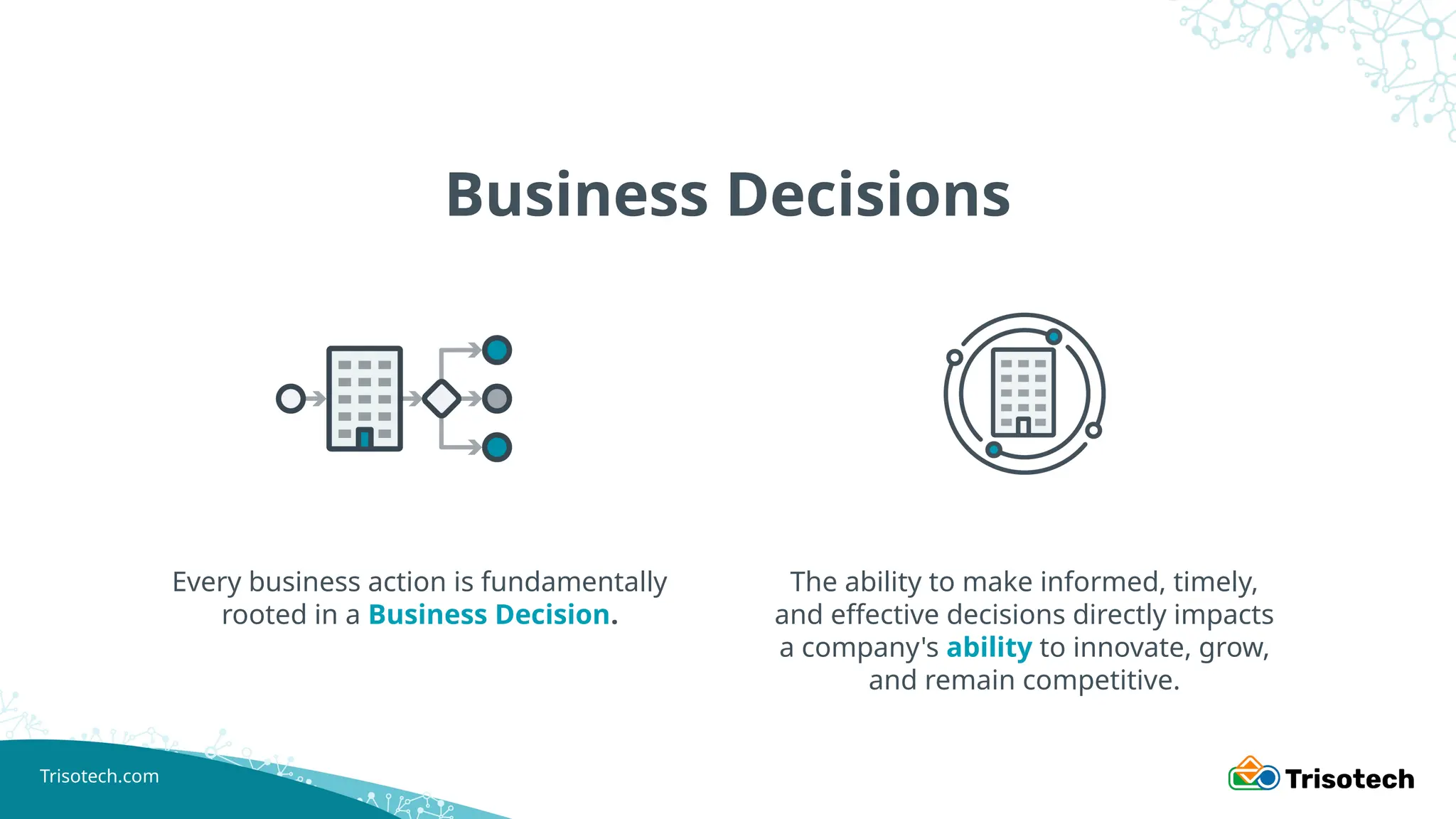
Every business action is fundamentally
rooted in a Business Decision.
The ability to make informed, timely,
and effective decisions directly impacts
a company's ability to innovate, grow,
and remain competitive.
Trisotech.com
The need for
Decision-Centric Organizations
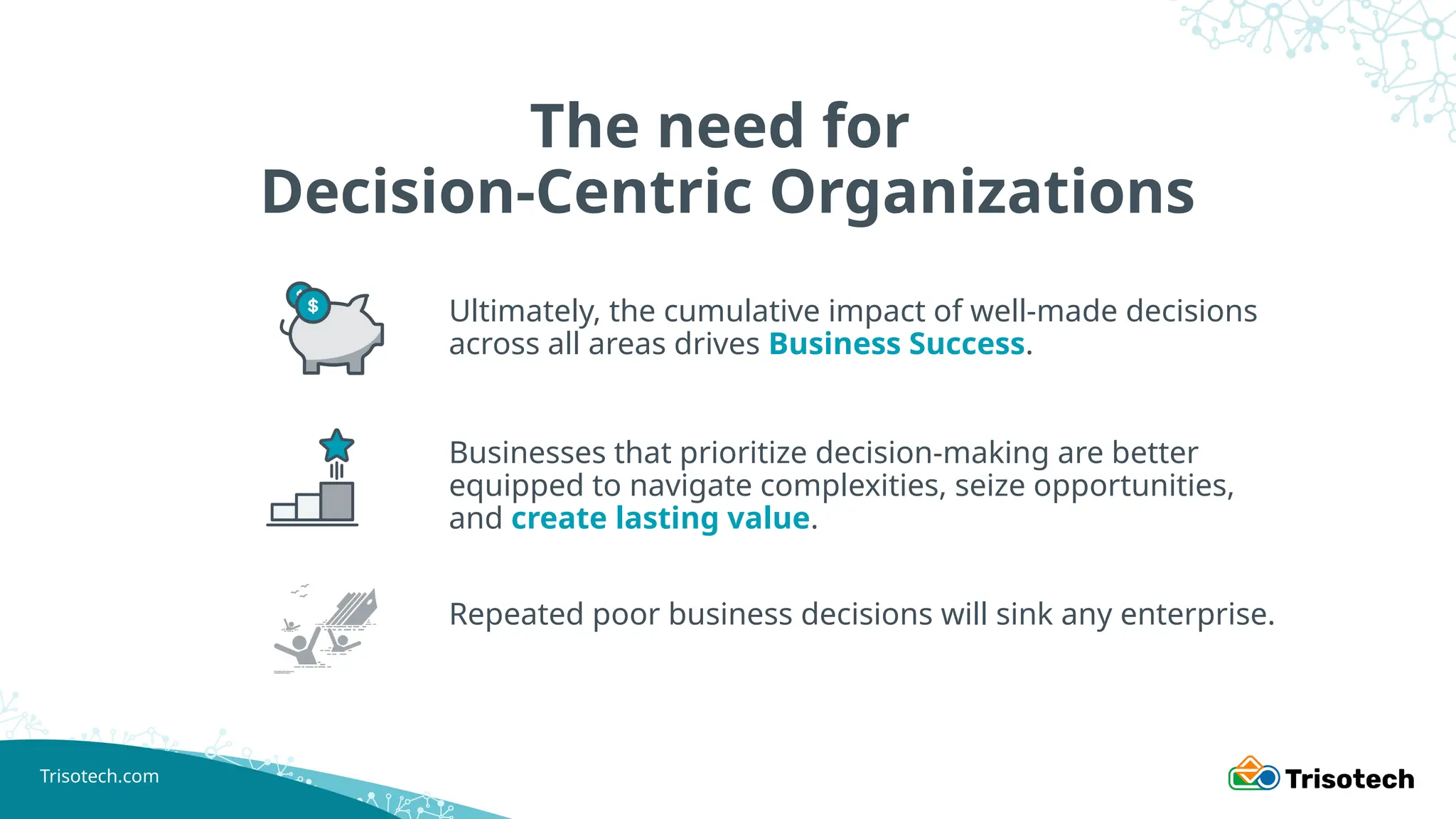
Ultimately, the cumulative impact of well-made decisions
across all areas drives Business Success.
Businesses that prioritize decision-making are better
equipped to navigate complexities, seize opportunities,
and create lasting value.
Repeated poor business decisions will sink any enterprise.
Trisotech.com
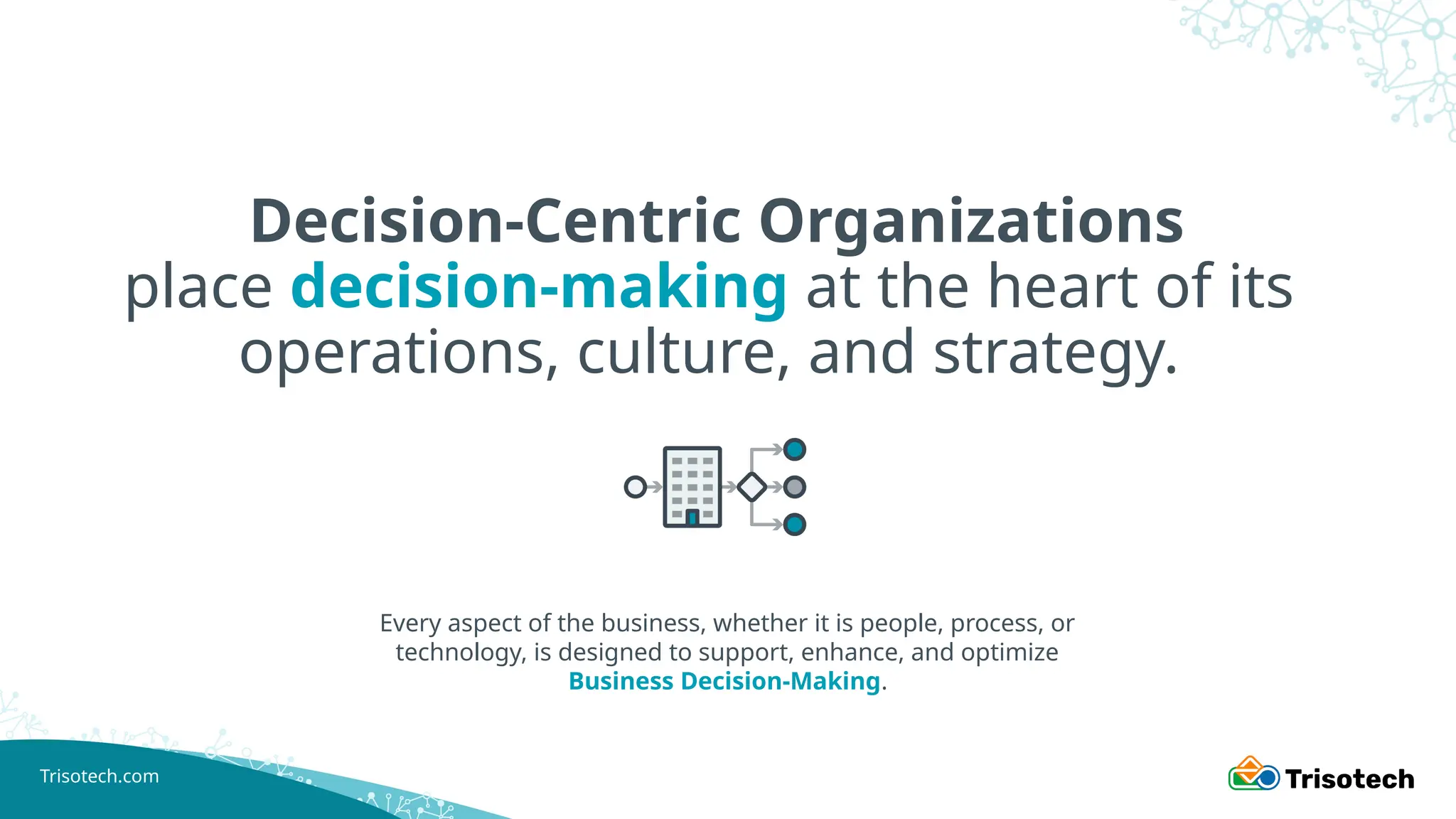
Decision-Centric Organizations
place decision-making at the heart of its
operations, culture, and strategy.
Every aspect of the business, whether it is people, process, or
technology, is designed to support, enhance, and optimize
Business Decision-Making.
Trisotech.com
Leveraging diverse decision-making approaches can
create a robust Business Decision-Making Ecosystem
that not only optimizes outcomes but also drives
innovation, efficiency, and long-term success.
Trisotech.com
The need for
Orchestration
Orchestration refers to the end-to-end coordinated
management and execution of complex processes,
cases, or workflows across multiple people, systems,
tools, or services.
Trisotech.com
The need for an
End-to-End
Perspective
Orchestration involves automating not just individual tasks,
but the entire end-to-end set of required tasks to reach a
desired outcome, ensuring that they happen in the right
order, at the right time, and with the correct data and
resources.
Trisotech.com
Decision Centric Orchestration
involves coordinating and managing various processes, systems, data,
and people within an organization to optimize
end-to-end business decision-making.
Ensures that every decision made within the organization is
informed, timely, and aligned with business objectives by
orchestrating the right resources and tools while making
business decisions.
Trisotech.com
Dynamic Business Environment
Business Decision Making has evolved into a complex process
that requires human intuition and advanced tooling.
How can businesses leverage the synergy
between human, tooling and AI to achieve
optimal outcomes.
Trisotech.com
Embedding AI into the
Flow of Work
The integration of AI should be seamless, with AI capabilities
appearing as natural extensions of existing tasks rather than
separate, complex systems to be learned.
Trisotech.com
The Purpose of
Decision-Centric Orchestration
Enable enterprises to make great, effective,
efficient, secure, explainable, justifiable,
end to end, contextualized, aligned
business decisions by leveraging human
business understanding and intuition with the
power of automation and AI.
Trisotech.com
The Role of AI in
Decision-Centric Orchestration
AI introduces capabilities that can enhance the
business decision making process.
Various forms of AI can be put to contribution.
Trisotech.com
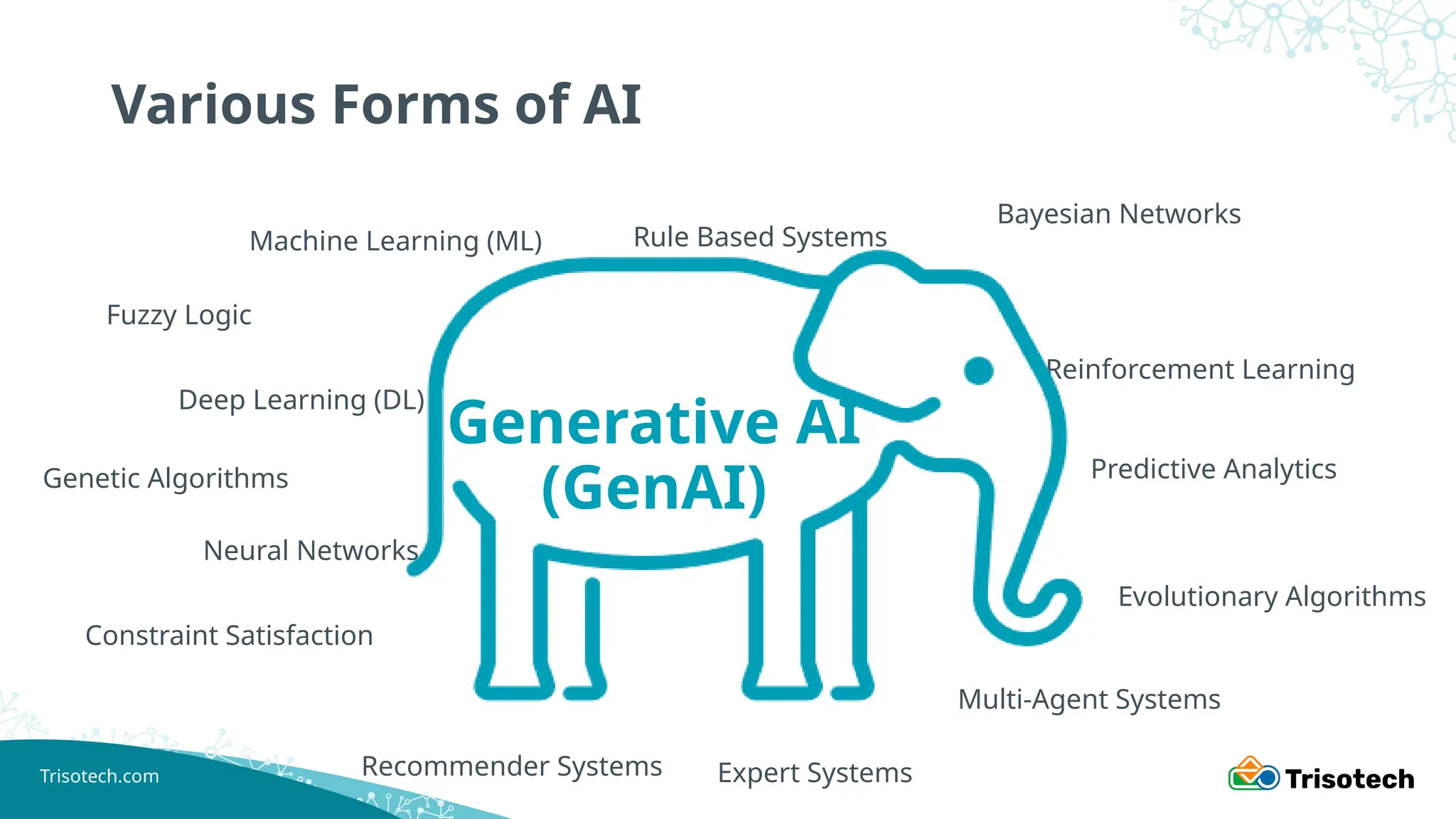
Generative AI
(GenAI)
Various Forms of AI
Machine Learning (ML)
Deep Learning (DL)
Expert Systems
Fuzzy Logic
Neural Networks
Reinforcement Learning
Evolutionary Algorithms
Bayesian Networks
Recommender Systems
Predictive Analytics
Genetic Algorithms
Constraint Satisfaction
Multi-Agent Systems
Rule Based Systems
Trisotech.com
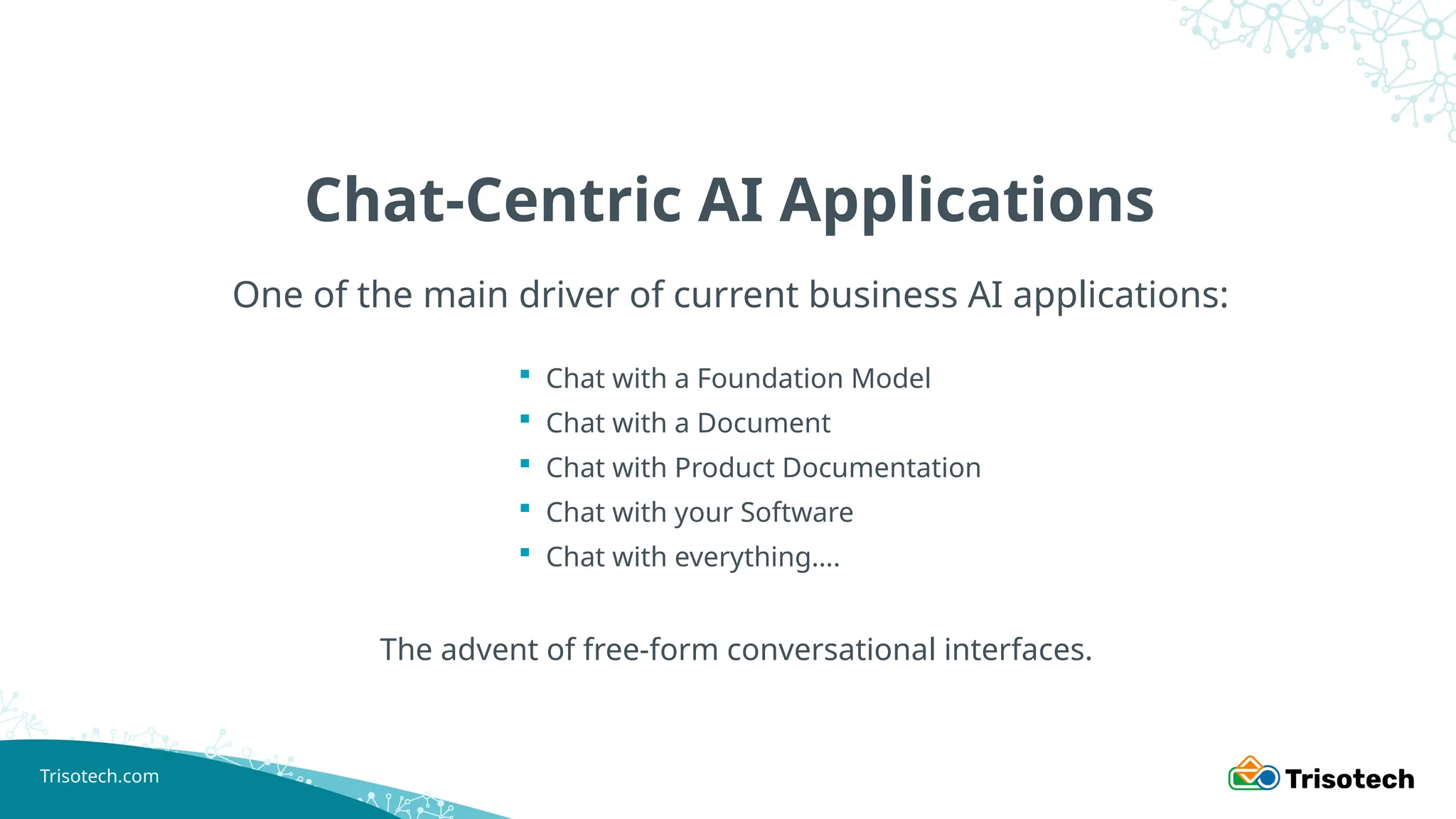
Chat-Centric AI Applications
One of the main driver of current business AI applications:
 Chat with a Foundation Model
 Chat with a Document
 Chat with Product Documentation
 Chat with your Software
 Chat with everything….
The advent of free-form conversational interfaces.
Trisotech.com
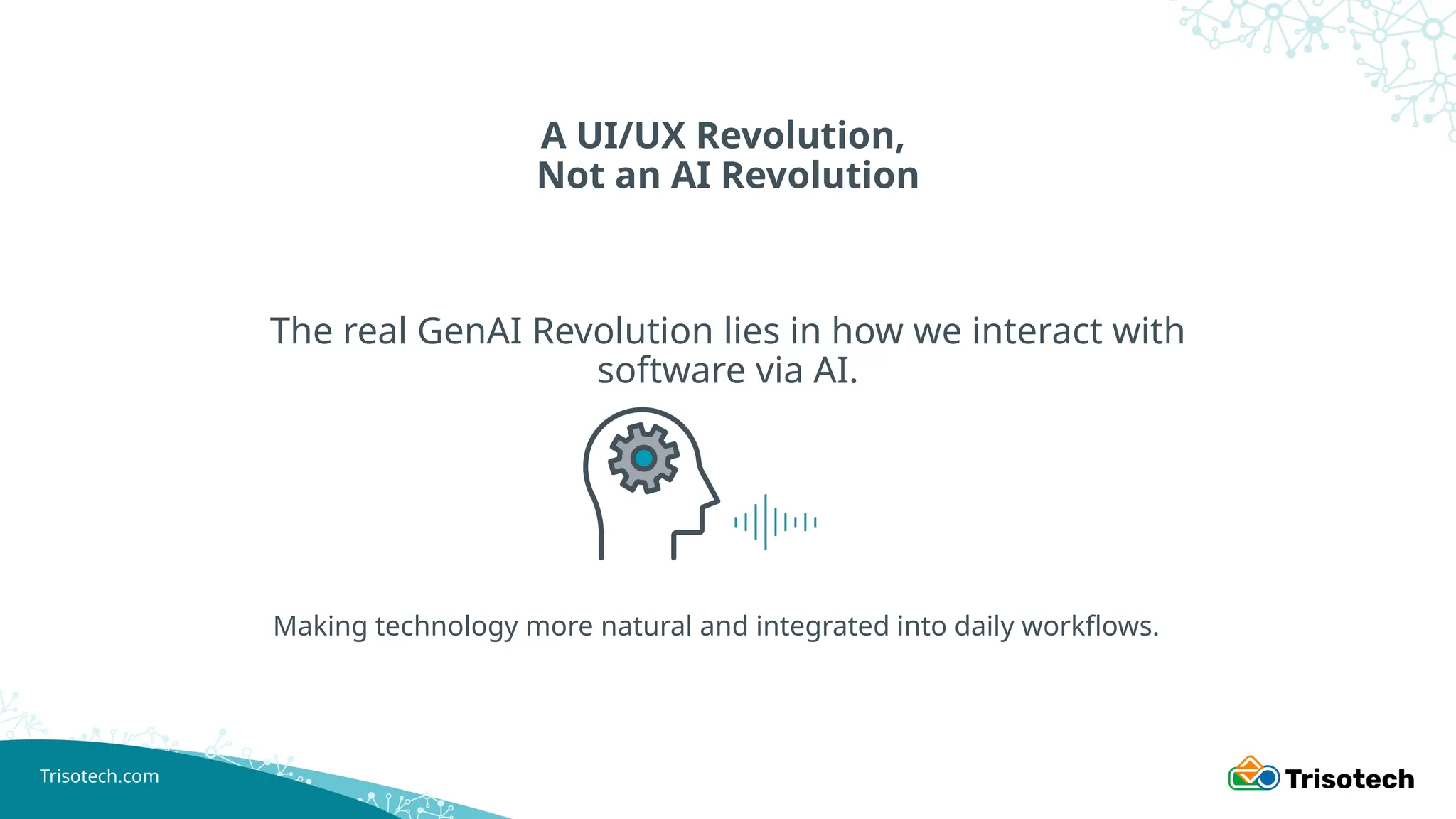
A UI/UX Revolution,
Not an AI Revolution
The real GenAI Revolution lies in how we interact with
software via AI.
Making technology more natural and integrated into daily workflows.
Trisotech.com
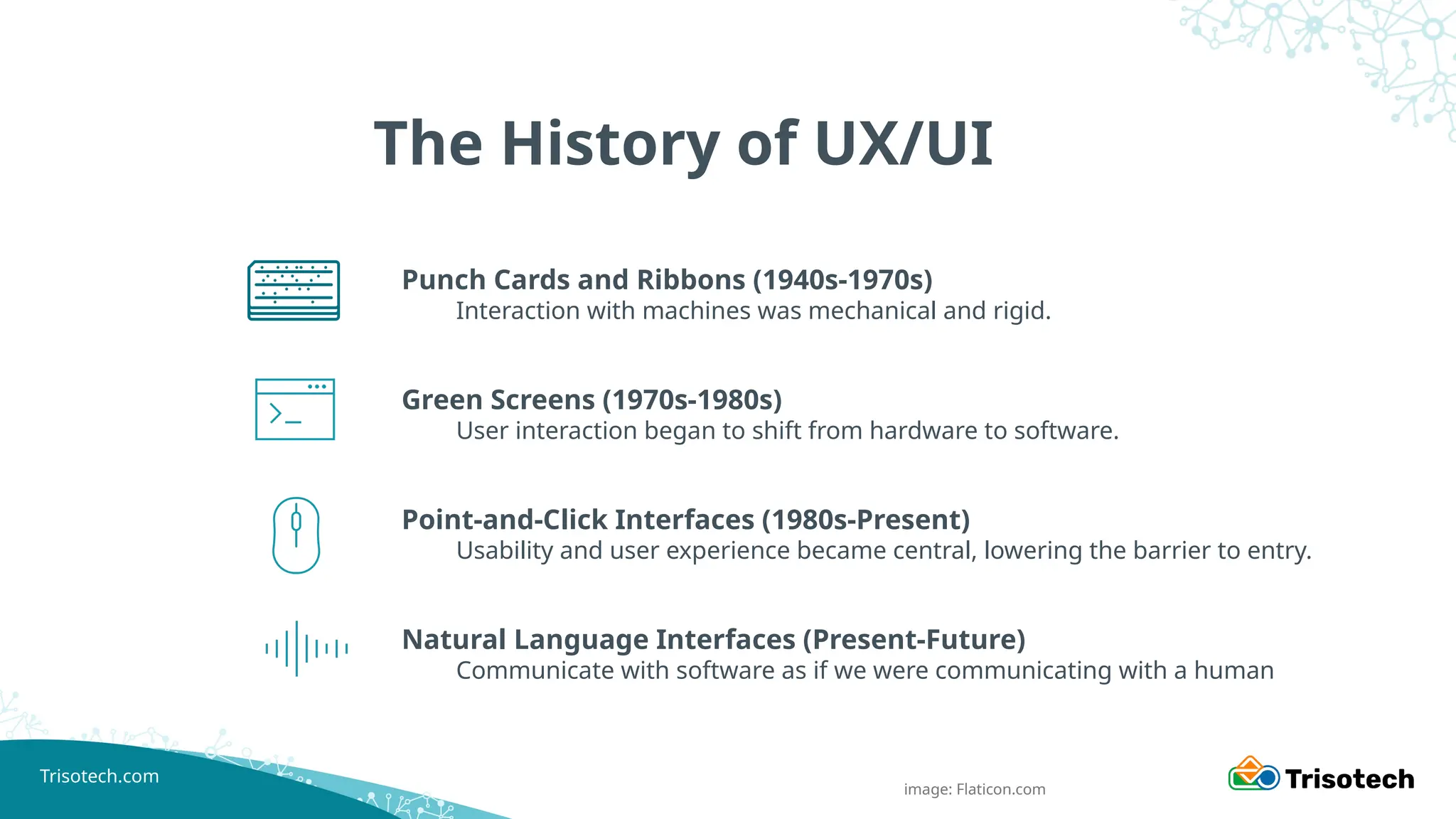
The History of UX/UI
Punch Cards and Ribbons (1940s-1970s)
Interaction with machines was mechanical and rigid.
Green Screens (1970s-1980s)
User interaction began to shift from hardware to software.
Point-and-Click Interfaces (1980s-Present)
Usability and user experience became central, lowering the barrier to entry.
Natural Language Interfaces (Present-Future)
Communicate with software as if we were communicating with a human
image: Flaticon.com
Trisotech.com
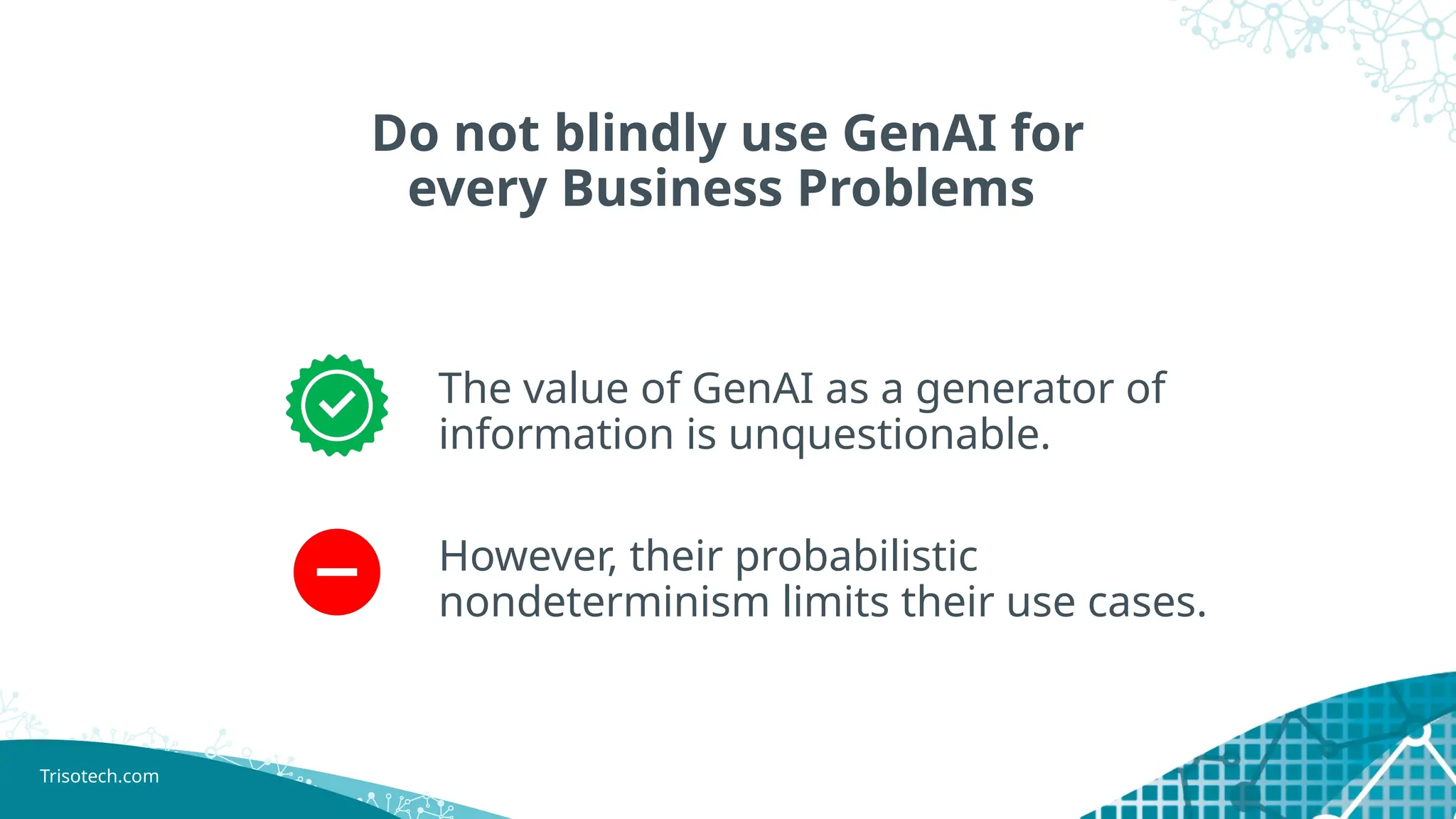
Do not blindly use GenAI for
every Business Problems
The value of GenAI as a generator of
information is unquestionable.
However, their probabilistic
nondeterminism limits their use cases.
Trisotech.com
Trisotech.com
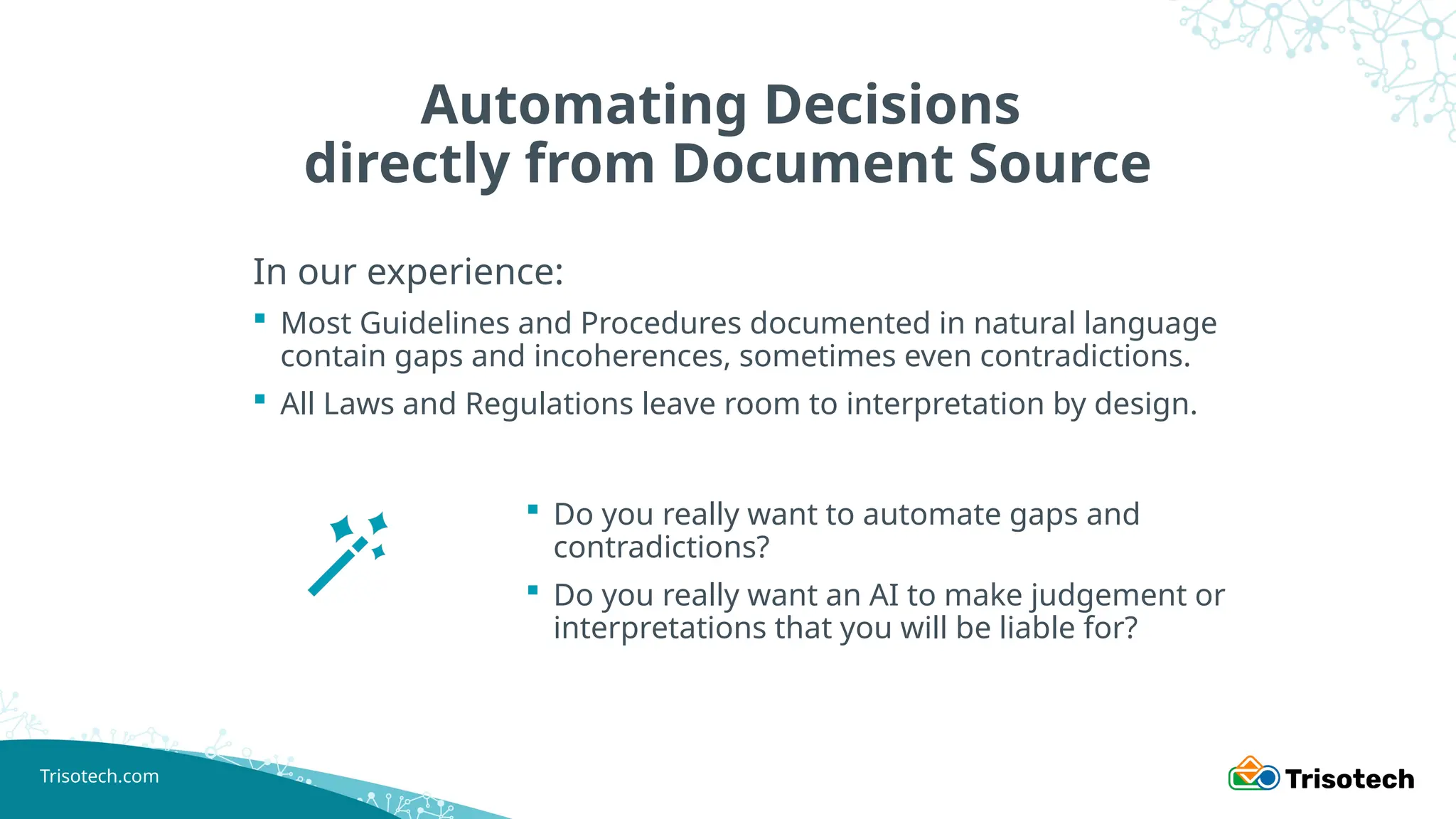
Automating Decisions
directly from Document Source
In our experience:
 Most Guidelines and Procedures documented in natural language
contain gaps and incoherences, sometimes even contradictions.
 All Laws and Regulations leave room to interpretation by design.
 Do you really want to automate gaps and
contradictions?
 Do you really want an AI to make judgement or
interpretations that you will be liable for?
Trisotech.com
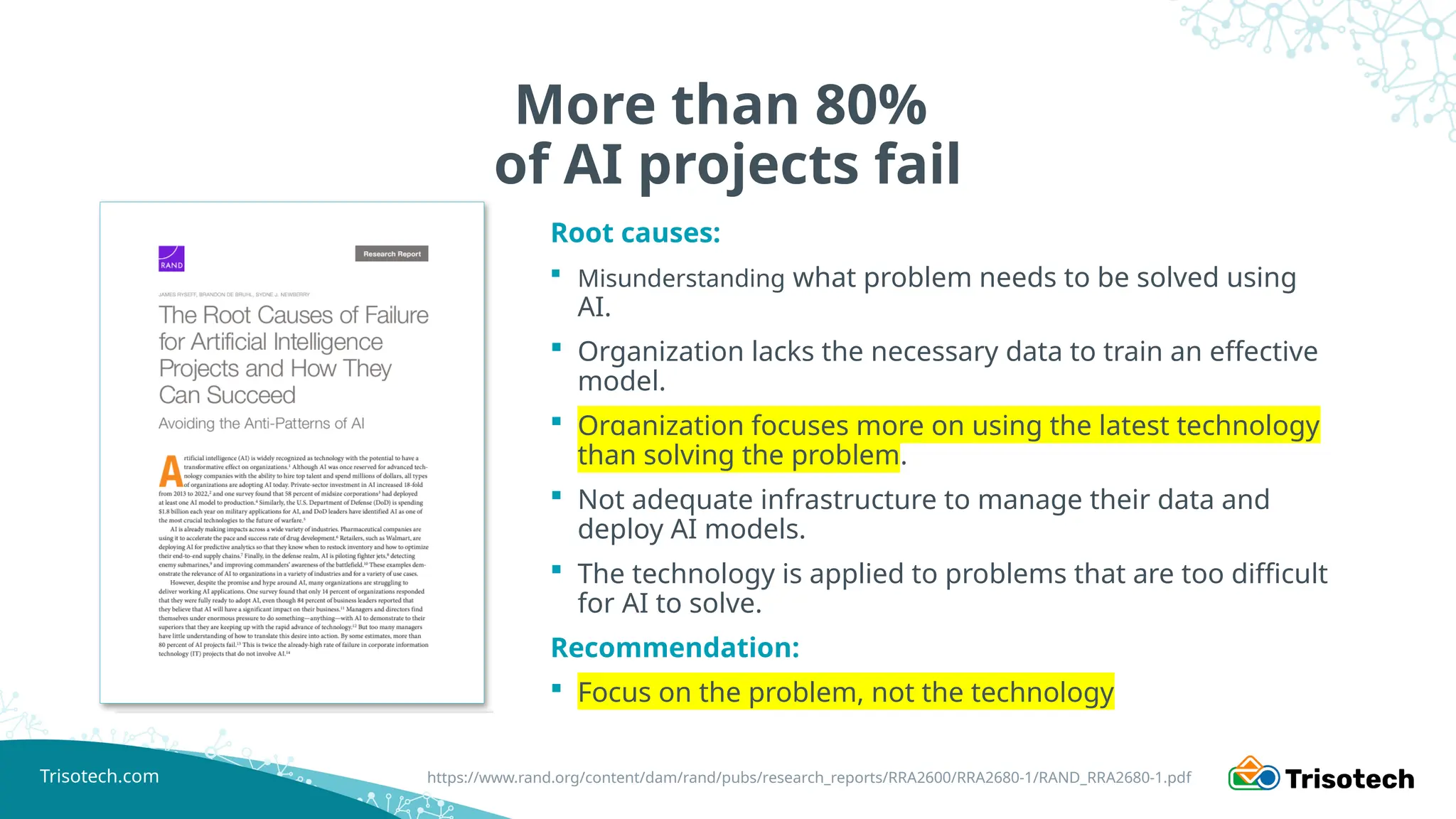
More than 80%
of AI projects fail
Root causes:
 Misunderstanding what problem needs to be solved using
AI.
 Organization lacks the necessary data to train an effective
model.
 Organization focuses more on using the latest technology
than solving the problem.
 Not adequate infrastructure to manage their data and
deploy AI models.
 The technology is applied to problems that are too difficult
for AI to solve.
Recommendation:
 Focus on the problem, not the technology
https://www.rand.org/content/dam/rand/pubs/research_reports/RRA2600/RRA2680-1/RAND_RRA2680-1.pdf
Trisotech.com
The Age of
Artificial Augmented Intelligence
We are in the era of Augmented Intelligence, where AI
doesn't replace humans but enhances our capabilities.
 Team up with AI on tasks and decisions.
 Integrate AI everywhere where it adds value.
Trisotech.com
The Imperative of
Human Oversight in Business Decision-
Making
 Human oversight remains indispensable in
decision-making.
 Humans bring ethical judgment, empathy, and
strategic vision that machines cannot replicate.
 Human oversight ensures alignment with
organizational values, ethical standards, and
long-term objectives.
Trisotech.com
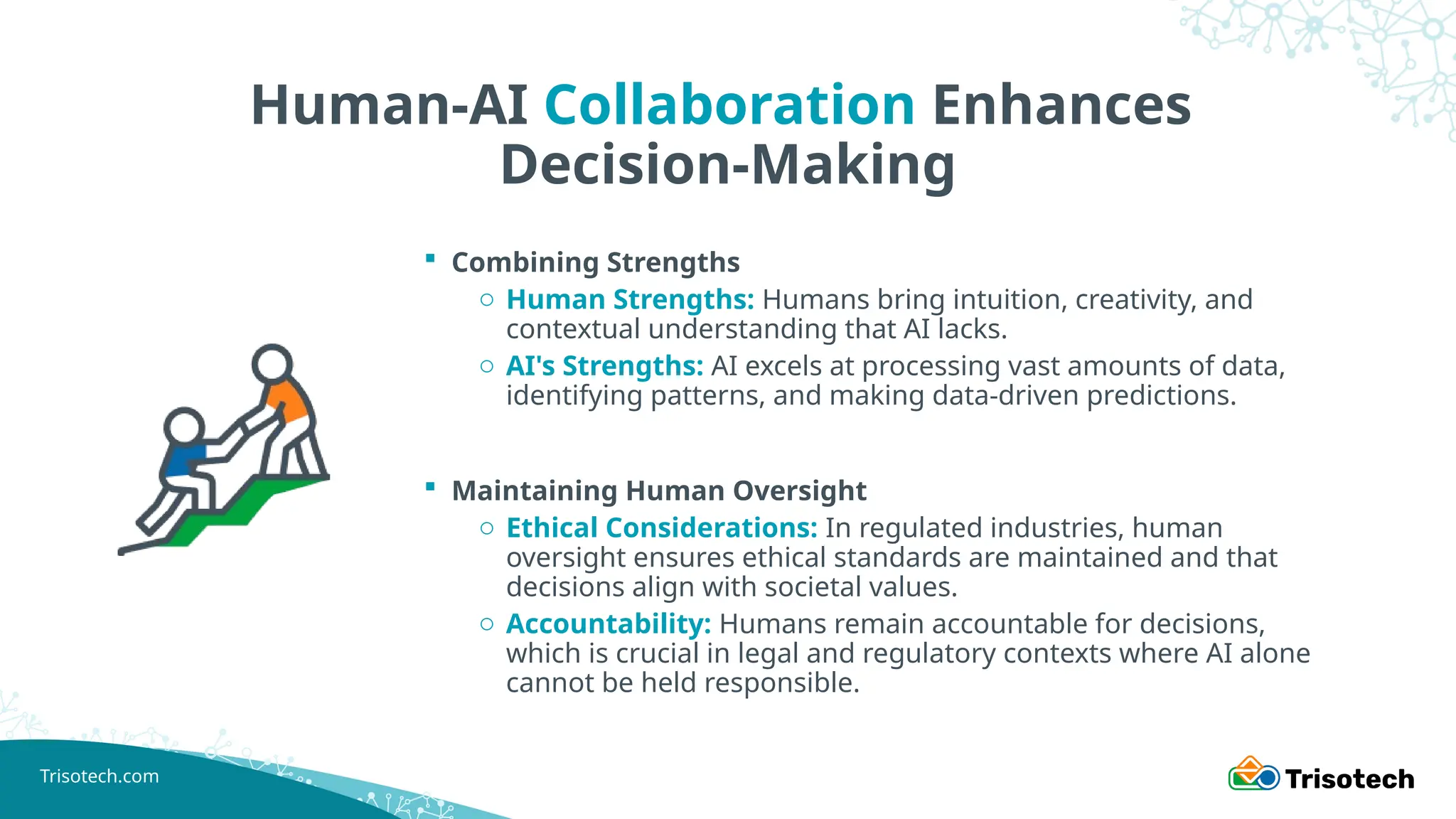
Human-AI Collaboration Enhances
Decision-Making
 Combining Strengths
o Human Strengths: Humans bring intuition, creativity, and
contextual understanding that AI lacks.
o AI's Strengths: AI excels at processing vast amounts of data,
identifying patterns, and making data-driven predictions.
 Maintaining Human Oversight
o Ethical Considerations: In regulated industries, human
oversight ensures ethical standards are maintained and that
decisions align with societal values.
o Accountability: Humans remain accountable for decisions,
which is crucial in legal and regulatory contexts where AI alone
cannot be held responsible.
Trisotech.com
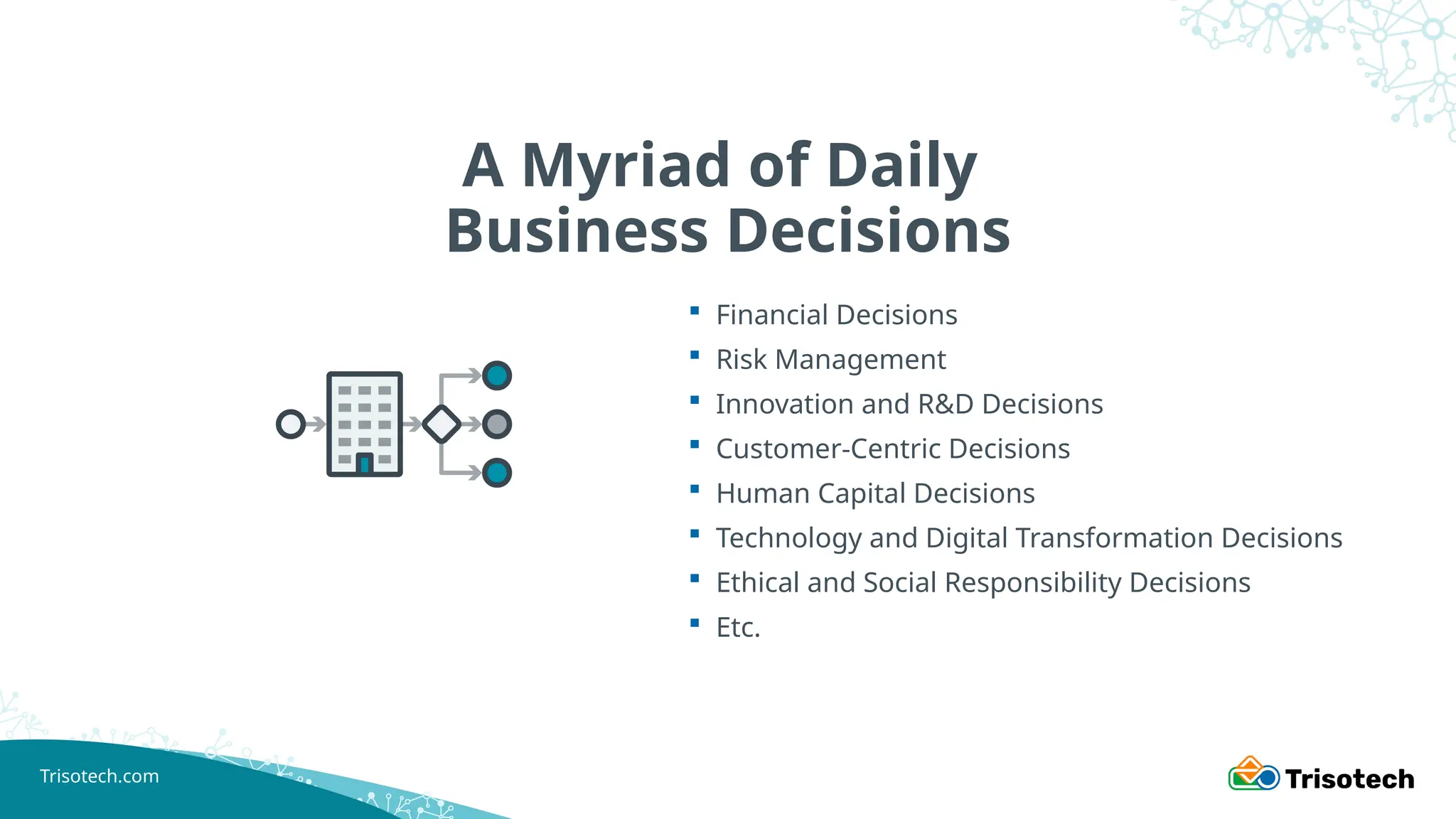
A Myriad of Daily
Business Decisions
 Financial Decisions
 Risk Management
 Innovation and R&D Decisions
 Customer-Centric Decisions
 Human Capital Decisions
 Technology and Digital Transformation Decisions
 Ethical and Social Responsibility Decisions
 Etc.
Trisotech.com
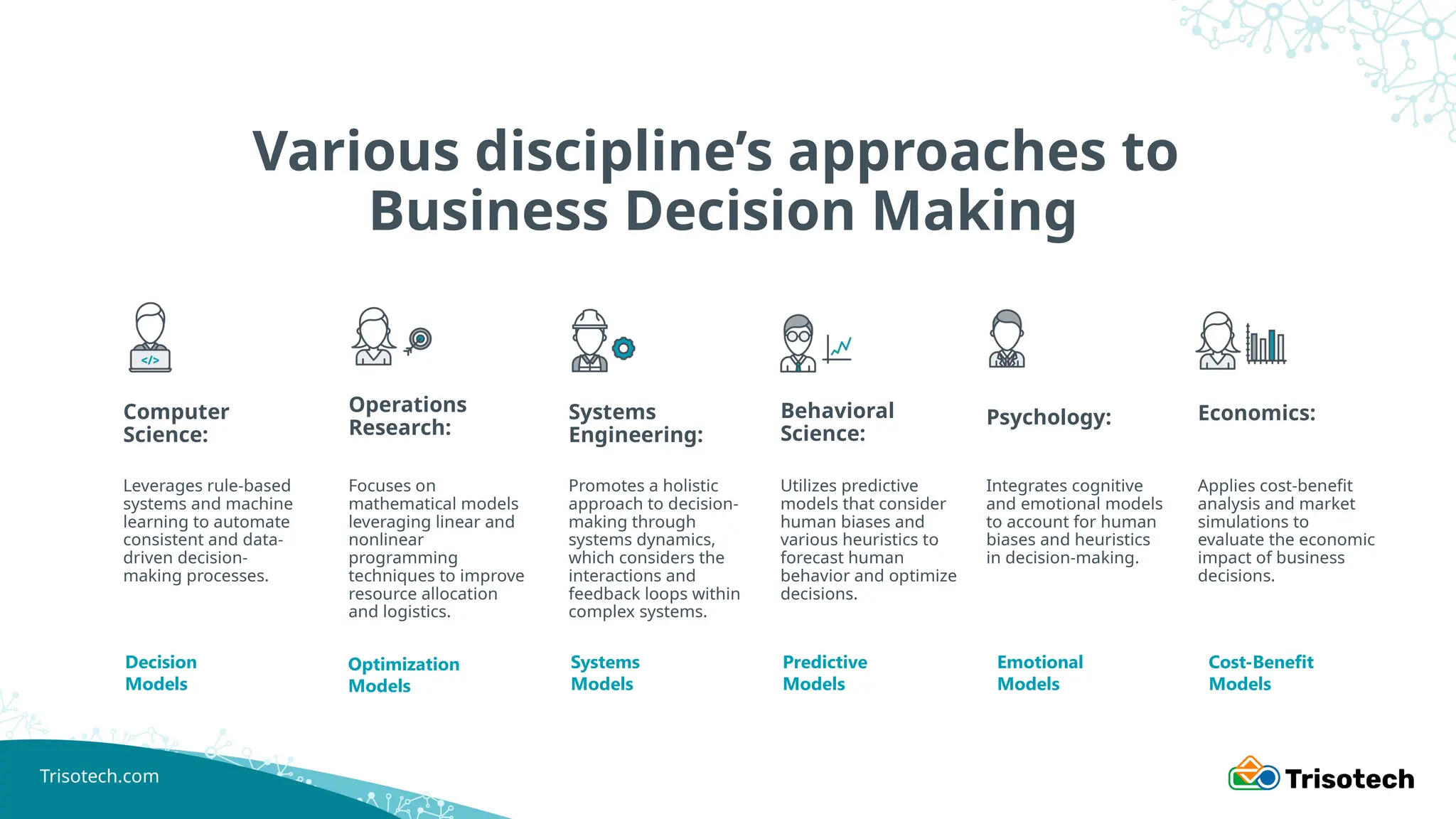
Various discipline’s approaches to
Business Decision Making
Decision
Models
Optimization
Models
Systems
Models
Predictive
Models
Emotional
Models
Cost-Benefit
Models
Systems
Engineering:
Psychology:
Promotes a holistic
approach to decision-
making through
systems dynamics,
which considers the
interactions and
feedback loops within
complex systems.
Utilizes predictive
models that consider
human biases and
various heuristics to
forecast human
behavior and optimize
decisions.
Behavioral
Science:
Integrates cognitive
and emotional models
to account for human
biases and heuristics
in decision-making.
Focuses on
mathematical models
leveraging linear and
nonlinear
programming
techniques to improve
resource allocation
and logistics.
Applies cost-benefit
analysis and market
simulations to
evaluate the economic
impact of business
decisions.
Computer
Science:
Leverages rule-based
systems and machine
learning to automate
consistent and data-
driven decision-
making processes.
Operations
Research:
Economics:
Trisotech.com
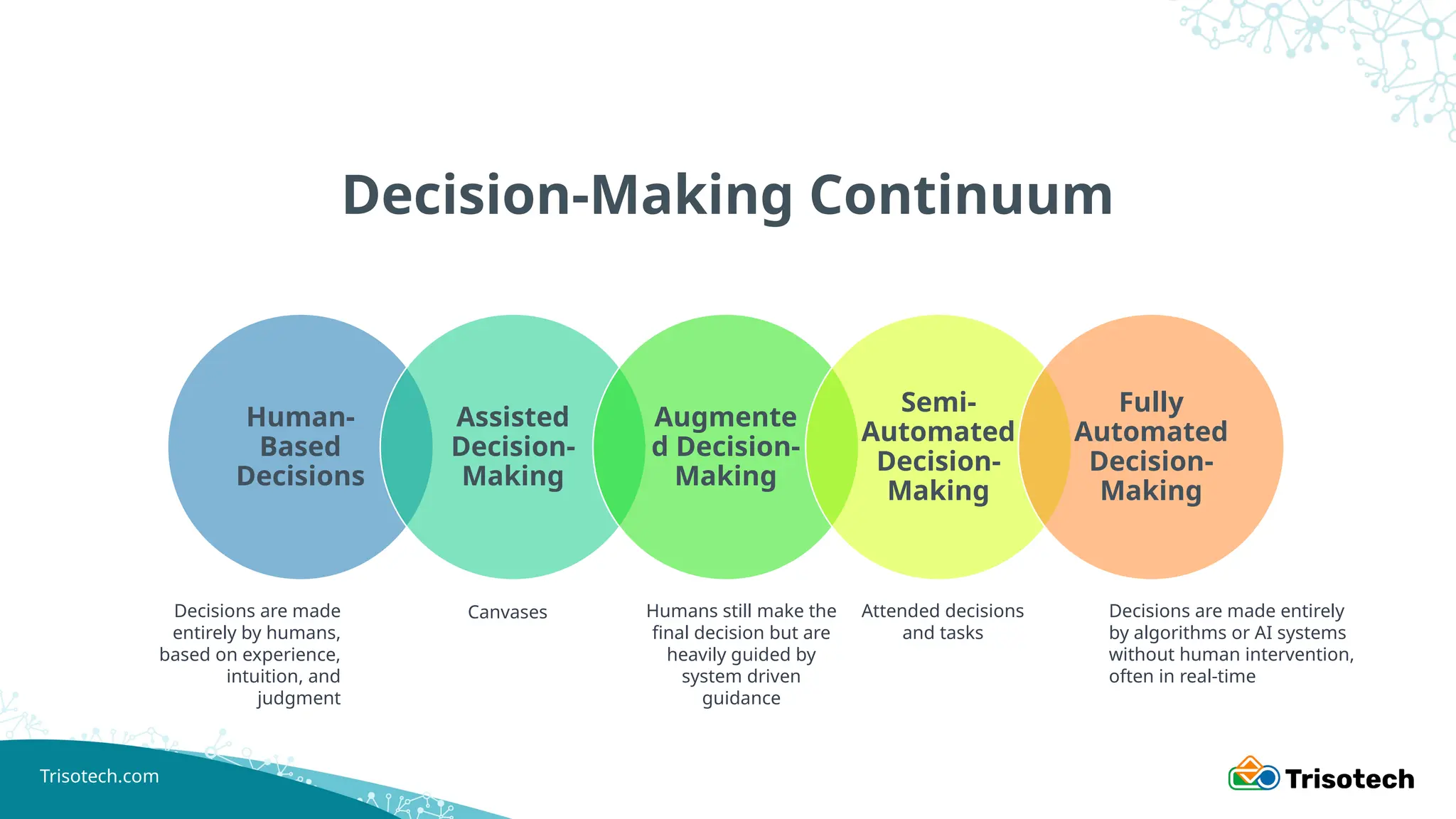
Decision-Making Continuum
Human-
Based
Decisions
Assisted
Decision-
Making
Augmente
d Decision-
Making
Semi-
Automated
Decision-
Making
Fully
Automated
Decision-
Making
Decisions are made
entirely by humans,
based on experience,
intuition, and
judgment
Decisions are made entirely
by algorithms or AI systems
without human intervention,
often in real-time
Humans still make the
final decision but are
heavily guided by
system driven
guidance
Canvases Attended decisions
and tasks
Trisotech.com
Business Decision Playbooks
 Typically includes a series of steps, decision criteria, key
considerations, and roles and responsibilities to ensure
consistent, informed, and efficient decision-making.
 Used to reduce uncertainty and align decisions with strategic
goals.
 They can be particularly useful in complex environments
where decisions need to be made quickly and consistently
by different teams or individuals.
A structured guide or framework that outlines the processes, criteria,
and best practices for making decisions within an organization.
Trisotech.com
Automating
Business Decision Playbooks
Engineering business decisions and Orchestrating AI tools
with human oversight into existing workflows ensuring careful
alignment with current processes to enhance efficiency without
disrupting operations.
Orchestrating business decisions by injecting the right kind of AI
at the right time within the workflows of your knowledge
workers.
Trisotech.com
Engineering Business Decisions
 Precision
 Transparency
 Traceability
 Flexibility
 Reusability
 Explainability
With a focus on transparency and ethical decision-making.
Trisotech.com
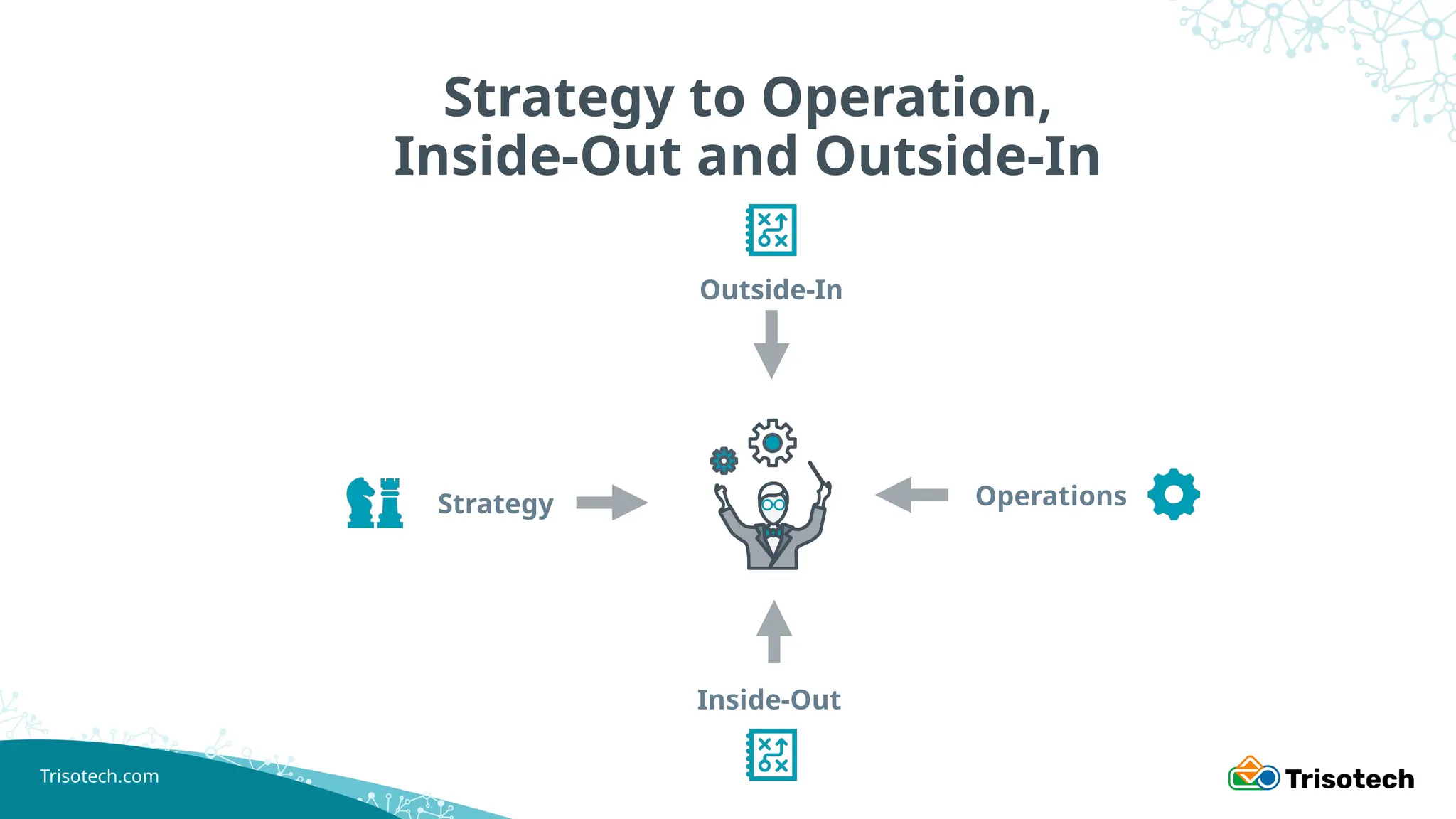
Strategy to Operation,
Inside-Out and Outside-In
Strategy Operations
Outside-In
Inside-Out
Trisotech.com
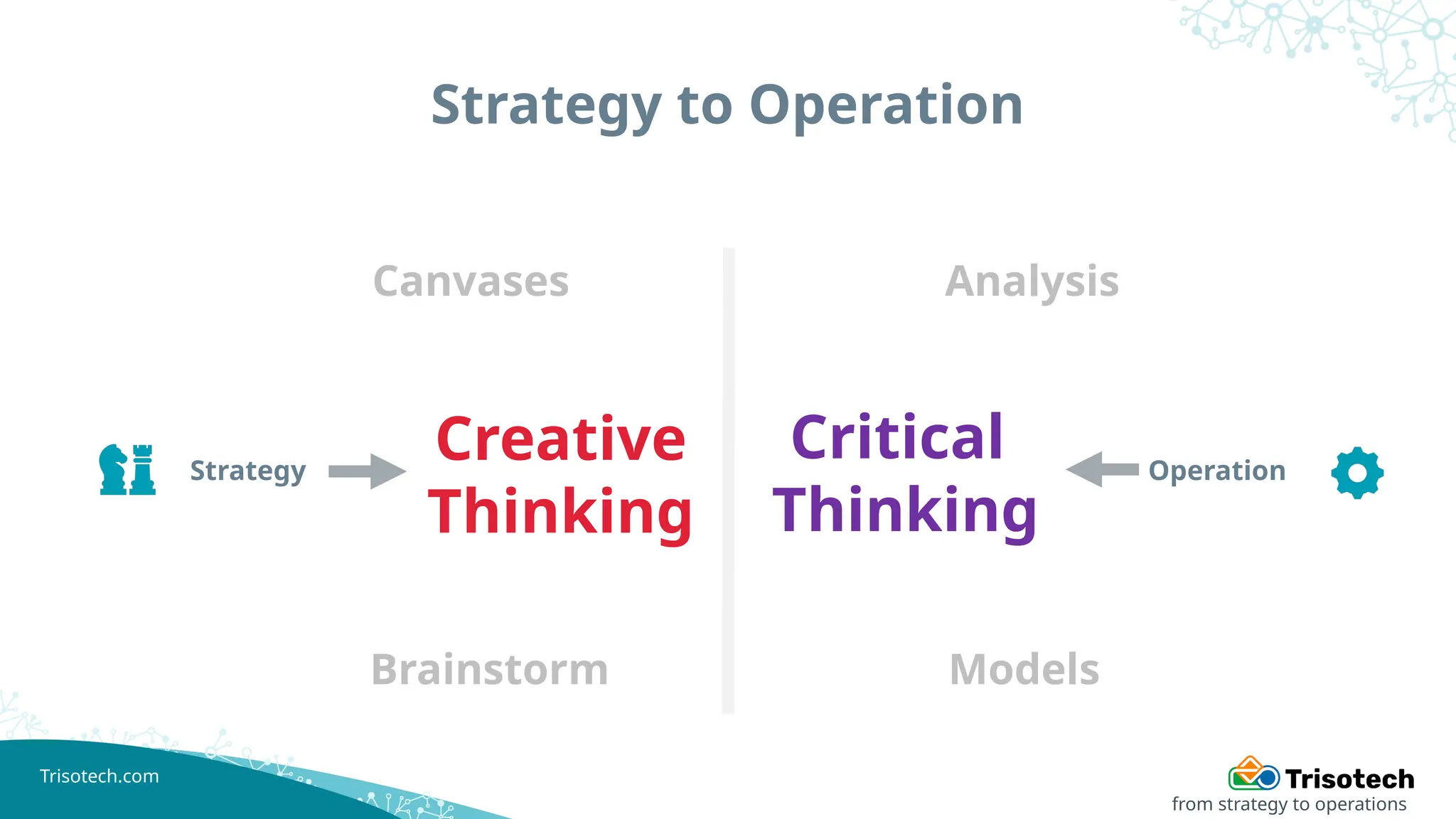
Strategy to Operation
Creative
Thinking
Critical
Thinking
Operation
Canvases
Brainstorm Models
Analysis
Strategy
from strategy to operations
Trisotech.com
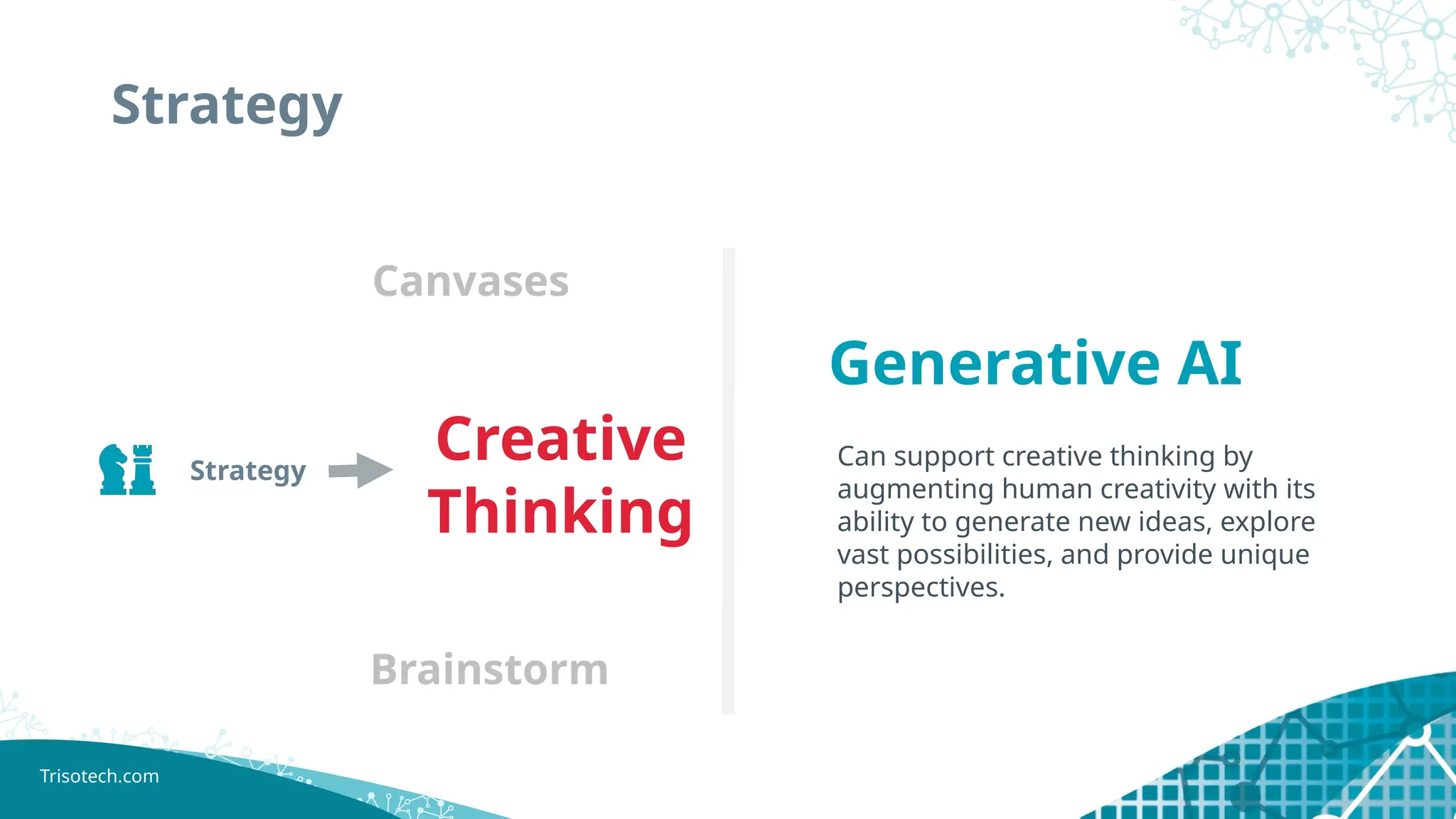
Strategy
Creative
Thinking
Generative AI
Canvases
Brainstorm
Strategy
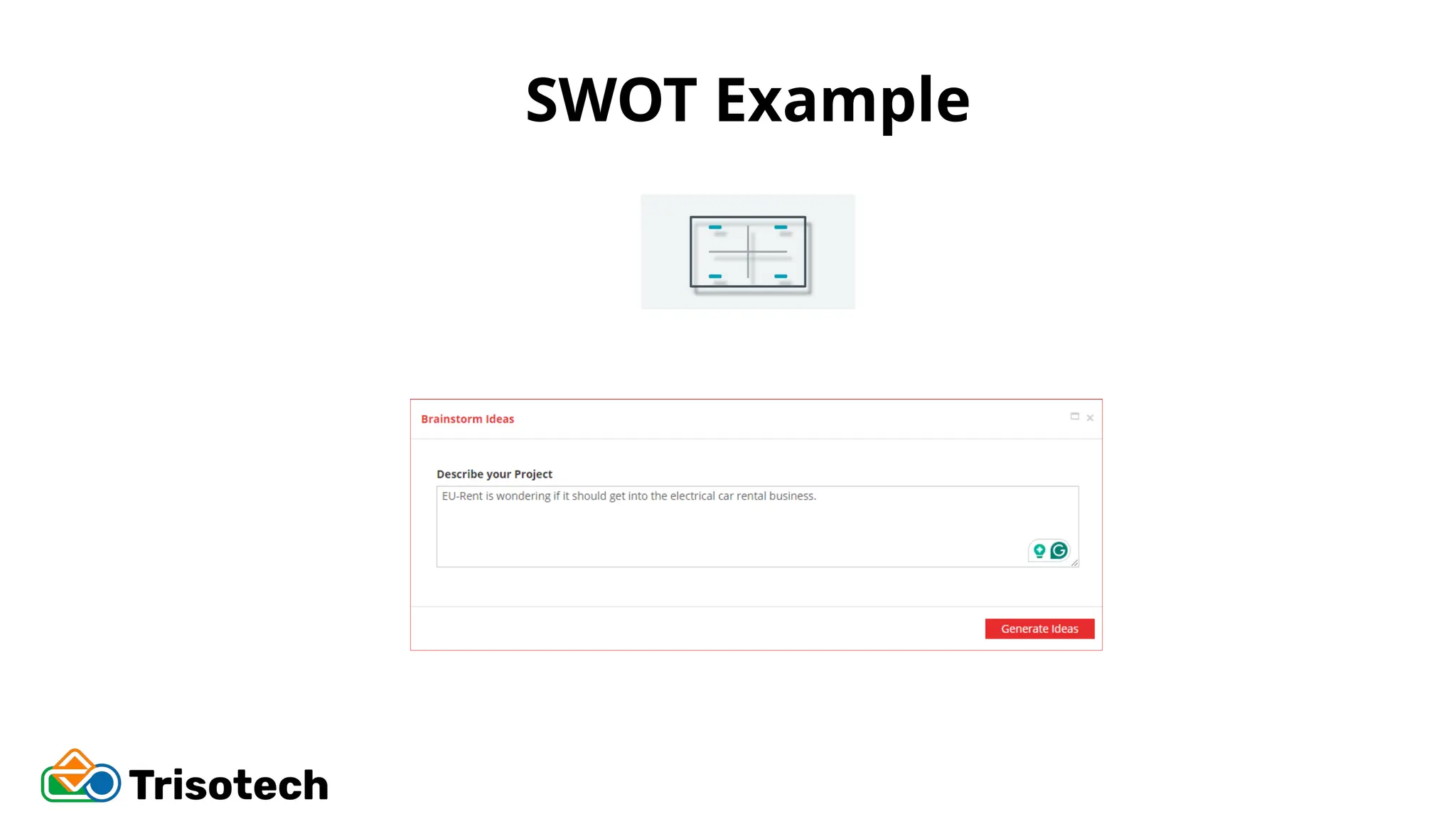
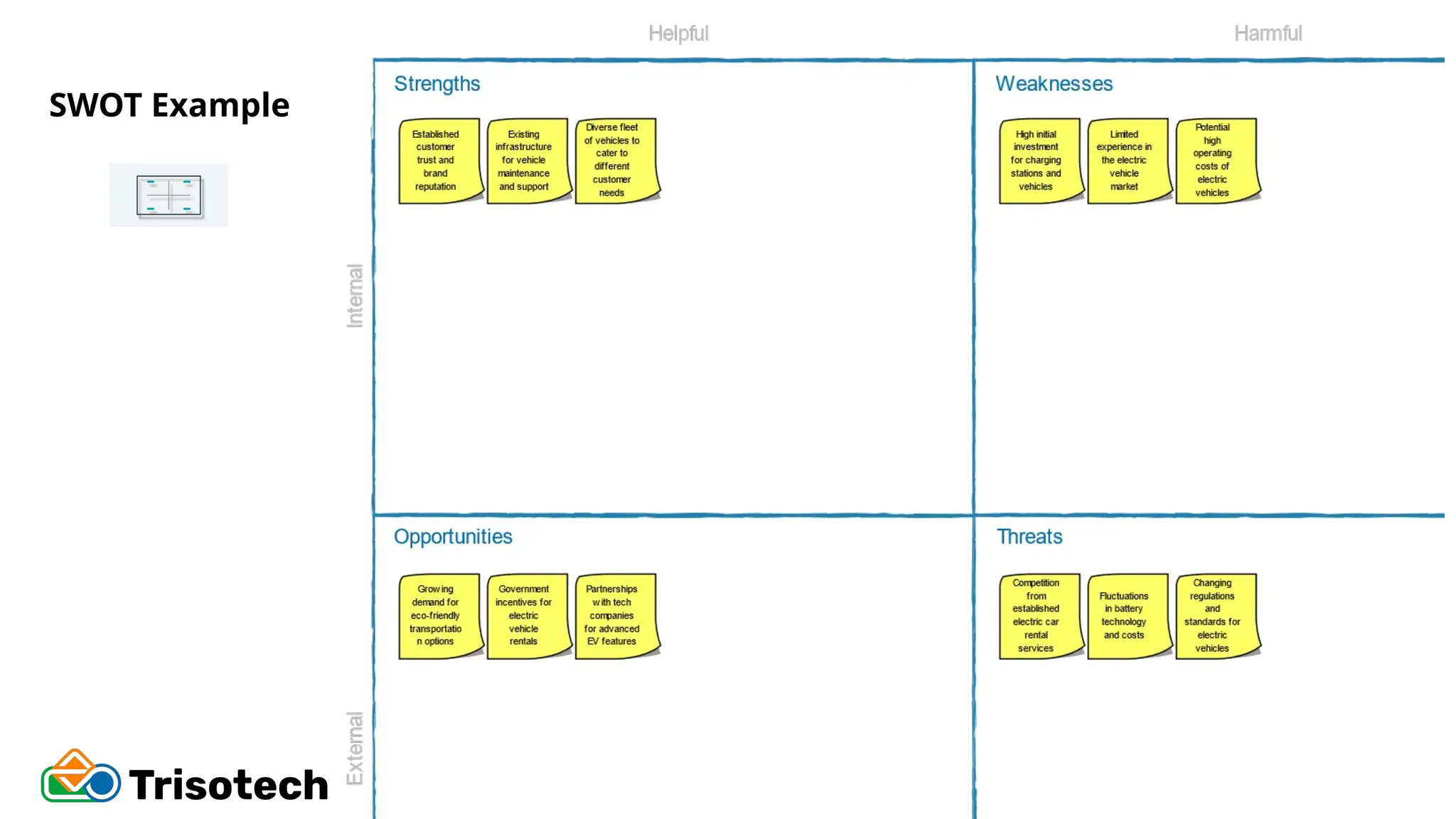
Can support creative thinking by
augmenting human creativity with its
ability to generate new ideas, explore
vast possibilities, and provide unique
perspectives.
SWOT Example
SWOT Example
Trisotech.com
Operation
Critical
Thinking
Operation
Models
Analysis
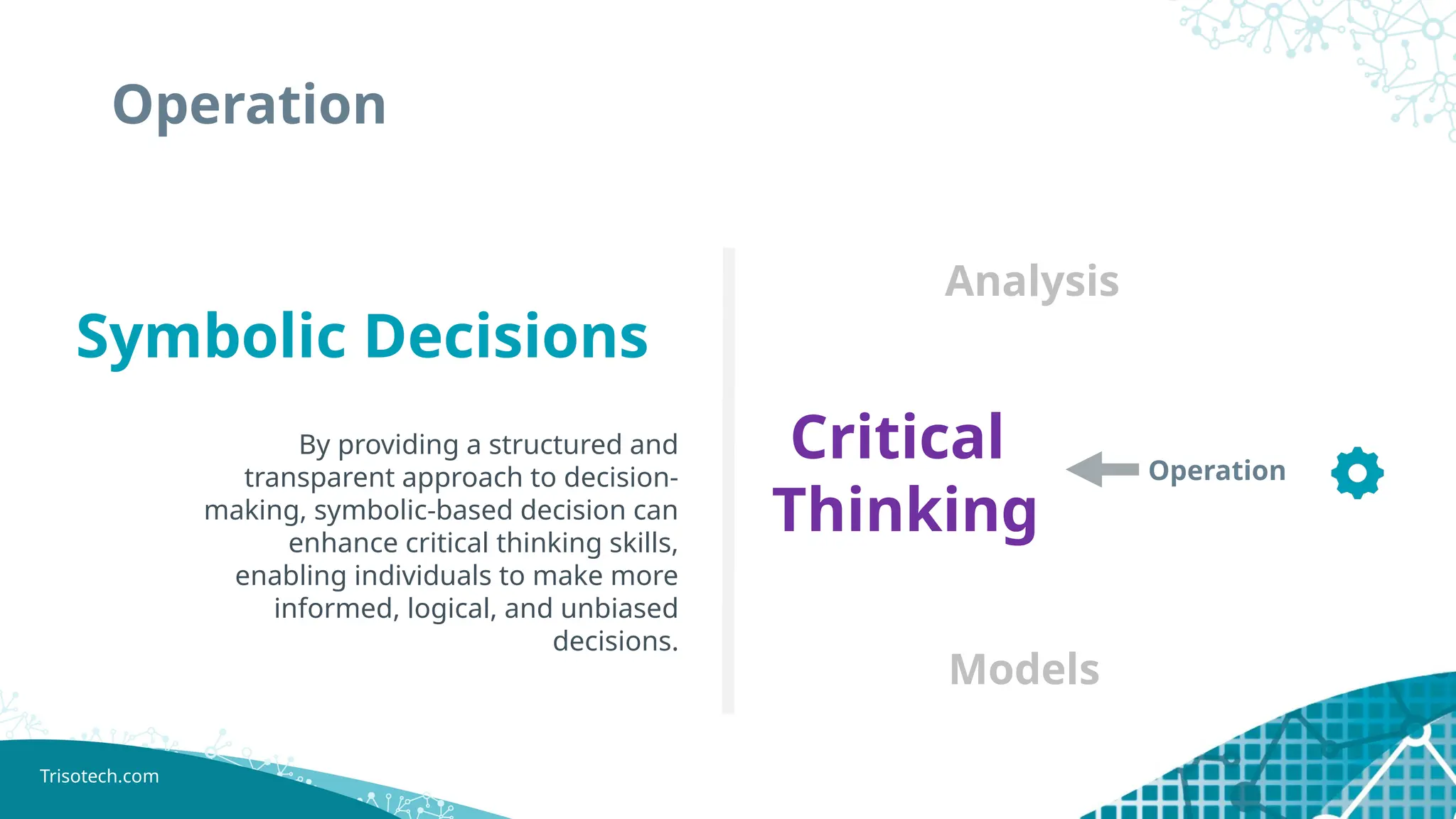
Symbolic Decisions
By providing a structured and
transparent approach to decision-
making, symbolic-based decision can
enhance critical thinking skills,
enabling individuals to make more
informed, logical, and unbiased
decisions.
Trisotech.com
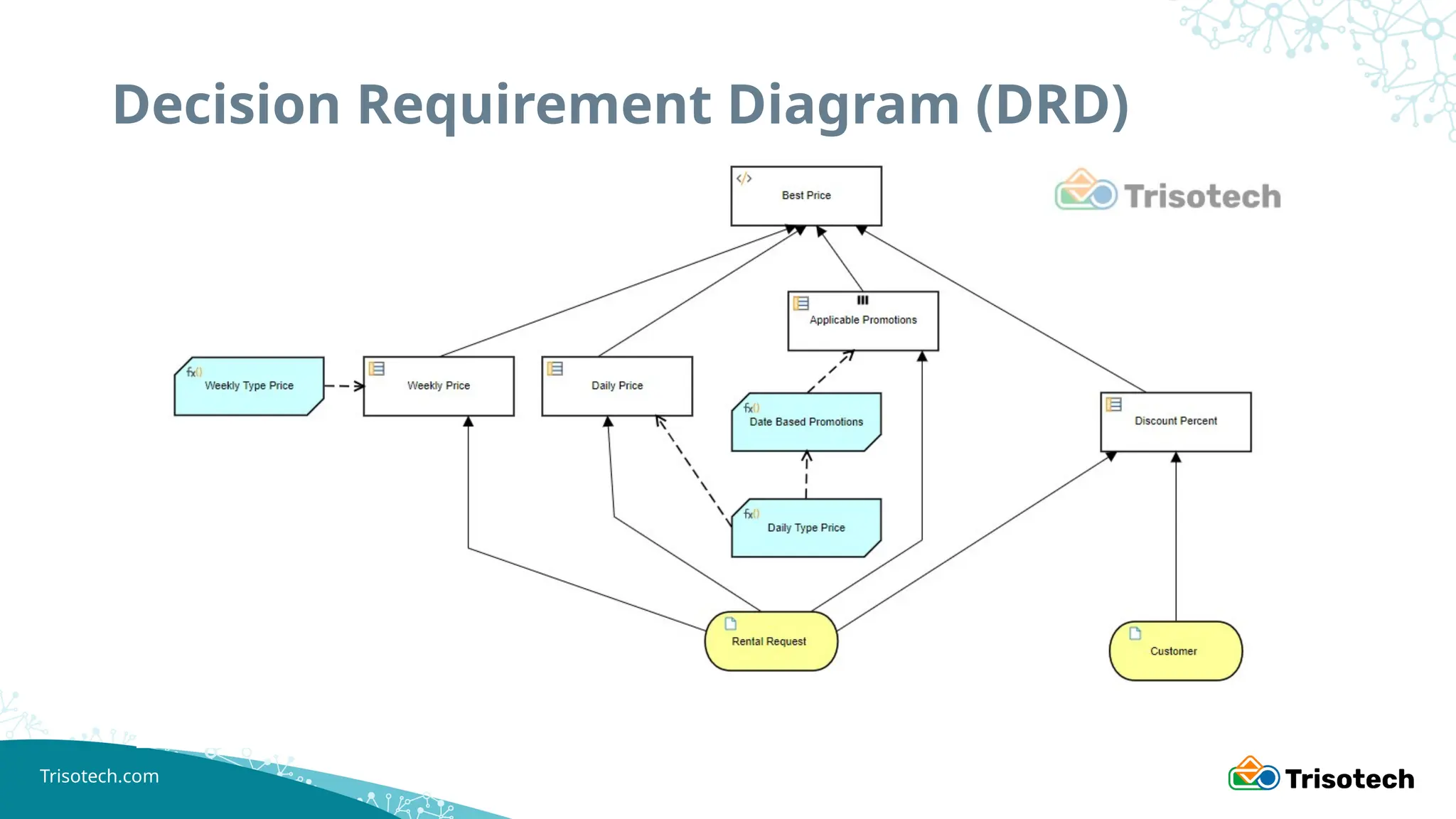
Decision Requirement Diagram (DRD)
Trisotech.com
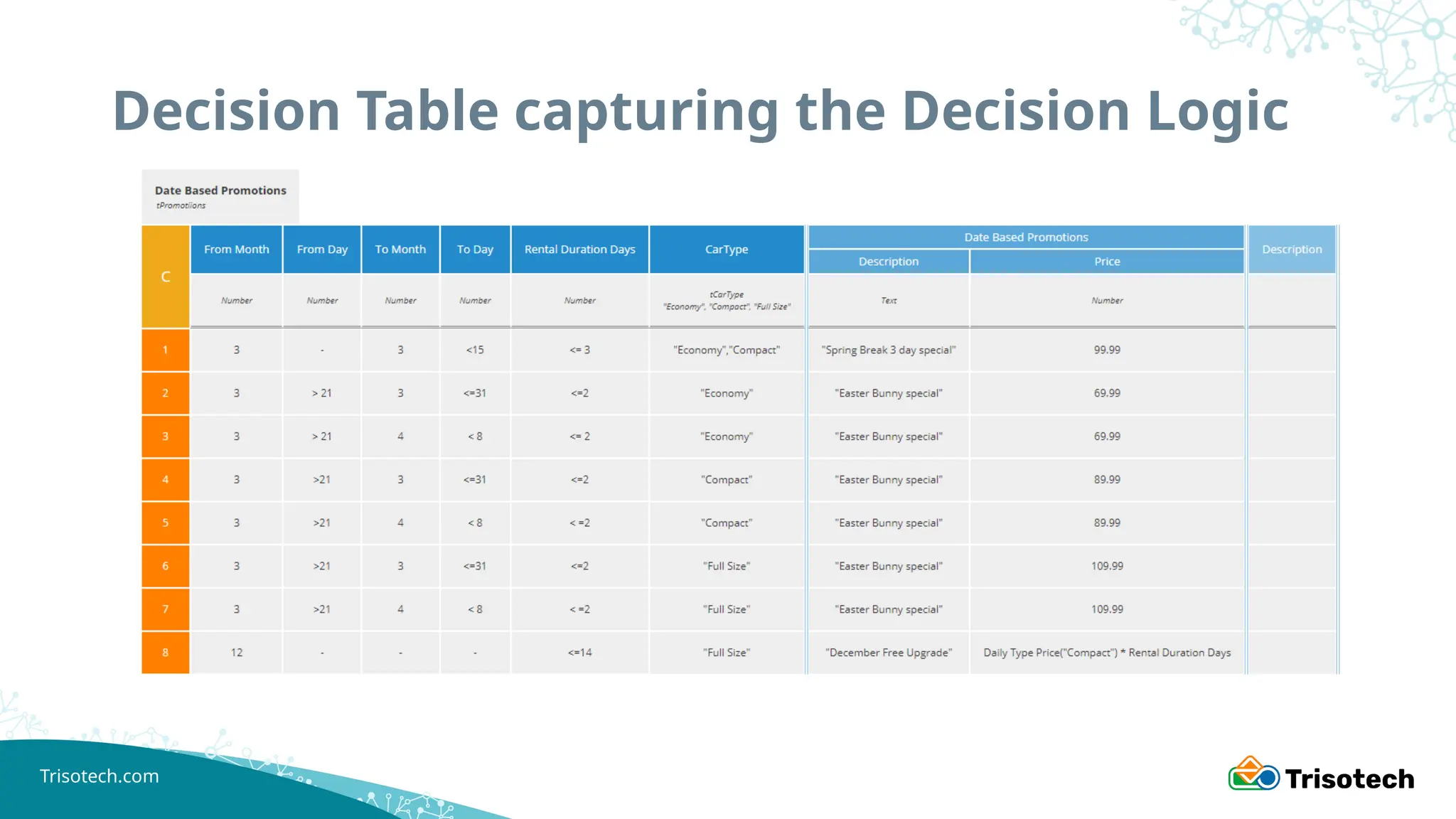
Decision Table capturing the Decision Logic
Trisotech.com
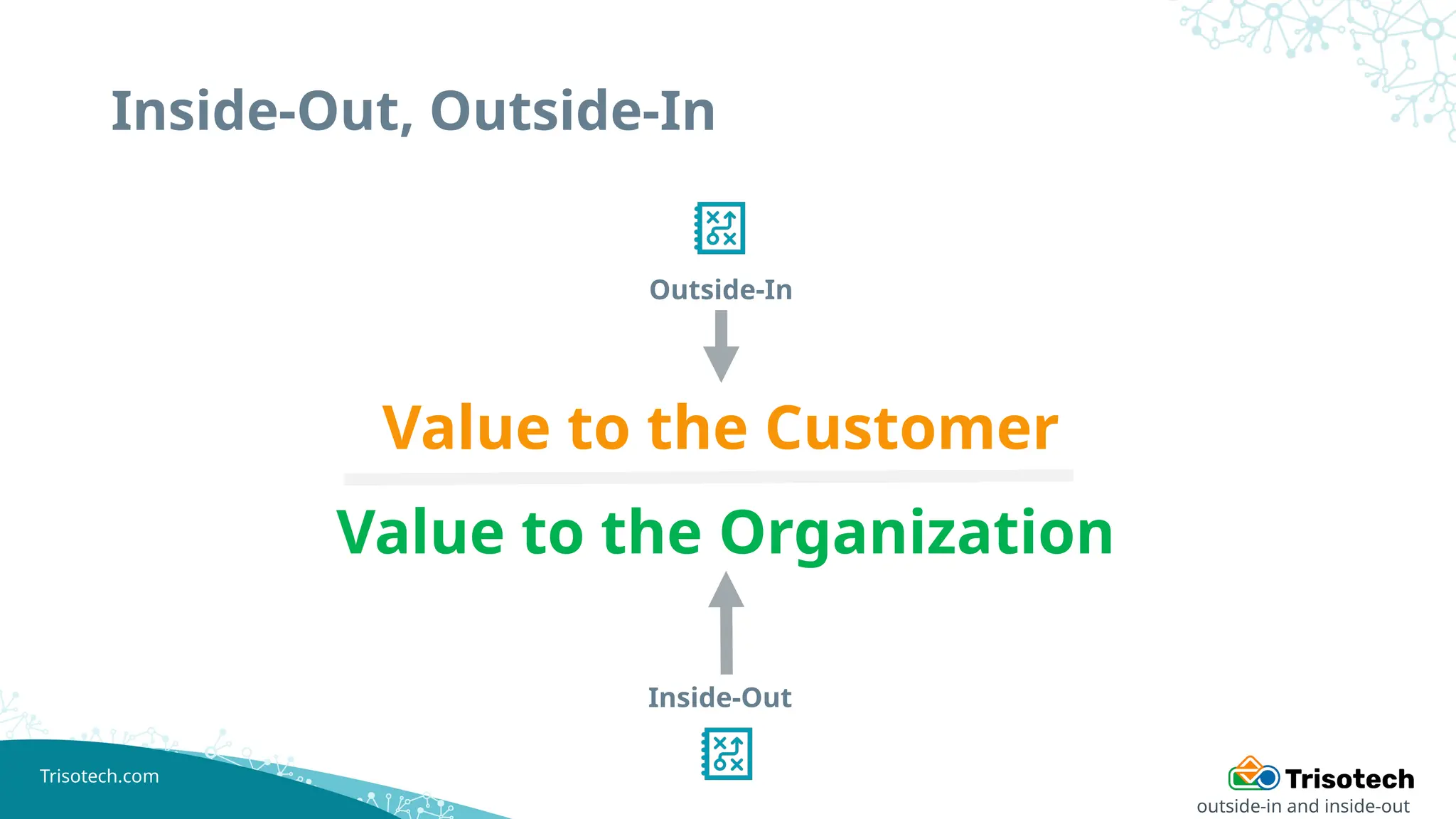
Inside-Out, Outside-In
Value to the Customer
Outside-In
Inside-Out
Value to the Organization
outside-in and inside-out
Trisotech.com
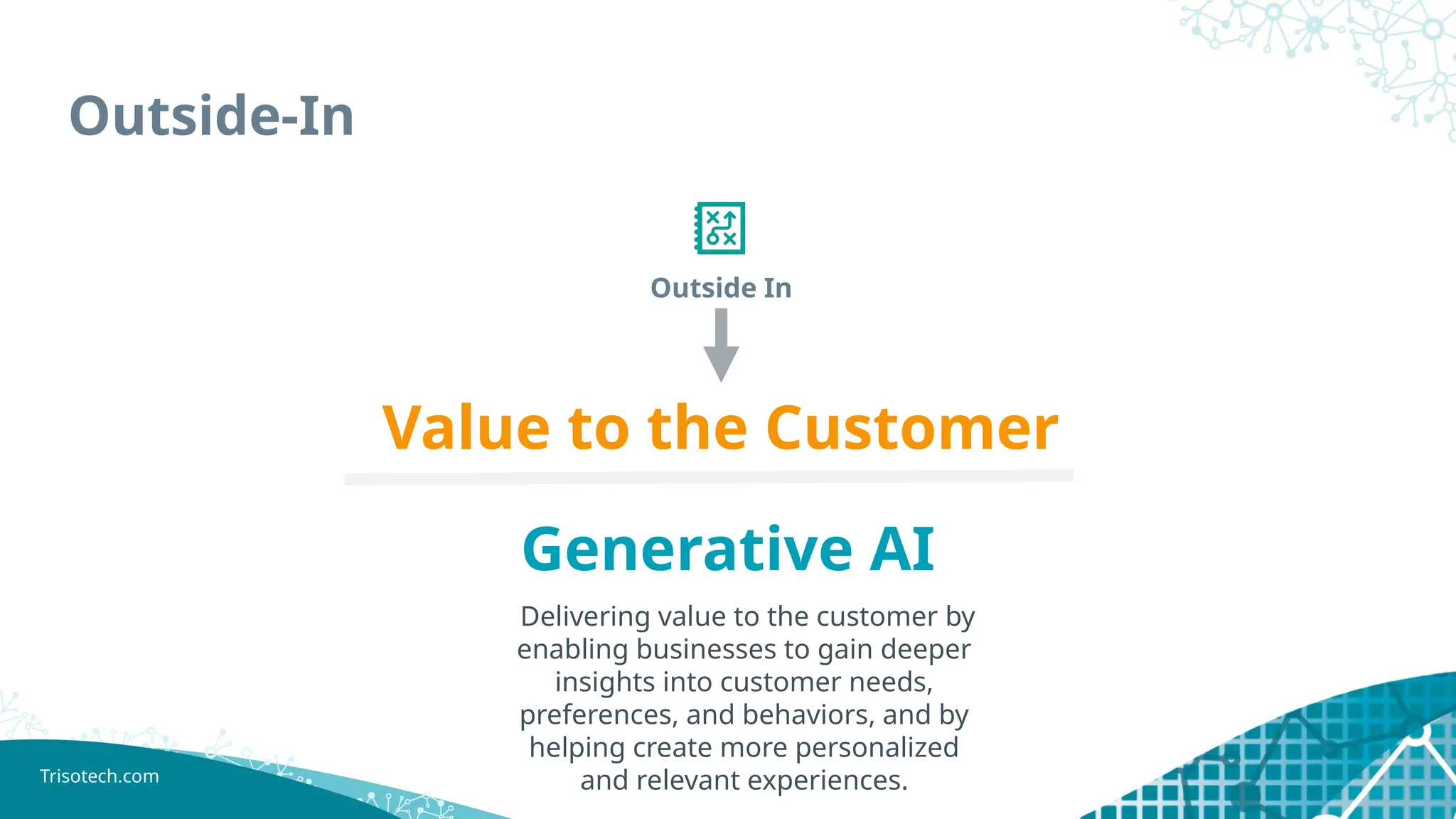
Outside-In
Value to the Customer
Outside In
Generative AI
Delivering value to the customer by
enabling businesses to gain deeper
insights into customer needs,
preferences, and behaviors, and by
helping create more personalized
and relevant experiences.
Trisotech.com
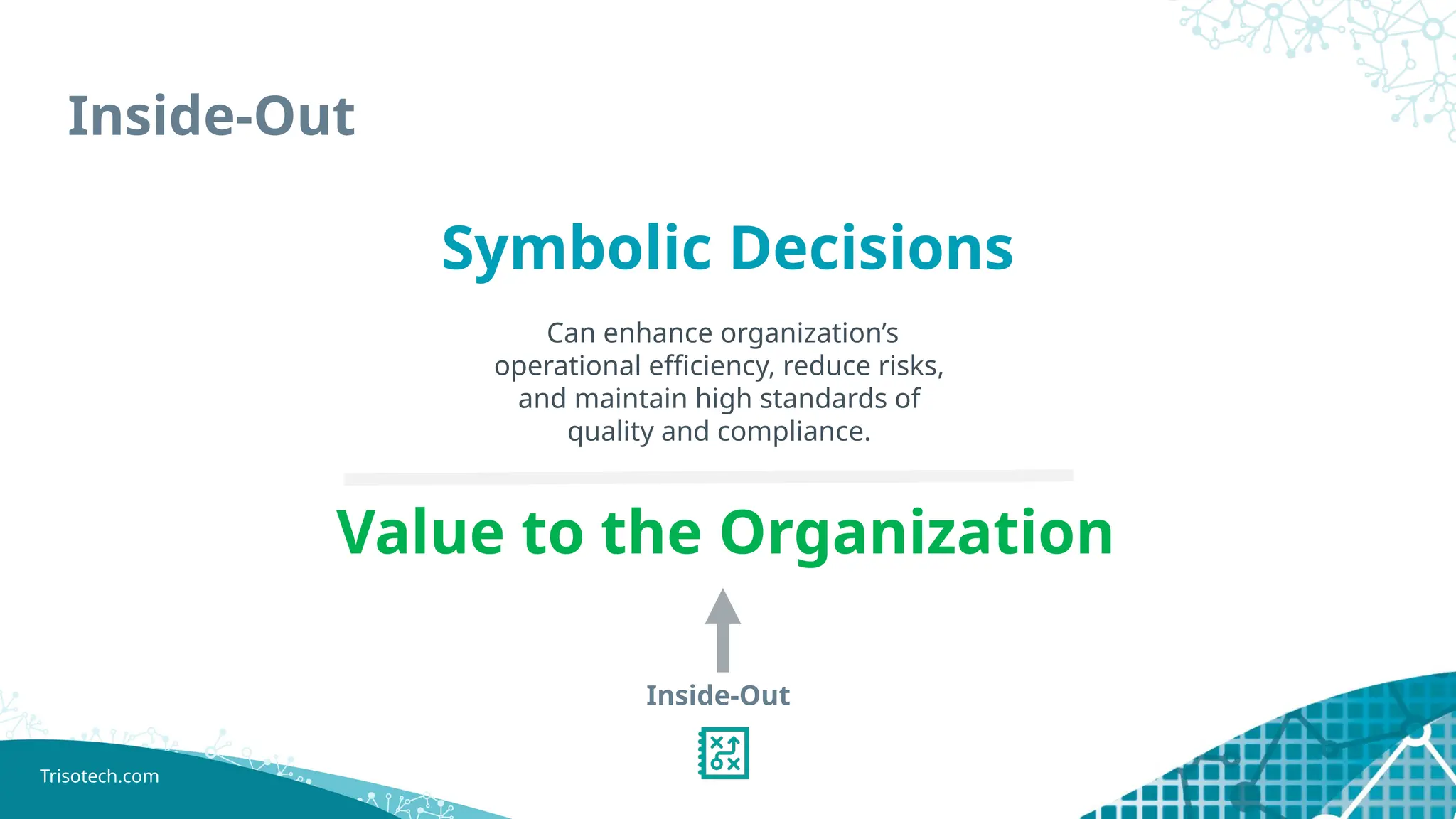
Inside-Out
Inside-Out
Value to the Organization
Symbolic Decisions
Can enhance organization’s
operational efficiency, reduce risks,
and maintain high standards of
quality and compliance.
Trisotech.com
Deciding
Thinking
Analyzing the Context
Thinking for Deciding
Selecting between options
Trisotech.com
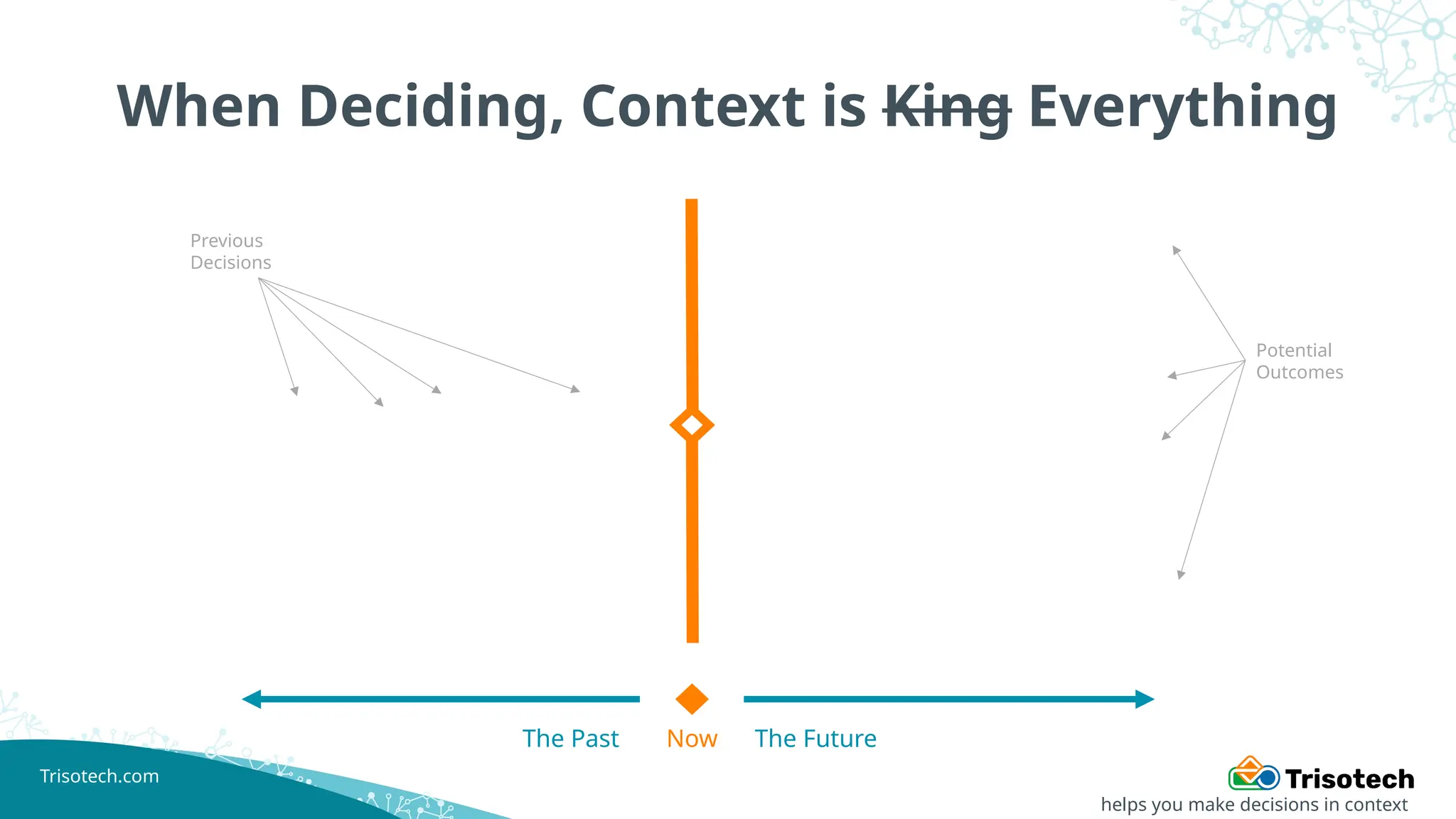
When Deciding, Context is King Everything
The Past The Future
Now
Potential
Outcomes
Previous
Decisions
helps you make decisions in context
Trisotech.com
Business Context
 Business Facts
o Past or present observations that are
supported by data.
 Business Values
o Fundamental and indistinctly important to the
organization. They help guide priorities and
judgement. Ensures desired bias.
Trisotech.com
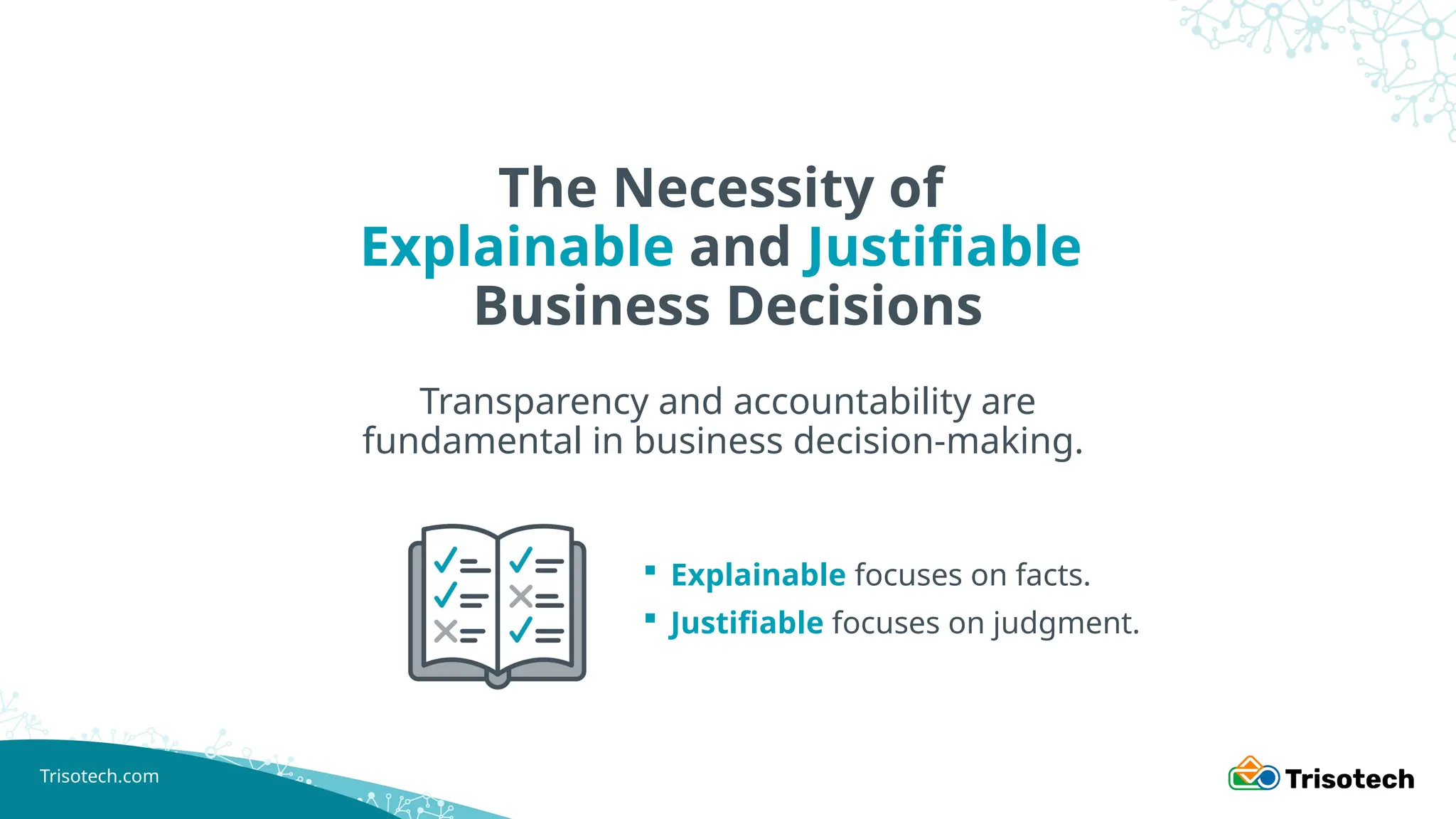
The Necessity of
Explainable and Justifiable
Business Decisions
Transparency and accountability are
fundamental in business decision-making.
 Explainable focuses on facts.
 Justifiable focuses on judgment.
Trisotech.com
Contextual Nuance
Humans can consider the broader context of a decision, including
cultural, social, and emotional factors that AI might miss.
It ensures that decisions are not only data-driven but
also contextually appropriate.
Trisotech.com
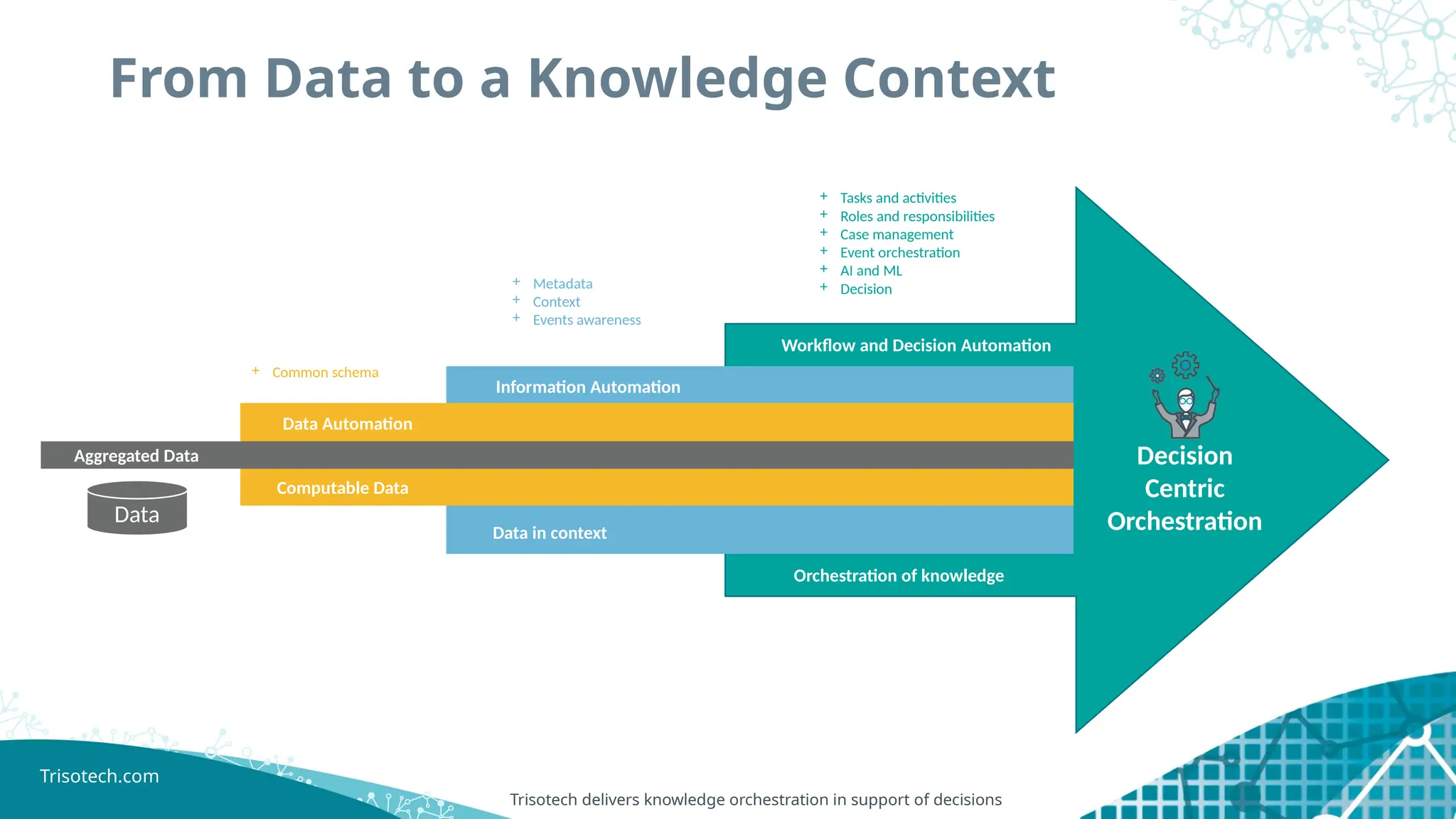
From Data to a Knowledge Context
Data
Decision
Centric
Orchestration
Computable Data
Aggregated Data
Data Automation
Information Automation
Orchestration of knowledge
Workflow and Decision Automation
Data in context
+ Common schema
+ Metadata
+ Context
+ Events awareness
+ Tasks and activities
+ Roles and responsibilities
+ Case management
+ Event orchestration
+ AI and ML
+ Decision
Trisotech delivers knowledge orchestration in support of decisions
Trisotech.com
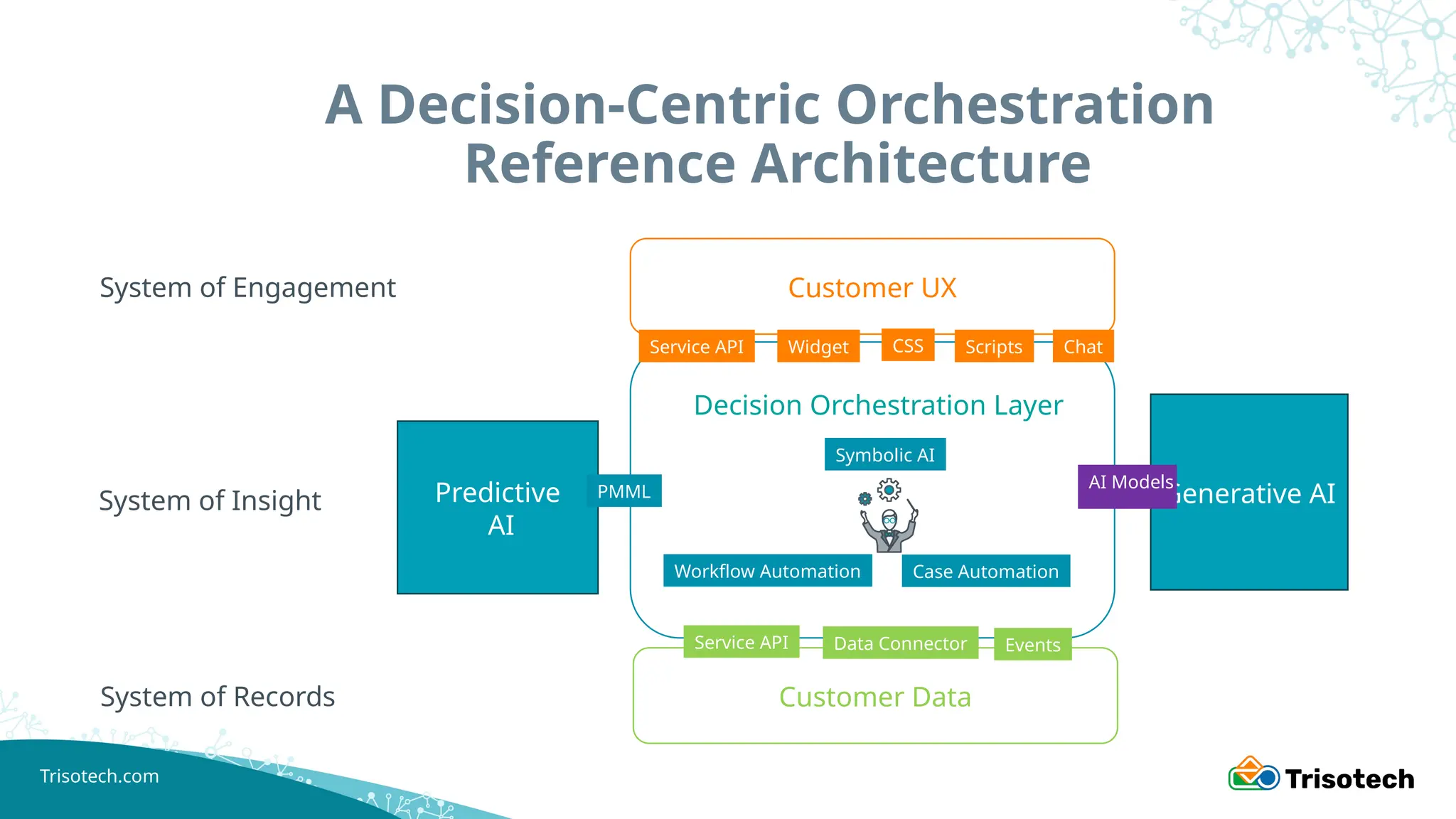
Predictive
AI
Customer Data
Generative AI
A Decision-Centric Orchestration
Reference Architecture
System of Engagement
System of Insight
System of Records
Service API
Widget CSS Scripts
Data Connector Events
Symbolic AI
PMML
Workflow Automation Case Automation
Service API Chat
Customer UX
AI Models
Decision Orchestration Layer
Trisotech.com
Knowledge Worker Assistant
Takes care of interaction, collaboration and
coordination of meaningful business events in a
specified business contract context.
See Intelligent Digital Assistance for Contract Workflows presentation with Tom DeBevoise
Uses just in time adaptive composition inferred from
context and previous actions.
Trisotech.com
Conclusion
 Mastering decision orchestration involves striking a
harmonious balance between human insight and AI
automation.
 By understanding the spectrum of organizational
decisions and leveraging various AI tools, businesses
can enhance their decision-making capabilities.
 Incorporating contextual information, emphasizing
explainable and justifiable decisions, and maintaining
human oversight are critical to navigating the
complexities of the modern business landscape.
Trisotech.com
Trisotech Decision Centric Orchestration
1. Decision Centric: business value creation comes from business decisions.
2. Outcome Driven Orchestration : coordinate any resources or endpoints using processes, workflows, and cases.
3. Decision Intelligence: semantic knowledge graph based.
4. Drag and Drop Composability: reuse by reference or by copy.
5. Business Digital Twin: the Who, What, When, Where, Why, and How of your business.
6. Contextualized: from strategy to operations, Outside-in and Inside-out.
7. Low-code, No-code, Pro-code: Intuitive to business, expressive for IT.
8. Model Driven: The model is the requirement, the documentation, and the execution code.
9. Visual Driven: Visual notations readable by both humans and machines.
10. Standard Based: Open Standards ensure no vendor lock-in.
11. API First: Exposed as services.
12. Containerized: Rapidly deployed and scaled.
13. Security built-in not bolt-on: Confidentiality, integrity, availability, authentication, authorization.
14. Integrate Anything : Data, documents, events, services, or legacy systems.
15. Headless First: Exposed via customer frontend or dynamic UI generation.
16. Stateful or Stateless: Manual, Augmented, or Automated applications.
17. Decentralized: Multichannel interactions (no central login or task list).
18. Leveraging AI: From specialized tasks to interaction modalities.
19. Flexible Interaction Modalities: Widget Interaction, contextual (current history, focus or RAG) chat, talk/voice.
Any questions?
THANKS!
52

Mastering Decision Orchestration - Denis Gagne

  • 1.
    Mastering Decision Orchestration Leading theDecision Automation Revolution Balancing Human Insight and AI Automation for Justifiable, Context-Aware Business Choices
  • 2.
    Trisotech.com Business Decisions Every businessaction is fundamentally rooted in a Business Decision. The ability to make informed, timely, and effective decisions directly impacts a company's ability to innovate, grow, and remain competitive.
  • 3.
    Trisotech.com The need for Decision-CentricOrganizations Ultimately, the cumulative impact of well-made decisions across all areas drives Business Success. Businesses that prioritize decision-making are better equipped to navigate complexities, seize opportunities, and create lasting value. Repeated poor business decisions will sink any enterprise.
  • 4.
    Trisotech.com Decision-Centric Organizations place decision-makingat the heart of its operations, culture, and strategy. Every aspect of the business, whether it is people, process, or technology, is designed to support, enhance, and optimize Business Decision-Making.
  • 5.
    Trisotech.com Leveraging diverse decision-makingapproaches can create a robust Business Decision-Making Ecosystem that not only optimizes outcomes but also drives innovation, efficiency, and long-term success.
  • 6.
    Trisotech.com The need for Orchestration Orchestrationrefers to the end-to-end coordinated management and execution of complex processes, cases, or workflows across multiple people, systems, tools, or services.
  • 7.
    Trisotech.com The need foran End-to-End Perspective Orchestration involves automating not just individual tasks, but the entire end-to-end set of required tasks to reach a desired outcome, ensuring that they happen in the right order, at the right time, and with the correct data and resources.
  • 8.
    Trisotech.com Decision Centric Orchestration involvescoordinating and managing various processes, systems, data, and people within an organization to optimize end-to-end business decision-making. Ensures that every decision made within the organization is informed, timely, and aligned with business objectives by orchestrating the right resources and tools while making business decisions.
  • 9.
    Trisotech.com Dynamic Business Environment BusinessDecision Making has evolved into a complex process that requires human intuition and advanced tooling. How can businesses leverage the synergy between human, tooling and AI to achieve optimal outcomes.
  • 10.
    Trisotech.com Embedding AI intothe Flow of Work The integration of AI should be seamless, with AI capabilities appearing as natural extensions of existing tasks rather than separate, complex systems to be learned.
  • 11.
    Trisotech.com The Purpose of Decision-CentricOrchestration Enable enterprises to make great, effective, efficient, secure, explainable, justifiable, end to end, contextualized, aligned business decisions by leveraging human business understanding and intuition with the power of automation and AI.
  • 12.
    Trisotech.com The Role ofAI in Decision-Centric Orchestration AI introduces capabilities that can enhance the business decision making process. Various forms of AI can be put to contribution.
  • 13.
    Trisotech.com Generative AI (GenAI) Various Formsof AI Machine Learning (ML) Deep Learning (DL) Expert Systems Fuzzy Logic Neural Networks Reinforcement Learning Evolutionary Algorithms Bayesian Networks Recommender Systems Predictive Analytics Genetic Algorithms Constraint Satisfaction Multi-Agent Systems Rule Based Systems
  • 14.
    Trisotech.com Chat-Centric AI Applications Oneof the main driver of current business AI applications:  Chat with a Foundation Model  Chat with a Document  Chat with Product Documentation  Chat with your Software  Chat with everything…. The advent of free-form conversational interfaces.
  • 15.
    Trisotech.com A UI/UX Revolution, Notan AI Revolution The real GenAI Revolution lies in how we interact with software via AI. Making technology more natural and integrated into daily workflows.
  • 16.
    Trisotech.com The History ofUX/UI Punch Cards and Ribbons (1940s-1970s) Interaction with machines was mechanical and rigid. Green Screens (1970s-1980s) User interaction began to shift from hardware to software. Point-and-Click Interfaces (1980s-Present) Usability and user experience became central, lowering the barrier to entry. Natural Language Interfaces (Present-Future) Communicate with software as if we were communicating with a human image: Flaticon.com
  • 17.
    Trisotech.com Do not blindlyuse GenAI for every Business Problems The value of GenAI as a generator of information is unquestionable. However, their probabilistic nondeterminism limits their use cases.
  • 18.
  • 19.
    Trisotech.com Automating Decisions directly fromDocument Source In our experience:  Most Guidelines and Procedures documented in natural language contain gaps and incoherences, sometimes even contradictions.  All Laws and Regulations leave room to interpretation by design.  Do you really want to automate gaps and contradictions?  Do you really want an AI to make judgement or interpretations that you will be liable for?
  • 20.
    Trisotech.com More than 80% ofAI projects fail Root causes:  Misunderstanding what problem needs to be solved using AI.  Organization lacks the necessary data to train an effective model.  Organization focuses more on using the latest technology than solving the problem.  Not adequate infrastructure to manage their data and deploy AI models.  The technology is applied to problems that are too difficult for AI to solve. Recommendation:  Focus on the problem, not the technology https://www.rand.org/content/dam/rand/pubs/research_reports/RRA2600/RRA2680-1/RAND_RRA2680-1.pdf
  • 21.
    Trisotech.com The Age of ArtificialAugmented Intelligence We are in the era of Augmented Intelligence, where AI doesn't replace humans but enhances our capabilities.  Team up with AI on tasks and decisions.  Integrate AI everywhere where it adds value.
  • 22.
    Trisotech.com The Imperative of HumanOversight in Business Decision- Making  Human oversight remains indispensable in decision-making.  Humans bring ethical judgment, empathy, and strategic vision that machines cannot replicate.  Human oversight ensures alignment with organizational values, ethical standards, and long-term objectives.
  • 23.
    Trisotech.com Human-AI Collaboration Enhances Decision-Making Combining Strengths o Human Strengths: Humans bring intuition, creativity, and contextual understanding that AI lacks. o AI's Strengths: AI excels at processing vast amounts of data, identifying patterns, and making data-driven predictions.  Maintaining Human Oversight o Ethical Considerations: In regulated industries, human oversight ensures ethical standards are maintained and that decisions align with societal values. o Accountability: Humans remain accountable for decisions, which is crucial in legal and regulatory contexts where AI alone cannot be held responsible.
  • 24.
    Trisotech.com A Myriad ofDaily Business Decisions  Financial Decisions  Risk Management  Innovation and R&D Decisions  Customer-Centric Decisions  Human Capital Decisions  Technology and Digital Transformation Decisions  Ethical and Social Responsibility Decisions  Etc.
  • 25.
    Trisotech.com Various discipline’s approachesto Business Decision Making Decision Models Optimization Models Systems Models Predictive Models Emotional Models Cost-Benefit Models Systems Engineering: Psychology: Promotes a holistic approach to decision- making through systems dynamics, which considers the interactions and feedback loops within complex systems. Utilizes predictive models that consider human biases and various heuristics to forecast human behavior and optimize decisions. Behavioral Science: Integrates cognitive and emotional models to account for human biases and heuristics in decision-making. Focuses on mathematical models leveraging linear and nonlinear programming techniques to improve resource allocation and logistics. Applies cost-benefit analysis and market simulations to evaluate the economic impact of business decisions. Computer Science: Leverages rule-based systems and machine learning to automate consistent and data- driven decision- making processes. Operations Research: Economics:
  • 26.
    Trisotech.com Decision-Making Continuum Human- Based Decisions Assisted Decision- Making Augmente d Decision- Making Semi- Automated Decision- Making Fully Automated Decision- Making Decisionsare made entirely by humans, based on experience, intuition, and judgment Decisions are made entirely by algorithms or AI systems without human intervention, often in real-time Humans still make the final decision but are heavily guided by system driven guidance Canvases Attended decisions and tasks
  • 27.
    Trisotech.com Business Decision Playbooks Typically includes a series of steps, decision criteria, key considerations, and roles and responsibilities to ensure consistent, informed, and efficient decision-making.  Used to reduce uncertainty and align decisions with strategic goals.  They can be particularly useful in complex environments where decisions need to be made quickly and consistently by different teams or individuals. A structured guide or framework that outlines the processes, criteria, and best practices for making decisions within an organization.
  • 28.
    Trisotech.com Automating Business Decision Playbooks Engineeringbusiness decisions and Orchestrating AI tools with human oversight into existing workflows ensuring careful alignment with current processes to enhance efficiency without disrupting operations. Orchestrating business decisions by injecting the right kind of AI at the right time within the workflows of your knowledge workers.
  • 29.
    Trisotech.com Engineering Business Decisions Precision  Transparency  Traceability  Flexibility  Reusability  Explainability With a focus on transparency and ethical decision-making.
  • 30.
    Trisotech.com Strategy to Operation, Inside-Outand Outside-In Strategy Operations Outside-In Inside-Out
  • 31.
  • 32.
    Trisotech.com Strategy Creative Thinking Generative AI Canvases Brainstorm Strategy Can supportcreative thinking by augmenting human creativity with its ability to generate new ideas, explore vast possibilities, and provide unique perspectives.
  • 33.
  • 34.
  • 35.
    Trisotech.com Operation Critical Thinking Operation Models Analysis Symbolic Decisions By providinga structured and transparent approach to decision- making, symbolic-based decision can enhance critical thinking skills, enabling individuals to make more informed, logical, and unbiased decisions.
  • 36.
  • 37.
  • 38.
    Trisotech.com Inside-Out, Outside-In Value tothe Customer Outside-In Inside-Out Value to the Organization outside-in and inside-out
  • 39.
    Trisotech.com Outside-In Value to theCustomer Outside In Generative AI Delivering value to the customer by enabling businesses to gain deeper insights into customer needs, preferences, and behaviors, and by helping create more personalized and relevant experiences.
  • 40.
    Trisotech.com Inside-Out Inside-Out Value to theOrganization Symbolic Decisions Can enhance organization’s operational efficiency, reduce risks, and maintain high standards of quality and compliance.
  • 41.
  • 42.
    Trisotech.com When Deciding, Contextis King Everything The Past The Future Now Potential Outcomes Previous Decisions helps you make decisions in context
  • 43.
    Trisotech.com Business Context  BusinessFacts o Past or present observations that are supported by data.  Business Values o Fundamental and indistinctly important to the organization. They help guide priorities and judgement. Ensures desired bias.
  • 44.
    Trisotech.com The Necessity of Explainableand Justifiable Business Decisions Transparency and accountability are fundamental in business decision-making.  Explainable focuses on facts.  Justifiable focuses on judgment.
  • 45.
    Trisotech.com Contextual Nuance Humans canconsider the broader context of a decision, including cultural, social, and emotional factors that AI might miss. It ensures that decisions are not only data-driven but also contextually appropriate.
  • 46.
    Trisotech.com From Data toa Knowledge Context Data Decision Centric Orchestration Computable Data Aggregated Data Data Automation Information Automation Orchestration of knowledge Workflow and Decision Automation Data in context + Common schema + Metadata + Context + Events awareness + Tasks and activities + Roles and responsibilities + Case management + Event orchestration + AI and ML + Decision Trisotech delivers knowledge orchestration in support of decisions
  • 47.
    Trisotech.com Predictive AI Customer Data Generative AI ADecision-Centric Orchestration Reference Architecture System of Engagement System of Insight System of Records Service API Widget CSS Scripts Data Connector Events Symbolic AI PMML Workflow Automation Case Automation Service API Chat Customer UX AI Models Decision Orchestration Layer
  • 48.
    Trisotech.com Knowledge Worker Assistant Takescare of interaction, collaboration and coordination of meaningful business events in a specified business contract context. See Intelligent Digital Assistance for Contract Workflows presentation with Tom DeBevoise Uses just in time adaptive composition inferred from context and previous actions.
  • 49.
    Trisotech.com Conclusion  Mastering decisionorchestration involves striking a harmonious balance between human insight and AI automation.  By understanding the spectrum of organizational decisions and leveraging various AI tools, businesses can enhance their decision-making capabilities.  Incorporating contextual information, emphasizing explainable and justifiable decisions, and maintaining human oversight are critical to navigating the complexities of the modern business landscape.
  • 50.
    Trisotech.com Trisotech Decision CentricOrchestration 1. Decision Centric: business value creation comes from business decisions. 2. Outcome Driven Orchestration : coordinate any resources or endpoints using processes, workflows, and cases. 3. Decision Intelligence: semantic knowledge graph based. 4. Drag and Drop Composability: reuse by reference or by copy. 5. Business Digital Twin: the Who, What, When, Where, Why, and How of your business. 6. Contextualized: from strategy to operations, Outside-in and Inside-out. 7. Low-code, No-code, Pro-code: Intuitive to business, expressive for IT. 8. Model Driven: The model is the requirement, the documentation, and the execution code. 9. Visual Driven: Visual notations readable by both humans and machines. 10. Standard Based: Open Standards ensure no vendor lock-in. 11. API First: Exposed as services. 12. Containerized: Rapidly deployed and scaled. 13. Security built-in not bolt-on: Confidentiality, integrity, availability, authentication, authorization. 14. Integrate Anything : Data, documents, events, services, or legacy systems. 15. Headless First: Exposed via customer frontend or dynamic UI generation. 16. Stateful or Stateless: Manual, Augmented, or Automated applications. 17. Decentralized: Multichannel interactions (no central login or task list). 18. Leveraging AI: From specialized tasks to interaction modalities. 19. Flexible Interaction Modalities: Widget Interaction, contextual (current history, focus or RAG) chat, talk/voice.
  • 51.