Business Process Modeling and Automation
giving control back to business
13 September 2016
DanGa
K E WProcess Modeling and Automation
31 August 2016 giving control back to business 2
 Who am I ?
 BPM Lifecycle
 Example 1 – Ordering Process
 Example 2 – Product Classification Process
 Process Modeling & Documentation
 Automation
 Addendum
DanGa
K E WProcess Modeling and Automation
31 August 2016 giving control back to business 3
 Who am I ?
 BPM Lifecycle
 Example 1 – Ordering Process
 Example 2 – Product Classification Process
 Process Modeling & Documentation
 Automation
 Addendum
DanGa
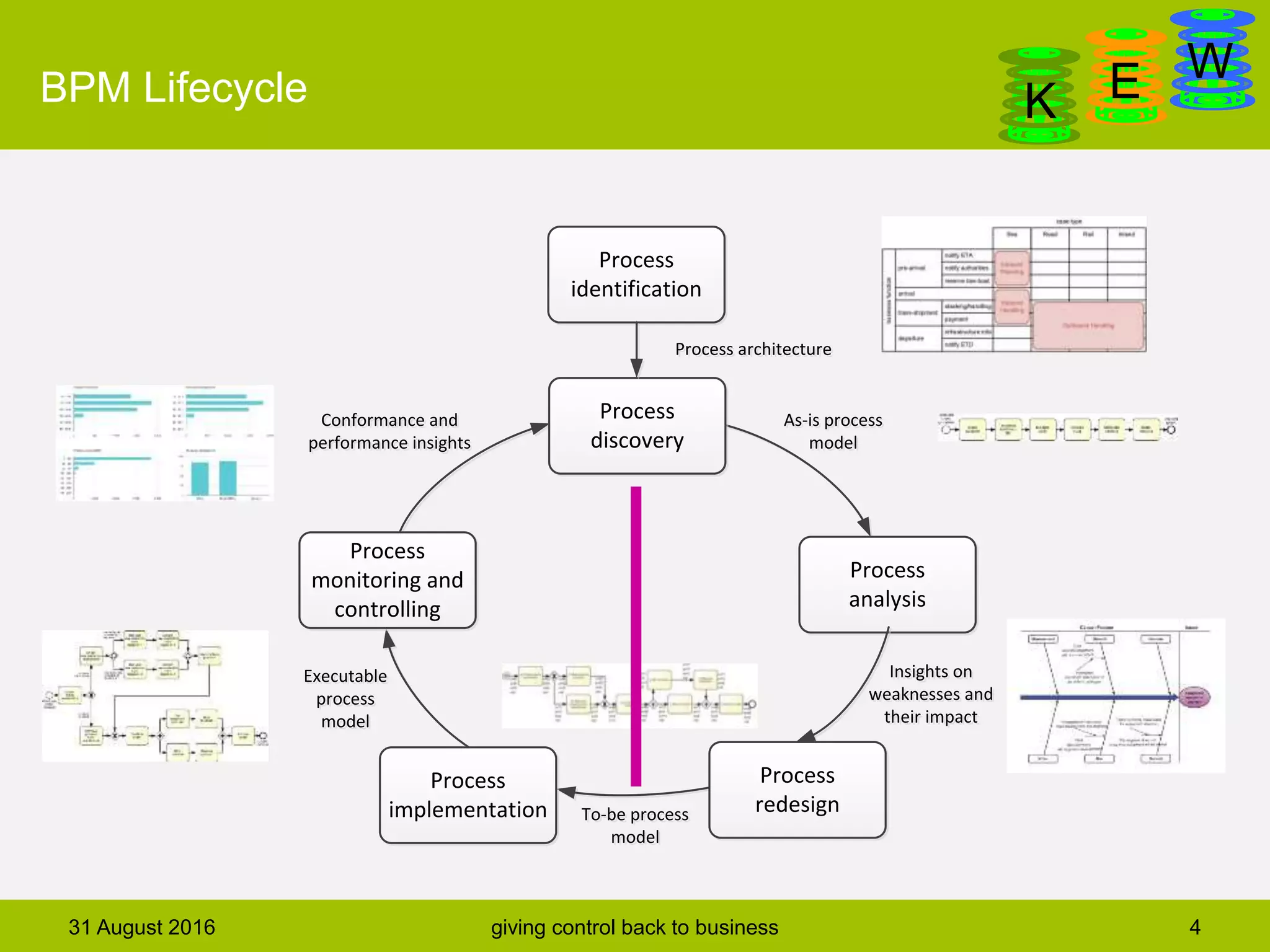
K E WBPM Lifecycle
31 August 2016 giving control back to business 4
Process
identification
Conformance and
performance insights
Conformance and
performance insights
Process
monitoring and
controlling
Executable
process
model
Executable
process
model
Process
implementation To-be process
model
To-be process
model
Process
analysis
As-is process
model
As-is process
model
Process
discovery
Process architectureProcess architecture
Process
redesign
Insights on
weaknesses and
their impact
Insights on
weaknesses and
their impact
DanGa
K E WBPM Lifecycle
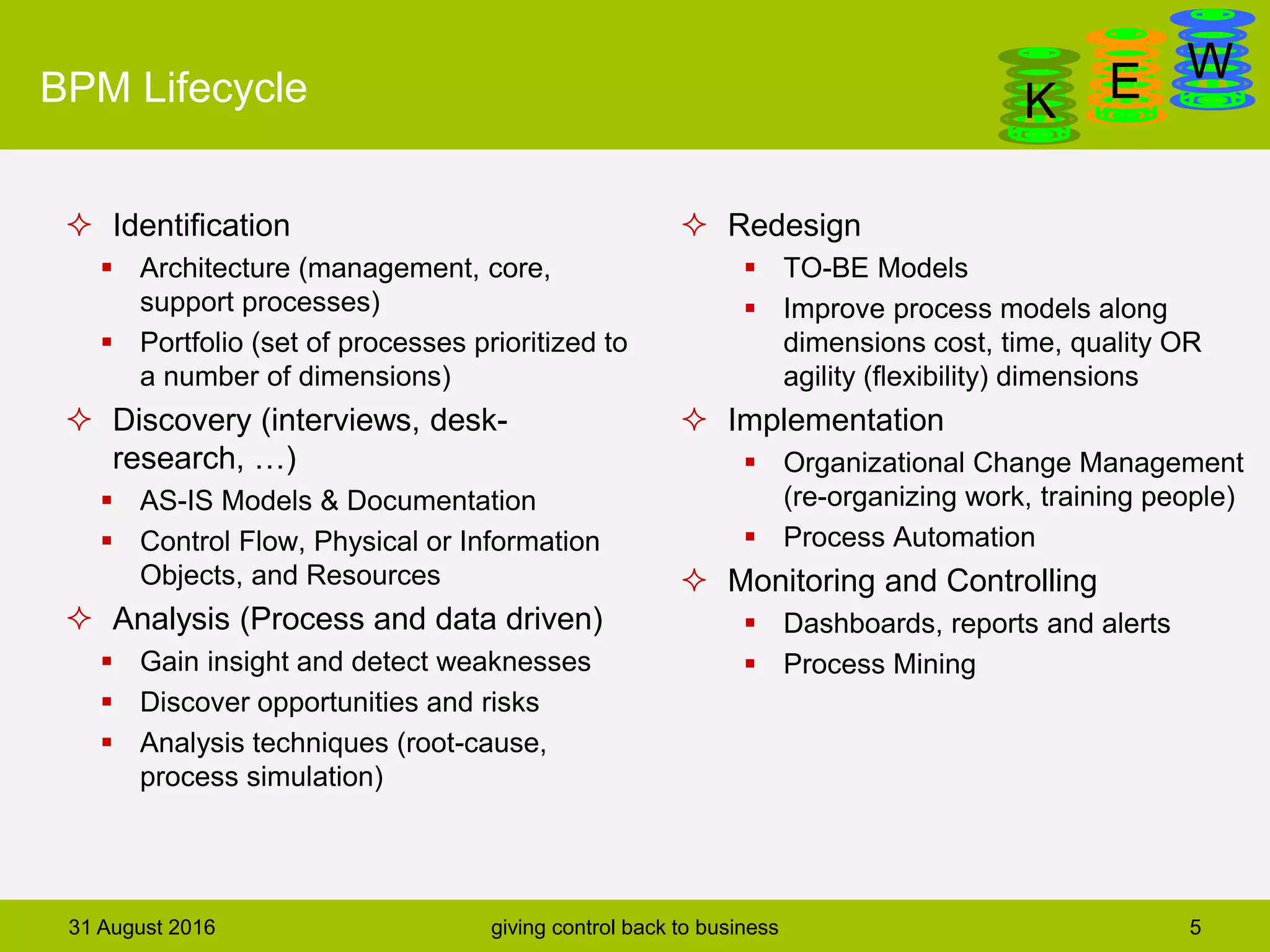
 Identification
 Architecture (management, core,
support processes)
 Portfolio (set of processes prioritized to
a number of dimensions)
 Discovery (interviews, desk-
research, …)
 AS-IS Models & Documentation
 Control Flow, Physical or Information
Objects, and Resources
 Analysis (Process and data driven)
 Gain insight and detect weaknesses
 Discover opportunities and risks
 Analysis techniques (root-cause,
process simulation)
31 August 2016 giving control back to business 5
 Redesign
 TO-BE Models
 Improve process models along
dimensions cost, time, quality OR
agility (flexibility) dimensions
 Implementation
 Organizational Change Management
(re-organizing work, training people)
 Process Automation
 Monitoring and Controlling
 Dashboards, reports and alerts
 Process Mining
DanGa
K E WProcess Modeling and Automation
31 August 2016 giving control back to business 6
 Who am I ?
 BPM Lifecycle
 Example 1 – Ordering Process
 Example 2 – Product Classification Process
 Process Modeling & Documentation
 Automation
 Addendum
DanGa
K E WExample 1: Processing of OEM Orders
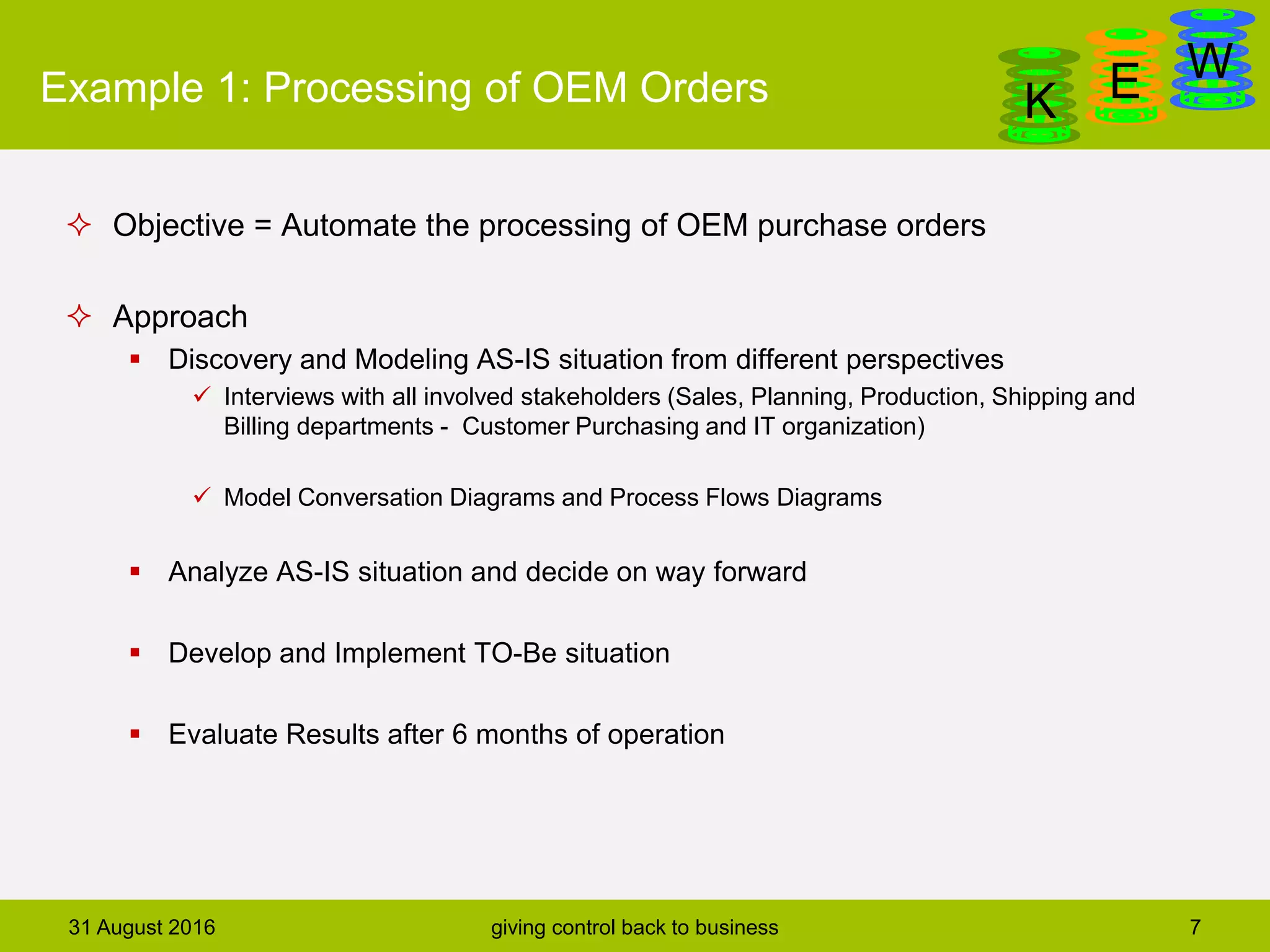
 Objective = Automate the processing of OEM purchase orders
 Approach
 Discovery and Modeling AS-IS situation from different perspectives
 Interviews with all involved stakeholders (Sales, Planning, Production, Shipping and
Billing departments - Customer Purchasing and IT organization)
 Model Conversation Diagrams and Process Flows Diagrams
 Analyze AS-IS situation and decide on way forward
 Develop and Implement TO-Be situation
 Evaluate Results after 6 months of operation
31 August 2016 giving control back to business 7
DanGa
K E WViewpoint Key Account Manager
31 August 2016 giving control back to business 8
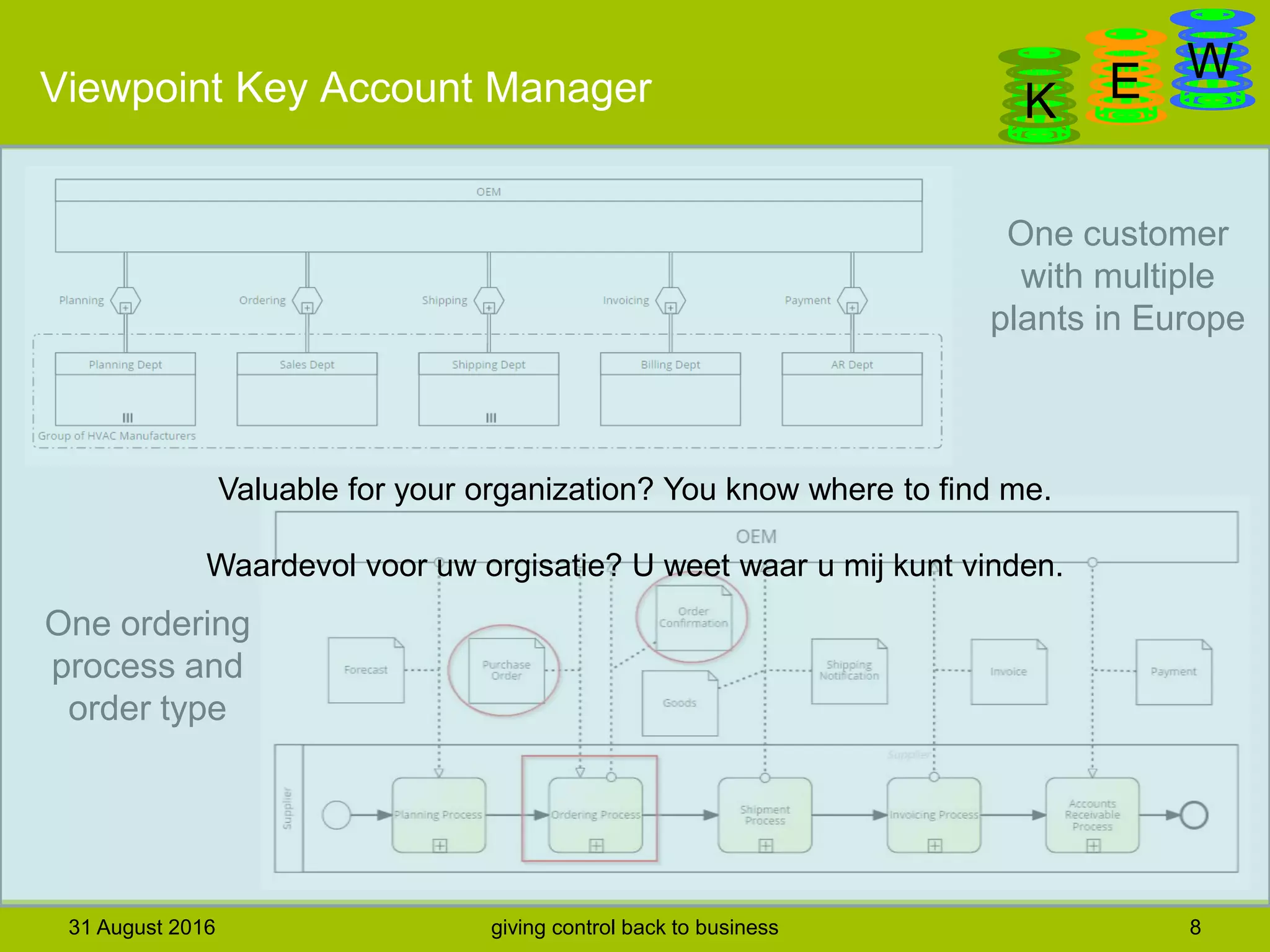
One customer
with multiple
plants in Europe
One ordering
process and
order type
DanGa
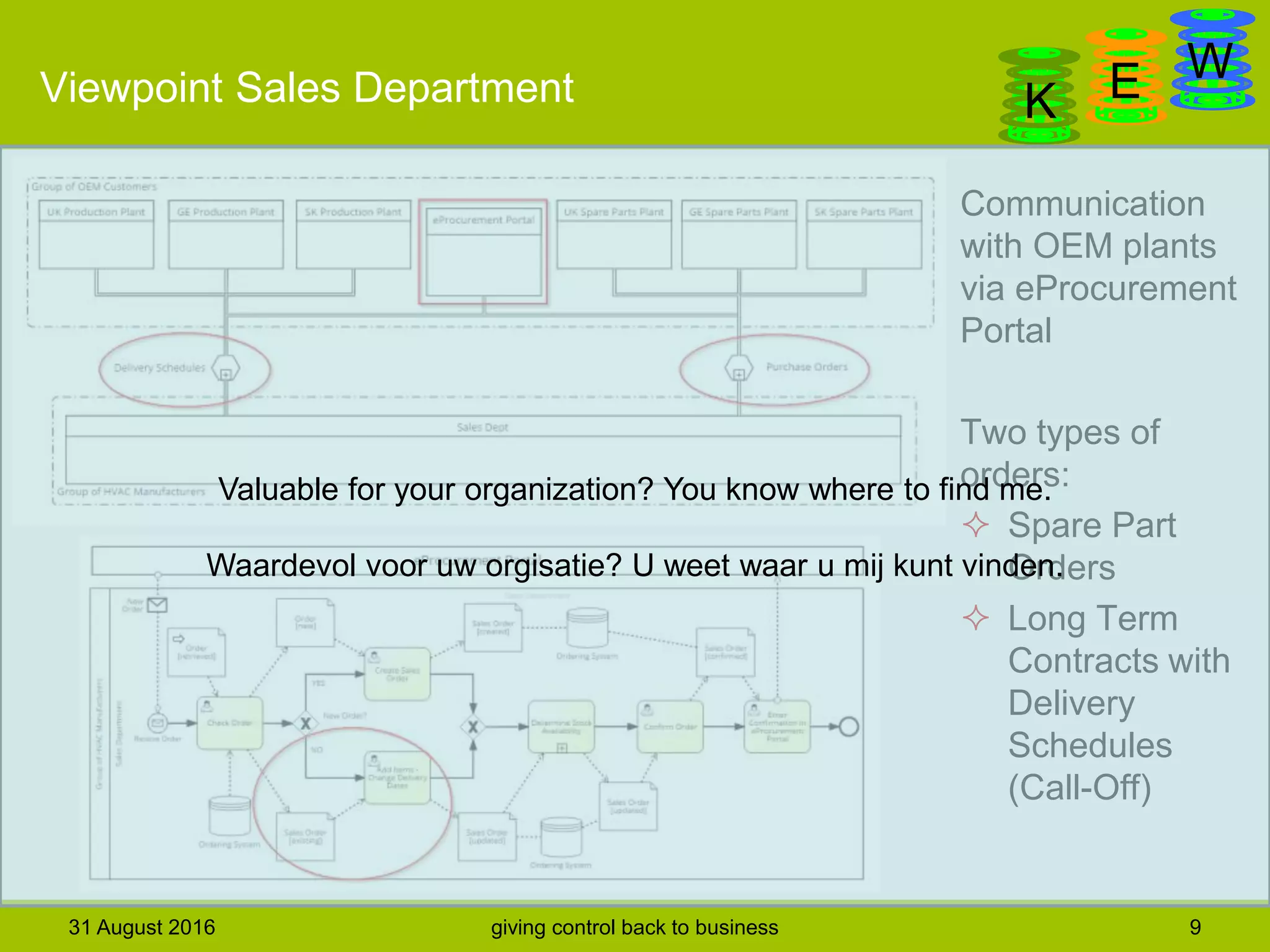
K E WViewpoint Sales Department
31 August 2016 giving control back to business 9
Communication
with OEM plants
via eProcurement
Portal
Two types of
orders:
 Spare Part
Orders
 Long Term
Contracts with
Delivery
Schedules
(Call-Off)
DanGa
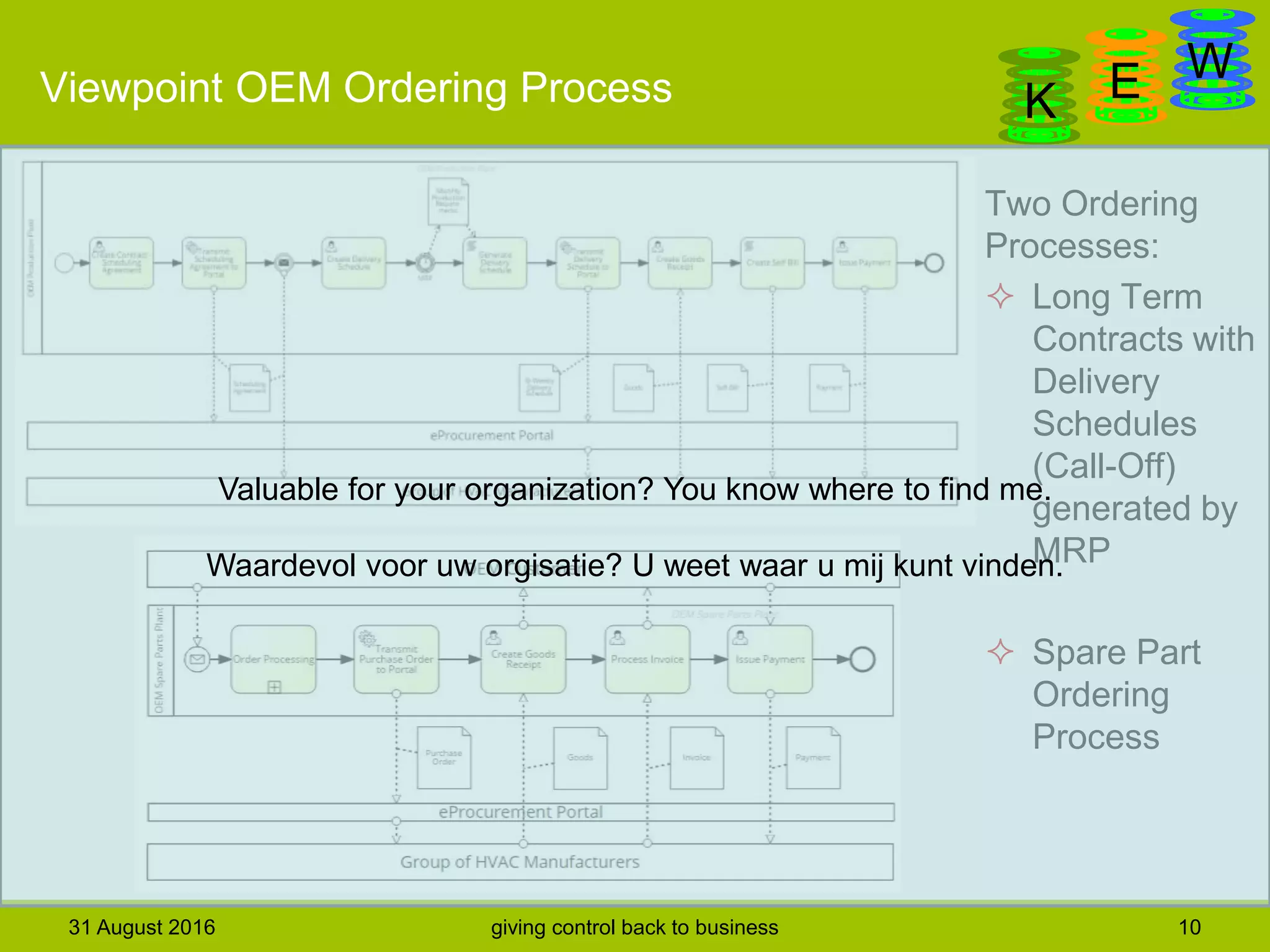
K E WViewpoint OEM Ordering Process
31 August 2016 giving control back to business 10
Two Ordering
Processes:
 Long Term
Contracts with
Delivery
Schedules
(Call-Off)
generated by
MRP
 Spare Part
Ordering
Process
DanGa
K E WFindings and way forward
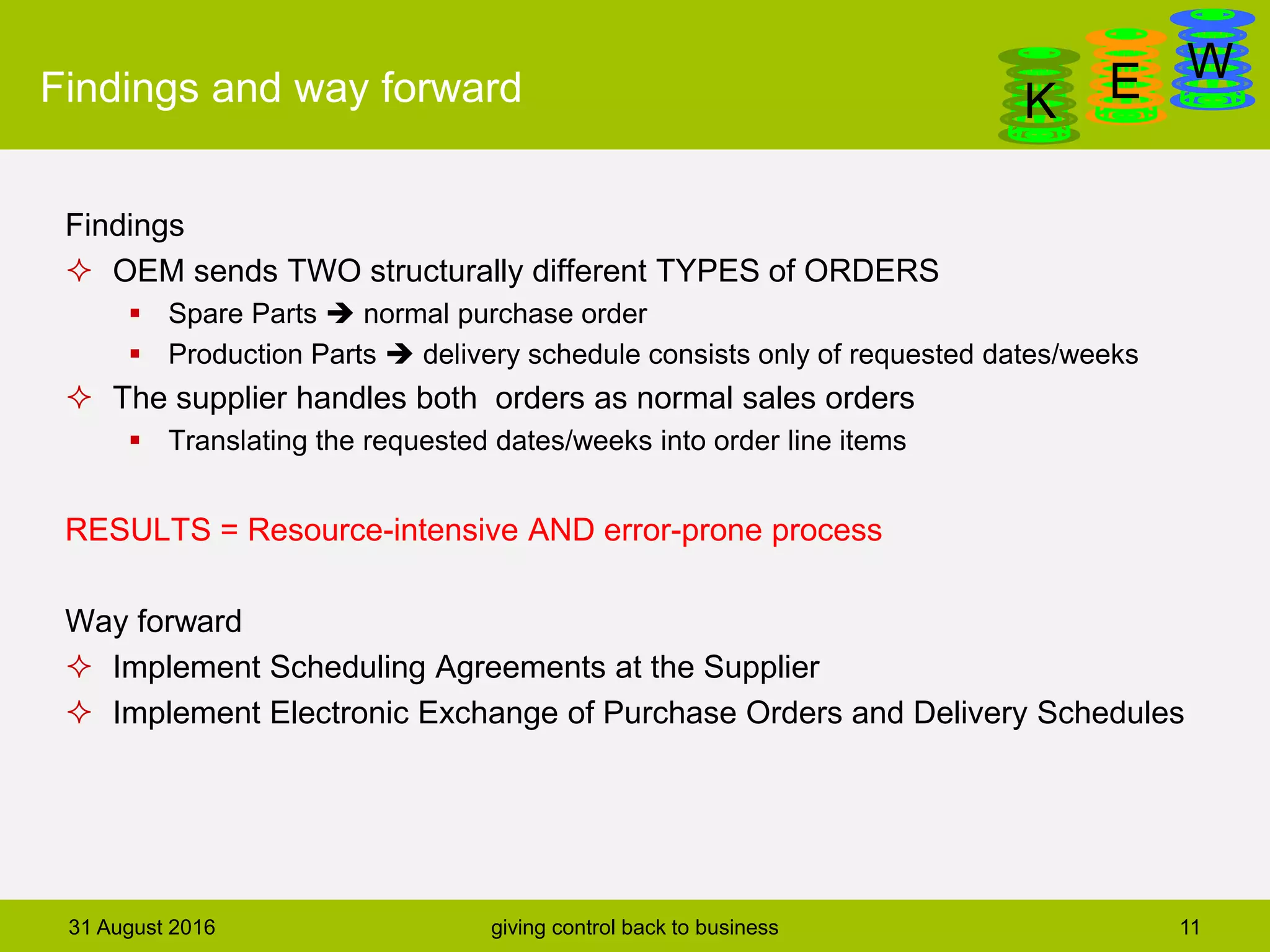
Findings
 OEM sends TWO structurally different TYPES of ORDERS
 Spare Parts  normal purchase order
 Production Parts  delivery schedule consists only of requested dates/weeks
 The supplier handles both orders as normal sales orders
 Translating the requested dates/weeks into order line items
RESULTS = Resource-intensive AND error-prone process
Way forward
 Implement Scheduling Agreements at the Supplier
 Implement Electronic Exchange of Purchase Orders and Delivery Schedules
31 August 2016 giving control back to business 11
DanGa
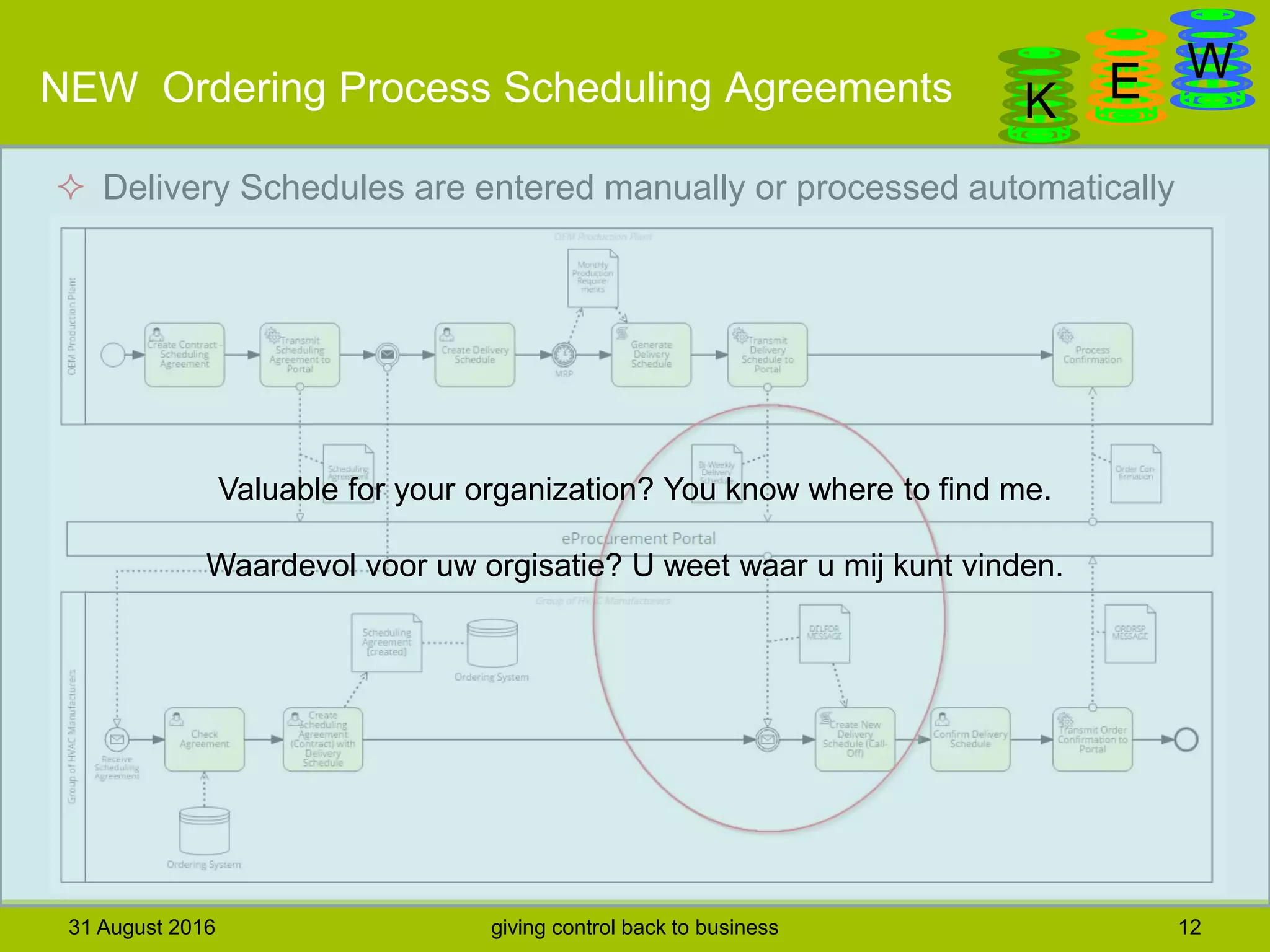
K E WNEW Ordering Process Scheduling Agreements
31 August 2016 giving control back to business 12
 Delivery Schedules are entered manually or processed automatically
DanGa
K E WOutcome – Savings
31 August 2016 giving control back to business 13
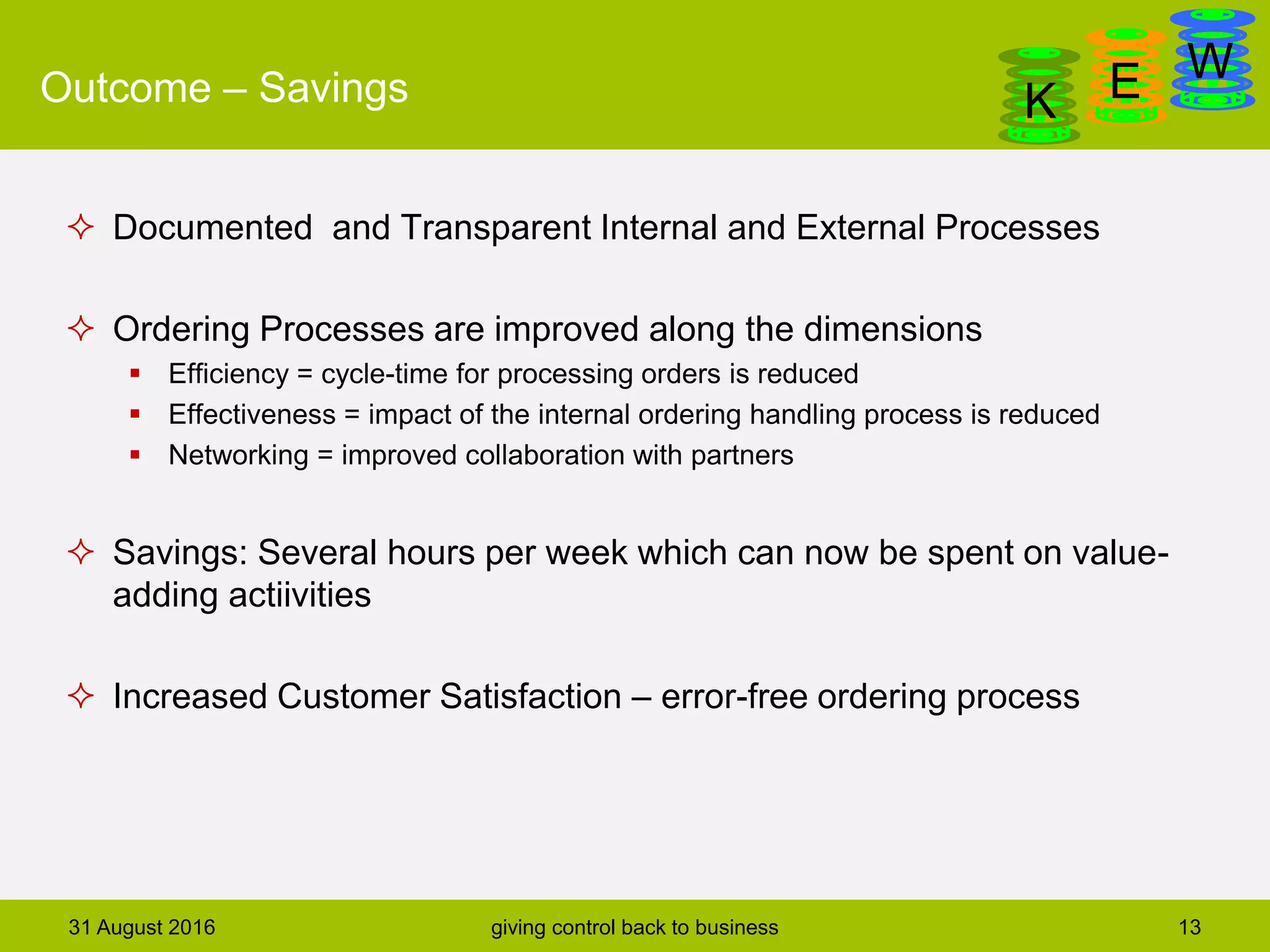
 Documented and Transparent Internal and External Processes
 Ordering Processes are improved along the dimensions
 Efficiency = cycle-time for processing orders is reduced
 Effectiveness = impact of the internal ordering handling process is reduced
 Networking = improved collaboration with partners
 Savings: Several hours per week which can now be spent on value-
adding actiivities
 Increased Customer Satisfaction – error-free ordering process
DanGa
K E WProcess Modeling and Automation
31 August 2016 giving control back to business 14
 Who am I ?
 BPM Lifecycle
 Example 1 – Ordering Process
 Example 2 – Product Classification Process
 Process Modeling & Documentation
 Automation
 Addendum
DanGa
K E WExample 2: Product Classification Process
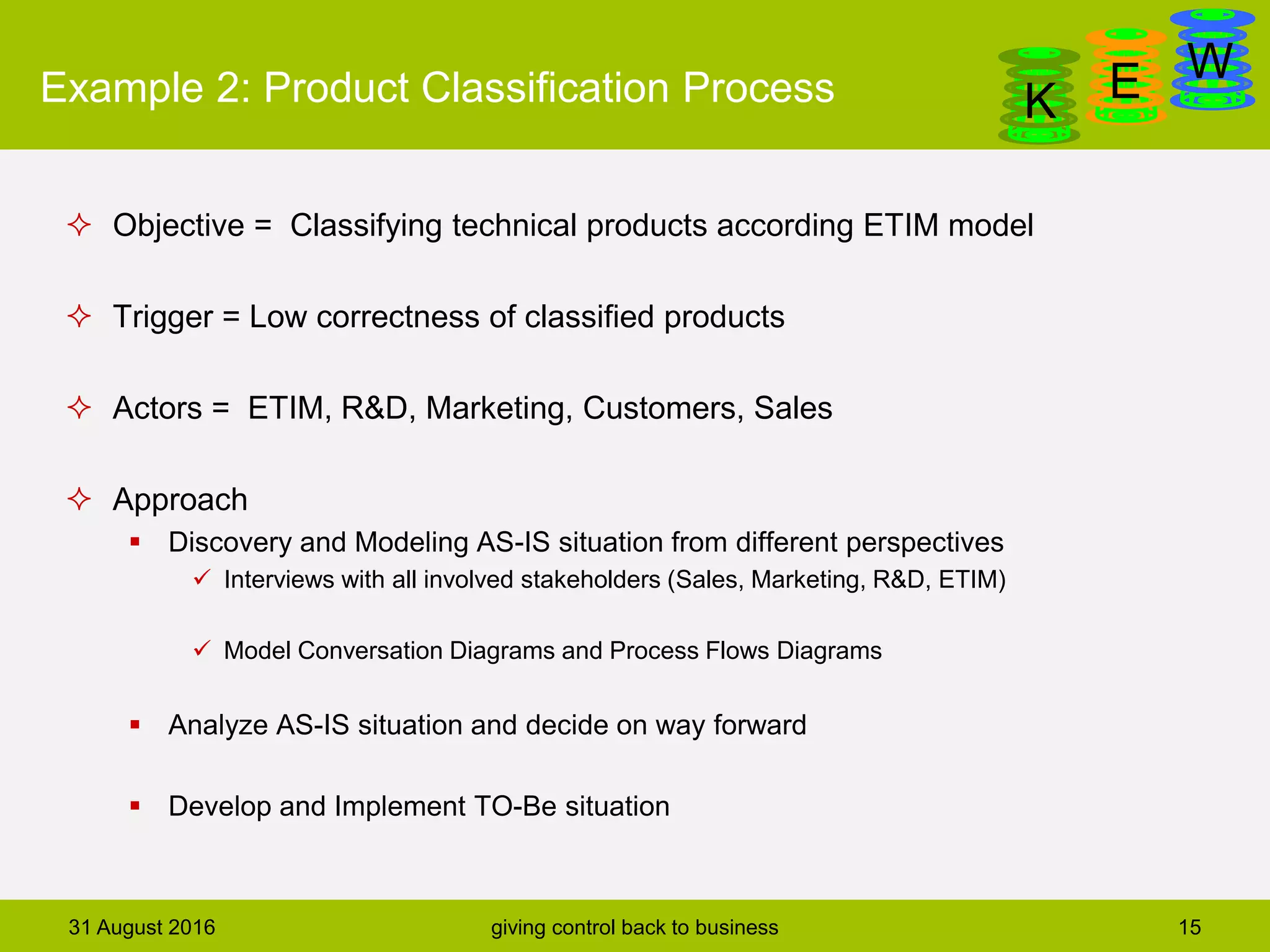
 Objective = Classifying technical products according ETIM model
 Trigger = Low correctness of classified products
 Actors = ETIM, R&D, Marketing, Customers, Sales
 Approach
 Discovery and Modeling AS-IS situation from different perspectives
 Interviews with all involved stakeholders (Sales, Marketing, R&D, ETIM)
 Model Conversation Diagrams and Process Flows Diagrams
 Analyze AS-IS situation and decide on way forward
 Develop and Implement TO-Be situation
31 August 2016 giving control back to business 15
DanGa
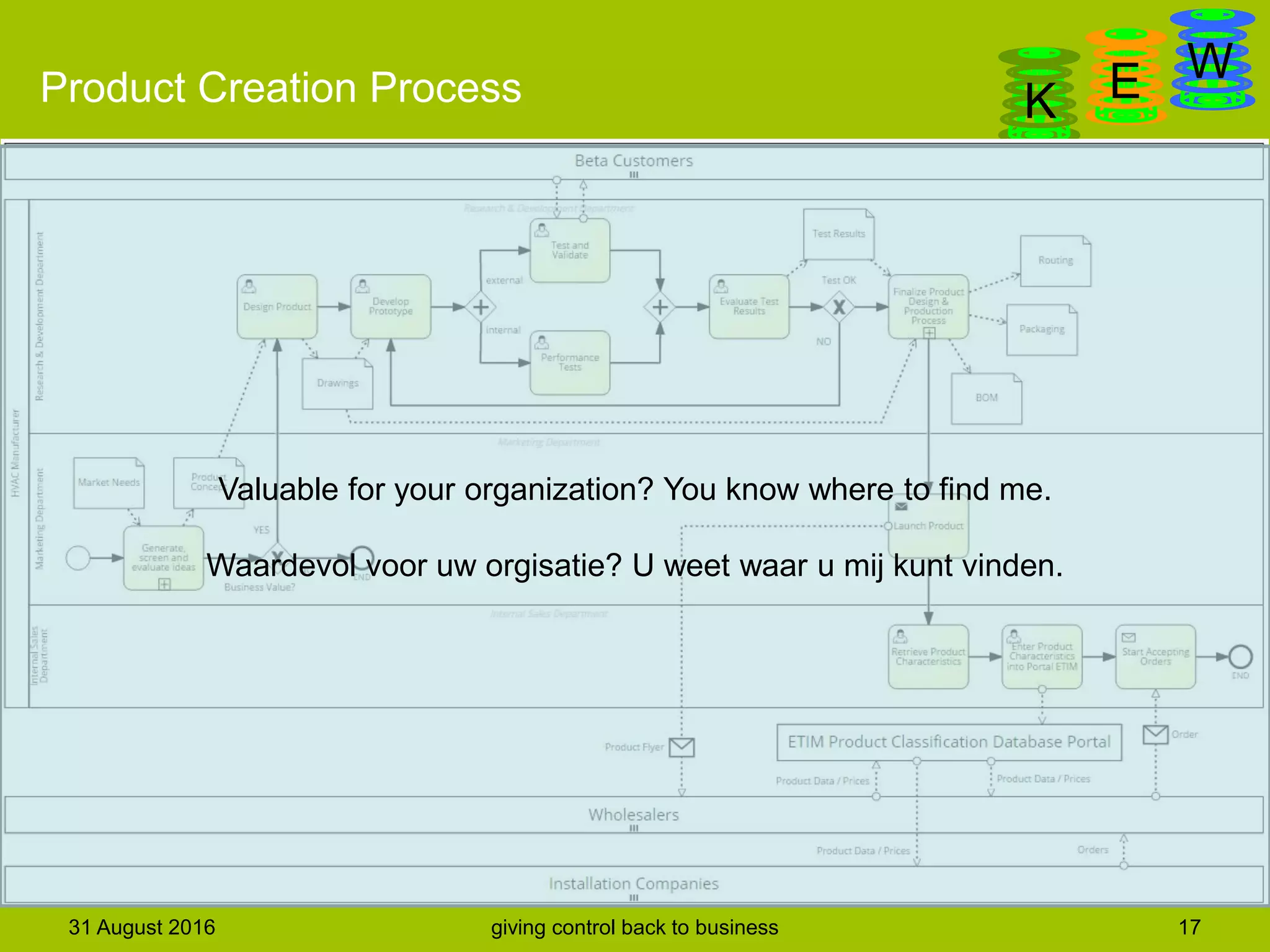
K E WETIM Product & Classification Database
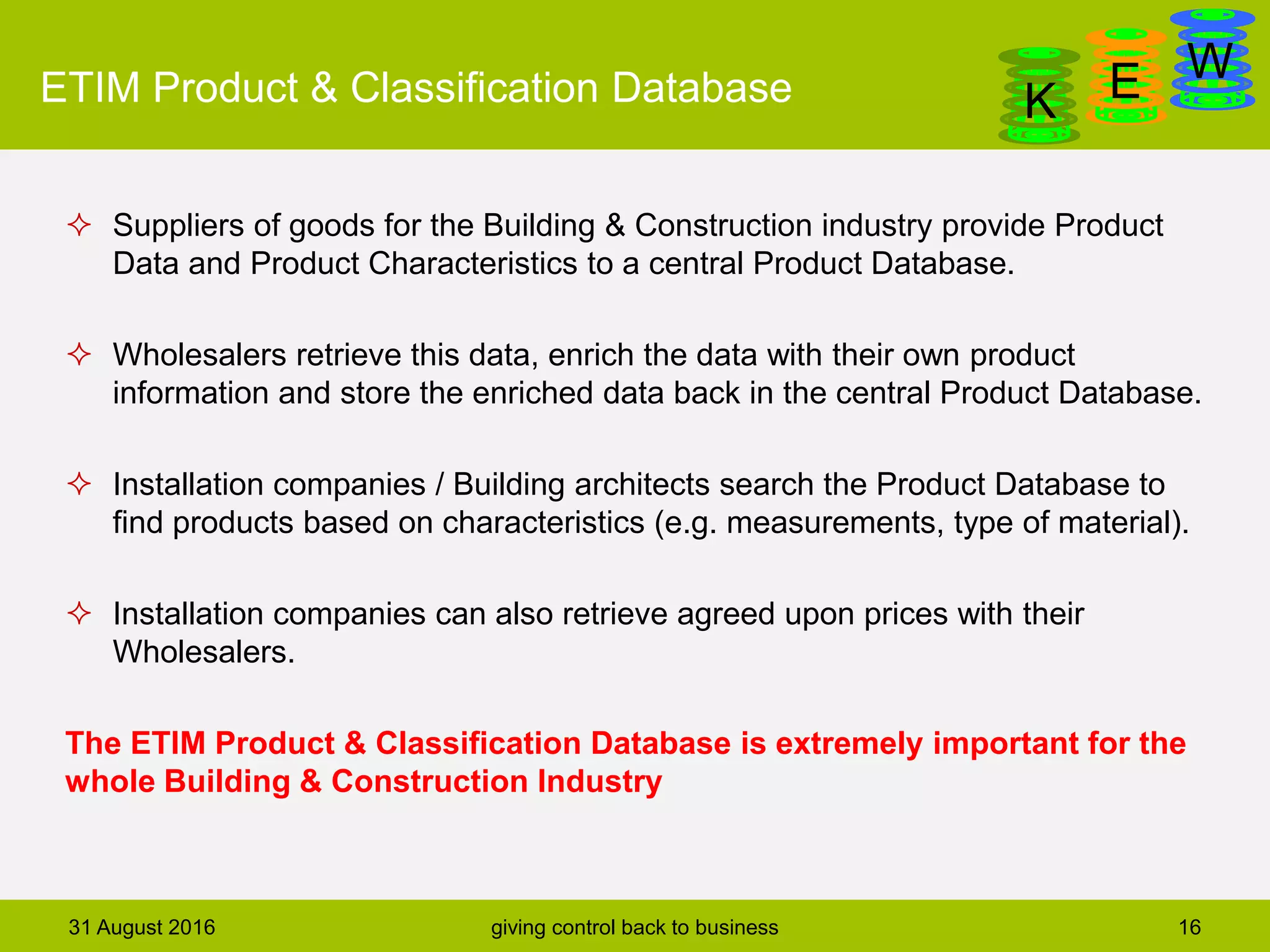
 Suppliers of goods for the Building & Construction industry provide Product
Data and Product Characteristics to a central Product Database.
 Wholesalers retrieve this data, enrich the data with their own product
information and store the enriched data back in the central Product Database.
 Installation companies / Building architects search the Product Database to
find products based on characteristics (e.g. measurements, type of material).
 Installation companies can also retrieve agreed upon prices with their
Wholesalers.
The ETIM Product & Classification Database is extremely important for the
whole Building & Construction Industry
31 August 2016 giving control back to business 16
DanGa
K E WProduct Creation Process
31 August 2016 giving control back to business 17
DanGa
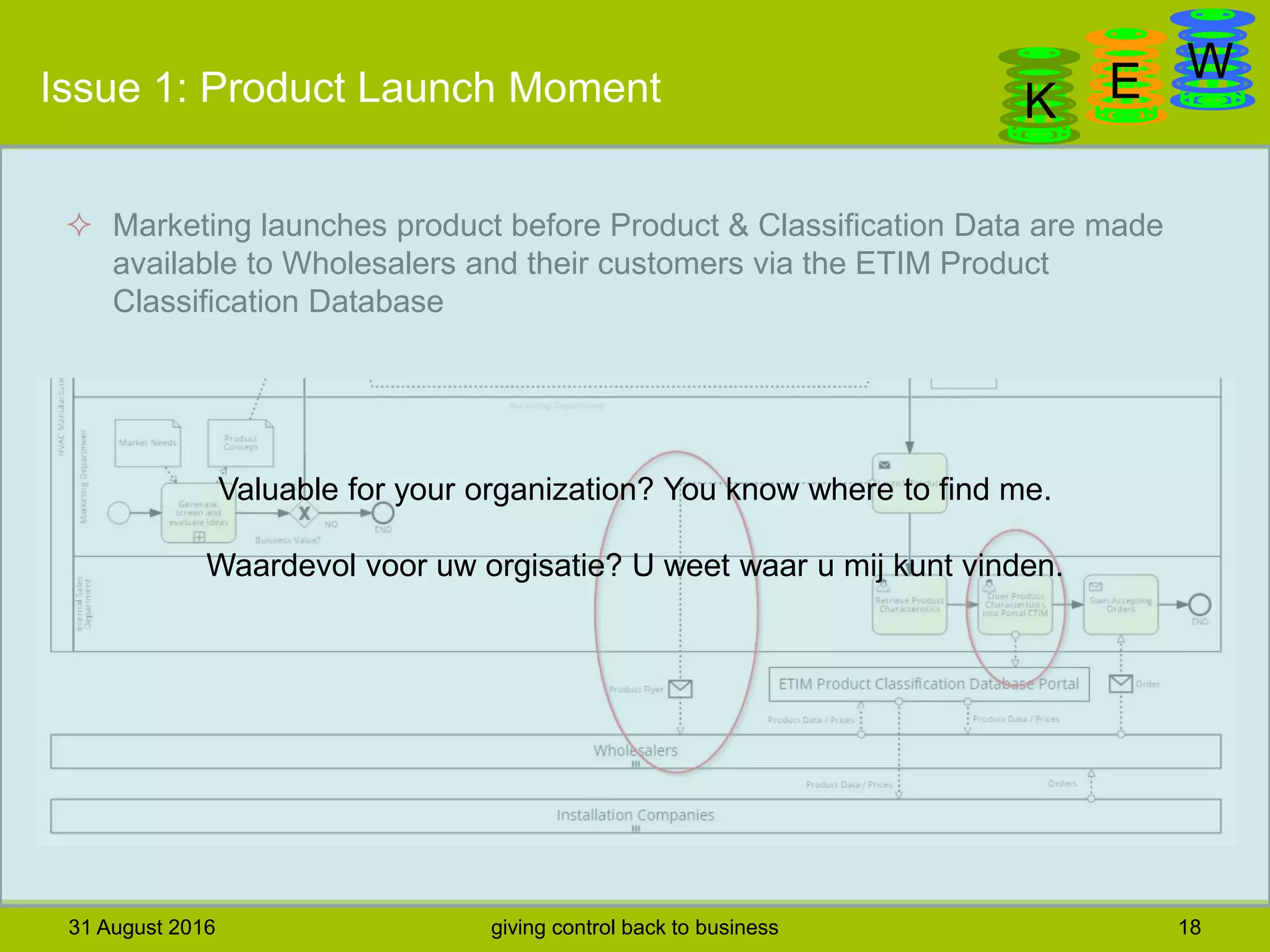
K E WIssue 1: Product Launch Moment
31 August 2016 giving control back to business 18
 Marketing launches product before Product & Classification Data are made
available to Wholesalers and their customers via the ETIM Product
Classification Database
DanGa
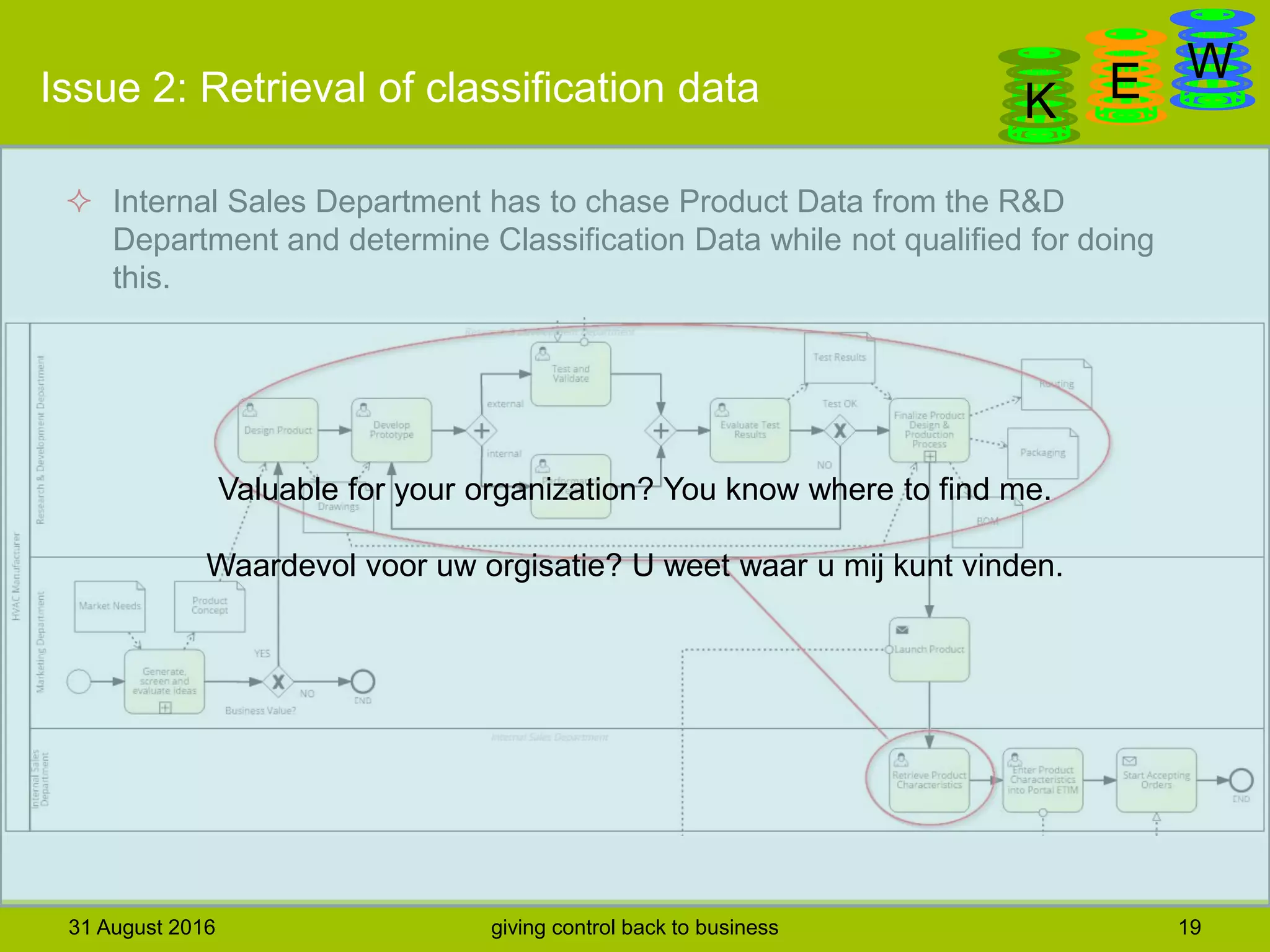
K E WIssue 2: Retrieval of classification data
31 August 2016 giving control back to business 19
 Internal Sales Department has to chase Product Data from the R&D
Department and determine Classification Data while not qualified for doing
this.
DanGa
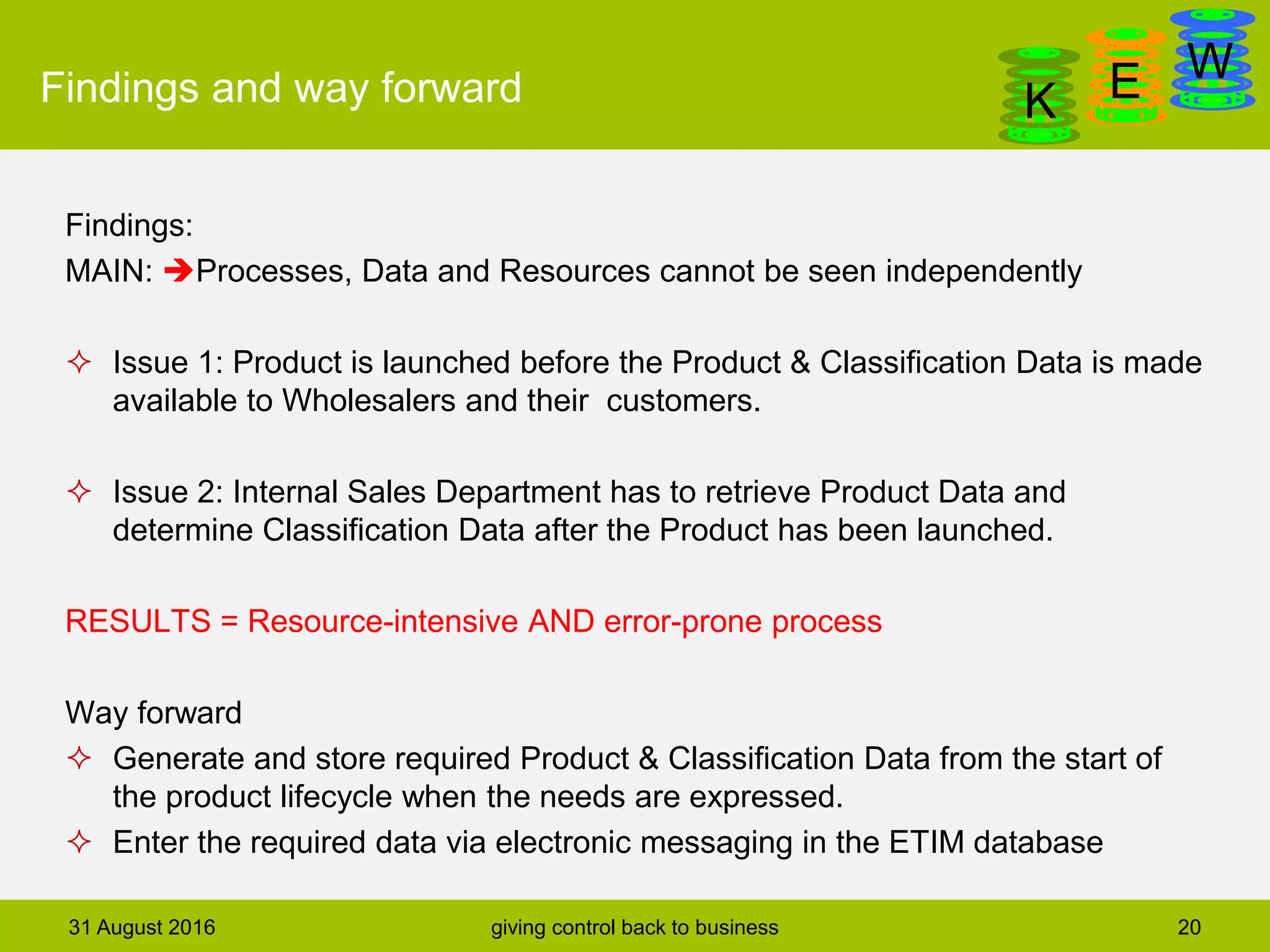
K E WFindings and way forward
Findings:
MAIN: Processes, Data and Resources cannot be seen independently
 Issue 1: Product is launched before the Product & Classification Data is made
available to Wholesalers and their customers.
 Issue 2: Internal Sales Department has to retrieve Product Data and
determine Classification Data after the Product has been launched.
RESULTS = Resource-intensive AND error-prone process
Way forward
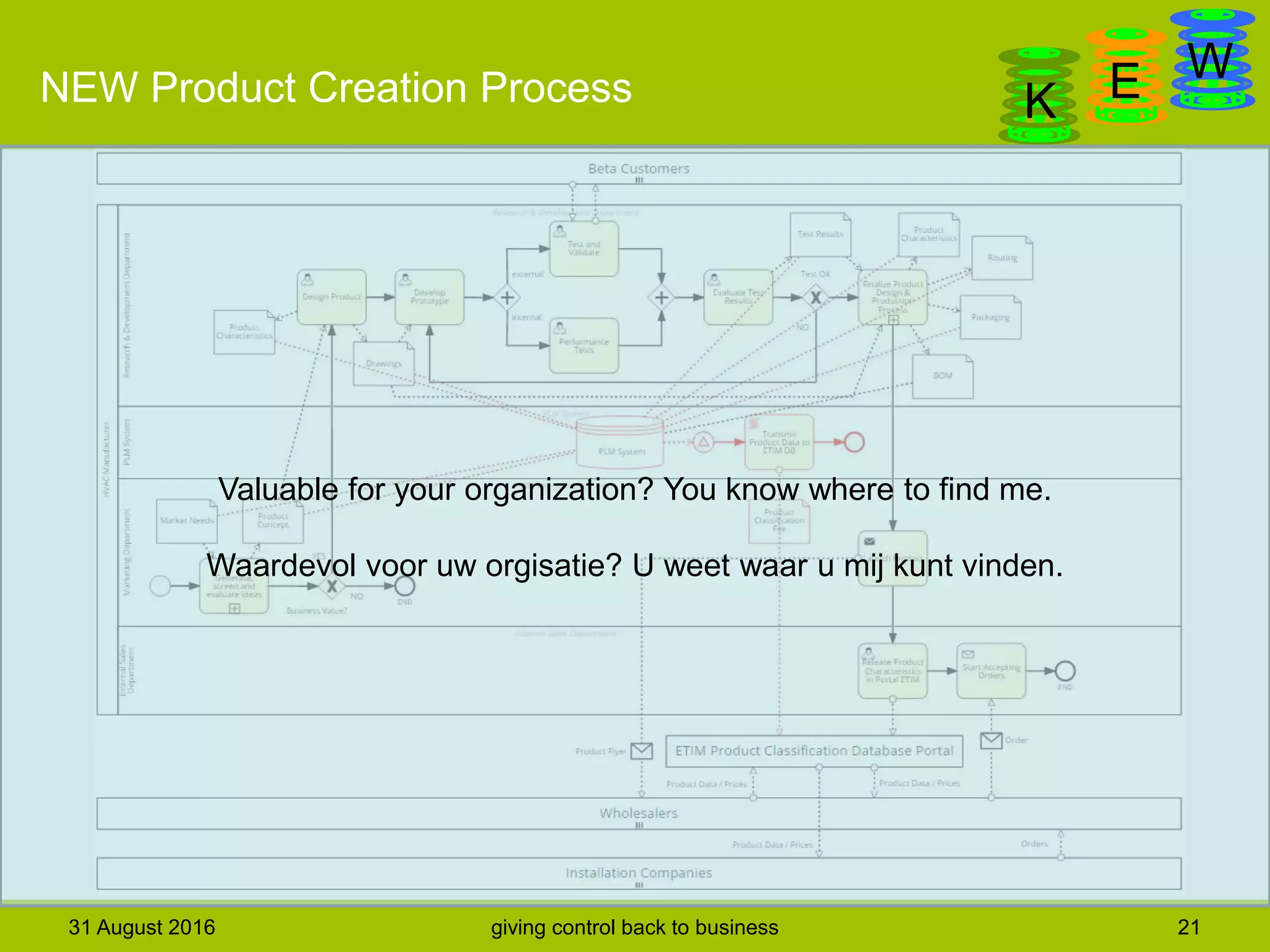
 Generate and store required Product & Classification Data from the start of
the product lifecycle when the needs are expressed.
 Enter the required data via electronic messaging in the ETIM database
31 August 2016 giving control back to business 20
DanGa
K E WNEW Product Creation Process
31 August 2016 giving control back to business 21
Valuable for your organization? You know where to find me.
Waardevol voor uw orgisatie? U weet waar u mij kunt vinden.
DanGa
K E WOutcome – savings
 Product Classification process is improved along the dimensions
 Efficiency =
 Cycle-time for gathering classification data is reduced significantly
 Data becomes faster available to Wholesalers and End-Customers
 Effectiveness = one version of the truth
 Impact of the classification process on the launch of products is reduced
 Quality of classified products is significantly improved
 Networking = improved collaboration with internally
 Product creation related data is instantly available for the whole organization
31 August 2016 giving control back to business 22
DanGa
K E WProcess Modeling and Automation
31 August 2016 giving control back to business 23
 Who am I ?
 BPM Lifecycle
 Example 1 – Ordering Process
 Example 2 – Product Classification Process
 Process Modeling & Documentation
 Automation
 Addendum
DanGa
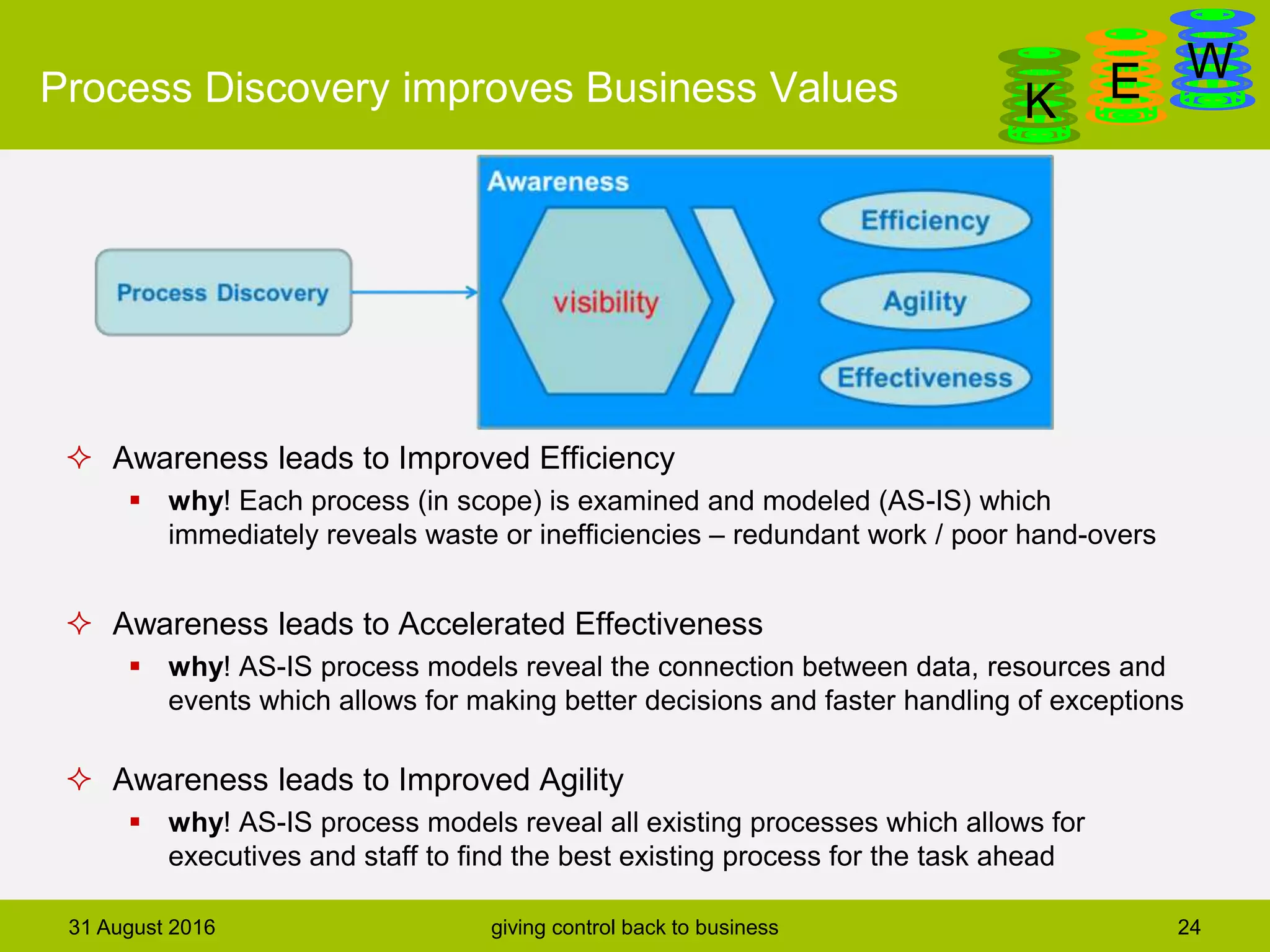
K E WProcess Discovery improves Business Values
31 August 2016 giving control back to business 24
 Awareness leads to Improved Efficiency
 why! Each process (in scope) is examined and modeled (AS-IS) which
immediately reveals waste or inefficiencies – redundant work / poor hand-overs
 Awareness leads to Accelerated Effectiveness
 why! AS-IS process models reveal the connection between data, resources and
events which allows for making better decisions and faster handling of exceptions
 Awareness leads to Improved Agility
 why! AS-IS process models reveal all existing processes which allows for
executives and staff to find the best existing process for the task ahead
DanGa
K E WProcess Analysis improves Business Values
31 August 2016 giving control back to business 25
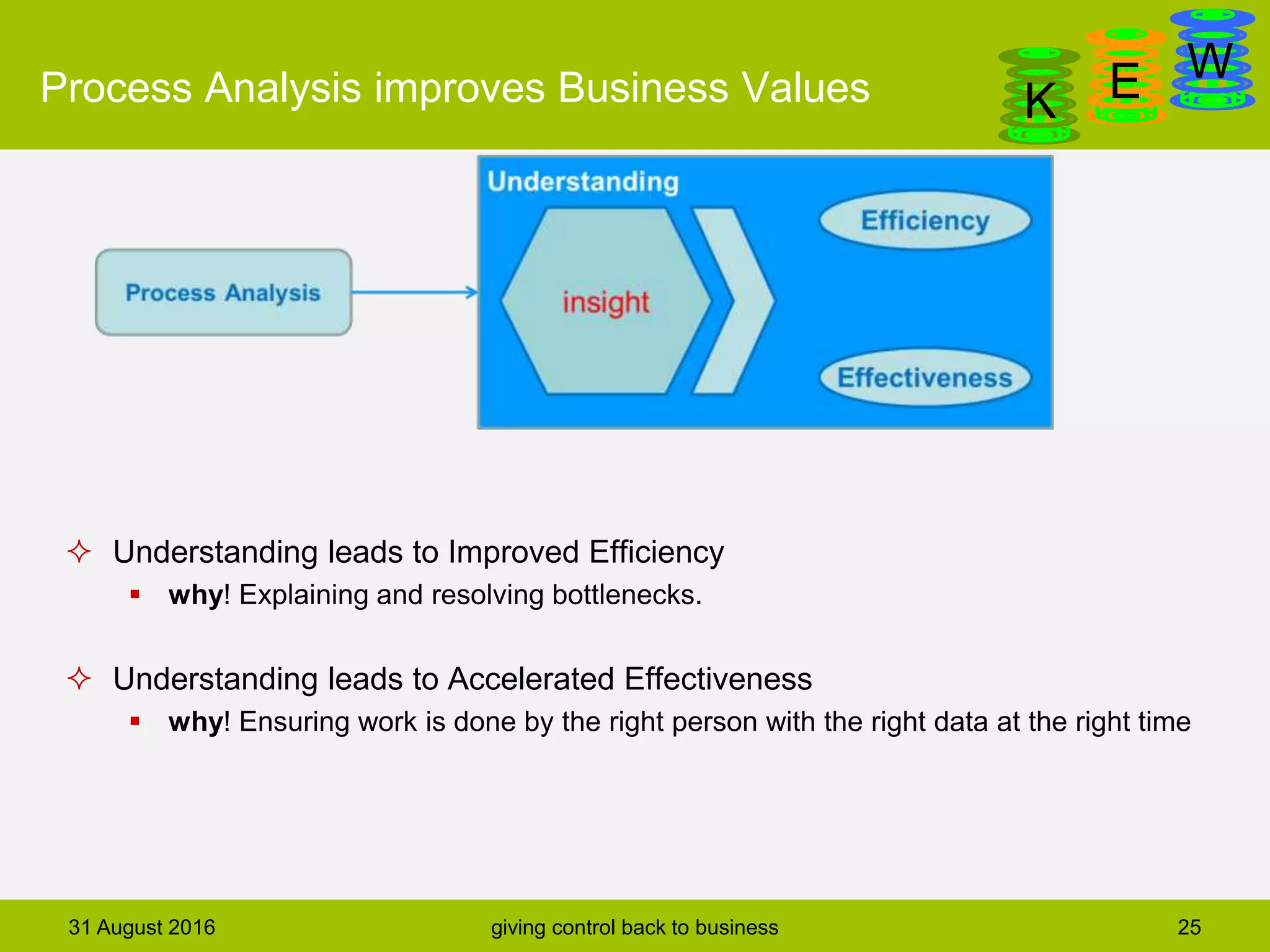
 Understanding leads to Improved Efficiency
 why! Explaining and resolving bottlenecks.
 Understanding leads to Accelerated Effectiveness
 why! Ensuring work is done by the right person with the right data at the right time
DanGa
K E WProcess Modeling and Automation
31 August 2016 giving control back to business 26
 Who am I ?
 BPM Lifecycle
 Example 1 – Ordering Process
 Example 2 – Product Classification Process
 Process Modeling & Documentation
 BPM Approach
 Addendum
DanGa
K E WBusiness Process Management Approach
31 August 2016 giving control back to business 27
DanGa
K E WDetermine Critical Outcomes
31 August 2016 giving control back to business 28
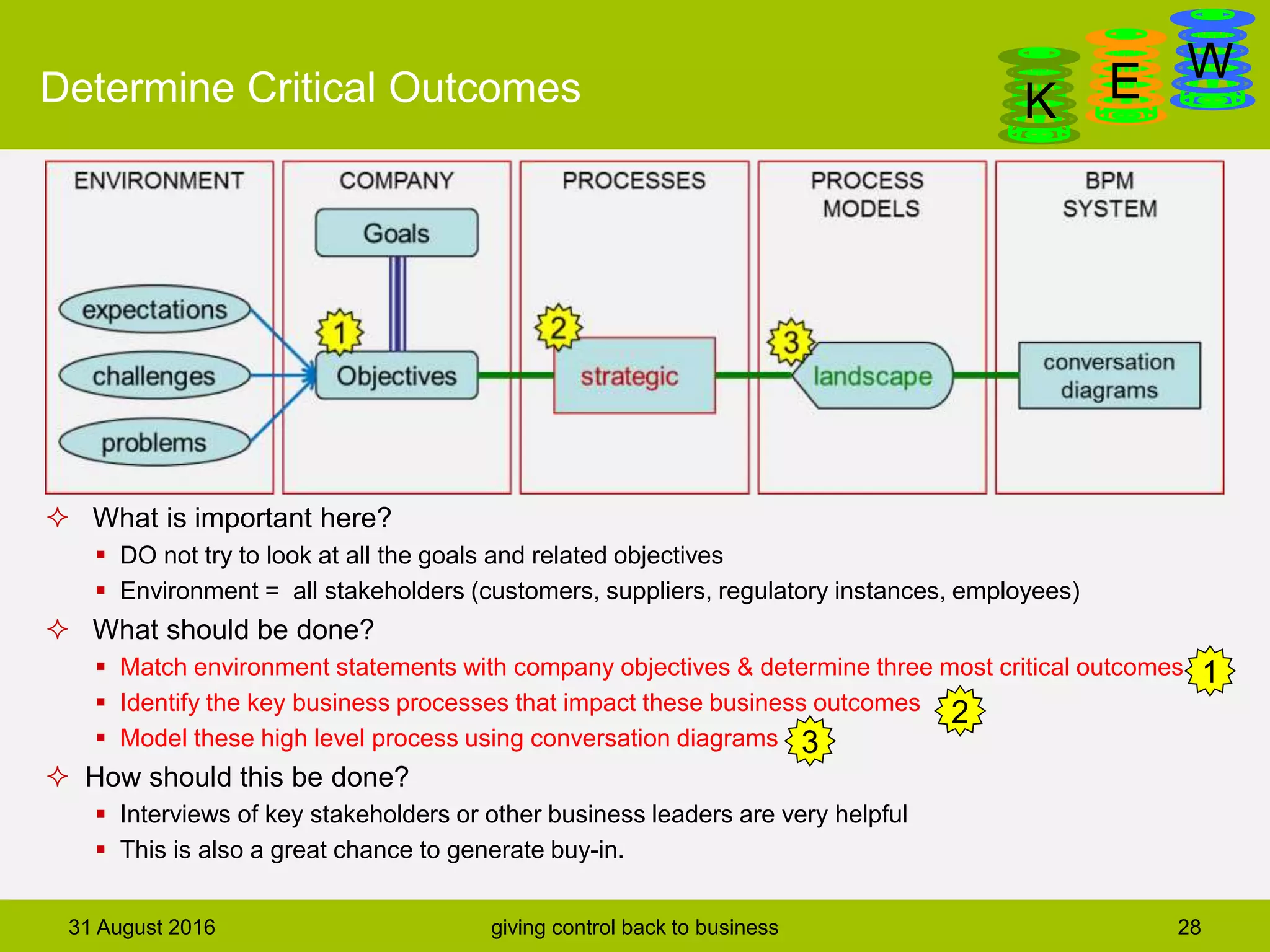
 What is important here?
 DO not try to look at all the goals and related objectives
 Environment = all stakeholders (customers, suppliers, regulatory instances, employees)
 What should be done?
 Match environment statements with company objectives & determine three most critical outcomes
 Identify the key business processes that impact these business outcomes
 Model these high level process using conversation diagrams
 How should this be done?
 Interviews of key stakeholders or other business leaders are very helpful
 This is also a great chance to generate buy-in.
1
2
3
DanGa
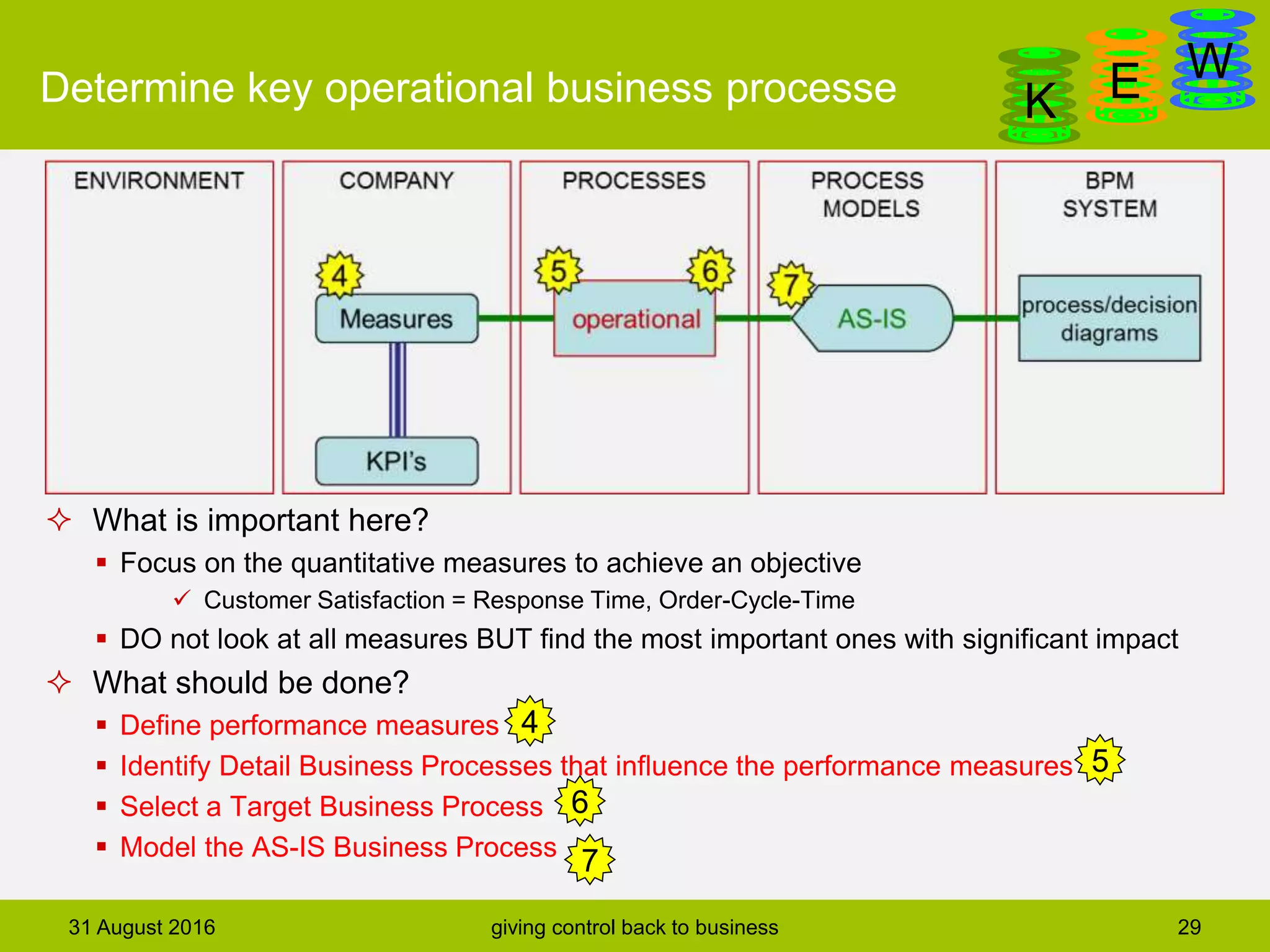
K E WDetermine key operational business processe
 What is important here?
 Focus on the quantitative measures to achieve an objective
 Customer Satisfaction = Response Time, Order-Cycle-Time
 DO not look at all measures BUT find the most important ones with significant impact
 What should be done?
 Define performance measures
 Identify Detail Business Processes that influence the performance measures
 Select a Target Business Process
 Model the AS-IS Business Process
31 August 2016 giving control back to business 29
4
5
7
6
DanGa
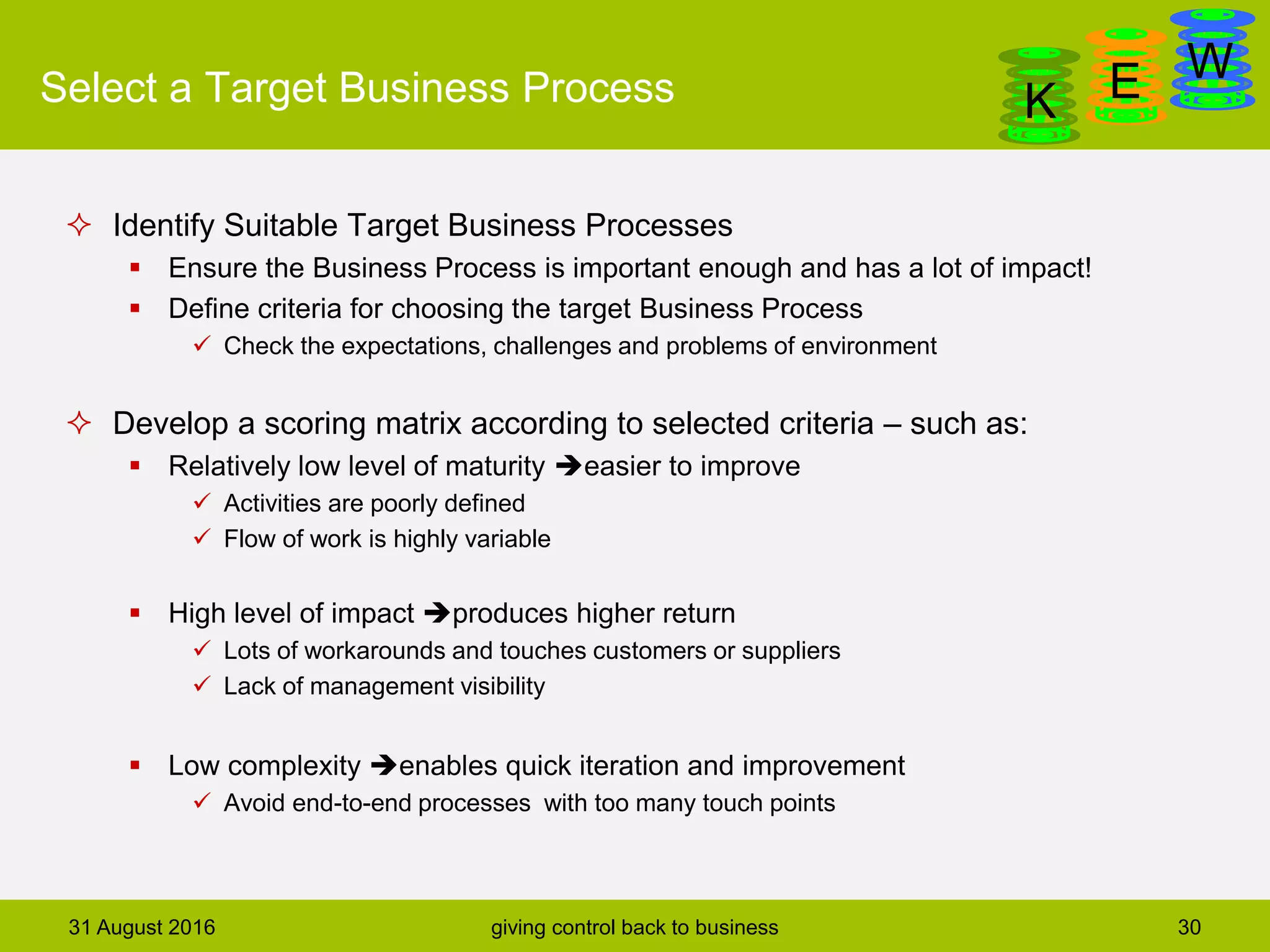
K E WSelect a Target Business Process
 Identify Suitable Target Business Processes
 Ensure the Business Process is important enough and has a lot of impact!
 Define criteria for choosing the target Business Process
 Check the expectations, challenges and problems of environment
 Develop a scoring matrix according to selected criteria – such as:
 Relatively low level of maturity easier to improve
 Activities are poorly defined
 Flow of work is highly variable
 High level of impact produces higher return
 Lots of workarounds and touches customers or suppliers
 Lack of management visibility
 Low complexity enables quick iteration and improvement
 Avoid end-to-end processes with too many touch points
31 August 2016 giving control back to business 30
DanGa
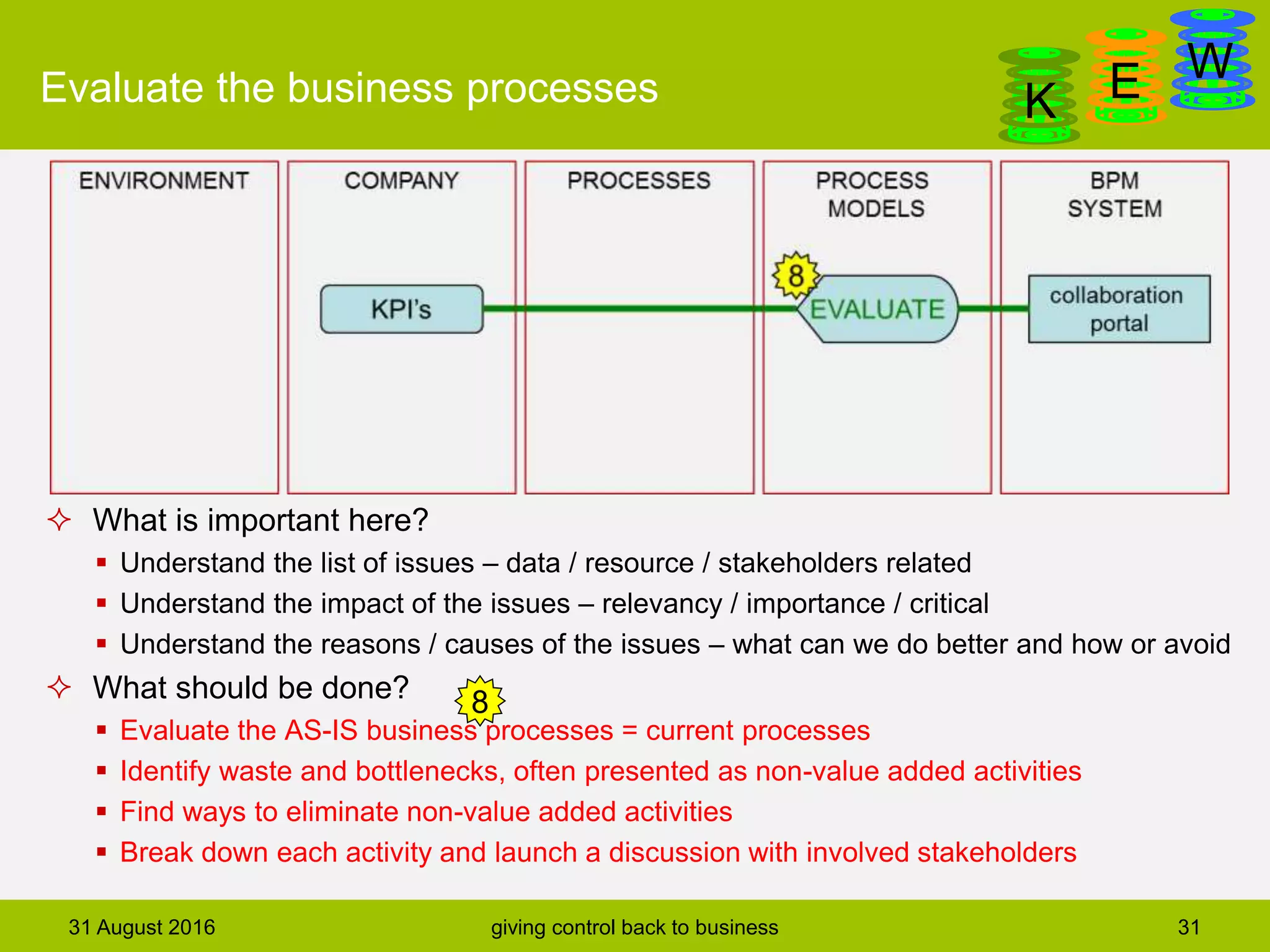
K E WEvaluate the business processes
31 August 2016 giving control back to business 31
 What is important here?
 Understand the list of issues – data / resource / stakeholders related
 Understand the impact of the issues – relevancy / importance / critical
 Understand the reasons / causes of the issues – what can we do better and how or avoid
 What should be done?
 Evaluate the AS-IS business processes = current processes
 Identify waste and bottlenecks, often presented as non-value added activities
 Find ways to eliminate non-value added activities
 Break down each activity and launch a discussion with involved stakeholders
8
DanGa
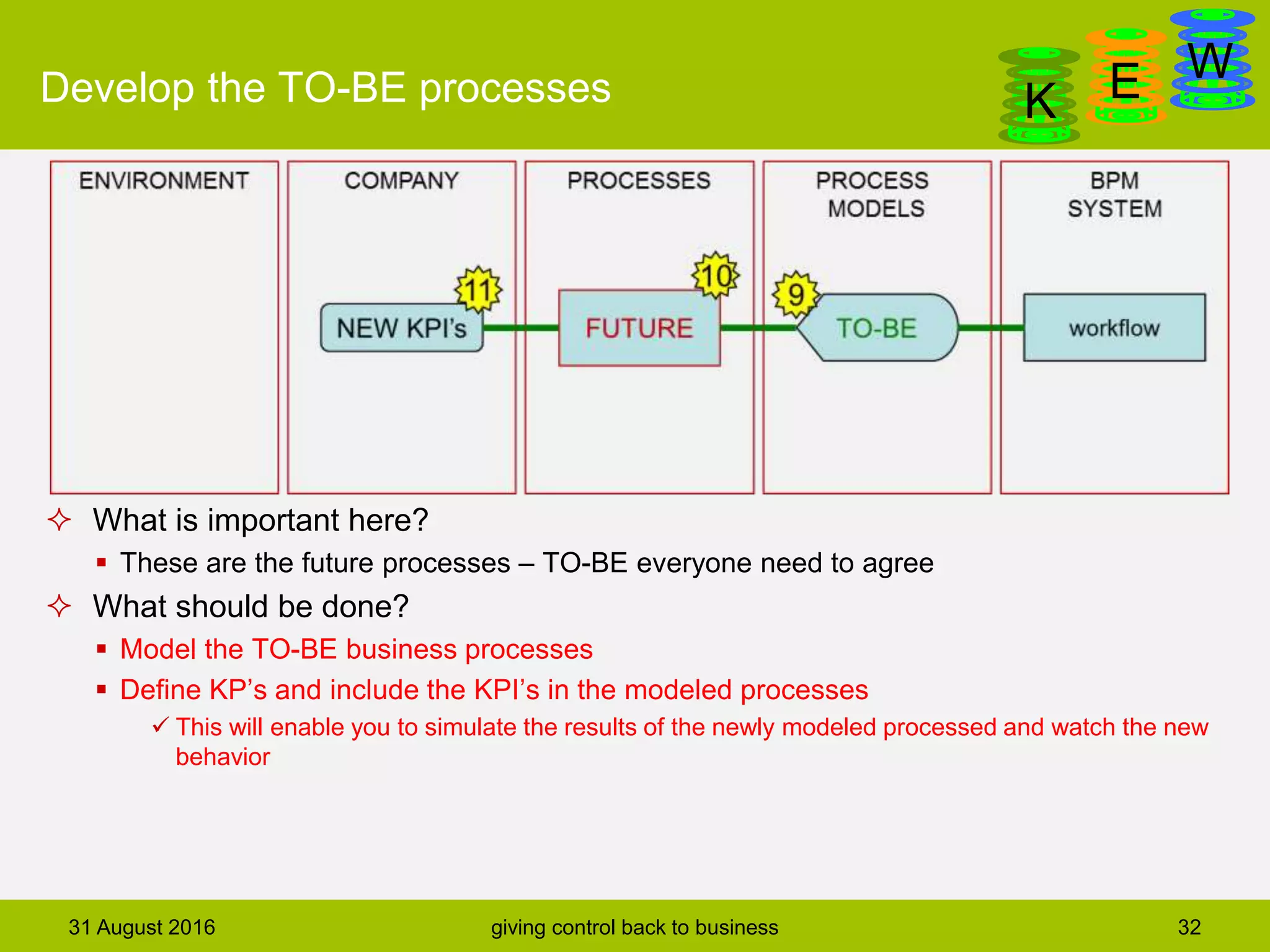
K E WDevelop the TO-BE processes
31 August 2016 giving control back to business 32
 What is important here?
 These are the future processes – TO-BE everyone need to agree
 What should be done?
 Model the TO-BE business processes
 Define KP’s and include the KPI’s in the modeled processes
 This will enable you to simulate the results of the newly modeled processed and watch the new
behavior
DanGa
K E WBusiness Process Management Approach
31 August 2016 giving control back to business 33
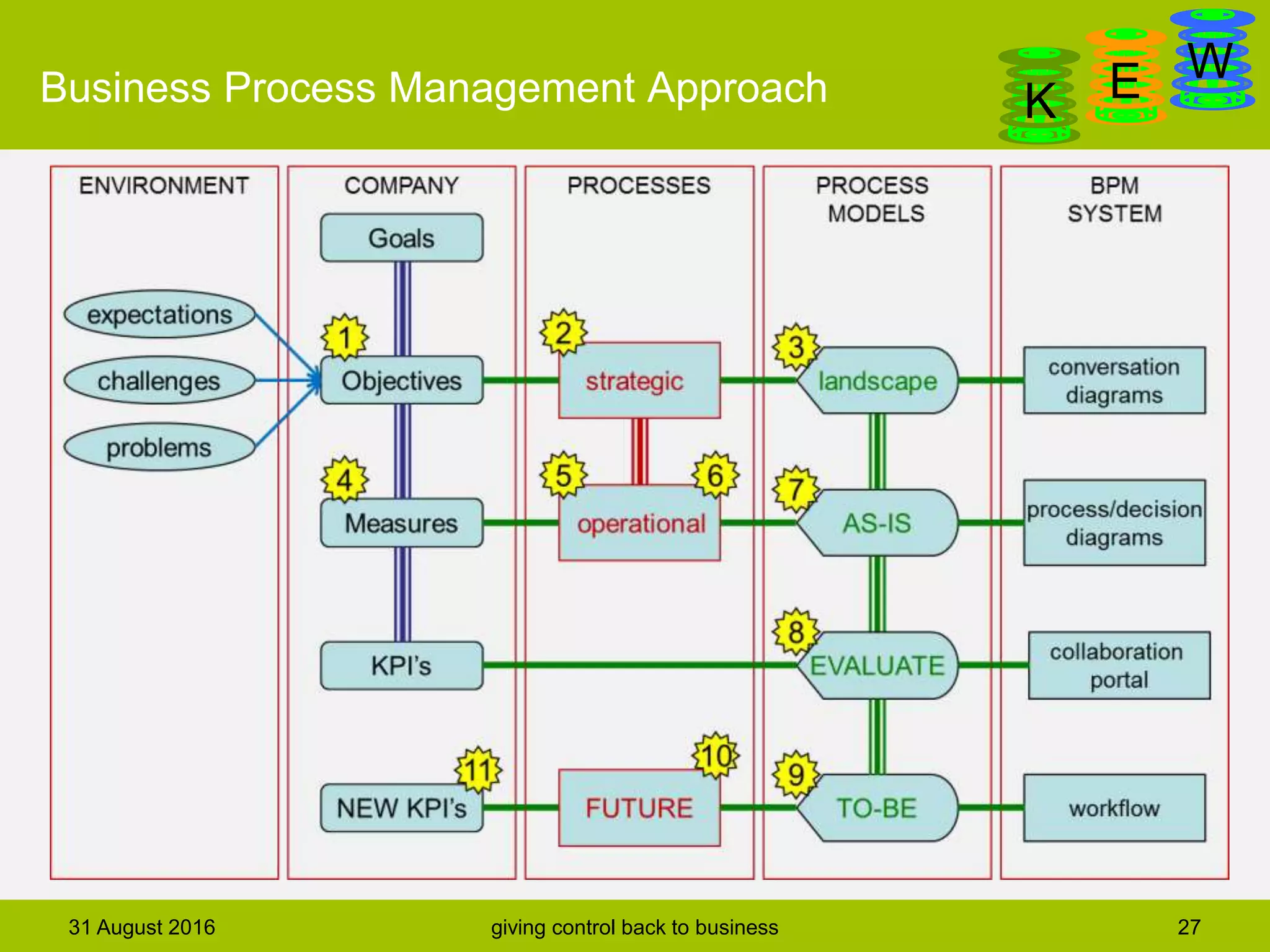
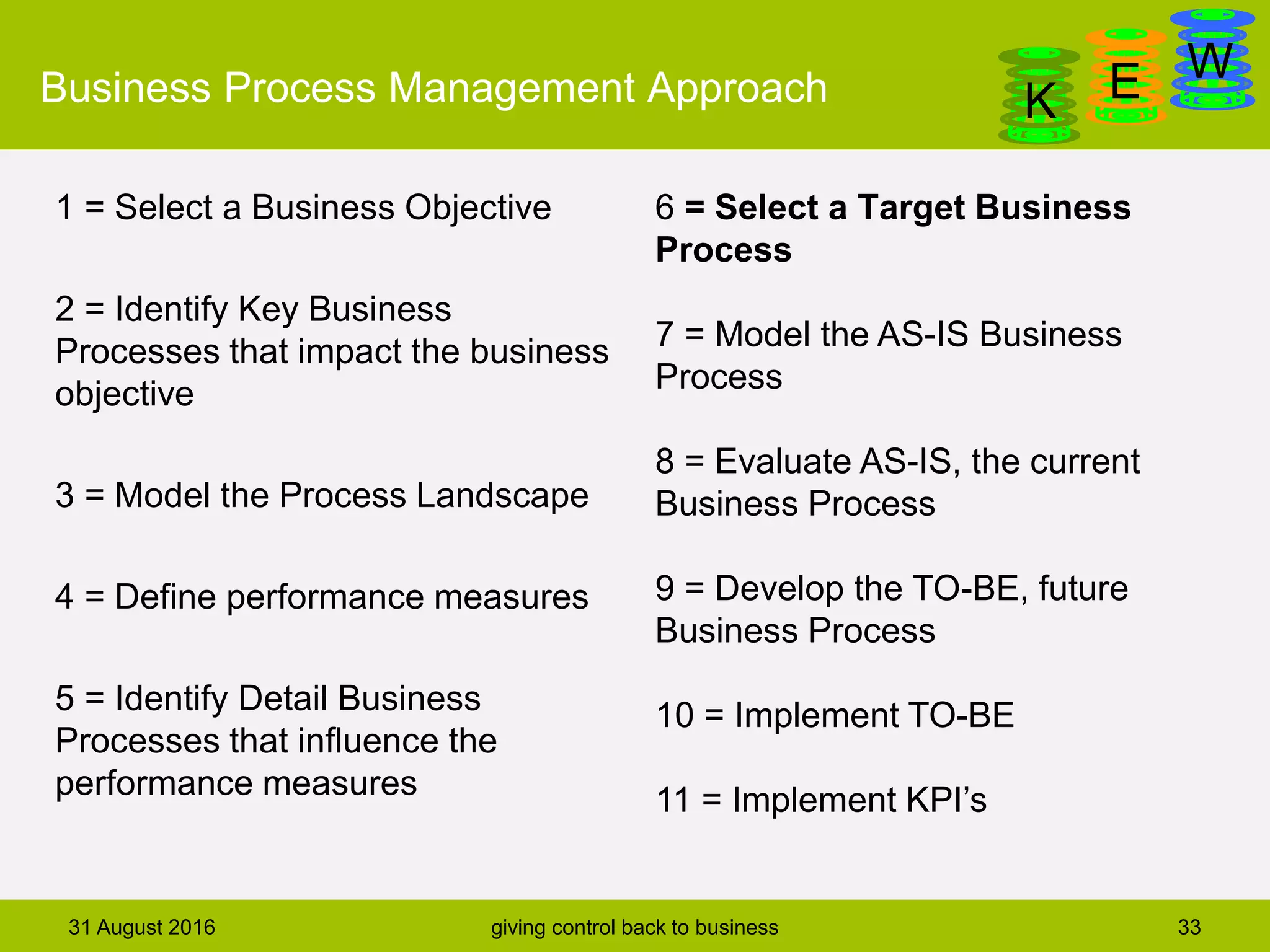
1 = Select a Business Objective
2 = Identify Key Business
Processes that impact the business
objective
3 = Model the Process Landscape
4 = Define performance measures
5 = Identify Detail Business
Processes that influence the
performance measures
6 = Select a Target Business
Process
7 = Model the AS-IS Business
Process
8 = Evaluate AS-IS, the current
Business Process
9 = Develop the TO-BE, future
Business Process
10 = Implement TO-BE
11 = Implement KPI’s
DanGa
K E WProcess Modeling and Automation
31 August 2016 giving control back to business 34
 Who am I ?
 BPM Lifecycle
 Example 1 – Ordering Process
 Example 2 – Product Classification Process
 Process Modeling & Documentation
 BPM Approach
 Addendum
For more information please contact:
Danny Gaethofs | Consultant / Adviseur
Business to Technologies
Email: Danny.Gaethofs@danga.biz
Mobile: +31(0)6 515 40 255
LinkedIn: www.linkedin.com/in/danga/ | XING: http://www.xing.com/profile/Danny_Gaethofs
Twitter: @DannyGaethofs | Weblog: www.danga.biz | SLIDESHARE: http://www.slideshare.net/danga/

Business Process Modeling and Automation - Food for Thoughts

  • 1.
    Business Process Modelingand Automation giving control back to business 13 September 2016
  • 2.
    DanGa K E WProcessModeling and Automation 31 August 2016 giving control back to business 2  Who am I ?  BPM Lifecycle  Example 1 – Ordering Process  Example 2 – Product Classification Process  Process Modeling & Documentation  Automation  Addendum
  • 3.
    DanGa K E WProcessModeling and Automation 31 August 2016 giving control back to business 3  Who am I ?  BPM Lifecycle  Example 1 – Ordering Process  Example 2 – Product Classification Process  Process Modeling & Documentation  Automation  Addendum
  • 4.
    DanGa K E WBPMLifecycle 31 August 2016 giving control back to business 4 Process identification Conformance and performance insights Conformance and performance insights Process monitoring and controlling Executable process model Executable process model Process implementation To-be process model To-be process model Process analysis As-is process model As-is process model Process discovery Process architectureProcess architecture Process redesign Insights on weaknesses and their impact Insights on weaknesses and their impact
  • 5.
    DanGa K E WBPMLifecycle  Identification  Architecture (management, core, support processes)  Portfolio (set of processes prioritized to a number of dimensions)  Discovery (interviews, desk- research, …)  AS-IS Models & Documentation  Control Flow, Physical or Information Objects, and Resources  Analysis (Process and data driven)  Gain insight and detect weaknesses  Discover opportunities and risks  Analysis techniques (root-cause, process simulation) 31 August 2016 giving control back to business 5  Redesign  TO-BE Models  Improve process models along dimensions cost, time, quality OR agility (flexibility) dimensions  Implementation  Organizational Change Management (re-organizing work, training people)  Process Automation  Monitoring and Controlling  Dashboards, reports and alerts  Process Mining
  • 6.
    DanGa K E WProcessModeling and Automation 31 August 2016 giving control back to business 6  Who am I ?  BPM Lifecycle  Example 1 – Ordering Process  Example 2 – Product Classification Process  Process Modeling & Documentation  Automation  Addendum
  • 7.
    DanGa K E WExample1: Processing of OEM Orders  Objective = Automate the processing of OEM purchase orders  Approach  Discovery and Modeling AS-IS situation from different perspectives  Interviews with all involved stakeholders (Sales, Planning, Production, Shipping and Billing departments - Customer Purchasing and IT organization)  Model Conversation Diagrams and Process Flows Diagrams  Analyze AS-IS situation and decide on way forward  Develop and Implement TO-Be situation  Evaluate Results after 6 months of operation 31 August 2016 giving control back to business 7
  • 8.
    DanGa K E WViewpointKey Account Manager 31 August 2016 giving control back to business 8 One customer with multiple plants in Europe One ordering process and order type
  • 9.
    DanGa K E WViewpointSales Department 31 August 2016 giving control back to business 9 Communication with OEM plants via eProcurement Portal Two types of orders:  Spare Part Orders  Long Term Contracts with Delivery Schedules (Call-Off)
  • 10.
    DanGa K E WViewpointOEM Ordering Process 31 August 2016 giving control back to business 10 Two Ordering Processes:  Long Term Contracts with Delivery Schedules (Call-Off) generated by MRP  Spare Part Ordering Process
  • 11.
    DanGa K E WFindingsand way forward Findings  OEM sends TWO structurally different TYPES of ORDERS  Spare Parts  normal purchase order  Production Parts  delivery schedule consists only of requested dates/weeks  The supplier handles both orders as normal sales orders  Translating the requested dates/weeks into order line items RESULTS = Resource-intensive AND error-prone process Way forward  Implement Scheduling Agreements at the Supplier  Implement Electronic Exchange of Purchase Orders and Delivery Schedules 31 August 2016 giving control back to business 11
  • 12.
    DanGa K E WNEWOrdering Process Scheduling Agreements 31 August 2016 giving control back to business 12  Delivery Schedules are entered manually or processed automatically
  • 13.
    DanGa K E WOutcome– Savings 31 August 2016 giving control back to business 13  Documented and Transparent Internal and External Processes  Ordering Processes are improved along the dimensions  Efficiency = cycle-time for processing orders is reduced  Effectiveness = impact of the internal ordering handling process is reduced  Networking = improved collaboration with partners  Savings: Several hours per week which can now be spent on value- adding actiivities  Increased Customer Satisfaction – error-free ordering process
  • 14.
    DanGa K E WProcessModeling and Automation 31 August 2016 giving control back to business 14  Who am I ?  BPM Lifecycle  Example 1 – Ordering Process  Example 2 – Product Classification Process  Process Modeling & Documentation  Automation  Addendum
  • 15.
    DanGa K E WExample2: Product Classification Process  Objective = Classifying technical products according ETIM model  Trigger = Low correctness of classified products  Actors = ETIM, R&D, Marketing, Customers, Sales  Approach  Discovery and Modeling AS-IS situation from different perspectives  Interviews with all involved stakeholders (Sales, Marketing, R&D, ETIM)  Model Conversation Diagrams and Process Flows Diagrams  Analyze AS-IS situation and decide on way forward  Develop and Implement TO-Be situation 31 August 2016 giving control back to business 15
  • 16.
    DanGa K E WETIMProduct & Classification Database  Suppliers of goods for the Building & Construction industry provide Product Data and Product Characteristics to a central Product Database.  Wholesalers retrieve this data, enrich the data with their own product information and store the enriched data back in the central Product Database.  Installation companies / Building architects search the Product Database to find products based on characteristics (e.g. measurements, type of material).  Installation companies can also retrieve agreed upon prices with their Wholesalers. The ETIM Product & Classification Database is extremely important for the whole Building & Construction Industry 31 August 2016 giving control back to business 16
  • 17.
    DanGa K E WProductCreation Process 31 August 2016 giving control back to business 17
  • 18.
    DanGa K E WIssue1: Product Launch Moment 31 August 2016 giving control back to business 18  Marketing launches product before Product & Classification Data are made available to Wholesalers and their customers via the ETIM Product Classification Database
  • 19.
    DanGa K E WIssue2: Retrieval of classification data 31 August 2016 giving control back to business 19  Internal Sales Department has to chase Product Data from the R&D Department and determine Classification Data while not qualified for doing this.
  • 20.
    DanGa K E WFindingsand way forward Findings: MAIN: Processes, Data and Resources cannot be seen independently  Issue 1: Product is launched before the Product & Classification Data is made available to Wholesalers and their customers.  Issue 2: Internal Sales Department has to retrieve Product Data and determine Classification Data after the Product has been launched. RESULTS = Resource-intensive AND error-prone process Way forward  Generate and store required Product & Classification Data from the start of the product lifecycle when the needs are expressed.  Enter the required data via electronic messaging in the ETIM database 31 August 2016 giving control back to business 20
  • 21.
    DanGa K E WNEWProduct Creation Process 31 August 2016 giving control back to business 21 Valuable for your organization? You know where to find me. Waardevol voor uw orgisatie? U weet waar u mij kunt vinden.
  • 22.
    DanGa K E WOutcome– savings  Product Classification process is improved along the dimensions  Efficiency =  Cycle-time for gathering classification data is reduced significantly  Data becomes faster available to Wholesalers and End-Customers  Effectiveness = one version of the truth  Impact of the classification process on the launch of products is reduced  Quality of classified products is significantly improved  Networking = improved collaboration with internally  Product creation related data is instantly available for the whole organization 31 August 2016 giving control back to business 22
  • 23.
    DanGa K E WProcessModeling and Automation 31 August 2016 giving control back to business 23  Who am I ?  BPM Lifecycle  Example 1 – Ordering Process  Example 2 – Product Classification Process  Process Modeling & Documentation  Automation  Addendum
  • 24.
    DanGa K E WProcessDiscovery improves Business Values 31 August 2016 giving control back to business 24  Awareness leads to Improved Efficiency  why! Each process (in scope) is examined and modeled (AS-IS) which immediately reveals waste or inefficiencies – redundant work / poor hand-overs  Awareness leads to Accelerated Effectiveness  why! AS-IS process models reveal the connection between data, resources and events which allows for making better decisions and faster handling of exceptions  Awareness leads to Improved Agility  why! AS-IS process models reveal all existing processes which allows for executives and staff to find the best existing process for the task ahead
  • 25.
    DanGa K E WProcessAnalysis improves Business Values 31 August 2016 giving control back to business 25  Understanding leads to Improved Efficiency  why! Explaining and resolving bottlenecks.  Understanding leads to Accelerated Effectiveness  why! Ensuring work is done by the right person with the right data at the right time
  • 26.
    DanGa K E WProcessModeling and Automation 31 August 2016 giving control back to business 26  Who am I ?  BPM Lifecycle  Example 1 – Ordering Process  Example 2 – Product Classification Process  Process Modeling & Documentation  BPM Approach  Addendum
  • 27.
    DanGa K E WBusinessProcess Management Approach 31 August 2016 giving control back to business 27
  • 28.
    DanGa K E WDetermineCritical Outcomes 31 August 2016 giving control back to business 28  What is important here?  DO not try to look at all the goals and related objectives  Environment = all stakeholders (customers, suppliers, regulatory instances, employees)  What should be done?  Match environment statements with company objectives & determine three most critical outcomes  Identify the key business processes that impact these business outcomes  Model these high level process using conversation diagrams  How should this be done?  Interviews of key stakeholders or other business leaders are very helpful  This is also a great chance to generate buy-in. 1 2 3
  • 29.
    DanGa K E WDeterminekey operational business processe  What is important here?  Focus on the quantitative measures to achieve an objective  Customer Satisfaction = Response Time, Order-Cycle-Time  DO not look at all measures BUT find the most important ones with significant impact  What should be done?  Define performance measures  Identify Detail Business Processes that influence the performance measures  Select a Target Business Process  Model the AS-IS Business Process 31 August 2016 giving control back to business 29 4 5 7 6
  • 30.
    DanGa K E WSelecta Target Business Process  Identify Suitable Target Business Processes  Ensure the Business Process is important enough and has a lot of impact!  Define criteria for choosing the target Business Process  Check the expectations, challenges and problems of environment  Develop a scoring matrix according to selected criteria – such as:  Relatively low level of maturity easier to improve  Activities are poorly defined  Flow of work is highly variable  High level of impact produces higher return  Lots of workarounds and touches customers or suppliers  Lack of management visibility  Low complexity enables quick iteration and improvement  Avoid end-to-end processes with too many touch points 31 August 2016 giving control back to business 30
  • 31.
    DanGa K E WEvaluatethe business processes 31 August 2016 giving control back to business 31  What is important here?  Understand the list of issues – data / resource / stakeholders related  Understand the impact of the issues – relevancy / importance / critical  Understand the reasons / causes of the issues – what can we do better and how or avoid  What should be done?  Evaluate the AS-IS business processes = current processes  Identify waste and bottlenecks, often presented as non-value added activities  Find ways to eliminate non-value added activities  Break down each activity and launch a discussion with involved stakeholders 8
  • 32.
    DanGa K E WDevelopthe TO-BE processes 31 August 2016 giving control back to business 32  What is important here?  These are the future processes – TO-BE everyone need to agree  What should be done?  Model the TO-BE business processes  Define KP’s and include the KPI’s in the modeled processes  This will enable you to simulate the results of the newly modeled processed and watch the new behavior
  • 33.
    DanGa K E WBusinessProcess Management Approach 31 August 2016 giving control back to business 33 1 = Select a Business Objective 2 = Identify Key Business Processes that impact the business objective 3 = Model the Process Landscape 4 = Define performance measures 5 = Identify Detail Business Processes that influence the performance measures 6 = Select a Target Business Process 7 = Model the AS-IS Business Process 8 = Evaluate AS-IS, the current Business Process 9 = Develop the TO-BE, future Business Process 10 = Implement TO-BE 11 = Implement KPI’s
  • 34.
    DanGa K E WProcessModeling and Automation 31 August 2016 giving control back to business 34  Who am I ?  BPM Lifecycle  Example 1 – Ordering Process  Example 2 – Product Classification Process  Process Modeling & Documentation  BPM Approach  Addendum
  • 35.
    For more informationplease contact: Danny Gaethofs | Consultant / Adviseur Business to Technologies Email: Danny.Gaethofs@danga.biz Mobile: +31(0)6 515 40 255 LinkedIn: www.linkedin.com/in/danga/ | XING: http://www.xing.com/profile/Danny_Gaethofs Twitter: @DannyGaethofs | Weblog: www.danga.biz | SLIDESHARE: http://www.slideshare.net/danga/