MODULE 1
•   The place where industrial buyer
    come into direct contact industrial
    seller.
•   Industrial Marketing/ B2B
    Marketing/Organizational
    Marketing
• Marketing of Products, services and
 solutions to organizations.
• Unique needs of industrial
 customers.
• Relatively few buyers and Derived
 demand.
• Products used for production of
 other consumption related
 products.
Business customers are also known as industrial
customers, purchase products or services to use in the
production of other products.

Classification of industrial customers
• Commercial enterprises
• Government customers
• Institutional customers
• Cooperatives societies
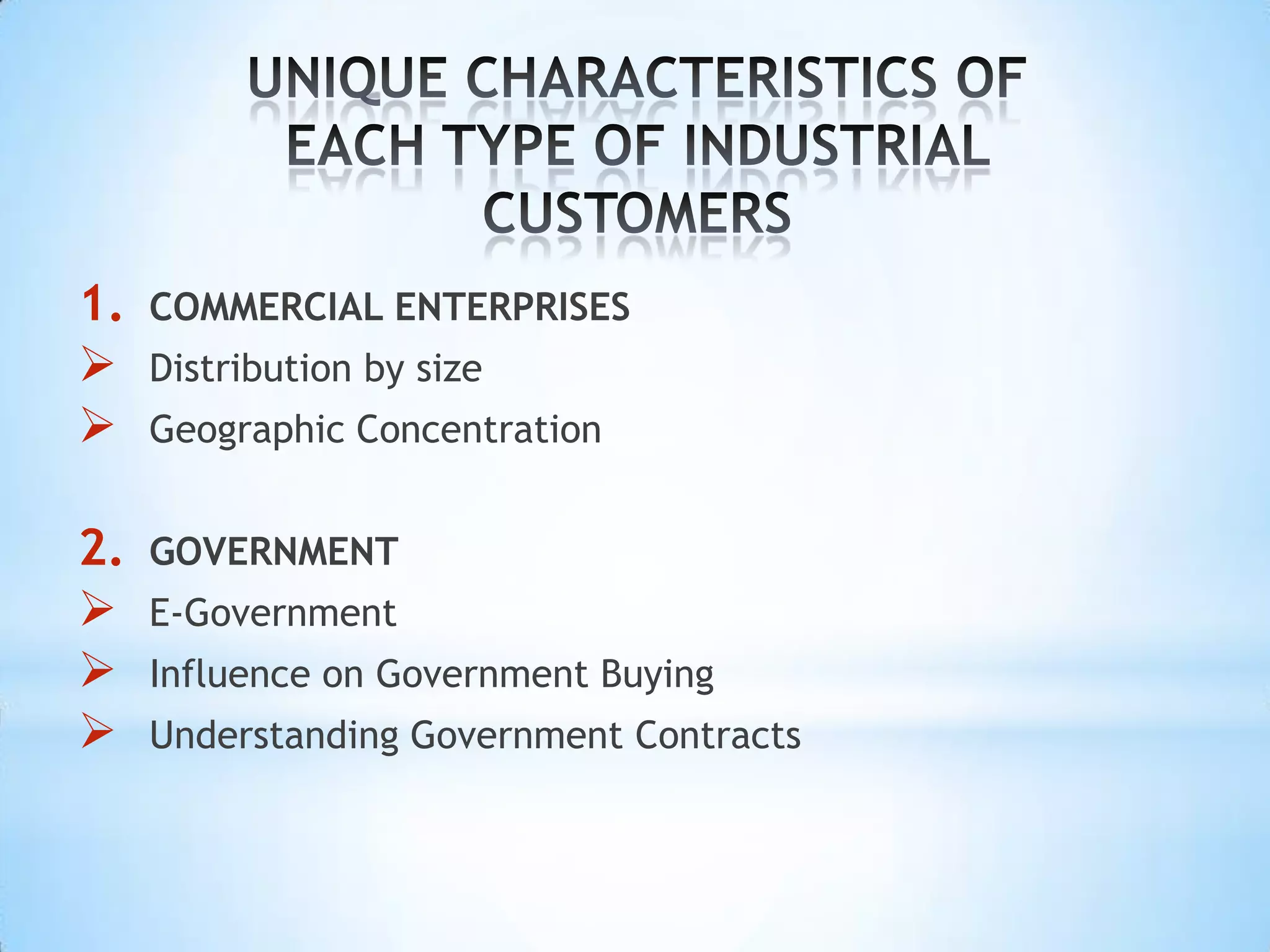
1.   COMMERCIAL ENTERPRISES
    Distribution by size
    Geographic Concentration


2.   GOVERNMENT
    E-Government
    Influence on Government Buying
    Understanding Government Contracts
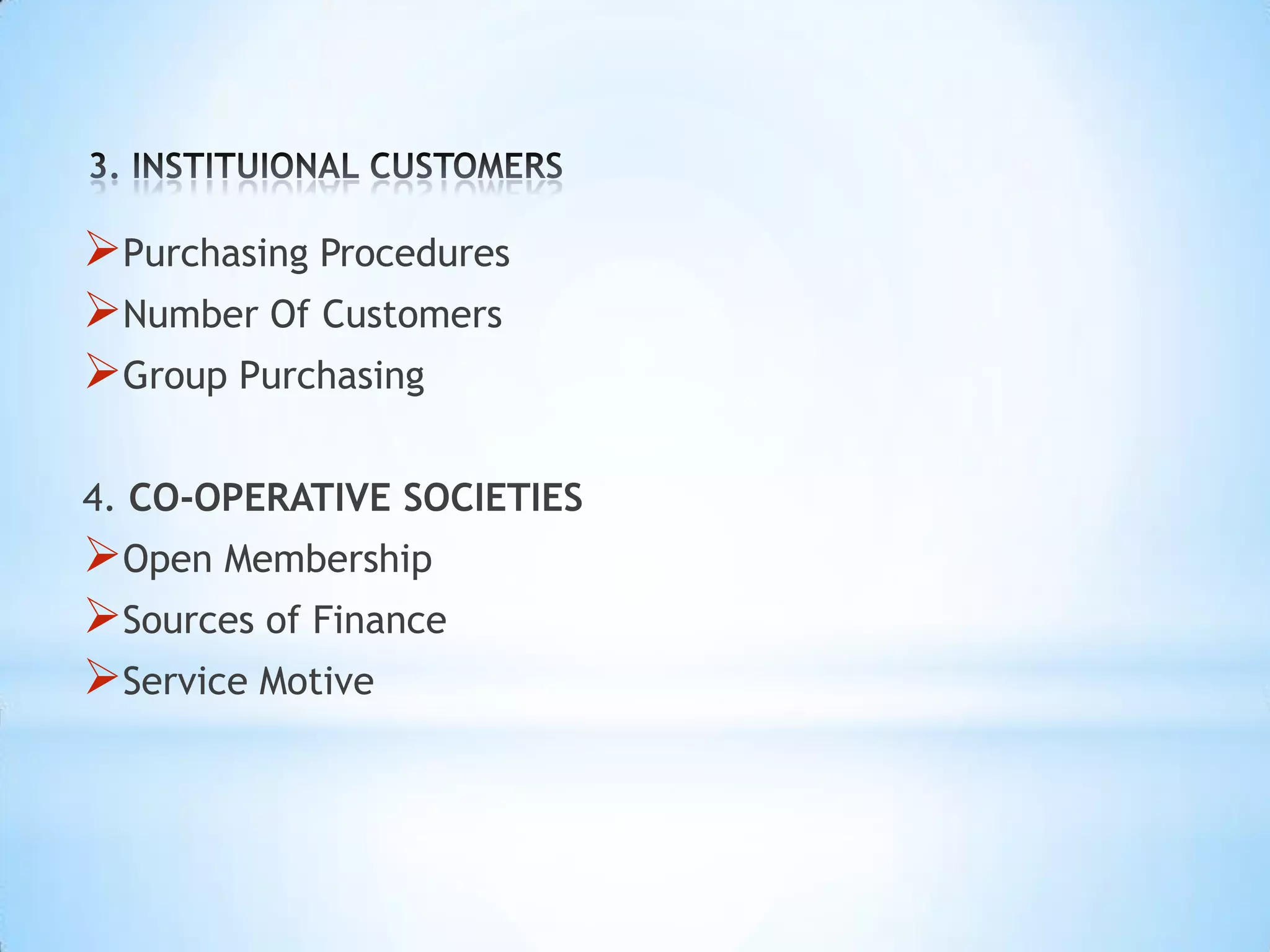
Purchasing Procedures
Number Of Customers
Group Purchasing

4. CO-OPERATIVE SOCIETIES
Open Membership
Sources of Finance
Service Motive
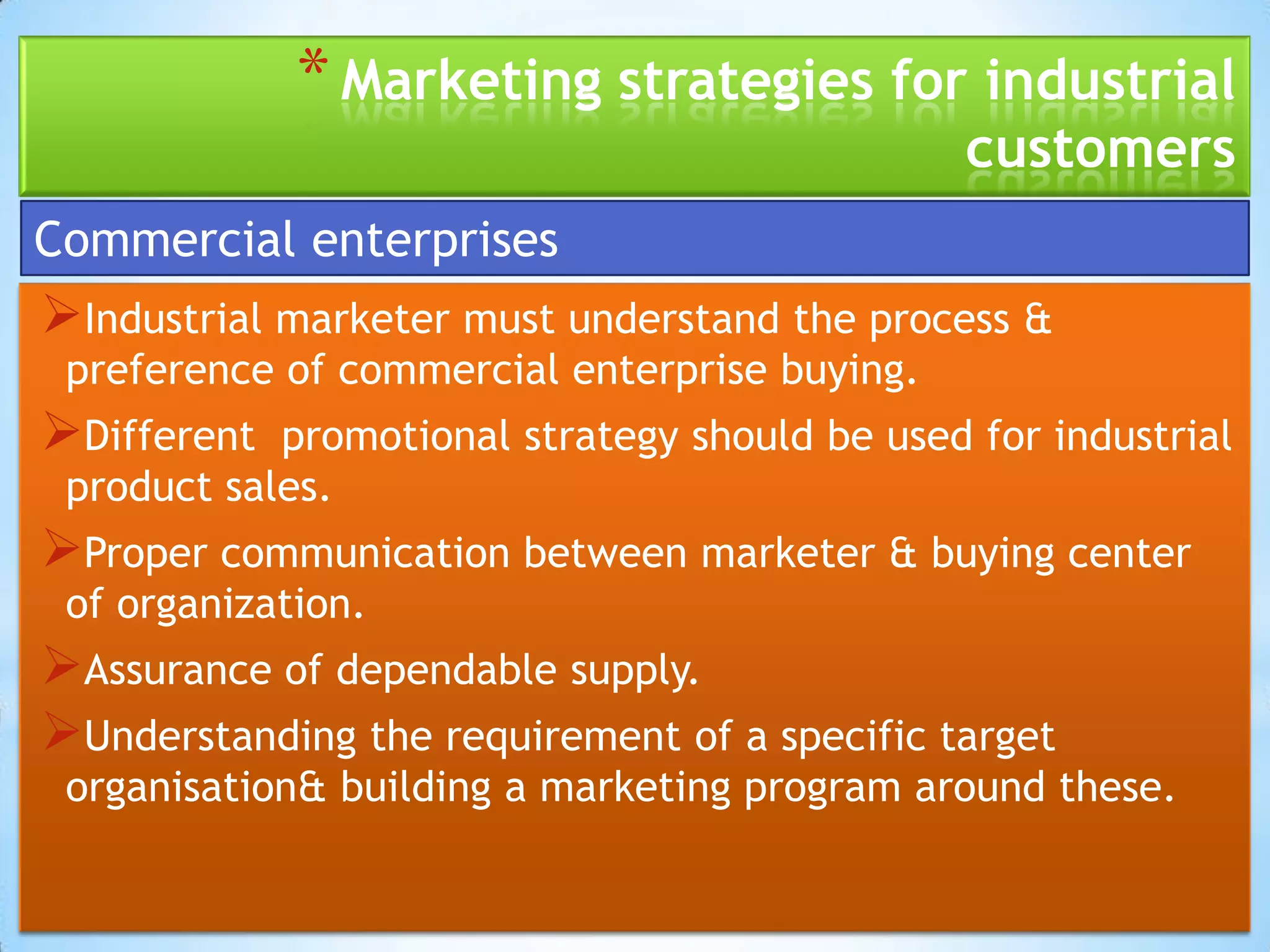
* Marketing strategies for industrial
                                                customers
Commercial enterprises
Industrial marketer must understand the process &
 preference of commercial enterprise buying.
Different  promotional strategy should be used for industrial
 product sales.
Proper communication between marketer & buying center
 of organization.
Assurance of dependable supply.
Understanding the requirement of a specific target
 organisation& building a marketing program around these.
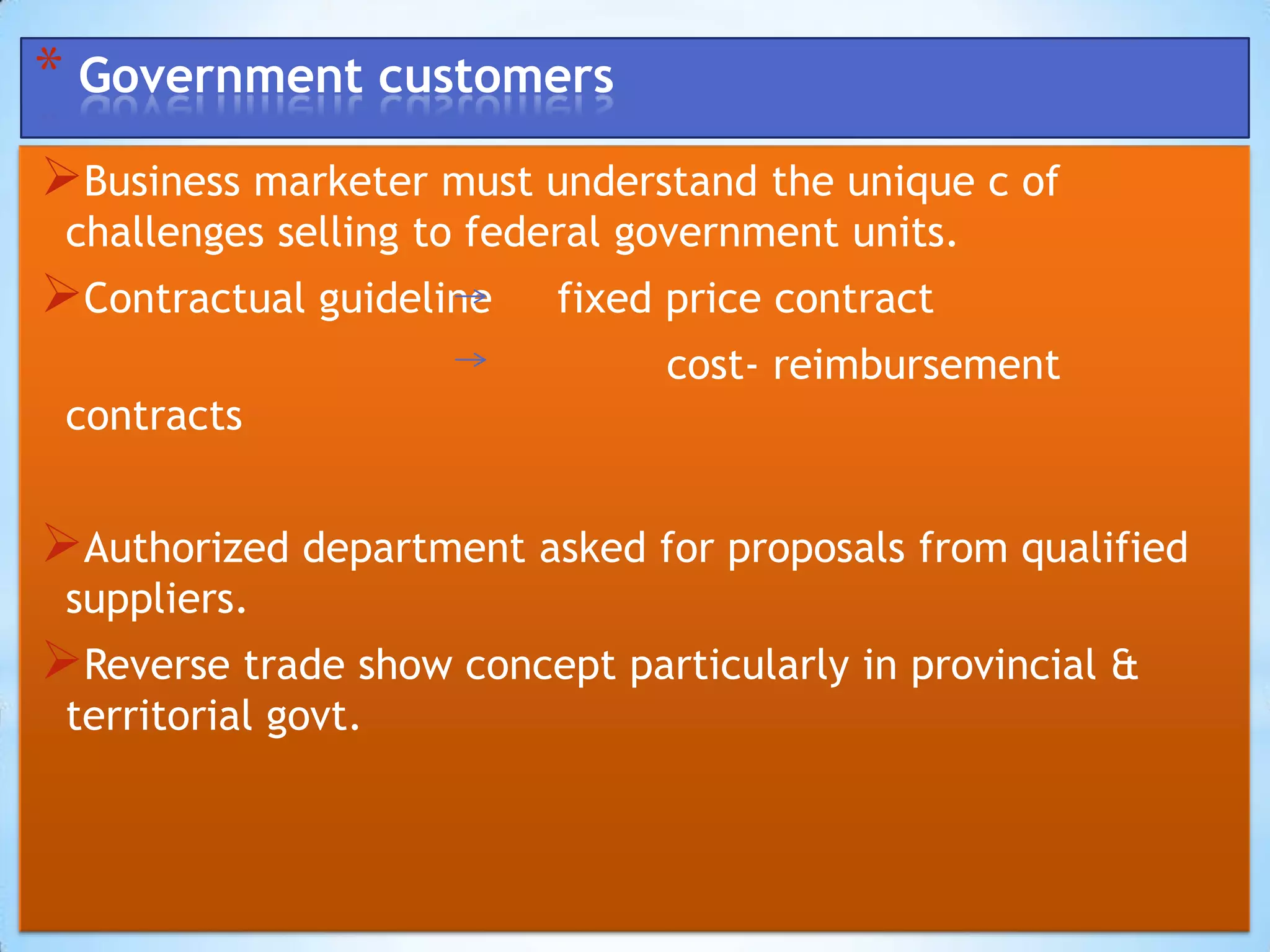
* Government customers
Business marketer must understand the unique c of
 challenges selling to federal government units.
Contractual guideline    fixed price contract
                                cost- reimbursement
 contracts


Authorized department asked for proposals from qualified
 suppliers.
Reverse trade show concept particularly in provincial &
 territorial govt.
* Institutional customer
Business marketer must carefully evaluate the budgeting
 status of institutional customers.
Salesperson must carefully analyze both professional staff &
 purchasing department.
Group purchasing for quantity discount.
Discount &effective distribution function play important
 roles in obtaining & keeping institutions as customers.
Classification of
       industrial products
Capital equipment and investment
Manufactured materials and component parts
MRO supplies ( maintenance, repair, operating)
Process materials
Raw materials
Business services
Overlapping of categories
B2B MARKETING
                  IS
 MARKETING OF GOODS AND SERVICES TO :
 ◦   Companies
 ◦   Government Bodies
 ◦   Institutions (i.e. hospitals)
 ◦   Non-Profit Organizations (i.e. American Red
     Cross)
                    FOR
 USE IN PRODUCING THEIR PRODUCTS
  AND/OR TO FACILITATE THEIR OPERATIONS
 Business that sells products or provides
services to other businesses.
 goods or services are sold for any use
other than personal consumption
 sale of their products or services to other
companies or organizations that in turn resell
them, use them as components in products or
services they offer.
 business marketing(industrial marketing)
is also called business-to-business marketing
• B2B sale is to a "Business" i.e. organization
  or firm
• Shorter and more direct channels of
  distribution.
• For corporate (E.g; ingredient materials or
  components) for consumption(E.g. process
  materials, consulting services) or for resale...
• DuPont and IBM spend more than $60
  million a day on purchases to support their
  operations.
Major Uses of B2B Products
   For additional production
   For use in operations
   For resale
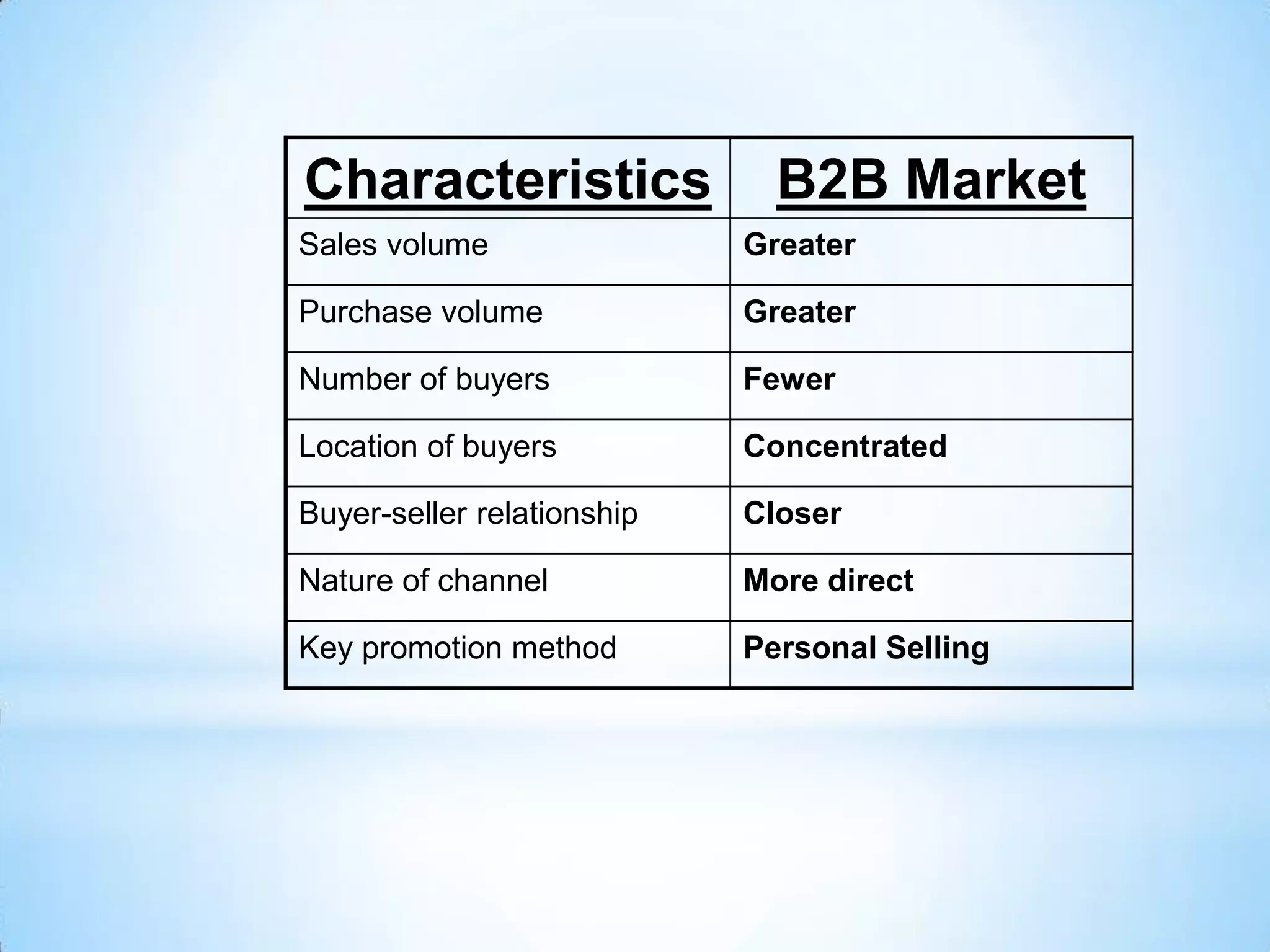
Characteristics               B2B Market
Sales volume                Greater

Purchase volume             Greater

Number of buyers            Fewer

Location of buyers          Concentrated

Buyer-seller relationship   Closer

Nature of channel           More direct

Key promotion method        Personal Selling
• Their demand is derived from the demand for final consumer
 goods.
• Industrial demand may be inelastic
• Buyer interest in price depends on the nature of the product.
• Buying is basically concerned with economic factors.
• The buyer’s attitude seems to be affected by the tax
 treatment according to the product.
PURCHASING
ORIENTATION AND
PRACTICES OF BUSINESS
CUSTOMERS
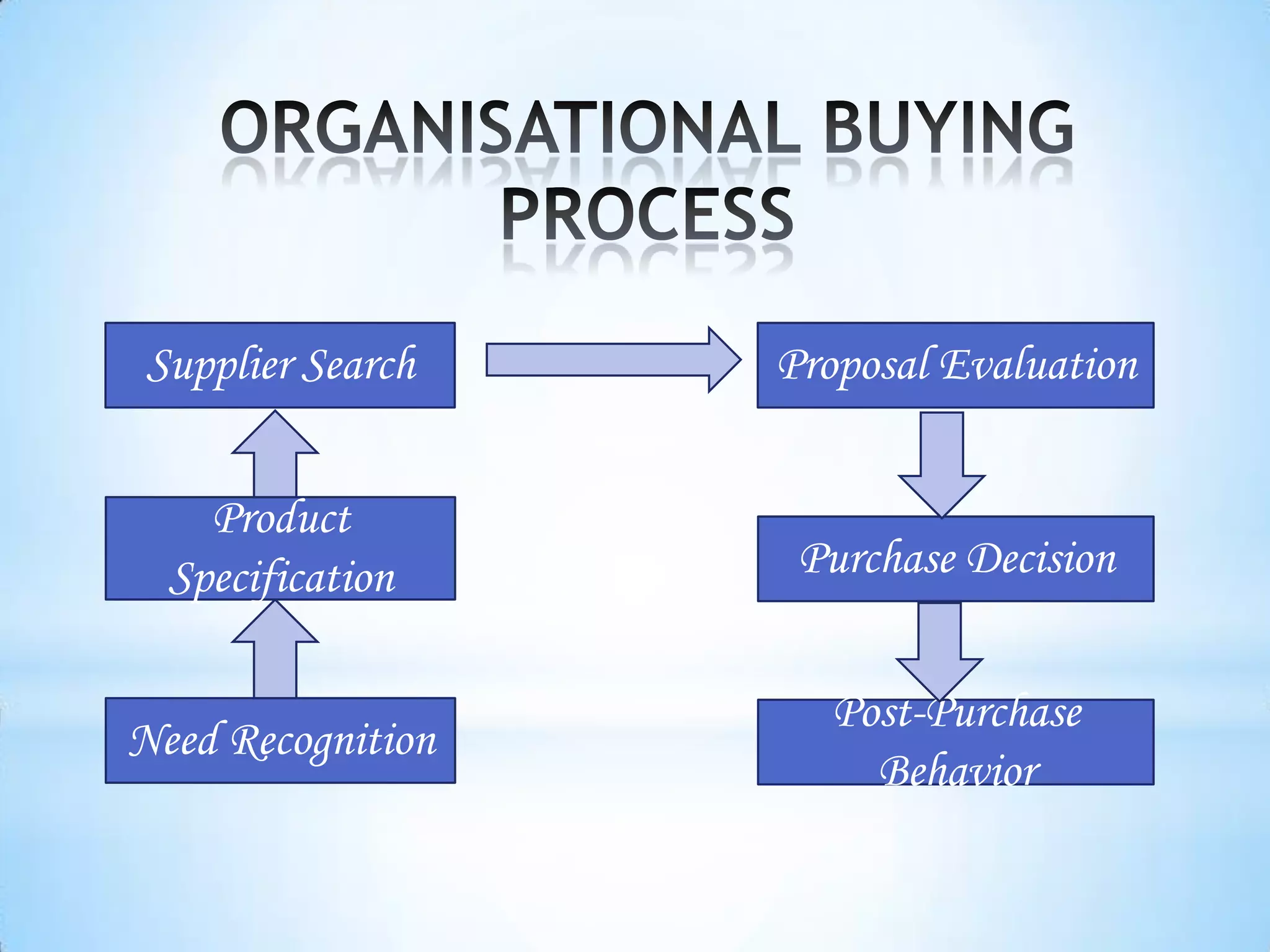
Supplier Search    Proposal Evaluation


    Product
  Specification     Purchase Decision


                     Post-Purchase
Need Recognition
                       Behavior
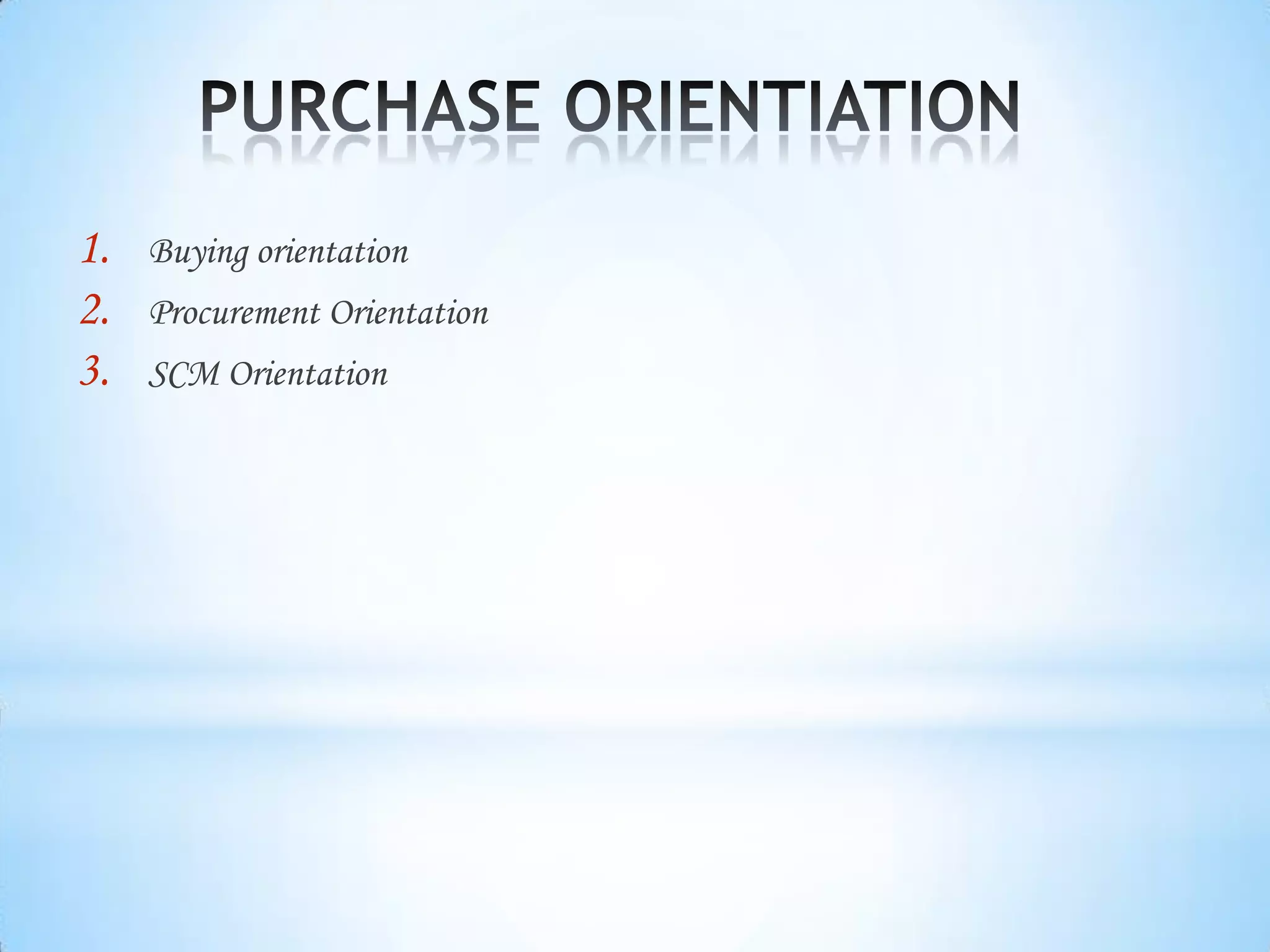
1.   Buying orientation
2.   Procurement Orientation
3.   SCM Orientation
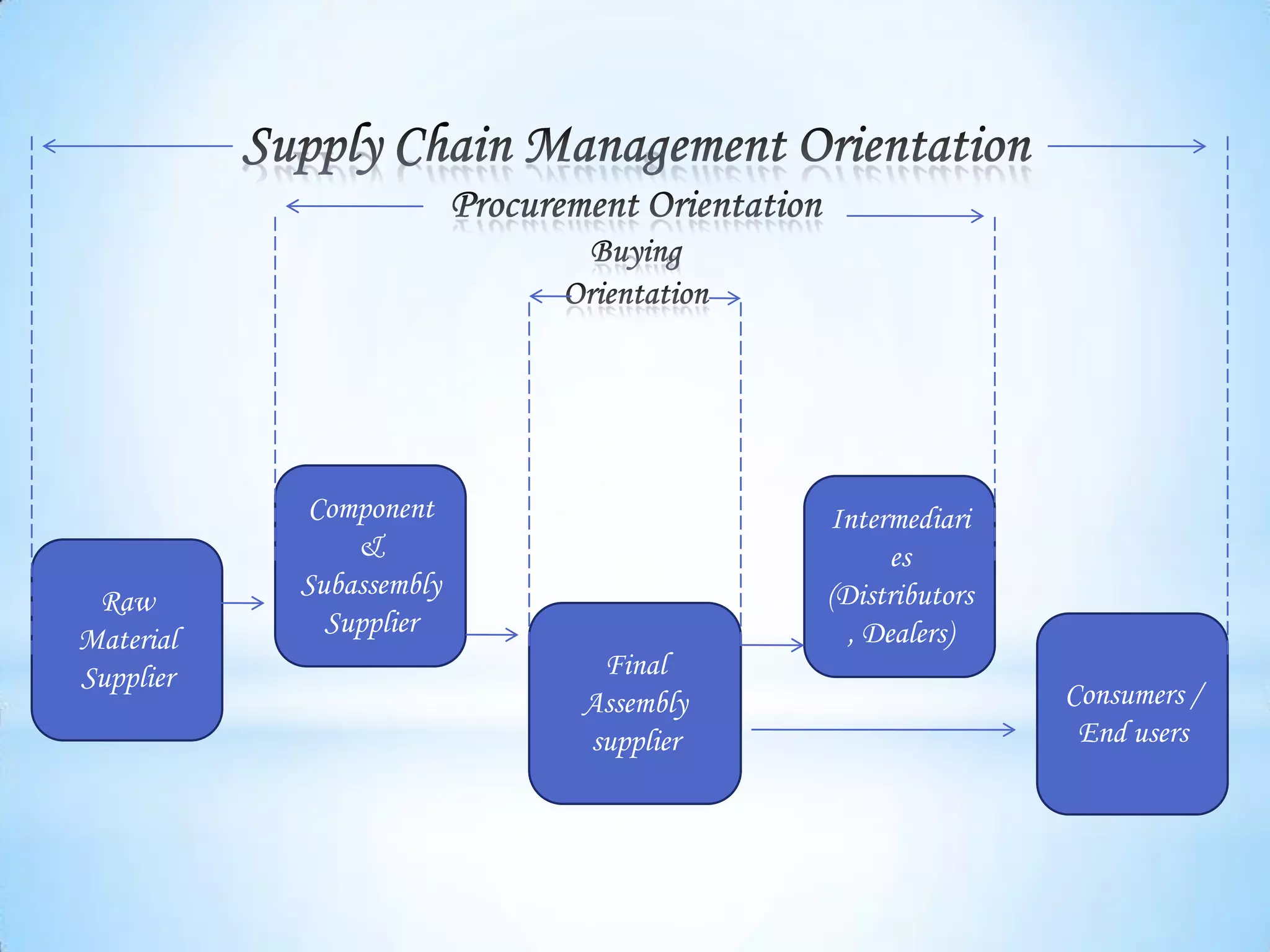
Component               Intermediari
               &                          es
           Subassembly              (Distributors
 Raw
             Supplier                 , Dealers)
Material
Supplier                  Final
                         Assembly                   Consumers /
                         supplier                    End users
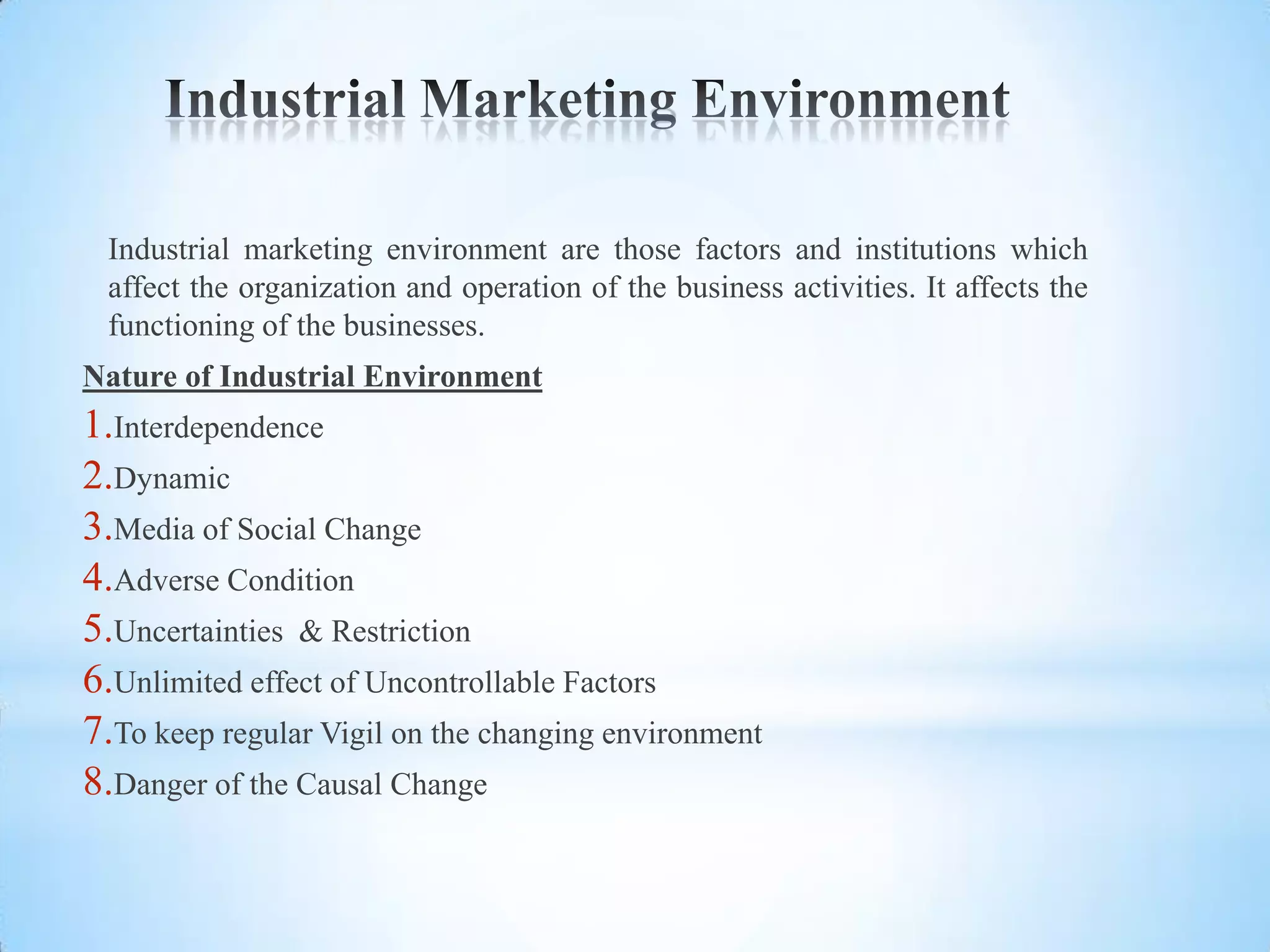
Industrial marketing environment are those factors and institutions which
 affect the organization and operation of the business activities. It affects the
 functioning of the businesses.
Nature of Industrial Environment
1.Interdependence
2.Dynamic
3.Media of Social Change
4.Adverse Condition
5.Uncertainties & Restriction
6.Unlimited effect of Uncontrollable Factors
7.To keep regular Vigil on the changing environment
8.Danger of the Causal Change
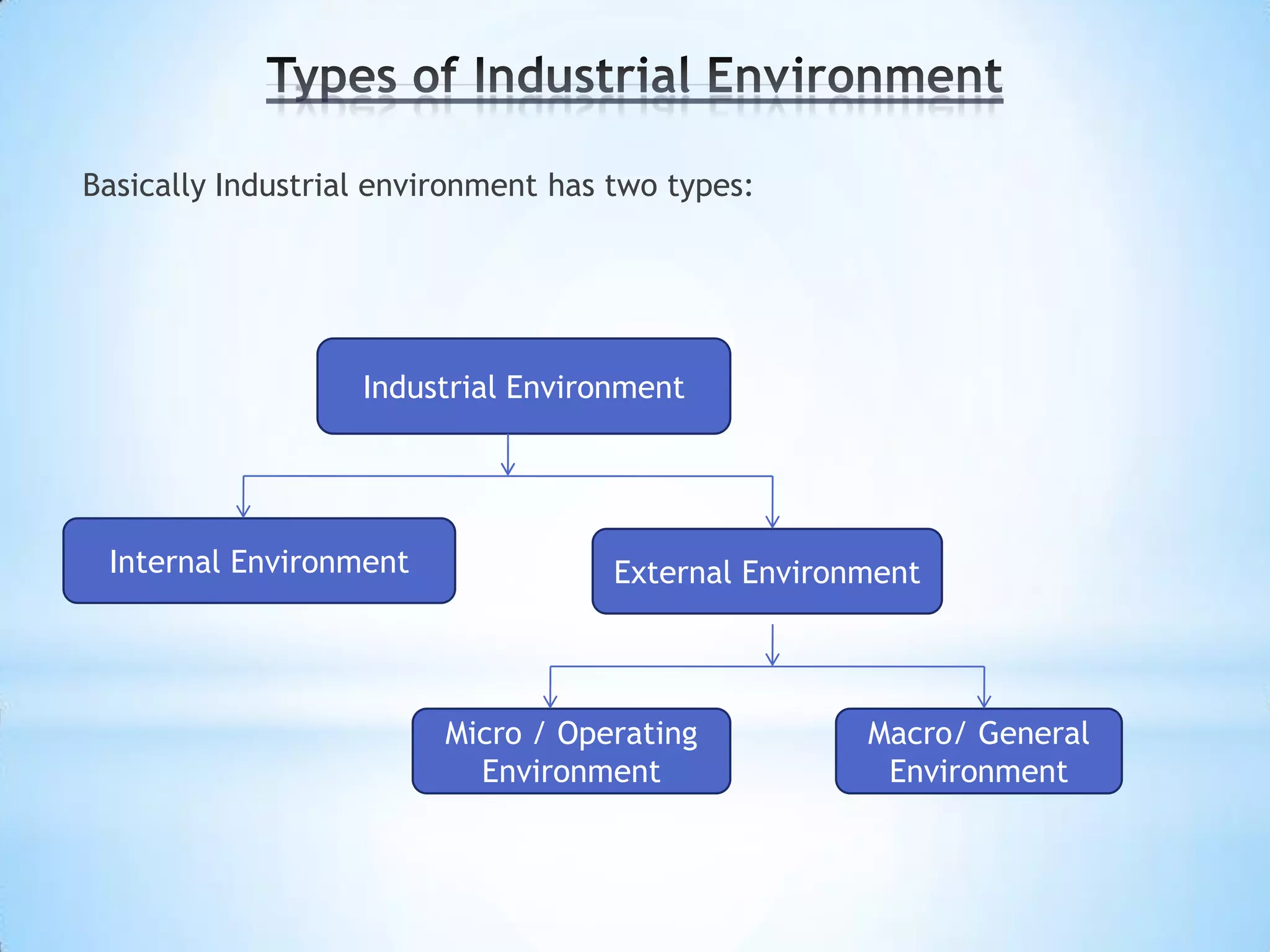
Basically Industrial environment has two types:


                   Industrial Environment


 Internal Environment                External Environment


                         Micro / Operating           Macro/ General
                           Environment                Environment
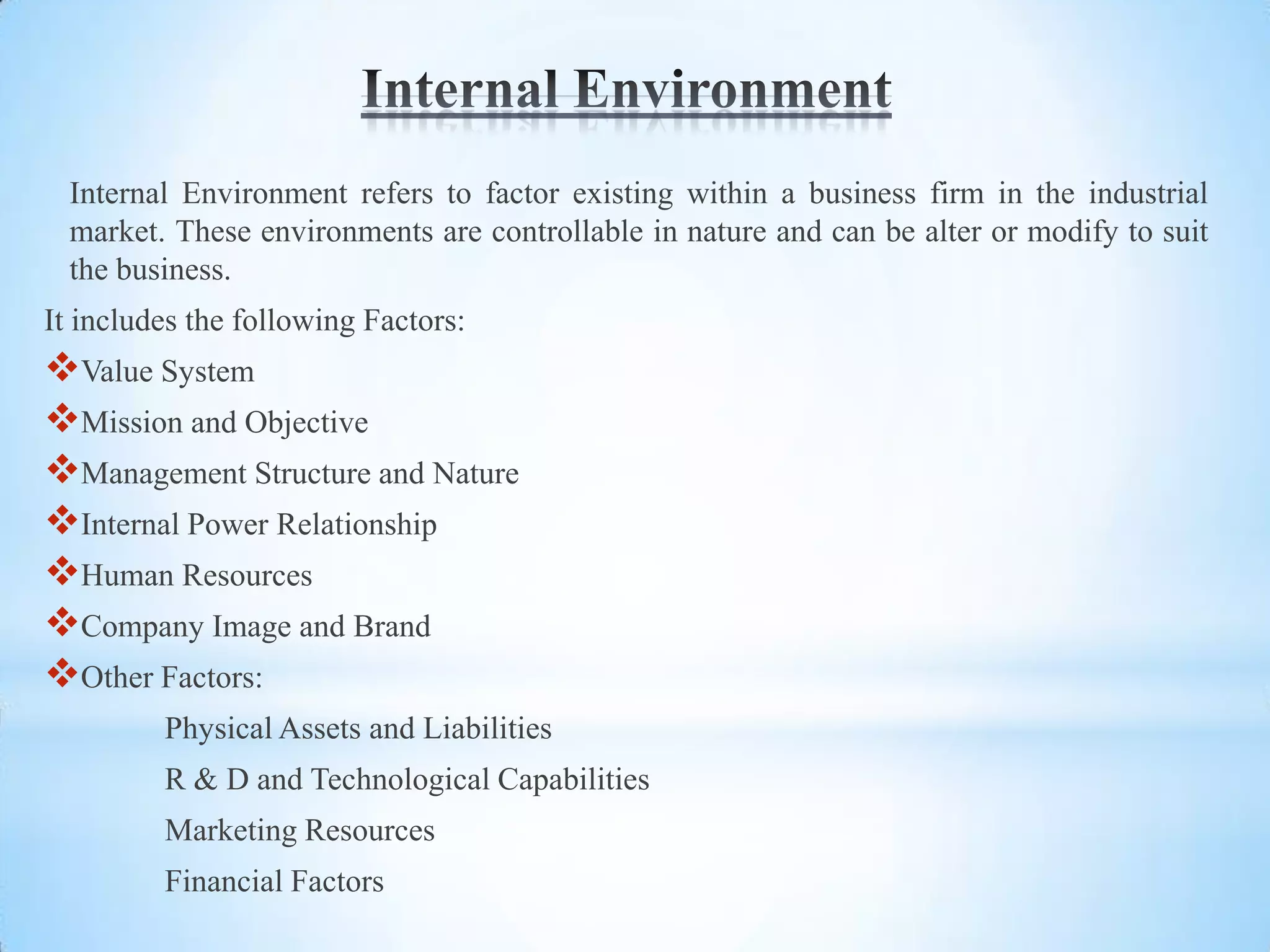
Internal Environment refers to factor existing within a business firm in the industrial
  market. These environments are controllable in nature and can be alter or modify to suit
  the business.
It includes the following Factors:
Value System
Mission and Objective
Management Structure and Nature
Internal Power Relationship
Human Resources
Company Image and Brand
Other Factors:
         Physical Assets and Liabilities
         R & D and Technological Capabilities
         Marketing Resources
         Financial Factors
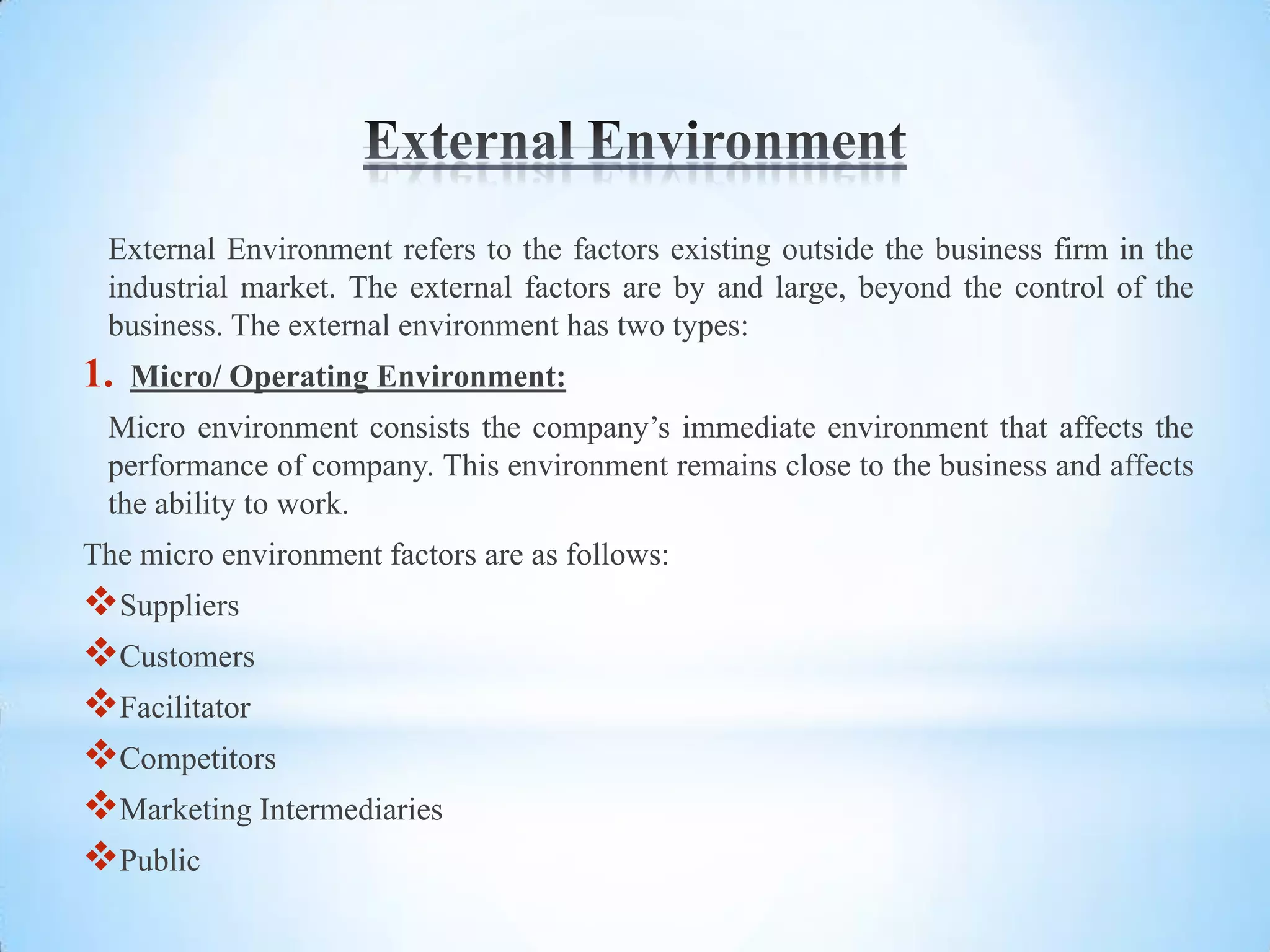
External Environment refers to the factors existing outside the business firm in the
 industrial market. The external factors are by and large, beyond the control of the
 business. The external environment has two types:
1.   Micro/ Operating Environment:
 Micro environment consists the company’s immediate environment that affects the
 performance of company. This environment remains close to the business and affects
 the ability to work.
The micro environment factors are as follows:
Suppliers
Customers
Facilitator
Competitors
Marketing Intermediaries
Public
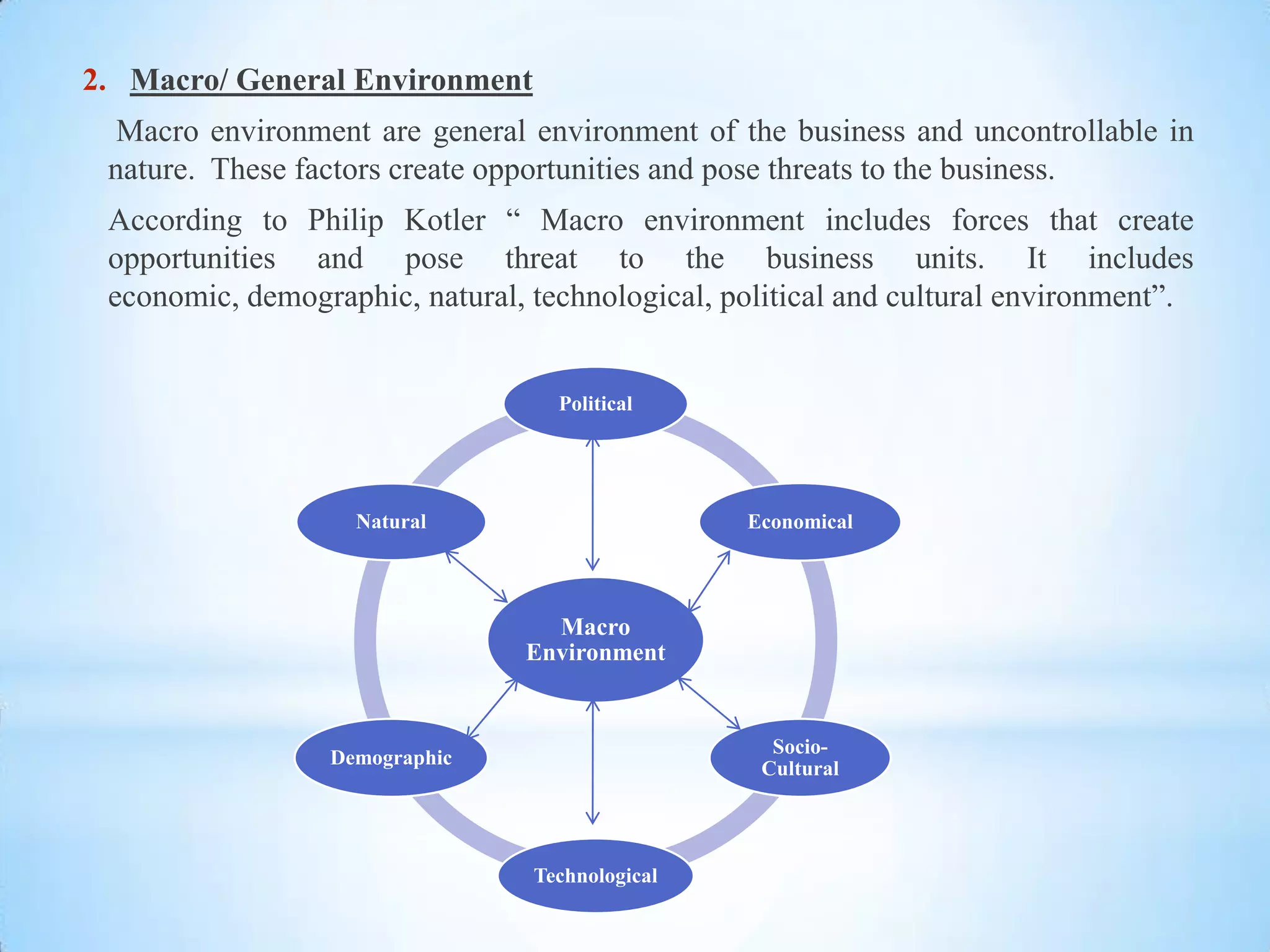
2. Macro/ General Environment
  Macro environment are general environment of the business and uncontrollable in
 nature. These factors create opportunities and pose threats to the business.
 According to Philip Kotler “ Macro environment includes forces that create
 opportunities and pose threat to the business units. It includes
 economic, demographic, natural, technological, political and cultural environment”.


                                   Political


                   Natural                       Economical


                                  Macro
                                Environment


                                                   Socio-
                 Demographic
                                                  Cultural


                                 Technological
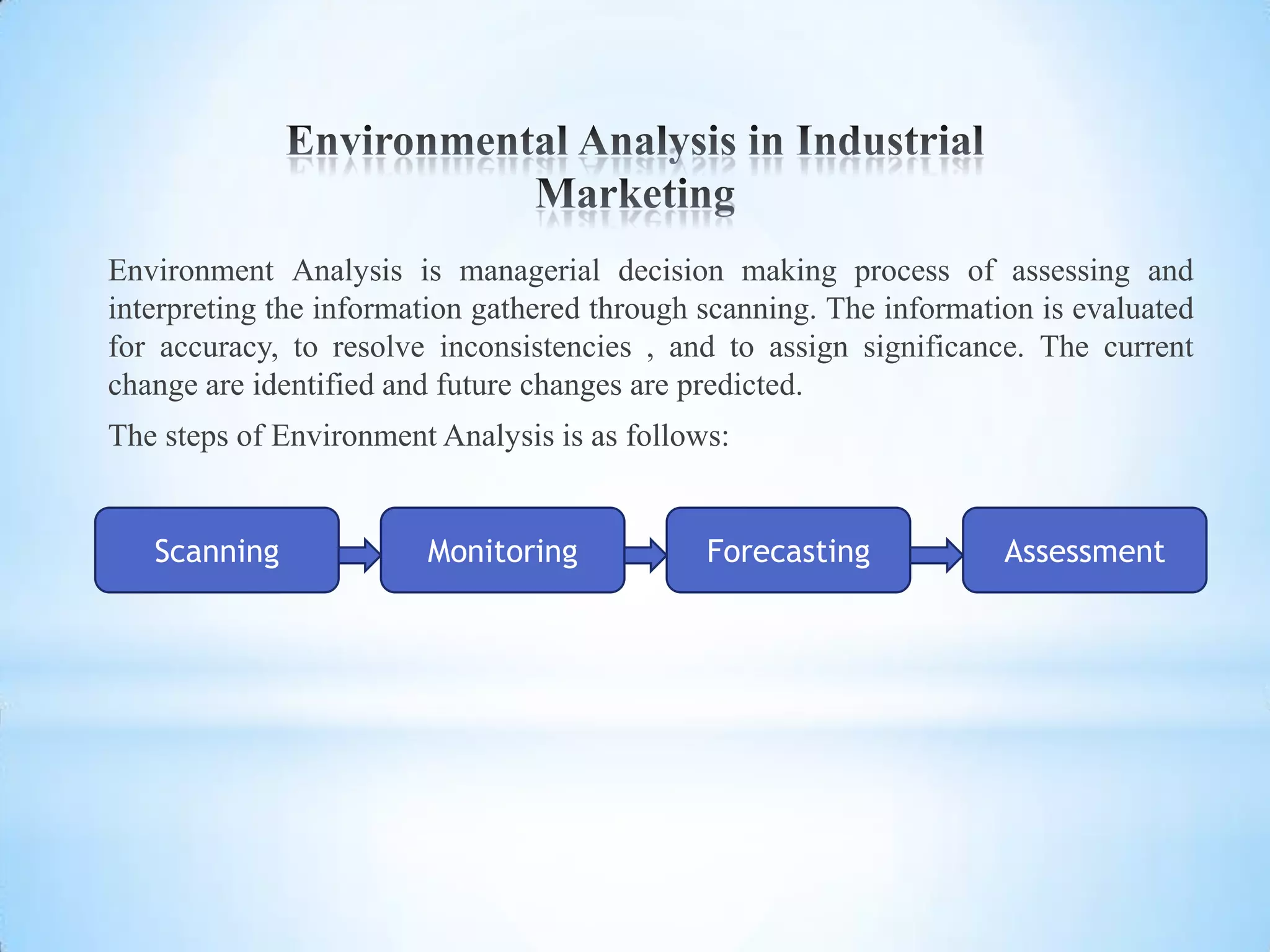
Environment Analysis is managerial decision making process of assessing and
interpreting the information gathered through scanning. The information is evaluated
for accuracy, to resolve inconsistencies , and to assign significance. The current
change are identified and future changes are predicted.
The steps of Environment Analysis is as follows:


   Scanning             Monitoring            Forecasting            Assessment
Industrial environment clearly dictates the need for industrial marketers to develop
and maintain strategies to influence, modify, or respond to actions within the
environment that may hinder or aid the achievement of organizational objective.
Marketers must adopt a proactive , creative stance with respect to the external
environment.
The strategies that are available for marketers for environmental management are as
mentioned below:
Independent Strategies:- Pricing decision, promotion decision etc
Cooperative Strategies :- Cooperation with other groups, firms or industries (Joint
venture) Examples: Myriad computer manufacturer, IBM Compatibles etc.
Strategic Maneuvering:- It involves strategic that are designed to alter or change
the firm’s relationship with respect to its interface environment.
thank
        u

Business Marketing

  • 1.
  • 2.
    The place where industrial buyer come into direct contact industrial seller. • Industrial Marketing/ B2B Marketing/Organizational Marketing
  • 3.
    • Marketing ofProducts, services and solutions to organizations. • Unique needs of industrial customers. • Relatively few buyers and Derived demand. • Products used for production of other consumption related products.
  • 4.
    Business customers arealso known as industrial customers, purchase products or services to use in the production of other products. Classification of industrial customers • Commercial enterprises • Government customers • Institutional customers • Cooperatives societies
  • 5.
    1. COMMERCIAL ENTERPRISES  Distribution by size  Geographic Concentration 2. GOVERNMENT  E-Government  Influence on Government Buying  Understanding Government Contracts
  • 6.
    Purchasing Procedures Number OfCustomers Group Purchasing 4. CO-OPERATIVE SOCIETIES Open Membership Sources of Finance Service Motive
  • 7.
    * Marketing strategiesfor industrial customers Commercial enterprises Industrial marketer must understand the process & preference of commercial enterprise buying. Different promotional strategy should be used for industrial product sales. Proper communication between marketer & buying center of organization. Assurance of dependable supply. Understanding the requirement of a specific target organisation& building a marketing program around these.
  • 8.
    * Government customers Businessmarketer must understand the unique c of challenges selling to federal government units. Contractual guideline fixed price contract cost- reimbursement contracts Authorized department asked for proposals from qualified suppliers. Reverse trade show concept particularly in provincial & territorial govt.
  • 9.
    * Institutional customer Businessmarketer must carefully evaluate the budgeting status of institutional customers. Salesperson must carefully analyze both professional staff & purchasing department. Group purchasing for quantity discount. Discount &effective distribution function play important roles in obtaining & keeping institutions as customers.
  • 10.
    Classification of industrial products Capital equipment and investment Manufactured materials and component parts MRO supplies ( maintenance, repair, operating) Process materials Raw materials Business services Overlapping of categories
  • 11.
    B2B MARKETING IS  MARKETING OF GOODS AND SERVICES TO : ◦ Companies ◦ Government Bodies ◦ Institutions (i.e. hospitals) ◦ Non-Profit Organizations (i.e. American Red Cross) FOR  USE IN PRODUCING THEIR PRODUCTS AND/OR TO FACILITATE THEIR OPERATIONS
  • 12.
     Business thatsells products or provides services to other businesses.  goods or services are sold for any use other than personal consumption  sale of their products or services to other companies or organizations that in turn resell them, use them as components in products or services they offer.  business marketing(industrial marketing) is also called business-to-business marketing
  • 13.
    • B2B saleis to a "Business" i.e. organization or firm • Shorter and more direct channels of distribution. • For corporate (E.g; ingredient materials or components) for consumption(E.g. process materials, consulting services) or for resale... • DuPont and IBM spend more than $60 million a day on purchases to support their operations.
  • 14.
    Major Uses ofB2B Products  For additional production  For use in operations  For resale
  • 15.
    Characteristics B2B Market Sales volume Greater Purchase volume Greater Number of buyers Fewer Location of buyers Concentrated Buyer-seller relationship Closer Nature of channel More direct Key promotion method Personal Selling
  • 16.
    • Their demandis derived from the demand for final consumer goods. • Industrial demand may be inelastic • Buyer interest in price depends on the nature of the product. • Buying is basically concerned with economic factors. • The buyer’s attitude seems to be affected by the tax treatment according to the product.
  • 17.
  • 18.
    Supplier Search Proposal Evaluation Product Specification Purchase Decision Post-Purchase Need Recognition Behavior
  • 19.
    1. Buying orientation 2. Procurement Orientation 3. SCM Orientation
  • 20.
    Component Intermediari & es Subassembly (Distributors Raw Supplier , Dealers) Material Supplier Final Assembly Consumers / supplier End users
  • 21.
    Industrial marketing environmentare those factors and institutions which affect the organization and operation of the business activities. It affects the functioning of the businesses. Nature of Industrial Environment 1.Interdependence 2.Dynamic 3.Media of Social Change 4.Adverse Condition 5.Uncertainties & Restriction 6.Unlimited effect of Uncontrollable Factors 7.To keep regular Vigil on the changing environment 8.Danger of the Causal Change
  • 22.
    Basically Industrial environmenthas two types: Industrial Environment Internal Environment External Environment Micro / Operating Macro/ General Environment Environment
  • 23.
    Internal Environment refersto factor existing within a business firm in the industrial market. These environments are controllable in nature and can be alter or modify to suit the business. It includes the following Factors: Value System Mission and Objective Management Structure and Nature Internal Power Relationship Human Resources Company Image and Brand Other Factors: Physical Assets and Liabilities R & D and Technological Capabilities Marketing Resources Financial Factors
  • 24.
    External Environment refersto the factors existing outside the business firm in the industrial market. The external factors are by and large, beyond the control of the business. The external environment has two types: 1. Micro/ Operating Environment: Micro environment consists the company’s immediate environment that affects the performance of company. This environment remains close to the business and affects the ability to work. The micro environment factors are as follows: Suppliers Customers Facilitator Competitors Marketing Intermediaries Public
  • 25.
    2. Macro/ GeneralEnvironment Macro environment are general environment of the business and uncontrollable in nature. These factors create opportunities and pose threats to the business. According to Philip Kotler “ Macro environment includes forces that create opportunities and pose threat to the business units. It includes economic, demographic, natural, technological, political and cultural environment”. Political Natural Economical Macro Environment Socio- Demographic Cultural Technological
  • 26.
    Environment Analysis ismanagerial decision making process of assessing and interpreting the information gathered through scanning. The information is evaluated for accuracy, to resolve inconsistencies , and to assign significance. The current change are identified and future changes are predicted. The steps of Environment Analysis is as follows: Scanning Monitoring Forecasting Assessment
  • 27.
    Industrial environment clearlydictates the need for industrial marketers to develop and maintain strategies to influence, modify, or respond to actions within the environment that may hinder or aid the achievement of organizational objective. Marketers must adopt a proactive , creative stance with respect to the external environment. The strategies that are available for marketers for environmental management are as mentioned below: Independent Strategies:- Pricing decision, promotion decision etc Cooperative Strategies :- Cooperation with other groups, firms or industries (Joint venture) Examples: Myriad computer manufacturer, IBM Compatibles etc. Strategic Maneuvering:- It involves strategic that are designed to alter or change the firm’s relationship with respect to its interface environment.
  • 28.