Environment
• Environment literally means the surroundings ,
external objects, influences or circumstances
under which someone or something exists. The
environment of an organization is the aggregate
of all conditions, events and influences that
surrounds and affects it. Since the environment
influences an organization in many ways, its
understanding is of crucial importance.
Marketing Environment

• The market environment is a
marketing term and refers to
factors and forces that affect a
firm’s ability to build and
maintain successful
relationships with customers
Marketing Environment
• Successful Companies take outside- Inside view of the
business

• Recognition of new Opportunities & Threats presented
by the environment

• Need is to continuously monitor & adapt to the
environment

• All successful companies recognize & respond profitably
to unmet needs & Trends
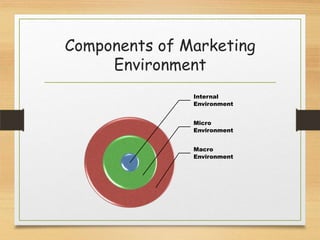
Components of Marketing
Environment
Internal
Environment
Micro
Environment
Macro
Environment
Micro Environment
• The micro-environment affects the organization
directly. It refers to the environment that most
closely linked to the firm

• This environment is also not under the full control
of business.

• The business can influence this environment.
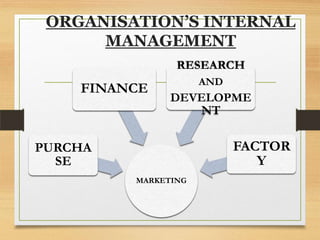
ORGANISATION’S INTERNAL
MANAGEMENT
RESEARCH

FINANCE

AND

DEVELOPME
NT

FACTOR
Y

PURCHA
SE
MARKETING
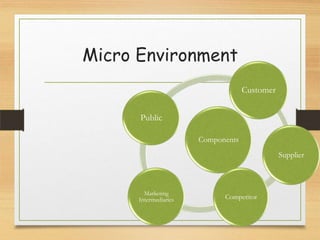
Micro Environment
Customer
Public
Components
Supplier

Marketing
Intermediaries

Competitor
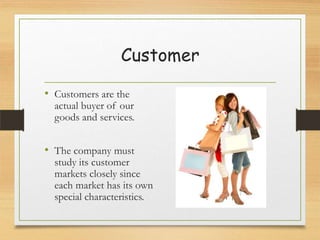
Customer
• Customers are the

actual buyer of our
goods and services.

• The company must

study its customer
markets closely since
each market has its own
special characteristics.
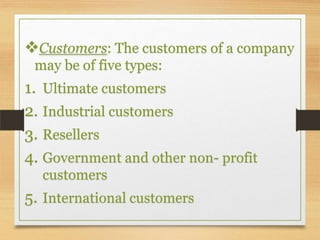
Customers: The customers of a company
may be of five types:

1. Ultimate customers
2. Industrial customers
3. Resellers
4. Government and other non- profit
customers

5. International customers
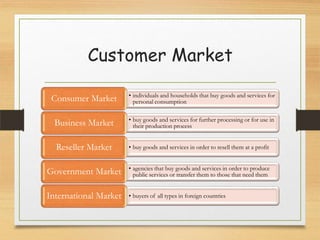
Customer Market
Consumer Market

• individuals and households that buy goods and services for
personal consumption

Business Market

• buy goods and services for further processing or for use in
their production process

Reseller Market

• buy goods and services in order to resell them at a profit

Government Market

• agencies that buy goods and services in order to produce
public services or transfer them to those that need them

International Market

• buyers of all types in foreign countries
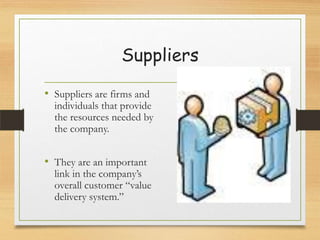
Suppliers
• Suppliers are firms and

individuals that provide
the resources needed by
the company.

• They are an important

link in the company’s
overall customer “value
delivery system.”
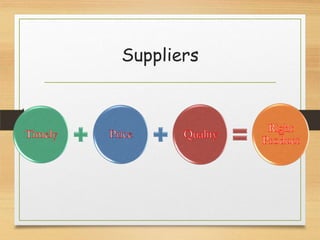
Suppliers
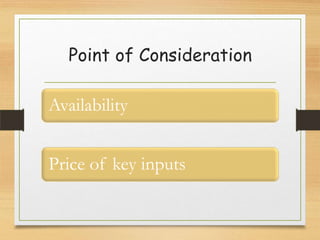
Point of Consideration

Availability
Price of key inputs
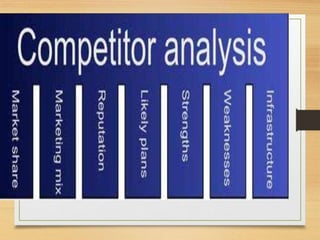
Competitors
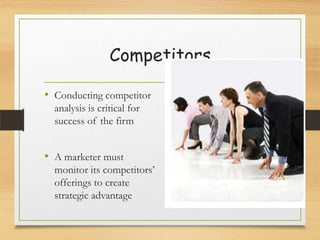
• Conducting competitor
analysis is critical for
success of the firm

• A marketer must
monitor its competitors’
offerings to create
strategic advantage
Competitors
• Must understand competitor’s strengths
• Must differentiate firm’s products and offerings from
those of competitors

• Competitive strategies should emphasize firm’s
distinctive competitive advantage in marketplace
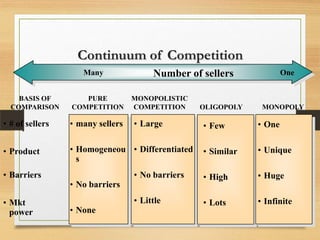
Continuum of Competition
Many
BASIS OF
COMPARISON

PURE
COMPETITION

Number of sellers
MONOPOLISTIC
COMPETITION

• # of sellers

• many sellers

• Product

• Homogeneou • Differentiated
s

• Barriers
• Mkt
power

• No barriers
• None

• Large

OLIGOPOLY

One

MONOPOLY

• Few

• One

• Similar

• Unique

• No barriers

• High

• Huge

• Little

• Lots

• Infinite
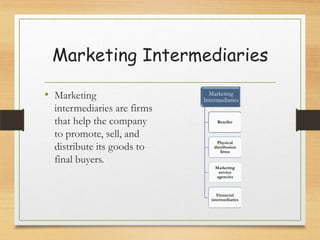
Marketing Intermediaries
• Marketing
intermediaries are firms
that help the company
to promote, sell, and
distribute its goods to
final buyers.

Marketing
Intermediaries

Reseller

Physical
distribution
firms

Marketing
service
agencies

Financial
intermediaries
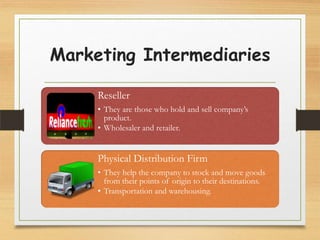
Marketing Intermediaries
Reseller
• They are those who hold and sell company’s
product.
• Wholesaler and retailer.

Physical Distribution Firm
• They help the company to stock and move goods
from their points of origin to their destinations.
• Transportation and warehousing.
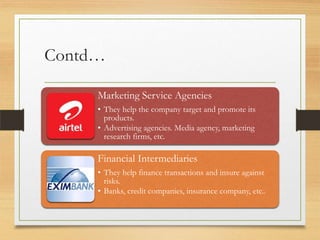
Contd…
Marketing Service Agencies
• They help the company target and promote its
products.
• Advertising agencies. Media agency, marketing
research firms, etc.

Financial Intermediaries
• They help finance transactions and insure against
risks.
• Banks, credit companies, insurance company, etc..
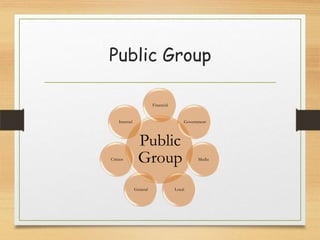
Public
• A public is any group that has an actual or
potential interest in or impact on an
organization’s ability to achieve its objectives.

• A company should prepare a marketing plan for
all of their major publics.
Public Group
Financial

Internal

Citizen

Government

Public
Group
General

Local

Media
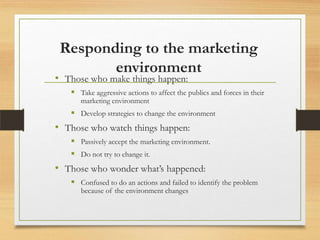
Responding to the marketing
environment

• Those who make things happen:

 Take aggressive actions to affect the publics and forces in their
marketing environment

 Develop strategies to change the environment

• Those who watch things happen:
 Passively accept the marketing environment.
 Do not try to change it.

• Those who wonder what’s happened:
 Confused to do an actions and failed to identify the problem
because of the environment changes
MACRO ENVIRONMENT
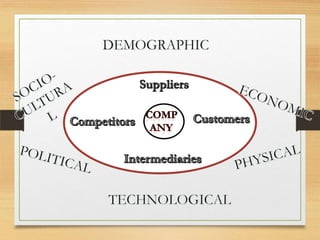
Macro environment refers to those factors
which are external forces in the company’s
activities and do not concern the immediate
environment. These are uncontrollable
factors which indirectly affect the concern’s
ability to operate in the market effectively.
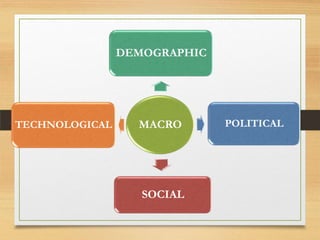
DEMOGRAPHIC

TECHNOLOGICAL

MACRO

SOCIAL

POLITICAL
 Demographic factors: Demography is
the study of population in terms of size,
density, location, age, gender, occupation
etc. These factors have a huge impact on the
marketing decisions of the company.
For example, a growth in population means
increasing human needs which results in
the expansion of product markets, if there
is sufficient purchasing power.
 Economic factors: It consists of factors related to the

means of production and distribution of wealth that
have an impact on the functioning of an organization. It
affects the spending power of people. Further economic
development and growth affects the product choice of
the customers. For example- per capita income, Balance
of payment position, Gross national product, inflation,
deflation etc.
 Physical

factors: Components of physical
forces are the earth’s natural renewable and
non renewable resources. Natural renewable
resources are forests, food products from
agriculture or sea. Non renewable resources
are finite such as oil, coal, minerals etc. both
these components often change the level and
type of resources available to a marketer for
his production.
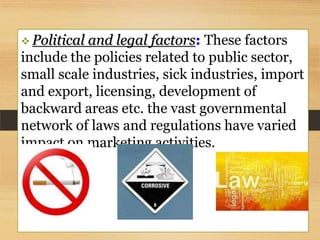
 Political

and legal factors: These factors
include the policies related to public sector,
small scale industries, sick industries, import
and export, licensing, development of
backward areas etc. the vast governmental
network of laws and regulations have varied
impact on marketing activities.
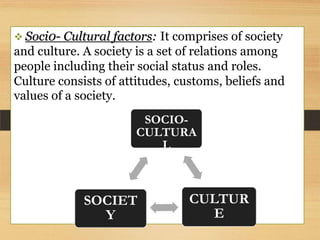
 Soci0- Cultural

factors: It comprises of society
and culture. A society is a set of relations among
people including their social status and roles.
Culture consists of attitudes, customs, beliefs and
values of a society.
SOCIOCULTURA
L

SOCIET
Y

CULTUR
E
References
• Marketing Mix by Gayatri27
• The marketing environment
macro environment or external
macro environment.by izzahnoaedia

• Marketing micro environmentthis presentation will
help you to know about various
micro environmental factors which influences the
activity of marketing.by 17somya

Marketing Micro environment presentaition..

  • 2.
    Environment • Environment literallymeans the surroundings , external objects, influences or circumstances under which someone or something exists. The environment of an organization is the aggregate of all conditions, events and influences that surrounds and affects it. Since the environment influences an organization in many ways, its understanding is of crucial importance.
  • 3.
    Marketing Environment • Themarket environment is a marketing term and refers to factors and forces that affect a firm’s ability to build and maintain successful relationships with customers
  • 4.
    Marketing Environment • SuccessfulCompanies take outside- Inside view of the business • Recognition of new Opportunities & Threats presented by the environment • Need is to continuously monitor & adapt to the environment • All successful companies recognize & respond profitably to unmet needs & Trends
  • 6.
  • 7.
    Micro Environment • Themicro-environment affects the organization directly. It refers to the environment that most closely linked to the firm • This environment is also not under the full control of business. • The business can influence this environment.
  • 8.
  • 9.
  • 10.
    Customer • Customers arethe actual buyer of our goods and services. • The company must study its customer markets closely since each market has its own special characteristics.
  • 11.
    Customers: The customersof a company may be of five types: 1. Ultimate customers 2. Industrial customers 3. Resellers 4. Government and other non- profit customers 5. International customers
  • 12.
    Customer Market Consumer Market •individuals and households that buy goods and services for personal consumption Business Market • buy goods and services for further processing or for use in their production process Reseller Market • buy goods and services in order to resell them at a profit Government Market • agencies that buy goods and services in order to produce public services or transfer them to those that need them International Market • buyers of all types in foreign countries
  • 13.
    Suppliers • Suppliers arefirms and individuals that provide the resources needed by the company. • They are an important link in the company’s overall customer “value delivery system.”
  • 14.
  • 15.
  • 16.
    Competitors • Conducting competitor analysisis critical for success of the firm • A marketer must monitor its competitors’ offerings to create strategic advantage
  • 17.
    Competitors • Must understandcompetitor’s strengths • Must differentiate firm’s products and offerings from those of competitors • Competitive strategies should emphasize firm’s distinctive competitive advantage in marketplace
  • 18.
    Continuum of Competition Many BASISOF COMPARISON PURE COMPETITION Number of sellers MONOPOLISTIC COMPETITION • # of sellers • many sellers • Product • Homogeneou • Differentiated s • Barriers • Mkt power • No barriers • None • Large OLIGOPOLY One MONOPOLY • Few • One • Similar • Unique • No barriers • High • Huge • Little • Lots • Infinite
  • 20.
    Marketing Intermediaries • Marketing intermediariesare firms that help the company to promote, sell, and distribute its goods to final buyers. Marketing Intermediaries Reseller Physical distribution firms Marketing service agencies Financial intermediaries
  • 21.
    Marketing Intermediaries Reseller • Theyare those who hold and sell company’s product. • Wholesaler and retailer. Physical Distribution Firm • They help the company to stock and move goods from their points of origin to their destinations. • Transportation and warehousing.
  • 22.
    Contd… Marketing Service Agencies •They help the company target and promote its products. • Advertising agencies. Media agency, marketing research firms, etc. Financial Intermediaries • They help finance transactions and insure against risks. • Banks, credit companies, insurance company, etc..
  • 23.
    Public • A publicis any group that has an actual or potential interest in or impact on an organization’s ability to achieve its objectives. • A company should prepare a marketing plan for all of their major publics.
  • 24.
  • 25.
    Responding to themarketing environment • Those who make things happen:  Take aggressive actions to affect the publics and forces in their marketing environment  Develop strategies to change the environment • Those who watch things happen:  Passively accept the marketing environment.  Do not try to change it. • Those who wonder what’s happened:  Confused to do an actions and failed to identify the problem because of the environment changes
  • 26.
    MACRO ENVIRONMENT Macro environmentrefers to those factors which are external forces in the company’s activities and do not concern the immediate environment. These are uncontrollable factors which indirectly affect the concern’s ability to operate in the market effectively.
  • 27.
  • 28.
     Demographic factors:Demography is the study of population in terms of size, density, location, age, gender, occupation etc. These factors have a huge impact on the marketing decisions of the company. For example, a growth in population means increasing human needs which results in the expansion of product markets, if there is sufficient purchasing power.
  • 29.
     Economic factors:It consists of factors related to the means of production and distribution of wealth that have an impact on the functioning of an organization. It affects the spending power of people. Further economic development and growth affects the product choice of the customers. For example- per capita income, Balance of payment position, Gross national product, inflation, deflation etc.
  • 30.
     Physical factors: Componentsof physical forces are the earth’s natural renewable and non renewable resources. Natural renewable resources are forests, food products from agriculture or sea. Non renewable resources are finite such as oil, coal, minerals etc. both these components often change the level and type of resources available to a marketer for his production.
  • 31.
     Political and legalfactors: These factors include the policies related to public sector, small scale industries, sick industries, import and export, licensing, development of backward areas etc. the vast governmental network of laws and regulations have varied impact on marketing activities.
  • 32.
     Soci0- Cultural factors:It comprises of society and culture. A society is a set of relations among people including their social status and roles. Culture consists of attitudes, customs, beliefs and values of a society. SOCIOCULTURA L SOCIET Y CULTUR E
  • 33.
    References • Marketing Mixby Gayatri27 • The marketing environment macro environment or external macro environment.by izzahnoaedia • Marketing micro environmentthis presentation will help you to know about various micro environmental factors which influences the activity of marketing.by 17somya