Module 1M10W7045楊 晰越
What is HTML?The standard version of historyHTML featuresThe overall structure of the HTML fileHTML Document TitleIntroduction to HTML
HTML is a standard, a standard symbol to mark it by marking the page to display the various parts.HTML is called Hypertext Markup Language, is because the text contains so-called "super link" points. The so-called hyperlinks, is a URL pointer, by activating (clicking) it allows easy access to a new browser page. It is also widely used HTML's one of the most important reason.What is HTML?
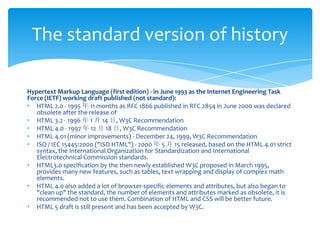
Hypertext Markup Language (first edition) - in June 1993 as the Internet Engineering Task Force (IETF) working draft published (not standard):HTML 2.0 - 1995 年 11 months as RFC 1866 published in RFC 2854 in June 2000 was declared obsolete after the release of
HTML 3.2 - 1996 年 1 月 14 日, W3C Recommendation
HTML 4.0 - 1997 年 12 月 18 日, W3C Recommendation
HTML 4.01 (minor improvements) - December 24, 1999, W3C Recommendation
ISO / IEC 15445:2000 ("ISO HTML") - 2000 年 5 月 15 released, based on the HTML 4.01 strict syntax, the International Organization for Standardization and International Electrotechnical Commission standards.
HTML3.0 specification by the then newly established W3C proposed in March 1995, provides many new features, such as tables, text wrapping and display of complex math elements.
HTML 4.0 also added a lot of browser-specific elements and attributes, but also began to "clean up" the standard, the number of elements and attributes marked as obsolete, it is recommended not to use them. Combination of HTML and CSS will be better future.
HTML 5 draft is still present and has been accepted by W3C.The standard version of history
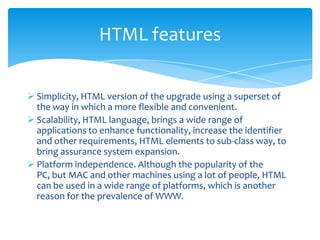
Simplicity, HTML version of the upgrade using a superset of the way in which a more flexible and convenient.

Module 1

  • 1.
  • 2.
    What is HTML?Thestandard version of historyHTML featuresThe overall structure of the HTML fileHTML Document TitleIntroduction to HTML
  • 3.
    HTML is astandard, a standard symbol to mark it by marking the page to display the various parts.HTML is called Hypertext Markup Language, is because the text contains so-called "super link" points. The so-called hyperlinks, is a URL pointer, by activating (clicking) it allows easy access to a new browser page. It is also widely used HTML's one of the most important reason.What is HTML?
  • 5.
    Hypertext Markup Language(first edition) - in June 1993 as the Internet Engineering Task Force (IETF) working draft published (not standard):HTML 2.0 - 1995 年 11 months as RFC 1866 published in RFC 2854 in June 2000 was declared obsolete after the release of
  • 6.
    HTML 3.2 -1996 年 1 月 14 日, W3C Recommendation
  • 7.
    HTML 4.0 -1997 年 12 月 18 日, W3C Recommendation
  • 8.
    HTML 4.01 (minorimprovements) - December 24, 1999, W3C Recommendation
  • 9.
    ISO / IEC15445:2000 ("ISO HTML") - 2000 年 5 月 15 released, based on the HTML 4.01 strict syntax, the International Organization for Standardization and International Electrotechnical Commission standards.
  • 10.
    HTML3.0 specification bythe then newly established W3C proposed in March 1995, provides many new features, such as tables, text wrapping and display of complex math elements.
  • 11.
    HTML 4.0 alsoadded a lot of browser-specific elements and attributes, but also began to "clean up" the standard, the number of elements and attributes marked as obsolete, it is recommended not to use them. Combination of HTML and CSS will be better future.
  • 12.
    HTML 5 draftis still present and has been accepted by W3C.The standard version of history
  • 13.
    Simplicity, HTML versionof the upgrade using a superset of the way in which a more flexible and convenient.