Marketing Management
Marketing and Environmental Analysis
 Marketing strategy is concerned with matching the capabilities of the organization with the
demands of the environment.
 The strategists monitor the environment on an ongoing basis so that opportunities and threats
are identified and subsequently reflected in strategy.
 In analyzing the environment a stepwise approach is needed. This begins with an initial audit of
general environmental influences, followed by a series of increasingly tightly-focused stages
designed to provide the strategist with a clear understanding of the organization’s strategic
position.
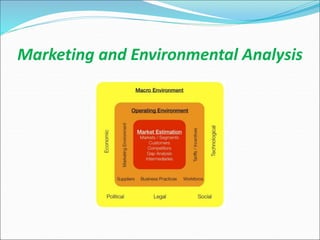
 Although a variety of approaches can be used for analyzing the environment, arguably the most
useful is the PEST framework. This involves the strategist focusing in turn upon the
Political/legal, Economic, Social/cultural and Technological elements of the environment..
 The environmental conditions faced by an organization are capable of varying greatly in their
complexity, and need to be reflected both in the ways in which environmental analysis is
conducted and in the ways in which strategy is subsequently developed.
 It is widely recognized that the pace of environmental change is increasing and that the need for
organizations to develop a structured approach to environmental analysis, with the results
then being fed into the strategic marketing planning process, is greater than ever.
 Despite this, the evidence suggests that in many organizations environmental scanning
systems are only poorly developed. If this is to change, top management commitment both to
the development of a scanning system and to the incorporation of the results into the planning
process is essential.
Learning Objectives
 Why a regular and detailed analysis of the
organization’s environment is important
 The key elements of the environment
 How firms go about analyzing the environment
 How environmental factors are changing
 The dimensions of environmental scanning systems
Importance of Organization’s
Environment
 An understanding of macro and micro marketing
environment forces is essential for planning.
 Helps a business to compete more effectively against its
rivals.
 Assists in the identification of opportunities and threats.
 Enables an organization to take advantage of emerging
strategic opportunities.
THE MARKETING ENVIRONMENT
 The forces that directly and indirectly influence an
organization’s capability to undertake its business.
 The trading forces operating in a market place
over which a business has no direct control ,but
which shape the manner in which the business
function and is able to satisfy its customers.
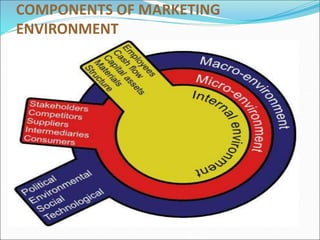
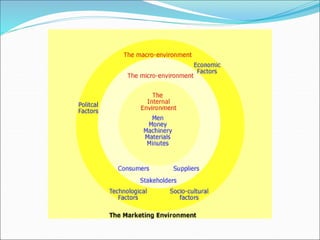
COMPONENTS OF MARKETING ENVIRONMENT
 Internal environment : Forces and actions inside the firm that
affect the marketing operation composed of internal stake
holders and the other functional areas within the business
organization.
 External environment
 Macro environment
 Micro environment
COMPONENTS OF MARKETING ENVIRONMENT
MICRO ENVIRONMENT
 The factors in the immediate environment .
MACRO ENVIRONMENT
 Broad forces which shape the character of opportunities
and threats.
COMPONENTS OF MARKETING
ENVIRONMENT
THE INTERNAL ENVIRONMENT
All factors that are internal to the organization are known
as the 'internal environment'. They are generally audited
by applying the 'Five Ms' which are Men, Money,
Machinery, Materials and Markets. The internal
environment is as important for managing change as the
external. As marketers we call the process of managing
internal change 'internal marketing.‘
THE INTERNAL ENVIRONMENT
It includes the following:
 The human resource department.
 The operations department.
 The accounting and finance department.
 The research and development department.
INTERNAL PROCESSES AND
PROCEDURES
•Allocation of responsibilities within the organization.
•Resources availability .
•The extent to which the major functional areas work
together supporting the marketing function to be
customer oriented .
•The culture of organization.
•The attitude of internal stakeholders.
Micro Environment
 The forces close to the company that affects its
ability to serve.
 It comprises all those organizations and
individuals who directly affect the activities of a
company.
 All factors which impact directly on a firm and
its activities in relation to a particular market.
1. Suppliers
2. The market channel
3. Customers.
4. Competitors
5. Community
SUPPLIERS
Suppliers are either individuals or business houses.
They provide resources needed by the company .
The developments in the suppliers environment have a
substantial impact on the marketing operations of the
company .
Companies can lower their supply costs and increase
product quality to gain competitive advantage in the
market.
supply shortages have to be fully monitored and plans
should be made to avoid it.
Market Intermediates
 They are either business houses or individuals .
 They help the company in promoting, selling and
distributing the goods to customers.
 They are middlemen, distributing agencies, market
service agencies and financial institutions.
Customers
 The target market of the company is usually of five types:
1.Consumer market i.e. individual and householders
2.Industrial market i.e. organizations buying for producing
other and services.
3.Reseller market i.e. organizations buying goods and
services with a view to sell them to others.
4.Government and other non profit markets.i.e.those buying
goods and services in order to produce public services.
5.International market i.e. individuals and organizations of
nations other then home land who buy for either
consumption or industrial use.
Competitors
 No company stands alone in serving and satisfying the
needs of a customer market. It faces competition.
 This helps the company in facing a host of competitors
with confidence .
 The company in order to come out successfully has to adopt
means which may help it to outmaneuver.
 The competitive environment consists of certain basic
things which every marketing manager has to take note of.
 Philip Kotler ‘the best way for a company to grasp the full
range of its competition is to take view point of a buyer.”
Community
 Community is defined as ‘any group that has an
actual or potential interest in or impact on a
company’s ability to achieve it’s objective.
 The actions of the company do affect the interest
of other groups i.e., those who form general public
for the company who must be satisfied along with
the consumers of the company.
 According to Kotler ‘companies must put their
primary energy into effectively managing their
relationships with their customers.
Macro Environment
Macro environment refers to those
factors which are external to company’s
activities and do not concern the
immediate environment.
It comprises general forces that affect all business
activities in market .
Factors Affecting Macro Environment
1. POLITICAL AND LEGAL FORCES
2. ECONOMIC FORCES
3. SOCIAL AND CULTURAL FORCES
4.NATURAL FORCES
5. TECHNOLOGICAL FORCES
6.DEMOGRAPHIC FORCES
Political and Legal forces
 Includes laws, government agencies and pressure
groups that influence or limit various organizations
and individuals in a given society.
 Increasing legislation.
 Changing government agency enforcement.
 More emphasis on ethics and socially responsible
actions.
Economic Environment
 The economic environment consists of factors that affect
consumers purchasing and spending power.
 Under economic environment manager generally studies
1.trends of gross national product
2.patterns of real growth in income
3.variations in geographical income distribution.
4.borrowing pattern ,trends and governmental and legal
restrictions.
5.major economic variables
Social and Cultural Forces
 Social responsibility has crept into the marketing
literature as an alternative to the market concept.
 Socially responsible marketing is that business firms
should take the lead in eliminating socially harmful
products
DEMOGRAPHIC FORCES
 Demographic data helps in preparing geographical
marketing plans, household marketing plans, age and
sex wise plans.
 It influences behavior of consumers which in turn will
have direct impact on market place.
 A marketer must communicate with consumers
anticipate problems ,respond to complaints and make
sure that the firm operates properly.
Technological Environment
 Most dramatic force now shaping our destiny.
 Changes rapidly.
 Creates new markets and opportunities
 Challenge is to make practical, affordable
products.
 Safety regulations result in higher research costs
and longer time between conceptualization and
introduction of product.
Natural Forces
 Involves the natural resources that are needed as
inputs by marketers or that are affected by marketing
activities.
Natural Environment Trends
 Shortage of raw materials.
 Limited quantities of non-renewable resources.
 Increased pollution.
 Waste disposal, air/water pollutants.
 Increased government intervention.
 Kyoto and other initiatives.
 Environmentally sustainable strategies.
 G.R.E.E.N. movement.
Pest Analysis
 A scan of the external macro environment in which the
firm operates can be expressed as a PEST Analysis.
 The acronym PEST (or sometimes rearranged as “STEP”)
is used to describe a framework for the analysis of these
macro environmental factors.
 A PEST Analysis fits into an overall environmental scan,
which includes Political, Economical, Social, and
Technological environment.
PURPOSE OF ANALYSING THE MARKET
 To know where the environment is heading
 To discern which events and trends are favorable
 To assess the scope of various opportunities
 To help secure the right fit between the environment
and the business unit
CONTROLLABILITY
 The organization has no control over the macro
environment. It can only respond to the changes taking
place.
 The organization has some degree of influence over the
micro environment but by no means complete control.
 The organization controls its own internal environment
although this does not mean the marketing department
or marketing manager has control.
The changing business
environment
 The stagnation of many markets
 Market fragmentation
 Product proliferation
 Growing product parity
 Shorter product life cycles
 Increasingly frequent niche attacks by competitors
 Greater customer sophistication and increased customer demands
 Downward price pressures
 Rising promotional costs and lower promotional returns
 Increasing sales force costs
 Changing patterns of distribution and shifts in the balance of power as
intermediaries become more dominant
 The erosion of many of the traditional bases of competitive advantage
 An increased emphasis upon environmental and ‘green’ issues
 The increasingly global nature of many markets
An Environmental Scanning process is
influenced by a variety of factors
 The management expectations.
 The size of the organization
 The managerial perceptions of the complexity of its
environment.
 Top management involvement and commitment.
 A detailed understanding of the dimensions and
parameters of the scanning model that it is intended
should operate.
 An established strategic planning culture.
Specific benefits of environmental
scanning
 An increased general awareness by management of
environmental changes
 Better planning and strategic decision-making
 Greater effectiveness in government matters
 Better industry and market analysis
 Better results in foreign business
 Improvements in diversification and resource
allocations
 Better energy planning.
The Difficulties in Environmental
Analysis
 The interpretation of results and the assessment of their specific
impact upon the organization is rarely clear-cut
 The output of environmental analysis may be too inaccurate, general
or uncertain to be taken seriously
 A preoccupation with the short term pre-empts attention being paid to
longer-term environmental issues
 Long-term environmental analyses are often treated sceptically
 In diversified businesses the amount of analysis needed is likely to be
both consider- able and complex, particularly when interrelationships
are considered
 Perceptions and interpretations of scenarios identified may differ
significantly between one manager and another.

Marketing environment

  • 1.
  • 2.
  • 3.
    Marketing and EnvironmentalAnalysis  Marketing strategy is concerned with matching the capabilities of the organization with the demands of the environment.  The strategists monitor the environment on an ongoing basis so that opportunities and threats are identified and subsequently reflected in strategy.  In analyzing the environment a stepwise approach is needed. This begins with an initial audit of general environmental influences, followed by a series of increasingly tightly-focused stages designed to provide the strategist with a clear understanding of the organization’s strategic position.  Although a variety of approaches can be used for analyzing the environment, arguably the most useful is the PEST framework. This involves the strategist focusing in turn upon the Political/legal, Economic, Social/cultural and Technological elements of the environment..  The environmental conditions faced by an organization are capable of varying greatly in their complexity, and need to be reflected both in the ways in which environmental analysis is conducted and in the ways in which strategy is subsequently developed.  It is widely recognized that the pace of environmental change is increasing and that the need for organizations to develop a structured approach to environmental analysis, with the results then being fed into the strategic marketing planning process, is greater than ever.  Despite this, the evidence suggests that in many organizations environmental scanning systems are only poorly developed. If this is to change, top management commitment both to the development of a scanning system and to the incorporation of the results into the planning process is essential.
  • 4.
    Learning Objectives  Whya regular and detailed analysis of the organization’s environment is important  The key elements of the environment  How firms go about analyzing the environment  How environmental factors are changing  The dimensions of environmental scanning systems
  • 5.
    Importance of Organization’s Environment An understanding of macro and micro marketing environment forces is essential for planning.  Helps a business to compete more effectively against its rivals.  Assists in the identification of opportunities and threats.  Enables an organization to take advantage of emerging strategic opportunities.
  • 6.
    THE MARKETING ENVIRONMENT The forces that directly and indirectly influence an organization’s capability to undertake its business.  The trading forces operating in a market place over which a business has no direct control ,but which shape the manner in which the business function and is able to satisfy its customers.
  • 7.
    COMPONENTS OF MARKETINGENVIRONMENT  Internal environment : Forces and actions inside the firm that affect the marketing operation composed of internal stake holders and the other functional areas within the business organization.  External environment  Macro environment  Micro environment
  • 8.
    COMPONENTS OF MARKETINGENVIRONMENT MICRO ENVIRONMENT  The factors in the immediate environment . MACRO ENVIRONMENT  Broad forces which shape the character of opportunities and threats.
  • 9.
  • 11.
    THE INTERNAL ENVIRONMENT Allfactors that are internal to the organization are known as the 'internal environment'. They are generally audited by applying the 'Five Ms' which are Men, Money, Machinery, Materials and Markets. The internal environment is as important for managing change as the external. As marketers we call the process of managing internal change 'internal marketing.‘
  • 12.
    THE INTERNAL ENVIRONMENT Itincludes the following:  The human resource department.  The operations department.  The accounting and finance department.  The research and development department.
  • 13.
    INTERNAL PROCESSES AND PROCEDURES •Allocationof responsibilities within the organization. •Resources availability . •The extent to which the major functional areas work together supporting the marketing function to be customer oriented . •The culture of organization. •The attitude of internal stakeholders.
  • 14.
    Micro Environment  Theforces close to the company that affects its ability to serve.  It comprises all those organizations and individuals who directly affect the activities of a company.  All factors which impact directly on a firm and its activities in relation to a particular market. 1. Suppliers 2. The market channel 3. Customers. 4. Competitors 5. Community
  • 15.
    SUPPLIERS Suppliers are eitherindividuals or business houses. They provide resources needed by the company . The developments in the suppliers environment have a substantial impact on the marketing operations of the company . Companies can lower their supply costs and increase product quality to gain competitive advantage in the market. supply shortages have to be fully monitored and plans should be made to avoid it.
  • 16.
    Market Intermediates  Theyare either business houses or individuals .  They help the company in promoting, selling and distributing the goods to customers.  They are middlemen, distributing agencies, market service agencies and financial institutions.
  • 17.
    Customers  The targetmarket of the company is usually of five types: 1.Consumer market i.e. individual and householders 2.Industrial market i.e. organizations buying for producing other and services. 3.Reseller market i.e. organizations buying goods and services with a view to sell them to others. 4.Government and other non profit markets.i.e.those buying goods and services in order to produce public services. 5.International market i.e. individuals and organizations of nations other then home land who buy for either consumption or industrial use.
  • 18.
    Competitors  No companystands alone in serving and satisfying the needs of a customer market. It faces competition.  This helps the company in facing a host of competitors with confidence .  The company in order to come out successfully has to adopt means which may help it to outmaneuver.  The competitive environment consists of certain basic things which every marketing manager has to take note of.  Philip Kotler ‘the best way for a company to grasp the full range of its competition is to take view point of a buyer.”
  • 19.
    Community  Community isdefined as ‘any group that has an actual or potential interest in or impact on a company’s ability to achieve it’s objective.  The actions of the company do affect the interest of other groups i.e., those who form general public for the company who must be satisfied along with the consumers of the company.  According to Kotler ‘companies must put their primary energy into effectively managing their relationships with their customers.
  • 20.
    Macro Environment Macro environmentrefers to those factors which are external to company’s activities and do not concern the immediate environment. It comprises general forces that affect all business activities in market .
  • 21.
    Factors Affecting MacroEnvironment 1. POLITICAL AND LEGAL FORCES 2. ECONOMIC FORCES 3. SOCIAL AND CULTURAL FORCES 4.NATURAL FORCES 5. TECHNOLOGICAL FORCES 6.DEMOGRAPHIC FORCES
  • 22.
    Political and Legalforces  Includes laws, government agencies and pressure groups that influence or limit various organizations and individuals in a given society.  Increasing legislation.  Changing government agency enforcement.  More emphasis on ethics and socially responsible actions.
  • 23.
    Economic Environment  Theeconomic environment consists of factors that affect consumers purchasing and spending power.  Under economic environment manager generally studies 1.trends of gross national product 2.patterns of real growth in income 3.variations in geographical income distribution. 4.borrowing pattern ,trends and governmental and legal restrictions. 5.major economic variables
  • 24.
    Social and CulturalForces  Social responsibility has crept into the marketing literature as an alternative to the market concept.  Socially responsible marketing is that business firms should take the lead in eliminating socially harmful products
  • 25.
    DEMOGRAPHIC FORCES  Demographicdata helps in preparing geographical marketing plans, household marketing plans, age and sex wise plans.  It influences behavior of consumers which in turn will have direct impact on market place.  A marketer must communicate with consumers anticipate problems ,respond to complaints and make sure that the firm operates properly.
  • 26.
    Technological Environment  Mostdramatic force now shaping our destiny.  Changes rapidly.  Creates new markets and opportunities  Challenge is to make practical, affordable products.  Safety regulations result in higher research costs and longer time between conceptualization and introduction of product.
  • 27.
    Natural Forces  Involvesthe natural resources that are needed as inputs by marketers or that are affected by marketing activities.
  • 28.
    Natural Environment Trends Shortage of raw materials.  Limited quantities of non-renewable resources.  Increased pollution.  Waste disposal, air/water pollutants.  Increased government intervention.  Kyoto and other initiatives.  Environmentally sustainable strategies.  G.R.E.E.N. movement.
  • 29.
    Pest Analysis  Ascan of the external macro environment in which the firm operates can be expressed as a PEST Analysis.  The acronym PEST (or sometimes rearranged as “STEP”) is used to describe a framework for the analysis of these macro environmental factors.  A PEST Analysis fits into an overall environmental scan, which includes Political, Economical, Social, and Technological environment.
  • 30.
    PURPOSE OF ANALYSINGTHE MARKET  To know where the environment is heading  To discern which events and trends are favorable  To assess the scope of various opportunities  To help secure the right fit between the environment and the business unit
  • 31.
    CONTROLLABILITY  The organizationhas no control over the macro environment. It can only respond to the changes taking place.  The organization has some degree of influence over the micro environment but by no means complete control.  The organization controls its own internal environment although this does not mean the marketing department or marketing manager has control.
  • 32.
    The changing business environment The stagnation of many markets  Market fragmentation  Product proliferation  Growing product parity  Shorter product life cycles  Increasingly frequent niche attacks by competitors  Greater customer sophistication and increased customer demands  Downward price pressures  Rising promotional costs and lower promotional returns  Increasing sales force costs  Changing patterns of distribution and shifts in the balance of power as intermediaries become more dominant  The erosion of many of the traditional bases of competitive advantage  An increased emphasis upon environmental and ‘green’ issues  The increasingly global nature of many markets
  • 33.
    An Environmental Scanningprocess is influenced by a variety of factors  The management expectations.  The size of the organization  The managerial perceptions of the complexity of its environment.  Top management involvement and commitment.  A detailed understanding of the dimensions and parameters of the scanning model that it is intended should operate.  An established strategic planning culture.
  • 34.
    Specific benefits ofenvironmental scanning  An increased general awareness by management of environmental changes  Better planning and strategic decision-making  Greater effectiveness in government matters  Better industry and market analysis  Better results in foreign business  Improvements in diversification and resource allocations  Better energy planning.
  • 35.
    The Difficulties inEnvironmental Analysis  The interpretation of results and the assessment of their specific impact upon the organization is rarely clear-cut  The output of environmental analysis may be too inaccurate, general or uncertain to be taken seriously  A preoccupation with the short term pre-empts attention being paid to longer-term environmental issues  Long-term environmental analyses are often treated sceptically  In diversified businesses the amount of analysis needed is likely to be both consider- able and complex, particularly when interrelationships are considered  Perceptions and interpretations of scenarios identified may differ significantly between one manager and another.