 KAUSTUBH

BARVE
 WILBERT EMMANUAL
 SHIKHA AGARWAL
 AKHILA WUNNAM
 AYENI NACHAN
 PREETI C
Ethics is :
1. The study of standards of conduct and moral
judgment, moral philosophy
2. A treatise on this study
3. The study or code of morals of a particular person,
religion, group, profession, etc.



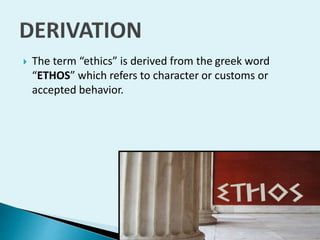
The term “ethics” is derived from the greek word
“ETHOS” which refers to character or customs or
accepted behavior.


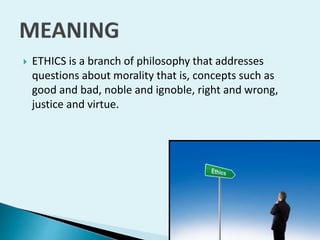
ETHICS is a branch of philosophy that addresses
questions about morality that is, concepts such as
good and bad, noble and ignoble, right and wrong,
justice and virtue.
Nine major theories have all been created
to explain ethics and determine whether
a decision is ethical or not











SITUATIONAL ETHICS
CONSEQUENTIAL ETHICS
VALUE ETHICS
UTILITARIAN ETHICS
MORALISTIC ETHICS
ETHICAL REALISM
ETHICAL HIERARCHIES
PRINCIPLE ETHICS
MORAL DEVELOPMENT







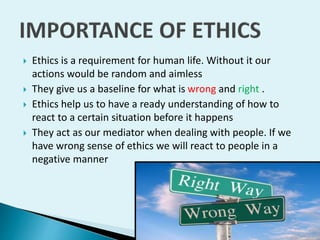
Ethics is a requirement for human life. Without it our
actions would be random and aimless
They give us a baseline for what is wrong and right .
Ethics help us to have a ready understanding of how to
react to a certain situation before it happens
They act as our mediator when dealing with people. If we
have wrong sense of ethics we will react to people in a
negative manner




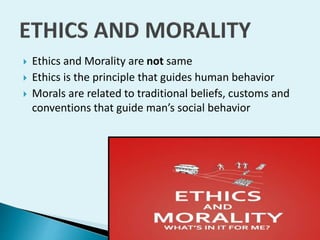
Ethics and Morality are not same
Ethics is the principle that guides human behavior
Morals are related to traditional beliefs, customs and
conventions that guide man’s social behavior




Ethics is the science of conduct. It deals with certain
standard conduct and morals
Law is a code of conduct which the authority in power
prescribes for society
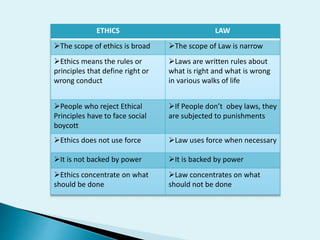
ETHICS

LAW

The scope of ethics is broad

The scope of Law is narrow

Ethics means the rules or
principles that define right or
wrong conduct

Laws are written rules about
what is right and what is wrong
in various walks of life

People who reject Ethical
Principles have to face social
boycott

If People don’t obey laws, they
are subjected to punishments

Ethics does not use force

Law uses force when necessary

It is not backed by power

It is backed by power

Ethics concentrate on what
should be done

Law concentrates on what
should not be done
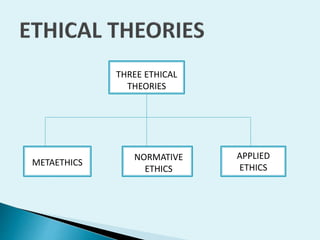
THREE ETHICAL
THEORIES

METAETHICS

NORMATIVE
ETHICS

APPLIED
ETHICS
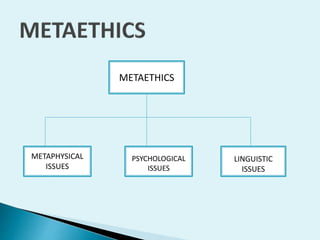
METAETHICS

METAPHYSICAL
ISSUES

PSYCHOLOGICAL
ISSUES

LINGUISTIC
ISSUES


The term Normative Ethics implies something that
guides or controls



Thus, Normative Ethics is the branch of ethics that
guides human conduct



It sets out certain moral standards that helps us to
determine what is right and what is wrong
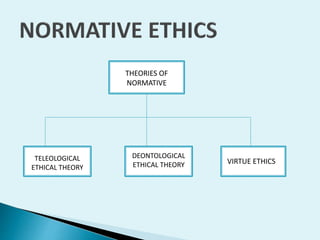
THEORIES OF
NORMATIVE

TELEOLOGICAL
ETHICAL THEORY

DEONTOLOGICAL
ETHICAL THEORY

VIRTUE ETHICS
Applied Ethics is a branch of ethics that deals with
specific, often controversial moral issues in different
fields which are as follows :
1. Medical Field : Abortion, Female Foeticide and
Infanticide, etc.
2. Business Fields : Misleading Advertising, insider
trading, bribery, corruption, etc.
3. Others : Displacement of tribal people due to hydroelectrical projects, cloning, testing drugs on animals,
etc.



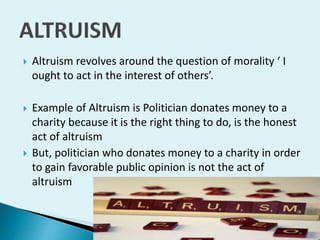
Altruism revolves around the question of morality ‘ I
ought to act in the interest of others’.



Example of Altruism is Politician donates money to a
charity because it is the right thing to do, is the honest
act of altruism
But, politician who donates money to a charity in order
to gain favorable public opinion is not the act of
altruism








Egoism revolves around the question “ I ought to act in
the interest of myself”
It states that people must do what is best for
themselves in order to live a morally correct life
In some cases of egoism, the idea of acting out one’s
self interest sometimes even extends to overlooking
other’s interests in order to satisfy your own.










CODE OF CONDUCT
UNIVERSAL APPLICATION
RELATIVE TERM
NEW CONCEPT
DETERMINES ISSUES
DESCRIBES AND DIFFERENTIATES
PROTECTION
SUPPORTS EXPANSION
EMPIRICAL APPROACH
 INTUITIVE APPROACH
 RATIONAL APPROACH
 REVELATION APPROACH

 SURVIVAL
 ONLY

PROFIT IS NOT ACCEPTABLE
 A FIRM NOT PERFORMING WELLIS
CONSIDERED AS LIABILITY
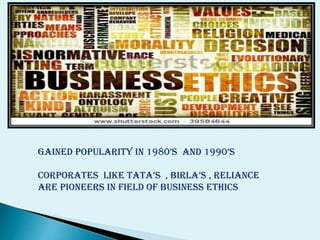
GAINED POPULARITY IN 1980’s AND 1990’s
CORPORATEs LIKE TATA’s , BIRLA’s , RELIANCE
ARE PIONEERS IN FIELD OF BUSINESS ETHICS








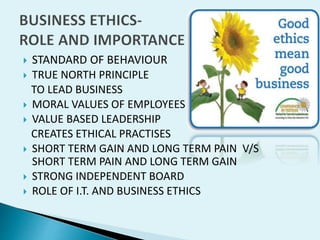
STANDARD OF BEHAVIOUR
TRUE NORTH PRINCIPLE
TO LEAD BUSINESS
MORAL VALUES OF EMPLOYEES
VALUE BASED LEADERSHIP
CREATES ETHICAL PRACTISES
SHORT TERM GAIN AND LONG TERM PAIN V/S
SHORT TERM PAIN AND LONG TERM GAIN
STRONG INDEPENDENT BOARD
ROLE OF I.T. AND BUSINESS ETHICS







MISSION OR VALUE STATEMENTS
CODE OF ETHICS
ETHICS MANAGERS, OFFICERS & COMMITTEES
ETHICS EDUCATION AND TRAINING
PEER REPORTING OF UNETHICAL BEHAVIOUR
THANK

YOU



Business Ethics

  • 2.
     KAUSTUBH BARVE  WILBERTEMMANUAL  SHIKHA AGARWAL  AKHILA WUNNAM  AYENI NACHAN  PREETI C
  • 3.
    Ethics is : 1.The study of standards of conduct and moral judgment, moral philosophy 2. A treatise on this study 3. The study or code of morals of a particular person, religion, group, profession, etc. 
  • 4.
     The term “ethics”is derived from the greek word “ETHOS” which refers to character or customs or accepted behavior.
  • 5.
     ETHICS is abranch of philosophy that addresses questions about morality that is, concepts such as good and bad, noble and ignoble, right and wrong, justice and virtue.
  • 6.
    Nine major theorieshave all been created to explain ethics and determine whether a decision is ethical or not
  • 7.
             SITUATIONAL ETHICS CONSEQUENTIAL ETHICS VALUEETHICS UTILITARIAN ETHICS MORALISTIC ETHICS ETHICAL REALISM ETHICAL HIERARCHIES PRINCIPLE ETHICS MORAL DEVELOPMENT
  • 8.
        Ethics is arequirement for human life. Without it our actions would be random and aimless They give us a baseline for what is wrong and right . Ethics help us to have a ready understanding of how to react to a certain situation before it happens They act as our mediator when dealing with people. If we have wrong sense of ethics we will react to people in a negative manner
  • 9.
       Ethics and Moralityare not same Ethics is the principle that guides human behavior Morals are related to traditional beliefs, customs and conventions that guide man’s social behavior
  • 10.
      Ethics is thescience of conduct. It deals with certain standard conduct and morals Law is a code of conduct which the authority in power prescribes for society
  • 11.
    ETHICS LAW The scope ofethics is broad The scope of Law is narrow Ethics means the rules or principles that define right or wrong conduct Laws are written rules about what is right and what is wrong in various walks of life People who reject Ethical Principles have to face social boycott If People don’t obey laws, they are subjected to punishments Ethics does not use force Law uses force when necessary It is not backed by power It is backed by power Ethics concentrate on what should be done Law concentrates on what should not be done
  • 12.
  • 13.
  • 14.
     The term NormativeEthics implies something that guides or controls  Thus, Normative Ethics is the branch of ethics that guides human conduct  It sets out certain moral standards that helps us to determine what is right and what is wrong
  • 15.
  • 16.
    Applied Ethics isa branch of ethics that deals with specific, often controversial moral issues in different fields which are as follows : 1. Medical Field : Abortion, Female Foeticide and Infanticide, etc. 2. Business Fields : Misleading Advertising, insider trading, bribery, corruption, etc. 3. Others : Displacement of tribal people due to hydroelectrical projects, cloning, testing drugs on animals, etc. 
  • 17.
     Altruism revolves aroundthe question of morality ‘ I ought to act in the interest of others’.  Example of Altruism is Politician donates money to a charity because it is the right thing to do, is the honest act of altruism But, politician who donates money to a charity in order to gain favorable public opinion is not the act of altruism 
  • 18.
       Egoism revolves aroundthe question “ I ought to act in the interest of myself” It states that people must do what is best for themselves in order to live a morally correct life In some cases of egoism, the idea of acting out one’s self interest sometimes even extends to overlooking other’s interests in order to satisfy your own.
  • 19.
            CODE OF CONDUCT UNIVERSALAPPLICATION RELATIVE TERM NEW CONCEPT DETERMINES ISSUES DESCRIBES AND DIFFERENTIATES PROTECTION SUPPORTS EXPANSION
  • 20.
    EMPIRICAL APPROACH  INTUITIVEAPPROACH  RATIONAL APPROACH  REVELATION APPROACH 
  • 21.
     SURVIVAL  ONLY PROFITIS NOT ACCEPTABLE  A FIRM NOT PERFORMING WELLIS CONSIDERED AS LIABILITY
  • 22.
    GAINED POPULARITY IN1980’s AND 1990’s CORPORATEs LIKE TATA’s , BIRLA’s , RELIANCE ARE PIONEERS IN FIELD OF BUSINESS ETHICS
  • 23.
           STANDARD OF BEHAVIOUR TRUENORTH PRINCIPLE TO LEAD BUSINESS MORAL VALUES OF EMPLOYEES VALUE BASED LEADERSHIP CREATES ETHICAL PRACTISES SHORT TERM GAIN AND LONG TERM PAIN V/S SHORT TERM PAIN AND LONG TERM GAIN STRONG INDEPENDENT BOARD ROLE OF I.T. AND BUSINESS ETHICS
  • 24.
         MISSION OR VALUESTATEMENTS CODE OF ETHICS ETHICS MANAGERS, OFFICERS & COMMITTEES ETHICS EDUCATION AND TRAINING PEER REPORTING OF UNETHICAL BEHAVIOUR
  • 25.