PRESENTATION ON:- BUSSINESS EVIRONMENT
SUBMITTED TO –
DR. ASHUTUSH CHATURVEDI
FACULTY OF MBA (ABM)
ACHARYA NARENDRA DEVA UNIVERSITY OF AGRICULTURE &TECHNOLOGY
KUMARGANJ, AYODHYA
SUBMITTED BY-
ANSHUT CHITRANSH (ID: A-12354/21)
MBA(ABM) 1st BATCH 2021-2023
Learning Objective
 What is Business
 What is Environment
 Business environment- Nature, Objective
 Dimension/Types of Business Environment
 Interaction between Internal & External Environment
 Importance of Business Environment
What is business
 Business is a human activity carried out by the unified
effects of different categories of people to produce the
wealth through production and distribution of the goods
and services
 According to Malvin anshen :- Business is the way by
which men make their living.
Environment
 The birth, growth and
continuous development of
organisation are influenced by a
wide range of variables like
employees customer supplies
producers competition etc.
● Business environment refers to
those aspects of the
surroundings of business
enterprise which affect or
influence its operations or
determine its effectiveness
● According to Keith Davis:-
business environment is the
aggregate of all conditions
events and influence that
surrounds and affects it
Nature of Business Environment
 Complex:
Environment consists of a number of factors, events, conditions arising from
different sources which impact business thus making the business complex.
 Interdependence:
Factors affecting business environment like social, economic, legal, cultural
etc. are inter dependent. Eg. A rich country can make sufficient expenditure
on the research and development.
 Dynamic:
Business environment is dynamic as it keeps on changing in terms of
technological improvement, changes in consumer preferences, entry of new
competitors
 Uncertainty:
Business environment is largely uncertain as it is very difficult to predict future
happenings.
 Relativity:
Business environment is a relative concept as it differs from country to country
and region to region. e.g. Demand of saree is high in India comparative to other
countries.
 Specific and General forces:
Specific forces affects individual enterprises directly and immediately whereas
general forces have impact on all business enterprises.
 Forecasting is not possible for all developments:
Many developments such as interest rate fluctuations, the rate of inflation etc.
are difficult to predict on long term basis which makes difficult to maintain
business environment.
Objective of Business Environment
 Knowledge of Information:
Every businessman should be aware about the current environment of the
business to change accordingly.
 Basis of Decision:
It contains all the information which is needed for taking good decision. E.g.
If a business knows about its competitors, suppliers and customers they take
decision about price, purchase, salary etc.
 Helpful in making of policies:
For making good business policies one needs to know and scan business
through business environment.
 Technological Planning:
Update now In today's environment it is really important for the
business houses to keep themselves changing according to the
technological changes in the market..
 Survive in the business:
Sometimes industry may face recession. In such condition only those
business will survive who estimate this entire situation in advance
through business environment study.
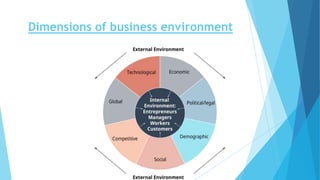
Dimensions of business environment
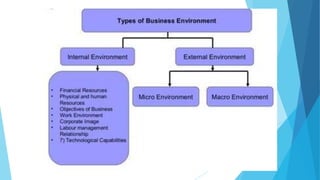
Internal Environment
Internal environment refers to factors existing within a business firm. These
factors are generally regarded as controllable factors because the company
has control over these factors.
 Financial Factors:
Factors like financial policies, financial procedures and capital structure are
also important internal environment affecting business performance,
strategies and decisions.
 Physical and Human Resources:
The characteristics of the human resources like skill, quality, moral,
commitment etc., contribute to the strength and weakness of an
organization.
 Objective of business:
The business domain of the company, direction of development, business
policy etc. are guided by the objectives of the company
 Work Environment:
The organizational structure, company policies, extent of professionalism in
management etc., are important factors influencing business decisions.
 Company Image and Brand:
The image of the company matters while raising finance, forming joint
ventures, entering purchase or sales contract etc.
 Labour Management Relationship:
Factors like the amount of support top management enjoys from different
level of employees, and other participants influences company decisions and
their implementations.
 R&D and Technological Capabilities:
It determines a company's ability to innovate and compete.
External environment
The External environment refers to the factors existing outside
the business firm. The external factors are beyond the control of
a company, hence its success depends to the adaptability of the
environment.
Again external environment is divided in two parts:
1)Micro Environment.
2)Macro Environment
 Micro Environment
The factors which are close to the company and affects its ability to work
constitutes micro environment. It is known as the operating environment of
business.
When competing form in the industry have the same micro elements. the
success of the firm depends on their relative effectiveness in dealing with
these elements.
 Suppliers:
Suppliers are those who supply the inputs like raw material and components
to the company, Uncertainties regarding the supply constraints the company
to maintain high inventories causing cost increase.
 Customers:
Success of any business depends upon identifying customers, their needs,
likes etc. and enhancing the level of customer satisfaction. The major task
of a business is to create and sustain customers.
 Competitors:
Competitors means other business units which are marketing or producing
similar products or a very close substitute of our product. Business has to
adjust its various activities according to the action and reactions of
competitors.
 Marketing Intermediaries:
These are the firms that aid the company in promoting, selling and
distributing its goods to final buyers. They are the vital links between the
company and the final consumers.
 Public:
A public is any group that has an actual or potential interest in or impact on
an organization's ability to achieve is interest Some companies are seriously
affected by such public.
Eg. Media
 Demographic:
Demographics is defined as statistical data about the characteristics of a
population, such as the age, gender and income of the people within the
population.
 Macro Environment
Macro environment means general environment of business. Macro forces are
uncontrollable in comparison to the micro forces of environment. The growth
and survival of business depends upon its adaptability to macro environmental
factors.
The important macro environment are:
1) Economic Environment
2) Non Economic Environment
 Economic Environment:
To know the economic environment of a country or a business one has to
understand the economic policies of the nation. These policies put direct impact
on the working and success of the business. Economic conditions, economic
policies (Industrial policies, monetary and fiscal policy etc.) and the economic
system are the important factors that constitute economic environment of the
business.
 Non Economic Environment
 Socio cultural Environment:
The socio-cultural environmental factors consist of human relationship and
the development. Some of the important factors in the social environment
are the buying and consumption habit of people, their languages, beliefs and
values, custom and traditions, etc. that effects the business.
 Legal Environment:
Every country follows its own system of law. The companies operating in the
global market have to take into account the provisions with respect to the
legal environment prevalent in the countries which thy do business. These
law and regulations affect the day-to-day operations of business.
 International Environment:
The international environment is particularly important for industries
directly depending on imports or exports. Eg. Import export policies of
various countries.
 Political Environment:
The political environment consists of factors related to the
management of public affairs that have a considerable impact on the
business of organization. It impacts the legislations and government
rules and regulations under which business organizations operates in a
country.
 Technological Environment:
Technological environment comprises both machines (hard technology)
and scientific thinking (soft technology) used to solve problems and
promote progress. It also represents the degree of advancement of
goods and services that are prevalent in a country or a region.
 Natural Environment:
Geographical factors such as natural resources endowments, weather
and climatic conditions, location aspects in the global context, port
facilities etc., are all relevant to business.
Significance of Business Environment
 First Mover Advantage: Awareness of environment helps an enterprise
to take advantage of early opportunities instead of loosing them to
competitors. Eg. Maruti Udyog became leader in small car.
 Early Warning Signal: Environmental awareness serves as an early
warning signal. It makes at firm aware of the future threats or crisis so
that the firm can take timely action to minimize the adverse effects.
 Customer Focus: Environmental understanding makes the management
sensitive to the changing needs and expectations of the consumers Eg.
Apps in mobile.
 Strategy Formulation: Environmental monitoring provids relevant
information about the business opportunities on the basis of which
firms makes their strategies. e.g. ITC in travel and tourism sector.
 Public Image: A business firm can improve its image by showing
that it is sensitive to its environment and responsive as per the need
of customers.
 Continuous Learning: Environmental analysis serves as broad and
ongoing education for business executive so that they can react in
an appropriate manner to the changing scenario and thereby
increase the success of their organization.
Business environment.pptx

Business environment.pptx

  • 1.
    PRESENTATION ON:- BUSSINESSEVIRONMENT SUBMITTED TO – DR. ASHUTUSH CHATURVEDI FACULTY OF MBA (ABM) ACHARYA NARENDRA DEVA UNIVERSITY OF AGRICULTURE &TECHNOLOGY KUMARGANJ, AYODHYA SUBMITTED BY- ANSHUT CHITRANSH (ID: A-12354/21) MBA(ABM) 1st BATCH 2021-2023
  • 4.
    Learning Objective  Whatis Business  What is Environment  Business environment- Nature, Objective  Dimension/Types of Business Environment  Interaction between Internal & External Environment  Importance of Business Environment
  • 5.
    What is business Business is a human activity carried out by the unified effects of different categories of people to produce the wealth through production and distribution of the goods and services  According to Malvin anshen :- Business is the way by which men make their living.
  • 6.
    Environment  The birth,growth and continuous development of organisation are influenced by a wide range of variables like employees customer supplies producers competition etc.
  • 7.
    ● Business environmentrefers to those aspects of the surroundings of business enterprise which affect or influence its operations or determine its effectiveness ● According to Keith Davis:- business environment is the aggregate of all conditions events and influence that surrounds and affects it
  • 9.
    Nature of BusinessEnvironment  Complex: Environment consists of a number of factors, events, conditions arising from different sources which impact business thus making the business complex.  Interdependence: Factors affecting business environment like social, economic, legal, cultural etc. are inter dependent. Eg. A rich country can make sufficient expenditure on the research and development.  Dynamic: Business environment is dynamic as it keeps on changing in terms of technological improvement, changes in consumer preferences, entry of new competitors
  • 10.
     Uncertainty: Business environmentis largely uncertain as it is very difficult to predict future happenings.  Relativity: Business environment is a relative concept as it differs from country to country and region to region. e.g. Demand of saree is high in India comparative to other countries.  Specific and General forces: Specific forces affects individual enterprises directly and immediately whereas general forces have impact on all business enterprises.  Forecasting is not possible for all developments: Many developments such as interest rate fluctuations, the rate of inflation etc. are difficult to predict on long term basis which makes difficult to maintain business environment.
  • 11.
    Objective of BusinessEnvironment  Knowledge of Information: Every businessman should be aware about the current environment of the business to change accordingly.  Basis of Decision: It contains all the information which is needed for taking good decision. E.g. If a business knows about its competitors, suppliers and customers they take decision about price, purchase, salary etc.  Helpful in making of policies: For making good business policies one needs to know and scan business through business environment.
  • 12.
     Technological Planning: Updatenow In today's environment it is really important for the business houses to keep themselves changing according to the technological changes in the market..  Survive in the business: Sometimes industry may face recession. In such condition only those business will survive who estimate this entire situation in advance through business environment study.
  • 13.
  • 15.
    Internal Environment Internal environmentrefers to factors existing within a business firm. These factors are generally regarded as controllable factors because the company has control over these factors.  Financial Factors: Factors like financial policies, financial procedures and capital structure are also important internal environment affecting business performance, strategies and decisions.  Physical and Human Resources: The characteristics of the human resources like skill, quality, moral, commitment etc., contribute to the strength and weakness of an organization.
  • 16.
     Objective ofbusiness: The business domain of the company, direction of development, business policy etc. are guided by the objectives of the company  Work Environment: The organizational structure, company policies, extent of professionalism in management etc., are important factors influencing business decisions.  Company Image and Brand: The image of the company matters while raising finance, forming joint ventures, entering purchase or sales contract etc.
  • 17.
     Labour ManagementRelationship: Factors like the amount of support top management enjoys from different level of employees, and other participants influences company decisions and their implementations.  R&D and Technological Capabilities: It determines a company's ability to innovate and compete.
  • 18.
    External environment The Externalenvironment refers to the factors existing outside the business firm. The external factors are beyond the control of a company, hence its success depends to the adaptability of the environment. Again external environment is divided in two parts: 1)Micro Environment. 2)Macro Environment
  • 19.
     Micro Environment Thefactors which are close to the company and affects its ability to work constitutes micro environment. It is known as the operating environment of business. When competing form in the industry have the same micro elements. the success of the firm depends on their relative effectiveness in dealing with these elements.  Suppliers: Suppliers are those who supply the inputs like raw material and components to the company, Uncertainties regarding the supply constraints the company to maintain high inventories causing cost increase.
  • 20.
     Customers: Success ofany business depends upon identifying customers, their needs, likes etc. and enhancing the level of customer satisfaction. The major task of a business is to create and sustain customers.  Competitors: Competitors means other business units which are marketing or producing similar products or a very close substitute of our product. Business has to adjust its various activities according to the action and reactions of competitors.  Marketing Intermediaries: These are the firms that aid the company in promoting, selling and distributing its goods to final buyers. They are the vital links between the company and the final consumers.
  • 21.
     Public: A publicis any group that has an actual or potential interest in or impact on an organization's ability to achieve is interest Some companies are seriously affected by such public. Eg. Media  Demographic: Demographics is defined as statistical data about the characteristics of a population, such as the age, gender and income of the people within the population.
  • 22.
     Macro Environment Macroenvironment means general environment of business. Macro forces are uncontrollable in comparison to the micro forces of environment. The growth and survival of business depends upon its adaptability to macro environmental factors. The important macro environment are: 1) Economic Environment 2) Non Economic Environment  Economic Environment: To know the economic environment of a country or a business one has to understand the economic policies of the nation. These policies put direct impact on the working and success of the business. Economic conditions, economic policies (Industrial policies, monetary and fiscal policy etc.) and the economic system are the important factors that constitute economic environment of the business.
  • 23.
     Non EconomicEnvironment  Socio cultural Environment: The socio-cultural environmental factors consist of human relationship and the development. Some of the important factors in the social environment are the buying and consumption habit of people, their languages, beliefs and values, custom and traditions, etc. that effects the business.  Legal Environment: Every country follows its own system of law. The companies operating in the global market have to take into account the provisions with respect to the legal environment prevalent in the countries which thy do business. These law and regulations affect the day-to-day operations of business.
  • 24.
     International Environment: Theinternational environment is particularly important for industries directly depending on imports or exports. Eg. Import export policies of various countries.  Political Environment: The political environment consists of factors related to the management of public affairs that have a considerable impact on the business of organization. It impacts the legislations and government rules and regulations under which business organizations operates in a country.
  • 25.
     Technological Environment: Technologicalenvironment comprises both machines (hard technology) and scientific thinking (soft technology) used to solve problems and promote progress. It also represents the degree of advancement of goods and services that are prevalent in a country or a region.  Natural Environment: Geographical factors such as natural resources endowments, weather and climatic conditions, location aspects in the global context, port facilities etc., are all relevant to business.
  • 27.
    Significance of BusinessEnvironment  First Mover Advantage: Awareness of environment helps an enterprise to take advantage of early opportunities instead of loosing them to competitors. Eg. Maruti Udyog became leader in small car.  Early Warning Signal: Environmental awareness serves as an early warning signal. It makes at firm aware of the future threats or crisis so that the firm can take timely action to minimize the adverse effects.  Customer Focus: Environmental understanding makes the management sensitive to the changing needs and expectations of the consumers Eg. Apps in mobile.
  • 28.
     Strategy Formulation:Environmental monitoring provids relevant information about the business opportunities on the basis of which firms makes their strategies. e.g. ITC in travel and tourism sector.  Public Image: A business firm can improve its image by showing that it is sensitive to its environment and responsive as per the need of customers.  Continuous Learning: Environmental analysis serves as broad and ongoing education for business executive so that they can react in an appropriate manner to the changing scenario and thereby increase the success of their organization.