William G. Scottdefines business communication as “It is a process which involves the transmission and
accurate replication of ideas ensured by feedback for the purpose of eliciting actions which will accomplish
organizational goals.”
It covers 4 aspects of business communication, as follows:
1) The sender’s ability to transmit his own ideas accurately.
2) The receiver’s mental ability to get the same idea as were transmitted i.e. accurate replication.
3) The feedback or the receiver’s response.
4) Eliciting action which will help to achieve the goals
2.
Key Components ofBusiness Communication
• Internal communication: This involves sharing information within an organization, such as between
employees, departments, and management.
• External communication: This encompasses communication with stakeholders outside the organization,
including customers, clients, suppliers, investors, and the public.
• Verbal communication: This includes spoken words, whether in person, over the phone, or through video
conferencing.
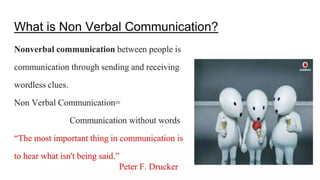
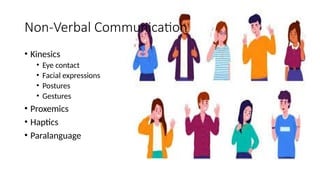
• Non-verbal communication: This involves body language, facial expressions, and tone of voice.
• Written communication: This encompasses emails, letters, reports, presentations, and other written
documents.
3.
Importance of EffectiveBusiness
Communication
• Growth in the size of organisations: Spreading over different states and over different countries
• Growth of trade Unions: To build a meaningful relationship with the TU’s.
• Improved efficiency: Clear communication streamlines processes and reduces errors.
• Enhanced decision-making: Effective communication ensures everyone is aligned with organizational
goals.
• Stronger relationships: Building trust and rapport with stakeholders is essential for business success.
• Increased productivity: Clear communication fosters collaboration and teamwork.
• Positive brand image: Consistent and effective communication enhances the company's reputation.
• Technological Advancements: These advancements affect the composition of the groups, so superior
subordinate relationship is necessary.
• To improve motivation and morale: Can improve self confidence and job satisfaction
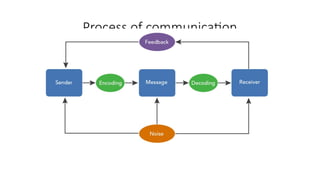
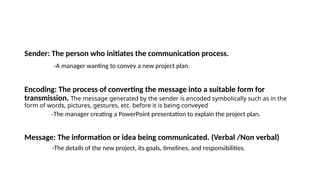
Sender: The personwho initiates the communication process.
-A manager wanting to convey a new project plan.
Encoding: The process of converting the message into a suitable form for
transmission. The message generated by the sender is encoded symbolically such as in the
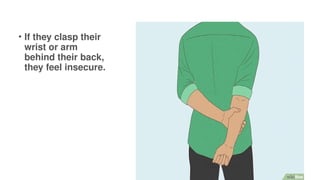
form of words, pictures, gestures, etc. before it is being conveyed
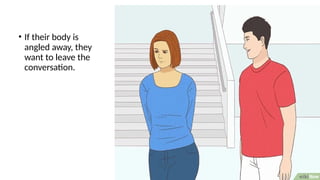
-The manager creating a PowerPoint presentation to explain the project plan.
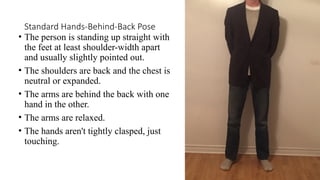
Message: The information or idea being communicated. (Verbal /Non verbal)
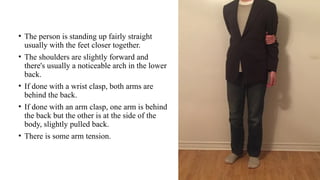
-The details of the new project, its goals, timelines, and responsibilities.
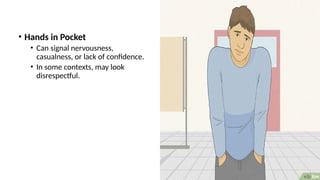
7.
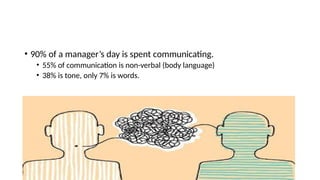
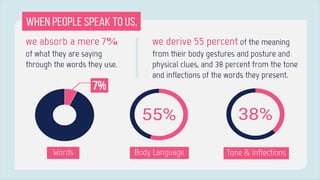
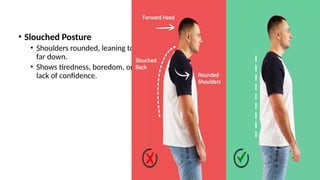
• 90% ofa manager’s day is spent communicating.
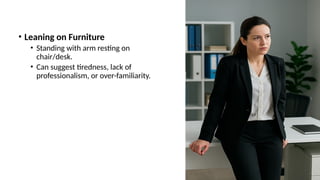
• 55% of communication is non-verbal (body language)
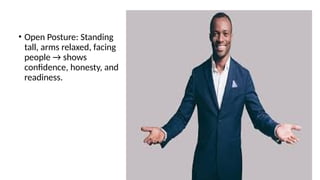
• 38% is tone, only 7% is words.
8.
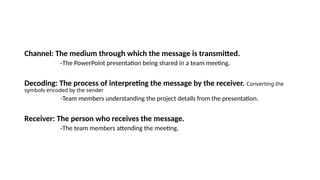
Channel: The mediumthrough which the message is transmitted.
-The PowerPoint presentation being shared in a team meeting.
Decoding: The process of interpreting the message by the receiver. Converting the
symbols encoded by the sender
-Team members understanding the project details from the presentation.
Receiver: The person who receives the message.
-The team members attending the meeting.
9.
Feedback: The receiver'sresponse to the sender.
-Team members asking questions or providing suggestions about the project.
Noise: Any interference that hinders the communication process.
-Background noise during the meeting, technical difficulties with the presentation, or
misunderstandings due to cultural differences.
10.
• A marketingmanager (sender) wants to introduce a new product to
the sales team (receiver). She creates a product presentation
(encoding) and schedules a team meeting (channel). During the
meeting, the sales team (receiver) listens to the presentation and asks
questions (feedback). If there are interruptions or distractions (noise),
the effectiveness of the communication can be impacted.
12.
Types of Communication
VerbalCommunication
Nonverbal Communication
Formal Communication
Informal Communication
Internal Communication
External Communication
Downward Communication
Upward Communication
Lateral/Horizontal Communication
Diagonal/Crosswire Communication
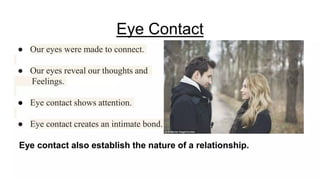
• Conveys
• Confidence
•Attention
• Honesty
• Respect
• Interest
• Too much-aggressive
• Too little-distracted
• Balanced-trust and connection
18.
Tips
• Maintain eyecontact for 60-70% of the conversation
• Break occasionally
• Eye contact+nodding
• Scan the audience
• Triangle technique
• 3 second rule
• Avoid eye darting- rapidly shifting
• Use eye contact to manage the room
• Avoid scanning like a fan
• Online meetings- look at the camera –not the screen
19.
Cultural sensitivity
• Japan-long, direct eye contact- disrespect
• Middle east- prolonged eye contact- disrespect
• USA,UK-steady eye contact-confidence
20.
Good eye contactis like a good wi-fi connection
If it is week…...the connection drops….
23.
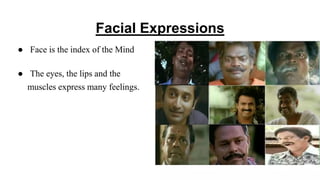
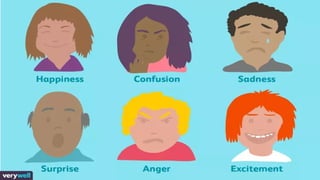
• Facial expressionsare the most universal language
• A smile, frown, anger, surprise, or fear is understood across cultures.
• As managers, leaders, or teachers, your face will often reveal your emotions
before your words do.
• In business:
• A smile can build rapport with clients.
• A frown can discourage team members.
• Raised eyebrows can signal curiosity or disbelief.
24.
• Smile Genuinely(Not Fake)
• Match Expression with
• Control Negative Micro-Expressions
• Use Expressions to Show Listening
• Avoid Over-Exaggeration
• Mirror, Don’t Mimic
25.
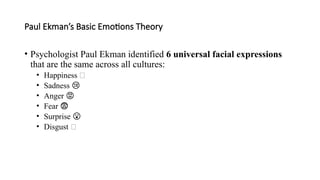
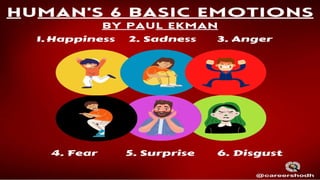
Paul Ekman’s BasicEmotions Theory
• Psychologist Paul Ekman identified 6 universal facial expressions
that are the same across all cultures:
• Happiness 🙂
• Sadness 😢
• Anger 😡
• Fear 😨
• Surprise 😮
• Disgust 🤢
27.
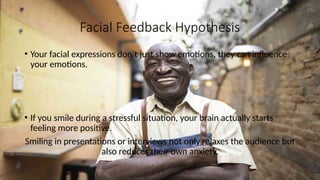
Facial Feedback Hypothesis
•Your facial expressions don’t just show emotions, they can influence
your emotions.
• If you smile during a stressful situation, your brain actually starts
feeling more positive.
Smiling in presentations or interviews not only relaxes the audience but
also reduces their own anxiety.
28.
Micro-expressions Theory- PaulEkman
• A micro-expression is a brief and subtle facial movement which
usually lasts for from 1/25 to 1/5 of a second revealing an emotion a
person is trying to conceal (Ekman and Friesen, 1969; Ekman, 2001;
2003b)
• In HR interviews, a candidate may smile and say “I’m fine” but show
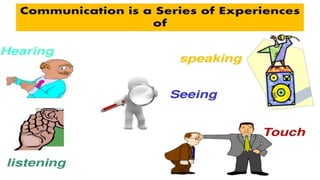
a split-second fear or doubt. Managers trained in this can pick up
hidden cues.
29.
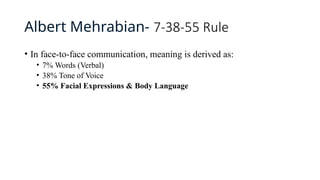
Albert Mehrabian- 7-38-55Rule
• In face-to-face communication, meaning is derived as:
• 7% Words (Verbal)
• 38% Tone of Voice
• 55% Facial Expressions & Body Language
31.
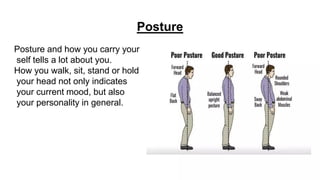
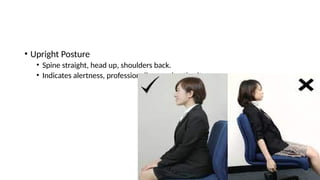
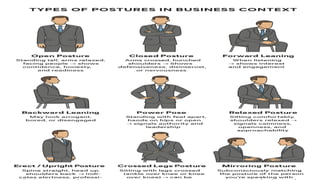
• Upright Posture
•Spine straight, head up, shoulders back.
• Indicates alertness, professionalism, and authority.
32.
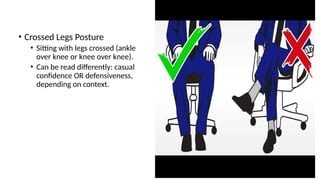
• Crossed LegsPosture
• Sitting with legs crossed (ankle
over knee or knee over knee).
• Can be read differently: casual
confidence OR defensiveness,
depending on context.
33.
• Combine withOther Signals → If you’re smiling, leaning slightly
forward, and keeping good eye contact, crossed legs look relaxed.
• If your arms are folded and you’re leaning back, it looks defensive.
34.
• Mirroring Posture
•Subconsciously matching the posture of the person you’re speaking with.
• Builds rapport, empathy, and trust.
35.
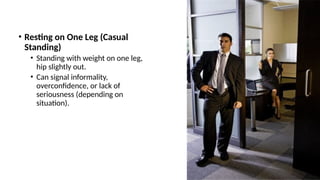
• Resting onOne Leg (Casual
Standing)
• Standing with weight on one leg,
hip slightly out.
• Can signal informality,
overconfidence, or lack of
seriousness (depending on
situation).
36.
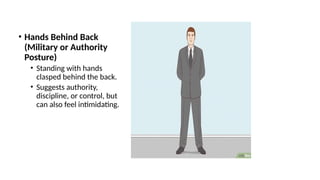
• Hands BehindBack
(Military or Authority
Posture)
• Standing with hands
clasped behind the back.
• Suggests authority,
discipline, or control, but
can also feel intimidating.
37.
• If theyclasp their
wrist or arm
behind their back,
they feel insecure.
38.
• If theirbody is
angled away, they
want to leave the
conversation.
39.
Standard Hands-Behind-Back Pose
•The person is standing up straight with
the feet at least shoulder-width apart
and usually slightly pointed out.
• The shoulders are back and the chest is
neutral or expanded.
• The arms are behind the back with one
hand in the other.
• The arms are relaxed.
• The hands aren't tightly clasped, just
touching.
40.
• The personis standing up fairly straight
usually with the feet closer together.
• The shoulders are slightly forward and
there's usually a noticeable arch in the lower
back.
• If done with a wrist clasp, both arms are
behind the back.
• If done with an arm clasp, one arm is behind
the back but the other is at the side of the
body, slightly pulled back.
• There is some arm tension.
41.
• Hands inPocket
• Can signal nervousness,
casualness, or lack of confidence.
• In some contexts, may look
disrespectful.
42.
• Slouched Posture
•Shoulders rounded, leaning too
far down.
• Shows tiredness, boredom, or
lack of confidence.
43.
• Leaning onFurniture
• Standing with arm resting on
chair/desk.
• Can suggest tiredness, lack of
professionalism, or over-familiarity.
44.
• Open Posture:Standing
tall, arms relaxed, facing
people → shows
confidence, honesty, and
readiness.
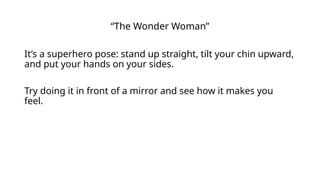
“The Wonder Woman”
It’sa superhero pose: stand up straight, tilt your chin upward,
and put your hands on your sides.
Try doing it in front of a mirror and see how it makes you
feel.
50.
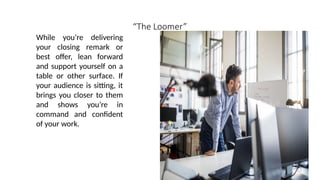
“The Loomer”
While you’redelivering
your closing remark or
best offer, lean forward
and support yourself on a
table or other surface. If
your audience is sitting, it
brings you closer to them
and shows you’re in
command and confident
of your work.
51.
“The Salutation”
Firmly plantyour feet, puff out your chest, lift your chin up,
and stretch your arms as wide as you can with your palms
facing the sky.
52.
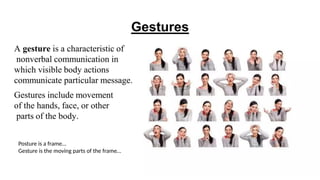
Posture is aframe…
Gesture is the moving parts of the frame…
53.
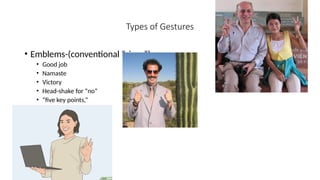
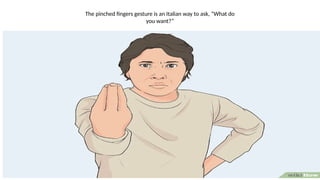
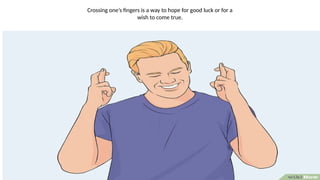
Types of Gestures
•Emblems-(conventional “signs”)
• Good job
• Namaste
• Victory
• Head-shake for “no”
• “five key points,”
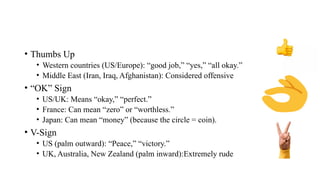
54.
• Thumbs Up
•Western countries (US/Europe): “good job,” “yes,” “all okay.”
• Middle East (Iran, Iraq, Afghanistan): Considered offensive
• “OK” Sign
• US/UK: Means “okay,” “perfect.”
• France: Can mean “zero” or “worthless.”
• Japan: Can mean “money” (because the circle = coin).
• V-Sign
• US (palm outward): “Peace,” “victory.”
• UK, Australia, New Zealand (palm inward):Extremely rude
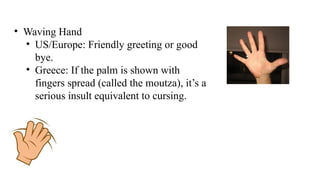
55.
• Waving Hand
•US/Europe: Friendly greeting or good
bye.
• Greece: If the palm is shown with
fingers spread (called the moutza), it’s a
serious insult equivalent to cursing.
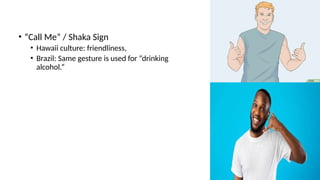
56.
• “Call Me”/ Shaka Sign
• Hawaii culture: friendliness,
• Brazil: Same gesture is used for “drinking
alcohol.”
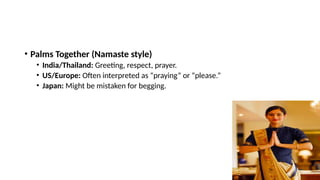
57.
• Palms Together(Namaste style)
• India/Thailand: Greeting, respect, prayer.
• US/Europe: Often interpreted as “praying” or “please.”
• Japan: Might be mistaken for begging.
Illustrators (support whatyou’re saying)
• Iconic: Draw the shape/size/motion.
• “Market size is this big” (hands spread),
• “pipeline flows like this” (wavy hand).
• Deictic (pointing): Indicate people/objects/slide areas.
• “On the left is cost, on the right is revenue.”
• “Look there!”
• Beat gestures: Small rhythmic flicks that mark emphasis.Great for key
phrases:
• “Three priorities: Speed. Quality. Cost.”
• In ateam meeting, Rahul finishes a point and looks at Priya. Priya
understands it’s her turn to respond.
• During a presentation, the speaker makes eye contact with different
audience members to keep them engaged.
63.
• Manual RegulationSignals
• Using hand gestures to guide conversation rhythm.
• Hands can serve as signals to pause, continue, or invite someone else to
speak. It helps avoid interruptions and keeps discussions smooth.
64.
• A managerraises a hand slightly during a heated debate to pause the
discussion.
• In a brainstorming session, a participant gestures towards a colleague
to invite them to share their idea.
65.
• Expressive FacialDirectives
• Using facial expressions as cues in conversation.
• Your face can show approval, disagreement, encouragement, or confusion
without words. It helps manage dialogue naturally.
66.
• Nodding whilesomeone is speaking shows agreement or
understanding.
• Raising eyebrows when surprised signals curiosity or prompts the
speaker to explain further.
• Smiling while someone shares an idea encourages them to continue.
67.
• Posture Adjustmentsfor Engagement
• Using body posture to show involvement or disengagement.
68.
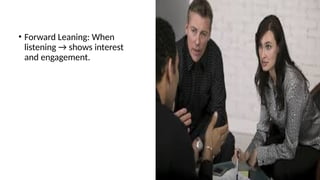
• Leaning induring a colleague’s presentation shows you are listening
carefully.
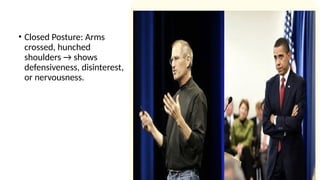
• Crossing arms and leaning back in a meeting might unintentionally
signal resistance or disinterest.
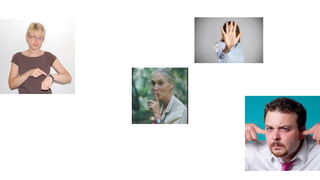
Adaptors (stress-relief habits)
•Adaptors are unconscious gestures or movements people use to
satisfy personal needs, manage emotions, or cope with stress during
communication. Unlike deliberate gestures, adaptors often happen
automatically and reveal inner feelings.
72.
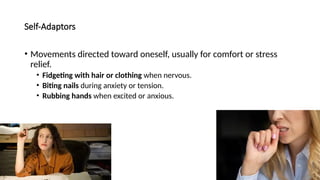
Self-Adaptors
• Movements directedtoward oneself, usually for comfort or stress
relief.
• Fidgeting with hair or clothing when nervous.
• Biting nails during anxiety or tension.
• Rubbing hands when excited or anxious.
73.
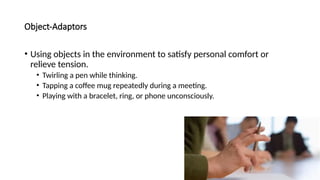
Object-Adaptors
• Using objectsin the environment to satisfy personal comfort or
relieve tension.
• Twirling a pen while thinking.
• Tapping a coffee mug repeatedly during a meeting.
• Playing with a bracelet, ring, or phone unconsciously.
75.
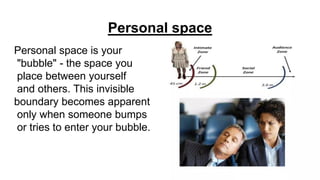
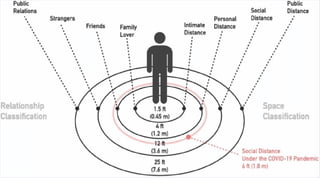
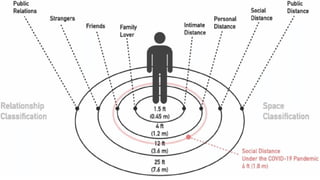
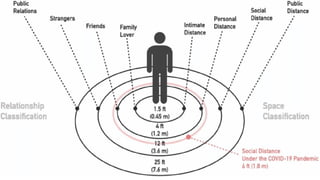
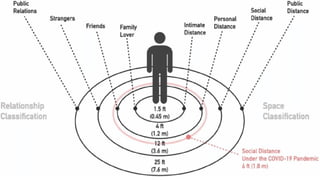
• Proxemics isthe study of how people use and perceive physical
space in communication. It reflects relationships, social norms, power
dynamics, and cultural expectations. Essentially, it’s about personal
space and territoriality in interactions.
• The term was introduced by Edward T. Hall, a cultural anthropologist,
in the 1960s.
78.
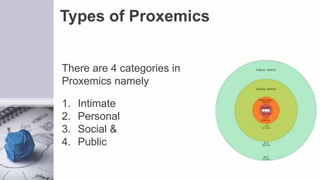
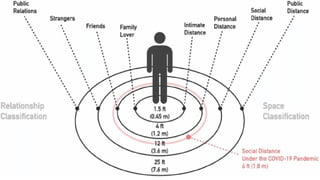
• Intimate Distance(0 – 18 inches / 0 – 45 cm)
• Reserved for close relationships: family, partners, or very close friends.
• Whispers, and private conversations are common.
• Hugging a friend or partner.
• Whispering a secret to a colleague you are very close to.
81.
• Personal Distance(1.5 – 4 feet / 45 cm – 1.2 m)
• Comfortable for conversations among friends and acquaintances.
• Encourages interaction without feeling intrusive.
• Chatting with a co-worker during a coffee break.
• Sitting next to a classmate while discussing a project.
84.
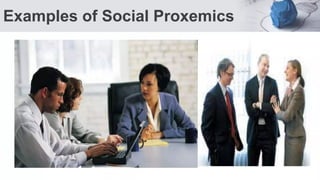
• Social Distance(4 – 12 feet / 1.2 – 3.6 m)
• Suitable for professional or formal interactions.
• Typical in workplace settings, business meetings, or networking.
• Sitting across a table in a business meeting.
• Talking to a lecturer during office hours.
87.
• Public Distance(12+ feet / 3.6+ m)
• Used for formal speeches, lectures, or addressing large groups.
• Prevents personal interaction; establishes authority or formality.
• A CEO addressing employees from a stage.
• A teacher giving a lecture to a large class.
90.
Haptics
• Haptics isthe study of touch as a form of communication.
• It is one of the most powerful nonverbal cues but is highly contextual
and culturally dependent.
91.
• Functional/Professional Touch
•Task-oriented, often in professional contexts.
• Purposeful, usually on neutral body areas (hands, forearms) and accompanied
by task-related speech.
• A doctor examining a patient, a barber cutting hair, or a teacher guiding a
student’s hand during a practical task.
• A physiotherapist guiding a patient’s limb during rehab.
92.
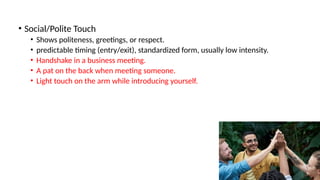
• Social/Polite Touch
•Shows politeness, greetings, or respect.
• predictable timing (entry/exit), standardized form, usually low intensity.
• Handshake in a business meeting.
• A pat on the back when meeting someone.
• Light touch on the arm while introducing yourself.
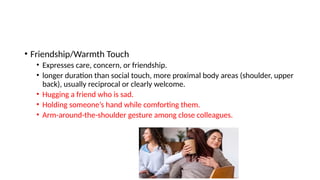
93.
• Friendship/Warmth Touch
•Expresses care, concern, or friendship.
• longer duration than social touch, more proximal body areas (shoulder, upper
back), usually reciprocal or clearly welcome.
• Hugging a friend who is sad.
• Holding someone’s hand while comforting them.
• Arm-around-the-shoulder gesture among close colleagues.
94.
• Love/Intimacy Touch
•Expresses romantic or deep emotional connection.
• sustained duration, strongly reciprocal
• inappropriate in workplace
• Holding hands with a partner.
• Gentle kiss on the cheek of a loved one.
• Cuddling or embracing a partner.
95.
• Aggressive/Control Touch
•Can convey dominance, aggression, or control.
• sudden, firm, not reciprocal, often accompanied by angry tone or tense facial
expression. Usually signals conflict or boundary violation.
• Grabbing someone’s arm to stop them from leaving.
• Slapping or pushing in anger.
97.
Paralanguage
• The nonverbalpart of our speech.
• It’s the tone, pitch, speed, pauses, volume, and emphasis that
accompany our words.
• If words are the message, paralanguage is the emotion that carries
them.
98.
Components of Paralanguage
Pitch(Highness or lowness of voice)
• Pitch conveys emotions and intentions.
• High Pitch:
• High-steady: Excitement (“Oh wow, that’s amazing!!”)
• High-shaky: Nervousness (“I… I really think I can do this, sir…”)
• Low Pitch- steady
• Authority (“This strategy will work. I have tested it.”)
• Seriousness (“We need to discuss this issue carefully.”)
99.
Volume (Loudness orsoftness of voice)
• Volume shows energy, mood, and importance.
• Too loud = aggressive, overpowering.
• Too soft = timid, lacking confidence.
Pauses / Silence
•Pauses create emphasis and give listeners time to absorb.
• Silence can show hesitation or create dramatic effect.
• Pauses and silence are not empty spaces — they are tools.
• A pause can highlight your most important idea.
• A silence can create suspense or show confidence.
102.
Intonation / Modulation(Rising and falling patterns in speech)
• Monotone = boring, robotic.
• Varied intonation = engaging, expressive.
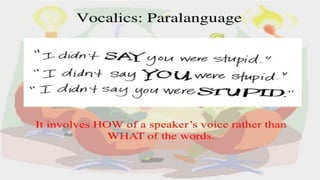
103.
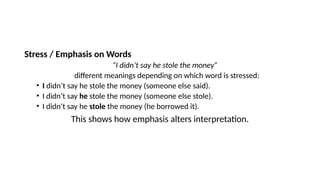
Stress / Emphasison Words
“I didn’t say he stole the money”
different meanings depending on which word is stressed:
• I didn’t say he stole the money (someone else said).
• I didn’t say he stole the money (someone else stole).
• I didn’t say he stole the money (he borrowed it).
This shows how emphasis alters interpretation.
104.
Fillers / Vocalizations
•Sounds like “uhh,” “umm,” “you know,” used while thinking.
• Too many fillers = nervousness or lack of preparation.
105.
Power distance
• Powerdistance refers to the extent to which people in an organization
or society accept unequal distribution of power.
• It affects how freely individuals communicate with superiors or subordinates.
• High Power Distance: Employees expect leaders to give directions;
subordinates rarely challenge authority or speak up.
• Low Power Distance: Employees feel comfortable sharing ideas,
questioning decisions, and giving feedback regardless of hierarchy.
106.
High PD
Characteristics:
• Upwardcommunication: Very limited; employees rarely report
problems directly.
• Downward communication: Strict instructions; little explanation or
dialogue.
• Horizontal communication: Limited; peers hesitate to challenge or
share ideas.
• Informal communication: Exists, but employees may hide concerns or
dissatisfaction.
107.
Low PD
Characteristics:
• Upwardcommunication: Open and encouraged; employees freely
share ideas and concerns.
• Downward communication: Managers explain reasons; dialogue is
encouraged.
• Horizontal communication: Open and collaborative; peer teams share
information.
• Informal communication: Supports innovation and quick problem-
solving.
108.
How Power DistanceInfluences
Communication
Upward Communication
• High Power Distance: Employees hesitate to report bad news,
concerns, or innovative ideas to senior management.
• Example: In the Nokia case, engineers didn’t speak up about outdated
technology because they feared management’s reaction.
• Low Power Distance: Employees openly share feedback and
suggestions, promoting innovation and problem-solving.
109.
Downward Communication
• HighPower Distance: Managers expect obedience; instructions are
given without much explanation.
• Employees follow orders without questioning.
• Low Power Distance: Managers explain reasoning, encourage
questions, and foster dialogue.
110.
• High PDOrganizations: May have clear hierarchy and discipline, but
risk missing employee insights, innovation, and early warning signals.
• Low PD Organizations: Encourage creativity and problem-solving, but
require managers to balance authority and freedom to avoid
confusion.
111.
GlobalTech Inc. isa leading technology firm specializing in software development and
IT solutions. With headquarters in Silicon Valley, USA, the company has expanded its
operations to India to leverage the country's vast talent pool. The workforce in the US
is characterized by a relatively low power distance, promoting open communication
and egalitarian management styles. Conversely, India has a higher power distance,
where hierarchical structures are more pronounced. As GlobalTech Inc. continues to
grow, it faces challenges related to cultural differences in its teams. The US office
promotes an open-door policy, encouraging employees to share ideas and challenge
their superiors. In contrast, Indian team members are often hesitant to voice concerns
or suggestions directly to their managers, resulting in missed opportunities for
innovation and collaboration.
• How can GlobalTech Inc. foster cultural awareness among its employees to bridge the
gap between the two offices? What training programs could be implemented?
• What strategies can the management employ to enhance communication between
the US and Indian teams? How can they encourage Indian employees to share their
ideas?
112.
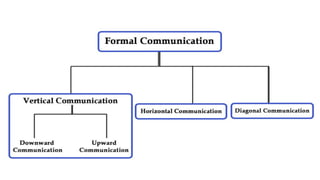
Formal Communication
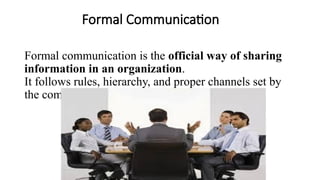
Formal communicationis the official way of sharing
information in an organization.
It follows rules, hierarchy, and proper channels set by
the company.
114.
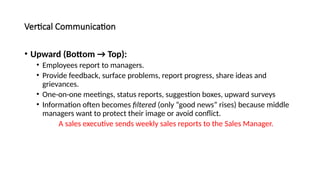
Vertical Communication
• Upward(Bottom → Top):
• Employees report to managers.
• Provide feedback, surface problems, report progress, share ideas and
grievances.
• One-on-one meetings, status reports, suggestion boxes, upward surveys
• Information often becomes filtered (only “good news” rises) because middle
managers want to protect their image or avoid conflict.
A sales executive sends weekly sales reports to the Sales Manager.
115.
Common Barriers
• Fearof retaliation; lack of anonymity for negative feedback.
• Perceived irrelevance (“they won’t act on it”).
• Complexity of formal reporting procedures.
• Poor upward channels (no structured template).
116.
Vertical Communication
• Downward(Top → Bottom):
• Managers give instructions to employees.
HR Head informs staff about a new leave policy.
• Memos, emails, performance reviews, manager meetings.
117.
Common Barriers
• Ambiguouslanguage
• Inconsistent messages,
• Information overload,
• “Cascading distortion” (message changes as it moves down).
118.
Horizontal or Lateral
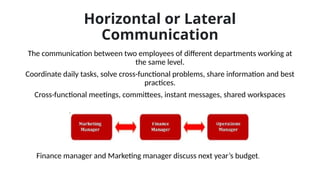
Communication
Thecommunication between two employees of different departments working at
the same level.
Coordinate daily tasks, solve cross-functional problems, share information and best
practices.
Cross-functional meetings, committees, instant messages, shared workspaces
Finance manager and Marketing manager discuss next year’s budget.
119.
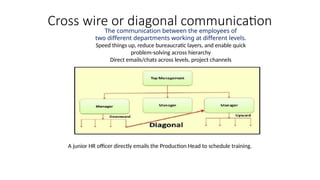
Cross wire ordiagonal communication
The communication between the employees of
two different departments working at different levels.
Speed things up, reduce bureaucratic layers, and enable quick
problem-solving across hierarchy
Direct emails/chats across levels, project channels
A junior HR officer directly emails the Production Head to schedule training.
120.
Informal Communication-Case ofTata Nano
Back in 2008, Tata Motors launched an ambitious dream project, the Tata Nano, known as the “people’s car.” The
company decided to set up its plant in Singur, West Bengal, after formal agreements with the state government. On
paper, everything looked smooth: the government officially announced compensation plans for farmers whose land
was acquired, Tata issued press releases about job creation, and formal meetings were held between officials and
community leaders. But beneath this layer of formal communication, another powerful stream of messages was
flowing. In villages around Singur, people gathered at tea stalls, markets, and homes, where informal conversations
spread rapidly. Rumors started circulating that farmers would lose their land forever, that compensation would not
reach them, and that jobs in the factory would go only to outsiders. This informal grapevine communication spread
much faster than official notices and created widespread fear and anger. Even when the government tried to clarify
matters through speeches and memos, the informal channel had already shaped people’s perceptions. The protests
grew stronger, sometimes turning violent, until finally Tata Motors had no choice but to abandon the Singur project
and shift the Nano plant to Gujarat.
121.
The Nano caseshows how even the biggest corporate decisions can fail
if informal communication is not understood or managed, because
sometimes the grapevine is more powerful than the circular.
122.
Informal communication
• Informalcommunication is the unofficial, spontaneous flow of
information that happens in an organization outside formal channels.
• Unlike formal communication, it doesn’t follow hierarchy, official
memos, or pre-defined procedures.
• It’s often called the “grapevine” because information spreads rapidly
123.
• It canhappen vertically, horizontally, or diagonally, but not through
official channels.
• It is faster than formal communication but may distort information.
• It reflects real emotions, perceptions, and reactions of employees.
125.
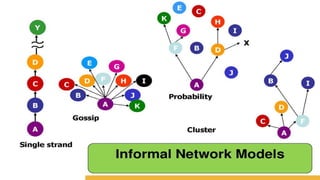
Single-Strand Chain
• Informationpasses sequentially from one person to the next, like a
chain link.
• Often slower than gossip or probability chains but less distorted.
• A junior employee passes a suggestion to a peer, who passes it to
another, and eventually it reaches a manager.
126.
Gossip Chain
• Informationspreads from one person to another through informal
talk.
• Often focused on personal or sensitive issues, rumors, or office news,
often exaggerated or opinion-based.
• Tata Nano case, villagers shared their fears and doubts about land
compensation through tea-stall conversations and word-of-mouth.
127.
Probability Chain
• Informationspreads randomly; each person passes it to some others,
not necessarily in a fixed manner and not necessarily personal
• Can resemble a “telephone game,” where messages get distorted
over time.
• A student hears from a friend that exams might be postponed. By the
time it reaches the tenth student, the message may have changed to
“Exams postponed by a month.”
128.
Cluster Chain
• Afew people actively share information with a select group, who then
pass it along to their own sub-groups.
• Information moves selectively rather than to everyone at once
• In a corporate office, a few employees hear that management is
planning a new bonus policy and share it only with their closest
friends before it becomes public.
• Impact: Can create “in-groups” and “out-groups” but spreads info
faster than official channels.
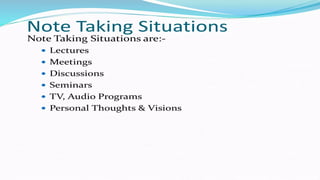
• Note-taking skillsare the ability to listen, understand, and record key
information quickly and effectively during communication (lectures,
meetings, interviews, training, etc.).
132.
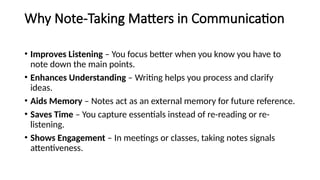
Why Note-Taking Mattersin Communication
• Improves Listening – You focus better when you know you have to
note down the main points.
• Enhances Understanding – Writing helps you process and clarify
ideas.
• Aids Memory – Notes act as an external memory for future reference.
• Saves Time – You capture essentials instead of re-reading or re-
listening.
• Shows Engagement – In meetings or classes, taking notes signals
attentiveness.
133.
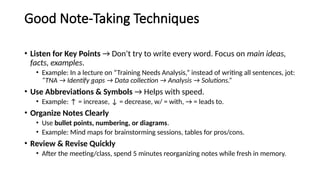
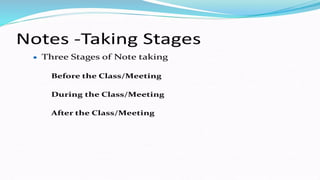
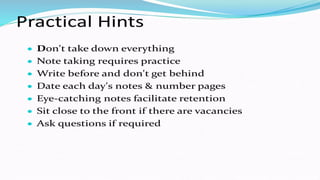
Good Note-Taking Techniques
•Listen for Key Points → Don’t try to write every word. Focus on main ideas,
facts, examples.
• Example: In a lecture on “Training Needs Analysis,” instead of writing all sentences, jot:
“TNA → Identify gaps → Data collection → Analysis → Solutions.”
• Use Abbreviations & Symbols → Helps with speed.
• Example: ↑ = increase, ↓ = decrease, w/ = with, → = leads to.
• Organize Notes Clearly
• Use bullet points, numbering, or diagrams.
• Example: Mind maps for brainstorming sessions, tables for pros/cons.
• Review & Revise Quickly
• After the meeting/class, spend 5 minutes reorganizing notes while fresh in memory.
134.
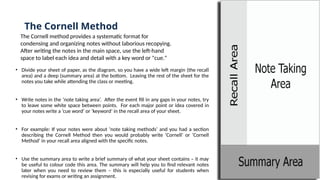
The Cornell Method
•Divide your sheet of paper, as the diagram, so you have a wide left margin (the recall
area) and a deep (summary area) at the bottom. Leaving the rest of the sheet for the
notes you take while attending the class or meeting.
• Write notes in the ‘note taking area’. After the event fill in any gaps in your notes, try
to leave some white space between points. For each major point or idea covered in
your notes write a ‘cue word’ or ‘keyword’ in the recall area of your sheet.
• For example: If your notes were about ‘note taking methods’ and you had a section
describing the Cornell Method then you would probably write ‘Cornell’ or ‘Cornell
Method’ in your recall area aligned with the specific notes.
• Use the summary area to write a brief summary of what your sheet contains – it may
be useful to colour code this area. The summary will help you to find relevant notes
later when you need to review them – this is especially useful for students when
revising for exams or writing an assignment.
The Cornell method provides a systematic format for
condensing and organizing notes without laborious recopying.
After writing the notes in the main space, use the left-hand
space to label each idea and detail with a key word or "cue."
135.
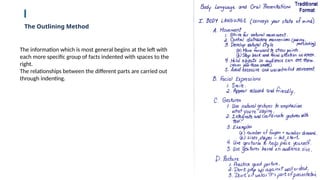
The Outlining Method
Theinformation which is most general begins at the left with
each more specific group of facts indented with spaces to the
right.
The relationships between the different parts are carried out
through indenting.
136.
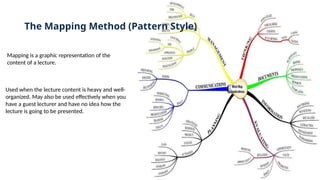
The Mapping Method(Pattern Style)
Mapping is a graphic representation of the
content of a lecture.
Used when the lecture content is heavy and well-
organized. May also be used effectively when you
have a guest lecturer and have no idea how the
lecture is going to be presented.
137.
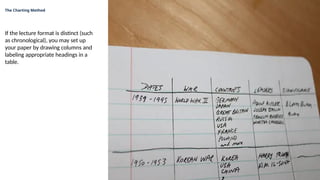
The Charting Method
Ifthe lecture format is distinct (such
as chronological), you may set up
your paper by drawing columns and
labeling appropriate headings in a
table.
138.
The Sentence Method
•Write every new thought, fact or topic on a separate line,
numbering as you progress.
• Use when the lecture is somewhat organized, but heavy
with content which comes fast.
142.
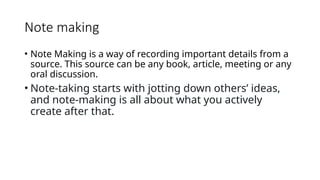
Note making
• NoteMaking is a way of recording important details from a
source. This source can be any book, article, meeting or any
oral discussion.
• Note-taking starts with jotting down others’ ideas,
and note-making is all about what you actively
create after that.
143.
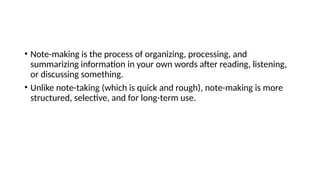
• Note-making isthe process of organizing, processing, and
summarizing information in your own words after reading, listening,
or discussing something.
• Unlike note-taking (which is quick and rough), note-making is more
structured, selective, and for long-term use.
144.
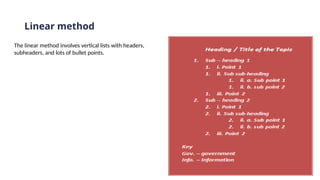
Linear method
The linearmethod involves vertical lists with headers,
subheaders, and lots of bullet points.
145.
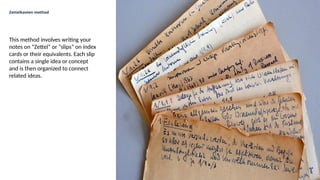
Zettelkasten method
This methodinvolves writing your
notes on “Zettel” or “slips” on index
cards or their equivalents. Each slip
contains a single idea or concept
and is then organized to connect
related ideas.
148.
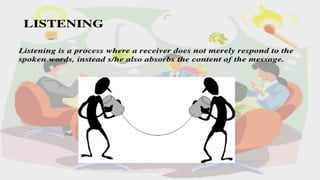
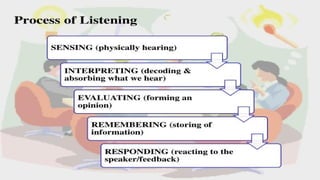
Sensing:
This is theinitial stage where you receive the sound waves or visual cues from the speaker. It involves
physically hearing or seeing the message. It is also known as the "hearing" stage.
During a presentation, you hear the speaker’s voice and see their gestures. You are focusing your attention on the
speaker, filtering out other distractions like background noise.
Interpreting:
In this stage, you try to understand the meaning of the message by interpreting the words, tone, and
body language. It involves making sense of what is being communicated.
A colleague says, “I’m fine,” but their tone is flat, and they avoid eye contact. You interpret that they might not be okay, even though
their words suggest otherwise.
Evaluating:
This involves analyzing and forming a judgment about the message. You assess its relevance,
credibility, and implications, deciding how to react to what you’ve heard.
When a salesperson explains the benefits of a product, you evaluate their claims by considering whether they sound realistic or if
there is any supporting evidence, like reviews or demonstrations.
149.
Remembering:
This stage isabout retaining and recalling the information that was shared. Effective
remembering ensures you can later refer to the details of the conversation accurately.
During a training session, you remember key points about using new software so you can apply them when working on a project
later.
Responding:
This is the feedback stage where you provide a reaction to the speaker. It could be verbal
(like asking questions or sharing thoughts) or non-verbal (like nodding, smiling, or
maintaining eye contact).
150.
Types of Listening
•Pretending Listening
• This type of listening involves acting as if you are paying attention while your
mind is elsewhere. You might nod, smile, or give short responses to create the
impression of engagement, but you're not actually absorbing the information.
• Selective Listening
• Selective listening is when you only hear parts of the conversation that interest
you or align with your views. The listener tends to ignore or filter out anything
they deem irrelevant or disagreeable.
151.
• Attentive Listening
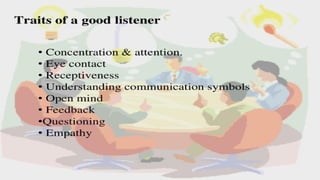
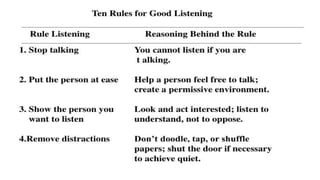
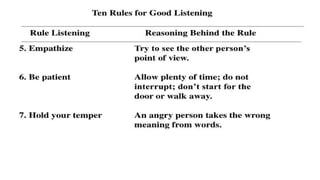
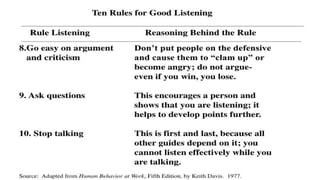
•This style involves giving your full attention to the speaker. You actively engage by listening
carefully to the content, asking questions, and making sure you understand what is being
said.
• Empathetic Listening
• Empathetic listening goes beyond just hearing words; it involves understanding the speaker’s
feelings, emotions, and perspective. It requires showing compassion and offering emotional
support.
152.
• Intuitive Listening
•Intuitive listening means picking up on subtle cues, like body language, tone
of voice, or what is left unsaid. It involves reading between the lines and
understanding the unspoken messages.
• During a performance review, the manager notices that although the employee says
everything is fine, their voice sounds tense, and they avoid eye contact. The manager
senses something is wrong and gently asks if there’s anything troubling them, opening
the door for a deeper conversation.