1
Executive Summary
Branch networking is changing as applications move to the cloud and the Internet edge
moves to the branch. In addition, mobility is putting more pressure on the network with
bring your own device adoption and the proliferation of bandwidth-intensive video
applications. In response, IT must meet expanding bandwidth requirements, increasing
user expectations for high network availability and quality of experience, and
strengthen its network visibility and control capabilities. Despite these challenges, WAN
budgets are flat for the majority of companies.
The Cisco Intelligent WAN (IWAN) solution combines secure connectivity, performance-
based routing technology and dual transport links at the branch to improve the
availability, quality, and security of the WAN while reducing its cost. IWAN employs the
Cisco ISR-AX integrated services router and dual transport links that allow IT to
augment premium-priced WAN services without sacrificing network requirements.
IWAN features transport independence, secure connectivity, intelligent path control,
and application optimization.
ACG Research analyzed four approaches to replacing all or some MPLS VPN WAN
services with business broadband Internet services without compromising network
availability. It found service cost savings of 34 percent to 81 percent, project payback of
five to 11 months, and return on investment (ROI) of 199 percent to 1,220 percent for
three years of monthly cash flows. Network downtime can be reduced by 79 percent by
adding a second router at each branch. This does not affect monthly savings but it
doubles project payback; none-the-less ROI is 279 percent when dual broadband
services are used. IWAN also greatly increases bandwidth utilization by making both
bandwidth paths active simultaneously. In addition, IWAN offers features to support
secure direct Internet access, where guest access or Software-as-a-Service can be
automatically offloaded to the Internet. This eliminates the costly and performance
diminishing practice of backhauling Internet traffic to the data center. Also, throughput
and application performance are enhanced through application-specific optimization
capabilities.
Business Case for Cisco Intelligent WAN
KEY FINDINGS
Cisco IWAN makes it feasible
to adopt low-cost Internet
services to augment
premium WAN services
without compromising
security, network availability,
quality or service for branch
networks. Case studies for
four alternative network
configurations found:
Transport service cost
savings of 34% to 81%
Payback on the IWAN
investment of 5 to 11
months
ROI of 199% to 1,220% for
99.998% availability (24
minutes a year downtime)
Addition of a second
router at each branch
increases availability to
99.999% (5 minutes a year
of downtime)
2
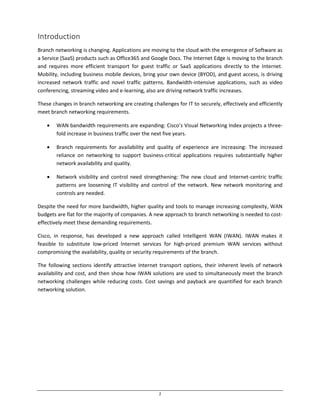
Introduction
Branch networking is changing. Applications are moving to the cloud with the emergence of Software as
a Service (SaaS) products such as Office365 and Google Docs. The Internet Edge is moving to the branch
and requires more efficient transport for guest traffic or SaaS applications directly to the Internet.
Mobility, including business mobile devices, bring your own device (BYOD), and guest access, is driving
increased network traffic and novel traffic patterns. Bandwidth-intensive applications, such as video
conferencing, streaming video and e-learning, also are driving network traffic increases.
These changes in branch networking are creating challenges for IT to securely, effectively and efficiently
meet branch networking requirements.
WAN bandwidth requirements are expanding: Cisco’s Visual Networking Index projects a three-
fold increase in business traffic over the next five years.
Branch requirements for availability and quality of experience are increasing: The increased
reliance on networking to support business-critical applications requires substantially higher
network availability and quality.
Network visibility and control need strengthening: The new cloud and Internet-centric traffic
patterns are loosening IT visibility and control of the network. New network monitoring and
controls are needed.
Despite the need for more bandwidth, higher quality and tools to manage increasing complexity, WAN
budgets are flat for the majority of companies. A new approach to branch networking is needed to cost-
effectively meet these demanding requirements.
Cisco, in response, has developed a new approach called Intelligent WAN (IWAN). IWAN makes it
feasible to substitute low-priced Internet services for high-priced premium WAN services without
compromising the availability, quality or security requirements of the branch.
The following sections identify attractive Internet transport options, their inherent levels of network
availability and cost, and then show how IWAN solutions are used to simultaneously meet the branch
networking challenges while reducing costs. Cost savings and payback are quantified for each branch
networking solution.
3
Branch WAN Today
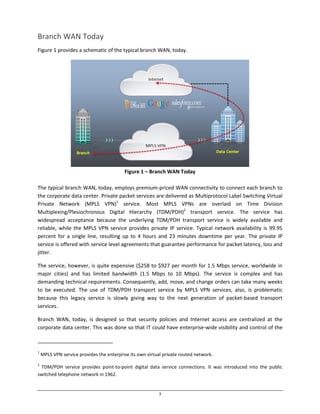
Figure 1 provides a schematic of the typical branch WAN, today.
Figure 1 – Branch WAN Today
The typical branch WAN, today, employs premium-priced WAN connectivity to connect each branch to
the corporate data center. Private packet services are delivered as Multiprotocol Label Switching Virtual
Private Network (MPLS VPN)1
service. Most MPLS VPNs are overlaid on Time Division
Multiplexing/Plesiochronous Digital Hierarchy (TDM/PDH)2
transport service. The service has
widespread acceptance because the underlying TDM/PDH transport service is widely available and
reliable, while the MPLS VPN service provides private IP service. Typical network availability is 99.95
percent for a single line, resulting up to 4 hours and 23 minutes downtime per year. The private IP
service is offered with service level agreements that guarantee performance for packet latency, loss and
jitter.
The service, however, is quite expensive ($258 to $927 per month for 1.5 Mbps service, worldwide in
major cities) and has limited bandwidth (1.5 Mbps to 10 Mbps). The service is complex and has
demanding technical requirements. Consequently, add, move, and change orders can take many weeks
to be executed. The use of TDM/PDH transport service by MPLS VPN services, also, is problematic
because this legacy service is slowly giving way to the next generation of packet-based transport
services.
Branch WAN, today, is designed so that security policies and Internet access are centralized at the
corporate data center. This was done so that IT could have enterprise-wide visibility and control of the
1
MPLS VPN service provides the enterprise its own virtual private routed network.
2
TDM/PDH service provides point-to-point digital data service connections. It was introduced into the public
switched telephone network in 1962.
4
network and to deliver uniform security policies across the enterprise. This approach made sense when
most corporate applications were hosted in the data center. However, now that an increasing
proportion of branch applications are hosted in the cloud this indirect connection to the Internet (See
red curve in Figure 1) limits the performance of both Internet and private network services and
unnecessarily increases costs. In this network design, backup network connectivity is provided by one
active and one inactive WAN connection to each branch. Significant bandwidth capacity is,
consequently, wasted since outages are only incurred 0.05 percent of the time for each connection.
Modern Business Internet Services
Modern business Internet services have changed radically since network architects chose the premium-
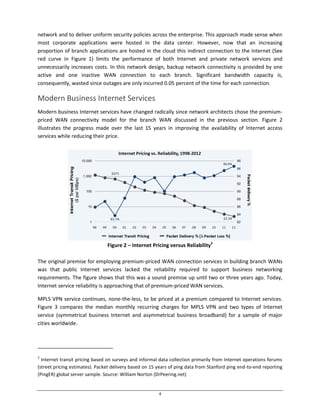
priced WAN connectivity model for the branch WAN discussed in the previous section. Figure 2
illustrates the progress made over the last 15 years in improving the availability of Internet access
services while reducing their price.
Figure 2 – Internet Pricing versus Reliability3
The original premise for employing premium-priced WAN connection services in building branch WANs
was that public Internet services lacked the reliability required to support business networking
requirements. The figure shows that this was a sound premise up until two or three years ago. Today,
Internet service reliability is approaching that of premium-priced WAN services.
MPLS VPN service continues, none-the-less, to be priced at a premium compared to Internet services.
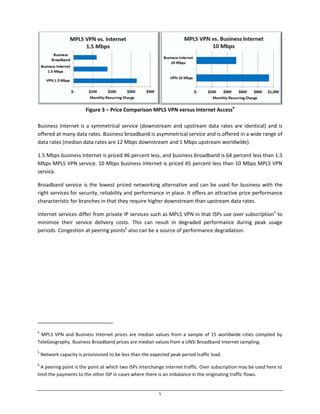
Figure 3 compares the median monthly recurring charges for MPLS VPN and two types of Internet
service (symmetrical business Internet and asymmetrical business broadband) for a sample of major
cities worldwide.
3
Internet transit pricing based on surveys and informal data collection primarily from Internet operations forums
(street pricing estimates). Packet delivery based on 15 years of ping data from Stanford ping end-to-end reporting
(PingER) global server sample. Source: William Norton (DrPeering.net)
5
Figure 3 – Price Comparison MPLS VPN versus Internet Access4
Business Internet is a symmetrical service (downstream and upstream data rates are identical) and is
offered at many data rates. Business broadband is asymmetrical service and is offered in a wide range of
data rates (median data rates are 12 Mbps downstream and 1 Mbps upstream worldwide).
1.5 Mbps business Internet is priced 46 percent less, and business broadband is 64 percent less than 1.5
Mbps MPLS VPN service. 10 Mbps business Internet is priced 45 percent less than 10 Mbps MPLS VPN
service.
Broadband service is the lowest priced networking alternative and can be used for business with the
right services for security, reliability and performance in place. It offers an attractive price performance
characteristic for branches in that they require higher downstream than upstream data rates.
Internet services differ from private IP services such as MPLS VPN in that ISPs use over subscription5
to
minimize their service delivery costs. This can result in degraded performance during peak usage
periods. Congestion at peering points6
also can be a source of performance degradation.
4
MPLS VPN and Business Internet prices are median values from a sample of 15 worldwide cities compiled by
TeleGeography. Business Broadband prices are median values from a UNSi Broadband Internet sampling.
5
Network capacity is provisioned to be less than the expected peak period traffic load.
6
A peering point is the point at which two ISPs interchange Internet traffic. Over subscription may be used here to
limit the payments to the other ISP in cases where there is an imbalance in the originating traffic flows.
6
IWAN Branch Networking Solution
The IWAN solution combines secure connectivity, performance-based routing technology and dual
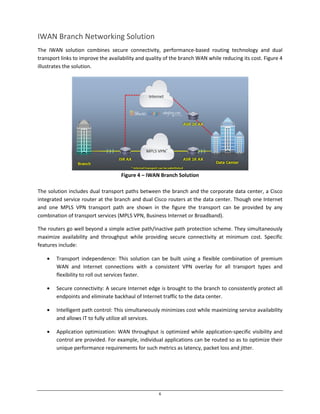
transport links to improve the availability and quality of the branch WAN while reducing its cost. Figure 4
illustrates the solution.
Figure 4 – IWAN Branch Solution
The solution includes dual transport paths between the branch and the corporate data center, a Cisco
integrated service router at the branch and dual Cisco routers at the data center. Though one Internet
and one MPLS VPN transport path are shown in the figure the transport can be provided by any
combination of transport services (MPLS VPN, Business Internet or Broadband).
The routers go well beyond a simple active path/inactive path protection scheme. They simultaneously
maximize availability and throughput while providing secure connectivity at minimum cost. Specific
features include:
Transport independence: This solution can be built using a flexible combination of premium
WAN and Internet connections with a consistent VPN overlay for all transport types and
flexibility to roll out services faster.
Secure connectivity: A secure Internet edge is brought to the branch to consistently protect all
endpoints and eliminate backhaul of Internet traffic to the data center.
Intelligent path control: This simultaneously minimizes cost while maximizing service availability
and allows IT to fully utilize all services.
Application optimization: WAN throughput is optimized while application-specific visibility and
control are provided. For example, individual applications can be routed so as to optimize their
unique performance requirements for such metrics as latency, packet loss and jitter.
7
Delivering Premium WAN Reliability at Internet Prices
Branches are not simply using the network more; they also are using it for more important business
activities. Network applications that affect routine work processes such as customer or supply chain
management make network availability vital to business success. The decision to employ a high-
availability network design must consider factors such as branch size, the use of critical applications and
the business-wide impact of a network outage versus the added cost of the design.
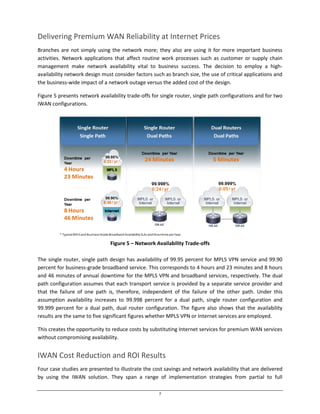
Figure 5 presents network availability trade-offs for single router, single path configurations and for two
IWAN configurations.
Figure 5 – Network Availability Trade-offs
The single router, single path design has availability of 99.95 percent for MPLS VPN service and 99.90
percent for business-grade broadband service. This corresponds to 4 hours and 23 minutes and 8 hours
and 46 minutes of annual downtime for the MPLS VPN and broadband services, respectively. The dual
path configuration assumes that each transport service is provided by a separate service provider and
that the failure of one path is, therefore, independent of the failure of the other path. Under this
assumption availability increases to 99.998 percent for a dual path, single router configuration and
99.999 percent for a dual path, dual router configuration. The figure also shows that the availability
results are the same to five significant figures whether MPLS VPN or Internet services are employed.
This creates the opportunity to reduce costs by substituting Internet services for premium WAN services
without compromising availability.
IWAN Cost Reduction and ROI Results
Four case studies are presented to illustrate the cost savings and network availability that are delivered
by using the IWAN solution. They span a range of implementation strategies from partial to full
8
substitution of Internet for MPLS VPN services and demonstrate the trade-offs between business
Internet and business broadband Internet services. All of the case studies are for a network consisting of
100 branches and one data center hub site. A cost comparison is made for the branch transport services.
ROI and payback are computed to compare the cost of the initial investment in ISR-AX branch routers
with the savings in monthly service charges. The investment includes the cost of the routers, their
installation costs, and their service costs. The ROI computation is for three years.
Dual MPLS VPN versus MPLS VPN/Business Internet Hybrid
This case compares the cost of providing dual transport links of 1.5 Mbps and 10 Mbps using MPLS VPN
service versus a hybrid alternative where the 1.5 Mbps MPLS VPN is retained while a 10 Mbps business
Internet service replaces the 10 Mbps MPLS VPN service. This approach could be used to give business-
critical applications priority access to the retained 1.5 Mbps MPLS VPN service while using the 10 Mbps
Business Internet service for Internet traffic. Both alternatives deliver availability of 99.998 percent.
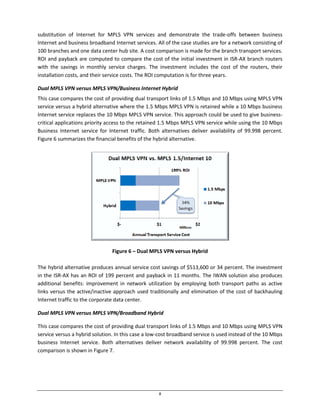
Figure 6 summarizes the financial benefits of the hybrid alternative.
Figure 6 – Dual MPLS VPN versus Hybrid
The hybrid alternative produces annual service cost savings of $513,600 or 34 percent. The investment
in the ISR-AX has an ROI of 199 percent and payback in 11 months. The IWAN solution also produces
additional benefits: improvement in network utilization by employing both transport paths as active
links versus the active/inactive approach used traditionally and elimination of the cost of backhauling
Internet traffic to the corporate data center.
Dual MPLS VPN versus MPLS VPN/Broadband Hybrid
This case compares the cost of providing dual transport links of 1.5 Mbps and 10 Mbps using MPLS VPN
service versus a hybrid solution. In this case a low-cost broadband service is used instead of the 10 Mbps
business Internet service. Both alternatives deliver network availability of 99.998 percent. The cost
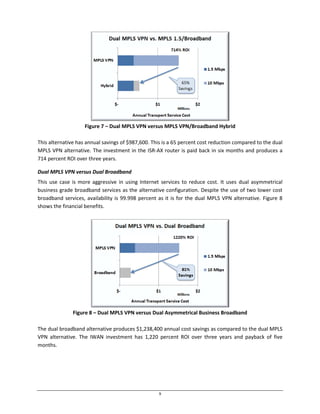
comparison is shown in Figure 7.
9
Figure 7 – Dual MPLS VPN versus MPLS VPN/Broadband Hybrid
This alternative has annual savings of $987,600. This is a 65 percent cost reduction compared to the dual
MPLS VPN alternative. The investment in the ISR-AX router is paid back in six months and produces a
714 percent ROI over three years.
Dual MPLS VPN versus Dual Broadband
This use case is more aggressive in using Internet services to reduce cost. It uses dual asymmetrical
business grade broadband services as the alternative configuration. Despite the use of two lower cost
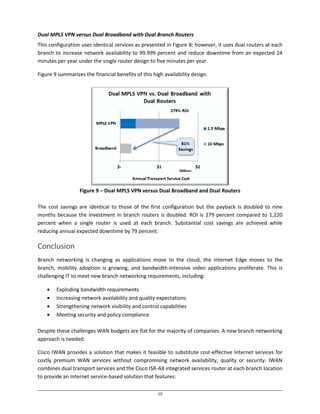
broadband services, availability is 99.998 percent as it is for the dual MPLS VPN alternative. Figure 8
shows the financial benefits.
Figure 8 – Dual MPLS VPN versus Dual Asymmetrical Business Broadband
The dual broadband alternative produces $1,238,400 annual cost savings as compared to the dual MPLS
VPN alternative. The IWAN investment has 1,220 percent ROI over three years and payback of five
months.
10
Dual MPLS VPN versus Dual Broadband with Dual Branch Routers
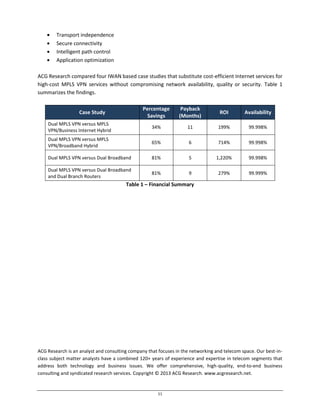
This configuration uses identical services as presented in Figure 8; however, it uses dual routers at each
branch to increase network availability to 99.999 percent and reduce downtime from an expected 24
minutes per year under the single router design to five minutes per year.
Figure 9 summarizes the financial benefits of this high availability design.
Figure 9 – Dual MPLS VPN versus Dual Broadband and Dual Routers
The cost savings are identical to those of the first configuration but the payback is doubled to nine
months because the investment in branch routers is doubled. ROI is 279 percent compared to 1,220
percent when a single router is used at each branch. Substantial cost savings are achieved while
reducing annual expected downtime by 79 percent.
Conclusion
Branch networking is changing as applications move to the cloud, the Internet Edge moves to the
branch, mobility adoption is growing, and bandwidth-intensive video applications proliferate. This is
challenging IT to meet new branch networking requirements, including:
Exploding bandwidth requirements
Increasing network availability and quality expectations
Strengthening network visibility and control capabilities
Meeting security and policy compliance
Despite these challenges WAN budgets are flat for the majority of companies. A new branch networking
approach is needed.
Cisco IWAN provides a solution that makes it feasible to substitute cost-effective Internet services for
costly premium WAN services without compromising network availability, quality or security. IWAN
combines dual transport services and the Cisco ISR-AX integrated services router at each branch location
to provide an Internet service-based solution that features:
11
Transport independence
Secure connectivity
Intelligent path control
Application optimization
ACG Research compared four IWAN based case studies that substitute cost-efficient Internet services for
high-cost MPLS VPN services without compromising network availability, quality or security. Table 1
summarizes the findings.
Case Study
Percentage
Savings
Payback
(Months)
ROI Availability
Dual MPLS VPN versus MPLS
VPN/Business Internet Hybrid
34% 11 199% 99.998%
Dual MPLS VPN versus MPLS
VPN/Broadband Hybrid
65% 6 714% 99.998%
Dual MPLS VPN versus Dual Broadband 81% 5 1,220% 99.998%
Dual MPLS VPN versus Dual Broadband
and Dual Branch Routers
81% 9 279% 99.999%
Table 1 – Financial Summary
ACG Research is an analyst and consulting company that focuses in the networking and telecom space. Our best-in-
class subject matter analysts have a combined 120+ years of experience and expertise in telecom segments that
address both technology and business issues. We offer comprehensive, high-quality, end-to-end business
consulting and syndicated research services. Copyright © 2013 ACG Research. www.acgresearch.net.

Business Case for Cisco Intelligent WAN

  • 1.
    1 Executive Summary Branch networkingis changing as applications move to the cloud and the Internet edge moves to the branch. In addition, mobility is putting more pressure on the network with bring your own device adoption and the proliferation of bandwidth-intensive video applications. In response, IT must meet expanding bandwidth requirements, increasing user expectations for high network availability and quality of experience, and strengthen its network visibility and control capabilities. Despite these challenges, WAN budgets are flat for the majority of companies. The Cisco Intelligent WAN (IWAN) solution combines secure connectivity, performance- based routing technology and dual transport links at the branch to improve the availability, quality, and security of the WAN while reducing its cost. IWAN employs the Cisco ISR-AX integrated services router and dual transport links that allow IT to augment premium-priced WAN services without sacrificing network requirements. IWAN features transport independence, secure connectivity, intelligent path control, and application optimization. ACG Research analyzed four approaches to replacing all or some MPLS VPN WAN services with business broadband Internet services without compromising network availability. It found service cost savings of 34 percent to 81 percent, project payback of five to 11 months, and return on investment (ROI) of 199 percent to 1,220 percent for three years of monthly cash flows. Network downtime can be reduced by 79 percent by adding a second router at each branch. This does not affect monthly savings but it doubles project payback; none-the-less ROI is 279 percent when dual broadband services are used. IWAN also greatly increases bandwidth utilization by making both bandwidth paths active simultaneously. In addition, IWAN offers features to support secure direct Internet access, where guest access or Software-as-a-Service can be automatically offloaded to the Internet. This eliminates the costly and performance diminishing practice of backhauling Internet traffic to the data center. Also, throughput and application performance are enhanced through application-specific optimization capabilities. Business Case for Cisco Intelligent WAN KEY FINDINGS Cisco IWAN makes it feasible to adopt low-cost Internet services to augment premium WAN services without compromising security, network availability, quality or service for branch networks. Case studies for four alternative network configurations found: Transport service cost savings of 34% to 81% Payback on the IWAN investment of 5 to 11 months ROI of 199% to 1,220% for 99.998% availability (24 minutes a year downtime) Addition of a second router at each branch increases availability to 99.999% (5 minutes a year of downtime)
  • 2.
    2 Introduction Branch networking ischanging. Applications are moving to the cloud with the emergence of Software as a Service (SaaS) products such as Office365 and Google Docs. The Internet Edge is moving to the branch and requires more efficient transport for guest traffic or SaaS applications directly to the Internet. Mobility, including business mobile devices, bring your own device (BYOD), and guest access, is driving increased network traffic and novel traffic patterns. Bandwidth-intensive applications, such as video conferencing, streaming video and e-learning, also are driving network traffic increases. These changes in branch networking are creating challenges for IT to securely, effectively and efficiently meet branch networking requirements. WAN bandwidth requirements are expanding: Cisco’s Visual Networking Index projects a three- fold increase in business traffic over the next five years. Branch requirements for availability and quality of experience are increasing: The increased reliance on networking to support business-critical applications requires substantially higher network availability and quality. Network visibility and control need strengthening: The new cloud and Internet-centric traffic patterns are loosening IT visibility and control of the network. New network monitoring and controls are needed. Despite the need for more bandwidth, higher quality and tools to manage increasing complexity, WAN budgets are flat for the majority of companies. A new approach to branch networking is needed to cost- effectively meet these demanding requirements. Cisco, in response, has developed a new approach called Intelligent WAN (IWAN). IWAN makes it feasible to substitute low-priced Internet services for high-priced premium WAN services without compromising the availability, quality or security requirements of the branch. The following sections identify attractive Internet transport options, their inherent levels of network availability and cost, and then show how IWAN solutions are used to simultaneously meet the branch networking challenges while reducing costs. Cost savings and payback are quantified for each branch networking solution.
  • 3.
    3 Branch WAN Today Figure1 provides a schematic of the typical branch WAN, today. Figure 1 – Branch WAN Today The typical branch WAN, today, employs premium-priced WAN connectivity to connect each branch to the corporate data center. Private packet services are delivered as Multiprotocol Label Switching Virtual Private Network (MPLS VPN)1 service. Most MPLS VPNs are overlaid on Time Division Multiplexing/Plesiochronous Digital Hierarchy (TDM/PDH)2 transport service. The service has widespread acceptance because the underlying TDM/PDH transport service is widely available and reliable, while the MPLS VPN service provides private IP service. Typical network availability is 99.95 percent for a single line, resulting up to 4 hours and 23 minutes downtime per year. The private IP service is offered with service level agreements that guarantee performance for packet latency, loss and jitter. The service, however, is quite expensive ($258 to $927 per month for 1.5 Mbps service, worldwide in major cities) and has limited bandwidth (1.5 Mbps to 10 Mbps). The service is complex and has demanding technical requirements. Consequently, add, move, and change orders can take many weeks to be executed. The use of TDM/PDH transport service by MPLS VPN services, also, is problematic because this legacy service is slowly giving way to the next generation of packet-based transport services. Branch WAN, today, is designed so that security policies and Internet access are centralized at the corporate data center. This was done so that IT could have enterprise-wide visibility and control of the 1 MPLS VPN service provides the enterprise its own virtual private routed network. 2 TDM/PDH service provides point-to-point digital data service connections. It was introduced into the public switched telephone network in 1962.
  • 4.
    4 network and todeliver uniform security policies across the enterprise. This approach made sense when most corporate applications were hosted in the data center. However, now that an increasing proportion of branch applications are hosted in the cloud this indirect connection to the Internet (See red curve in Figure 1) limits the performance of both Internet and private network services and unnecessarily increases costs. In this network design, backup network connectivity is provided by one active and one inactive WAN connection to each branch. Significant bandwidth capacity is, consequently, wasted since outages are only incurred 0.05 percent of the time for each connection. Modern Business Internet Services Modern business Internet services have changed radically since network architects chose the premium- priced WAN connectivity model for the branch WAN discussed in the previous section. Figure 2 illustrates the progress made over the last 15 years in improving the availability of Internet access services while reducing their price. Figure 2 – Internet Pricing versus Reliability3 The original premise for employing premium-priced WAN connection services in building branch WANs was that public Internet services lacked the reliability required to support business networking requirements. The figure shows that this was a sound premise up until two or three years ago. Today, Internet service reliability is approaching that of premium-priced WAN services. MPLS VPN service continues, none-the-less, to be priced at a premium compared to Internet services. Figure 3 compares the median monthly recurring charges for MPLS VPN and two types of Internet service (symmetrical business Internet and asymmetrical business broadband) for a sample of major cities worldwide. 3 Internet transit pricing based on surveys and informal data collection primarily from Internet operations forums (street pricing estimates). Packet delivery based on 15 years of ping data from Stanford ping end-to-end reporting (PingER) global server sample. Source: William Norton (DrPeering.net)
  • 5.
    5 Figure 3 –Price Comparison MPLS VPN versus Internet Access4 Business Internet is a symmetrical service (downstream and upstream data rates are identical) and is offered at many data rates. Business broadband is asymmetrical service and is offered in a wide range of data rates (median data rates are 12 Mbps downstream and 1 Mbps upstream worldwide). 1.5 Mbps business Internet is priced 46 percent less, and business broadband is 64 percent less than 1.5 Mbps MPLS VPN service. 10 Mbps business Internet is priced 45 percent less than 10 Mbps MPLS VPN service. Broadband service is the lowest priced networking alternative and can be used for business with the right services for security, reliability and performance in place. It offers an attractive price performance characteristic for branches in that they require higher downstream than upstream data rates. Internet services differ from private IP services such as MPLS VPN in that ISPs use over subscription5 to minimize their service delivery costs. This can result in degraded performance during peak usage periods. Congestion at peering points6 also can be a source of performance degradation. 4 MPLS VPN and Business Internet prices are median values from a sample of 15 worldwide cities compiled by TeleGeography. Business Broadband prices are median values from a UNSi Broadband Internet sampling. 5 Network capacity is provisioned to be less than the expected peak period traffic load. 6 A peering point is the point at which two ISPs interchange Internet traffic. Over subscription may be used here to limit the payments to the other ISP in cases where there is an imbalance in the originating traffic flows.
  • 6.
    6 IWAN Branch NetworkingSolution The IWAN solution combines secure connectivity, performance-based routing technology and dual transport links to improve the availability and quality of the branch WAN while reducing its cost. Figure 4 illustrates the solution. Figure 4 – IWAN Branch Solution The solution includes dual transport paths between the branch and the corporate data center, a Cisco integrated service router at the branch and dual Cisco routers at the data center. Though one Internet and one MPLS VPN transport path are shown in the figure the transport can be provided by any combination of transport services (MPLS VPN, Business Internet or Broadband). The routers go well beyond a simple active path/inactive path protection scheme. They simultaneously maximize availability and throughput while providing secure connectivity at minimum cost. Specific features include: Transport independence: This solution can be built using a flexible combination of premium WAN and Internet connections with a consistent VPN overlay for all transport types and flexibility to roll out services faster. Secure connectivity: A secure Internet edge is brought to the branch to consistently protect all endpoints and eliminate backhaul of Internet traffic to the data center. Intelligent path control: This simultaneously minimizes cost while maximizing service availability and allows IT to fully utilize all services. Application optimization: WAN throughput is optimized while application-specific visibility and control are provided. For example, individual applications can be routed so as to optimize their unique performance requirements for such metrics as latency, packet loss and jitter.
  • 7.
    7 Delivering Premium WANReliability at Internet Prices Branches are not simply using the network more; they also are using it for more important business activities. Network applications that affect routine work processes such as customer or supply chain management make network availability vital to business success. The decision to employ a high- availability network design must consider factors such as branch size, the use of critical applications and the business-wide impact of a network outage versus the added cost of the design. Figure 5 presents network availability trade-offs for single router, single path configurations and for two IWAN configurations. Figure 5 – Network Availability Trade-offs The single router, single path design has availability of 99.95 percent for MPLS VPN service and 99.90 percent for business-grade broadband service. This corresponds to 4 hours and 23 minutes and 8 hours and 46 minutes of annual downtime for the MPLS VPN and broadband services, respectively. The dual path configuration assumes that each transport service is provided by a separate service provider and that the failure of one path is, therefore, independent of the failure of the other path. Under this assumption availability increases to 99.998 percent for a dual path, single router configuration and 99.999 percent for a dual path, dual router configuration. The figure also shows that the availability results are the same to five significant figures whether MPLS VPN or Internet services are employed. This creates the opportunity to reduce costs by substituting Internet services for premium WAN services without compromising availability. IWAN Cost Reduction and ROI Results Four case studies are presented to illustrate the cost savings and network availability that are delivered by using the IWAN solution. They span a range of implementation strategies from partial to full
  • 8.
    8 substitution of Internetfor MPLS VPN services and demonstrate the trade-offs between business Internet and business broadband Internet services. All of the case studies are for a network consisting of 100 branches and one data center hub site. A cost comparison is made for the branch transport services. ROI and payback are computed to compare the cost of the initial investment in ISR-AX branch routers with the savings in monthly service charges. The investment includes the cost of the routers, their installation costs, and their service costs. The ROI computation is for three years. Dual MPLS VPN versus MPLS VPN/Business Internet Hybrid This case compares the cost of providing dual transport links of 1.5 Mbps and 10 Mbps using MPLS VPN service versus a hybrid alternative where the 1.5 Mbps MPLS VPN is retained while a 10 Mbps business Internet service replaces the 10 Mbps MPLS VPN service. This approach could be used to give business- critical applications priority access to the retained 1.5 Mbps MPLS VPN service while using the 10 Mbps Business Internet service for Internet traffic. Both alternatives deliver availability of 99.998 percent. Figure 6 summarizes the financial benefits of the hybrid alternative. Figure 6 – Dual MPLS VPN versus Hybrid The hybrid alternative produces annual service cost savings of $513,600 or 34 percent. The investment in the ISR-AX has an ROI of 199 percent and payback in 11 months. The IWAN solution also produces additional benefits: improvement in network utilization by employing both transport paths as active links versus the active/inactive approach used traditionally and elimination of the cost of backhauling Internet traffic to the corporate data center. Dual MPLS VPN versus MPLS VPN/Broadband Hybrid This case compares the cost of providing dual transport links of 1.5 Mbps and 10 Mbps using MPLS VPN service versus a hybrid solution. In this case a low-cost broadband service is used instead of the 10 Mbps business Internet service. Both alternatives deliver network availability of 99.998 percent. The cost comparison is shown in Figure 7.
  • 9.
    9 Figure 7 –Dual MPLS VPN versus MPLS VPN/Broadband Hybrid This alternative has annual savings of $987,600. This is a 65 percent cost reduction compared to the dual MPLS VPN alternative. The investment in the ISR-AX router is paid back in six months and produces a 714 percent ROI over three years. Dual MPLS VPN versus Dual Broadband This use case is more aggressive in using Internet services to reduce cost. It uses dual asymmetrical business grade broadband services as the alternative configuration. Despite the use of two lower cost broadband services, availability is 99.998 percent as it is for the dual MPLS VPN alternative. Figure 8 shows the financial benefits. Figure 8 – Dual MPLS VPN versus Dual Asymmetrical Business Broadband The dual broadband alternative produces $1,238,400 annual cost savings as compared to the dual MPLS VPN alternative. The IWAN investment has 1,220 percent ROI over three years and payback of five months.
  • 10.
    10 Dual MPLS VPNversus Dual Broadband with Dual Branch Routers This configuration uses identical services as presented in Figure 8; however, it uses dual routers at each branch to increase network availability to 99.999 percent and reduce downtime from an expected 24 minutes per year under the single router design to five minutes per year. Figure 9 summarizes the financial benefits of this high availability design. Figure 9 – Dual MPLS VPN versus Dual Broadband and Dual Routers The cost savings are identical to those of the first configuration but the payback is doubled to nine months because the investment in branch routers is doubled. ROI is 279 percent compared to 1,220 percent when a single router is used at each branch. Substantial cost savings are achieved while reducing annual expected downtime by 79 percent. Conclusion Branch networking is changing as applications move to the cloud, the Internet Edge moves to the branch, mobility adoption is growing, and bandwidth-intensive video applications proliferate. This is challenging IT to meet new branch networking requirements, including: Exploding bandwidth requirements Increasing network availability and quality expectations Strengthening network visibility and control capabilities Meeting security and policy compliance Despite these challenges WAN budgets are flat for the majority of companies. A new branch networking approach is needed. Cisco IWAN provides a solution that makes it feasible to substitute cost-effective Internet services for costly premium WAN services without compromising network availability, quality or security. IWAN combines dual transport services and the Cisco ISR-AX integrated services router at each branch location to provide an Internet service-based solution that features:
  • 11.
    11 Transport independence Secure connectivity Intelligentpath control Application optimization ACG Research compared four IWAN based case studies that substitute cost-efficient Internet services for high-cost MPLS VPN services without compromising network availability, quality or security. Table 1 summarizes the findings. Case Study Percentage Savings Payback (Months) ROI Availability Dual MPLS VPN versus MPLS VPN/Business Internet Hybrid 34% 11 199% 99.998% Dual MPLS VPN versus MPLS VPN/Broadband Hybrid 65% 6 714% 99.998% Dual MPLS VPN versus Dual Broadband 81% 5 1,220% 99.998% Dual MPLS VPN versus Dual Broadband and Dual Branch Routers 81% 9 279% 99.999% Table 1 – Financial Summary ACG Research is an analyst and consulting company that focuses in the networking and telecom space. Our best-in- class subject matter analysts have a combined 120+ years of experience and expertise in telecom segments that address both technology and business issues. We offer comprehensive, high-quality, end-to-end business consulting and syndicated research services. Copyright © 2013 ACG Research. www.acgresearch.net.