E-government Planning Preparing E-Business Plan  for E-government: Transforming Government   by Dr D.C.MISRA
Wednesday, February 11, 2009 2-15 p.m. to 4-15 p.m. 3rd Post Graduate Diploma in Public Policy and Management Programmme  (2008-10)  School of Public Policy and Governance Management Development Institute  P.B.60, Mehrauli Road, Sukhrali,  Gurgaon 122 001
Preparing E-business Plan: A Presentation  by Dr D.C.Misra Independent E-government Consultant New Delhi, India Email:  [email_address] Web:  http:// in.geocities.com/drdcmisra Think Tank:   http:// tech.groups.yahoo.com/group/cyber_quiz Tel:  91-11- 2245 2431  Fax: 91-11- 4244 5183
What is proposed to be covered? Preparing E-business Plan NeGP 2007-2012 and E-government Review of Current Status of E-business Plans in Ministries/Departments/Organisations What is E-business Plan? What is  not  E-business Plan? What  then  is E-business Plan? Characteristics of a Good E-business Plan Elements of E-business Plan Conclusion
Preparing E-business Plan:  Elements of E-business Plan I. Executive Summary II. Part A: Operative Time Frame Deliverables Preparation:  In-house or Outsourced E-business Team Financial Implications Consultation and Approval  I.  Executive Summary II.  Part A :  Operative Introduction Mandate Objectives Services Online
Elements of E-business Plan III Part B: Planning Business Process Reengineering (BPR) Risk Analysis Cost-Benefit Analysis (CBA) Architecture  and Standards Enterprise Resource Planning (ERP) NeGP 2007-2012 and E-business Plan Strategic Planning Portfolio Management Situation Analysis- Fishbone Analysis Best Practices Free and Open Source Software (FOSS)
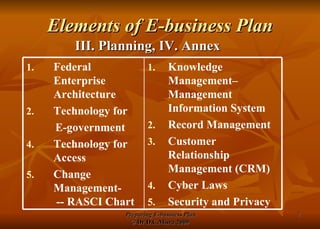
Elements of E-business Plan III. Planning, IV. Annex  Knowledge Management– Management Information System Record Management Customer Relationship Management (CRM) Cyber Laws Security and Privacy Federal Enterprise Architecture Technology for  E-government Technology for Access Change Management-  -- RASCI Chart
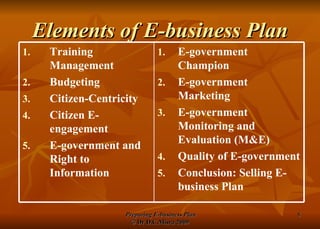
Elements of E-business Plan E-government Champion E-government Marketing E-government Monitoring and Evaluation (M&E) Quality of E-government Conclusion: Selling E-business Plan Training Management Budgeting Citizen-Centricity Citizen E-engagement E-government and Right to Information
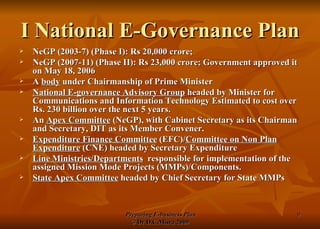
I National E-Governance Plan NeGP (2003-7) (Phase I): Rs 20,000 crore; NeGP (2007-11) (Phase II): Rs 23,000 crore; Government approved it on May 18, 2006 A  body  under Chairmanship of Prime Minister National E-governance Advisory Group  headed by Minister for Communications and Information Technology Estimated to cost over Rs. 230 billion over the next 5 years.  An  Apex Committee  (NeGP), with Cabinet Secretary as its Chairman and Secretary, DIT as its Member Convener.  Expenditure Finance Committee  (EFC)/ Committee on Non Plan Expenditure  (CNE) headed by Secretary Expenditure Line Ministries/Departments   responsible for implementation of the assigned Mission Mode Projects (MMPs)/Components. State Apex Committee  headed by Chief Secretary for State MMPs
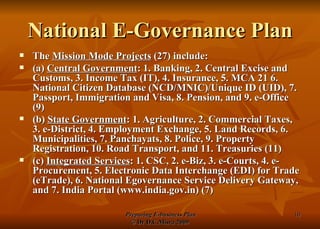
National E-Governance Plan The  Mission Mode Projects  (27) include: (a)  Central Government : 1. Banking, 2. Central Excise and Customs, 3. Income Tax (IT), 4. Insurance, 5. MCA 21 6. National Citizen Database (NCD/MNIC)/Unique ID (UID), 7. Passport, Immigration and Visa, 8. Pension, and 9. e-Office (9) (b)  State Government : 1. Agriculture, 2. Commercial Taxes, 3. e-District, 4. Employment Exchange, 5. Land Records, 6. Municipalities, 7. Panchayats, 8. Police, 9. Property Registration, 10. Road Transport, and 11. Treasuries (11)  (c)  Integrated Services : 1. CSC, 2. e-Biz, 3. e-Courts, 4. e-Procurement, 5. Electronic Data Interchange (EDI) for Trade (eTrade), 6. National Egovernance Service Delivery Gateway, and 7. India Portal (www.india.gov.in) (7)
National E-Governance Plan 10 Components :  I.  Core and Support Infrastructure : 1. Common Service Centres (CSC), 2. State Wide Area Networks (SWANs), 3. State Data Centres (SDCs) II.  Other Components : 1. Capacity Building, 2. Standards, 3. Awareness and Communication, 4. Assessment, etc. Common Service Centres  (CSCs):  100,000 rural Common Services Centers (CSC), catering to 600,000 villages, to be set up at cost of Rs. 5,742 crore  Government of India: Rs. 856 crore, State Governments: Rs 793 crore, and balance Private sector: Rs 4093 crore) to provide broadband Internet connectivity (256 Kbps) (1 crore=10 million).
I National E-Governance Plan Four Pillars of NEGP 2003-2007 (i)  State-Wide Area Network  (SWAN)  (ii)  State Data Centre  (SDC)  (iii)  Mission Mode Projects  (MMPs), and  (iv)  Common Service Centres  (CSCs) (Source: Department of Information Technology)
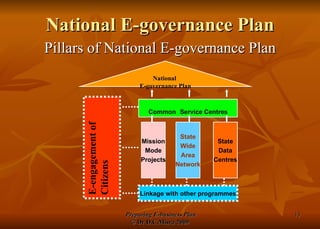
National E-governance Plan Pillars of National E-governance Plan National  E-governance Plan Common   Service Centres Mission Mode Projects State Wide Area Network State Data Centres Linkage with other programmes E-engagement of Citizens
II Review of Current Status of  E-business Plans  Status :  Assess the current status of Preparation of E-business Plan I.  Prepared  (a) In-house, (b) Outsourced II.  Under Preparation   (a) In-house, (b) Outsourced   III.  Not Under Preparation   IV.  No Action Required
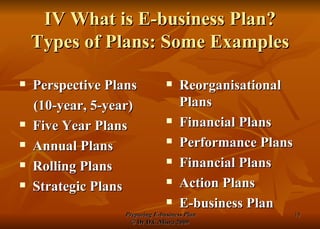
IV What is E-business Plan? Types of Plans: Some Examples Perspective Plans  (10-year, 5-year) Five Year Plans Annual Plans Rolling Plans Strategic Plans Reorganisational Plans Financial Plans Performance Plans Financial Plans Action Plans E-business Plan
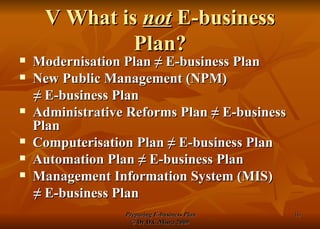
V What is  not  E-business Plan? Modernisation Plan  ≠  E-business Plan New Public Management (NPM)  ≠  E-business Plan  Administrative Reforms Plan  ≠  E-business Plan Computerisation Plan  ≠  E-business Plan Automation Plan  ≠  E-business Plan Management Information System (MIS) ≠  E-business Plan
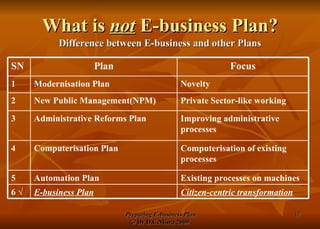
What is  not  E-business Plan? Difference between E-business and other Plans Citizen-centric transformation E-business Plan 6  √ Existing processes on machines Automation Plan 5  Computerisation of existing processes Computerisation Plan 4  Improving administrative processes Administrative Reforms Plan 3  Private Sector-like working New Public Management(NPM) 2  Novelty Modernisation Plan 1  Focus Plan SN
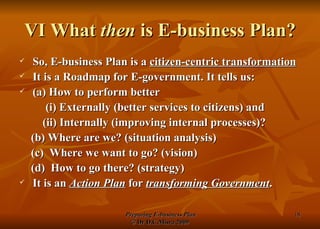
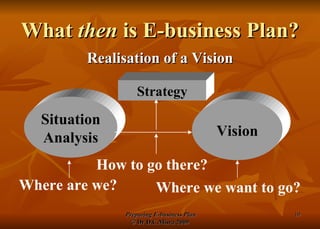
VI What  then  is E-business Plan? So, E-business Plan is a  citizen-centric transformation It is a Roadmap for E-government. It tells us:  (a) How to perform better  (i) Externally (better services to citizens) and  (ii) Internally (improving internal processes)? (b) Where are we? (situation analysis) (c)  Where we want to go? (vision) (d)  How to go there? (strategy) It is an  Action Plan  for  transforming Government .
What  then  is E-business Plan? Realisation of a Vision Situation Analysis Vision Where are we? Where we want to go? How to go there? Strategy
VI Characteristics of a  Good E-business Plan It is a comprehensive document It has a standard format The standard format is common to all Ministries/Departments/Organisations It is prepared in consultation with all stakeholders including citizens It has Government’s approval (Top Management buy-in)
Characteristics of a  Good E-business Plan It incorporates latest technology It takes into account citizen access to  E-government through multiple channels It incorporates, inter alia, knowledge management (KM), change management (CM), training (T) and monitoring and evaluation (M&E) modules It has adequate budgetary support It has a E-gov Champion to implement it
VII Elements of E-business Plan: Composition An E-business Plan typically consists of four parts: --  I. Executive Summary -- II. Part A: Operative -- III. Part B:  Planning -- IV. Annex It is a time-bound document with a shelf life of 3-5 years for transforming Government and serving citizens and non-citizens.
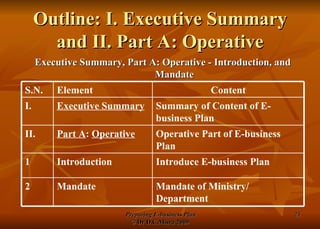
Outline: I. Executive Summary and II. Part A: Operative Executive Summary, Part A: Operative - Introduction, and Mandate Mandate of Ministry/ Department Mandate 2 Introduce E-business Plan Introduction 1 Operative Part of E-business Plan Part A :  Operative II. Summary of Content of E-business Plan Executive Summary I. Content Element S.N.
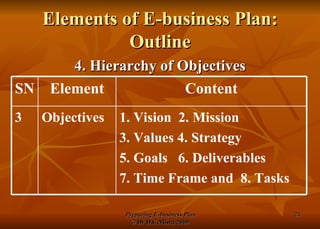
Elements of E-business Plan: Outline 4. Hierarchy of Objectives 1. Vision  2. Mission  3. Values 4. Strategy  5. Goals  6. Deliverables 7. Time Frame and  8. Tasks Objectives 3 Content Element SN
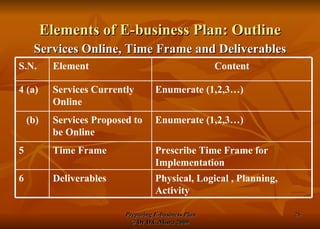
Elements of E-business Plan: Outline Services Online, Time Frame and Deliverables Physical, Logical , Planning, Activity Deliverables 6 Prescribe Time Frame for  Implementation Time Frame 5 Enumerate (1,2,3…) Services Proposed to be Online (b) Enumerate (1,2,3…) Services Currently Online 4 (a) Content Element S.N.
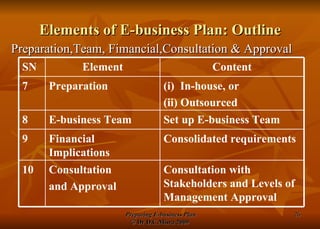
Elements of E-business Plan: Outline Preparation,Team, Fimancial,Consultation & Approval Consultation with Stakeholders and Levels of Management Approval Consultation  and Approval 10 Consolidated requirements Financial Implications 9 Set up E-business Team E-business Team  8 (i)  In-house, or  (ii) Outsourced Preparation 7 Content Element SN
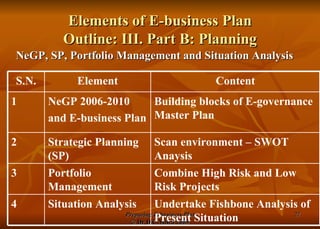
Elements of E-business Plan Outline: III. Part B: Planning NeGP, SP, Portfolio Management and Situation Analysis Building blocks of E-governance Master Plan NeGP 2006-2010 and E-business Plan 1 Content Element S.N. Undertake Fishbone Analysis of Present Situation Situation Analysis 4 Combine High Risk and Low Risk Projects Portfolio Management 3 Scan environment – SWOT Anaysis Strategic Planning (SP) 2
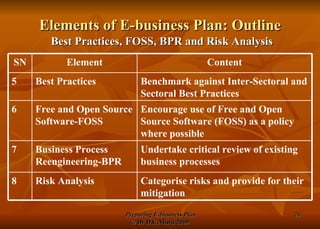
Elements of E-business Plan: Outline Best Practices, FOSS, BPR and Risk Analysis Benchmark against Inter-Sectoral and Sectoral Best Practices Best Practices 5 Content Element SN Categorise risks and provide for their mitigation Risk Analysis 8 Undertake critical review of existing business processes Business Process Reengineering-BPR  7 Encourage use of Free and Open Source Software (FOSS) as a policy where possible Free and Open Source Software-FOSS 6
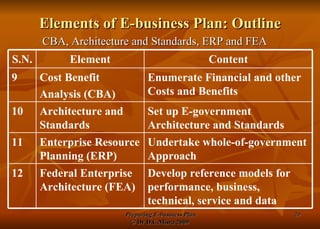
Elements of E-business Plan: Outline CBA, Architecture and Standards, ERP and FEA Develop reference models for performance, business, technical, service and data Federal Enterprise Architecture (FEA) 12 Undertake whole-of-government Approach Enterprise Resource Planning (ERP) 11 Set up E-government Architecture and Standards Architecture and Standards 10 Enumerate Financial and other Costs and Benefits  Cost Benefit  Analysis (CBA) 9 Content Element S.N.
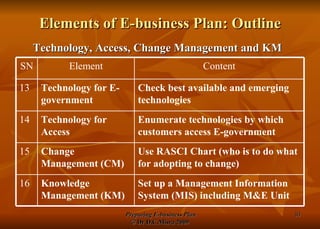
Elements of E-business Plan: Outline Technology, Access, Change Management and KM Set up a Management Information System (MIS) including M&E Unit Knowledge Management (KM) 16 Use RASCI Chart (who is to do what for adopting to change) Change Management (CM) 15 Enumerate technologies by which customers access E-government Technology for Access 14 Check best available and emerging technologies Technology for E-government 13 Content Element SN
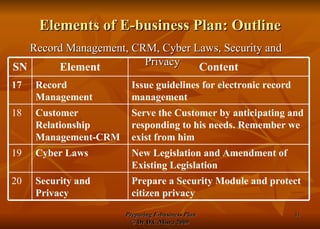
Elements of E-business Plan: Outline Record Management, CRM, Cyber Laws, Security and Privacy Prepare a Security Module and protect citizen privacy Security and Privacy 20 New Legislation and Amendment of Existing Legislation Cyber Laws 19 Serve the Customer by anticipating and responding to his needs. Remember we exist from him Customer Relationship Management-CRM  18 Issue guidelines for electronic record management Record Management 17 Content Element SN
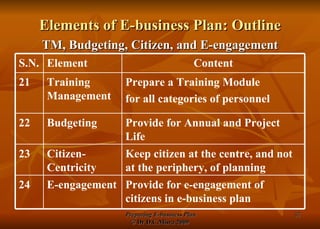
Elements of E-business Plan: Outline TM, Budgeting, Citizen, and E-engagement Provide for e-engagement of citizens in e-business plan E-engagement 24 Keep citizen at the centre, and not at the periphery, of planning Citizen-Centricity 23 Provide for Annual and Project Life Budgeting 22 Prepare a Training Module  for all categories of personnel Training Management 21 Content Element S.N.
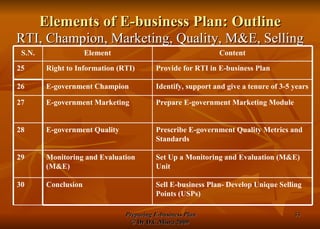
Elements of E-business Plan: Outline RTI, Champion, Marketing, Quality, M&E, Selling Prepare E-government Marketing Module  E-government Marketing 27 Prescribe E-government Quality Metrics and Standards E-government Quality 28 Set Up a Monitoring and Evaluation (M&E) Unit Monitoring and Evaluation (M&E) 29 Sell E-business Plan- Develop Unique Selling Points (USPs) Conclusion 30 Content Element S.N. Identify, support and give a tenure of 3-5 years E-government Champion 26 Provide for RTI in E-business Plan Right to Information (RTI) 25
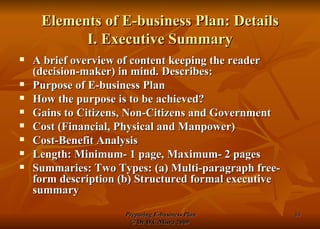
Elements of E-business Plan: Details I. Executive Summary A brief overview of content keeping the reader (decision-maker) in mind. Describes: Purpose of E-business Plan How the purpose is to be achieved? Gains to Citizens, Non-Citizens and Government Cost (Financial, Physical and Manpower) Cost-Benefit Analysis Length: Minimum- 1 page, Maximum- 2 pages Summaries: Two Types: (a) Multi-paragraph free-form description (b) Structured formal executive summary
Part A: Operative 1. Introduction Give Purpose Need  Background (What has prompted it)  History (Earlier Efforts) Scope (What it covers), and  Layout
2 Mandate of Ministry/Department Subjects allocated to Ministry/Department Allocation of Business Rules Transaction of Business Rules Cabinet, Cabinet Sub-Committees, Group of Ministers (GOM)  Preparation of Cabinet Notes High Powered Committee, Empowered Committee, Steering Committee, Task Force
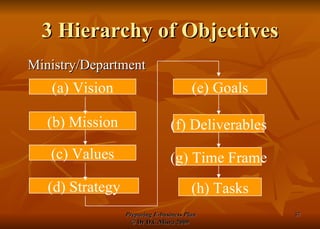
3 Hierarchy of Objectives Ministry/Department (a) Vision (b) Mission (c) Values (d) Strategy (e) Goals (f) Deliverables (g) Time Frame (h) Tasks
(a) Vision Lodestar for Ministry/Department Described by Policy-Makers, often in their election Manifesto and subsequently in Government Programme(s) Often the overarching  raison de etre  for Ministry/Department Vision is essential; without it Ministry /Department is directionless and unproductive Do you believe in it?
(b) Mission To realise vision, mission statement is essential Mission statement should be brief, sharp and to-the-point Capture it in a short and striking sentence like:  PUTTING PEOPLE FIRST To realise vast untapped potential of E-government, mission-mode projects are essential, which are sharply-focused and cut red tape
(c) Values Mission to be governed by values. Identify and establish values: Integrity Service Empathy Dedication Excellence Learning
(d) Strategy Strategy: How to realise the vision It is a practical, feasible approach A good strategy is half the battle won Civil servants, due to their vast “hands-on” experience are good developers of “strategy” Should be developed in a collaborative mode and made known to all stakeholders Should be “hard-boiled” (based on resources) and not on just “feel-good” discussions
(e) Goals Strategy breaks down the mission into goals. Goals are  SMART : S pecific,  M easurable,  A chievable,  R ealistic T ime-bound We will deal with (f) Deliverables and (g) Time Frame separately
(h) Tasks This is “most granular level” of the  E-government project Policy-Maker’s View:  Vision to Task Implementer’s View:  Task to Vision The two view must meet (co-shared) for optimum results (high productivity) Vision without task performance will remain a dream Task performance without vision is unproductive routine
4 Services Online Enumerate (1,2,3…) services  currently online At what  stage  are the online services? Enumerate (1,2,3…) services  proposed to be online  (in 3-year perspective, that is,  life span  of  E-business Plan ):   (i)  By June 2008, (ii)  By June 2009 (iii)  By June 2010 Work out volume of transactions
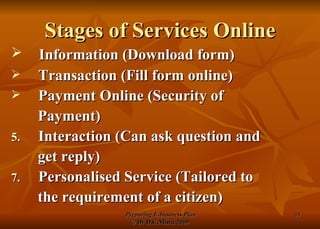
Stages of Services Online Information (Download form)  Transaction (Fill form online)  Payment Online (Security of Payment) Interaction (Can ask question and get reply) Personalised Service (Tailored to the requirement of a citizen)
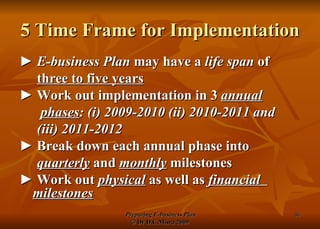
5 Time Frame for Implementation ►  E-business Plan  may have a  life span  of three to five years ►  Work out implementation in 3  annual phases : (i) 2009-2010 (ii) 2010-2011 and (iii) 2011-2012 ►  Break down each annual phase into quarterly  and  monthly  milestones ►  Work out  physical  as well as  financial  milestones
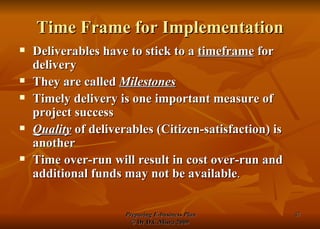
Time Frame for Implementation Deliverables have to stick to a  timeframe  for delivery They are called  Milestones Timely delivery is one important measure of project success Quality  of deliverables (Citizen-satisfaction) is another Time over-run will result in cost over-run and additional funds may not be available .
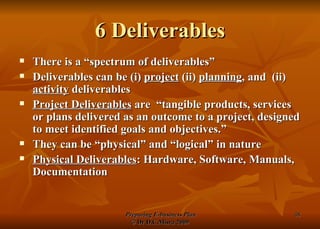
6 Deliverables There is a “spectrum of deliverables” Deliverables can be (i)  project  (ii)  planning , and  (ii)  activity  deliverables Project Deliverables  are  “tangible products, services or plans delivered as an outcome to a project, designed to meet identified goals and objectives.” They can be “physical” and “logical” in nature Physical Deliverables : Hardware, Software, Manuals, Documentation
Deliverables Logical Deliverables : Service Delivery, Performance Improvement, Solution of Problems, Recommendations Planning Deliverables : Project Proposal, Budget, Plans for Knowledge Management, Change Management, Training and Monitoring and Evaluation (M&E)  Activity Deliverables : Status Reports, Meeting Agendas , Minutes, Purchase Orders, Timesheets, Contact Lists  Must be  specified ,  scheduled  and  accepted  Cover entire timeline of project – from inception to closure
7 Preparation of E-business Plan In-house or Outsourced? (a)  Preparing E-business Plan In-house? Indicated in case of smaller Ministries /Departments/Organisations Requisite expertise may not be available Requisite expertise may have to be provided through training It is better to prepare E-business Plan i n-house  rather than  outsource it
(b) Outsourcing E-business Plan E-business Plan may have to be outsourced for larger Ministries/Departments This opens up a new front Outsourcing may bring cost and other benefits but it may increase “reputation, compliance and operational risks.” Guidelines for Outsourcing are required to be issued, which may include:
(b) Outsourcing E-business Plan Risk Management (Service provider may not fulfill his commitments) Material Management (Equipment may not be delivered in time or not at all) Legal and Procurement Requirements may not be met There may be country risk (service provider may be located in another country) There may be concentration risk (Lack of control over a common service provider) (Source: http://www.mas.gov.sg/)
8 E-business Team Set up a team of CIO DBA Project Manager, and Deputy CIO, to draft the E-business Plan in a definite timeframe (say, 2 months)
9 Financial Implications Give the gist of financial requirements Do not load it with unnecessary data Suggest alternative figures Suggest source of funding, for example, budget, external assistance, etc. Give any economy measures and savings from other projects
10 Consultation and Approval Consultation : Give details of consultations made with stakeholders- citizens, non-citizens, women, youth, and businesses Approval Describe the levels at which the E-business Plan has been approved Ensure Top Management buy-in of the Plan
III. Part B: Planning Part 1. NeGP and E-business Plan Show how the E-business Plan  (i)  helps the National E-governance Plan (NeGP), the ICT sector and the economy (ii)  makes specific contribution to socio- economic parameters (iii) is a building block of E-government Master Plan (NeGP/State eGP) (iv) provides citizen-centric government, and (v)  implements government programmes
2. Strategic Planning Scan external, particularly political and technological environment environments Undertake Strengths, Weaknesses, Opportunities and Threats (SWOT) Analysis Check how your plan fits with over-all national priorities Undertake documentation
3 Portfolio Management    Traditional Approach: Project-by-Project investment    Portfolio Management: Planning best practice    It considers all the projects taken together    Identify low-risk low payoff and high-risk high payoff projects    Mix these two types of projects in the e-business plan
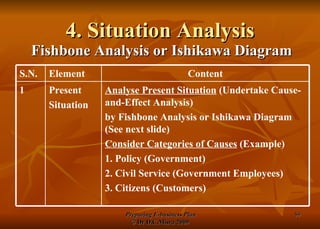
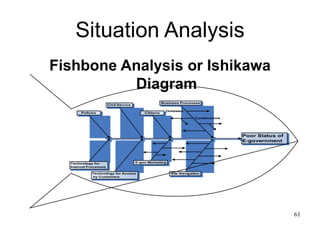
4. Situation Analysis Fishbone Analysis or Ishikawa Diagram Analyse Present Situation  (Undertake Cause-and-Effect Analysis) by Fishbone Analysis or Ishikawa Diagram (See next slide) Consider Categories of Causes  (Example) 1. Policy (Government) 2. Civil Service (Government Employees) 3. Citizens (Customers) Present  Situation 1 Content Element S.N.
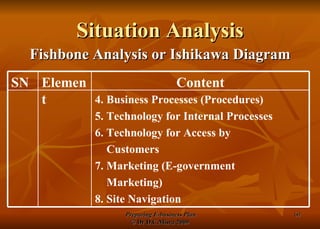
Situation Analysis Fishbone Analysis or Ishikawa Diagram 4. Business Processes (Procedures) 5. Technology for Internal Processes 6. Technology for Access by Customers 7. Marketing (E-government Marketing) 8. Site Navigation Content Element SN
Situation Analysis Fishbone Analysis or Ishikawa Diagram
5 Benchmarking against Best Practices Benchmark against best practices worldwide Where are we and what is the benchmark? Can we reach the benchmark? If yes, what is the timeframe? If no, why not? Be practical in your analysis Adopt the “best practice” which is  attainable  and not what looks  attractive.
6 Free and Open Source Software Describe current use of Free and Open Source Software (FOSS) Describe Proposed Use of Free and Open Source Software (FOSS) in E-business Plan Highlight Cost savings and Scalability Pay due regard to Security Encourage Use of Free and Open Source Software (FOSS) as a matter of policy
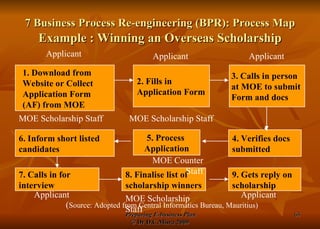
7 Business Process Re-engineering (BPR): Process Map   Example : Winning an Overseas Scholarship 1. Download from  Website or Collect  Application Form  (AF) from MOE 2. Fills in  Application Form 3. Calls in person  at MOE to submit  Form and docs 4. Verifies docs  submitted 5. Process  Application 6. Inform short listed candidates 7. Calls in for  interview 8. Finalise list of  scholarship winners 9. Gets reply on scholarship Applicant Applicant Applicant MOE Scholarship Staff MOE Scholarship Staff MOE Counter Staff Applicant MOE Scholarship Staff Applicant ( Source: Adopted from Central Informatics Bureau, Mauritius)
BPR Questions Why at Stage 3 Applicant is called in   person? Can one or more stages in the scholarship award process be eliminated? Why cannot a candidate apply online? Is there any public notification of scholarship winners online or print media? Is there any consolidated list of scholarships available at MOE and/or online, etc.
8 Risk Analysis    Undertake risk analysis audit    Identify and categorise  risks,  for example    Political, Financial, Personnel, Technological    Work out their magnitude and probabilities of occurrence    Provide for their mitigation, and    Prepare Risk Mitigation Plan
9 Cost Benefit Analysis An old and widely used methodology Benefits must be greater than Cost Net Present Value (NPV) / Discounted Cash Flow (DCF)/Return on Investment (ROI) Quantifiable and Non-Quantifiable Elements Should be one, and not the only, criterion in decision-making
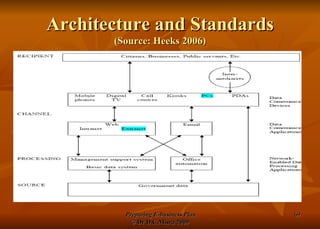
10 Architecture and Standards Develop E-government Architecture following Zachman (2008) /USDOD/ TOGAF (2009) Include (a) Divisional (b) Sectional Needs, and (b) Exploitation of Technologies  Make it conform to National E-government Architecture Develop Sectoral E-government Standards Make them conform to National Inter-sectoral E-government Standards
Architecture and Standards (Source: Heeks 2006)
11 Enterprise Resource Planning    A private sector software which often failed even in private sector    It is based on consolidation of all resources    One-size-fits-all does not work.     Each E-business plan has its own characterstics and has to be considered on its own    It laid the foundation of Federal Enterprise Architecture (FEA) in the U.S.
12 Federal Enterprise Architecture U.S. Federal Enterprise Architecture  (FEA)  Framework  (5 Reference Models) Performance Reference Model  (PRM)- Outcomes, Metrics against Best Practices Business Reference Model  (BRM)- 4 Business Areas, 39 Lines of Business and 154 Subfunctions Service Reference Model  (SRM)- Software application categories for cross-agency use- 7 domains, 29 service types and 168 components
Federal Enterprise Architecture Technical Reference Model  (TRM)- 4 Core Service Areas, Service Categories, Service Standards and Service Specifications Data Reference Model  (DRM)- Common data definitions for categorising and exchanging data    Overlays : Policy documents affecting above 5 reference models- For Security and Privacy    National Informatics Centre (NIC) has set up a  Working Group on E-government Standards  Source: Garson (2006)
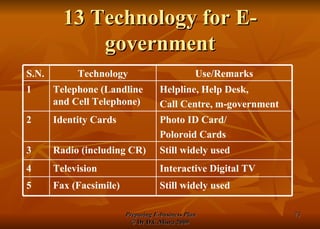
13 Technology for E-government Still widely used Fax (Facsimile) 5 Interactive Digital TV Television 4 Still widely used Radio (including CR) 3 Photo ID Card/  Poloroid Cards Identity Cards 2 Helpline, Help Desk, Call Centre, m-government  Telephone (Landline and Cell Telephone) 1 Use/Remarks Technology S.N.
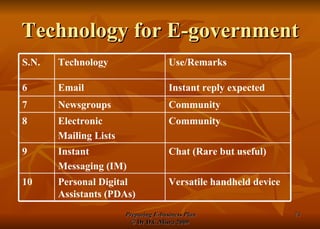
Technology for E-government Versatile handheld device Personal Digital Assistants (PDAs) 10 Chat (Rare but useful) Instant  Messaging (IM)  9 Community Electronic Mailing Lists 8 Community Newsgroups 7 Instant reply expected Email 6 Use/Remarks Technology S.N.
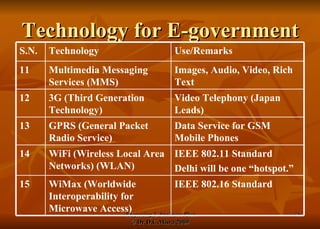
Technology for E-government IEEE 802.16 Standard WiMax (Worldwide Interoperability for Microwave Access)  15 IEEE 802.11 Standard Delhi will be one “hotspot.” WiFi (Wireless Local Area Networks) (WLAN) 14 Data Service for GSM Mobile Phones GPRS (General Packet Radio Service) 13 Video Telephony (Japan Leads) 3G (Third Generation Technology) 12 Images, Audio, Video, Rich Text Multimedia Messaging Services (MMS) 11 Use/Remarks Technology S.N.
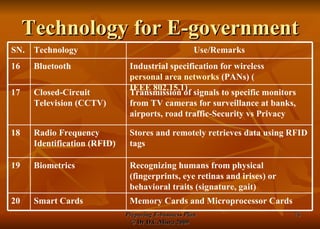
Technology for E-government Memory Cards and Microprocessor Cards Smart Cards 20 Recognizing humans from physical (fingerprints, eye retinas and irises) or behavioral traits (signature, gait) Biometrics 19 Stores and remotely retrieves data using RFID tags Radio Frequency Identification (RFID)  18 Transmission of signals to specific monitors from TV cameras for surveillance at banks, airports, road traffic-Security vs Privacy Closed-Circuit Television (CCTV) 17 Industrial specification for wireless  personal area networks  (PANs) ( IEEE 802.15.1 ) Bluetooth 16 Use/Remarks Technology SN.
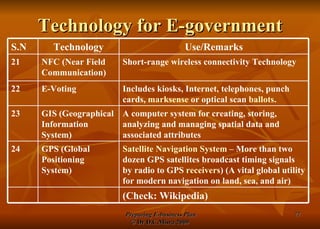
Technology for E-government (Check: Wikipedia) Satellite Navigation System  – More than two dozen GPS satellites broadcast timing signals by radio to GPS  receivers ) (A vital global utility for modern navigation on land, sea, and air)  GPS ( Global Positioning System) 24 A computer system for creating, storing, analyzing and managing spatial data and associated attributes GIS (Geographical Information System) 23 I ncludes kiosks, Internet, telephones, punch cards,  marksense  or optical scan  ballots . E-Voting 22 S hort-range wireless connectivity Technology NFC (Near Field Communication) 21 Use/Remarks Technology S.N
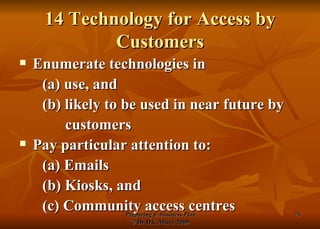
14 Technology for Access by Customers Enumerate technologies in (a) use, and (b) likely to be used in near future by customers Pay particular attention to: (a) Emails (b) Kiosks, and (c) Community access centres
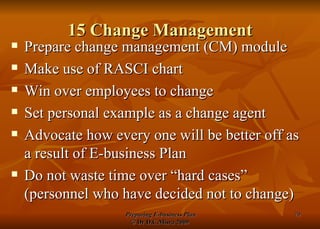
15 Change Management Prepare change management (CM) module Make use of RASCI chart Win over employees to change Set personal example as a change agent Advocate how every one will be better off as a result of E-business Plan Do not waste time over “hard cases” (personnel who have decided not to change)
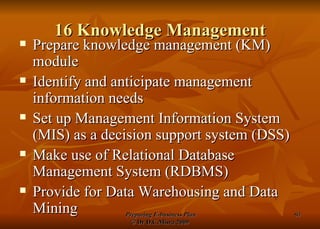
16 Knowledge Management Prepare knowledge management (KM) module Identify and anticipate management information needs Set up Management Information System (MIS) as a decision support system (DSS) Make use of Relational Database Management System (RDBMS) Provide for Data Warehousing and Data Mining
17 Record Management    Record Retention Schedule I.  Facilitative Functions: (i)  Establishment, Personnel, Housekeeping, etc. (ii)  Office Procedure- Register, Diaries, etc. (iii) Financial- Finance, Budget, Accounts, etc. --  Record Retention Schedule for Records Common to All Departments-  DARPG --  Central Secretariat Manual of Office Procedure  – DARPG --  General Financial Rules ,  1963
Record Management II.  Substantive Functions 'A' Category : For permanent preservation; Microfilmed.  'B'  Category : For permanent preservation;  not  Microfilmed. 'C'  Category : For a limited period, not exceeding 10 years (C-1, C-3, C-5, C-10, numerals indicate number of years)
Record Management Electronic Record Management   Module for Storage, Safety and Retrieval   Record Retention Schedule   Meta Data, File Naming and File Format   Storage Options (magnetic tape, optical disk)    E-mail Management   Electronic Record and Right to information
18 Customer Relationship Management (CRM)    Improve CRM. Public Grievance Mechanisms do not work despite an eco-system    Set up Citizen Call Centres    Improve eCRM. IVRS (Interactive Voice Response System) is unsatisfactory    Both public and private sectors are wanting in performance    Should a citizen demand  public service as her right  or beg for it ?
19 Cyber Laws    Eastern Code  (Washington, D.C.) – Old Laws: Common Law, Statutory Law    Western Code  (Silicon Valley) – Software Code    Norms  and  Market    New Laws  (IT Act, RTI Act, etc.)    Proposed Laws  including  Amendments
20 Security and Privacy    Set up a Security Module    Include sensitisation of  all levels  of personnel to security needs    Conform to ISO/IEC 17799:2005    Have a Diaster Recovery Plan    Ensure  Privacy  of Citizens by giving explicit insurance
21 Training Management    Include Training Module (TM)    Introduce new technology only after training    Train all levels of personnel    Prepare a training plan    Go for best training resources    Treat training outlay as an  investment  and  not  as an  expenditure
22 Budgeting    Undertake zero-base budgeting    Provide for Annual and Project Life    Undertake financial, physical, and performance budgeting    Support proposal by highlighting (a) efficiency , (b)  productivity , and (c) effectiveness    Give concrete examples from past performance, if any
23 Citizen-Centricity    Keep citizen at the  centre  of e-business plan    Identify and categorise  citizens , for example, (i)  Senior Citizen, (ii) Women, (iii) Youth, etc.    Identify and categorise  non-citizens , for example, (i) Children, (ii) Tourists, (iii) Immigrants, etc.    Provide  individualised  services  online  for  each category
24 E-engagement    Promote E-democracy    Engage citizens in policy formulation and implementation    Use e-engagement tools like (i) Discussion Forum, (ii) RSS Feed (iii) Blog, and (iv)  Wiki,and (v) E-petition     Provide for e-engagement on official Websites    Provide for time-bound replies to E-mails
25 E-government and Right to Information (RTI)    Right to information is an  integral part  of E-government    E-business Plan will blend with the requirements of Right to Information (RTI) Act (See also record management)    Incorporate requirements of the  Nodal Officer  under the RTI Act    Co-share responsibility with the Nodal Officer for compliance with RTI Act
26 E-government Champion    Identify and support E-government Champion, who will be a civil servant Enthusiasm rather than qualifications will be the criterion of identification    She need not be a technocrat    Give her a fixed term of 3-5 years to show results    Do not include political e-champions
27 E-government Marketing    E-services will be  need -based    Identify  Unique Selling Points  (USPs) of  E-services    Use  Online  and  Offline  advertising to good effect    Insert an E-government  slogan/banner  in official ads and stationery    Prepare an e-government  marketing plan
28 E-government Quality Selected Quality Measures 1.  Citizen’s Charter (U.K., India) 2. Charter Mark (U.K.) 3. Baldridge Criteria (US) 4. ISO 9000 Series  5. Customer Charter (Mauritius) 6. Balanced Scorecard (Kaplan and Nortan 1992) 7. Six Sigma (Motorola University) 8. E-gov ACSI (American Consumer Satisfaction Index) (1994) (U.S.)
29. E-government Monitoring and Evaluation (M&E)    Set up an E-government Monitoring and Evaluation (M&E) Unit    It is  independent  of Project Management Unit    It reports directly to Top Management    It consists of professional multi-disciplinary personnel     It is an  integral part  of  Management Information System  (MIS)
30 Conclusion Selling E-business Plan    Marketing of E-services is done for citizens    E-business plan has to be sold to  policy- makers    Highlight  gains to citizens , etc. (and not to organisation)    Think of points which will give them publicity  and  political mileage
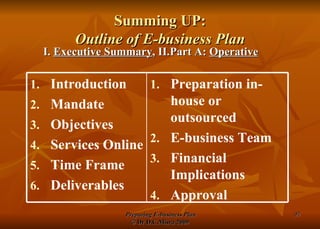
Summing UP: Outline of E-business Plan I.  Executive Summary , II.Part A:  Operative Preparation in-house or outsourced E-business Team Financial Implications Approval Introduction Mandate Objectives Services Online Time Frame Deliverables
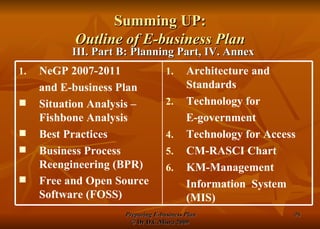
Summing UP: Outline of E-business Plan III. Part B: Planning Part, IV. Annex Architecture and Standards  Technology for  E-government Technology for Access CM-RASCI Chart KM-Management Information  System (MIS) NeGP 2007-2011 and E-business Plan Situation Analysis – Fishbone Analysis Best Practices Business Process Reengineering (BPR) Free and Open Source Software (FOSS)
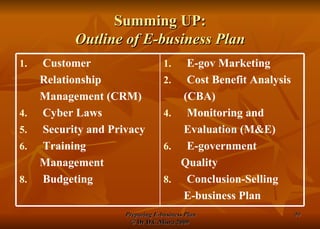
Summing UP: Outline of E-business Plan E-gov Marketing Cost Benefit Analysis (CBA) Monitoring and Evaluation (M&E) E-government  Quality Conclusion-Selling E-business Plan Customer  Relationship Management (CRM) Cyber Laws Security and Privacy  Training  Management Budgeting
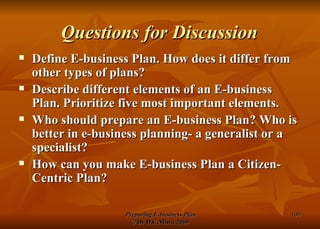
Questions for Discussion Define E-business Plan. How does it differ from other types of plans? Describe different elements of an E-business Plan. Prioritize five most important elements. Who should prepare an E-business Plan? Who is better in e-business planning- a generalist or a specialist? How can you make E-business Plan a Citizen-Centric Plan?
Your Questions?    Feel free to ask any  question . I value  them greatly.    Feel free to  contact  me too, if you feel like: Dr D.C.Misra E-government Researcher and Consultant New Delhi, India Email:  [email_address] Web:  http:// in.geocities.com/drdcmisra Think Tank:   http:// tech.groups.yahoo.com/group/cyber_quiz Tel:  91-11- 2245 2431  Fax: 91-11- 4244 5183
End of Presentation Thank you for your attention. Have a Nice Day . --  Dr D.C.Misra February 11, 2009 Gurgaon

Misra, D.C. (2009): Preparing E Business Plan for E-government_ MDI_ 11.2.2009

  • 1.
    E-government Planning PreparingE-Business Plan for E-government: Transforming Government by Dr D.C.MISRA
  • 2.
    Wednesday, February 11,2009 2-15 p.m. to 4-15 p.m. 3rd Post Graduate Diploma in Public Policy and Management Programmme (2008-10) School of Public Policy and Governance Management Development Institute P.B.60, Mehrauli Road, Sukhrali, Gurgaon 122 001
  • 3.
    Preparing E-business Plan:A Presentation by Dr D.C.Misra Independent E-government Consultant New Delhi, India Email: [email_address] Web: http:// in.geocities.com/drdcmisra Think Tank: http:// tech.groups.yahoo.com/group/cyber_quiz Tel: 91-11- 2245 2431 Fax: 91-11- 4244 5183
  • 4.
    What is proposedto be covered? Preparing E-business Plan NeGP 2007-2012 and E-government Review of Current Status of E-business Plans in Ministries/Departments/Organisations What is E-business Plan? What is not E-business Plan? What then is E-business Plan? Characteristics of a Good E-business Plan Elements of E-business Plan Conclusion
  • 5.
    Preparing E-business Plan: Elements of E-business Plan I. Executive Summary II. Part A: Operative Time Frame Deliverables Preparation: In-house or Outsourced E-business Team Financial Implications Consultation and Approval I. Executive Summary II. Part A : Operative Introduction Mandate Objectives Services Online
  • 6.
    Elements of E-businessPlan III Part B: Planning Business Process Reengineering (BPR) Risk Analysis Cost-Benefit Analysis (CBA) Architecture and Standards Enterprise Resource Planning (ERP) NeGP 2007-2012 and E-business Plan Strategic Planning Portfolio Management Situation Analysis- Fishbone Analysis Best Practices Free and Open Source Software (FOSS)
  • 7.
    Elements of E-businessPlan III. Planning, IV. Annex Knowledge Management– Management Information System Record Management Customer Relationship Management (CRM) Cyber Laws Security and Privacy Federal Enterprise Architecture Technology for E-government Technology for Access Change Management- -- RASCI Chart
  • 8.
    Elements of E-businessPlan E-government Champion E-government Marketing E-government Monitoring and Evaluation (M&E) Quality of E-government Conclusion: Selling E-business Plan Training Management Budgeting Citizen-Centricity Citizen E-engagement E-government and Right to Information
  • 9.
    I National E-GovernancePlan NeGP (2003-7) (Phase I): Rs 20,000 crore; NeGP (2007-11) (Phase II): Rs 23,000 crore; Government approved it on May 18, 2006 A body under Chairmanship of Prime Minister National E-governance Advisory Group headed by Minister for Communications and Information Technology Estimated to cost over Rs. 230 billion over the next 5 years. An Apex Committee (NeGP), with Cabinet Secretary as its Chairman and Secretary, DIT as its Member Convener. Expenditure Finance Committee (EFC)/ Committee on Non Plan Expenditure (CNE) headed by Secretary Expenditure Line Ministries/Departments responsible for implementation of the assigned Mission Mode Projects (MMPs)/Components. State Apex Committee headed by Chief Secretary for State MMPs
  • 10.
    National E-Governance PlanThe Mission Mode Projects (27) include: (a) Central Government : 1. Banking, 2. Central Excise and Customs, 3. Income Tax (IT), 4. Insurance, 5. MCA 21 6. National Citizen Database (NCD/MNIC)/Unique ID (UID), 7. Passport, Immigration and Visa, 8. Pension, and 9. e-Office (9) (b) State Government : 1. Agriculture, 2. Commercial Taxes, 3. e-District, 4. Employment Exchange, 5. Land Records, 6. Municipalities, 7. Panchayats, 8. Police, 9. Property Registration, 10. Road Transport, and 11. Treasuries (11) (c) Integrated Services : 1. CSC, 2. e-Biz, 3. e-Courts, 4. e-Procurement, 5. Electronic Data Interchange (EDI) for Trade (eTrade), 6. National Egovernance Service Delivery Gateway, and 7. India Portal (www.india.gov.in) (7)
  • 11.
    National E-Governance Plan10 Components : I. Core and Support Infrastructure : 1. Common Service Centres (CSC), 2. State Wide Area Networks (SWANs), 3. State Data Centres (SDCs) II. Other Components : 1. Capacity Building, 2. Standards, 3. Awareness and Communication, 4. Assessment, etc. Common Service Centres (CSCs): 100,000 rural Common Services Centers (CSC), catering to 600,000 villages, to be set up at cost of Rs. 5,742 crore Government of India: Rs. 856 crore, State Governments: Rs 793 crore, and balance Private sector: Rs 4093 crore) to provide broadband Internet connectivity (256 Kbps) (1 crore=10 million).
  • 12.
    I National E-GovernancePlan Four Pillars of NEGP 2003-2007 (i) State-Wide Area Network (SWAN) (ii) State Data Centre (SDC) (iii) Mission Mode Projects (MMPs), and (iv) Common Service Centres (CSCs) (Source: Department of Information Technology)
  • 13.
    National E-governance PlanPillars of National E-governance Plan National E-governance Plan Common Service Centres Mission Mode Projects State Wide Area Network State Data Centres Linkage with other programmes E-engagement of Citizens
  • 14.
    II Review ofCurrent Status of E-business Plans Status : Assess the current status of Preparation of E-business Plan I. Prepared (a) In-house, (b) Outsourced II. Under Preparation (a) In-house, (b) Outsourced III. Not Under Preparation IV. No Action Required
  • 15.
    IV What isE-business Plan? Types of Plans: Some Examples Perspective Plans (10-year, 5-year) Five Year Plans Annual Plans Rolling Plans Strategic Plans Reorganisational Plans Financial Plans Performance Plans Financial Plans Action Plans E-business Plan
  • 16.
    V What is not E-business Plan? Modernisation Plan ≠ E-business Plan New Public Management (NPM) ≠ E-business Plan Administrative Reforms Plan ≠ E-business Plan Computerisation Plan ≠ E-business Plan Automation Plan ≠ E-business Plan Management Information System (MIS) ≠ E-business Plan
  • 17.
    What is not E-business Plan? Difference between E-business and other Plans Citizen-centric transformation E-business Plan 6 √ Existing processes on machines Automation Plan 5 Computerisation of existing processes Computerisation Plan 4 Improving administrative processes Administrative Reforms Plan 3 Private Sector-like working New Public Management(NPM) 2 Novelty Modernisation Plan 1 Focus Plan SN
  • 18.
    VI What then is E-business Plan? So, E-business Plan is a citizen-centric transformation It is a Roadmap for E-government. It tells us: (a) How to perform better (i) Externally (better services to citizens) and (ii) Internally (improving internal processes)? (b) Where are we? (situation analysis) (c) Where we want to go? (vision) (d) How to go there? (strategy) It is an Action Plan for transforming Government .
  • 19.
    What then is E-business Plan? Realisation of a Vision Situation Analysis Vision Where are we? Where we want to go? How to go there? Strategy
  • 20.
    VI Characteristics ofa Good E-business Plan It is a comprehensive document It has a standard format The standard format is common to all Ministries/Departments/Organisations It is prepared in consultation with all stakeholders including citizens It has Government’s approval (Top Management buy-in)
  • 21.
    Characteristics of a Good E-business Plan It incorporates latest technology It takes into account citizen access to E-government through multiple channels It incorporates, inter alia, knowledge management (KM), change management (CM), training (T) and monitoring and evaluation (M&E) modules It has adequate budgetary support It has a E-gov Champion to implement it
  • 22.
    VII Elements ofE-business Plan: Composition An E-business Plan typically consists of four parts: -- I. Executive Summary -- II. Part A: Operative -- III. Part B: Planning -- IV. Annex It is a time-bound document with a shelf life of 3-5 years for transforming Government and serving citizens and non-citizens.
  • 23.
    Outline: I. ExecutiveSummary and II. Part A: Operative Executive Summary, Part A: Operative - Introduction, and Mandate Mandate of Ministry/ Department Mandate 2 Introduce E-business Plan Introduction 1 Operative Part of E-business Plan Part A : Operative II. Summary of Content of E-business Plan Executive Summary I. Content Element S.N.
  • 24.
    Elements of E-businessPlan: Outline 4. Hierarchy of Objectives 1. Vision 2. Mission 3. Values 4. Strategy 5. Goals 6. Deliverables 7. Time Frame and 8. Tasks Objectives 3 Content Element SN
  • 25.
    Elements of E-businessPlan: Outline Services Online, Time Frame and Deliverables Physical, Logical , Planning, Activity Deliverables 6 Prescribe Time Frame for Implementation Time Frame 5 Enumerate (1,2,3…) Services Proposed to be Online (b) Enumerate (1,2,3…) Services Currently Online 4 (a) Content Element S.N.
  • 26.
    Elements of E-businessPlan: Outline Preparation,Team, Fimancial,Consultation & Approval Consultation with Stakeholders and Levels of Management Approval Consultation and Approval 10 Consolidated requirements Financial Implications 9 Set up E-business Team E-business Team 8 (i) In-house, or (ii) Outsourced Preparation 7 Content Element SN
  • 27.
    Elements of E-businessPlan Outline: III. Part B: Planning NeGP, SP, Portfolio Management and Situation Analysis Building blocks of E-governance Master Plan NeGP 2006-2010 and E-business Plan 1 Content Element S.N. Undertake Fishbone Analysis of Present Situation Situation Analysis 4 Combine High Risk and Low Risk Projects Portfolio Management 3 Scan environment – SWOT Anaysis Strategic Planning (SP) 2
  • 28.
    Elements of E-businessPlan: Outline Best Practices, FOSS, BPR and Risk Analysis Benchmark against Inter-Sectoral and Sectoral Best Practices Best Practices 5 Content Element SN Categorise risks and provide for their mitigation Risk Analysis 8 Undertake critical review of existing business processes Business Process Reengineering-BPR 7 Encourage use of Free and Open Source Software (FOSS) as a policy where possible Free and Open Source Software-FOSS 6
  • 29.
    Elements of E-businessPlan: Outline CBA, Architecture and Standards, ERP and FEA Develop reference models for performance, business, technical, service and data Federal Enterprise Architecture (FEA) 12 Undertake whole-of-government Approach Enterprise Resource Planning (ERP) 11 Set up E-government Architecture and Standards Architecture and Standards 10 Enumerate Financial and other Costs and Benefits  Cost Benefit Analysis (CBA) 9 Content Element S.N.
  • 30.
    Elements of E-businessPlan: Outline Technology, Access, Change Management and KM Set up a Management Information System (MIS) including M&E Unit Knowledge Management (KM) 16 Use RASCI Chart (who is to do what for adopting to change) Change Management (CM) 15 Enumerate technologies by which customers access E-government Technology for Access 14 Check best available and emerging technologies Technology for E-government 13 Content Element SN
  • 31.
    Elements of E-businessPlan: Outline Record Management, CRM, Cyber Laws, Security and Privacy Prepare a Security Module and protect citizen privacy Security and Privacy 20 New Legislation and Amendment of Existing Legislation Cyber Laws 19 Serve the Customer by anticipating and responding to his needs. Remember we exist from him Customer Relationship Management-CRM 18 Issue guidelines for electronic record management Record Management 17 Content Element SN
  • 32.
    Elements of E-businessPlan: Outline TM, Budgeting, Citizen, and E-engagement Provide for e-engagement of citizens in e-business plan E-engagement 24 Keep citizen at the centre, and not at the periphery, of planning Citizen-Centricity 23 Provide for Annual and Project Life Budgeting 22 Prepare a Training Module for all categories of personnel Training Management 21 Content Element S.N.
  • 33.
    Elements of E-businessPlan: Outline RTI, Champion, Marketing, Quality, M&E, Selling Prepare E-government Marketing Module E-government Marketing 27 Prescribe E-government Quality Metrics and Standards E-government Quality 28 Set Up a Monitoring and Evaluation (M&E) Unit Monitoring and Evaluation (M&E) 29 Sell E-business Plan- Develop Unique Selling Points (USPs) Conclusion 30 Content Element S.N. Identify, support and give a tenure of 3-5 years E-government Champion 26 Provide for RTI in E-business Plan Right to Information (RTI) 25
  • 34.
    Elements of E-businessPlan: Details I. Executive Summary A brief overview of content keeping the reader (decision-maker) in mind. Describes: Purpose of E-business Plan How the purpose is to be achieved? Gains to Citizens, Non-Citizens and Government Cost (Financial, Physical and Manpower) Cost-Benefit Analysis Length: Minimum- 1 page, Maximum- 2 pages Summaries: Two Types: (a) Multi-paragraph free-form description (b) Structured formal executive summary
  • 35.
    Part A: Operative1. Introduction Give Purpose Need Background (What has prompted it) History (Earlier Efforts) Scope (What it covers), and Layout
  • 36.
    2 Mandate ofMinistry/Department Subjects allocated to Ministry/Department Allocation of Business Rules Transaction of Business Rules Cabinet, Cabinet Sub-Committees, Group of Ministers (GOM) Preparation of Cabinet Notes High Powered Committee, Empowered Committee, Steering Committee, Task Force
  • 37.
    3 Hierarchy ofObjectives Ministry/Department (a) Vision (b) Mission (c) Values (d) Strategy (e) Goals (f) Deliverables (g) Time Frame (h) Tasks
  • 38.
    (a) Vision Lodestarfor Ministry/Department Described by Policy-Makers, often in their election Manifesto and subsequently in Government Programme(s) Often the overarching raison de etre for Ministry/Department Vision is essential; without it Ministry /Department is directionless and unproductive Do you believe in it?
  • 39.
    (b) Mission Torealise vision, mission statement is essential Mission statement should be brief, sharp and to-the-point Capture it in a short and striking sentence like: PUTTING PEOPLE FIRST To realise vast untapped potential of E-government, mission-mode projects are essential, which are sharply-focused and cut red tape
  • 40.
    (c) Values Missionto be governed by values. Identify and establish values: Integrity Service Empathy Dedication Excellence Learning
  • 41.
    (d) Strategy Strategy:How to realise the vision It is a practical, feasible approach A good strategy is half the battle won Civil servants, due to their vast “hands-on” experience are good developers of “strategy” Should be developed in a collaborative mode and made known to all stakeholders Should be “hard-boiled” (based on resources) and not on just “feel-good” discussions
  • 42.
    (e) Goals Strategybreaks down the mission into goals. Goals are SMART : S pecific, M easurable, A chievable, R ealistic T ime-bound We will deal with (f) Deliverables and (g) Time Frame separately
  • 43.
    (h) Tasks Thisis “most granular level” of the E-government project Policy-Maker’s View: Vision to Task Implementer’s View: Task to Vision The two view must meet (co-shared) for optimum results (high productivity) Vision without task performance will remain a dream Task performance without vision is unproductive routine
  • 44.
    4 Services OnlineEnumerate (1,2,3…) services currently online At what stage are the online services? Enumerate (1,2,3…) services proposed to be online (in 3-year perspective, that is, life span of E-business Plan ): (i) By June 2008, (ii) By June 2009 (iii) By June 2010 Work out volume of transactions
  • 45.
    Stages of ServicesOnline Information (Download form) Transaction (Fill form online) Payment Online (Security of Payment) Interaction (Can ask question and get reply) Personalised Service (Tailored to the requirement of a citizen)
  • 46.
    5 Time Framefor Implementation ► E-business Plan may have a life span of three to five years ► Work out implementation in 3 annual phases : (i) 2009-2010 (ii) 2010-2011 and (iii) 2011-2012 ► Break down each annual phase into quarterly and monthly milestones ► Work out physical as well as financial milestones
  • 47.
    Time Frame forImplementation Deliverables have to stick to a timeframe for delivery They are called Milestones Timely delivery is one important measure of project success Quality of deliverables (Citizen-satisfaction) is another Time over-run will result in cost over-run and additional funds may not be available .
  • 48.
    6 Deliverables Thereis a “spectrum of deliverables” Deliverables can be (i) project (ii) planning , and (ii) activity deliverables Project Deliverables are “tangible products, services or plans delivered as an outcome to a project, designed to meet identified goals and objectives.” They can be “physical” and “logical” in nature Physical Deliverables : Hardware, Software, Manuals, Documentation
  • 49.
    Deliverables Logical Deliverables: Service Delivery, Performance Improvement, Solution of Problems, Recommendations Planning Deliverables : Project Proposal, Budget, Plans for Knowledge Management, Change Management, Training and Monitoring and Evaluation (M&E) Activity Deliverables : Status Reports, Meeting Agendas , Minutes, Purchase Orders, Timesheets, Contact Lists Must be specified , scheduled and accepted Cover entire timeline of project – from inception to closure
  • 50.
    7 Preparation ofE-business Plan In-house or Outsourced? (a) Preparing E-business Plan In-house? Indicated in case of smaller Ministries /Departments/Organisations Requisite expertise may not be available Requisite expertise may have to be provided through training It is better to prepare E-business Plan i n-house rather than outsource it
  • 51.
    (b) Outsourcing E-businessPlan E-business Plan may have to be outsourced for larger Ministries/Departments This opens up a new front Outsourcing may bring cost and other benefits but it may increase “reputation, compliance and operational risks.” Guidelines for Outsourcing are required to be issued, which may include:
  • 52.
    (b) Outsourcing E-businessPlan Risk Management (Service provider may not fulfill his commitments) Material Management (Equipment may not be delivered in time or not at all) Legal and Procurement Requirements may not be met There may be country risk (service provider may be located in another country) There may be concentration risk (Lack of control over a common service provider) (Source: http://www.mas.gov.sg/)
  • 53.
    8 E-business TeamSet up a team of CIO DBA Project Manager, and Deputy CIO, to draft the E-business Plan in a definite timeframe (say, 2 months)
  • 54.
    9 Financial ImplicationsGive the gist of financial requirements Do not load it with unnecessary data Suggest alternative figures Suggest source of funding, for example, budget, external assistance, etc. Give any economy measures and savings from other projects
  • 55.
    10 Consultation andApproval Consultation : Give details of consultations made with stakeholders- citizens, non-citizens, women, youth, and businesses Approval Describe the levels at which the E-business Plan has been approved Ensure Top Management buy-in of the Plan
  • 56.
    III. Part B:Planning Part 1. NeGP and E-business Plan Show how the E-business Plan (i) helps the National E-governance Plan (NeGP), the ICT sector and the economy (ii) makes specific contribution to socio- economic parameters (iii) is a building block of E-government Master Plan (NeGP/State eGP) (iv) provides citizen-centric government, and (v) implements government programmes
  • 57.
    2. Strategic PlanningScan external, particularly political and technological environment environments Undertake Strengths, Weaknesses, Opportunities and Threats (SWOT) Analysis Check how your plan fits with over-all national priorities Undertake documentation
  • 58.
    3 Portfolio Management Traditional Approach: Project-by-Project investment  Portfolio Management: Planning best practice  It considers all the projects taken together  Identify low-risk low payoff and high-risk high payoff projects  Mix these two types of projects in the e-business plan
  • 59.
    4. Situation AnalysisFishbone Analysis or Ishikawa Diagram Analyse Present Situation (Undertake Cause-and-Effect Analysis) by Fishbone Analysis or Ishikawa Diagram (See next slide) Consider Categories of Causes (Example) 1. Policy (Government) 2. Civil Service (Government Employees) 3. Citizens (Customers) Present Situation 1 Content Element S.N.
  • 60.
    Situation Analysis FishboneAnalysis or Ishikawa Diagram 4. Business Processes (Procedures) 5. Technology for Internal Processes 6. Technology for Access by Customers 7. Marketing (E-government Marketing) 8. Site Navigation Content Element SN
  • 61.
    Situation Analysis FishboneAnalysis or Ishikawa Diagram
  • 62.
    5 Benchmarking againstBest Practices Benchmark against best practices worldwide Where are we and what is the benchmark? Can we reach the benchmark? If yes, what is the timeframe? If no, why not? Be practical in your analysis Adopt the “best practice” which is attainable and not what looks attractive.
  • 63.
    6 Free andOpen Source Software Describe current use of Free and Open Source Software (FOSS) Describe Proposed Use of Free and Open Source Software (FOSS) in E-business Plan Highlight Cost savings and Scalability Pay due regard to Security Encourage Use of Free and Open Source Software (FOSS) as a matter of policy
  • 64.
    7 Business ProcessRe-engineering (BPR): Process Map Example : Winning an Overseas Scholarship 1. Download from Website or Collect Application Form (AF) from MOE 2. Fills in Application Form 3. Calls in person at MOE to submit Form and docs 4. Verifies docs submitted 5. Process Application 6. Inform short listed candidates 7. Calls in for interview 8. Finalise list of scholarship winners 9. Gets reply on scholarship Applicant Applicant Applicant MOE Scholarship Staff MOE Scholarship Staff MOE Counter Staff Applicant MOE Scholarship Staff Applicant ( Source: Adopted from Central Informatics Bureau, Mauritius)
  • 65.
    BPR Questions Whyat Stage 3 Applicant is called in person? Can one or more stages in the scholarship award process be eliminated? Why cannot a candidate apply online? Is there any public notification of scholarship winners online or print media? Is there any consolidated list of scholarships available at MOE and/or online, etc.
  • 66.
    8 Risk Analysis Undertake risk analysis audit  Identify and categorise risks, for example  Political, Financial, Personnel, Technological  Work out their magnitude and probabilities of occurrence  Provide for their mitigation, and  Prepare Risk Mitigation Plan
  • 67.
    9 Cost BenefitAnalysis An old and widely used methodology Benefits must be greater than Cost Net Present Value (NPV) / Discounted Cash Flow (DCF)/Return on Investment (ROI) Quantifiable and Non-Quantifiable Elements Should be one, and not the only, criterion in decision-making
  • 68.
    10 Architecture andStandards Develop E-government Architecture following Zachman (2008) /USDOD/ TOGAF (2009) Include (a) Divisional (b) Sectional Needs, and (b) Exploitation of Technologies Make it conform to National E-government Architecture Develop Sectoral E-government Standards Make them conform to National Inter-sectoral E-government Standards
  • 69.
    Architecture and Standards(Source: Heeks 2006)
  • 70.
    11 Enterprise ResourcePlanning  A private sector software which often failed even in private sector  It is based on consolidation of all resources  One-size-fits-all does not work.  Each E-business plan has its own characterstics and has to be considered on its own  It laid the foundation of Federal Enterprise Architecture (FEA) in the U.S.
  • 71.
    12 Federal EnterpriseArchitecture U.S. Federal Enterprise Architecture (FEA) Framework (5 Reference Models) Performance Reference Model (PRM)- Outcomes, Metrics against Best Practices Business Reference Model (BRM)- 4 Business Areas, 39 Lines of Business and 154 Subfunctions Service Reference Model (SRM)- Software application categories for cross-agency use- 7 domains, 29 service types and 168 components
  • 72.
    Federal Enterprise ArchitectureTechnical Reference Model (TRM)- 4 Core Service Areas, Service Categories, Service Standards and Service Specifications Data Reference Model (DRM)- Common data definitions for categorising and exchanging data  Overlays : Policy documents affecting above 5 reference models- For Security and Privacy  National Informatics Centre (NIC) has set up a Working Group on E-government Standards Source: Garson (2006)
  • 73.
    13 Technology forE-government Still widely used Fax (Facsimile) 5 Interactive Digital TV Television 4 Still widely used Radio (including CR) 3 Photo ID Card/ Poloroid Cards Identity Cards 2 Helpline, Help Desk, Call Centre, m-government Telephone (Landline and Cell Telephone) 1 Use/Remarks Technology S.N.
  • 74.
    Technology for E-governmentVersatile handheld device Personal Digital Assistants (PDAs) 10 Chat (Rare but useful) Instant Messaging (IM) 9 Community Electronic Mailing Lists 8 Community Newsgroups 7 Instant reply expected Email 6 Use/Remarks Technology S.N.
  • 75.
    Technology for E-governmentIEEE 802.16 Standard WiMax (Worldwide Interoperability for Microwave Access) 15 IEEE 802.11 Standard Delhi will be one “hotspot.” WiFi (Wireless Local Area Networks) (WLAN) 14 Data Service for GSM Mobile Phones GPRS (General Packet Radio Service) 13 Video Telephony (Japan Leads) 3G (Third Generation Technology) 12 Images, Audio, Video, Rich Text Multimedia Messaging Services (MMS) 11 Use/Remarks Technology S.N.
  • 76.
    Technology for E-governmentMemory Cards and Microprocessor Cards Smart Cards 20 Recognizing humans from physical (fingerprints, eye retinas and irises) or behavioral traits (signature, gait) Biometrics 19 Stores and remotely retrieves data using RFID tags Radio Frequency Identification (RFID) 18 Transmission of signals to specific monitors from TV cameras for surveillance at banks, airports, road traffic-Security vs Privacy Closed-Circuit Television (CCTV) 17 Industrial specification for wireless personal area networks (PANs) ( IEEE 802.15.1 ) Bluetooth 16 Use/Remarks Technology SN.
  • 77.
    Technology for E-government(Check: Wikipedia) Satellite Navigation System – More than two dozen GPS satellites broadcast timing signals by radio to GPS receivers ) (A vital global utility for modern navigation on land, sea, and air) GPS ( Global Positioning System) 24 A computer system for creating, storing, analyzing and managing spatial data and associated attributes GIS (Geographical Information System) 23 I ncludes kiosks, Internet, telephones, punch cards, marksense or optical scan ballots . E-Voting 22 S hort-range wireless connectivity Technology NFC (Near Field Communication) 21 Use/Remarks Technology S.N
  • 78.
    14 Technology forAccess by Customers Enumerate technologies in (a) use, and (b) likely to be used in near future by customers Pay particular attention to: (a) Emails (b) Kiosks, and (c) Community access centres
  • 79.
    15 Change ManagementPrepare change management (CM) module Make use of RASCI chart Win over employees to change Set personal example as a change agent Advocate how every one will be better off as a result of E-business Plan Do not waste time over “hard cases” (personnel who have decided not to change)
  • 80.
    16 Knowledge ManagementPrepare knowledge management (KM) module Identify and anticipate management information needs Set up Management Information System (MIS) as a decision support system (DSS) Make use of Relational Database Management System (RDBMS) Provide for Data Warehousing and Data Mining
  • 81.
    17 Record Management Record Retention Schedule I. Facilitative Functions: (i) Establishment, Personnel, Housekeeping, etc. (ii) Office Procedure- Register, Diaries, etc. (iii) Financial- Finance, Budget, Accounts, etc. -- Record Retention Schedule for Records Common to All Departments- DARPG -- Central Secretariat Manual of Office Procedure – DARPG -- General Financial Rules , 1963
  • 82.
    Record Management II. Substantive Functions 'A' Category : For permanent preservation; Microfilmed. 'B' Category : For permanent preservation; not Microfilmed. 'C' Category : For a limited period, not exceeding 10 years (C-1, C-3, C-5, C-10, numerals indicate number of years)
  • 83.
    Record Management ElectronicRecord Management  Module for Storage, Safety and Retrieval  Record Retention Schedule  Meta Data, File Naming and File Format  Storage Options (magnetic tape, optical disk)  E-mail Management  Electronic Record and Right to information
  • 84.
    18 Customer RelationshipManagement (CRM)  Improve CRM. Public Grievance Mechanisms do not work despite an eco-system  Set up Citizen Call Centres  Improve eCRM. IVRS (Interactive Voice Response System) is unsatisfactory  Both public and private sectors are wanting in performance  Should a citizen demand public service as her right or beg for it ?
  • 85.
    19 Cyber Laws Eastern Code (Washington, D.C.) – Old Laws: Common Law, Statutory Law  Western Code (Silicon Valley) – Software Code  Norms and Market  New Laws (IT Act, RTI Act, etc.)  Proposed Laws including Amendments
  • 86.
    20 Security andPrivacy  Set up a Security Module  Include sensitisation of all levels of personnel to security needs  Conform to ISO/IEC 17799:2005  Have a Diaster Recovery Plan  Ensure Privacy of Citizens by giving explicit insurance
  • 87.
    21 Training Management Include Training Module (TM)  Introduce new technology only after training  Train all levels of personnel  Prepare a training plan  Go for best training resources  Treat training outlay as an investment and not as an expenditure
  • 88.
    22 Budgeting  Undertake zero-base budgeting  Provide for Annual and Project Life  Undertake financial, physical, and performance budgeting  Support proposal by highlighting (a) efficiency , (b) productivity , and (c) effectiveness  Give concrete examples from past performance, if any
  • 89.
    23 Citizen-Centricity  Keep citizen at the centre of e-business plan  Identify and categorise citizens , for example, (i) Senior Citizen, (ii) Women, (iii) Youth, etc.  Identify and categorise non-citizens , for example, (i) Children, (ii) Tourists, (iii) Immigrants, etc.  Provide individualised services online for each category
  • 90.
    24 E-engagement  Promote E-democracy  Engage citizens in policy formulation and implementation  Use e-engagement tools like (i) Discussion Forum, (ii) RSS Feed (iii) Blog, and (iv) Wiki,and (v) E-petition  Provide for e-engagement on official Websites  Provide for time-bound replies to E-mails
  • 91.
    25 E-government andRight to Information (RTI)  Right to information is an integral part of E-government  E-business Plan will blend with the requirements of Right to Information (RTI) Act (See also record management)  Incorporate requirements of the Nodal Officer under the RTI Act  Co-share responsibility with the Nodal Officer for compliance with RTI Act
  • 92.
    26 E-government Champion Identify and support E-government Champion, who will be a civil servant Enthusiasm rather than qualifications will be the criterion of identification  She need not be a technocrat  Give her a fixed term of 3-5 years to show results  Do not include political e-champions
  • 93.
    27 E-government Marketing E-services will be need -based  Identify Unique Selling Points (USPs) of E-services  Use Online and Offline advertising to good effect  Insert an E-government slogan/banner in official ads and stationery  Prepare an e-government marketing plan
  • 94.
    28 E-government QualitySelected Quality Measures 1. Citizen’s Charter (U.K., India) 2. Charter Mark (U.K.) 3. Baldridge Criteria (US) 4. ISO 9000 Series 5. Customer Charter (Mauritius) 6. Balanced Scorecard (Kaplan and Nortan 1992) 7. Six Sigma (Motorola University) 8. E-gov ACSI (American Consumer Satisfaction Index) (1994) (U.S.)
  • 95.
    29. E-government Monitoringand Evaluation (M&E)  Set up an E-government Monitoring and Evaluation (M&E) Unit  It is independent of Project Management Unit  It reports directly to Top Management  It consists of professional multi-disciplinary personnel  It is an integral part of Management Information System (MIS)
  • 96.
    30 Conclusion SellingE-business Plan  Marketing of E-services is done for citizens  E-business plan has to be sold to policy- makers  Highlight gains to citizens , etc. (and not to organisation)  Think of points which will give them publicity and political mileage
  • 97.
    Summing UP: Outlineof E-business Plan I. Executive Summary , II.Part A: Operative Preparation in-house or outsourced E-business Team Financial Implications Approval Introduction Mandate Objectives Services Online Time Frame Deliverables
  • 98.
    Summing UP: Outlineof E-business Plan III. Part B: Planning Part, IV. Annex Architecture and Standards Technology for E-government Technology for Access CM-RASCI Chart KM-Management Information System (MIS) NeGP 2007-2011 and E-business Plan Situation Analysis – Fishbone Analysis Best Practices Business Process Reengineering (BPR) Free and Open Source Software (FOSS)
  • 99.
    Summing UP: Outlineof E-business Plan E-gov Marketing Cost Benefit Analysis (CBA) Monitoring and Evaluation (M&E) E-government Quality Conclusion-Selling E-business Plan Customer Relationship Management (CRM) Cyber Laws Security and Privacy Training Management Budgeting
  • 100.
    Questions for DiscussionDefine E-business Plan. How does it differ from other types of plans? Describe different elements of an E-business Plan. Prioritize five most important elements. Who should prepare an E-business Plan? Who is better in e-business planning- a generalist or a specialist? How can you make E-business Plan a Citizen-Centric Plan?
  • 101.
    Your Questions?  Feel free to ask any question . I value them greatly.  Feel free to contact me too, if you feel like: Dr D.C.Misra E-government Researcher and Consultant New Delhi, India Email: [email_address] Web: http:// in.geocities.com/drdcmisra Think Tank: http:// tech.groups.yahoo.com/group/cyber_quiz Tel: 91-11- 2245 2431 Fax: 91-11- 4244 5183
  • 102.
    End of PresentationThank you for your attention. Have a Nice Day . -- Dr D.C.Misra February 11, 2009 Gurgaon

Editor's Notes

  • #84 Minnesota has 4800 file formats (Garson 2006)