





Best Practices For Business
Analyst
Modern practices in 2017
Benefits, Roles, Consistent Requirements, tips
Presented by: Moutasm Tamimi
Software Engineering
3
Speaker Information
 Moutasm tamimi
Independent consultant , IT Researcher , CEO at ITG7
Instructor of: Project Development.
DBMS.
.NET applications.
Digital marketing.
Email: tamimi@itg7.com
LinkedIn: click here.
Outline
1. Introduction
2. Target Audience
3. Benefits of having dedicated BA
4. BA role in the IT project organisation
5. Differences of Business analyses, System analyses,
6. Differences of User Assurance Coordinator and Business Assurance
Coordinator
7. Roles and Responsibilities of BA
8. Tips for BA Role in IT Project Organisation
9. Relationship between BA and project manager
10. Relationship between BA and SA
11. Consistent requirements according to the BA
Outline
12. Elicitation and Analysis of Requirements
13. Prepare for Elicitation
14. Perform Elicitation
15. Prioritise Requirements
16. Refine and Organise Requirements
17. Verify Requirements
Introduction
■ A business analyst (BA) role be explicitly instituted into the IT project
organisation.
■ Best Practices for Business Analyst” (“Document”) is to provide guidance
to government bureaux and departments (B/Ds)
■ It is not a procedure manual and the BA should apply business
knowledge and experience while practising business analysis to achieve
the expected outcome.
■ To boost the adoption of the practices, support and buy-in of senior
management and business users in B/Ds are very important
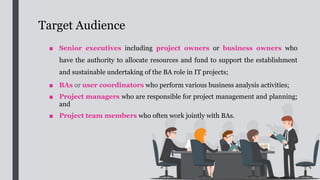
Target Audience
Project owners
or business
owners
BAs or user
coordinators
Project
managers
Project team
members
Target Audience
■ Senior executives including project owners or business owners who
have the authority to allocate resources and fund to support the establishment
and sustainable undertaking of the BA role in IT projects;
■ BAs or user coordinators who perform various business analysis activities;
■ Project managers who are responsible for project management and planning;
and
■ Project team members who often work jointly with BAs.
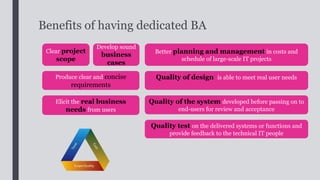
Benefits of having dedicated BA
Clear project
scope
Develop sound
business
cases
Better planning and management in costs and
schedule of large-scale IT projects
Produce clear and concise
requirements
Elicit the real business
needs from users
Quality of design is able to meet real user needs
Quality of the system developed before passing on to
end-users for review and acceptance
Quality test on the delivered systems or functions and
provide feedback to the technical IT people
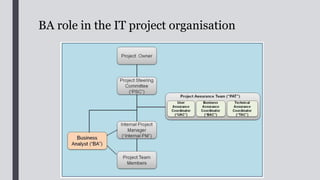
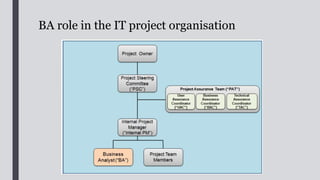
BA role in the IT project organisation
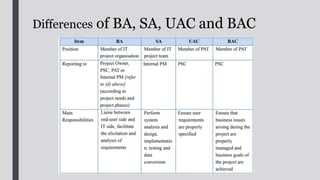
Differences of BA, SA, UAC and BAC
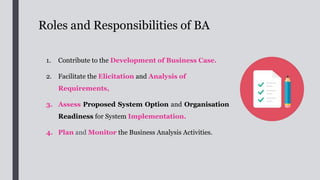
Roles and Responsibilities of BA
1. Contribute to the Development of Business Case.
2. Facilitate the Elicitation and Analysis of
Requirements,
3. Assess Proposed System Option and Organisation
Readiness for System Implementation.
4. Plan and Monitor the Business Analysis Activities.
Tips for BA Role in IT Project Organisation
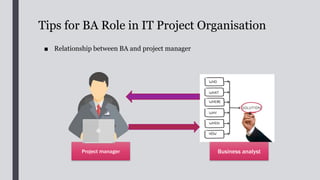
■ Relationship between BA and project manager
Project manager Business analyst
Relationship between BA and project manager
■ Project managers should understand that BAs need to be involved in all phases
of the SDLC including elicitation and documentation of
requirements.
■ Both BA and project manager should understand each other’s roles and
responsibilities in the project organisation, and
closely communicate and coordinate with each other.
Relationship between BA and SA
■ While the SA has the focus on IT related issues, he/she has the overall responsibility
for the SA&D and implementation of IT system development
project.
■ The BA and SA should work closely together to make sure that the BA has accurately
conveyed business requirements to the SA and that the SA has
come up with the system design and got the system
implemented according to the confirmed requirements.
Consistent requirements according to the BA
Roles
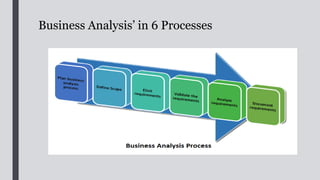
1. Elicitation and Analysis of Requirements
2. Prepare for Elicitation
3. Perform Elicitation
4. Prioritise Requirements
5. Refine and Organise Requirements
6. Verify Requirements
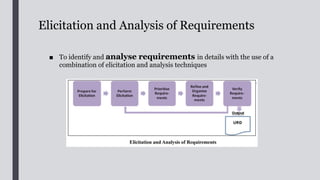
Elicitation and Analysis of Requirements
■ To identify and analyse requirements in details with the use of a
combination of elicitation and analysis techniques
Prepare for Elicitation
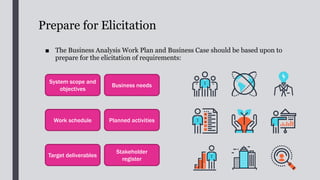
■ The Business Analysis Work Plan and Business Case should be based upon to
prepare for the elicitation of requirements:
System scope and
objectives
Business needs
Work schedule Planned activities
Target deliverables
Stakeholder
register
Prepare for Elicitation
2) The preparation tasks include:
■ Select the elicitation techniques to be used and specify the scope of work
for each selected technique. E.g. (brainstorming, document analysis, interface
analysis, focus groups, interviews, observation, prototyping, requirements
workshops and surveys/questionnaires.)
■ Prepare supporting materials required for using the selected techniques
e.g. survey form, interview questions list, discussion materials, existing
documentation, comment/feedback form, etc.
■ Schedule all other required resources such as participants,
meeting venue, facilities and equipment before performing elicitation;
■ Prepare an elicitation work plan with a schedule;
■ Notify and agree with all involved stakeholders and related parties such
as project team members on the elicitation work plan.
3) The BA should agree with the stakeholders on the scope of work and the
elicitation work schedule, and define a mechanism for verifying and signing off the
elicited results
Perform Elicitation
■ Upon completing the necessary preparatory tasks, the elicitation activities can be
performed according to the elicitation work plan.
■ BA should start by studying all documentation about the concerned
business and existing system, including policies, procedures and current
system documentation where applicable.
■ It should be ensured that requirements can always be traced back to
the business goals/objectives to ensure that they are within scope, and should be
capable of addressing the business needs as well as addressing the
relevant current problems and issues.
■ During the elicitation, requirements attributes such as the source, value to
users and priority should be recorded. This will help to manage the requirements
throughout the project life cycle.
■ All requirements provided by stakeholders during the elicitation should be
properly recorded and documented, and a summary should be produced.
Prioritise Requirements
The requirements collected should be prioritised based on their relative
importance:
■ Business Value: The requirements with the highest business value should be
considered for development first.
■ Stakeholder Agreement: Agreement from the senior or key stakeholders
on which requirements are most useful or valuable is another important factor
when prioritising requirements.
■ Impact on Users: Some requirements may cause high impact on users
affecting their current processes, or requiring additional staff effort.
■ Impact on Other Systems: Some requirements may require data input
from/output to other interfaced systems such that associated changes are required
to be made on those systems which they may not be capable or willing to do the
changes.
Prioritise Requirements
■ Regulatory or Policy Compliance: Meeting regulatory or policy
demands may take precedence over other stakeholder interests.
■ Dependency: A requirement which supports other higher priority
requirements, i.e. other requirements have a high dependency on it, may need
for early implementation.
■ Urgency: Time sensitivity is another important consideration.
■ Business or Technical Risk: Select requirement(s) with higher risk of
project failure for early investigation and implementation such that rectification
can be made at an early stage in case any problem occurs.
■ Implementation Difficulty: Select requirements that are easiest to
implement if early visualisation of functions is required to gain user familiarity
and management support.
Refine and Organise Requirements
■ Requirements should be described in natural language. Simple and
consistent definitions should be used when defining the requirements.
■ The dependencies and interrelationship among the requirements should also be
described. Usually, requirements on their own are not complex, but
complexity may arise from the relationships and interdependencies among
requirements.
■ Requirements should be developed in enough details that are sufficient to
fully describe the project scope and meet the informational needs of stakeholders.
■ Future business processes are required to be defined to help visualise
the requirements.
■ Some modelling techniques such as process modelling for business processes,
functional decomposition, scenarios and use cases,
flow diagram, activity diagram, sequence diagram,
structured walkthrough, etc. can be used for organising the
Verify Requirements
■ A high quality requirement should
be concise, complete, consistent, correct, feasible,
testable, modular, traceable and unambiguous. The
quality of the requirements can be verified
by doing the followings:
1. Check the completeness of the requirements;
2. Check that consistent terms and words are
used, and that they are understandable to
stakeholders and aligned with those terms
used in the Government;
3. Ensure all variations (e.g. exception cases and
branching logics) to the processes are
identified and documented;
4. Ensure all causes and outcomes of the
variations have been explained; and
5. Give examples to strengthen the business case
Verify Requirements
■ Techniques such as prototyping and structured walkthrough can be used to assist in
the verification of requirements.
■ The requirements should be assessed to determine if they could deliver direct or
indirect business value. If a requirement does not provide any value to the stakeholder, the
requirement can be removed.
■ This verification process may last for a number of rounds until all requirements are
verified. However, each round should normally have fewer refinements than the previous round.
■ A User Requirements Document (URD) should be prepared based on the finalised
requirements and project team can also make reference to the existing documentation such as FS
or SA&D report of the old system and/or a relevant system if there is any. It describes what the
new IT system looks like from a business perspective.
■ BA should lead the preparation of the URD. If required, BA may seek assistance from
IT project team in preparing the URD especially for those sections that the BA is not familiar
with.
■ The URD should preferably be signed off by the users once all requirements are
confirmed and accepted.
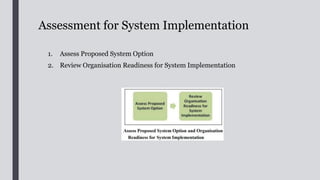
Assessment for System Implementation
1. Assess Proposed System Option
2. Review Organisation Readiness for System Implementation
Assess Proposed System Option
■ BA should help the IT project team to determine whether
the proposed system option and the high-level system design could meet the business
needs and deliver enough business value to justify the investment.
■ In assessing the proposed system option, BA should learn about the
implications of the design to ensure that the design risks associated with
the requirements are minimised
■ If it is determined that no proposed IT system option can deliver enough value to
justify the investment, a recommendation to terminate the
implementation of the project may be needed.
Review Organisation Readiness for System
Implementation
■ BA should understand the changes that will probably occur to
business and users, and should identify the potential impacts of the new system
to the organisation such as the organisation culture, its business units and
stakeholders.
■ BA should effectively communicate the identified
potential changes and impacts on the concerned parties
and senior management, and propose any needs for training and
change management to be conducted in association with the implementation of
the system.
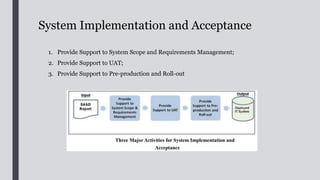
System Implementation and Acceptance
1. Provide Support to System Scope and Requirements Management;
2. Provide Support to UAT;
3. Provide Support to Pre-production and Roll-out
Provide Support to System Scope and
Requirements Management;
■ During system implementation, BA should provide support to
stakeholders in helping them to resolve issues/conflicts, obtain
consensus on any changes in system scope & requirements and seek approval of
change requests
■ The system scope serves as a boundary for requirements
management. s
■ The requirements specified in the URD and endorsed by the PSC at
the end of the SA&D Phase will form a baseline for any change to requirements.
■ BA should manage and resolve issues/conflicts among
stakeholders on changes in requirements and technical changes that emerge
in the System Implementation Phase.
■ After completing the SA&D, the implementation may be outsourced
to external contractor. In this case, the role of BA is particularly
Provide Support to User Acceptance Test
■ The aim to check and verify whether the developed IT system fully meets the
requirements and business needs. The support activities include the
following:
1. Get key users involved as early as during UAT planning, and ensure that the
participants are committed to the success of the UAT;
2. Assist in preparing the UAT plan to verify that all major components or
functions of the system meet the user requirements and business needs
3. Coordinate external departments and business stakeholders (such as focus
group users) for the UAT on interface functions;
Provide Support to User Acceptance Test
1. Organise hands-on training for UAT participants to get them
familiarised with the new system functions and workflow;
2. Work with users to prepare a testing schedule, and ensure that
schedule resembles the process flow in real life;
3. Request users to define and document all the necessary test
data, expected output and acceptance criteria for each test case;
4. Assist users to conduct the UAT, consolidate findings and testing
reports;
5. Follow up with IT project team on failed UAT test cases to
ensure that all problems are fixed and re-tested.
Provide Support to Pre-production and Roll-
out
■ Assist in organising training for users on how to use the new IT
system such as helping to review the training materials and arranging logistics for
the training courses;
■ Collaborate between users and IT project team on pre-production
activities such as disaster recovery drill, transition work like setting up of temporary
business processes/work flows for transition and data conversion like initialisation
of new system data and archiving of old system data to ensure that data is properly
migrated and preloaded into the new system
■ Coordinate among users, related stakeholders and IT project
team to perform system roll-out activities such as system verification, user
administration, system support and maintenance, nursing, etc.;
■ Assist users in reviewing and revising user-related
documentation such as user manual, user guides, user administration
procedures, operation manual, etc.;
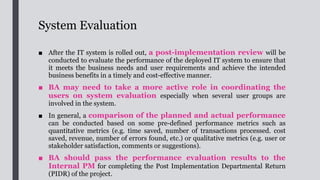
System Evaluation
■ After the IT system is rolled out, a post-implementation review will be
conducted to evaluate the performance of the deployed IT system to ensure that
it meets the business needs and user requirements and achieve the intended
business benefits in a timely and cost-effective manner.
■ BA may need to take a more active role in coordinating the
users on system evaluation especially when several user groups are
involved in the system.
■ In general, a comparison of the planned and actual performance
can be conducted based on some pre-defined performance metrics such as
quantitative metrics (e.g. time saved, number of transactions processed. cost
saved, revenue, number of errors found, etc.) or qualitative metrics (e.g. user or
stakeholder satisfaction, comments or suggestions).
■ BA should pass the performance evaluation results to the
Internal PM for completing the Post Implementation Departmental Return
(PIDR) of the project.
References
■ The Government of the Hong Kong Special Administrative Region, March 2015 ©
Speaker Information
 Moutasm tamimi
Independent consultant , IT Researcher , CEO at ITG7
Instructor of: Project Development.
DBMS.
.NET applications.
Digital marketing.
Email: tamimi@itg7.com
LinkedIn: click here.
Concepts Of business analyst
Practices
Modern practices in 2017
B e s t P r a c t i c e s
Presented by: Moutasm Tamimi
Software Engineering
1
https://www.slideshare.net/moutasmtamimi/concepts-of-business-analyst-practices-part-
1
Best Practices For Business
Analyst
Modern practices in 2017
R e q u i r e m e n t s , R o l e s , S t r a t e g y, T i p s
Presented by: Moutasm Tamimi
Software Engineering
2
https://www.slideshare.net/moutasmtamimi/best-practices-for-business-analyst
Best Practices For Business Analyst - Part 3

Best Practices For Business Analyst - Part 3

  • 1.
    Best Practices ForBusiness Analyst Modern practices in 2017 Benefits, Roles, Consistent Requirements, tips Presented by: Moutasm Tamimi Software Engineering 3
  • 3.
    Speaker Information  Moutasmtamimi Independent consultant , IT Researcher , CEO at ITG7 Instructor of: Project Development. DBMS. .NET applications. Digital marketing. Email: tamimi@itg7.com LinkedIn: click here.
  • 4.
    Outline 1. Introduction 2. TargetAudience 3. Benefits of having dedicated BA 4. BA role in the IT project organisation 5. Differences of Business analyses, System analyses, 6. Differences of User Assurance Coordinator and Business Assurance Coordinator 7. Roles and Responsibilities of BA 8. Tips for BA Role in IT Project Organisation 9. Relationship between BA and project manager 10. Relationship between BA and SA 11. Consistent requirements according to the BA
  • 5.
    Outline 12. Elicitation andAnalysis of Requirements 13. Prepare for Elicitation 14. Perform Elicitation 15. Prioritise Requirements 16. Refine and Organise Requirements 17. Verify Requirements
  • 6.
    Introduction ■ A businessanalyst (BA) role be explicitly instituted into the IT project organisation. ■ Best Practices for Business Analyst” (“Document”) is to provide guidance to government bureaux and departments (B/Ds) ■ It is not a procedure manual and the BA should apply business knowledge and experience while practising business analysis to achieve the expected outcome. ■ To boost the adoption of the practices, support and buy-in of senior management and business users in B/Ds are very important
  • 7.
    Target Audience Project owners orbusiness owners BAs or user coordinators Project managers Project team members
  • 8.
    Target Audience ■ Seniorexecutives including project owners or business owners who have the authority to allocate resources and fund to support the establishment and sustainable undertaking of the BA role in IT projects; ■ BAs or user coordinators who perform various business analysis activities; ■ Project managers who are responsible for project management and planning; and ■ Project team members who often work jointly with BAs.
  • 9.
    Benefits of havingdedicated BA Clear project scope Develop sound business cases Better planning and management in costs and schedule of large-scale IT projects Produce clear and concise requirements Elicit the real business needs from users Quality of design is able to meet real user needs Quality of the system developed before passing on to end-users for review and acceptance Quality test on the delivered systems or functions and provide feedback to the technical IT people
  • 10.
    BA role inthe IT project organisation
  • 11.
    BA role inthe IT project organisation
  • 12.
    Differences of BA,SA, UAC and BAC
  • 13.
    Roles and Responsibilitiesof BA 1. Contribute to the Development of Business Case. 2. Facilitate the Elicitation and Analysis of Requirements, 3. Assess Proposed System Option and Organisation Readiness for System Implementation. 4. Plan and Monitor the Business Analysis Activities.
  • 14.
    Tips for BARole in IT Project Organisation ■ Relationship between BA and project manager Project manager Business analyst
  • 15.
    Relationship between BAand project manager ■ Project managers should understand that BAs need to be involved in all phases of the SDLC including elicitation and documentation of requirements. ■ Both BA and project manager should understand each other’s roles and responsibilities in the project organisation, and closely communicate and coordinate with each other.
  • 16.
    Relationship between BAand SA ■ While the SA has the focus on IT related issues, he/she has the overall responsibility for the SA&D and implementation of IT system development project. ■ The BA and SA should work closely together to make sure that the BA has accurately conveyed business requirements to the SA and that the SA has come up with the system design and got the system implemented according to the confirmed requirements.
  • 17.
    Consistent requirements accordingto the BA Roles 1. Elicitation and Analysis of Requirements 2. Prepare for Elicitation 3. Perform Elicitation 4. Prioritise Requirements 5. Refine and Organise Requirements 6. Verify Requirements
  • 18.
    Elicitation and Analysisof Requirements ■ To identify and analyse requirements in details with the use of a combination of elicitation and analysis techniques
  • 19.
    Prepare for Elicitation ■The Business Analysis Work Plan and Business Case should be based upon to prepare for the elicitation of requirements: System scope and objectives Business needs Work schedule Planned activities Target deliverables Stakeholder register
  • 20.
    Prepare for Elicitation 2)The preparation tasks include: ■ Select the elicitation techniques to be used and specify the scope of work for each selected technique. E.g. (brainstorming, document analysis, interface analysis, focus groups, interviews, observation, prototyping, requirements workshops and surveys/questionnaires.) ■ Prepare supporting materials required for using the selected techniques e.g. survey form, interview questions list, discussion materials, existing documentation, comment/feedback form, etc. ■ Schedule all other required resources such as participants, meeting venue, facilities and equipment before performing elicitation; ■ Prepare an elicitation work plan with a schedule; ■ Notify and agree with all involved stakeholders and related parties such as project team members on the elicitation work plan. 3) The BA should agree with the stakeholders on the scope of work and the elicitation work schedule, and define a mechanism for verifying and signing off the elicited results
  • 21.
    Perform Elicitation ■ Uponcompleting the necessary preparatory tasks, the elicitation activities can be performed according to the elicitation work plan. ■ BA should start by studying all documentation about the concerned business and existing system, including policies, procedures and current system documentation where applicable. ■ It should be ensured that requirements can always be traced back to the business goals/objectives to ensure that they are within scope, and should be capable of addressing the business needs as well as addressing the relevant current problems and issues. ■ During the elicitation, requirements attributes such as the source, value to users and priority should be recorded. This will help to manage the requirements throughout the project life cycle. ■ All requirements provided by stakeholders during the elicitation should be properly recorded and documented, and a summary should be produced.
  • 22.
    Prioritise Requirements The requirementscollected should be prioritised based on their relative importance: ■ Business Value: The requirements with the highest business value should be considered for development first. ■ Stakeholder Agreement: Agreement from the senior or key stakeholders on which requirements are most useful or valuable is another important factor when prioritising requirements. ■ Impact on Users: Some requirements may cause high impact on users affecting their current processes, or requiring additional staff effort. ■ Impact on Other Systems: Some requirements may require data input from/output to other interfaced systems such that associated changes are required to be made on those systems which they may not be capable or willing to do the changes.
  • 23.
    Prioritise Requirements ■ Regulatoryor Policy Compliance: Meeting regulatory or policy demands may take precedence over other stakeholder interests. ■ Dependency: A requirement which supports other higher priority requirements, i.e. other requirements have a high dependency on it, may need for early implementation. ■ Urgency: Time sensitivity is another important consideration. ■ Business or Technical Risk: Select requirement(s) with higher risk of project failure for early investigation and implementation such that rectification can be made at an early stage in case any problem occurs. ■ Implementation Difficulty: Select requirements that are easiest to implement if early visualisation of functions is required to gain user familiarity and management support.
  • 24.
    Refine and OrganiseRequirements ■ Requirements should be described in natural language. Simple and consistent definitions should be used when defining the requirements. ■ The dependencies and interrelationship among the requirements should also be described. Usually, requirements on their own are not complex, but complexity may arise from the relationships and interdependencies among requirements. ■ Requirements should be developed in enough details that are sufficient to fully describe the project scope and meet the informational needs of stakeholders. ■ Future business processes are required to be defined to help visualise the requirements. ■ Some modelling techniques such as process modelling for business processes, functional decomposition, scenarios and use cases, flow diagram, activity diagram, sequence diagram, structured walkthrough, etc. can be used for organising the
  • 25.
    Verify Requirements ■ Ahigh quality requirement should be concise, complete, consistent, correct, feasible, testable, modular, traceable and unambiguous. The quality of the requirements can be verified by doing the followings: 1. Check the completeness of the requirements; 2. Check that consistent terms and words are used, and that they are understandable to stakeholders and aligned with those terms used in the Government; 3. Ensure all variations (e.g. exception cases and branching logics) to the processes are identified and documented; 4. Ensure all causes and outcomes of the variations have been explained; and 5. Give examples to strengthen the business case
  • 26.
    Verify Requirements ■ Techniquessuch as prototyping and structured walkthrough can be used to assist in the verification of requirements. ■ The requirements should be assessed to determine if they could deliver direct or indirect business value. If a requirement does not provide any value to the stakeholder, the requirement can be removed. ■ This verification process may last for a number of rounds until all requirements are verified. However, each round should normally have fewer refinements than the previous round. ■ A User Requirements Document (URD) should be prepared based on the finalised requirements and project team can also make reference to the existing documentation such as FS or SA&D report of the old system and/or a relevant system if there is any. It describes what the new IT system looks like from a business perspective. ■ BA should lead the preparation of the URD. If required, BA may seek assistance from IT project team in preparing the URD especially for those sections that the BA is not familiar with. ■ The URD should preferably be signed off by the users once all requirements are confirmed and accepted.
  • 27.
    Assessment for SystemImplementation 1. Assess Proposed System Option 2. Review Organisation Readiness for System Implementation
  • 28.
    Assess Proposed SystemOption ■ BA should help the IT project team to determine whether the proposed system option and the high-level system design could meet the business needs and deliver enough business value to justify the investment. ■ In assessing the proposed system option, BA should learn about the implications of the design to ensure that the design risks associated with the requirements are minimised ■ If it is determined that no proposed IT system option can deliver enough value to justify the investment, a recommendation to terminate the implementation of the project may be needed.
  • 29.
    Review Organisation Readinessfor System Implementation ■ BA should understand the changes that will probably occur to business and users, and should identify the potential impacts of the new system to the organisation such as the organisation culture, its business units and stakeholders. ■ BA should effectively communicate the identified potential changes and impacts on the concerned parties and senior management, and propose any needs for training and change management to be conducted in association with the implementation of the system.
  • 30.
    System Implementation andAcceptance 1. Provide Support to System Scope and Requirements Management; 2. Provide Support to UAT; 3. Provide Support to Pre-production and Roll-out
  • 31.
    Provide Support toSystem Scope and Requirements Management; ■ During system implementation, BA should provide support to stakeholders in helping them to resolve issues/conflicts, obtain consensus on any changes in system scope & requirements and seek approval of change requests ■ The system scope serves as a boundary for requirements management. s ■ The requirements specified in the URD and endorsed by the PSC at the end of the SA&D Phase will form a baseline for any change to requirements. ■ BA should manage and resolve issues/conflicts among stakeholders on changes in requirements and technical changes that emerge in the System Implementation Phase. ■ After completing the SA&D, the implementation may be outsourced to external contractor. In this case, the role of BA is particularly
  • 32.
    Provide Support toUser Acceptance Test ■ The aim to check and verify whether the developed IT system fully meets the requirements and business needs. The support activities include the following: 1. Get key users involved as early as during UAT planning, and ensure that the participants are committed to the success of the UAT; 2. Assist in preparing the UAT plan to verify that all major components or functions of the system meet the user requirements and business needs 3. Coordinate external departments and business stakeholders (such as focus group users) for the UAT on interface functions;
  • 33.
    Provide Support toUser Acceptance Test 1. Organise hands-on training for UAT participants to get them familiarised with the new system functions and workflow; 2. Work with users to prepare a testing schedule, and ensure that schedule resembles the process flow in real life; 3. Request users to define and document all the necessary test data, expected output and acceptance criteria for each test case; 4. Assist users to conduct the UAT, consolidate findings and testing reports; 5. Follow up with IT project team on failed UAT test cases to ensure that all problems are fixed and re-tested.
  • 34.
    Provide Support toPre-production and Roll- out ■ Assist in organising training for users on how to use the new IT system such as helping to review the training materials and arranging logistics for the training courses; ■ Collaborate between users and IT project team on pre-production activities such as disaster recovery drill, transition work like setting up of temporary business processes/work flows for transition and data conversion like initialisation of new system data and archiving of old system data to ensure that data is properly migrated and preloaded into the new system ■ Coordinate among users, related stakeholders and IT project team to perform system roll-out activities such as system verification, user administration, system support and maintenance, nursing, etc.; ■ Assist users in reviewing and revising user-related documentation such as user manual, user guides, user administration procedures, operation manual, etc.;
  • 35.
    System Evaluation ■ Afterthe IT system is rolled out, a post-implementation review will be conducted to evaluate the performance of the deployed IT system to ensure that it meets the business needs and user requirements and achieve the intended business benefits in a timely and cost-effective manner. ■ BA may need to take a more active role in coordinating the users on system evaluation especially when several user groups are involved in the system. ■ In general, a comparison of the planned and actual performance can be conducted based on some pre-defined performance metrics such as quantitative metrics (e.g. time saved, number of transactions processed. cost saved, revenue, number of errors found, etc.) or qualitative metrics (e.g. user or stakeholder satisfaction, comments or suggestions). ■ BA should pass the performance evaluation results to the Internal PM for completing the Post Implementation Departmental Return (PIDR) of the project.
  • 36.
    References ■ The Governmentof the Hong Kong Special Administrative Region, March 2015 ©
  • 37.
    Speaker Information  Moutasmtamimi Independent consultant , IT Researcher , CEO at ITG7 Instructor of: Project Development. DBMS. .NET applications. Digital marketing. Email: tamimi@itg7.com LinkedIn: click here.
  • 39.
    Concepts Of businessanalyst Practices Modern practices in 2017 B e s t P r a c t i c e s Presented by: Moutasm Tamimi Software Engineering 1 https://www.slideshare.net/moutasmtamimi/concepts-of-business-analyst-practices-part- 1
  • 40.
    Best Practices ForBusiness Analyst Modern practices in 2017 R e q u i r e m e n t s , R o l e s , S t r a t e g y, T i p s Presented by: Moutasm Tamimi Software Engineering 2 https://www.slideshare.net/moutasmtamimi/best-practices-for-business-analyst