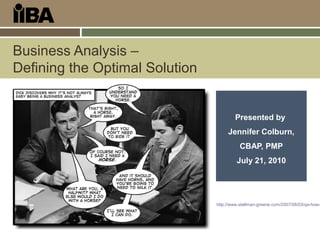
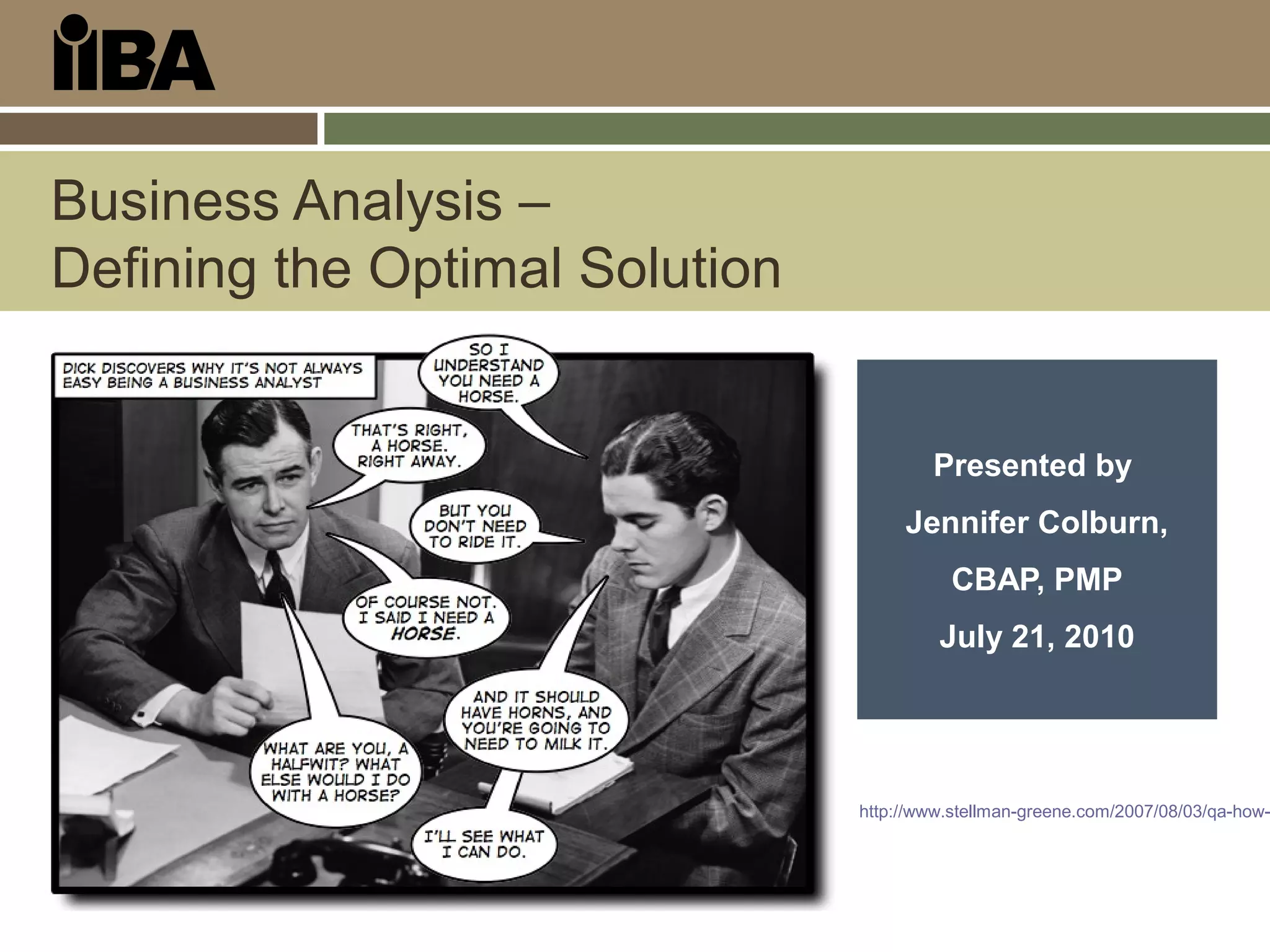
Business Analysis –
Defining the Optimal Solution
Presented by
Jennifer Colburn,
CBAP, PMP
July 21, 2010
http://www.stellman-greene.com/2007/08/03/qa-how-
Jennifer C. Colburn, CBAP, PMP
 Senior Business Analyst at Kindred Healthcare
 CBAP (Certified Business Analysis Professional) by
the IIBA (International Institute of Business Analysis)
 PMP (Project Management Professional) by PMI
(Project Management Institute)
 VP of Education for Louisville Chapter of the IIBA
 Member of the IIBA’s Business Analysis Competency
Model Committee
 Just returned from European vacation- London,
Brussels, Germany, and Croatia.
Business Analysis –
Defining the Optimal Solution
 Overview of Business Analysis Profession
 Key Terms- Solutions and Requirements
 BABOK Knowledge Areas
 Elicitation Techniques
Presentation material from the BABOK 2.0 (unless otherwise stated)
4
International Institute of Business Analysis
TM
Develop and maintain standards for the
practice of business analysis and for the
certification of its practitioners
The IIBA
TM
is an international not-for-profit professional
association for business analysis professionals.
Founded in 2003
www.theiiba.org
Vision
The world's leading association for
Business Analysis professionals
Mission
KBa
 Analogous to the PMI and the PMBOK, the IIBA has
authored the Business Analysis Body of Knowledge
(BABOK) reflecting generally accepted practices in
the Business Analysis community.
 Released in 2005
 Version 2.0 released March 31, 2009
Business Analysis Body of KnowledgeTM
6
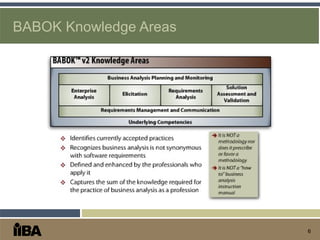
BABOK Knowledge Areas
CBAP Certification
 Certified Business Analysis Professional
 7,500 hours business analysis work experience in last
ten years
 Experience and expertise in four of six knowledge areas
 150 question multiple choice exam
 Almost 1000 CBAPs internationally
 At the end of 2010, the IIBA will also offer Certification of
Competency in Business Analysis (CCBA), an
intermediate level designation.
Value of a Business Analyst
 Anyone who has ever worked on a complex and
lengthy software development project knows that the
involvement of a business analyst can mean the
difference between success and failure.
 ~ Thomas Wailgum, CIO http://www.cio.com/article/343013/
 “Everyone agrees on the importance of the business
analyst role, but few know exactly what it is that
business analysts do.”
 ~ Carey Schwaber & Rob Carel, Forrester Research
April 2008
What is A Business Analyst?
 Works as a liaison among stakeholders in order to
understand the structure, policies, and operations of an
organization, and to recommend solutions that enable the
organization to achieve its goals.
 Understands how organizations function to accomplish
their purposes.
 Definition of organizational goals
 How those goals connect to specific objectives
 Determining courses of action that a business has to
undertake to achieve those goals and objectives
 Defining how various organizational units and stakeholders
within and outside the organization interact.
(from the Business Analysis Body Of Knowledge v. 2.0, p. 3)
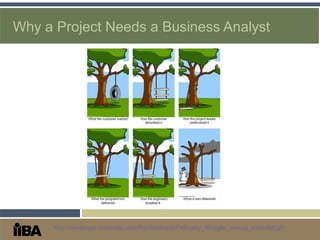
Why a Project Needs a Business Analyst
http://developer.motorola.com/fromfasttrack/February_09/agile_versus_waterfall.gif/
Business Analysis
 Understanding:
 How an organization works
 Why the organization exists
 What are the organization’s goals and objectives
 How does an organization accomplish those goals
and objectives
 How does an organization need to change to better
accomplish those objectives and/or overcome
challenges
 Defining the scope of the solution
(from the IIBA “A Primer to the Business Analysis Body of Knowledge” presentation)
Solution Definition
 A solution meets a business need by solving
problems and/or enabling the organization to take
advantage of an opportunity.
 System of interacting solution components such as:
software applications, web services, business
processes, business rules that govern that process,
an IT application, revised org structure, outsourcing,
insourcing, redefining job roles or any other method
of creating a capability needed by an organization.
Business Analysis and Solution Scope
 Business Analysis helps organizations define the
optimal solution for their needs, given a set of
constraints (time, budget, regulations, etc) under
which that organization operates.
 Solution Scope- the set of capabilities a solution
must support to meet the business needs.
 Project Scope- the work necessary to construct and
implement a particular solution
Complimentary Roles
 Project Manager – Project Scope: resources,
budget, schedule, plan, risks, quality.
 Business Analyst – Solution Scope: business
risks/issues, requirements related tasks in WBS,
solution quality, represent business.
Why a Project Needs a Project Manager and a
Business Analyst
 PM responsible for ensuring product delivered to
customer on time and within budget.
 BA responsible for ensuring product built according to
requirements and built correctly.
 Difference in focus is reason that both roles on team
are critical.
~ Barbara Carkenord, President B2T Training
Requirements Definition
 A condition or capability needed by a stakeholder to
solve a problem or achieve an objective.
 A condition or capability that must be met or possessed
by a solution or solution component to satisfy a
contract, standard specification or other formally
imposed documents.
 A documented representation of a condition or
capability as in 1) or 2).
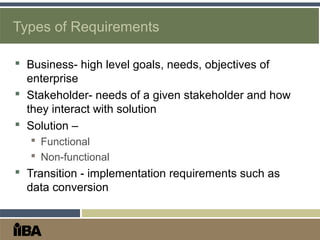
Types of Requirements
 Business- high level goals, needs, objectives of
enterprise
 Stakeholder- needs of a given stakeholder and how
they interact with solution
 Solution –
 Functional
 Non-functional
 Transition - implementation requirements such as
data conversion
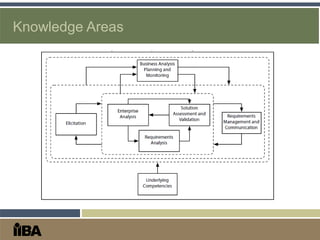
Knowledge Areas
Enterprise Analysis
 Understanding the “big picture”
 Define business goals the solution must meet
 Integrate requirements into larger business
architecture
 Support initiatives and long term planning
 Strategic planning, business case development,
Cost Benefit Analysis, feasibility studies
 “Why are we doing this?”
Business Analysis Planning and Monitoring
 Focus on planning for the BA processes and
activities.
 “What do I need to do?”
 Specify the how the business analysis tasks
will be performed
 Identify the deliverables produced
 Describe how changes will be controlled and
managed
Requirements Management and Communications
 Focus on presenting and communicating
documented requirements to all stakeholders,
including project team members, to bring the
group to consensus on project scope.
 Identify and manage change
 “Does everyone understand and agree?”
Elicitation
 Focus on gathering requirements from various
stakeholder groups
 Identify the tasks, knowledge and techniques
for capturing requirements
 “What do the Stakeholders need?”
Requirements Analysis
 Focuses on analyzing the data
 Defines the methods, tools, techniques to
structure raw data collected during elicitation
 Identifies gaps in requirements
 Defines the “solution” capabilities and can
serve as the foundation for selecting among
solution alternatives.
 “What must the solution do?”
Solutions Assessment & Validation
 Focus on ensuring the best approach is
chosen, that the solution will meet
stakeholder objectives, that the solution is
feasible, and guides solution “verification.”
 “Does the solution do what it is suppose to
do?”
BA Underlying Competencies
Analytical Thinking & Problem Solving-
 Creative Thinking
 Decision Making
 Learning
 Problem Solving
 Systems Thinking
 Behavioral Characteristics- ethics, personal
organization, trustworthiness
 Business Knowledge
 Communication Skills
 Interaction Skills- facilitation &negotiation, leadership &
influencing, teamwork
 Software Applications
Elicitation Techniques:
 Brainstorming
 Focus Groups
 Interviewing
 Observation
 Prototyping
 Requirements Workshop
 Survey/Questionnaire
 Document Analysis
 Interface Analysis
Brainstorming
 Brainstorming is an excellent way to foster creative
thinking about a problem.
 The aim is to produce numerous new ideas, and to
derive from them themes for further analysis.
 Best applied in a group - it draws on the experience and
creativity of all members of the group.
 Participants are encouraged to use new ways of looking
at things and free associate in any direction.
Focus Groups
 “A means to elicit ideas and attitudes about a
specific product, service or opportunity in an
interactive group environment. The participants
share their impressions, preferences and needs,
guided by a moderator.”
 Pre-qualified individuals
 Homogenous or Heterogeneous groups
Interviewing
 “Systematic approach designed to elicit information
from a person or group of people in an informal or
formal setting by talking to an interviewee, asking
relevant questions and documenting the responses.”
 One-on-one or Group
 Structured – pre-defined questions
 Unstructured – open-ended discussion
Observation
 “Means of eliciting requirements by conducting an
assessment of the stakeholder’s work
environment.”
 Also known as “Job Shadowing”
 Documenting details about current processes
 Enhance or change a current process
 Passive/Invisible
 Active/Visible
Prototyping
 Horizontal prototype
 Demonstrates outer layer of human interface only, such as menus
and screens; no logic behind the visualization
 Incremental prototype
 The final product is built as separate prototypes. At the end, the
separate prototypes are merged into an overall design
 Throw-away prototype
 Simple, quick approach - can be paper & pencil or screen mock-
ups
 Discarded when final system is developed
 Evolutionary (Breadboard) prototype
 A system that is continually refined and rebuilt until it is a fully
functioning system
Requirements Workshop
 “A structured way to capture requirements. A
workshop may be used to scope, discover, define,
prioritize and reach closure on requirements for the
target system.”
 Effective way to deliver high quality requirements
quickly
 Promote trust, understanding, and communication
among the stakeholders/team
 Produce deliverables that structure and guide future
analysis
Surveys/Questionnaire
 Collect information about customers, products, work practices
and attitudes from many people in a relatively short period of
time
 Can be Anonymous
 Closed - Respondent selects from predetermined choices
 Easier to analyze, limited responses
 Useful when ranges of response is understood, but strength of
response needs to be determined
 Open - Respondent is free to answer as they wish
 Wider range of responses, difficult to quantify
 Useful when issues known but range of responses is not
Document Analysis
 “A means to elicit requirements by studying
available documentation on existing and
comparable solutions and identifying relevant
information”
 Gathering detail of AS-IS
 SMEs not available
 Enhancements to existing system
 Existing system to be included in new system
Interface Analysis
Purpose - identify interfaces between solutions and/or solution
components and define requirements that describe how they
will act.
Summary
 BA has a variety of techniques available to elicit
requirements depending on situation
 Goal is to deliver a feasible quality solution that
meets the business needs- the optimal solution
 Help prevent scope creep and reduce project risks,
including rework
 Provide traceability to business goals
 Business Analysis is a formally defined profession
 Internationally acknowledged certification program
Business Analysis- Defining the Optimal Solution

Business Analysis- Defining the Optimal Solution

  • 1.
    Business Analysis – Definingthe Optimal Solution Presented by Jennifer Colburn, CBAP, PMP July 21, 2010 http://www.stellman-greene.com/2007/08/03/qa-how-
  • 2.
    Jennifer C. Colburn,CBAP, PMP  Senior Business Analyst at Kindred Healthcare  CBAP (Certified Business Analysis Professional) by the IIBA (International Institute of Business Analysis)  PMP (Project Management Professional) by PMI (Project Management Institute)  VP of Education for Louisville Chapter of the IIBA  Member of the IIBA’s Business Analysis Competency Model Committee  Just returned from European vacation- London, Brussels, Germany, and Croatia.
  • 3.
    Business Analysis – Definingthe Optimal Solution  Overview of Business Analysis Profession  Key Terms- Solutions and Requirements  BABOK Knowledge Areas  Elicitation Techniques Presentation material from the BABOK 2.0 (unless otherwise stated)
  • 4.
    4 International Institute ofBusiness Analysis TM Develop and maintain standards for the practice of business analysis and for the certification of its practitioners The IIBA TM is an international not-for-profit professional association for business analysis professionals. Founded in 2003 www.theiiba.org Vision The world's leading association for Business Analysis professionals Mission KBa
  • 5.
     Analogous tothe PMI and the PMBOK, the IIBA has authored the Business Analysis Body of Knowledge (BABOK) reflecting generally accepted practices in the Business Analysis community.  Released in 2005  Version 2.0 released March 31, 2009 Business Analysis Body of KnowledgeTM
  • 6.
  • 7.
    CBAP Certification  CertifiedBusiness Analysis Professional  7,500 hours business analysis work experience in last ten years  Experience and expertise in four of six knowledge areas  150 question multiple choice exam  Almost 1000 CBAPs internationally  At the end of 2010, the IIBA will also offer Certification of Competency in Business Analysis (CCBA), an intermediate level designation.
  • 8.
    Value of aBusiness Analyst  Anyone who has ever worked on a complex and lengthy software development project knows that the involvement of a business analyst can mean the difference between success and failure.  ~ Thomas Wailgum, CIO http://www.cio.com/article/343013/  “Everyone agrees on the importance of the business analyst role, but few know exactly what it is that business analysts do.”  ~ Carey Schwaber & Rob Carel, Forrester Research April 2008
  • 9.
    What is ABusiness Analyst?  Works as a liaison among stakeholders in order to understand the structure, policies, and operations of an organization, and to recommend solutions that enable the organization to achieve its goals.  Understands how organizations function to accomplish their purposes.  Definition of organizational goals  How those goals connect to specific objectives  Determining courses of action that a business has to undertake to achieve those goals and objectives  Defining how various organizational units and stakeholders within and outside the organization interact. (from the Business Analysis Body Of Knowledge v. 2.0, p. 3)
  • 10.
    Why a ProjectNeeds a Business Analyst http://developer.motorola.com/fromfasttrack/February_09/agile_versus_waterfall.gif/
  • 11.
    Business Analysis  Understanding: How an organization works  Why the organization exists  What are the organization’s goals and objectives  How does an organization accomplish those goals and objectives  How does an organization need to change to better accomplish those objectives and/or overcome challenges  Defining the scope of the solution (from the IIBA “A Primer to the Business Analysis Body of Knowledge” presentation)
  • 12.
    Solution Definition  Asolution meets a business need by solving problems and/or enabling the organization to take advantage of an opportunity.  System of interacting solution components such as: software applications, web services, business processes, business rules that govern that process, an IT application, revised org structure, outsourcing, insourcing, redefining job roles or any other method of creating a capability needed by an organization.
  • 13.
    Business Analysis andSolution Scope  Business Analysis helps organizations define the optimal solution for their needs, given a set of constraints (time, budget, regulations, etc) under which that organization operates.  Solution Scope- the set of capabilities a solution must support to meet the business needs.  Project Scope- the work necessary to construct and implement a particular solution
  • 14.
    Complimentary Roles  ProjectManager – Project Scope: resources, budget, schedule, plan, risks, quality.  Business Analyst – Solution Scope: business risks/issues, requirements related tasks in WBS, solution quality, represent business.
  • 15.
    Why a ProjectNeeds a Project Manager and a Business Analyst  PM responsible for ensuring product delivered to customer on time and within budget.  BA responsible for ensuring product built according to requirements and built correctly.  Difference in focus is reason that both roles on team are critical. ~ Barbara Carkenord, President B2T Training
  • 16.
    Requirements Definition  Acondition or capability needed by a stakeholder to solve a problem or achieve an objective.  A condition or capability that must be met or possessed by a solution or solution component to satisfy a contract, standard specification or other formally imposed documents.  A documented representation of a condition or capability as in 1) or 2).
  • 17.
    Types of Requirements Business- high level goals, needs, objectives of enterprise  Stakeholder- needs of a given stakeholder and how they interact with solution  Solution –  Functional  Non-functional  Transition - implementation requirements such as data conversion
  • 18.
  • 19.
    Enterprise Analysis  Understandingthe “big picture”  Define business goals the solution must meet  Integrate requirements into larger business architecture  Support initiatives and long term planning  Strategic planning, business case development, Cost Benefit Analysis, feasibility studies  “Why are we doing this?”
  • 20.
    Business Analysis Planningand Monitoring  Focus on planning for the BA processes and activities.  “What do I need to do?”  Specify the how the business analysis tasks will be performed  Identify the deliverables produced  Describe how changes will be controlled and managed
  • 21.
    Requirements Management andCommunications  Focus on presenting and communicating documented requirements to all stakeholders, including project team members, to bring the group to consensus on project scope.  Identify and manage change  “Does everyone understand and agree?”
  • 22.
    Elicitation  Focus ongathering requirements from various stakeholder groups  Identify the tasks, knowledge and techniques for capturing requirements  “What do the Stakeholders need?”
  • 23.
    Requirements Analysis  Focuseson analyzing the data  Defines the methods, tools, techniques to structure raw data collected during elicitation  Identifies gaps in requirements  Defines the “solution” capabilities and can serve as the foundation for selecting among solution alternatives.  “What must the solution do?”
  • 24.
    Solutions Assessment &Validation  Focus on ensuring the best approach is chosen, that the solution will meet stakeholder objectives, that the solution is feasible, and guides solution “verification.”  “Does the solution do what it is suppose to do?”
  • 25.
    BA Underlying Competencies AnalyticalThinking & Problem Solving-  Creative Thinking  Decision Making  Learning  Problem Solving  Systems Thinking  Behavioral Characteristics- ethics, personal organization, trustworthiness  Business Knowledge  Communication Skills  Interaction Skills- facilitation &negotiation, leadership & influencing, teamwork  Software Applications
  • 26.
    Elicitation Techniques:  Brainstorming Focus Groups  Interviewing  Observation  Prototyping  Requirements Workshop  Survey/Questionnaire  Document Analysis  Interface Analysis
  • 27.
    Brainstorming  Brainstorming isan excellent way to foster creative thinking about a problem.  The aim is to produce numerous new ideas, and to derive from them themes for further analysis.  Best applied in a group - it draws on the experience and creativity of all members of the group.  Participants are encouraged to use new ways of looking at things and free associate in any direction.
  • 28.
    Focus Groups  “Ameans to elicit ideas and attitudes about a specific product, service or opportunity in an interactive group environment. The participants share their impressions, preferences and needs, guided by a moderator.”  Pre-qualified individuals  Homogenous or Heterogeneous groups
  • 29.
    Interviewing  “Systematic approachdesigned to elicit information from a person or group of people in an informal or formal setting by talking to an interviewee, asking relevant questions and documenting the responses.”  One-on-one or Group  Structured – pre-defined questions  Unstructured – open-ended discussion
  • 30.
    Observation  “Means ofeliciting requirements by conducting an assessment of the stakeholder’s work environment.”  Also known as “Job Shadowing”  Documenting details about current processes  Enhance or change a current process  Passive/Invisible  Active/Visible
  • 31.
    Prototyping  Horizontal prototype Demonstrates outer layer of human interface only, such as menus and screens; no logic behind the visualization  Incremental prototype  The final product is built as separate prototypes. At the end, the separate prototypes are merged into an overall design  Throw-away prototype  Simple, quick approach - can be paper & pencil or screen mock- ups  Discarded when final system is developed  Evolutionary (Breadboard) prototype  A system that is continually refined and rebuilt until it is a fully functioning system
  • 32.
    Requirements Workshop  “Astructured way to capture requirements. A workshop may be used to scope, discover, define, prioritize and reach closure on requirements for the target system.”  Effective way to deliver high quality requirements quickly  Promote trust, understanding, and communication among the stakeholders/team  Produce deliverables that structure and guide future analysis
  • 33.
    Surveys/Questionnaire  Collect informationabout customers, products, work practices and attitudes from many people in a relatively short period of time  Can be Anonymous  Closed - Respondent selects from predetermined choices  Easier to analyze, limited responses  Useful when ranges of response is understood, but strength of response needs to be determined  Open - Respondent is free to answer as they wish  Wider range of responses, difficult to quantify  Useful when issues known but range of responses is not
  • 34.
    Document Analysis  “Ameans to elicit requirements by studying available documentation on existing and comparable solutions and identifying relevant information”  Gathering detail of AS-IS  SMEs not available  Enhancements to existing system  Existing system to be included in new system
  • 35.
    Interface Analysis Purpose -identify interfaces between solutions and/or solution components and define requirements that describe how they will act.
  • 36.
    Summary  BA hasa variety of techniques available to elicit requirements depending on situation  Goal is to deliver a feasible quality solution that meets the business needs- the optimal solution  Help prevent scope creep and reduce project risks, including rework  Provide traceability to business goals  Business Analysis is a formally defined profession  Internationally acknowledged certification program

Editor's Notes

  • #3 Poll the audience- PMs, Developers, BAs, Consultants, IT Infrastructure, others- what do they do?
  • #5 “What Requiring Minds Want to Know” – member newsletter 90 Chapters over 12,000 Members in more than 30 countries Local Chapter meets 3rd Thursday of the month at 6 pm at Tek Systems, no meeting in July.
  • #7 Like PMBOK it is not a methodology We will discuss each of the knowledge areas in detail later.
  • #8 Similar to PMP designation Work experience specifically excludes any project management activities, testing (creating test scripts, test plans/strategies), & programming.
  • #10 Bridges the gap between IT and business Does not always work on projects, can also engage in business process re-engineering, either in conjunction with a product that changes business processes, or alone when streamlining existing business processes. Does not always involve IT.
  • #11 What’s missing? The Business Analyst
  • #12 Understanding the business model and how a project supports the organization’s ability to meet business objectives is the beginning of the traceability between a proposed solution and business goals. Different than a systems analyst or QA or training, although BAs in many companies assume these additional tasks.
  • #13 The interacting solution components can be solutions in and of themselves.
  • #15 PM big picture, keeps project on schedule, meeting deadlines BAs very detailed oriented, analysis paralysis Each role provides specialized capabilities that can make the difference between a project that succeeds and one that struggles. Solutions are not predetermined by the Business Analyst, but are driven solely by the requirements of the business.
  • #18 Functional requirements are PRODUCT capabilities Non-functional requirements- security, performance, design and implementation constraints, external interfaces, etc
  • #19 Not a linear process- feedback throughout and may need to go back and elicit more requirements as a result of analysis.
  • #20 What does success look like to the business? Provides context for evaluation and decision making in either project selection or requirements prioritization on a specific project. Many BAs are under utilized in this area, but can provide great value. Take a business need, refine and clarify the definition of that need, define a solution scope that can be feasibly implemented by the business.
  • #21 This feeds into WBS- key input into project plan. This is only tasks BA does, not project team. Occurs throughout lifecycle. How to assess the progress of the work
  • #22 40% of project requirements change through lifecycle. Negotiate solutions How to manage conflict, issues and changes to keep everyone in agreement on scope- stakeholders and team Occurs throughout lifecycle includes Requirements Traceability, preparing the requirements package, managing solution scope & versioning requirements, managing formal approvals Importance of traceability is key to avoiding scope creep on a project.
  • #23 Stated Requirements vs. analyzed requirements. People take offense to “why” but you have to ask. Elicitation is new buzz word for requirements gathering or collecting- more encompassing of what we do. We will discuss specific elicitation techniques at the end of this presentation.
  • #24 Transforms the business need into clearly described capabilities. Provides foundation for selecting best among solution options. includes prioritizing, organizing, specifying & modeling requirements, as well as determining assumptions/constraints, verifying and validating requirements
  • #25 This process is designed to be iterative; from paper-based solution assessment and validation to testing processes. Strict BA work doesn’t include testing- just writing use cases. Assumes you have a QA dept. Not all of this have that luxury. Which solution best fits the business need, identify gaps and shortcomings in solutions, determine necessary workarounds or changes. Assessing deployed solutions to see if they meet needs so sponsor can evaluate performance and effectiveness of projects.
  • #26 Abbreviated list from the BABOK 2.0 Not all encompassing
  • #27 As defined by the BABOK 2.0
  • #28 Facilitated properly by a skilled facilitator, brainstorming can be fun, engaging and productive STRENGTHS Ability to elicit many ideas in a short time period. Non-judgmental environment enables creative thinking. Can be useful during a workshop to reduce tension between participants Weaknesses Dependent on participants’ creativity and willingness to participate. Organizational and interpersonal politics may also limit participation. Group participants must agree to avoid debating the ideas raised during brain­storming.
  • #29 Strengths Ability to elicit data from a group of people in a single session saves time and cost compared to individual interviews. Effective for learning desires, attitudes, experiences. Active discussion and ability to ask others questions creates environment where people can consider (and change) their personal view in relation to other perspectives. Weaknesses Trust issues, sensitive/personal topics What people say may not be consistent with how people actually behave Homogeneous groups may not represent all requirements Scheduling issues with groups Needs skilled moderator For new/changed products, not for usability.
  • #30 Advantages Encourages participation and establishes rapport with the stakeholder. Simple, direct technique that can be used in varying situations. Allows the interviewer and participant to have full discussions and explanations of the questions and answers. Enables observations of non-verbal behavior The interviewer can ask follow-up and probing questions to confirm their own understanding. Maintains focus through the use of clear objectives for the interview that are agreed upon by all participants and can be met in the time allotted. Allows interviewees to express opinions in private that they may be reluctant to express in public. Disadvantages Interviews are not an ideal means of reaching consensus across a group of stakeholders. Requires considerable commitment and involvement of the participants. Training is required to conduct effective interviews. In particular, unstructured interviews require special skills including facilitation/virtual facilitation and active listening. Depth of follow-on questions may be dependent on the interviewer’s knowledge of the business domain. Transcription and analysis of interview data can be complex and expensive. Based on the level of clarity provided during the interview, the resulting documentation may be subject to interviewer’s interpretation. There is a risk of unintentionally leading the interviewee.
  • #31 Advantages Provides realistic and practical insight into the business by getting a hands-on feel for how the business process works today. Elicits details of informal communication and ways people actually work around the system that may not be documented anywhere. Disadvantages Only possible for existing processes. Could be time-consuming. May be disruptive to the person being shadowed. Unusual exceptions and critical situations that happen infrequently may not occur during the observation. May not well work if the current process involves a high level of intellectual activity or other work that is not easily observable.
  • #32 STRENGTHS Supports Business Sponsors who are more comfortable articulating needs based on visuals Improved and increased user involvement from Business Sponsors to define requirements Can demonstrate what is technically feasible with a new platform Provides steady, visible signs of advancement WEAKNESSES May take time up front to educate Development staff and set up the prototype Assumptions in the underlying technology need to be made Business Sponsors may get unrealistic expectations of the delivered system’s completion date, performance, reliability, and usability Business Sponsors may focus on design instead of requirements that system must address
  • #33 Sometimes also called a JAD Session highly productive focused event attended by carefully selected key stakeholders and subject matter experts for a short, intensive period (typically one or a few days). Advantages A requirements workshop can be a means to elicit detailed requirements in a relatively short period of time. A requirements workshop provides a means for stakeholders to collaborate, make decisions and gain a mutual understanding of requirements. Requirements workshop costs are often lower than the cost of performing multiple interviews. A requirements workshop enables the participants to work together to reach consensus. This can be a cheaper and faster approach than doing serial requirements interviews, as interviews may yield conflicting requirements and the effort needed to resolve those conflicts across all interviewees can be very costly. Feedback is immediate. The facilitator’s interpretation of requirements is provided immediately to the stakeholders and validated. Disadvantages Stakeholder availability may make it difficult to schedule the requirements workshop. The success of the requirements workshop is highly dependent on the expertise of the facilitator and knowledge of the participants. Requirements workshops that involve too many participants can slow down the workshop process. Conversely, collecting input from too few participants can lead to overlooking requirements that are important to users, or to specifying requirements that don’t represent the needs of majority of the users.
  • #34 STRENGTHS Closed surveys provide quantitative data for statistical analysis Open surveys offer insights and opinions not easily obtainable Not time consuming for responders Effective and efficient for dispersed Stakeholders May get a large number of responses Quick and relatively inexpensive to administer Can offer responders anonymity WEAKNESS Open questions require more analysis by the BA Statistical sampling methods are required Some questions may be unanswered or answered incorrectly May require further iterations Not suited to get information on actual behaviors May be difficult to get participation Requires prep work and knowledge of business
  • #35 AS-IS can include business rules, entities, attributes. Can include review of RFPs, Statements of Work, market studies, training guides, memos, contracts, competing product literature, comparative reviews, service call tickets, existing system specs Users may not know what is out there- comparative product functionality may provide value add. Determine what is available, relevant and appropriate Use analysis to determine additional questions Strengths Have a starting point Leverage existing materials to discover and/or confirm requirements Cross-check requirements from other elicitation techniques Weaknesses Limited to the “as-is” perspective Existing documents may not be up to date or valid Can be time consuming and tedious to locate info
  • #36 Clarifies boundaries, inputs and outputs of various systems. Separate requirements for each system. Shared interfaces determine interoperability. Used for in-house or third party software, as many times third party software interfaces with one or more systems. Document Analysis of existing interface documentation such as DFD is helpful to determine all possible inputs/outputs. Strengths Enables more accurate project planning and potential savings in time and cost. This is because the complexity and testing needs are known early. Collaboration between projects: Determine if the change to existing interfaces is easy or difficult Establish ownership for new interfaces so project plans can be coordinated Weaknesses Provides no understanding of the business processes. Does not provide insight into other requirements.