What is Business Analyst
IIBA Definition of a Business Analyst:
Business Analysts are responsible for identifying business needs.
The Business Analyst is responsible for requirements development and
requirements management. Specifically, the Business Analyst elicits, analyzes,
validates and documents business, organizational and/or operational
requirements.  Solutions are not predetermined by the Business Analyst, but are
driven solely by the requirements of the business.  Solutions often include a
systems development component, but may also consist of process improvement
or organizational change.
The Business Analyst is a key facilitator within an organization, acting as a bridge
between the client, stakeholders and the solution team.
Business Analysis is distinct from financial analysis, project management, quality
assurance, organizational development, testing, training and documentation
development.
International Institute for Business Analysis
http://www.iiba.com
•
•
•
•
•

Usually assigned to the project after it has started
Responsible for bridging the gap between the Business and IT
Learn the business inside and out
Essentially the architect of effective business systems
Job title, definition and responsibilities viewed inconsistently across
the industry

Technology
Business
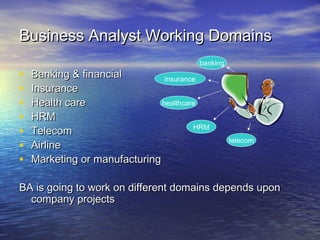
Business Analyst Working Domains
•
•
•
•
•
•
•

banking

Banking & financial
insurance
Insurance
healthcare
Health care
HRM
HRM
Telecom
Airline
Marketing or manufacturing

telecom

BA is going to work on different domains depends upon
company projects
EXAMPLE
T-MOBILE

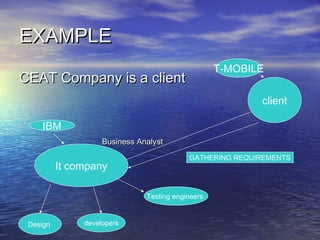
CEAT Company is a client

client
IBM
Business Analyst

It company

GATHERING REQUIREMENTS

Testing engineers

Design

developers
• In above diagram for example, client want to built his intranet Home
•
•
•
•
•
•
•
•

page for his internal collaboration and communication between their
employees.
As a BA we are going to interact with the clients and gather
requirements.
Prepare the BRD document
Business Requirement Document
Work flows
Wire frames
Use case documents and diagrams
Test case document
UAT & Function test case
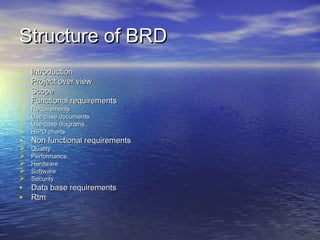
Structure of BRD
•
•
•
•






Introduction
Project over view
Scope
Functional requirements
Requirements
Use case documents
Use case diagrams
HIPO charts

• Non functional requirements






Quality
Performance
Hardware
Software
Security

• Data base requirements
• Rtm
BRD Document
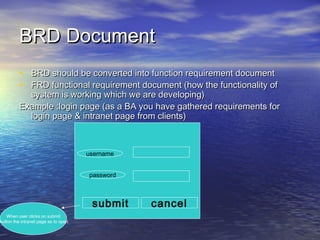
• BRD should be converted into function requirement document
• FRD functional requirement document (how the functionality of

system is working which we are developing)
Example :login page (as a BA you have gathered requirements for
login page & intranet page from clients)

When user clicks on submit
button the intranet page as to open

username
password

submit

cancel
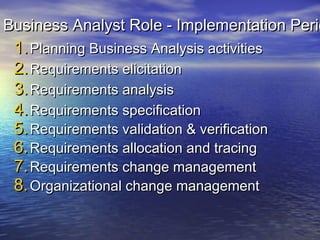
Business Analyst Role - Implementation Perio

1. Planning Business Analysis activities
2. Requirements elicitation
3. Requirements analysis
4. Requirements specification
5. Requirements validation & verification
6. Requirements allocation and tracing
7. Requirements change management
8. Organizational change management
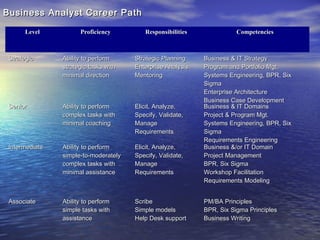
Business Analyst Career Path
Level

Proficiency

Responsibilities

Strategic

Ability to perform
strategic tasks with
minimal direction

Strategic Planning
Enterprise Analysis
Mentoring

Senior

Ability to perform
complex tasks with
minimal coaching

Elicit, Analyze,
Specify, Validate,
Manage
Requirements

Intermediate

Ability to perform
simple-to-moderately
complex tasks with
minimal assistance

Elicit, Analyze,
Specify, Validate,
Manage
Requirements

Associate

Ability to perform
simple tasks with
assistance

Scribe
Simple models
Help Desk support

Competencies

Business & IT Strategy
Program and Portfolio Mgt.
Systems Engineering, BPR, Six
Sigma
Enterprise Architecture
Business Case Development
Business & IT Domains
Project & Program Mgt.
Systems Engineering, BPR, Six
Sigma
Requirements Engineering
Business &/or IT Domain
Project Management
BPR, Six Sigma
Workshop Facilitation
Requirements Modeling
PM/BA Principles
BPR, Six Sigma Principles
Business Writing
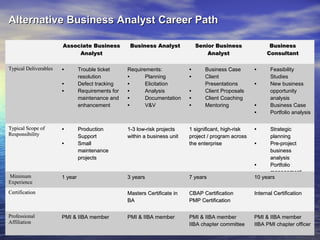
Alternative Business Analyst Career Path
Associate Business
Analyst
Typical Deliverables

•

•
•

Minimum
Experience

Business
Consultant

Trouble ticket
resolution
Defect tracking
Requirements for
maintenance and
enhancement

Requirements:
Planning
•
Elicitation
•
Analysis
•
Documentation
•
V&V
•

•
•

Production
Support
Small
maintenance
projects

1-3 low-risk projects
within a business unit

1 significant, high-risk
project / program across
the enterprise

3 years

7 years
CBAP Certification
PMP Certification

Internal Certification

PMI & IIBA member

PMI & IIBA member
IIBA chapter committee

PMI & IIBA member
IIBA PMI chapter officer

1 year

Certification

Professional
Affiliation

Senior Business
Analyst

Masters Certificate in
BA

•
•

Typical Scope of
Responsibility

Business Analyst

PMI & IIBA member

•
•
•

Business Case
Client
Presentations
Client Proposals
Client Coaching
Mentoring

•
•
•
•

Feasibility
Studies
New business
opportunity
analysis
Business Case
Portfolio analysis

•

Strategic
planning
Pre-project
•
business
analysis
Portfolio
•
management
10 years
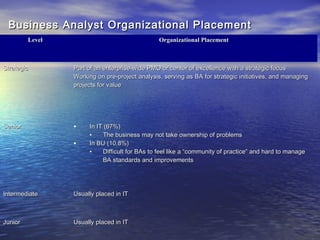
Business Analyst Organizational Placement
Level

Organizational Placement

Strategic

Part of an enterprise-wide PMO or center of excellence with a strategic focus
Working on pre-project analysis, serving as BA for strategic initiatives, and managing
projects for value

Senior

•
•

In IT (67%)
The business may not take ownership of problems
•
In BU (10.8%)
Difficult for BAs to feel like a “community of practice” and hard to manage
•
BA standards and improvements

Intermediate

Usually placed in IT

Junior

Usually placed in IT
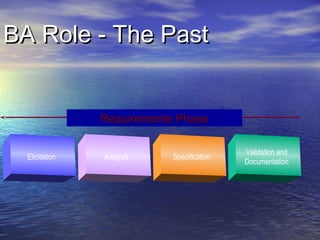
BA Role - The Past

Requirements Phase
Elicitation

Analysis

Specification

Validation and
Documentation
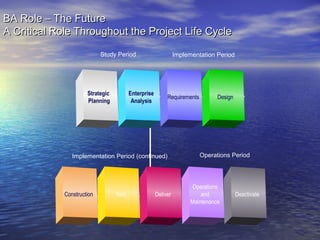
BA Role – The Future
A Critical Role Throughout the Project Life Cycle
Study Period

Strategic
Planning

Implementation Period

Enterprise
Analysis

Requirements

Implementation Period (continued)

Construction

Test

Deliver

Design

Operations Period

Operations
and
Maintenance

Deactivate
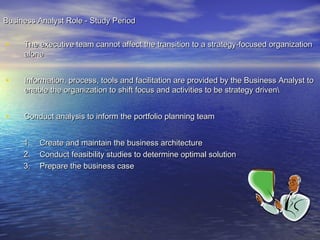
Business Analyst Role - Study Period

•

The executive team cannot affect the transition to a strategy-focused organization
alone

•

Information, process, tools and facilitation are provided by the Business Analyst to
enable the organization to shift focus and activities to be strategy driven

•

Conduct analysis to inform the portfolio planning team
1.
2.
3.

Create and maintain the business architecture
Conduct feasibility studies to determine optimal solution
Prepare the business case
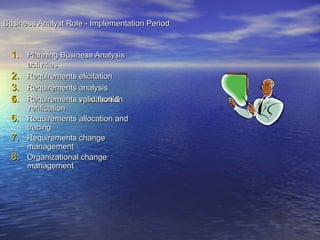
Business Analyst Role - Implementation Period

1. Planning Business Analysis
2.
3.
5.
4.
6.
7.
8.

activities
Requirements elicitation
Requirements analysis
Requirements specification
validation &
verification
Requirements allocation and
tracing
Requirements change
management
Organizational change
management
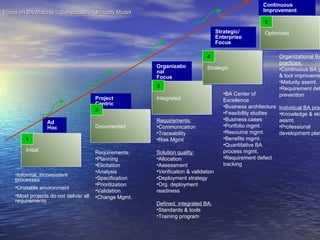
Focus on BA Maturity

Continuous
Improvement

CompassBA TM Maturity Model

5
Strategic/
Enterprise
Focus

Optimized

4
Organizatio
nal
Focus

Strategic

3
Project
Centric
2
Ad
Hoc

Documented

1
Initial

•Informal, inconsistent
processes
•Unstable environment
•Most projects do not deliver all
requirements

Requirements:
•Planning
•Elicitation
•Analysis
•Specification
•Prioritization
•Validation
•Change Mgmt.

Integrated

Requirements:
•Communication
•Traceability
•Risk Mgmt
Solution quality:
•Allocation
•Assessment
•Verification & validation
•Deployment strategy
•Org. deployment
readiness
Defined, integrated BA:
•Standards & tools
•Training program

•BA Center of
Excellence
•Business architecture
•Feasibility studies
•Business cases
•Portfolio mgmt.
•Resource mgmt.
•Benefits mgmt.
•Quantitative BA
process mgmt.
•Requirement defect
tracking

Organizational BA
practices:
•Continuous BA p
& tool improveme
•Maturity assmt.
•Requirement def
prevention

Individual BA prac
•Knowledge & ski
assmt.
•Professional
development plan
IIBA Definitions

• Business Analysis
–

•

The set of tasks, knowledge, and techniques
required to identify business needs and determine
solutions to business problems
Business Analyst
– Identify the business needs and help determine
solutions to business problems
– Responsible for requirements development and
requirements management

Business analyst training in india

  • 1.
    What is BusinessAnalyst IIBA Definition of a Business Analyst: Business Analysts are responsible for identifying business needs. The Business Analyst is responsible for requirements development and requirements management. Specifically, the Business Analyst elicits, analyzes, validates and documents business, organizational and/or operational requirements.  Solutions are not predetermined by the Business Analyst, but are driven solely by the requirements of the business.  Solutions often include a systems development component, but may also consist of process improvement or organizational change. The Business Analyst is a key facilitator within an organization, acting as a bridge between the client, stakeholders and the solution team. Business Analysis is distinct from financial analysis, project management, quality assurance, organizational development, testing, training and documentation development. International Institute for Business Analysis http://www.iiba.com
  • 2.
    • • • • • Usually assigned tothe project after it has started Responsible for bridging the gap between the Business and IT Learn the business inside and out Essentially the architect of effective business systems Job title, definition and responsibilities viewed inconsistently across the industry Technology Business
  • 3.
    Business Analyst WorkingDomains • • • • • • • banking Banking & financial insurance Insurance healthcare Health care HRM HRM Telecom Airline Marketing or manufacturing telecom BA is going to work on different domains depends upon company projects
  • 4.
    EXAMPLE T-MOBILE CEAT Company isa client client IBM Business Analyst It company GATHERING REQUIREMENTS Testing engineers Design developers
  • 5.
    • In abovediagram for example, client want to built his intranet Home • • • • • • • • page for his internal collaboration and communication between their employees. As a BA we are going to interact with the clients and gather requirements. Prepare the BRD document Business Requirement Document Work flows Wire frames Use case documents and diagrams Test case document UAT & Function test case
  • 6.
    Structure of BRD • • • •     Introduction Projectover view Scope Functional requirements Requirements Use case documents Use case diagrams HIPO charts • Non functional requirements      Quality Performance Hardware Software Security • Data base requirements • Rtm
  • 7.
    BRD Document • BRDshould be converted into function requirement document • FRD functional requirement document (how the functionality of system is working which we are developing) Example :login page (as a BA you have gathered requirements for login page & intranet page from clients) When user clicks on submit button the intranet page as to open username password submit cancel
  • 8.
    Business Analyst Role- Implementation Perio 1. Planning Business Analysis activities 2. Requirements elicitation 3. Requirements analysis 4. Requirements specification 5. Requirements validation & verification 6. Requirements allocation and tracing 7. Requirements change management 8. Organizational change management
  • 9.
    Business Analyst CareerPath Level Proficiency Responsibilities Strategic Ability to perform strategic tasks with minimal direction Strategic Planning Enterprise Analysis Mentoring Senior Ability to perform complex tasks with minimal coaching Elicit, Analyze, Specify, Validate, Manage Requirements Intermediate Ability to perform simple-to-moderately complex tasks with minimal assistance Elicit, Analyze, Specify, Validate, Manage Requirements Associate Ability to perform simple tasks with assistance Scribe Simple models Help Desk support Competencies Business & IT Strategy Program and Portfolio Mgt. Systems Engineering, BPR, Six Sigma Enterprise Architecture Business Case Development Business & IT Domains Project & Program Mgt. Systems Engineering, BPR, Six Sigma Requirements Engineering Business &/or IT Domain Project Management BPR, Six Sigma Workshop Facilitation Requirements Modeling PM/BA Principles BPR, Six Sigma Principles Business Writing
  • 10.
    Alternative Business AnalystCareer Path Associate Business Analyst Typical Deliverables • • • Minimum Experience Business Consultant Trouble ticket resolution Defect tracking Requirements for maintenance and enhancement Requirements: Planning • Elicitation • Analysis • Documentation • V&V • • • Production Support Small maintenance projects 1-3 low-risk projects within a business unit 1 significant, high-risk project / program across the enterprise 3 years 7 years CBAP Certification PMP Certification Internal Certification PMI & IIBA member PMI & IIBA member IIBA chapter committee PMI & IIBA member IIBA PMI chapter officer 1 year Certification Professional Affiliation Senior Business Analyst Masters Certificate in BA • • Typical Scope of Responsibility Business Analyst PMI & IIBA member • • • Business Case Client Presentations Client Proposals Client Coaching Mentoring • • • • Feasibility Studies New business opportunity analysis Business Case Portfolio analysis • Strategic planning Pre-project • business analysis Portfolio • management 10 years
  • 11.
    Business Analyst OrganizationalPlacement Level Organizational Placement Strategic Part of an enterprise-wide PMO or center of excellence with a strategic focus Working on pre-project analysis, serving as BA for strategic initiatives, and managing projects for value Senior • • In IT (67%) The business may not take ownership of problems • In BU (10.8%) Difficult for BAs to feel like a “community of practice” and hard to manage • BA standards and improvements Intermediate Usually placed in IT Junior Usually placed in IT
  • 12.
    BA Role -The Past Requirements Phase Elicitation Analysis Specification Validation and Documentation
  • 13.
    BA Role –The Future A Critical Role Throughout the Project Life Cycle Study Period Strategic Planning Implementation Period Enterprise Analysis Requirements Implementation Period (continued) Construction Test Deliver Design Operations Period Operations and Maintenance Deactivate
  • 14.
    Business Analyst Role- Study Period • The executive team cannot affect the transition to a strategy-focused organization alone • Information, process, tools and facilitation are provided by the Business Analyst to enable the organization to shift focus and activities to be strategy driven • Conduct analysis to inform the portfolio planning team 1. 2. 3. Create and maintain the business architecture Conduct feasibility studies to determine optimal solution Prepare the business case
  • 15.
    Business Analyst Role- Implementation Period 1. Planning Business Analysis 2. 3. 5. 4. 6. 7. 8. activities Requirements elicitation Requirements analysis Requirements specification validation & verification Requirements allocation and tracing Requirements change management Organizational change management
  • 16.
    Focus on BAMaturity Continuous Improvement CompassBA TM Maturity Model 5 Strategic/ Enterprise Focus Optimized 4 Organizatio nal Focus Strategic 3 Project Centric 2 Ad Hoc Documented 1 Initial •Informal, inconsistent processes •Unstable environment •Most projects do not deliver all requirements Requirements: •Planning •Elicitation •Analysis •Specification •Prioritization •Validation •Change Mgmt. Integrated Requirements: •Communication •Traceability •Risk Mgmt Solution quality: •Allocation •Assessment •Verification & validation •Deployment strategy •Org. deployment readiness Defined, integrated BA: •Standards & tools •Training program •BA Center of Excellence •Business architecture •Feasibility studies •Business cases •Portfolio mgmt. •Resource mgmt. •Benefits mgmt. •Quantitative BA process mgmt. •Requirement defect tracking Organizational BA practices: •Continuous BA p & tool improveme •Maturity assmt. •Requirement def prevention Individual BA prac •Knowledge & ski assmt. •Professional development plan
  • 17.
    IIBA Definitions • BusinessAnalysis – • The set of tasks, knowledge, and techniques required to identify business needs and determine solutions to business problems Business Analyst – Identify the business needs and help determine solutions to business problems – Responsible for requirements development and requirements management