

Business analysis: ontwikkeling, toepassing, ervaringen
Business analysis (BA) is een van de snelst groeiende disciplines in de wereld van business en ICT-consultancy. Een snelle opeenvolging van veranderingen in markten en bedrijfsorganisaties, waarvan de impact steeds groter wordt, zorgen hiervoor.
SKA bedrijfskundigen meteen ‘ICT-tic’ sinds 1984 energie & water, pensioenen, overheid en zorg (m.n. GGZ) takken van sport: management grote ICT-projecten ICT-organisatie bedrijfs- en informatiearchitectuur bedrijfsprocessen en AO/IC kwaliteitssystemen specialisten in elektronische dossiers business analysis
3.
Hoofdtrajecten van strategienaar werkende processen en systemen van informatieanalyse naar business analysis van requirements naar implementatie van Nederlands naar Werelds business analysis Nederlands en Engels door elkaar
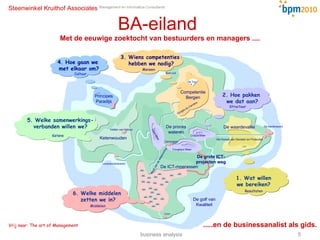
BA-eiland Metde eeuwige zoektocht van bestuurders en managers .... Ketenwouden Competentie Bergen De Top De ICT-moerassen De klantenpoort De waardevallei Gorges du Carrière Leveranciershaven Burn out Gates Velden van Nabuur De proces wateren Ketens 5. Welke samenwerkings- verbanden willen we? Mensen 3. Wiens competenties hebben we nodig? Middelen 6. Welke middelen zetten we in? 1. Wat willen we bereiken? Resultaten Het Kanaal van Diensten en Producten De golf van Kwaliteit Beek van de Afstemming Demington Input Meer Troughput Meer Output Meer Principes Paradijs Cultuur 4. Hoe gaan we met elkaar om? Vrij naar: The art of Management De grote ICT-projecten weg .....en de businessanalist als gids. business analysis Structuur 2. Hoe pakken we dat aan?
6.
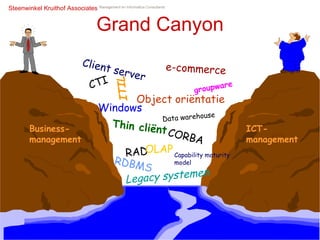
Grand Canyon businessanalysis Business- management ICT- management Client server ITIL groupware CTI Object oriëntatie Windows RAD Thin cliënt RDBMS Data warehouse OLAP CORBA e-commerce Legacy systemen Capability maturity model
7.
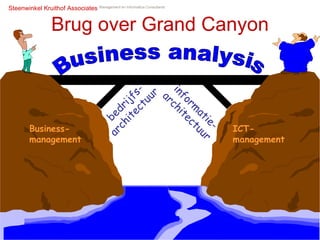
Brug over GrandCanyon business analysis Business- management ICT- management Business analysis bedrijfs-architectuur informatie-architectuur
8.
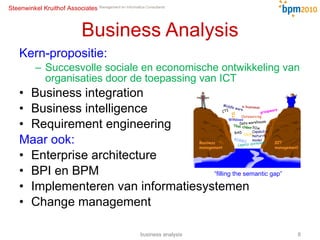
Business Analysis Kern-propositie:Succesvolle sociale en economische ontwikkeling van organisaties door de toepassing van ICT Business integration Business intelligence Requirement engineering Maar ook: Enterprise architecture BPI en BPM Implementeren van informatiesystemen Change management “ filling the semantic gap” business analysis Business management ICT management Middle ware ITIL groupware CTI Outsourcing Windows RAD Thin cliënt RDBMS Data warehouse OLAP SOA e-business Legacy systemen Capability maturity model
9.
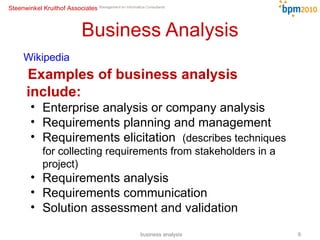
Business Analysis Wikipedia Examples of business analysis include: Enterprise analysis or company analysis Requirements planning and management Requirements elicitation (describes techniques for collecting requirements from stakeholders in a project) Requirements analysis Requirements communication Solution assessment and validation business analysis
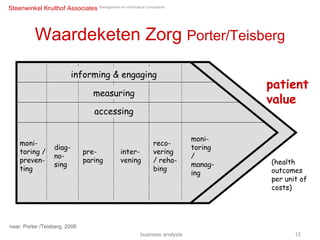
Waardeketen Zorg Porter/Teisberg business analysis moni-toring / preven-ting diag-no-sing pre-paring inter-vening reco-vering / reha-bing informing & engaging measuring accessing moni-toring / manag-ing patient value (health outcomes per unit of costs) naar: Porter /Teisberg, 2006
13.
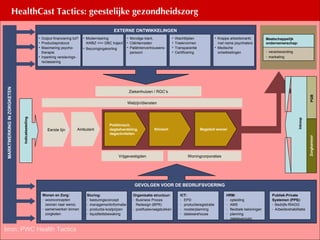
business analysis bron:PWC Health Tactics HealthCast Tactics: geestelijke gezondheidszorg Zorgkantoor etc Indicatiestelling MARKTWERKING IN ZORGKETEN Maatschappelijk ondernemerschap: verantwoording marketing EXTERNE ONTWIKKELINGEN Output financiering tot? Productieprotocol Maximering psycho- therapie Inperking verslavings- reclassering Krappe arbeidsmarkt, met name psychiaters Medische ontwikkelingen Wachtlijsten Treeknormen Transparantie Certificering Modernisering AWBZ <=> DBC traject Bezuinigingskorting Mondige klant, Cliëntenraden Patiëntenvertrouwens- persoon Inkoop PGB Zorgkantoor Eerste lijn Ambulant Welzijn/diensten Woningcorporaties Ziekenhuizen / RGC’s Poliklinisch, dagbehandeling, dagactiviteiten Klinisch Begeleid wonen Wonen en Zorg: woonconcepten (wonen naar wens) samenwerken binnen zorgketen Sturing: besturingsconcept managementinformatie productie-kostprijzen liquiditeitsbewaking Organisatie structuur: Business Proces Redesign (BPR) postfusievraagstukken ICT: EPD productieregistratie roosterplanning datawarehouse HRM: opleiding AMS flexibele beloningen planning ziekteverzuim Publiek-Private Systemen (PPS): Bedrijfs-RIAGG Arbeidsrehabilitatie GEVOLGEN VOOR DE BEDRIJFSVOERING Vrijgevestigden
14.
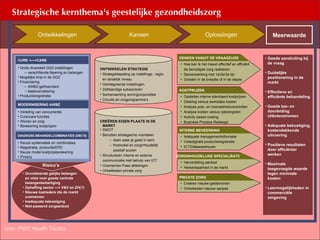
business analysis Strategischekernthema's geestelijke gezondheidszorg Meerwaarde Kansen Oplossingen Ontwikkelingen Grote diversiteit GGZ-instellingen verschillende fasering en belangen Mogelijke knip in de GGZ Financiering AWBZ-gefinancierd basisverzekering Productieregistratie Keuze systematiek en combinaties Registratie, productie/EPD Keuze model kostprijsberekening Privacy Risico’s Onvoldoende gelijke belangen en visie voor goede centrale belangenbehartiging Opheffing sector —> V&V en ZH(?) Nieuwe toetreders die de markt overnemen Inadequate bekostiging Niet-passend zorgaanbod ONTWIKKELEN STRATEGIE Strategiebepaling op instellings-, regio- en landelijk niveau Geïntegreerde instellingen Zelfstandige subsectoren Samenwerking woningcorporaties Circuits en zorgprogramma’s CREËREN EIGEN PLAATS IN DE MARKT SWOT Benutten strategische voordelen doen waar je goed in bent financieel en zorginhoudelijk positief scoren Structureren interne en externe communicatie met behulp van ICT Overnemen Paaz-afdelingen Ontwikkelen private zorg Goede aansluiting bij de vraag Duidelijke positionering in de markt Effectieve en efficiënte behandeling Goede toe- en doorleiding cliëntenstromen Adequate bekostiging, kostendekkende uitvoering Positieve resultaten door efficiënter werken Maximale toegevoegde waarde tegen minimale kosten Leermogelijkheden in commerciële omgeving Intreding van concurrentie Cure\care functies Wonen en zorg Berekening kostprijzen CURE <—>CARE MODERNISERING AWBZ DIAGNOSE-BEHANDELCOMBINATIES (DBC'S) Hoe kan ik het meest effectief en efficiënt de benodigde zorg realiseren Samenwerking met 1e/2e/3e lijn Groeien in de breedte of in de diepte Opstellen interne standaard-kostprijzen Dekking versus werkelijke kosten Analyse prijs- en hoeveelheidverschillen Analyse kosten versus opbrengsten Activity based costing Business Process Redesign Adequate managementinformatie Volledigheid productieregistratie ICT\Datawarehouse INTERNE BEHEERSING Herverdeling aanbod Herkenbaarheid in de markt ZORGINHOUDELIJKE SPECIALISATIE Creëren nieuwe geldstromen Ontwikkelen nieuwe aanpak PRIVATE ZORG bron: PWC Health Tactics DENKEN VANUIT DE VRAAGZIJDE KOSTPRIJZEN
15.
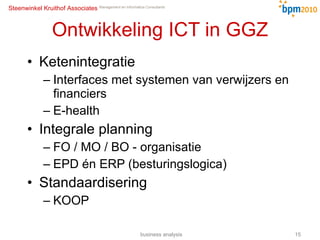
Ontwikkeling ICT inGGZ Ketenintegratie Interfaces met systemen van verwijzers en financiers E-health Integrale planning FO / MO / BO - organisatie EPD én ERP (besturingslogica) Standaardisering KOOP business analysis
16.
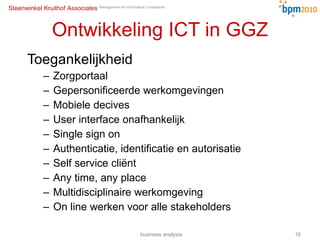
Ontwikkeling ICT inGGZ Toegankelijkheid Zorgportaal Gepersonificeerde werkomgevingen Mobiele decives User interface onafhankelijk Single sign on Authenticatie, identificatie en autorisatie Self service cliënt Any time, any place Multidisciplinaire werkomgeving On line werken voor alle stakeholders business analysis
17.
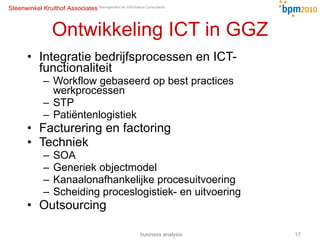
Ontwikkeling ICT inGGZ Integratie bedrijfsprocessen en ICT-functionaliteit Workflow gebaseerd op best practices werkprocessen STP Patiëntenlogistiek Facturering en factoring Techniek SOA Generiek objectmodel Kanaalonafhankelijke procesuitvoering Scheiding proceslogistiek- en uitvoering Outsourcing business analysis
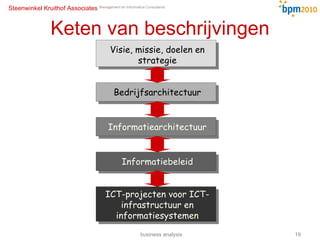
Keten van beschrijvingenVisie, missie, doelen en strategie Bedrijfsarchitectuur Informatiearchitectuur Informatiebeleid ICT-projecten voor ICT-infrastructuur en informatiesystemen business analysis
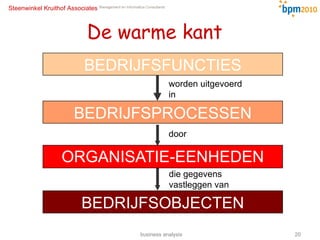
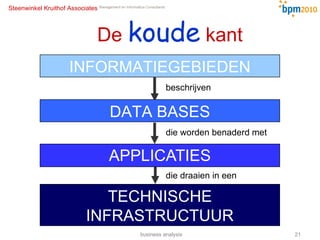
APPLICATIES DATA BASESINFORMATIEGEBIEDEN beschrijven die worden benaderd met TECHNISCHE INFRASTRUCTUUR die draaien in een De De koude kant business analysis
22.
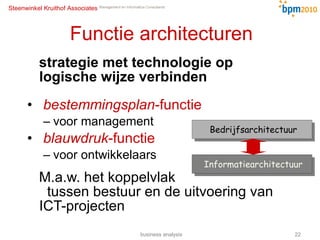
Functie architecturen strategiemet technologie op logische wijze verbinden bestemmingsplan -functie voor management blauwdruk -functie voor ontwikkelaars M.a.w. het koppelvlak tussen bestuur en de uitvoering van ICT-projecten Bedrijfsarchitectuur Informatiearchitectuur business analysis
23.
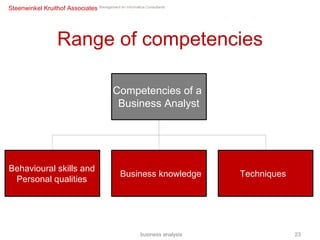
Competencies of a Business Analyst Business knowledge Behavioural skills and Personal qualities Techniques Range of competencies business analysis
24.
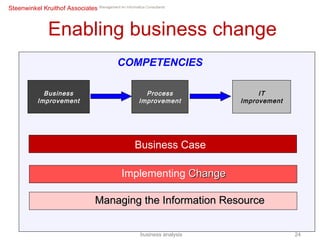
Business Case COMPETENCIESImplementing Change Managing the Information Resource IT Improvement Process Improvement Business Improvement Enabling business change business analysis
25.
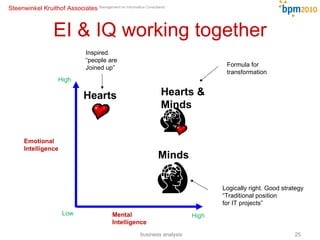
EI & IQworking together Low High High Emotional Intelligence Hearts Minds Hearts & Minds Logically right. Good strategy “ Traditional position for IT projects” Formula for transformation Inspired. “ people are Joined up” Mental Intelligence business analysis
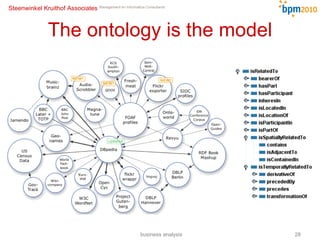
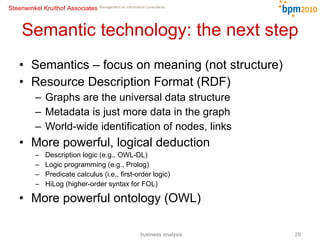
Semantic technology: thenext step Semantics – focus on meaning (not structure) Resource Description Format (RDF) Graphs are the universal data structure Metadata is just more data in the graph World-wide identification of nodes, links More powerful, logical deduction Description logic (e.g., OWL-DL) Logic programming (e.g., Prolog) Predicate calculus (i.e., first-order logic) HiLog (higher-order syntax for FOL) More powerful ontology (OWL) business analysis
30.
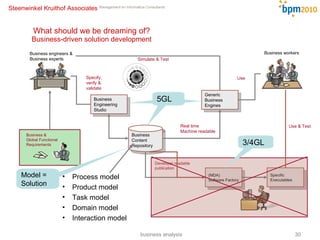
What should webe dreaming of? Business-driven solution development Business engineers & Business experts Process model Product model Task model Domain model Interaction model Model = Solution business analysis Business Content Repository Business Engineering Studio Specify, verify & validate 5GL 5GL Simulate & Test Generic Business Engines Real time Machine readable Business workers Use 5GL (MDA) Software Factory Specific Executables Developer readable publication Use & Test 3/4GL Business & Global Functional Requirements
31.
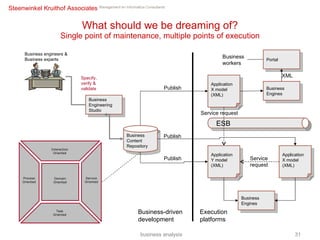
What should webe dreaming of? Single point of maintenance, multiple points of execution Business Engineering Studio Specify, verify & validate Business engineers & Business experts Business-driven development business analysis Business Content Repository Business Engines Application X model (XML) Business Engines Application X model (XML) Application Y model (XML) ESB Publish Execution platforms Service request Service request Publish Publish Portal XML Business workers
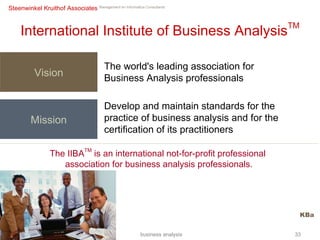
International Institute ofBusiness Analysis TM Develop and maintain standards for the practice of business analysis and for the certification of its practitioners The IIBA TM is an international not-for-profit professional association for business analysis professionals. Vision The world's leading association for Business Analysis professionals Mission KBa business analysis
34.
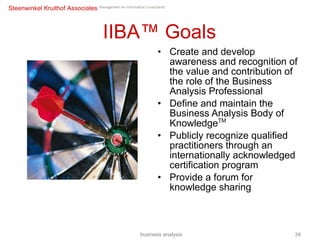
IIBA™ Goals Createand develop awareness and recognition of the value and contribution of the role of the Business Analysis Professional Define and maintain the Business Analysis Body of Knowledge TM Publicly recognize qualified practitioners through an internationally acknowledged certification program Provide a forum for knowledge sharing business analysis
35.
March 2004 37 members 2 countries (Canada & US) December 2008 7,791 members 81 chapters 68 countries 462 CBAP’s (Certified Business Analysis Professional) IIBA facts business analysis
36.
Business Analysis BusinessAnalysis is the set of tasks, knowledge and techniques required to identify business needs and determine solutions to business problems. Solutions often include a systems development component, but may also consist of process improvement or organizational change. International Institute of Business Analysis – Body of Knowledge (BABOK) business analysis
37.
A Business Analystworks: as a liaison among stakeholders in order to elicit, analyze, communicate and validate requirements for changes to business processes, policies, and information systems Business Analyst business analysis
38.
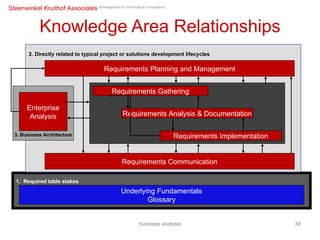
Knowledge Area Relationships1. Required table stakes 2. Directly related to typical project or solutions development lifecycles 3. Business Architecture Enterprise Analysis Requirements Planning and Management Requirements Communication Requirements Gathering Requirements Analysis & Documentation Requirements Implementation Underlying Fundamentals Glossary business analysis
39.
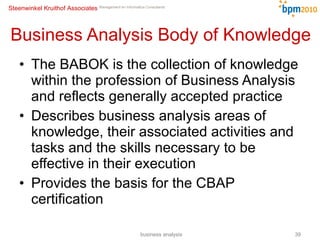
Business Analysis Bodyof Knowledge The BABOK is the collection of knowledge within the profession of Business Analysis and reflects generally accepted practice Describes business analysis areas of knowledge, their associated activities and tasks and the skills necessary to be effective in their execution Provides the basis for the CBAP certification business analysis
40.
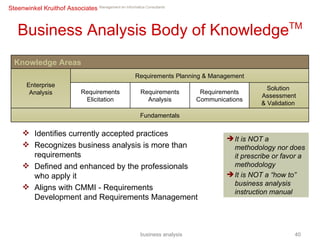
Business Analysis Bodyof Knowledge TM Identifies currently accepted practices Recognizes business analysis is more than requirements Defined and enhanced by the professionals who apply it Aligns with CMMI - Requirements Development and Requirements Management It is NOT a methodology nor does it prescribe or favor a methodology It is NOT a “how to” business analysis instruction manual business analysis Knowledge Areas Enterprise Analysis Requirements Planning & Management Requirements Elicitation Requirements Analysis Requirements Communications Solution Assessment & Validation Fundamentals
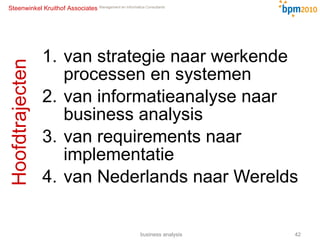
Hoofdtrajecten van strategienaar werkende processen en systemen van informatieanalyse naar business analysis van requirements naar implementatie van Nederlands naar Werelds business analysis
Editor's Notes
#2 Steenwinkel Kruithof Associates - www.sk-a.nl 22 september 2010 business analysis -- bpm2010
#3 Steenwinkel Kruithof Associates - www.sk-a.nl 22 september 2010 business analysis -- bpm2010
#6 Steenwinkel Kruithof Associates - www.sk-a.nl 22 september 2010 business analysis -- bpm2010
#28 That they have made considerable progress in identifying the metadata elements (i.e., structure and fields, as in a DTD). Our work for them will be: a. Idenitify which fields need taxonomy. b. Product these taxonomies
#35 First bullet - The establishment of an independent, non-profit association will bolster the recognition and value of BAs. Second bullet - At an intern’l and chapter level, the organization provides a forum for BAs to discuss their profession and learn from each other. Third bullet - Defining the BOK plays a critical role in establishing standards of practice. Identifies the currently accepted skills and competencies of the Business Analyst role (BOK discussed in more detail later in presentation) Fourth bullet - Certification will d efine training and professional development standards and recognize individual (certification discussed in more detail later in presentation)
#39 Not a methodology, but there are relationships between the areas of Body of Knowledge an the real work that the business analyst fits into. Underlying Fundamentals and Glossary sections not activity or task driven Outline base knowledge needed for BA to be successful Six core knowledge areas are: Directly involved in project or pre-project work that BA does Described with activities and tasks Interrelationships shown above Not all work BA does is for defined project: Work to understand what projects are necessary over time (roadmap) Define current state or target state business architecture
#41 How does this relate to / differ with project management? Business Analysis is about product Project Management is about project How does this relate to CMMI? Requirements Development & Requirements Management RD Elicit needs form users that represent all user classes Understand user tasks and objectives Understand the relative importance of quality attributes Negotiate implementation priorities Translate user needs into written specs and models Review requirements documentation RM Establish and maintain an agreement with customers on requirements Control the baseline of requirements Process proposed requirements changes Keep plans and products consistent with changed requirements Negotiate new commitments based on impact of the changes