

WHY
PROJECTS
FAIL
+ FOUR TIPS TO SUCCEED
Presented by:
Kevin Wordon
Digital Transformation Leader
Australia
McKinsey &
Company AND
UNIVERSITY OF
OXFORD STUDY
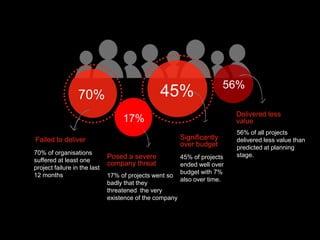
Study of 5,400 large scale IT projects across the world.
Average budgets of $13 million.
70% 45%
17%
56%
70% of organisations
suffered at least one
project failure in the last
12 months
Failed to deliver
Posed a severe
company threat
17% of projects went so
badly that they
threatened the very
existence of the company
Significantly
over budget
45% of projects
ended well over
budget with 7%
also over time.
Delivered less
value
56% of all projects
delivered less value than
predicted at planning
stage.
WHY DO
Projects FAIL?
A project is considered a failure when it has not delivered what was
required, in line with expectations. Therefore, in order to succeed, a
project must deliver to cost, to quality, and on time; and it must
deliver the benefits presented in the business case.
PROJECT
FAILURE
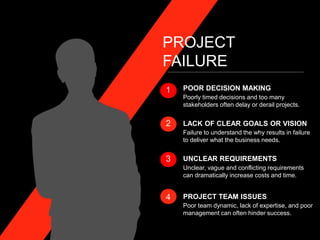
POOR DECISION MAKING
Poorly timed decisions and too many
stakeholders often delay or derail projects.
1
LACK OF CLEAR GOALS OR VISION
Failure to understand the why results in failure
to deliver what the business needs.
2
UNCLEAR REQUIREMENTS
Unclear, vague and conflicting requirements
can dramatically increase costs and time.
3
PROJECT TEAM ISSUES
Poor team dynamic, lack of expertise, and poor
management can often hinder success.
4
DECISION MAKING
Stay committed to your decisions, but stay
flexible in your approach.
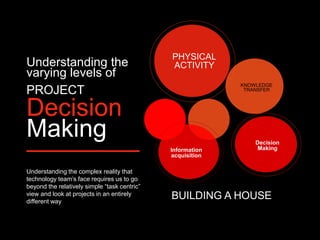
Understanding the
varying levels of
PROJECT
Decision
Making
Understanding the complex reality that
technology team’s face requires us to go
beyond the relatively simple “task centric”
view and look at projects in an entirely
different way
BUILDING A HOUSE
PHYSICAL
ACTIVITY
Information
acquisition
Decision
Making
KNOWLEDGE
TRANSFER
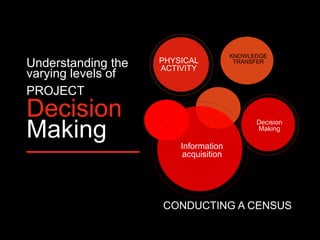
CONDUCTING A CENSUS
PHYSICAL
ACTIVITY
Information
acquisition
Decision
Making
KNOWLEDGE
TRANSFER
Understanding the
varying levels of
PROJECT
Decision
Making
PHYSICAL
ACTIVITY
Information
acquisition
Decision
Making
KNOWLEDGE
TRANSFER
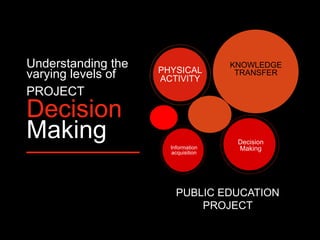
PUBLIC EDUCATION
PROJECT
Understanding the
varying levels of
PROJECT
Decision
Making
PHYSICAL
ACTIVITY
Information
acquisition
Decision
Making
KNOWLEDGE
TRANSFER
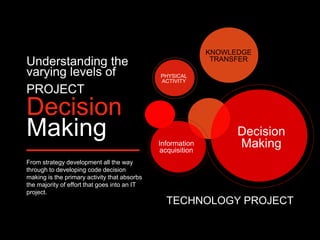
TECHNOLOGY PROJECT
Understanding the
varying levels of
PROJECT
Decision
Making
From strategy development all the way
through to developing code decision
making is the primary activity that absorbs
the majority of effort that goes into an IT
project.
AGILE DECISION
MAKING
THE OODA LOOP
The phrase OODA loop refers to the decision cycle of
observe, orient, decide, and act, developed by military
strategist and USAF Colonel John Boyd.
According to Boyd, decision-making occurs in a recurring cycle of
observe-orient-decide-act. An entity (whether an individual or an
organization) that can process this cycle quickly, observing and reacting
to unfolding events more rapidly than an opponent, can thereby "get
inside" the opponent's decision cycle and gain the advantage.
AGILE DECISION
MAKING
THE OODA LOOP
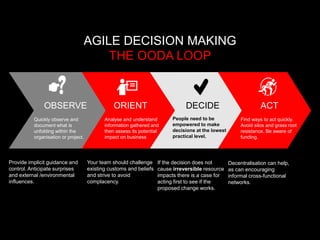
AGILE DECISION MAKING
THE OODA LOOP
OBSERVE
Quickly observe and
document what is
unfolding within the
organisation or project.
ORIENT
Analyse and understand
information gathered and
then assess its potential
impact on business
DECIDE
People need to be
empowered to make
decisions at the lowest
practical level.
Provide implicit guidance and
control. Anticipate surprises
and external /environmental
influences.
Your team should challenge
existing customs and beliefs
and strive to avoid
complacency.
If the decision does not
cause irreversible resource
impacts there is a case for
acting first to see if the
proposed change works.
ACT
Find ways to act quickly.
Avoid silos and grass root
resistance. Be aware of
funding.
Decentralisation can help,
as can encouraging
informal cross-functional
networks.
CLEAR DIRECTION
& COMMON GOALS
“Fuzzy business objectives, out-of-sync stakeholders, and excessive rework”
mean that 75% of project participants lack confidence that their projects will
succeed.
2011 Geneca study of 600 people involved in software development projects.
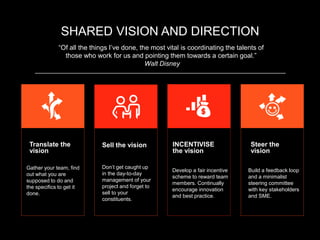
Gather your team, find
out what you are
supposed to do and
the specifics to get it
done.
Translate the
vision
Develop a fair incentive
scheme to reward team
members. Continually
encourage innovation
and best practice.
INCENTIVISE
the vision
Build a feedback loop
and a minimalist
steering committee
with key stakeholders
and SME.
Steer the
vision
Don’t get caught up
in the day-to-day
management of your
project and forget to
sell to your
constituents.
Sell the vision
SHARED VISION AND DIRECTION
“Of all the things I’ve done, the most vital is coordinating the talents of
those who work for us and pointing them towards a certain goal.”
Walt Disney
CHANGE
Advocates
Source key SME (Subject
Matter Experts) who can be
turned into advocates of
change post project
implementation
“Managing changes in a large organization
has been compared to re-engineering an
aircraft while it's in flight”
CLEAR Requirements
“No matter how good the team or efficient the methodology,
if we’re not solving the right problem, the project fails.”
Woody Wilson
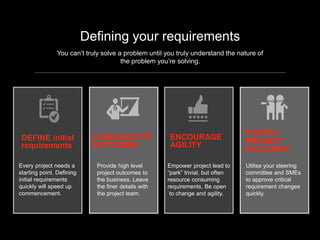
Defining your requirements
You can’t truly solve a problem until you truly understand the nature of
the problem you’re solving.
Every project needs a
starting point. Defining
initial requirements
quickly will speed up
commencement.
DEFINE initial
requirements
Provide high level
project outcomes to
the business. Leave
the finer details with
the project team.
COMMUNICATE
OUTCOMES
Empower project lead to
“park” trivial, but often
resource consuming
requirements. Be open
to change and agility.
ENCOURAGE
AGILITY
Utilise your steering
committee and SMEs
to approve critical
requirement changes
quickly.
FOSTER
PROJECT
INCLUSION
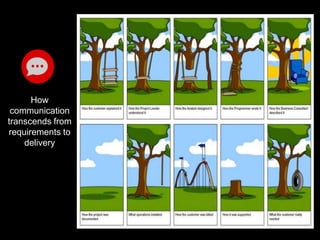
How
communication
transcends from
requirements to
delivery
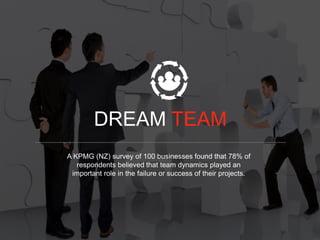
DREAM TEAM
A KPMG (NZ) survey of 100 businesses found that 78% of
respondents believed that team dynamics played an
important role in the failure or success of their projects.
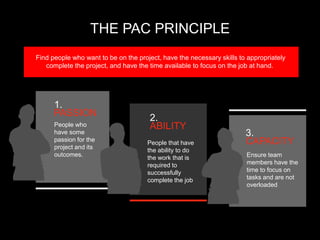
THE PAC PRINCIPLE
Find people who want to be on the project, have the necessary skills to appropriately
complete the project, and have the time available to focus on the job at hand.
1.
PASSION
People who
have some
passion for the
project and its
outcomes.
2.
ABILITY
People that have
the ability to do
the work that is
required to
successfully
complete the job
3.
CAPACITY
Ensure team
members have the
time to focus on
tasks and are not
overloaded
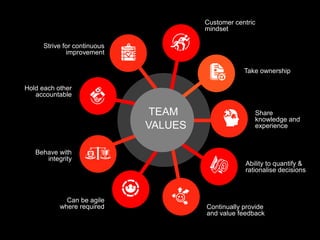
Take ownership
Share
knowledge and
experience
Customer centric
mindset
Strive for continuous
improvement
Can be agile
where required
Behave with
integrity
Hold each other
accountable
Continually provide
and value feedback
TEAM
VALUES
Ability to quantify &
rationalise decisions
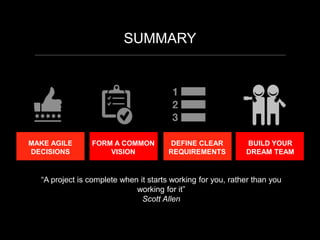
SUMMARY
MAKE AGILE
DECISIONS
FORM A COMMON
VISION
DEFINE CLEAR
REQUIREMENTS
BUILD YOUR
DREAM TEAM
“A project is complete when it starts working for you, rather than you
working for it”
Scott Allen
THANK YOU
REACH OUT
au.linkedin.com/in/kevinwordon
twitter.com/kevinwordon
slideshare.net/KevinWordon

Why Projects Fail + Four Steps to Succeed

  • 1.
    WHY PROJECTS FAIL + FOUR TIPSTO SUCCEED Presented by: Kevin Wordon Digital Transformation Leader Australia
  • 2.
    McKinsey & Company AND UNIVERSITYOF OXFORD STUDY Study of 5,400 large scale IT projects across the world. Average budgets of $13 million.
  • 3.
    70% 45% 17% 56% 70% oforganisations suffered at least one project failure in the last 12 months Failed to deliver Posed a severe company threat 17% of projects went so badly that they threatened the very existence of the company Significantly over budget 45% of projects ended well over budget with 7% also over time. Delivered less value 56% of all projects delivered less value than predicted at planning stage.
  • 4.
    WHY DO Projects FAIL? Aproject is considered a failure when it has not delivered what was required, in line with expectations. Therefore, in order to succeed, a project must deliver to cost, to quality, and on time; and it must deliver the benefits presented in the business case.
  • 5.
    PROJECT FAILURE POOR DECISION MAKING Poorlytimed decisions and too many stakeholders often delay or derail projects. 1 LACK OF CLEAR GOALS OR VISION Failure to understand the why results in failure to deliver what the business needs. 2 UNCLEAR REQUIREMENTS Unclear, vague and conflicting requirements can dramatically increase costs and time. 3 PROJECT TEAM ISSUES Poor team dynamic, lack of expertise, and poor management can often hinder success. 4
  • 6.
    DECISION MAKING Stay committedto your decisions, but stay flexible in your approach.
  • 7.
    Understanding the varying levelsof PROJECT Decision Making Understanding the complex reality that technology team’s face requires us to go beyond the relatively simple “task centric” view and look at projects in an entirely different way BUILDING A HOUSE PHYSICAL ACTIVITY Information acquisition Decision Making KNOWLEDGE TRANSFER
  • 8.
  • 9.
  • 10.
    PHYSICAL ACTIVITY Information acquisition Decision Making KNOWLEDGE TRANSFER TECHNOLOGY PROJECT Understanding the varyinglevels of PROJECT Decision Making From strategy development all the way through to developing code decision making is the primary activity that absorbs the majority of effort that goes into an IT project.
  • 11.
    AGILE DECISION MAKING THE OODALOOP The phrase OODA loop refers to the decision cycle of observe, orient, decide, and act, developed by military strategist and USAF Colonel John Boyd.
  • 12.
    According to Boyd,decision-making occurs in a recurring cycle of observe-orient-decide-act. An entity (whether an individual or an organization) that can process this cycle quickly, observing and reacting to unfolding events more rapidly than an opponent, can thereby "get inside" the opponent's decision cycle and gain the advantage. AGILE DECISION MAKING THE OODA LOOP
  • 13.
    AGILE DECISION MAKING THEOODA LOOP OBSERVE Quickly observe and document what is unfolding within the organisation or project. ORIENT Analyse and understand information gathered and then assess its potential impact on business DECIDE People need to be empowered to make decisions at the lowest practical level. Provide implicit guidance and control. Anticipate surprises and external /environmental influences. Your team should challenge existing customs and beliefs and strive to avoid complacency. If the decision does not cause irreversible resource impacts there is a case for acting first to see if the proposed change works. ACT Find ways to act quickly. Avoid silos and grass root resistance. Be aware of funding. Decentralisation can help, as can encouraging informal cross-functional networks.
  • 14.
    CLEAR DIRECTION & COMMONGOALS “Fuzzy business objectives, out-of-sync stakeholders, and excessive rework” mean that 75% of project participants lack confidence that their projects will succeed. 2011 Geneca study of 600 people involved in software development projects.
  • 15.
    Gather your team,find out what you are supposed to do and the specifics to get it done. Translate the vision Develop a fair incentive scheme to reward team members. Continually encourage innovation and best practice. INCENTIVISE the vision Build a feedback loop and a minimalist steering committee with key stakeholders and SME. Steer the vision Don’t get caught up in the day-to-day management of your project and forget to sell to your constituents. Sell the vision SHARED VISION AND DIRECTION “Of all the things I’ve done, the most vital is coordinating the talents of those who work for us and pointing them towards a certain goal.” Walt Disney
  • 16.
    CHANGE Advocates Source key SME(Subject Matter Experts) who can be turned into advocates of change post project implementation “Managing changes in a large organization has been compared to re-engineering an aircraft while it's in flight”
  • 17.
    CLEAR Requirements “No matterhow good the team or efficient the methodology, if we’re not solving the right problem, the project fails.” Woody Wilson
  • 18.
    Defining your requirements Youcan’t truly solve a problem until you truly understand the nature of the problem you’re solving. Every project needs a starting point. Defining initial requirements quickly will speed up commencement. DEFINE initial requirements Provide high level project outcomes to the business. Leave the finer details with the project team. COMMUNICATE OUTCOMES Empower project lead to “park” trivial, but often resource consuming requirements. Be open to change and agility. ENCOURAGE AGILITY Utilise your steering committee and SMEs to approve critical requirement changes quickly. FOSTER PROJECT INCLUSION
  • 19.
  • 20.
    DREAM TEAM A KPMG(NZ) survey of 100 businesses found that 78% of respondents believed that team dynamics played an important role in the failure or success of their projects.
  • 21.
    THE PAC PRINCIPLE Findpeople who want to be on the project, have the necessary skills to appropriately complete the project, and have the time available to focus on the job at hand. 1. PASSION People who have some passion for the project and its outcomes. 2. ABILITY People that have the ability to do the work that is required to successfully complete the job 3. CAPACITY Ensure team members have the time to focus on tasks and are not overloaded
  • 22.
    Take ownership Share knowledge and experience Customercentric mindset Strive for continuous improvement Can be agile where required Behave with integrity Hold each other accountable Continually provide and value feedback TEAM VALUES Ability to quantify & rationalise decisions
  • 23.
    SUMMARY MAKE AGILE DECISIONS FORM ACOMMON VISION DEFINE CLEAR REQUIREMENTS BUILD YOUR DREAM TEAM “A project is complete when it starts working for you, rather than you working for it” Scott Allen
  • 24.