Hazard Recognition 
www.discountppe.com 
Burns and Hot Condensate
Hazard Recognition 
www.discountppe.com 
Burns and Hot Condensate 
Objectives: 
Upon completion of this module, the participant will be able to: 
 Recognize the hazard posed by the several heat sources 
present in the plant with particular attention to steam and 
hot condensate 
 Identify the potential consequences associated with 
hazards related to steam and hot condensate 
 Describe actions required to control the hazards 
associated with steam and hot condensate 
 Identify the three levels of burn wound severity 
 Identify the first aid actions for treating burn wounds
Hazard Recognition 
www.discountppe.com 
Burns and Hot Condensate 
Key Principles 
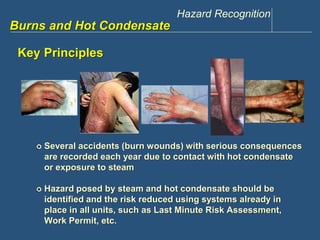
 Several accidents (burn wounds) with serious 
consequences are recorded each year due to contact with 
hot condensate or exposure to steam 
 Hazard posed by steam and hot condensate should be 
identified and the risk reduced using systems already in 
place in all units, such as Last Minute Risk Assessment, 
Work Permit, etc.
Hazard Recognition 
www.discountppe.com 
Burns and Hot Condensate 
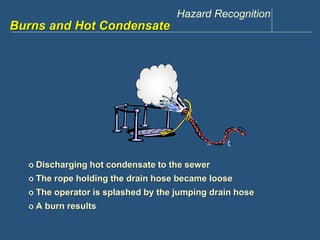
 Discharging hot condensate to the sewer 
 The rope holding the drain hose became loose 
 The operator is splashed by the jumping drain hose 
 A burn results
Hazard Recognition 
www.discountppe.com 
Burns and Hot Condensate 
Other Incidents 
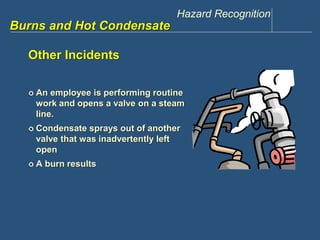
 An employee is performing routine 
work and opens a valve on a steam 
line. 
 Condensate sprays out of another 
valve that was inadvertently left 
open 
 A burn results
Hazard Recognition 
www.discountppe.com 
Burns and Hot Condensate 
Other Incidents 
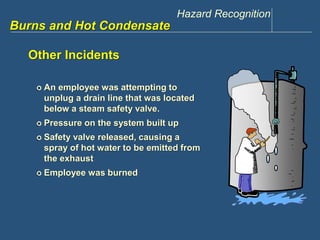
 An employee was attempting to 
unplug a drain line that was located 
below a steam safety valve. 
 Pressure on the system built up 
 Safety valve released, causing a 
spray of hot water to be emitted from 
the exhaust 
 Employee was burned
Hazard Recognition 
www.discountppe.com 
Burns and Hot Condensate 
Other Incidents 
 In private situations, contact with hot boiling water (especially 
children) in the kitchen is daily business!
Hazard Recognition 
www.discountppe.com 
Burns and Hot Condensate 
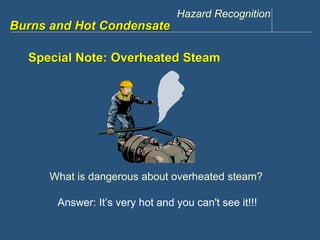
Special Note: Overheated Steam 
What is dangerous about overheated steam? 
Answer: It’s very hot and you can't see it!!!
Hazard Recognition 
www.discountppe.com 
Burns and Hot Condensate 
Why Is Hot Condensate Dangerous? 
We worry about hot hydrocarbons / chemicals and additives but 
condensate is only water ! 
(We Think)!!
Hazard Recognition 
www.discountppe.com 
Burns and Hot Condensate 
Why Is Hot Condensate Dangerous? 
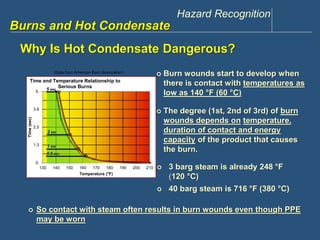
 Burn wounds start to develop when 
there is contact with temperatures as 
low as 140 °F (60 °C) 
 3 barg steam is already 248 °F 
(120 °C) 
 40 barg steam is 716 °F (380 °C) 
(Data from American Burn Association) 
Time and Temperature Relationship to 
5. 
3.8 
2.5 
1.3 
0. 
Serious Burns 
130 140 150 160 170 180 190 200 210 
Time (sec) 
Temperature (°F) 
5 sec 
2 sec 
1 sec 
0.5 sec 
 The degree (1st, 2nd of 3rd) of burn 
wounds depends on temperature, 
duration of contact and energy 
capacity of the product that causes 
the burn. 
 So contact with steam often results in burn wounds even though PPE 
may be worn
Hazard Recognition 
www.discountppe.com 
Burns and Hot Condensate 
Why Is Hot Condensate Dangerous? 
 Steam traps contain condensed steam often at 194 °F (90 °C) 
and always above 167 °F (75 °C) - so the potential for burn 
wounds is always present. 
 Hot condensate has a greater (energy) capacity to cause burn 
wounds than steam.
Hazard Recognition 
www.discountppe.com 
Burns and Hot Condensate 
Equipment / Location Where The Contact Is 
Possible 
 Atmospheric condensate drums 
 Steam drums 
 Atmospheric exhausts from 
turbines or other equipment 
 Silencers from turbines of other 
equipment 
 Steam traps
Hazard Recognition 
www.discountppe.com 
Burns and Hot Condensate 
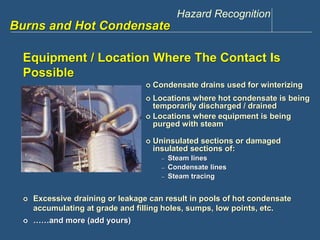
Equipment / Location Where The Contact Is 
Possible 
 Condensate drains used for winterizing 
 Excessive draining or leakage can result in pools of hot condensate 
accumulating at grade and filling holes, sumps, low points, etc. 
 ……and more (add yours) 
 Locations where hot condensate is being 
temporarily discharged / drained 
 Locations where equipment is being 
purged with steam 
 Uninsulated sections or damaged 
insulated sections of: 
– Steam lines 
– Condensate lines 
– Steam tracing
Hazard Recognition 
www.discountppe.com 
Burns and Hot Condensate 
Precautions To Prevent Contact 
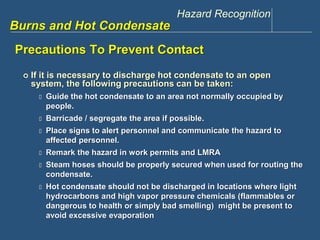
 If it is necessary to discharge hot condensate to an open 
system, the following precautions can be taken: 
 Guide the hot condensate to an area not normally occupied by 
people. 
 Barricade / segregate the area if possible. 
 Place signs to alert personnel and communicate the hazard to 
affected personnel. 
 Remark the hazard in work permits and LMRA 
 Steam hoses should be properly secured when used for routing the 
condensate. 
 Hot condensate should not be discharged in locations where light 
hydrocarbons and high vapor pressure chemicals (flammables or 
dangerous to health or simply bad smelling) might be present to 
avoid excessive evaporation
Hazard Recognition 
www.discountppe.com 
Burns and Hot Condensate 
Precautions To Prevent Contact 
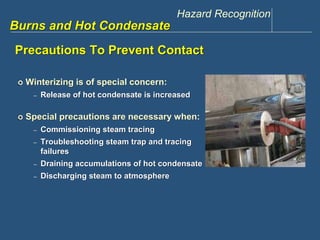
 Winterizing is of special concern: 
– Release of hot condensate is increased 
 Special precautions are necessary when: 
– Commissioning steam tracing 
– Troubleshooting steam trap and tracing 
failures 
– Draining accumulations of hot condensate 
– Discharging steam to atmosphere
Hazard Recognition 
www.discountppe.com 
Burns and Hot Condensate 
Precautions To Prevent Contact 
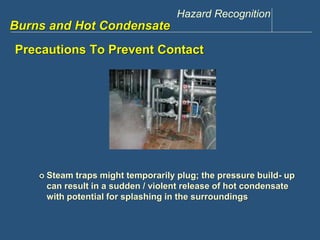
 Steam traps might temporarily plug; the pressure build- up 
can result in a sudden / violent release of hot condensate 
with potential for splashing in the surroundings
Hazard Recognition 
www.discountppe.com 
Burns and Hot Condensate 
Precautions To Prevent Contact 
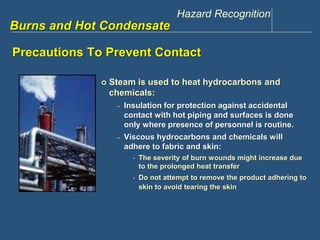
 Steam is used to heat hydrocarbons and 
chemicals: 
– Insulation for protection against accidental 
contact with hot piping and surfaces is done 
only where presence of personnel is routine. 
– Viscous hydrocarbons and chemicals will 
adhere to fabric and skin: 
• The severity of burn wounds might increase due 
to the prolonged heat transfer 
• Do not attempt to remove the product adhering to 
skin to avoid tearing the skin
Hazard Recognition 
www.discountppe.com 
Burns and Hot Condensate 
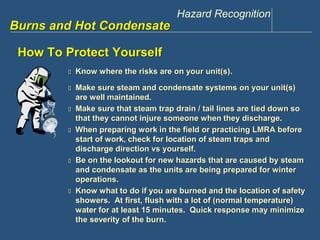
How To Protect Yourself 
 Know where the risks are on your unit(s). 
 Make sure steam and condensate systems on your unit(s) 
are well maintained. 
 Make sure that steam trap drain / tail lines are tied down so 
that they cannot injure someone when they discharge. 
 When preparing work in the field or practicing LMRA before 
start of work, check for location of steam traps and 
discharge direction vs yourself. 
 Be on the lookout for new hazards that are caused by steam 
and condensate as the units are being prepared for winter 
operations. 
 Know what to do if you are burned and the location of safety 
showers. At first, flush with a lot of (normal temperature) 
water for at least 15 minutes. Quick response may minimize 
the severity of the burn.
Hazard Recognition 
www.discountppe.com 
Burns and Hot Condensate 
Burns: Memory Refresher 
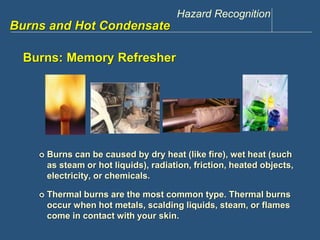
 Burns can be caused by dry heat (like fire), wet heat (such 
as steam or hot liquids), radiation, friction, heated objects, 
electricity, or chemicals. 
 Thermal burns are the most common type. Thermal burns 
occur when hot metals, scalding liquids, steam, or flames 
come in contact with your skin.
Hazard Recognition 
www.discountppe.com 
Burns and Hot Condensate 
Burns: Memory Refresher 
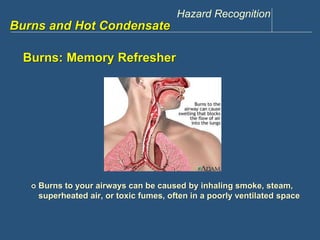
 Burns to your airways can be caused by inhaling smoke, steam, 
superheated air, or toxic fumes, often in a poorly ventilated space
Hazard Recognition 
www.discountppe.com 
Burns and Hot Condensate 
Burns: Memory Refresher 
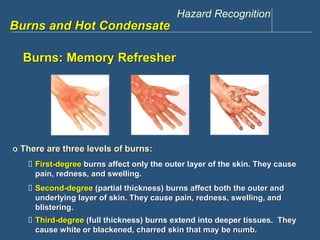
 There are three levels of burns: 
 First-degree burns affect only the outer layer of the skin. They cause 
pain, redness, and swelling. 
 Second-degree (partial thickness) burns affect both the outer and 
underlying layer of skin. They cause pain, redness, swelling, and 
blistering. 
 Third-degree (full thickness) burns extend into deeper tissues. They 
cause white or blackened, charred skin that may be numb.
Hazard Recognition 
www.discountppe.com 
Burns and Hot Condensate 
First Aid - For Minor Burns 
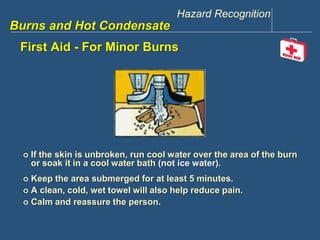
 If the skin is unbroken, run cool water over the area of the burn 
or soak it in a cool water bath (not ice water). 
 Keep the area submerged for at least 5 minutes. 
 A clean, cold, wet towel will also help reduce pain. 
 Calm and reassure the person.
Hazard Recognition 
www.discountppe.com 
Burns and Hot Condensate 
First Aid - For Minor Burns 
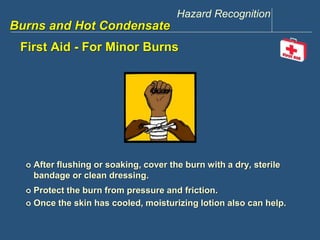
 After flushing or soaking, cover the burn with a dry, sterile 
bandage or clean dressing. 
 Protect the burn from pressure and friction. 
 Once the skin has cooled, moisturizing lotion also can help.
Hazard Recognition 
www.discountppe.com 
Burns and Hot Condensate 
First Aid - For Minor Burns 
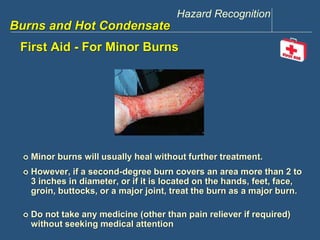
 Minor burns will usually heal without further treatment. 
 However, if a second-degree burn covers an area more than 2 
to 3 inches in diameter, or if it is located on the hands, feet, 
face, groin, buttocks, or a major joint, treat the burn as a major 
burn. 
 Do not take any medicine (other than pain reliever if required) 
without seeking medical attention
Hazard Recognition 
www.discountppe.com 
Burns and Hot Condensate 
First Aid - For Major Burns 
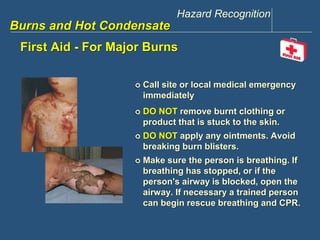
 Call site or local medical emergency 
immediately 
 DO NOT remove burnt clothing or 
product that is stuck to the skin. 
 DO NOT apply any ointments. Avoid 
breaking burn blisters. 
 Make sure the person is breathing. If 
breathing has stopped, or if the 
person's airway is blocked, open the 
airway. If necessary a trained person 
can begin rescue breathing and CPR.
Hazard Recognition 
www.discountppe.com 
Burns and Hot Condensate 
First Aid - For Major Burns 
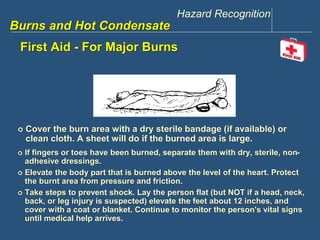
 Cover the burn area with a dry sterile bandage (if available) or 
clean cloth. A sheet will do if the burned area is large. 
 If fingers or toes have been burned, separate them with dry, sterile, non-adhesive 
dressings. 
 Elevate the body part that is burned above the level of the heart. Protect 
the burnt area from pressure and friction. 
 Take steps to prevent shock. Lay the person flat (but NOT if a head, neck, 
back, or leg injury is suspected) elevate the feet about 12 inches, and 
cover with a coat or blanket. Continue to monitor the person's vital signs 
until medical help arrives.
Hazard Recognition 
www.discountppe.com 
Burns and Hot Condensate 
Objectives Review: 
Upon completion of this module, the participant will be able to: 
 Recognize the hazard posed by the several heat sources 
present in the plant with particular attention to steam and 
hot condensate 
 Identify the potential consequences associated with the 
hazards related to steam and hot condensate 
 Describe actions required to control the hazards 
associated with steam and hot condensate 
 Identify the three level of burn wounds severity 
 Identify the first aid actions for treating burn wounds

Burns & condensate

  • 1.
    Hazard Recognition www.discountppe.com Burns and Hot Condensate
  • 2.
    Hazard Recognition www.discountppe.com Burns and Hot Condensate Objectives: Upon completion of this module, the participant will be able to:  Recognize the hazard posed by the several heat sources present in the plant with particular attention to steam and hot condensate  Identify the potential consequences associated with hazards related to steam and hot condensate  Describe actions required to control the hazards associated with steam and hot condensate  Identify the three levels of burn wound severity  Identify the first aid actions for treating burn wounds
  • 3.
    Hazard Recognition www.discountppe.com Burns and Hot Condensate Key Principles  Several accidents (burn wounds) with serious consequences are recorded each year due to contact with hot condensate or exposure to steam  Hazard posed by steam and hot condensate should be identified and the risk reduced using systems already in place in all units, such as Last Minute Risk Assessment, Work Permit, etc.
  • 4.
    Hazard Recognition www.discountppe.com Burns and Hot Condensate  Discharging hot condensate to the sewer  The rope holding the drain hose became loose  The operator is splashed by the jumping drain hose  A burn results
  • 5.
    Hazard Recognition www.discountppe.com Burns and Hot Condensate Other Incidents  An employee is performing routine work and opens a valve on a steam line.  Condensate sprays out of another valve that was inadvertently left open  A burn results
  • 6.
    Hazard Recognition www.discountppe.com Burns and Hot Condensate Other Incidents  An employee was attempting to unplug a drain line that was located below a steam safety valve.  Pressure on the system built up  Safety valve released, causing a spray of hot water to be emitted from the exhaust  Employee was burned
  • 7.
    Hazard Recognition www.discountppe.com Burns and Hot Condensate Other Incidents  In private situations, contact with hot boiling water (especially children) in the kitchen is daily business!
  • 8.
    Hazard Recognition www.discountppe.com Burns and Hot Condensate Special Note: Overheated Steam What is dangerous about overheated steam? Answer: It’s very hot and you can't see it!!!
  • 9.
    Hazard Recognition www.discountppe.com Burns and Hot Condensate Why Is Hot Condensate Dangerous? We worry about hot hydrocarbons / chemicals and additives but condensate is only water ! (We Think)!!
  • 10.
    Hazard Recognition www.discountppe.com Burns and Hot Condensate Why Is Hot Condensate Dangerous?  Burn wounds start to develop when there is contact with temperatures as low as 140 °F (60 °C)  3 barg steam is already 248 °F (120 °C)  40 barg steam is 716 °F (380 °C) (Data from American Burn Association) Time and Temperature Relationship to 5. 3.8 2.5 1.3 0. Serious Burns 130 140 150 160 170 180 190 200 210 Time (sec) Temperature (°F) 5 sec 2 sec 1 sec 0.5 sec  The degree (1st, 2nd of 3rd) of burn wounds depends on temperature, duration of contact and energy capacity of the product that causes the burn.  So contact with steam often results in burn wounds even though PPE may be worn
  • 11.
    Hazard Recognition www.discountppe.com Burns and Hot Condensate Why Is Hot Condensate Dangerous?  Steam traps contain condensed steam often at 194 °F (90 °C) and always above 167 °F (75 °C) - so the potential for burn wounds is always present.  Hot condensate has a greater (energy) capacity to cause burn wounds than steam.
  • 12.
    Hazard Recognition www.discountppe.com Burns and Hot Condensate Equipment / Location Where The Contact Is Possible  Atmospheric condensate drums  Steam drums  Atmospheric exhausts from turbines or other equipment  Silencers from turbines of other equipment  Steam traps
  • 13.
    Hazard Recognition www.discountppe.com Burns and Hot Condensate Equipment / Location Where The Contact Is Possible  Condensate drains used for winterizing  Excessive draining or leakage can result in pools of hot condensate accumulating at grade and filling holes, sumps, low points, etc.  ……and more (add yours)  Locations where hot condensate is being temporarily discharged / drained  Locations where equipment is being purged with steam  Uninsulated sections or damaged insulated sections of: – Steam lines – Condensate lines – Steam tracing
  • 14.
    Hazard Recognition www.discountppe.com Burns and Hot Condensate Precautions To Prevent Contact  If it is necessary to discharge hot condensate to an open system, the following precautions can be taken:  Guide the hot condensate to an area not normally occupied by people.  Barricade / segregate the area if possible.  Place signs to alert personnel and communicate the hazard to affected personnel.  Remark the hazard in work permits and LMRA  Steam hoses should be properly secured when used for routing the condensate.  Hot condensate should not be discharged in locations where light hydrocarbons and high vapor pressure chemicals (flammables or dangerous to health or simply bad smelling) might be present to avoid excessive evaporation
  • 15.
    Hazard Recognition www.discountppe.com Burns and Hot Condensate Precautions To Prevent Contact  Winterizing is of special concern: – Release of hot condensate is increased  Special precautions are necessary when: – Commissioning steam tracing – Troubleshooting steam trap and tracing failures – Draining accumulations of hot condensate – Discharging steam to atmosphere
  • 16.
    Hazard Recognition www.discountppe.com Burns and Hot Condensate Precautions To Prevent Contact  Steam traps might temporarily plug; the pressure build- up can result in a sudden / violent release of hot condensate with potential for splashing in the surroundings
  • 17.
    Hazard Recognition www.discountppe.com Burns and Hot Condensate Precautions To Prevent Contact  Steam is used to heat hydrocarbons and chemicals: – Insulation for protection against accidental contact with hot piping and surfaces is done only where presence of personnel is routine. – Viscous hydrocarbons and chemicals will adhere to fabric and skin: • The severity of burn wounds might increase due to the prolonged heat transfer • Do not attempt to remove the product adhering to skin to avoid tearing the skin
  • 18.
    Hazard Recognition www.discountppe.com Burns and Hot Condensate How To Protect Yourself  Know where the risks are on your unit(s).  Make sure steam and condensate systems on your unit(s) are well maintained.  Make sure that steam trap drain / tail lines are tied down so that they cannot injure someone when they discharge.  When preparing work in the field or practicing LMRA before start of work, check for location of steam traps and discharge direction vs yourself.  Be on the lookout for new hazards that are caused by steam and condensate as the units are being prepared for winter operations.  Know what to do if you are burned and the location of safety showers. At first, flush with a lot of (normal temperature) water for at least 15 minutes. Quick response may minimize the severity of the burn.
  • 19.
    Hazard Recognition www.discountppe.com Burns and Hot Condensate Burns: Memory Refresher  Burns can be caused by dry heat (like fire), wet heat (such as steam or hot liquids), radiation, friction, heated objects, electricity, or chemicals.  Thermal burns are the most common type. Thermal burns occur when hot metals, scalding liquids, steam, or flames come in contact with your skin.
  • 20.
    Hazard Recognition www.discountppe.com Burns and Hot Condensate Burns: Memory Refresher  Burns to your airways can be caused by inhaling smoke, steam, superheated air, or toxic fumes, often in a poorly ventilated space
  • 21.
    Hazard Recognition www.discountppe.com Burns and Hot Condensate Burns: Memory Refresher  There are three levels of burns:  First-degree burns affect only the outer layer of the skin. They cause pain, redness, and swelling.  Second-degree (partial thickness) burns affect both the outer and underlying layer of skin. They cause pain, redness, swelling, and blistering.  Third-degree (full thickness) burns extend into deeper tissues. They cause white or blackened, charred skin that may be numb.
  • 22.
    Hazard Recognition www.discountppe.com Burns and Hot Condensate First Aid - For Minor Burns  If the skin is unbroken, run cool water over the area of the burn or soak it in a cool water bath (not ice water).  Keep the area submerged for at least 5 minutes.  A clean, cold, wet towel will also help reduce pain.  Calm and reassure the person.
  • 23.
    Hazard Recognition www.discountppe.com Burns and Hot Condensate First Aid - For Minor Burns  After flushing or soaking, cover the burn with a dry, sterile bandage or clean dressing.  Protect the burn from pressure and friction.  Once the skin has cooled, moisturizing lotion also can help.
  • 24.
    Hazard Recognition www.discountppe.com Burns and Hot Condensate First Aid - For Minor Burns  Minor burns will usually heal without further treatment.  However, if a second-degree burn covers an area more than 2 to 3 inches in diameter, or if it is located on the hands, feet, face, groin, buttocks, or a major joint, treat the burn as a major burn.  Do not take any medicine (other than pain reliever if required) without seeking medical attention
  • 25.
    Hazard Recognition www.discountppe.com Burns and Hot Condensate First Aid - For Major Burns  Call site or local medical emergency immediately  DO NOT remove burnt clothing or product that is stuck to the skin.  DO NOT apply any ointments. Avoid breaking burn blisters.  Make sure the person is breathing. If breathing has stopped, or if the person's airway is blocked, open the airway. If necessary a trained person can begin rescue breathing and CPR.
  • 26.
    Hazard Recognition www.discountppe.com Burns and Hot Condensate First Aid - For Major Burns  Cover the burn area with a dry sterile bandage (if available) or clean cloth. A sheet will do if the burned area is large.  If fingers or toes have been burned, separate them with dry, sterile, non-adhesive dressings.  Elevate the body part that is burned above the level of the heart. Protect the burnt area from pressure and friction.  Take steps to prevent shock. Lay the person flat (but NOT if a head, neck, back, or leg injury is suspected) elevate the feet about 12 inches, and cover with a coat or blanket. Continue to monitor the person's vital signs until medical help arrives.
  • 27.
    Hazard Recognition www.discountppe.com Burns and Hot Condensate Objectives Review: Upon completion of this module, the participant will be able to:  Recognize the hazard posed by the several heat sources present in the plant with particular attention to steam and hot condensate  Identify the potential consequences associated with the hazards related to steam and hot condensate  Describe actions required to control the hazards associated with steam and hot condensate  Identify the three level of burn wounds severity  Identify the first aid actions for treating burn wounds

Editor's Notes

  • #2 Welcome participants to the Burns and Hot Condensate Module of the Hazard Recognition Training course. Cover, with the participants, the facility and amenities. (i.e. facilities layout, evacuation routes, accommodations such as restrooms, available cafeteria(s), and participant materials). With facilities and amenities sufficiently covered start the module by stating: Narrative: As discussed in the “Hazard Recognition Basics” module, operational hazards are inherent to everything we do. The key to managing these hazards is to first recognize them and ensure the proper barriers are in place to minimize the likelihood of an incident. In this module we will discuss hazards associated with steam and hot condensate and the actions required to minimize the probability of being burned. This package is intended to cover only the burn hazards that are related to steam and hot condensate. ◄CUE► Next Slide
  • #3 Read objective stem. ◄CUE► slide and read each objective statement as it is automatically revealed. After the objectives have been read aloud, state the following: Narrative: The expected outcomes for this topic are: All workers are proficient in hazard recognition associated with steam and hot condensate and develop a risk assessment habit, utilizing the proper available tools to assess risks. All workers demonstrate zero tolerance to unmanaged hazards and apply appropriate preventive measures for safe work execution. It is expected that the number of hot condensate and steam related incidents and near-misses will reduce. ◄CUE► Next Slide
  • #4 Read the bullet item from the slide ◄CUE► slide to read bullet item. Stress that systems are already identified to minimize the potential for burns. It is up to the individual to follow these systems. ◄CUE► Next Slide
  • #5 Read and discuss the incident statements from slide. ◄CUE► Next Slide
  • #6 Read and discuss the incident statements from slide. ◄CUE► Next Slide
  • #7 Read and discuss the incident statements from slide. ◄CUE► Next Slide
  • #8 Read and discuss the incident statements from slide. ◄CUE► Next Slide
  • #9 Narrative: Working around overheated or superheated steam is extremely dangerous. ◄CUE► slide and read question. Discuss with participants the danger of superheated steam. ◄CUE► slide and read answer. ◄CUE► Next Slide
  • #10 Narrative: So, why is hot condensate dangerous? ◄CUE► slide and read statement from slide. ◄CUE► Next Slide
  • #11 Narrative: Condensate may only be water, but hot water can cause burns. ◄CUE► slide and read bullet item. Repeat to reveal and discuss remaining bullet items. (5) ◄CUE► Next Slide
  • #12 Narrative: A steam trap is a very common place where we encounter hot condensate. Read and discuss bullet items from slide. ◄CUE► Next Slide
  • #13 Narrative: So we know that the hazard associated with hot condensate and steam is a burn hazard. Let’s take a look at some equipment / locations where contact with hot condensate or steam may occur. ◄CUE► slide and discuss how contact with the equipment / location can result in burns. Repeat for remaining bullets. (5) ◄CUE► Next Slide
  • #14 Continue to discuss equipment / location where burns could result from contact with steam or hot condensate. ◄CUE► slide continue to reveal and discuss equipment / locations. Repeat for remaining bullets. (6) Upon revealing the last bullet, ask participants to provide other locations they feel can result in burns. ◄CUE► Next Slide
  • #15 Narrative: So, how can we reduce the risks of being burned due to contact with steam or hot condensate? Well, first …. ◄CUE► slide to reveal and read the statement from the slide. ◄CUE► slide to reveal and discuss each bullet item. Repeat until all bullets are discussed. (6) ◄CUE► Next Slide
  • #16 Continue to discuss precautions. ◄CUE► slide to reveal and discuss second item. ◄CUE► Next Slide
  • #17 Narrative: As we stated earlier, steam traps are common points where contact with steam and hot condensate may occur. Special attention must be paid when operating or working around steam traps because… Read and discuss bullet item from slide. ◄CUE► Next Slide
  • #18 Narrative: Direct contact with steam or hot condensate is not the only way you could be burned. Contact with the metal surfaces of the piping or components containing steam or hot condensate could also result in severe burns. Read and discuss bulleted items. ◄CUE► Next Slide
  • #19 Narrative: So lets take a moment to review a few items that we have discussed so far: First, that contact with steam or hot condensate could result in severe and painful burns. We also stated that steam or hot condensate is present in several locations throughout the plant. So what do I need to know to protect myself against the possibility of burns due to contact with steam or hot condensate? ◄CUE► slide to reveal and discuss bullets. Repeat until all bullets are discussed. (6) ◄CUE► Next Slide
  • #20 Narrative: We stated that the primary consequence of contact with steam or hot condensate is burns. Lets take a few minute to refresh our knowledge about burns. ◄CUE► slide to reveal and discuss bullets. Repeat for second bullets. ◄CUE► Next Slide
  • #21 Continue refresher on burns by reading and discussing bullet item on burns to airway. ◄CUE► Next Slide
  • #22 Narrative: Recall that there are three levels of burns…. ◄CUE► slide to reveal and discuss first degree burns. ◄CUE► slide to reveal and discuss second degree burns. ◄CUE► slide to reveal and discuss third degree burns. ◄CUE► Next Slide
  • #23 Narrative: So if you or a co-worker suffer a burn, what actions should be taken? Lets first look at minor burns. ◄CUE► slide to reveal and discuss bullets. Repeat until all bullets are discussed. (4) ◄CUE► Next Slide
  • #24 Continue to discuss first aid for minor burns. ◄CUE► slide and read/discuss each item revealed. The first bullet appears automatically on slide load. Repeat until all items are discussed. (3) ◄CUE► Next Slide
  • #25 Continue to discuss first aid for minor burns. ◄CUE► slide and read/discuss each item revealed. The first bullet appears automatically on slide load. Repeat until all items are discussed. (3) ◄CUE► Next Slide
  • #26 Narrative: Major burns are more serious and require immediate medical attention. ◄CUE► slide to reveal and discuss bullets. Repeat until all bullets are discussed. (4) ◄CUE► Next Slide
  • #27 Continue to discuss first aid for major burns. ◄CUE► slide and read/discuss each item revealed. The first bullet appears automatically on slide load. Repeat until all items are discussed. (4) ◄CUE► Next Slide
  • #28 Narrative: In summary, we have identified that steam and hot condensate are hazards present in the units and if not properly managed, severe burn injuries could result. We have reviewed some incidents that demonstrated the consequences when the hazards are not properly identified and addressed. We have reviewed some actions we can take to minimize the potential for exposure to steam or hot condensate. And lastly, we have reviewed the three levels of burns and the first aid actions to treat burn wounds. Ask if there are any questions. End the session with a reminder of the anticipated date and time of your next scheduled Hazard Recognition Toolbox Safety meeting.