BAD TO   WORSE Why Some Start-ups Go Down  the Tubes … and Others Don't   GREG FISHER   #1 BESTSELLER
 
Top   10 Mistakes of Entrepreneurs
“ I don’t care about the product, I just want to make loads of money”  1 NO REAL PASSION FOR THE BUSINESS
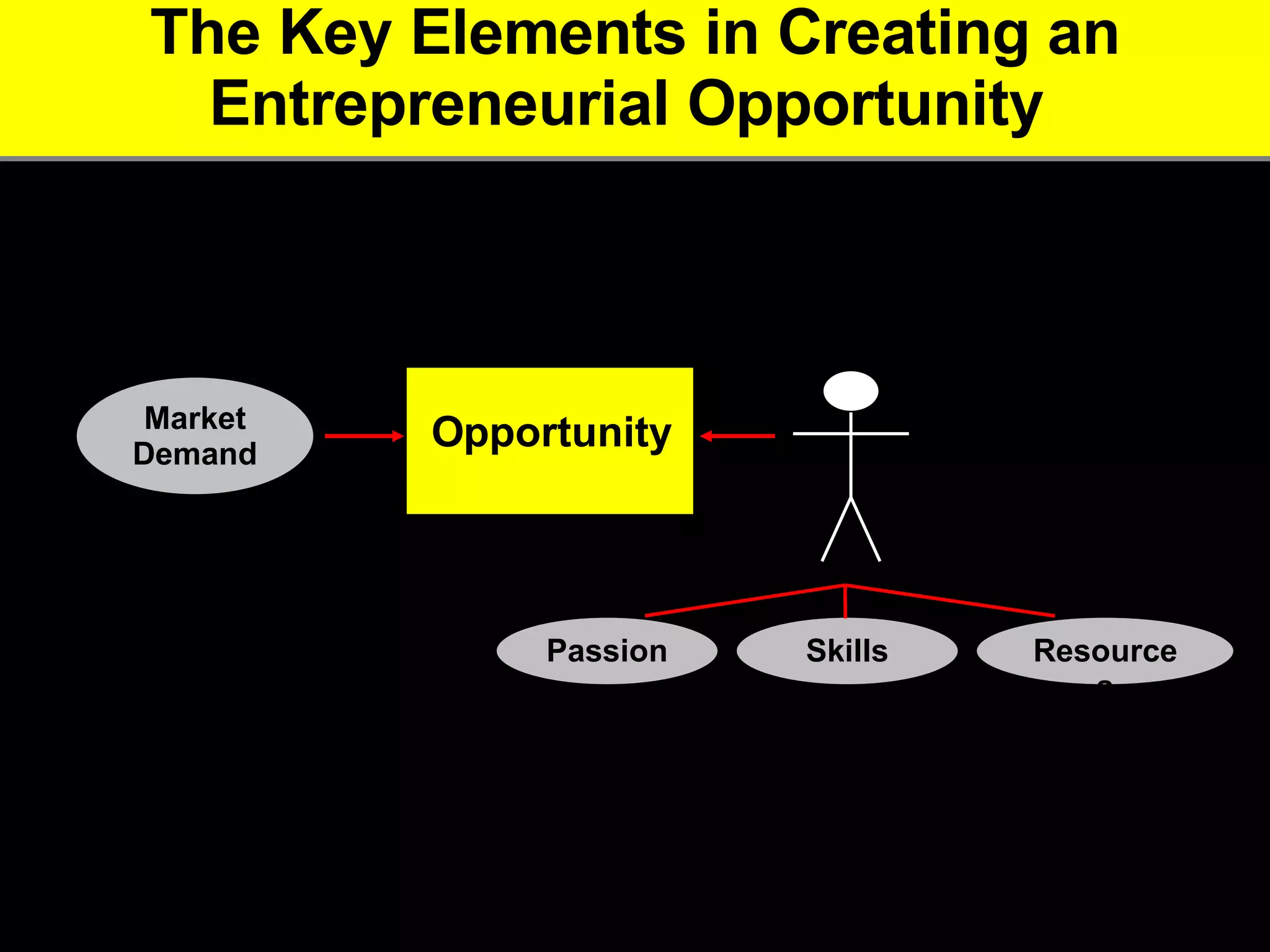
Linking Market Demand with passion, skills and resources to create an entrepreneurial opportunity  Market Demand Passion Skills Resources
The Key Elements in Creating an Entrepreneurial Opportunity  Opportunity Market Demand Passion Skills Resources Entrepreneur
Key questions to sourcing the right opportunity What  do people need?  Who   will buy it?  Why  do they want it?  How  can I reach them?  What am I (are we) deeply  passionate  about?  How can I leverage my (our)  unique skills ?  Where can I (we) get the  resources  to make it happen?
“ We want one so everyone will want one ”   2 NO UNDERSTANDING OF THE MARKET
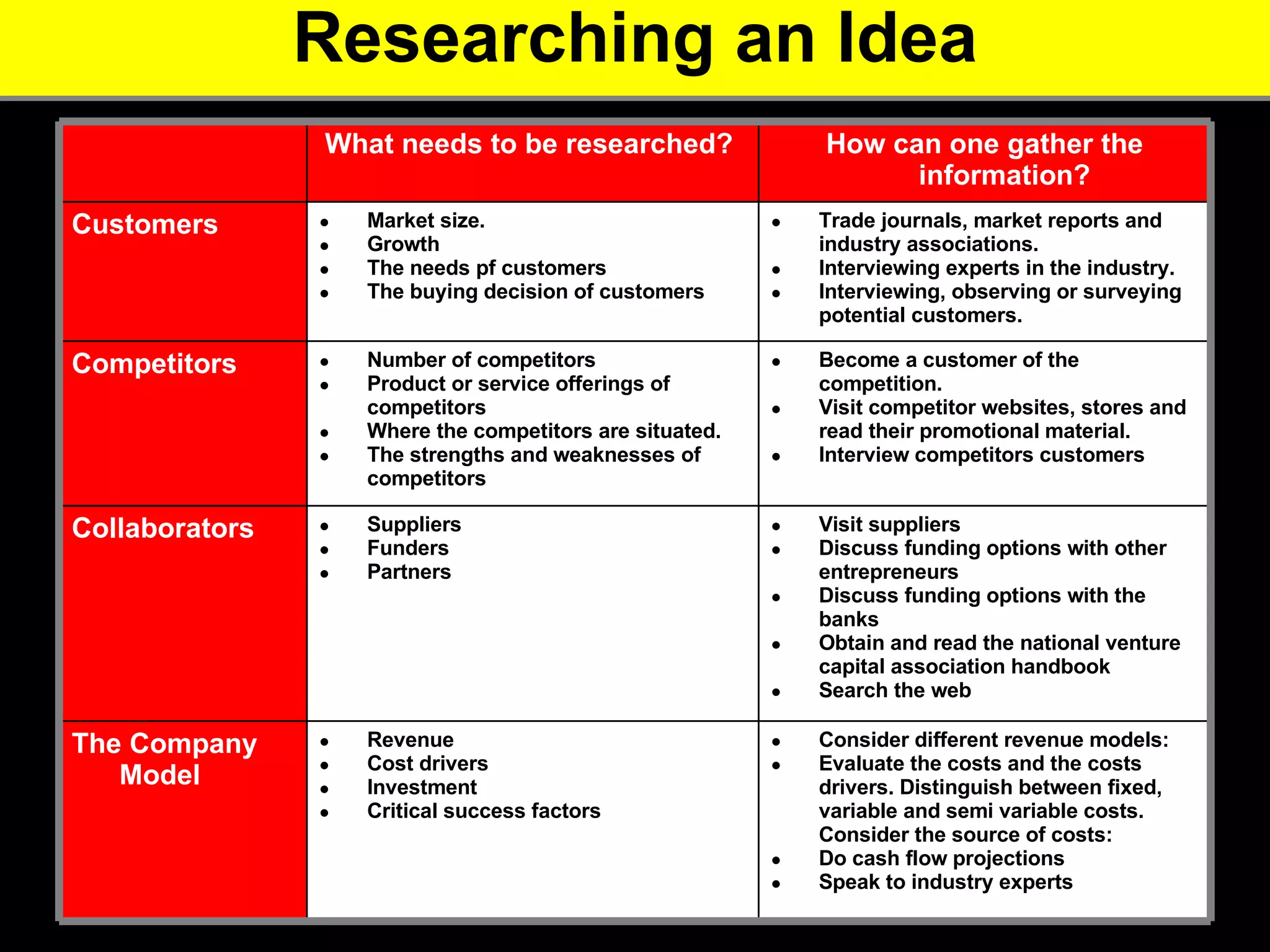
Researching an Idea Consider different revenue models:  Evaluate the costs and the costs drivers. Distinguish between fixed, variable and semi variable costs. Consider the source of costs:  Do cash flow projections Speak to industry experts Revenue  Cost drivers  Investment  Critical success factors The Company Model Visit suppliers Discuss funding options with other entrepreneurs Discuss funding options with the banks Obtain and read the national venture capital association handbook Search the web  Suppliers  Funders  Partners Collaborators Become a customer of the competition.  Visit competitor websites, stores and read their promotional material.  Interview competitors customers Number of competitors  Product or service offerings of competitors  Where the competitors are situated.  The strengths and weaknesses of competitors Competitors Trade journals, market reports and industry associations.  Interviewing experts in the industry.  Interviewing, observing or surveying potential customers.  Market size.  Growth  The needs pf customers The buying decision of customers Customers How can one gather the information?  What needs to be researched?
“ We are going to be just like Amazon.com, only better”  3 NO DIFFERENTIATION
Assessing an Opportunity [VENTURE] Concept Attractiveness Competitive Advantage [ENTREPRENERIAL TEAM] Low Low High High Market Size  Market Growth  Differentiation Customer Need Skills  Resources  Passion / Energy Network 1 2 3 4 5 6 7 8 9 10 10 9 8 7 6 5 4 3 2 1
Response [VENTURE] Concept Attractiveness Competitive Advantage [ENTREPRENERIAL TEAM] Low Low High High Avoid / Wait & Reassess in Future Build / hire / develop the required capabilities Identify / exploit a specific under served niche Revise product or business model Invest and pursue the opportunity 1 2 3 4 5 6 7 8 9 10 10 9 8 7 6 5 4 3 2 1
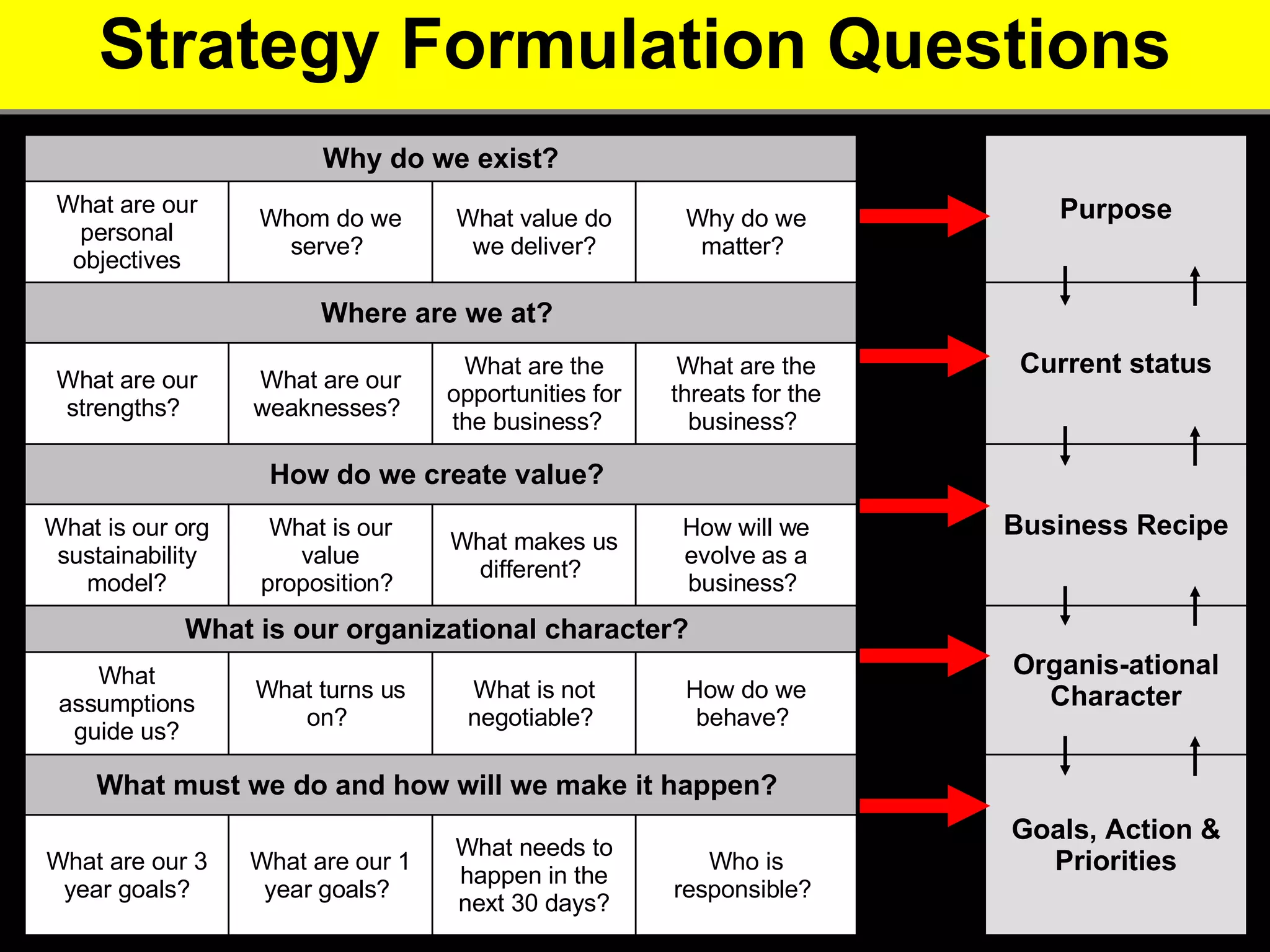
Strategy Formulation Questions What are the threats for the business?  What are the opportunities for the business?  What are our weaknesses?  What are our strengths?  Current status Where are we at?  Who is responsible?  What needs to happen in the next 30 days? What are our 1 year goals?  What are our 3 year goals? Goals, Action & Priorities What must we do and how will we make it happen?  How do we behave?  What is not negotiable?  What turns us on?  What assumptions guide us? Organis-ational Character What is our organizational character?  How will we evolve as a business?  What makes us different?  What is our value proposition?  What is our org sustainability model? Business Recipe How do we create value ?   Why do we matter?  What value do we deliver? Whom do we serve?  What are our personal objectives Purpose Why do we exist?
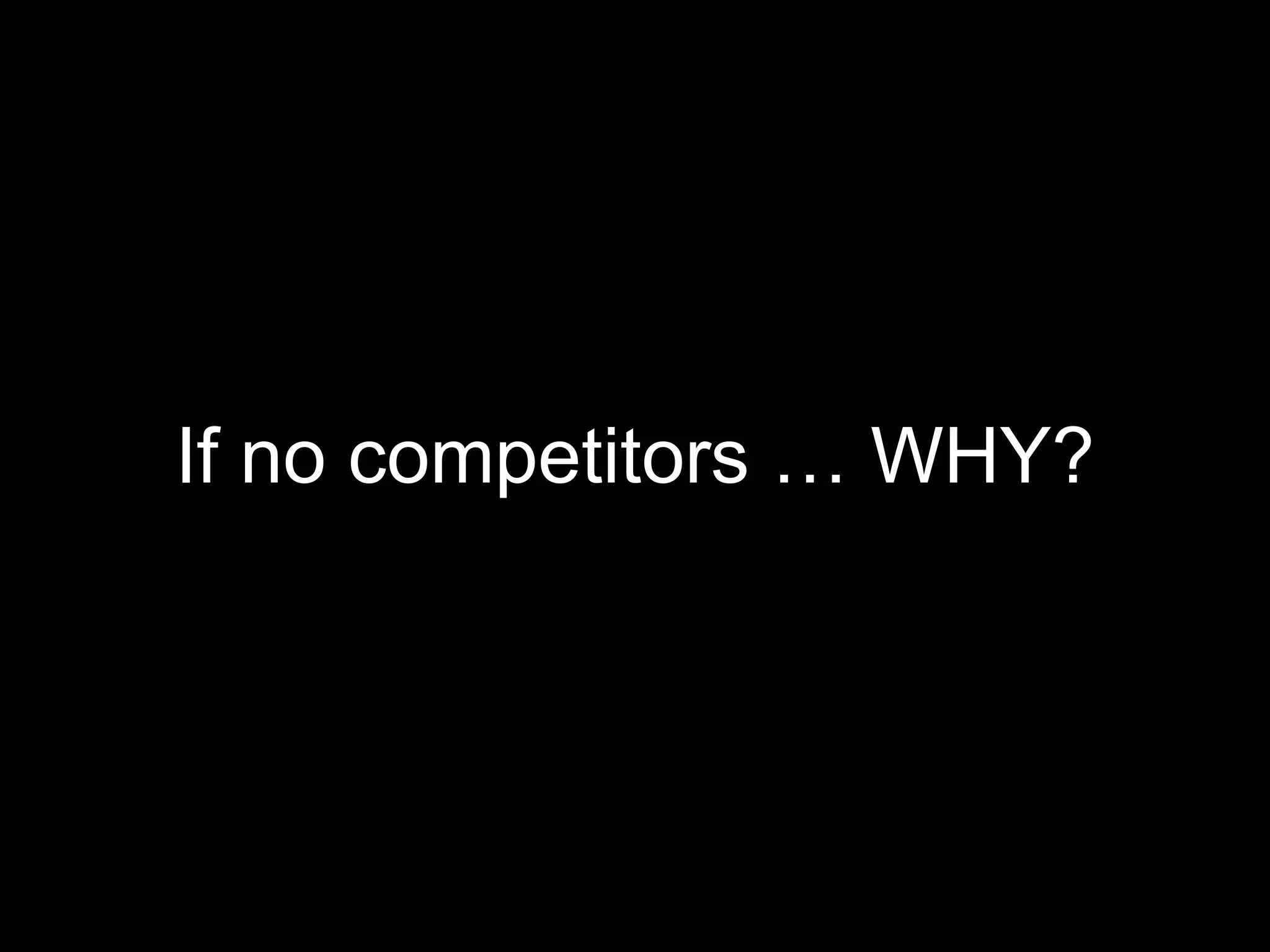
“ We are so unique that we have no competition in the market”  4 NO COMPETITORS
If no competitors … WHY?
Be REAL about your competition
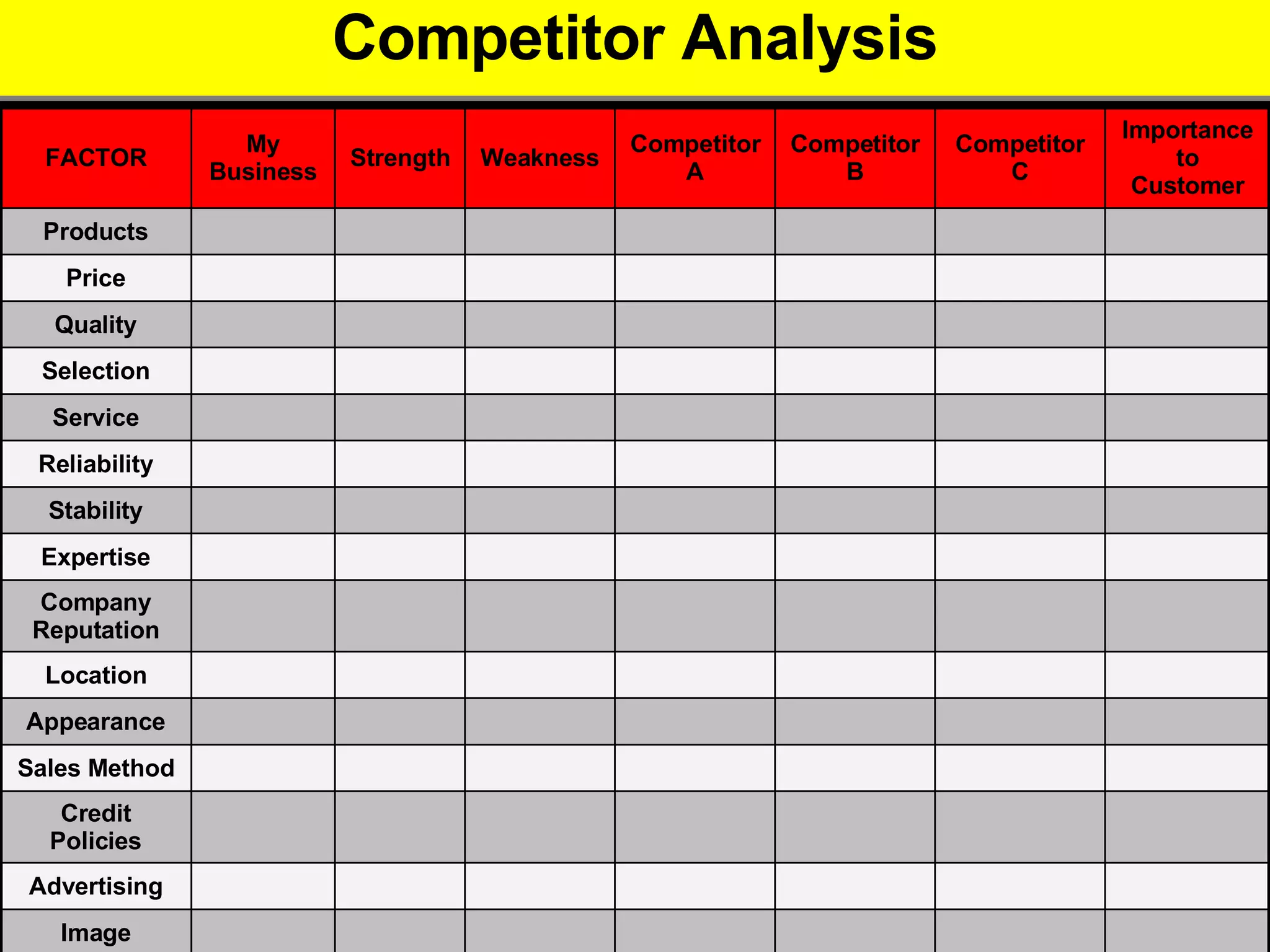
Competitor Analysis Image Advertising Credit Policies Sales Method Appearance Location Company Reputation Expertise Stability Reliability Service Selection Quality Price Products Importance to Customer Competitor C Competitor B Competitor A Weakness Strength My Business FACTOR
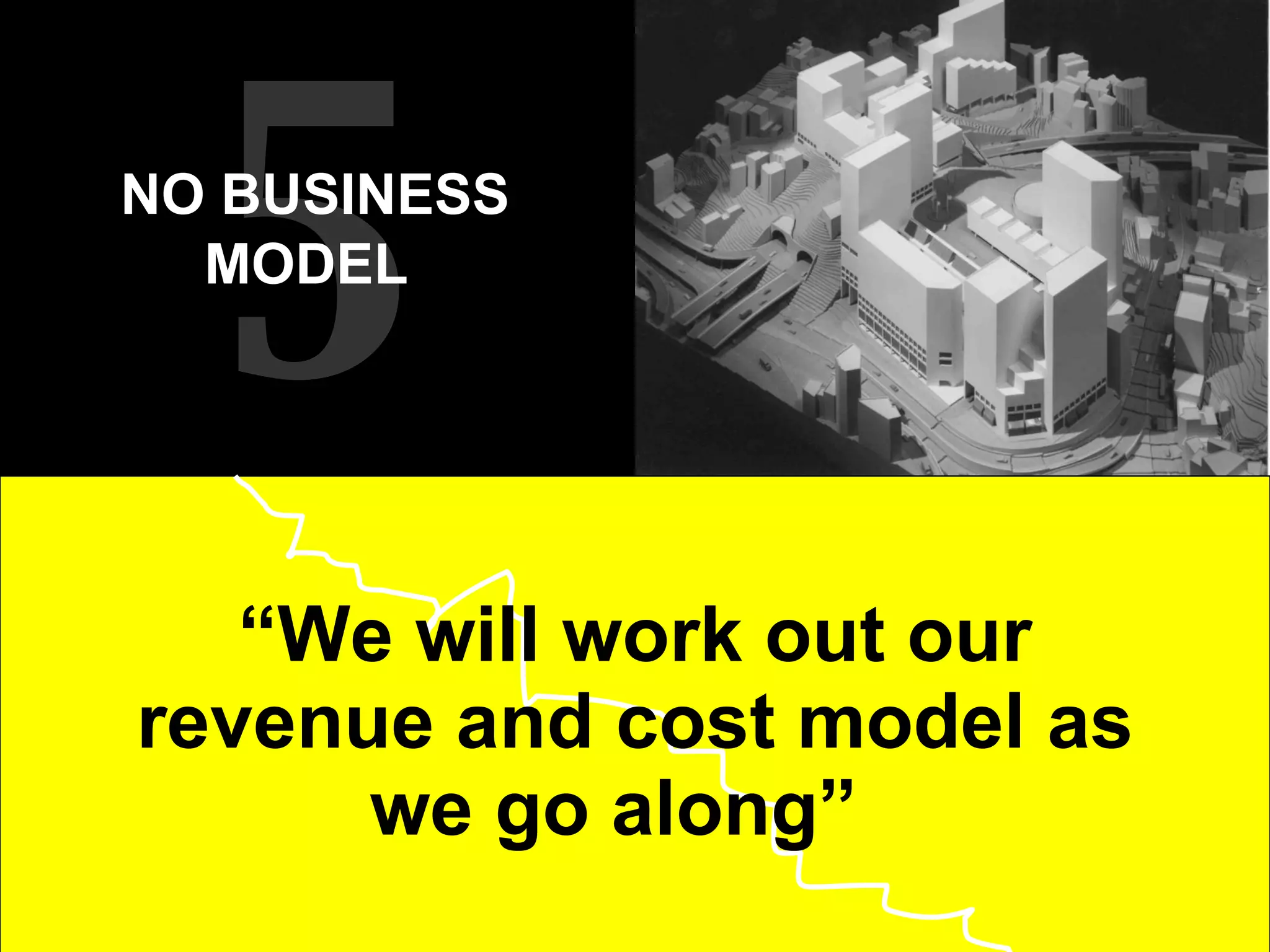
“ We will work out our revenue and cost model as we go along”  5 NO BUSINESS MODEL
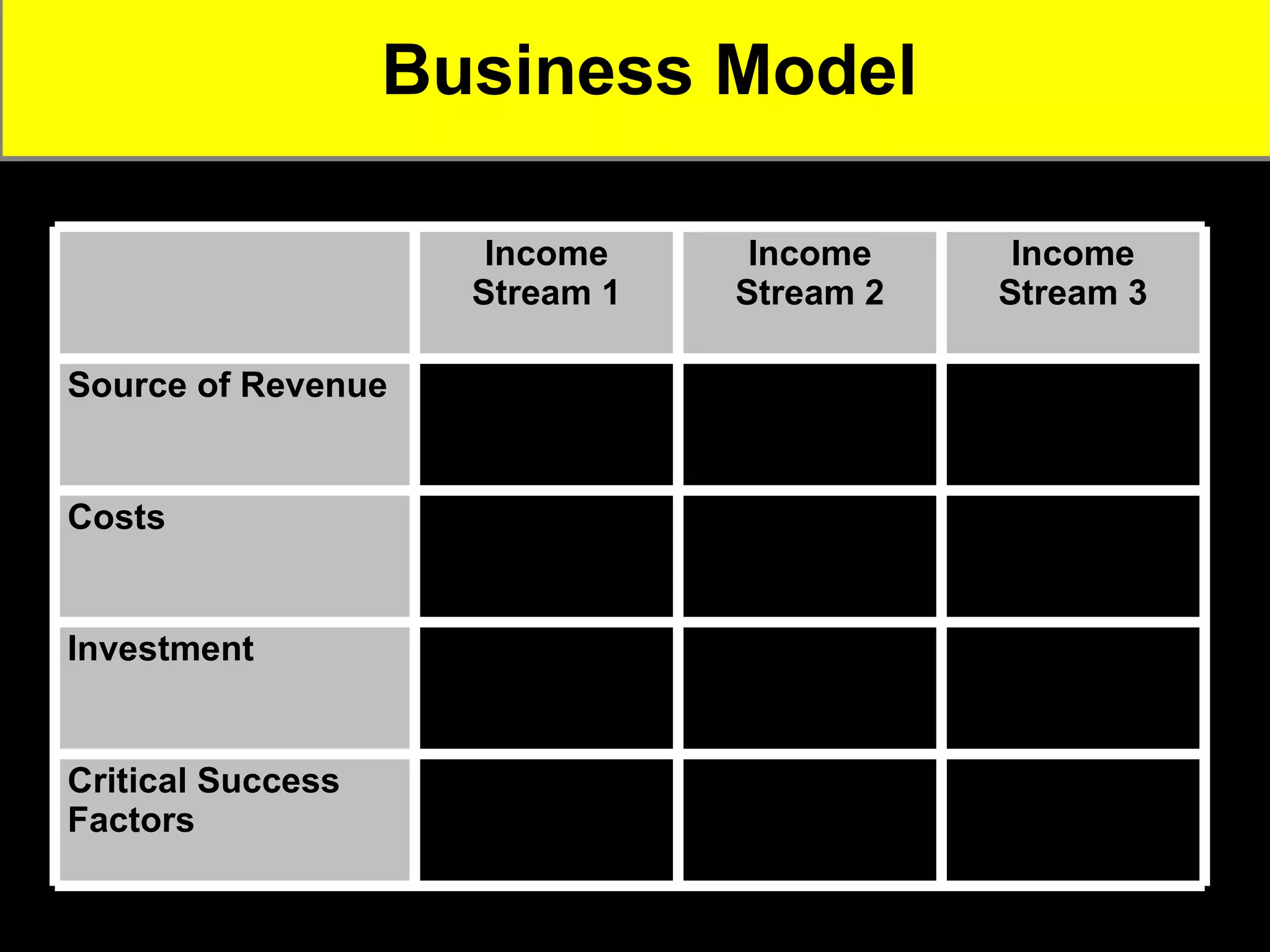
Business Model   Critical Success Factors Investment  Costs Source of Revenue Income Stream 3 Income Stream 2 Income Stream 1
Key questions for building a business model   What are the  sources of revenue  for the business?   Single or multiple revenue streams?  Payment terms – upfront, over a period of time or post delivery?  What are the  cost drivers  for the new business?   Major costs incurred to generate revenue?  Nature of costs – fixed, variable or semi-variable?  Payment terms – upfront, over a period of time or post delivery? What size  capital investment  is required to launch and sustain the business?  To sustain a positive cash balance?  To make profit?  What are the  critical success factors  for this business?   Identify the issues that will determine the success or failure of the business?
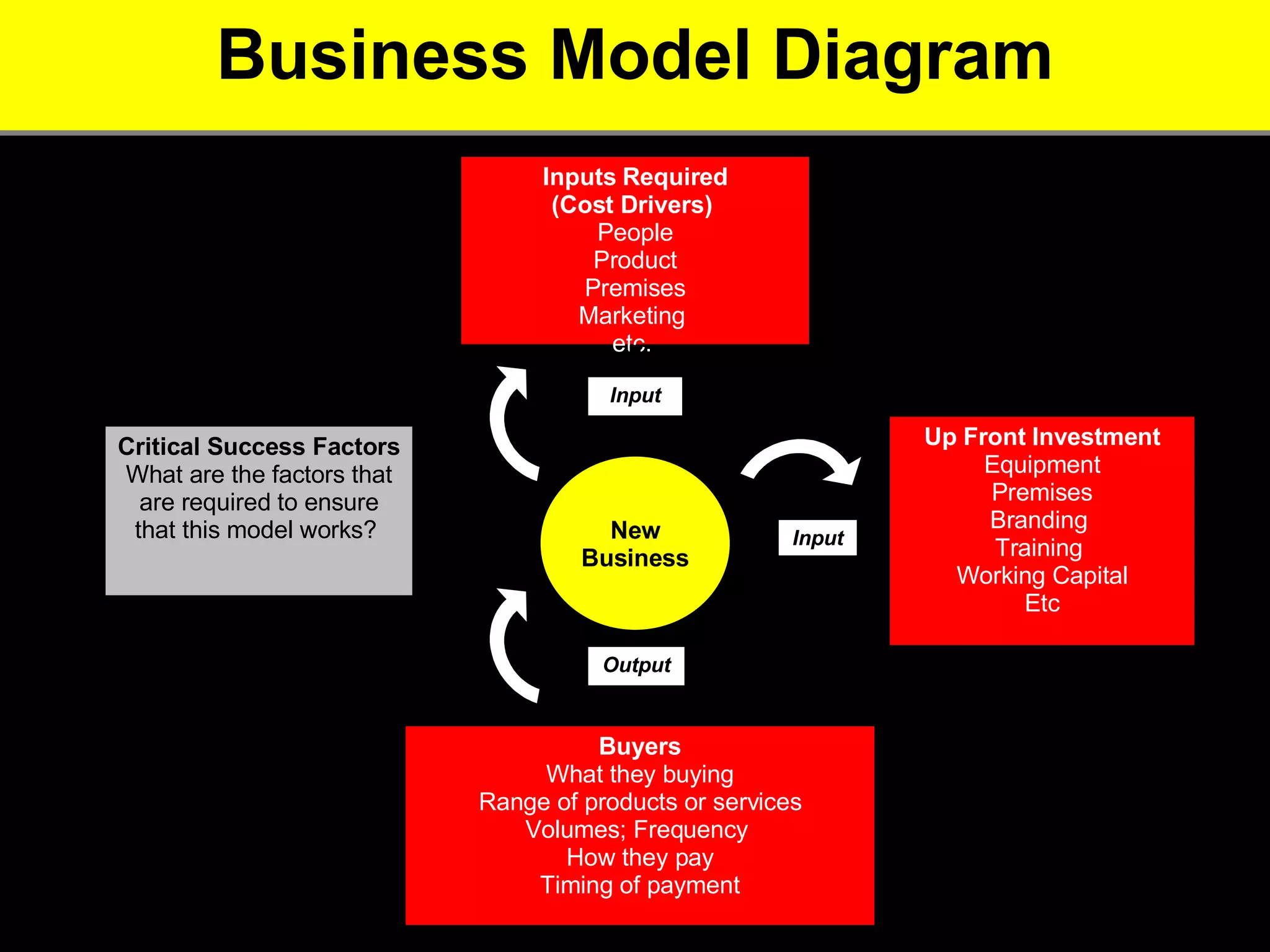
Business Model Diagram New Business Inputs Required (Cost Drivers)  People Product Premises Marketing  etc.  Buyers What they buying Range of products or services Volumes; Frequency  How they pay Timing of payment Up Front Investment Equipment Premises Branding  Training  Working Capital Etc Input Output Input $ $ $ Critical Success Factors What are the factors that are required to ensure that this model works?  Revenue  Costs  Investment
“ We are four CAs so all is okay”  6 NO BALANCE IN THE TEAM
0 Rands Revenue Investment Extremist Revolutionary Growth Entrepreneur Lifestyle  Entrepreneur Survivalist Breadline Time Types of Entrepreneurs
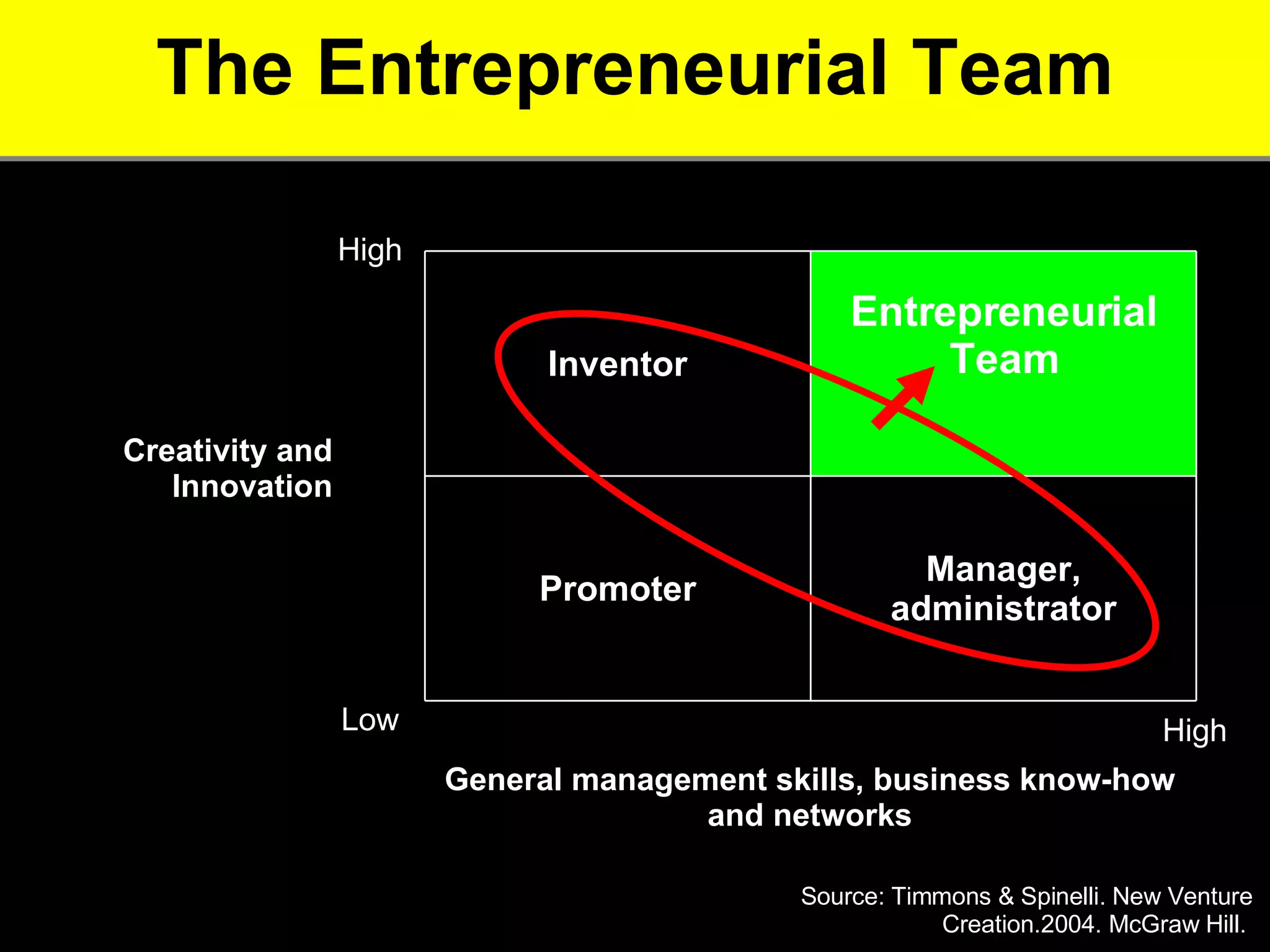
The Entrepreneurial Team Creativity and Innovation General management skills, business know-how and networks Low High High Source: Timmons & Spinelli. New Venture Creation.2004. McGraw Hill.  Manager, administrator Promoter Entrepreneurial Team Inventor
Quality of the team Entrepreneurial Attributes Commitment and Determination  Opportunity Obsession  Tolerance for Risk, Ambiguity and Uncertainty  Creativity, Self-Reliance and Ability to Adapt  Motivation to Excel  Leadership  Management Attributes Marketing Operations / Production  Finance  Administration  Interpersonal / Team  Law   Source: Timmons & Spinelli. New Venture Creation.2004. McGraw Hill.
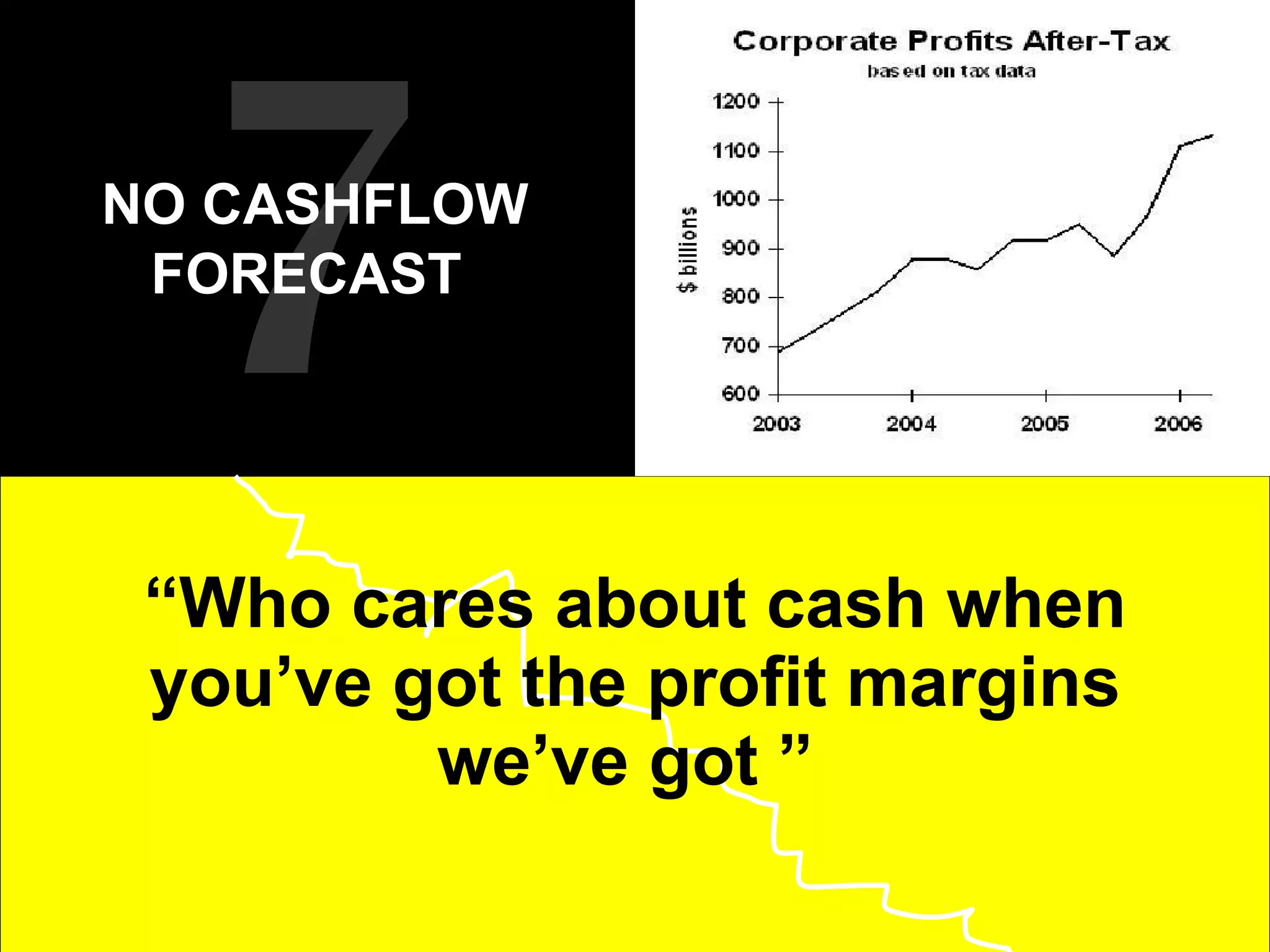
“ Who cares about cash when you’ve got the profit margins we’ve got ”  7 NO CASHFLOW FORECAST
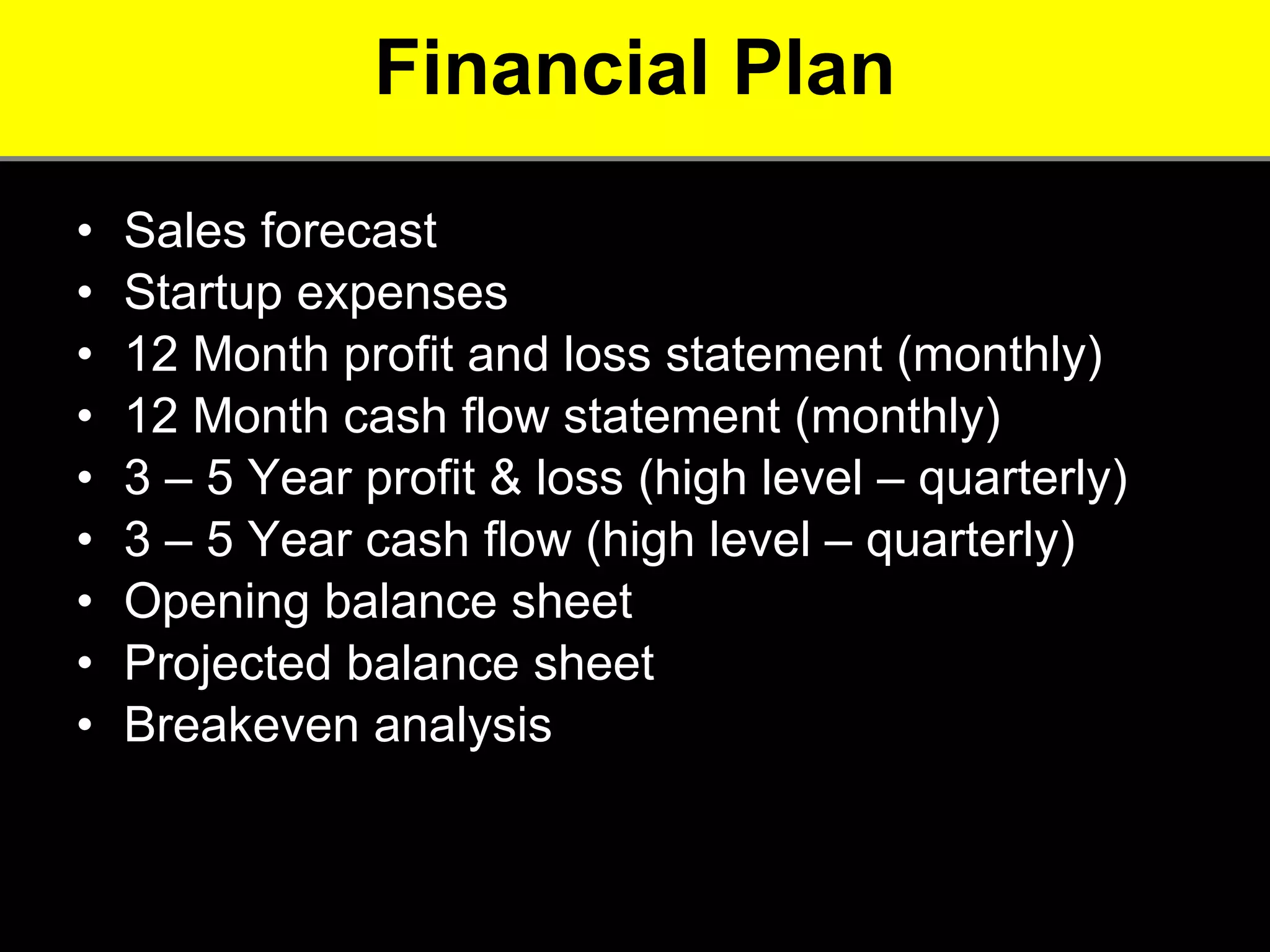
Financial Plan Sales forecast  Startup expenses 12 Month profit and loss statement (monthly)  12 Month cash flow statement (monthly)  3 – 5 Year profit & loss (high level – quarterly) 3 – 5 Year cash flow (high level – quarterly) Opening balance sheet Projected balance sheet  Breakeven analysis
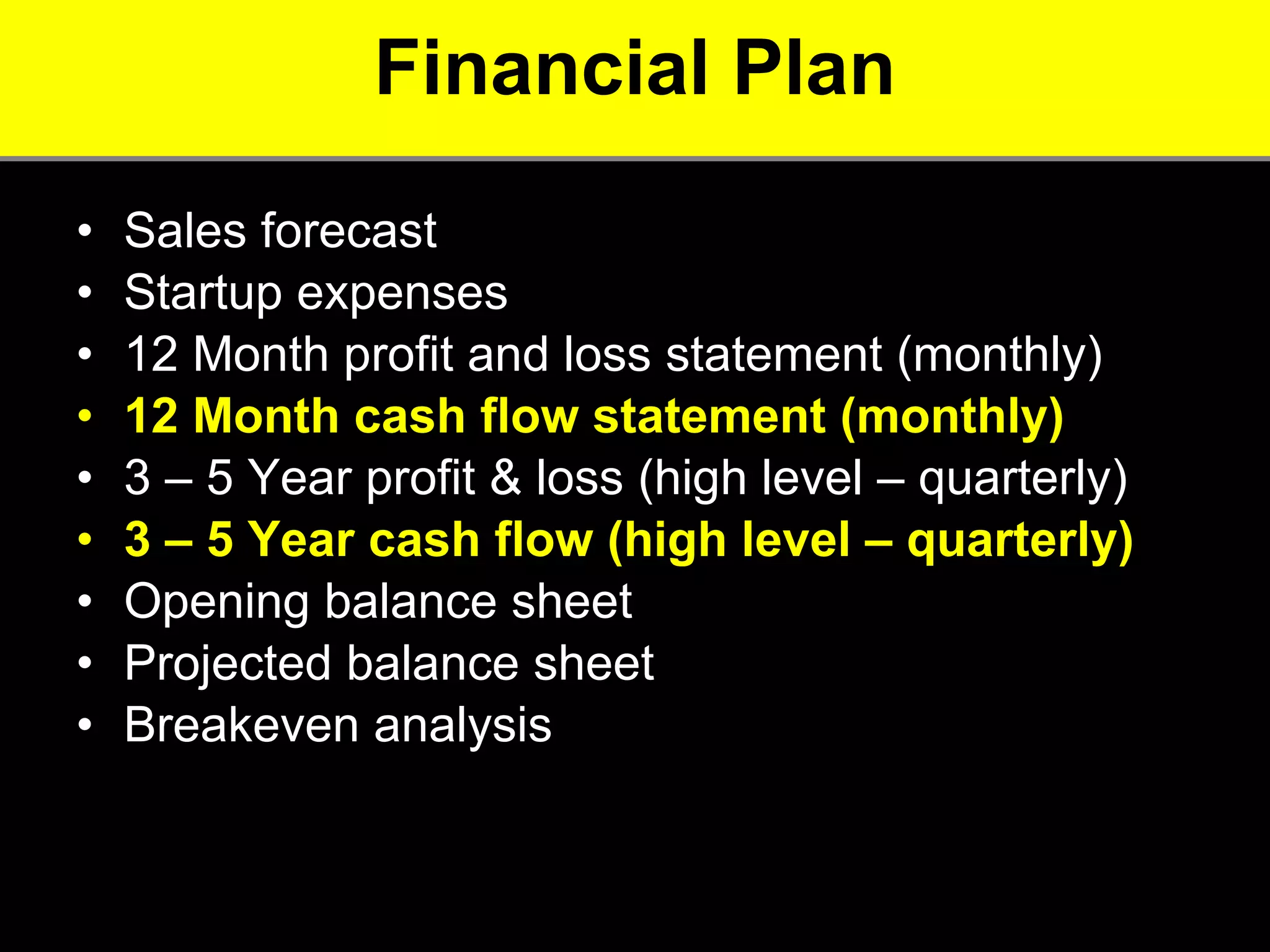
Financial Plan Sales forecast  Startup expenses 12 Month profit and loss statement (monthly)  12 Month cash flow statement (monthly)   3 – 5 Year profit & loss (high level – quarterly) 3 – 5 Year cash flow (high level – quarterly) Opening balance sheet Projected balance sheet  Breakeven analysis
Cash Flow Forecast (NB) =  _ _ + + M5 Budget =  _ _ + + M6 Budget … Units Sold =  =  =  =  =  Closing Cash Balance _ _ _ _ _ Variable Cash Outflows _ _ _ _ _ Fixed Cash Outflows + + + + + Cash Inflows + + + + + Opening Cash Balance Total Budget M12 Budget M4 Budget M3 Budget M2 Budget M1 Budget
Sales Forecast * State the assumptions on which these numbers are based c Cat 2 Units Sold* d Sales Price Per Unit* cxd=Y Category 2 TOTAL M5 Budget M6 Budget … Z + Y Monthly Total axb=Z Category 1 TOTAL b Sales Price Per Unit* a Cat 1 Units Sold* Total Budget M12 Budget M4 Budget M3 Budget M2 Budget M1 Budget
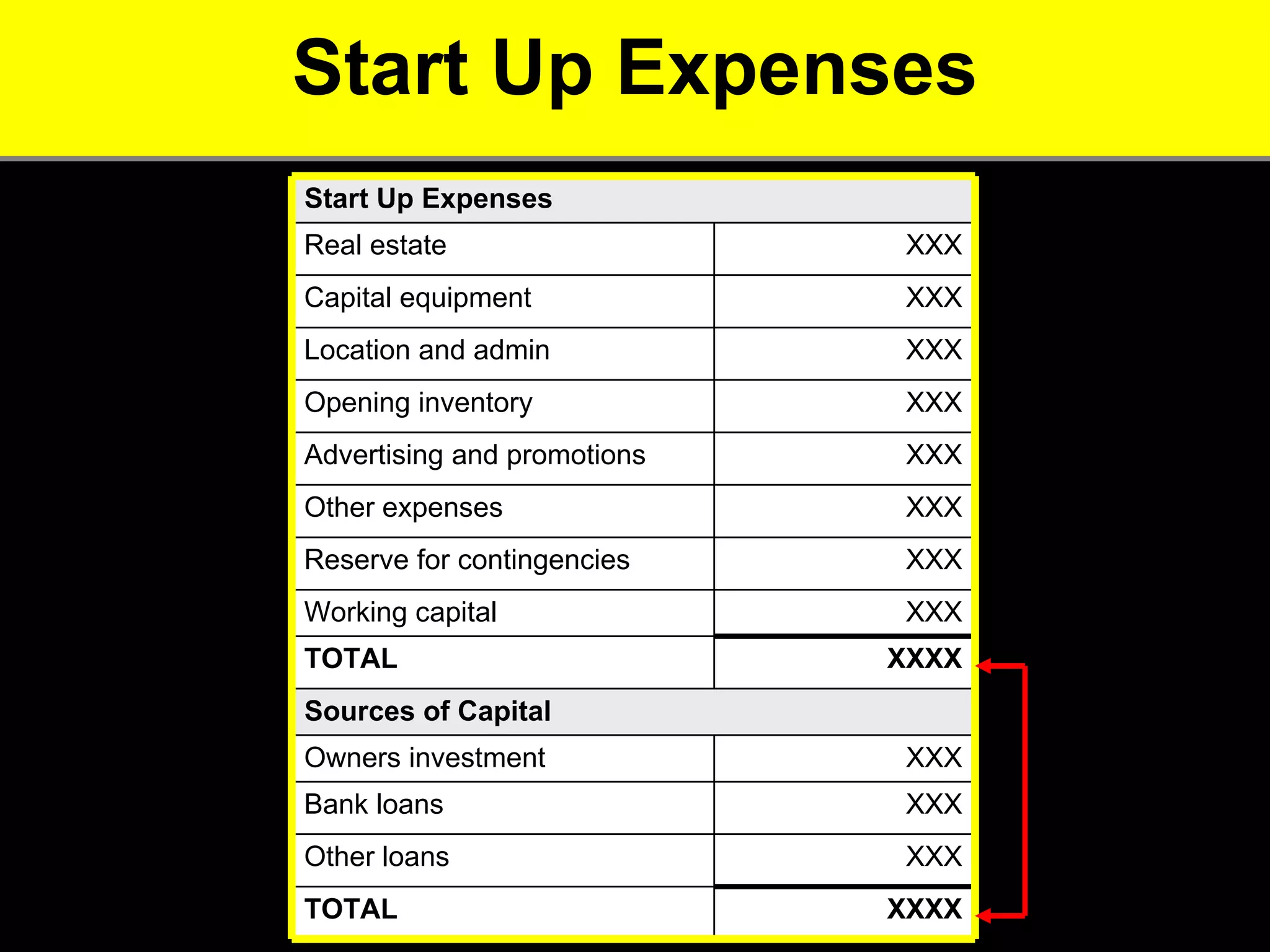
Start Up Expenses XXX Other loans XXX Working capital  XXX Reserve for contingencies XXXX TOTAL  XXX Other expenses  XXX Advertising and promotions  XXXX TOTAL XXX Bank loans XXX Owners investment  Sources of Capital   XXX Opening inventory  XXX Location and admin  XXX Capital equipment XXX Real estate Start Up Expenses
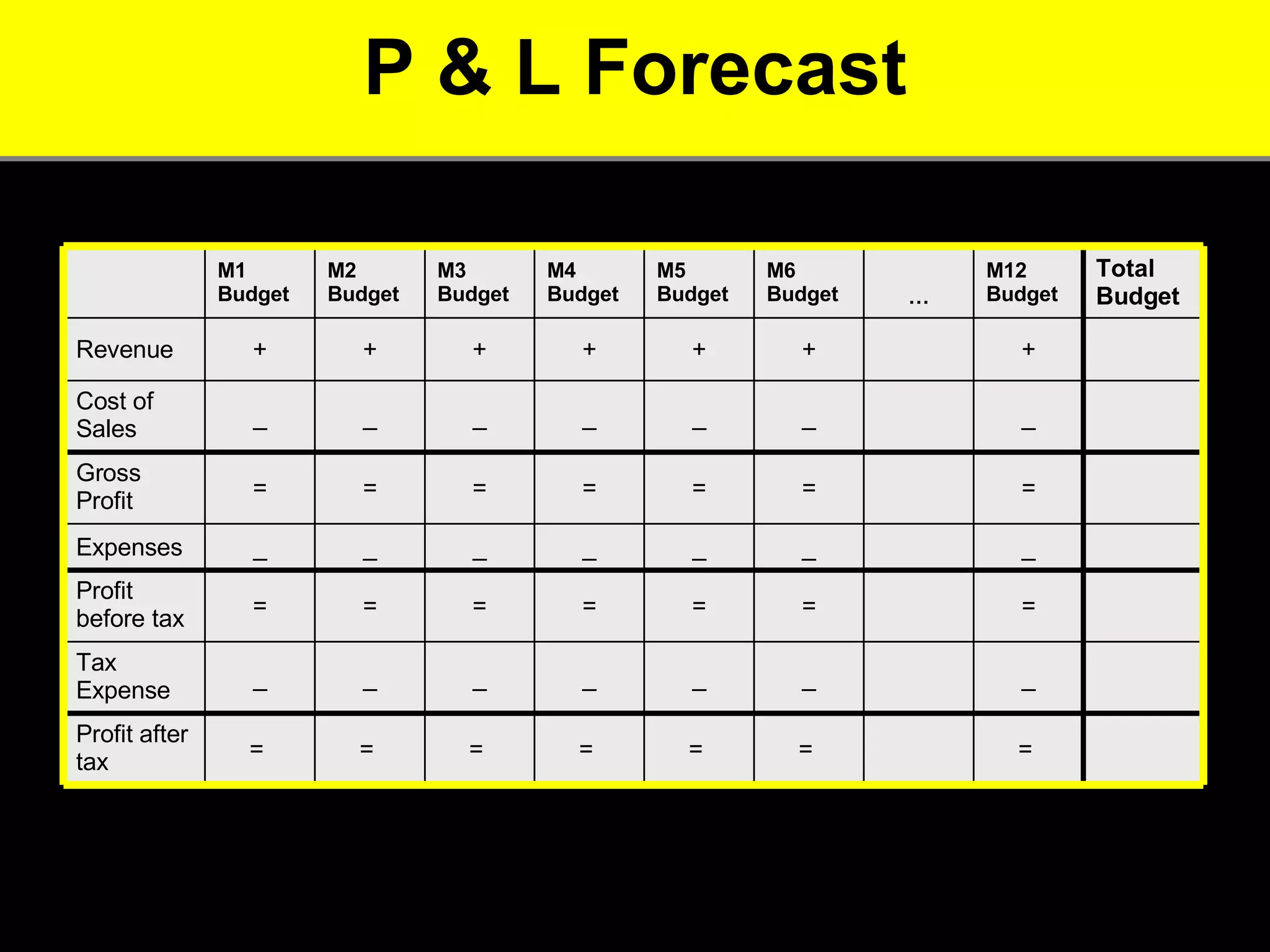
P & L Forecast _ _ _ _ _ _ _ Expenses = = = = = = = Profit before tax = = = = = = = Gross Profit _ _ _ _ _ _ _ Cost of Sales =  _ + M5 Budget =  _ + M6 Budget … =  =  =  =  =  Profit after tax _ _ _ _ _ Tax Expense + + + + + Revenue Total Budget M12 Budget M4 Budget M3 Budget M2 Budget M1 Budget
P & L Forecast EXAMPLES Salaries & wages  Other operating expenses  Interest payments  Depreciation  EXAMPLES Direct cost of goods sold _ _ _ _ _ _ _ Expenses = = = = = = = Profit before tax = = = = = = = Gross Profit _ _ _ _ _ _ _ Cost of Sales =  _ + M5 Budget =  _ + M6 Budget … =  =  =  =  =  Profit after tax _ _ _ _ _ Tax Expense + + + + + Revenue Total Budget M12 Budget M4 Budget M3 Budget M2 Budget M1 Budget
Cash Flow Forecast (NB) =  _ _ + + M5 Budget =  _ _ + + M6 Budget … Units Sold =  =  =  =  =  Closing Cash Balance _ _ _ _ _ Variable Cash Outflows _ _ _ _ _ Fixed Cash Outflows + + + + + Cash Inflows + + + + + Opening Cash Balance Total Budget M12 Budget M4 Budget M3 Budget M2 Budget M1 Budget
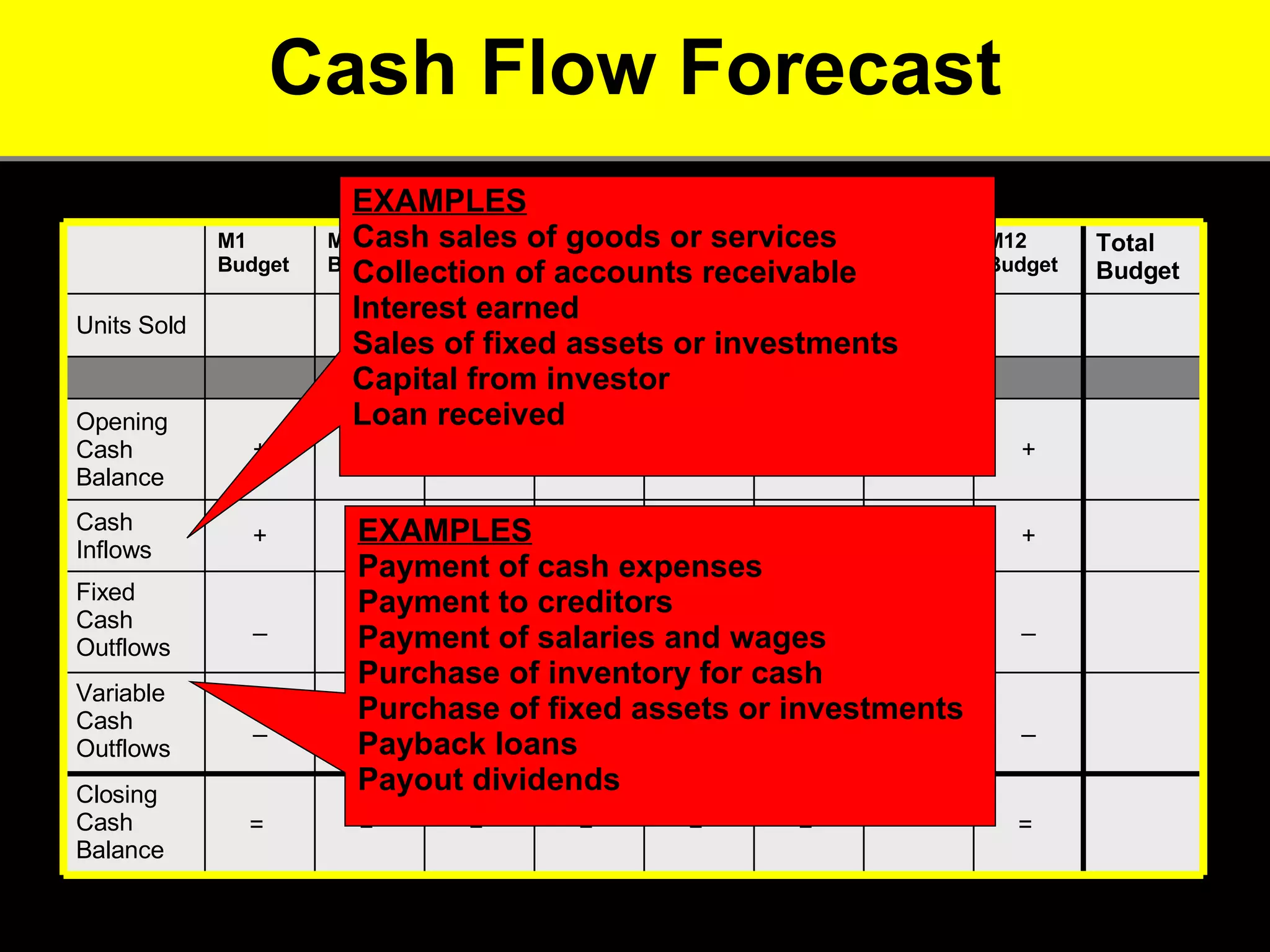
Cash Flow Forecast EXAMPLES Cash sales of goods or services Collection of accounts receivable Interest earned Sales of fixed assets or investments Capital from investor Loan received EXAMPLES Payment of cash expenses Payment to creditors Payment of salaries and wages Purchase of inventory for cash Purchase of fixed assets or investments Payback loans Payout dividends =  _ _ + + M5 Budget =  _ _ + + M6 Budget … Units Sold =  =  =  =  =  Closing Cash Balance _ _ _ _ _ Variable Cash Outflows _ _ _ _ _ Fixed Cash Outflows + + + + + Cash Inflows + + + + + Opening Cash Balance Total Budget M12 Budget M4 Budget M3 Budget M2 Budget M1 Budget
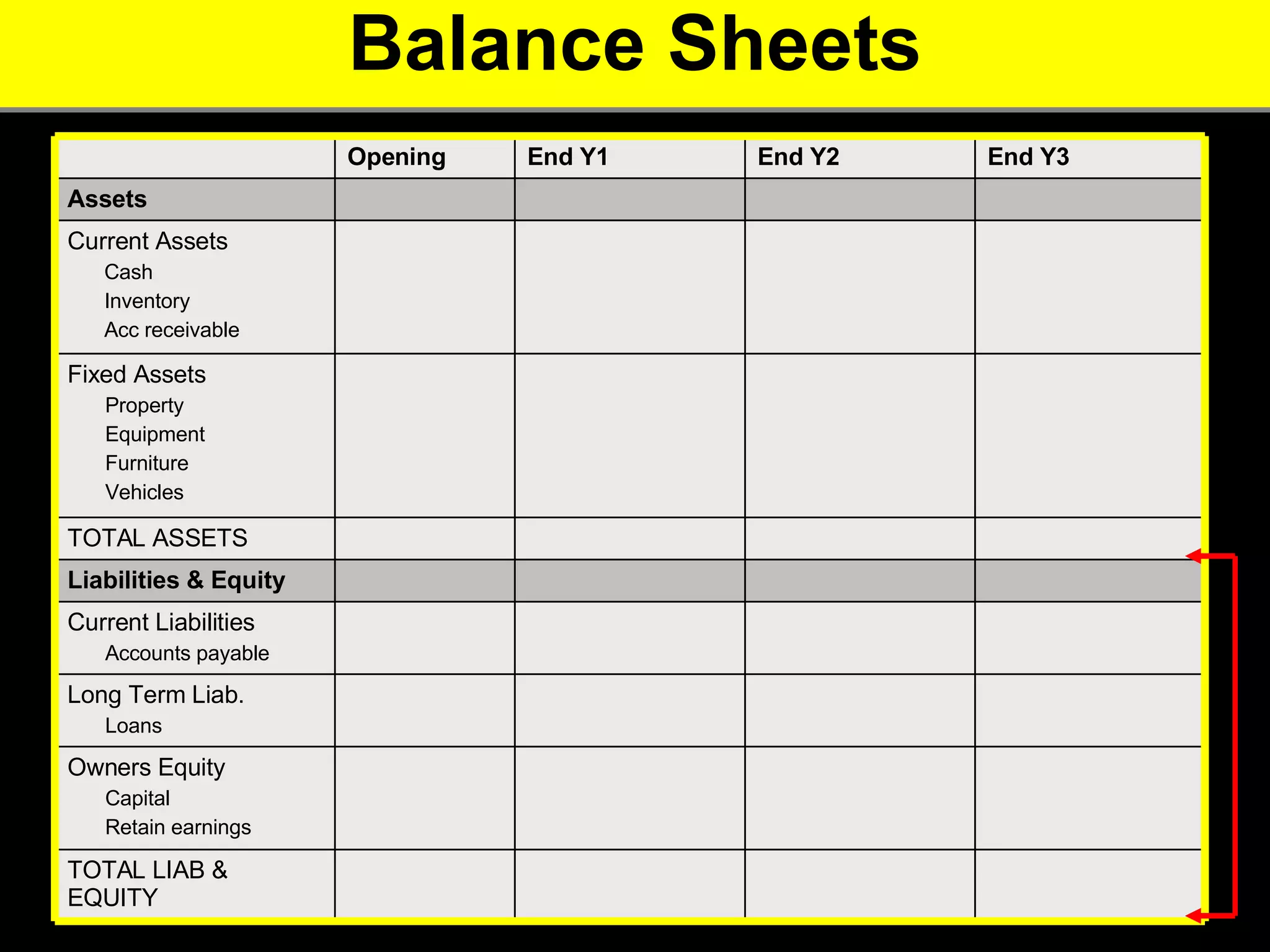
Balance Sheets Owners Equity  Capital  Retain earnings End Y2 TOTAL LIAB & EQUITY  Long Term Liab.  Loans  Current Liabilities  Accounts payable  Liabilities & Equity   TOTAL ASSETS Fixed Assets  Property  Equipment  Furniture Vehicles Current Assets  Cash  Inventory  Acc receivable Assets End Y3 End Y1  Opening
Balance Sheets Goods or resources owned by the business to be transformed utilized / realized in 1 year  Goods or resources owned by the business that have a life span exceeding 1 year  Amounts owed by the business to be paid back within 12 months Amounts owed by the business to be paid back after 12 months Portion of the business attributable to the owners Total amount OWNED by the business  Total amount OWED by the business to lenders or owners  Owners Equity  Capital  Retain earnings End Y2 TOTAL LIAB & EQUITY  Long Term Liab.  Loans  Current Liabilities  Accounts payable  Liabilities & Equity   TOTAL ASSETS Fixed Assets  Property  Equipment  Furniture Vehicles Current Assets  Cash  Inventory  Acc receivable Assets End Y3 End Y1  Opening
“ We need R10m in venture capital and then we will get going”  8 NO MOMENTUM UNTIL CAPITAL IS RAISED
New venture financing and the equity gap Stage Source Demand Supply Pre-seed Seed / Start-Up Early Later Founders  Family Friends Angels /  Angel Alliances Venture  Funds Private  Equity 100k 500k R5-10 mil R20 mil Government Funds Equity Gap Adapted from a model proposed designed by Jeffery E Sohl – Center for Venture Research, University of New Hampshire
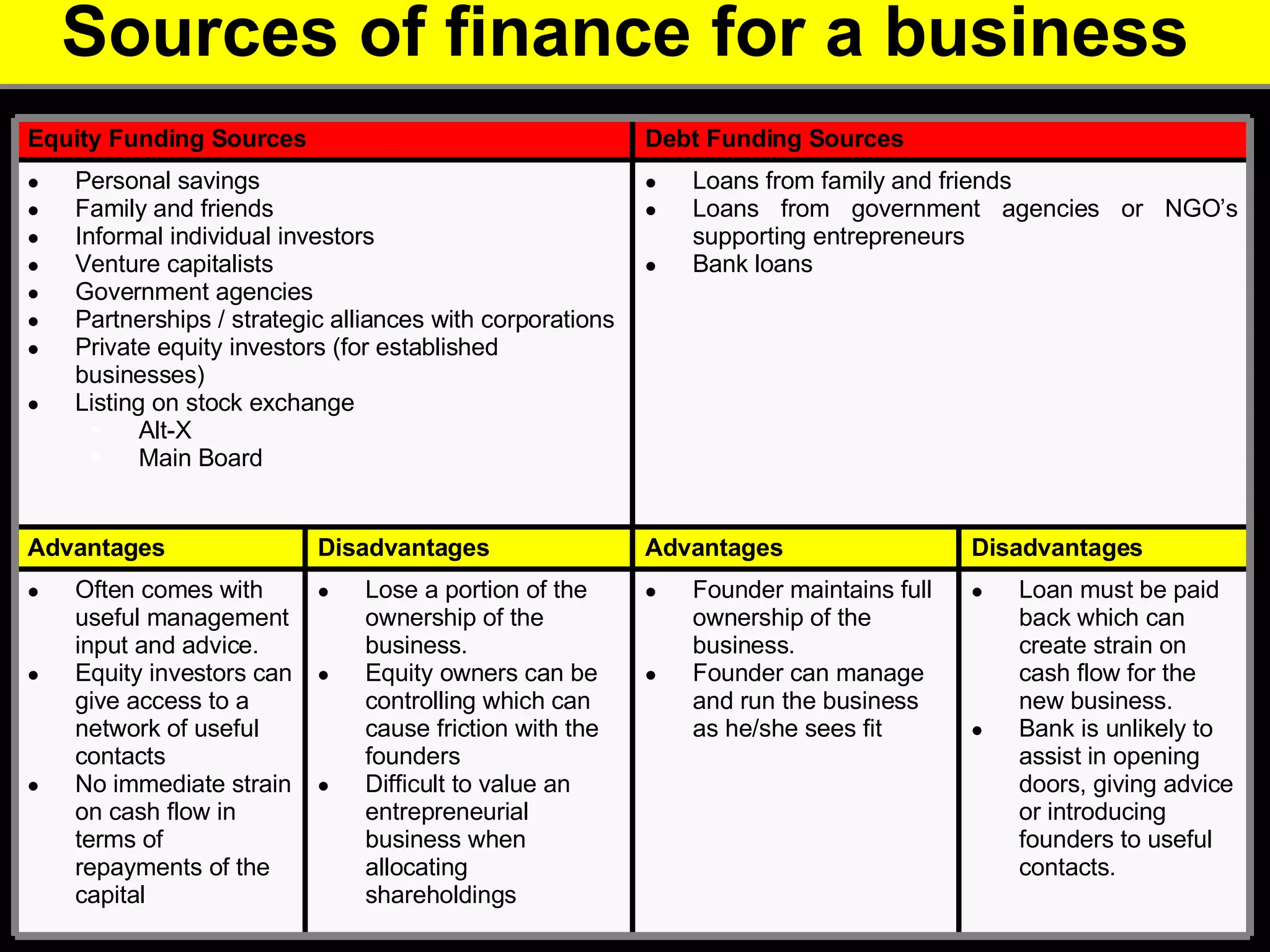
Sources of finance for a business  Loan must be paid back which can create strain on cash flow for the new business.  Bank is unlikely to assist in opening doors, giving advice or introducing founders to useful contacts.  Founder maintains full ownership of the business.  Founder can manage and run the business as he/she sees fit Lose a portion of the ownership of the business.  Equity owners can be controlling which can cause friction with the founders Difficult to value an entrepreneurial business when allocating shareholdings Often comes with useful management input and advice.  Equity investors can give access to a network of useful contacts No immediate strain on cash flow in terms of repayments of the capital Disadvantages Advantages Disadvantages Advantages Loans from family and friends Loans from government agencies or NGO’s supporting entrepreneurs Bank loans Personal savings  Family and friends  Informal individual investors Venture capitalists Government agencies Partnerships / strategic alliances with corporations Private equity investors (for established businesses)  Listing on stock exchange Alt-X Main Board Debt Funding Sources Equity Funding Sources
The Art of Bootstrapping Focus on cash flow, not profitability Forecast from the bottom up   Ship, then test   Forget the “proven” team   Start as a service business   Focus on function, not form   Pick your battles   Understaff  Go direct Position against the leader   Take the “red pill.” Source: Kawasaki, G. The Art of the Start. 2004. Portfolio.
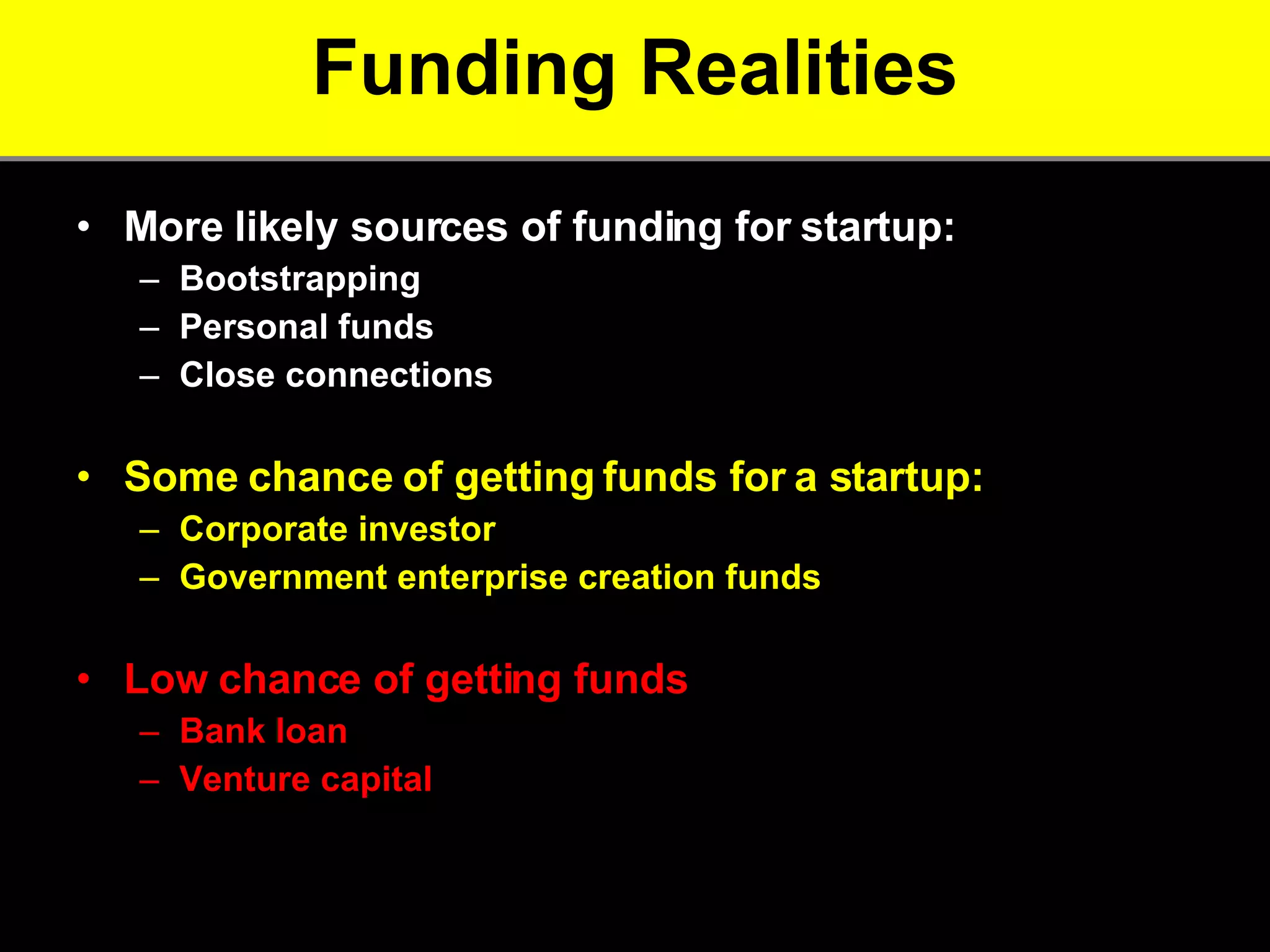
Funding Realities More likely sources of funding for startup:  Bootstrapping  Personal funds  Close connections  Some chance of getting funds for a startup: Corporate investor  Government enterprise creation funds   Low chance of getting funds  Bank loan  Venture capital
“ We have hired offices in Sandton, acquired Hummer’s for the directors and will pay the most to get the best”  9 NO FRUGALITY
BUDGETING MONITORING REPORTING Budget for  CASH FLOW Build your  OWN  models Its not just about  HOW MUCH  but also about  WHEN .  Know the  NATURE  of different cash flows  SHORT TERM =  DETAIL ; long term = big picture Your  BANK BALANCE  is your truth Know your  BASELINE  (breakeven)  Keep  UP TO DATE Balance off being overly  PEDANTIC  versus dangerously  LACKADAISICAL 10.Report results with  PURPOSE Entrepreneurial Financial Management
“ Our marketing plan will be a combination of print, TV and internet advertising”  10 MISGUIDED MARKETING PLAN
Simple Marketing Plan  List price  Discounts  Allowances  Payment period  Credit terms What does it cost us to produce the good or service?  What are the competition charging for similar goods or services?  Why are we charging more or less than the competition?  How would revenue and profits be affected if we increased or decreased the price?  You need to find a balance between attracting customers and making profits.  Price  Product variety Quality  Design  Features Packaging  Services  Warranties Returns  Does it meet a specific need? What is that need?  Must we customize our product or service?  Do we deliver the appropriate quality for the customer?  Good marketing begins with a good product or service.  Product  Considerations Key questions to be answered by the entrepreneur Description of the component Marketing mix component
Simple Marketing Plan Advertising  Sales force Public relations  Direct marketing How will we make customers aware of the benefits of buying our product or service?  Promotion is about communicating the merits of the product or service to target customers and persuading them to buy.  Promotion Channels  Coverage Transport Are we going to sell locally, regionally, nationally or globally?  How will we reach the customer?  Do we need more than one channel for reaching the customer?  Should we create our own distribution channel or partner with an established distributor?  This is about getting the product or service to the customer. Customers will only buy products or services that they have access to, thus it is critical to have distribution channels that reach the customer.  Place  Considerations Key questions to be answered by the entrepreneur Description of the component Marketing mix component
New Venture Creation Model  OPPORTUNITY Demand Passion Skills Resources STRUCUTRE Business Model Legal Form Tools / Facilities Team FUNDING Traditional financing Bootstrapping  Cash flow  SALES Product  Price  Promotion  Place  Word of mouth Growth Research BUSINESS PLAN
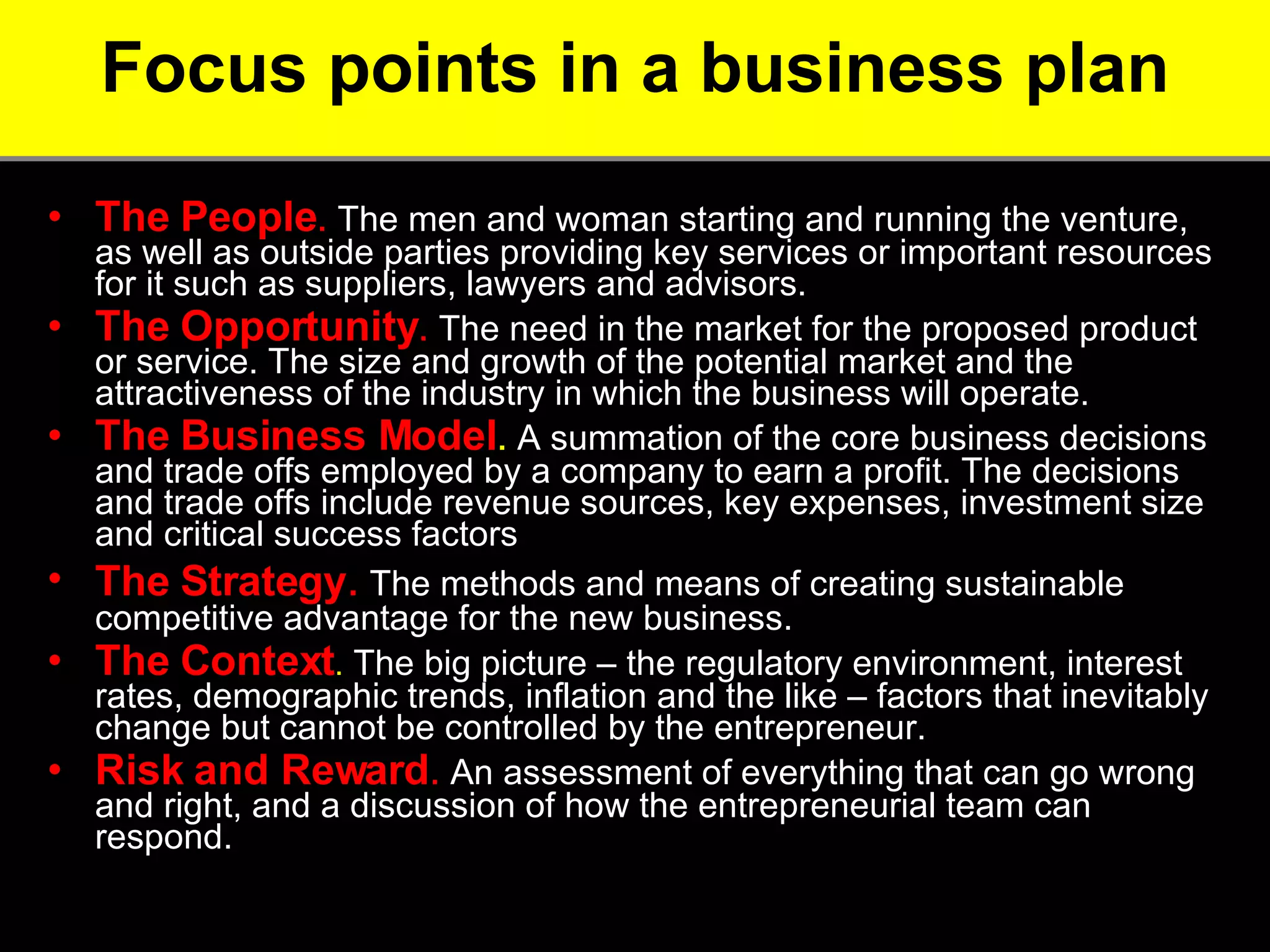
Focus points in a business plan The People .  The men and woman starting and running the venture, as well as outside parties providing key services or important resources for it such as suppliers, lawyers and advisors.  The Opportunity .  The need in the market for the proposed product or service. The size and growth of the potential market and the attractiveness of the industry in which the business will operate.  The Business Model .  A summation of the core business decisions and trade offs employed by a company to earn a profit. The decisions and trade offs include revenue sources, key expenses, investment size and critical success factors The Strategy .  The methods and means of creating sustainable competitive advantage for the new business.  The Context .  The big picture – the regulatory environment, interest rates, demographic trends, inflation and the like – factors that inevitably change but cannot be controlled by the entrepreneur.  Risk and Reward .  An assessment of everything that can go wrong and right, and a discussion of how the entrepreneurial team can respond.
Go out and do it… Business In A Box www.biz-box.net Email – Slides   [email_address] Blog  –  Slides [email_address]

Bad To Worse

  • 1.
    BAD TO WORSE Why Some Start-ups Go Down the Tubes … and Others Don't GREG FISHER #1 BESTSELLER
  • 2.
  • 3.
    Top 10 Mistakes of Entrepreneurs
  • 4.
    “ I don’tcare about the product, I just want to make loads of money” 1 NO REAL PASSION FOR THE BUSINESS
  • 5.
    Linking Market Demandwith passion, skills and resources to create an entrepreneurial opportunity Market Demand Passion Skills Resources
  • 6.
    The Key Elementsin Creating an Entrepreneurial Opportunity Opportunity Market Demand Passion Skills Resources Entrepreneur
  • 7.
    Key questions tosourcing the right opportunity What do people need? Who will buy it? Why do they want it? How can I reach them? What am I (are we) deeply passionate about? How can I leverage my (our) unique skills ? Where can I (we) get the resources to make it happen?
  • 8.
    “ We wantone so everyone will want one ” 2 NO UNDERSTANDING OF THE MARKET
  • 9.
    Researching an IdeaConsider different revenue models: Evaluate the costs and the costs drivers. Distinguish between fixed, variable and semi variable costs. Consider the source of costs: Do cash flow projections Speak to industry experts Revenue Cost drivers Investment Critical success factors The Company Model Visit suppliers Discuss funding options with other entrepreneurs Discuss funding options with the banks Obtain and read the national venture capital association handbook Search the web Suppliers Funders Partners Collaborators Become a customer of the competition. Visit competitor websites, stores and read their promotional material. Interview competitors customers Number of competitors Product or service offerings of competitors Where the competitors are situated. The strengths and weaknesses of competitors Competitors Trade journals, market reports and industry associations. Interviewing experts in the industry. Interviewing, observing or surveying potential customers. Market size. Growth The needs pf customers The buying decision of customers Customers How can one gather the information? What needs to be researched?
  • 10.
    “ We aregoing to be just like Amazon.com, only better” 3 NO DIFFERENTIATION
  • 11.
    Assessing an Opportunity[VENTURE] Concept Attractiveness Competitive Advantage [ENTREPRENERIAL TEAM] Low Low High High Market Size Market Growth Differentiation Customer Need Skills Resources Passion / Energy Network 1 2 3 4 5 6 7 8 9 10 10 9 8 7 6 5 4 3 2 1
  • 12.
    Response [VENTURE] ConceptAttractiveness Competitive Advantage [ENTREPRENERIAL TEAM] Low Low High High Avoid / Wait & Reassess in Future Build / hire / develop the required capabilities Identify / exploit a specific under served niche Revise product or business model Invest and pursue the opportunity 1 2 3 4 5 6 7 8 9 10 10 9 8 7 6 5 4 3 2 1
  • 13.
    Strategy Formulation QuestionsWhat are the threats for the business? What are the opportunities for the business? What are our weaknesses? What are our strengths? Current status Where are we at? Who is responsible? What needs to happen in the next 30 days? What are our 1 year goals? What are our 3 year goals? Goals, Action & Priorities What must we do and how will we make it happen? How do we behave? What is not negotiable? What turns us on? What assumptions guide us? Organis-ational Character What is our organizational character? How will we evolve as a business? What makes us different? What is our value proposition? What is our org sustainability model? Business Recipe How do we create value ? Why do we matter? What value do we deliver? Whom do we serve? What are our personal objectives Purpose Why do we exist?
  • 14.
    “ We areso unique that we have no competition in the market” 4 NO COMPETITORS
  • 15.
  • 16.
    Be REAL aboutyour competition
  • 17.
    Competitor Analysis ImageAdvertising Credit Policies Sales Method Appearance Location Company Reputation Expertise Stability Reliability Service Selection Quality Price Products Importance to Customer Competitor C Competitor B Competitor A Weakness Strength My Business FACTOR
  • 18.
    “ We willwork out our revenue and cost model as we go along” 5 NO BUSINESS MODEL
  • 19.
    Business Model Critical Success Factors Investment Costs Source of Revenue Income Stream 3 Income Stream 2 Income Stream 1
  • 20.
    Key questions forbuilding a business model What are the sources of revenue for the business? Single or multiple revenue streams? Payment terms – upfront, over a period of time or post delivery? What are the cost drivers for the new business? Major costs incurred to generate revenue? Nature of costs – fixed, variable or semi-variable? Payment terms – upfront, over a period of time or post delivery? What size capital investment is required to launch and sustain the business? To sustain a positive cash balance? To make profit? What are the critical success factors for this business? Identify the issues that will determine the success or failure of the business?
  • 21.
    Business Model DiagramNew Business Inputs Required (Cost Drivers) People Product Premises Marketing etc. Buyers What they buying Range of products or services Volumes; Frequency How they pay Timing of payment Up Front Investment Equipment Premises Branding Training Working Capital Etc Input Output Input $ $ $ Critical Success Factors What are the factors that are required to ensure that this model works? Revenue Costs Investment
  • 22.
    “ We arefour CAs so all is okay” 6 NO BALANCE IN THE TEAM
  • 23.
    0 Rands RevenueInvestment Extremist Revolutionary Growth Entrepreneur Lifestyle Entrepreneur Survivalist Breadline Time Types of Entrepreneurs
  • 24.
    The Entrepreneurial TeamCreativity and Innovation General management skills, business know-how and networks Low High High Source: Timmons & Spinelli. New Venture Creation.2004. McGraw Hill. Manager, administrator Promoter Entrepreneurial Team Inventor
  • 25.
    Quality of theteam Entrepreneurial Attributes Commitment and Determination Opportunity Obsession Tolerance for Risk, Ambiguity and Uncertainty Creativity, Self-Reliance and Ability to Adapt Motivation to Excel Leadership Management Attributes Marketing Operations / Production Finance Administration Interpersonal / Team Law Source: Timmons & Spinelli. New Venture Creation.2004. McGraw Hill.
  • 26.
    “ Who caresabout cash when you’ve got the profit margins we’ve got ” 7 NO CASHFLOW FORECAST
  • 27.
    Financial Plan Salesforecast Startup expenses 12 Month profit and loss statement (monthly) 12 Month cash flow statement (monthly) 3 – 5 Year profit & loss (high level – quarterly) 3 – 5 Year cash flow (high level – quarterly) Opening balance sheet Projected balance sheet Breakeven analysis
  • 28.
    Financial Plan Salesforecast Startup expenses 12 Month profit and loss statement (monthly) 12 Month cash flow statement (monthly) 3 – 5 Year profit & loss (high level – quarterly) 3 – 5 Year cash flow (high level – quarterly) Opening balance sheet Projected balance sheet Breakeven analysis
  • 29.
    Cash Flow Forecast(NB) = _ _ + + M5 Budget = _ _ + + M6 Budget … Units Sold = = = = = Closing Cash Balance _ _ _ _ _ Variable Cash Outflows _ _ _ _ _ Fixed Cash Outflows + + + + + Cash Inflows + + + + + Opening Cash Balance Total Budget M12 Budget M4 Budget M3 Budget M2 Budget M1 Budget
  • 30.
    Sales Forecast *State the assumptions on which these numbers are based c Cat 2 Units Sold* d Sales Price Per Unit* cxd=Y Category 2 TOTAL M5 Budget M6 Budget … Z + Y Monthly Total axb=Z Category 1 TOTAL b Sales Price Per Unit* a Cat 1 Units Sold* Total Budget M12 Budget M4 Budget M3 Budget M2 Budget M1 Budget
  • 31.
    Start Up ExpensesXXX Other loans XXX Working capital XXX Reserve for contingencies XXXX TOTAL XXX Other expenses XXX Advertising and promotions XXXX TOTAL XXX Bank loans XXX Owners investment Sources of Capital XXX Opening inventory XXX Location and admin XXX Capital equipment XXX Real estate Start Up Expenses
  • 32.
    P & LForecast _ _ _ _ _ _ _ Expenses = = = = = = = Profit before tax = = = = = = = Gross Profit _ _ _ _ _ _ _ Cost of Sales = _ + M5 Budget = _ + M6 Budget … = = = = = Profit after tax _ _ _ _ _ Tax Expense + + + + + Revenue Total Budget M12 Budget M4 Budget M3 Budget M2 Budget M1 Budget
  • 33.
    P & LForecast EXAMPLES Salaries & wages Other operating expenses Interest payments Depreciation EXAMPLES Direct cost of goods sold _ _ _ _ _ _ _ Expenses = = = = = = = Profit before tax = = = = = = = Gross Profit _ _ _ _ _ _ _ Cost of Sales = _ + M5 Budget = _ + M6 Budget … = = = = = Profit after tax _ _ _ _ _ Tax Expense + + + + + Revenue Total Budget M12 Budget M4 Budget M3 Budget M2 Budget M1 Budget
  • 34.
    Cash Flow Forecast(NB) = _ _ + + M5 Budget = _ _ + + M6 Budget … Units Sold = = = = = Closing Cash Balance _ _ _ _ _ Variable Cash Outflows _ _ _ _ _ Fixed Cash Outflows + + + + + Cash Inflows + + + + + Opening Cash Balance Total Budget M12 Budget M4 Budget M3 Budget M2 Budget M1 Budget
  • 35.
    Cash Flow ForecastEXAMPLES Cash sales of goods or services Collection of accounts receivable Interest earned Sales of fixed assets or investments Capital from investor Loan received EXAMPLES Payment of cash expenses Payment to creditors Payment of salaries and wages Purchase of inventory for cash Purchase of fixed assets or investments Payback loans Payout dividends = _ _ + + M5 Budget = _ _ + + M6 Budget … Units Sold = = = = = Closing Cash Balance _ _ _ _ _ Variable Cash Outflows _ _ _ _ _ Fixed Cash Outflows + + + + + Cash Inflows + + + + + Opening Cash Balance Total Budget M12 Budget M4 Budget M3 Budget M2 Budget M1 Budget
  • 36.
    Balance Sheets OwnersEquity Capital Retain earnings End Y2 TOTAL LIAB & EQUITY Long Term Liab. Loans Current Liabilities Accounts payable Liabilities & Equity TOTAL ASSETS Fixed Assets Property Equipment Furniture Vehicles Current Assets Cash Inventory Acc receivable Assets End Y3 End Y1 Opening
  • 37.
    Balance Sheets Goodsor resources owned by the business to be transformed utilized / realized in 1 year Goods or resources owned by the business that have a life span exceeding 1 year Amounts owed by the business to be paid back within 12 months Amounts owed by the business to be paid back after 12 months Portion of the business attributable to the owners Total amount OWNED by the business Total amount OWED by the business to lenders or owners Owners Equity Capital Retain earnings End Y2 TOTAL LIAB & EQUITY Long Term Liab. Loans Current Liabilities Accounts payable Liabilities & Equity TOTAL ASSETS Fixed Assets Property Equipment Furniture Vehicles Current Assets Cash Inventory Acc receivable Assets End Y3 End Y1 Opening
  • 38.
    “ We needR10m in venture capital and then we will get going” 8 NO MOMENTUM UNTIL CAPITAL IS RAISED
  • 39.
    New venture financingand the equity gap Stage Source Demand Supply Pre-seed Seed / Start-Up Early Later Founders Family Friends Angels / Angel Alliances Venture Funds Private Equity 100k 500k R5-10 mil R20 mil Government Funds Equity Gap Adapted from a model proposed designed by Jeffery E Sohl – Center for Venture Research, University of New Hampshire
  • 40.
    Sources of financefor a business Loan must be paid back which can create strain on cash flow for the new business. Bank is unlikely to assist in opening doors, giving advice or introducing founders to useful contacts. Founder maintains full ownership of the business. Founder can manage and run the business as he/she sees fit Lose a portion of the ownership of the business. Equity owners can be controlling which can cause friction with the founders Difficult to value an entrepreneurial business when allocating shareholdings Often comes with useful management input and advice. Equity investors can give access to a network of useful contacts No immediate strain on cash flow in terms of repayments of the capital Disadvantages Advantages Disadvantages Advantages Loans from family and friends Loans from government agencies or NGO’s supporting entrepreneurs Bank loans Personal savings Family and friends Informal individual investors Venture capitalists Government agencies Partnerships / strategic alliances with corporations Private equity investors (for established businesses) Listing on stock exchange Alt-X Main Board Debt Funding Sources Equity Funding Sources
  • 41.
    The Art ofBootstrapping Focus on cash flow, not profitability Forecast from the bottom up Ship, then test Forget the “proven” team Start as a service business Focus on function, not form Pick your battles Understaff Go direct Position against the leader Take the “red pill.” Source: Kawasaki, G. The Art of the Start. 2004. Portfolio.
  • 42.
    Funding Realities Morelikely sources of funding for startup: Bootstrapping Personal funds Close connections Some chance of getting funds for a startup: Corporate investor Government enterprise creation funds Low chance of getting funds Bank loan Venture capital
  • 43.
    “ We havehired offices in Sandton, acquired Hummer’s for the directors and will pay the most to get the best” 9 NO FRUGALITY
  • 44.
    BUDGETING MONITORING REPORTINGBudget for CASH FLOW Build your OWN models Its not just about HOW MUCH but also about WHEN . Know the NATURE of different cash flows SHORT TERM = DETAIL ; long term = big picture Your BANK BALANCE is your truth Know your BASELINE (breakeven) Keep UP TO DATE Balance off being overly PEDANTIC versus dangerously LACKADAISICAL 10.Report results with PURPOSE Entrepreneurial Financial Management
  • 45.
    “ Our marketingplan will be a combination of print, TV and internet advertising” 10 MISGUIDED MARKETING PLAN
  • 46.
    Simple Marketing Plan List price Discounts Allowances Payment period Credit terms What does it cost us to produce the good or service? What are the competition charging for similar goods or services? Why are we charging more or less than the competition? How would revenue and profits be affected if we increased or decreased the price? You need to find a balance between attracting customers and making profits. Price Product variety Quality Design Features Packaging Services Warranties Returns Does it meet a specific need? What is that need? Must we customize our product or service? Do we deliver the appropriate quality for the customer? Good marketing begins with a good product or service. Product Considerations Key questions to be answered by the entrepreneur Description of the component Marketing mix component
  • 47.
    Simple Marketing PlanAdvertising Sales force Public relations Direct marketing How will we make customers aware of the benefits of buying our product or service? Promotion is about communicating the merits of the product or service to target customers and persuading them to buy. Promotion Channels Coverage Transport Are we going to sell locally, regionally, nationally or globally? How will we reach the customer? Do we need more than one channel for reaching the customer? Should we create our own distribution channel or partner with an established distributor? This is about getting the product or service to the customer. Customers will only buy products or services that they have access to, thus it is critical to have distribution channels that reach the customer. Place Considerations Key questions to be answered by the entrepreneur Description of the component Marketing mix component
  • 48.
    New Venture CreationModel OPPORTUNITY Demand Passion Skills Resources STRUCUTRE Business Model Legal Form Tools / Facilities Team FUNDING Traditional financing Bootstrapping Cash flow SALES Product Price Promotion Place Word of mouth Growth Research BUSINESS PLAN
  • 49.
    Focus points ina business plan The People . The men and woman starting and running the venture, as well as outside parties providing key services or important resources for it such as suppliers, lawyers and advisors. The Opportunity . The need in the market for the proposed product or service. The size and growth of the potential market and the attractiveness of the industry in which the business will operate. The Business Model . A summation of the core business decisions and trade offs employed by a company to earn a profit. The decisions and trade offs include revenue sources, key expenses, investment size and critical success factors The Strategy . The methods and means of creating sustainable competitive advantage for the new business. The Context . The big picture – the regulatory environment, interest rates, demographic trends, inflation and the like – factors that inevitably change but cannot be controlled by the entrepreneur. Risk and Reward . An assessment of everything that can go wrong and right, and a discussion of how the entrepreneurial team can respond.
  • 50.
    Go out anddo it… Business In A Box www.biz-box.net Email – Slides [email_address] Blog – Slides [email_address]