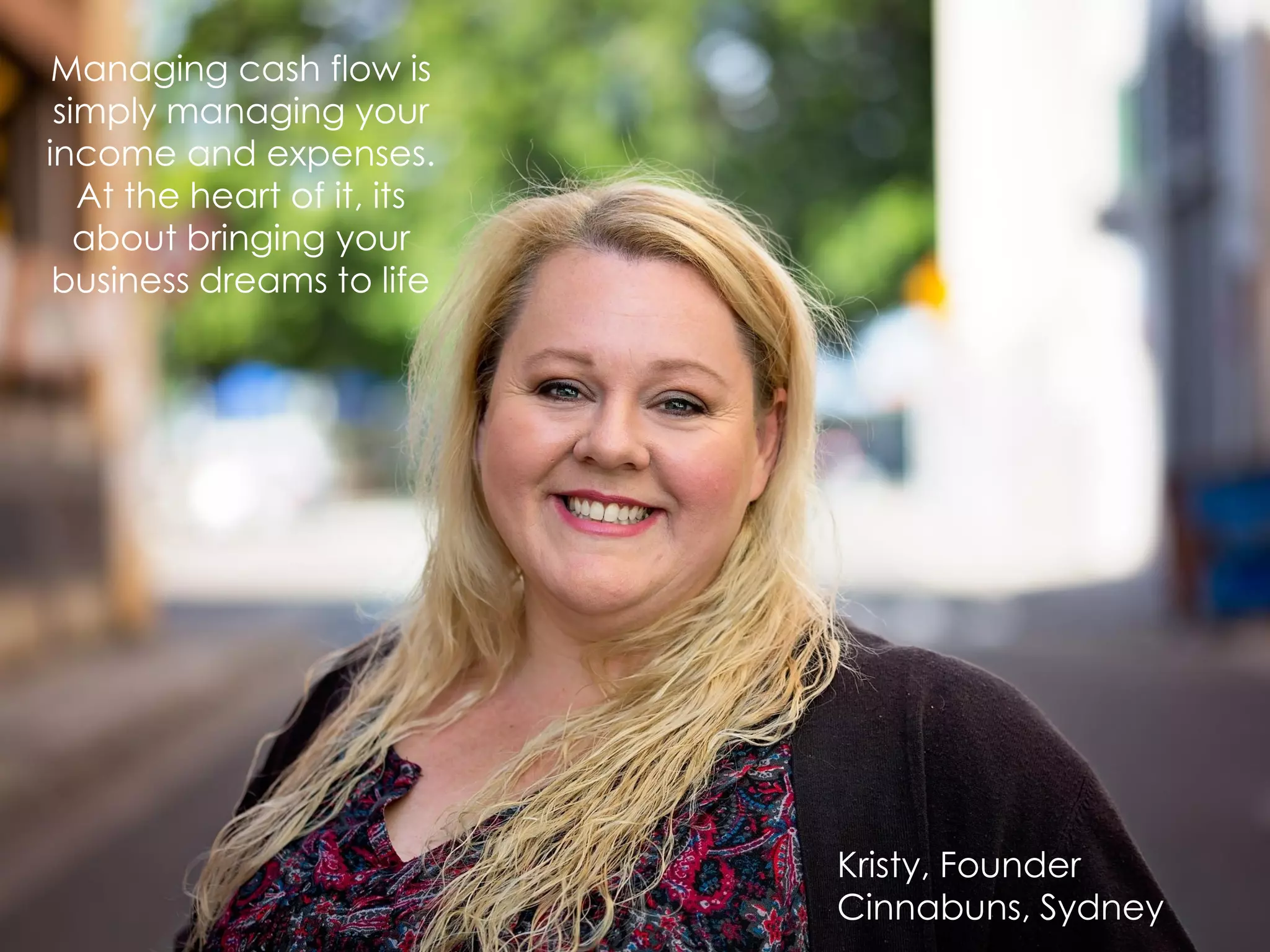
Managing cash flow is
simply managing your
income and expenses.
At the heart of it, its
about bringing your
business dreams to life
Kristy, Founder
Cinnabuns, Sydney
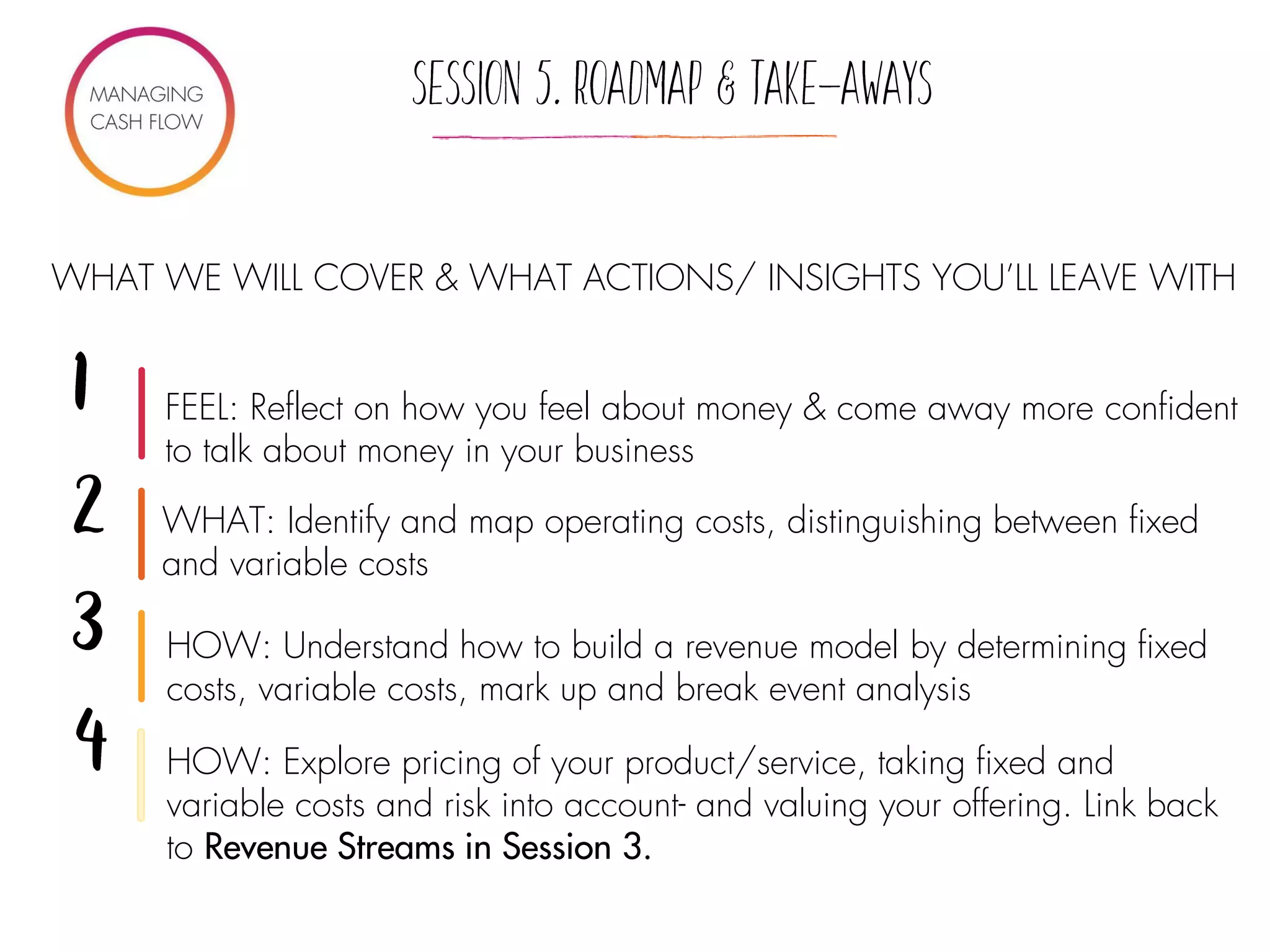
WHAT WE WILL COVER & WHAT ACTIONS/ INSIGHTS YOU’LL LEAVE WITH
WHAT: Identify and map operating costs, distinguishing between fixed
and variable costs
HOW: Understand how to build a revenue model by determining fixed
costs, variable costs, mark up and break event analysis
HOW: Explore pricing of your product/service, taking fixed and
variable costs and risk into account- and valuing your offering. Link back
to Revenue Streams in Session 3.
FEEL: Reflect on how you feel about money & come away more confident
to talk about money in your business
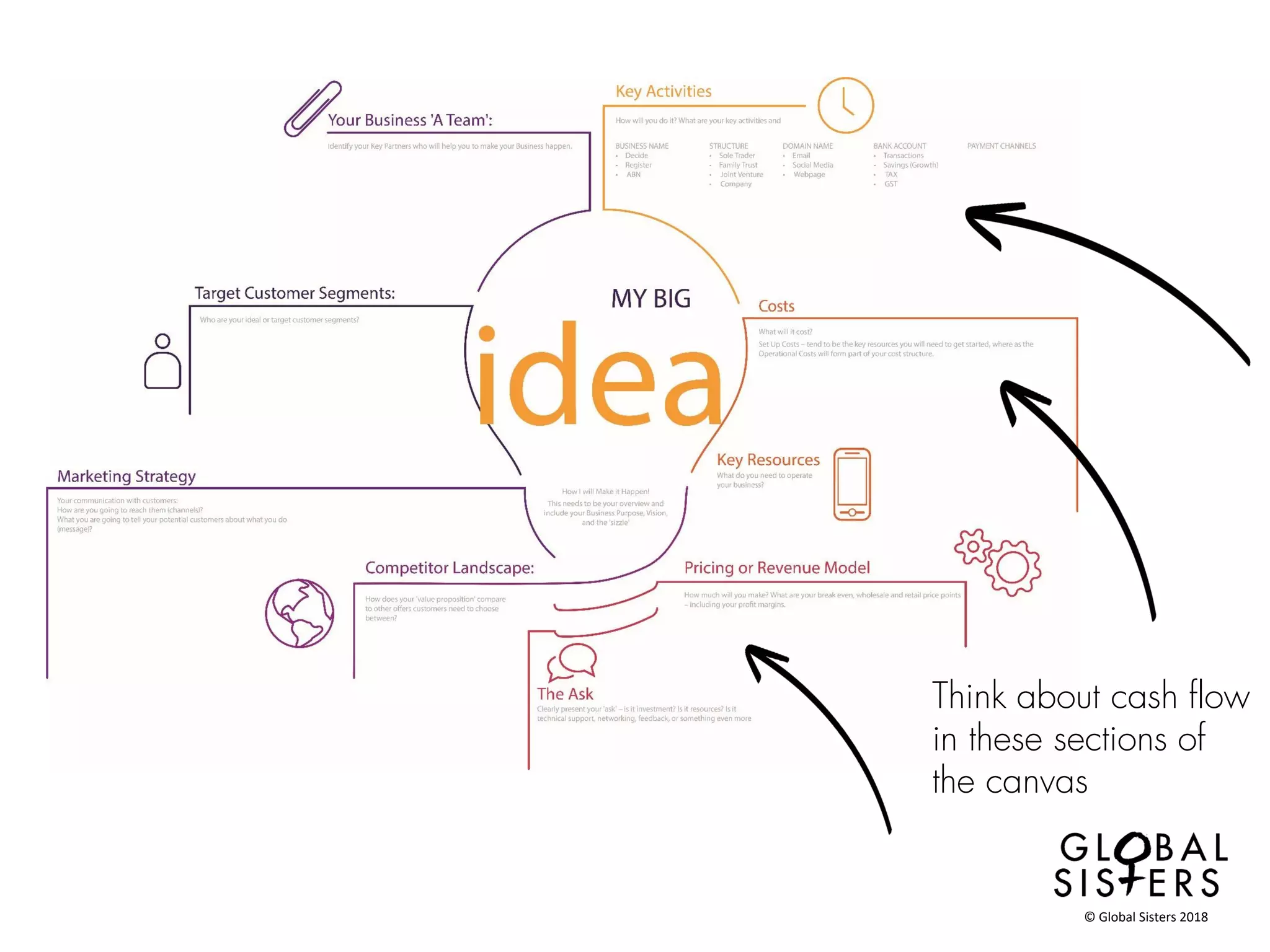
Think about cash flow
in these sections of
the canvas
© Global Sisters 2018
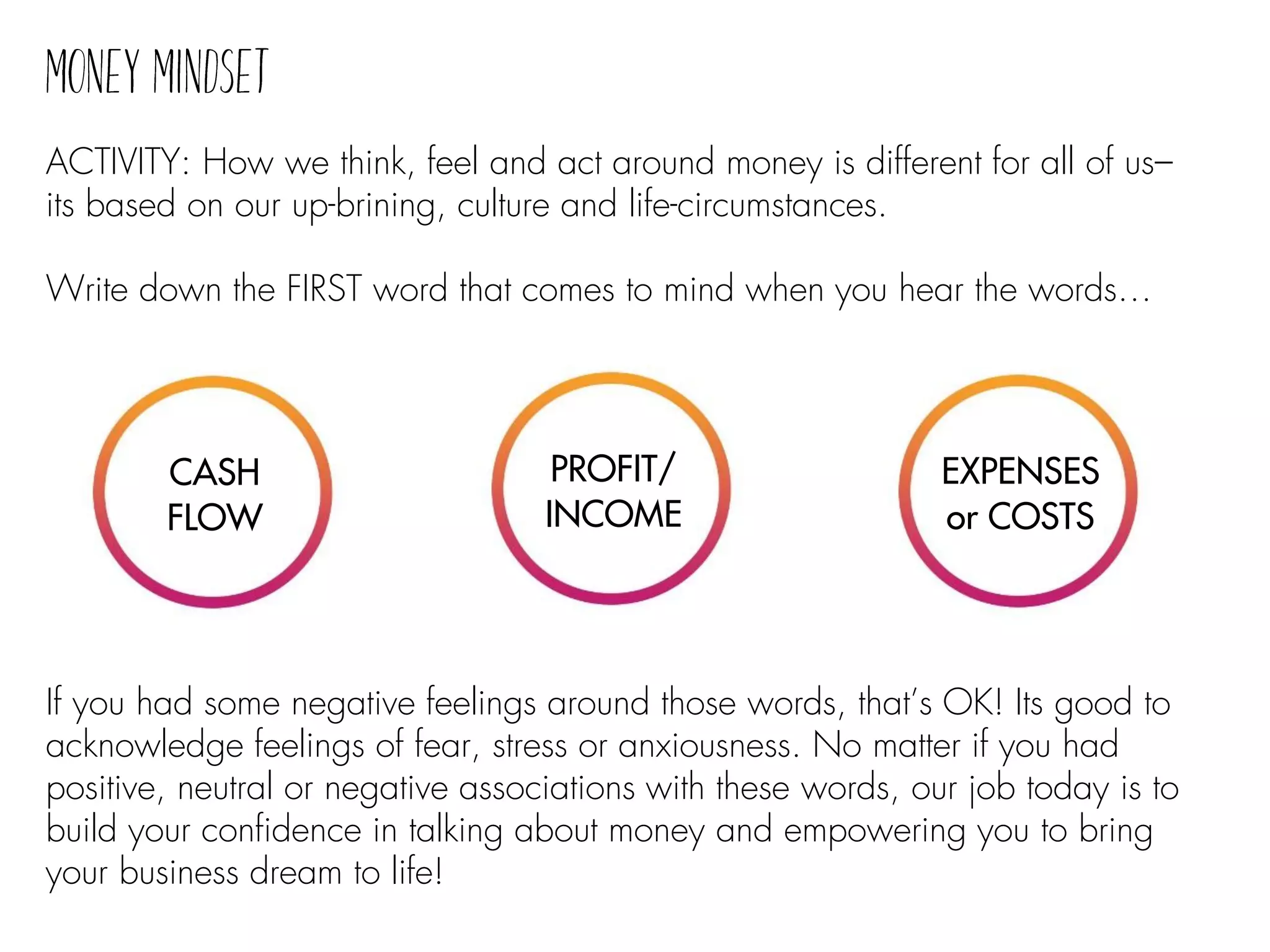
If you had some negative feelings around those words, that’s OK! Its good to
acknowledge feelings of fear, stress or anxiousness. No matter if you had
positive, neutral or negative associations with these words, our job today is to
build your confidence in talking about money and empowering you to bring
your business dream to life!
ACTIVITY: How we think, feel and act around money is different for all of us–
its based on our up-brining, culture and life-circumstances.
Write down the FIRST word that comes to mind when you hear the words…
CASH
FLOW
PROFIT/
INCOME
EXPENSES
or COSTS
ACTIVITY:
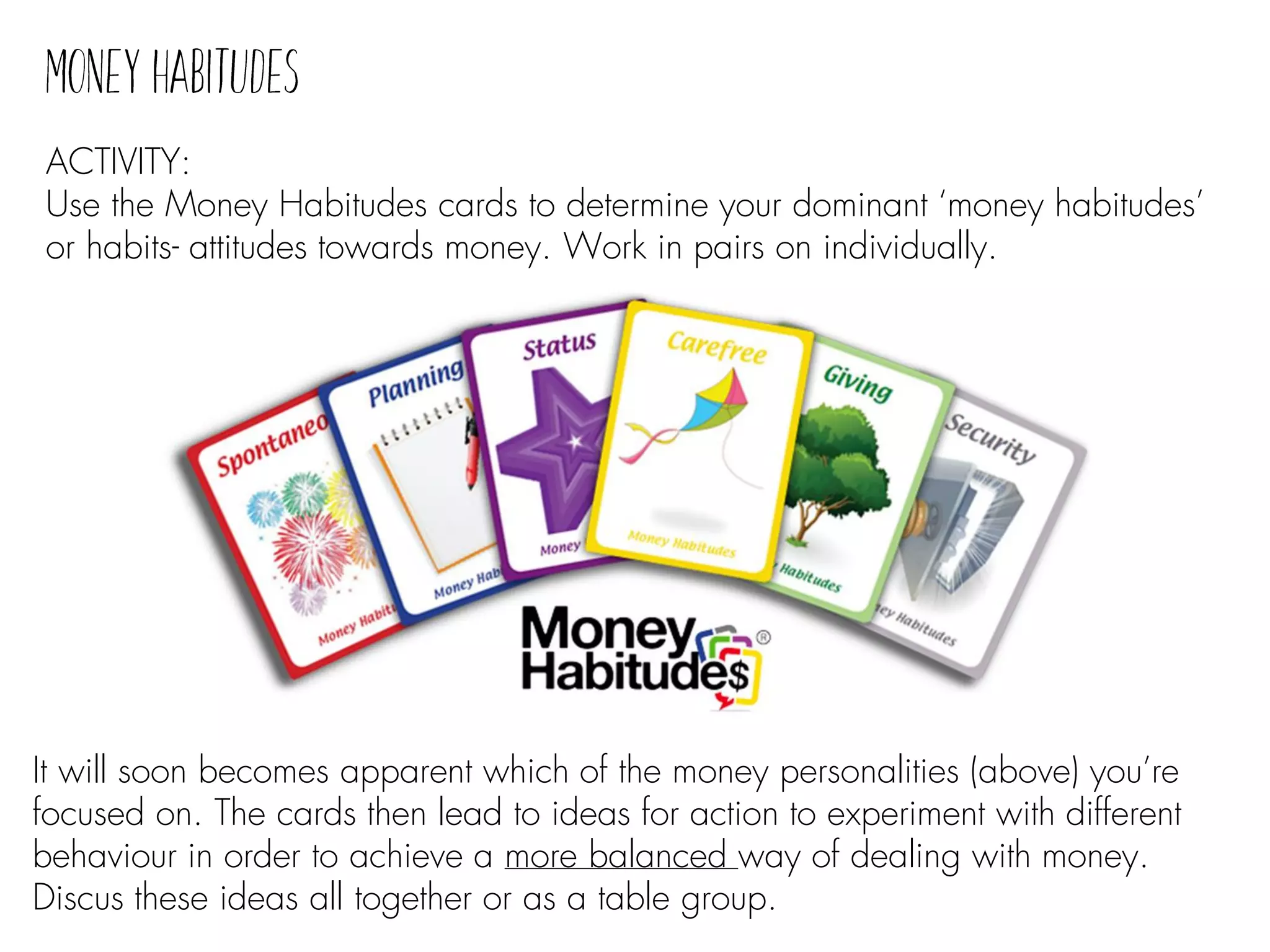
Use the Money Habitudes cards to determine your dominant ‘money habitudes’
or habits- attitudes towards money. Work in pairs on individually.
It will soon becomes apparent which of the money personalities (above) you’re
focused on. The cards then lead to ideas for action to experiment with different
behaviour in order to achieve a more balanced way of dealing with money.
Discus these ideas all together or as a table group.
OPEN A BUSINESS
ACCOUNT
RECORD ALL
TRANSACTIONS
USE SUPPORTING
DOCUMENTS
Why do you think it
is important to have
a separate bank
account for your
business that does
not involve any of
your personal funds
or expenses?
Why do you think
it is important to
record ALL
transactions when
starting and
operating a
business?
What are supporting
documents?
Why would it be
important to create,
use and keep
supporting
documents?
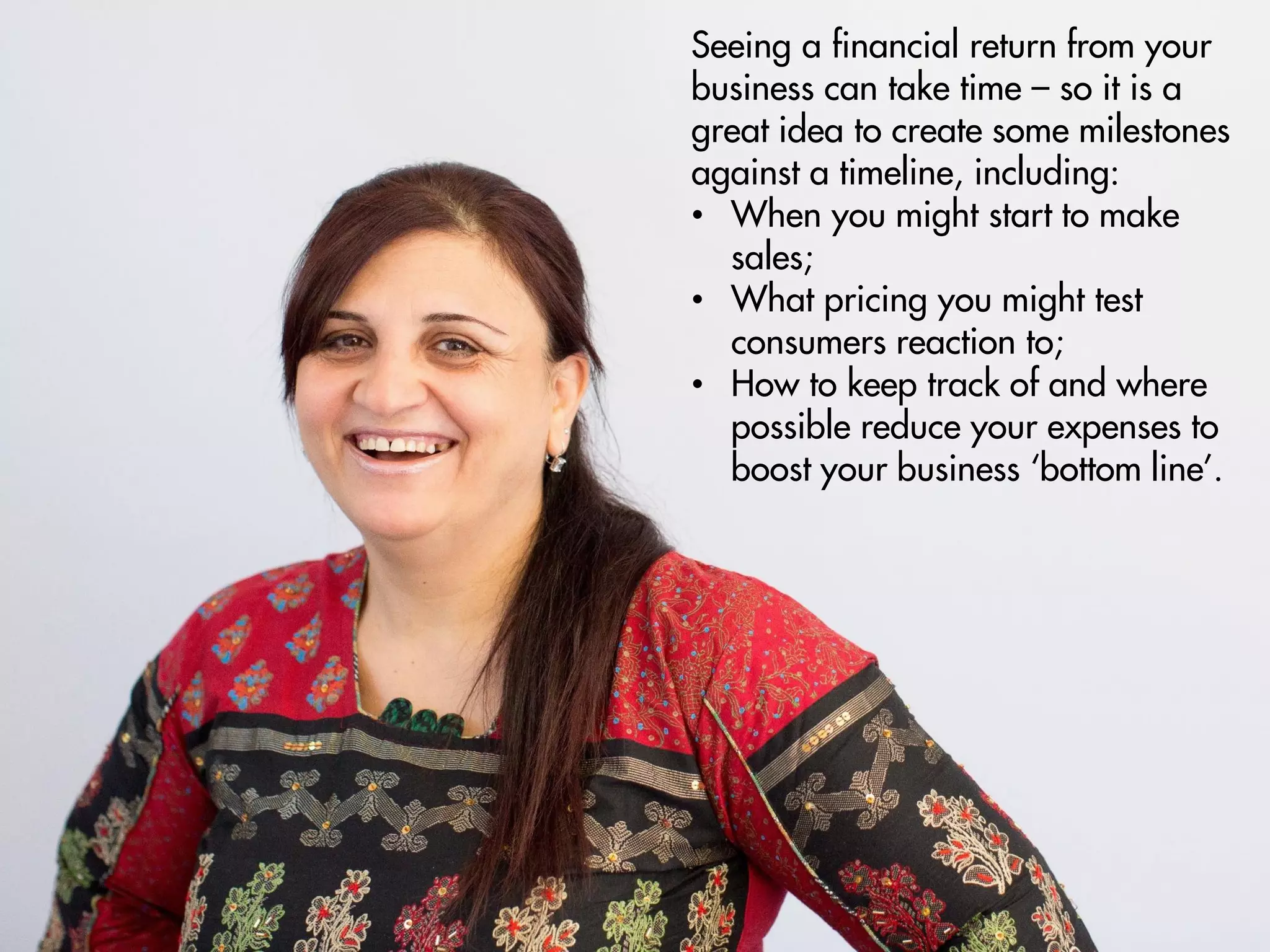
Seeing a financial return from your
business can take time – so it is a
great idea to create some milestones
against a timeline, including:
• When you might start to make
sales;
• What pricing you might test
consumers reaction to;
• How to keep track of and where
possible reduce your expenses to
boost your business ‘bottom line’.
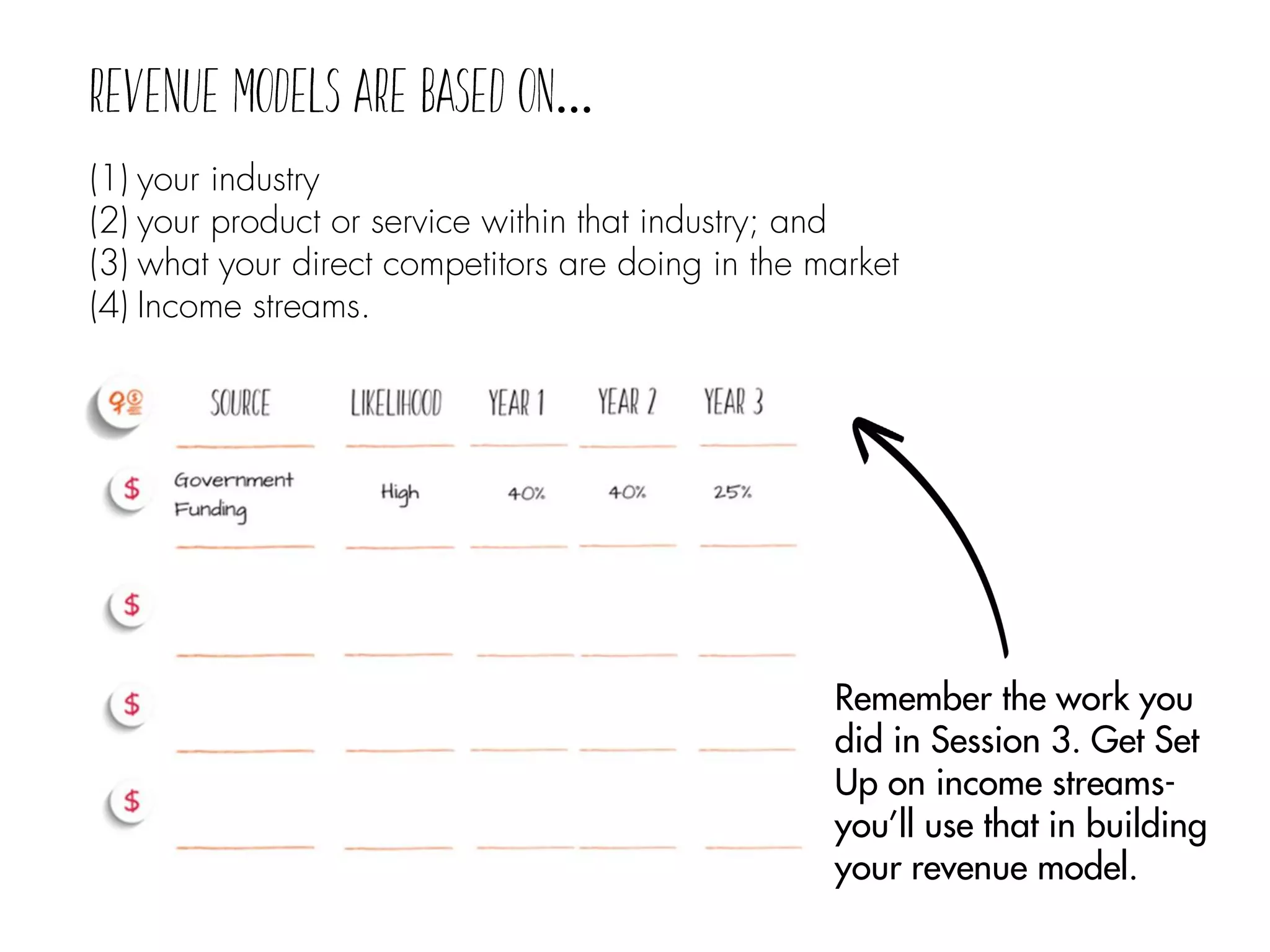
…
(1) your industry
(2) your product or service within that industry; and
(3) what your direct competitors are doing in the market
(4) Income streams.
Remember the work you
did in Session 3. Get Set
Up on income streams-
you’ll use that in building
your revenue model.
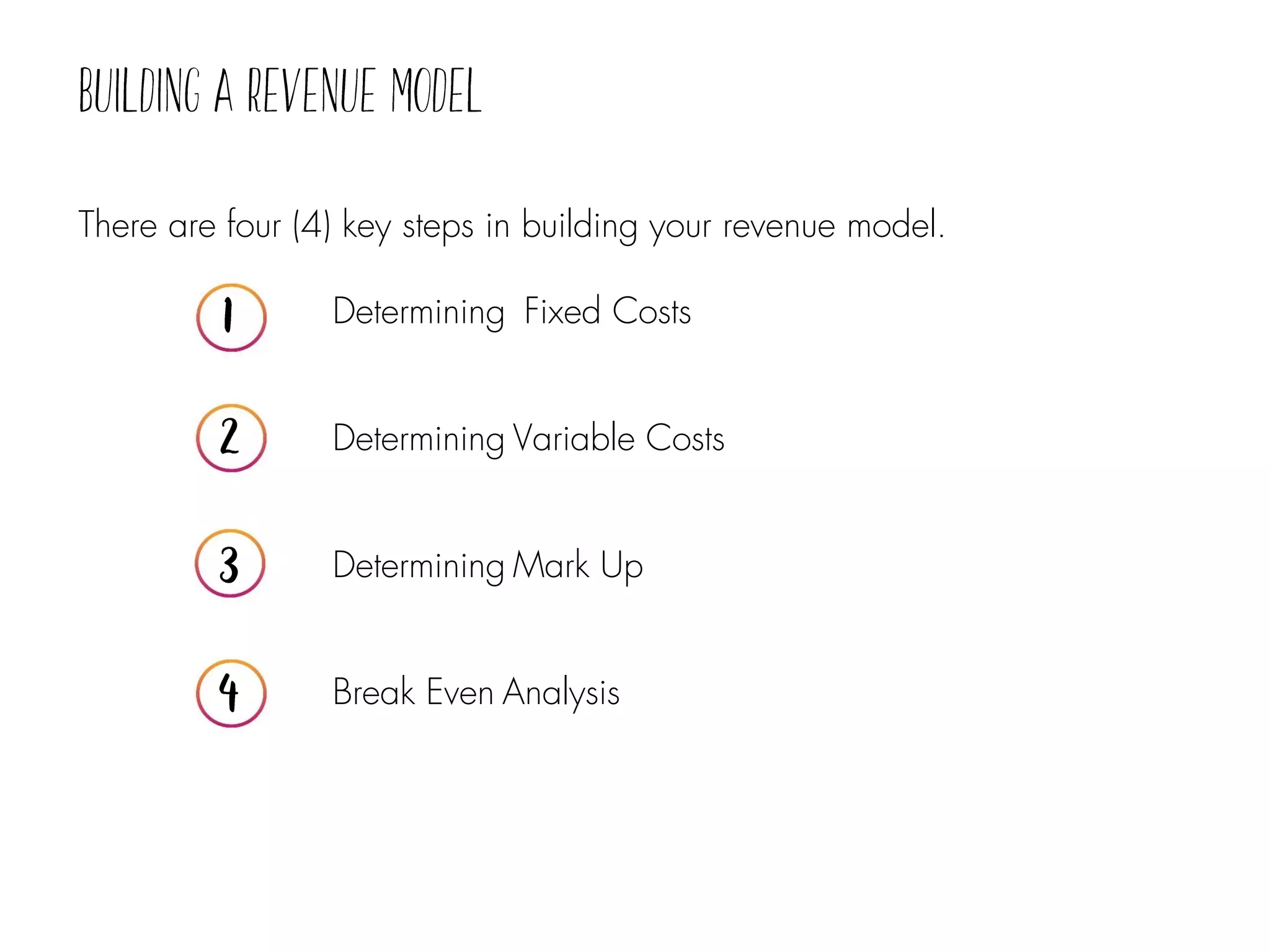
There are four (4) key steps in building your revenue model.
Determining Fixed Costs
Determining Variable Costs
Determining Mark Up
Break Even Analysis
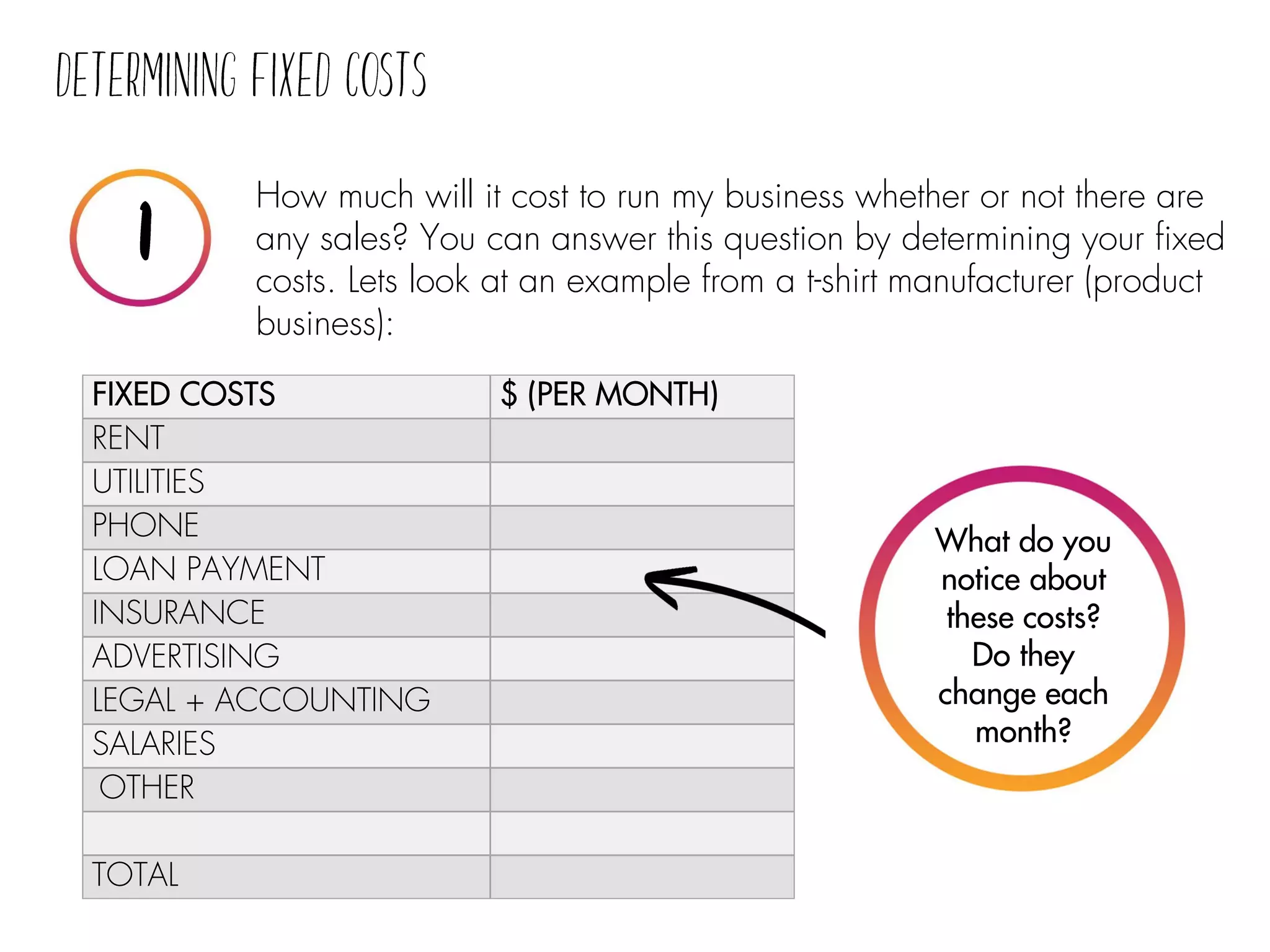
How much will it cost to run my business whether or not there are
any sales? You can answer this question by determining your fixed
costs. Lets look at an example from a t-shirt manufacturer (product
business):
FIXED COSTS $ (PER MONTH)
RENT
UTILITIES
PHONE
LOAN PAYMENT
INSURANCE
ADVERTISING
LEGAL + ACCOUNTING
SALARIES
OTHER
TOTAL
What do you
notice about
these costs?
Do they
change each
month?
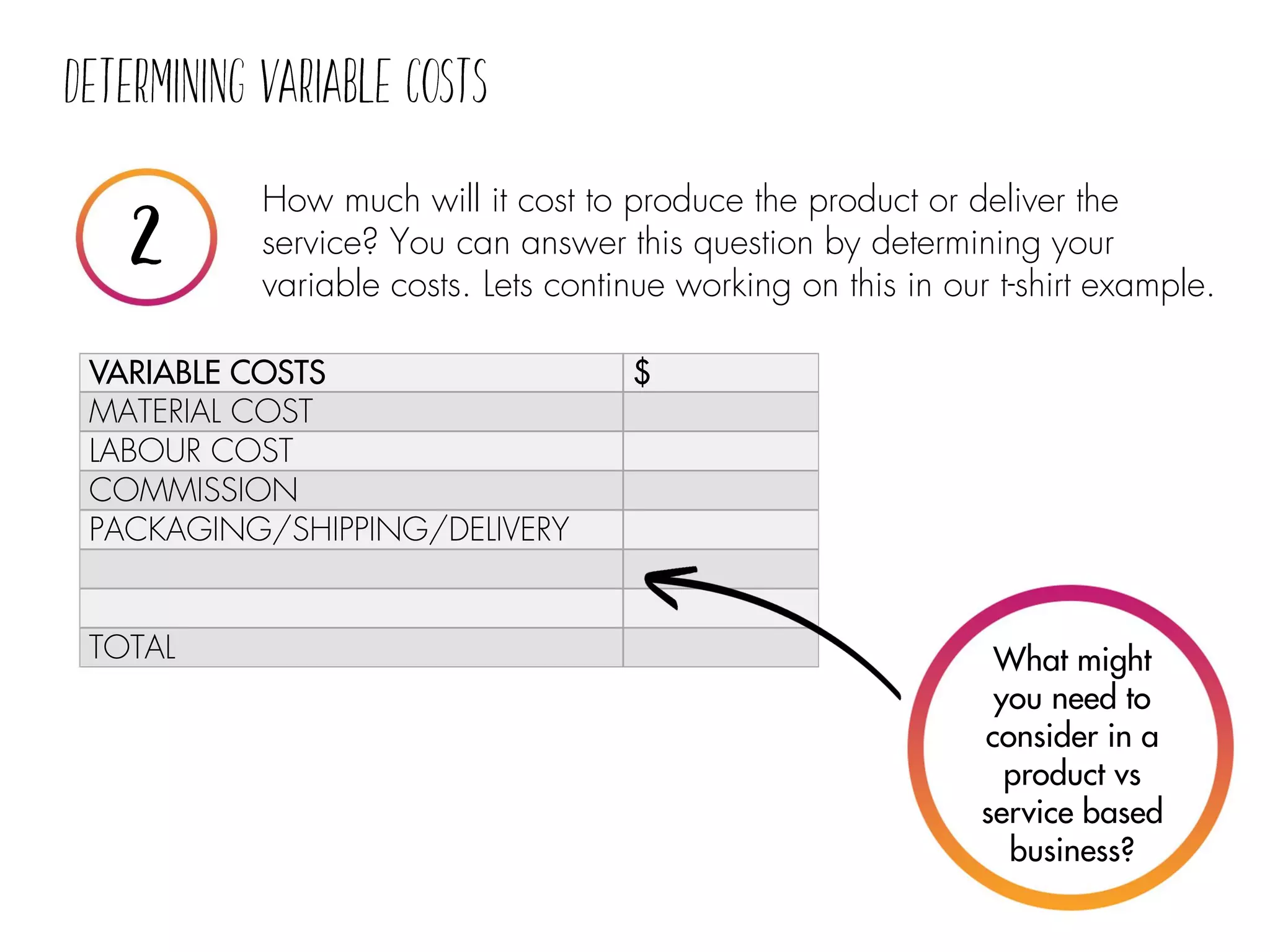
How much will it cost to produce the product or deliver the
service? You can answer this question by determining your
variable costs. Lets continue working on this in our t-shirt example.
VARIABLE COSTS $
MATERIAL COST
LABOUR COST
COMMISSION
PACKAGING/SHIPPING/DELIVERY
TOTAL What might
you need to
consider in a
product vs
service based
business?
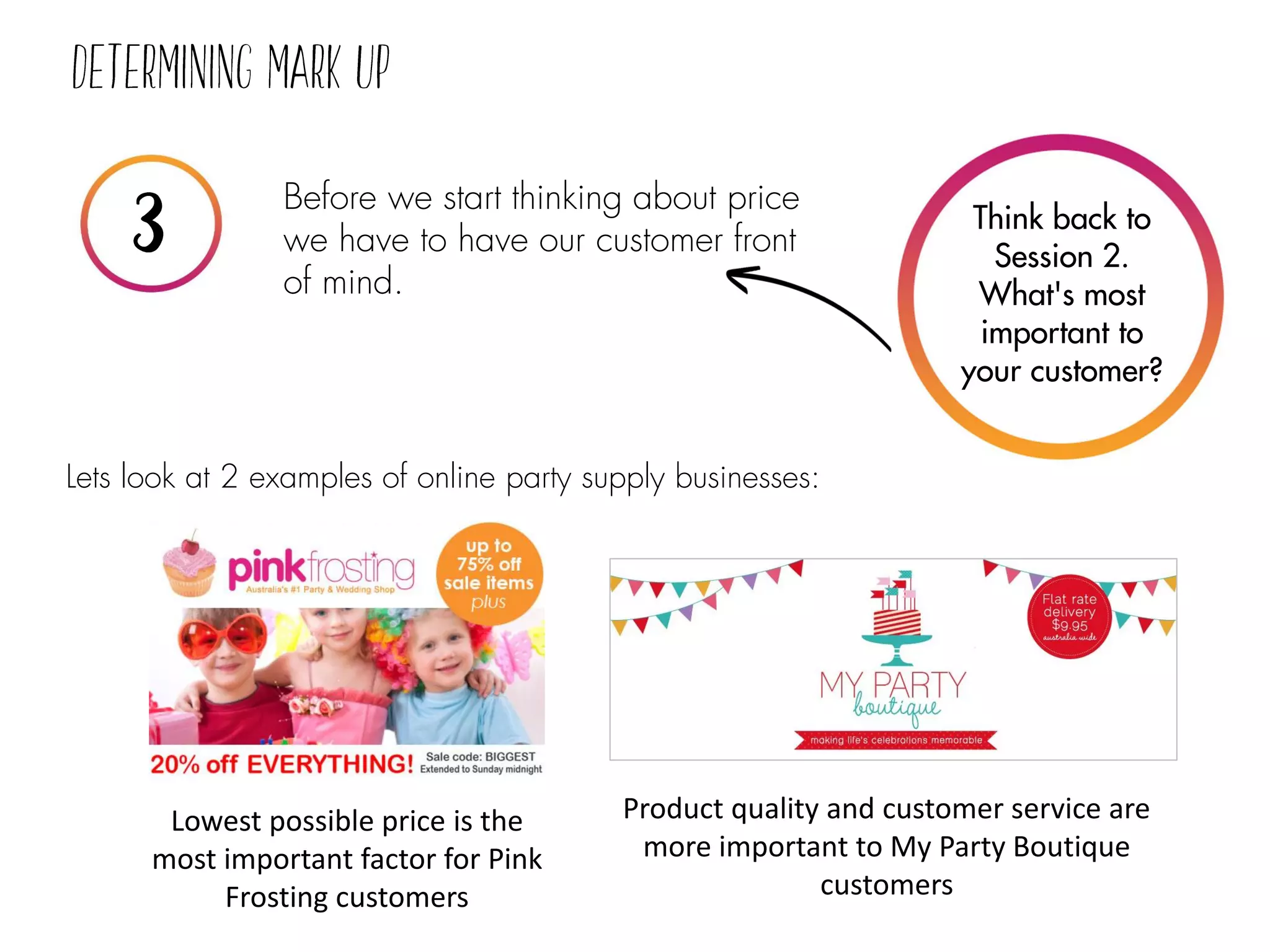
Before we start thinking about price
we have to have our customer front
of mind.
Lets look at 2 examples of online party supply businesses:
Think back to
Session 2.
What's most
important to
your customer?
Lowest possible price is the
most important factor for Pink
Frosting customers
Product quality and customer service are
more important to My Party Boutique
customers
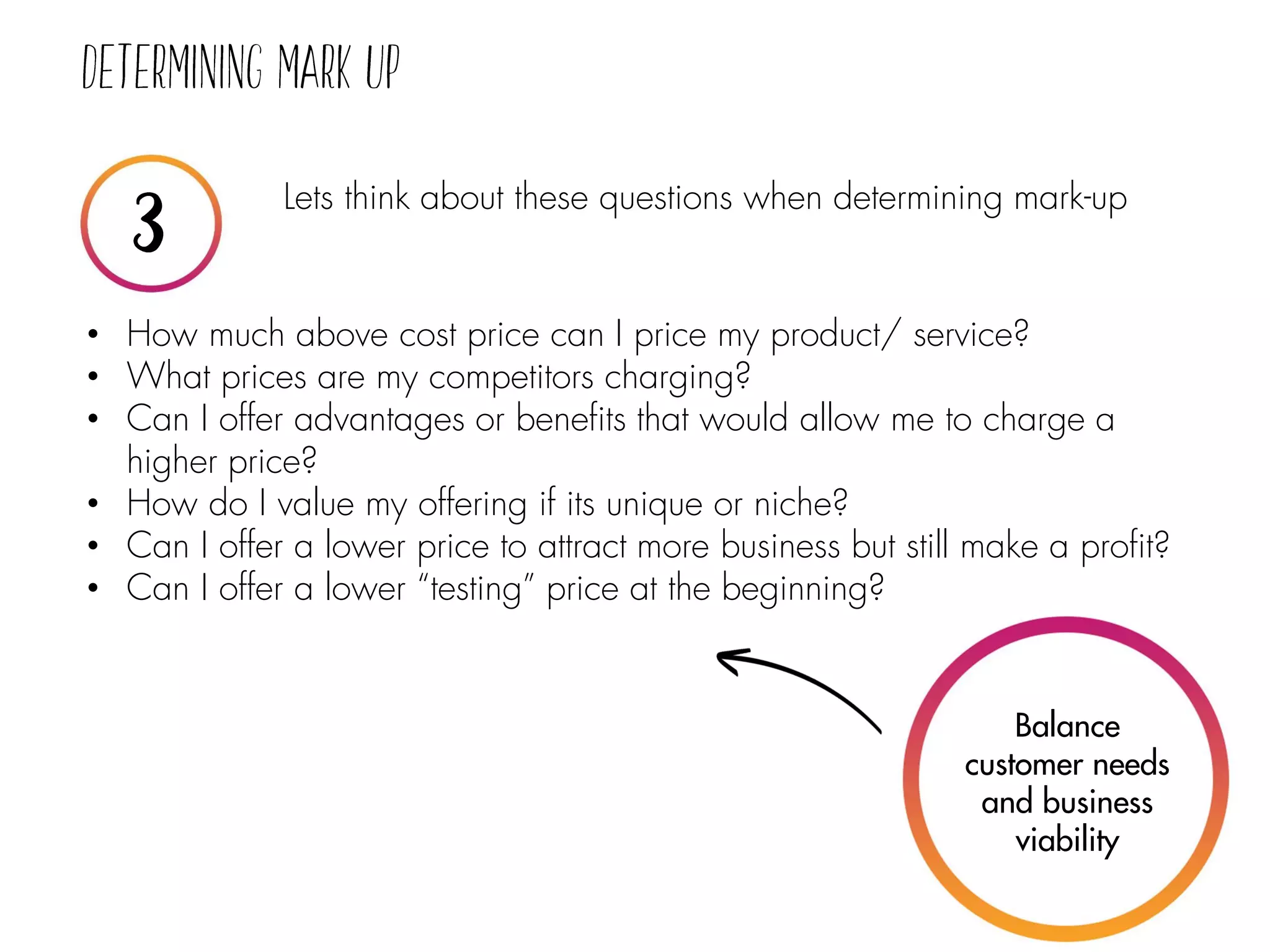
Lets think about these questions when determining mark-up
• How much above cost price can I price my product/ service?
• What prices are my competitors charging?
• Can I offer advantages or benefits that would allow me to charge a
higher price?
• How do I value my offering if its unique or niche?
• Can I offer a lower price to attract more business but still make a profit?
• Can I offer a lower “testing” price at the beginning?
Balance
customer needs
and business
viability
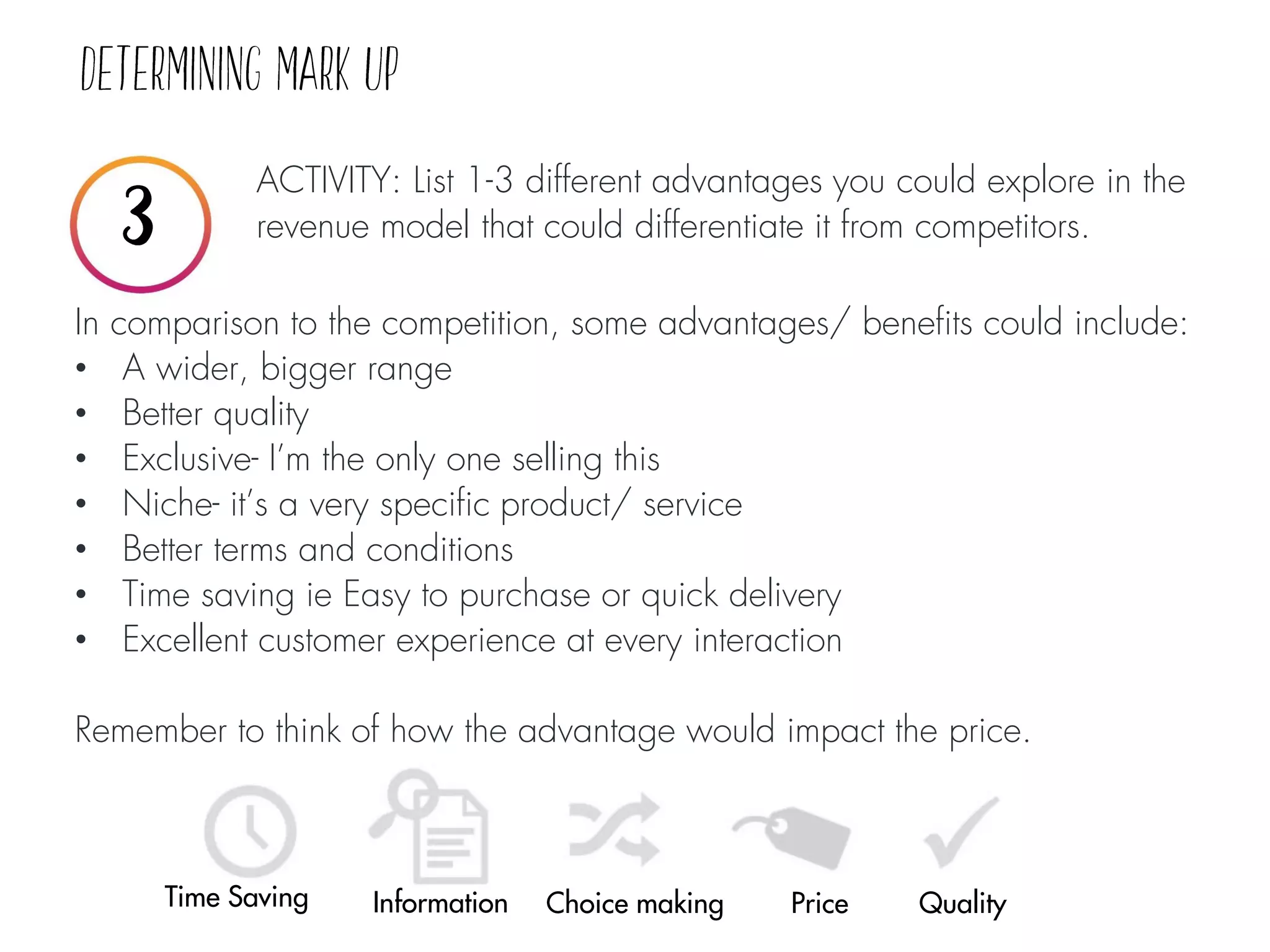
ACTIVITY: List 1-3 different advantages you could explore in the
revenue model that could differentiate it from competitors.
Choice making Price Quality
In comparison to the competition, some advantages/ benefits could include:
• A wider, bigger range
• Better quality
• Exclusive- I’m the only one selling this
• Niche- it’s a very specific product/ service
• Better terms and conditions
• Time saving ie Easy to purchase or quick delivery
• Excellent customer experience at every interaction
Remember to think of how the advantage would impact the price.
Time Saving Information
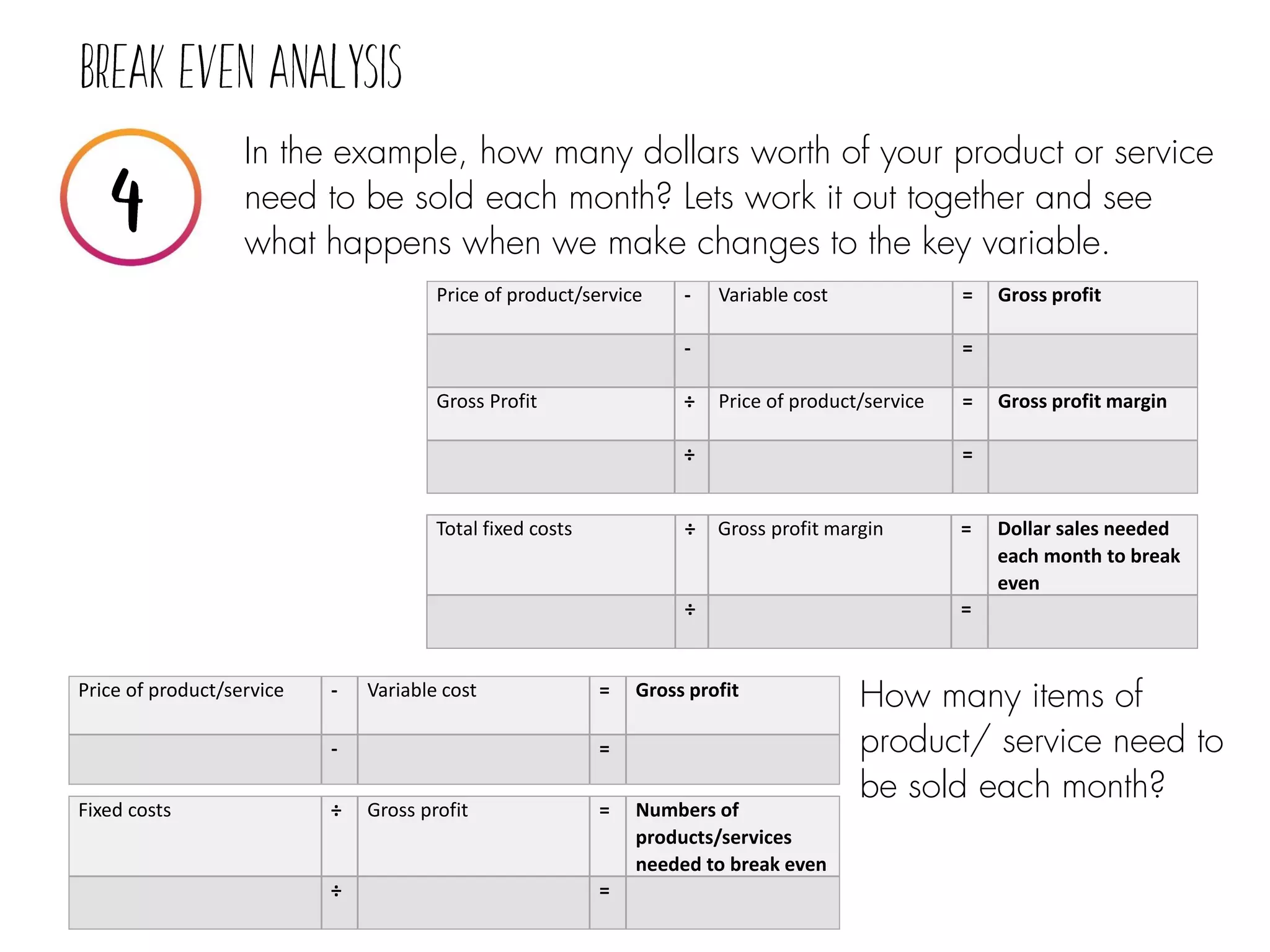
✓ In the example, how many dollars worth of your product or service
need to be sold each month? Lets work it out together and see
what happens when we make changes to the key variable.
Price of product/service - Variable cost = Gross profit
- =
Gross Profit ÷ Price of product/service = Gross profit margin
÷ =
Total fixed costs ÷ Gross profit margin = Dollar sales needed
each month to break
even
÷ =
Price of product/service - Variable cost = Gross profit
- =
Fixed costs ÷ Gross profit = Numbers of
products/services
needed to break even
÷ =
How many items of
product/ service need to
be sold each month?
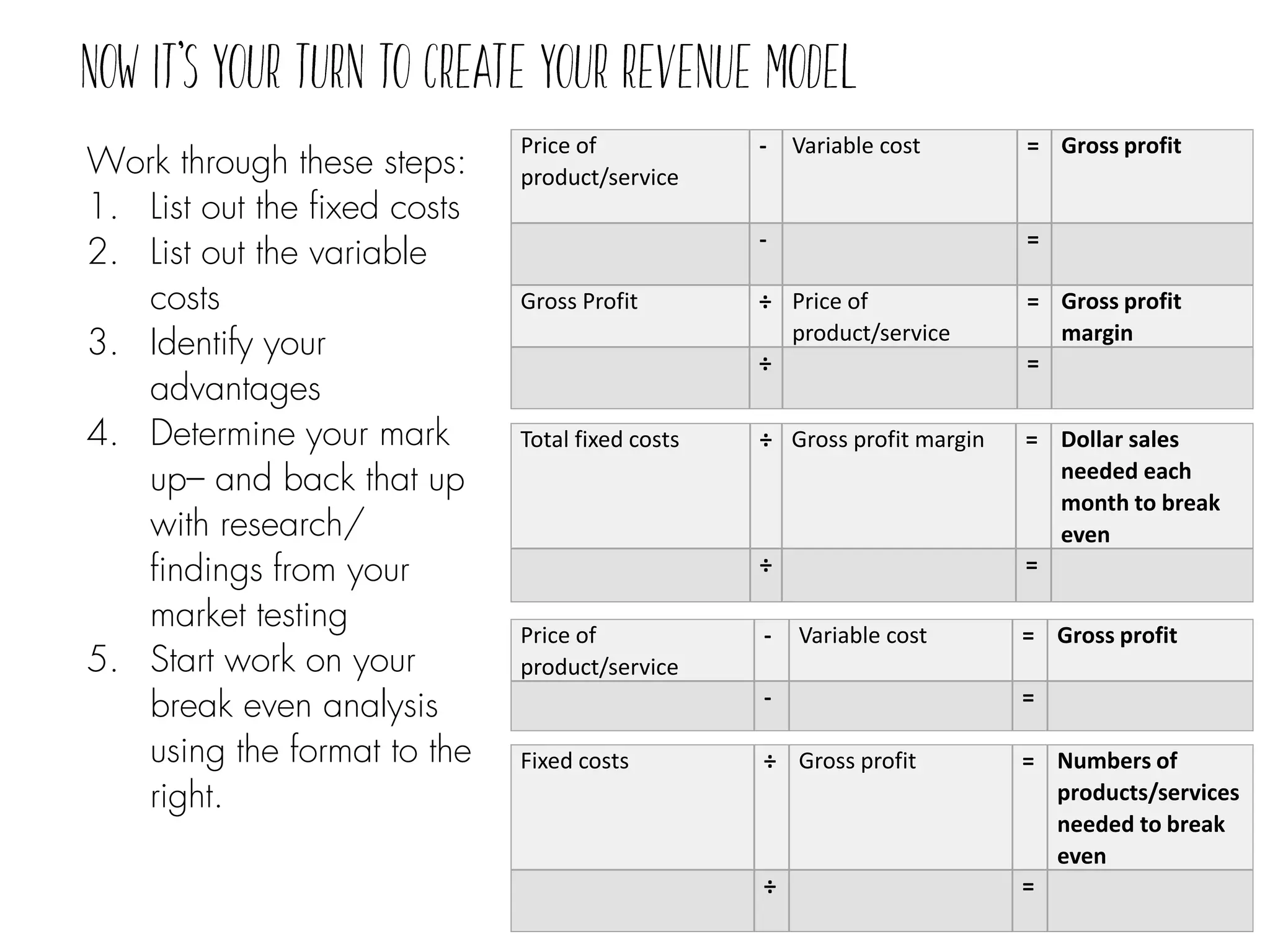
Work through these steps:
1. List out the fixed costs
2. List out the variable
costs
3. Identify your
advantages
4. Determine your mark
up– and back that up
with research/
findings from your
market testing
5. Start work on your
break even analysis
using the format to the
right.
Price of
product/service
- Variable cost = Gross profit
- =
Gross Profit ÷ Price of
product/service
= Gross profit
margin
÷ =
Total fixed costs ÷ Gross profit margin = Dollar sales
needed each
month to break
even
÷ =
Price of
product/service
- Variable cost = Gross profit
- =
Fixed costs ÷ Gross profit = Numbers of
products/services
needed to break
even
÷ =
The last step in setting your revenue model is making sure it passes
the common sense check:
• Is your revenue per transaction high enough to cover your costs and
make a profit (recovering the costs of production and distribution of the
product, or all of the resources required to deliver the service)?
• Have you market tested your ideas first, to ensure you are clear on your
cost and understand the reaction of potential customers to your
proposed revenue model? Are customers willing to pay for the price
you have set? This information will help you get clear on how best to
design your revenue model.
• Can you turn your start-up costs (even losses) into profits with a 12-18
month period? If not, how much longer do you think it will take?
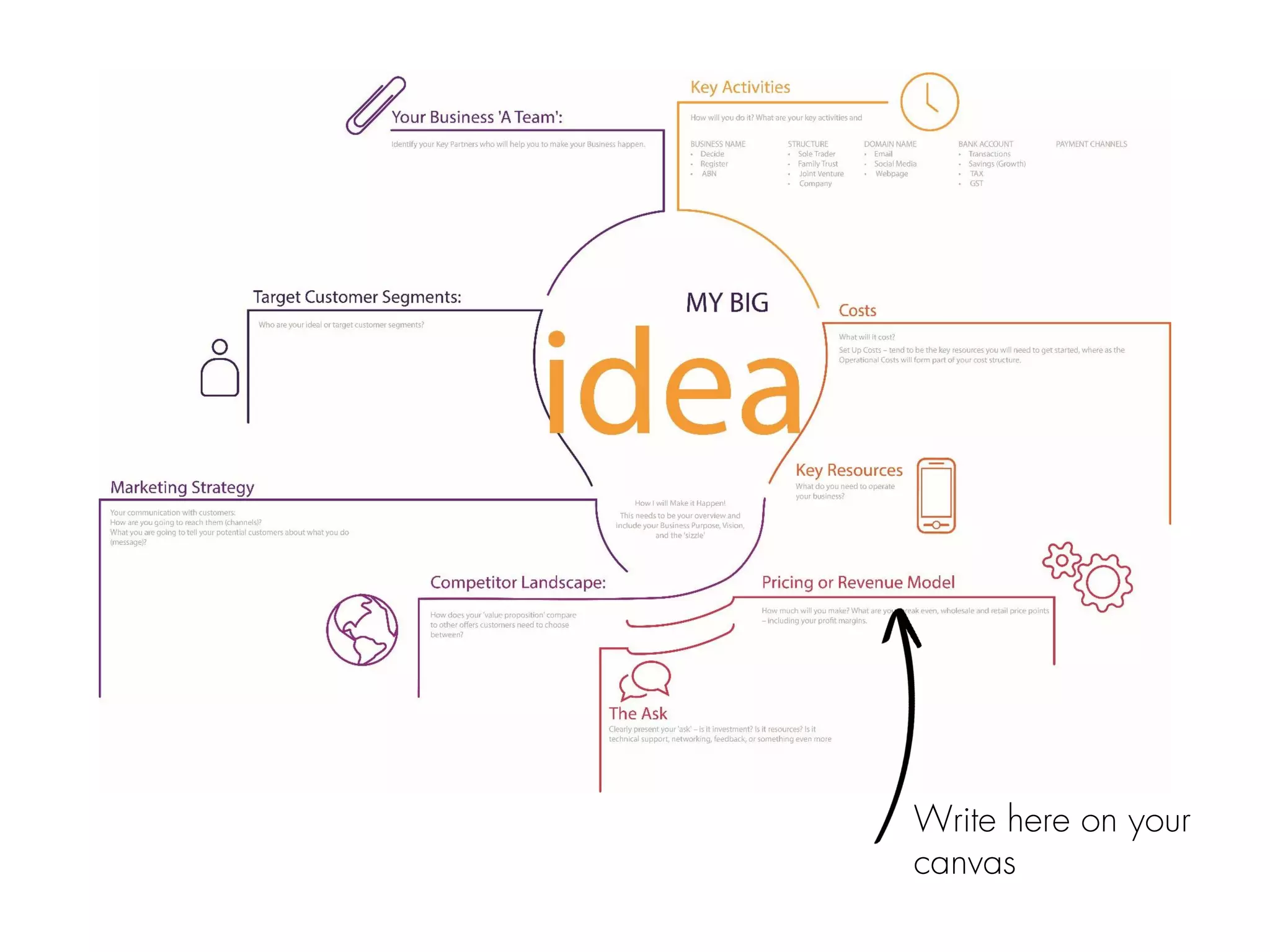
Write here on your
canvas
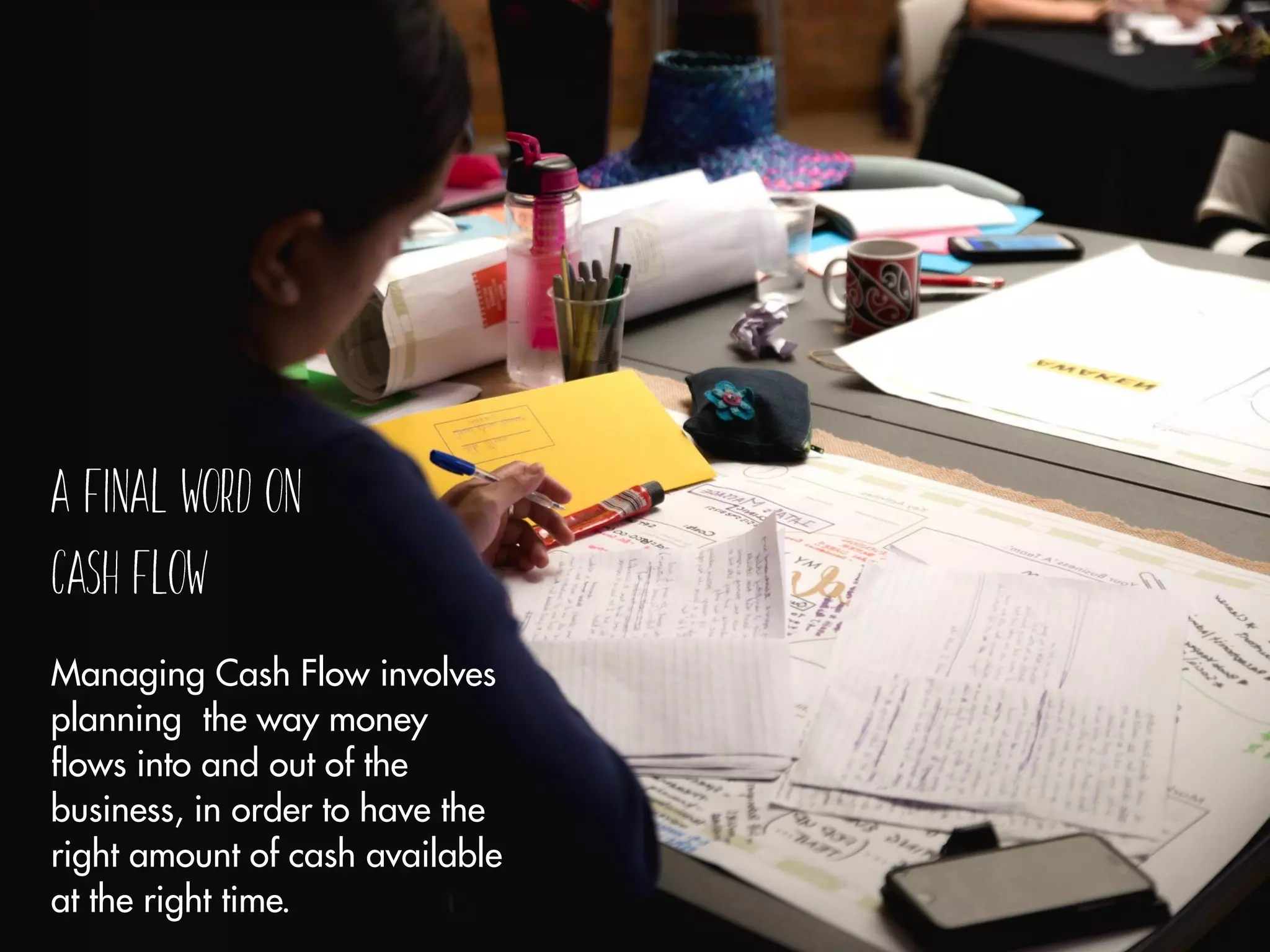
Managing Cash Flow involves
planning the way money
flows into and out of the
business, in order to have the
right amount of cash available
at the right time.
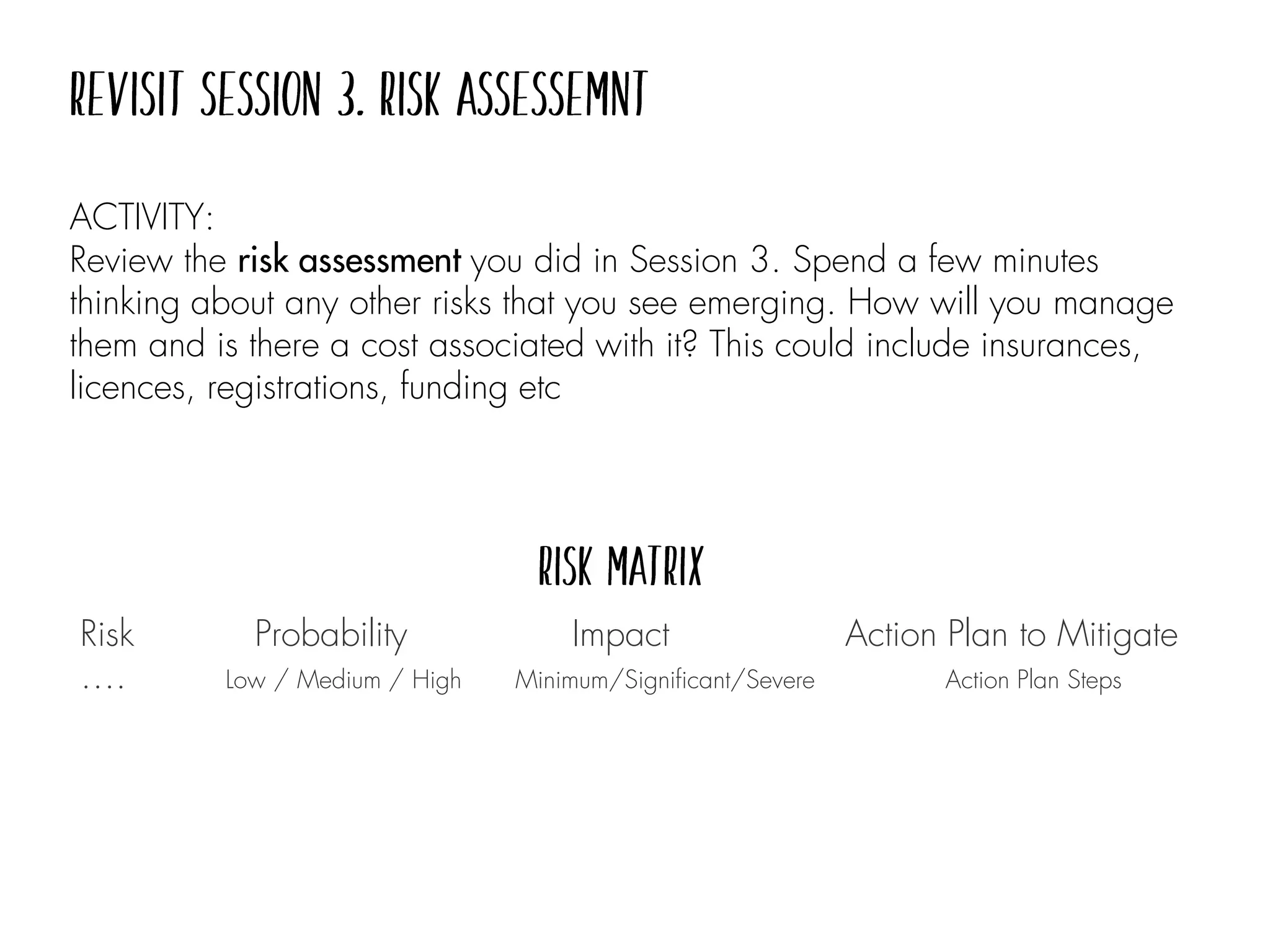
ACTIVITY:
Review the risk assessment you did in Session 3. Spend a few minutes
thinking about any other risks that you see emerging. How will you manage
them and is there a cost associated with it? This could include insurances,
licences, registrations, funding etc
Risk Probability Impact Action Plan to Mitigate
…. Low / Medium / High Minimum/Significant/Severe Action Plan Steps
Check out the BOOKLET & BUZZ WORDS used in Session 5
and get a sneak look at the BUZZ WORDS we will be using in
Session 6.
© Global Sisters 2018
Session 5 - Manage Cash Flow

Session 5 - Manage Cash Flow

  • 2.
    Managing cash flowis simply managing your income and expenses. At the heart of it, its about bringing your business dreams to life Kristy, Founder Cinnabuns, Sydney
  • 3.
    WHAT WE WILLCOVER & WHAT ACTIONS/ INSIGHTS YOU’LL LEAVE WITH WHAT: Identify and map operating costs, distinguishing between fixed and variable costs HOW: Understand how to build a revenue model by determining fixed costs, variable costs, mark up and break event analysis HOW: Explore pricing of your product/service, taking fixed and variable costs and risk into account- and valuing your offering. Link back to Revenue Streams in Session 3. FEEL: Reflect on how you feel about money & come away more confident to talk about money in your business
  • 4.
    Think about cashflow in these sections of the canvas © Global Sisters 2018
  • 5.
    If you hadsome negative feelings around those words, that’s OK! Its good to acknowledge feelings of fear, stress or anxiousness. No matter if you had positive, neutral or negative associations with these words, our job today is to build your confidence in talking about money and empowering you to bring your business dream to life! ACTIVITY: How we think, feel and act around money is different for all of us– its based on our up-brining, culture and life-circumstances. Write down the FIRST word that comes to mind when you hear the words… CASH FLOW PROFIT/ INCOME EXPENSES or COSTS
  • 6.
    ACTIVITY: Use the MoneyHabitudes cards to determine your dominant ‘money habitudes’ or habits- attitudes towards money. Work in pairs on individually. It will soon becomes apparent which of the money personalities (above) you’re focused on. The cards then lead to ideas for action to experiment with different behaviour in order to achieve a more balanced way of dealing with money. Discus these ideas all together or as a table group.
  • 7.
    OPEN A BUSINESS ACCOUNT RECORDALL TRANSACTIONS USE SUPPORTING DOCUMENTS Why do you think it is important to have a separate bank account for your business that does not involve any of your personal funds or expenses? Why do you think it is important to record ALL transactions when starting and operating a business? What are supporting documents? Why would it be important to create, use and keep supporting documents?
  • 8.
    Seeing a financialreturn from your business can take time – so it is a great idea to create some milestones against a timeline, including: • When you might start to make sales; • What pricing you might test consumers reaction to; • How to keep track of and where possible reduce your expenses to boost your business ‘bottom line’.
  • 9.
    … (1) your industry (2)your product or service within that industry; and (3) what your direct competitors are doing in the market (4) Income streams. Remember the work you did in Session 3. Get Set Up on income streams- you’ll use that in building your revenue model.
  • 10.
    There are four(4) key steps in building your revenue model. Determining Fixed Costs Determining Variable Costs Determining Mark Up Break Even Analysis
  • 11.
    How much willit cost to run my business whether or not there are any sales? You can answer this question by determining your fixed costs. Lets look at an example from a t-shirt manufacturer (product business): FIXED COSTS $ (PER MONTH) RENT UTILITIES PHONE LOAN PAYMENT INSURANCE ADVERTISING LEGAL + ACCOUNTING SALARIES OTHER TOTAL What do you notice about these costs? Do they change each month?
  • 12.
    How much willit cost to produce the product or deliver the service? You can answer this question by determining your variable costs. Lets continue working on this in our t-shirt example. VARIABLE COSTS $ MATERIAL COST LABOUR COST COMMISSION PACKAGING/SHIPPING/DELIVERY TOTAL What might you need to consider in a product vs service based business?
  • 13.
    Before we startthinking about price we have to have our customer front of mind. Lets look at 2 examples of online party supply businesses: Think back to Session 2. What's most important to your customer? Lowest possible price is the most important factor for Pink Frosting customers Product quality and customer service are more important to My Party Boutique customers
  • 14.
    Lets think aboutthese questions when determining mark-up • How much above cost price can I price my product/ service? • What prices are my competitors charging? • Can I offer advantages or benefits that would allow me to charge a higher price? • How do I value my offering if its unique or niche? • Can I offer a lower price to attract more business but still make a profit? • Can I offer a lower “testing” price at the beginning? Balance customer needs and business viability
  • 15.
    ACTIVITY: List 1-3different advantages you could explore in the revenue model that could differentiate it from competitors. Choice making Price Quality In comparison to the competition, some advantages/ benefits could include: • A wider, bigger range • Better quality • Exclusive- I’m the only one selling this • Niche- it’s a very specific product/ service • Better terms and conditions • Time saving ie Easy to purchase or quick delivery • Excellent customer experience at every interaction Remember to think of how the advantage would impact the price. Time Saving Information
  • 16.
    ✓ In theexample, how many dollars worth of your product or service need to be sold each month? Lets work it out together and see what happens when we make changes to the key variable. Price of product/service - Variable cost = Gross profit - = Gross Profit ÷ Price of product/service = Gross profit margin ÷ = Total fixed costs ÷ Gross profit margin = Dollar sales needed each month to break even ÷ = Price of product/service - Variable cost = Gross profit - = Fixed costs ÷ Gross profit = Numbers of products/services needed to break even ÷ = How many items of product/ service need to be sold each month?
  • 17.
    Work through thesesteps: 1. List out the fixed costs 2. List out the variable costs 3. Identify your advantages 4. Determine your mark up– and back that up with research/ findings from your market testing 5. Start work on your break even analysis using the format to the right. Price of product/service - Variable cost = Gross profit - = Gross Profit ÷ Price of product/service = Gross profit margin ÷ = Total fixed costs ÷ Gross profit margin = Dollar sales needed each month to break even ÷ = Price of product/service - Variable cost = Gross profit - = Fixed costs ÷ Gross profit = Numbers of products/services needed to break even ÷ =
  • 18.
    The last stepin setting your revenue model is making sure it passes the common sense check: • Is your revenue per transaction high enough to cover your costs and make a profit (recovering the costs of production and distribution of the product, or all of the resources required to deliver the service)? • Have you market tested your ideas first, to ensure you are clear on your cost and understand the reaction of potential customers to your proposed revenue model? Are customers willing to pay for the price you have set? This information will help you get clear on how best to design your revenue model. • Can you turn your start-up costs (even losses) into profits with a 12-18 month period? If not, how much longer do you think it will take?
  • 19.
    Write here onyour canvas
  • 20.
    Managing Cash Flowinvolves planning the way money flows into and out of the business, in order to have the right amount of cash available at the right time.
  • 21.
    ACTIVITY: Review the riskassessment you did in Session 3. Spend a few minutes thinking about any other risks that you see emerging. How will you manage them and is there a cost associated with it? This could include insurances, licences, registrations, funding etc Risk Probability Impact Action Plan to Mitigate …. Low / Medium / High Minimum/Significant/Severe Action Plan Steps
  • 22.
    Check out theBOOKLET & BUZZ WORDS used in Session 5 and get a sneak look at the BUZZ WORDS we will be using in Session 6. © Global Sisters 2018