Sustainable
Growth Rate
from
businessbankingcoach.com
in association with
One of the major
problems for businesses
is when they become
successful and grow their
sales (revenue or
turnover).
One of the major
problems for businesses
is when they become
successful and grow their
sales (revenue or
turnover).
Sales growth, especially
when it’s significant and
rapid, has implications for
the funding needs of
businesses.
The growth phase of a
business’ life-cycle is
the most dangerous
phase because that’s
when cash and capital
are usually in short
supply and funding for
growth often comes
from borrowed money.
But why does this growth
become a problem for
businesses – why don’t
they simply grow at a
pace that is suited to their
available funding?
Because they want to
grow as fast as the
market will allow – if
they see an opportunity
for sales growth, they’re
going to take it – duh!
Owners are often
unwilling to dilute their
ownership or share their
good fortune by issuing
new equity – in the case
of smaller businesses,
they may not be able to
issue new equity
because of a lack of
interested investors.
Companies may have a
target capital structure
(sometimes imposed on
them by lending banks by
way of loan covenants)
and, sometimes, a target
dividend policy to
maintain so access to
additional borrowing may
be restricted anyway.
So, a business’
sustainable growth rate
is the rate at which it
can grow its sales
(revenue) without
negatively affecting its
balance sheet structure
through increasing its
debt.
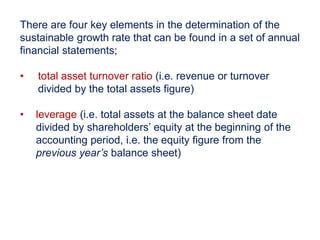
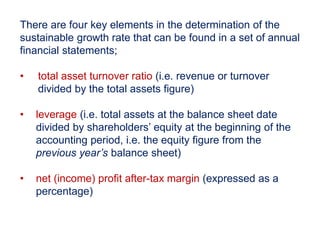
There are four key elements in the determination of the
sustainable growth rate that can be found in a set of annual
financial statements;
There are four key elements in the determination of the
sustainable growth rate that can be found in a set of annual
financial statements;
• total asset turnover ratio (i.e. revenue or turnover
divided by the total assets figure)
There are four key elements in the determination of the
sustainable growth rate that can be found in a set of annual
financial statements;
• total asset turnover ratio (i.e. revenue or turnover
divided by the total assets figure)
• leverage (i.e. total assets at the balance sheet date
divided by shareholders’ equity at the beginning of the
accounting period, i.e. the equity figure from the
previous year’s balance sheet)
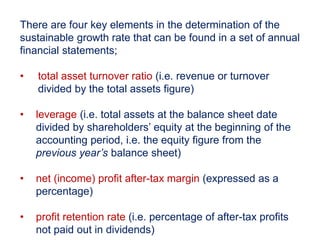
There are four key elements in the determination of the
sustainable growth rate that can be found in a set of annual
financial statements;
• total asset turnover ratio (i.e. revenue or turnover
divided by the total assets figure)
• leverage (i.e. total assets at the balance sheet date
divided by shareholders’ equity at the beginning of the
accounting period, i.e. the equity figure from the
previous year’s balance sheet)
• net (income) profit after-tax margin (expressed as a
percentage)
There are four key elements in the determination of the
sustainable growth rate that can be found in a set of annual
financial statements;
• total asset turnover ratio (i.e. revenue or turnover
divided by the total assets figure)
• leverage (i.e. total assets at the balance sheet date
divided by shareholders’ equity at the beginning of the
accounting period, i.e. the equity figure from the
previous year’s balance sheet)
• net (income) profit after-tax margin (expressed as a
percentage)
• profit retention rate (i.e. percentage of after-tax profits
not paid out in dividends)
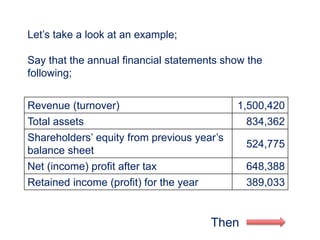
Let’s take a look at an example;
Say that the annual financial statements show the
following;
Revenue (turnover) 1,500,420
Total assets 834,362
Shareholders’ equity from previous year’s
balance sheet
524,775
Net (income) profit after tax 648,388
Retained income (profit) for the year 389,033
Then
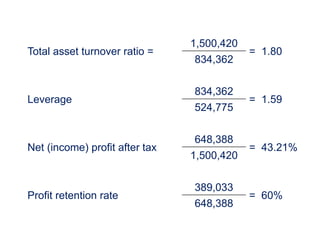
Total asset turnover ratio =
1,500,420
= 1.80
834,362
Leverage
834,362
= 1.59
524,775
Net (income) profit after tax
648,388
= 43.21%
1,500,420
Profit retention rate
389,033
= 60%
648,388
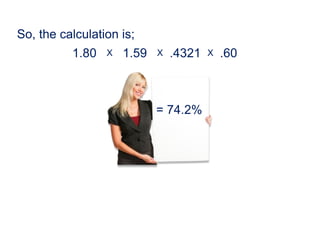
So, the calculation is;
1.80 X 1.59 X .4321 X .60
= 74.2%
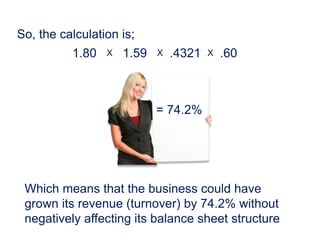
So, the calculation is;
1.80 X 1.59 X .4321 X .60
Which means that the business could have
grown its revenue (turnover) by 74.2% without
negatively affecting its balance sheet structure
= 74.2%
However, keep in mind that
this is a historical figure – it
is the sustainable growth
rate for the past financial
period and is of limited
value to lenders making a
future-based decision.
Its major usefulness is in
comparing it with the
change in revenue
(turnover) during the past
financial period to
determine whether the
business did, in fact,
manage to grow at least by
its optimum level (i.e. at the
sustainable growth rate)
given its existing debt to
equity structure.
So, to help with our risk
assessment we need to
gain insight into the future
sustainable growth rate of
the business.
How could we do this?
It’s simpler than you’d think!
You need to know two things;
It’s simpler than you’d think!
You need to know two things;
• the shareholders’ equity figure
from the most recent balance
sheet
It’s simpler than you’d think!
You need to know two things;
• the shareholders’ equity figure
from the most recent balance
sheet
• the expected retained (income)
profit for the current financial
year.
Expressing the expected retained
income as a percentage of the
shareholders’ equity figure will
give you the future sustainable
growth rate for the current
financial year.
The future sustainable
growth rate is then
compared to the anticipated
growth in revenue (turnover)
provided by the
management of the
business and……...
……….assuming that the working capital
management practices do not change…..
If the future sustainable
growth rate is higher than
the anticipated revenue
(turnover) growth rate, the
balance sheet structure will
not be negatively affected
and additional funding for
the growth will not,
therefore, be necessary.
If the future sustainable
growth rate is lower than
the anticipated revenue
(turnover)growth rate, the
balance sheet structure
will be negatively affected
and you will need to
calculate the financial gap.
What the future sustainable growth rate is not;
It is not a limit on the rate at which a business
can grow its revenue (turnover).
What the future sustainable growth rate is not;
It is not a limit on the rate at which a business
can grow its revenue (turnover).
It is not a indicator of good or bad rates of
revenue (turnover) growth.
What the future sustainable growth rate is not;
It is not a limit on the rate at which a business
can grow its revenue (turnover).
It is not a indicator of good or bad rates of
revenue (turnover) growth.
It is not the ideal rate at which a business can
grow its revenue (turnover).
What the future sustainable growth rate is not;
It is not a limit on the rate at which a business
can grow its revenue (turnover).
It is not a indicator of good or bad rates of
revenue (turnover) growth.
It is not the ideal rate at which a business can
grow its revenue (turnover).
It is not the minimum rate at which a business
should grow its revenue (turnover).

Sustainable growth rate

  • 1.
  • 2.
    One of themajor problems for businesses is when they become successful and grow their sales (revenue or turnover).
  • 3.
    One of themajor problems for businesses is when they become successful and grow their sales (revenue or turnover). Sales growth, especially when it’s significant and rapid, has implications for the funding needs of businesses.
  • 4.
    The growth phaseof a business’ life-cycle is the most dangerous phase because that’s when cash and capital are usually in short supply and funding for growth often comes from borrowed money.
  • 5.
    But why doesthis growth become a problem for businesses – why don’t they simply grow at a pace that is suited to their available funding?
  • 6.
    Because they wantto grow as fast as the market will allow – if they see an opportunity for sales growth, they’re going to take it – duh!
  • 7.
    Owners are often unwillingto dilute their ownership or share their good fortune by issuing new equity – in the case of smaller businesses, they may not be able to issue new equity because of a lack of interested investors.
  • 8.
    Companies may havea target capital structure (sometimes imposed on them by lending banks by way of loan covenants) and, sometimes, a target dividend policy to maintain so access to additional borrowing may be restricted anyway.
  • 9.
    So, a business’ sustainablegrowth rate is the rate at which it can grow its sales (revenue) without negatively affecting its balance sheet structure through increasing its debt.
  • 10.
    There are fourkey elements in the determination of the sustainable growth rate that can be found in a set of annual financial statements;
  • 11.
    There are fourkey elements in the determination of the sustainable growth rate that can be found in a set of annual financial statements; • total asset turnover ratio (i.e. revenue or turnover divided by the total assets figure)
  • 12.
    There are fourkey elements in the determination of the sustainable growth rate that can be found in a set of annual financial statements; • total asset turnover ratio (i.e. revenue or turnover divided by the total assets figure) • leverage (i.e. total assets at the balance sheet date divided by shareholders’ equity at the beginning of the accounting period, i.e. the equity figure from the previous year’s balance sheet)
  • 13.
    There are fourkey elements in the determination of the sustainable growth rate that can be found in a set of annual financial statements; • total asset turnover ratio (i.e. revenue or turnover divided by the total assets figure) • leverage (i.e. total assets at the balance sheet date divided by shareholders’ equity at the beginning of the accounting period, i.e. the equity figure from the previous year’s balance sheet) • net (income) profit after-tax margin (expressed as a percentage)
  • 14.
    There are fourkey elements in the determination of the sustainable growth rate that can be found in a set of annual financial statements; • total asset turnover ratio (i.e. revenue or turnover divided by the total assets figure) • leverage (i.e. total assets at the balance sheet date divided by shareholders’ equity at the beginning of the accounting period, i.e. the equity figure from the previous year’s balance sheet) • net (income) profit after-tax margin (expressed as a percentage) • profit retention rate (i.e. percentage of after-tax profits not paid out in dividends)
  • 15.
    Let’s take alook at an example; Say that the annual financial statements show the following; Revenue (turnover) 1,500,420 Total assets 834,362 Shareholders’ equity from previous year’s balance sheet 524,775 Net (income) profit after tax 648,388 Retained income (profit) for the year 389,033 Then
  • 16.
    Total asset turnoverratio = 1,500,420 = 1.80 834,362 Leverage 834,362 = 1.59 524,775 Net (income) profit after tax 648,388 = 43.21% 1,500,420 Profit retention rate 389,033 = 60% 648,388
  • 17.
    So, the calculationis; 1.80 X 1.59 X .4321 X .60 = 74.2%
  • 18.
    So, the calculationis; 1.80 X 1.59 X .4321 X .60 Which means that the business could have grown its revenue (turnover) by 74.2% without negatively affecting its balance sheet structure = 74.2%
  • 19.
    However, keep inmind that this is a historical figure – it is the sustainable growth rate for the past financial period and is of limited value to lenders making a future-based decision.
  • 20.
    Its major usefulnessis in comparing it with the change in revenue (turnover) during the past financial period to determine whether the business did, in fact, manage to grow at least by its optimum level (i.e. at the sustainable growth rate) given its existing debt to equity structure.
  • 21.
    So, to helpwith our risk assessment we need to gain insight into the future sustainable growth rate of the business. How could we do this?
  • 22.
    It’s simpler thanyou’d think! You need to know two things;
  • 23.
    It’s simpler thanyou’d think! You need to know two things; • the shareholders’ equity figure from the most recent balance sheet
  • 24.
    It’s simpler thanyou’d think! You need to know two things; • the shareholders’ equity figure from the most recent balance sheet • the expected retained (income) profit for the current financial year.
  • 25.
    Expressing the expectedretained income as a percentage of the shareholders’ equity figure will give you the future sustainable growth rate for the current financial year.
  • 26.
    The future sustainable growthrate is then compared to the anticipated growth in revenue (turnover) provided by the management of the business and……...
  • 27.
    ……….assuming that theworking capital management practices do not change…..
  • 28.
    If the futuresustainable growth rate is higher than the anticipated revenue (turnover) growth rate, the balance sheet structure will not be negatively affected and additional funding for the growth will not, therefore, be necessary.
  • 29.
    If the futuresustainable growth rate is lower than the anticipated revenue (turnover)growth rate, the balance sheet structure will be negatively affected and you will need to calculate the financial gap.
  • 30.
    What the futuresustainable growth rate is not;
  • 31.
    What the futuresustainable growth rate is not; It is not a limit on the rate at which a business can grow its revenue (turnover).
  • 32.
    What the futuresustainable growth rate is not; It is not a limit on the rate at which a business can grow its revenue (turnover). It is not a indicator of good or bad rates of revenue (turnover) growth.
  • 33.
    What the futuresustainable growth rate is not; It is not a limit on the rate at which a business can grow its revenue (turnover). It is not a indicator of good or bad rates of revenue (turnover) growth. It is not the ideal rate at which a business can grow its revenue (turnover).
  • 34.
    What the futuresustainable growth rate is not; It is not a limit on the rate at which a business can grow its revenue (turnover). It is not a indicator of good or bad rates of revenue (turnover) growth. It is not the ideal rate at which a business can grow its revenue (turnover). It is not the minimum rate at which a business should grow its revenue (turnover).