Building Strong
Brands
Submitted to: Miss Arooj Shahzad
Submitted by: Muhammad Zafar & Arooj Suleman
What Is Brand?
A brand is a product, service, or
concept that is publicly distinguished
from others so that it can be easily
communicated and usually marketed.
A brand name is the name of the
distinctive product, service, or concept.
Branding
Branding is the process of giving a
meaning to specific products by
creating and shaping a brand in
consumers’ minds.
Branding can be applied to the entire
corporate identity as well as to
individual product and service names.
Branding
It gives your company a unique
personality, and establish a
differentiated position in the market
that attracts the right customers.
It is a strategy designed by companies to
help people to quickly identify their
products and organization
Branding can be achieved
through
advertising and communications
product and packaging design
in-store experience
pricing
sponsoring and partnerships
The visual identity of the brand (logo,
website and colors, are just some
examples).
Brand Protection
Brands are usually protected from use by
others by securing a trademark or service
mark from an authorized agency, usually a
government agency.
Before applying for a trademark or service
mark, you need to establish that someone
else hasn't already obtained one for your
name.
you can do the searching yourself or can hire
a law firm for this process.
Brand Protection
Once you've learned that no one else is
using it, you can begin to use your brand
name as a trademark simply by stating it
is a trademark (using the "™" where it
first appears in a publication or Web
site).
After you receive the trademark, you can
use the registered symbol " ®" after your
trademark.
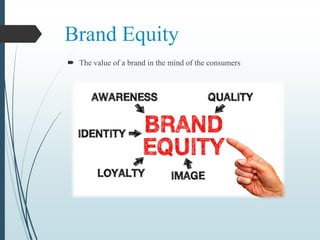
Brand Equity
 The value of a brand in the mind of the consumers
How to build a brand?
 To build a brand we have o follow these seven steps.
• Research your target audience and your
competitors.
• Pick your focus and personality.
• Choose your business name.
• Write your slogan.
• Choose the look of your brand (colors and font)
• Design your logo.
• Apply your branding across your business and
evolve it as you grow.
Brand Loyalty
Once a brand has created positive
sentiment among its target audience, the
firm is said to have built brand equity.
If done right, a brand results in an increase
in sales for not just the specific product
being sold, but also other products sold by
the same company.
This phenomenon is often referred
as brand loyalty.
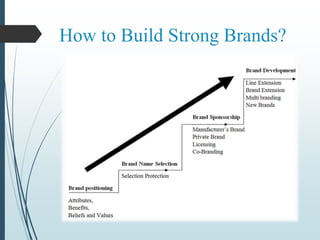
How to Build Strong Brands?
Brand positioning &
Brand Name Selection
Brand Positioning: is the process of
positioning your brand in the mind of
your customers.
Brand Name Selection includes the
desirable qualities of a company or
organization.
Desirable qualities of a
company
 These are the Qualities the company Focus during Brand name selection process.
• Suggest benefits and qualities
• Easy to pronounce, recognize, and remember
• Distinctive
• Extendable
• Translatable for the global economy
• Capable of registration and legal protection
Brand Sponsorship
• Sponsorship is a powerful marketing
tool.
• A manufacturer can launch its own brand
or
• It can sell to resellers who give the
product a private brand.
• a manufacturer can join forces with
another company to co-brand a product.
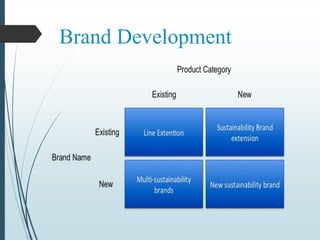
Brand Development
Benefits of a strong brand
• It will add value to a company
• Requires less persuasion for consumers to use
other products from the same brand
• Can ensure a lasting customer relationship due
to trust
• It aids recognition in a cluttered marketplace
• Has the ability to command a premium
• Allows differentiation between very similar
products, for example still mineral water
• Can attract merchandising contracts
• Leads to the perception of quality
Factors that can damage the
brand
• Untrustworthy behavior
• Concern about public safety or health
• Poor customer service (at any level)
• Obvious company financial difficulty
• Poor quality products
Any Question??

Building Strong Brands|Brand making|presentation

  • 1.
    Building Strong Brands Submitted to:Miss Arooj Shahzad Submitted by: Muhammad Zafar & Arooj Suleman
  • 2.
    What Is Brand? Abrand is a product, service, or concept that is publicly distinguished from others so that it can be easily communicated and usually marketed. A brand name is the name of the distinctive product, service, or concept.
  • 3.
    Branding Branding is theprocess of giving a meaning to specific products by creating and shaping a brand in consumers’ minds. Branding can be applied to the entire corporate identity as well as to individual product and service names.
  • 4.
    Branding It gives yourcompany a unique personality, and establish a differentiated position in the market that attracts the right customers. It is a strategy designed by companies to help people to quickly identify their products and organization
  • 5.
    Branding can beachieved through advertising and communications product and packaging design in-store experience pricing sponsoring and partnerships The visual identity of the brand (logo, website and colors, are just some examples).
  • 6.
    Brand Protection Brands areusually protected from use by others by securing a trademark or service mark from an authorized agency, usually a government agency. Before applying for a trademark or service mark, you need to establish that someone else hasn't already obtained one for your name. you can do the searching yourself or can hire a law firm for this process.
  • 7.
    Brand Protection Once you'velearned that no one else is using it, you can begin to use your brand name as a trademark simply by stating it is a trademark (using the "™" where it first appears in a publication or Web site). After you receive the trademark, you can use the registered symbol " ®" after your trademark.
  • 8.
    Brand Equity  Thevalue of a brand in the mind of the consumers
  • 9.
    How to builda brand?  To build a brand we have o follow these seven steps. • Research your target audience and your competitors. • Pick your focus and personality. • Choose your business name. • Write your slogan. • Choose the look of your brand (colors and font) • Design your logo. • Apply your branding across your business and evolve it as you grow.
  • 10.
    Brand Loyalty Once abrand has created positive sentiment among its target audience, the firm is said to have built brand equity. If done right, a brand results in an increase in sales for not just the specific product being sold, but also other products sold by the same company. This phenomenon is often referred as brand loyalty.
  • 11.
    How to BuildStrong Brands?
  • 12.
    Brand positioning & BrandName Selection Brand Positioning: is the process of positioning your brand in the mind of your customers. Brand Name Selection includes the desirable qualities of a company or organization.
  • 13.
    Desirable qualities ofa company  These are the Qualities the company Focus during Brand name selection process. • Suggest benefits and qualities • Easy to pronounce, recognize, and remember • Distinctive • Extendable • Translatable for the global economy • Capable of registration and legal protection
  • 14.
    Brand Sponsorship • Sponsorshipis a powerful marketing tool. • A manufacturer can launch its own brand or • It can sell to resellers who give the product a private brand. • a manufacturer can join forces with another company to co-brand a product.
  • 15.
  • 16.
    Benefits of astrong brand • It will add value to a company • Requires less persuasion for consumers to use other products from the same brand • Can ensure a lasting customer relationship due to trust • It aids recognition in a cluttered marketplace • Has the ability to command a premium • Allows differentiation between very similar products, for example still mineral water • Can attract merchandising contracts • Leads to the perception of quality
  • 17.
    Factors that candamage the brand • Untrustworthy behavior • Concern about public safety or health • Poor customer service (at any level) • Obvious company financial difficulty • Poor quality products
  • 18.