CREATING BRAND EQUITY DAVID AAKER
CREATING BRAND EQUITY  BUILDING A STRONG BRAND REQUIRES CAREFUL PLANNING &  GREAT DEAL  OF LONG-TERM INVESTMENT.  AT THE HEART OF A SUCCESSFUL BRAND IS A GREAT PRODUCT OR SERVICE, BACKED BY A CREATIVELY DESIGNED & EXECUTED MARKETING.
The scope of branding All about creating differences Differences often related to attributes or benefits of product itself, or By understanding consumer motivations & desires & creating relevant & appealing images round their products Branding can be applied virtually anywhere a consumer has a choice
Defining brand equity Brand equity is the added value endowed to products & services Marketers & researchers use various perspectives to study brand equity Customer-based brand equity can be defined as  the differential effect  that brand knowledge has on consumer response to marketing of that brand
A. Customer-based brand equity A BRAND IS SAID TO HAVE A POSITIVE CUSTOMER-BASED BRAND EQUITY WHEN CONSUMERS REACT FAVOURABLY  TO A PRODUCT & THE WAY IT IS MARKETED  WHEN THE BRAND IS IDENTIFIED AS COMPARED TO WHEN IT IS NOT: 3 main ingredients to this definition: Brand equity arises from differences in consumer response Differences as a result of consumer’s knowledge about the brand Reflected in perceptions, preferences, &  behaviour related to all aspects of the marketing of a brand
Brand equity as a bridge All marketing spends each year on products & services should be thought of as investments in consumer brand knowledge It is actually possible to “overspend” on brand building At the same time, the brand knowledge created  by these marketing investments dictates appropriate future  directions for the brand
Brand equity models   Aaker’s model
A. Aaker’s model DAVID AAKER VIEWS BRAND EQUITY AS A SET OF 5 CATEGORIES OF ASSETS & LIABILITIES LINKED TO  BRAND THAT ADD OR SUBTRACT FROM THE VALUE PROVIDED BY THE PRODUCT OR SERIVICE TO  FIRM AND/OR TO THE FIRM’S CUSTOMERS: These categories of  brand assets  are: Brand loyalty Brand awareness  Perceived quality Brand association Other proprietary assets (patents, trademarks, channel relationships)
BRAND IDENTITY BRAND IDENTITY IS A UNIQUE SET OF BRAND ASSOCIATIONS THAT THE BRAND STRATEGIST ASPIRES TO CREATE OR MAINTAIN THESE ASSOCIATIONS REPRESENT WHAT THE BRAND STANDS FOR & IMPLY A PROMISE TO CUSTOMERS FROM THE ORGANIZATION MEMBERS
BRAND IDENTITY( contd.) BRAND IDENTITY SHOULD HELP ESTABLISH A RELATIONSHIP BETWEEN THE BRAND & THE CUSTOMER BY GENERATING A VALUE PROPOSITION INVOLVING FUNCTIONAL, EMOTIONAL, OR SELF-EXPRESSIVE BENEFITS
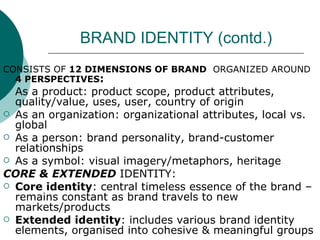
BRAND IDENTITY (contd.) CONSISTS OF  12 DIMENSIONS OF BRAND   ORGANIZED AROUND  4 PERSPECTIVES : As a product: product scope, product attributes, quality/value, uses, user, country of origin As an organization: organizational attributes, local vs. global As a person: brand personality, brand-customer relationships As a symbol: visual imagery/metaphors, heritage CORE & EXTENDED  IDENTITY: Core identity : central timeless essence of the brand – remains constant as brand travels to new markets/products Extended identity : includes various brand identity elements, organised into cohesive & meaningful groups
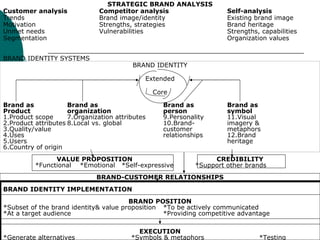
STRATEGIC BRAND ANALYSIS Customer analysis Competitor analysis Self-analysis Trends Brand image/identity   Existing brand image  Motivation Strengths, strategies Brand heritage Unmet needs Vulnerabilities Strengths, capabilities Segmentation Organization values BRAND IDENTITY SYSTEMS BRAND IDENTITY Extended Core Brand as Brand as Brand as Brand as Product organization person symbol 1.Product scope 7.Organization attributes 9.Personality 11.Visual  2.Product attributes 8.Local vs. global 10.Brand-   imagery & 3.Quality/value customer   metaphors 4.Uses relationships 12.Brand 5.Users heritage 6.Country of origin VALUE PROPOSITION CREDIBILITY *Functional  *Emotional  *Self-expressive *Support other brands BRAND-CUSTOMER RELATIONSHIPS BRAND IDENTITY IMPLEMENTATION BRAND POSITION *Subset of the brand identity& value proposition *To be actively communicated *At a target audience *Providing competitive advantage EXECUTION *Generate alternatives *Symbols & metaphors *Testing TRACKING
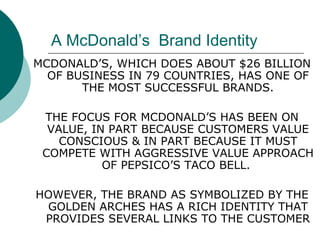
A McDonald’s  Brand Identity MCDONALD’S, WHICH DOES ABOUT $26 BILLION OF BUSINESS IN 79 COUNTRIES, HAS ONE OF THE MOST SUCCESSFUL BRANDS. THE FOCUS FOR MCDONALD’S HAS BEEN ON VALUE, IN PART BECAUSE CUSTOMERS VALUE CONSCIOUS & IN PART BECAUSE IT MUST COMPETE WITH AGGRESSIVE VALUE APPROACH OF PEPSICO’S TACO BELL.  HOWEVER, THE BRAND AS SYMBOLIZED BY THE GOLDEN ARCHES HAS A RICH IDENTITY THAT PROVIDES SEVERAL LINKS TO THE CUSTOMER
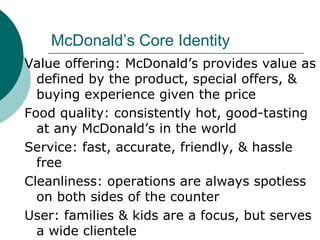
McDonald’s Core Identity Value offering: McDonald’s provides value as defined by the product, special offers, & buying experience given the price Food quality: consistently hot, good-tasting at any McDonald’s in the world Service: fast, accurate, friendly, & hassle free Cleanliness: operations are always spotless on both sides of the counter User: families & kids are a focus, but serves a wide clientele
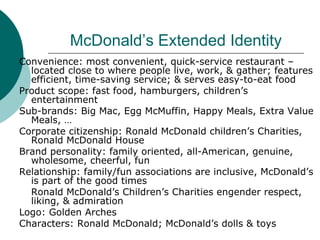
McDonald’s Extended Identity Convenience: most convenient, quick-service restaurant – located close to where people live, work, & gather; features efficient, time-saving service; & serves easy-to-eat food Product scope: fast food, hamburgers, children’s entertainment Sub-brands: Big Mac, Egg McMuffin, Happy Meals, Extra Value Meals, … Corporate citizenship: Ronald McDonald children’s Charities, Ronald McDonald House Brand personality: family oriented, all-American, genuine, wholesome, cheerful, fun Relationship: family/fun associations are inclusive, McDonald’s is part of the good times Ronald McDonald’s Children’s Charities engender respect, liking, & admiration Logo: Golden Arches Characters: Ronald McDonald; McDonald’s dolls & toys
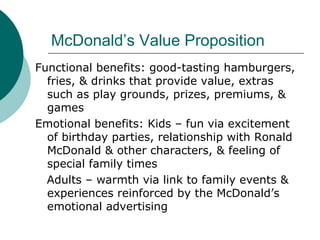
McDonald’s Value Proposition Functional benefits: good-tasting hamburgers, fries, & drinks that provide value, extras such as play grounds, prizes, premiums, & games Emotional benefits: Kids – fun via excitement of birthday parties, relationship with Ronald McDonald & other characters, & feeling of special family times Adults – warmth via link to family events & experiences reinforced by the McDonald’s emotional advertising

brand equity

  • 1.
  • 2.
    CREATING BRAND EQUITY BUILDING A STRONG BRAND REQUIRES CAREFUL PLANNING & GREAT DEAL OF LONG-TERM INVESTMENT. AT THE HEART OF A SUCCESSFUL BRAND IS A GREAT PRODUCT OR SERVICE, BACKED BY A CREATIVELY DESIGNED & EXECUTED MARKETING.
  • 3.
    The scope ofbranding All about creating differences Differences often related to attributes or benefits of product itself, or By understanding consumer motivations & desires & creating relevant & appealing images round their products Branding can be applied virtually anywhere a consumer has a choice
  • 4.
    Defining brand equityBrand equity is the added value endowed to products & services Marketers & researchers use various perspectives to study brand equity Customer-based brand equity can be defined as the differential effect that brand knowledge has on consumer response to marketing of that brand
  • 5.
    A. Customer-based brandequity A BRAND IS SAID TO HAVE A POSITIVE CUSTOMER-BASED BRAND EQUITY WHEN CONSUMERS REACT FAVOURABLY TO A PRODUCT & THE WAY IT IS MARKETED WHEN THE BRAND IS IDENTIFIED AS COMPARED TO WHEN IT IS NOT: 3 main ingredients to this definition: Brand equity arises from differences in consumer response Differences as a result of consumer’s knowledge about the brand Reflected in perceptions, preferences, & behaviour related to all aspects of the marketing of a brand
  • 6.
    Brand equity asa bridge All marketing spends each year on products & services should be thought of as investments in consumer brand knowledge It is actually possible to “overspend” on brand building At the same time, the brand knowledge created by these marketing investments dictates appropriate future directions for the brand
  • 7.
    Brand equity models Aaker’s model
  • 8.
    A. Aaker’s modelDAVID AAKER VIEWS BRAND EQUITY AS A SET OF 5 CATEGORIES OF ASSETS & LIABILITIES LINKED TO BRAND THAT ADD OR SUBTRACT FROM THE VALUE PROVIDED BY THE PRODUCT OR SERIVICE TO FIRM AND/OR TO THE FIRM’S CUSTOMERS: These categories of brand assets are: Brand loyalty Brand awareness Perceived quality Brand association Other proprietary assets (patents, trademarks, channel relationships)
  • 9.
    BRAND IDENTITY BRANDIDENTITY IS A UNIQUE SET OF BRAND ASSOCIATIONS THAT THE BRAND STRATEGIST ASPIRES TO CREATE OR MAINTAIN THESE ASSOCIATIONS REPRESENT WHAT THE BRAND STANDS FOR & IMPLY A PROMISE TO CUSTOMERS FROM THE ORGANIZATION MEMBERS
  • 10.
    BRAND IDENTITY( contd.)BRAND IDENTITY SHOULD HELP ESTABLISH A RELATIONSHIP BETWEEN THE BRAND & THE CUSTOMER BY GENERATING A VALUE PROPOSITION INVOLVING FUNCTIONAL, EMOTIONAL, OR SELF-EXPRESSIVE BENEFITS
  • 11.
    BRAND IDENTITY (contd.)CONSISTS OF 12 DIMENSIONS OF BRAND ORGANIZED AROUND 4 PERSPECTIVES : As a product: product scope, product attributes, quality/value, uses, user, country of origin As an organization: organizational attributes, local vs. global As a person: brand personality, brand-customer relationships As a symbol: visual imagery/metaphors, heritage CORE & EXTENDED IDENTITY: Core identity : central timeless essence of the brand – remains constant as brand travels to new markets/products Extended identity : includes various brand identity elements, organised into cohesive & meaningful groups
  • 12.
    STRATEGIC BRAND ANALYSISCustomer analysis Competitor analysis Self-analysis Trends Brand image/identity Existing brand image Motivation Strengths, strategies Brand heritage Unmet needs Vulnerabilities Strengths, capabilities Segmentation Organization values BRAND IDENTITY SYSTEMS BRAND IDENTITY Extended Core Brand as Brand as Brand as Brand as Product organization person symbol 1.Product scope 7.Organization attributes 9.Personality 11.Visual 2.Product attributes 8.Local vs. global 10.Brand- imagery & 3.Quality/value customer metaphors 4.Uses relationships 12.Brand 5.Users heritage 6.Country of origin VALUE PROPOSITION CREDIBILITY *Functional *Emotional *Self-expressive *Support other brands BRAND-CUSTOMER RELATIONSHIPS BRAND IDENTITY IMPLEMENTATION BRAND POSITION *Subset of the brand identity& value proposition *To be actively communicated *At a target audience *Providing competitive advantage EXECUTION *Generate alternatives *Symbols & metaphors *Testing TRACKING
  • 13.
    A McDonald’s Brand Identity MCDONALD’S, WHICH DOES ABOUT $26 BILLION OF BUSINESS IN 79 COUNTRIES, HAS ONE OF THE MOST SUCCESSFUL BRANDS. THE FOCUS FOR MCDONALD’S HAS BEEN ON VALUE, IN PART BECAUSE CUSTOMERS VALUE CONSCIOUS & IN PART BECAUSE IT MUST COMPETE WITH AGGRESSIVE VALUE APPROACH OF PEPSICO’S TACO BELL. HOWEVER, THE BRAND AS SYMBOLIZED BY THE GOLDEN ARCHES HAS A RICH IDENTITY THAT PROVIDES SEVERAL LINKS TO THE CUSTOMER
  • 14.
    McDonald’s Core IdentityValue offering: McDonald’s provides value as defined by the product, special offers, & buying experience given the price Food quality: consistently hot, good-tasting at any McDonald’s in the world Service: fast, accurate, friendly, & hassle free Cleanliness: operations are always spotless on both sides of the counter User: families & kids are a focus, but serves a wide clientele
  • 15.
    McDonald’s Extended IdentityConvenience: most convenient, quick-service restaurant – located close to where people live, work, & gather; features efficient, time-saving service; & serves easy-to-eat food Product scope: fast food, hamburgers, children’s entertainment Sub-brands: Big Mac, Egg McMuffin, Happy Meals, Extra Value Meals, … Corporate citizenship: Ronald McDonald children’s Charities, Ronald McDonald House Brand personality: family oriented, all-American, genuine, wholesome, cheerful, fun Relationship: family/fun associations are inclusive, McDonald’s is part of the good times Ronald McDonald’s Children’s Charities engender respect, liking, & admiration Logo: Golden Arches Characters: Ronald McDonald; McDonald’s dolls & toys
  • 16.
    McDonald’s Value PropositionFunctional benefits: good-tasting hamburgers, fries, & drinks that provide value, extras such as play grounds, prizes, premiums, & games Emotional benefits: Kids – fun via excitement of birthday parties, relationship with Ronald McDonald & other characters, & feeling of special family times Adults – warmth via link to family events & experiences reinforced by the McDonald’s emotional advertising